
Tag: Career

  • NIH Grant Terminations Have ‘Frightening Implications’ for Science

    NIH Grant Terminations Have ‘Frightening Implications’ for Science

    After months of uncertainty about the future of federally funded research, the National Institutes of Health this month started canceling grants it deemed “nonscientific.”

    So far, that includes research into preventing HIV/AIDS; managing depressive symptoms in transgender, nonbinary and gender-diverse patients; intimate partner violence during pregnancy; and how cancer affects impoverished Americans.

    In letters canceling the grants, the NIH said those and other research projects “no longer [effectuate] agency priorities.”

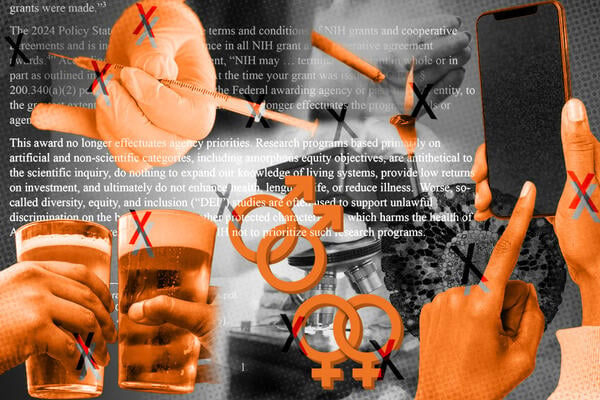
    But the world’s largest funder of biomedical research didn’t stop there. The agency went on to tell researchers that “research programs based primarily on artificial and nonscientific categories, including amorphous equity objectives, are antithetical to the scientific inquiry, do nothing to expand our knowledge of living systems, provide low returns on investment, and ultimately do not enhance health, lengthen life, or reduce illness,” according to a March 18 letter sent to the University of Nebraska at Lincoln.

    Katie Bogen, a Ph.D. student in the clinical psychology program at UNL, found out via the letter that NIH was canceling the $171,000 grant supporting her dissertation research. She was planning to explore the links between bisexual women’s disclosure of past sexual violence experience to a current romantic partner and subsequent symptoms, including traumatic stress, alcohol use and risk for violence revictimization within their current relationship. She started work on the project last May and was set to start data collection at the end of this month.

    The NIH told Bogen and other researchers that “so-called diversity, equity, and inclusion studies are often used to support unlawful discrimination on the basis of race and other protected characteristics, which harms the health of Americans,” and that NIH policy moving forward won’t support such research programs.

    “No corrective action is possible” for Bogen’s project, because “the premise of this award is incompatible with agency priorities, and no modification of the project could align the project with agency priorities.”

    Last week, Bogen, who told Inside Higher Ed that she was inspired to pursue this topic because she herself is a bisexual woman with a trauma history, posted on TikTok about the termination letter.

    @sexualityscholar

    Man this is actually very sad. Thinking about all the scientists today who are being told their scholarship isn’t important. It is. Your work matters. Let’s figure out how to move forward as a community of inquiry together.

    ♬ original sound – Katie

    She received thousands of comments and messages lamenting the loss of her work, with some characterizing the letter’s language as “appalling” and “horrifying.” Another commenter, who identified “as a bi femme who has survived the specific harm you’ve been studying,” told Bogen their “heart is broken” for her and other researchers “and all the folks who could be helped by the studies being defunded.”

    Inside Higher Ed interviewed Bogen for more insight into her research and what the NIH’s abrupt cancellation of her and other projects means for public health and the future of scientific discovery.

    (This interview has been edited for clarity and style.)

    Q: What got you interested in researching intimate partner violence prevention for bisexual women? Why do you believe it’s an important line of scientific inquiry?

    A: We know that bisexual women are at an elevated risk of experiencing intimate partner violence and sexual harm. We also know they have higher rates of post-traumatic stress disorder after these experiences compared to other people, and that they have greater and more problematic high-risk alcohol use afterwards. A key part of the process of meaning-making after the experience of violence is disclosure because of ambient bi-negativity. Bisexual people’s disclosure processes are often burdened by anti-bisexual prejudice.

    For example, if you’re a bisexual woman who’s experienced violence at the hands of a woman partner, and you disclose that to a man partner that you’re seeing now, that man partner might say, “How much did she really hurt you?” If you’re a bisexual woman who’s now with a woman and you disclose violence perpetrated by a man, your woman partner might say something like, “This is what you get for dating men. We all know better than to date men.”

    Katie Bogen is a fifth-year clinical psychology Ph.D. student at the University of Nebraska at Lincoln

    So much of the disclosure research on sexual violence victims has been done with formal support providers like police or campus security or therapists, and then informal support providers like friends or parents or siblings. But very little research has documented the exposure process with intimate partners, which seems like a gap, given that intimate partners can then choose to sort of wield that insight or knowledge for good—or for harm.

    I want to study how to intervene so that they don’t develop severe post-traumatic stress and problematic drinking. And this is particularly important because problem drinking is a risk factor for revictimization, and so bisexual women have all of these factors working against them that contribute to the cycle of revictimization and chronic victimization over their life span.

    Q: Can you describe the process of applying for this NIH grant?

    A: In 2022, I had just finished my second year of graduate school when a colleague of mine sent me a funding opportunity from the National Institute on Alcohol Abuse and Alcoholism that had a notice of special interest on the health of bisexual and bisexual-plus people.

    We haven’t even been able to recruit our participants and I have none of the data.”

    I worked very hard for a year on my application. It was the first grant I wrote as a [principal investigator]. I submitted to NIH, and a kind of miracle happened—I scored a 20 on this grant, which means my very first grant being written up as a PI got funded on the first round of peer review, which is almost unheard-of.

    Q: How much of the project had you finished before receiving the termination notice?

    A: I started work last May. I’ve hired and trained an entire lab of undergrads.

    I’ve already done the literature reviews with the help of my undergraduate team and put together and tested the Qualtrics surveys. We set up backup safety measures in case the online surveys were infiltrated by bots or false respondents. The amount of literature I’ve read and the foundational conference presentations and analysis that I’ve run using other available data sets has been an immense labor.

    It has been a productive 10 months. The things that this research has made possible for me—not only as a student and trainee, but as a scientist and as now a mentor helping to train the next generation of scholars—cannot be understated.

    But we haven’t even been able to recruit our participants and I have none of the data. We were slated to begin data collection on March 31, and it’s a shame that will no longer happen.

    Q: The NIH’s termination letter said your project is “antithetical to scientific inquiry” and “harms the health of Americans.” What was your reaction to that characterization of your work?

    A: It hurts to hear that your work isn’t scientific. But it almost made me laugh because it’s so revelatory of the ignorance of folks in positions of power to claim that the work that I’m doing—that my colleagues are doing, that my mentors have taught me to do, that other folks in a field of doing—is ascientific and itself violence.

    To me, the language in the letter is an example of DARVO, which is a rhetorical abuse tactic that stands for deny, attack, reverse victim and offender. They’re saying that what I’m doing isn’t scientific, and that they’re actually trying to uphold the standards of science, and by me focusing on these marginalized groups, I’m harming, quote unquote, real or regular Americans.

    [The termination letter] almost made me laugh because it’s so revelatory of the ignorance of folks in positions of power to claim that the work that I’m doing … is ascientific and itself violence.”

    Q: How does your work benefit society broadly?

    A: Even if we take queerness out of the equation in this model, we are still garnering insight and understanding of the mechanism of post-traumatic stress, alcohol use and intimate partner violence for people in general. We’re getting a deeper understanding of how discussing sexual violence with a partner fundamentally changes that relationship, what is perceived as potentially acceptable in that relationship, norms of conflict within that relationship and sexual norms within that relationship.

    Being able to investigate questions like this and enact scholarship like this could be a balm to some of the self-blame and shame that survivors are experiencing. And when research like this is able to reach health-care providers, public health improves, people become safer and we’re better able to protect folks from things like intimate partner violence, revictimization and sexual revictimization, which is endemic in our society.

    Q: Given that this research grant was a central piece of your plan to complete your dissertation, how does its abrupt cancellation complicate your path toward degree completion?

    A: I now have to work with my mentors to generate a new dissertation proposal and send it to my committee and get it reapproved, which means I have to access data sets at my institution that have either already been collected or that are safe from future rounds of cuts like this.

    I believe I’m being intimidated [by the NIH] into taking the data that are already available, rather than collecting data with more specificity, which means the accurate data answering these research questions is tampered. I don’t necessarily want to go to a data set that was collected on, for example, masculinity and violence perpetration, and try and string together a similar enough model to pass the proxy of what I wanted. That’s poor scholarship.

    It’s something a lot of scholars who are dealing with this crisis are facing now. How does that further marginalize the populations we’re aiming to serve if we’re trying to presume or assume that data on different populations? It creates this ethical and academic quandary.

    Q: How might this termination affect your career in the long term?

    A: I have a demonstrated record of receiving grant funding on my own, which is a difficult thing to demonstrate when you’re still a trainee or you’re still a student. It makes folks more competitive for postdocs, research-oriented internships or research jobs at bigger research institutions down the line. If I wanted to work at an academic hospital, it shows that I’ll be able to bring in grant funding.

    But now I have this really sad line on my CV. I had to write several asterisks that the grant closed early, and I just have to hope that people who are reviewing my CV later know what that means—that the grant closed early, not because of my failure to complete the research, but because we have the infiltration of antiscientific thought in the federal government that forced a number of grants to close early.

    It doesn’t stop at political science, psychology or even economics. It has legs and encroaches and creeps into biophysiological sciences and neuropsychology. It leaves no science safe.”

    Q: How does your situation speak to any concerns you might have about the broader environment for science in this country right now?

    A: We’re in this identity war moment, and it’s not based on anything but people’s own prejudice and bias and a sense of being victimized because they no longer have access to the power they used to. This is an attempt to recollect and to narrow who has that power, which has frightening implications across the board.

    It doesn’t stop at political science, psychology or even economics. It has legs and encroaches and creeps into biophysiological sciences and neuropsychology. It leaves no science safe.



    Source link

  • Trump Administration Revokes 300 Student Visas, More to Come

    Trump Administration Revokes 300 Student Visas, More to Come

    The Trump administration has revoked more than 300 international students’ visas in the past three weeks, according to reporting from Axios

    Yesterday two Ph.D. students with revoked visas were detained by immigration agents and now await deportation: an Iranian student at the University of Alabama and a Turkish student at Tufts University in Massachusetts. 

    The Tufts student, Rumesya Ozturk, was abducted by plainclothes ICE agents on the street. At a press conference Thursday, U.S. secretary of state Marco Rubio said that any international student whose visa was revoked could be forcefully deported in such a manner. 

    “Once you’ve lost your visa, you’re no longer legally in the United States,” he said. “If you come to the U.S. as a visitor and create a ruckus for us, we don’t want it.”

    Axios also reported that the administration has discussed using a small arm of the Immigration and Customs Enforcement office to strip colleges they deem to be “pro-Hamas” of their ability to enroll international students.

    “You can have so many bad apples in one place that it leads to decertification of the school,” an unnamed White House official told Axios. “I don’t think we’re at that point yet. But it is not an empty threat.”

    The Student and Exchange Visitor Program normally investigates student visa fraud and international student recruiting practices, sometimes withdrawing colleges’ certification to enroll foreign students if there’s evidence that students are primarily enrolling as a pretext to reside and work in the U.S. instead of earn a degree. 

    Now, the SEVP may be tasked with a very different mandate: punishing colleges that have been the site of large pro-Palestine protests. 

    “What you’re going to see in the not-too-distant future is the universities … not doing anything to stop these demonstrations in support of Hamas … we can stop approving student visas for them,” a senior Justice Department official told Axios. “That’s one of their biggest cash cows, foreign students. That’s a meaningful source of revenue.” 

    Source link

  • Duke Criticizes the Use of Its Brand on “The White Lotus”

    Duke Criticizes the Use of Its Brand on “The White Lotus”

    Duke University is unhappy with The White Lotus, the hit HBO television show, for using its logo repeatedly in its third season—particularly in a scene where one character is on the verge of suicide, holding a gun to his head, all while wearing a Duke T-shirt.

    A spokesperson for institution told Bloomberg and other media outlets this week that Duke hadn’t approved of the use of its logo on the show. “The White Lotus not only uses our brand without permission, but in our view uses it on imagery that is troubling, does not reflect our values or who we are, and simply goes too far,” the spokesperson said.

    A copyright attorney told Bloomberg that the show’s use of the logo is most likely protected by the First Amendment.

    Source link

  • CUNY Revises Palestinian Scholar Job After Controversy

    CUNY Revises Palestinian Scholar Job After Controversy

    The City University of New York’s Hunter College reposted a job listing for Palestinian studies scholars earlier this week, one month after New York governor Kathy Hochul ordered the system to remove an earlier listing that she called antisemitic.

    The new job description does not include some of the phrases that initially angered pro-Israel activist groups who lobbied for the original posting’s removal. 

    The old posting said Hunter sought “a historically grounded scholar who takes a critical lens to issues pertaining to Palestine including but not limited to: settler colonialism, genocide, human rights, apartheid, migration, climate and infrastructure devastation, health, race, gender, and sexuality.” The revised version excised that entire list of issues.

    Free speech advocates and Hunter staff told Inside Higher Ed last month that CUNY’s decision to pull the initial job posting and revise it in response to the governor’s order was an unprecedented breach of the institution’s academic autonomy in faculty hiring, an area normally sequestered from political influence. 

    The new posting comes as colleges face federal investigations, funding cuts and student harassment as a result of pro-Palestinian campus activity.

    Correction: an earlier version of this story reported that the posting had removed a description of Hunter as a “vibrant and dynamic community within a highly diverse urban setting.” That language is still in the revised post.

    Source link

  • Recruiting U.S. Scholars Can Protect “Threatened Research”

    Recruiting U.S. Scholars Can Protect “Threatened Research”

    Universities should look to recruit researchers fleeing the U.S. amid dramatic funding cuts by the Trump administration because it could help protect vital scientific expertise from being lost, according to the rector of a leading Belgian university.

    Vrije Universiteit Brussel (VUB) has announced a host of new postdoctoral positions for international academics, stating that the institution “particularly welcomes excellent researchers currently working in the U.S. which see their line of research threatened.”

    VUB and its sister university Université Libre de Bruxelles are offering a total of 36 grants to researchers with a maximum of eight years of postdoctoral experience, funded by the European Union’s Marie Skłodowska-Curie Actions. The positions are not exclusively designed for U.S.-based researchers, VUB rector Jan Danckaert stressed, but are “open to all incoming researchers, whatever their nationality or their working place at the moment outside of Belgium.”

    VUB chose to advertise the positions to scholars in the U.S., Danckaert explained, in the wake of drastic funding cuts by the Trump administration, with research fields under particular threat including climate, public health and any areas considered to be related to diversity.

    “We also hear from colleagues in the United States that they are applying a kind of self-censorship in order to stay under the radar,” he said. “We believe that freedom of investigation is now under threat in the U.S.”

    “It’s not so much about trying to attract the best US researchers to Brussels but trying to prevent fruitful lines of research from being abruptly cut off,” Danckaert said. While recruiting talent “would benefit our society,” he said, “it’s important that these lines of research can be continued without interruption, for the benefit of the scientific community as a whole and, in the end, for humanity.”

    VUB has already lost U.S. funding for two research projects, one concerning youth and disinformation and the other addressing the “transatlantic dialogue,” Danckaert said. The grants, amounting to 50,000 euros ($53,800) each, were withdrawn because “they were no longer in line with policy priorities,” the rector said. “Now, we have some costs that will have to be covered, but that’s nothing in comparison to the millions that are being cut in the United States.”

    European efforts to recruit U.S.-based researchers have faced some criticism, with the KU Leuven rector Luc Sels arguing that “almost half of the world population lives in countries where academic freedom is much more restricted,” while “the first and most important victims of Trump’s decisions”—such as the cancellation of USAID funding—“live and work in the Global South.”

    “Should we not prioritise supporting the scientists most at risk?” Sels writes in a recent Times Higher Education comment piece, adding that “drawing [the U.S.’s] talented scientists away will not help them.”

    Asked about these concerns, Danckaert said, “It’s true, of course, that the U.S. by no means has a monopoly on putting scientists under threat,” noting that VUB, alongside other Belgian universities, participates in academic sanctuary programs such as Scholars at Risk. “We try to provide a safe haven for scholars who are being persecuted in their countries, and this work doesn’t stop.”

    As for fears of a potential brain drain from the U.S., the VUB rector said he was “by nature optimistic.” Recruiting U.S.-based researchers “is hopefully only a temporary measure to avoid some lines of research being abruptly cut,” Danckaert said.

    “I believe this is a temporary difficult period for a number of scientists,” he continued. “We’ve always looked with high esteem to the quality of science done in the United States, and I’m confident that the climate in which science was prospering will come back.”

    Source link

  • Yeshiva U Accepts LGBTQ+ Student Group but Not “Pride” Clubs

    Yeshiva U Accepts LGBTQ+ Student Group but Not “Pride” Clubs

    Less than a week after Yeshiva University agreed to recognize an LGBTQ+ student club as part of a legal settlement, university president Ari Berman apologized for the way the university conveyed the announcement and stressed that “pride” clubs still run counter to the values of the Modern Orthodox Jewish university, Jewish Telegraphic Agency reported. He emphasized that the newly approved club would function “in accordance with halacha,” or Jewish law.

    “I deeply apologize to the members of our community—our students and parents, alumni and friends, faculty and Rabbis—for the way the news was rolled out,” Berman, a rabbi, wrote in an email to students Tuesday. “Instead of clarity, it sowed confusion. Even more egregiously, misleading ‘news’ articles said that Yeshiva had reversed its position, which is absolutely untrue.”

    The university has been mired in a legal battle with its LGBTQ+ student group, the YU Pride Alliance, since 2021, when the group sued for official university recognition. Yeshiva said it wasn’t legally required to recognize the club because of Orthodoxy’s stance against same-sex relations. The two parties announced a settlement last week in which students will run an LGBTQ+ club called Hareni that will “operate in accordance with the approved guidelines of Yeshiva University’s senior rabbis,” according to a joint statement issued last Thursday.

    LGBTQ+ students celebrated the settlement as a new milestone. But Berman framed the settlement as doubling down on an old proposal from 2022, when the university sought to create its own LGBTQ+ student club called Kol Yisrael Areivim. Plaintiffs rejected the plan at the time, on the grounds that the club wouldn’t be student-run. But Berman said Hareni was similarly created “to support students who are striving to live authentic, uncompromising” lives within the bounds of Jewish law, “as previously described.”

    “The Yeshiva has always conveyed that what a Pride club represents is antithetical to the undergraduate program in which the traditional view of marriage and genders being determined at birth are transmitted,” Berman wrote in his message to students. “The Yeshiva never could and never would sanction such an undergraduate club and it is due to this that we entered litigation.”

    As he sees it, “last week, the plaintiffs in the lawsuit against YU accepted to run Hareni, instead of what they were originally suing us for, moved to end the case, and the case has been dismissed.”

    Source link

  • A Five-Module Course for College Student Career Wellness

    A Five-Module Course for College Student Career Wellness

    Entering the workforce can be a daunting experience for recent college graduates. A May 2024 Student Voice survey by Inside Higher Ed and Generation Lab found 68.9 percent of current students are at least somewhat stressed when they think about and prepare for their life after graduation.

    Working in a career that resonates with their interests is also a goal for students: Two-thirds of young people globally say they want their job to be meaningful and make them happier than they were last year. Of respondents’ top three work ambitions, young people in the U.S. identified financial stability (65 percent) and achieving work-life balance (52 percent) as priorities.

    To help students engage in career wellness, a group of students from the University of Wisconsin at Madison and California State Polytechnic University, Pomona—supported by advisers from Cal Poly Pomona—created Tune In to Strive Out, which encourages students to channel their inner potential for future success and collective well-being.

    The program, housed at the Center for Research on College-Workforce Transitions (CCWT) at Madison, includes student resources and facilitator training. The initiative launched in spring 2022 and has supported over 150 students to date.

    Survey Says

    A survey of young people in the workforce (ages 27 to 35) found about one in four respondents strongly agree their employer has policies or structures in place to support work-life balance.

    How it works: The Tune in to Strive Out Career Wellness Program guides students through practices that build their self-efficacy and understanding of their wellness. The goal is to bridge theory and practice in ways that are applicable and flexible to various circumstances students may be in.

    The intervention can be offered as a stand-alone program or integrated into existing courses.

    Tune in to Strive Out includes five modules, rooted in the radical healing framework, which focus on students’ development of values, career goals, resiliency and senses of hope and community. The program includes a supplemental tool kit of resources for students to explore as well.

    “The program addresses unique challenges individuals face by emphasizing the importance of community and cultural strengths in healing and strategies to foster radical hope to persist in the face of barriers,” said Mindi Thompson, executive director of CCWT.

    To guide practitioners on delivering the intervention, the center provides a three-hour facilitator training, which costs $30 per person and fulfills continuing education hours for National Career Development Association credentials.

    Once training is completed, a facilitator receives access to a portal containing the detailed facilitation manual, a student workbook and presentation slides.

    The impact: Seventeen students from three different postsecondary institutions participated in a pilot study, which has since been scaled to involve more than 150 student participants and 90 professionals who completed the facilitator training to deliver the program.

    In the future, CCWT hopes to further scale and reach practitioners with the resources so they can better support student success.

    Do you have a career-focused intervention that might help others promote student success? Tell us about it.

    Source link

  • Community College of Philadelphia Averts a Strike

    Community College of Philadelphia Averts a Strike

    The Community College of Philadelphia reached a tentative agreement with its faculty and staff union, staving off an impending strike, 6ABC Action News reported.  

    The union, AFT Local 2026, or the Faculty and Staff Federation of Community College of Philadelphia, threatened to strike Wednesday morning if a deal wasn’t reached. But union and college leaders say they worked through Tuesday night to arrive at an agreement after more than a year of bargaining over employee contracts.  

    “After a long night of bargaining, Community College of Philadelphia is glad to have reached a tentative agreement with our partners in the Faculty and Staff Federation,” Donald Guy Generals, president of Community College of Philadelphia, said in a press release. “We are grateful for the hard work and collaboration that brought us to this milestone. The agreement secures fair terms and wage increases while ensuring the financial sustainability of the College. The College is thankful the spring semester will proceed uninterrupted for our students, faculty and staff.”

    The outstanding issues previously holding up an agreement were union proposals for wage and staffing increases and SEPTA passes for employees and students. The tentative agreement includes class size reductions and wage increases that were a compromise between the college and the union’s proposals. The union will also be invited to join ongoing discussions with SEPTA about securing public transportation benefits, according to the release from the college.

    “We showed what can happen when faculty, staff and students stand in real solidarity with each other,” Rainah Chambliss, co-president of the federation, said in a union press release. “This campaign wasn’t just about us. It was about our students and our community.”

    Source link

  • Letter to Faculty on Self-Censorship and Boldness (opinion)

    Letter to Faculty on Self-Censorship and Boldness (opinion)

    This is a call to my dear faculty friends and colleagues in higher education institutions.

    In the first months of the new presidential administration, and indeed since the election, many have been searching for answers. I have been in more meetings, gatherings and brain dump sessions than I can count, all focused on the same existential question: What does this all mean?

    I have heard a number of higher education faculty, in particular those who are committed to diversity, equity and inclusion work, who are wondering what this means in terms of their research and teaching. I do not want to minimize these fears, but I would also like to reframe these discussions.

    The fears are real, and the threats that people face vary greatly from state to state. That is, the potential repercussions for someone in South Dakota or Idaho are substantially greater than for someone in California, for example. I also fully understand that pretenure or non-tenure-track faculty members risk more than those like me with the protections of tenure. I also am aware that issues around federal research funding for DEI-related topics remain highly unsettled as grant cancellations continue.

    I am not calling for us to be lacking in strategy or unaware of our contexts. However, I am extremely concerned that a number of my fellow academics are engaging in pre-emptive self-censorship.

    That is, my dear friends and colleagues continually make statements like these behind closed doors:

    • “Only sign on/speak up on issue X if you are comfortable.”
    • “We need to be sensitive to the potential harm that can befall our members.”

    I do not disagree with these sentiments on their face, but I worry about this on two fronts.

    First, there is one key issue I have not seen engaged in these discussions: While tenured faculty are currently under attack across the country, we also have privileges enjoyed by no one else on college campuses, such as academic freedom and tenure.

    While this does not absolutely insulate us from potential harms stemming from regressive laws or executive actions, it does mean that relative to professors of practice, adjuncts and staff, we enjoy a number of privileges they do not. For example, in my home state of Arizona, staff are considered at-will employees and can be quickly dismissed for speaking out.

    I do not deny that we are living in perilous times, but what good are academic freedom and tenure if we do not use them? Some think, I believe mistakenly, that speaking out will only embolden the attacks on higher education institutions and faculty. I, instead, am more compelled by Frederick Douglass’s proclamation,

    Find out just what any people will quietly submit to and you have found out the exact measure of injustice and wrong which will be imposed upon them, and these will continue till they are resisted …”

    Generation after generation, people have been convinced that being quiet will quell attacks, and generation after generation, this approach has only invited more of them. It also seems fairly clear that the attacks on higher education are not going to stop any time soon.

    I am reminded of the first time I saw Noam Chomsky speak, when he offered, “We are so concerned with the cost of our actions that we forget to ask, what is the cost of inaction?” We are frequently so concerned with the potential consequences of speaking out, we forget what our silence will invite.

    This leads to my second point: What good are academic freedom and tenure if we do not use them? We as academics so often talk about the rights afforded us through academic freedom. Much less frequently do we ask what the social responsibilities of said freedom are. Returning to Chomsky, the responsibility of intellectuals is to “speak the truth and expose lies.” There can be no greater calling for academics in a “post-truth” society than to do both publicly and boldly.

    Finally, and I cannot stress this enough, we are not going to feel comfortable before speaking out. I am reminded of Archie Gates (George Clooney’s character in Three Kings), who said, “The way this works is, you do the thing you’re scared shitless of and you get the courage after you do it, not before you do it.” This is why I am frustrated by the continual asking if my dear faculty friends and colleagues feel comfortable about speaking up, being identified in actions and putting ourselves in harm’s way. We will not a priori feel comfortable, so this should not be a prerequisite for action.

    So let us take comfort in the prophetic words of Audre Lorde in her poem “A Litany for Survival”:

    and when we speak we are afraid
    our words will not be heard
    nor welcomed
    but when we are silent
    we are still afraid

    So it is better to speak
    remembering
    we were never meant to survive.”

    Make no mistake—this is an all-out attack on higher education. When the current president refers to the “enemies from within,” this in part means us. For some reason, higher education leaders currently think that they can simply put their heads down, not make waves and ride out this storm. For every leader like President Danielle Holley of Mount Holyoke College, who openly challenges Trump’s attacks on DEI, there are many more who are removing DEI language from websites while considering shutting down these programs.

    This is extremely misguided, because being quiet will not save us.

    Bending the knee and precomplying will not stave off these attacks.

    Acquiescing to censorship will not stop the threats.

    Only engaging in collective, bold, public, strategic struggle and disruption has the potential to do so.

    We did not pick this fight, but this is the fight that we are in.

    Nolan L. Cabrera is a professor at the University of Arizona, but he writes this as a private citizen. Views expressed here are only his own. He is the author of Whiteness in the Ivory Tower (Teachers College Press, 2024), and this op-ed is adapted from Chapter 3 of the book. He is also the co-author of Banned: The Fight for Mexican American Studies in the Streets and in the Courts (Cambridge University Press, 2025).

    Source link

  • Jay Bhattacharya Confirmed as NIH Director

    Jay Bhattacharya Confirmed as NIH Director

    The Senate confirmed President Donald Trump’s pick to lead the National Institutes of Health on Tuesday. 

    Jay Bhattacharya, a Stanford University health economist who gained notoriety for his criticism of the NIH’s handling of the COVID-19 pandemic, secured the confirmation with a 53-to-47 party-line vote, The New York Times reported

    His confirmation as NIH director comes as the agency, which sends billions in funding each year to researchers at more than 2,500 universities, faces dramatic funding cuts and a shake-up of its research priorities. In the two months since Trump took office, the NIH has eliminated some 1,200 staff, effectively paused grant reviews and sent termination letters to many researchers whose NIH-funded projects allegedly conflict with Trump’s orders to eliminate support for diversity, equity and inclusion initiatives and other topics.

    The NIH also issued guidance in February that would cap the funding it gives to universities for the indirect costs of research, such as building maintenance, hazardous waste removal and adhering to patient safety protocols. A federal judge blocked that guidance after numerous universities, research and higher education advocacy organizations, and 22 Democratic state attorneys general sued the NIH, arguing that the plan will hurt university budgets, local economies and the pace of scientific discovery. 

    At a confirmation hearing before the Senate Committee on Health, Education, Labor and Pensions earlier this month, Bhattacharya said that if confirmed, he would “fully commit to making sure that all the scientists at the NIH and the scientists that the NIH supports have the resources they need to meet the mission of the NIH.” However, he offered few specifics on how he’d do that and wouldn’t commit to axing the agency’s plan to cut indirect costs by more than $4 billion.

    Source link