Tag: Career

  • Trump Administration Attempts to Deport, Bar Entry to Scholars

    Trump Administration Attempts to Deport, Bar Entry to Scholars

    Earlier this month, Immigration and Customs Enforcement (ICE) agents arrested Mahmoud Khalil, a green card holder and recent Columbia University graduate, and threatened him with deportation. The Trump administration said Khalil, who is of Palestinian descent, was a national security threat and accused him of terrorist activity for leading student protests at Columbia last year.

    In a public statement to The Guardian, Khalil described himself as a “political prisoner.”

    “The Trump administration is targeting me as part of a broader strategy to suppress dissent,” he said. “Visa holders, green-card carriers, and citizens alike will all be targeted for their political beliefs.”

    That prediction has begun to come true. In the past three weeks, immigration officers have targeted international students they suspected of participating in pro-Palestinian protests, raiding their dorm rooms and revoking their visas. In recent days, the administration’s dragnet has widened to include faculty members, postdoctoral fellows, visiting scholars and researchers.

    At least two of those international scholars were employed by U.S. institutions and in the country on valid work or academic visas. An Indian postdoctoral research fellow at Georgetown University was detained outside his home for alleged pro-Palestinian activity that the administration has yet to specify; and a Lebanese professor at Brown University’s medical school was denied reentry after attending the funeral of assassinated Hezbollah leader Hassan Nusrallah.

    Another case involves an unidentified French scientist, who, according to a statement from the French Minister of Higher Education and Research, was denied entry into the U.S. because of his “personal opinion on the Trump administration’s research policy.”

    Isaac Kamola, director of the American Association of University Professors’ Center for the Defense of Academic Freedom and an associate political science professor at Trinity College in Connecticut, said the administration’s “completely arbitrary” crackdown on foreign scholars threatens academic freedom and undermines the role of U.S. institutions in global research exchange and scholarship networks.

    “I think it’s pretty clear that the administration has decided it’s going to use the force of the state to intimidate faculty and students,” he said. “They’re basically doing a kind of stochastic terrorism.”

    The administration is also targeting international doctoral candidates who participated in pro-Palestinian protests last year, revoking their visas and sending ICE agents to apprehend them.

    Momodou Taal, a British Ph.D. candidate at Cornell University who made national headlines when he overturned an academic suspension for protest activity that would have forced him to leave the country, received a visit from ICE agents on Wednesday. Just days earlier, Taal filed a lawsuit against the Trump administration seeking to block immigration officials from deporting international students for protesting.

    Taal told Inside Higher Ed he’d been expecting a knock on his door since Trump’s inauguration, and that immigration officials were targeting students and scholars for protected pro-Palestinian speech.

    “It goes against the ideals that this country espouses, or at least claims to espouse,” Taal said. “I’ve not been convicted of a crime, I’m not being charged with any crime or accused of any crime. So why should I be living in fear over what I decide to say and the causes I support?”

    Teresa R. Manning, director of policy at the conservative National Association of Scholars, said, “We see it as more an issue of security and safety than an issue of academics or free speech.”

    “The real threat to free speech is the complete leftwing domination of American education,” Manning said. “No conservatives are allowed. That’s the real threat, not our attempt to guard the nation’s security and safety and protect against potential terrorist threats.”

    The White House did not respond to a request for comment Thursday, nor did a spokesperson for ICE. A spokesperson for the State Department’s Bureau of Educational and Cultural Affairs, which oversees and promotes global academic and research exchange, did not respond to a request for comment in time for publication.

    Georgetown Fellow Detained

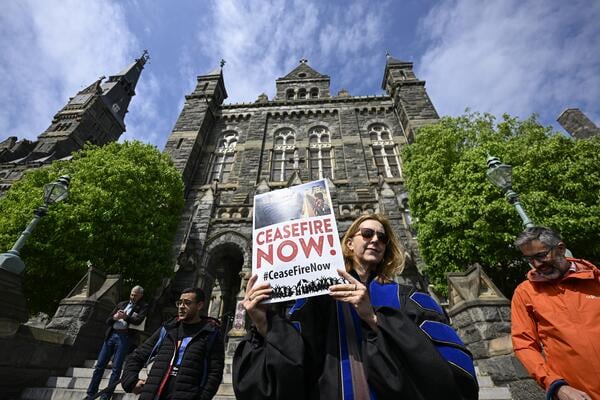
    On Monday night, immigration officials arrested and detained Badar Khan Suri, an Indian postdoctoral fellow at Georgetown University, outside his home in Rosslyn, Virginia. Suri was in the country on a J-1 visa, a nonimmigrant document meant to promote academic and cultural exchange that is usually reserved for students and scholars; according to his lawyers, Department of Homeland Security agents told him his visa had been revoked.

    A peace and conflict studies scholar, he was at Georgetown’s School of Foreign Service conducting research for his dissertation on the U.S. peace process in Iraq and Afghanistan.

    “If an accomplished scholar who focuses on conflict resolution is whom the government decides is bad for foreign policy, then perhaps the problem is with the government, not the scholar,” Suri’s lawyer Hassan Ahmad wrote in a statement Thursday.

    After his arrest, Suri was first brought to a migrant holding cell in Virginia before being transported to Louisiana, where he’s currently awaiting trial in the same detention center as Khalil, according to Suri’s lawyers.

    Tricia McLaughlin, a spokesperson for the Department of Homeland Security, said in a statement on X that Suri had been detained for “spreading Hamas propaganda and promoting antisemitism on social media,” though she failed to provide any evidence.

    Suri’s wife, a U.S. citizen of Palestinian descent and a graduate student at Georgetown, is the daughter of Ahmed Yousef, former adviser to the late Hamas leader Ismail Haniyeh, The New York Times confirmed. Yousef, who has called the Oct. 7, 2023 Hamas attacks a “terrible error,” told The Times that he left his position a decade ago and that his daughter and son-in-law have no involvement in political activism on behalf of the organization.

    On Thursday, a federal judge in Virginia ordered that Suri be kept in the country until a lawsuit brought by his lawyers is resolved, according to The Washington Post.

    In a post on BlueSky Thursday, Virginia representative Don Beyer wrote that “the arrests of academics like Suri and Mahmoud Khalil are intended to have a chilling effect and discourage the free expression of political views which Trump dislikes.”

    A Georgetown spokesperson told Inside Higher Ed that the university was “not aware of [Suri] engaging in any illegal activity, and we have not received a reason for his detention.”

    “Suri is an Indian national who was duly granted a visa to enter the United States to continue his doctoral research on peacebuilding in Iraq and Afghanistan,” the spokesperson wrote in an email. “We support our community members’ rights to free and open inquiry, deliberation and debate, even if the underlying ideas may be difficult, controversial or objectionable. We expect the legal system to adjudicate this case fairly.”

    Brown Professor Denied Entry

    Media outlets have reported that Rasha Alawieh, an assistant professor of medicine and clinician educator at Brown, was flown out of the U.S. last week despite a court order requiring the government to inform a judge ahead of any deportation. The federal government said Alawieh was returning from Lebanon, where she had attended the funeral of Hezbollah leader Hassan Nusrallah. Officials also said she had deleted “sympathetic photos and videos” of Hezbollah leaders from her phone.

    Alawieh never made it past Boston’s Logan International Airport. On Monday, a DHS spokesperson posted on X that Nusrallah was “a brutal terrorist” and that Alawieh had “openly admitted” attending his funeral and supporting him.

    “A visa is a privilege not a right—glorifying and supporting terrorists who kill Americans is grounds for visa issuance to be denied,” the spokesperson wrote. “This is commonsense security.”

    The White House then reposted DHS’s statement with a photo of President Trump waving goodbye out of a drive-thru window at McDonald’s during a campaign stop.

    Kamola, of the AAUP, said claims of Alawieh’s supposed connections to Hezbollah were “spurious.” One of Alawieh’s lawyers didn’t respond to requests for comment Thursday.

    Asked whether Brown is defending Alawieh’s academic freedom or disciplining her, Amanda McGregor, a spokesperson for Brown, replied only that “Alawieh is an employee of Brown Medicine with a clinical appointment to Brown University.”

    “Such appointments carry a faculty title, though the employment resides with Brown Medicine,” McGregor wrote in an email.

    Interrogated for Anti-Trump Texts

    Meanwhile, foreign academics traveling to the U.S. are being hassled and turned away by border agents.

    Philippe Baptiste, France’s minister of higher education and research, told Agence France-Presse that a French scientist from the country’s National Center for Scientific Research was heading to a conference near Houston, Texas, when the scientist was denied entry and expelled. The minister did not reveal the scientist’s name.

    “This measure was apparently taken by the American authorities because the researcher’s phone contained exchanges with colleagues and friends in which he expressed a personal opinion on the Trump administration’s research policy,” Baptiste said. “Freedom of opinion, free research and academic freedom are values we will continue to proudly uphold.”

    On Wednesday, Baptiste met with counterparts from other European Union nations to discuss “threats to free research in the United States,” according to a post on X.

    As the Trump administration escalates its attacks on foreigners in American academe, international students are increasingly apprehensive about studying at U.S. institutions and scholars worry about attending conferences or accepting fellowships in the country. Kamola said the end result may be the destruction of America’s reputation as a bastion of academic freedom.

    “I think the message is: Everybody who wants to speak about Palestine, everybody who wants to argue that higher education should be more inclusive or diverse, anybody who wants to defend free speech in ways that the current regime finds unacceptable could potentially face retaliation,” Kamola said. “The intention is to not only sow chaos but to sow fear.”
    Source link

  • Search for Higher Ed Legislation Proposed in Congress

    Search for Higher Ed Legislation Proposed in Congress

    Welcome Inside Higher Ed‘s legislation tracker, a database of the key higher-ed related bills lawmakers have proposed in Congress. Few will likely become law, but the proposals offer insights into how Republicans and Democrats want to reshape the sector.

    So far, lawmakers have proposed 31 bills that would directly impact colleges and universities.

    You can search the database below to learn more about each proposal. The current session of Congress runs through the end of 2026 which means this list will grow. We’ll update the database regularly, so please check back for updates.

    Questions, comments or think we’re missing a bill? Email [email protected].

    The database was last updated March 20.

    More Coverage of Higher Ed and Congress:

    Source link

  • A way to honor the teach-in movement at 60 (opinion)

    A way to honor the teach-in movement at 60 (opinion)

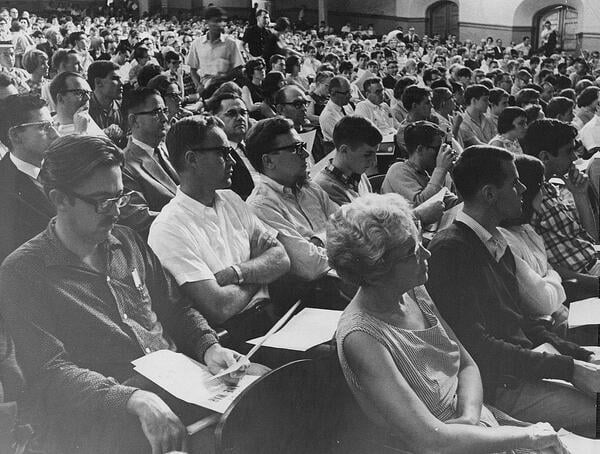
    This month marks the 60th anniversary of the teach-in movement against the U.S. war in Vietnam. The first teach-in was held at the University of Michigan, March 24–25, 1965; by the end of the spring semester, teach-ins had spread to college and university campuses across the nation, educating tens of thousands of students, faculty and community members about the moral, political and strategic reasons why the escalating Vietnam War was doomed to failure.

    The teach-ins were sparked by the Johnson administration’s launch of the Rolling Thunder bombing campaign against North Vietnam in late February 1965. But it is less its antiwar ideas than its strategic and tactical brilliance that makes the teach-in movement so relevant today, offering a valuable model for resisting the threat that the Trump administration’s authoritarianism and hatred of the liberal university poses to academic freedom and free speech on campus, the university’s funding of scientific research, the college and university’s role in battling racial and sexual discrimination, and higher education’s cosmopolitanism and international character.

    Though we tend to think of the campus antiwar movement as led by radical students who used militant tactics, breaking university regulations and the law in their protests, the teach-in movement was initiated by faculty, not students, and it did not break any such regulations or the law. Its only tools were education—offered by knowledgeable speakers—and effective publicity and outreach. In fact, the very idea of a teach-in was the result of a tactical retreat.

    Initially, Michigan’s Faculty Committee to Stop the War in Vietnam had envisioned a work moratorium, a day when faculty did not teach their regular academic classes so that the whole university could focus on the Vietnam War. But this moratorium idea proved immensely controversial, drawing all kinds of denunciations, especially from the state’s war-hawk politicians, who labeled it an anarchist hijacking of the university that denied students access to their classes. Seeing that this controversy was distracting people from the war itself, the faculty shrewdly changed course. Instead of a work moratorium, they came up with the idea of an antiwar teach-in that would begin after classes ended and go on through the night (from 8 p.m. to 8 a.m.).

    Some on the left saw this tactical shift as unfortunate, even cowardly, and feared that few students would attend such an evening event. But they were wrong. This first teach-in drew some 3,000 students, faculty and community members. It was, in the words of one its speakers, Carl Oglesby, “like a transfigured night. It was amazing: classroom after classroom bulging with people hanging on every word of those who had something to say about Vietnam.” Michigan’s antiwar faculty then helped raise funds for more teach-ins in May, which connected with faculty and student activists on more than 100 campuses, with the movement reaching its peak at a University of California, Berkeley, weekend teach-in that drew some 30,000 participants. All this provided a major boost to the peace movement and helped make the campuses a center of antiwar activism.

    In our own era, college and university administrations have tightened campus regulations to restrict mass protest and have been quick to have even nonviolent anti-Gaza war student protesters arrested for the most minor campus rule violations. In fact, last spring there were more than 3,000 arrests nationally, for campus antiwar encampments that were quite tame compared to the disruptive student protests that erupted in the Vietnam era’s most turbulent years.

    The decline of free speech on campus since the 1960s is also evident when one reflects back on the famous case of Marxist historian Eugene Genovese. At a Rutgers University teach-in, Genovese, in 1965, provoked a huge right-wing backlash by saying that he did “not fear or regret the impending Vietcong victory in Vietnam. I welcome it.” Despite calls for Genovese’s firing from many supporters of the war, including then-former Vice President Richard Nixon, Rutgers’ administration, while disdaining Genovese’s pro-Vietcong views, defended his right to free speech and refused to fire him—though two years later Genovese, tired of the death threats and political pressure, opted to leave Rutgers. One hears no such campus administration defense of free speech today as Trump, who pardoned his J6 rioters, pursues arrests and deportations of anti-war student protestors, including the arrest and detention of recent Columbia University graduate and Green Card holder Mahmoud Khalil.

    All this repression has struck fear into the hearts of student activists. So, while direct action and civil disobedience have their place in campus protest, they are, understandably, not in vogue at this authoritarian moment. This is a time when important news outlets, such as The Washington Post and The Los Angeles Times, the business community, the U.S. Senate minority leader, and campus administrators cower in fear of the Trump administration. This seems like a good time for faculty to act boldly yet strategically, taking the lead, showing that their campuses can, without rule-breaking or civil disobedience, become major centers of education about Trump’s authoritarianism, his embarrassingly illiberal and predatory foreign policy, and his crude attacks on education, the courts, the press, the First Amendment and federal agencies. Faculty should use their skills as teachers and scholars, as their predecessors did in 1965, but this time help teach America about the threat Trumpism poses to democracy and education, in a new national wave of teach-ins that would honor our past and offer hope for the future.

    Robert Cohen is a professor of history and social studies at New York University. His research focuses on student protest, free speech and the Black Freedom Movement in 1960s America. His most recent book is Confronting Jim Crow: Race, Memory and the University of Georgia in the 20th Century (University of North Carolina Press, 2024).

    Source link

  • Bret Stephens Don’t Know Higher Education

    Bret Stephens Don’t Know Higher Education

    What I want to know is why The New York Times lets opinion columnist Bret Stephens lie about higher education institutions.

    I understand this is a strong charge, and perhaps it’s unfair. Maybe Stephens is merely uninformed and parroting bad information.

    I’m thinking these things because we recently had the rare occasion of a pundit (Stephens) being challenged in real time by two experts (Tressie McMillan Cottom and M. Gessen) in the form of a three-way conversation printed under the headline “‘It Is Facing a Campaign of Annihilation’: Three Columnists on Trump’s War Against Academia.”

    The conversation is moderated by Patrick Healey, another Times journalist, who gives Stephens the first word on the question “What went wrong with higher ed? How did colleges become such easy pickings?”

    Stephens hearkens to the infamous Yale Halloween incident from 2015, when students committed the grave error of speaking intemperately to university administrators about a communication that seemed to authorize racially insensitive Halloween costumes over the objections of students.

    Stephens wonders why these students weren’t expelled or at least suspended, justifying a crackdown for what may have been a break in decorum but was undeniably the exercise of free speech. Stephens ostensibly is against the threats of the Trump administration against Columbia University and others, and yet here he is essentially authorizing the administration rationale of punishing institutions that are not sufficiently punitive toward protesting students.

    The voice of reason appears in the form of Cottom, both an active professor at the University of North Carolina and a sociologist who studies higher education. In the words of Kevin Carey, “Reading Tressie McMillan Cottom debate Bret Stephens on higher education is like watching Steph Curry play H.O.R.S.E. against a barely-sentient lump of gravel.”

    Cottom counters with lived experience over Stephens’s fever dream: “I have taught the most quintessentially tense courses my entire academic career. My course names often have the words race, class and gender in them. I do this as a Black woman. I have never had a problem with students refusing to have debates. It could be that I am a uniquely gifted pedagogue but I reject that idea.”

    This becomes a pattern throughout the exchanges, where Stephens makes something up and then Cottom and/or Gessen knock it down. Later on, Stephens goes on an uninformed rant about the lack of value of degrees with the word “studies” in them before going on to extol the virtues of humanistic study in the spirit of Matthew Arnold: “It means academic rigor, it means the contestation of ideas, it means a spirit of inquiry, curiosity, questioning and skepticism. Outside of a few colleges and universities, I’m not sure that kind of education is being offered very widely.”

    That Stephens is extolling the virtues of rigorous thought and questioning while parroting ill-informed tropes about higher education does not occur to him. Cottom again corrects his misapprehension with verifiable data: “It is worth pointing out that data on labor market returns really challenge the well-worn idea that such degrees are worthless. We love the joke about your barista having a liberal arts degree, but most of the softness among those degree-holders disappears when you look at state-level data and not just starting salaries after graduation.”

    Cottom goes on to acknowledge that there are some problems with the kinds of institutions she wrote about in Lower Ed: The Troubling Rise of the For-Profit College in the New Economy, after which Stephens jumps in with my favorite nonsense of the entire deal before being again, corrected—more gently than he deserves—by Cottom:

    Stephens: I’d say the lowest-quality institutions created since the 1990s have names like Columbia and Berkeley—these are essentially factories of Maoist cadres taught by professors whose political views ranged almost exclusively from the left to the far left.

    Cottom: I would counter, Bret, that the lowest-quality institutions are the for-profit colleges created as paradigmatic economic theories of exchange value that churned out millions of students in “career ready” fields who found it hard to get a job worth the debt—colleges not unlike the one that our current dear leader once ran as a purely economic enterprise.

    It is worth pausing here to consider how untethered Stephens is from the truth with saying the Columbia and Berkeley are “essentially factories of Maoist cadres.” One would think that if this were the case, they would be overwhelmingly churning out graduates in those dubious “studies” majors.

    Let’s go to the data.

    Top majors at Columbia: political science, economics, computer science, financial economics

    Top majors at Cal: computer science, economics, cellular biology, computer and information sciences, engineering

    The wokeness … it burns! Actually … it’s nonexistent.

    I don’t know if Stephens has convinced himself of a fantasy based on a selective accounting of what’s happening on campus, promulgated by his center-right anti-woke fellow travelers, or if he is simply a liar, but either way, he is demonstrably out of touch with reality.

    Stephens consistently authorizes the “logic” of the authoritarian, even if he disagrees with the specifics of the punishment. The idea that he would claim the mantle of the protector of rights is an irony beyond understanding.

    Stephens concludes, “When diffident liberal administrators fail to confront the far left, the winners ultimately tend to be on the far right.”

    I take a different lesson from all of this, namely that diffident administrators found some utility in the scolding of figures like Stephens as a rationale to crack down on student dissent and protect a status quo of administrative authority. If student demands are inherently unreasonable, they don’t need to be dealt with. I seem to recall a very popular book that invented an entire psychological pathology on the basis of a handful of campus incidents in order to delegitimize student speech people like Stephens didn’t like because it threatened authority.

    This was the core weakness, and it is coming home to roost, because the most important asset institutions have in defending themselves against the attacks of the Trump administration would be the students—provided there was a reservoir of trust between students and administrations, which, in many cases, there isn’t.

    The whole thing is a mess, and an existential one for universities. Stephens seems to think it’s possible that the current actions by Trump are “a loud shot across the bow of academia to get it to clean up its act.” This is, I fear, only additional delusion.

    I’d ask leaders of institutions who they think is going to be a bigger help in this situation, people like Stephens, who seem to believe that at least some measure of the arbitrary punishment is deserved, or the people who live and work in their communities, who understand the mission and importance of what these institutions try to do.

    Listen to the experts, particularly those on your own faculty, not the pundits.

    Source link

  • Judge Rules Drake Didn’t Defame Des Moines Community College

    Judge Rules Drake Didn’t Defame Des Moines Community College

    A federal judge recently dismissed claims that Drake University defamed Des Moines Area Community College, the latest development in a fraught trademark battle between the two institutions, the Des Moines Register reported.

    Their ongoing legal dispute, which began last summer, is over the letter “D.”

    Drake University sued the community college after it changed its logo to a simple, block-style “D.” The university has used a “D” as its logo for decades and argued the similar branding creates confusion.

    U.S. Chief District Judge Stephanie Rose concluded in November that Drake was likely to prevail, given the logos’ similar color schemes and other details, and issued a preliminary injunction that the community college stop using the new logo. The order led to two pending appeals, one from the community college to reverse the preliminary injunction and one from Drake asserting the ruling didn’t include some older logos. The community college achieved some wins in February when Rose determined DMACC tried in “good faith” to change the logo and Drake should put more money toward helping the college switch the logo if Drake ultimately wins the case.

    Meanwhile, counterclaims from DMACC accused Drake of defamation. The college dropped those claims after Drake asked the court to dismiss them but then brought defamation claims against the university again on behalf of the Des Moines Area Community College Foundation after Drake sent out an email about the case to its alumni in July.

    Rose wrote on Friday that the foundation took “giant interpretive leaps from the content of the email” such that the defamation claims were “untenable.”

    “While zealous advocacy is expected, counsel must ground their pleadings in reasonable factual and legal interpretations,” she chided.

    Drake President Marty Martin said in an email statement to The Des Moines Register that he was pleased by the outcome. But DMACC shows little sign of giving up.

    “DMACC and the DMACC Foundation continue to believe that Drake does not own the letter ‘D’ and the scope of Drake’s rights are now the subject of appeal,” spokesperson Dan Ryan said in a statement.

    Source link

  • Congress Eying More Control Over Colleges

    Congress Eying More Control Over Colleges

    American voters want to see an overhaul in higher education and Republicans are taking advantage of it. Over the course of its first 75 days, the 119th Congress introduced more than 30 pieces of legislation concerning higher education—more than half of which came from members of the GOP.

    Historically, conservative lawmakers have taken a laissez-faire approach to governing colleges and universities. But at a time when students and families are demanding greater accountability and a solution to the debt crisis, Republicans—who hold majority in both the House and the Senate—are laying the legislative groundwork to increase federal control over colleges.

    But while the bills do in some ways levy penalties against institutions, lawmakers are also aiming to advance key Trump agenda items, an Inside Higher Ed analysis tracking proposed legislation shows. For example, they’ve introduced bills to crack down on immigration and foreign influence by threatening student visas and restricting international donations; to hamper flexibility for borrowers by capping student loan amounts; and to suppress “liberal ideologies,” by establishing penalties for pro-Palestinian protests. Republicans are also escalating their ongoing attacks on wealthy colleges with proposals to significantly increase the tax on university endowments.

    Rep. Tim Walberg, a Michigan Republican who chairs the House Committee on Education and Workforce, has applauded Trump’s “enormous strides” and reinforced that these efforts will be a priority. 

    “Under President Trump, common sense is returning to America, and House Republicans are committed to enacting his bold vision for the country,” he said in a statement after the President’s March 4 joint address. “I will work in lockstep with this administration to protect students, workers, and job creators to ensure every American has a chance to thrive.”

    Meanwhile, Democrats have rallied in defiance, introducing many bills that promote the exact opposite of what Republicans are trying to achieve. For example, the Republican bill that would ban transgender women from participating in female sports has a direct Democrat counterpart that would prohibit discrimination in athletics based on gender identity.  

    And all of that doesn’t even take into account the possibility that Republicans could revive parts of the College Cost Reduction Act—a comprehensive piece of legislation introduced last Congress to overhaul higher education. Although the bill itself has yet to be introduced, many of its provisions—such as requiring colleges to pay back a portion of students’ unpaid loans—could be part of the forthcoming reconciliation bill, a top priority for Congressional Republicans this spring that could mean billions in cuts to higher education. (Reconciliation is a budgetary tool which can be used once a year to quickly advance high-priority—and often controversial—pieces of legislation.)  

    Combined, the proposed legislation and potential for sweeping changes via reconciliation could lead to an unprecedented amount of federal focus on higher ed that college and university advocates say could heavily discourage international enrollment, indirectly increase the cost of attendance and cause a chilling effect on campus free speech.

    “Higher education has moved to the forefront of the minds of our policy makers,” said Emmanual Guillory, senior director of government relations at the American Council on Education. “It has become a point of contention, especially with the increased oversight over institutions themselves by the current administration.”

    But regardless of which party’s behind a bill, Guillory said he’s focused on educating lawmakers on how each piece of legislation could also have unintended consequences for institutions and the students they serve.

    “Oftentimes what we see with Republicans and Democrats is they have good intentions behind what they’re trying to do, it’s just the way that they go about doing it,” he said. “When we begin to have more detailed conversations. Then [lawmakers] are like, ‘Oh, well no, we didn’t think about that. We didn’t realize this would happen. So it’s just a matter of us still continuing to do our job in advocating and educating.”

    Given the emphasis on higher education in this session of Congress and the stakes for colleges, Inside Higher Ed is tracking higher-ed related bills. The searchable database, available here, currently includes 31 bills introduced since January, and we’ll update it regularly. Below you can find a breakdown of the legislation proposed so far.

    Legislating at the federal level is complicated, so below you can find more information about how a bill becomes a law in 2025 as well as more details about the legislation raising concerns for institutions.

    How a Bill Becomes Law

    Few of the introduced bills will ever become law, based on Congress’s recent track record. And while the process is similar to what Schoolhouse Rock! described in the 1970s, partisan divides over policy have led to much gridlock on Capitol Hill.

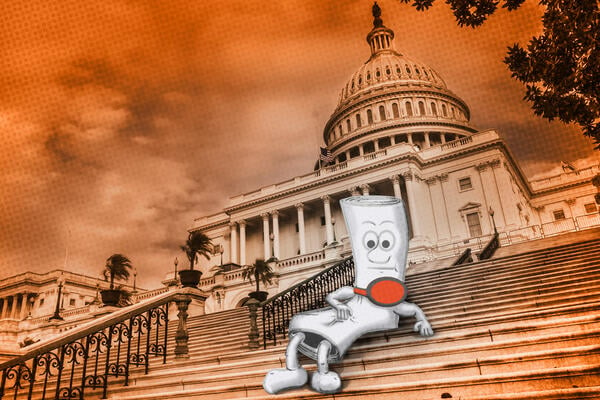
    A cartoon bill with a graduation hat sits on the stairs of the U.S. Capitol Building.

    An Inside Higher Ed cartoon showing a bill on the steps of Congress.

    Photo illustration by Justin Morrison/Inside Higher Ed 
    dkfielding/iStock/Getty Images

    During the 118th Congress—which ran from 2023 to 2025 with a Republican-controlled House and Democrat-controlled Senate—more than 90 percent of measures introduced died in committee and only about 3 percent became law, according to GovTrack.US. Even during the 115th Congress, the last time the Republicans held a trifecta, 85 percent of bills got stuck in committee and only 8 percent became law.

    Many pieces of legislation introduced are considered nothing more than messaging bills by which a party or lawmaker signals their priorities. For example, it’s highly unlikely the Democrats will advance either the Closing the College Hunger Gap Act or the Affordable College Textbook Act, but they demonstrate a focus on meeting students’ most basic needs.

    But if the legislation comes from Republicans on the House Committee on Education and Workforce and the Senate Committee on Health, Education, Labor and Pensions, it might be more likely to gain traction.

    The chairs of those committees hold a lot of power over whether a bill will move forward. They control the schedule for public hearings and mark up sessions—where a bill is debated, amended and then voted on—so if a bill isn’t a priority for the chairs,  it’s dead in the water.

    But once again, having support and investment from an education committee member is helpful here. If they can make a case for the bill to receive time on the floor, it will face debate, amendments and a final vote. Bills have to pass both chambers and undergo negotiations to settle legislative differences before they go to the White House to become law. And that doesn’t include potential road bumps like the Senate filibuster.

    Long story short, it’s a tedious process that can take months or even years. That’s why having support from Republicans on the education-focused committees—especially committee chairs—is critical to gaining momentum this year.

    As Guillory said, “There are other members of Congress that are introducing legislation in the higher education space, but it doesn’t mean that those bills will necessarily have legs and actually be able to move through regular order.”

    Bills Higher Ed Is Watching

    Much of lawmakers’ attention right now is on reconciliation as they work to cut billions in dollars from the federal budget in order to pay for tax cuts and Trump’s other priorities. But outside of that just a handful of bills have received a hearing and/or a markup session so far. One of the most notable and concerning to higher ed advocates is the DETERRENT Act.

    Scheduled for a vote on the House floor next week, this bill would require colleges to submit much more information about the foreign gifts and contracts that they receive. Republicans have claimed for years that colleges aren’t sufficiently complying with Section 117 of the Higher Education Act, which requires them to disclose twice a year all foreign gifts and contracts totaling $250,000 or more.

    The legislation, which supporters say would discourage foreign influence in higher education, would lower the threshold to $50,000. For gifts and contracts from countries of concern—China, Russia, Iran and North Korea—colleges would have to report gifts and contracts of any amount. Institutions that fail to comply could lose access to federal student aid.

    The House passed a nearly identical bill last Congress, but it died in the then-Democrat controlled Senate. House Republicans argued that as tensions with communist countries like China rise, universities have not taken their reporting obligations and vetting processes for international students seriously and in doing so are risking national security by granting foreign governments access to American research. 

    But institutional advocates say this bill goes well beyond what Section 117 of the Higher Education Act ever intended, making an already time consuming and confusing process more difficult.

    Sarah Spreitzer, ACE’s chief of staff for government relations, said that these added steps and the processing workload that will come with it for the shrinking Education Department could lead to major delays in launching countless research collaborations and study abroad programs

    In addition to the DETERRENT Act, Guillory said ACE is also paying attention to any measures focused on accountability, affordability and transparency of institutional data, many of which represent threads of last year’s College Cost Reduction Act (CCRA).

    For example, the Graduate Opportunity and Affordable Loans Act would put a cap on the amount of loans available to graduate students and terminate their access to PLUS loans. The Endowment Tax Fairness Act would increase the amount of excise tax private institutions pay each year. And the Ensuring Distance Education Act would reverse some components of the Education Department’s 90-10 rule.

    “In a lot of ways, CCRA is still alive, even though it has not been reintroduced this Congress,” Guillory said.

    Lastly, he noted that many of the bills echo the Trump administration’s focus on more culture war facing topics like campus protests and immigration. The Laken Riley Act, which has already been passed, could impact visa access for international students from countries with a large number of undocumented immigrants. And several bills focused on antisemitism are likely to be discussed in the HELP Committee’s first education-specific hearing, Guillory said.

    In general, he noted, a lot of the agenda is left to be determined. “I think it’s a matter of what can we accomplish in reconciliation first? Then, after that, what would we have to move through regular order?”

    Source link

  • Pro-Palestinian Journalism Professor Denied Tenure

    Pro-Palestinian Journalism Professor Denied Tenure

    Steven Thrasher, an assistant journalism professor who tried to block police from breaking up a pro-Palestinian encampment at Northwestern University last spring, announced he was denied tenure and will lose his job in August 2026, the end of the next academic year.

    “This has nothing to do with my scholarship or teaching,” Thrasher wrote in a statement he shared on Bluesky. “It is a political hit job over my support for Palestine and for trying to protect our student protesters last year from physical attack, by nonviolently subjecting my own body to assault by the Northwestern Police instead of our students.”

    The incident between Thrasher and campus police came up when Northwestern president Michael Schill went before Congress during a hearing on campus antisemitism. In a June 2024 letter, the House Committee on Education and the Workforce accused Schill of not fully answering members’ questions at the hearing, including about Thrasher.

    Thrasher was suspended from teaching last summer. According to an email from Medill School of Journalism dean Charles F. Whitaker, which Thrasher’s lawyer provided to Inside Higher Ed, the dean initiated disciplinary proceedings in response to complaints about Thrasher’s social media activity and allegedly sexist comments to students, as well as his failure to disclose major course changes and his comments about journalism standards that were “antithetical to our profession.”

    According to Thrasher’s statement, posted Thursday, Whitaker wrote in an explanation of the tenure denial that Thrasher’s teaching was “inadequate with serious concerns reported by some students.” Thrasher said he previously received a “glowing” mid-tenure review in 2023. He also said a university-wide ad hoc faculty committee “exonerated” him after a four-month investigation into issues, including student concerns.

    “I read the situation as a Plan B by Northwestern after Dean Whitaker tried (and failed) to exclude me through the disciplinary process,” Thrasher wrote. “I will appeal this decision at Northwestern and have much more to say.”

    In a statement to Inside Higher Ed, a university spokesperson wrote, “As policy, Northwestern does not comment on personnel matters. The University takes the tenure process very seriously and has adhered to the rules that govern that process. The University has full confidence in the decision-making process of our Medill faculty and dean.”

    Source link

  • Bunker Hill Cancels Study Abroad Amid Federal Policy Shifts

    Bunker Hill Cancels Study Abroad Amid Federal Policy Shifts

    Bunker Hill Community College is canceling its summer study abroad programs in response to Trump administration immigration policies, WBUR reported.

    “Our first priority in any Study Abroad experience is the safety of our students and staff,” read a statement from the community college to WBUR. “With the changes in national immigration policy and enforcement that have emerged over the last several weeks, including the prospect of renewed travel restrictions, the College will redirect this year’s exploration and learning to U.S.-based sites.”

    The community college planned to send about 60 students to Costa Rica, Ghana, Japan, Kenya and Panama for two-week educational programs between May and July. The decision to cancel the trips came after news reports that the Trump administration is considering a travel ban on dozens of countries.

    Biology professor Scott Benjamin, who’s led the Costa Rica trip since 2002, told WBUR that college leaders were concerned for international students who planned to go on these trips. International students make up 7 percent of the college’s student body.

    “The school was just very worried about the probably remote, but still potential possibility that we could go away and come back, and a student couldn’t come back into the country,” Benjamin told the news outlet.

    Source link

  • Results of Women’s March Madness Bracket Based on Academics

    Results of Women’s March Madness Bracket Based on Academics

    Tyler Schank/NCAA Photos/Getty Images

    Women’s basketball has experienced a surge in popularity of late, and this year is no different. The Athletic reported that regular season viewing of women’s college basketball was up 3 percent on ESPN—even if this year’s Big Ten championship didn’t quite hit the record-breaking viewership of 2024’s, fueled by fans of then–University of Iowa point guard Caitlin Clark.

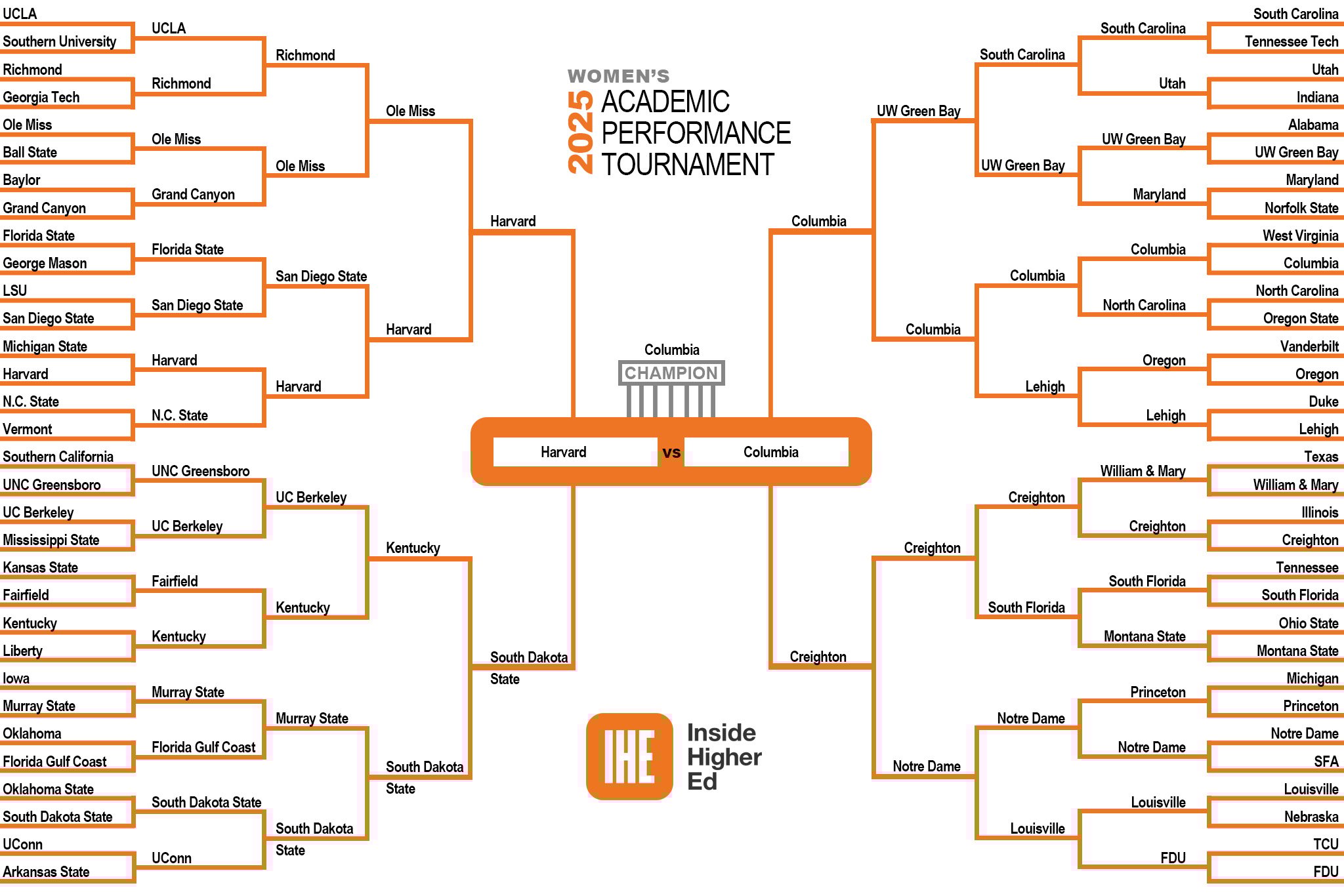
    Here at Inside Higher Ed, though, we celebrate the start of March Madness a little differently from the 1.44 million people who tuned in earlier this month to this year’s Big Ten championship face-off between the University of Southern California and the University of California, Los Angeles. For every tournament since 2006, we’ve created a bracket of who would take home the trophy if the winners were selected based on academic, rather than athletic, achievement.

    If you’re new here (or you didn’t see the men’s bracket from yesterday), here’s how it works: Matchups are decided by which team had the higher academic progress rate—the NCAA’s own metric for measuring academic performance—based on the most recent data available, from 2022–23. The academic progress rate measures student athlete retention and academic eligibility, though some outside experts have criticized the metric for painting an incomplete picture of a team’s academic achievement.

    There are, inevitably, at least a handful of ties every year. In those cases, we used several different graduation metrics to select winners. First, we used the team’s 2023–24 graduation success rate, which shows whether athletes graduated within six years of entering an institution. If teams tied again, we then turned to the teams’ federal graduation rates, which are more inclusive than the NCAA’s metric. Finally, when teams were matched up on all three of those measures, we turned to the institution’s overall GSR across their athletics programs.

    It’s worth noting that federal graduation rate data is not available for Ivy League teams, so for GSR ties involving Ivies, we skipped right to the overall GSR metric. That caused some chaos in a bracket that ended up seeing a total of seven ties featuring Ivy League institutions.

    Another note on methodology: Although two of the First Four games were decided before publication, we used academic metrics to select the winners of those matchups as well.

    This tournament was intense. There were not two, not three, but four matchups in the second round in which both teams had perfect APRs of 1,000. Kudos to those teams!

    The championship matchup was between two Ivies, Harvard University and Columbia University, both of which had perfect APRs and GSRs and whose overall GSRs were perfectly matched at 99. We’ve never seen this before in Inside Higher Ed’s 19 years of academic March Madness, so, although not ideal, we had to resort to a (virtual) coin flip. Naturally, Harvard was heads, because both start with “H.”


    Women’s 2025 Academic Performance Bracket Fullscreen

    But, in the end, we got tails. Congratulations to the Columbia Lions—who have now won Inside Higher Ed’s academic tournament two years in a row!


    Source link

  • Ithaka’s New Transfer Explorer Maps Transfer Courses to Degree Requirements

    Ithaka’s New Transfer Explorer Maps Transfer Courses to Degree Requirements

    Over two-thirds of adult Americans who have attempted to transfer academic credit report having at least one negative experience, according to a recently released survey from Public Agenda. Student mobility is increasing, as is student access to college-level learning from multiple sources. But as evidenced by the Public Agenda survey and slow progress toward improving outcomes for transfer students, higher education institutions are still struggling to improve the transfer experience.

    Part of this continued struggle is the siloed and opaque nature of information about how prior learning will be accepted and applied toward a credential upon transfer to a new institution. With 1.2 million students transferring between institutions in 2024—a 4.4 percent increase from 2023—it is more critical than ever to overcome the barriers students face moving academic credit to and between institutions to earn a degree.

    To help address these complex and longstanding challenges, our teams at not-for-profit Ithaka have launched a new, public, national credit mobility website, Transfer Explorer. Currently in its beta release, Transfer Explorer will expand in 2025 to contain data from a growing number of institutions across four states, thanks to collaborations with the Connecticut State Colleges and Universities system, the City University of New York, the South Carolina Commission on Higher Education, and the Washington Student Achievement Council.

    To break down transfer data silos, Transfer Explorer member schools establish an automated data feed of evaluated course equivalencies, course catalog information and program requirements directly from their institutions’ student information and degree audit systems. This enables Transfer Explorer to create exploration tools with the most accurate and up-to-date information and allows institutions to easily maintain accurate information on the website simply by maintaining data within their existing systems. Data integration from member college source systems is powered by CampusAPI Requisite and Equivalency services from the nonprofit DXtera Institute.

    Students can use Transfer Explorer beta to:

    • Create a personal wallet of courses they have taken or plan to take at one or more schools
    • Explore how courses in that wallet transfer and apply to degree requirements at Transfer Explorer member schools
    • Create multiple explorations and research different schools and degrees
    • Save and share explorations by creating a personal, unique, and editable hyperlink
    • Discover information about Transfer Explorer member schools

    Three schools in South Carolina are the first to be featured as destination schools on Transfer Explorer: Aiken Technical College, Coastal Carolina University and Lander University. These represent three different source systems (Colleague, Banner and DegreeWorks), but their data are normalized for a consistent exploration experience in Transfer Explorer.

    Lander University was the first institution to launch Transfer Explorer in February 2025.

    “At Lander University, we have made major changes over the past five years to make our institution more transfer friendly: We have streamlined our general education curriculum, modified the maximum number of credit hours we will accept and added staff to enhance the transfer student onboarding experience,” said Lloyd Willis, dean of the College of Graduate and Online Studies.

    “We view Transfer Explorer as the next step of this evolution. We love the tool’s user interface, the level of data it contains and the functionalities it contains that empower students to engage in course articulation and transfer conversations with their academic advisers.”

    Community and technical colleges play a critical role in student mobility both as preparers of students for transfer and careers, as well as receivers of transfer students from all sectors of higher education. Aiken Technical College is planning to use Transfer Explorer in its recruitment and admission activities for new students, as well as to support students planning to transfer to a university.

    “Aiken Technical College is excited to be a part of the Transfer Explorer project. The website is very user-friendly for students and advisors and will go a long way in avoiding lost college credits for students upon transfer,” said Chad Crumbaker, vice president of academic affairs and workforce innovation at Aiken Technical College.

    Crumbaker is also eager to see how Transfer Explorer can help Aiken improve transfer processes and rules: “It also will help us identify additional opportunities to analyze course equivalencies to ensure that students get credit towards their programs for the courses they have already taken and to confirm that our transfer agreements are in practice in our transfer process.”

    Transfer Explorer will continue to expand and grow in 2025 and beyond. Upcoming additions to the site include enabling users to add credit for prior learning experiences (e.g., exams, military training) to their explorations, improving the interoperability of school data by allowing comparisons across destinations and enhancing the user experience in collaboration with member schools and systems.

    Transfer Explorer is inspired by and builds upon the groundbreaking CUNY Transfer Explorer (T-Rex) created by the City University of New York and Ithaka S+R in 2020, which has helped hundreds of thousands of people explore, discover and use the over 1.6 million credit transfer rules for the CUNY system’s 20 undergraduate colleges.

    Transfer Explorer and the broader Articulation of Credit Transfer Project have been generously funded by Ascendium Education Group, the Gates Foundation, the Carroll and Milton Petrie Foundation, ECMC Foundation, the Heckscher Foundation for Children, and the Ichigo Foundation.

    Chris Buonocore is product manager for Transfer Explorer at Ithaka and founding member of the CUNY Transfer Explorer platform.

    Alex Humphreys is vice president for innovation at Ithaka, where he leads a team that scouts and develops the future of research and education through projects, partnerships and investments.

    Martin Kurzweil is vice president for educational transformation at Ithaka S+R and principal investigator of the ACT project.

    Emily Tichenor is a senior program manager at Ithaka S+R leading initiatives and research focused on credit mobility, including Transfer Explorer.

    Source link