Tag: Career

  • College presidents’ survey finds alarm over Trump

    College presidents’ survey finds alarm over Trump

    Even before President Donald Trump unleashed a flurry of executive orders involving higher education, college and university presidents expressed serious concerns about his possible impact on the sector and on their own institutions. That’s according to findings released today from Inside Higher Ed’s forthcoming 2025 Survey of College and University Presidents with Hanover Research.

    More than half of presidents surveyed in December and early January—51 percent—at that point believed Trump’s second administration would have a somewhat or significant negative impact on the regulatory environment for higher education. Some 38 percent of respondents said they believed Trump would have a somewhat or significant positive impact on the regulatory environment, while the remainder expected his administration to have no impact. Male presidents were more likely than their female counterparts to express confidence in the Trump administration, with 42 percent of men responding that they expected an at least somewhat positive regulatory environment for the sector compared to 30 percent of women.

    Drilling down into specific concerns, the vast majority of presidents—80 percent—indicated Trump would have a negative impact on DEI across higher education. On an institutional level, 60 percent said he would negatively impact DEI efforts at their own colleges and universities.

    Presidents also expressed concerns about what Trump 2.0 would mean for public perceptions of higher education’s value, the climate for campus speech and the financial outlook for colleges and universities.

    The latest edition of the annual survey of presidents, now in its 15th year, includes responses from 298 leaders from a mix of two- and four-year institutions, public and private nonprofit. It was administered after Trump was elected but before he took office. The findings below are focused exclusively on his new administration and the broader political environment. The full survey, covering a broad range of issues relevant to college leaders, is forthcoming.

    Unpacking the Findings

    Given the timing of the survey and the rapid-fire executive orders and other actions that have followed, which included a temporary freeze on federal funding that created uncertainty and alarm across the sector, some experts believe presidents would respond even more negatively now.

    “I don’t think there’s any question that had this survey been done after Jan. 20, the numbers would be more negative than they were, with what we have seen since: the executive orders flowing out of the White House and funding freezes and just the chaos and uncertainty,” Michael Harris, a professor of higher education at Southern Methodist University, told Inside Higher Ed.

    “The survey indicates that presidents had some sense of what was coming,” Harris said. But he noted their “failure of imagination” to realize how quickly Trump would act.

    Already higher education is feeling the pressure on DEI, an area presidents anticipated would come under fire by the new administration.

    One of Trump’s first executive orders, issued on Jan. 21, called on federal agencies “to enforce our longstanding civil-rights laws and to combat illegal private-sector DEI preferences, mandates, policies, programs, and activities.” It also tasked Trump’s attorney general and the education secretary with crafting guidance for universities on how to comply with the 2023 Supreme Court ruling that banned the consideration of race in admissions policies.

    Universities have reacted in myriad ways to Trump’s attack on DEI. Last month the Rutgers University Center for Minority Serving Institutions canceled a virtual conference on apprenticeships at historically Black colleges and universities, and Michigan State University called off a lunch to celebrate Lunar New Year (but allowed other related events to go on).

    According to the survey, 71 percent of respondents believe that Trump will have a negative impact on the climate for free inquiry and civil dialogue across higher education. But only 52 percent said their own institution would suffer those negative effects.

    The majority of respondents—71 percent—also said Trump would have a negative financial impact on the sector. But at the institutional level, only 45 percent believe the same is true at their institution. And nearly a quarter of respondents believe he’ll positively affect their finances.

    Harris views with skepticism the belief among many presidents that their institutions will fare better than the rest of the sector. He argues that presidents can be “blinded” by proximity to their institution, which makes them overconfident in its strength.

    “I tend to believe the response around the industry more than the individual institution,” he said.

    But Anne Harris, president of Grinnell College—and no relation to Michael—believes that presidents have a firm grasp on their community “and all of its complexity,” which helps them better understand how a situation may play out on campus. She said that the “direct impact of a federal policy is always going to be negotiated, diffused and maybe absorbed by the multiplicity of constituencies on a campus.”

    While the new Republican president was the cause of concern for many respondents, presidents also expressed dissatisfaction with his Democratic predecessor, Joe Biden, last year.

    In Inside Higher Ed’s 2024 survey of College and University Presidents, only 33 percent of respondents indicated satisfaction with the Biden administration’s record on higher education. Last year’s survey found that 41 percent of respondents were completely or somewhat dissatisfied with Biden, who left behind a mixed legacy on higher education. He was accused of leaving some promises unfulfilled while overreaching in other areas, such as student loan forgiveness.

    Killing the Education Department

    One of Trump’s campaign promises was to dismantle the U.S. Department of Education, a process that he has already taken steps toward but that will likely face an uphill battle given that he would need congressional approval to shut it down, which Democrats have made clear they are unwilling to provide. Even with a Republican majority in the Senate, the move faces highly unlikely odds.

    The majority of presidents surveyed disapprove of shutting down the department: 72 percent opposed the idea and 21 percent indicated uncertainty, while 8 percent voiced support for the effort. Presidents of private, nonprofit institutions were most likely to support the move.

    Harris, the Grinnell College president, questions what role last year’s botched launch of the new Free Application for Federal Student Aid played in draining support from the Department of Education, given the financial pressures felt by countless students, families and institutions.

    “There are going to be very few presidents who are going to cheer what happened with FAFSA,” she said. “So maybe this is some FAFSA lack of confidence saying the Department of Education did not serve higher ed well with the FAFSA debacle last year. So why not try something else?”

    Brad Mortensen, president of Weber State University, offered a similar perspective.

    “It wouldn’t have surprised me if [that number] was higher, just given how rough of a time the Department of Education had in rolling out the new FAFSA,” Mortensen told Inside Higher Ed. “That had real impacts on all types of institutions across the country.”

    Both presidents indicated that the programs housed in ED are more important than the department itself. They are more concerned about the continued flow of federal financial aid, for example, than where it comes from—whether that’s ED or the U.S. Department of the Treasury.

    Ongoing Optimism

    Concerns about Trump notwithstanding, other findings in the forthcoming full survey were positive—including the financial outlook at the institutional level, despite clear signs of strain across the sector. (Financial findings will be covered in depth as part of the full survey release.)

    Some presidents believe that optimism comes with the job.

    “College and university presidents are a funny lot. As I was applying for this job, I had a past president tell me, ‘Brad, you have to be smart enough to get the job and dumb enough to take it.’ I think by nature, we tend to be naïve optimists because it’s a job with a lot of challenges,” Mortensen said.

    Source link

  • Abrupt presidential exits at Oklahoma State, CSU Pueblo

    Abrupt presidential exits at Oklahoma State, CSU Pueblo

    Two presidents resigned abruptly with few details in recent days: Kayse Shrum stepped down at Oklahoma State University, and Armando Valdez resigned the presidency of Colorado State University, Pueblo.

    For Shrum, the move comes less than four years into her job and with no public explanation.

    Local news outlet NonDoc reported that her resignation—which blindsided many at the university—coincides with an opaque review of improper transfers of “legislatively appropriated funds.” NonDoc also noted recent tensions over the contract of football coach Mike Gundy, who signed a restructured deal that gave him an extension but also a $1 million–a–year pay cut. 

    One anonymous source told the news outlet that the situation escalated quickly as Shrum “went from being on solid footing last Thursday to essentially not being president on Monday night.”

    Though the resignation was official Monday, the Board of Regents did not announce the move until Wednesday.

    Valdez resigned as president of CSU Pueblo one day shy of hitting a year on the job. The move follows an independent investigation that found he had violated university policy, according to a Colorado State University System news release. System officials did not indicate what policy Valdez allegedly violated, noting in the news release that Valdez disagreed with the findings but recognized he had lost “the confidence of the Board of Governors and CSU System leadership. As a result, to allow the university to move forward, he resigned his role.”

    System officials told The Pueblo Chieftain that his resignation and the alleged policy violation were a personnel matter and therefore “not something the CSU system will be commenting on.”

    Source link

  • Abolishing the Department of Education is unpopular

    Abolishing the Department of Education is unpopular

    The majority of likely voters oppose abolishing the U.S. Department of Education by executive order, according to a new poll conducted by the progressive think tank Data for Progress, on behalf of the Student Borrower Protection Center and Groundwork Collaborative, a left-wing advocacy group.

    The poll found 61 percent of all survey respondents “somewhat” or “strongly” opposed the idea of eliminating the department, compared to 64 percent of likely voters under the age of 45 and 59 percent above age 45. Among likely voters who attended college, 70 percent opposed the plan, compared to 57 percent who didn’t attend college.

    The results are based on a survey of 1,294 likely voters between Jan. 31 and Feb. 2.

    The poll, released Tuesday, comes amid news report that President Donald Trump is planning to sign an executive order to dismantle the Department of Education or direct “the agency to begin to diminish itself,” The Washington Post reported, citing three people briefed on the order.

    In a press release, Mike Pierce, executive director of the Student Borrower Protection Center, called “the rumored plan” to eliminate the department “wildly unpopular.”

    Source link

  • Trump signs order banning trans athletes in women’s sports

    Trump signs order banning trans athletes in women’s sports

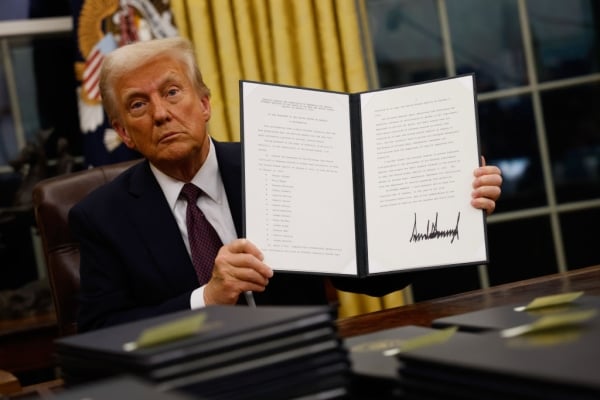
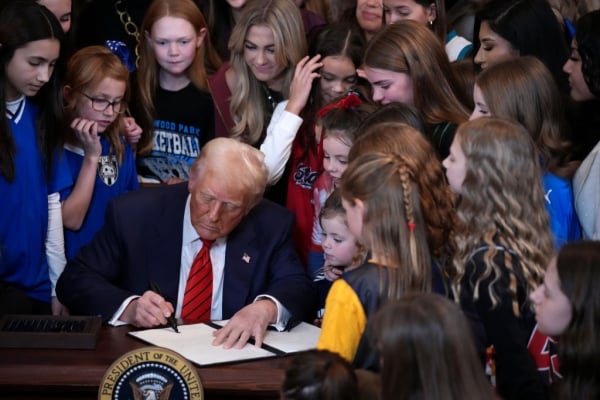
    President Donald Trump signed an executive order Wednesday banning transgender women from participating in women’s sports.

    “The war on women’s sports is over,” he said. “With my action this afternoon, we are putting every school receiving taxpayer dollars on notice that if you let men take over women’s sports teams or invade your locker rooms, you will be investigated for violations of Title IX and risk your federal funding.”

    The executive order, signed on National Girls and Women in Sports Day, declares that it’s “the policy of the United States to oppose male competitive participation in women’s sports more broadly, as a matter of safety, fairness, dignity, and truth.” Under the order, the assistant to the president for domestic policy will bring together representatives of “major athletic organizations and governing bodies, and female athletes harmed by such policies, to promote policies that are fair and safe, in the best interests of female athletes.”

    The president’s latest action builds on the GOP’s broader campaign to remove all recognition of transgender individuals from state and federal programs. On his first day in office, Trump signed a separate executive action declaring that there are only two sexes and banning federal funding for any program related to “gender ideology.” And House Republicans have passed a bill that would unilaterally ban trans women from competing in women’s sports. In nearly half of the country, trans women are banned from playing women’s sports at the K-12 or higher education level, but the order would take those bans nationwide.

    Additionally, the order calls on the education secretary to prioritize “Title IX enforcement actions against educational institutions (including athletic associations composed of or governed by such institutions) that deny female students an equal opportunity to participate in sports and athletic events by requiring them, in the women’s category, to compete with or against or to appear unclothed before males.” (Federally funded K-12 public schools and colleges are required to comply with Title IX, which bars discrimination based on sex in educational settings.)

    Charlie Baker, president of the National Collegiate Athletic Association, told Congress recently that out of the more than 500,000 college athletes, fewer than 10 were transgender. The NCAA released a statement Wednesday that said, “The NCAA Board of Governors is reviewing the executive order and will take necessary steps to align NCAA policy in the coming days, subject to further guidance from the administration.”

    As Trump spoke Wednesday, girls and women—including former University of Kentucky swimmer and anti-trans advocate Riley Gaines—stood behind him, often clapping in support.

    After thanking them, the president turned back to face the rest of the East Room audience. He acknowledged the federal lawmakers, state attorneys general and governors in attendance, describing them as “friends of women’s sports.”

    “My administration will not stand by and watch men beat and batter women,” he said. “It’s going to end and nobody’s gonna be able to do a damn thing about it because when I speak [I] speak with authority.” (Trump was referring to an Olympic gold medal–winning Algerian boxer whom some accused of being transgender; the boxer has publicly said she was born a woman.)

    Fatima Goss Graves, president of the National Women’s Law Center, said in a statement that trans students do not pose a threat in sports and deserve the same opportunities as their peers.

    “The far-right’s disturbing obsession with controlling the bodies, hearts, and minds of our country’s youth harms all students,” Graves said.

    Education secretary nominee Linda McMahon attended the ceremony, though her confirmation hearing for the office has yet to be scheduled. In the meantime, the department is being led by a collection of acting officials and appointees, including Deputy General Counsel Candice Jackson, who described the president’s order as “a demonstration of common sense.”

    “The President affirmed that this administration will protect female athletes from the danger of competing against and the indignity of sharing private spaces with someone of the opposite sex,” Jackson said in a news release. “The Department of Education stands proudly with President Trump’s action as we prioritize Title IX enforcement against educational institutions that refuse to give female athletes the Title IX protections they deserve.”

    Other Republican lawmakers praised the order Wednesday, arguing it would ensure women and girls won’t be pushed to the sidelines.

    But Representative Bobby Scott, a Democrat from Virginia and ranking member on the House education committee, was quick to oppose the order, calling it “yet another overreach by this administration” and saying its lack of clarity will further complicate what should be addressed by sports associations.

    “Rather than address the real, urgent issues that students and families are facing every day, this administration continues to target vulnerable students—specifically transgender girls and women—with a shameless attempt to bully them,” he said in a statement. “They are willing to use the most vulnerable Americans as pawns in a political game.”

    Source link

  • Career coaches fill critical gaps in Ph.D. training

    Career coaches fill critical gaps in Ph.D. training

    To the editor:

    In “The Doctoral Dilemma” (Feb. 3, 2025), Inside Higher Ed reporter Johanna Alonso describes career coaching as a “cottage industry” of “gurus” that emerged to fill critical gaps in graduate training. As a career coach cited in the article, I was disappointed to see such an inaccurate and biased portrayal of my work. 

    Coaching is a professional industry with proven methods, tools, and credentialing provided by the International Coaching Federation (ICF). Coaching is distinct from “consulting,” and it’s an intentional, strategic step for anyone seeking to change careers. This is why Johns Hopkins University employs coaches as part of its Doctoral Life Design Studio. Yet, the article portrays these university-led coaching initiatives as legitimate, structured and holistic, while describing coaching outside of the university as an opportunistic “cottage industry.” Why frame the same service in two very different ways?

    From our wide-ranging, 20-minute interview, Alonso only highlighted my hourly rate—$250/hour for a single one-to-one meeting—without any context. There is no mention of the benefits of career coaching, or whether universities like Johns Hopkins pay their coaches a similar rate. The monetary cost, presented in isolation, suggests exploitation. The reality? As a neurodivergent person, I find one-to-one meetings draining, so I’ve priced them to limit bookings. Instead, I direct Ph.D.s toward my free library of online content, my lower-cost group programs and my discounted coaching packages, all of which have helped Ph.D.s secure industry roles that double or triple their academic salaries. The article doesn’t include these details.

    The most telling sign of the article’s bias is the use of the word “guru.” Why use a loaded term like “guru” instead of “expert” to describe career coaches? As I frequently remind my clients, language shapes perception. Ph.D.s are more likely to be seen as industry-ready professionals if they use terms like “multi-year research project” instead of “dissertation” or “stakeholders” instead of “academic advisers.” The same logic applies here—calling career coaches “gurus” trivializes our work, implying we are self-appointed influencers rather than qualified professionals. I’ll never forget the professor who once tweeted, “If life outside of academia is so great, why do alt-ac gurus spend so much time talking about it? Don’t they have better things to do?”

    My response? “I wouldn’t have to do this if professors provided ANY professional development for non-academic careers.”

    Because contrary to what the article claims, I didn’t start my coaching business because I wished there were more resources available to me. I started it because, after I quit my postdoctoral fellowship for an industry career, I spent untold hours providing uncompensated career support to Ph.D.s. For nearly two years, I responded to thousands of messages, created online resources, reviewed résumés and met one-to-one with hundreds of Ph.D. students, postdocs and even tenured professors—all for free, in my leisure time. Eventually, I burned out from the incessant demand. I realized that, if I was going to continue pouring my time into helping Ph.D.s, I needed to be compensated. That’s when I started my business.

    Academia conditions us to see for-profit businesses as unethical, while “nonprofit” universities push students into a lifetime of high-interest debt. It convinces us that charging for expertise is predatory, while asking Ph.D.s to work for poverty wages is somehow noble. It forces us to internalize the idea that, if you truly care about something, you should sacrifice your well-being and life for it. But our time is valuable. Our skills are valuable. We deserve to be fairly compensated for our labor, inside and outside of academia.

    Career coaching isn’t the problem. The real problem is that academia still refuses to take a critical look in the mirror.

    Ashley Ruba is the founder of After Academia.

    Source link

  • Encouraging first-gen students to study abroad

    Encouraging first-gen students to study abroad

    Study abroad is tied to personal and professional growth for college students, but crossing the border can be an enormous hurdle or feel unattainable for some learners.

    A new initiative at Bucknell University seeks to empower and support first-generation and low-income students who are interested in experiential learning and study away through workshops, financial aid and mentorship.

    In this episode of Voices of Student Success, host Ashley Mowreader speaks to Chris Brown, Bucknell’s Andrew Hartman ’71 and Joseph Fama ’71 Executive Director of the Center for Access and Success, to learn more about the center and how it reduces barriers to student participation in high-impact activities.

    Listen to the episode here and learn more about The Key here.

    Read a transcript of the podcast here.

    Source link

  • As DEI is scapegoated, silence is complicity (opinion)

    As DEI is scapegoated, silence is complicity (opinion)

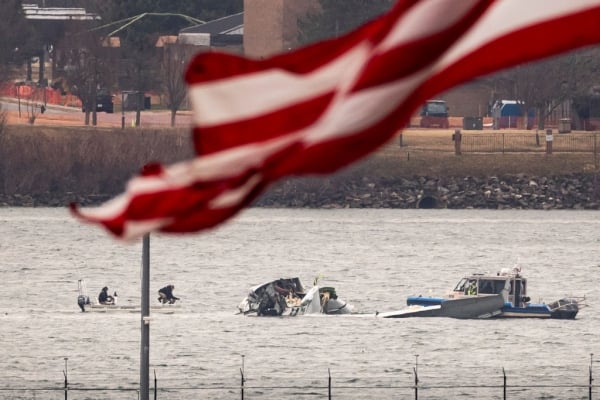
    President Trump has used diversity, equity and inclusion to explain failures in education, the economy and national security, so you might think we’d be inured to his strategies by now. When he blamed the tragic plane crash in Washington, D.C., on DEI, he reached a new nadir of callousness. The victims of the crash had not even been recovered and he was blaming DEI policies for “lower” standards. When pressed by reporters, he couldn’t even articulate the object of his complaint or any specifics related to last week’s crash. His instinct, though, reveals a deeper, more troubling current.

    By tacking immediately to DEI in the wake of a tragedy, he seeks to create an association in the minds of Americans: People of color are underqualified and incompetent. As a woman of color who earned a Ph.D. and is also the president of a university, I know these narratives are baseless. I know how many talented, innovative people of color there are in our country. I know that their leadership, research and intelligence have produced countless benefits to our society. I also know that we have spent the last century undoing the psychological and practical damage of systemic racism in our nation. We have spent precious capital in our country recreating equality of opportunity, and programs of diversity, equity and inclusion have been essential to this transformation.

    When a president of the United States has the audacity to pose DEI as a corruption tool he is combating, I cannot be silent. It is an affront to those who sacrificed in the multiple civil rights struggles of the 20th century and helped position our nation as a place with more equality of opportunity than ever in our history. Education has been a central part of that architecture.

    As a student of language and culture, I also know that when a president and his narrow-minded minions repeat a paradigm ad nauseam, people start to believe it. The forerunner of exclusion and violence across history has been gradual dehumanization. Let us not be complicit with our silence.

    DeRionne P. Pollard is president of Nevada State University. The views expressed here are her own and do not represent the views of Nevada State University or the Nevada System of Higher Education.

    Source link

  • Hegseth orders military academies to end affirmative action

    Hegseth orders military academies to end affirmative action

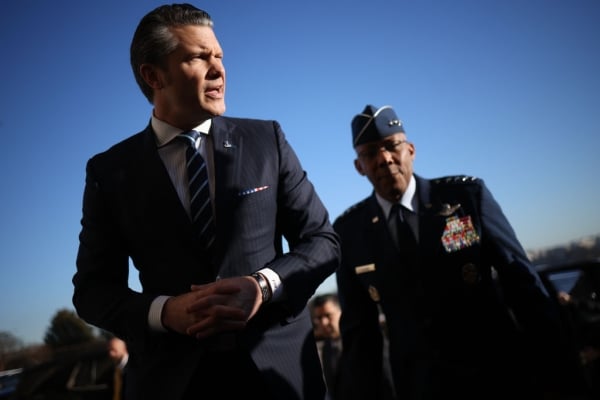
    Newly confirmed U.S. secretary of defense Pete Hegseth issued a memo Jan. 29 ordering the Department of Defense to eliminate diversity, equity and inclusion initiatives and offices—including race-conscious admissions at military academies.

    The memo establishes a task force “charged with overseeing the department’s efforts to abolish DEI offices” and specifically prohibits “sex-based, race-based or ethnicity-based goals for academic admission” within the department, which oversees military academies. Hegseth wrote that he’s enforcing an executive order issued by President Trump instructing military academy leaders to eliminate DEI initiatives. 

    When the Supreme Court struck down affirmative action in 2023’s Students for Fair Admissions v. Harvard and UNC Chapel Hill, the justices explicitly made an exception for the military academies. In his majority opinion, Chief Justice John Roberts argued that the institutions, which train the military officer corps, may have “potentially distinct interests” when it comes to admissions and that diversity in the armed forces may be a national security prerogative.

    Three of those academies—the Military Academy at West Point, the Naval Academy and the Air Force Academy—have since been sued by anti–affirmative action groups seeking to eliminate the exemption. Last February the Supreme Court declined to hear the case against West Point, and in December a federal judge ruled that the Naval Academy can continue to consider race in admissions; the case against the Air Force Academy is ongoing. 

    It is unclear if Hegseth’s order to eliminate race-based “quotas” in admissions would prohibit military academies from considering race at all when reviewing applications. 

    Source link

  • Trump reiterates plan to abolish the Education Department

    Trump reiterates plan to abolish the Education Department

    Amid reports that the White House is finalizing an executive order to get rid of the Education Department, President Donald Trump said Tuesday that when he nominated Linda McMahon as secretary, he instructed her to “put herself out of a job.” 

    “Linda, I hope you do a great job and put yourself out of a job,” the president said to a group of reporters in the Oval Office.

    The comment was the first time Trump has publicly talked about his campaign promise to dissolve the department since taking office last month. Several media outlets reported Monday that the administration is preparing an executive order that would direct department officials to shut down some functions and develop a plan for the agency’s demise. The timing of such an order is still unclear.

    When asked Tuesday whether abolishing the department was something he could legally do, the president said, “I’d like to be able to do that.” He later added that “there are some people that think I could.” Many experts say that only Congress can kill off the federal agency.

    Trump said that the largest obstacle in the way of passing a bill to dissolve the department is teachers’ unions.

    “The teachers’ unions are the only ones that are opposed to it,” he said. “No one else would want to hold [us] back.”

    A recent Wall Street Journal poll found that 61 percent of registered voters oppose getting rid of the department. Numerous education lobbying groups, higher education experts and Democratic lawmakers have criticized the concept, saying that it would cause chaotic disruptions and make college hard to access for low-income students and those with disabilities.

    “Investment in our children is an investment in our future. Dismantling the Department of Education would do the opposite by making it harder for children to achieve and for parents, caregivers, and communities to thrive,” Senator Edward Markey, a Democrat from Massachusetts, said in a news release. “President Trump wants to lock the promise of public education—of equal opportunity and hope for all—behind an ivory tower accessible only to his billionaire donors … It is callous and cynical.” 

    Source link

  • College leaders in the foxhole (opinion)

    College leaders in the foxhole (opinion)

    The second Trump administration has begun with a cacophony of executive orders, memos from the Office of Management and Budget, and the disconcerting disappearance—and some reappearance—of research grants and programs. This has led to fear of the loss of important federal data, threats to the livelihoods of researchers and students, and the end of critical programs that have enabled greater participation in science. Many of these actions are being litigated in the courts, and while some judges have helped stop the worst actions, the whiplash leads to more drama and uncertainty. The research community on college campuses has been left in a state of anxiety and confusion.

    The public response from college presidents has been mostly muted so far. While this is causing even more distress in some quarters, there are reasons for it. The administration has suggested that on top of the current actions, there are prospects for increasing the tax on large university endowments, cutting indirect cost recovery on federal grants, investigating students and institutions for antisemitism, and more. It’s no surprise that university presidents, general counsels, communications professionals and federal relations officials want to play it safe. Many of these leaders probably also feel constrained by their commitments to institutional neutrality and don’t want to be seen as taking a political position against the administration’s actions.

    And so higher education is in yet another crisis. This one affects the whole country, just like the 2008 financial crisis and the pandemic. Former Tulane University president Scott Cowen faced a unique local crisis after Hurricane Katrina and also navigated the pandemic as interim president at Case Western Reserve University. He has been justifiably praised as an outstanding crisis manager, bringing Tulane through an event that easily could have permanently devastated the institution. He said on this site that—both after Hurricane Katrina in New Orleans and during COVID-19 in Cleveland—frequent, emotionally transparent communication was crucial to lower anxiety and provide updated information.

    “Crises are bound to happen,” he said, “impacting a few people or everyone. How we lead through them depends in large part on the nature of the crisis. And when one strikes, a leader should first understand how that particular crisis makes them feel” (emphasis mine).

    We don’t need to wonder about how people feel this time. The current crisis is definitely making people on campuses anxious and afraid. A few presidents have heeded Cowen’s advice and made public statements, including Christina Paxson at Brown University, Maurie McInnis at Yale University and Kevin Guskiewicz at Michigan State University. These statements have all acknowledged the pain and anxiety on the campuses. All three of these presidents are quite experienced: Paxson has been in office at Brown for 12 years, and McInnis and Guskiewicz are both in their second executive positions.

    Paxson perhaps went the farthest in taking a stand. “We always follow the law,” she said. “But we are also prepared to exercise our legal right to advocate against laws, regulations or other actions that compromise Brown’s mission.” That would be a difficult statement to make at a public university in a red state—and is still quite a courageous one at a private one in Rhode Island.

    Other presidents have made similar statements, and as the situation grinds on, more will continue to do so, particularly as it becomes apparent that this is not something to be waited out but rather to be managed and adapted to. Nearly every college president cares first and foremost about their campus; when they don’t show it, it’s usually because they think doing so would cause more damage in the long run. My heart goes out to all of the officials who for two weeks—and for many weeks to come—have had long early-morning and late-night meetings trying to figure out what they can and cannot do or say. Being in the foxhole late at night with your team and college town takeout can be energizing at first, but as it continues, it gets very difficult, especially as the days start to blur and it’s hard to remember whether you’ve already decided something or not.

    I went through two crises myself as chancellor of University of North Carolina at Chapel Hill. I followed Cowen’s advice on the first one, the 2008 financial crisis; I had seen him present on what he did at Tulane at my first presidents’ meeting. I sent out frequent emails to the campus with the help of a very sharp communications colleague who helped me craft my voice for such times. I went to employee meetings and answered all the questions I could. I hugged people when appropriate and let them share their emotions. As an autistic person, I don’t always know when emotions are in the air, but this was a dire enough situation that I didn’t need to do a lot of interpreting. We got through it, and I felt even more connected to the campus when we did.

    In the second crisis, which was a local scandal involving UNC athletics, I started off on the right foot by famously apologizing to “everyone who loves this university” at the first press conference. It seemed a logical continuation of what had gotten me through my first crisis, and it was consistent with what I had learned from Cowen. But the reaction was very different. While much of the campus appreciated it, the sports fans ridiculed me for being apologetic and not having a “stiffer spine” when it came to fighting for athletics. To my literal brain, this meant they wanted me to say it was acceptable that we cheated. I should have ignored that, because it caused me to lose my voice for a year or more, during which I just looked tongue-tied and indecisive while the scandal grew. As with the current situation, I was worried that saying anything would lead to more investigations and penalties for the Tar Heels. Finally, a wise adviser told me that I needed to decide who my people were. The people on the campus—the students, staff and faculty—those were my people. The sports fans were not; I can’t make a layup to save my life. “Stick to your people,” he said. I eventually got my voice back and happily went off to a Division III university.

    As the current crop of presidents goes through this same process, they’ll begin sticking with their people, too. Like me, many of them will end up wishing they did it sooner, but that’s to be expected given the stress and tension. In the long run, we need leaders who can lead the academic community to the other side of this. And that doesn’t always mean overt “resistance” as we often hear calls for, although as Paxson said in her letter, it certainly does mean standing up for the academic freedom of the individuals on the campus. It also means understanding the situation, caring for the people under their charge who are affected, helping them grieve for what is being lost and leading a conversation about how higher education is going to adapt to the new realities without sacrificing our values. I believe those leaders will emerge.

    As McInnis said at Yale, “Our mission is to create, share and preserve knowledge; to educate and inspire students; and to apply our discoveries to address the world’s greatest challenges. We are committed to navigating these times with a steadfast focus on advancing that mission and on supporting members of our community.” Most of the college leaders who read this and don’t think they can say something like it are wishing they could. In the coming weeks, more will.

    In the meantime, the academic community needs to stick together and try not to get overwhelmed by responding to everything that comes along while also acknowledging the fear, loss and pain many are experiencing. Teaching, patient care, research, justice and opportunity have defined American higher education for a century. And, somehow, they will continue.

    Holden Thorp is the editor in chief of the Science family of journals. He previously served as the chancellor of the University of North Carolina at Chapel Hill and the provost of Washington University in St. Louis.

    Source link