Tag: Career

  • The Meta-Lessons of College (opinion)

    The Meta-Lessons of College (opinion)

    What we learn in school comes in part, and perhaps the smaller part, through the manifest curriculum. We first learn skills—how to read and write and do arithmetic—and then we begin the long process of learning subject matter. This is what school is intended to impart to us. We are taught, in all manner of visible ways, how to do things and what we ought to know.

    From the start, we learn other things as well: how to follow rules, how organizational hierarchies work and how we can be held accountable for misbehavior. We learn, too, what matters to other members of our tribe—individual achievement, success in competition—and what makes some people more important than others. These are elements of the hidden curriculum, or what might be called the meta-lessons of school.

    By the time students get to college, they have already absorbed many such lessons, or they wouldn’t be here at all. But college offers a new set of meta-lessons. These are lessons about knowledge itself: how to assess it, how to identify its varieties, how it’s created. To miss out on these lessons, as can happen, is to miss out on what is most valuable about a college education.

    The meta-lessons of college come with political implications. As political scientists and others have shown, there is a diploma divide in this country. On one side is the largest and most loyal group of Trump supporters: whites without a college degree. On the other side are those with bachelor’s or advanced degrees, who tend to vote Democratic. Clearly, there is something about a college education that makes a difference in political behavior.

    Some analysts have argued that the divide reflects a feeling on the part of non-college-educated whites of being left behind in a high-tech economy. These feelings of disappointment and failure in turn make this group receptive to racist dog whistlesDEI policies are giving undeserving minorities unfair advantages!—used by right-wing politicians. Others have argued that the divide reflects an indoctrination into liberalism that students experience in college.

    Analyses of the diploma divide have been going on for nearly a decade, since soon after Trump’s first election in 2016. Sorting out this body of work would require a separate essay. Here I am proposing only that the divide owes in part to the meta-lessons of college, in that these lessons should, in theory, make people less susceptible to political hucksterism, emotionally manipulative rhetoric and the embrace of simple nostrums as solutions to complex social problems.

    And so it seems worthwhile for pedagogical and civic reasons to put the meta-lessons of college on the table. I identify seven that strike me as crucial. No doubt others’ lists will vary, as will ideas about how much these lessons matter. Yet it seems to me that these lessons, if taken to heart and applied, are what enable college graduates to sort sense from nonsense, fact from fiction and rational argument from demagoguery. Here, then, are the lessons.

    1. Empirical claims are distinct from moral claims. To say, for example, that the death penalty deters capital crimes is to make an empirical claim. It isn’t a matter of opinion. With the right data, we can determine whether this claim is true or not (it’s not). To say the death penalty is wrong is to make a moral claim that must be addressed philosophically. Students who learn how to make this fundamental distinction are less likely to be distracted by philosophical apples when empirical oranges are the issue. Whether revenge feels like justice, they will understand, has no bearing on its practical consequences.
    2. Evidence must be weighed. Arguments gain credence when supported by evidence, especially when it comes to empirical matters. But the importance of assessing the quantity and quality of supporting evidence is less widely appreciated. To the extent that college students learn how to do this—and acquire the inclination to do it even when an argument or analysis is emotionally appealing—they are less likely to be misled by anecdotes, atypical examples or cherry-picked studies that employ weak methods.
    1. Errors often hide in assumptions. An argument can be persuasive because it sounds good and appears to be backed by evidence. Yet it can still be wrong because it starts from false premises. A key meta-lesson in this regard is that it is important to examine the foundations of an argument for logical or empirical cracks that make it unsound. To always ask, “What does this argument take for granted that might be wrong?” is a valuable habit of mind, a habit nurtured in college classrooms where students are taught, likely at the cost of some discomfort, to interrogate their own beliefs.
    2. Logic matters. Poets might want to express the contradictory multitudes they contain, but those who purport to offer serious political analysis must respect logic, the absence of which ought to be discrediting. If your theory of social attraction says birds of a feather flock together, except when opposites attract, you had better find a higher-order principle that reconciles the contradiction or admit that you’re just making stuff up. The meta-lesson that logic matters, again learned through disciplined skepticism, provides at least partial protection against toxic nonsense.
    3. Truth can be elusive, but it is not an illusion. Truth has taken a beating in recent decades under the influence of postmodernist social theories. Even so, it remains possible, unless we abandon the idea of evidence altogether, to have confidence that some empirical claims are true, in the ordinary sense of the term. Students learn this in their subject-matter courses; they learn that research can turn up real facts, that some empirical claims warrant more confidence than others and that some claims are demonstrably wrong. This meta-lesson can help ward off the nihilism—the paralyzing feeling that it is impossible to know what to believe—that often arises in the face of a blizzard of lies.
    1. Expertise is real. In college, students encounter people who have spent years studying, and possibly creating new knowledge about, some aspect of the natural or social world. These people—scientists, scholars—know more about their subject-matter areas than just about anyone else. The meta-lesson, hopefully one that sticks, is that hard-won expertise exists, and while experts might not always be right, they are more reliable sources of analysis than glib pundits and unctuous politicians.
    2. A slogan is not an analysis. Slogans that are useful as rallying cries often deliver no real understanding. “Defund the police” is as useful a guide to crime prevention as “Guns don’t kill people; people kill people” is to addressing the problem of gun violence. Other examples abound. The important meta-lesson is that a useful, sense-making analysis of a complex problem is likely to be complex in itself—and it would be wise, as college students ought to learn, not to forsake complexity in favor of a catchy sound bite.

    The suggestion that these meta-lessons inoculate college graduates against irrationality and unreason stumbles against the fact that college graduates can still succumb to these maladies. It’s hard to know whether this occurs because the lessons were not learned, or if circumstances make it expedient to forget them. I suspect that when well-educated people—the JD Vances and Josh Hawleys of the world—appear not to have learned these lessons, what we’re seeing is a cynical performance in the service of self-interest. The lessons were indeed learned, I further suspect, but are applied perversely, as when the physician becomes a skilled poisoner.

    Nonetheless, the diploma divide is real; a college education, on average, all else being equal, does seem to make people more resistant to misinformation, comforting myths, evidence-free claims about the world, irrational emotional appeals, illogical arguments and outright lies. This is as it should be; it is higher education having the effects it ought to have, effects that can impede authoritarianism. To be sure, college is not the only place where this kind of critical acumen is acquirable. College is just the place best organized to cultivate it.

    In the end, the issue is not the diploma divide. For educators, the issue should be how to do a better job of transmitting the meta-lessons of college, presuming a shared belief in the value of these lessons for the intellectual and civic benefits they can yield. Spotlighting these elements of the “hidden curriculum” of course means they are not hidden at all, and so when critics insist that our job is to teach students how to think, we can say, “Yes, look here: That is exactly what we’re doing.”

    Michael Schwalbe is professor emeritus of sociology at North Carolina State University.

    Source link

  • Supporting Transfer Student Success Through Data

    Supporting Transfer Student Success Through Data

    Transfer students often experience a range of challenges transitioning from a community college to a four-year institution, including credit loss and feeling like they don’t belong on campus.

    At the University of California, Santa Barbara, 30 percent of incoming students are transfers. More than 90 percent of those transfers come from California community colleges and aspire to complete their degree in two years.

    While many have achieved that goal, they often lacked time to explore campus offerings or felt pressured to complete their degree on an expedited timeline, according to institutional data.

    “Students feel pressure to complete in two years for financial reasons and because that is the expectation they receive regarding four-year graduation,” said Linda Adler-Kassner, associate vice chancellor of teaching and learning. Transfer students said they don’t want to “give up” part of their two years on campus to study away, she said.

    Institutional data also revealed that their academic exploration opportunities were limited, with fewer transfers participating in research or student groups, which are identified as high-impact practices.

    As a result, the university created a new initiative to improve transfer student awareness of on-campus opportunities.

    Getting data: UCSB’s institutional research planning and assessment division conducts an annual new student survey, which collects information on students’ demographic details, academic progress and outside participation or responsibilities. The fall 2024 survey revealed that 26 percent of transfers work for pay more than 20 hours per week; an additional 40 percent work between 10 and 20 hours per week. Forty-four percent of respondents indicated they do not participate in clubs or student groups.

    In 2024, the Office of Teaching and Learning conducted a transfer student climate study to “identify specific areas where the transfer student experience could be more effectively supported,” Adler-Kassner said. The OTL at UCSB houses six units focused on advancing equity and effectively supporting learners.

    The study found that while transfers felt welcomed at UCSB, few were engaging in high-impact practices and many had little space in their schedules for academic exploration, “which leads them to feel stress as they work on a quick graduation timeline,” Adler-Kassner said.

    Put into practice: Based on the results, OTL launched various initiatives to make campus stakeholders aware of transfer student needs and create effective interventions to support their success.

    Among the first was the Transfer Connection Project, which surveys incoming transfer students to identify their interests. OTL team members use that data to match students’ interests with campus resources and generate a personalized letter that outlines where the student can get plugged in on campus. In fall 2025, 558 students received a personal resource guide.

    The data also showed that a majority—more than 60 percent—of transfers sought to enroll in four major programs: communications, economics, psychological and brain sciences, and statistics and data science.

    In turn, OTL leaders developed training support for faculty and teaching assistants working in these majors to implement transfer-focused pedagogies. Staff also facilitate meet-and-greet events for transfers to meet department faculty.

    This work builds on the First Generation and Transfer Scholars Welcome, which UCSB has hosted since 2017. The welcome event includes workshops, a research opportunity fair and facilitated networking to get students engaged early.

    The approach is unique because it is broken into various modules that, when combined, create a holistic approach to student support, Adler-Kassner said.

    Gauging impact: Early data shows the interventions have improved student success.

    Since beginning this work, UCSB transfer retention has grown from 87 percent in 2020 to 94 percent in 2023. Similarly, graduation rates increased 10 percentage points from 2020 to 2024. Adler-Kassner noted that while this data may be correlated with the interventions, it does not necessarily demonstrate causation.

    In addition, the Transfer Student Center reaches about 40 percent of the transfer student population each year, and institutional data shows that those who engage with the center have a four-percentage-point higher retention rate and two-point higher graduation rate than those who don’t.

    Do you have an intervention that might help others promote student success? Tell us about it.

    This article has been updated to correct the share of incoming students that are transfers at UCSB.

    Source link

  • NACIQI Meeting Delayed by Government Shutdown

    NACIQI Meeting Delayed by Government Shutdown

    The Department of Education has delayed the semiannual convening of its accreditation advisory committee for the second time this year, according to an email sent to committee members and obtained by Inside Higher Ed.

    The meeting of the National Advisory Committee on Institutional Quality and Integrity, originally slated to take place in July, had already been pushed back to Oct. 21. Now, as a result of the government shutdown, it’s been rescheduled for Dec. 16.

    “As many of you know, most department staff, including those supporting NACIQI, have been furloughed and the Department has suspended operations except for specific excepted activities,” Jeffrey Andrade, deputy assistant secretary for policy, planning and innovation, wrote in the email. “The Department will be publishing a notice in the Federal Register shortly announcing this change of meeting date.”

    Inside Higher Ed reached out to the department for direct comment on the delay but did not get a response prior to publication.

    The meeting was slated to include Under Secretary Nicholas Kent’s first comments on accreditation since he took office, as well as compliance reports from five different accreditors. Three of those agencies are institutional: the Middle States Commission on Higher Education, the New England Commission of Higher Education, and the Western Association of Schools and Colleges Senior College and University Commission. The other two are programmatic: the Accreditation Commission for Midwifery Education and the Commission on Accreditation in Physical Therapy.

    And while it wasn’t formally listed on the committee’s agenda, this meeting also likely would have served as the unveiling of six new Trump-appointed committee members.

    When department officials announced the first delay in July, observers noted that by the time the rescheduled meeting took place, the terms of six of the committee’s 18 members would be over. With key decisions about the future of higher education accreditation looming, many policy experts took this as a sign that the Trump administration was trying to stack the panel in its favor.

    Now, the new appointees will likely go unnamed for another two months, and the compliance reports will remain unchecked until the next meeting. And though neither of these agenda items is quite as high-stakes as a recognition review—the process by which independent accrediting agencies are granted the power to gate-keep federal student aid—one expert feared it could lead to a backlog in future evaluations.

    “While [the accreditation agencies] are coming up before NACIQI on this compliance report, they are also likely in the process of having their regular recognition reviewed again,” said Antoinette Flores, the director of higher education accountability and quality at New America, a left-leaning think tank. “So it adds to the burden and could lead to compounding issues.”

    Flores, who served in the same role as Andrade during the Biden administration, is worried that the delay could not only slow down future reviews but also hamper current ones, putting certain agencies and the institutions they serve at risk. When an agency is placed under compliance review, it has 12 months to fix the problem and prove it is meeting the committee’s criteria, she explained. So, if it hasn’t proven it’s meeting those criteria within that period, technically the agency’s authorization could be at stake.

    Flores said she’s particularly worried for Middle States Commission and the New England Commission, because they each received letters from the Trump administration earlier this year pressuring them to take action against member institutions’ alleged noncompliance with civil rights laws. Neither accreditor has done so, and they won’t be able to present their compliance reports before the 12-month deadline.

    “So is the agency in compliance? Is its recognition going to continue? … That’s kind of the underlying question,” Flores said.

    Others are far less concerned.

    Kyle Beltramini, a policy research fellow at the American Council of Trustees and Alumni, a right-leaning policy organization, said that to his knowledge there’s never been a time when NACIQI failed to meet and review an agency’s compliance or recognition before the deadline.

    So while it remains unclear what would happen if the meeting never took place or the agencies were unable to present their compliance reports before deadline, Beltramini believes that any consequences of the delay will be minimal.

    “I don’t think what we’re going to see is the nuclear option of an accreditor losing their authorization,” he said. “It’s partially because of the fact that even if that’s what the administration wanted to do—which I don’t think that that’s the case—they just don’t have the full majority on the committee.” (Although, technically, the under secretary and secretary of education do not have to follow the committee’s guidance.)

    Either way, if and when the meeting occurs, Beltramini anticipates that it will set the tone for how the Trump administration plans to approach accreditation moving forward.

    “There is a broad and bipartisan agreement that there needs to be change to the system, and what you’re going to see, more and more often, is NACIQI attempting to hold the accreditors accountable by asking them questions and getting them on the record in ways that may make them uncomfortable,” he said.

    Source link

  • 4 Ways to Better Grade Team Projects (opinion)

    4 Ways to Better Grade Team Projects (opinion)

    Some professors resist using teamwork in their classes because they mistakenly believe that team projects are too difficult to grade. One issue is that, as educators, we often only evaluate the team presentation, project or paper with a grade based on how well the team has met our learning objectives.

    However, a single project evaluation at the end allows some members to potentially free ride on harder-working teammates, or enables one aggressive or dominating member to take over the entire project to ensure the team gets an A. If we simply grade team projects at the end, it is too late for our student teams to adapt or adjust and learn how to be better at working in teams, a key skill that employers look for in our graduates.

    The key to effectively grading teamwork is to set up the grading process systematically at the start of the project. In this article, we offer four ways that you can grade team projects effectively to meet your learning objectives and help students become better team members.

    1. Share your grading rubric at the start of the assignment. Students need to know at the outset of the team project how they will be graded. Many good students tell us they hate team projects because they know they will have to deal with “social loafers” who rely on one or two others to do the work. However, by sharing a rubric that highlights the expectations for each team member and how you will be combining individual and team grading, you can help students make more intentional decisions regarding how they distribute the assignment’s requirements. We not only distribute the rubric at the start of the project, but we post it on our course management system and frequently review it with the class so our expectations are clear.
    2. Include peer evaluation as a part of the evaluation process. Students are sometimes asked to rate their fellow team members, but they are seldom taught how to do it well. As a result, they tend to only give positive feedback to avoid conflict or hurting another student’s feelings. Teaching peer feedback takes only a little class time, as few as 15 minutes. It starts with clarifying your expectations about how you will use peer feedback. You can use or create a form that allows students to provide quantitative and qualitative feedback, and then you should use this same form multiple times during the project. The first time you collect peer feedback should be a low-stakes or practice situation early during the project so that students have a psychologically safe opportunity to learn how to use it. Your students should begin with self-evaluation and then evaluate their peers.
      Next, you need to summarize the peer feedback and give results to individual students so they know how they are doing. Finally, have groups reflect on how well the group is doing without naming or shaming others. There are times when students will have to give feedback to a person who is free riding or loafing. When they do, make sure they know to first ask that person for permission before they give feedback, then praise in public, and finally provide any negative feedback in private. Finally, we have a YouTube video that instructors can show during class to help students learn about how to give and receive feedback.
    1. Incorporate ongoing feedback from the instructor. We know of faculty who give out a team assignment and never mention it again until the week before the project is due. This is setting up the student teams for failure. Faculty need to check in frequently with their teams to be sure they are making progress on their work and any questions or concerns are answered. Taking just five minutes at the end of class for teams to meet can pay great dividends in a better project product. This instructor feedback can include a way to hold individual team members accountable for the work they are doing. For example, we have set up a separate Google folder for each team with instructor access. Each team member needed to post their contributions to the team project weekly. In this way, we could keep an eye on any social loafers, and provide feedback to those who were working independently instead of with the team. Instructors can also schedule a brief time to sit in on team meetings so that they get a more comprehensive update about the project and who is working toward each of the outcomes.
    2. Carefully consider the weight you give to each phase of the project. It is essential to incorporate peer assessments and the instructor evaluation about how well the project met the learning objectives into any final grade; both are important. However, the weight of these different evaluations tells students the importance of each. More weight on the individual peer assessments stresses the individual work, while more weight on the instructor grade of the project shows the team efforts are more important. At a minimum, use the 80/20 rule: At least 20 percent of the student’s grade should be based on each.
      Also, be sure to check the peer evaluations to verify that they result from real behaviors rather than personal biases. We accomplish this by looking for consistency across the times of evaluation, across team members and between peer and self-evaluations. In most cases, we find that the evaluations show consistency in all three areas (though self-evaluations are often inflated). In the rare cases when they don’t align, we always refer to supporting documentation, such as agendas, meeting minutes and information that resulted from our ongoing check-ins to help make sense of the reasons underlying any inconsistencies.

    Grading a team project may seem like a daunting challenge, but grading is by no means a reason to avoid giving students the experience of working with a team. By following these four principles for evaluating teamwork, instructors can account for the team’s achievement of the learning objectives as well as provide students with valuable teamwork experiences that they can take to future classes, internships, co-ops and employment.

    Lauren Vicker is a communications professor emeritus, and Tim Franz is a professor of psychology, both at St. John Fisher University. They are the authors of Making Team Projects Work: A College Instructor’s Guide to Successful Student Groupwork (Taylor & Francis, 2024).

    Source link

  • IVF and the Leadership Gap for Women (opinion)

    IVF and the Leadership Gap for Women (opinion)

    After a 20-year career in higher education, including roles as a chief academic officer and faculty member, I left to have a child. I was one step away from a presidency on the higher ed career ladder, and in fact I had written my dissertation on what gets in the way of women moving into college presidencies. Yet it was not until I finally met my life partner and had the opportunity, in my 40s, to start a family that I understood how fully the higher ed career deck is still stacked against those seeking to have children, and especially those seeking to have children in nontraditional ways—largely women, LGBTQIA+ folks and anyone facing a difficult pregnancy, in vitro fertilization, adoption or fostering process.

    In the United States, 2.6 percent of all births—95,860 babies in 2023—result from IVF, a time-consuming, costly and physically and emotionally challenging process. The percentage for women academics may be even higher, given their relatively high education levels, socioeconomic status and pressure to delay childbearing for academic careers. According to Pew, 56 percent of people with graduate degrees have gone through or know someone who has undergone IVF or other assisted reproduction.

    The literature has well documented how the academy has been created by men and is designed to fit their needs and their bodies. Women who have sought professorships or academic leadership positions have, historically, needed to conform to rules written for men’s life cycles. Articles such as Carmen Armenti’s classic “May Babies and Posttenure Babies” speak to women’s attempts to give birth at the end of the academic year and after earning tenure. The tenure clock illustrates this issue well—the usual seven years in which a newly hired assistant professor has time to sufficiently publish and obtain tenure largely coincide with women’s most fertile years. Many forward-thinking institutions such as the University of California system have been addressing this issue by stopping the tenure clock for childbirth and related family formation. It is a step in the right direction that all colleges and universities should consider.

    But what happens when the usual challenges of pregnancy and childbirth are compounded by infertility, miscarriage and the sometimes years-long process of IVF?

    I met my husband during the pandemic, and we married the next year. Both of us in our 40s and having always wanted a child but neither having met the right partner, we quickly found ourselves going down the IVF route. At the time, I had completed a one-year executive interim role and was on the job hunt and doing part-time remote teaching, and this situation proved fortuitous.

    I had no idea how grueling the IVF process would be—multiple rounds of more than a month at a time of hormone pills; nightly self-administered injections for weeks on end; weekly doctor visits, blood draws and ultrasounds—and at the end of each round, a day surgery under anesthesia to retrieve eggs. Several iterations of this, followed by more of a similar process to prepare the body for embryo transfer. The journey is physically and emotionally exhausting, time-consuming, and logistically challenging. It can also be incredibly expensive, with the medications and surgeries costing into the tens of thousands for those whose health insurance does not cover it.

    My husband and I had a number of factors helping us on this journey. We had built a supportive network of family and friends. We were fortunate that I was less sick than many women are on these medications. Finally, we were privileged to have insurance (through my husband’s job, which is not in higher ed) that paid for the majority of our treatments. Due to working part-time and remotely, I had the flexibility I needed to take naps, wear comfortable clothes that fit my bloated belly without having to reveal my family-forming status to anyone at work and generally have the privacy I needed during a challenging time.

    Other women who work full-time in-person during this process navigate a daunting gauntlet of frequent doctor appointments, exhaustion and sickness at work, while trying to hide a body that can look pregnant before it is. Not to mention that few people fully understand the process, and telling a little can lead you down an uncomfortable path of revealing a lot. Because everything is timed to the menstrual cycle, seemingly innocent questions inevitably lead to awkward conversations. It’s therefore hard to share what you’re going through or ask for support at work at the time you need it most.

    And then there are the chemical pregnancies and miscarriages that can happen, and did for us. Grieving for both parents is exacerbated by the isolation and privacy of the whole process. Some companies and higher ed institutions, such as Tufts University in Massachusetts, now offer bereavement leave for miscarriage, something that happens in 10 to 20 percent of pregnancies but is still rarely talked about. All institutions throughout higher ed should offer similar leave.

    During this journey, I was also interviewing for full-time jobs, and I was hired into a senior leadership position. My husband and I were taking a break from the exhausting process at that point and the opportunity was once-in-a-lifetime, and so we picked up and moved two states away. My husband’s job had gone remote, giving us the flexibility we needed for my career. We wagered that if I stayed in a part-time role too much longer, it would be increasingly difficult to climb back into a full-time position. The stigma around a résumé gap is alive and well in higher education, with little understanding that this gap often reflects people’s (frequently women’s) time away for family and other care-taking needs, rather than their work experience or abilities. Yet, even when I’ve tried to explain to search committees that I’ve led how discriminatory it can be to overly focus on résumé gaps, faculty and staff often have looked askance at me. This is something else that needs to change.

    My husband and I waited almost a year before doing our next embryo transfer. I settled into the job, we settled into our home, we finally had a post-COVID celebration of our marriage. And then I was pregnant! Sadly, I miscarried again toward the end of my first trimester. I powered through at work, serving as a chief academic officer and supervising 200 people while trying to juggle meds, doctor’s appointments, exhaustion and then loss. I read students’ names at a stadium-sized graduation ceremony soon after a miscarriage.

    It became clear to me over the following months that the stress and lack of flexibility of a senior role would not lend itself to a last chance at a healthy pregnancy. It was a difficult decision to leave, but also one that I had no doubts about once made. Within weeks we were pregnant again, this time successfully so with a beautiful baby girl who is now a year old. It was not an easy pregnancy, and our daughter likely would not be here had I stayed in my role and not been able to rest as much as I did.

    Since her birth, I have launched a higher ed editing and consulting business, resumed teaching part-time, and otherwise adjusted to life as a new mother. For me, leaving higher ed senior leadership was a deliberate choice. I needed more flexibility and control over my own time to be able to care for myself and my child properly. I may or may not return someday to that leadership pathway, and that door may or may not be open to me if I attempt to do so. I’ve learned, however, that to address the question my dissertation asked—Why don’t we have more women in presidencies?—we need to better understand and respond to the many women (and many men and nonbinary folks) who find themselves going through similar family-formation challenges across higher education.

    • First, we need to offer more flexibility—remote work, flexible hours, the option for extended parental leaves for new parents and foster parents.
    • Second, we need to consider not only fully paid leave under the Family and Medical Leave Act for childbirth and parental bonding, but also paid medical benefits for IVF as well as similar support for adoption and fostering.
    • Third, we need to formalize bereavement leave for miscarriage.
    • Fourth, we need to destigmatize the career gap, so that those who leave would have the opportunity to return.
    • Fifth, we need to fairly compensate those who assume the work of colleagues who take FMLA for any care-taking reason.
    • Lastly, we need to change the higher ed culture to one that understands and supports family formation in all its iterations, not just traditional pregnancy with traditional medical leaves.

    I recognize my privilege in being able to leave my job—privilege that enabled me to have a child when so many before me without the same economic resources have not been able to. My situation may seem like an outlier to those who are in their 20s or early 30s or who have had relatively easy and healthy pregnancies. But I’m sure that my story rings true for those who have delayed childbearing for their academic careers and then faced the rigors of IVF, or for people of any age who have faced infertility or more difficult pregnancies. For those LGBTQIA+ and other folks who go through the egg/sperm donation process and IVF and surrogacy. For couples and singles who may adopt or foster and face needs for legal meetings and other child-related time off that institutions do not always provide.

    Higher ed has taught me so much about antiracism, feminism, LGBTQIA+ rights and other inclusive practices. However, higher ed writ large doesn’t offer the kinds of paid leave and flexibility needed for all employees to succeed at both parenting and work.

    Higher ed is losing women with executive leadership potential. The majority of undergraduate and graduate students are women. Yet only 37 percent of full-time faculty are women. Only 33 percent of college presidents are women. Women melt away for a host of reasons. But this former chief academic officer, one step away from a presidency on the career ladder, left the executive pathway because it was the only way I could do so and have a healthy pregnancy and a healthy child.

    As long as higher ed makes having a child versus having an academic career a zero-sum choice for many women, it shouldn’t be a surprise that we still have so few women in senior leadership. When the answer becomes “yes, have both” at institutions across the board is when we might start to see the numbers change.

    Source link

  • CSU Campuses Reel From Blow to HSI Funding

    CSU Campuses Reel From Blow to HSI Funding

    California State University, Fresno, celebrated the launch of a new program this fall called Finish in Five, which allows students to earn both a bachelor’s and master’s degree within five years. University leaders were eager to offer students at the Central Valley campus—which serves large populations of first-generation and low-income students, many the children of local farmworkers—a streamlined pathway to high-demand STEM fields in an economically distressed region.

    But less than a month later, the program’s funding, which came from a Hispanic-serving institution grant, abruptly ended. The Education Department stopped awarding grants for HSIs and many other minority-serving institutions last month, claiming the federal programs amounted to “discrimination.” Officials argued the programs are “unconstitutional” because they require institutions to enroll certain percentages of students from specific racial or ethnic backgrounds, among other criteria.

    Saúl Jiménez-Sandoval, president of Fresno State, said he doesn’t know what’s going to happen to the Finish in Five program now that the money is gone. In the past, the campus relied on about $5 million annually in HSI funding, which fueled a wide range of student supports and programs. The university was also expecting to receive $250,000 this fiscal year as an Asian American and Native American Pacific Islander–serving institution.

    “In the grander scheme of things, most of the innovative programs that we have at Fresno State that further student success and graduation rates started with an HSI grant or with an MSI grant,” Jiménez-Sandoval said.

    Similar stories are playing out across the California State University system. Hispanic students account for almost half of the system’s more than 450,000 students. Out of the CSU’s 22 campuses, 21 are Hispanic-serving institutions, meaning they enroll at least 25 percent Hispanic students and at least half low-income students. In addition, 11 are AANAPISIs, which have the same low-income student threshold and enroll at least 10 percent Asian and Pacific Islander students. CSU officials estimate ED’s axing of the grant programs leaves the system $43 million short on funds it expected for the 2025–26 fiscal year.

    CSU chancellor Mildred García called the move “deeply troubling.”

    “This action will have an immediate impact and irreparable harm to our entire community,” García said in a statement. “Without this funding, students will lose the critical support they need to succeed in the classroom, complete their degrees on time, and achieve social mobility for themselves and their families.”

    Potential for ‘Great Devastation’

    The sudden loss of funding caught system and campus leaders off guard.

    Jeff Cullen, CSU’s assistant vice chancellor for federal relations, said he knew the HSI program was at risk when the state of Tennessee and the advocacy group Students for Fair Admissions sued the Education Department in June over such programs, questioning their constitutionality. But he expected the case to wind its way through the courts. He said ED’s swift decision to end the grant programs robbed campuses of time to prepare or fight on MSIs’ behalf. Cullen also pointed out that CSU campuses qualify as HSIs because of the demographics of their surrounding communities—not because they rely on affirmative action in admissions, one of the issues raised in the lawsuit; California banned affirmative action in 1996.

    “Canceling grants midcycle and right in the middle of the semester creates unprecedented confusion and chaos,” Cullen said. “Our central goal is student success and getting students across the stage with a degree in hand. And this just continually undermines those efforts to do that.”

    Meanwhile, CSU has no way to make up for the full extent of the funding losses, said Dilcie Perez, the system’s deputy vice chancellor of academic and student affairs. She called the abrupt end of MSI grants a “triple blow” at a time when the system’s campuses are already facing a $144 million cut in state support. The system also has only $760 million in reserves, a meager emergency fund compared to the endowments of wealthier institutions. She expects campus leaders will have to make painful choices, including cutting faculty and staff positions, to make the numbers work.

    “I think the reality is we don’t know the magnitude yet,” Perez said, “but what we know is … we have folks who have lost positions, we have students who have lost support services, and that is not OK. What I know to be true is that no one campus can completely replace any of the funding that they lost.”

    Jiménez-Sandoval, of Fresno State, said because of state-level cuts, he’s had to scrape together funds for “the basics,” leaving the university to rely on HSI funding to afford efforts to boost retention and graduation rates. More than 60 percent of Fresno State’s students are Latino, and about 65 percent qualify for Pell Grants and are the first in their families to attend college; many of them “need an extra little push in order to support them through their college career,” he said.

    Despite some success with fundraising, he doesn’t believe philanthropy will ever make up for the missing funds.

    The HSI program “is systemic and comprehensive in its support, and likewise, it is systemic and comprehensive in the tragic hit that we are taking right now,” he said.

    Ronald S. Rochon, president of California State University, Fullerton, said he’s reaching out to alumni, donors and industry leaders in the hopes of keeping programs previously supported by HSI funding alive.

    The end of HSI grants cost the campus at least $4.2 million, he said, endangering a range of student services. For example, money evaporated for the university’s Establishing Roots to Grow STEMs program, which offers peer mentoring and other supports to math and science majors, as well as the Fullerton ASPIRE program, which aims to improve graduation and retention rates for underserved students, including first-generation and community college transfer students.

    Rochon plans to “fight hard” to preserve such programs. He emphasized that the university’s student success goals aren’t going to change, despite the losses. But he also pleaded with policymakers to “reconsider.”

    While 54 percent of CSUF’s more than 45,000 students are Hispanic, “this is not just impacting students who identify as Hispanic,” Rochon stressed. “This impacts our entire campus community.” Some of these losses risk bringing “great devastation to our student body.”

    Perez worries that the full effects of the funding losses on CSU students won’t be clear for years. She expects the sudden end of MSI funding will get in the way of the system’s long-term goals for students, including increasing graduation rates.

    “More likely than not, there will be students who are not able to hit the finish line in the same time frame as they would have with this support and with this funding,” Perez said. CSU leaders are scrambling to figure out “how do we mitigate that as much as possible, because we’re not OK with students not crossing the finish line.”

    Source link

  • 2 U.S. Academics Among Winners of Nobel Prize in Economics

    2 U.S. Academics Among Winners of Nobel Prize in Economics

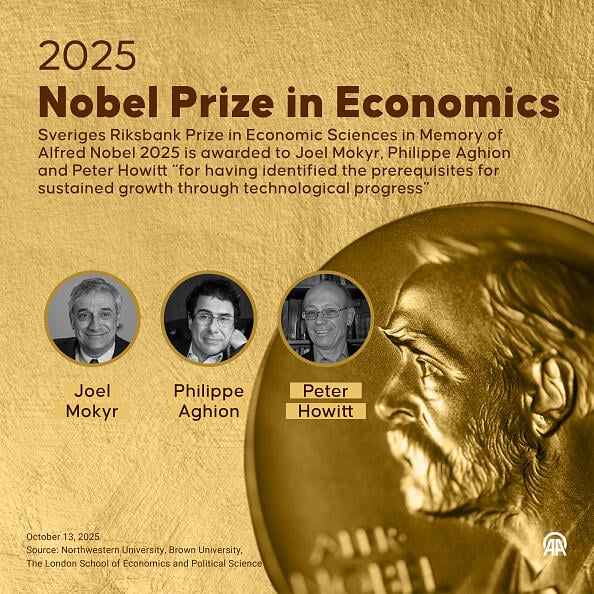
    Two American academics were among the three winners of this year’s Sveriges Riksbank Prize in Economic Sciences in Memory of Alfred Nobel. They were given the prestigious award “for having explained innovation-driven economic growth,” the Royal Swedish Academy of Sciences announced Monday morning.

    Joel Mokyr, the Robert H. Strotz Professor of Economics at Northwestern University, will receive half the roughly $1.6 million prize “for having identified the prerequisites for sustained growth through technological progress,” according to the announcement.

    Peter Howitt, a professor emeritus of economics at Brown University, will split the other half of the award money with Philippe Aghion of Collège de France and INSEAD and the London School of Economics and Political Science, “for the theory of sustained growth through creative destruction.”

    “The laureates’ work shows that economic growth cannot be taken for granted,” said John Hassler, chair of the committee for the Prize in Economic Sciences. “We must uphold the mechanisms that underlie creative destruction, so that we do not fall back into stagnation.”

    Source link

  • Pepperdine Closes Exhibit Featuring “Overtly Political” Art

    Pepperdine Closes Exhibit Featuring “Overtly Political” Art

    Henry Adams/Pepperdine Graphic

    Last month Pepperdine University in Malibu, Calif., opened an art exhibit titled “Hold My Hand In Yours,” which was scheduled to run for six months in the on-campus Frederick R. Weisman Museum of Art. But On Oct. 6, the university closed the exhibit after artists learned their work had been removed or altered for being “overtly political.”

    The exhibition, curated by Weisman Museum director Andrea Gyorody, centered on the imagery of hands in paintings, drawings, sculpture and videos, among other media, with a focus on hands as a means of labor and care, according to the museum’s website.

    Last week, one of the artists in the show learned her video had been turned off at the university’s request, and a sculpture had been modified to hide text that said “Save the Children” and “Abolish ICE,” Hyperallergic reported. The creators requested their pieces be removed from the museum, and several other contributors followed suit in solidarity with the affected artists and in opposition to the university.

    Pepperdine administrators alleged the pieces went against the museum’s policy to “avoid overtly political content consistent with the university’s nonprofit status,” Michael Friel, senior director of communication and public relations at Pepperdine, told Inside Higher Ed in an email.

    In addition to removing pieces, the university inquired about posting signage that notifies visitors that “the artwork does not necessarily reflect the views of the university,” Friel noted. “That process has not been successful.” With the addition of the artists pulling their work, the museum decided to close the gallery. All compensation agreements are being honored and inconvenienced artists have received an apology, according to Friel.

    “For the past week, the administration’s rationale for the initial censorship and removal has been murky and opaque, and honestly, still unclear to me. It didn’t have to be this way,” Stephanie Syjuco, an artist who was featured in the show, wrote on Instagram.

    The Weisman Museum is housed under the university’s advancement office. “Our intent is to maintain the highest standards of excellence as we celebrate artistic expression through the visual arts,” Friel said.

    In 2019, Pepperdine censored a senior art student’s gallery because the art featured nude bodies; officials placed the art in a mobile gallery instead of in the Weisman Museum, which featured work by the artist’s peers.  


    Source link

  • Trump Fires More Education Dept. Employees

    Trump Fires More Education Dept. Employees

    Photo illustration by Justin Morrison/Inside Higher Ed | Tierney L. Cross/Getty Images | BraunS and Prostock-Studio/iStock/Getty Images

    Staff members at the Department of Education will be affected by the mass layoffs taking place across the federal government, a spokesperson said Friday.

    Russell Vought, director of the Office of Management and Budget, has threatened the layoffs for weeks, citing the government shutdown. Vought wrote on social media Friday that his promised reduction in force had begun.

    A department spokesperson then confirmed in an email to Inside Higher Ed that “ED employees will be impacted by the RIF.” The spokesperson did not clarify how many employees will be affected or in which offices. Other sources say no one who works in the Office of Federal Student Aid will be laid off.

    Trump administration officials said in a court filing that an estimated 466 employees were given reduction-in-force notices. About 1,100 to 1,200 employees at the Department of Health and Human Services also got laid off. Overall, more than 4,200 workers across eight agencies were fired.

    At the Education Department, the estimated layoffs will leave the department with just over 2,001 employees. The agency, which President Trump wants to close, already lost nearly half its career staff members during a first round of mass layoffs in March. In the wake of those layoffs, former staffers warned that the cuts would lead to technical mishaps, gaps in oversight and a loss of institutional knowledge. College administrators have also reported delays and issues in getting communications and updates from the department, though agency officials say critical services have continued.

    The federal workers’ union and multiple outside education advocacy groups challenged the first round of layoffs in court. Lower courts blocked the RIF, but the Supreme Court overturned those rulings in July. Affected staff members officially left the department in August.

    Another lawsuit challenged this latest round when Vought threatened the layoffs – before the pink slips had even been distributed today. It was filed at the end of September.

    The union representing Education Department employees as well as sources with connections to staffers who were still working at the department as of Friday morning said that the latest round of cuts will at least affect staff members from the offices of elementary and secondary education and communications and outreach. A union representative added that all of the employees in the communications office’s state and local engagement division were laid off.

    A senior department leader, who spoke on condition of anonymity, told Inside Higher Ed that the layoffs were directed by OMB and came as a surprise.

    “Last week the [education] secretary’s office had said no RIFs at all,” the senior leader explained. “We heard on Tuesday that OMB sent over a list of people for ED to RIF … ED apparently edited it and sent it back.”

    In neither case were cuts planned for the Office of Federal Student Aid, which manages the Pell Grant and student loans, the senior leader added.

    Rachel Gittleman, president of the union that represents Education Department employees, promised in a statement to fight the layoffs.

    “This administration continues to use every opportunity to illegally dismantle the Department of Education against congressional intent,” Gittleman said. “They are using the same playbook to cut staff without regard for the impacts to students and families in communities across the country … Dismantling the government through mass firings, especially at the ED, is not the solution to our problems as a country.”

    Through late September and into the first 10 days of the shutdown, both Vought and President Trump used the threat of further RIFs to try to convince Democrats in the Senate to acquiesce and sign the Republicans’ budget stopgap bill. But Democrats have stood firm, refusing to sign the bill unless the GOP meets their demands and extends an expiring tax credit for health insurance.

    Health and Human Services Department spokesperson Andrew G. Nixon wrote in an email to Inside Higher Ed earlier on Friday that “HHS employees across multiple divisions” received layoff notices. But he didn’t provide an interview or answer written questions about whether the layoffs include employees at the National Institutes of Health, a major funder of university research.

    Nixon wrote that “HHS under the Biden administration became a bloated bureaucracy” and “all HHS employees receiving reduction-in-force notices were designated non-essential by their respective divisions. HHS continues to close wasteful and duplicative entities, including those that are at odds with the Trump administration’s Make America Healthy Again agenda.”

    Democrats and some Republicans have warned against the layoffs. Sen. Susan Collins, a Maine Republican who chairs the powerful appropriations committee, opposed the layoffs in a statement while also blaming Democrats in the shutdown.

    “Arbitrary layoffs result in a lack of sufficient personnel needed to conduct the mission of the agency and to deliver essential programs, and cause harm to families in Maine and throughout our country,” she said.

    But Democrats in particular have argued that firing federal workers during a shutdown is unconstitutional.

    “No one is making Trump and Vought hurt American workers—they just want to,” Sen. Patty Murray, a Washington State Democrat and vice chair of the appropriations committee, said in a statement Friday afternoon. “A shutdown does not give Trump or Vought new, special powers to cause more chaos or permanently weaken more basic services for the American people … This is nothing new, and no one should be intimidated by these crooks.”

    Rep. Bobby Scott, a Virginia democrat and ranking member of the House Education and Workforce Committee, pointed out in a statement that the administration has had to rehire employees who were fired earlier this year.

    “In addition to wasting millions of taxpayer dollars to fire and rehire government employees, arbitrarily firing government employees means there are fewer people to help administer essential programs,” he said. “Moreover, I fear the lasting impact of mass firings will be an incredible loss of invaluable institutional knowledge. Furthermore, random and chaotic layoffs will make it difficult to recruit qualified employees in the future.”

    Ryan Quinn contributed to this report.

    Source link

  • ACE, Other Higher Ed Groups Endorse Strada Framework for Connecting College and Career

    ACE, Other Higher Ed Groups Endorse Strada Framework for Connecting College and Career

    The American Council on Education (ACE) has joined a coalition of higher education organizations—including the American Association of Community Colleges, the American Association of State Colleges and Universities, the Association of American Colleges and Universities, and NASPA—in endorsing Strada Education Foundation’s Principles for Quality Education-to-Career Guidance.

    The framework lays out a clear vision for how colleges and universities can help students connect their education to meaningful careers. It calls for guidance that is equity-centered, driven by student agency, and informed by evidence and labor market data.

    “By centering education-to-career guidance on equity, student agency, and evidence, these principles strengthen ACE’s work in shaping responsive policy, supporting nontraditional learners, and advancing flexible, career-aligned pathways,” said ACE President Ted Mitchell.

    Strada’s five guiding principles are:

    1. Centered on education-to-career outcomes
    2. Driven by student agency
    3. Foundational and universal
    4. Rooted in relationships
    5. Informed by data and evidence

    The framework builds on Strada’s 2024 report Quality Coaching: Helping Students Navigate the Journey from Education to Career, which outlined the essential components of effective coaching to help students persist, complete, and secure college-level jobs after graduation.

    —Hollie Chessman


    If you have any questions or comments about this blog post, please contact us.

    Source link