Tag: Career

  • Tuition Discounts Fuel Higher Ed Skepticism

    Tuition Discounts Fuel Higher Ed Skepticism

    Tuition discounting is a tactic private colleges have long used to control a primary revenue stream. But over the past decade, an increasingly precarious financial picture—driven in part by stagnating state funding and tuition caps—has pushed public institutions to adopt tuition-discounting policies, too.

    According to an issue brief from the Strada Education Foundation, the share of first-time, full-time undergraduates receiving institutional grant aid at public four-year institutions increased from 49 percent to 62 percent between 2014–15 and 2021–22. The average discount rates increased from 24 percent to 31 percent over the same period.

    Strada argued in the brief that tuition discounting sows confusion about the real cost of college among students and their parents. The practice also fuels increased public skepticism about the value of a college degree. It warned that growing financial uncertainty for public higher education could make the problem worse.

    “State postsecondary budgets soon may face new strains stemming from federal actions, demographic shifts, and broader fiscal pressures,” the brief said. “Without intentional alignment between states and institutions, this environment could drive even more aggressive tuition discounting in the years ahead—further complicating cost transparency for students, public missions, and the perceived value of education.”

    Tuition discounts allow institutions to maintain financial stability and recruit academically strong or underrepresented students who may be enticed by a big discount presented as a scholarship. However, increases in merit-based aid can “favor wealthier or out-of-state students at the expense of low-income, in-state residents,” according to Strada’s brief.

    “These practices also leave students, families, and citizens confused and without a transparent understanding of the cost of higher education,” the report said, noting that low-income and first-generation college students are especially vulnerable to uncertainty around tuition prices. “As the debate over the value of postsecondary education continues, exaggerated prices and confusion over actual costs weigh heavily on public trust and whether ‘college is worth it.’” 

    The report recommends a set of guiding principles to address tuition discounts:

    • Transparency and clarity for families;
    • Alignment between state and institutional aid;
    • Regular assessment of aid strategies;
    • Ensuring discounting supports public mission and access goals, not just revenue; and
    • Avoiding blunt, one-size-fits-all approaches.

    Source link

  • Readers Respond on Advising The Girl

    Readers Respond on Advising The Girl

    (Program note: In order to reduce the competition for attention, this column’s Monday and Thursday schedule has been changed to Monday and Friday.)

    Monday’s post outlined The Girl’s many academic strengths and mourned some changes in the field that make pursuing her preferred career a high-risk enterprise. She’s a wildly talented reader and writer—insightful, distinctive and often funny—who would make a great English professor if the world still offered jobs like those in any meaningful number. She’s looking closely at an information science option. I asked my wise and worldly readers if they had any thoughts on advice I could offer her.  

    Luckily, I have the best readers ever. Folks responded thoughtfully and graciously. Some highlights and patterns:

    • Readers within the library world responded with variations on “We love our jobs, but they’re getting scarcer, too.”
    • Even there, though, hope could be found. A few pointed out that having a master’s degree in a discipline can be a selling point with academic libraries. They often suggested getting a foot in the door at a university library, then using the free tuition offered to staff to get the master’s in English. I have to admit that free tuition is a nifty benefit.
    • They also pointed out that working full-time in a college or university library doesn’t preclude teaching the occasional English course on the side. Adjuncting for a living is brutal, but a course on the side—when the basic needs are met elsewhere—can be gratifying.

    One wise and worldly reader took issue with the assumption that graduate programs are about getting jobs. As he put it,

    “I tell students that, so long as you are going to grad school in a funded program, if no job in academia results, then you’ve had the privilege of spending fiveish years doing something that few people get to ever do. And then, in terms of career prospects, you’re right back where you were when you finished your B.A. Being in a funded grad program will allow you to tread water, financially speaking. So yes, you will be behind your friends from undergrad who went straight into careers and began building up equity in their homes and their 401(k)s, but that is the sacrifice one makes to get to spend time in grad school.”

    Concur in part and dissent in part. (That’s language from the Supreme Court, from back when they used to explain their decisions.) It’s certainly true that the kind of extended reading of academic texts that grad students do is rare outside of the academy. And on good days, there can be real intellectual excitement. But I also remember a lot of posturing, preening, bluffing and one-upmanship that seemed as petty as would be found anywhere else. And while it’s true that a fellowship is a rare privilege, it’s also true that the opportunity cost of subsistence-level living for five or more years is shockingly high. So yes, it can be intellectually rewarding, but I suspect there are other ways to get that without being quite so broke.

    Another reader reframed the issue, putting the field of study at the center:

    “If I really believe in the importance of transmitting human culture across generations, then should I maintain that it’s worth doing only when it’s economically expedient? Would I have any real credibility with my students if I seemed to tell them, out of one side of my mouth, that reading Walden and Moby-Dick is a valuable use of their time and a potential source of future wisdom and happiness, and then also tell them, out of the other side of my mouth, that they should make career choices that are at odds with what they’re gleaning from these books—and also, by the way, not be bothered if those books disappear from their children’s and grandchildren’s civilization?”

    It struck me as a variation on the much older idea of a calling. I’m sympathetic to that at some level—when I don’t write for a while, I feel out of tune—but I’ve seen the idea of a calling used to justify appalling levels of exploitation. While TG is wildly talented, she’s also pragmatic; her politics, like mine, are about rejecting poverty across the board, rather than romanticizing it. I consider her clear-sightedness a real strength. She wants to make an adult living, and I don’t blame her one bit.

    On the opposite end, one reader suggested that she pick up some training in automotive repair, start working in a shop, and use her communication skills to move up over time. It’s an interesting theoretical point, and it brought back fond memories of Car Talk, but I don’t see her doing that. (She confirmed my hunch.)

    High school teaching also showed up as a frequent option. Even as professor gigs seemingly vanish into the ether, many states have teacher shortages. As dual enrollment gains ground, opportunities for teaching at least introductory college-level courses may become easier to find. High school is a very different environment, but the option exists.

    Several readers’ stories (or their children’s stories) started with traditional academic pathways and veered into institutional research (the in-house research office on campuses) or instructional design. Both fields draw on a general knowledge of the ways that higher ed works, and a rapport with faculty is helpful in both. The job market for instructional designers appears to be much healthier than the market for either librarians or humanities faculty. That may be because instructional design can lead to corporate training jobs, as well as jobs in the academy. A wider scope of potential options is not a bad thing.

    Others made the point in various ways that career paths aren’t linear. One mentioned a daughter with a Ph.D. in physics who went on to become a successful patent attorney. Another started trying to be a librarian, switched to the tech world, got a Ph.D. in philosophy and now helps engineers with their people skills.

    I had to smile at this argument, because I know it’s true. If you had told me, in the midst of my doctoral program, that I’d spend much of my career in community college administration, I would have looked at you quizzically. Yet here we are. Degrees matter most at the early stage; by a decade or two into a career, it’s not unusual for the job title to be pretty distant from the degree. But TG is at the early stage, so it still matters.

    Thanks to everyone who wrote! I was gratified by the generosity of spirit that everyone showed. Best. Readers. Ever.

    Source link

  • NIH Fires 4 Directors After Putting Them on Leave

    NIH Fires 4 Directors After Putting Them on Leave

    Wesley Lapointe/The Washington Post via Getty Images

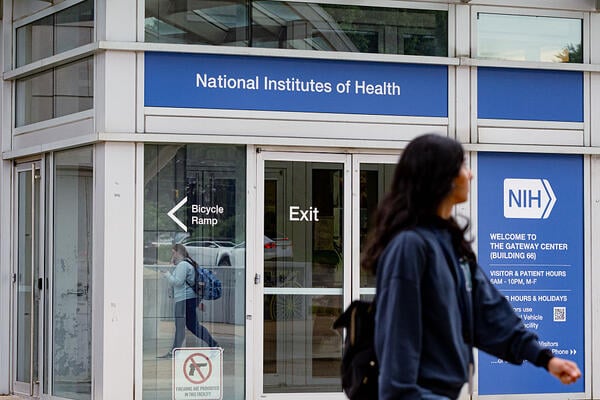
    Four directors at the National Institutes of Health who were placed on administrative leave earlier this year have now been fired, Science reported.

    The ousted leaders led the National Institute of Allergy and Infectious Diseases, the National Institute of Child Health and Human Development, the National Institute on Minority Health and Health Disparities, and the National Institute of Nursing Research. Tara Schwetz, the deputy director for program coordination, planning and strategic initiatives, was also fired. The directors were put on leave in the spring around the same time that the administration laid off thousands at the Department of Health and Human Services.

    Science reported that the directors felt they were targeted as part of the administration’s crackdown on diversity, equity and inclusion and for political reasons. Jeanne Marrazzo, the former NIAID director, took over for Anthony Fauci, a frequent target for Republicans who took issue with his approach to the COVID-19 pandemic. Marrazzo filed a whistleblower complaint in early September that in part accused NIH leadership of downplaying the value of vaccines, The New York Times reported.

    “It’s not surprising, but it’s still incredibly disappointing,” Marrazzo told Science. “I would have been quite happy to serve under the new administration as long as we were allowed to do our jobs.”

    Source link

  • Duration-of-Status Rule Prompts Opposition From Commenters

    Duration-of-Status Rule Prompts Opposition From Commenters

    A slew of public commenters derided the Department of Homeland Security’s proposal that would restrict how long international students can stay in the country.

    The measure would alter the long-standing policy known as duration of status, which allows international students to stay in the U.S. until their course of study is complete. Among other concerns, commenters argued that the rule would unnecessarily restrict international students, who are already closely monitored by the government and their institutions of study. Many commenters also drew attention to the potential consequences for the health-care system and employers.

    The proposed rule would instead cap the amount of time students could stay in the U.S. to just four years, though they would be able to request an extension from U.S. Citizenship and Immigration Services. It would also prevent international students from changing their majors or transferring between U.S. institutions.

    According to DHS, the proposal aims to lessen the number of students who overstay their F and J visas. However, NAFSA, the international education association, argued that research has shown that DHS overestimates overstay rates. The organization, along with other commenters, also noted that the Student Exchange and Visitor Information System—the online system that monitors international students—already alerts Immigration and Customs Enforcement if a student overstays their visa.

    The comment period closed on Sept. 29. DHS will now have to review and respond to more than 15,700 comments before deciding whether to move forward with the elimination of duration of status.

    More Than 4 Years

    Numerous commenters noted that a significant number of students take more than four years to complete their undergraduate degree—and it’s incredibly rare to complete a Ph.D. in that length of time. That means a significant number of students will be at risk of being unable to complete their programs if they are unable to secure extensions.

    Commenters noted a range of reasons they, their peers or their students have struggled to finish a degree in under four years, including medical and family emergencies, the death or departure of a faculty mentor, completing cooperative internships, and more.

    Others pointed out that some programs are even intended to take longer than four years. Jessica Goswick, an architect and a lecturer, wrote that a B.Arch., a professional bachelor’s degree in architecture, is intended to be completed in five years. The University of Illinois system—one of several dozen institutions that opposed the rule in written comments—said that its main Urbana-Champaign campus has over 30 undergraduate programs requiring more than 120 credit hours.

    “Limiting initial entry to four years would require students in these programs to take more than 15 credits every semester for four years, which would reduce performance and graduation rates,” the system’s comment reads. “Undergraduate students should be encouraged to take course loads appropriate for success rather than rush toward an arbitrary completion date determined by their date of entry to the United States.”

    Several researchers and current Ph.D. students also stressed that graduate students frequently need more time to complete their research.

    “Reducing this time for foreign student scientists would make it impossible for them to earn a Ph.D. in many fields, including my own field of neuroscience. Science takes years to build, develop, execute, and compile in order [to] share the information with the world and enrich the scientific community,” wrote Grace Swaim, a postdoctoral researcher at Yale University.

    Although students would have the option to get their visas extended beyond the four-year cap, experts warned that doing so is costly, time-consuming and uncertain, and it would add to USCIS’s already-lengthy processing time—about 6.5 months—for such extensions, according to NAFSA. The University of Illinois system also emphasized that the rule would force the system to hire 13 new full-time and one part-time employee and spend over $2 million in the first year alone to apply for these extensions.

    These added barriers could ultimately lead fewer students to want to study in the United States, commenters warned, which many faculty said would be a loss for their labs, their larger institutions and the country as a whole.

    “These students not only make crucial contributions to the fundamental research in our department, but often end up filling important roles in industry, academia and national labs in the U.S. Others contribute to the international efforts unraveling the nature of matter and developing novel technologies even after returning to their home country,” wrote Sebastian Kuhn, chair of the physics department at Old Dominion University. “International graduate students are an indispensable contribution to the success of the U.S. research enterprise and the international standing of our country.”

    Beyond the Campus

    Other commenters shared that the rule could have an impact outside of the classroom and the lab. Physicians and hospital administrators said the roughly 17,000 J-1 visa holders currently working in hospitals as part of their medical training would be affected and detailed in comments how the change could ultimately disrupt Americans’ access to health care.

    “It is important to recognize that the 17,000 J-1 physicians training in the U.S. do not displace domestic medical graduates; rather, they fill residency slots that would otherwise remain unfilled each year,” wrote the American Hospital Association in a comment. “These physicians disproportionately train in high-need specialties that continue to be in substantial shortage, such as internal medicine, pediatrics and family medicine. They also frequently work in rural and underserved communities, and many who train in those settings continue to work in them when their training is complete. J-1 physicians not only help sustain the physician workforce pipeline but also help expand patient access to essential care.”

    Numerous commenters who identified themselves as leaders in industries from financial services to pharmaceuticals also explained how their companies and industries at large rely on the contributions of international students.

    “The maximum stay restrictions are especially problematic for Ph.D. students and those conducting long-term clinical trials, which often span five to seven years,” wrote an anonymous commenter who identified themself as a senior executive in a global pharmaceutical company. “Reducing this flexibility would disrupt important research in drug efficacy and public health. Students engaged in such long-term research projects would be forced to abandon their work prematurely, leading to a waste of time, resources, and intellectual capital that the U.S. cannot afford to lose.”

    A seemingly small number of comments were in favor of the change, with many of the supportive comments claiming international students are taking jobs and spots at colleges away from Americans.

    One higher education association—the Council for Christian Colleges and Universities—did not outright oppose the measure, but rather encouraged DHS to limit it just to colleges with admission rates under 30 percent. The council’s president, David A. Hoag, argued that those are the institutions at which the administration is concerned about “foreign students potentially displacing American students.”

    “This approach directly addresses the administration’s stated concern by focusing on the subset of institutions where foreign student enrollment is most likely to impact domestic applicants,” he wrote. “By limiting the rule’s scope in this way, DHS can more effectively target its regulatory efforts while minimizing unnecessary restrictions on less selective schools where this displacement issue is less pronounced.”

    Source link

  • Texas Tech Clarified Anti-Trans Policies in FAQ—Then Removed It

    Texas Tech Clarified Anti-Trans Policies in FAQ—Then Removed It

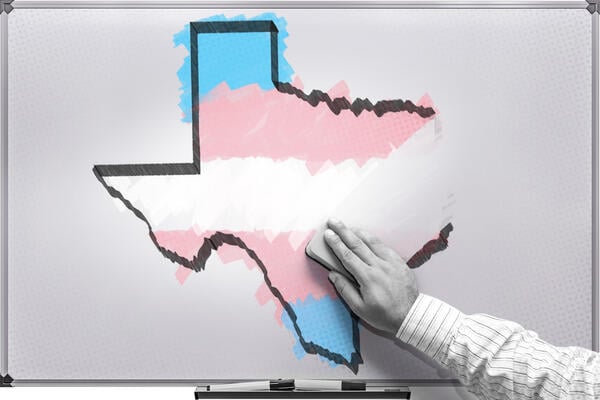
    Photo illustration by Justin Morrison/Inside Higher Ed | menonsstocks/E+/Getty Images | snorkulencija/iStock/Getty Images

    After a confusing week, Texas Tech University officials offered the first written clarification on new university policies that prohibit faculty members from speaking or teaching about transgender identity. On Sunday, the provost’s office posted a lengthy frequently asked questions page that, among other things, addressed the definition of “noncompliant language,” explained how the new policies impact research and answered whether faculty can write on their syllabi that they are an ally to transgender people.

    But after three days, the FAQ was taken down. Faculty have not been told why the information was removed, and health-care instructors are concerned students will not be trained in care for transgender patients, as required by certification exams.

    A university spokesperson did not respond to Inside Higher Ed’s questions on the matter. Some faculty suspect that Brandon Creighton, who was officially named the Texas Tech system’s next chancellor on Tuesday, may have orchestrated the removal of the FAQ. Creighton was the lead author of the Texas Senate’s sweeping ban on diversity, equity and inclusion in 2023, and of the recent bill giving control of faculty senates to university presidents and boards. He will assume the chancellor role on Nov. 19.

    While it was the first and most comprehensive written guidance Texas Tech has posted on its anti-trans policies, the FAQ left a lot of questions unanswered. The word “transgender” wasn’t included in any of the written answers. In one answer, officials wrote that noncompliant language “refers specifically to outdated or inaccurate syllabus content (i.e., COVID-era statements or statements referring to offices or units that no longer exist at Texas Tech.),” but said nothing about gender identity.

    In response to a question about academic freedom, officials wrote, “Faculty may include course content that is relevant to a student’s program of study and post-graduation opportunities, including workforce and additional education. Faculty are encouraged to be thoughtful about including content that is described in the Chancellor’s memo.”

    The new directives do not impact research, the FAQ clarified. Officials advised against including a “personal statement of student support” or a statement professing LGBTQ allyship, writing that “such a statement could attract unwanted attention.” They also wrote that faculty could include a preferred name policy on their syllabi, but that “until further clarification is available, it is advisable to omit personal pronoun language.” When relevant, instructors are permitted to facilitate classroom discussions in which students examine the state’s position on gender alongside other views, but the instructor may not advocate for any particular view.

    In a later question about government censorship and faculty retention, officials wrote, “We recognize that faculty recruitment and retention may be affected. At present, the issued guidance applies only to instructional activities, not a faculty member’s independent research.”

    The Texas conference of the American Association of University Professors has pushed back on the anti-trans policies at Texas Tech and other public universities in the state.

    “Colleges and universities have an obligation to develop campus policies that protect the constitutional rights of their faculty to teach and research the subjects in their areas of expertise without intimidation or censorship,” said Brian Evans, president of the Texas conference of the AAUP. “By ensuring that teachers can speak freely, campus administrators should enable students to explore and learn the widest set of topics for civil engagement and successful careers. Campus policies related to academic freedom and free speech should be devised with the full participation of faculty in the spirit of a shared commitment to excellence.”

    The FAQ—as short-lived as it was—only applied to Texas Tech’s flagship campus. The four other campuses in the public system, including Angelo State University, where faculty have received a profusion of conflicting verbal information, were not included.

    A faculty member at the Texas Tech University Health Sciences Center who asked to remain anonymous for fear of retribution confirmed to Inside Higher Ed that faculty at their campus have been told not to use certain terms in their course content, including “transgender”; “gender-affirming care”; “diversity, equity and inclusion”; and “affirmative action.” Health Sciences Center faculty have not received any written guidance, and the deans don’t have clarifying information, either, the faculty member said. It is an especially troubling policy to enforce for health-care students, because care for transgender patients is included in some certification exams students must pass to be licensed, they said.

    “There are certainly many things that our government has [outlawed] … but I can’t think of another thing that we’ve been told we can’t talk about,” the faculty member said. “Sex trafficking is illegal, but we can talk about how to care for people who have been victims of sex trafficking. Drunk driving—there’s about a million examples.”

    It is unclear how much information students have about these new policies, according to the faculty member. Some students are bringing up transgender care in classroom discussions, and instructors are unsure how to respond.

    Source link

  • Mike Gavin Resigns to Lead DEI Defense Coalition

    Mike Gavin Resigns to Lead DEI Defense Coalition

    Mike Gavin, the founder of Education for All, a grassroots group of community college administrators fighting legislative attacks on diversity, equity and inclusion, will step down as president of Delta College in January. He has been in the post since 2021. 

    Gavin informed the Delta College Board of Trustees last week that he would resign to lead a national coalition focused on defending equity in higher ed. 

    “My whole career has been focused on equity and how higher ed is situated in the democratic experiment, so when I was asked to do the next thing, I felt compelled to do it,” Gavin told Inside Higher Ed

    “I was not looking for a job. Delta has been amazing. The faculty and staff are some of the most insightful and student-centered I’ve ever seen,” he said. 

    More information about the coalition, including its priorities and funding model, will be released soon, he added. 

    Since the early days of the second Trump administration, Gavin has been a leading voice in defending DEI work in higher ed, especially at community colleges. Participation in Education for All surged at the beginning of the year as college leaders sought advice on protecting programs and navigating compliance with Trump administration mandates. 

    “My scholarship rests on the great thinkers of our past, from Benjamin Franklin to James Baldwin. It is also grounded in the belief that our country depends on a higher education sector that must be free from partisan interference, in order to democratize higher education for all,” Gavin wrote in a letter to the Delta College community.  

    Delta College trustees said they will begin the process of appointing Gavin’s successor in the coming weeks. 

    Source link

  • Judge Upholds Biden-Era Gainful Employment Rule

    Judge Upholds Biden-Era Gainful Employment Rule

    A federal judge rejected an effort to overturn the gainful-employment rule, which was put in place during the Biden administration.

    In an opinion issued Thursday, Judge Reed O’Connor from the Northern District of Texas sided with the Education Department on every point. One of the plaintiffs, a trade association representing cosmetology schools, had argued in its lawsuit that the regulations jeopardized the “very existence” of cosmetology schools and used flawed measures to determine whether graduates of career education programs are gainfully employed.

    Under the rules, for-profit and nondegree programs have to prove that their graduates can afford their loan payments and earn more than a high school graduate. Those that fail the tests in two consecutive years could lose access to federal financial aid. The regulations also included new reporting requirements for all colleges under the financial value transparency framework. 

    The lawsuit started under the Biden administration, and Trump officials opted to defend the regulations in court and urged the judge to keep the rules in place. 

    Similar gainful-employment rules survived a legal challenge in 2014 but were ultimately scrapped by the first Trump administration. However, in recent years, lawmakers on both sides of the aisle have become more interested in finding ways to hold colleges accountable for their students’ career outcomes. Under legislation that Congress passed this summer, most college programs will have to pass a similar earnings test. How the Education Department carries out that test will be subject to a rule-making process set to kick off later this year.

    Jason Altmire, president and chief executive officer of Career Education Colleges and Universities, which represents the for-profit sector and opposed the Biden rule, said in a statement that he looks forward to revisiting the issue during the rule-making process.

    “We are confident the Biden Gainful Employment Rule will be revised to incorporate a fairer accountability measure that will apply equally to all schools, ensuring all students can benefit,” he said. “We look forward to a full consideration of these issues during the months ahead.”

    Dan Zibel, vice president of the legal advocacy group Student Defense, applauded the court ruling in a statement. 

    “Higher education is supposed to offer students a path to a better life, not a debt-filled dead end,” he said. “The 2023 Gainful Employment Rule reflects a common-sense policy to ensure that students are not wasting time and money on career programs that provide little value.”

    Source link

  • ED Put Political Out-of-Office Reply on Staff Emails

    ED Put Political Out-of-Office Reply on Staff Emails

    Photo illustration by Justin Morrison/Inside Higher Ed | Tierney L. Cross/Getty Images | nevodka/iStock/Getty Images

    Wednesday morning, as the government shutdown began, chief officers at the Department of Education distributed a standard out-of-the-office statement to all furloughed staff members and instructed them to copy and paste it into their email. So that’s what they did.

    But just hours later, those same nonpartisan staffers began to hear that the message they’d pasted into their email account was not the message being received by the public.

    “On Wednesday evening, my supervisor reached out to me on my personal equipment and said, ‘You’re going to want to log in and change your out-of-office status,’” one department staffer told Inside Higher Ed on the condition of anonymity out of fear of losing her job.

    When she followed her supervisor’s direction and logged in, the automatic message she saw was not the one she had saved earlier that morning.

    Rather than the original note, which had said, “There is a temporary shutdown … due to a lapse in appropriations,” the new message said, “Unfortunately, Democrat Senators are blocking passage of [a bill] … which has led to a lapse in appropriations.”

    This is one of the more than 10 emails Inside Higher Ed received as automatic responses including the same political message. Although Keast was appointed by Trump, most of the staffers we contacted were not.

    The outgoing message had been changed internally without her consent. And this staffer was not alone. Inside Higher Ed emailed 10 separate Education Department staffers Thursday, all of whom had been placed on furlough, and each one bounced back with identical responses. One senior leader from the department, who also spoke anonymously, said that to his knowledge the politically charged message was set as the out-of-office notification for all furloughed employees.

    (The Department of Education did not immediately provide comment. In fact, the emails sent to both deputy press secretary Ellen Keast and the general press team account were met with the same automatic response.)

    The first staffer said that while she was caught off guard by the override at first, it made sense the more she thought about it. Similar messages blaming Democratic senators for the shutdown had already been put at the top of HUD.gov, the landing page for all things Department of Housing and Urban Development, and other federal websites.

    As of Thursday evening, the HUD website noted, “The Radical Left in Congress shut down the government. HUD will use available resources to help Americans in need.”

    Republicans control the White House, the House and the Senate. In the Senate, they need the votes of at least seven Democratic senators to reach the 60-vote threshold necessary to overcome a filibuster.

    “I was really surprised, because we had gotten such explicit instructions on what to use for our out-of-office message,” the staffer said. But “when I saw that message from my supervisor, I assumed it had been changed to something more political than the original neutral one.”

    She has already logged back in multiple times to change the automatic response back to the neutral language. But each time, within hours, the department has overridden her changes.

    “It’s what [is being sent] to people who contact me, and they could reasonably misunderstand it as coming from me, and I don’t feel comfortable as a federal employee communicating a political message like that,” she said.

    A second staffer told Inside Higher Ed that he has worked through multiple shutdowns prior but not experienced anything like this.

    “It’s just wild to see your name attached to a message that you had nothing to do with,” he said. “It feels like a violation … You know that you don’t have any expectation of privacy when you’re working for the federal government. But it’s a different thing to say that you don’t have autonomy over your own words.”

    The second staffer noted that in his view, not only did this seem to be a violation of his personal rights, but also a violation of federal law.

    The Hatch Act, passed in 1939, was intended to ensure that nonpartisan federal workers who worked across administrations remained just that—nonpartisan. And according to documents from the Office of Special Counsel website, the Hatch Act “limits certain political activities of federal employees,” like using official authority for political purposes, soliciting political donations, wearing partisan political gear at work and posting or sharing partisan content on government systems.

    “It’s crazy to see the law violated on your behalf,” the second staffer said.

    None of the department employees Inside Higher Ed spoke with intended to file an individual lawsuit, nor had they heard anything from their union about a collective legal response. But one shared that Democracy Forward, a nonprofit legal organization that has sued the Trump administration several times this year, will be going to court over the matter as soon as Friday.

    Source link

  • White House Floats Compact for Preferential Treatment

    White House Floats Compact for Preferential Treatment

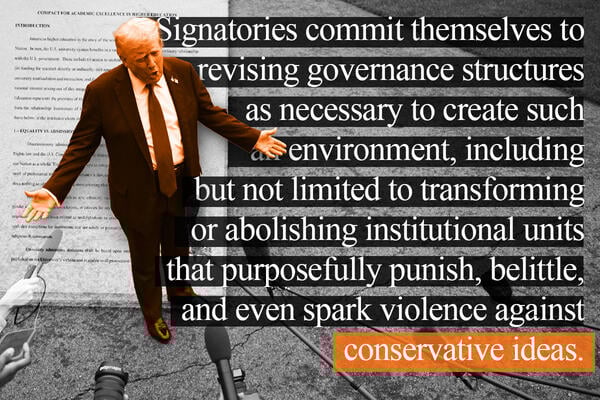
    The Trump administration has asked nine universities to sign on to a proposed compact, mandating certain changes in exchange for preferential treatment on federal funding.

    First reported by The Washington Post and confirmed, with additional details, by The Wall Street Journal, the proposal seeks an agreement with nine institutions that are being asked to commit to a 10-point memo referred to as the “Compact for Academic Excellence in Higher Education.”

    Among the various conditions, institutions are reportedly being asked to:

    • Ban consideration of race or sex in hiring and admissions processes
    • Freeze tuition for a five-year period
    • Limit international undergraduate enrollment to 15 percent of the student body
    • Commit to institutional neutrality
    • Require applicants to take standardized tests, such as the SAT or ACT
    • Clamp down on grade inflation
    • Ensure a “vibrant marketplace of ideas on campus” 
    • Restrict employees from expressing political views on behalf of the institution
    • Shut down departments that “punish, belittle” or “spark violence against conservative ideas”
    • Anonymously poll students and employees on compact compliance and publish the results

    Another requirement mandates that signatories “deploy their endowments to the public good,” such as by not charging tuition to students “pursuing hard science programs (with exceptions, as desired, for families of substantial means)” for universities with more than $2 million per undergraduate student in endowment assets. Universities would also be required to post more details about graduates’ earnings and refund tuition to those who drop out in their first semester.

    After leveraging funding freezes and other tactics to pressure colleges to make changes, the compact reflects a different approach from the administration while still geared toward the same goal—remaking higher education in Trump’s image. May Mailman, a Trump adviser, hinted at the plan in a New York Times interview a week before the proposal emerged, saying it could be a way for universities to affirm they are “doing the right things.”

    “The Trump administration does not want to be all Whac-a-Mole or all negative, but these are the principles that universities and the Trump administration and, frankly, private donors can ascribe to to say, ‘This makes a great university,’” she told the Times.

    Institutions reportedly invited to join are: Brown University, Dartmouth College, the Massachusetts Institute of Technology, the University of Arizona, the University of Pennsylvania, the University of Southern California, University of Texas at Austin, the University of Virginia and Vanderbilt University.

    Those that agree will receive “multiple positive benefits,” including “substantial and meaningful federal grants,” according to a copy of the memo published by The Washington Examiner.

    But failure to comply with the agreement would come with steep consequences. Noncompliant universities would “lose access to the benefits of this agreement” for a year. Subsequent violations would lead to a two-year punishment. And the federal government could claw back “all monies advanced by the U.S. government during the year of any violation.” Private donations would also be required to be returned, upon request.

    The Department of Justice would be tasked to enforce the agreements.

    Institutional Responses

    Most universities did not respond to requests for comment from Inside Higher Ed. But Texas officials seem eager to sign on, sharing a statement indicating their enthusiasm for the compact.

    University of Texas system Board of Regents chairman Kevin P. Eltife wrote in the statement that the flagship was “honored” to be among the institutions “selected by the Trump Administration for potential funding advantages” under the proposed compact, which it is currently reviewing.

    “Higher education has been at a crossroads in recent years, and we have worked very closely with Governor [Greg] Abbott, Lt. Gov. [Dan] Patrick and Speaker [Dustin] Burrows to implement sweeping changes for the benefit of our students and to strengthen our our [sic] institutions to best serve the people of Texas,” Eltife wrote. “Today we welcome the new opportunity presented to us and we look forward to working with the Trump Administration on it.”

    University of Virginia spokesperson Brian Coy told Inside Higher Ed by email that interim president Paul Mahoney “created a working group under the leadership of Executive Vice President and Provost Brie Gertler and Executive Vice President and Chief Operating Officer J.J. Davis to advise him” on UVA’s response to the letter but has not yet made a decision to sign or not.

    USC simply said in a statement, “We are reviewing the Administration’s letter.”

    Both the White House and the Department of Education initially responded to requests for comment with automatic replies because of the federal government shutdown, which began Wednesday. A press office official later responded only to confirm The Wall Street Journal’s reporting.

    Outside Perspectives

    News of the proposal prompted a flurry of criticism within academic circles.

    American Association of University Professors president Todd Wolfson blasted the idea in a Thursday statement and called on governing boards to reject it.

    “The Trump administration’s offer to give preferential treatment to colleges and universities that court government favor stinks of favoritism, patronage, and bribery in exchange for allegiance to a partisan ideological agenda. This compact is akin to a loyalty oath. Adherence by university administrations would usher in a new era of thought policing in American higher education,” Wolfson wrote.

    The executive committee of Penn’s AAUP chapter also opposed the proposal.

    The Foundation for Individual Rights and Expression also criticized it in a post on X, writing that “the compact includes troubling language” specifically pointing to the call to eliminate academic departments critical of conservative ideas, which it cast as undermining free speech.

    “A government that can reward colleges and universities for speech it favors today can punish them for speech it dislikes tomorrow. That’s not reform. That’s government-funded orthodoxy,” FIRE officials wrote.

    Trinity Washington University president Pat McGuire called the proposal “political extortion.”

    Brendan Cantwell, a higher education professor at Michigan State University, told Inside Higher Ed there are multiple issues with the proposal, including vague language about political speech that could allow universities or the federal government to single out faculty members for publicly discussing topics within their expertise. He added that “enforcement is so vague” that it would be easy for the federal government to declare universities out of compliance with the agreement.

    Cantwell suggested, “This is probably a bigger deal than the Columbia [settlement] because it’s creating an incentive structure” that spurs universities to go along or opens them up to retaliation from the federal government, making it risky whether a university signs on or not.

    (Columbia agreed to far-reaching changes to admissions, hiring, disciplinary processes and more in July, including a $221 million fine, when it reached a deal with the federal government to settle over findings that it failed to properly police antisemitism on campus. Columbia did not admit to wrongdoing, but administrators have acknowledged the need for reforms.)

    Brian L. Heuser, a Vanderbilt professor and long-standing member of the university’s Faculty Senate, urged fellow senators and other faculty colleagues to organize against the idea in an email shared with Inside Higher Ed. Heuser called the compact “a dangerous departure from the core values that should underpin our institutions—namely, free inquiry, open debate, and institutional autonomy” and argued that it endangers academic freedom, among other concerns.

    But some conservatives have lauded the idea and want ED to push harder.

    “Secretary [Linda] McMahon deserves credit for working to disincentivize the use of race or sex in college admissions,” U.S. Sen. Todd Young, an Indiana Republican, wrote in a social media post. “We must go further—federally accredited institutions should eliminate ALL preferences grounded in ancestry, such as legacy status, or other factors unrelated to merit.”

    Why These 9?

    While it is unclear how the federal government landed on the nine schools as candidates for the proposal, one official told The Wall Street Journal the Trump administration believed they would be “good actors.” But contextual clues offer insights into why some may have been picked.

    Of the nine, only five presidents signed on to a letter published earlier this year by higher education organizations pushing back on government overreach and political interference, which ultimately gathered 662 signatures. Of those five presidents, one has since resigned: Jim Ryan at UVA, who faced pressure from the Trump administration after it claimed the university failed to fully dismantle diversity, equity and inclusion programs.

    Two institutions—Brown and Penn—previously struck deals with the federal government.

    Others have drawn attention for political reasons. At Vanderbilt, Chancellor Daniel Diermeier has emerged as a leading voice advocating for institutional neutrality and has clashed with other campus leaders, arguing that higher education is in desperate need of reform, agreeing with frequent conservative criticisms of the sector. And Texas—one of three public institutions on the list—has an overwhelmingly conservative board, and both the system and flagship are led by former Republican elected officials.


    Source link

  • UNC Professor on Leave After Alleged Advocacy of Political Violence

    UNC Professor on Leave After Alleged Advocacy of Political Violence

    Eros Hoagland/Getty Images

    Officials at the University of North Carolina at Chapel Hill placed Professor Dwayne Dixon on leave Monday while the university investigates his “alleged advocacy of politically motivated violence,” said Dean Stoyer, UNC Chapel Hill’s vice chancellor for communications and marketing.

    Dixon, an associate professor of Asian and Middle Eastern studies, used to be a member of Silver Valley Redneck Revolt, a chapter of the antifascist, antiracist, anticapitalist political group Redneck Revolt. The group was formed in 2016 and some members, including Dixon, were present at the 2017 Unite the Right rally in Charlottesville, Va., to provide armed security and medical assistance to counterprotesters. Redneck Revolt disbanded in 2019 and has no active chapters, according to its website.

    In a 2018 interview with The Chronicle of Higher Education, Dixon described himself as an “anarchist,” and he is no stranger to blowback for his political activism and support for gun rights. He was arrested for bringing a semiautomatic rifle to a Ku Klux Klan counterprotest in Durham, N.C., in 2018—the case was later dismissed as unconstitutional on the grounds that the charges violated Dixon’s First and Second Amendment rights. He was also among 20 people who protected counterprotesters in Durham when white supremacists protested the removal of a Confederate statue in 2017. Through all these events, Dixon remained employed at UNC Chapel Hill.

    Why is Dixon in the hot seat now? The answer is convoluted, but it begins with fliers on the Georgetown University campus.

    On Sept. 24, Andrew Kolvet, a spokesperson for the late Charlie Kirk’s Turning Point USA, posted on X a photo of a flier on the Georgetown campus in Washington, D.C., that read, “Hey Fascist! Catch!”—a nod to engraving on the casing of bullets left behind by Kirk’s suspected killer—and “The only political group that celebrates when Nazis die.” The flier also included a QR code to a Google form for a potential Georgetown chapter of the John Brown Gun Club, a Redneck Revolt affiliate organization known as a “leftist gun-rights group” with multiple independent chapters, including one in the D.C. area, according to the Counter Extremism Project. It “arms itself to defend against far-right violence and often appears as a security force at protests to protect against expected far-right violence,” the CEP wrote. Google has since removed the form for violating its terms of service.

    University officials removed the fliers and reported them to the FBI. Education Secretary Linda McMahon also weighed in: “At a moment like this, Georgetown has to determine what it stands for as an institution … Allowing violent rhetoric to fester on our nation’s campuses without consequences is dangerous. It must be condemned by institutional leaders,” she wrote on X. “I am grateful to those who spoke out against this and made noise about the posters on campus—you made a difference. There is power in speaking up to reveal these hateful ideologies that have incited deadly violence.”

    Kolvet posted again, this time linking to a recent Fox News article that cited Dixon’s involvement in Redneck Revolt based on an old blog post that has since been taken down. “I posted this flyer our team spotted at Georgetown University, and now we find out professors at ‘elite’ schools are members of this group and its offshoots,” Kolvet wrote. “This professor must be immediately fired and the group/network investigated.”

    Dixon was placed on leave Monday, which will “allow the University to investigate these allegations in a manner that protects the integrity of its assessment,” UNC’s Stoyer said in his statement. “Depending upon the nature and circumstances of this activity, this conduct could be grounds for disciplinary action up to and including potential termination of employment.”

    UNC Chapel Hill officials declined to answer any other questions about Dixon and did not say whether Kolvet’s post or the Fox News article led to the investigation. Dixon did not reply to a request for comment but told the student newspaper The Daily Tarheel that he left the Silver Valley Redneck Revolt in 2018.

    A Change.org petition to reinstate Dixon is circulating and as of Wednesday evening had more than 900 signatures. In a statement Wednesday, the North Carolina chapter of the American Association of University Professors, as well as UNC Chapel Hill’s AAUP president, condemned the university’s actions and demanded Dixon be reinstated.

    “Right-wing activists are attacking Dixon for prior membership in a group that has been inactive since 2019, and are baselessly connecting him to flyers allegedly posted by a different group on a different campus outside of North Carolina. Fox News picked up the story on September 27, 2025, without verifying the existence of the flyers, and apparently this was enough for UNC’s administration to remove a professor from the classroom in the middle of the semester and bar him from campus,” the statement read. “Let’s call this what it is: UNC administrators are capitulating to a call from a right-wing group, infamous for attacking faculty, to fire a professor based on an unsubstantiated rumor.”

    Dixon joins the ranks of dozens of college and university faculty members who have been placed on leave, disciplined or fired in the weeks since Kirk was shot and killed. All of these professors have been investigated after right-wing personalities identified them on social media. Two of them—Michael Hook, who was placed on leave for social media comments he made about Kirk’s death, and Thomas Alter, who was terminated after being accused of inciting violence during a speech—have been reinstated by court orders.

    Source link