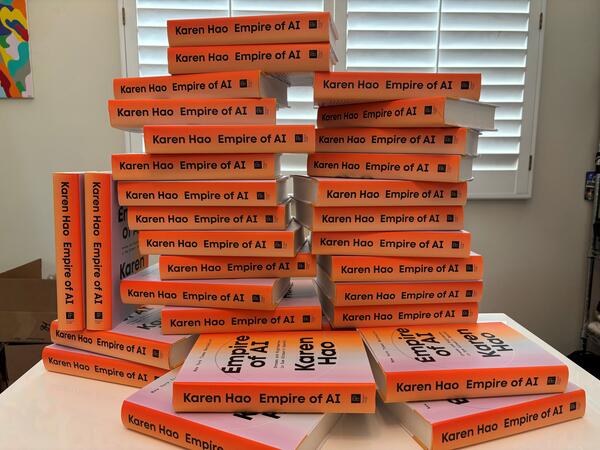
University of Southern California professor Helen Choi had a pretty basic assignment for her students this fall: Read a book.
To be sure, Choi’s pedagogical choice isn’t novel for many faculty; 71 percent of professors use print materials in some capacity in their classroom, a Bay View Analytics survey found.
But Choi teaches Advanced Writing for Engineers, a course focused on teaching STEM students how to write across disciplines. Many of them “think nothing of shoveling a writer’s work into a chatbot for a summary,” Choi said. So this fall, Choi is encouraging students to close their laptops and spend time with Karen Hao’s book Empire of AI, about the evolution and tech behind AI.
Choi chronicled her decision in a Substack article titled, “I’m Making My Students Read a Book!” The post caught the attention of some faculty on Bluesky, including Vance Ricks, a Northeastern computer science and philosophy professor. Ricks had similarly selected Empire of AI for his master’s-level students to read this term.
Both Choi and Ricks hope to encourage their students to relearn how to read critically and engage in robust conversations with their peers. And after finishing the books, Choi and Ricks’s students will get the chance to reflect together on the book during a virtual meeting, where they will discuss the role of AI in their lives.
What’s the need: In the past, Choi would assign short online articles for students to inform their writing responses. “The questions I was getting from students indicated to me that the engagement with the underlying materials wasn’t as deep as I wanted,” Choi said. “Sometimes it was just straight up reading comprehension.”
In 2024, only 34 percent of students were considered proficient, which NAEP classifies as connecting key details within and across texts and drawing complex inferences about the author’s purpose, tone or word choice. Thirty-two percent of 12th graders ranked below “basic,” unable to locate and identify relevant details in the text to support literal comprehension.
In addition to helping students apply deeper learning and thinking skills, Choi hopes having print material will allow them to step away from their laptops and connect with peers in a more meaningful way.
In the classroom: Choi and Ricks have assigned the 482-page book to be read over four to five weeks, with students responsible for annotating and reflecting on the assigned sections on a weekly basis. Neither assigns content-based quizzes or reviews, relying on student discussions to reveal participation with the text.
At the start of the term, both Choi and Ricks said they spent time in class discussing why they were requiring a physical book, and specifically Hao’s book.
“You have to justify why you’re doing this abnormal thing,” Choi said.
Students seemed to get it and were excited about the opportunity, both professors said.
“They’re genuinely eager to have those conversations and engage in that sort of reflection,” Ricks said.
The assignment has, however, required some additional attention and time on their part to help students grasp reading.
“I’ve spent more time than I had anticipated literally walking around the book and saying, like, ‘This is an epigraph; why are the quotes here? What’s a prologue? What’s the index?’ Things like that,” Choi said.
Both professors said they’ve had to adjust their expectations for how quickly students would be able to complete the text. The book itself also proved more difficult than anticipated for students who speak English as a second language, so Choi and Ricks are considering ways to better support these students in the future.
The impact: “So far, students have shared that they are enjoying Hao’s book because it is relevant to their fields and lives outside of school,” Choi said. Their written responses to the reflection prompts also show improvement in clarity and organized reasoning.
In Ricks’s class, the print format has proven a fruitful learning experience in and of itself. “Just hearing from students about how they are engaging physically with the book, tactilely, in terms of the smell of the pages or the sound of turning the pages—all of those things, let alone the material that the book is about,” Ricks said.
The two classes will meet over Zoom on Sept. 26 for a student-led discussion on the book’s materials and themes.
While the overall goal is to promote better reading and writing for her students, Choi said the exercise has also been a bright spot in her courses.
“It’s really fun for me to teaching reading as part of writing,” she said. “It’s about the students, but I think having a joyful teaching experience is important for the classroom experience. Every day I’m pretty excited about having this book, and seeing the students with books makes me super happy.”
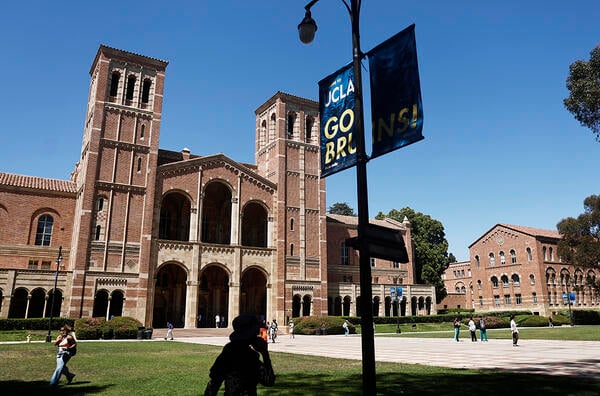
A federal court order issued late Monday evening provides significant financial relief to the University of California, Los Angeles, restoring about $500 million in federal research grants amid an ongoing lawsuit with the Trump administration over alleged instances of antisemitism on campus.
The preliminary injunction, first reported by CalMatters and Politico, is temporary. But for now it reinstates more than 500 grants from the National Institutes of Health, the Department of Defense and the Department of Labor, allowing hundreds, if not thousands, of university researchers to resume their work. That’s on top of a previous order in August from the same court that unfroze about 300 grants from the National Science Foundation.
Between the two rulings, almost all of UCLA’s federal research grants have been restored.
The funds were first withheld in late July, less than a week after the Justice Department accused the university of tolerating discrimination against Jewish students, faculty members and staff, in violation of federal civil rights law. The Trump administration later said UCLA could resolve the situation by paying $1.2 billion and agreeing to lengthy list of policy changes.
But university researchers pushed back, using an existing broader lawsuit and injunction to challenge the grant freeze.
In the end, District Judge Rita F. Lin, a Biden appointee, ruled in favor of the faculty members, saying the indefinite suspensions of grants was “likely arbitrary,” “capricious” and a violation of the Administrative Procedure Act.
In June, in an escalation of the Trump administration’s pressure on Harvard University to bow to its demands, a federal Office for Civil Rights announced that the institution was violating federal law.
The office released a nearly 60-page report accusing Harvard of “deliberate indifference” to ongoing discrimination against Jewish and Israeli students, which is illegal under Title VI of the Civil Rights Act of 1964. “OCR’s findings document that a hostile environment existed, and continues to exist, at Harvard,” the office said in an accompanying news release.
But this wasn’t the Education Department’s Office for Civil Rights. It was an office of the same name within the Health and Human Services Department that’s been playing a more public role as part of Trump’s crackdown on higher ed. Officials who served in previous administrations said agencies used to generally defer to the Education Department when it came to civil rights issues in higher ed. But since Trump retook office, colleges and universities are facing increased pressure from probes by HHS and other agencies enforcing the new administration’s right-wing interpretation of civil rights.
HHS OCR said it began its Harvard investigation in February by looking into the university’s medical school, after alleged antisemitism during the May 2024 graduation ceremony. But, in April, it widened its probe to “include Harvard University as a whole and to extend the timeframe of review to include events and information from October 7, 2023, through the present.” (The HHS OCR has jurisdiction over institutions that accept HHS funding, including National Institutes of Health research grants and Medicaid dollars.)
And this wasn’t the HHS OCR’s only investigation into parts of Harvard that didn’t appear related to health or medicine. The news release noted the “findings released today do not address OCR’s ongoing investigation under Title VI into suspected race-based discrimination permeating the operations of the Harvard Law Review journal.” And Harvard is just one of several universities that this non–Education Department OCR has targeted since Trump retook the White House in January.
Civil rights advocates say the HHS OCR has become just one more pawn in Trump’s strategy to target universities and end protections and programs that aid minority groups. For universities, Trump’s HHS OCR represents a new threat to their funding if they’re accused of promoting diversity, equity and inclusion; fostering antisemitism; or letting transgender women play on women’s sports teams.
It’s unnecessary to do what the administration is doing now, unless one is operating like a mob boss.”
—Catherine Lhamon, former head of OCR at the Education Department
The office’s investigations and public denunciations add to the work of the ED OCR, which the Trump administration has also shifted to focus on the same issues. The two OCRs announced a joint finding of violations against Columbia University, but they’ve also trumpeted independent probes into other institutions.
“As we feared, the Trump administration is abusing civil rights tools to advance a radical and divisive agenda that aggressively hoards access to education, living wage jobs, and so much more,” the NAACP Legal Defense Fund said in a statement. “Unfortunately, HHS and many other federal agencies are being used as one of the vehicles to carry out that agenda.”
The Legal Defense Fund said, “Colleges and universities are being targeted precisely because of the critical role they play in opening the doors of opportunity and preparing the next generation to lead our multi-racial democracy. By attacking institutions that help level the playing field for Black students and other students of color, the Trump administration is ultimately weakening our democracy and our economy as a whole.”
Former officials at the Justice Department, to which HHS OCR can forward cases if the targets of investigations don’t comply, told Inside Higher Ed that HHS OCR historically deferred probes into universities to the Education Department.
Catherine Lhamon, former director of the Education Department’s OCR under Presidents Biden and Obama, said, “There are 13 federal agencies with external civil rights enforcement, of which HHS is one, and it’s relatively large.” She said they’re pieces of Trump’s broader strategy.
“The administration has used every agency in a contemporaneous, simultaneous assault on universities,” Lhamon said, multiplying the amount of federal funding it can threaten.
The HHS OCR’s announced investigations under Trump show it’s investigating similar issues to the Education Department OCR—or what’s left of that office after the administration’s cuts. Lhamon said the practice for decades has been for the agency with principal expertise over an area to investigate that area—hence why universities were mostly investigated by the Education Department OCR.
“It’s unnecessary to do what the administration is doing now, unless one is operating like a mob boss,” Lhamon said.
An HHS spokesperson said, “We’re leading implementation of the president’s bold civil rights agenda,” which includes four focuses: upholding religious conscience rights, fighting antisemitism, ending race-based discrimination embedded in DEI programs and “defending biological truth” in sex-discrimination enforcement. She also said that fighting antisemitism, for instance, is a priority across the whole administration, “so our office is going to be a part of that and going to participate to the fullest extent that we can.”
It remains unclear how much of the HHS OCR’s daily workload is now devoted to Trump’s targeting of higher ed. HHS OCR did investigate higher ed institutions even before Trump took office, the HHS spokesperson said.
“We may be being more public about it now,” the spokesperson said, “particularly because that’s where the issue areas with respect to this administration are.”
She said the office also continues to investigate non–higher ed–related medical providers and non–civil rights issues that it has responsibility for despite the office’s name—such as information privacy under the Health Insurance Portability and Accountability Act.
The spokesperson said the HHS OCR news releases don’t tell the full story of what the office is currently investigating because—out of the roughly more than 40,000 complaints it receives annually—it doesn’t normally disclose which complaints lead to probes “to protect the integrity of the investigation.” The office also launches some investigations without receiving complaints, she said.
“In the past we’ve not announced through press releases that we’ve opened major investigations,” she said.
She didn’t provide Inside Higher Ed a list of the office’s current investigations. She also didn’t say how many employees HHS OCR has. HHS’s fiscal year 2026 budget request said that “in FY 2010, there were 111 investigators onboard, and in FY 2022, this number fell to 60, while simultaneously HHS received the highest number of complaints in its history (51,788).” (For comparison, the ED OCR, in a FY 2024 report, said it had received its highest-ever volume of complaints, but the number was only 22,687.)
Since taking power, the Trump administration has been slashing the federal workforce—the administration laid off nearly half of the Education Department’s OCR staff in March. It’s unclear how much HHS OCR has been cut. The FY 2026 budget request said the HHS OCR “has faced a continually growing number of cases in their backlog, rising to 6,532 cases by the end of FY 2024.” And that was before the office launched these new probes based on Trump’s priorities.
The HHS OCR receives roughly more than 40,000 complaints annually, a spokesperson said.
Kayla Bartkowski/Getty Images
A String of Investigations
Since Trump’s Jan. 20 inauguration, HHS OCR has announced a spate of higher ed investigations, mostly without naming the institutions. The spokesperson said most are ongoing.
In early February, it announced investigations of four unnamed medical schools, also citing reports of antisemitism during their 2024 commencements. (That was the same month the Harvard investigation began, HHS OCR later said, so Harvard was likely among the four.)
On Feb. 21, Trump told Maine governor Janet Mills during a televised White House event that her state must bar transgender women from women’s sports or lose federal funding, to which Mills replied, “See you in court.” In response to this, the HHS OCR issued a news release that same day announcing an investigation into “the Maine Department of Education, including the University of Maine System,” due to reports that the “state will continue to allow biological males to compete in women’s sports.” (The HHS spokesperson said the investigation eventually found that the most relevant issues were unrelated to higher ed.)
In March, the office announced investigations into four unnamed “medical schools and hospitals” over “allegations and information” concerning medical education or scholarships “that discriminate on the basis of race, color, national origin, or sex.” The news release didn’t have much further detail but referenced a Trump executive order targeting “illegal” diversity, equity and inclusion programs. Later that month—again citing the anti-DEI order—it announced it was investigating “a major medical school in California” over whether it “gives unlawful preference to applicants based on their race, color, or national origin.”
In April, it announced it was investigating an “HHS-funded organization” over whether it excludes “certain races” from a “health services research scholarship program.” Later in April, it launched an “online portal where whistleblowers can submit a tip or complaint regarding the chemical and surgical mutilation of children”—the Trump administration’s phrase for gender-affirming care. Simultaneously, it announced it’s investigating “a major pediatric teaching hospital” for allegedly firing a whistleblower nurse who “requested a religious accommodation to avoid administering puberty blockers and cross-sex hormones to children.” (The HHS spokesperson said the first Trump administration brought a focus on religious conscience rights to the office that disappeared under Biden but has now returned.)
Also in April, it announced a second Harvard probe: a joint investigation with the Education Department’s OCR into both Harvard and the Harvard Law Review “based on reports of race-based discrimination permeating the operations of the journal.” The HHS OCR news release said an editor of the law journal “reportedly wrote that it was ‘concerning’ that ‘[f]our of the five people’ who wanted to reply to an article about police reform ‘are white men.’” The office also raised concern about another editor allegedly suggesting expedited review for an article because the author was a minority.
In May, the HHS OCR announced it’s investigating a “prestigious Midwest university” over alleged discrimination against Jewish students. Later that month came its announcement of its joint finding with the Education Department OCR that Columbia University violated Title VI through “deliberate indifference towards student-on-student harassment of Jewish students.” (This was part of the administration’s pressure campaign on Columbia that culminated with a controversial July settlement.)
In June came the HHS OCR’s Title VI finding against Harvard in the investigation of alleged antisemitism. Then, in July, HHS OCR said it was investigating “allegations of systemic racial discrimination permeating the operations of Duke University School of Medicine and other components of Duke Health,” which includes “other Duke health professions schools” and “health research programs across Duke University.” In a statement alongside that announcement, HHS secretary Robert F. Kennedy Jr. said, “Federal funding must support excellence—not race—in medical education, research, and training.”
And last week, after months of silence on new higher ed–related investigations, the HHS OCR announced an investigation into the legal scholarship of an HHS-funded “national organization,” over allegations that it “preferences applicants of certain races and national origin groups.”
Lhamon, the former Education Department OCR head, said what the administration has called civil rights investigations into Harvard, Columbia and other universities aren’t really investigations. She noted the administration has used a “mob theory” by going ahead and pulling HHS and other funding from multiple institutions before the investigations are over.
Instead, she said, this is “an assault on universities, which is a very different thing from ensuring compliance with the civil rights laws as Congress has enacted them.”
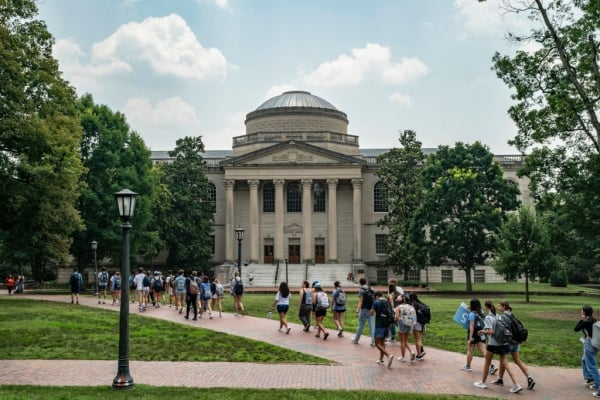
A former provost at the University of North Carolina at Chapel Hill accused the Board of Trustees of systematically violating open records and meetings laws on multiple occasions, including to retaliate against him, according to a lawsuit filed earlier this week.
At the heart of the lawsuit from Chris Clemens, who resigned in April, is a delayed tenure vote.
In March, the UNC Board of Trustees postponed a vote to grant tenure to 33 faculty members. At that meeting, held March 20, the board moved into closed session, with Clemens present, apparently to discuss individual tenure cases. Instead, trustees launched into a debate over the value of tenure, with some voicing their philosophical opposition to the practice and others arguing that they should delay such approvals for financial reasons, according to the lawsuit.
The board eventually approved tenure for all 33 candidates in June via an email vote.
According to the lawsuit, Clemens shared details from the meeting with other academic leaders, noting that no tenure decisions were made or individual candidates considered and that the board instead “engaged in a sweeping policy discussion about tenure’s institutional value and global costs.” Following that briefing, the Board of Trustees allegedly communicated through Signal, a private messaging application that includes a feature to automatically delete messages after they are read, to call for a vote of no confidence in Clemens. UNC leadership asked Clemens to step down shortly thereafter, according to the lawsuit.
But even if Clemens’s suit is successful and the violations are proven to be true, the board will likely face few repercussions given past precedent.
A Systemic Pattern
Clemens’s lawsuit also accused Jed Atkins, director and dean of the School for Civic Life and Leadership, of relaying the former provost’s briefing to then–board chair John Preyer via Signal. (Clemens had taken issue with the hiring practices at the civic life school before stepping down.)
The lawsuit alleges that Atkins “requires that his leadership team subscribe to a Signal group and conducts a substantial portion of official communications via Signal with auto-delete enabled not only in exchanges with trustees but as a routine practice,” in violation of state law. Atkins did not respond to a request for comment from Inside Higher Ed.
Beyond the tenure flap, Clemens has accused the board of defying state open meetings laws on multiple occasions in an effort to “hide policy debates from public view,” according to his lawsuit.
“Over the past four years, the Board has engaged in a pattern and practice of systematically violating the Open Meetings Law by improperly invoking closed session exemptions to shield policy and budget deliberations from public scrutiny,” the former provost alleged.
Contacted by Inside Higher Ed, Clemens declined to comment.
In his legal filing, Clemens cited three specific examples beyond the March tenure discussion in which he alleged the board violated open meetings laws. He specifically pointed to a closed session discussion in November 2023, when UNC discussed athletic conference realignment; further secret deliberations over athletics in May 2024 involving both conference realignment and finances; and an “emergency meeting” in December 2024 to hire a head football coach. At the December meeting, UNC Chapel Hill hired NFL legend Bill Belichick on a $10 million annual contract.
(Responding to a separate legal complaint over the May 2024 meeting, trustees previously agreed to reaffirm their commitment to open meetings laws and pay $25,000 in attorneys’ fees.)
“Each episode follows the same pattern: the Board invokes a statutory exemption, enters closed session, then discusses broad policy or budget matters that must be debated publicly,” the lawsuit states.
Despite being allegedly pressured to step down, Clemens isn’t seeking a payout or his job back. Instead, he’s asking the court to prevent the board from continuing its alleged defiance of open meetings laws, to produce minutes or a transcript of the March 20 closed session and to mandate that trustees participate in training on state open meetings and public records laws.
Responses
Contacted by Inside Higher Ed, UNC Chapel Hill spokesperson Kevin Best wrote by email, “We’re aware of the litigation and are reviewing it closely,” but he declined to comment further given the pending nature of the case.
The Board of Trustees released a more forceful statement Wednesday.
“The former Provost’s baseless assault on this volunteer Board and how it conducts its business stands in stark contrast to the widely recognized excellence the University has achieved under this Board’s leadership,” chair Malcom Turner said. “His allegations are disappointing and inaccurate, not to mention a waste of taxpayer dollars, for which this former officer of the University shows no regard. His claims will not withstand scrutiny.”
Most of the individuals named in the lawsuit either declined to comment or did not respond to media inquiries. Multiple faculty and staff members at the School of Civic Life and Leadership (none of whom are defendants in the lawsuit) also did not respond to requests for comment.
However, one source alleged that the former provost instructed employees to use Signal and that he also used it for university business, which Inside Higher Ed confirmed via screenshots.
Allegations that Clemens used Signal come amid an opaque investigation by outside counsel into the School of Civic Life and Leadership that was announced earlier this month. While Chapel Hill leadership has said little about the investigation, it comes after multiple resignations from faculty members in the school, some of whom have alleged it has “lost sight of its mission.”
Dustin Sebell, a School of Civic Life and Leadership professor, told Inside Higher Ed via text message that Clemens “habitually used Signal for university business” and encouraged others to do so. To Sebell, the lawsuit seems like an effort by Clemens to sidestep the investigation.
“By hastily filing a hypocritical lawsuit, Chris is trying to avoid investigators’ questions about his misconduct as Provost by claiming privilege pending ongoing litigation,” Sebell wrote.
But some faculty members, such as Michael Palm—president of the UNC Chapel Hill chapter of the American Association of University Professors—expressed concern about political influence on the board.
“Open meetings laws are important for public universities. Unfortunately, right now we don’t need them to know that the UNC [Board of Trustees] considers UNC faculty to be their enemy,” Palm wrote to Inside Higher Ed via email. “The crisis we’re in is political, not procedural.”
Although North Carolina has historically been considered a swing state, the UNC Chapel Hill board appears to be overwhelmingly comprised of Republicans. Some have previously worked for Republican officials, while others have donated heavily to GOP candidates and causes.
Of 14 voting members on the UNC Chapel Hill board, at least 10 have donated to conservative politicians and organizations, some contributing tens of thousands of dollars, according to a review by Inside Higher Ed. Several others have direct GOP connections, including Preyer, who previously worked for former senator Lauch Faircloth. Three other trustees previously held state office: Robert Bryan III, James Blaine II and Patrick Ballantine. All were elected as Republicans.
Potential Consequences
Should the allegations in the lawsuit be proven true, consequences will likely be fairly light—at least, that has been the outcome in other cases where boards allegedly violated sunshine laws.
The Pennsylvania State Board of Trustees, for example, was required to complete training on the state’s Sunshine Act recently as part of a settlement with the news organization Spotlight PA over alleged violations of opening meetings laws related to secretive practices by the board.
But in other cases, universities have largely escaped consequences for clandestine actions.
Kentucky attorney general Russell Coleman has found that multiple state institutions have violated open records laws, adding up to 10 times this year alone. Coleman found that the University of Kentucky violated open records law four times and had four partial violations, while Northern Kentucky University had one violation and the University of Louisville had a partial violation. However, none of those violations resulted in punitive actions from the state.
Last year Indiana’s public access counselor found that Indiana University’s Board of Trustees violated open meetings laws when members claimed that they were holding a private meeting to discuss litigation. But trustees also discussed IU president Pamela Whitten’s performance and a campus climate review, expanding the private meeting beyond its stated aims. A complaint from a news organization prompted scrutiny from state officials, but no punitive or corrective actions.
UNC Chapel Hill was also previously accused of violating state open meetings laws, including in 2021 when it hired Clemens as provost, choosing to approve “Action 1” on its agenda with a vague reference to personnel matters, raising concerns that trustees violated state law via a secretive vote. Board leadership defended the vote and Clemens remained in place until April.
This story has been updated with a statement from the UNC Chapel Hill Board of Trustees.
News of the policies comes after a Texas bill was signed into a law that prohibits people from using bathrooms that differ from their sex assigned at birth in state buildings.
Photo illustration by Justin Morrison/Inside Higher Ed | rustamank/iStock/Getty Images
Employees at Angelo State University in Texas could be fired for displaying a pride flag or discussing any topic that suggests there are more gender identities than male and female.
Spokespeople for Angelo State have not confirmed or denied details of the policies reportedly discussed at meetings Monday between faculty, staff and institutional leaders. But, local news magazine the Concho Observer reported that the policies would ban discussion of transgender topics or any topics that suggest there are more than two genders.
The policies would also require instructors to remove information about transgender topics on syllabi and refer to students by their given names only, not any alternative names. Safe space stickers and LGBTQ+ flags would be banned and employees wouldn’t be allowed to include their pronouns in their email signatures.
News of the policies comes just as Gov. Greg Abbott signed a bill on Monday that prohibits people from using the bathroom that differs from their sex assigned at birth in state buildings, including public universities, NBC reported. Institutions that violate this law face fines of up to $125,000.
The Angelo State policies are the latest in a string of attacks on academic freedom at Texas public universities in recent weeks. Texas A&M University officials terminated a professor, demoted two other faculty members and, as of Thursday, accepted the president’s resignation in response to a viral video that showed a student challenging a professor in class for teaching about gender identity.
“What is happening at ASU is part of a larger assault on higher education and marginalized communities across Texas and the nation,” Brian Evans, president of the Texas Conference of the American Association of University Professors, said in a statement. “Moreover, it is an overt attempt to erase individuals of diverse backgrounds and experiences by limiting not only what can be taught but also what ideas students can explore. These policies and this extremist push to censor open inquiry, debate, and discovery is an affront to the U.S. and Texas Constitutions and an assault on the very foundations of our colleges and universities.”
It is unclear exactly whom the new policies at Angelo State will apply to, and whether there are exceptions, particularly for displays and conversations held in private offices or for conversations outside of the classroom.
Angelo State spokespeople did not answer any of the questions Inside Higher Ed asked about the new policies, and instead provided the following statement: “Angelo State University is a public institute of higher education and is therefore subject to both state and federal law, executive orders and directives from the President of the United States, and executive orders and directives from the Governor of Texas,” spokesperson Brittney Miller wrote. “As such, Angelo State fully complies with the letter of the law.”
Miller also sent a link to a Jan. 30 letter from Abbott that said, “All Texas agencies must ensure that agency rules, internal policies, employment practices, and other actions comply with the law and the biological reality that there are only two sexes—male and female,” as well as President Donald Trump’s Jan. 20 executive order stating that the United States only recognizes two genders, male and female.
What type of legal case faculty could bring in response—and whether they may have a case at all—will depend largely on the policy details, said Eugene Volokh, a professor of law emeritus at the University of California, Los Angeles, School of Law.
There are no Texas state laws that explicitly prohibit faculty members from discussing LGBTQ+ topics in classrooms. Even Brian Harrison, the Texas state representative who is largely responsible for making the Texas A&M video go viral, said as much during an interview Sept. 13 on a conservative radio show.
“The governor and lieutenant governor and speaker have been telling everybody for two years now that we passed bans on DEI and transgender indoctrination in public universities,” Harrison said. “The only little problem with that? It’s a complete lie. The bill that was passed to ban DEI explicitly authorizes DEI in the classroom—same thing with transgender indoctrination.” Harrison has introduced several bills to ban these topics, but so far none have been passed.
The legislation Harrison referred to is Texas Senate Bill 17, which bans diversity, equity and inclusion efforts by public institutions. It was signed into law in 2023 and includes carve-outs for academic instruction, scholarly research and campus guest speakers. Meanwhile, House Bill 229 took effect on Sept. 1 and specifies that the state recognizes two genders. It applies to data collection by government entities only and does not restrict academic instruction or speech.
Public employers, because they only speak through their employees, can generally tell people what to say as part of their job, Volokh said. “A police department may order police officers to talk in certain ways to their citizens and to not talk in other ways to citizens, right? In fact, we expect the police department to do that,” he said. “The question is whether there’s a specific, special rule that protects the rights of college or university professors.”
The courts are largely undecided on that, he added. “It’s being litigated right now in other federal courts. It’s been raised in past cases, and there isn’t really a clear answer,” he said.
“It’s certainly possible that [professors] may have First Amendment rights to choose to teach what they want to teach, but it’s also possible that boards will also say, ‘No, when you’re on the job and talking to a captive audience of students that the university provided for you … we, the university, get to tell you what to teach.’”
Other state university systems have implemented similar policies with the opposite effect. For example, the University of California system requires university-issued documents to offer three gender identity options—male, female and nonbinary—and for all university documents and IT systems to include an individual’s “lived name” instead of their legal name. If an individual’s lived name is different from their legal name, their legal name must be kept confidential.
This article has been updated to correct the Texas Senate bill number.
Amid rising political violence, the need for nonpartisan civic education has never been clearer. Yet saying, “civic thought” or “civic life and leadership” now reads conservative. Should it?
With the backing of a legislature his party dominated, Republican governor Doug Ducey created Arizona State University’s School of Civic and Economic Thought and Leadership in 2016. Both SCETL and its founding director, Paul Carrese, are now understood as key leaders in a movement for civic schools and centers.
In a March 2024 special issue on civic engagement in the journal Laws, Caresse outlines a deepening American civic crisis, including as evidence, “the persistent appeal of the demagogic former President Donald Trump.”
He’s not exactly carrying water for the MAGA movement.
Whether MAGA should be considered conservative is part of the puzzle. If by “conservative” we mean an effort to honor that which has come before us, to preserve that which is worth preserving and to take care when stepping forward, civic education has an inherently conservative lineage.
But even if we dig back more than a half century, it can be difficult to disentangle the preservation of ideals from the practices of partisanship. The Institute for Humane Studies was founded in the early 1960s to promote classical liberalism, including commitments to individual freedom and dignity, limited government, and the rule of law. It has been part of George Mason University since 1985, receiving millions from the Charles Koch Foundation.
The editors at Persuasion, which ran the column, certainly would seem to think so. But Persuasion also has a bent toward “a free society,” “free speech” and “free inquiry,” and against “authoritarian populism.” The founder, Yascha Mounk, a political scientist at Johns Hopkins University, has been a persistent center-left critic of what he and others deem the excesses of the far left. Some of the challenges they enumerate made it into Steven Pinker’s May opinion piece in The New York Times, in which Pinker defended Harvard’s overwhelming contributions to global humanity while also admitting to instances of political narrowness; Pinker wrote that a poll of his colleagues “turned up many examples in which they felt political narrowness had skewed research in their specialties.” Has political narrowness manifested within the operating assumptions of the civic engagement movement?
Toward the beginning of this century, award-winning researchers Joel Westheimer and Joseph Kahne pushed for a social change–oriented civic education. Writing in 2004, in the American Educational Research Journal, they described their predispositions as such: “We find the exclusive emphasis on personally responsible citizenship when estranged from analysis of social, political, and economic contexts … inadequate for advancing democracy. There is nothing inherently democratic about the traits of a personally responsible citizen … From our perspective, traits associated with participatory and justice oriented citizens, on the other hand, are essential.”
Other scholars have also pointed to change as an essential goal of civic education. In 1999, Thomas Deans provided an overview of the field of service learning and civic engagement. He noted dueling influences of John Dewey and Paulo Freire across the field, writing, “They overlap on several key characteristics essential to any philosophy of service-learning,” including “an anti-foundationalist epistemology” and “an abiding hope for social change through education combined with community action.”
Across significant portions of the fields of education, service learning and community engagement, the penchant toward civic education as social change had become dominant by 2012, when I inhabited an office next to Keith Morton at Providence College. It had been nearly 20 years since Morton completed an empirical study of different modes of community service—charity, project and social change—finding strengths and integrity within each. By the time we spoke, Morton observed that much of the field had come to (mis)interpret his study as suggesting a preference for social change over project or charity work.
While service learning and community engagement significantly embraced this progressive orientation, these pedagogies were also assumed to fulfill universities’ missional commitments to civic education. Yet the link between community-engaged learning and education for democracy was often left untheorized.
In 2022, Carol Geary Schneider, president emerita of the American Association of Colleges and Universities, cited real and compounding fractures in U.S. democracy. Shortly thereafter in the same op-ed, Geary Schneider wrote, “two decades of research on the most common civic learning pedagogy—community-based projects completed as part of a ‘service learning’ course—show that student participation in service learning: 1) correlates with increased completion, 2) enhances practical skills valued by employers and 3) builds students’ motivation to help solve public problems.”
All three of these outcomes are important, but to what end? The first serves university retention goals, the second supports student career prospects and the third contributes broadly to civic learning. Yet civic learning does not necessarily contribute to the knowledge, skills, attitudes and beliefs necessary to sustain American democracy.
There is nothing inherently democratic about a sea of empowered individuals, acting in pursuit of their separate conceptions of the good. All manner of people do this, sometimes in pursuit of building more inclusive communities, and other times to persecute one another. Democratic culture, norms, laws and policies channel energies toward ends that respect individual rights and liberties.
Democracy is not unrestrained freedom for all from all. It is institutional and cultural arrangements advancing individual opportunities for empowerment, tempered by an abiding respect for the dignity of other persons, grounded in the rule of law. Commitment to one another’s empowerment starts from that foundational assumption that all people are created equal. All other democratic rights and obligations flow from that well.
Proponents of civic schools and centers have wanted to see more connections to foundational democratic principles and the responsibilities inherent in stewarding an emergent, intentionally aspirational democratic legacy.
In a paper published by the American Enterprise Institute, Benjamin Storey and Jenna Silber Storey consider next steps for the movement advancing civic schools and centers, while also emphasizing responsibility-taking as part of democratic citizenship. They write, “By understanding our institutions of constitutional government, our characteristic political philosophy, and the history of American politics in practice as answers to the challenging, even paradoxical questions posed by the effort to govern ourselves, we enter into the perspective of responsibility—the citizen’s proper perspective as one who participates in sovereign oversight of, and takes responsibility for, the American political project. The achievement of such a perspective is the first object of civic education proper to the university.”
This sounds familiar. During the Obama administration, the Civic Learning and Democratic Engagement National Task Force called for the “cultivation of foundational knowledge about fundamental principles and debates about democracy.” More than a half century before, the Truman Commission’s report on “Higher Education for American Democracy” declared, “In the past our colleges have perhaps taken it for granted that education for democratic living could be left to courses in history and political science. It should become instead a primary aim of all classroom teaching and, more important still, of every phase of campus life.” And in the era of the U.S. founding, expanding access to quality education was understood as central to the national, liberatory project of establishing and sustaining democratic self-government. Where does this leave us today?
Based on more than 20 years of research, teaching and administration centered around civic education, at institutions ranging from community colleges to the Ivy League, I have six recommendations for democratic analysis, education and action to move beyond this hyperpartisan moment.
Advance analysis rather than allegations. I started this essay with two critiques of President Trump advanced by leaders at centers ostensibly associated with conservativism. More recently I demonstrated alignments between current conservative appeals and civic aspirations under two popular Democratic presidents. We should spend far less time and ink debating whether something emerges from Republican or Democratic roots. Our proper roles as academics and as citizens direct us to consider specific policies and practices, to compare them historically and cross-nationally, and to gather evidence of impacts. We now have a landscape that includes more than a dozen new civic schools and centers. We therefore have opportunities to assess their differences, similarities and impact.
Demonstrate that rights derive from shared governance. Work with students to understand the relationship between good government and everyday functions such as freedom to move, freedom to associate, freedom to contract and freedom to trade. These rights manifest through the promise made in the Declaration of Independence. “Governments are instituted,” it reads, “to effect … Safety and Happiness.” Danielle Allen’s Our Declaration is an indispensable aid in any such effort.
Encourage historic political-economic comparisons of rights. Diving deep into history from all corners of the world clarifies various kinds of colonizing forces and diverse approaches to good government, from imperial China to the Persian Empire and American expansion. Last year’s winners of the Nobel Prize in Economics, Daron Acemoglu, Simon Johnson and James Robinson, received the award for research demonstrating that societies with well-established rule of law and individual rights are more likely to become economically prosperous. Consider this and other, disciplinarily diverse explorations of the structural conditions for human flourishing. Push past dichotomizing narratives that sort history into tidy buckets. Rights as we know them—expanded and protected through state institutions—are tools of liberation with an extended, colonial and global heritage. Mounk’s podcast is an excellent resource for contemporary, comparative interrogation of the structures and cultural commitments that advance rights.
Wrestle with power and violence. Despite national and global history riven with conflict and conquest, many progressives came to imagine that democracy is a given, that having rights in conditions of comparative peace is the natural state. Yet those rights only manifest through the disciplined commitments of state officials doing their jobs. In a recent article in Democracy, William A. Galston, a Brookings Institution senior fellow, professor at the University of Maryland and former Clinton administration official, suggests democracy is on the defensive because citizens too frequently “regard the movement toward tolerance at home and internationalism abroad as irreversible.” Nonsense, argues Galston. History shows us societies descend into evil, governments revoke liberties and armies invade. Democratic liberties are co-created political commitments. They have always depended upon judicious, democratic stewardship of policing power at home and military power abroad. Questioning state structures of enforcement should be part of university-level civic education, but so too should respecting them and understanding the reasons for their persistence. Here and throughout, civic education must balance respect for the past, its traditions and its empirical lessons, with possibilities for the future.
Embrace and interrogate foundational democratic values. Meditate on the intentionally aspirational commitment to American democracy, embodied in the assertion that all people are created equal. Nurture the virtue of respect for others implied by inherent equality. Foster—in yourself and in your students—an embrace of human dignity so strong that you seek bridging opportunities across the American experiment, working to find the best in others, seeking connections with individuals who seem most unlike you. Even if they offer no reciprocity, never forget any person’s basic humanity. Before analyzing or convincing, listen and find ways to listen well beyond your normal circles. My colleague at the University of Pennsylvania Lia Howard is modeling such efforts with systematic approaches to democratic listening across the Commonwealth of Pennsylvania.
Most of all, if principled, rigorous, honest analysis beyond partisan dichotomizing appeals to you, know that you are not alone. Danielle Allen (Harvard University), Kwame Anthony Appiah (New York University) and Eboo Patel (Interfaith America) lead among numerous scholars and organizers refreshing democratic ideals for our era. They demonstrate that democracy does not manifest without attention to our shared heritage, our collective institutions and our willingness to respect one another. They hold a pragmatic space between civic education as unquestioning nation-building on one extreme and as unmoored social justice activism on another. Readers curious about their approaches can begin with Allen presenting “How to Be a Confident Pluralist” at Brigham Young University, Appiah making a cosmopolitan case for human dignity and humility in The New York Times Magazine, and Patel in conversation with American University president Jonathan Alger in AU’s “Perspectives on the Civic Life” series.
This essay, it must be noted, was almost entirely completed before the political assassination of Charlie Kirk. It now becomes even clearer that we must identify ways to analyze beyond partisan pieties while embracing human dignity. Some leaders are reminding us of our ideals. Utah governor Spencer Cox’s nine minutes on ending political violence deserves a listen. Ezra Klein opened his podcast with a reflection on the meaning of the assassination, followed by his characteristic modeling of principled disagreement with a political opponent (in this case, Ben Shapiro). It is the second feature of that Klein podcast—extended periods of exploration, disagreement and brief periods of consensus regarding critical democratic questions—that we must see more of across campuses and communities. One of the worst possible, and unfortunately plausible, outcomes of this movement for civic schools and centers could be the continuing balkanization of campuses into self-sorted identity-based communities, with very little cross-pollination. That would be bad for learning and for our country.
Whatever the political disposition of civic centers or other programs across campus, we need more and better cross-campus commitment to democratic knowledge, values and beliefs if we wish to continue and strengthen the American democratic tradition.
Eric Hartman is a senior fellow and director of the executive doctorate in higher education management at the University of Pennsylvania Graduate School of Education.
Q: What is a fractional COLO? What types of schools might this service be a good fit for? Why would a college or university invest in a fractional COLO instead of recruiting for a full-time online learning leader?
A: A fractional COLO is a senior-level executive, chief online learning officer, who embeds within an institution on a part-time basis, providing executive-level expertise without the full-time commitment.
This service is particularly well suited for small to midsize universities that recognize the need to invest in online learning but lack the start-up capital for a full-time executive position, which can be quite expensive when you factor in salary and benefits at the senior level.
Many institutions approach fractional COLO services because they need to see a return on investment before making larger commitments. Building online learning programs requires significant up-front investment, and schools don’t always see returns in the first year. (I recently wrote an article exploring this: “Can You Build a Brand New Online Program for Half a Million Dollars?”)
Essentially, many schools know they need to make the investment in online learning leadership, but they can’t commit to a full-time hire right out of the gate. A fractional COLO allows them to get started with expert guidance while building revenues, which go towards that larger investment.
Q: Help us understand the fractional COLO from the provider perspective. How do you provide this service? How scalable is the model? How does the fractional COLO idea differ from the work of consultants/consulting companies, in terms of methods, deliverables, costs and outcomes?
A: I offer several service levels to meet schools where they are. Some institutions want an assessment of their current online operations—essentially an outsider’s perspective on their strengths and opportunities. I’ve developed a comprehensive rubric covering 10 key areas, from strategic planning to marketing, admissions, course design, faculty support and student services. I spend two days on campus meeting with staff, faculty and administrators to understand how they holistically support online students, then deliver a report with actionable improvements for six- and 12-month time frames.
From there, service levels scale up. Some schools need help launching specific programs, while others commit to the full fractional COLO engagement.
When I begin working with any institution, I always visit campus first to meet everyone, from senior leaders to registrars, financial aid staff, instructional designers and the entire support team. After conducting my assessment, we then develop a six- to 12-month strategic plan tailored to that institution’s specific needs.
Regarding scalability, that’s a great question. As a new venture, I haven’t reached my bandwidth limit yet. Hopefully, that becomes a good problem to have! If demand grows, I’d look for individuals with a similar mindset: individuals with a teacher’s heart who want to roll up their sleeves and help institutions learn and implement best practices. I like to say I “teach institutions how to fish.”
What differentiates my approach from traditional consulting or vendors is the hands-on, DIY element. There are many excellent consultants and companies that do great work for institutions and achieve results. I focus on teaching and blending consultation with implementation. I’ll conduct assessments and provide strategic guidance, but I also get my hands dirty helping different departments across the institution implement those strategies.
This approach works best for institutions that want to build online learning capabilities internally [and] retain all tuition revenue and can commit to a one- to two-year development timeline. The costs are significantly less than a full-time hire, without the overhead of salary and benefits, and deliverables are always scaled to meet each institution’s specific needs.
Q: Why have you decided to build up this fractional COLO business instead of pursuing a more traditional COLO role at a single institution? Tell us about your educational and professional background and how that prepared you to create this concept.
A: I’ve always had an entrepreneurial itch, even though I spent over 20 years of my career in higher education in traditional roles. I was fortunate to serve as COLO at an institution for eight years. That was a valuable experience since fewer than 10 percent of institutions have an online learning leader serving on the cabinet or reporting directly to the president. That role gave me a unique perspective on integrating online learning throughout an institution rather than keeping it siloed.
My educational background combines business and education, which prepared me for this venture. My undergraduate degree was in business, which seeded those entrepreneurial interests, but I transitioned to education for my master’s and completed a Ph.D. in learning sciences.
In my previous role, we were essentially building from scratch, so I referred to our team as a start-up. We developed new standard operating procedures, created budget models and hired new team members. In some ways, I felt like I was running a business within the university. That unique combination of business skills, educational expertise and start-up experience prepared me for this role. Also, maybe most importantly, if you’re going to start a new company, you’d better have a supportive spouse because it’s not easy, lol.
One last comment related to the intro—my goal isn’t to replace full-time COLOs. It’s actually the opposite. My intent is that as institutions work with me and see the value a COLO brings, they’ll eventually hire their own full-time leader once operations are established. I hope this work helps more schools recognize the importance of dedicated online learning leadership, ultimately growing the pool of full-time COLO positions across higher education. I don’t want to take work away from anyone. I want to grow the position and demonstrate the value these roles bring to institutions.
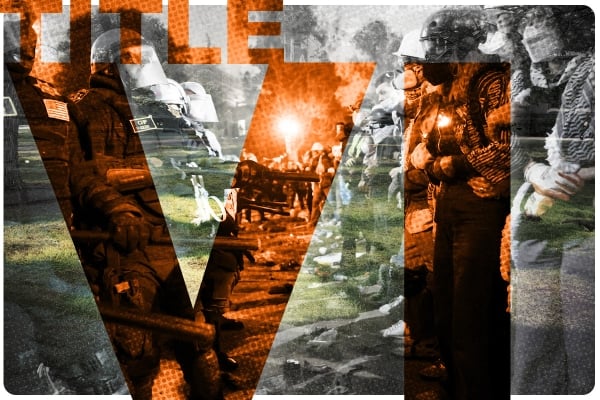
The Biden and Trump administrations have both stepped up enforcement of Title VI in the last two years.
Photo illustration by Justin Morrison/Inside Higher Ed | Etienne Laurent/AFP/Getty Images | Scott Olson/Getty Images
A new report released Monday by the American Association of University Professors and its Committee A on Academic Freedom and Tenure argues that the Trump administration has weaponized federal civil rights laws with a goal of discrediting colleges and compromising their academic freedom and institutional autonomy.
The report focuses in part on a surge of investigations that have been launched by the Department of Education since Oct. 7, 2023, especially those that involve national origin and religion. Based on an analysis of those cases, AAUP argues that in many instances the Trump administration has targeted types of speech or programming that do not actually qualify as legally actionable discrimination. Rather, the association says, the Trump administration has used this surge to sidestep historical procedures and enforce its own interpretation of the law.
Both the Biden and Trump administrations stepped up their enforcement of Title VI of the Civil Rights Act of 1964, which prohibits discrimination based on race, color, religion, sex or national origin, after the Hamas attack on Israel prompted a number of protests on college campuses and an increase in reports of antisemitism. Their approaches, however, have been quite different.
Biden civil rights officials took issue with how colleges responded to reports of antisemitic harassment and found severalcolleges in violation of that law.
However, the Trump administration has moved aggressively to cut off funds and to demandsweeping changes at institutions—all in the name of combating antisemitism. More recently, the administration has used Title VI as a way to restrict and investigate race-based practices and programs as well as admissions decisions.
“In a perverse reading of DEI, the administration makes it an instance of racial discrimination rather than an attempt to dismantle the structures of discrimination based on race,” the report notes.
Over all, the AAUP argues that the Trump administration is attempting to “unmake” and “hijack” Title VI.
The Trump administration is “unmooring the Civil Rights Act from its foundational commitments to addressing structures of discrimination that prevent educational access,” the report stated. And doing so “is nothing less than an attempt to rewrite the history of the nation.”
In an effort to address a deep deficit caused by rising costs, declining international enrollment and flat state funding, University of Nebraska–Lincoln officials have proposed merging or cutting a slew of programs. But one proposal has sparked particular outrage—within the university and beyond: the plan to ax the educational administration department.
If the plan goes through, faculty members and students worry the state will be left without a key pipeline to fill leadership roles at local schools and colleges, particularly in rural areas. The University of Nebraska–Lincoln is the only university in the state that offers a Ph.D. program in educational leadership or higher education, which has a distinct scholarly focus, while Ed.D. programs and master’s degrees to train education leaders can be found elsewhere.
“It’s hard for me to imagine the flagship university in a state does not offer a program to prepare future principals, future superintendents, future leaders of colleges and universities,” said Crystal Garcia, an associate professor and Ph.D. coordinator in the department. Eliminating the department would be “really doing a disservice to education as a whole in the state of Nebraska.” She noted the department is “incredibly impactful,” serving 316 current and incoming graduate students.
Administrators have proposed nixing five other academic programs as well: community and regional planning; earth and atmospheric sciences; landscape architecture; statistics; and textiles, merchandising and fashion design. The plan would potentially retain the master’s degree program in educational administration but rehouse it elsewhere.
Through these cuts, the university aims to reduce the budget by $27.5 million, in part by eliminating 58 roles—17 from the educational administration department, including tenured and tenure-track positions. University officials also proposed two department mergers and budget cuts to the College of Engineering and the College of Arts and Sciences, amid other cuts to administrative and staff expenses.
The proposal will now be considered by the Academic Planning Committee, a group of faculty, staff and students. Members of affected programs can make their case before the committee in live-streamed hearings, and the public can weigh in through a feedback form. Then, the APC will come out with recommendations the chancellor can take or leave. If the chancellor decides to move forward with the proposed cuts, the issue will come before the Board of Regents in December.
Elizabeth Niehaus, a professor in the educational administration department, said faculty were stunned by the news and are preparing to defend the department to the committee—and the Board of Regents if need be. She and other faculty members believe the department is thriving.
The proposed cut was “quite honestly shocking, because we are a strong department with great students, great faculty, with a national reputation, folks who have been winning awards for teaching and research,” Niehaus said. “So, we did not see that coming.”
The Decision-Making Process
The university’s executive team undertook “a strategic, data-informed and holistic review of all academic programs,” said Mark Button, UNL’s executive vice chancellor.
The review weighed a variety of metrics, he said, including student success outcomes—such as retention rates and degree-completion rates over a five-year period—the ratio of student enrollments to faculty members, and demand for programs as measured in student credit hours and students joining majors.
Administrators also drew on metrics for research success used by the Association of American Universities; the university is seeking to regain membership in the organization, which it lost in 2011. Those measures include book publications, research citations and awards and fellowships. Administrators also compared programs to similar programs at other public AAU institutions, Button said, and considered more qualitative factors, like whether a program was distinctive in the state. The metrics were shared with college deans and then department chairs in May.
Button said the metrics used to review the academic programs reflected priorities already in the university’s strategic plan and the criteria used for past budget reductions. Education administration was among the departments that “didn’t perform as well,” he said.
Faculty members argue the process lacked transparency; they didn’t know until a day before the proposal came out that the department was on the chopping block. They say their specific questions have gone unanswered, including which particular measures caused them to fall short and whether the pandemic years were contextualized in the data.
“We were reduced to a single number that definitely does not reflect the depth and breadth of what we do and our contributions to the field, to the university, to the state,” Niehaus said of the scoring process.
The decision felt so at odds with how the department sees itself that associate professor Sarah Zuckerman said she wondered if it was being targeted for its outspoken faculty members. Zuckerman, who serves as president of the university’s chapter of the American Association of University Professors, said other members of the department are also active in the organization, as well as in Advocating for Inclusion, Respect and Equity, a faculty coalition focused on diversity issues.
“It gives me a little bit of a nauseous feeling,” Zuckerman said.
Button argued it’s “definitively not true” that the proposed cuts target outspoken departments. He said the proposal involved “very painful decisions.”
“I probably can’t underscore enough just how difficult this budget-reduction process is for our entire university community and for everyone who’s committed to an outstanding land-grant, flagship, Big Ten university here in Nebraska,” Button said. “I share the sense of pain and grief that everyone on our campus is going through now.”
If the cuts become a reality, tenured and tenure-track professors will have a year’s notice of their termination and the university has promised to develop teach-out plans for students. But students don’t have the details of those plans, and some said the uncertainty makes them ill at ease.
Korrine Fagenstrom, who is participating in the online Ph.D. program focused on higher ed administration from Montana, said she doesn’t know what she’s going to do.
Four years into her program, she doesn’t want to leave, she said, but “I don’t know what it would look like to stay—I don’t know that anybody does.”
“The idea of the program getting eliminated at my final hour is terrifying,” said Kathryn Duvall, a third-year student in the Ed.D. program. “I have made sacrifices to my family. I have made sacrifices to my own personal life and dedicated years to getting my education. And this program has spent years pouring into me and developing me as a researcher, as a writer, as an educator, as a leader.”
She also worries on a “macro level” that education in the state will suffer without the leadership training UNL provides.
“Eliminating a program like this is eliminating foundational training that produces equitable educational opportunities in our society,” Duvall said.
The Bigger Picture
University officials argue that other offerings in the state, such as Ed.D. programs at University of Nebraska–Omaha or small private universities, can fill the same needs as UNL’s educational administration programs.
But K–12 superintendents, who generally have doctorates, need more—not less—access to the affordable, high-caliber training public institutions like UNL historically provide, said Mónica Byrne-Jiménez, executive director of the University Council for Educational Administration. The proposal to cut the department has garnered national attention, because it’s an unusual move for a flagship campus or a university with a Research-1 Carnegie classification, she added.
“It’s nothing I’ve seen before,” Byrne-Jiménez said, noting most R-1 universities boast strong K–12 and higher ed leadership programs. “We don’t want it to become a national trend.”
Cheryl Holcomb-McCoy, president and CEO of the American Association of Colleges for Teacher Education, said that while UNL is a “unique case,” she has seen a growing number of education schools or colleges merge with other programs over the last decade. The Iowa Board of Regents also approved plans last week to end the University of Iowa’s graduate and doctoral programs in elementary education, secondary education, special education and science education.
Byrne-Jiménez said such programs may be extra vulnerable at a time when Americans are questioning the value of higher education and schools are “hyperscrutinized.” Educational administration programs also tend to attract smaller cohorts, she said, because a select few want to go into education leadership roles. She fears their size, combined with national skepticism, makes them susceptible to budget cuts. But she believes these programs have an outsize effect on the long-term success of state residents that needs to be considered.
“From an external perspective, it looks like these are small, sort of niche programs that might not be generating a lot of money for the university,” she said. But “the impact is great.” At UNL, “those 300 students are going to go out to 300 schools and 300 communities.”
The high cost associated with college is one of the greatest deterrents for students interested in higher education. A 2024 survey by Inside Higher Ed and Generation Lab found that 68 percent of students believe higher ed institutions charge too much for an undergraduate degree, and an additional 41 percent believe their institution has a sticker price that’s too high.
A recent study by the National College Attainment Network found that a majority of two- and four-year colleges cost more than the average student can pay, sometimes by as much as $8,000 a year. The report advocates for additional state and federal financial aid to close affordability gaps and ensure opportunities for low- and middle-income students to engage in higher education.
Methodology: NCAN’s formula for affordability compares total cost of attendance (tuition, fees, housing, etc.) plus an emergency reserve of $300 against any aid a student receives. This includes grants, federal loans and work-study dollars, as well as expected family contribution and the summer wages a student could earn in a full-time, minimum-wage job in their state. Housing costs vary depending on the student’s enrollment: Bachelor’s-granting institutions include on-campus housing costs, and community colleges include off-campus housing rates.
A graphic by the National College Attainment Network demonstrating how the organization calculated affordable rates for the average college student.
National College Attainment Network
Costs that outweigh expected aid and income are classified as an “affordability gap” for students.
A recent Inside Higher Ed and Generation Lab survey of 5,065 undergraduates found that 9 percent of respondents said an unexpected expense of $300 or less would threaten their ability to remain enrolled in college.
The total sample size covered 1,137 public institutions, 600 of which were community colleges.
Majority of colleges unaffordable: Using these metrics, 48 percent of community colleges and 35 percent of bachelor’s-granting institutions were affordable during the 2022–23 academic year. In total, NCAN rated 473 institutions as affordable.
Comparative data from 2015–16 finds slightly more community colleges were affordable then (50 percent) than in 2022–23 (48 percent), but that the average affordability gap, or total unmet need, has grown from $246 to $486.
Among four-year colleges, more public institutions were affordable in 2022–23 than in 2015–16 (29 percent) and the average affordability gap shrank slightly, from $1,656 to $1,554. The data indicates slight improvement in affordability metrics but highlights challenges for low-income students interested in a bachelor’s degree, according to the report.
NCAN researchers believe the $400 increase in the maximum Pell Grant in 2023 helped lower costs per student at bachelor’s-granting institutions, but community colleges appear less affordable due to the loss of HEERF funding and the increase in cost of attendance due to rising housing costs.
Affordability ranges by states: Access to affordable institutions is also more of a challenge for students in some regions than in others. NCAN’s analysis found that 14 states lacked a single institution with an affordable bachelor’s degree program for low-income students. In 27 states, 65 percent of public four-year colleges were unaffordable.
For two-year programs, five states lacked an affordable community college. Some states had a small sample (fewer than five) of community colleges analyzed; Delaware and Florida had no community colleges in NCAN’s sample.
In Kentucky, Maine and New Mexico, 100 percent of the two-year colleges analyzed were found to be affordable for students, along with at least 80 percent of the bachelor’s degree–granting institutions in those states.
Students pursuing a bachelor’s degree in New Hampshire ($8,239), Pennsylvania ($8,076) and Ohio ($5,138) had the largest affordability gaps. For community colleges, students in New Hampshire ($11,499), Utah ($7,689) and Pennsylvania ($4,508) had the greatest unmet need.
Conversely, some states had aid surpluses, which can help address other expenses associated with college, including textbooks and transportation.
Cost isn’t the only barrier to access, however. “For many students who live in rural or remote areas, far from the postsecondary institutions in their state, college may remain inaccessible,” the report noted.
Based on the data, NCAN supports additional funding for higher education at all levels, federal, state and local, to provide students with financial aid.
Get more content like this directly to your inbox. Subscribe here.