This summer, I did a gig as an international cat courier. As a favor, I agreed to fly from my home in Spokane, Wash., to D.C., meet my sister-in-law and travel with her to her new government post—taking responsibility for one of her two cats—on a plane to Algiers.
Having never visited a Muslim country, I was game, though people who’d traveled widely warned me that Algiers is unusually conservative and restrictive. I got warnings not to ask about religion or politics. A friend who works for the U.N. gave me a talking-to about what to wear, which boiled down to: no exposed skin.
My sister-in-law would start work the day after we arrived, so I’d be on my own in a country where my options were limited. You cannot use credit cards, only cash, and can’t change money. I’d tough it out and then five days later head to Italy for a vacation.
The only thing I could do in Algiers was walk around, make friends with many street cats, and talk to strangers. In French brushed up from college with some recent Duolingo practice, I spoke with shopkeepers, chatted with security guards outside embassies and met people hanging out on the streets. I didn’t always bother conjugating verbs and probably misgendered every noun.
What I found were people who love their homeland and were eager to show me around. Even in a country that fought for independence in the 1960s, endured a bloody civil war in the ’90s and now exists under a repressive government, pride endured. But I also noticed what wasn’t there: easy travel, open political discourse, casual criticism of authority. Their pride lived alongside careful silence.
In my layover on the way home, I struck up a conversation with a Delta employee from Algeria. I told him how generous and openhearted I’d found everyone I’d met. His face lit up. “It’s good now. It’s better.” But when he spoke of the government and the civil war—even in the Minneapolis airport—his voice dropped to a whisper.
He now lived in the U.S., scanning bags as they rode around the carousel, having earned a Ph.D. in economics in his home country and taught for 30 years at a university in Poland. He would be going “home” to Algeria in September.
People, I’m just gonna go there and say it: I love America.
Given my politics, profession and (hippie Vietnam War–protesting) parentage (father: regional public faculty; mother: community college and Ivy lecturer), I’m a little surprised to find myself feeling a surge of patriotism, especially these days, I know I’m expected to be cynically critical of everything our (legitimate) government does. Many of my friends and colleagues dismiss folks who vote differently from us and wave a virtue flag at “those people” who drape their homes in red, white and blue.
And yet, many who share my convictions about diversity, equity and inclusion have often been intolerant of others. We’ve gotten shouty, telling others they’re wrong, uneducated and a bucket of creeps. Maybe some of them are. Maybe some of us are, too. But we sure have stopped talking to each other. We’re not even getting the same news or finding the same facts. Some of my friends say they’ve become numb to what’s coming out our nation’s capitol. Not me. Every day I am shocked by where we are now, and where I fear we might be heading (another bloody civil war).
In academe, we have the luxury to spout off. We spouted and in 2016 learned a big lesson: Not everyone was buying what we were selling. Which is how we got to the current political, cultural and societal shit show.
And yet, I still love America. I love the values expressed in the documents that established us, written in such beautiful language I often assign them to creative writing students. The autobiography of our funniest founder—the first best-selling book—still carries so much wit and wisdom I’m filled with awe and envy when I reread it. The America Lincoln described in speeches with the brevity and power of a prose poem can bring me to my knees. And I love that over the past two centuries, our best leaders hoped by their criticism to form a more perfect union, to correct the many things we’ve gotten wrong.
Just before I boarded a long and uncomfortable flight, a friend sent me a link to Ronald Reagan’s last speech. In it, he quoted from a letter he’d received: “You can go to live in France, but you cannot become a Frenchman … But anyone, from any corner of the Earth, can come to live in America and become an American.” His point: “If we ever closed the door to new Americans, our leadership in the world would soon be lost.”
If you’d told me decades ago I’d write in praise of Ronald freaking Reagan, I’d have said that’s as likely as 2001: A Space Odyssey’s HAL becoming reality. But, well, here we are.
We can’t stop critiquing our country—that’s the essence of democracy and the real value of higher ed. But instead of just spouting off about what’s wrong with America, we need to model how to engage constructively with imperfect institutions. We need to teach our students how to critique while also participating, how to demand better while acknowledging what’s worth preserving.
Seeing a country like Algeria, that has closed itself down politically, isolated from the other North African nations and in many ways the rest of the world, even after throwing off colonial rule, felt like a cautionary example. In higher education, when we shut ourselves off to uncomfortable truths or dismiss those who disagree with us, we risk becoming like that whispered conversation in the airport—fearful, constrained, diminished.
Which is why, after five days of wandering Algiers with bad French and heat-slick layers of covered skin, I boarded my flight to Rome to stuff myself with pasta alla carbonara, gelato and vigorous discussions about what’s wrong with today’s world with an odd mix of relief and resolve. You don’t have to think your country’s perfect to love it, but you do have to notice when the door’s still open and fight to keep it that way. In democracy, as in academe, the moment we stop letting in new voices, new challenges, new possibilities, we begin to die from the inside out.
Rachel Toor is a contributing editor at Inside Higher Ed and the co-founder of The Sandbox, a weekly newsletter that allows presidents and chancellors to write anonymously. She is also a professor of creative writing and the author of books on weirdly diverse subjects. Reach her here with questions, comments and complaints compliments.
I will never forget the student who—upon being given 15 minutes at the end of class to get rolling on the writing assignment I’d just given—whipped out their phone and starting furiously typing away.
At first, I thought this was an act of defiance, a deliberate wasting of time I’d been generous enough to provide following a carefully constructed discussion activity that was meant to give students sufficient kindling to get the flames of the first draft flickering to life.
I said something about maybe texting people later and the student said that they were working on their draft, that they, in fact, first wrote everything on their phone. Not wanting to make a fuss in the moment, I shut up about it, but a week or so later in an individual conference I asked the student about their method, and they showed me the reams and reams of text in their phone’s Notes app.
The phone itself was a fright, the screen cracked, a particularly dense web of fractures at the bottom, but when I asked the student to show me how they used the app for writing, it became clear that they could type at a speed comparable or better to the average student on a computer keyboard.
I’d been teaching the writing process for my entire career, talking students through the steps and sequence to producing a satisfactory piece of work—prewriting, drafting, revision, editing, proofreading—with more detailed dives into each of those stages, but until that incident I didn’t fully appreciate that I shouldn’t be teaching the writing process per se, I should be giving students the kinds of challenges that allowed them to develop their own writing processes.
As I considered this distinction, I realized how truly idiosyncratic my own process is and how different it can be depending on the occasion and situation. An outside observer looking at how I put together a column or book or proposal would see all manner of inefficiency and declare my method … madness.
But the key thing about my method is that it’s mine, and I think I have sufficient proof that it works. It may continue to evolve over time, which I suppose we could equate with improvement, but it’s really just different.
My student’s strategy was rooted in resource constraints, both time and money. Typing on the phone had started as a way to get stuff done during brief in-between times when working as a bicycle delivery person for one of the downtown-Charleston sandwich shops. They’d capture a draft on the phone on the fly and then transfer it to a computer for further development. The phone text had notes like “put thing from that thing here” as place markers for sources or evidence.
I realized that this method required the student to fundamentally work from a place of their own thoughts and ideas, something that was actually at odds with some of their first-year writing classmates who had been conditioned to defer to their readings, seeing their job as students to prove that they’d read and (generally) understood the content, rather than building on that content with ideas of their own, as I’d been asking them to do.
At the time of the conference, the student didn’t even have a computer, having had theirs stolen and not having sufficient funds at the time to immediately replace it. The student had been using the terminals in the library computer lab for the nonphone work.
This conference also revealed the reason for the rather up-and-down nature of this student’s work that semester. This was a clearly curious and driven person who had a number of extra challenges at simply completing the work of college. The assignment we were working on at the time, an alternate history analysis where students had to take a past event, change some aspect of it and imagine a different future, was probably the most challenging experience of the semester, but according to my archives at least, it proved to be this student’s best work.
Writing the initial draft untethered from any sources or even being able to easily move between information online and the text on the screen required the student to think creatively and analytically in ways that unlocked interesting insights into their choice of subject. Because of fate and circumstance, and without me really planning it, this student was getting a high-level experience in how to harness their own mind.
I started thinking more deeply about the intersection between the affordances of the tools and the writing process. One of the biggest shifts in my method over the years was when I acquired an external monitor that allowed me to see two full pages of text simultaneously on screen. This was something I’d longed for for years but resisted because I’m cheap. I now have a hard time working without it.
This incident happened as I was also experimenting with approaches to alternative grading, so it became a natural fit to start asking students to reflect more purposefully on the literal mechanics of their writing process so they could identify missing needs that they might be able to fulfill.
At the time I hadn’t yet come up with my framework of the writer’s practice, but now I can see how integral asking students to be this mindful about their own process can be to the development of a practice.
It’s also a good route for introducing mindfulness into the choices they may make when it comes to using generative AI tools. If they understand their labor and its meaning, they will have the capacity to assess how using the tool may enhance or—what I think is more likely—distort their process. It is also a reminder to us to design challenges that encourage the kind of labor we want students to be doing.
Before we retreat to old technology that dodges these challenges, like blue books, I think we could do a lot of good by really leaning in to helping students see writing as an experience that will differ based on their unique intelligences, and that if they pay attention, if what they are doing matters, they can come to know themselves a bit better.
Approximately 65 percent of the 1.2 million active-duty service members in the U.S. armed forces have less than an associate degree level of education, according to 2023 data; many of them hold some college credits but no degree. Federal aid programs make enrolling in college and earning a degree more accessible for military-affiliated students, but not every student is aware of academic interventions that can help them complete a credential sooner, including credit for prior learning.
A 2024 research article found that prospective students with military experience were most likely to prioritize academic programming when selecting a college, followed by financial assistance and affordability. CPL is one way colleges and universities seek to expedite student veterans’ ability to enroll in and graduate from college, recognizing the learning already accomplished while in the armed forces.
In the most recent episode of Voices of Student Success, host Ashley Mowreader speaks with three experts from the Kentucky Council on Postsecondary Education—senior fellows Matt Bergman and Dallas Kratzer, and Tracy Teater, associate director of adult learner attainment—to discuss the state’s adult education attainment goals, challenges in CPL rollout and other models of success across the country.
An edited version of the podcast appears below.
Inside Higher Ed: Just to get us started, Matt, can you talk a little about the connection between credit for prior learning and adult learner success? What is that link and why is this an important starting point when it comes to engaging adult learners?
Matthew Bergman, senior fellow at the Kentucky Council on Postsecondary Education and an associate professor at the University of Louisville
Matt Bergman: Credit for prior learning has been around quite a long while, from the early 1930s to when we saw the transition of many military back into higher education. [We were] thinking about, how we could transition individuals that are work-ready but have some college-level and credit-worthy learning that would create more efficient pathways?
Credit for prior learning has been a huge benefit to so many of those folks with that experience. And this is just not experience alone; this is very thoroughly and rigorously assessed learning that we can translate and map directly to curriculum.
The University of Louisville was part of a 72-institution study by the Council on Adult and Experiential Learning, or CAEL, and the CPL Boost came out with some really hard-hitting empirical evidence that not only do people get to graduation faster, but they graduate at a higher rate, and also those that actually engage in this work take more credit hours.
That might seem a bit counterintuitive, but what it boils down to is this idea that you increase retention and persistence by percentage points that create a net-positive revenue for institutions along the way. So the myth of taking away tuition from the university is gone. We’ve got empirical evidence that not only does it benefit students and they save money, but actually the institutions are making more money in the long term because they are creating paths that are efficient, meaningful and impactful for these adult learners, military and beyond.
Inside Higher Ed: Why are students with military experience a focus area when it comes to CPL?
Dallas Kratzer, senior fellow at the Kentucky Council on Postsecondary Education
Dallas Kratzer: The American Council on Education has done the evaluation of a lot of military workplace learning, which can include not only the courses they’ve taken in their military careers but also the learning that they’ve had on the job.
In the military, we have a lot of different types of things that we do, and ACE has evaluated many of those. In those evaluations, the great thing is, those types of jobs and skills line up to the civilian sector. About 85 percent of what we do in the military is done in the civilian sector. So, if we can get it right and benchmark off of what ACE has done, it makes it really easy for a higher ed institution to then step across the line to the civilian sector and say, “ACE evaluated it this way. This is how it looks in the civilian sector. We can take that same credit recommendation and make some linkage there.”
As a matter of fact, O*NET has a military jobs crosswalk to civilian jobs. So linking all of that together, and the program that Matt worked on at the University of Louisville, he and I both worked with it, they use it really heavily to make that crosswalk, or that linkage between those two.
Inside Higher Ed: Part of this is from the institution side—making it clear how military experience fulfills civilian responsibilities or those job functionalities. But there’s also making that linkage for the student; if you are somebody with military experience, maybe you haven’t considered the ways that that can translate into the transition outside the civilian world.
Kratzer: You are so on the mark with that comment, because so many folks in the military just see that they’re doing their job. I did 35 years in the Air Force and worked extensively with the Army in the later years, and [military personnel] often think that what they’ve learned on the job or the things that they are doing in their career fields are just that—a job. They don’t see the experiential learning that comes along with that and how that can be translated into college credit.
I’ve had times where I’ve worked with individuals, and I’m like, “So have you gone to college?” Yes, some of them have. “Have you completed a degree?” “No, but I’ve got some college.” And then about a third of them don’t even think about it, and they would say, “No, I don’t have any college [credit] at all.” I’m like, “Actually, you do. There’s this thing called a joint service transcript, and your workplace learning, your military courses have been evaluated, and you have this pot of credits that you need to take to your higher ed institution and say, ‘How does this translate into me completing my degree?’”
Inside Higher Ed: Kentucky has a large plan at the state level to support adults and nontraditional students; how does CPL fit into this vision of student success?
Tracy Teater, associate director of adult learner attainment
Tracy Teater: The Kentucky Council on Postsecondary Education is committed to supporting and improving learner pathways, both to access and then successfully complete postsecondary goals across the age continuum, whether that is a traditional or a post-traditional student. We recognize that supporting our adult learners—whether they be adults with high school equivalency diplomas, adults enrolling for the first time or adults re-enrolling to finish their degree—leads to increased economic mobility for them and their families, increased workforce for Kentucky, of course, and an increased college-going rate for the next generation.
Because our adult learners are often parents, I can’t stress that point enough: By investing in our adult learners and our adult learner returners, we are investing in those generations to come.
Credit for prior learning is a key part of Kentucky’s larger vision for student success. It removes barriers and accelerates pathways for those adults to earn meaningful credentials. That supports Kentucky’s 60 by 30 goal, our North Star, if you will.
To ensure 60 percent of working-age adults hold that postsecondary credential by 2030, it requires that we recognize the learning and experiences that our adults often bring with them from military service, from work, from industry certifications and from their life experiences. This saves tuition dollars for our families and increases return on investment, as Matt shared earlier on, for both the campus and the state. I think also important and sometimes overlooked in this conversation is the fact that it sends a powerful message to the learner that you belong on campus and you’re respected and valued for the college credit–worthy experiences you bring. And so this sense of belonging, I think, impacts persistence towards learning goals. And so CPL for Kentucky is not a stand-alone effort. It’s woven into the broader student success agenda as a way to re-engage adults, and it’s been really exciting to be a part of the work, because Kentucky has a demonstrated commitment to adult learners.
The goals of the Kentucky Student Success Collaborative are we want to set the conditions for a culture of collaboration, and we want to build capacities of our campus partners to innovate and then ultimately accelerate progress.
Kratzer: I’d like to make a comment or tag on to what Tracy just said about one part of that, and that is the tuition dollars and how we can reduce the cost of going to college or returning to college through credit for prior learning. But more importantly, to the military community, the thing that we need to keep in mind is if they have already earned the training and the learning, and we don’t recognize that in higher ed, we’re not being a good steward of the taxpayers’ dollars, because we’re having them go back and take training that they’ve already accomplished. So this is such an important aspect to that military credit recommendation.
Inside Higher Ed: We’ve laid out a lot of the reasons why CPL is so beneficial to the state, to the institution, to the student, to their families, to their future families. But if CPL were easy to do, everyone would be doing it, and they’d be doing it well. So I wonder if we can talk about some of those hurdles when it comes to implementing and executing CPL effectively, and what sort of resources and time it takes to do this work and to do it well.
Bergman: There are a number of barriers, because it is labor-intense. In some ways now, as a result of the American Council on Education, we have military acknowledgment and recommendations for these credits that make it very tangible, almost as though it is transfer credit for most institutions. But the portfolio process that goes beyond that is a bit more labor-intense and faculty-driven. So that is a bit of a barrier.
But what we are seeing as a result of the people on this call here—Dallas, Tracy and so many others that are doing research in this field—we have seen barriers declining. The skepticism of this whole process is starting to wane in a way that is creating pathways for us to reach other institutions in Kentucky, but also nationally. And that’s good. A lot of thanks goes to some of the seminal authors in this work, like Nan Travers and Becky Klein-Collins. These individuals have produced scholarship that has really rooted empirical proof that this is most valuable. It creates efficiency. It helps with tax dollars, and when you boil down all of the pieces and parts, it becomes very process-oriented and very standard in approach.
Now, that has been a long road getting to this moment. So when you talk about barriers, they have been there for so many years that they are starting to diminish, and we are so grateful for that—not only in the Commonwealth of Kentucky, but beyond, because institutions and specifically faculty, which were the biggest barrier in acknowledgment of CPL, are starting to come onboard. Not only because of the demographic cliff, but also because of some of the skepticism that we have in higher education and the shortages that we have in enrollment now. [Faculty] are more likely open to this concept because we are taking this work, we are showing the process, we are showing a portfolio and we are being very transparent about how we calculate and assess learning and translate that to academic credit. In the moment that we do that, we show the robust process. We have new advocates for this work.
When we think about military personnel directly, we plug those individuals into some of those more traditional classes and disciplines, and those faculty are immediately like, “Bring every military learner into my class. They are so mission-driven. They are so committed to this goal of getting to the degree that I want every military learner in my classroom.”
When institutions become military-friendly, that’s when you see the pipeline. Because military folks are insular in their process of communicating about the programs that work well, that are very “military engaged,” to use the phrase from Dallas, but you have to be military engaged and ready for these learners if you’re going to serve them well. And more and more institutions are doing that, showing that commitment.
Kratzer: Just to add to what Matt’s talking about, this whole thing really boils down to awareness. And back in 2015, ACE and a couple of other organizations got together and produced this document called “Credit for Prior Learning: Charting Institutional Practice For Sustainability,” and they identified four major challenges: organizational structure, organizational awareness, student awareness and student engagement. When we see what the challenges are and then address those challenges, it’s really awareness. People just need to become more aware of the population and how what we do in the military can be translated to other sectors and other affinity groups and very easily done.
We’re in a spot right now in higher education. And Tracy alluded to this with the demographic cliff, that we see that adult learners have become a recognized population, and in that adult learner population are different subsets that we can engage with. I think the military one is the best one to start with, because so much of the work has been done and it’s just capitalizing on that. Additionally, the military community is a different set of learners. Military training is about learning, and in the military today, it is very technical thought processes, processing information, very much focused on that academic rigor. So that’s why they make some of the best students today, and anything that we can do to help attract them to our institutions will be incredibly beneficial for all of us.
Inside Higher Ed: We’ve mentioned CAEL and ACE and some other well-known organizations who are supporting this work, but are there other states that you’re learning from or other organizations that you think are doing this work well?
Bergman: One in particular is North Carolina, and through the Belk [Endowment], my buddy Mike Krause is making magic happen down there through InsideTrack and their connection to reconnecting learners that have some college and no degree, but also tying in CPL and then military-connected learners. They are going full force with the type of resources to really re-engage those learners and create a very clear path.
Oftentimes when trying to reconnect with people, they need to see how this might fit into a compartment of their lives. Because we know, as we serve these learners, they have No. 1, No. 2, No. 3 priorities and then education might come into the conversation [later]. So it’s really important for when we engage these types of learners, when we think about military learners, we have to understand that [education] is not likely priority No. 1.
I use this analogy of “Would you give up some streaming services or social media scrolling to the tune of four to five hours a week for a bachelor’s degree in two years?” And oftentimes people are going to say, “What do you mean? Of course I would.” And I say, “OK, let me break this down and work backwards,” and you look at the number of credits one can earn that they get from CPL, but also what they’ve accumulated thus far, and you start to put the pieces of the puzzle together.
States like North Carolina, Tennessee have done an absolutely wonderful job. California has gone all in on CPL as well, to really try and reconnect learners and show them that the light at the end of the tunnel is quite bright.
We learn from one another—these people are just colleagues in the weeds, really grinding, trying to find ways to really replicate and make it respective to our own institutions and just chop and drop these policies so that we really can scale and impact more and more learners. Now we have battled for years and years and years, and you can hear my passion in this, but we have fought the very traditional mechanisms of institutions, and we are starting to break down so many of those barriers, partially because of the demographic cliff, partially because of some of the skepticism. But as Dallas said, adult learners, military learners are on the forefront. We are at the table for traditional higher ed, and that is a huge change in such a benefit for these learners, because there are new funding models, there are scholarships, grants and then CPL, creating efficiency that we just didn’t have 15 years ago.
Kratz: A couple of organizations that I think are doing some interesting work here … the Council of College and Military Educators. They do an amazing job at bringing the senior leadership of the Department of Education, Department of Labor, Veterans Affairs, all these folks together to talk about education related to the military community.
One that I see as a rising star is NASPA Vets. They have a military-connected students conference every year. I was very excited to see what they’re doing, because it’s helping student affairs administrators to better understand the military population, and part of this is this whole awareness and how we can serve that community.
Of course, Student Veterans of America, it’s a great organization to have on your campus. The work they’re doing in getting the word out to service members is so important … “Hey, come and be in higher education, because we have space for you. This is part of your culture and you can be part of it through this student organization.”
Some states to add on to what Matt was saying about Tennessee and California: Ohio started this thing called Collegiate Purple Star, and I think we need to do that across the country. The reason for that is everybody’s military-friendly right now, but with both Ohio and Indiana’s Collegiate Purple Star, it’s about not only being military-friendly, but military-ready, meaning that you’ve gone the extra mile and you’ve created the pathways to degree completion for service members based on their experiential learning that they’ve had during their military careers.
Inside Higher Ed: How are you all tracking effectiveness and the impact of the work that you’re doing? What does it mean to apply data to CPL for military-affiliated students? What are some of those metrics that you’re tracking?
Teater: I would back up one step to say that data alignment has been a gap that we have learned firsthand about during this pilot. One of the things that we know is that across the broader CPL opportunities, our campus partners are tracking that in different ways, which means that it is a definite gap of how we can track impact as a state without having aligned ways to do that. I wouldn’t call it a challenge; I think I’d call it an opportunity. But it’s something that we definitely want to end this with state recommendations so that we can do a really, really good job of tracking all types of CPL across the state. That’s one gap we’ve seen that I think we will be able to end this with a definite solution to and again, looking at some of our neighboring states and how they’ve been able to address that.
Bergman: It’s important to note that the state work that we’re engaged in, the CPL Council on Postsecondary Education initiative, we are collecting data around metrics directly in growth of CPL, total numbers of credits earned, those programs that are offering them—so additional programs beyond just single adult-friendly programs at institutions—and then actually the number of humans that are connected in the work, so hiring individuals that are responsible for CPL and tracking data through the institutional research office.
We are seeing great growth there, but this is also a direct by-product of what we are seeing in the field, in research and scholarship. I did my dissertation roughly 15 years ago, and it was a really challenging enterprise to find empirical work and scholarship that would really drive my dissertation forward, looking at adult military persistence. What I see today, as I am looking at journals almost daily, is new articles, new empirical pieces and new national work and research that is popping up almost monthly now that is focused on these populations. It is such a boon to our work, because individuals are doing this work, not only for their dissertations, but in their research and scholarship field.
There were not a lot of folks doing this work many years ago, but now we have a new crop of young people jumping in as advocates and allies of military and adult learners, and it truly is making a direct impact, because we have data to lean on and say, “Here is empirical proof of how this directly impacts this individual program or this particular state or this region,” and using that to guide a lot of our push and our nudging that we do, both in Kentucky and beyond, to make institutions think differently about how they formalize policy to really attract these folks and know that they can get them to and through more efficiently.
Kratzer: ACE and CAEL just partnered together to do the national landscape of credit for prior learning, talking about how states are making those recommendations. And I think there’s a lot of work to be done yet to help states, particularly at the legislative position, to understand how to help systems better collect the information. Because from the state, we hear them say, “Yes, you must accept military credit recommendations.” And the schools go, “OK, we accepted, but we don’t apply it well.” We need to be better at counting how we apply it so that we can provide back better information to say, “It does. It is valued in our state. It’s not just brought in as elective credit, but it’s brought in as degree credit that will accelerate degree completion,” and we’re not tracking that as well as I think we could.
Inside Higher Ed: I think you bring up a really valuable point there about the different types of credit. Just because it’s accepted doesn’t necessarily mean it’s helpful to the student in their specific career goal. But I think making sure that all credit is recognized and supported as part of a degree pathway is definitely the next step that we need to see.
Bergman: I would be remiss if I didn’t mention the fact that we have nearly 150 institutions involved in the prior learning assessment network. So for listeners that are checking in on this particular podcast, you can say, “Hey, I’m going to connect with Dallas,” or “I’m going to reach out to Matt and join this prior learning assessment network and hear from these institutions that are doing this work on the ground.” Each month, it costs zero money—we have a featured individual from an institution talking about, whether it be marketing or military credit recommendation or policy implementation or the admissions process in CPL; we are looking at all angles of CPL through the prior learning assessment network from people on the ground.
Inside Higher Ed: That’s amazing. I love especially when we can talk about different institution sizes and types, because what works for one institution might not be easy to do at another.
Bergman: And the best part of that is it’s free. We are not charging individuals. We are just a community of committed professionals that have been working for so many years trying to make an impact, and now we see our crop of individuals growing and growing every single month.
Inside Higher Ed: I want to hear more about what’s next for the state as you all consider adult learners and that lofty goal of 60 percent attainment.
Teater: Matt laid it out beautifully from a national perspective; from a Kentucky perspective, we hope to do the exact same thing.
We are exploring ways to align data collection efforts so we can accurately gauge impact across the state, impact for the institutions and then impact, of course, for the adult learner. We also hope to explore ways to align and standardize credit mobility across our two-year and four-year campuses, so that credit earned at one institution can be recognized at another, so that our two-year graduates can seamlessly transfer to our four-year campuses, and then this will lead to state standards and policies to further support CPL efforts. We’re looking to some of our neighboring states on best practices there.
Then finally, we are, in the fall, launching our Kentucky Adult Attainment Network, from which we will convene a state working group and community of practice to continue to build champions for the work, but also share resources, best practices and be able to offer up policy recommendations that will enact to further address this key part of our adult learner action plan.
Inside Higher Ed: Do you have any advice or insight for others looking to support military-affiliated learners?
Kratzer: I think the big thing that my peers need to know and to understand about the military community is that there’s a significant amount of learning that they gain from their military experience. However, the service member doesn’t always appreciate it the way that we as academics can understand it. They just say, “Hey, I was just doing my job.”
Well, that job has worth and value beyond what you did when you were in the service. There’s so much more we can do. The leadership training that they get—business and industry are just dying for that kind of professional development, so let’s recognize it. Let’s help them to see how they can transition to the civilian sector and bring those great learning skills into the workplace and into higher education.
Bergman: CPL for military and beyond is being done very effectively. If your institution is not doing it perfect or is not even involved, it is being done and there are so many people that are ready to provide open-source information, policy practice, forms, strategies, techniques and nuanced information to your institution directly for free, so that you can engage in this work without having to start from scratch. So to boil it down, you don’t have to start from scratch. So many institutions are doing so well in this work, and if you want to engage, just reach out and we will plug you into the prior learning assessment network or any type of forums at the University of Louisville or share data or information that we use in the state of Kentucky’s CPL initiative. We are ready to share these things because it matters and it’s impactful.
Teater: The awareness is critical, and that’s awareness across states, across institutions and within institutions. One of the things that we have seen is sometimes just a gap in awareness on what’s possible, what’s available and then how best to pull the technical levers to make those things happen for students. So I would say every single conversation that we come out of, we learn something new, and hopefully others learn something new as well. And I just think that that awareness can’t be underestimated.
The new “Tracking Transfer” report from the National Student Clearinghouse Research Center shows little improvement in transfer rates for first-time college students. But it also sheds light on factors that could contribute to better outcomes.
The latest report, part of a series, examined transfer data for students who entered community college in 2017 and for former community college students enrolled at four-year institutions that academic year.
It found that only 31.6 percent of first-time students who started community college in 2017 transferred within six years. And slightly fewer than half of those who transferred, 49.7 percent, earned a bachelor’s degree, consistent with outcomes for the previous cohort.
But some types of students had better outcomes than others. For example, students who came to community college with some dual-enrollment credits had higher transfer and bachelor’s degree completion rates, 46.9 percent and 60.1 percent, respectively.
Bachelor’s degree completion rates were also highest for transfer students at public four-year institutions compared to other types of institutions. Nearly three-quarters of students who transferred from community colleges to public four-year institutions in the 2017–18 academic year earned a bachelor’s degree within six years. The report also found that most transfer students from community colleges, 75.2 percent, attend public four-year colleges and universities.
Retention rates among these students were also fairly high. Among students who transferred, 82 percent returned to their four-year institutions the following year. The retention rate was even higher for students who earned a certificate or an associate degree before they transferred, 86.8 percent, which was nearly 10 percentage points higher those who didn’t earn a credential before transferring.
Other business schools, including University of Michigan’s Ross Business School and Columbia Business School, also enforce set grade distributions.
Photo illustration by Justin Morrison/Inside Higher Ed | Ralf Geithe/iStock/Getty Images
Some faculty members at the Indiana University Kelley School of Business have been instructed to eliminate grade rounding, remove the A-plus grade option and keep average section GPAs between 3.3 and 3.5 for the fall semester.
The grading changes aim to “address grade inflation and promote rigor across our curriculum,” according to an email sent to faculty in the Communication, Professional and Computer Skills (CPS) department from business writing course coordinator Polly Graham, which was obtained by Inside Higher Ed. “During the COVID-19 pandemic, [CPS] grades elevated, and in recent years, grades have remained high. In recent semesters, some instructors have awarded 100% A’s in standard (i.e., non-honors) sections, and others have awarded extraordinary numbers of A+’s and incompletes,” the email said.
The new grading policy was sent to instructors in early August without faculty discussion or approval, according to a faculty member in the CPS department who asked to remain anonymous for fear of retribution. The department, which does not have its own governance or bylaws beyond what governs the business school writ large, is the only one in Kelley that is staffed entirely by lecturers who do not have tenure protections. So far, the new grading policies apply only to courses in the CPS department, the faculty member said.
Instructors of standard, nonhonors courses must make the GPA of each section average between 3.3 and 3.5, and honors course GPA averages must fall within 0.2 points of the “section’s cumulative student GPA,” the email stated. Faculty members should not round up final grades “even if the student’s grade is very close to a higher letter grade,” and each instructor will complete two check-ins with CPS leadership—one before and one after midterms—after which “formative support will be provided to faculty as requested or needed.” It’s unclear what form the support will take, but the faculty member suspects it could be additional assistance from the chair on lesson plans or grading strategies.
It’s not unusual for business schools to enforce a set grade distribution. At the University of Michigan’s Ross Business School, for instance, core class instructors must follow a distribution that allows 40 percent or fewer undergraduates to earn an A-minus or higher, 90 percent or fewer undergraduates to earn a B or higher, and at least 10 percent of undergraduates must earn between a B-minus and an F. Emory University’s Goizueta Business School also enforces a grade distribution, as does Columbia Business School.
The Kelley School will also enforce an attendance policy for CPS classes this fall. Students will be allowed up to three absences without a grade penalty. After the fourth absence, they lose one-third of their final letter grade, and after five absences, they lose a full letter grade. Six absences will result in an automatic “failure due to non-attendance,” the email explained. The school will allow exceptions on a case-by-case basis.
All Kelley students are required to take courses within the CPS department, including a business presentations class, a business writing course and three “Kelley Compass” classes that teach soft business skills such as team building, interviewing and conflict management. Like the lab time that accompanies physical science classes, CPS courses offer skills-based training that encourages mastery, the CPS faculty member told Inside Higher Ed. Faculty are concerned that the new GPA targets put an artificial limit on students’ success.
A spokesperson for the Kelley School did not answer Inside Higher Ed’s questions about the grade recalibration and instead provided the following statement: “At Kelley, faculty design courses to be both rigorous and fair, while supporting student development and career preparation. Our longstanding priority is to ensure that grades reflect the quality of each student’s performance and that grade distribution is fair and consistent, including across multiple sections of the same course.”
The statement language echoes what faculty have been instructed to tell students and parents who ask about the grading changes, according to the CPS faculty member.
Indiana’s Kelley School has become more popular of late, and administrators appear to be tightening admissions standards in response. The school has fielded some 27,000 applications for approximately 2,000 spots in recent years, the faculty member said, though the Kelley spokesperson did not confirm or refute these numbers.
In March, Kelley promoted Patrick E. Hopkins, an accounting professor who has worked at the business school since 1995, to dean. Just over two months later, on June 2, incoming Indiana University prebusiness students were notified that the minimum grade for automatic admission to the Kelley School would be raised from a B to a B-plus, starting with their cohort. Christopher Duff, the father of an incoming Indiana prebusiness student who plans to seek admission to Kelley, said the change was a “bait and switch.”
“To be crystal clear, I have zero issues with the Kelley School of Business changing their admission criteria. I do, however, have a major issue in the timing of this change. We made our decision based on clearly stated information at the time of commitment. We jettisoned all other schools, offers and financial aid to pursue a degree from Indiana-Kelley,” Duff told Inside Higher Ed. “You want to change the criteria? Fine. Do so with the incoming class who will be aware to make an informed decision. We did not get that choice. It was made for us and when we complained—and we all did—we were essentially told to take it or leave it.”
Duff said he met with Kelley’s undergraduate admissions director, Alex Bruce, in June to discuss the change, and in that meeting Bruce told him the school had overadmitted for the incoming class and received commitments from far more students than they anticipated.
“I asked [Bruce] if the admission department was telling the academic departments to grade harder, to weed out even more students than prior years,” Duff said. “He assured me that admissions and academics are separate entities and have no control over each other. I do not believe anything he told me that day.”
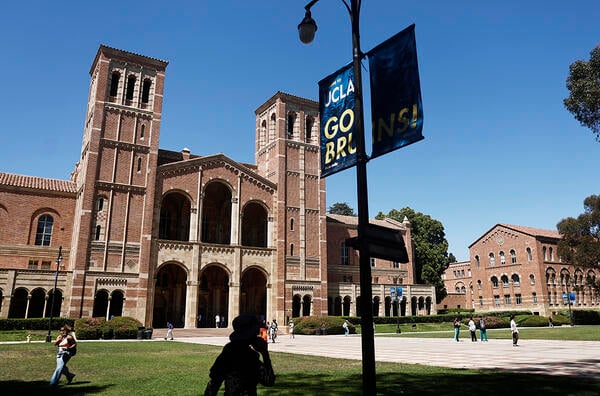
The Trump administration has already frozen $500 million in grant funding at UCLA.
The University of California system is warning state lawmakers that federal funding cuts could extend well beyond UCLA as tensions between the Trump administration and American colleges continue to rise.
UC president James B. Milliken wrote a letter to dozens of local elected officials Tuesday explaining that “the stakes are high and the risks are very real.” The system’s 10 institutions could lose billions of dollars in aid, forcing its leaders to make tough calls about staffing, the continuation of certain academic programs and more, he said.
President Trump has already frozen more than $500 million in grants at UCLA, allegedly because the Justice Department accused the university of violating Jewish students’ civil rights. The president demanded the university pay a $1.2 billion fine to unlock the funds,and system officials are worried that more funding cuts are likely. California lawmakers have repeatedly urged the UC system not to capitulate.
In an August letter, State Sen. Scott Wiener, a Democrat and chair of the Joint Legislative Budget Committee, and 33 other lawmakers told Milliken that Trump’s actions were “an extortion attempt and a page out of the authoritarian playbook,” the Los Angeles Times reported.
Milliken wrote in Tuesday’s letter that a loss in funding would “devastate” the system and harm students, among other groups.
“Classes and student services would be reduced, patients would be turned away, tens of thousands of jobs would be lost, and we would see UC’s world-renowned researchers leaving our state for other more seemingly stable opportunities in the US or abroad,” he wrote.
If the UC system loses federal funding, it would need about $4 to $5 billion a year to make up the difference, Milliken added. “That is what fighting for the people of California will take.”
Landscape, a College Board tool for providing colleges with information about the educational environment of an applicant’s high school and neighborhood based on publicly available information, has been discontinued, the organization announced this week.
“As federal and state policy continues to evolve around how institutions use demographic and geographic information in admissions, we are making a change to ensure our work continues to effectively serve students and institutions,” College Board wrote in the short announcement.
Geographic recruitment has come under fire from the Trump administration. Attorney General Pamela Bondi, in a memo declaring various diversity, equity and inclusion initiatives unconstitutional, said that recruiting from specific areas or neighborhoods could be unlawful when it’s being done as a proxy for race. Experts have said that doing so is not a standard practice for universities.
Jon Boeckenstedt, a longtime enrollment manager, criticized the decision to discontinue Landscape in a post on LinkedIn.
“I’m no fan of College Board of course … but I thought Landscape was a good and thoughtful product,” he wrote. “Now, it’s going away. You don’t have to be Wile E. Coyote to figure out why. Someone in DC has suggested it’s too close to ‘race based admissions’ (a thing that does not exist) and ‘it’d be a shame if something happened to your company.’ Or their lawyers rolled over voluntarily.”
Edward Blum, the founder of Students for Fair Admissions, the group that successfully challenged affirmative action at the Supreme Court, lauded the decision.
“Since the 2023 Supreme Court opinion in our Harvard and UNC cases, Students for Fair Admissions raised has concerns that Landscape was little more than a disguised proxy for race in the admissions process. We are gratified that this problematic tool will no longer be used to influence who is and who is not admitted to America’s colleges and universities,” he wrote in a statement. “This decision represents another important step toward ensuring that all students are treated as individuals, not as representatives of a racial or ethnic group.”
The university has vowed to honor financial commitments made to M.F.A. and Ph.D. students.
Brown University will give money to some of its graduate students whose federal research grants were cut by the Trump administration, The Brown Daily Herald reported.
“We want to make sure that we’re able to give each of you all of the attention and support that you need to get through comfortably [and] well supported,” Janet Blume, interim dean of the graduate school, said at a Graduate Student Council meeting Wednesday. She said the university will honor the financial commitments of M.F.A. and Ph.D. students who lost their grants.
The National Institutes of Health, the National Science Foundation and other federal agencies have terminated thousands of academic researchers’ grants—including many at Brown—that don’t align with the Trump administration’s ideological agenda.
Blume said Brown is also reducing its graduate student admissions target this year to allow “time to work out issues of the federal financial landscape and also shifts in the job market.”
In addition to canceling research grants, numerous federal agencies have put forth plans to cap the amount of money they reimburse universities to cover indirect research costs, which universities say will hurt their budgets and slow innovation. Brown is among the institutions suing the government over its changes to indirect cost reimbursement rates, which are on pause during ongoing litigation.
Brown, which had a $46 million deficit before President Trump took office in January, has also faced targeted scrutiny from the Trump administration. The university implemented a hiring freeze in March. In April, the government froze $510 million of Brown’s federal research dollars in retaliation for the university’s alleged failures to address antisemitism on campus.
In June, administrators warned of the potential for “significant cost-cutting” measures amid the “deep financial losses” resulting from grant cuts, increased endowment taxes and threats to international student enrollment.
The following month, Brown and the government came to an agreement, and the frozen grant money is coming back to the university. However, the deal did not restore the grants of researchers whose funding was terminated as part of the broader ideologically driven policy changes.
The U.K. and China will be the biggest beneficiaries of the U.S. health secretary’s “own goal” of pulling funding for mRNA vaccines, according to experts.
Paul Hunter, professor of medicine at the University of East Anglia, said other countries with active biotechnology industries will benefit, but the decision will still delay the development of new vaccines worldwide.
“Progress will continue but not as quickly as otherwise. Lives will be lost that could have been saved had there been a vaccine,” he told Times Higher Education.
The U.S. Department of Health and Human Services said 22 projects by major pharmaceutical companies, including Pfizer and Moderna, will be affected. The projects were working on vaccines against bird flu and other viruses.
“It will certainly make the U.S. poorer for not having a biotechnology industry that is not as competitive as it could be,” added Hunter. “The U.S. will certainly lose out to China and Europe, and when its researchers move overseas, it may not be easy to get them to return later.”
Kennedy said mRNA technology “poses more risks than benefits” for respiratory viruses and announced a shift toward “safer, broader vaccine platforms that remain effective even as viruses mutate.”
“I would certainly say it’s an own goal for the U.S. and something they are likely to regret,” said Robin Shattock, professor of mucosal infection and immunity at Imperial College London.
Shattock said innovation would continue at pace in the U.K., mainland Europe and Asia. While China pushes ahead with RNA technologies, the U.S. appears to be looking to shift to older technology used by Chinese companies.
“This current retrograde step by the U.S. will allow others to catch up and likely pull ahead in the context of vaccines,” he added. “It will only take another pandemic for them to rapidly see their mistake.”
“The disinvestment in mRNA vaccine development and production is, in my view, a serious error.”
“It is a blow to the U.S.’ own interests—they’re shooting themselves in the foot.”
In the absence of any strong evidence that COVID-19 vaccines caused adverse reactions, Bangham said it was hard to rationalize why the U.S. was acting so decisively on “the basis of a few anecdotes.”
“It’s more than a lack of competency. I think it’s active and explicit, and often voiced, opposition and denigration and disavowal of the value of scientific evidence, which I think is extremely damaging.”
Along with the U.K., Europe and China, there are now “huge opportunities” for research development in Southeast Asia, he added.
Following more than a year of scrutiny from Republicans over how Northwestern University handled pro-Palestinian campus protests last year as well as a months-long federal funding freeze, President Michael Schill plans to step down.
Schill, who has been president since 2022, announced his departure Thursday.
“Over the past three years, it has been my profound honor to serve as president of Northwestern University,” Schill wrote in a message to the campus community. “In that time, our community has made significant progress while simultaneously facing extraordinary challenges. Together, we have made decisions that strengthened the institution and helped safeguard its future.”
Schill’s exit marks an end to a tumultuous tenure at Northwestern.
The wealthy private institution in Illinois has weathered attacks from congressional Republicans over a deal Schill struck with pro-Palestinian campus protesters who set up an encampment on university grounds. Congress hauled Schill in for a hearing on antisemitism in May 2024 over his agreement with the protesters. Schill agreed to provide more insight and input into university investment decisions, amid demands to divest from companies attached to the Israeli war effort. He also promised more support for Palestinian students and faculty, among other concessions.
(However, Northwestern has not provided the level of endowment transparency it promised.)
The president defended the deal before Congress. Schill, who appeared alongside the leaders of Rutgers University and the University of California, Los Angeles, was the main target for congressional Republicans, but he stood his ground—batting away hypothetical questions and refusing to discuss the conduct of individual faculty members.
Still, accusations that Northwestern mishandled antisemitism have continued to dog Schill since, and the Trump administration launched an investigation into alleged civil rights violations and later froze $790 million in federal research funding at the university, which led to deep job cuts this summer.
Schill and other Northwestern leaders said in July that they were working to restore the research funding and were “hopeful it will happen soon.”
Faculty members and other critics also raised concerns about actions taken by Northwestern under his leadership. Steven Thrasher, a journalism professor involved in pro-Palestinian protests on campus, alleged in March that Northwestern denied him tenure for his activism.
Schill also navigated turmoil in athletics when a whistleblower alleged in late 2002 that hazing was allowed to run unchecked in the football program. Schill briefly suspended and later fired Northwestern football coach Pat Fitzgerald and a subordinate. The coach sued Northwestern for wrongful termination in 2023; the two parties reached an undisclosed settlement last month.
“As I reflect on the progress we have made and what lies ahead, I believe now is the right time for new leadership to guide Northwestern into its next chapter,” Schill said Wednesday.
Schill will remain in his role until an interim president steps into the job.
Schill’s pending exit now means only one of seven campus leaders who were called to testify in congressional hearings on campus antisemitism in late 2023 and 2024 still has her job. Leaders at Harvard University, the University of Pennsylvania, Columbia University, UCLA, Rutgers and now Northwestern stepped down within a year of the hearings. (Then–UCLA chancellor Gene Block was already set to retire.) Only Sally Kornbluth at Massachusetts Institute of Technology remains in her job.
Rep. Elise Stefanik, a New York Republican, who emerged as one of the more aggressive inquisitors in prior campus antisemitism hearings, celebrated the news on social media.
“LONG overdue!” she wrote on X. “@NorthwesternUni President Michael Schill finally resigned today after he failed protect Jewish students, caved to the demands of the antisemitic, pro-Hamas mob on Northwestern’s campus, and failed to hold students who perpetuate antisemitic attacks accountable at an Education and the Workforce Committee hearing.”
The White House also welcomed Schill’s resignation in an emailed statement.
“The Trump Administration looks forward to working with the new leadership, and we hope they seize this opportunity to Make Northwestern Great Again,” spokesperson Liz Huston wrote.