Tag: Career

  • ED Reallocates MSI Funding to HBCUs, Tribal Colleges

    ED Reallocates MSI Funding to HBCUs, Tribal Colleges

    When the U.S. Department of Education abruptly ended grants for most minority-serving institutions last week, it raised questions about what the department would do with the hundreds of millions of dollars already slated for these programs. The department offered an answer Monday, announcing plans to repurpose funds from programs “not in the best interest of students and families” to historically Black colleges and universities, tribal colleges, charter schools, and civics education.

    “The department has carefully scrutinized our federal grants, ensuring that taxpayers are not funding racially discriminatory programs but those programs which promote merit and excellence in education,” Education Secretary Linda McMahon said in a statement. “The Trump Administration will use every available tool to meaningfully advance educational outcomes and ensure every American has the opportunity to succeed in life.”

    The department promised to direct an extra $495 million to HBCUs and tribal colleges, on top of the funds already anticipated for fiscal year 2025—increases of 48.4 percent and 109.3 percent, respectively. In total, HBCUs are slated to receive over $1.34 billion and tribal colleges expect to receive $108 million this fiscal year, which ends Sept. 30. The department is also giving an additional $60 million to charter schools and putting $137 million toward civics education grants. The department didn’t share more specifics on how it would allocate the funds to institutions.

    The move has been met with mixed reactions. Some HBCU advocates are celebrating the one-time influx as a game-changer for cash-starved institutions. Others’ joy is tempered by concern that the Trump administration is uplifting some MSIs at the expense of others, sowing tensions between them.

    The new funds come less than a week after the Education Department quashed grant programs for Hispanic-serving institutions and other MSIs, deeming them “unconstitutional” because they require colleges to serve a certain percentage of students from a particular racial or ethnic background to qualify. (HBCUs and tribal colleges don’t have enrollment thresholds.) This blow to MSI grants, as well as cuts to teacher prep and gifted and talented programs, is paying for the department’s recent largess, The New York Times reported, citing several anonymous sources familiar with the department’s plans.

    Lodriguez Murray, vice president of public policy and government affairs at the United Negro College Fund, which represents private HBCUs, said the funds are “nothing short of a godsend” for institutions operating on lean budgets.

    “Now, all of a sudden, [HBCUs] have much more wherewithal to do the things, not just that take you from year to year, but can make an impact on your campus,” he said. He foresees HBCUs using the funds to buy property, improve their campus infrastructure and invest in student and faculty supports in new ways.

    Murray said he doesn’t have qualms about the money coming from the slashed MSI programs.

    He claimed many of these institutions are predominantly white, tend to have higher endowments than HBCUs and serve lower shares of Pell-eligible students. (Most enrollment-based MSIs are required to serve at least 50 percent low-income students. HBCUs have no such requirement but tend to enroll at least 70 percent Pell-eligible students.)

    As far as he’s concerned, the Trump administration is channeling “resources toward the institutions that seem to need it the most—and the institutions that have a better track record at taking students from underserved backgrounds and … changing the economic outlook of their lives,” Murray said. “That is the reason why we have no pause about receiving the funds this morning.”

    Harry Williams, president and CEO of the Thurgood Marshall College Fund, which represents public HBCUs, said he wants to see other types of MSIs thrive, and at the same time, he’s excited about how the new support could help HBCU students.

    He didn’t know the Trump administration planned to drop millions on the institutions, he said. And while TMCF regularly lobbies for HBCU funding, “candidly, we have never made any recommendations about where the money should come from to the administration, because that’s their decision in terms of how they operate.”

    He said he’s “sensitive” to the challenges facing MSIs, noting that TMCF has three predominantly Black institutions among its members. TMCF put out a statement last week in support of them when the department said it was ending MSI grant programs, including PBIs.

    “We do support MSIs and PBIs and all the groups in that category and recognize the importance of them having resources, too,” he said, “but our primary focus has always been working with HBCUs.”

    Pitting MSIs Against Each Other

    Marybeth Gasman, executive director of the Rutgers Center for Minority Serving Institutions, said HBCUs and tribal colleges deserve the money.

    These institutions have “always been underfunded” and “the federal government should always be thinking about ways to enhance them, especially based on our country’s history of racism and inequities,” she said.

    But Gasman believes other types of MSIs are also deserving of these resources. She pointed out that many Hispanic-serving institutions are community colleges, and they serve about a third of the country’s students over all, not just Latino students.

    The Education Department is “trying to pit different types of minority-serving institutions against each other,” even though MSI leaders and advocacy groups have worked together for years toward similar policy goals, she said. “And that is really, really troubling … I hope people don’t fall for that.”

    Gasman noted that department officials made a “purposeful” decision to share that new funds for HBCUs and tribal colleges came from defunded programs. She called the framing of the announcement “spiteful” and said she worries for the future of the MSI community.

    “There is enough pie for all of these institutions,” she said. “It’s not like you need to take from one to feed the others.”

    Dominique Baker, associate professor of education and public policy at the University of Delaware, said the funding for HBCUs and tribal colleges, while necessary, doesn’t lead her to believe the Trump administration has their best interests at heart.

    The funds are “a nice way” for the administration to claim “they hold no racial animus, because look at all the money that they’ve given to HBCUs,” Baker said, at the same time as they crack down on diversity, equity and inclusion at predominantly white institutions.

    “It can both be true that you are providing funding to institutions that deserve funding—and you are working to ensure that the institutions that you hold in high prestige resegregate,” she added.

    Executive Branch Overreach?

    The legality of the department’s move—cutting funding for some programs to be showered on others—is also a little murky. Department officials say they are relying on “existing flexibilities in discretionary grant programs” to move the money around.

    Amanda Fuchs Miller, former deputy assistant secretary for higher education programs under the Biden administration and now president of the higher ed consultancy Seventh Street Strategies, said under statute, the department legally has the right to “reprogram” funds within an account.

    But even if department officials are following the law, she said the “intent” of reprogramming was never to end programs authorized and continually funded by Congress, like the MSI programs. And the executive branch claiming it has the authority to declare anything unconstitutional is “the real problem.” So, as far as she’s concerned, the department went out of bounds by eliminating the MSI programs and regifting their money to other institutions.

    “It’s great that the HBCUs and TCUs will get more money—they need it,” Miller said. “Those students will benefit from it. But to take away funds from one group of students to help another group of students, that’s not beneficial to anybody. We should be pushing back to help all students succeed and have these resources.”

    Source link

  • Strategies for Personalized Learning in AI Age (opinion)

    Strategies for Personalized Learning in AI Age (opinion)

    How do we teach effectively—and humanly—in this age of AI?

    New advances in artificial intelligence break news at such a rapid pace that many of us have difficulties keeping up. Dinuka Gunaratne gave a detailed summary of many different AI tools in his “Carpe Careers” article published in July; yet more tools will likely appear in the next months and years in an exponential explosion. How do we, as educators (new and established Ph.D.s) design curriculum and classes with these new AI tools being released every few weeks? How do we design effective assignments that teach critical analysis and logical thought while knowing that our students, too, have access to these tools?

    Many existing AI tools can be used to assist with course design. However, I will provide some insight on methods of pedagogy that emphasize personalized learning regardless of what new technology becomes available.

    Some questions educators are now thinking about include:

    1. How do I design an assignment so the student cannot just prompt an AI tool to complete it?
    2. How do I design the course so that the student can choose whether or not to use AI tools—and how do I assess these two groups of students?

    Below, I outline some wise teaching practices with an eye toward helping students develop core skills including critical thinking, problem-solving, teamwork, creativity and—the most essential skill of all—curiosity.

    Making the Most Out of Class Time

    An effective course utilizes a combination of teaching strategies. I outline three here.

    1. Make sure that your class is generative so that when you give an assignment, it reaches as far back as day one. A generative learning model is one in which each week is built upon the previous one, and in which a student is assessed on the knowledge they have cumulatively accrued.
    1. Hold interactive in-person activities in each class, building upon the previous assignments and content.
    2. Flip the classroom so that class time is used for discussion and not a monologue presentation from you. If you can assign videos or reading assignments for students to view or read prior to class, then you can use class time to discuss the content or reinforce the learning with group activities.

    Here is an example of combining these tools in the buildup to a presentation from one of my classes.

    • Week 1: Each student writes and brings a one-page summary of their research so that peers can provide feedback. I provide feedback training in class before the peer readings take place.
    • Week 2: Using the peer feedback of the summary, each student creates one slide summarizing their research for a three-minute thesis (3MT) and brings the slide to class to receive peer feedback.
    • Week 3: Students practice presentation skills through an activity called “slide karaoke,” in which a student has one minute to present a simple slide they have never seen before. They are then given feedback by peers and the instructor on general presentation skills. I provide peer feedback training before the presentations.
    • Week 4: Students implement the general feedback from slide karaoke and give practice 3MT presentations to receive specific peer and mentor feedback on the content. These mentors are usually students from the year before who revisit the class.
    • Week 5: Students give the final 3MT in front of judges and peers for evaluation.
    • Week 6: Students write a summary of what was learned from the entire generative experience.

    This sequence of assignments is personalized so that the final report can only be about the student’s individual experience. While students might want to use AI tools to edit or organize their ideas, ChatGPT or other AI tools cannot possibly know what happened in the classroom—only the student can write about it.

    For larger classes in which a presentation from each student may not be possible, here is another example.

    • Week 1: A video or reading assigned to students to view/read before class discusses the basics of DNA and inheritance. An in-class assignment involves a group discussion on Mendelian inheritance problem sets.
    • Week 2: Before class, students read an article on how DNA is packaged; the in-class discussion focuses on the molecules involved in chromatin structure.
    • The next classes all have either prereads or videos, which students discuss in class, and the content builds up to a more complex genetic mechanism, such as elucidating the gene for a disease. The final report could be “summarize how one could find a gene responsible for a certain disease using the discussion points we had in class.” In this scenario as well, the student is taking the personalized class experience and incorporating the ideas into the final report, something that cannot be wholly outsourced to any AI tool.

    If you decide to embrace AI tools in the classroom, you can still teach critical thinking and creativity by asking the students to use AI to write a report on a topic discussed in class—and then in part two of the assignment, ask them to assess the AI-generated report, cite the proper references and correct any mistakes, content or grammar-wise.

    I sometimes show an example of this in class to demonstrate to students that AI makes mistakes, rather than giving it as an assignment. But it is something you might want to try making an optional method for an assignment. Students can declare whether they used AI or not on their submission. As an instructor, you will need to design two rubrics for these different groups. Group one will have a rubric based on content, grammar, references, logical thought and organization, and clarity. Group two (those who use AI) will have a rubric consisting of the same components in addition to an evaluation of how well the student found the AI mistakes.

    Applying for Teaching Positions

    If you are applying for a teaching position, you should address AI in your teaching dossier and how you may or may not incorporate it—but at the very least, discuss its effects on higher education. Many articles and books on this topic exist, including Teaching with AI: A Practical Guide to a New Era of Human Learning, by José Antonio Bowen and C. Edward Watson (Johns Hopkins Press, 2024); Robot-Proof: Higher Education in the Age of Artificial Intelligence, by Joseph E. Aoun (MIT Press, 2017); and Generative AI in Higher Education, by Cecilia Ka Yuk Chan and Tom Colloton (Routledge, 2024).

    Yet even as we consider how to integrate AI in our teaching, we must not forget the human experience at work in all that we do. We can emphasize things like 1) encouraging students to meet with us in person or even for a walk as opposed to a virtual meeting and 2) assessing what emotions students bring to the meeting or class and how that may affect the dynamics. We as educators should harness the human side of teaching, including the classroom experience and the in-class group work, so that the “final” assessments build directly out of these personalized learnings.

    For those venturing into a career that involves teaching or mentoring, develop teaching strategies and tools that center the human experience and include them in your teaching dossier. Your application will shine.

    Nana Lee is the director of professional development and mentorship, special adviser to the dean of medicine for graduate education, and associate professor, teaching stream, at the University of Toronto. She is also a member and regional director of the Graduate Career Consortium—an organization providing an international voice for graduate-level career and professional development leaders.

    Source link

  • A Disenchanted Provost Discusses Why He Ditched the Job

    A Disenchanted Provost Discusses Why He Ditched the Job

    Throughout his 20-year career in higher education, Julian Vasquez Heilig has steadily climbed the career ladder, moving from assistant to associate professor at the University of Texas at Austin; into a full professorship at California State University, Sacramento; and then to a dean position at the University of Kentucky’s College of Education, Human Development and Sport Science. Being dean was rewarding, he said. The wins were visible, the feedback loop was short and he was well supported. Hoping to expand his impact, Heilig stepped onto the next career-ladder rung and became provost at Western Michigan University in Kalamazoo. But as provost, he didn’t feel emboldened to make change, he said; he felt isolated and exposed.

    After two years, he stepped down, and he now serves as a professor of educational leadership, research and technology at Western Michigan. His frustrations with the provost role had less to do with Western Michigan and more to do with how the job is designed, he explained. “Each person sees the provost a little differently. The faculty see the provost as administration, although, honestly, around the table at the cabinet, the provost is probably the only faculty member,” Heilig said. “The trustees—they see the provost as a middle manager below the president, and the president sees [the provost] as a buffer from issues that are arising.”

    Inside Higher Ed sat down with Heilig to talk about the provost job and all he’s learned about the role through years of education leadership research, conversations with colleagues and his own experience.

    The interview has been edited for length and clarity.

    Q: You stepped down from the provost role at Western Michigan in January, two years after taking the position. What tipped you off that the position wasn’t for you?

    A: In general, provosts are judged on student success, retention, faculty hiring and academic quality, and yet the purse strings of those things often truly sit with the president or the chief financial officer. That split means the provost really answers for outcomes without the levers to fund them. The job really asks you, as a leader, to redesign programs and diversify pipelines while working with multiple stakeholders—trustees, donors and faculty. If you push too hard on innovation, you face backlash. If you move too slowly and the role becomes ceremonial, then that might violate your own personal mission and beliefs. I’m not specifically talking about Western Michigan—all institutions have to decide whether they value transformation or whether they want tranquil optics.

    For most provosts, the average tenure is three years, based on the research I’ve seen. But durable change, sustainable change could take five, seven, 10 years. A lot of the things that [provosts] initiate outlive the job—it’s difficult to be around to see your agenda finished.

    Q: You’ve described the provost role as being “structurally exposed.” What does that mean, exactly?

    A: The relationship between presidents and provosts can be—especially at research universities—really fraught. One of the ways that it can be helped is by, from the outset, sitting down with your president to talk about how you’re going to make decisions, what the expectations are for resource commitments and joint accountability for decisions. A lot of times provosts are enforcing decisions and policies they didn’t make, but they’re held accountable to those policies, and having a compact [with the president] would be a better foundation.

    Leaders need to be able to have buffers to take smart risks without constant political whiplash. Those could look like multiyear resource agreements or protocols for handling disputes among vice presidents. That is super important—insulation is not isolation; it’s a structure that enables courage among leaders. Higher education is always the first to call for change and the last to make it because we have to align authority with responsibility. We have to be committed to change. We can’t avoid crises because there are some people that aren’t interested in making change and are completely satisfied with the status quo.

    Q: Did pushback to your equity work factor into your decision to ultimately step down?

    A: When controversy hits, the easiest release valve is the provost … It’s important for institutions to see the provost role not as disposable if they expect the provost to be bold stewards of academic affairs.

    Someone told me on LinkedIn that the provost role is not actually the chief officer of academic affairs; they’re actually the associate dean of academic affairs. Because pressure comes at the provost from the side from other vice presidents, from above you from the president and from below you from the deans, without the opportunity to respond to all those stakeholders in all the ways you would like. If you reallocate resources and challenge the institution’s sacred cows, then you’re going to take immediate fire. A lot of provosts will last many, many years in the job because caretaking is much safer than transforming under the current norms of higher education. So we need to think about how you reward measured disruption in the provost role and protect those who are doing the hard work of solving problems.

    There’s a high burnout cost to this job because you have nonstop negotiation between all these different stakeholder groups and competing demands. Each of these stakeholder groups want something different. Emotional labor mounts for you as a provost because the wins are very diffused … and if something goes wrong with accreditation or something else, the blame is very concentrated. So without structural support from each of those stakeholder groups, even the best leaders get drained.

    A lot of people go right from dean to president nowadays; they don’t want to get sidelined by the provost role. They just decide that this type of leadership is not worth it. That means that institutions are losing people who would build in this role, who would innovate in this role, and are rewarding people who just simply want to manage and caretake. Instead of hiring leaders, they’re just going to hire a manager.

    Q: You’ve written that provosts are almost always destined for a falling-out with their president. How do you think those roles are pitted against each other?

    A: If you’re thinking about becoming a provost, you have to take the measure of the person you’re working for. You’ve got to figure out: How is this hard decision going to be made? How are resources going to be committed? How is there going to be joint accountability for decisions that the president wants you to make? Will there be shared goals and shared power, rather than performative communications and performative statements? A real relationship and a real compact is the foundation for success for a partnership like this.

    Deans operate in a bounded area of things with very visible outcomes and very tight feedback loops, but the provost has a very diffuse set of responsibilities and is responsible for not just one but [many] colleges. The clarity that deans have really fuels that work. Vice president of academic affairs is a title that suggests influence, but its insulation and authority are very thin. Visibility is high, but when things go wrong, they go very wrong. We’ve got to pair the prestige of that position with clear powers and clear protections, because, again, each of the stakeholder groups has different interests, and so they see you either as their friend or their enemy.

    Q: Is there anything in particular that you would like to see from presidents in general to better support their provosts?

    A: [Provosts] can’t be seen as expendable by design. So when a controversy hits—and you have controversies day after day after day—the main job of the provost is to fix things, hard problems that weren’t fixed before they got to your desk. And so when things go really wrong, from what I hear from my colleagues, the easiest release valve is the provost.

    As you look across campuses, people are saying provost is the hardest job. And there’s a reason why they say that.

    Q: Inside Higher Ed with Hanover Research is releasing its annual survey of provosts tomorrow, and one of the things we found is that 86 percent of respondents said they enjoyed being provost, but only 29 percent of them felt that they consistently have the resources they need to implement initiatives. Do you feel like your experience aligned with that?

    A: Yeah, I think it’s particularly difficult when you come in as a vice president rather than as an executive vice president. When you’re on the same level with other VPs, it creates a Game of Thrones in terms of resources. The finance people want money for building, and the VP of research wants money for research, and so one of the challenges when you come into the provost role is you need to have more flexibility, especially around equity. When equity moves from emails and speeches to actual budget shifts, you get resistance. Leaders who are expected to redirect resources to close gaps, they become targets.

    Q: Also in our survey, more than half of provosts said their job was more about fixing problems than planning ahead. Would you agree that the role is like playing crisis manager?

    A: Part of the challenge is that provosts are having to deal with decisions that other people made. And so you have to deal with decisions that faculty made that may be problematic. You’ve got to implement decisions that the president made. You have a cabinet wanting to implement their decisions for academic affairs, and some of those things go wrong. So you’ve got to work with your team to fix all the different things, and sometimes you can’t fix it fast enough.

    Source link

  • Trump Administration Withholds Millions for TRIO Programs

    Trump Administration Withholds Millions for TRIO Programs

    Normally, back-to-school season means that the staff who lead federally funded programs for low-income and first-generation college students are kicking into high gear. But this month, the Trump administration has frozen hundreds of millions of dollars in TRIO grants, creating uncertainty for thousands of programs. Some have been forced to grind to a halt, advocates say.

    Colleges and nonprofits that had already been approved for the award expected to hear by the end of August that their federal funding was on its way. But rather than an award notice, program leaders received what’s known as a “no cost extension,” explaining that while programs could continue to operate until the end of the month, they would not be receiving the award money. 

    Over all, the Council for Opportunity in Education, a nonprofit advocacy group that focuses on supporting TRIO programs, estimates that the Trump administration has withheld about $660 million worth of aid for more than 2,000 TRIO programs. (Congress allocated $1.19 billion to TRIO for the current fiscal year.) 

    As a result of the freeze, COE explained, many colleges and nonprofit organizations had to temporarily pivot to online services or shutter their programs and furlough staff. Roughly 650,000 college students and high school seniors will lack vital access to academic advising, financial guidance and assistance with college applications if the freeze persists, they say.

    “For many students, these first few weeks of the year are going to set the trajectory for their whole semester, especially if you’re an incoming freshman,” said COE president Kimberly Jones. “This is when you’re making critical choices about your coursework, trying to navigate the campus and just trying to acclimate to this new world. If you’re first-gen, you need the guidance of a program to help you navigate that.”

    Jones said that Education Department officials said this week that the pause is temporary. However, the Department of Education did not immediately respond to Inside Higher Ed’s request for comment Friday.

    TRIO Under Threat

    Originally established in the 1960s, TRIO now consists of seven different programs, each designed to support various individuals from disadvantaged backgrounds and help them overcome barriers of access to higher education.  

    Not all the TRIO programs have had funding withheld. Roughly 1,300 awards for certain programs—such as Upward Bound Math-Science, Student Support Services and any general Upward Bound projects with a June 1 start date—were disbursed on time, Jones said. But that’s only 40 percent of the more than 3,000 TRIO programs.  

    Other programs, including Upward Bound projects with a Sept. 1 start date, Veterans Upward Bound, Educational Opportunity Centers and Talent Search, are still waiting for checks to land in their accounts.

    Policy experts added that funding for the McNair Postbaccalaureate Achievement program, a TRIO service focused on graduate students, also has yet to be distributed. But unlike most of the programs, funding for McNair is not due until Sept. 30. Still, Jones and others said they are highly concerned those funds will also be frozen.

    Given the unpredictability of everything this year around education, we can’t make any assumptions. Until we get those grants in the hands of our constituents, we have to assume the worst.”

    —COE president Kimberly Jones

    President Donald Trump proposed cutting all funding for TRIO in May, saying that the executive branch lacks the ability to audit the program and make sure it isn’t wasting taxpayer dollars. But so far, House and Senate appropriators have pushed back, keeping the funding intact. 

    When confronted by Sen. Susan Collins, a Maine Republican and longtime TRIO advocate, at a budget hearing in June, McMahon acknowledged that “Congress does control the purse strings,” but went on to say that she would “sincerely hope” to work with lawmakers and “renegotiate” the program’s terms. 

    And while advocates hope that funds will eventually be reinstated, most experts interviewed remain skeptical. With 18 days left until the end of the fiscal year, any unallocated TRIO funds will likely be sent back to the Department of Treasury, never to reach the organizations they were intended for. 

    The Trump administration has tried to freeze or end other education-related grant programs—including a few TRIO programs that were cut off in June—which officials said “conflict with the Department’s policy of prioritizing merit, fairness, and excellence in education; undermine the well-being of the students these programs are intended to help; or constitute an inappropriate use of federal funds.”

    And while some of the funding freezes have been successfully challenged in court, the judicial process needed to win back federal aid is slow. Most colleges don’t have that kind of time, the advocates say.

    “Given the unpredictability of everything this year around education, we can’t make any assumptions,” Jones said. “Until we get those grants in the hands of our constituents, we have to assume the worst.”

    ‘Crippling’ Effects 

    For Summer Bryant, director of the Talent Search program at Morehead State University in Kentucky, the funding freeze has been “crippling.”

    Talent Search is a TRIO program focused on supporting middle and high school students with college preparation. And while the loss of about $1 million hasn’t forced Bryant to shut down her program quite yet, it has significantly limited her capacity to serve students.

    After paying the program’s 10 staff members for the month of September, Bryant has just over $1,000 left—and that’s between both of the grants she received last year.

    “It may sound like a lot, but when you take into account that we’re providing services to eight counties and 27 target schools, coupled with the fact that driving costs about 50 cents a mile and some of our schools one-way are almost 120 miles away, that’s not a lot of money,” she said. “So instead, I had to make a Facebook post notifying our students and their guardians that we would be pausing all in-person services until we receive our grant awards.”

    Even then, Morehead TRIO programs are based in a rural part of Appalachia, so broadband access and choppy connections are also a concern. 

    “Doing things over the phone or over a Zoom is just not as effective as doing it face-to-face—information is lost,” Bryant said. And because this freeze is happening during the most intensive season for college applications, “even a one month delay could lead to a make-or-break moment for a lot of our seniors,” she added.

    It’s not just Bryant facing these challenges. Of Morehead’s nine preapproved TRIO grants, only four have been awarded. The same scenario is playing out at campuses across the country.

    Democratic senators Jeff Merkley of Oregon and Raphael Warnock of Georgia, along with 32 other lawmakers from both sides of the aisle, demanded in a letter sent Wednesday that the administration release the funds. Collectively, they warned that failure to do so “will result in irreversible damage to our students, families, and communities, as many rely on the vital programs and services provided by TRIO programs.”

    They wrote that TRIO has produced over six million college graduates since its inception in 1964, promoting a greater level of civic engagement and spurring local economies. 

    “The data proves that TRIO works,“ the senators stressed. “Students’ futures will be less successful if they do not receive their appropriated funds immediately.” 

    Rep. Gwen Moore, a Wisconsin Democrat and TRIO alumna, and 53 fellow House members sent a similar letter the same day.

    The freeze is hitting community colleges particularly hard; they receive half of all TRIO grants, said David Baime, senior vice president for government relations at the American Association of Community Colleges.

    Baime said he has “no idea” why the department is withholding funds and added that while he is hopeful the federal dollars will be restored, there is an “unusual degree of uncertainty.”

    Between a handful of TRIO grants that were terminated with little to no explanation earlier in the year and the recent decision to cancel all grant funding for minority-serving institutions, worries among TRIO programs are high, Jones from COE and others said.

    Still, Baime is holding out hope.

    “The department has gone on record saying that fiscal year 2025 TRIO funds would be allocated,” he said. “So despite the very concerning delays, we remain optimistic.”

    Source link

  • 3 More Faculty, Staff Removed for Kirk Comments

    3 More Faculty, Staff Removed for Kirk Comments

    Photo illustration by Inside Higher Ed | LeoPatrizi/E+/Getty Images

    At least five faculty and staff members have been fired so far for comments they made in response to the death of Turning Point USA founder and conservative firebrand Charlie Kirk, who was shot and killed Wednesday during an event at Utah Valley University. 

    Investigators announced Friday they arrested a suspect, 22-year-old Tyler Robinson, who is now being held in a Utah jail without bail. Utah governor Spencer Cox said during a press conference Friday that a family friend turned Robinson in to authorities after the suspect suggested to a relative that he’d killed Kirk. Robinson was not a student at Utah Valley.

    The Utah Board of Higher Education said in a statement that Robinson is a third-year student in the electrical apprenticeship program at Dixie Technical College and that he attended Utah State University for one semester in 2021.

    Among the latest college employees terminated for their responses to Kirk’s killing, Lisa Greenlee was removed as a part-time instructor from Guilford Technical Community College in Jamestown, N.C., on Thursday after she made comments criticizing Kirk to students during an online class, saying, “I’ll praise the shooter; he had good aim.” A video of her remarks made the rounds on X, where right-wing accounts encouraged the college to fire her.

    “We deeply regret that students, employees, and the community were impacted by her comments. Greenlee’s behavior is not consistent with the college’s values and mission to serve Guilford County. Her statement regarding the assassination of Charlie Kirk does not support the open and respectful learning and working environment that GTCC provides every day,” GTCC president Anthony Clarke said in a statement. “We want to reiterate that supporting violence is reprehensible and will not be tolerated at the college.” Greenlee did not respond to Inside Higher Ed’s request for comment. 

    Two employees at Cumberland University in Lebanon, Tenn., were dismissed Thursday for making “inappropriate comments on the internet related to the tragic shooting of Charlie Kirk,” university president Paul Stumb wrote in a statement posted on X. He identified the employees as Michael Rex, an English and creative writing professor, and Max Woods, an assistant esports coach, but he did not share what they said. Like Greenlee, both had been the subject of online campaigns advocating for their firing. 

    “This decision was not made lightly,” Stumb wrote. “We understand the importance and the impact of this action, and we want to emphasize that we conducted a comprehensive investigation prior to making our decision.” 

    Before Stumb’s statement was publicized, Rex posted an apology on his Facebook page. “No one deserves to be murdered,” he wrote. “I did not think about the pain and anger that my words would create. My comments were not meant to celebrate nor to foster political violence and for any traums [sic] my words caused, I am truly sorry.” Rex and Wood did not respond to Inside Higher Ed’s request for comment.

    The recent firings follow the dismissals of Laura Sosh-Lightsy, a student affairs administrator at Middle Tennessee State University, and an unnamed staff member at the University of Mississippi.

    A Clemson university professor is also subject to an ongoing push by X users to have him fired for statements on Kirk’s death. On Friday afternoon, the university posted a statement that alluded to the situation. “We stand firmly on the principles of the U.S. Constitution, including the protection of free speech. However, that right does not extend to speech that incites harm or undermines the dignity of others. We will take appropriate action for speech that constitutes a genuine threat which is not protected by the Constitution.”

    Source link

  • Teaching and Learning Can’t Happen Under These Circumstances

    Teaching and Learning Can’t Happen Under These Circumstances

    I’m hoping everyone working in higher education is aware of the recent events at Texas A&M, where a student recording of an exchange with an instructor ultimately led to the dismissal of the instructor and the demotion of both the department chair and college dean that had backed the instructor’s classroom autonomy.

    I looked at the big-picture academic freedom implications in a newsletter for the Center for the Defense of Academic Freedom, where I note that one of the people who initially defended the instructor’s autonomy was Texas A&M president Mark Welsh, who told the student complainant that firing the instructor was “not happening,” only to reverse course after a storm of right-wing outrage and political pressure rained down.

    The instructor was a model of professionalism—watch the video yourself if you don’t believe me—and yet this student set out with a plan deliberately engineered to get the instructor fired, and it worked.

    I’ve been thinking a lot about this student, about what has to happen for a young person to enter college seeing something like this—personally targeting and destroying another human being who is just doing their job—as what they want to spend their college years doing.

    It is an act of great cruelty, and yet I must imagine this person does not see themselves as cruel. I’m sure they somehow have justified this cruelty, but there is simply no justification for it. If they are not cruel, what is left? It becomes an act of madness.

    One of my favorite things about teaching college-age students is that they are ready for the whole deal, adults who have volunteered themselves for a potentially transformative experience. Look, I’m not naïve about the more transactional mindsets that students bring to college, but it always seemed to me that at least the potential for something more meaningful, more lasting, was always present.

    I loved teaching because I knew that this was the goal, even as I only had vague notions of how it could be achieved. And when it was achieved for a particular student, it was clear that this was not necessarily replicable on a mass scale using the same approach. That difficulty is fascinating. The tension in not knowing if it can be pulled off, but trying anyway, was energizing, sometimes even intoxicating. This is very hard, but it is also very worth doing.

    At least I think so.

    Sometimes, when things were going well during a class, I would step outside myself for a moment and think, Look at all these people! Each one of them was a person, and together we were collectively being human, at least for a moment. What could be better?

    Here we are. I honestly don’t know how anyone can teach and learn under the present circumstances. For the bulk of my career, I worked in places where my political and religious views were out of sync with those of most my students, but I could not imagine being afraid of them exacting punishment or revenge on me for the mere fact of these views. My students were fundamentally open and curious, not without convictions by any means, but also essentially trusting that everyone involved in the educational enterprise had their best interests at heart unless proven otherwise.

    Now, it seems prudent to assume someone is out to get you, because it only takes one person of bad faith armed with a smart phone and ill intent to destroy your career. There is an essential fragility, a brittleness to this student who took down their instructor that makes them impossible to work alongside. There is no potential for community. Even if they are only one in a thousand, the whole deal is spoiled.

    In my course policies, I would often share a quote from Cornel West regarding the project I hoped the students and I were embarking on together.

    “I want to be able to engage in the grand calling of a Socratic teacher, which is not to persuade and convince students, but to unsettle and unnerve and maybe even unhouse a few students, so that they experience that wonderful vertigo and dizziness in recognizing at least for a moment that their world view rests on pudding, but then see that they have something to fall back on. It’s the shaping and forming of critical sensibility. That, for me, is what the high calling of pedagogy really is.”

    There are places today where it seems like even articulating such a philosophy, let alone attempting to put it into practice, would disqualify me from the classroom.

    As I was first working on drafting this column, I saw the news of the violent death of another young person who got his start as an antagonist to college professors and became quite wealthy and powerful primarily by calling down harassment on others—harassment that caused them to fear for their jobs and even sometimes their lives.

    He had a wife and two children under 4 years old. More madness.

    I honestly don’t know what to make of any of this. I am in a moment of Dr. West’s “pudding.”

    Maybe tomorrow more helpful thoughts will come.

    Source link

  • Texas State Fires Professor Accused of Inciting Violence

    Texas State Fires Professor Accused of Inciting Violence

    Mikala Compton/Austin American-Statesman/Getty Images

    Texas State University fired a professor Wednesday after he was accused of inciting violence during a speech at a socialist conference, The Texas Tribune reported

    In a video posted on X, associate professor of history Thomas Alter can be seen giving a speech over Zoom to attendees of the Revolutionary Socialism Conference. “Without organization, how can anyone expect to overthrow the most bloodthirsty, profit-driven mad organization in the history of the world—that of the U.S. government,” he said in the clip, which was circulated online by a YouTuber who infiltrated and recorded the event.

    Texas State president Kelly Damphousse said in a statement Wednesday that the university reviewed the comments, which he said “amounted to serious professional and personal misconduct.”

    “As a result, I have determined that his actions are incompatible with their responsibilities as a faculty member at Texas State University,” he added. “Effective immediately, his employment with Texas State University has been terminated.”

    The video clip shared on social media was spliced and cut together. In the full version of his speech, which is posted on YouTube, Alter discusses the various tactics of different socialist groups. 

    “Another strain of anarchism gaining ground recently is that of insurrectionary anarchism,” Alter said in his speech. “Primarily coming out of those that were involved in the Cop City protest. These groups, individuals have grown rightfully frustrated with symbolic protests that do not disrupt the normal functioning of government and business. They call for more direct action and shutting down the military-industrial complex and preventing ICE from kidnapping members of their communities. Many insurrectionary anarchists are serving jail time, lost jobs and face expulsion from school. They have truly put their bodies on the line. While their actions are laudable, it should be asked, what purpose do they serve? As anarchists, these insurrectionists explicitly reject the formation of a revolutionary party capable of leading the working class to power. Without organization, how can anyone expect to overthrow the most bloodthirsty, profit-driven mad organization in the history of the world—that of the U.S. government.”

    Alter didn’t respond to a request for comment from Inside Higher Ed.

    He is the second Texas professor to be fired from their post this week. On Tuesday, Texas A&M officials fired Melissa McCoul, a senior lecturer, and removed two faculty members from their administrative roles after a student complained that the material McCoul taught in a summer course violated President Donald Trump’s executive orders.

    Source link

  • Staff Members Fired, Grad Student Punished for Cheering Charlie Kirk’s Death

    Staff Members Fired, Grad Student Punished for Cheering Charlie Kirk’s Death

    Photo illustration by Justin Morrison/Inside Higher Ed | skynesher/E+/Getty Images

    Two administrators are now out of a job and a graduate student lost an internship after making comments online that downplayed or celebrated the death of Charlie Kirk, the influential conservative founder of the campus-focused Turning Point USA. 

    In the 36 hours since Kirk was shot and killed during an event at Utah Valley University, right-wing social media accounts have screenshotted and circulated several social media posts, likes and reposts from college faculty and staff members related to Kirk’s death. In addition to the firings, the campaign to name and shame these individuals has led to death threats, Wired reported.

    Late Wednesday, a student affairs administrator at Middle Tennessee State University was fired after posting “insensitive” remarks on Facebook in response to Kirk’s death. “We take great pride in the professionalism of our staff; in my long tenure with this university I’ve never before had to dismiss someone for so carelessly undermining the work and mission of this fine institution,” Middle Tennessee State president Sidney McPhee wrote in a statement Thursday. A university spokesperson confirmed the employee was Laura Sosh-Lightsy, an associate dean of student care and conduct who had worked at the university since 2005. 

    “Looks like ol’ Charlie spoke his fate into existence. Hate begets hate. ZERO sympathy,” Sosh-Lightsy wrote in a Facebook post that has been circulated widely by right-wing accounts on social media. A university spokesperson did not confirm whether or not that specific post led to her firing but noted that “her termination was related to her insensitive social media posts related to the horrific death of Mr. Kirk.” Tennessee senator Marsha Blackburn, a Republican, called for Sosh-Lightsy’s firing on X, writing that she “should be ashamed of her post.” Sosh-Lightsy did not respond to Inside Higher Ed’s request for comment.

    On Thursday afternoon, University of Mississippi chancellor Glenn Boyce confirmed the firing of an unnamed staff member who he said “re-shared hurtful, insensitive comments on social media regarding the tragic murder of Charlie Kirk.”

    Boyce didn’t provide specifics but noted that “these comments run completely counter to our institutional values of civility, fairness and respecting the dignity of each person.” 

    At Baylor University, officials distanced the university from a graduate student who wrote “this made me giggle” in response to a social media post sharing the news of Kirk’s death.

    “We are aware and greatly disappointed by a social media comment from a Baylor graduate student regarding the fatal shooting of Charlie Kirk. To make light of the death of a fellow human being is completely inappropriate and completely counter to Baylor’s Christian mission. Baylor strives to be a community in which every individual is treated with respect—in life and in death,” a university statement said.

    The graduate student—whose online username includes “coach”—is not a member of the faculty nor a part of the athletics program, the statement clarified. Midway Middle School, where the graduate student was student teaching, also removed him from teaching there, KWTX reported

    The Foundation for Individual Rights and Expression is monitoring which universities are censoring employee speech, said Lindsie Rank, director of campus rights advocacy at FIRE. “It may not be moral to speak ill of the dead, but it is protected by the First Amendment so we’re going to be keeping our eyes open for those situations,” she said.

    Ryan Quinn contributed to this report.

    Source link

  • Florida Finalizes Interim President Hire

    Florida Finalizes Interim President Hire

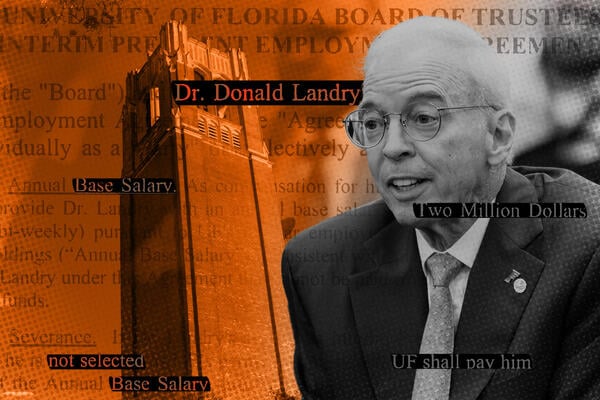
    The Florida Board of Governors unanimously approved Donald Landry on Thursday as interim president of the University of Florida, three months after it rejected Santa Ono for the job in a split vote.

    Landry, who has a lengthy academic résumé but has never been a college president, will now be among the top-paid campus leaders in the country, with a base salary of $2 million and the potential to earn an additional $500,000 in bonuses. But the one-year contract also includes an unusual caveat: Landry will earn $2 million in severance pay if he is not selected for the permanent job.

    Such a guarantee is an anomaly for an interim president, one expert said.

    The Interview

    Landry’s interview with the Board of Governors Thursday was much less contentious than Ono’s.

    The board grilled Ono, who resigned as president of the University of Michigan to pursue the top job at UF, for almost three hours, mostly over his past support of diversity, equity and inclusion initiatives, which he sought to distance himself from ahead of the interview.

    But on Thursday, it was clear from the outset that board members liked what they saw in Landry.

    Prior to the vote, University of Florida Board of Trustees chair Mori Hosseini ticked off Landry’s accomplishments, noting he is a celebrated physician and academic. Hosseini also highlighted his various roles, such as chair emeritus of the Department of Medicine at Columbia University and president of the American Academy of Sciences and Letters, as well as his prior experience on the President’s Council on Bioethics during the George W. Bush administration, among other achievements.

    “We are excited to see what UF can accomplish under his leadership,” Hosseini told the board.

    The statewide Board of Governors also seemed excited about the candidate, approving his hire after an interview of around 30 minutes, which included more complimentary remarks from members praising Landry for his leadership in the health field and for filing an amicus brief supporting Florida and Texas officials in a Supreme Court case last year. In that brief, Landry argued against content moderation efforts on social media platforms, which he cast as censoring alternative perspectives and “suppressing dissent on a host of scientific questions.”

    Paul Renner, a former Republican lawmaker and current gubernatorial candidate, told Landry, “In addition to your remarkable academic record, it strikes me as unique that I don’t know anyone else in academia that’s filed an amicus brief to the Supreme Court in defense of free speech.”

    Renner also asked how Landry would defend free speech at UF.

    Landry answered that beyond academic freedom and free speech, there “is a right to teach and a right to learn.” He said he would prevent disruptions to “the teaching functions of the university” by emphasizing time, place and manner restrictions “as significant as necessary but as small as possible” to balance free speech with UF’s mission. Landry also emphasized the importance of inculcating a culture of civility and the need for UF students and faculty to buy in.

    At another point in the interview, Landry expressed concerns about “ideological pressure” to “not speak to certain topics,” specifically referring to climate change. He argued that climate activism has suppressed the free discussion of science, which Landry said “is not settled in that area.”

    The Contract

    One expert noted that several parts of Landry’s contract stand out as unusual—starting with severance pay if he’s denied the permanent job in a year.

    “I’ve never seen a guarantee of any type given to an interim,” said Judith Wilde, a research professor at George Mason University who studies presidential searches and contracts.

    The salary itself is also quite substantial, especially for an interim president, she said. Ono was set to make around $3 million a year, which Wilde suspects the next permanent president will also get.

    “Given the way that Santo Ono was treated in Florida, they may have been fearful that it would be difficult to get anybody to come. So they’ve advertised, in a sense, that they are still willing to give a big salary,” Wilde said. “Whoever steps into that job will probably get at least $3 million.”

    Wilde also said that the key duties and responsibilities listed in Landry’s contract are highly prescriptive compared to other contracts, which don’t spell out specifics to the same level of detail. Among other duties, Landry is directed to appoint a permanent provost, fill interim dean positions and other vacant leadership roles, and “accelerate efforts” to encourage “Jewish students who feel threatened or harassed at other institutions to apply for admission.”

    He is also instructed to “work with Florida and Federal [Department of Government Efficiency] to eliminate waste, fraud, and abuse”—a provision that has appeared in other presidential contracts. (While Ono’s contract also included that provision, it was less prescriptive over all.)

    Several of the key duties and responsibilities, including certain hiring decisions, require the approval of UF’s board chair, which Wilde said would grant significant power to Hosseini.

    “In essence, it makes him a co-president,” Wilde said.

    Source link

  • Trump Wants Harvard to Build Vocational School

    Trump Wants Harvard to Build Vocational School

    Zhu Ziyu/VCG/Getty Images

    While President Trump has proposed slashing the federal workforce development budget, a potential settlement between Harvard University and the Trump administration could involve the a plan to use $500 million the government is demanding to build vocational schools, Bloomberg reported Thursday. 

    Harvard is one of nine universities the Trump administration has targeted with federal funding freezes. In April, the government froze $2.2 billion in federal grants after the university rejected its demands to overhaul its policies on admissions, governance, hiring and more. In July, Harvard, which also sued the Trump administration over the freeze, was reported as open to paying as much as $500 million to settle with the Trump administration, though leaders said they would be reluctant to pay the government directly. 

    While no deal with Harvard has materialized yet, Commerce Secretary Howard Lutnick told CNBC on Thursday that if one does, the $500 million could go toward vocational education. 

    “If Harvard settles with Donald Trump, you know what he’s going to do with the $500 million?” Lutnick said. “He’s going to have Harvard build vocational schools. The Harvard vocational school, because that’s what America needs.” 

    But deal or no deal, the frozen funds may start flowing back to Harvard soon.

    Last week, a federal judge ruled that the Trump administration illegally froze Harvard’s federal money, but the government plans to appeal. Earlier this week, The New York Times reported that Harvard researchers were told some grants were being restored, though it’s not clear how widespread those restorations were.

    Source link