Tag: Career

  • How to Make Career Connections for Online College Learners

    How to Make Career Connections for Online College Learners

    Assuring positive career outcomes for college students is a growing priority for institutions, policymakers and students themselves as they consider the value of higher education. A July report from the Center for Higher Education Policy and Practice at Southern New Hampshire University identifies opportunities for institutions to enhance career readiness for online learners and nontraditional students, a growing demographic within undergraduate populations.

    The report authors urge college leaders to consider the unique needs and circumstances of working and older students and to develop creative solutions to connect classroom and career learning.

    What’s the need: Most students attend college to improve their economic circumstances or to secure employment, according to the report.

    Risepoint’s Voice of the Online Learner survey for 2025 finds that majorities work full-time while pursuing a degree (75 percent), are enrolled in a program related to their current industry (78 percent) and are parents with children under the age of 18 (53 percent). The greatest share of students pay for college out of their income and savings (48 percent) or federal loans (41 percent).

    However, not every student will participate in a work-based learning experience, and nontraditional students often face the biggest barriers to participation.

    A 2024 Student Voice survey by Inside Higher Ed and Generation Lab found that 34 percent of respondents working more than 30 hours a week (n=1,106) said they have had no experience with the career center on their campus. Of that group, students 25 and older (n=501) were far more likely to say they hadn’t engaged with the career center (76 percent).

    As a result, the report advocates for flexible, workforce-aligned and embedded strategies to help older students prepare for careers and their lives after college.

    Making career connections: CHEPP defines “career connection strategies” as activities, services and experiences that help students select, prepare for and pursue a career path, according to the report. These strategies range from internships to informational interviews and career exploration events.

    One opportunity is workforce-aligned curriculum, which focuses on developing students’ skills and competencies in connection to future employment roles. Workforce-aligned curricula can be particularly beneficial for adult and working learners because it makes materials engaging and “keeps them from having to choose between pursuing a degree or work-relevant training,” the report authors wrote.

    For example, Calbright College in California, an online public community college, has 10 “durable skills”—such as critical thinking and collaboration—embedded into the curriculum with dedicated modules for each that award students badges upon completion. All academic programs include at least two of these modules in their curriculum.

    The authors also advocate for career exploration opportunities that are flexible and tailored to the individual, such as offering career advising alongside credit for prior learning assessments, remote job shadows and employer relations events.

    Making career services more accessible on campus should also be a top priority for administrators, because many adult learners do not take advantage of these supports, as highlighted in the Student Voice data.

    To accommodate these students, SNHU offers professional communication and career planning courses that focus on career development. Calbright College assigns each student a student success counselor who can address some career readiness and exploration topics and connect them with workshops offered by the career services team.

    Key elements: When considering traditional models of career preparation and readiness, the report encourages higher education practitioners and policymakers to determine how best to meet adult and nontraditional students where they are, including by:

    • Establishing authentic workforce opportunities that promote real-world professional development, such as having an assignment supervisor or participating in team meetings.
    • Respecting and validating learners’ existing skills from previous life experiences, including through credit for prior learning.
    • Offering paid opportunities, which allow students to forgo earnings from work in order to pursue new career experiences or development events.
    • Pairing advising with comprehensive supports to help students understand options, develop a plan and leverage existing skills.
    • Embedding career prep into existing commitments to limit the competing priorities students must balance and the number of hours they spend on career development outside the classroom.
    • Identifying clear goals for student learning, including the duties students will perform and outcomes from the experience.
    • Instituting good data practices to ensure continuous improvement and gauge employer and student satisfaction at the end of experiences.

    Do you have a career-focused intervention that might help others promote student success? Tell us about it.

    Source link

  • Public Ill. Universities Will Provide Medication Abortions

    Public Ill. Universities Will Provide Medication Abortions

    Public colleges and universities in Illinois will now be required by law to supply contraception and abortion medication in the student health center or pharmacy, according to Illinois Public Media.

    Democratic governor JB Pritzker signed HB 3709 into law Friday, requiring colleges to supply birth control and medication abortions starting this academic year. Only three other states—California, Massachusetts and New York—currently have similar laws.

    The law was inspired in part by a student referendum at the University of Illinois at Urbana-Champaign regarding whether the university health center should offer medication abortions. About three-quarters of the more than 6,000 undergraduates who voted were in favor of the idea, but the university didn’t implement the idea, saying it didn’t have the expertise to provide abortions.

    The governor also signed a bill increasing protections for abortion providers on the same day.

    Source link

  • It’s More Difficult to File Student Aid Complaints, Dems Say

    It’s More Difficult to File Student Aid Complaints, Dems Say

    Alex Wong/Getty Images

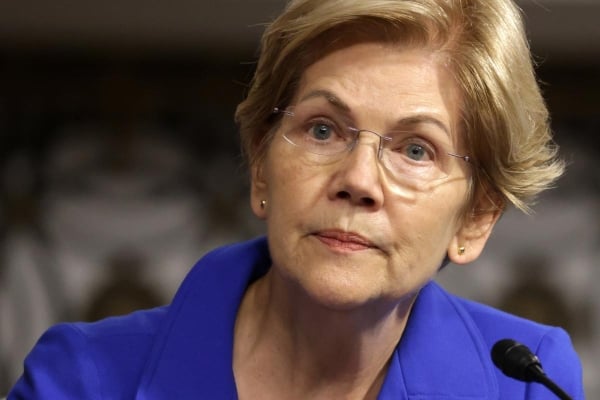
    Massachusetts senator Elizabeth Warren and four of her fellow Democrats asked Education Secretary Linda McMahon in a letter Monday why her department has made it more difficult to file complaints about federal student aid and demanded her staff remove any extra steps that have been added to the process.

    “ED is covering up its attempts to make [the Office of Federal Student Aid] less responsive to millions of students, families, and borrowers who rely on the agency to lower the cost of attending college and protect them from loan servicer misconduct,” the senators wrote. “We urge you to immediately act on our findings by streamlining the ‘Submit a Complaint’ process and restoring FSA’s workforce so borrowers can get the help they need.”

    Who Signed the Letter?

    Richard Blumenthal (Conn.), Mazie Hirono (Hawaii), Jeff Merkley (Ore.), Chris Van Hollen (Md.), Elizabeth Warren (Mass.)

    In the letter, Warren states that she told FSA in March that the button for submitting online complaints had been “hidden.” The department responded in April that the button had just been moved from the top of the webpage to the footer and relabeled as “submit feedback.”  The department added that no employees who handle technical functions of the aid applications of loan servicing had been laid off, and while some employees that handle complaints were, the remaining employees will “still be responding” to future complaints. 

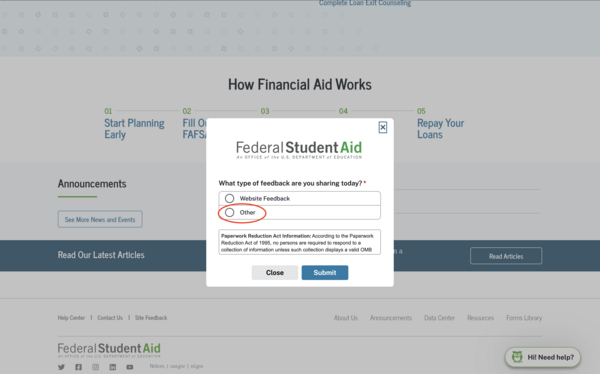
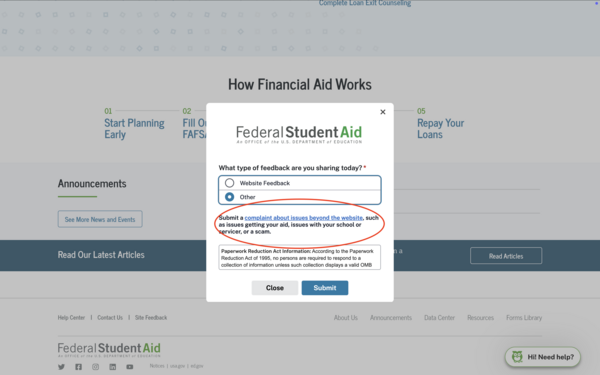
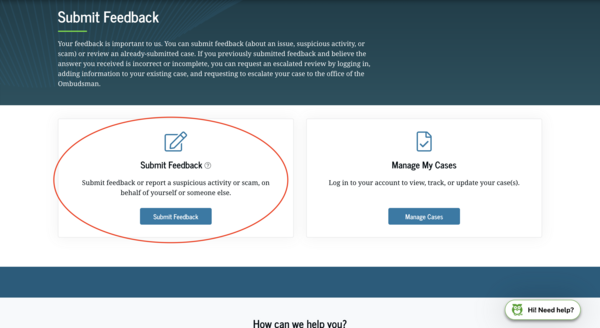
    But the Democrats say they tested those claims and found the department’s reassurances were misleading. Although the department did move and rename the complaint button, it also added a series of four extra navigation clicks that must be made before the user actually reaches the webpage where they can file a complaint. (Inside Higher Ed checked the website and verified these steps. You can see screenshots of the process below.)

    “Via an unintuitive, multi-step process,” the department is “making it more difficult for borrowers to let ED know when they are experiencing issues with their student loan servicer,” the letter reads.

    The senators argue that this change was geared toward increasing the difficulty of filing complaints, citing an email sent by a senior department staff member and obtained by Politico. According to a report published by the department at the end of the Biden presidency, more than 289,000 complaints were filed with FSA in 2024 alone.

    In the email obtained by Politico, the official wrote, “I believe this change would help decrease contact center volume and the number of complaints … so an overall win.”

    Step two FSA complaint process, click other
    Step three of FSA complaint process, click complaint about issues beyond website
    Step four of FSA complaint process, select submit feedback

    Source link

  • Faculty/Administrative Divides Weaken Higher Ed (opinion)

    Faculty/Administrative Divides Weaken Higher Ed (opinion)

    As U.S. higher education enters one of the most perilous times in its history, an internal threat makes it even more vulnerable—the ever-widening chasm between administrators and faculty. In the last three decades, budget pressures at larger universities have led administrators to shift faculty ranks toward contingent appointments with near-poverty wages, no benefits and little opportunity for advancement.

    At research universities, the remaining tenure-track faculty positions have become hypercompetitive, with faculty having to publish far more than they did in the 1980s to obtain tenure and promotion. Pressure on these faculty to obtain large grants continues to mount in a funding environment that is now uncertain and even chaotic. At other universities, faculty ranks in general have shrunk, leading to increased workloads and larger class sizes, alongside shifts to more online offerings to meet student demand.

    On the administrative side, the tenure of senior leaders is also shrinking, leading to increased leadership turnover. New leaders come in with change agendas to fix some prior unaddressed issue or manage significant budget deficits or other operational inefficiencies. In this environment, faculty disillusionment is high, as is disengagement. It is all too easy for administrators to treat faculty as expendable resources, forgetting that there is a human component to leadership and fostering distrust between these two critical groups of campus leaders.

    But as external threats come to campuses, a divided campus will not be well prepared to fend off attacks aimed at weakening institutional autonomy. Administrators on many campuses find themselves unable to speak openly about their objections to current federal or state policies due to institutional neutrality stances or concerns about political blowback; at the same time, we have seen faculty organizations and unions step out in front to defend academic freedom and institutional autonomy. In this context, how can these two groups come together to restore trust, re-engage all stakeholders and build productive working relationships?

    We write this from the perspectives of a longtime faculty leader and faculty champion who has published on the problems of deprofessionalizing the faculty and a longtime administrator who started as a faculty member and moved up the ranks to a chancellor position by working with faculty to solve campus challenges. We have worked together over the years from our respective vantage points, publishing tools and resources that are geared toward fostering clarity, communication and collaboration in the face of a rapidly changing environment. We know that the faculty/administrative divides will not serve the academy in this current crisis. But we have seen examples of ways that both groups can come together.

    Here we offer some suggestions for leaders—faculty and administrative—from our experiences working with hundreds of campuses. We call for administrators to take the first step in reaching out, repairing and rebuilding where trust and relationships have been broken. But we also call on faculty to ask what they can do in response or how they might “lead up.” If one group extends an olive branch, and if there is to be hope for a different future, the other must accept it. Both parties must also hold one another accountable as relationships are renewed, trust is rebuilt and bridges across the chasm are constructed.

    1. Empower and support faculty leadership. Studies have shown that administrators can help support faculty in having a voice and assuming an active leadership role. Mentoring faculty on how the institution operates, sending faculty to leadership development opportunities, rewarding faculty who step into significant leadership or shared governance roles, providing summer stipends to work on projects, and offering course releases for active faculty leadership can all empower faculty to play a greater leadership role on campus.
    2. Strengthen shared governance structures. Over the last three decades, shared governance has been hollowed out on many campuses. Rebuilding it will require examining processes, policies and structures that enable faculty to contribute meaningfully to campus decision and policymaking. A strong shared governance system is a way to ensure that external groups are less able to divide and conquer, to commandeer the curriculum, the student experience and other key areas of campus work. And ensuring that faculty have avenues to exert their leadership with governing boards can help ensure that board members hear from and understand faculty perspectives and concerns.
    3. Clearly delineate administrative and faculty roles and responsibilities with respect to decision-making, authority and accountability. Strengthening shared governance means including faculty in more than advisory capacities when budgets, organizational structures or operations that affect them are slated for major changes. Put more decisions back in faculty hands, explain situations and ask for input, and include faculty in more important and strategic decisions on campus. Viewpoints may be at odds, and boards and administrators do have important fiduciary responsibilities, but these do not preclude engaging stakeholders in the decision-making process.
    1. Establish and grow your own leadership programs aimed at faculty. One of the best ways to ensure that faculty can play a leadership role on campus and off is to offer an annual leadership program for faculty. Costs can be relatively low for grow-your-own programs that rely on more senior and experienced faculty to serve as facilitators and trainers. Empowering senior faculty to train newer faculty on the campus operations and broader higher education landscape can lead to more proactive succession planning for key campus committees and leadership roles.
    2. Consider using a shared leadership approach to clearly involve multiple people and perspectives in decision-making. Beyond leadership development, consider using more formal structures associated with collaborative or shared leadership. This may help campuses create more inclusive and transparent processes for decision-making, especially when a variety of constituents are involved in or impacted by the changes.
    3. Have regular sessions for faculty and administrators to interact outside shared governance. Occasional lemonade or iced tea gatherings, Zoom social hours, annual community forums and the like can ensure that faculty and administrators get to know each other as people, not just positions. It may also be helpful to have periodic focused workshops or retreats for faculty and administrators on key change issues. These events can be led by external expert facilitators who can help create space for difficult dialogue.
    4. Acknowledge the wrongs and correct the course. When trust is broken, administrators should listen to concerns and be prepared to make adjustments and change course to address those concerns, and faculty should take the opportunity to collaboratively engage. That doesn’t necessarily mean going backward, but going forward in ways that involve a two-way dialogue to address concerns. For example, administrators need to be open about the need to strengthen faculty job security, pay and autonomy, while faculty need to recognize the competing pressures administrators are facing. Ensuring a strong faculty is a key component of a robust system of higher education, which is what is needed to ward off external threats. Somewhere in between lies the solution.

    While these may seem like long-term strategies in the midst of a crisis, this crisis is going to last years, so investing in and empowering the faculty will pay off. Faculty have critical voices that can productively shape the change agenda, if given the opportunity to use them.

    Adrianna Kezar is the Dean’s Professor of Leadership, Wilbur-Kieffer Professor of Higher Education and director of the Pullias Center for Higher Education at the University of Southern California.

    Susan Elrod is the former chancellor and professor emeritus of Indiana University South Bend. She studies higher education systemic change and is actively engaged in helping campus leaders build capacity to create more strategic, scalable and sustainable change.

    Source link

  • 12 Steps for Responding to a Tenure Denial (opinion)

    12 Steps for Responding to a Tenure Denial (opinion)

    I have been denied tenure at my former R-1 institution. Twice. And after being assured yearly, in writing, that I was making appropriate or exceptional progress toward a positive decision based on departmental criteria and standards. Most of you can imagine, and some of you know, how that felt. The inconsistency seemed misleading and a breakdown of the promotion and tenure process, similar to articles in Inside Higher Ed by Colleen Flaherty and in The Chronicle of Higher Education by Michael W. Kraus, Megan Zahneis and Chelsea Long.

    I fought the first decision through formal institutional channels and won, and my institution did a re-review of my dossier from the ground up. In April of this year, I was told that I’d been denied a second time, and I was dismissed at the end of May. However, I could contest the decision processes as a nonemployee. I’m fighting the denial decision (again), and the hearings will begin in the fall.

    My area of specialization is program evaluation, with a focus on graduate education. That means I have seen the good, bad and ugly as higher education institutions discuss criteria and standards about student and faculty performance, curriculum and policy; I have a professional and personal interest in all university processes being fair and defensible for all their constituents. My experience is that the processes are not always fair, and having gone through this process before, I have some advice on the steps you should take to fight the decision. While my advice is necessarily grounded in the context of my experience and my former institution’s procedures, it can be adapted to your own.

    1. Get angry. Talk to your family, friends, colleagues you trust and your dream team of collaborators. Rage about the process and the decision and the decision-makers and the injustice, but get the hot anger out of your system and absolutely do not hurt yourself or anyone else. Let your rage cool so you can use it as energy to fight. You are not powerless, because all university processes and assumptions can be challenged. But know that the odds are heavily stacked against you.
    2. Recognize the fundamental assumption of institutional competence. There is an assumption that the university correctly followed its policies and procedures and therefore reached a defensible decision. Without very specific performance criteria for promotion, it likely won’t matter how many dozens of works you’ve published, how many grants you’ve supported, how many students you’ve helped complete their degrees, how much your skills are in demand from other units or how you’ve (over-) satisfied the criteria against which you were supposed to be judged. The standing assumption is that the university did its due diligence.
    3. Get help. Your institution has a vested interest in making sure its processes are defensible and that you can fight against decisions corrupted by inappropriate processes. Ask for a grievance hearing by the university’s regulatory body or a hearing panel (in my former institution, this group is housed in the University Senate). They should be able to connect you with a tenured faculty advocate to help you develop your process-based argument. To prevent further corruption in the process and avoid possibilities of retaliation, this advocate must be housed in a different college from the one in which the decisions were made.

    You may have the option of using an external lawyer or union representative to argue your case, but if you bring a lawyer, the respondent will bring one, too. Do what you think is best, but know that the standard of evidence in a grievance hearing is different from that in a court of law, and will likely be closer to “likelihood of procedural issues or prejudicial influence” than to “beyond a reasonable doubt.”

    1. Be clear about the relief you’re requesting. Even if a grievance panel rules in your favor, they may be limited in the relief they can offer. It’s unlikely that they can simply overturn the provost’s decision, but they may be able to recommend a re-review of your dossier. It may be helpful to think about the worst-case scenario—if your dossier is sent for re-review by the same people who voted against you the first time—and ask for reasonable, specific protections to make the re-review fair and balanced.

    Be sure to request that the judgment includes a monitoring and compliance aspect. If the panel rules in your favor, the institution needs to ensure that the recommendations are followed. Don’t let assumptions of institutional competence prevent this from happening, and do not take on that responsibility yourself.

    1. Use available templates. The grievance panel likely has a template to help you structure your argument. Use it faithfully, and don’t deviate from the specific information it requests. It will likely start by asking you to form the basis of your argument by quoting verbatim from your institution’s tenure code. Copy and paste this to make it easy for the panel to find information when they hear your case. The panel needs to stay within its institutional authority, and you must convince them immediately that your experience and concerns about the process are within their purview.
    2. Read and re-read your institution’s foundational documents. There are at least three essential documents you must use to support your argument that the process was corrupted: the department or college’s faculty handbook, the regents’ or president’s statement on tenure criteria and ways of contesting decisions, and statements on employee conduct inclusive of reporting requirements for policy violations. You must show how procedural violations significantly contributed to an unjust decision. Examples of such violations could include:
    • Discrimination against personal beliefs and expression, or factors protected by federal/state law (e.g., equal opportunity violations, Title IX violations)
    • Decision-makers’ dismissal of available information about your performance
    • Demonstrable prejudicial mistakes of fact
    • Other factors that cause substantial prejudice
    • Other violations of university policy

    After you have articulated the criteria you are using to contest the decision, you must substantiate each claim with evidence that the violation negatively influenced the final decision. The burden of proof will be on you.

    1. Organize your evidence. Whatever evidence you present must be organized, accessible and easy for the hearing panel to review. It may be helpful—and therapeutic—to start by making a comprehensive timeline of the pertinent events that led to the decision. Include the dates and written summaries of every annual review, the steps you took to address any human resources issues, the outcomes of those steps, leadership transitions, as well as sociopolitical events that directly influenced the department and institution. Your goal is to share with the panel the entirety of your experience at the institution and make the argument that you did the best you could to address any real or perceived performance issues.

    Include the official dossier that was passed through the system as evidence, and use the highlight function of the PDF software to focus on the parts that are most important for your case and that best challenge the assumption of institutional competence. Keep a running list of your documented evidence, which you’ll submit as a set of appendices, and refer to your appendices in the complaint document itself, using quotes cut and pasted directly from your primary sources.

    In the document where you set out your complaint, refer to individual appendices by letter, name and page number, so readers can find information and see your evidence in the original context (e.g., “Appendix C: Committee response to factually inaccurate information introduced in faculty discussion, p. 22–24”). Copying and pasting evidence from primary sources will make it easier to reconcile page numbers in the complaint document later. This process is also helpful if you need to argue that the content of the dossier was misrepresented by decision-makers or that one or more particularly vocal individuals are waging a vendetta against you (e.g., “Appendix E: Unsolicited letter from Professor [X] that engages in conspiracy theories about you, p. 100–125”).

    It is crucial to make the argument that you were treated unfairly and in violation of university policy, and that your treatment was significantly different from that of your colleagues who were under review at the same time or in the immediate past. If, for example, a decision-maker voted against your promotion because of their individual critiques of your work, and those critiques are not consistent with other levels of review or they attack the credibility of the other reviewers, you have an argument for their idiosyncratic interpretation of the promotion criteria. Put that evidence in an appendix and draw attention to it.

    It is also helpful to be able to point to the research of others in your department who used the same scholarly processes but who were not critiqued similarly. This can help you argue differential application of criteria and standards of performance, or that a particular reviewer is applying the standards of research in their discipline to your own, which may be a violation of the tenets of academic freedom (talk to representatives from your institution’s academic freedom committee for more information). This comparison may be essential if you are alleging discrimination or prejudicial treatment that may be based on your personal characteristics.

    1. Do not fear a request for summary judgment. This processual request means that the respondent in your case (usually a high-level decision-maker such as the provost or dean) is using the assumption of institutional competence to ask that the case be dismissed without a formal hearing. The respondent will argue that everything was done correctly, that the decision was justified and that you are simply angry about the decision. The request will likely be formal and the words intimidating, but that may be the point. Read every word so you can respond in writing to each argument, and prepare responses on the assumption that the issues will come up during oral arguments at the official hearing. Sometimes the request for summary judgment will be peppered with prejudicial language that helps reinforce the basis of your complaint. Use their words against them.
    2. Prepare your witnesses. You will want to identify good witnesses who will substantiate your main points, but not people who will repeat their evidence from the same perspective; you do not want to bore the hearing panel. Let your witnesses know who your other witnesses are and you can give them a sense of the questions you will ask them during the hearing. You cannot, however, coach them on how to respond; witnesses must be able to respond to your questions honestly, and their responses must stand up under cross-examination.

    Be sure to list the respondent and decision-makers on your witness list; you don’t want to miss the chance to hold them accountable for the things they’ve written and the decisions they’ve made. Don’t waste time indicting them on their leadership practices. Instead, show how their active and passive behaviors violated policy and prejudiced the review process in violation of the university’s foundational documents.

    1. Make the most of the hearing. You may find that the hearing is a very formal process, that an external lawyer will be present for the institution (not the respondent) to ensure the process unfolds correctly and a court transcriptionist will ensure accurate recording of testimony. The witnesses may be sworn in, and you can count on them being asked questions by the complainant, respondent and the hearing panel. If possible, you should lead the questioning for your witnesses and ask your advocate to lead the questioning of the respondent and their powerful witnesses to minimize the power imbalance.

    The respondent may not have many questions for you, but remember that you have the burden of proof, and they will not want to provide additional opportunities for you to substantiate your claims. If they do open additional areas of critique, be ready to call out the ones that are inconsistent with policy and processes. Expect to be physically and emotionally exhausted at the end of your hearing.

    1. Respond to the decision. When the hearing panel’s decision arrives, expect strong emotions. You may feel vindicated and think that you’ve finally been heard or feel as if you’ve been traumatized again. Even if you win, both are fair responses. If you won on all or some of the issues you raised, you can expect the panel to propose a set of recommendations intended to address those issues, but the process is not yet over.

    The panel may be empowered only to make recommendations to the university president, who has the final say on what happens. The president has the right to overrule the panel, just as they have the right to order compliance with its recommendations. You can write a formal letter to the president about the panel’s recommendations, as can the respondent. If you have concerns about the recommendations, especially if new issues came to light during the hearing, this is your one chance to make those issues known to the ultimate decision-maker.

    Because the grievance hearing may have shown that the process contained problems that have not likely been institutionally addressed, emphasize monitoring and compliance with hope for reconciliation. Don’t expect the president to grant you additional protections beyond what was recommended by the panel, but if the re-review is corrupted, you have documentation showing that you were concerned about making the process fair and transparent and that you did your due diligence.

    1. Go through the promotion and tenure review process again or leave the institution. Going for tenure again means another year of hoping for a positive decision, dreading a negative one and thinking about your next steps. This is a very difficult time, especially if the underlying issues have not been acknowledged or addressed. Do the best you can, and document everything. A counselor will be essential for processing the ongoing experience.

    If your complaint exposed evidence of systematic harassment or prejudicial behavior against you, reach out to the equal opportunity or Title IX offices for support. They have the option of opening formal or informal investigations but may not be likely to do this during a tenure review or re-review because they cannot be seen as influencing the process. They may not be able to act until you have been promoted or have officially lost your job (again), at which point you might wonder why you should reach out. The answer is unsatisfying but simple: You connect with them because you need emotional support and with the hope they can eventually help address the underlying factors that corrupted the process.

    If you didn’t win on the redo, you’ll need to find another job somewhere else. I hope you’ve used this last year to network and apply for opportunities as you balanced the burden of the grievance process on top of your regular commitments of teaching, research and service.

    If you’re looking at going through this process, you have my sympathy, support and encouragement. Going through it has been one of the hardest experiences of my life, but I’m glad I did it, even if I cannot change my former institution; I can only hope that they will not waste my experience by ignoring the issues it exposed. I couldn’t have done it the first time without extraordinary support from people who hate injustice and fear for institutions that do not follow their own rules. As I prepare for the second round, I will continue to look to my former colleagues for support as I try to be strong for myself, my family, my (former) students and others that go through this process.

    Regardless of what the future brings, I did my best to challenge prejudicial and harrowing issues in higher education by opening conversation about them and dragging trauma from the shadows into the light. No matter the ultimate decision, I can walk with my head high.

    John M. LaVelle is a scholar of program evaluation specializing in the academic preparation of program evaluators. He lives in the United States with his family and is cautiously optimistic about the future.

    Source link

  • Law Firm Threatens Brown Climate Researchers

    Law Firm Threatens Brown Climate Researchers

    A law firm representing anti–wind energy groups is demanding that Brown University researchers retract findings linking those groups to the fossil fuel industry, The New York Times reported Monday. 

    The move comes weeks after Brown reached an agreement with the Trump administration. The government restored $510 million in frozen federal research grants after the university agreed to certain demands, including adopting the Trump administration’s definitions of male and female and turning over admissions data. 

    The Trump administration has halted or canceled thousands of other research grants across the country, including many focused on climate change.

    Marzulla Law LLC characterized the research published by Brown’s Climate and Development Lab as “false and injurious” in an Aug. 11 letter to Brown’s general counsel. It threatened to file complaints with Brown’s public and private funders, including the Energy Department, the National Science Foundation and the Mellon Foundation. 

    A university spokesperson did not comment specifically on the law firm’s demands but told the Times that it’s committed to maintaining academic freedom. 

    Brown researchers who authored a case study about Marzulla Law have written that the firm has “a history of advancing anti-environmental lawsuits and significant ties with the fossil fuel industry.” Researchers have also published findings accusing one of the firm’s clients—the nonprofit Green Oceans, which is trying to shut down the construction of a nearly complete $4 billion wind farm off the coast of Rhode Island—of being part of “a fossil-fuel-funded disinformation network.”

    On Friday, the Trump administration, which opposes the wind energy industry, halted the wind farm project without citing specific reasons. 

    Source link

  • 3 Questions for Senior Learning Designer Heather Hans

    3 Questions for Senior Learning Designer Heather Hans

    On Aug. 12, senior learning designer Heather Hans posted on LinkedIn,

    After 7 years of service with a great team, I’ve been laid off from Duke, like many of my colleagues. 

    I’m taking some time to consider what I want to do next. This includes any of my areas of expertise, from learning design and libraries to visual art and journalism. I’m also keeping my eye out for roles that combine my experience in new ways.

    If you have 5 minutes, could you please share this post, connect me with someone you think I should talk to, or share any relevant job openings?

    I’m looking for hybrid roles in the Triad and Triangle of NC and remote roles anywhere (willing to travel some, too).

    I saw Heather’s post, read all the supportive comments the post generated and had two questions: 1) Which university or organization will be smart and lucky enough to recruit Heather? 2) Would Heather be willing to share her story in this space for this community? 

    On my second question, Heather graciously agreed to participate in this Q&A.

    Q: Tell us about your professional and educational background. What are the projects, initiatives and services that you have contributed to and led? What are your superpowers that potential employers should know about?

    A: I’m an art major who worked in journalism for five years after college, doing writing and editing. Then I pursued my master’s in library and information studies and worked for several years as an academic librarian focused on teaching and learning. I moved into instructional design for online learning at UNC Chapel Hill and then worked at Duke University for seven years, most recently as a senior learning experience designer. 

    My recent accomplishments include: 

    • Establishing digital education strategies with five professional schools and developing certificate programs in UAS (Drones) Applications and Operations in Environmental Science, Church Administration and Human Resources, and Healthcare Leadership for Climate Science.
    • Leading continuous improvement initiatives to develop new or updated workflows, create standard operating procedures and update team roles and responsibilities.
    • Mentoring and coaching newer designers in project leadership and advanced learning design skills, like creating assessments and drafting course content.
    • Developing team AI guidelines that set expectations for how generative AI is used in course development work.

    My superpowers are empathy, strategy and creativity. I excel at building relationships, collaborating and coaching, whether that be to design an online course for the first time or to grow as a professional. I think analytically and strategically about work processes, projects and goals. I generate a lot of ideas, and I enjoy figuring out how to take an idea or vision and implement it successfully.

    Q: In thinking about your next role, what is the organizational culture and institutional priorities that you are looking for in determining the fit with your strengths and values?  

    A: As I look for roles, I keep going back to the idea of work being human-centered. Does the organization value its people and its impact more than its profits? Does it genuinely want to improve educational access for everyone? How has it shown that it keeps humans centered in discussions of technology and AI? Further, is it continuing to prioritize equity and inclusivity, and does it ask, “Who needs a seat at the table?” when embarking on new projects and initiatives?

    Like people, organizations are works in progress—ultimately, what I care about is follow-through. Do you set human-centered intentions and see them through? I want a workplace where leaders embrace empathy and difficult conversations while encouraging healthy collaboration and boundaries. Finally, I want a workplace where workers have agency to think deeply and creatively.

    Q: From your experience navigating the fallout of the federal attack on higher education, what advice do you have for all of us also dealing with job uncertainty and professional stress?  

    A: I’ve been asking everyone else this question! What I’ve learned so far is that we are a community of educators that is much bigger than any particular institution or organization. How can we help each other and continue to do the important work we care about? 

    I wasn’t expecting the outpouring of support I received, and it reminded me that it’s okay to reach out and ask for help. It also strengthened my resolve to help others when I can.

    Finally, remember that you are much more than your role and your organization–you can figure it out, and you contain multitudes that may end up surprising you.

    Source link

  • University of Florida Hires Interim President

    University of Florida Hires Interim President

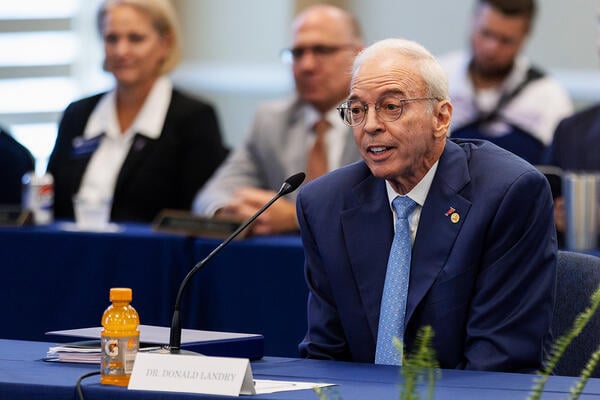
    After months of uncertainty over who will lead the University of Florida, the Board of Trustees tapped Donald Landry as interim president in a unanimous vote at a meeting Monday morning.

    Landry, chair emeritus of the Department of Medicine at Columbia University, will replace outgoing interim president Kent Fuchs, whose contract ends on Sept. 1. The appointment comes after the Florida Board of Governors rejected Santa Ono as UF’s next leader in June over his past support of diversity, equity and inclusion efforts, despite the university’s trustees approving the hire.

    Landry, who is currently president of the American Academy of Sciences and Letters, will officially step into the job on Sept. 1, pending successful contract negotiations. Details of Landry’s contract have not been released, but Ono was set to make about $3 million annually.

    The interim hire will still need to be approved by the state’s Board of Governors.

    UF’s New Leader

    In a public hourlong interview during Monday’s board meeting, Landry promised that UF would be “neutral” under his leadership. However, he added a caveat.

    “A neutral university, paradoxically, in this nation at the moment would be a conservative university. Not espousing conservative values, certainly not indoctrinating in conservatism,” Landry said. “We’d be neutral. We wouldn’t choose sides.”

    Landry also criticized Columbia faculty and administrators for failing to respond to concerns about antisemitism amid pro-Palestinian student protests last year. Last month the university reached a settlement with the federal government that included sweeping reforms to academic programs, speech and disciplinary policies, as well as a $221 million payout.

    “I saw things at Columbia that suggested an alignment between some faculty and students that I think encouraged the students to do things that were more reckless,” Landry told UF’s board.

    At another point, when asked about DEI, he said when it “first emerged it was a bit vague what it actually meant” but “by the time it crystallized it was clear [DEI] had gone too far.” Landry added that he was thankful the “government has intervened and returned us to a rational meritocracy.”

    Landry also cast himself as someone who resisted DEI at Columbia when it was “being implemented widely at every level, from the very top down to the smallest unit,” adding that “the Department of Medicine never wavered in its commitment to excellence” in his time there. Landry vowed to uphold state laws barring spending on DEI at Florida’s public institutions.

    A physician by training, Landry has degrees from Lafayette College, Harvard University and Columbia’s College of Physicians and Surgeons. In 2008, President George W. Bush awarded Landry the Presidential Citizens Medal for his work on stem cell research, which used embryos that did not survive in vitro fertilization. Bush lauded Landry as a man of science and faith, crediting his approach to stem cell research. Landry was also on the President’s Council on Bioethics during the Bush administration.

    Landry has also brought his scientific training to bear on other political debates. In early 2024, he filed a brief in a Supreme Court case in support of former Florida attorney general Ashley Moody and Texas attorney general Ken Paxton, who were sued by a technology trade group over laws passed in both states seeking to limit content moderation on social media platforms. Landry expressed concerns about censoring alternative perspectives, arguing that “the danger of censoring scientific dissent is painfully apparent from the conduct of social media platforms during the COVID-19 crisis,” which “reinforced prevailing opinion and allied government policy by suppressing dissent on a host of scientific questions.”

    SCOTUS ultimately remanded the case to the lower courts.

    Landry has also praised Jay Bhattacharya, director of the National Institutes of Health and an epidemiologist who was skeptical of the dangers of COVID-19 and prevention measures such as stay-at-home orders. Last year Landry said that Bhattacharya refused “to compromise his scientific findings,” thus risking “his own personal and professional self-interest, repeatedly, without hesitation, to take a stand for the public’s right to unrestricted scientific discussion and debate.”

    ‘A Great Selection’

    UF Board of Trustees chair Mori Hosseini emphasized Landry’s scientific background in a news release announcing the hire, stating the new interim president “has shown exceptional leadership in academia and beyond, building programs with innovation, energy and integrity.”

    Chris Rufo, the conservative anti-DEI activist who helped tank Ono’s chances at the UF presidency through an online campaign highlighting his past statements, praised the hire.

    “Dr. Landry is a principled leader who will reverse ideological capture and restore truth-seeking within the institution. Kudos to the UF board of trustees on a great selection,” Rufo wrote on social media.

    Alan Levine, a member of the Florida Board of Governors who voted against hiring Ono, also praised the selection in a post on X, calling Landry “an excellent choice” for the UF interim presidency.

    Landry is expected to serve as interim president while UF begins a national search for its next leader. The university has been without a permanent president since former Republican senator Ben Sasse of Nebraska abruptly resigned from the job shortly before a spending scandal emerged.

    Source link

  • GMU President Refuses to Apologize, Rejects OCR Findings

    GMU President Refuses to Apologize, Rejects OCR Findings

    Bill O’Leary/The Washington Post via Getty Images

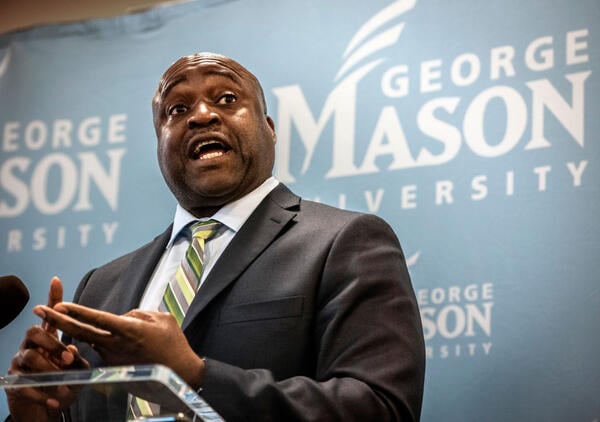
    George Mason University president Gregory Washington has rejected demands by the Department of Education’s Office for Civil Rights that he apologize for alleged discriminatory hiring practices, questioning the findings of an OCR investigation that accused him of implementing “unlawful DEI policies.”

    In a letter to GMU’s board Monday, Washington’s attorney, Douglas F. Gansler, alleged that OCR cut its fact-finding efforts short and only interviewed two university deans before reaching the conclusions the Department of Education published Friday. Gansler wrote that “OCR’s letter contains gross mischaracterizations of statements made by Dr. Washington and outright omissions” related to the university’s DEI practices.

    Gansler also accused OCR of selectively interpreting various remarks by Washington, the first Black president in GMU’s history.

    “To be clear, per OCR’s own findings, no job applicant has been discriminated against by GMU, nor has OCR attempted to name someone who has been discriminated against by GMU in any context. Therefore, it is a legal fiction for OCR to even assert or claim that there has been a Title VI or Title IX violation here,” Gansler wrote in a 10-page letter.

    ED has demanded changes at GMU and a personal apology from Washington.

    “In 2020, University President Gregory Washington called for expunging the so-called ‘racist vestiges’ from GMU’s campus,” Acting Assistant Secretary for Civil Rights Craig Trainor said in a statement released by the Department of Education last week. “Without a hint of self awareness, President Washington then waged a university-wide campaign to implement unlawful DEI policies that intentionally discriminate on the basis of race. You can’t make this up.”

    In his letter to the board, Gansler emphasized that under Washington’s leadership, GMU has complied with executive orders that cracked down on DEI programs and practices, pointing to recent changes such as the dissolution of GMU’s DEI office and restricting the use of diversity statements in hiring.

    “If the Board entertains OCR’s demand that Dr. Washington personally apologize for promoting unlawful discriminatory practices in hiring, promotion, and tenure processes, it will undermine GMU’s record of compliance. An apology will amount to an admission that the university did something unlawful, opening GMU and the Board up to legal liability for conduct that did not occur under the Board’s watch,” Gansler wrote. He added that admitting to such violations could bring about punitive action from other federal agencies, such as the Department of Justice.

    Washington’s rejection of an apology and dispute over the claims made by OCR comes shortly after speculation that GMU’s Board of Visitors—which includes numerous conservative political figures and activists appointed by Republican Virginia governor Glenn Youngkin—would fire him. Instead, the board gave Washington a raise after a lengthy closed-door meeting earlier this month that brought dozens of protesters out to show their support for the besieged president.

    Asked for a statement, GMU officials referred Inside Higher Ed to Gansler.

    ED did not immediately respond to a request for comment from Inside Higher Ed.

    Source link

  • Letter From a Region of My Mind

    Letter From a Region of My Mind

    Working in journalism left Inside Higher Ed’s co-founder Doug Lederman little time to read for anything but information, so last summer, when he stepped away from 90-hour workweeks, he told me he wanted to watch less Netflix. I said, “Friend, you came to the right place.” Recommending reading is pretty much the only area where I can make solid contributions these days.

    I started Doug out with things I knew he’d like. Chad Harbach’s The Art of Fielding was an early favorite. I moved him along to Jess Walter’s Beautiful Ruins, The Friend by Sigrid Nunez, James (Percival Everett, not Henry), Meg Wolitzer’s The Interestings and loaded him onto the Louise Penny train.

    But just before I headed to D.C. last March for his official farewell party, I assigned him a novel I’d been wanting to reread and liked the idea of book-clubbing with him: John Williams’s beautiful and heartbreaking Stoner. I’ve often given Doug a hard time about—well, everything—but especially the fact that he’s never actually been in higher ed. He’s only peered in from outside with a reporter’s magnifying glass, exposing our flaws and fault lines, doing his essential duty as a journalist.

    When Doug asked me to work with him as a thought partner to create a newsletter for upper-level administrators, he wanted to bring tough love to leaders. He confessed to having a case of the fuck-its, disappointed that higher ed has been so slow to change and unwilling to take responsibility for some missteps. As we know, disappointment can only come from love, and is much harder for recipients to bear.

    I responded in my typically tactful fashion, asking him, “Who the fuck are you to have a case of the fuck-its? Do not speak to me of the fuck-its! Have you had to read millions of pages of academic monographs? Have you heard academics complain that their names were too small on book covers? Have you denied thousands of qualified applicants admission to their dream college, or sat through interminable Faculty Senate meetings group-copyediting policies? Have you taught classes that flop or graduate students who just can’t?”

    In other words, I told the co-founder of IHE he had little idea what it was like to be in higher ed, especially from the perspective of a faculty or staff member. Given his role and prominence in the industry, Doug’s attention is always sought after, a high-value treat. In our world, he is beef jerky, not a Milk-Bone.

    I thought it time for him to use his leisure reading to get a deeper understanding of what it’s like to be a regular professor. Not an oversize character like Morris Zapp (my old boss, Stanley) or even Lucky Hank Devereaux (or Lucky Jim).

    Stoner follows the fictional life and career of an English professor at the University of Missouri in the early part of the last century. Early in the novel, and just before the sinking of the Lusitania, the sharpest of a group of three young academics asks his fellows, “Have you gentlemen ever considered the question of the true nature of the University?”

    Mr. Stoner “sees it as a great repository, like a library or a whorehouse, where men come of their free will and select that which will complete them, where all work together like little bees in a common hive.” Mr. Finch, with his “simple mind,” sees it as “a kind of spiritual sulphur-and-molasses that you administer every fall to get the little bastards through another winter.” Finch goes on, naturally, to become a dean.

    But they are both wrong, claims the character named Masters. The university ”is an asylum …. a rest home, for the infirm, the aged, the discontent, the otherwise incompetent.” His self-diagnosis: ”I’m too bright for the world, and I won’t keep my mouth shut about it.” He concludes, ”But bad as we are, we’re better than those on the outside, in the muck, the poor bastards of the world. We do no harm, we say what we want, and we get paid for it.”

    The book, published in 1965, presents characters that feel so current and vibrant you can imagine having a cocktail with them. In the times we now find ourselves, Stoner may become popular again—but not for all the right reasons.

    I have friends who have long said they’re done reading things by dead white men. When Doug and I were in college, that was pretty much the entire curriculum, with the exception of the 19th century gals, an Emily Dickinson here, a Frederick Douglass there. This reluctance is understandable, given how long the canon excluded previously silenced voices. Yet, I don’t discriminate. Stoner offers profound insights into institutional structures that persist today.

    These thoughts were on my mind as I finished my reread just before our flight to D.C. to celebrate Doug’s retirement next chapter, where institutional structures of a different kind awaited us in marble and glass.

    We had half a day before the event and my husband, Toby, and I wanted to be tourists. It had not been my intention to speed-walk through four museums in five hours. (Toby could spend hours in front of one painting, but he loves me and is a good sport.)

    My childhood consisted of trips downstate to see grandparents in New York City, which often involved visits to museums. A favorite was the one that hosted the squid and the whale. Unconsciously, I bought into the primate visions described by Donna Haraway about hierarchies—her critique of how science museums construct narratives of power and evolution that shape our understanding.

    Fifty years later, I was eager to see what had changed. We started at Natural History, moved on to American History, then African American, and ended up at the Holocaust. In March 2025, this journey was not, it won’t surprise you to learn, an uplifting experience. The museums, like higher education itself, told a complex story of American identity that is now under dire threat.

    I sped through to parse the presentation. How did the curators choose to tell the stories, some of which I know well, and which, as an adult, I would always prefer to read? Since I began my career publishing books in American history at Oxford University Press, I’ve imbibed a decent amount of quality scholarship.

    When I became an acquisitions editor at Duke University Press in 1991, I was intrigued by the work of scholars like Kimberlé Crenshaw, Patricia Williams, Mari Matsuda, Derrick Bell and other theorists who used narrative to examine how our legal system perpetuated structural inequalities. Most people weren’t reading law journals back then, and it took a while for those ideas to make it into the mainstream

    Academe cranked open the curriculum to face historical truths not always self-evident: We are a country built on a commitment to diversity, equity and inclusion. At times we fell short of the mark, but the arc of the universe is long, and we were taught the direction in which it bends.

    Except. The rise to power documented in that last somber building we visited reads to me like a blueprint for what’s happening today. Before I could remember not knowing it, my father drilled into me that what it means to be a Jew is there’s always someone who wants to put you in an oven. That was made tangible by the numbers I saw tattooed on the arm of Great-Grandpa Max.

    How much longer will busloads of boisterous students milling around these repositories of culture be able to learn our history? When will the whitewashing take hold so that the ideas contained in the curators’ vision—in the works we’ve published since the latter part of the last century—are mummified?

    One of many chilling moments: coming on a small story I knew from the film Who Will Write Our History? Historian Emanuel Ringelblum organized Jews in the Warsaw Ghetto in 1939 to document unprecedented actions. He collected materials, placed them in milk cans and buried them throughout the city. The archive known as the Oneg Shabbat is housed in Jerusalem at Yad Vashem.

    It was impossible in March not to feel that my colleagues at IHE and other media outlets are busting their butts at a similar task: chronicling the last days of an era of inclusion.

    How long before these exhibits come down, replaced by gold toilets in buildings repurposed for hotels and casinos?

    Just as the bright shining moment of Camelot disappeared for a previous generation, many of us already look back on Hamilton with nostalgia. A too-quick tour of museums in our nation’s capital filled me with love for America and the things that made us great. When I left, all I felt was grief. What happens if we don’t rise to today’s challenge?

    This sobering experience in D.C. brought me back to my conversation with Doug about higher education’s resistance to change. A reading of Stoner should not feel as resonant and familiar as it does. Little about faculty structure and the ethos of academe has evolved in the last century.

    Walking through those endangered halls of American memory, what Doug has long been saying to leaders is urgent: We need more than just better storytelling about higher education—we need to fundamentally reimagine it. And we need to do it now.

    The buried milk cans of our moment will someday be unearthed. The articles, reports and assessments documenting higher education’s struggles will serve as testimony to what we did—or failed to do—in this critical period. My only hope is that they’ll reveal how colleges and universities finally broke free from institutional inertia to continue to do the work of educating our citizenry toward truth and justice for all.

    Note: This reflection was published March 22, 2025, as an issue of The Sandbox. I wanted to share it as part of my new column here for two reasons (and with apologies to subscribers). First, if you’ve been reading the news, you’ll see that I wish I’d been wrong. Just a week after this first came out, the dismantling began. And now we’re seeing a scrubbing of our nation’s history in essential cultural institutions and not just in D.C.

    Also, I got a ton of responses from readers thanking me for putting them onto Stoner. So now, you’re welcome, friends.

    Rachel Toor is a contributing editor at Inside Higher Ed and the co-founder of The Sandbox, a weekly newsletter that allows presidents and chancellors to write anonymously. She is also a professor of creative writing and the author of books on weirdly diverse subjects. Reach her here with questions, comments and complaints compliments.


    Source link