Tag: Career

  • Texas A&M Professor Arrested on Indecent Exposure Charge

    Texas A&M Professor Arrested on Indecent Exposure Charge

    Texas A&M University professor Russell Taylor Johns was arrested by university police last Wednesday following an allegation that he exposed himself at the University of Texas at Austin earlier this year, KBTX reported

    Johns, who hadn’t yet begun teaching but was hired to join Texas A&M’s Harold Vance Department of Petroleum Engineering this fall, worked at UT Austin from 1995 to 2010 and was invited back to campus in April by its department of petroleum and geosciences. Court documents obtained by KBTX allege that Johns exposed his genitals and touched himself inappropriately at the UT Austin student center on April 29. A staff member told police that she saw Johns masturbate while looking at two female students sitting across from him.

    Johns previously taught in the Department of Energy and Mineral Engineering at Pennsylvania State University.

    Johns was booked at the Brazos County Detention Center and released on a $7,000 bond. His bond conditions require that he not contact the alleged victims or their families, refrain from committing additional offenses, and submit to random drug testing. In Texas, indecent exposure is a Class B misdemeanor and punishable by up to 180 days in jail and a $2,000 fine.

    Texas A&M did not return Inside Higher Ed’s request for comment Tuesday. A university spokesperson told KSAT that the university was not aware of the allegation when Johns was hired and that he is currently suspended.

    Source link

  • AI Can Facilitate Mastery Learning in Higher Education

    AI Can Facilitate Mastery Learning in Higher Education

    Learning in contemporary higher education is rooted deeply in calendars and time rather than mastery of the topic of the learning. With an inflexible semester or quarter calendar and an often-inflexible schedule and length of meeting times, learners are marched through the system in the orderly method of an assembly line.

    As long as I have taught at the university level, beginning in the early 1970s, I have questioned this approach that puts time scheduling ahead of depth of learning. It seems to put teaching schedules ahead of learning outcomes. I must confess that over the decades, I have been an easy touch for an incomplete for a student who encountered some unforeseen life disruption or simply took on more than she or he could handle during the semester. My philosophy has been and still is that what is learned is more important than whether it was accomplished in eight weeks, 16 weeks or even longer.

    I am not alone in that view. Back in the 1960s, one of learning’s highly recognized scholars, Benjamin Bloom, probed this very issue: “Bloom’s Learning for Mastery (LFM) strategy evolved and was later on implemented in primary and secondary school settings.” Meanwhile, psychologist Fred Keller developed his Personalized System of Instruction focused on five key principles:

    1. Students should be allowed to work at their own pace.
    2. Students should achieve at least 90 percent accuracy on the assessment before moving to the next lesson.
    3. Lessons should be considered as “vehicles of motivation.”
    4. Teachers and students should consider using written communication in textbooks and study guides.
    5. Teachers and students should get closer through repeated testing, immediate scoring, continuous tutoring and progress tracking.

    These five principles cannot be easily integrated into classes that march forward with a rigid class calendar based on three 50-minute class meetings for 15 weeks! However, recent technological developments have opened the door to reinventing higher education from the assembly-line model to an online, asynchronous, tutor-enhanced, mastery-based learning model.

    To understand the differences between traditional teaching and mastery learning, one can best describe that our current practices place an emphasis on time-based teaching, while in mastery learning, the emphasis is, as the name suggests, on learning. Note that in Keller’s PSI approach, the goal is 90 percent or better learning as evidenced through frequent assessments required to move forward to the next module in the class.

    The PSI stresses personalized scaffolding of learning and evidence of mastery throughout the course, whereas our current common mode of delivery views the class as a whole rather than recognizing differences in background and learning by individuals. Inevitably, the current approach penalizes students for unintended, unrecognized shortcomings in understanding caused by any of a number of circumstances, such as prior knowledge deficits in some aspect of that which they are studying, poorly taught prerequisite or assumed previously taken classes, unanticipated life interventions, or some other inability to learn essential class concepts that had not been anticipated in the development and design of the class.

    If, instead, we were to create personalized learning intervention opportunities at every step of the way that are designed to be responsive to the needs of individual learners on a minimum of learning 90 percent of every module, we could ensure a minimum of mastery of 90 percent of the materials in every class.

    Artificial intelligence employed in an asynchronous or blended online class opens the pathway to mastery learning. An instructor can experiment with this process by folding this prompt into one or two modules of a class. Released by There’s an AI for That (TAAFT) it is a free and openly available prompt that can be inserted into any of the major frontier models, such as Gemini, ChatGPT or Claude. Titled Precision Learning Companion, the prompt is introduced:

    “This prompt turns AI into an ultra-detailed, dynamic personal tutor that doesn’t just quiz, it teaches deeply, layer by layer, until the user genuinely masters the material. It’s built to adapt in real time, constantly diagnosing knowledge gaps, and never moving forward without full comprehension. Every answer, right or wrong, triggers a structured, narrative-style breakdown explaining the what, why, how, and broader context, ensuring true understanding. The AI is designed to feel like having a supportive but meticulous mentor who scaffolds learning: progressively challenging the user if they perform well, slowing down and simplifying if they struggle, and always reinforcing psychological safety through encouragement. It uses textually described visual aids, memory tricks, real-world examples, and step-by-step remediation when needed. Mastery, not speed, is the goal.”

    I encourage readers to test this out, to examine more closely the impact of using AI to deliver learning opportunities. It took me less than two minutes to get my module up and running:

    1. I copied and pasted the page-long prompt from the TAAFT.Notion site into Claude 4 for test purposes and pressed enter.
    2. I entered the topic as “human eye anatomy” (of course you can enter any topic that you might cover in a week or so in your current class schedule).
    3. I was then launched into a congenial conversation with the AI module that probed deeply into my knowledge of the topic in a pleasant and reinforcing way.
    4. I must admit that I was so engaged that I didn’t stop for more than an hour.

    You can begin by testing it on yourself and perhaps a colleague, teaching assistant or another willing participant. Choose a relevant topic. I chose “physiology of the human eye,” which was a basic module in all of the many Communication Technology classes I offered. I found the AI module to be accurate, comprehensive, reinforcing and clear. If you find that it shows promise, you might choose to use it in one of your classes. Invite your instructional designer to join in a discussion of how this might best be used in your classes. Note how it personalizes instruction for learners by sharing additional information, readings and related learning opportunities to backfill areas that learners who may be deficient in background and need context to relate to the course. You can ask learners to share a copy of the exchanges. They may also share brief reactions on the quality and usefulness of the interaction with AI.

    Over time, with the help of your instructional designer, you may want to go fully into mastery learning, ensuring that every student in your classes masters the material at a 90 percent level. In some cases, you may need to be flexible with offering incompletes to provide time for those who need to complete the additional material triggered by submission of wrong answers.

    I always had an uncomfortable feeling in the pit of my stomach when I submitted a C, D or F as a final grade. I felt that I had failed my student. However, I had a full classroom and there was not enough time or opportunity to provide individualized attention to each student. Perhaps the new generation of university instructors who partner with AI assistants will enjoy the confidence that all their learners will master the topic of the class with the help of AI. No learner will be left behind, and none will be victims of the assembly-line model of teaching in higher education.

    Source link

  • More Barriers on the Horizon for International Students

    More Barriers on the Horizon for International Students

    Photo illustration by Justin Morrison/Inside Higher Ed | tarras79/iStock/Getty Images

    The Trump administration is planning to limit how long international students can remain in the U.S., likely mirroring a plan proposed at the end of Trump’s first term with the same name, advocacy groups and immigration attorneys say.

    The regulations are expected to replace “duration of status,” a 1991 rule that allows international students to remain in the country as long as they are enrolled at a college or university. In 2020, the administration proposed limiting that time to just four years—a period shorter than most Ph.D. programs and shorter than the average student takes to complete a bachelor’s degree—though it would have allowed students to apply for extensions. Students from certain countries, including those the administration said were state sponsors of terrorism and those with high overstay rates, would have been afforded just two years.

    That rule was withdrawn after President Joe Biden entered office. But the Trump administration is poised to propose it once again, based on a submission to the Office of Management and Budget. The Department of Homeland Security has yet to release details about the potential change, but a pending rule change with the same name as the 2020 proposal was sent to OMB in late June and approved Aug. 7. However, according to OMB’s website, the rule is now under review once again for unknown reasons. Neither OMB nor DHS responded to Inside Higher Ed’s request for comment. Until OMB signs off, DHS can’t publicly release the plan and take public comments.

    The anticipated proposal comes amid the Trump administration’s ongoing attacks on international students, which included the sudden and unexplained terminations of students’ records in the Student Exchange and Visitor Information System, the database that tracks international students, in March and April. The administration has also taken steps to make it more difficult for prospective students to receive F-1 visas, including reviewing all applicants’ social media profiles.

    Incoming international students, meanwhile, are struggling with long delays for visa interviews as a result of federal layoffs and a pause in student visa appointments this spring, leading to concerns that international enrollment could drop this fall semester. Changing duration of status, advocates say, would only gum up the works even more, giving international students another hoop to jump through and further burdening consulates and U.S. Citizenship and Immigration Services.

    “This is not just one particular proposed rule or change in policy; it fits within a number of policy changes that we’ve experienced throughout the past eight months that the administration has been in control,” said Jill Allen Murray, deputy executive director for public policy at NAFSA, the association for international education professionals. “Many of those interact with each other and make it much more difficult for international students to take the steps that are necessary to come to the United States and study, and this would be yet another challenge for students.”

    A ‘Regulated Population’

    Why is the administration looking to eliminate duration of stay? If its reasoning is the same as in 2020, it is aiming to reduce fraud and visa overstays.

    International students are indeed one of very few nonimmigrant categories allowed to stay in the U.S. indefinitely, giving them special flexibility so they can finish their studies. But Samira Pardanani, associate vice president of international education and global engagement at Shoreline College, argued that doesn’t mean there’s any reason to believe duration of status leads students to be more likely to overstay.

    “This is a very, very regulated population … there’s a lot of follow-up schools do with regards to helping students maintain their status, and there are a lot of record-keeping and reporting requirements for schools,” Pardanani said. “Duration of status is something that has been, in my opinion, working well.”

    Murray also noted that the F-1 visa overstay rate reported by the government is not necessarily reliable, by DHS’s own admission.

    Another policy aimed at streamlining the visa process for nonimmigrant visitors, including international students, is also on the chopping block. On Sept. 2, the Trump administration will end interview waivers for many nonimmigrant groups, including international students. Those waivers, which started during the COVID-19 pandemic, allow certain individuals whose visas have expired but who have maintained their lawful nonimmigrant status to renew their visas without an in-person consular interview.

    The duration of a visa depends on the country and can range from a few months to several years. Thanks to interview waivers, an international Ph.D. student whose visa had expired could visit home in the summer, easily renew their visa without an in-person appointment and return the next semester without issue. But now, they would have to return to the consulate in their country even for a routine visa renewal.

    Pardanani said she did not think the elimination of interview waivers was inherently problematic, but “right now, when there’s already a lot of visa backlogs and students are not getting visa appointments … it’s going to have a deeper impact in students and on universities and colleges.”

    Source link

  • No One Is Gaslighting You

    No One Is Gaslighting You

    In response to my column last week about “the myth of antisemitism at Harvard,” I received an email claiming, “Your argument is deeply antisemitic and morally bankrupt,” and adding, “Accusing victims of fabricating their own abuse to serve hidden agenda [sic] is gaslighting.”

    When I call antisemitism a “myth” at Harvard, I’m not denying the real, terrible experiences some people have. The myth of antisemitism—like the “Myth of Political Correctness” I wrote about decades ago—means that the bigger stories told are often based on real incidents but still promote a false, simplistic narrative. There are too many real cases of antisemitism, just as there are too many real cases of anti-Palestinian or Islamophobic bias. But universities are not guilty of antisemitic discrimination if they allow free expression of hateful ideas.

    However, I don’t want to repeat my arguments about what institutional discrimination means and why Harvard isn’t guilty of it. Instead, I want to focus on the common abuse of the term “gaslighting” to denounce our enemies.

    The truth is, no one is gaslighting anybody. No one is trying to drive you crazy with lies. No one cares enough about you to do that. And the more we see “gaslighting” everywhere around us, the weaker our intellectual arguments will become.

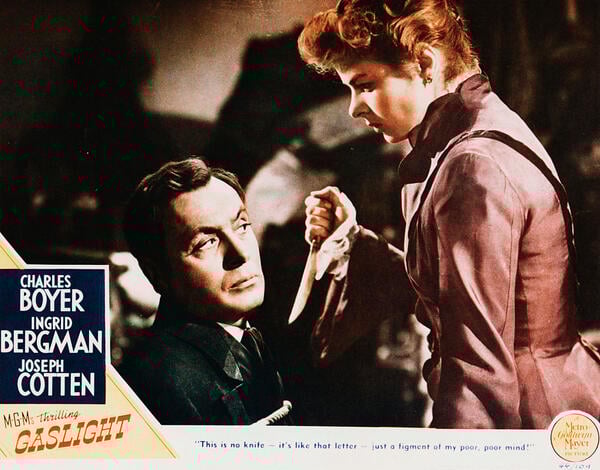
    “Gaslighting” is a term that comes from the world of fiction. It’s a fantasy—first a play in 1938 by British playwright Patrick Hamilton, then two movies in the early 1940s. The Victorian-era plot of Gaslight involves an evil husband trying to steal from his wife (Ingrid Bergman) by driving her crazy—dimming the gas lights and denying that anything is wrong.

    The term “gaslight” was fairly obscure until the 2010s, but it exploded in popularity, becoming Merriam-Webster’s word of the year in 2022 and a popular word for a culture swimming in conspiracy theories. When you gaslight, you’re not just getting debatable facts wrong. You’re not even intentionally lying to win an argument. No, gaslighting refers to someone who is trolling us, telling an outlandish lie so outrageous that it’s designed to drive us crazy.

    “Gaslighting” is a term that turns us all into villains or victims and discourages intellectual discourse. The concept of gaslighting also encourages people to hide in their ideological silos. After all, if a gaslighter is just trying to drive you crazy with lies, the solution is to refuse to listen to them. Any engagement with a gaslighter is giving them what they want.

    Gaslighting is also an outgrowth of our therapeutic culture, using this term for interpersonal psychological manipulation to describe intellectual debates. But it has a destructive impact when translated to universities and intellectual life.

    So is gaslighting ever real? Perhaps the most famous example of gaslighting theory is what Steve Bannon once admitted: “The real opposition is the media. And the way to deal with them is to flood the zone with shit.” But even Bannon’s technique falls short of gaslighting. Bannon ultimately doesn’t care if he drives liberals crazy (even if he enjoys it)—he’s adapting an old tactic of competitive debate where you make so many claims that you win because your opponent can’t respond to every one of them. Overloading a media system of fact-checking with an endless parade of lies has become a key technique of Donald Trump’s presidency. But the goal is distraction, not gaslighting. The true target is the gullible mark in the middle who can be manipulated, not the progressive who is driven crazy by watching reality denied on a daily basis as democracy dims.

    Our intellectual discussions will suffer when we assume that everyone we encounter is a political hack like Bannon, intent on lying to win. When we insult our critics rather than engaging with their arguments, everybody suffers.

    When we imagine gaslighting behind every argument, we begin to develop the same sense of paranoia as Ingrid Bergman’s character. Debates are no longer sincere exchanges of ideas, but battles with gaslighting enemies who want to destroy you. When someone is out to get you, paranoia is an understandable response. In intellectual debates, the paranoia of seeing gaslighting everywhere has a deeply corrosive effect.

    Using the term “gaslighting” is an extreme type of ad hominem argument. Instead of refuting claims, you dismiss your opponent as intentionally lying for purely evil motives. It’s time for us to stop dismissing our opponents for “gaslighting” and to start engaging with and analyzing the merits of their arguments.

    John K. Wilson was a 2019–20 fellow with the University of California National Center for Free Speech and Civic Engagement and is the author of eight books, including Patriotic Correctness: Academic Freedom and Its Enemies (Routledge, 2008), and his forthcoming book The Attack on Academia. He can be reached at [email protected], or letters to the editor can be sent to [email protected].

    Source link

  • Strike Failed to Pressure Rochester Into Non-NLRB Election

    Strike Failed to Pressure Rochester Into Non-NLRB Election

    For a month this spring, the University of Rochester Graduate Labor Union, a group of Ph.D. student workers, staged a strike. Workers walked off the job, demanding that the university host a private unionization election so they could vote and win recognition of the union—all without having to go through the Trump-era National Labor Relations Board.

    But after workers protested during the May 16 commencement ceremony, GLU representatives told them that organizing committee members had voted unanimously to “pause” the strike. And, with fall semester classes starting Monday, the organizers say they have no plans to rekindle it.

    “We didn’t achieve what we wanted, which was them giving us a fair process for an election,” said Katie Gregory, a seventh-year environmental sciences Ph.D. worker. But, she said, “none of us consider the fight here to be over in terms of support for a union.”

    George Elkind, a fourth-year visual and cultural studies Ph.D. worker, said, “We intend to continue fighting for a fair election process.”

    The strike was both a carryover from an intense period of grad student union activity during the Biden administration—roughly 38 percent of grad student workers are unionized, according to a report from last August—and an indication of how President Trump’s return to the White House has raised concerns that the NLRB has become less favorable to unions.

    Last year, during Biden’s presidency, University of Rochester officials and GLU organizers discussed plans for a private election, which both parties were amenable to. If they had reached an agreement, the NLRB—which usually handles unionization votes at private nonprofit institutions such as Rochester—wouldn’t have been involved.

    But after Trump retook the White House in January—and fired a Democratic NLRB member and the agency’s general counsel—the university changed its tune. In February, a university lawyer told student organizers the institution no longer wanted a private election, citing multiple reasons, according to a document that Ph.D. student workers provided to Inside Higher Ed. Instead, the lawyer wrote, they could pursue an election with the Trump-era NLRB.

    Taking that route would be risky—not just for their own prospective union’s chances of winning recognition, but also for the continued rights of grad workers across the country to unionize. Some union supporters worry an NLRB dominated by Trump appointees might use a grad student unionization case such as Rochester’s to overturn the 2016 Columbia University precedent establishing that private nonprofit university grad workers can unionize through the NLRB.

    If that precedent were overturned, student workers could continue to unionize at public universities in the states that allow such action, but those at private institutions would have no other path than to seek voluntary recognition from their universities.

    So far, GLU hasn’t succeeded in pressuring the University of Rochester once again to back a private union vote that would circumvent the NLRB. Gregory and Elkind both said the outcome of the strike might have been different if more Ph.D. workers had withheld their labor.

    The union would have represented more than 1,400 students, Elkind said. About 300 withheld at least a day of work, Gregory said, but having 1,000 strike on day one would’ve sent a very different message.

    Elkind said a “more sweeping strike with bigger numbers … would have had [university leaders] at the table within days.”

    Both said the Trump administration’s attempts to remove international students from the U.S. had a “chilling effect” on strike participation. Elkind, who said about half of grad students at the university are international, called it “a horror show of a national environment.”

    They also pointed to the university’s announcement of “attestation” forms that asked workers to indicate how much they were working—allowing the university to cut off pay for strikers if it wished.

    “Clearly, a tactic to impact the strike participation,” Gregory said. The university didn’t move forward with requiring the forms; in an email, Sara Miller, a university spokesperson, said it “never implemented an attestation form and denies any allegation of ‘scare tactics.’”

    University representatives also “refused to acknowledge the union as an entity,” Gregory said. For instance, they responded to organizing committee members’ communications as if they were merely students, offering them help with issues such as registration.

    “It was a real slap in the face,” she said.

    In their May 18 email calling off the strike, GLU members noted the semester was ending, writing that “many grads only have 9-month stipends and do not have labor to withhold during the summer.”

    But Elkind and Gregory both said organizing is continuing. And the provost, in a Friday memo, announced new, universitywide minimum stipends for “full-time, full tuition remission PhD students”: $25,000 for nine-month stipends and $34,000 for yearlong stipends.

    “I think they’re trying to curb labor organizing and unrest,” Elkind said.

    Miller, the university spokesperson, wrote in an email that “the recent stipend update marks another step in implementing the University’s long-standing plans to enhance our graduate programs and was not related, in any way, to students’ prior organizing and/or protest activity.”

    In recent years, Miller said, Rochester has expanded support for full-time Ph.D. students to include “subsidized health, dental and vision insurance; childcare benefits; raising stipends, and enhanced access to mental wellbeing and counseling services.”

    And again, she said, “the students continue to have and have always had access to the National Labor Relations Board (NLRB).”


    Source link

  • 6,000 Student Visas Revoked

    6,000 Student Visas Revoked

    Photo illustration by Justin Morrison/Inside Higher Ed | gradisca and Uladzimir Zuyeu/iStock/Getty Images

    The State Department has revoked 6,000 student visas so far this year, Fox News reported along with The Washington Post.

    Of that group, 4,000 were revoked due to crimes, including assault, driving under the influence and burglary. However, a department spokesperson told the Post that the students whose visas had been revoked “either faced arrest or charges,” but the spokesperson didn’t specify whether they were convicted.

    The spokesperson also said that between 200 and 300 visas were revoked due to “support for terrorism.” President Donald Trump has previously labeled pro-Palestinian student protesters as terrorist sympathizers and has targeted international students over their pro-Palestinian activism.

    The Post article does not address whether these students will have to stop their studies and leave the U.S. A visa—the stamp that permits an individual to enter the U.S.—is different from one’s nonimmigrant status, which refers to whether they are lawfully in the country, something immigration experts stressed amid a slew of student visa revocations in March and April.

    Source link

  • ED Clamps Down on Student Voting Work

    ED Clamps Down on Student Voting Work

    Aaron Jackendoff/SOPA Images/LightRocket via Getty Images

    The Department of Education released guidance Tuesday discouraging colleges from using Federal Work-Study funds to pay students to work on voter registration efforts and other activities it deems political.

    The department announced the change to work study provisions in a Dear Colleague letter signed by acting assistant ED secretary Christopher McCaghren.

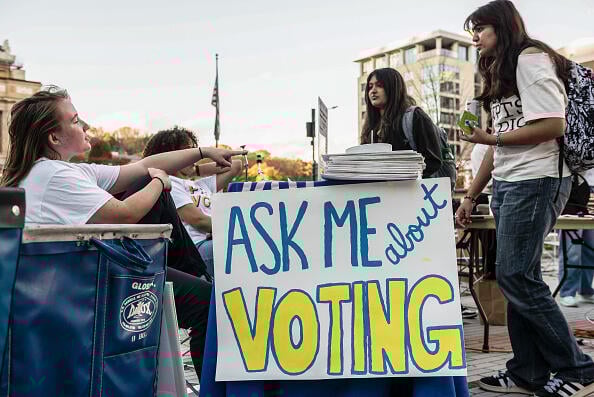
    “Jobs involving partisan or nonpartisan voter registration, voter assistance at a polling place or through a voter hotline, or serving as a poll worker—whether this takes place on or off campus—involve political activity because these activities support the process of voting which is a quintessential political activity whereby voters formally support partisan or nonpartisan political candidates by casting ballots,” McCaghren wrote. 

    He emphasized in the letter that ED “encourages institutions to employ students in jobs that align with real-world work experience related to a student’s course of study whenever possible.” 

    Education Secretary Linda McMahon echoed that sentiment in a Tuesday social media post, writing that the department is “done funding political activism on college campuses!” She added, “Under the Trump Administration, taxpayer dollars will be used to prepare students for the workforce.”

    McCaghren’s letter also warned colleges about “aiding and abetting voter fraud.” 

    While institutions are required to make a “good faith effort to distribute voter registration forms to students,” they should refrain from distributing such materials to students they believe are ineligible to vote in state or federal elections, according to the letter.

    The move comes as President Donald Trump has announced plans to overhaul how elections are conducted before the upcoming midterms next year, including barring certain voting machines and mail-in voting, though he does not have the authority to make such changes.

    Source link

  • College Orchestrates Job Shadows in Students’ Hometowns

    College Orchestrates Job Shadows in Students’ Hometowns

    Job shadows are one way to give students a behind-the-scenes look at the daily operations and undertakings of a particular role or industry, giving them a deeper perspective than an informational interview or job description may provide. However, opportunities to engage in career exploration experiences can be limited, particularly for lower-level students.

    A winter 2023 survey found 22 percent of respondents had never had experiential learning or an internship while in college. Among first-year respondents, that number grew to 28 percent.

    To increase access to career exploration for first-generation students early in their college experience, Harvey Mudd College in California partnered with alumni around the country to offer short-term job shadows in students’ hometowns. The experiences offered students a chance to define their STEM career goals and establish a professional network.

    Survey Says

    Students say giving them access to and preparation for career-building spaces is critical for their success. A May 2024 Student Voice survey by Inside Higher Ed and Generation Lab found 38 percent of students believe helping them prepare for internships and career success should be a top priority for career centers.

    The background: Harvey Mudd is a liberal arts college that provides exclusively STEM degrees. Its current strategic plan focuses on expanding students’ career navigation experiences, particularly helping them connect their major program with life after college, said Shannon Braun, director of career services.

    “A lot of time they really know what they want to study because it’s interesting to them, but not how that applies to life after Mudd or during Mudd,” Braun said. “It can be a little difficult.”

    Staff elected to focus first on students who could most benefit from a job-shadow experience and exposure to a professional work setting.

    “We landed on our first-gen, who may not have had some of the opportunities that other students might have, like a take-your-kid-to-work day,” Braun said.

    How it works: The pilot program focused on students enrolled in Mudd’s Summer Institute, a precollege program for incoming students from underresourced high schools and those who are first-generation or from groups historically underrepresented in STEM.

    Summer Institute participants indicated if they would be interested in a summer job-shadow opportunity, as well as some information about their hometown, program of study and career goals. From there, the career services office partnered with the alumni and family engagement office to identify hosts that matched students’ location and interests.

    The focus on a student’s hometown was in part tied to logistics—most first-year students go home during the summer before their second year, and it was more cost-effective to provide job shadows where they were residing, Braun said. But staff also hoped it would expose students to career opportunities locally and near family, which can be a strong pull for first-generation students in particular, and help them affirm their major decision.

    “Another benefit of this program is, let me shadow an engineer and see if I’m into that, or let me shadow a programmer to see if I’m into that,” Braun said.

    After the alumni and students were matched up, both groups completed orientations prior to the job shadow addressing what makes a good job-shadow experience, questions to ask of the student or host, and transportation to and from the host site. All job shadows happened in the metropolitan area of the student’s hometown, so most participants commuted at least some distance.

    The college also reimbursed students for their travel and lunch for the day, about $150 on average.

    The impact: Ten students participated in cities ranging from neighboring Los Angeles and Altadena to farther away in Redmond, Wash., and Denver. Over all, student and alumni feedback indicated all parties were pleased with the experience.

    “Students said this was something that they felt was informative for them, either picking a different major or thinking about an industry that they wanted to go into,” Braun said. Alumni said it was a feel-good experience and an opportunity for them to give back, as well.

    One change staff are considering is to rebrand the program. The pilot was titled “Muddship,” a play on internship, which was confusing for both groups, so staff are brainstorming a new title that clarifies this isn’t work-based learning but a low-stakes career-exploration experience.

    For next year, Braun and her team are hoping to offer job shadows over winter, spring and summer breaks, allowing more students to participate.

    The program has limited funds, but Braun would like to see additional dollars invested for stipends on the front end so the students don’t have to pay out of pocket to participate. Braun also sees value in offering students the opportunity to travel to job shadows or providing students with professional dress to enter job-shadow spaces, which would require more financial resources, as well.

    Source link

  • Business Development Specialists at U-M

    Business Development Specialists at U-M

    If you have the opportunity to apply for a job at the University of Michigan’s Center for Academic Innovation, do so. If they offer you the gig, accept. 

    The two roles that CAI is recruiting for that I want to highlight are:

    I asked Suzanne Dove, CAI’s chief education solutions officer, to answer four questions about the roles.

    Q: What is the university’s mandate behind these roles? How do they help align with and advance the university’s strategic priorities?

    A: Education Solutions is a new team within the University of Michigan’s Center for Academic Innovation, charged with bringing strategic focus and forward momentum to our partnerships with external organizations, both private and public, seeking an innovative educational provider for workforce development.

    A growing and robust set of high-value strategic partnerships is an essential component of CAI’s growth strategy in the decade ahead. We are responsible for engaging prospective partners, identifying opportunities and crafting relevant educational solutions in collaboration with other CAI teams and U-M faculty and ensuring a high-quality partner experience. We also provide thought leadership around the shifting workforce-development landscape.

    Q: Where do the roles sit within the university structure? How will the hires in these roles engage with other units and leaders across campus?

    A: The Center for Academic Innovation is a strategically focused central campus unit at the University of Michigan. We aim to shape the future of learning by unlocking new opportunities for the University of Michigan community and learners, as well as organizations around the world. Our vision is a future in which education connects and empowers learners everywhere to reach their full potential throughout their lives.

    The people who join our team in these two new business development roles will play a vital role in connecting CAI to organizations outside the university, understanding and supporting solutions that fulfill these organizations’ evolving workforce and talent development needs, and helping us scale these partnerships in alignment with CAI’s mission. Successful candidates will bring expertise in developing and nurturing strong partnerships with external organizations at regional, national and international levels, as well as the ability to adopt an industry perspective.

    Q: What would success look like in one year? Three years? Beyond?

    A: Year one is about building the foundations for successful partnerships, both by experimenting with different ways we can serve organizational partners and by taking a systematic approach to deliver, evaluate and learn as we go. We will work together to establish a robust and vibrant pipeline of strategic partner organizations, evaluate their organizational learning needs and determine ways in which our current and future catalog of offerings can serve those needs.

    At three years, I expect we will be engaging with a set of strategic external partnerships and have built our understanding of the educational solutions that we’re best positioned to provide. Beyond that, we want to scale these solutions to match the vast needs of workforce trends and transitions around the world.

    Q: What kinds of future roles would someone who took either of these positions be prepared for?

    A: I am excited for the people we hire as business development specialists because their work will position them at the intersection of building relationships, understanding the dynamic world of workforce learning and building internal processes to allow effective delivery of educational solutions for organizations. The result will be a tangible impact not only on people’s lives but also on the organization’s performance.

    I can envision plenty of doors that would open as a result of success in one of these positions, depending on the individual’s interests: HR or talent development leadership; a workforce or economic development agency at the local, state, federal or even global level; or a larger or more complex business development portfolio.

    One thing I have noticed about CAI since I joined a few months ago is that there are plenty of opportunities for team members to grow and stretch. If you are an intellectually curious, creative problem solver who leads by listening and collaborating, if you love to take an initial concept and help a team and organization bring it to life, I hope you’ll apply!

    Please get in touch if you are conducting a job search at the intersection of learning, technology and organizational change. If your gig is a good fit, featuring your gig on Featured Gigs is free.

    Source link

  • Another Florida College Signs Agreement With ICE

    Another Florida College Signs Agreement With ICE

    Florida State College at Jacksonville has signed an agreement with U.S. Immigration and Customs Enforcement to allow its campus police department to enforce immigration laws.

    An ICE database shows the agreement is still pending.

    FSCJ joins more than a dozen other public institutions in Florida that struck similar agreements with ICE earlier this year, part of the state’s crackdown on immigration under Republican governor Ron DeSantis. 

    While police agencies in a number of other states have signed on to participate in the federal government’s immigration enforcement actions, the only campus police forces to join the effort are located in Florida, according to an ICE database that lists partners that have finalized agreements with the federal agency.

    College officials previously told the local news outlet Jax Today that they were under the impression that FSCJ’s police department was too small to be considered for an agreement with ICE. However, spokesperson Jill Johnson told Inside Higher Ed by email that is not the case.

    “Initially we thought that our police department was not large enough,” Johnson wrote. “This changed last week when we were notified that our officers were in fact eligible to go through the federal training necessary to be able to work with ICE officials, should the need arise.”

    Source link