My erstwhile wise and worldly readers will remember that I wrote this column for many years, trying to shed light on the inner workings of public higher education in hopes of making things better.
In 2023, my career took an unexpected turn, and I found myself working at a public policy think tank in another part of the country. Though I’m proud of the work we did there, ultimately, it just wasn’t me. I’ve returned to the world of community colleges, this time as VPAA at Westmoreland County Community College, near Pittsburgh. Being back in public higher education feels right, and being within driving distance of family again makes a difference.
So, in the two years away, did I miss anything?
When I stepped away, the public discourse around higher education involved deciding how much of it should be free and how much student debt should be forgiven. Colleges proudly trumpeted their commitments to diversity and inclusive student success. Harvard and its counterparts enjoyed massive public prestige and had more money than they knew what to do with. (I was known to comment that Harvard was wildly unrepresentative of American higher education, which is still true.) Debates around academic integrity tended to focus on whether it was reasonable to use detection software to figure out if students plagiarized from existing websites. The president of the United States openly lauded community colleges, and not only because his wife worked at one.
Hmm. I might need to update a few things.
I regularly included stories about family, partly because they’re fun to share, but mostly to make the point that men, too, need to own the implications of being working parents. I’m happy to report that the main characters are still around, and thriving. The Wife and I had our 26th wedding anniversary this year. The Boy (!) is 24, living in New York City, working in a clinical research lab and applying to medical schools. The Girl (!) is 21, a rising senior in college, and writing papers that earn effusive praise from her professors. Even Penny, our dog, is still around, making new friends wherever she goes.
The new job started before we found a house in Pennsylvania, so we’ve been staying in an apartment. Our previous houses had sliding doors that led to the backyard, so Penny learned that when she needed to go outside, she’d stand by the sliding door. In the apartment, the sliding door opens onto a second-floor balcony; the first time Penny stepped out there, she looked confused and even a little betrayed.
Since then, we’ve found a house, so we’ll be moving over the next few weeks. It has a backyard, so sanity will be restored to Penny’s world.
I’m unspeakably grateful to WCCC for letting me back into the world I’ve spent much of my adult life trying to help. And I’m grateful to Sara Custer at Inside Higher Ed for letting me unretire the jersey and bring “Confessions” back to life. Inspired by Jon Stewart’s example, I’m setting a goal of posting twice a week, as opposed to the four or five posts per week from before.
So, to my longtime readers: It’s great to see you again! And to new readers: Welcome! I hope we can make some sense of what has abruptly become a much more complicated field. The students, as always, are worth it. And as before, reader questions are welcome at deandad (at) gmail (dot) com. See you soon!
Graduating into a tight job market can feel very daunting. You’ve invested years into your education and training, built strong skill sets, and followed the advice given by mentors and peers to make yourself competitive. So why aren’t the offers coming?
If you find yourself in this situation, it’s normal to feel discouraged, demoralized or unsure of what to do next. Below are some steps you can take to help jump-start your job hunt by evaluating what’s working and identifying what might need adjusting so you can move forward and maintain momentum.
Step 1: Evaluate Your Job Search Strategy
Before making any major changes, start by examining your current approach.
Are you submitting lots of job applications but not hearing back? This could be a sign that your application materials need refinement. Ask yourself: Are my CV or résumé and cover letter polished and tailored to each role? Am I clearly highlighting how my skills align with the job description? If you’re unsure, reach out to a professional in your field, mentor or career coach to review these materials and provide feedback.
Are you getting interviews but not progressing to the next round or receiving final offers? This may signal that your interview approach needs improvement. Using structured interview methods, such as the STAR method (situation, task, action, result), can help you learn how to better organize your responses to highlight your experiences in a more focused manner. Practicing with a mentor or even a peer can help you identify gaps in preparation or missteps in how you present yourself. Many universities offer free career services, including mock interviews, to their students and alumni.
In a competitive market, job searching also requires proactive strategies beyond submitting applications. I often see job seekers hyperfixate on tweaking applications that are already strong when their time would be better spent networking. Reach out to professionals, schedule informational interviews and make connections that help you uncover hidden opportunities and potentially receive internal referrals. These conversations can also help you better understand your target roles and the broader job landscape.
Step 2: Broaden Your Search Strategically
If networking and refining your materials isn’t enough, it may be time to broaden the types of jobs you’re considering. This doesn’t mean giving up on your long-term career aspirations; instead it means exploring bridge or adjacent roles that can help you stay on track while you continue to grow professionally. While bridge roles may not be your first choice, they can support future career moves by helping you gain relevant work experience, build new skills and expand your professional network.
One way to identify bridge roles is to explore LinkedIn profiles of alumni and professionals in your field. Examining the positions they held after graduating and where they are now can help expand your list of possible bridge roles. Take this a step further during informational interviews by asking professionals about their knowledge of bridge roles. For example, a person targeting a medical science liaison role might ask an MSL in an informational interview, “I have been applying to MSL roles without any success; what other roles could help me work toward this path?” They might learn of opportunities in medical communications, clinical research or technical sales, positions that develop many of the same skills valued in MSL roles and often done by professionals before landing an MSL position.
Bridge jobs can also provide financial stability while allowing you to build your skills. For example, I work with many students who aim to move directly into industry as scientists. However, if the job search stalls, an academic postdoc can be a strategic choice, especially when it aligns with building specific skills and provides much-needed income. One graduate I advised discovered through informational interviews that he would need additional expertise in advanced sequencing techniques to be competitive for the R&D roles he was targeting. He chose to take a two-year academic postdoc with a clear plan to build those exact skills, positioning himself for a stronger transition into industry while providing financial stability for his family. A postdoc can offer time to deepen your technical expertise, build a more competitive research portfolio and prepare for roles in biotech, R&D or other sectors.
If you pursue a postdoc as a bridge role, be transparent with the postdoc mentor about your intentions. Take the earlier example of the graduate pursuing industry R&D roles. He was clear in communicating both the specific skills he needed to gain (RNA sequencing) and the time frame he would commit (two years). That kind of clarity helps establish shared expectations and ensures the postdoc experience is mutually beneficial for both you and the lab.
Another important strategy for broadening your job search is to reflect carefully on your needs versus preferences. Needs are the nonnegotiables, such as visa requirements, caregiving responsibilities or a two-income household situation. A person’s preferences might include living in a specific city, having a certain job title or starting at a particular salary. While all of these are important to consider, being flexible on preferences can help you uncover new possibilities. Ask yourself: Are there geographic areas I’ve ruled out that might be worth reconsidering? Could I shift my salary expectations temporarily to get a foot in the door? Widening your criteria doesn’t mean compromising your goals; it’s a strategic step in reaching them.
Step 3: Know When to Pivot
If you’ve been searching consistently and not gaining traction, it may be time for a bigger strategic shift. Sometimes we become so focused on our initial ideas about our career that we overlook other options that could be equally or more fulfilling. Ask yourself: Could there be paths that better match my strengths or allow me to grow in ways my original plan didn’t? Have I overlooked opportunities that may better align with my values, interests or lifestyle goals as they are now?
In the book Designing Your Life: How to Build a Well-Lived, Joyful Life (Knopf, 2016), authors Bill Burnett and Dave Evans suggest that being stuck can be a powerful launchpad for creativity and personal growth. They encourage readers to approach career planning as a design problem that benefits from curiosity, experimentation and iteration. One recommended exercise to stimulate curiosity is to brainstorm multiple career paths for yourself. Once you have your list of possible futures, you can then explore the most promising options through research and conversations with professionals in those roles.
If you need help identifying new directions, the individual development plan can be a useful tool. Platforms such as myIDP or ImaginePhD offer exercises and assessments to help you identify your skills, interests and values and pinpoint career paths aligned with your results. These platforms also include resources to guide you toward researching and setting goals to reach a new path.
Importantly, pivoting doesn’t mean giving up. It means recognizing that there are many viable paths available and you may end up at a better destination than originally planned.
Managing the Emotions of Job Searching
Job searching can take a real emotional toll, especially when it feels like you’re doing everything right and not seeing results. Many students feel intense pressure to secure a job after graduation, and when that doesn’t happen quickly, feelings of inadequacy can creep in. These feelings can make it harder to ask for help, reach out for support or even acknowledge how difficult the process has been. When the process feels overwhelming, shift your focus to what you can control. Set small, achievable goals each week to keep your momentum going during a slow-moving search. For example, set a goal of applying to a defined number of jobs, completing a short online course to build a new skill or attending a virtual or local networking event in your field.
One trend I’ve noticed is that some students reach a point in which they are tempted to pay someone to “fix” the problem. If you are considering investing in paid career coaching, do your homework first. This should be a thoughtful decision, not an emotional reaction driven by frustration. Some paid coaches and services are legitimately helpful, but others overpromise results and prey on frustrated job seekers. Ask about outcomes, get referrals and make sure that their services align with your goals.
Take Your Next Steps
After reading this, you may have several new ideas or directions you are considering. To avoid feeling overwhelmed, start by writing down one microgoal you can complete in the next few days that is simple but still meaningful. For example, you might set up a meeting with a mentor, revise a section of your résumé or research a new role. Choose something that is doable and aligned with where you want to go. Small steps like these can really jump-start your progress.
Even if it’s not going according to your original timeline, remember that the job search is a dynamic process. By keeping an eye on your long-term goals but remaining flexible, you’ll be open to the roles and experiences that can help you get there. Most importantly, give yourself credit for working the problem, pushing forward and continuing to put yourself out there.
Raquel Y. Salinas is the assistant dean of career and alumni engagement at the University of Texas MD Anderson Cancer Center UTHealth Houston Graduate School of Biomedical Sciences. She is a member of the Graduate Career Consortium, an organization providing an international voice for graduate-level career and professional development leaders.
Welcome to the first installment of my monthly column, “The Public Scholar,” in which I invite academics and other experts to step forward—thoughtfully, clearly and with purpose—to help shape public conversations that matter. In this space, I’ll offer practical, field-tested strategies for turning academic expertise into public impact, including how to know if an idea is op-ed–worthy, how to turn a classroom anecdote into publishable prose, how to know when it’s time to query a literary agent about your book idea and more.
I’m Susan D’Agostino, a mathematician whose stories have been published in The Atlantic, the BBC, Scientific American, The Washington Post, TheFinancial Times, Wired, Quanta and other leading publications. (You may recall that I wrote with some frequency about math and technology for Inside Higher Ed a couple of years ago.) My last book, How to Free Your Inner Mathematician (Oxford University Press, 2020), won the Mathematical Association of America’s Euler Book Prize for an exceptionally well-written book with a positive impact on the public’s view of math. My next book, How Math Will Save Your Life, to be published by W. W. Norton, makes the case for harnessing mathematical thinking in the face of personal and global crises.
But none of that came easily or automatically. A decade ago, I was a tenured mathematics professor who had spent years honing proofs and lectures. Yet amid lagging public math literacy, I felt an unshakable urge to reach beyond the walls of academia and write for the public. Still, I hesitated. Was my voice or expertise welcome outside of peer-reviewed journals? Did I have the authority to write for readers I could not picture in a seminar room? Did I even know how?
That transition—from academic to public scholar—was bumpy. I made mistakes. I received more rejections than I care to count. (Stay tuned for a future column about all those rejections!) I had to unlearn some academic habits and relearn how to communicate with clarity for broad audiences. But step by step, I found my way.
You don’t need to leave higher ed to write for the public. And you certainly don’t need permission. Academia often trains scholars to seek approval—through grants, press offices and peer-reviewed publications. But the reality is that institutional support often follows after a scholar gains visibility. You already have the credentials to write for the public in your area of expertise. Now you need the courage and practical tips for doing so.
Maybe you’re a historian who sees how your field illuminates today’s political divides. Or a scientist concerned about climate change, misinformation or public health. Or an artist reflecting on what the arts can—and do—offer society. Or a literary scholar exploring how stories shape our moral imaginations. Or an educator with hard-won insights into what learning looks like in today’s classrooms. If you feel the tug to engage beyond campus gates, this column is for you.
Many academics assume that public writing takes time away from scholarship. But making your work accessible to a wide audience forces you to think harder, not less. How can you distill the central argument of your research so that an intelligent friend with no training in your field can understand? Why should they care? Honing translation skills is an art. Your goal is to show up with clarity and generosity.
As a bonus, crafting the occasional op-ed can energize your research and teaching—not distract from it. You can clarify your ideas and receive real-time feedback on your argument and may even attract collaborators. Public writing can also be personally restorative. It reconnects you with the real-world questions that made you fall for your field. Your op-ed may even catch the eye of a literary agent or editor who’s interested in discussing book ideas. Also, your willingness to be a novice again may offer credibility among students, as that’s what many are wrestling with in your classroom.
When I began writing in public-facing newspapers and magazines, I felt newly connected to issues that mattered beyond academia. While campus conversations are vital and intellectually rich, I found that engaging the broader public offered a different kind of clarity and urgency—to respond to a moment unfolding in real time and to make research relevant to people’s lives.
Scholars across disciplines have watched with rising unease as the Trump administration has terminated research grants, dismissed government scientists without cause and wielded funding as a cudgel against universities. In this atmosphere, it can be tempting to self-censor or to wait for more hospitable times.
But the cost of silence must be weighed against the consequences of inaction. Public conversations—about health care, history, science, democracy, libraries, public art and education—unfold every day, with or without scholars who can offer nuance, evidence and context.
“Opinions are most malleable before they are fully formed,” wrote Lisa Fazio, a psychology professor at Vanderbilt whose federal grant for misinformation research was terminated. “We must not shy away from the spotlight.”
Fazio’s warning is especially resonant now, as academics face mounting pressure from funding threats to political scrutiny. These pressures are real, and they are unevenly distributed. As University of Washington computer scientist Kate Starbird, also a target for her work on misinformation, toldScience magazine, “I never had the option of keeping my head down.”
And yet: Sharing knowledge, humanizing data and contextualizing history are profound acts of public service in consequential times. The OpEd Project puts it plainly: “If you say things of consequence, there may be consequences. The alternative is to be inconsequential.”
Here’s some good news: Editors at newspapers and magazines want academic voices in the mix, and they’re often willing collaborators in helping your ideas rise above the noise. Editors want assurance that you are trained in your area of expertise, but they are less concerned with titles or tenure than your academic colleagues. Whether you’re a graduate student, an adjunct, new on the tenure track or a full professor, what matters is your voice, your argument and your ability to meet the moment.
Ready to begin? Here are a few prompts to spark your first (or next) op-ed:
What’s one thing people misunderstand about your field, and why does it matter?
What recent news headline made you think, “If only they understood this about my field …?”
What conversation is already happening in the news, online or in your community that your research can help reframe, complicate or clarify?
What’s one counterintuitive idea from your work that could shift how people think?
Has your research or teaching ever changed how you see the world, and could it do the same for others?
Where is your field falling short in meeting a public need, and what would it take to change that?
You don’t need to have all the answers. Often, a strong op-ed starts with one sharp insight, thoughtfully delivered and timed to the news cycle.
Try drafting a few notes in your phone during your commute, between classes or even while multitasking in that faculty meeting (I won’t tell). Write as if you’re talking to a smart, curious friend. Make it clear, specific and real. Proofread like your reputation depends on it, because for the editor you’re pitching, it does. Make it short, too! Aim for 800 words max.
And if you’d like more help along the way, sign up for my monthly newsletter. You’ll get notice of each new article in “The Public Scholar,” practical writing tips, behind-the-scenes insights from my work and inspiration from other academics finding their voice in public spaces. Your expertise is hard-won. What might happen if you shared what you know more broadly?
Susan D’Agostino is a mathematician whose stories have been published in The Atlantic, the BBC, Scientific American, The Washington Post, Wired, The Financial Times, Quanta and other leading publications. Her last book, How to Free Your Inner Mathematician (Oxford University Press, 2020) won the Mathematical Association of America’s Euler Book Prize for an exceptionally well-written book with a positive impact on the public’s view of math. Her next book, How Math Will Save Your Life, will be published by W. W. Norton. She has been a journalism fellow at Oxford University’s Reuters Institute, Columbia University’s Graduate School of Journalism and the Mila-Quebec AI Institute. For notice of each new article in Susan’s Inside Higher Ed column, “The Public Scholar,” practical writing tips, behind-the-scenes insights from her work and inspiration from other academics finding their voice in public spaces, sign up for her free, monthly newsletter here.
Colleges and universities are increasingly devoting resources to improving graduate student well-being.
Ivant Weng Wai/E+/Getty Images
Graduate student success has been a growing priority for institutions of higher education; national data points to a lower return on investment for some programs, leaving students saddled with debt. Nationally, only 58 percent of students who enter graduate programs complete their degree within six years.
The elimination of Grad PLUS loans, included in the recently passed One Big Beautiful Bill Act, may further impede students’ ability to pay for graduate degrees, threatening enrollment and persistence in some programs.
Graduate students can also struggle with basic needs insecurity; 12.2 percent of students pursuing a graduate degree experience food insecurity and 4.6 experience homelessness, according to the U.S. Department of Education’s National Center for Education Statistics.
Inside Higher Ed compiled four examples of institutions that are devoting resources toward boosting graduate students’ financial and personal well-being.
Texas Christian University: Suits for M.B.A. Students
Through a partnership with suit maker Reveal Suits, eligible students receive a custom suit with a TCU-branded lining that includes their name. Thanks to donations, they can also receive shoes and a shirt and tie if needed.
To receive a suit, students submit an application detailing their career goals and a brief statement of financial need, which university leaders use to select recipients.
By the Numbers
Master’s of business administration degrees are among the most popular graduate programs in the U.S.; over 205,000 students earned an M.B.A. in 2021–22, according to data from the National Center for Education Statistics. However, affordability remains a top barrier to students looking to advance their careers.
Nearly half of students say the cost of an M.B.A. program is one of the top barriers to their pursuit of additional education, according to the 2025 GMAC Prospective Students survey.
The survey also found that the average candidate plans to fund their degree using more financial aid and less support from their parents, compared to pre-pandemic.
Wichita State University: Mental Health Course
To emphasize the importance of well-being to executive M.B.A. students, Wichita State University faculty designed a mandatory course that teaches wellness as a leadership skill.
The course, Mental Wellness as a Business Strategy, launched in fall 2024 and focuses on integrating mental health initiatives into company culture as a way to gain a competitive advantage. Students learn to build psychologically safe teams, incorporate mental health policies into leadership practices and drive business success using well-being.
California State University, Fullerton: Mentorship and Education
Project upGRADS, short for Utilizing and Promoting Graduate Resources and Access for Disadvantaged Students, provides advising, mentorship and scholarships to students enrolled at CSUF. The program has supported nearly 7,000 students from all levels of higher education since 2019; Excelencia in Education recently recognized it as a model of innovative support for Latino students, according to a university press release.
The program provides information about the benefits of graduate school, how to navigate the admissions and financial aid processes, and the advantages of participating in faculty mentorship and professional networking.
Through Project upGRADS, graduate students can ask to be matched with a faculty member who provides support for research, career development and overcoming impostor syndrome. Students can also opt into GRAD 700, a Canvas community that offers deadlines and guidelines for thesis writing in addition to a workshop calendar and upcoming events database.
Ohio State University: Mental Health Resources
In 2024, Ohio State University bolstered on-campus and online mental health resources for graduate students.
The university invested in training peer mental health ambassadors, providing teletherapy services and developing online mental health modules for self-paced learning and preventative care.
Ohio State also extended on-campus services to ensure students who need after-hours care on the weekends or evenings can continue to receive support.
If your student success program has a unique feature or twist, we’d like to know about it. Click here to submit.
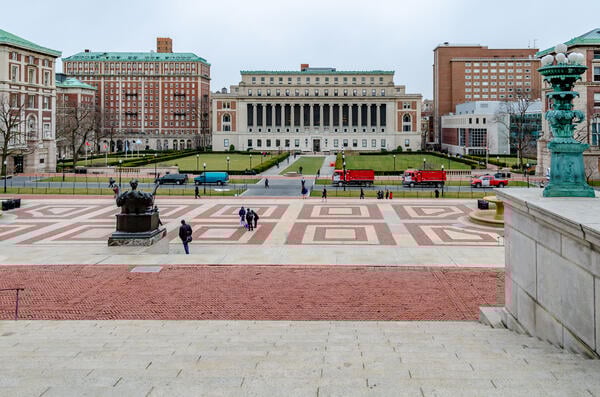
Columbia University president Claire Shipman would have us believe she snatched academic freedom from the flames of Trump’s higher education dumpster fire, but this is more of the same gaslighting we’ve endured for almost two years. Beginning with the first university administrator’s response to the first campus protest against the war in Gaza, university administrations everywhere repeatedly decried antisemitism while rarely naming what the students were actually calling for—namely, for the harm to the Palestinian people to stop, not for harm to come to the Jewish people.
The words “Palestine” and “Gaza” almost never appeared in university administrators’ statements. That they also don’t appear in Shipman’s announcement of the agreement Columbia reached with the federal government to settle allegations of antisemitism is one tell that protections for academic freedom were not “carefully crafted” over the course of the negotiations but that they were abandoned instead. (For a thorough analysis of the settlement’s many failures that goes beyond the focus of this article, see “An Agreement That Settles Nothing,” by the Columbia chapter of the American Association of University Professors.)
On CNN, Shipman claimed that the resolution “protects our academic integrity,” calling that a “red line” for Columbia. In her announcement, Shipman offers as evidence of this integrity a sentence in the settlement that reads, “No provision of this agreement, individually or taken together, shall be construed as giving the United States authority to dictate faculty hiring.” She glosses this by adding, “The federal government will not dictate … who teaches.”
When reading the official document, one is startled, then, to find that faculty hiring is dictated by its terms:
“13. Columbia shall, consistent with its announcement on March 21, 2025, appoint new faculty members with joint positions in both the Institute for Israel and Jewish Studies and the departments or fields of economics, political science, or SIPA [the School of International and Public Affairs].”
The government should not be determining which programs Columbia chooses to invest in. I suspect that the slippage in Shipman’s statement from “faculty hiring” (the government cannot dictate faculty hiring) to “who teaches” (the government cannot dictate who teaches) is purposeful. She can always say that no member of the multiagency Task Force to Combat Anti-Semitism that had her by the throat will be personally reviewing candidate files, so Columbia retains control over the who of who teaches. But this is a distinction without substance when the ideological viewpoint of candidates is guaranteed in advance.
The Institute for Israel and Jewish Studies “is dedicated to the academic study and discussion of Israel and Jewish Studies,” we learn from its webpage. “The Institute for Israel and Jewish Studies supports the State of Israel’s right to exist and to flourish,” its webpage also tells us. Can an academic department be a kind of lobbying organization at the same time? And can an academic department on Israel exclude some of the best thinking on its formation, that of anti-Zionist Jewish scholars? Isn’t this combination of the academic and the ideological a bit like the nonsensical liberal platitude calling Israel a Jewish and democratic state? The conjunction “and” does a heck of a lot of spackling work.
By sharing the hires in the Institute for Israel and Jewish Studies as joint appointments with other departments, the work performed by phrases like “Israel’s right to exist” is amplified. In this way, the settlement seeks to multiply a particular, pro-Israel point of view in the university, potentially helping to shield Israel from criticism at the very moment it most needs to be criticized. This is not institutional neutrality. This is an intentional tilting of an already painfully tilted playing field.
If anyone doubts that this tilt is precisely what the settlement seeks to secure, they need only consult No. 12 in the agreement, which stipulates that “the Senior Vice Provost, acting with the authority of the Office of the Provost, will conduct a thorough review of … the Center for Palestine Studies; the Institute for Israel and Jewish Studies; Middle Eastern, South Asian, and African Studies; the Middle East Institute; the Tel Aviv and Amman global hubs; the School of International and Public Affairs Middle East Policy major; and other University programs focused on the Middle East.”
This person will “make recommendations to the President and Provost, in accordance with academic procedures, about any necessary changes, academic restructuring, or investments.” We already know which program on this list will find its fortunes soon improved. It’s not hard to imagine which ones might find themselves impoverished under the heading “necessary changes” or “academic restructuring.”
Columbia did negotiate something wise. As Shipman wrote, “We have agreed on a robust dispute resolution process that includes a mutually agreed upon independent monitor and arbitrator as neutral third parties, rather than ceding authority to the government or a court.” Without this provision, Columbia would face a future of potentially endless arbitrary civil rights investigations.
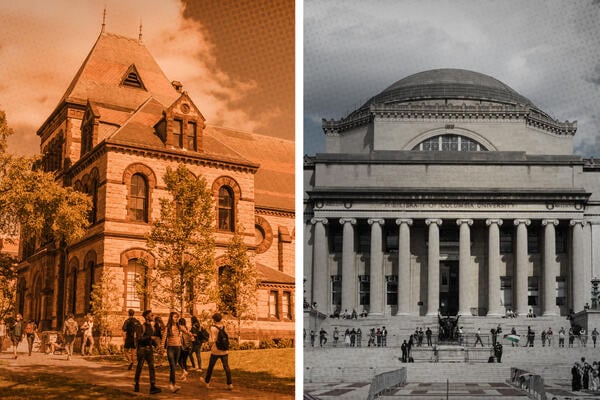
As more journalists report on the transformation of the federal civil service from a body of mostly nonpartisan experts into one evaluated on loyalty to the president, and as more stories expose the illegitimate tactics and methodologies used to levy accusations of antisemitism, this caveat providing for a third-party arbiter will be one that every institution will want to negotiate before discussing anything else. Columbia’s saga is, after all, only one of the first of many likely to come—last week, Brown University became the second institution to strike a deal with the Trump administration, and Harvard University is reportedly making progress toward one). After the Columbia settlement was announced, Trump posted on Truth Social, “Numerous other Higher Education Institutions that have hurt so many, and been so unfair and unjust, and have wrongly spent federal money, much of it from our government, are upcoming.”
But this third-party provision holding out the hope that saner heads than those in the federal government will adjudicate going forward—a provision that will have to be negotiated individually by each institution—isn’t good enough, is it? Each institution, in this scenario, stanches its own bleeding, but not one of them directly challenges the federal administration’s use of antisemitism as a weapon of intimidation. It’s a rational calculation for each institution, I suppose, but a disastrous one taken as a whole.
“For months,” Shipman says, “Columbia’s discussions with the federal government have been set up as a test of principle—a binary fight between courage and capitulation. But like most things in life, the reality is far more complex.” No doubt Shipman has in mind the real tragedies that would have resulted from a show of courage that might have cost Columbia its federal funding—critical research halted, jobs lost, students’ lives derailed, perhaps even the end of Columbia’s continued existence. The stakes were very high for Columbia, as they remain very high for all but the most financially insulated universities and colleges.
When the presidents of our universities and colleges compromise our academic freedom, they are doing so by playing along with a narrative of widespread antisemitism that they know is a pretext and a deflection. By going along with this narrative rather than challenging it, they co-create with the federal government a culture of fear that makes us scared to use our voices as professors to name and discuss a genocide. When we hesitate to openly address what is morally undeniable, the world begins to wobble. Yes, the reality is more complex than “a test of principle,” because we do not lose an abstract principle when we lose academic freedom; we slowly but surely lose our ability to tell right from wrong.
Much of the money funds medical research, including time-sensitive clinical trials.
Photo illustration by Justin Morrison/Inside Higher Ed | Wolterk/iStock/Getty Images | Alex Kent/Getty Images
Days after reaching deals with the Trump administration, Columbia and Brown Universities say the government has already initiated the process of restoring hundreds of millions in federal research dollars it terminated earlier this year in retaliation for their alleged failures to address antisemitism on campus.
Many of those grants came from the National Institutes of Health, which is overseen by the Department of Health and Human Services, and funded medical research, including time-sensitive clinical trials.
“The agreement finalized this week restored all National Institutes of Health grants to Brown researchers that had been terminated,” Brian Clark, a Brown spokesperson, wrote in an email to Inside Higher Ed Thursday evening. “We started to see that formalized in award letters today and expect in the coming days and weeks to see this across all of these grants.”
In April, the administration blocked $510 million in federal grants and contracts for Brown. But under the terms of the agreement the government and university finalized Wednesday, Clark said, “Any payments should resume within 30 days,” which applies to both “the restoration of specific grants that had been terminated, and also to active (non-terminated) grants for which Brown had not been reimbursed.”
If you had a grant frozen because of the Trump administration’s investigations, we want to hear about your experience and whether you’ve received your funding. Email [email protected] to share more.
According to Columbia’s website, “Funding and reimbursement payments have already begun to flow.”
“One week later, more than half of the terminated grants have been restored, and we expect the others to be reinstated promptly,” the website says. “Renewals and continuations that were frozen are also coming in on non-terminated grants.”
The university wrote that it’s “reviewing all grants that were terminated or suspended over the last months to identify those that were specifically directed at Columbia” and expects “the fair treatment of Columbia grants and ability to compete to be honored by all federal agencies.”
The university noted that the agreement only applies to HHS and NIH grants that the administration canceled as part of its targeted pressure campaign on Columbia.
Faculty who asked to remain anonymous told Inside Higher Ed that either the university or NIH has told them that some grants are being reinstated or renewed. But it was unclear to them whether actual dollars have resumed flowing, and how many.
Since Trump took office in January, numerous federal agencies, including the NIH, the National Science Foundation and Education Department, have terminated thousands of other research grants at institutions across the country that don’t align with their ideological priorities. In particular, many grants that focused on transgender health, vaccine hesitancy, climate change and racial disparities have been canceled.
Columbia researchers whose grants were terminated as part of that sweep should not expect to see their funding restored as part of this deal, the university wrote on its website.
“Some of these grants were terminated or suspended across the board for all institutions, and have nothing specific to do with Columbia,” the webpage said. “To the extent that the federal government has made the decision not to fund certain types of projects at any institution, those grants will not be coming back to Columbia.”
Columbia and Brown are just two of numerous Ivy League Institutions that the Trump administration has targeted by threatening federal funding.
So far, the administration has frozen nearly $5.9 billion across eight universities, including Brown, Columbia and Penn. Most of the funding freezes started in March, but in the last week, the administration resumed blocking funds at institutions under investigation. First, it put about $108 million on hold at Duke University, and then officials suspended an unspecified number of grants at the University of California, Los Angeles.
Embattled George Mason University president Gregory Washington remains on the job despite concerns that GMU’s Board of Visitors would fire him amid multiple federal investigations into alleged racial discrimination, antisemitism and other matters, which he has publicly pushed back on.
GMU’s Board of Visitors met Friday to review Washington’s performance and to consult with legal counsel on “actual or probable litigation,” according to the board agenda. While specific legal matters were not detailed in the agenda, GMU is facing investigations from both the U.S. Department of Education and the Department of Justice over alleged discrimination in hiring practices and antisemitism. The DOJ also launched a highly unusual investigation into GMU’s Faculty Senate after it approved a resolution in support of Washington’s leadership.
The Trump administration seized on remarks made by Washington following the 2020 murder of George Floyd. Washington, as noted in a letter from the DOJ to the university, expressed the need to hire diverse faculty members, promised to advance an antiracist agenda and threw his support behind GMU’s diversity, equity and inclusion initiatives.
Washington denied engaging in what the Trump administration labeled “illegal DEI” efforts.
On Friday, he defended both GMU and his own performance, noting he arrived on campus in 2020 when tensions were high and racial strife was still simmering over Floyd’s murder. Adding to the pressure, students, faculty members and others demanded he tear down a statue of university founder George Mason, who was a slave owner.
“Despite the commentary that you might hear, this institution is doing extraordinarily well,” Washington told board members on Friday in the open session portion of the meeting, during which he touted GMU’s rise in various university rankings as well as an increase in state funding.
But many community members feared that Washington, GMU’s first Black president, would lose this job as a result of the investigations. They worried that the inquiries give the Board of Visitors—which is stocked with conservative political activists and former GOP officials—the pretext to remove him. Multiple speakers and attendees at a Friday rally held in support of Washington pointed to other campus leaders recently pushed out. That includes Jim Ryan at the University of Virginia, who resigned under pressure from the DOJ over DEI programs, and Cedric Wins, superintendent of Virginia Military Institute, whose contract was not renewed this spring amid alumni complaints about DEI. One rally organizer had referred to the Friday meeting as “high noon at the OK Corral.”
Instead, after roughly three hours in closed session, the board emerged with one action item: approval of a 1.5 percent raise for Washington, which members unanimously signed off on. Board members did not discuss their review of his performance conducted behind closed doors.
That means despite faculty concerns Washington will keep his job—at least for now.
Support for Washington
As faculty, students and local lawmakers gathered Friday, they had a clear message for the Board of Visitors: Support Washington and push back on federal investigations they deemed both illegitimate and a broadside against academic freedom at GMU. They also called on the board to protect DEI at GMU, which is Virginia’s most diverse university. However, the board defied that demand by passing a resolution Friday to end race-conscious hiring, scholarships, graduation ceremonies and other initiatives.
While Washington’s fate was unknown during the rally, speakers urged attendees to push on.
“We’ve got to keep fighting. No matter what happens today, this is still our university,” said Bethany Letiecq, chair of GMU’s chapter of the American Association of University Professors. Letiecq also referenced personal safety concerns, arguing, “Faculty are being harassed and threatened.” (She previously told Inside Higher Ed she has been subject to two death threats.)
Bethany Letiecq was one of several speakers to voice support for GMU president Gregory Washington at a Friday rally.
Former Board of Visitors member Bob Witeck, who served on the search committee that hired Washington in 2020, said he “could not believe our luck” in selecting the president from a pool of nearly 200 candidates and praised his “character, intellect and honesty.” Witeck also warned about threats to both academic freedom and the inclusive nature of GMU, stating, “Discrimination cannot find a home here, nor should political interference or baseless investigations.”
Another speaker was supportive of Washington while also critical.
Ellie Fox, a GMU student and president of its Jewish Voices for Peace chapter, was critical of Washington for allegedly repressing “pro-Palestinian speech in the name of Jewish safety.” Fox added that he was “reluctant to resist Trump and conservatives and their attack” on GMU but urged Washington to defy calls to resign from his position and work “toward a better future.”
Other rally speakers included Fairfax mayor Catherine Read and State Senator Saddam Salim, both GMU graduates and Democrats, who threw their support behind the university and Washington and expressed concerns about the investigations and other attacks on higher education.
Board-Faculty Tensions
Although the board did not make any public announcement about the items they discussed in closed session, beyond approving a raise for Washington, an exchange between one member and a GMU professor highlighted the tensions at play.
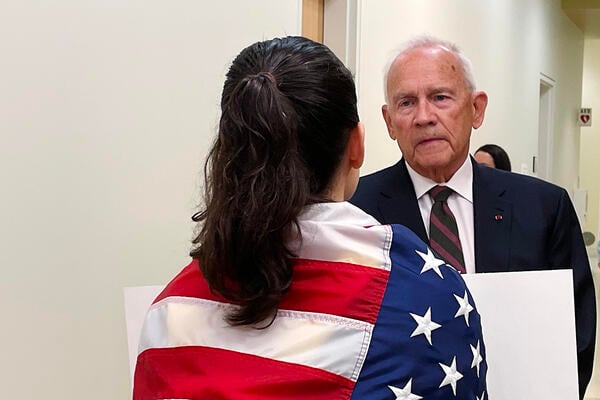
Robert Pence, a former ambassador to Finland appointed during President Donald Trump’s first term, took issue with a faculty member’s protest sign when he encountered her in a hallway outside the board’s meeting room during a break. Tehama Lopez, a professor in the Jimmy and Rosalynn Carter School for Peace and Conflict Resolution, held a sign calling on the board to support Washington and uphold the First Amendment, academic freedom and due process.
“You’re suggesting that Bob Pence—Robert Pence—does not support the First Amendment,” he told Lopez before shifting his attention to her call for board members to support Washington.
Pence then asked Lopez, “If you got a lot of facts and you became convinced that he was engaged in conduct that is deleterious to the university, would you then fire [Washington]? If he meets the standard—whatever the standard is for discharge—would you be willing to fire him?”
Lopez responded, “Who is being deleterious to the university?” Pence fired back, “You won’t answer the question” and “I’m not playing that game” before walking away from the exchange to return to the meeting.
Board member Robert Pence clashed with a faculty member outside of Friday’s meeting.
In a brief interview following that conversation, Lopez said that she wanted to see the board uphold its fiduciary duties as GMU faces multiple investigations, which she called “politically motivated.” Given the stakes, she wants to make sure the Board of Visitors protects the universityrather than enacting a political agenda pushed by the Trump administration.
But Lopez appeared uncertain of which path the board will take.
“Their job on the Board of Visitors is to do the work of protecting the school and the school’s interest, and it’s very unclear whose bidding they’re doing,” Lopez said.
The $221 million settlement with the Trump administration by Columbia University (and a similar $50 million deal by Brown University) represent a terrible capitulation by these campus leaders. AAUP president Todd Wolfson called the settlement “a disaster for Columbia students, faculty, and staff, as well as for academic freedom, freedom of speech, and the independence of colleges and universities nationwide. Never in the history of our nation has an educational institution so thoroughly bent to the will of an autocrat.”
Columbia and Brown had slam-dunk legal cases against the Trump administration, which clearly violated the processes required under Title VI when they suspended funding. (Brown was never notified of any reasons for the funding to be cut off, and there wasn’t even the pretense of a finding of antisemitic discrimination.) By making a settlement, universities give up their legal rights to challenge this repression, agree to impose massive censorship and pay a huge sum for the privilege of sacrificing their values.
It’s possible that the leaders of Columbia and Brown made this agreement because they concluded that Trump is a pathological liar, a petty dictator, a petulant lawbreaker intent on taking revenge against any perceived enemy and a president who will simply ignore any adverse judicial rulings. That analysis is accurate. But if you think Trump will ignore the law and violate any rules, then trusting his regime to obey a legal settlement is just as crazy.
The settlements include a bizarre amount of federal micromanagement of private universities, requiring Brown to provide single-sex floors in student housing, ban admissions decisions using personal statements that mention race and conduct a survey about antisemitism by the end of the year and take “appropriate action” in response. Even the smallest violation of the numerous requirements could be used to justify a future cutoff in federal funds.
The same officials who made ludicrous accusations of antisemitic discrimination to punish these universities will get to decide if the colleges are violating the agreement and deserve to be punished. While the agreements settle the old baseless charges, nothing prevents new baseless charges from being filed and leading to the same illegal funding cuts. Colleges that settle with the Trump administration have no guarantee of safety from further retaliation, and Trump officials will actually use these settlements to demand a tighter reign of censorship.
The New York Timesreported about those praising the Columbia agreement, “Many have focused on a provision that said no part of the settlement ‘shall be construed as giving the United States authority to dictate faculty hiring, university hiring, admissions decisions or the content of academic speech.’” Far from being a positive protection for intellectual liberty, this language is actually a terrible threat to free expression on campus.
By only protecting academic speech, this provision leaves the door wide open for government-imposed repression. Most expression on college campuses is not academic speech. The extramural utterances of faculty, along with virtually all student speech, is not academic speech and therefore is open to any suppression by the government under this agreement. But protecting extramural utterances is an essential part of academic freedom and has been a fundamental aspect of its definition since the AAUP’s 1915 Declaration of Principles.
While the provision says that the government can’t “dictate faculty hiring,” there’s nothing about dictating faculty firings. By solely protecting hiring decisions, Columbia leaves the door wide-open for purging faculty, staff and students who are deemed undesirable by the Trump administration.
In an email to the campus, Brown president Christina H. Paxson wrote that the first key aspect of the settlement was that “no provision of this Agreement, individually or taken together, shall be construed as giving the United States authority to dictate Brown’s curriculum or the content of academic speech.” (Brown apparently didn’t bother to follow Columbia and get a ban on federal control over its hiring decisions, which is an alarming omission.)
Some people might think that paying $221 million to get $400 million in research grants is a good bargain. Federal grants aren’t free money for colleges. All of the funding goes to research expenses. Now that the Trump administration has arbitrarily lowered the indirect cost rate to 15 percent, government-sponsored research is much less profitable for colleges—and possibly an expense they must subsidize. Certainly, Columbia will be losing money by paying $221 million to get access to $400 million in grants.
Paramount bribed Donald Trump a mere $16 million (and purged a few critics) in order to get approved an $8 billion merger that can’t be undone. As terrible as Paramount’s submission to Trump was, Columbia purged far more students and spent 13 times as much to get a deal worth 1/20th the value that increases ongoing federal control over Columbia. Paramount and Columbia executives may share a moral gutter, but at least Paramount’s bribe made financial sense.
Worse yet, by making a settlement, Columbia loses that $221 million forever, with no opportunity to prevail in court and receive the full funding their researchers are entitled to. By agreeing to obey the government, Columbia hurts its legal options to challenge future funding cutoffs, because the government can claim that Columbia failed to live up to the terms of the settlement. If the courts rule against the Trump administration’s illegal actions, Columbia and Brown will still be forced to pay these millions, impose repressive censorship and face retaliation without legal recourse.
The Columbia capitulation sets a precedent for Harvard to pay an even bigger settlement, estimated at up to $500 million. Unfortunately, hapless apologists for repression such as former Harvard president Larry Summers are urging Harvard to follow Columbia’s model, and Summers praised the Columbia capitulation as “the best day higher education has had in the last year.” Summers claimed, “The prestige of the university is not to be arrogated by faculty members in support of any set of political convictions, particularly those in leadership positions of academic units.”
Let me translate this: Professors should not be allowed to express political views. For believers in censorship such as Summers, the desire to suppress academic freedom finds a convenient partner in the Trump administration.
Universities are making these deals with the Trump regime not in spite of the requirements for censorship, but because of those restrictions. The provisions in these settlements enhance administrative power to suppress dissent, and that’s precisely what makes them so appealing to some campus administrators.
Columbia and other colleges are trapped in a no-win situation, but even difficult moral dilemmas have wrong answers, and that’s what Columbia’s leadership has chosen. Let’s hope Harvard is not the next lemming to throw itself over the cliff and sacrifice its core values, its donor money and its common sense in the vain hope that fawning obedience and bribery can satisfy the vengeance of a mad leader.
The Justice Department this week accused UCLA of failing to protect its Jewish students.
Frederic J. Brown/AFP via Getty Images
(This article has been updated with comment from UCLA.)
The National Science Foundation said Thursday that it’s suspending grant awards at the University of California, Los Angeles.
An NSF spokesperson said that the university’s awards “are not in alignment with current NSF priorities and/or programmatic goals,” though they didn’t offer more specifics. NSF changed its priorities in April and, as a result, cut off funding to programs related to diversity, equity and inclusion and those aimed at combating misinformation
Freelance journalist Dan Garisto wrote on BlueSky that nearly 300 grants at UCLA are now suspended. That includes a $25 million grant that supports the university’s Institute for Pure and Applied Mathematics. (In 2022, UCLA had about 450 grants from the NSF, totaling more than $350 million.)
UCLA chancellor Julio Frenk wrote in a letter to the campus community that the freeze extended beyond NSF to include grants from the National Institutes of Health and other federal agencies.
“This is not only a loss to the researchers who rely on critical grants,” Frenk wrote. “It is a loss for Americans across the nation whose work, health, and future depend on the groundbreaking work we do.”
Frenk noted that UCLA was prepared for a grant freeze and has developed contingency plans. “We will do everything we can to protect the interests of faculty, students and staff—and to defend our values and principles,” he pledged.
The Associated Pressreported that the freeze affected $339 million in federal grants.
The grant suspension comes as UCLA finds itself the Trump administration’s latest target in its growing war with higher education. Earlier this week, the university settled a lawsuit in which a group of Jewish students alleged that UCLA enabled pro-Palestinian activists to cut off Jewish students’ access to parts of campus. On the same day the settlement was announced, the Justice Department accused UCLA of violating the federal civil rights law that bars antisemitism and race-based discrimination.
Frenk said the government claimed “antisemitism and bias as the reasons” for the freeze. But he argued that Trump’s “far-reaching penalty of defunding life-saving research does nothing to address any alleged discrimination.”
He added that UCLA shares the goal of eradicating antisemitism, detailing the steps the university has taken in the last year to address the issue, including establishing new policies for campus protests.
UCLA has until Aug. 5 to respond to the DOJ’s notice of violation; DOJ officials threatened that the university would “pay a heavy price for putting Jewish Americans at risk.” The Justice Department is also investigating the admissions practices at UCLA, but that inquiry hasn’t wrapped up yet.
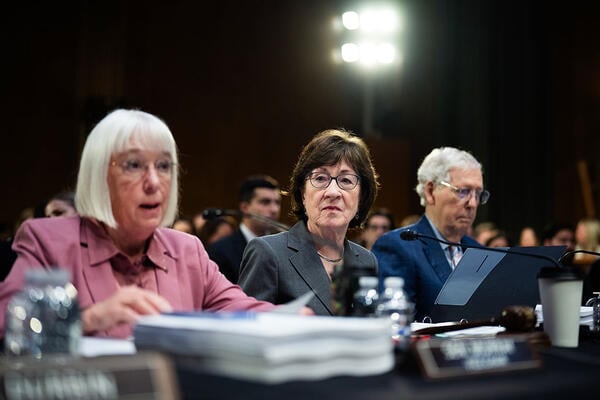
Senate Republicans are planning to protect the Pell Grant program, keeping the maximum grant award at $7,395 for the coming academic year, despite the Trump administration’s proposal to lower it to $5,710.
The rejection of Pell Grant cuts at a key committee markup Thursday is just the latest rebuke from congressional appropriators as lawmakers in both chambers have appeared wary of President Trump’s plans to shutter offices, gut programs and generally reshape the federal government.
In addition to protecting $22.5 billion for Pell, the GOP also spared TRIO, campus childcare subsidies and numerous other programs that Trump had proposed zeroing out. It also set new staffing standards for the recently gutted Department of Education, increased funding for medical research by $400 million and rejected the National Institutes of Health’s attempt to cap indirect research cost reimbursements at 15 percent. The legislation also restricts other efforts at NIH to change how grants are awarded, though Democrats say “more needs to be done to protect NIH research programs.”
Over all, the Department of Education is going to receive $79 billion and the NIH will get $48.7 billion. In comparison, Trump had requested $66.7 billion for ED and $27.5 billion for NIH.
Committee chair Sen. Susan Collins, a Maine Republican, said she was proud of the legislation that advanced Thursday, calling it a bipartisan effort to fund the health and education of American families. She noted that “the appropriations process is the key way that Congress carries out its constitutional responsibility for the power of the purse.”
But Democrats, while overall supportive, noted that they’ve had to make a number of compromises already and warned that Trump could still attempt to make unilateral changes moving forward.
“These are not the bills I would have written on my own, but nonetheless they represent serious bipartisan work to make some truly critical investments in our country and families’ future,” said Sen. Patty Murray, a Washington Democrat and ranking member of the committee. Still, she added, this is only half the battle. “The fact of the matter is we have an administration right now that is intent on ignoring Congress, breaking the law and doing everything it can without transparency to dismantle programs and agencies.”
The Trump administration has repeatedly frozen or cut grant funding, largely declining to spend money that Congress appropriated—moves that Murray and others have decried as illegal. More recently, the administration waited weeks before sending critical funding to states that supports after-school programs, migrant education and adult education. About $7 billion was affected, and colleges had to scramble to find a way to fill the funding gaps before Trump’s Office of Management and Budget finally released the money last week. Meanwhile, colleges are still waiting for the Education Department to open up grant applications for millions in funds.
At NIH, grant cancellations and other changes have slowed the flow of research funding to colleges. Earlier this week the administration briefly paused all new grant awards, infuriating congressional Democrats. Over all, since Trump took office, the biomedical research agency has cut more than 4,000 grants at 600 institutions totaling somewhere between $6.9 billion and $8.2 billion.
Beyond the grant cuts, the Trump administration recently clawed back money that had been allocated to public broadcasting, using a legislative process called rescission. The president is expected to propose a second rescission package in the months to come, this time targeting education dollars. Democrats have warned that using rescissions to change the budget could endanger talks on fiscal year 2026 spending.
So while higher ed lobbyists typically look to the Senate’s spending plan as the framework for what to expect in the final bill, Trump’s willingness to test the limits of executive power complicates the picture.
Still, the Senate’s proposals for the NIH as well as the Education Department, which funds a number of programs at the previous year’s level, is a victory for advocates who spent months warning that Trump’s budget cuts would be devastating for students and research.
“We are not surprised by what we’ve seen. The Senate often works more bipartisanly together, and that was reflected in the markup today,” said Emmanual Guillory, senior director of government relations at the American Council on Education. “In this political environment, flat funding is a win. It’s not ideal, but it is us being mindful of the current realities that we’re in and the financial constraints that we’re in, especially with the upcoming rescissions package that’s supposed to include education.”
That said, Guillory noted that he’s bracing for deeper cuts from the House, which has yet to release its education and health spending proposals.
“I could see the House having a bit more influence [than most years past], as they have had more influence so far this Congress,” he said.
Seeking Guardrails
Democrats did try to amend the bill in order to establish guardrails that would retroactively address Trump’s funding cuts and protect the fiscal year 2026 appropriations from a similar ambush.
Sen. Dick Durbin, an Illinois Democrat, proposed reinstating all college grants frozen or retracted since Jan. 28, with the exception of those pulled due to financial malfeasance. He highlighted how, in Chicago, the cuts have halted infant heart defect research and then ran through a lengthy list of other medical projects affected in other senators’ districts.
“This could happen to any of your states’ research centers. It could hurt any of your families,” he argued.
Later, Sen. Chris Murphy of Connecticut, one of the few Democrats who did not support the bill, sought an inspector general report into whether the Department of Education’s civil rights office is properly following statutes when investigating discrimination complaints and issuing discipline.
Murphy proposed withholding OCR funding until the appropriations committee received the IG’s report.
“My worry is simply that the president is going to ignore the will of Congress that is present in this legislation,” he said. “If this does become normalized—if the president of the United States gets to deny funds to universities because they don’t like political viewpoints of the student body or of the faculty—that is a Pandora’s box that is hard to ever again close.”
Sen. Shelley Moore Capito, the West Virginia Republican who leads the education and health subcommittee, shot down both proposals, calling Murphy’s amendment “contrary to the point of the [OCR] office” and Durbin’s “too broad.”
“I think every administration has the prerogative to implement new goals and priorities,” she said.