In a study of 99,542 donors who supported causes between 2020 and 2024 with gifts totaling less than $5,000 a year (nearly 97 percent of all donors), just 5.7 percent supported education institutions. That’s according to “The Generosity Report: Data-Backed Insights for Resilient Fundraising,” published this April by Neon One, a provider of nonprofit operational technology.
While major gifts will always be a crucial part of higher ed advancement success, it’s important to remember that smaller gifts add up, and during this uncertain time higher ed leaders must prioritize capturing the interest of every could-be donor.
Among the donors studied, nearly 30 percent gave to more than one nonprofit, for a combined average of about $545 in 2024, an increase from $368 in 2020. Many—if they have a good relationship with a nonprofit and are asked—will increase their level of support.
Sharing donation impact stories on a college’s main giving page is an approach not taken enough, in my experience. Typically, the “make a gift” or “give now” link, found prominently on an institution’s homepage, brings a visitor to a form. (“Yes, we’ll take that credit card info now.”) While no one wants to distract anyone from giving online, some colleges are clearly making efforts to inspire and inform giving by sharing how donations are helping students succeed and contributing to research and other efforts benefiting the community or beyond.
In uncovering examples of colleges using engaging narratives on their donation pages, I now have a clear sense of several practices to consider. For anyone asking how an already resource-strapped marketing and comms team is supposed to make time for additional storytelling, here’s some good news: Most institutions are probably already publishing articles that can be gently repurposed for alumni and other friends thinking about making a gift.
Following are three actions to take when the goal is telling impact stories on a main giving page.
Find (and tweak) or create the content.
Do some sleuthing to locate any articles already written about programs and supports made possible at least in part with donor funding. While giving sites can include articles about major gifts that center around the donor, focusing on individuals or communities that are better because of the initiative is more compelling.
Donation-related video content—although probably needing to be built from scratch—is a great way to highlight real student successes, whether it’s a scholarship that opened up access, emergency funds that allowed a student to stay in school or the excitement of commencement. Minnesota State University, Mankato, recorded accepted students finding out they had received scholarships and students who had benefited from emergency funding sharing how the gift had “saved the day.” Gratitude-focused videos, especially when they use student voices, need not reveal specific personal circumstances.
To help find individuals to feature, some giving pages invite students, alumni, employees and donors to suggest or contribute their own impact stories.
Provide a mix of content formats and collections.
Slideshows, blown-up quotes and infographics (individual graphics or numbers-driven stories) are a few visual content tactics spotted on giving pages.
Lewis & Clark College tells succinct stories on its giving page through a slideshow with three students sharing how their financial aid offers allowed them to enroll. The Oregon college’s giving page also includes a collection of five featured stats, highlighting how gifts from the past year have made an “immediate impact on the areas of greatest need.” Rather than just presenting the most obvious numbers, such as giving totals, these data points note, for example, the number of potential jobs and internships sourced by the career center, or how many new titles were purchased by the library.
To make an impact story most effective at inspiring a gift, be sure to take the extra step of adding a call-to-action message and link within each article. Even institutions doing this tend to be inconsistent about it. Try adding an italicized note at the end, a sentence within the text or a box that explains the related fund, as University of Colorado at Boulder does.
Be thoughtful about giving page content organization.
Content-rich giving pages don’t start with a gift form or a bunch of stories. Instead, a single large photo or slideshow featuring students and a short, impactful message seems to be the preferred approach.
As a visitor scrolls down, additional content tiers can offer more detail and giving encouragement—such as students expressing gratitude for support. More comprehensive feature articles and/or collections of impact story content tend to appear toward the bottom of the page, with a few teaser stories and often a link to see more. Larger collections of stories can be broken into categories and made searchable.
Some institutions place links to impact story pages in more than one place and include multiple “make a gift” buttons on the main giving page.
A new focus on giving content should also trigger some tweaks to the gift form itself. Does it include a drop-down menu with specific fund options? Can a donor write in where to direct the gift?
Or consider McGill’s approach: Each of five big ideas listed on its giving stories page takes visitors to a gift form, followed by a description of the meaning of that idea, followed by specific stories that bring it to life.
What inspirational success stories could you be sharing with friends who click to donate?
Wayne State University will offer incarcerated people the opportunity to enroll in a bachelor’s of sociology starting this fall.
Wayne State University
With the reinstatement of Pell Grant eligibility for incarcerated individuals in 2023, more colleges have launched or restarted prison education programs. Wayne State University in Michigan will join their ranks this fall, offering a bachelor’s degree to incarcerated individuals for the first time.
Twenty-five students will join the inaugural cohort in August, and the university is forging ahead with program plans despite looming Pell Grant cuts.
What’s the need: Twenty-five percent of formerly incarcerated people have no high school diploma, and 20 percent have only a high school diploma, compared to the 91 percent of Americans who have attained at least that credential. “We know that today’s workforce, much of it requires a college education, so it’s almost a necessary criterion to earn a living wage in today’s society,” said Michelle Jacobs, a professor of sociology and Wayne State’s Prison Education Program lead.
While many incarcerated individuals express an interest in postsecondary education, college often gets placed on the back burner after they leave prison as they focus on more pressing challenges, such as meeting basic needs and providing for themselves, Jacobs said. Higher education–in–prison programs help students get a head start on reclaiming their lives after they are released.
The initiative also ties into Wayne State president Kimberly Andrews Espy’s Prosperity Agenda for the Detroit area, which includes supporting economic mobility for students, improving the health of urban neighborhoods and fostering innovation in the local economy.
Individuals who participate in postsecondary education programs while in prison are 48 percent less likely to be reincarcerated than those who don’t, and they are more likely to get a job after their release. Research also shows that education-in-prison programs not only benefit the individual but also increase safety in prison settings and can improve families’ socioeconomic mobility.
“One of our goals for the program is to empower families in low-income communities that have been disproportionately impacted [by mass incarceration],” Jacobs said.
How it works: Wayne State’s Prison Education Program will enroll 25 incarcerated men at the Macomb Correctional Facility in Lenox, Mich., about 35 miles northeast of the university.
To be considered, applicants have to be at least five years from their earliest release date, giving them time to finish the program, and they must complete an essay outlining why they want to participate.
All courses will be delivered in person and the university will provide any school supplies or resources the students need for their coursework, including pens, paper and dictionaries. Students have to complete paper applications and FAFSA forms, so staff will assist with that process.
Program participants will complete a degree in sociology, as well as a range of general education courses, similar to their on-campus peers. Students can also opt in to an entrepreneurship and innovation minor.
Both programs are designed to support the unique experiences of incarcerated people, Jacobs said.
“I’m extremely biased towards sociology, and I think that benefits everyone,” Jacobs said. “I think that incarcerated individuals can benefit so much, not only in terms of understanding the broader structures that have impacted their own realities, but also on that interactional level … I think that’ll be really helpful for them as they’re navigating their lives postrelease.”
Faculty members from across the university will serve as instructors.
Facing headwinds: Since beginning the project, Wayne State has encountered various challenges.
The initial plan was to use donor funding to kick off the program, but officials had to pivot to relying on Pell dollars and money from the Michigan Department of Corrections to cover student tuition. Then, reorganization at the federal Department of Education and a lack of staff stalled approval of the program. Changes to the Pell Grant may further impede the program’s future.
Despite the obstacles, Jacobs and her team are pushing on.
“Once we started working on it, I couldn’t let it go,” Jacobs said. “I deeply believe in the transformative power of education, and I also deeply believe that there is an amazing among of talent and wit and love and humor and expertise already in carceral settings … I just made a decision that we will forge ahead regardless of what is happening at the federal level—while, of course, paying attention to it.”
Wayne State staff received advice and support in establishing the program from the Michigan Consortium for Higher Education in Prison. “It’s very collaborative instead of competitive, which is unique for academic spaces, and I appreciate it so much,” Jacobs said.
Next steps: Jacobs and her team are currently reviewing student applications to select the inaugural cohort, with plans to enroll another cohort in fall 2026.
Before classes start this August, participating faculty and students will both complete an orientation. The faculty orientation will provide instructors with professional development that helps prepare them to teach inside a prison, supported by a student organization on campus focused on criminal justice reform.
Students will be given college-readiness support, as well as access to academic and support resources similar to those offered on campus.
If your student success program has a unique feature or twist, we’d like to know about it. Click here to submit.
The number of assessments set by universities is steadily rising, but there are worries this could result in student burnout and prove counteractive if implemented without centering learning.
A recent report by the U.K.-based Higher Education Policy Institute (Hepi) and Advance HE found that assessments at U.K. institutions have risen to 5.8 summative assignments and 4.1 formative assignments per semester in 2025, compared to five summative assessments and 2.5 formative assessments in 2020.
Josh Freeman, policy manager at Hepi and co-author of the report, said the advent of AI is “reducing the accuracy of assessments as a measure of students’ performance,” prompting universities to re-evaluate their examination methods.
“It’s possible that course organizers are assessing students more to improve the confidence they have in their assessments,” he said.
“It’s also possible that, as they redo assessment models, which may have remained the same for a long time, they are switching to alternative models of assessment—for example, those that assess students on an ongoing basis, rather than simply once at the end of the year.”
However, rising numbers of exams risks universities “overassessing” students, he added, as “students now face an intense battle over their time,” noting that the number of hours that students spend studying has fallen.
“[Many are making] sacrifices around social activities, sports and societies. These ‘extra’ activities are the first to go when students are squeezed and would probably be cut further if the academic elements of university become more demanding.”
Michael Draper, a professor in legal education at Swansea University and chair of the university’s academic regulations and student cases board, said that some universities have begun supplementing assessments with “some form of in-person assessment” to counteract AI “credibility concerns.” But “that of course does lead to perhaps overassessment or more assessments than were in place before.”
“Students have got so many competing claims on their time, not just in relation to work, but care responsibilities and work responsibilities, that you run the risk of student burnout,” he continued.
“That is not a position you actually want to be in. You want to make sure that students have got a fair opportunity to work consistently and get the best grade possible. You want students to have a chance to reflect upon their feedback and then to demonstrate that in other assessments, but if they’re being continuously assessed, it’s very difficult to have that reflection time.”
However, Thomas Lancaster, principal teaching fellow in the Department of Computing at Imperial College London, speculated that a rise in the number of exams could be a sign that assessments are being “split into smaller stages,” with more continuous feedback throughout the process, which could also simultaneously have benefits for counteracting AI use.
“This is something I’ve long recommended in response to contract cheating, where it’s good practice to see the process, not just the final product. So I do hope that the revised assessment schedules are being put in place to benefit the students, rather than purely as a response to AI.”
While breaking assessments down could prove beneficial to student learning, Drew Whitworth, reader at the Manchester Institute of Education, questioned, “How does one count what constitutes ‘separate’ assessments?”
“If a grade is given partway through this process … this is actually quite helpful for students, answering the question ‘How am I doing?’ and giving them a pragmatic reason to show [their work and that they are working] in the first place.
“But does this count as a separate assessment or just part of a dialogue taking place that helps students develop better work in response to a single assessment?”
The U.S. Department of Justice sued Minnesota lawmakers Wednesday over the state’s policy allowing in-state tuition benefits for undocumented students.
The lawsuit names Gov. Tim Walz, Attorney General Keith Ellison and the state’s Office of Higher Education as defendants. It claims Minnesota is violating federal law and discriminating against U.S. citizens by permitting noncitizens who grew up in the state to pay in-state tuition rates. Under the Minnesota Dream Act, signed into law in 2013, undocumented students have to meet various criteria to qualify, including spending three years at and graduating from a Minnesota high school.
The suit also takes issue with the state’s North Star Promise Program, a free college program launched last year for Minnesotans who meet certain requirements, including undocumented students who live in the state.
The lawsuit comes after the Justice Department successfully sued Texas over the same issue earlier in June. Texas swiftly sided with the federal government, and within hours, its two-decade-old law allowing in-state tuition for undocumented students became moot. The DOJ also sued Kentucky politicians over its in-state tuition policy last week. The lawsuits cite President Donald Trump’s May executive order that called for a crackdown on cities and states with laws that benefit undocumented immigrants, including those that offer in-state tuition benefits.
“No state can be allowed to treat Americans like second-class citizens in their own country by offering financial benefits to illegal aliens,” Attorney General Pamela Bondi said in a news release. “The Department of Justice just won on this exact issue in Texas, and we look forward to taking this fight to Minnesota in order to protect the rights of American citizens first.”
Citing an unnamed source, Axios reported this week that the Trump administration has cut “about $20 million in grants covering subscriptions” with Springer Nature, which publishes more than 3,000 journals, including the prestigious Nature.
The article didn’t specify which agency cut these subscriptions. Axios reported that Springer Nature “has long received payments for subscriptions from National Institutes of Health and other agencies.” The NIH originally told Inside Higher Ed in an email Thursday that it “has not terminated any contracts with Springer Nature.” But the Department of Health and Human Services, which includes NIH, sent a new statement Thursday evening.
“All NIH staff currently have full access to Springer Nature journals through the NIH Library—and that access will continue uninterrupted,” the NIH wrote in the initial email. “NIH is not, in any way, limiting access to scientific publications. On the contrary, the agency actively encourages the use of these resources to advance scientific discovery and promote transparency and replicability in research.”
But the Department of Health and Human Services then wrote in a statement that “all contracts with Springer Nature are terminated or no longer active. Precious taxpayer dollars should be not be [sic] used on unused subscriptions to junk science.”
A National Science Foundation spokesperson told Inside Higher Ed in an email that “NSF has not canceled subscriptions to Springer or Nature publishing journals.”
In a statement, a Springer Nature spokesperson said, “We are proud of our track record in communicating U.S. research to the rest of the world for over a century and continue to have good relationships with U.S. federal agencies.”
The spokesperson wrote, “We don’t comment on individual contracts, but across our U.S. business there is no material change to our customers or their spend.”
The White House didn’t provide comment to Inside Higher Ed.
Months after individual researchers, advocacy groups and a coalition of Democratic state attorneys general filed two lawsuits against the National Institutes of Health for terminating hundreds of active research grants misaligned with the Trump administration’s ideologies, some scientists are hopeful that the agency will soon restore the grants and allow them to resume their research.
Last week, a federal judge in Massachusetts ordered the NIH to restore the roughly 900 grants named in the lawsuits, including many focused on studying vaccine hesitancy, LGBTQ+ health and diversity, equity and inclusion in the medical field. U.S. District Judge William Young, who was appointed by President Ronald Reagan, ruled the terminations void and unlawful, stating during a hearing that in all his years on the bench he’d “never seen” discrimination by the government to this extent.
Although Science reported Thursday morning that the NIH has internally communicated plans to restore those grants “as soon as practicable”—and also cease further grant terminations—researchers say they still don’t know when they can expect to get the money they were promised.
“Since the ruling, we are really encouraged,” said Heidi Moseson, a plaintiff in one of the cases and a senior researcher at Ibis Reproductive Health. “But we haven’t heard anything from the NIH about our grants being reinstated, and we don’t have a window into what that process looks like.”
Back in March, Moseson received a letter from the agency terminating her grant, which was aimed at improving the accuracy of data collected in sexual and reproductive health research for all people, including those who identify as transgender and gender diverse. The award “no longer effectuates agency priorities,” the letter said. “Research programs based on gender identity are often unscientific, have little identifiable return on investment, and do nothing to enhance the health of many Americans.”
The NIH did not respond to Inside Higher Ed’s request for comment on its specific plans for restoring the terminated grants.
Appeal Anxiety
Moseson said each week that goes by with the grant on pause “is another week where people are not being appropriately screened into clinical care and research that would be relevant for their bodies, leading to missed preventative care or, conversely, unnecessary preventive care.”
While her team is ready to resume their research as soon as the NIH restores the funding in accordance with the judge’s ruling, she’s bracing for further disruptions ahead, depending on what happens with the appeals process.
On Monday, the NIH filed a notice of appeal with the U.S. Court of Appeals for the First Circuit. It also filed a motion to stay the judge’s order to restore the grants while pending the appeal, but Young denied that motion on Tuesday, noting that a stay “would cause irreparable harm to the plaintiffs.”
“This is a case in equity concerning health research already bought and paid for by the Congress of the United States through funds appropriated for expenditure and properly allocated during this fiscal year,” the judge wrote. “Even a day’s delay further destroys the unmistakable legislative purpose from its accomplishment.”
The following day, Michelle Bulls, a senior NIH official who oversees extramural funding, told staffers in an email that the agency must restore funding for the hundreds of projects identified by the plaintiffs, Science reported. “Please proceed with taking action on this request as part of the first phase of our compliance with the court’s judgment,” Bulls wrote, noting that “additional information is forthcoming.”
Noam Ross, executive director at rOpenSci, a nonprofit that supports reproducible open research, and co-founder of the website Grant Watch, which is tracking grant terminations, put out a call for information on LinkedIn Wednesday about any grants the NIH has restored. But he told Inside Higher Ed Thursday afternoon that he has yet to receive any verified reports of restored NIH grants.
Shalini Goel Agarwal, counsel for Protect Democracy, a nonprofit focused on combating perceived authoritarian threats, and one of the lawyers representing the plaintiffs, said Thursday morning that she also had not yet heard of any researchers getting grant money the NIH previously terminated.
Though it’s not clear what could come of the government’s effort to appeal Young’s ruling, “at this moment the judge’s order is in effect and the NIH should be returning money to the researchers whose grants were terminated,” she said. “NIH should right now be undoing the effects of its directives.”
‘Cautiously Optimistic’
Katie Edwards, a social work professor at the University of Michigan and a plaintiff in one of the cases, said that as of Thursday afternoon, she had yet to receive any communication from the NIH about its plans to restore her numerous multiyear grants.
Edwards, whose research focuses on Indigenous and LGBTQ+ youth, said that delaying the grants much longer will undermine the research she’s already started, to the detriment of public health research.
“For some of our studies, it’s just a matter of weeks before they’ll be really hard if not impossible to restart. I’m feeling a lot of anxiety,” she said. “We’re in a waiting phase, but I’m trying to be cautiously optimistic.”
Despite the uncertainty of what’s ahead, she did get some reassuring news from the NIH on Thursday. The agency notified her that it approved her bid for a new three-year, $710,000 grant to develop and evaluate a self-defense program for adult women survivors of sexual violence. Like many other applications for new grants, the application had been in limbo for months. “So something (good??) is going on there!” she said in an email.
Other cases moving through the courts also look promising for federally funded researchers eager to get their grants restored.
On Monday, U.S. District Court Judge Rita Lin ruled that the Environmental Protection Agency, the National Science Foundation and the National Endowment for the Humanities had also unlawfully terminated grants that had already been awarded to researchers in the University of California’s 10-campus system. The judge, a Biden appointee, ordered the government to restore them, adding that she is weighing extending the order to 13 other federal agencies, including the NIH.
“Many of the cases that are making their way through the courts share claims that are being made about the illegality of the federal government’s actions,” said Olga Akselrod, counsel for the American Civil Liberties Union and a lawyer representing the plaintiffs in one of the suits against the NIH. “Any time we have a win in one of these cases it’s an important statement of the applicable law, and that’s relevant for all of the cases that are proceeding.”
When it comes to politics, most of us have only two outlets: a voice and a vote.
Votes come, at best, once a year, the most consequential votes for national office every two and four years. We all only have one voice, though some of us also have the additional power of a megaphone to amplify that voice.
This column is my megaphone. It ain’t huge, but it’s something.
Because the Supreme Court has declared that money is speech, if you are fabulously wealthy, perhaps the CEO of a car company, a space company, a company that tortures monkeys by implanting stuff in their brains and the owner of a social media platform, your voice can get very loud indeed, drowning out the voices of others.
Some have genuine political power. Elected officials have political power. People with voices big enough to resonate with larger groups, or with enough money to purchase access to the levers of government, have political power. This is a fairly narrow class of people and organizations, and one of the things that has distressed me as of late is the refusal of some with genuine political power to use that political power in order to resist what I think is undeniable: that there is an ongoing attempt at an authoritarian takeover of our democracy.
I understand that there are differing minds around the likelihood of success of this attempted takeover, as well as the manner in which it is best resisted, but I’m reasonably certain that if you were to feed even a wee dram of truth serum to those attempting this takeover, they would admit that this is the case. They pretty much already have.
Voices are by no means meaningless. The recent “No Kings” protests, which brought out millions of people distributed all across the country to object to this takeover, demonstrated the capacity for collective voices to aggregate into something like political power.
But in this moment, when we are still more than a year away from our next consequential national election, the immediate power of resistance rests elsewhere, which is why the authoritarian threat has been busy trying to undermine and destroy democratic institutions like the free press and higher education.
This is why they have targeted Harvard. No one should seriously believe this is a principled dispute. The Trump administration does not care about genuinely fighting antisemitism, nor are they concerned about lax record-keeping regarding foreign students. The cancellation of NIH grants was done on a sweeping, ad hoc basis—pure destruction, no deliberation.
This is also why I declared that “We are all Harvard” now, a recognition that in this moment, we must express total solidarity in the fight against the authoritarian forces. Up to now, Harvard has been fighting admirably in both the courts and the world of public opinion, winning on both of these fronts. For example, just this week a judge ruled for Harvard in its motion to allow international students to continue to enroll.
The article frames Harvard’s present dilemma this way: “Despite a series of legal wins against the administration, though, Harvard officials concluded in recent weeks that those victories alone might be insufficient to protect the university.”
It is clear that Harvard is suffering from these attacks. It is causing harm on all kinds of fronts, and the damage is real and probably lasting. It must be tempting if relief is promised to explore what it might take to realize that relief.
All this being true, and me obviously not being privy to any inside knowledge of Harvard, I still don’t think it is a difficult call to not engage in any kind of settlement with Trump.
There are two obvious reasons not to take the deal:
Trump won’t stick to it. My evidence is 50 years of Trump’s modus operandi.
Public opinion will turn against Harvard, causing possible lasting reputational damage (see: Columbia University).
But there is an even bigger reason: Doing a deal with Trump legitimizes the authoritarian approach to government of using illegal intimidation to validate the power of the authoritarian. Long term, Harvard does not survive in an authoritarian state, because independent higher education institutions are not part of authoritarian states.
Maybe it’s unfair that Harvard, by virtue of its wealth and status, has become one of the levers of democracy by which authoritarianism can be resisted, but this is where we find ourselves. In better times, Harvard arguably disproportionately benefits from our system; now it is being disproportionately harmed. It should very much want to return as much as possible to the previous status quo, rather than attempting to reach an accommodation that may keep it atop a significantly diminished and consistently eroding pile.
If you merely see Trump and Trumpism as a temporary phenomenon that could be dispatched at the ballot box in three years, giving Trump a symbolic victory over Harvard (assuming anything Harvard gives in on will truly not be substantive) perhaps make sense.
How certain are we of this? How much of Harvard’s (and the country’s) future are we willing to gamble?
Because I still believe we are all Harvard, I hope it does the right thing and uses the power it possesses to defend our democracy.
The Harvard Kennedy School announced a contingency plan for its international students Tuesday in the event that the Trump administration successfully bars the university from enrolling foreign students, according to The Boston Globe.
The Kennedy School, Harvard’s postgraduate college of government, public policy and international affairs, said that both incoming and returning students could study remotely, and returning students would be given the option to finish their degree at the University of Toronto’s Munk School of Global Affairs and Public Policy.
“We are announcing these contingency plans now to alleviate the uncertainty many students feel, but we will not officially launch these programs unless there is sufficient demand from students who are unable to come to the United States,” Kennedy School dean Jeremy Weinstein wrote in an email Tuesday.
Harvard needs the approval of its accreditor, the New England Commission of Higher Education, to allow students to complete their degrees online, and current students who want to study in Toronto would have to apply for a Canadian visa next month.
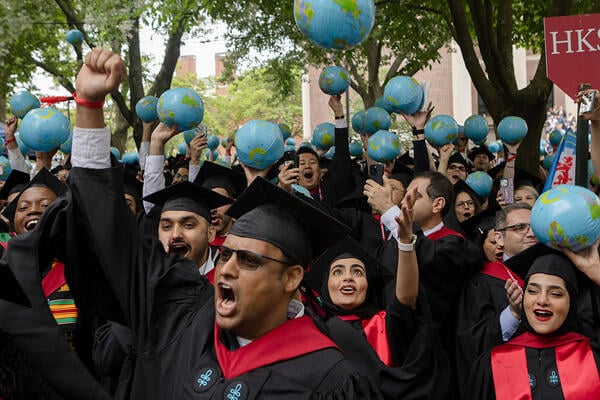
The Kennedy School is the first college at the university to release its formal contingency plan; others are working on developing their own. HKS is particularly vulnerable to a foreign student ban: 59 percent of its students are international, compared to 24 percent of Harvard’s total student population.
Harvard is currently suing the Trump administration over multiple attempts to ban its foreign student population, including by revoking the university’s Student Exchange and Visitor Program certification and issuing an executive proclamation. Last Friday, a federal judge granted Harvard a preliminary injunction in one of its court challenges.
Even if the Trump administration’s efforts targeting Harvard specifically are struck down by the courts, other moves—such as revoking Chinese students’ visas en masse or banning nonimmigrant visa holders from a dozen countries—could prevent some of the Kennedy School’s current and incoming students from attending.
The recent decision by the American Council on Education and the Carnegie Foundation to simplify the classification of research universities may have been well meaning, but it represents a serious misstep with consequential results.
By reducing a comprehensive system of research metrics down to just two—in order to gain coveted R-1 status, an institution must now spend $50 million annually on research and award 70 research doctorates per year—ACE has fundamentally changed what it means to be a top-tier research institution. The shift away from more holistically evaluating research activity risks distorting public understanding and perception of university excellence while incentivizing behavior that undermines long-term research creativity and innovation.
To most effectively appreciate the importance of this change, it is helpful to trace the history of the Carnegie classification system. Initially conceived in 1973 by the Carnegie Commission on Higher Education, the system was intended as a tool to support research and policymaking by categorizing U.S. colleges and universities according to their missions and output.
Over the decades, the classification system has become a trusted compendium for the public, media and higher education community. Designations such as “R-1” (which historically stood for “Doctoral University—Very High Research Activity”) and “R-2” (“Doctoral University—High Research Activity”) gained prominence, indicating robust levels of scholarly productivity, research funding, doctoral education and infrastructure.
The methodology used for the 2021 classifications (the most recent until this year) involved a suite of indicators that aimed to quantify research excellence, with partial normalization for institutional size. These included total research expenditures in science and engineering, research expenditures in non–science and engineering fields, science and engineering research personnel size (postdoctoral appointees and other nonfaculty Ph.D. researchers), and the number of doctoral degrees awarded annually in humanities, social sciences, STEM fields and other fields like business and education.
A principal components analysis then allowed for the creation of indices representing both total and per-capita research activity, enabling close and equitable comparisons across different institutions. This methodology was, in many ways, one of the most comprehensive and encompassing frameworks to date, providing a statistical assessment of American research universities founded on publicly available data.
For the 2025 classifications, however, the landscape changed. With ACE’s leadership, the Carnegie Foundation developed a new framework that substantially simplifies the standards for achieving flagship research status. The revised criteria focus on just the two metrics mentioned above: Institutions must spend at least $50 million annually on research activities and award at least 70 research doctorates per year. Institutions qualifying on both criteria are R-1; those that fail to qualify but spend at least $5 million on research activities and award at least 20 research doctorates are R-2. These terms now stand for very high and high “spending and doctoral production,” respectively, and not the previously used very high and high “research activity.”
This change may appear technical, but it removes numerous subtle measures of academic involvement and output and represents a profound shift in values. Under the previous activity-based framework, institutions were rewarded for building a diverse research ecosystem across a range of disciplines. Now, the metric has been reduced to total money spent and degrees awarded—inputs and outputs that do not necessarily equate to research excellence.
Moreover, this move opens the door for institutions to “teach to the test.” Rather than pursuing organic growth in their research missions, universities may instead make tactical investments to reach the magic numbers needed for R-1 status. This situation is a textbook case of Goodhart’s law: “When a measure becomes a target, it ceases to be a good measure.”
By selecting just two metrics to assess national standing, the classification system invites institutions to game the criteria, boosting research spending and degree output not necessarily through improved research performance but administrative and accounting shifts. This oversimplification of a complex and holistic evaluation tool can have unintended consequences, such as distorting institutional priorities and stifling the motivation to invest in long-term, mission-driven scholarship.
Unfortunately, proof of this phenomenon is already visible. A cursory search of the internet will reveal multiple universities that have recently announced their elevation to R-1 status: More than 40 new institutions gained R-1 status under the revised criteria. While many have made commendable progress, it’s worth noting that their elevation to “elite” research status occurred not as a result of a significant shift in scholarly output, but because they met the two quantitative benchmarks.
The concern is not that these institutions shouldn’t be proud of their growth—it’s that the public will now assume parity between these universities and others whose research footprints are significantly deeper, broader and more globally impactful. ACE has effectively redefined what it means to be an “R-1” institution without clearly communicating that this designation no longer reflects the same type of achievement it once did.
To prevent confusion and preserve the integrity of the classification system, ACE and the Carnegie Foundation should consider rebranding the new categories to reflect their true nature. Rather than continuing to use the historically meaningful “R-1” and “R-2” terms, a more accurate labeling system might be RS-1 and RS-2, signifying “research spending.” This small change would clarify for stakeholders that these categories are now based largely on spending thresholds, not a holistic measure of research activity.
Whereas simplification may make the classifications more politically appealing and easier to administer, it does so at the cost of such vital ingredients as analytical comprehensiveness, contextual responsiveness and evaluative accuracy. To appropriately recognize and support genuine centers of research excellence, it is imperative to adopt a multidimensional evaluative framework—one that ideally encompasses not only research expenditures and doctoral degree program productivity, but also incorporates measures of scholarly impact, the quality of research publications, the development of research infrastructure and the extent of faculty engagement in research activities.
Also, to balance the structural advantages of larger institutions, appropriate normalization factors—such as costs per faculty member, publications per capita and doctoral degrees per research-active department—must be factored in. The 2021 classification model better reflected such a comprehensive and equitable approach, in contrast to the more reductive orientation observed in the 2025 iteration.
In order to preserve the integrity of American research universities as engines of discovery and innovation, their evaluation should be grounded in objective scholarly metrics that meaningfully reflect institutional excellence in research. Given the multifaceted nature of research excellence, our classification systems should be equally nuanced and comprehensive.
G. Dale Wesson is the dean and director of land-grant programs at Florida A&M University’s College of Agriculture and Food Science. He holds a Ph.D. in chemical engineering from Michigan State University, an M.S. in chemical engineering from Georgia Institute of Technology and a B.S. in chemical engineering from Illinois Institute of Technology.
Over 820,000 undergraduates are connected to the U.S. military, including those who are actively serving or enlisted in the National Guard, former service members and spouses, or dependents of military service members.
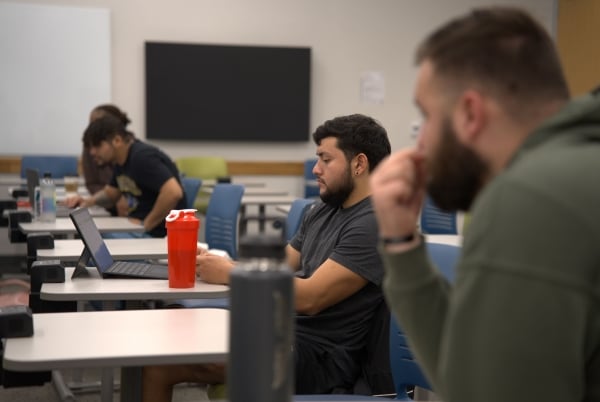
The University of Texas at San Antonio, located in Military City USA, serves over 5,000 military-affiliated students, including veterans, service members and their families, in a region that has the largest concentration of military bases in the country.
In the most recent episode of Voices of Student Success, host Ashley Mowreader speaks with Michael Logan, UTSA’s senior director for veteran and military affairs and a U.S. Marine Corps veteran, about supporting military-affiliated students through their transition into higher ed and the role of community in student veteran retention.
An edited version of the podcast appears below.
Q: Can you set the playing field for people who might not be familiar with San Antonio and the region and how that impacts your military-affiliated students?
Michael Logan, senior director for veteran and military affairs.
University of Texas San Antonio
A: It’s interesting, because the branding of the city, or the trademark, is Military City USA, and that’s not hyperbole when you consider not just the active-duty components that are here, but how many veterans retire to this area.
It’s not just the folks that are here because [the Department of Defense] is making them be here, but it’s a destination. In the county alone, there are about 100,000 veterans. If you expand into the Alamo area, Council of Governments region, it gets up to about 250,000 veterans. So you have to think, it’s not just the veterans, it’s the veterans’ spouses, all the dependents, all the family members. And so the number is probably three times that that we’re actually serving.
Q: That’s crazy, just the sheer number of people. I wonder if you can tie into this population of military-affiliated students at the university. Obviously you have veterans and then those, like you mentioned, family members, dependents. But then there’s also students who are currently engaged in the military.
A: You’ll notice if you look at our website, we lean away from using “veteran” in our terminology even in our center for military-affiliated students, and that’s intentional. Because we have so many different military-connected students that are not specifically in that veteran category. We do have a lot of National Guard and military reserve members; we do have a lot of activity duty. In fact, the family members probably outnumber the veterans and active duty two to one.
So for us, it was very important that the entire military-connected population understood that we were here to support everybody and not just that narrow swath of just those who had previously worn the uniform.
Q:When we are thinking about those students who are associated more directly with military service, so student veterans, ROTC or currently enlisted, can you talk a little bit about some of those challenges or opportunities when military-affiliated learners engage with higher education and how they look different from maybe your traditional learner on campus?
A: That’s a very good question, and I learn something every day, too. Even as someone who did time on active duty, I wasn’t doing those things simultaneously.
But what’s very interesting to me is having to articulate to folks who are not vets or not military-connected that military is a culture. So when we’re talking about validating everybody’s experiences in the classroom and making sure that we’re digging into the full richness and depth of experiences to really give everyone the best possible collegiate experience, we can’t discount military service as a separate and distinct culture.
I think what has happened previously is that there was concern where maybe a student was reframing things they were learning in their military context, and the instructor might have been thinking, “Well, you’re not getting it. I’m trying to get you to think this certain way, but you keep defaulting it back to your military context.” And then that leads to a conversation that I’ll eventually have with the instructor that talks about, “Well, the reason why this is happening is because categorically and demonstrably military service is a culture.”
I actually did research on that back in 2019, and again in 2024, we did a quantitative study. I did it with some student veterans who were graduate students here at the university, where we were able to empirically demonstrate that veteran itself is a culture.
You are all your intersectional identities, but once you’ve served and once you’ve had that military service experience, you experience all of those pieces of yourself through the lens of that military service. And so of course, when you’re teaching somebody something, when they contextualize it, it’s going to be through the lens that they see everything else, including their own identity.
Q: I’m the daughter of two veterans, and it’s funny, I remember being in high school, and the word “squad” was really trendy with young people at that time, and my mom was like, “Squad? That’s a military term. Like, what do you mean, your squad? Like, your squadron? What’s happening?” Even in the daily words that we use, there’s this affiliation that’s always going to come back to people.
So when we talk about supporting students that are military affiliated on campus, can you walk us through some of the programs and offerings that you all have?
A: There’s many, and some of them are more focused on traditional academic outcomes; we’ve got resources specific for individual tutoring.
We recognize that we have a very large relative population of veterans using what’s called veteran readiness and employment, which means they’re disabled veterans. We have over 430 of those on our campus, so we have more just from that group than most campuses have veterans. So we’re very intentional about providing services that are, first of all, diverse enough to cover all the different conditions, visible and invisible, that might be barriers to success academically.
The activities that I’m most proud of are the ones that are more impactful and [contribute] directly toward sense of belonging and community building. Because I think if you don’t have a strong sense of belonging, and you don’t have a visible and established community, then you’re not going to get true engagement. You’re just going to get a veteran or a family member that shows up, goes to the class, absorbs the information, goes home, but they’re not really engaging with their peers on campus, or campus culture. They’re not getting the other 50 percent of why you go to college, which is to develop social capital and be exposed to ideas that are new and different than your own.
Some of the programs that we’ve put together on that front are something we call Coffee With Vets, which is a very informal mixer that we do every second Wednesday of the month. When I say Coffee With Vets, you’ll notice I didn’t say with student vets, right? Because it’s for the entire veteran community. We have over 200 employees that wore the uniform as well, and it’s not uncommon to see students, employees, people from the community, stakeholders, that use that event as an opportunity to just be seen and get to know people.
I think what we’re guilty of, myself included, is that a veteran might look at a resource and think, “I don’t need that today, so it’s not relevant to me,” and then when they do need it, then there’s this issue with trust: “I’m only going to engage with something I trust.” And so Coffee With Vets is an opportunity for someone like me to maybe engage with VA [U.S. Department of Veterans Affairs] staff. And even though I may not need what they’re doing right now, I may need it in six months or a year, and I’m going to remember that person that I commiserated with over a bacon-covered doughnut and some Black Rifle coffee. I’m much more willing to engage in whatever that support is.
That’s just one example. And the reason why we do that, the reason why we emphasize community building and building that trust is because when you look at some of the barriers to completion and matriculation, a lot of them are vets putting something off or not engaging with something. So if we can minimize hesitation and maximize trust, then we can get those vets to fully utilize the wraparound services that we provide and ultimately be successful, not just in school, but beyond school, because they’re only here for a little while. And what we’re trying to do is set them up for success in the future.
Q: I’m so glad that you mentioned that role of helping students see that resources might be useful later on. Because one of the common barriers that we hear from student veterans is that the military is so structured and that there’s so much told to them about what your next step is and where you’re going to go and what your job is, that when you come to higher ed, you really have to find a sense of self-advocacy and start finding things on your own that might just be unfamiliar or different.
I love that you all provide a space for students to explore but also be connected with people who think like they do and understand that it might be a totally different culture change to have somebody like you have to ask for help sometimes.
A: The two things you bring up are advocacy and what I like to call cultural considerations. I don’t like to say cultural competency, because that implies incompetency. It’s not incompetency, it’s just cultivated.
Advocacy is a big thing. There’s a significant amount of my time spent doing that, sometimes at the request of veterans, sometimes not. Sometimes it’s because I need to help the veteran figure out how to learn to live in the world that they’re in now. But it’s not uncommon for me to have a veteran reach out and say, “I want to have this conversation with an instructor, but I don’t know how to do it without coming across as just super aggressive or knife handing or using the F-word as a comma,” which sometimes they’re still in the habit of doing. But they’re self-aware, right? So they’re coming in, they’re asking, “I don’t want the message to get lost in how I’m delivering it. So please help me.” And we’ll do that.
But the other side of that is also the self-advocacy piece, which I’m glad you mentioned, too, because there’s just, like you said, when you’re on active duty, there’s somebody who’s responsible for you. As you mentioned, you’ve got a squad leader, you’ve got a battle buddy, you’ve got somebody, even when you check into a base, somebody walks you around and shows you everything. And that’s just not the case in higher ed.
You may not know what Student Disability Services is. You may not know that if you have a 50 percent or higher [disability] rating, you get free [ADA] surface parking. So here you are paying for it. Or testing accommodations—just all these different things that vets are leaving on the table, and it’s hurting them in some form or fashion, because they’re not able to maximize their potential.
It’s a weird tightrope where we’re trying to figure out, “How do we give them all this information, but in a way where it’s not like sipping water from a fire hose or this is going to be information dumped five minutes later?” We have to be very, very intentional about parceling out that information.
We kind of do it in layers. First, here’s who we are, then if you have an interest in these things categorically, and then it eventually it gets into the into the weeds of things. But that’s actually been very successful for us.
As a matter of fact, we asked some of our vets, “Hey, what do you wish you would have known the first day, now that you’re here towards the end, what do you wish you would have known?” And they actually put together a booklet that has everything that they all said: “Here’s what would have been super helpful on day one to know.” So now that’s turned into something that our student vets maintain.
My transition off of active duty was—I’m going to date myself here—over 20 years ago, probably over 25 years ago. My experiences and my needs are very, very different than a service member becoming a veteran in the year 2025. So it’s very important that we maintain that close connection with these subsequent cohorts of veterans that are showing up on our campus and giving them the agency to drive—“Here’s the information we need, so hey, please provide it.”
That requires a lot of psychological safety on behalf of my staff, because you get that thought about, “if it ain’t broke, don’t fix it.” But at the same time, something that was relevant two years ago may not be relevant to the folks that are getting out in a very different environment.
Q: You touched on this a little bit earlier, but I think just having that staff that has military experience or military affiliation as well can be really helpful. And like you said, translating to higher education, but also understanding, like, even if it’s not right now, what service members might need, but having a little bit of empathy for that circumstance and what they might be transitioning through.
A: I agree with that 100 percent. All of the staff members that I have today in summer of ’25 I had in fall of 2018, every single one of them. I haven’t lost anybody through COVID—if you’re in Texas, Snowvid—or the great resignation.
I think that is a very clear indicator of the orientation of my staff. We’re all military connected, either veterans or family members themselves, and they’re here because the work that we do here is what fills our cup.
As a matter of fact, we have a purpose statement that is taped up everywhere, and it’s derived from an old story about President Kennedy visiting NASA. He sees a janitor, and he asks the janitor, “Hey, what do you do here?” And the janitor says, “I’m helping put someone on the moon.”
We’ve adapted that, and if you were to walk into UTSA Center for Military Affiliated Students and you see somebody shredding paper or filing or helping a student all across the range of things we could be doing, and you ask them, “Hey, what are you doing here?” The answer is going to be “I’m trying to provide a level of support for students that I wish I would have had for myself.”
Q: I wanted to talk a little bit about careers, because military students often come in with lots of life and career experience, but often enter higher education as a pivot or as an exploration of doing something else. I wonder if you can talk about navigating that space and understanding where higher education is a bridge for military-affiliated students.
A: That’s a tricky one in that you’re right, some of them come in and that pivot sometimes is intentional. If you look at our chief information officer [Kendra Ketchum], who was a Navy corpsman, and then postmilitary pivoted into, she’s our CIO.
But I think what’s very important when trying to help a service member navigate what they’re going to do with their higher education experience is you have to ask almost the five whys. If you’re familiar with Lean, you know what the five whys are. If you have a toddler, you know what five whys are.
But if you ask a vet, “Hey, why are you here?” The first answer you’re probably going to get is, “Because you’re supposed to use the GI Bill.” That’s what you’re told. You leave active duty, you go to college, you use the GI Bill.
“So what do you want to get out of it?”
“I wanted to get a degree and get a good job.”
But really, what it comes back to is trying to get them to be reflective on who it is you want to be, rather than what it is you want to do. What we uncover is that most veterans are looking for two things: to continue serving and community.
So once we figure out what that piece is for them, it’s a lot easier to guide them through the process and not just tell them all, “Here’s the major you should take, or which classes or which instructor,” but actually provide opportunities for academic inquiry.
I mentioned earlier that we did research for sense of belonging and identity. It started years ago when a veteran came to me, and she was frustrated because she had this great idea for doing a study to create a rubric based on positive psychology to figure out what motivates a veteran, what makes them tick, what fills their cup. Because she wanted to focus on that, not on the deficit discourse: What’s wrong with you and how do we address your problem today?
She had gone to different places and couldn’t get any traction because nobody was studying that; that wasn’t a topic that anyone was researching. And I said, “Well, I’m not a psychologist, but I’ll do everything I can to help you.”
Fast-forward to the end of that story: She did the study, and then she got accepted to two national conferences to talk about it, and she graduated with her master’s in social work and has returned to our university as an internship coordinator to start our first-ever veteran case management program. We’re going to pilot it under her watch. She invented the rubric.
That’s one example and I can give you many more. But again, it’s very nontraditional. We’re not just talking about advising students, we’re talking about providing opportunities for students to develop and cultivate their inquiry so they don’t lose that through the college process and then end up being something other than what they intended when they graduate.
Q: Regarding sense of belonging, I think it’s natural for student veterans to fall in step with each other. But then there’s also the wider campus community and finding that sense of belonging just on campus as well. I wonder if you can talk about those two avenues, one connecting like-minded, military-affiliated students, and the other encouraging them to get out, explore and see what else the campus has to offer?
A: That’s an excellent point, and it is a strange kind of rut that we fall into where we want to gravitate towards what we know. We show up on a campus and everything’s weird, and people are different, and so we’re looking for other people that are like us, and that’s kind of missing the point.
What I do to try and encourage engagement outside of just vets hanging out with vets is I will encourage vets to cultivate the thing that they want to keep doing, which is continue serving, but expand that vision beyond vets.
For example, our local Student Veteran Association chapter, they were doing a lot of programming that was vet-focused, vet-centric. And I said, “You know who doesn’t have a lot of support on this campus is military family members, like the kids in the center for military families. So maybe we connect with them and we look for a broader opportunity to support where there’s a gap.”
We had vets that would ask me, “How come I’m having trouble getting nonvets to see the value in us, or not look at us sideways or appreciate our presence in the classroom?” And I said, “Well, why don’t we look at service projects that benefit them, and not necessarily just y’all?”
So a group of vets got together, and they came up with this great idea to provide golf cart shuttle service for folks with mobility issues. It was the vet group that was like, “All right, we’re going to write the grant, we’re going to get the golf cart, we’re going to drive it, but it’s going to be available to anyone who’s got any kind of mobility issue.” They didn’t even say disability, just mobility. It could be a sprained ankle.
And it’s a service that they were going to leverage their capital. Because vets can go and they can ask for these things and get these donations, but [they] make it available to the entire campus population and that lines up exactly with their values. They enlisted to serve, and they served folks. This was kind of a microcosm of that.
It’s great to see how, when they’re thinking it through and they’re ideating, all of a sudden, that light bulb goes off, and it makes sense that we don’t have to circle the wagons because we’re in a strange environment. What we need to do is do what we’ve always been doing and leverage everything that we bring to the table to lift everyone else around us.
Q: You’re a veteran and a veteran in this space in higher education. For those who might be unfamiliar with working with military-affiliated students or looking to do more on their campus to support these students, what’s a point or two you would give for someone who wants to do better?
A: First and foremost, I think that there might be a misconception out there that vets maybe see themselves as apart from or maybe even above [others]. You hear about Billy Madison syndrome: “I’m older and I know more things.”
While that might be true for some vets, vets are typically not looking for differential treatment—especially in the classroom or among their peers or from instructors or even from staff; they’re just looking for their experiences to be as validated as anybody else’s. So it’s very important that we’re aware that there are some things we can do and say that will be received as microaggressions. The issue is, when a vet experiences a microaggression, they don’t get aggressive. I think some people think, “Oh, man, they’re about to snap and lose their minds,” and that’s not what they’re going to do. What the vet’s gonna do is absolutely shut down, and they will disengage, and you will have lost any opportunity going forward to regain their trust and to have them feel a part of the community.
So first and foremost, just if one could shift their mindset and understand veteran [experiences] is a culture, and think of it as any other culture you support on campus. No. 1, that’s going to help you as the nonvet to really inform your perspective.
Then second of all is listen and don’t be prescriptive. And that applies not just for nonvets, but for people like me as well. Like I mentioned, my [military] experience was a long time ago versus what people are experiencing now. And as much as I’m tempted all the time to say, “I know what you’re going to need, I know what’s going to happen to you in six months and in two years, and the stages of going from active duty to civilian and the wall you’re going to hit. I know all these things are coming, so I’m going to set all these things up, and I’m gonna expect you to do them.” Every vet is sitting there saying, “Oh, that’s not me. You don’t know me.” And I know, because I was that guy that did the same thing.
It’s important to kind of push down my own impulses and stay very, very actively engaged and just constantly ask, “What is it you need? What is it I can do to support you?” By doing that, you’re building that trust, so that when those other [challenges] inevitably do happen, you don’t have to go find them and save them from it. They’re going to come to you and ask you, “Hey, can you help me through it?”
That’s the difference between, I think, being effective and going through the motions, is when they’re asking for it and they want to engage with it. But those are the two biggest things. Vets aren’t all that different. They’re just actually, weirdly, looking to be part of the crowd.
Get more content like this directly to your inbox. Subscribe here.