Tag: Children

  • 3,000 Children Repeating Third Grade Under New Indiana Literacy Requirement – The 74

    3,000 Children Repeating Third Grade Under New Indiana Literacy Requirement – The 74


    Get stories like this delivered straight to your inbox. Sign up for The 74 Newsletter

    About 3,000 Indiana students are repeating third grade this school year for not meeting the state’s reading proficiency standards.

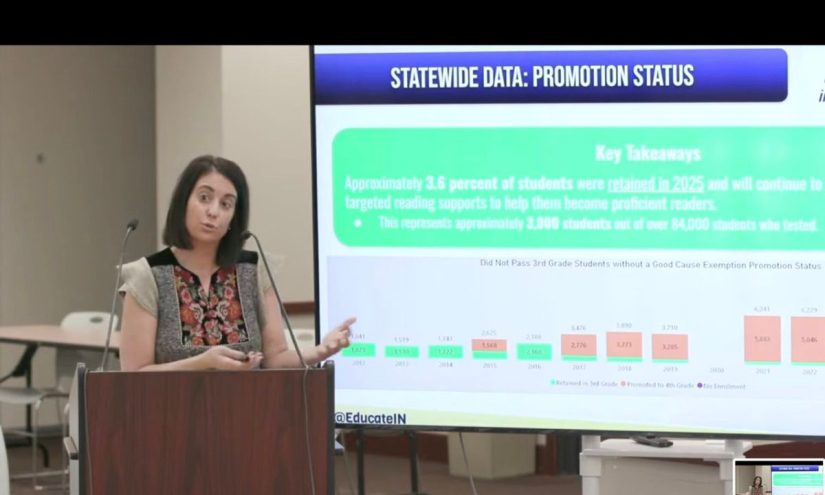
    Data released Wednesday by the Indiana Department of Education showed 3.6% of the 84,000 children who took the statewide IREAD exam were retained in third grade under the first enforcement of a requirement approved by the Legislature in 2024.

    Those 3,040 retained students are more than seven times the 412 children held back in third grade two years ago.

    Education Secretary Katie Jenner credited improved performance by students in the IREAD exam given last school year with the retention figure being lower than anticipated when the literacy requirement was being debated.

    “The numbers that were being thrown out is that it would be 7,000 to 10,000 that this law would trigger retention,” Jenner told State Board of Education members. “But, in fact, a huge shout out to our teachers and our people, we have thousands of kids who are now readers.”

    Education officials announced in August that 87.3% of third graders — about 73,500 out of more than 84,000 students statewide — demonstrated proficient reading skills in 2024-25. They hailed the nearly five percentage point improvement from the previous school year as the largest year-to-year jump since the state began IREAD testing in 2013.

    That left about 10,600 children who didn’t meet the standard, with almost 7,000 being given “good cause exemptions” to avoid retention. Nearly 75% of those given exemptions were special education students and about 24% are English learners with less than two years of specific literacy services.

    Anna Shults, the Department of Education’s chief academic officer, said the new retention requirement was having its intended effect.

    “We are now ensuring that students that are promoted on to grade four are doing so with an ability to read and show mastery of key foundational reading skills,” Shults told the State Board of Education.

    The Department of Education will have an online dashboard providing breakdowns of the Indiana Reading Evaluation and Determination assessment, or IREAD, by school district and individual schools, including charter schools and nonpublic schools.

    Officials noted about 670 children who didn’t meet the literacy standards were not enrolled in Indiana schools this year, saying they likely moved out of state or were being homeschooled.

    Jenner said a determination would need to be made about those students if they returned to Indiana schools.

    “That’s a question that we’ll need to sort through, because some may move back into Indiana, or if they left for homeschool may come back in,” Jenner said. “Because we’re looking at every unique student, I think we’ll try to figure out exactly where they are.”

    According to 2023 data, 13,840 third-graders did not pass I-READ-3. Of those, 5,503 received an exemption and 8,337 did not. Of those without an exemption, 95% moved onto 4th grade while only 412 were retained.

    Indiana Capital Chronicle is part of States Newsroom, a nonprofit news network supported by grants and a coalition of donors as a 501c(3) public charity. Indiana Capital Chronicle maintains editorial independence. Contact Editor Niki Kelly for questions: [email protected].


    Did you use this article in your work?

    We’d love to hear how The 74’s reporting is helping educators, researchers, and policymakers. Tell us how

    Source link

  • School Admissions Anxiety Hits Parents of Young Children, Too – The 74

    School Admissions Anxiety Hits Parents of Young Children, Too – The 74

    A few factors have made selecting an elementary school particularly challenging in recent years. For one, there are simply more schools for parents to pick from over the past few decades, ranging from traditional public and private to a growing number of magnet and charter programs. There are also new policies in some places, such as New York City, that allow parents to select not just their closest neighborhood public school but schools across and outside of the districts where they live.

    As a scholar of sociology and education, I have seen how the expanding range of school options – sometimes called school choice – has spread nationwide and is particularly a prominent factor in New York City.

    I spoke with a diverse range of more than 100 New York City parents across income levels and racial and ethnic backgrounds from 2014 to 2019 as part of research for my 2025 book, “Kindergarten Panic: Parental Anxiety and School Choice Inequality.”

    All of these parents felt pressure trying to select a school for their elementary school-age children, and school choice options post-COVID-19 have only increased.

    Some parents experience this pressure a bit more acutely than others.

    Women often see their choice of school as a reflection of whether they are good moms, my interviews show. Parents of color feel pressure to find a racially inclusive school. Other parents worry about finding niche schools that offer dual-language programs, for example, or other specialties.

    Navigating schools in New York City

    Every year, about 65,000 New York City kindergartners are matched to more than 700 public schools.

    New York City kindergartners typically attend their nearest public school in the neighborhood and get a priority place at this school. This school is often called someone’s zoned school.

    Even so, a spot at your local school isn’t guaranteed – students get priority if they apply on time.

    While most kindergartners still attend their zoned schools, their attendance rate is decreasing. While 72% of kindergartners in the city attended their zoned school in the 2007-08 school year, 60% did so in the 2016-17 school year.

    One reason is that since 2003, New York City parents have been able to apply to out-of-zone schools when seats were available. And in 2020, when the COVID-19 pandemic began, all public school applications moved entirely online. This shift allowed parents to easily rank 12 different school options they liked, in and outside of their zones.

    Still, New York City public schools remain one of the most segregated in the country, divided by race and class.

    Pressure to be a good mom

    Many of the mothers I interviewed from 2015 through 2019 said that getting their child into what they considered a “good” school reflected good mothering.

    Mothers took the primary responsibility for their school search, whether they had partners or not, and regardless of their social class, as well as racial and ethnic background.

    In 2017, I spoke with Janet, a white, married mother who at the time was 41 years old and had an infant and a 3-year-old. Janet worked as a web designer and lived in Queens. She explained that she started a group in 2016 to connect with other mothers, in part to discuss schools.

    Though Janet’s children were a few years away from kindergarten, she believed that she had started her research for public schools too late. She spent multiple hours each week looking up information during her limited spare time. She learned that other moms were talking to other parents, researching test results, analyzing school reviews and visiting schools in person.

    Janet said she wished she had started looking for schools when her son was was 1 or 2 years old, like other mothers she knew. She expressed fear that she was failing as a mother. Eventually, Janet enrolled her son in a nonzoned public school in another Queens neighborhood.

    Pressure to find an inclusive school

    Regardless of their incomes, Black, Latino and immigrant families I interviewed also felt pressure to evaluate whether the public schools they considered were racially and ethnically inclusive.

    Parents worried that racially insensitive policies related to bullying, curriculum and discipline would negatively affect their children.

    In 2015, I spoke with Fumi, a Black, immigrant mother of two young children. At the time, Fumi was 37 years old and living in Washington Heights in north Manhattan. She described her uncertain search for a public school.

    Fumi thought that New York City’s gifted and talented programs at public schools might be a better option academically than other public schools that don’t offer an advanced track for some students. But the gifted and talented programs often lacked racial diversity, and Fumi did not want her son to be the only Black student in his class.

    Still, Fumi had her son tested for the 2015 gifted and talented exam and enrolled him in one of these programs for kindergarten.

    Once Fumi’s son began attending the gifted and talented school, Fumi worried that the constant bullying he experienced was racially motivated.

    Though Fumi remained uneasy about the bullying and lack of diversity, she decided to keep him at the school because of the school’s strong academic quality.

    Pressure to find a niche school

    Many of the parents I interviewed who earned more than US$50,000 a year wanted to find specialty schools that offered advanced courses, dual-language programs and progressive-oriented curriculum.

    Parents like Renata, a 44-year-old Asian mother of four, and Stella, a 39-year-old Black mother of one, sent their kids to out-of-neighborhood public schools.

    In 2016, Renata described visiting multiple schools and researching options so she could potentially enroll her four children in different schools that met each of their particular needs.

    Stella, meanwhile, searched for schools that would de-emphasize testing, nurture her son’s creativity and provide flexible learning options.

    In contrast, the working-class parents I interviewed who made less than $50,000 annually often sought schools that mirrored their own school experiences.

    Few working-class parents I spoke with selected out-of-neighborhood and high academically performing schools.

    New York City data points to similar results – low-income families are less likely than people earning more than them to attend schools outside of their neighborhoods.

    For instance, Black working-class parents like 47-year-old Risha, a mother of four, and 53-year-old Jeffery, a father of three, who attended New York City neighborhood public schools themselves as children told me in 2016 that they decided to send their children to local public schools.

    Based on state performance indicators, students at these particular schools performed lower on standard assessments than schools on average.

    Cracks in the system

    The parents I spoke with all live in New York City, which has a uniquely complicated education system. Yet the pressures they face are reflective of the evolving public school choice landscape for parents across the country.

    Parents nationwide are searching for schools with vastly different resources and concerns about their children’s future well-being and success.

    When parents panic about kindergarten, they reveal cracks in the foundation of American schooling. In my view, parental anxiety about kindergarten is a response to an unequal, high-stakes education system.

    Bailey A. Brown, Assistant Professor of Sociology, Spelman College

    This article is republished from The Conversation under a Creative Commons license. Read the original article.

    Source link

  • Can gifted testing spot potential in young children?

    Can gifted testing spot potential in young children?

    by Sarah Carr, The Hechinger Report
    November 13, 2025

    In New Orleans, a few hundred dollars could once help a family buy a “gifted” designation for their preschooler.

    As an education reporter for the city’s Times-Picayune newspaper several years ago, I discovered that there was a two-tiered system for determining whether 3-year-olds met that mark, which, in New Orleans, entitled them to gifted-only prekindergarten programs at a few of the city’s most highly sought-after public schools.

    Families could sit on a lengthy waitlist and have their children tested at the district central office for free. Or they could pay the money for the private test. In 2008, the year that I wrote about the issue, only a few of the more than 100 children tested at the central office were deemed gifted; but dozens of privately tested kiddos — nearly all of them tested by the same psychologist for $300 — met the benchmark.

    Since working on that story, I’ve been interested in the use of intelligence testing for high-stakes decisions about educational access and opportunity — and the ways that money, insider knowledge and privilege can manipulate that process.

    But I knew less about what the research shows about a broader question: Should gifted-only programming for the youngest students exist at all and, if so, what form should it take? When New York City Mayor-elect Zohran Mamdani announced in October that he would end long-standing gifted programming for kindergartners (while preserving it for the older grades), I reached out to some leading researchers in search of answers to those questions. Read the story.


    More on gifted education

    Hechinger reporter Jill Barshay, who covers education research, has written several stories about different facets of gifted education, which she captured in a column earlier this month.

    In 2020, The Hechinger Report and NBC News produced a three-part series on the ways that gifted education has maintained segregation in American schools and efforts to diversify gifted classes. 

    More early childhood news

    Federal immigration agents pulled an infant teacher out of her classroom at a Chicago child care, pinning her arms behind her — and traumatizing the families who witnessed the incident, report Molly DeVore and Mack Liederman for Block Club Chicago.

    Growing numbers of child care workers are running for elected office, hoping to work directly on behalf of change and more support for a sector that desperately needs it, writes Rebecca Gale for The 74

    Colorado voters approved two sales tax levies to support child care providers and families with young children, reports Ann Schimke with Chalkbeat Colorado.

    Research quick take

    Contrary to perception, there’s little evidence that an increased academic focus in the early elementary years disadvantages boys, write researchers in a new working paper published by Brown University’s Annenberg Institute. The researchers, Megan Kuhfeld and Margaret Burchinal, examined growth in reading and math test scores for a sample of 12 million students at 22,000 schools between 2016 and 2025. They found that boys are surpassing girls in math by the end of elementary school, and that girls maintain an advantage in reading through fifth grade. 

    This story about gifted testing was produced by The Hechinger Report, a nonprofit, independent news organization focused on inequality and innovation in education. Sign up for the Hechinger newsletter.

    This <a target=”_blank” href=”https://hechingerreport.org/how-young-is-too-young-for-gifted-testing/”>article</a> first appeared on <a target=”_blank” href=”https://hechingerreport.org”>The Hechinger Report</a> and is republished here under a <a target=”_blank” href=”https://creativecommons.org/licenses/by-nc-nd/4.0/”>Creative Commons Attribution-NonCommercial-NoDerivatives 4.0 International License</a>.<img src=”https://i0.wp.com/hechingerreport.org/wp-content/uploads/2018/06/cropped-favicon.jpg?fit=150%2C150&amp;ssl=1″ style=”width:1em;height:1em;margin-left:10px;”>

    <img id=”republication-tracker-tool-source” src=”https://hechingerreport.org/?republication-pixel=true&post=113347&amp;ga4=G-03KPHXDF3H” style=”width:1px;height:1px;”><script> PARSELY = { autotrack: false, onload: function() { PARSELY.beacon.trackPageView({ url: “https://hechingerreport.org/how-young-is-too-young-for-gifted-testing/”, urlref: window.location.href }); } } </script> <script id=”parsely-cfg” src=”//cdn.parsely.com/keys/hechingerreport.org/p.js”></script>


    Source link

  • Want to Protect American Children? End the Shutdown – The 74

    Want to Protect American Children? End the Shutdown – The 74


    Get stories like this delivered straight to your inbox. Sign up for The 74 Newsletter

    Politicians love to say, “We must protect our children. They are our future.” But looking at what’s happening in Congress right now, children are not being protected. Families are not being prioritized. Instead, lawmakers are locked in a standoff, waiting to see who blinks first as they fight over who gets the last word and how big of a tax break they can give the wealthiest Americans.

    Meanwhile, families — especially families of color and low-income families — are left to hold their breath and wonder what this shutdown means for them. As members of Congress keep making their rounds on television, babies still need formula, toddlers still need health screenings, children still need breakfast and lunch at school and in their child care programs, and parents still need child care so they can work. Amid extreme stress, families are left, wondering how they will be able to take care of their children.

    The demands of children and their families do not stop just because Congress is at a standstill. 

    According to Kids’ Share 2024, an annual report published by the Urban Institute about federal expenditures, children received only about 9% of all federal spending in 2023, while about 43% of federal spending went toward health and retirement benefits for adults 18 years and older. That’s a very small percentage for a nation in which politicians on both sides of the aisle have expressed interest in increased government investment in children. These numbers contradict the narrative that claims children matter because they are our future.

    That 9% starts to feel even smaller during a government shutdown. Some programs, like Social Security, Medicaid and Medicare, are mandatory, meaning they don’t require annual congressional approval. But others, including a number of crucial children’s programs, such as the Special Supplemental Nutrition Assistance Program for Women, Infants, and Children (WIC), are funded through the annual appropriations process, which Congress must approve. This means when lawmakers can’t agree on a budget, these critical programs are left in limbo.

    The fallout on the horizon from this needless dysfunction is becoming clearer.

    In September, the National WIC Association reminded the public that WIC only had enough funds to temporarily remain open during a government shutdown. Now, according to Reuters, at least two dozen state websites warn there could be an unprecedented benefit gap for more than 41 million people in America who get aid from the Supplemental Nutrition Assistance Program (SNAP) and the nearly 7 million people who rely on WIC

    Georgia Machell, president and chief executive officer of the National WIC Association, delivered this sobering news last week.

    “Without additional support, State WIC Agencies face another looming crisis,” she said. “Several are set to run out of funds to pay for WIC benefits on November 1 and may need to start making contingency plans.”

    Many families in historically marginalized communities, who already face greater barriers to health care, housing and early education, will feel this impact even more sharply. For example, we know that tens of thousands of young children and families rely on vital support received through Head Start, a service that promotes early learning and development, health and well-being. The shutdown is already in its fourth week, and, according to a statement issued on Oct. 16 from the National Head Start Association, if the government shutdown doesn’t end by Nov. 1, more than 65,000 children and families will be at risk of losing critical services

    A missed doctor’s appointment, a delay in SNAP benefits or a gap in child care isn’t just inconvenient. It can destabilize a family and hinder a child’s development, especially in the classroom.

    A research brief published by The Food Research & Action Center highlighted the links between hunger and learning, stating that “behavioral, emotional, mental health, and academic problems are more prevalent among children and adolescents struggling with hunger” and that young people experiencing hunger have lower math scores and poorer grades. The shutdown will have real and lasting consequences on the learning, development and well-being of America’s children because these programs are being impacted.

    It’s frustrating to watch lawmakers stand at podiums and declare how much they care about children while their actions — or inaction — puts children at risk. 

    Words don’t put food on the table. Words don’t pay rent. But actions do. 

    And right now, the actions coming out of Congress are sending an unfortunate message to families: protecting children is not the priority.

    If children truly are our future, then they cannot be treated as bargaining chips. Children deserve more than 9% of America’s federal spending budget. We need federal budgets that reflect children’s needs and protection for essential services. Critical programs that protect child health and well-being should never be disrupted by a government shutdown.

    Finally, Americans deserve government accountability. Policymakers should be held responsible for their words and actions, especially when they fail to deliver on the promises they make about protecting children.

    Children cannot wait. They are growing, learning and developing right now. The choices we make as a country today will shape their tomorrow.


    Did you use this article in your work?

    We’d love to hear how The 74’s reporting is helping educators, researchers, and policymakers. Tell us how

    Source link

  • Student-parents belong on college campuses. So do their children

    Student-parents belong on college campuses. So do their children

    Too many student-parents never make it to graduation, in no small part because their campuses don’t adequately help them fit college into their lives — or even just fit in.

    Yet over 3 million student-parents across the nation, myself included, are pursuing higher education, seeking the intergenerational benefits that come with earning a degree. To reap them, we must overcome many obstacles, as colleges aren’t designed for students like us.

    For me, the last hurdle I had to clear was graduation itself. After years of sacrifice — not just my own, but my whole family’s — walking the stage with my four children at my graduation from the University of California, Santa Cruz was deeply important.

    The university, however, didn’t understand that or account for us. When I asked to accept my diploma with my kids, I was met with resistance, a particularly tough reminder of the work institutions have left to do to meet the needs and priorities of student-parents.

    Related: Interested in innovations in higher education? Subscribe to our free biweekly higher education newsletter.

    Earning my college degree in my late 30s was undoubtedly a major achievement, but so was going back for my bachelor’s in the first place — I didn’t even finish high school the first time around.

    After I became a mom at 20, I earned my GED, hoping it would help me support my family. Continuing my education only got harder. I started and stopped community college more times than I can count, juggling bills, jobs, custody battles and parenting.

    Finally, I transferred to UCSC, proud that I was taking this step two decades in the making and changing the trajectory of my and my family’s lives.

    However, I didn’t fully realize what my education would cost my children. Used to our tight-knit Tongan community, they felt like cultural outsiders when we moved to Santa Cruz, no longer surrounded by family, our native language or familiar foods and music.

    My children sacrificed their home and sense of belonging so that I could pursue this dream. As graduation approached, I knew I wanted to walk the stage with them. They had earned it just as much as I had.

    Yet the administration denied my request, citing the added logistical difficulties. They suggested I bring my kids to a separate, informal celebration for those of us living in family student housing instead. The offer sounded like “be invisible or settle for less.”

    I immediately started mobilizing UCSC’s Student Parent Organization, where I was president. Working with the student government, I drafted a resolution permitting student-parents to walk with their children. I reached out to alumni, administrators, fellow parents and friends for support.

    Thanks to our collective voice, the dean of students changed his mind, offered an apology and committed to changing the policy going forward for all graduating student-parents. Though my kids and I were placed at the end of the ceremony, we crossed the stage together as a family.

    That seed of inclusion will grow in them, just like it will for all the children of student-parents who walk that path in the future.

    The next year, my mentee and friend walked with her son at the UCSC commencement, this time without pushback. The university invited them to rehearsal, and on graduation day, they had VIP seats. She was one of the first to walk, not the last.

    That is the power of advocacy. It turns exclusion into inclusion. It rewrites the rules not just for one person, but for those who come after. I am proud to continue my advocacy work as a graduate student at the University of San Francisco and a member of The California Alliance for Student Parent Success.

    I have since seen institutions across California make good progress on their efforts to support student-parents, but colleges and universities nationwide must still do more. At the University at Buffalo, university police chased a graduating student across the stage when he attempted to bring his infant son with him.

    Related: A federal program helped student-parents thrive. Now it’s on life support

    These stories and the momentum building in the wake of September’s National Student Parent Month should serve as a call to higher education leaders across the country to cultivate campus climates that build trust and belonging among student-parents.

    This work should start before we even step foot on campus and continue until we graduate.

    Institutions that truly wish to serve families will ensure that the value we bring to higher education is visible. They will account for student-parents when planning campus events and weave together support networks of faculty, staff and peers who can respond to our needs.

    When we ask institutions for policies and practices to better accommodate our families, they will listen and act. They will hold themselves accountable to all of their students, parents included.

    Walking the stage with my kids was a step in the right direction, albeit an uphill climb. Let’s keep going and do better by student-parents and their families.

    Krystle Pale is a UC Santa Cruz graduate, a mother of five and a recent Advisory Committee member of The California Alliance for Student Parent Success.

    Contact the opinion editor at [email protected].

    This story about student-parents was produced by The Hechinger Report, a nonprofit, independent news organization focused on inequality and innovation in education. Sign up for Hechinger’s weekly newsletter.

    The Hechinger Report provides in-depth, fact-based, unbiased reporting on education that is free to all readers. But that doesn’t mean it’s free to produce. Our work keeps educators and the public informed about pressing issues at schools and on campuses throughout the country. We tell the whole story, even when the details are inconvenient. Help us keep doing that.

    Join us today.

    Source link

  • Many children with ADHD miss a crucial step in treatment

    Many children with ADHD miss a crucial step in treatment

    When pediatricians diagnose preschoolers with attention deficit hyperactivity disorder, there are clear steps they are supposed to take.

    Families should first be referred to behavior therapy, which teaches caregivers how to better support their children and manage challenging behaviors that may be related to ADHD. If therapy isn’t making a significant difference, the American Academy of Pediatrics advises, pediatricians can then consider medication.

    Nationwide, this process — behavior therapy, then medication if needed — isn’t being followed as often as it should, according to a study recently released by Stanford Medicine and published in JAMA Network Open. Instead, more than 42 percent of 3- to 5-year-olds with ADHD were prescribed medication within a month of their diagnosis.

    Missing out on behavior therapy has worrisome implications for children and families, said Dr. Yair Bannett, assistant professor of pediatrics at Stanford Medicine and lead author of the study. Behavioral management training for parents over the course of several months has been found to reduce children’s ADHD symptoms and behavioral problems, and improve parent skills and their relationships with their children. 

    Without that support, families may be left facing additional challenges. Behavioral training “reduces the chaos in the house and can improve the quality of life for the parents and the child,” Bannett said. 

    There are several reasons families may be missing this intervention. Some pediatricians aren’t familiar with the purpose of behavior therapy, Bannett added, which is specifically aimed at the adults who support children with ADHD, not the children. “It’s really more of an advanced type of parenting course,” he said. Families also may have trouble finding affordable local therapists.

    Bannett said parents should use three key practices to support young children with ADHD. (These strategies also work well for teachers, he added.)

    Focus on building a strong, positive relationship: Having a strong attachment between the child and parent or teacher is an important first step to managing behavior, Bannett said. That means spending quality one-on-one time with the child. “That’s the child’s motivation, they want to please you,” he added. “Without that first piece, none of this will work.”

    Use positive reinforcement: Rather than punishing a child’s negative behavior, Bannett said, parents and teachers will see more success if they praise good behaviors and develop reward systems to encourage them.  

    Adjust the child’s environment: Children with ADHD may thrive with simple environmental changes, such as “visual schedules” — charts that use pictures to show a child daily activities or tasks — and a consistent, structured routine.

    Parents who can’t find in-person therapists can substitute online therapy, Bannett said. The training is also useful for families even after their children are prescribed medication. 

    To make sure more families have access to helpful strategies, Bannett would like to see more education for doctors and clinicians on these best practices. 

    “The pediatricians could also counsel families in the office about these techniques,” Bannett said. “Some written materials and resources could be enough” to at least introduce these practices, he added. “That’s what I’m hoping could make a change.”

    Reading list

    This story about children with ADHD was produced by The Hechinger Report, a nonprofit, independent news organization focused on inequality and innovation in education. Sign up for the Hechinger newsletter.

    The Hechinger Report provides in-depth, fact-based, unbiased reporting on education that is free to all readers. But that doesn’t mean it’s free to produce. Our work keeps educators and the public informed about pressing issues at schools and on campuses throughout the country. We tell the whole story, even when the details are inconvenient. Help us keep doing that.

    Join us today.

    Source link

  • Black fathers should not be perceived as a threat when they show up for their children

    Black fathers should not be perceived as a threat when they show up for their children

    Across the country, Black fathers are too often seen as a threat when they speak up and advocate for their children. And it’s not just in courtrooms and on sidewalks — it’s happening in classrooms, daycares and schools. 

    I’ve spent my career in education and equity leadership, and I know this is part of a larger, troubling pattern. When Black parents — especially men — assert themselves in spaces not designed for them, they are too often perceived as “aggressive.”  

    Their advocacy is sometimes interpreted as “rude,” and their presence is framed as disruption rather than partnership, something that has played out in my own experience as a proud Black father of three.  

    This isn’t about one parent or teacher or even one moment. It’s about what happens when systems designed to support children carry embedded racial assumptions. 

    Related: A lot goes on in classrooms from kindergarten to high school. Keep up with our free weekly newsletter on K-12 education. 

    I’ll never forget picking my kids up from daycare during a lice outbreak. My wife and I had no experience dealing with lice, and I asked a few questions — just trying to understand what to expect. Instead of getting reassurance or guidance, I was met with suspicion, even subtle blame.  

    Or the time I raised a safety concern about an emotional child in my son’s class who had a pattern of throwing chairs. Rather than treating my concern as legitimate, it was brushed off — as if I were overreacting.  

    In both cases, my presence and voice weren’t welcomed. They were managed. 

    In a society in which Black men are still fighting to be seen as full participants in their children’s lives, we cannot ignore the role that bias plays in shaping who gets welcomed, who gets questioned and who gets believed. Daycares, schools, courts and society at large must actively affirm and restore the voices of Black fathers, rather than dismiss them. 

    Too often, Black men are portrayed as threats or criminals — rather than as nurturers and protectors. These images become mentally entrenched, shaping public attitudes and institutional responses. This persistent framing contributes to a cultural blind spot that brings confusion to the presence of Black fathers and negatively affects how they are treated in schools, courts and communities. 

    Nationally, for example, Black families are disproportionately reported to child protective services, even when controlling for income or neighborhood factors.  

    Despite this anti-Black bias, Black fathers defy stereotypes every day. Black dads, on average, are actually more involved in daily caregiving than fathers of other racial backgrounds, the National Health Statistics Reports from the Centers for Disease Control and Prevention notes. Yet media representation has not caught up with this reality.  

    As a student pursuing a doctorate in education leadership and policy, I study how identity shapes access to opportunity. And I know that bias against Black men starts early — when we are boys. A 2016 Yale Child Study Center report found that preschool teachers, regardless of race, were more likely to monitor Black boys for misbehavior — even when no misbehavior was apparent. 

    And in Indiana, studies highlight that nearly four out of every five Black children in the state will be investigated for suspected maltreatment. 

    Related: 7 realities for Black students in America, 70 years after Brown 

    These are not just statistical disparities — they’re stories of fractured trust between families and the institutions meant to serve them.  

    I have explored the concept of “mega-threats” introduced by researchers Angelica Leigh and Shimul Melwani — high-profile, identity-relevant events that trigger lasting psychological stress for people who share that identity. Though typically used to describe major public tragedies, these threats can be individual and personal, too. When a Black father sees himself reduced to a stereotype — his parenting undercut, his words distorted — it becomes an embodied threat, one that lingers and works to fulfill the myth that Black fathers are absent. These corrosive interactions run counter to the heroic influence and legacy that Black men have within their communities as warm demanders — men who emphatically build relationships and uphold high expectations. 

    If we want to support children, we must support their families. That means ensuring that early childhood professionals are trained not just in child development but in cultural competence and anti-bias practices. It means separating assumptions from observations when writing reports.  

    And it means reflecting on how language like “rude” or “aggressive” can carry racial undertones that reinforce long-standing stereotypes. 

    In my work as an educator, leader and former coach, I’ve partnered with countless families across race and class lines. What all parents want — especially those from marginalized communities — is the assurance that when they show up, they’ll be heard, not judged. That their questions will be met with respect, not suspicion. 

    If we truly believe in family engagement, we must be honest about the ways our systems still punish the very people we say we want more of. Black fathers are showing up.  

    The question is: are we ready to see them clearly? 

    Craig Jordan is an educator and doctoral student at Vanderbilt University’s Peabody College. A native of Gary, Indiana, he writes about equity, identity and systemic change in education. His work has been featured in IndyStar and Yahoo News. 

    Contact the opinion editor at [email protected]. 

    This story about Black fathers was produced by The Hechinger Report, a nonprofit, independent news organization focused on inequality and innovation in education. Sign up for Hechinger’s weekly newsletter.

    The Hechinger Report provides in-depth, fact-based, unbiased reporting on education that is free to all readers. But that doesn’t mean it’s free to produce. Our work keeps educators and the public informed about pressing issues at schools and on campuses throughout the country. We tell the whole story, even when the details are inconvenient. Help us keep doing that.

    Join us today.

    Source link

  • How some states are keeping children with disabilities in child care

    How some states are keeping children with disabilities in child care

    Selina Likely, a child care director in Columbus, Ohio, understands the desperation that parents feel when they can’t find a good placement for their children with disabilities. When Likely’s daughter was a child, the little girl was abruptly kicked out of her daycare center for biting, leaving her mother with little recourse.

    “I was so angry and mad at the time,” said Likely, whose daughter is now an adult. “How are you going to kick out a 1-year-old?”

    Thanks to a new state initiative, Likely and other child care providers like her can now receive additional training on how to support children with disabilities, who are far more likely than other children to be expelled from child care programs. Some states have similar programs, with the ultimate goal of creating more child care slots where young children with disabilities and delays can thrive.


    How Hechinger inspired a bill

    Earlier this year, my colleague Sarah Carr published a piece revealing that in Illinois and other states many families of premature babies are leaving the hospital with no information or guidance on critical therapies they are entitled to. In June, the Illinois Legislature passed a bill that would require hospitals to distribute detailed information on early intervention — those required therapies for babies and toddlers with disabilities and developmental delays — to most families with severely premature infants. The new law was proposed by state Rep. Janet Yang Rohr after Sarah’s story was published.

    The bill, which awaits action by the governor, would also require the state’s early childhood systems to prioritize, in a public awareness campaign, the early identification of infants who automatically qualify for the therapies because of their low birth weight.

    This story about children with disabilities was produced by The Hechinger Report, a nonprofit, independent news organization focused on inequality and innovation in education. Sign up for the Hechinger newsletter.

    The Hechinger Report provides in-depth, fact-based, unbiased reporting on education that is free to all readers. But that doesn’t mean it’s free to produce. Our work keeps educators and the public informed about pressing issues at schools and on campuses throughout the country. We tell the whole story, even when the details are inconvenient. Help us keep doing that.

    Join us today.

    Source link

  • How the FY25 funding freeze impacts students across America

    How the FY25 funding freeze impacts students across America

    This press release originally appeared online.

    Key points:

    Communities across the nation began the budget process for the 2025-2026 school year after Congress passed the FY25 Continuing Resolution on March 14, 2025. Historically, states receive these funds on July 1, enabling them to allocate resources to local districts at the start of the fiscal year. 

    Even though these funds were approved by Congress, the Administration froze the distribution on June 30. Since that time, AASA, The School Superintendents Association, has advocated for their release, including organizing hundreds of superintendents to meet with offices on the Hill to share information about its impact, the week of July 7.  

    On July 16, the Office of Management and Budget (OMB) announced that Title IV-B or 21st Century funds (afterschool funds) would be released. AASA’s Executive Director issued a statement about the billions of dollars that remain frozen

    To gather more information about the real-world effects on students across America, AASA conducted a survey with its members. 

    From July 11th to July 18th, AASA received responses from 628 superintendents in 43 states.

    Eighty-five percent of respondents said they have existing contracts paid with federal funds that are currently being withheld, and now have to cover those costs with local dollars.

    Respondents shared what will be cut to cover this forced cost shift: 

    • Nearly three out of four respondents said they will have to eliminate academic services for students. The programs include targeted literacy and math coaches, before and after school programming, tutoring, credit recovery, CTE and dual enrollment opportunities.
    • Half of respondents reported they will have to lay off teachers and personnel. These personnel include those who work specifically with English-language learners and special education students, as well as staff who provide targeted reading and math interventions to struggling students.
    • Half of respondents said they will have to reduce afterschool and extracurricular offerings for students. These programs provide STEM/STEAM opportunities, performing arts and music programs, and AP coursework. 
    • Four out of five respondents indicated they will be forced to reduce or eliminate professional development offerings for educators. These funds are used to build teachers’ expertise such as training in the science of reading, teaching math, and the use of AI in the classroom. They are also used to ensure new teachers have the mentors and coaching they need to be successful.  

    As federal funding is still being withheld, 23 percent of respondents have been forced to make tough choices about how to reallocate funding, and many districts are rapidly approaching similar inflection points.  

    Notably, 29 percent of districts indicated that they must have access to these funds by August 1 to avoid cutting critical programs and services for students. Twenty-one percent of districts will have to notify parents and educators about the loss of programs and services by August 15.  

    Without timely disbursement of funding, the risk of disruption to essential educational supports for children grows significantly.

    As one superintendent who completed the survey said, “This isn’t a future problem; it’s happening now. Our budget was set with these funds in mind. Their sudden withholding has thrown us into chaos, forcing drastic measures that will negatively impact every student, classroom, and school in our district. We urgently need these funds released to prevent irreparable harm to our educational programs and ensure our students get the quality education they deserve.” 

    Latest posts by staff and wire services reports (see all)

    Source link

  • New teachers’ impact on equitable science learning

    New teachers’ impact on equitable science learning

    Key points:

    New elementary teachers who promote equity in science are proving highly effective at engaging students, no matter their background, a new University of Michigan study shows.

    U-M researchers found that new educators are pioneering paths in science education by offering opportunities for scientific conversations, innovative learning strategies and encouraging children to become active participants in scientific exploration. 

    “When teachers are equipped to foster a more equitable and just learning environment in science, it not only enhances children’s understanding of scientific concepts but also empowers them to see themselves as scientists and to use science to address real-world issues that matter in their communities,” said Elizabeth Davis, a professor at U-M’s Marsal Family School of Education.

    “Beginning teachers use a range of effective strategies to work toward more equitable science teaching. They vary in their emphasis on opportunity and access, representation and identification, expanding what counts as science and engaging children as change-makers using science to support a better world. This variation highlights the multiplicity of entry points into this challenging work and shows these teachers’ many strengths.”

    The study, published in the General Proceedings of the 5th Annual Meeting of the International Society for the Learning Sciences 2025, also identified areas for growth: These teachers were less consistently likely to work to broaden what counts as science and to link science to social justice. 

    Davis and co-authors Jessica Bautista and Victoria Pérez Nifoussi said the study helps understand how different approaches to equity in science education can work together, potentially influencing future teacher training for improved K-12 science learning. 

    They emphasized the clear need for teacher educators and curriculum developers to provide more concrete examples and resources to help future teachers navigate complex, justice-oriented approaches to science.

    “All children deserve to experience the joy and wonder of the natural world, yet science is taught far less often than language arts or math in elementary schools,” Davis said. “Furthermore, many students are marginalized in science, including girls, students of color, children with learning differences and queer or gender nonconforming children.”

    Funding challenges impact long-term research

    The study is part of the U-M ASSETS research, a four-year longitudinal project that began in September 2023. Although it was intended to run for four years, the project, funded by the National Science Foundation, was terminated in its 20th month, just shy of two years from its start.

    “The termination of these NSF projects–focused on STEM education, and in particular equity in STEM education–is going to adversely affect science education and science for generations to come,” Davis said. 

    “We are seeking additional funds for this work. Regardless, we will continue to support the teachers who participate in this project and we’ll continue to collect and analyze data to the extent we’re able to do so.”

    The team is now working on characterizing the participants’ first year of teaching to assess how their approaches to equitable and just elementary science teaching align with and differ from their approaches during teacher education.

    This news release originally appeared on U-M’s news site.

    Latest posts by eSchool Media Contributors (see all)

    Source link