In the nearly two years since the U.S. Supreme Court struck down race-conscious admissions, there have been repeatedcalls for universities to address the resulting decline in diversity by recruiting from community colleges.
On the surface, encouraging students to transfer from two-year colleges sounds like a terrific idea. Community colleges enroll large numbers of students who are low-income or whose parents did not attend college. Black and Latino students disproportionately start college at these institutions, whose mission for more than 50 years has been to expand access to higher education.
But while community colleges should be an avenue into high-value STEM degrees for students from low-income backgrounds and minoritized students, the reality is sobering: Just 2 percent of students who begin at a community college earn a STEM bachelor’s degree within six years, our recent study of transfer experiences in California found.
There are too many roadblocks in their way, leaving the path to STEM degrees for community college students incredibly narrow. A key barrier is the complexity of the process of transferring from a community college to a four-year institution.
Related: Interested in innovations in higher education? Subscribe to our free biweekly higher education newsletter.
Many community college students who want to transfer and major in a STEM field must contend with three major obstacles in the transfer process:
1. A maze of inconsistent and often opaque math requirements. We found that a student considering three or four prospective university campuses might have to take three or four different math classes just to meet a single math requirement in a given major. One campus might expect a transfer student majoring in business to take calculus, while another might ask for business calculus. Still another might strongly recommend a “calculus for life sciences” course. And sometimes an institution’s website might list different requirements than a statewide transfer site. Such inconsistencies can lengthen students’ times to degrees — especially in STEM majors, which may require five- or six-course math sequences before transfer.
2. Underlying math anxiety. Many students interviewed for the study told us that they had internalized negative comments from teachers, advisers and peers about their academic ability, particularly in math. This uncertainty contributed to feelings of anxiety about completing their math courses. Their predicament is especially troubling given concerns that required courses may not contribute to success in specific fields.
3. Course scheduling conflicts that slow students’ progress. Two required courses may meet on the same day and time, for example, or a required course could be scheduled at a time that conflicts with a student’s work schedule. In interviews, we also heard that course enrollment caps and sequential pathways in which certain courses are offered only once a year too often lengthen the time to degree for students.
To help, rather than hinder, STEM students’ progress toward their college and professional goals, the transfer process needs to change significantly. First and foremost, universities need to send clear and consistent signals about what hoops community college students should be jumping through in order to transfer.
A student applying to three prospective campuses, for example, should not have to meet separate sets of requirements for each.
Community colleges and universities should also prioritize active learning strategies and proven supports to combat math anxiety. These may include providing professional learning for instructors to help them make math courses more engaging and to foster a sense of belonging. Training for counselors to advise students on requirements for STEM pathways is also important.
Community colleges must make their course schedules more student-centered, by offering evening and weekend courses and ensuring that courses required for specific degrees are not scheduled at overlapping times. They should also help students with unavoidable scheduling conflicts take comparable required courses at other colleges.
At the state level, it’s critical to adopt goals for transfer participation and completion (including STEM-specific goals) as well as comprehensive and transparent statewide agreements for math requirements by major.
States should also provide transfer planning tools that provide accurate and up-to-date information. For example, the AI Transfer and Articulation Infrastructure Network, led by University of California, Berkeley researchers, is using artificial intelligence technology to help institutions more efficiently identify which community college courses meet university requirements. More effective tools will increase transparency without requiring students and counselors to navigate complex and varied transfer requirements on their own. As it stands, complex, confusing and opaque math requirements limit transfer opportunities for community college students seeking STEM degrees, instead of expanding them.
We must untangle the transfer process, smooth pathways to high-value degrees and ensure that every student has a clear, unobstructed opportunity to pursue an education that will set them up for success.
Pamela Burdman is executive director of Just Equations, a California-based policy institute focused on reconceptualizing the role of math in education equity. Alexis Robin Hale is a research fellow at Just Equations and a graduate student at UCLA in Social Sciences and Comparative Education.
The Hechinger Report provides in-depth, fact-based, unbiased reporting on education that is free to all readers. But that doesn’t mean it’s free to produce. Our work keeps educators and the public informed about pressing issues at schools and on campuses throughout the country. We tell the whole story, even when the details are inconvenient. Help us keep doing that.
Economic uncertainty—the kind that dominated headlines for the first half of 2025—makes long-term financial planning difficult. But nearly two in three college and university chief business officers say that uncertainty surrounding federal policy for higher education is hindering their ability to conduct even basic financial planning. That’s according to Inside Higher Ed’s forthcoming annual survey of CBOs with Hanover Research.
“Higher education has not faced this level of financial uncertainty in generations,” said Robert Kelchen, chair of educational leadership and policy studies at the University of Tennessee at Knoxville, who reviewed preliminary survey data.
While recent history offers one comparison—the early days of the pandemic, when uncertainty was similarly “off the charts”—the federal government at that time “quickly stepped in to provide support,” Kelchen continued. Today, by contrast, the federal government “is causing the uncertainty.”
According to the survey, federal policy uncertainty under the second Trump administration is moderately impacting basic financial planning at 49 percent of institutions represented, meaning that challenges have arisen but CBOs and their colleagues have managed to adapt. Another 14 percent of institutions are severely impacted, meaning basic financial planning has been extremely difficult, leading to major disruptions. This is consistent across sectors.
The survey was fielded in April and May, with CBOs from 169 institutions, public and private nonprofit, associate to doctoral degree–granting, responding. The full 2025 Survey of College and University Chief Business Officers will be released later this month. It includes additional findings on the second Trump administration’s impact on institutional finances so far, mergers and acquisitions, value and affordability, and more.
CBOs see federal student aid policy changes as a major risk, with 68 percent citing this as a top federal policy concern from a longer list of options. A distant second: research funding levels, cited by 24 percent of all CBOs. Public institution CBOs are relatively more concerned about research funding, at 36 percent versus 9 percent of private nonprofit peers.
Questions about the future of federal student aid come on top of last year’s Free Application for Federal Student Aid fiasco. And nearly four in 10 surveyed CBOs (38 percent) report having already experienced significant to severe disruptions related to that FAFSA rollout.
In Kelchen’s assessment, there’s no guarantee that the federal financial aid system will work as intended this fall—especially for colleges that require additional oversight before receiving funds, given recent mass layoffs at the U.S. Education Department. Congress also last week passed what he described as the largest set of changes to federal higher education policy in decades, via the Trump-backed One Big Beautiful Bill Act, with potential “downstream effects for state budgets due to cuts to federal benefits.”
Case in point: Michigan State University president Kevin Guskiewicz recently announced a plan to cut spending, including faculty and staff positions. He blamed expectations that the university will receive “less money from the federal government due to research cuts and restrictions on international enrollments, although the magnitude of those impacts is uncertain.” Also at play: increasing operating costs and state budget concerns.
In another example of uncertainty in action, Val Smith, president of Swarthmore College, announced in late May that the institution’s Board of Managers had been unable to carry out “one of its primary fiduciary responsibilities: approving the college’s operating budget,” at least as usual. Given the “confluence of uncertainties we currently face,” she said at the time, the board moved forward with an interim operating budget for the first three months of the new fiscal year. It plans to revisit and adopt a full operating budget in the fall, “when we expect to have more clarity.”
To Kelchen, interim budgets such as Swarthmore’s can make sense if revenues are “highly volatile.” So he said he wouldn’t be surprised if other institutions were quietly making similar moves.
In an additional expression of uncertainty, most surveyed CBOs describe the impact of the second Trump administration’s policies on their institution’s financial outlook—both current and over the next 12 months—as somewhat or very negative.
Most CBOs report minimal federal funding cuts under Trump so far. A handful do indicate that their funding has been reduced significantly, by more than 10 percent. An additional 11 percent report that funding has been reduced by 5 to 10 percent. And about as many aren’t sure. But the rest say funding has decreased by less than 5 percent or stayed consistent.
While the ultimate impact of federal policy changes remains to be seen—and will look different at different institutions—strategist Rebeka Mazzone advised frequent collaboration and communication between CBOs and other cabinet-level leaders, “so that you always know what’s happening on a more real-time basis.”
Also critical: forecasting, or “having a tool that allows you to constantly update the dollars you have so that you understand the impact.” Mazzone, founder of FuturED Finance, said that this real-time process is underused and very different from typical budgeting, in a which a yearlong spending plan is developed based on a particular moment in time. But the “smaller and the more cash-strapped the institution is, the more important the forecast becomes.”
Fancy software isn’t necessary, she said, as forecasting can happen on a spreadsheet. What matters is “capturing changes and overlaying them on the budget so that you understand where you’re going to end the year, and that helps you to more proactively manage the outcomes.”
Another important tool? Five-year projections. “If you have lower enrollment this year, that is going to affect you also for the next three years. If you have a higher discount rate this year, that is going to affect you also for the next three years.” So when institutions “suddenly” close, Mazzone said, “it’s not so sudden. They just weren’t using these tools to really understand how bad things were—and how quickly things were heading in the wrong direction.”
To Mazzone’s point, while federal policy uncertainty is challenging short-term planning, many institutions now making budget cuts have significant underlying issues.
What’s Kelchen’s advice for colleges and universities struggling with present uncertainty—including those navigating longer-term financial woes? Prepare multiple budget scenarios “ranging from something close to business as usual to the possibility of losing most federal funding.”
Institutions will get “some answers on what actual revenues look like as the start of a new academic year draws nearer, but this will take time,” he said. Those in stronger positions can “operate more at business as usual and absorb losses if needed. But if there is underlying weakness, colleges need to budget for the worst right now and hope for something better.”
In a recent piece in The New Yorker, “What Happens After AI Destroys College Writing?,” Hua Hsu tells a story that will be familiar to anyone working in higher education: students wrestling—to varying degrees—about when and how to use generative AI tools like ChatGPT in the completion of their schoolwork.
There is a range of approaches and opinions among students—as there must be, as students are not a monolith—but Hsu centers the piece around “Alex,” an NYU student with a future goal to become a CPA who makes extensive and, to his mind, strategic use of these tools in various aspects of his life, including in writing the emails he exchanged with Hsu to arrange the interview for the piece.
Alex walks Hsu through his use of Claude to first crunch an article on Robert Wedderburn (a 19th-century Jamaican abolitionist) into a summary, and then, when the summary was longer than he had time to absorb before class, to reduce it to bullet points that he then transcribed into a notebook since his professor didn’t allow computers in class.
In a more elaborate example, Alex also used it to complete an art history assignment rooted in a visit to a museum exhibition, where he took pictures of the works and wall text and then fed it all into Claude.
His rationale, as told to Hsu, was “I’m trying to do the least work possible, because this is a class I’m not hella fucking with.”
At the end of the article, we check in with Alex on his finals. Alex “estimated he’d spent between thirty minutes and an hour composing two papers for his humanities classes,” something that would’ve taken “eight or nine hours” without Claude. Alex told Hsu, “I didn’t retain anything. I couldn’t tell you the thesis for either paper hahhahaha.”
Hsu then delivers the kicker: “He received an A-minus and a B-plus.”
I mean this without offense to Hsu, an accomplished writer (New Yorker staff writer and author of the best-selling memoir Stay True) and professor at Bard College, but the piece, for all its specifics and color, felt like very old news—to me, at least.
The transactional mindset toward education, something I’ve been writing about for years, is on perfect display in Alex’s actions. Generative AI has merely made this more plain, more common and more troubling, since there aren’t even any hoops to jump through in order to fake engagement. Alex is doing nothing (or nearly so) and earning credits from New York University.
On reflection, though, the story of Alex is even older than I thought, since it was also my story, particularly the line “I’m trying to do the least work possible,” which was very much my experience for significant chunks of my own college experience from 1988 to 1992.
I earned quite a few credits in my time for, if not doing nothing, certainly learning nothing. Or not learning the subject for which I’d earned the credits, anyway.
How could I blame a student of today for adopting the attitude that I lived by? With my own students, when I was teaching college, I often made hay from my lackluster undergraduate performance, talking about how I skipped more than 70 percent of my class meetings second semester of freshman year but still received no grade lower than a B.
In the article, Hsu remarks that “None of the students I spoke with seemed lazy or passive.” The students “worked hard—but part of their effort went to editing out anything in their college experiences that felt extraneous. They were radically resourceful.”
I, on the other hand, at least when it came to the school part of college, was resolutely lazy and largely passive, except when it came to making sure to avoid courses I was not interested in—essentially anything outside of reading and writing—or that had a mode of assessment not suited to my skills.
My preferred structure was a lecture or lecture/discussion with in-class essay exams and/or short response papers geared to specific texts. Exams and research papers were to be avoided, because exams required studying and research papers required … research.
If you let me loose on a reading or a few chapters from a textbook, I had no trouble giving something that resembled a student doing college, even though the end result was very much akin to Alex’s. I didn’t retain anything.
But hindsight says I learned a lot—or learned enough, anyway, through the classes I was interested in and, perhaps more importantly, the noncurricular experiences of college.
While there are some similarities between my and Alex’s mindset vis-à-vis college, there is a significant difference. Alex appears to be acting out of an “optimization” mindset, where he focuses his efforts on what is most “relevant,” presumably to his future interests, like employment and monetary earnings.
I, on the other hand, majored in the “extraneous experiences.” I was pretty dedicated to the lacrosse club, showing up for practice five days a week with games on the weekend, but I also recall a game day following my 21st birthday when I was so hungover (and perhaps still drunk) that you could smell the alcohol oozing from my pores. My shifts in the midfield were half the length of my line mates’.
(That was the last time I got that drunk.)
I recall a contest at my fraternity where the challenge was to gain the most weight within an 18-hour period, during which we stuffed ourselves with spaghetti, Italian bread, chocolate pudding and gallons of water until we were sick and bloated. Another time we ground through an entire season of Nintendo Super Tecmo Bowl football over the span of a few days, skipping class if you had a matchup that needed playing. We had a group of regulars who gathered in my room to watch All My Children and General Hospital most weekdays. I am the least successful of that crew by a fair stretch.
I know that I took courses in economics, geography, Asian studies and Russian history where, like Alex, I retained virtually nothing about the course material even days after the courses, when I crammed for a test or bs’ed my way through a paper to get my B and move on to what I wanted to spend my time on.
From my perspective as a middle-aged person whose life has been significantly enhanced by all the ways I dodged schoolwork while I was in college, including spending inordinate amounts of time with the woman to whom I have been married for 25 years this August, I would say that missing out on those classes to make room for experiences was the right thing to do.
(Even though I had no understanding of this at the time.)
Will Alex look back and feel the same?
So many questions that need exploring:
Would Alex be as appalled by my indigence, my failure at optimization, as I am by his ignorance?
Have we lost our belief that we as humans have agency over this world of technology?
Is Alex actively deskilling himself, or am I failing to develop the skills necessary for surviving in the world we’ve made for students like Alex?
I wonder if Alex and I have different definitions of what it is to survive.
A bipartisan House bill introduced last Thursday aims to reshape college athletics by limiting how universities can fund sports programs while offering the NCAA limited antitrust protections—changes that could significantly affect institutional priorities and student access.
The SCORE Act, backed by seven Republicans and two Democrats, faces uncertain prospects despite bipartisan support. While the House appears receptive, the bill would require at least seven Democratic votes in the Senate, where passage remains unlikely.
The legislation addresses three key NCAA priorities: antitrust protections, federal preemption of state name-image-likeness (NIL) laws, and provisions preventing student-athletes from becoming university employees. These changes come as colleges navigate the fallout from a $2.78 billion settlement requiring institutions to compensate athletes directly.
The bill’s prohibition on using student fees to support athletics could force difficult budget decisions at universities nationwide. This restriction strikes at proposed funding mechanisms as schools scramble to find up to $20.5 million annually for athlete compensation.
Several institutions have already announced fee increases that would be affected. Clemson University implemented a $150 per-semester “athletic fee” this fall, while Fresno State approved $495 in additional yearly fees, with half designated for athletics. Such fees disproportionately impact students from lower-income backgrounds who already face rising educational costs.
The financial pressures extend beyond student fees. Tennessee has introduced “talent fees” for season-ticket holders, Arkansas has raised concession prices, and numerous schools are seeking increased booster contributions—all reflecting the growing financial demands of competitive athletics.
The legislation includes provisions aimed at protecting Olympic sports programs, which some fear could be eliminated as resources shift toward revenue-generating football and basketball. Schools with coaches earning over $250,000 would be required to offer at least 16 sports programs, mirroring existing NCAA Division I FBS requirements.
This mandate could help preserve opportunities for student-athletes in traditionally underrepresented sports, many of which provide crucial scholarship pathways for diverse student populations. However, critics question whether this protection is sufficient given the magnitude of financial pressures facing athletic departments.
The bill’s broader implications for Title IX compliance and gender equity in athletics remain unclear, as institutions balance new athlete compensation requirements with existing obligations to provide equal opportunities for male and female student-athletes.
Research shows that adults often enter college with a goal in mind, such as a career pivot, additional education in their current industry or completion of a degree they previously started. But returning to the classroom can be challenging, particularly for first-generation students or those who haven’t been in school for a while.
In 2024, Wichita State University launched a college bridge program, the Adult Learner Community and Connections Program, to ease the transition for adult and online learners. The program, part of the university’s Shocker Preseason series, offers eight modules of self-paced online content designed to assist them in their first term at the university.
In the most recent episode of Voices of Student Success, host Ashley Mowreader speaks with Brett Bruner, assistant vice president for student success and persistence at Wichita State, about adult learner pedagogy and lessons learned in the first year.
An edited version of the podcast appears below.
Q: Can you introduce us to your adult learner population? Whom do you serve and how does their makeup change how you serve them?
Brett Bruner, assistant vice president for student success and persistence
A: At Wichita State University, our adult learners come from various backgrounds. We know that two-thirds of our adult learners are first-generation college students. And when we think about being the first age friendly [University Global Network]–designated university in the state of Kansas, I think we’re really focused on how do we support learners of all ages, including adult learners of all ages?
When we think about the more than 2,200 adult learners and more than 1,600 online learners at Wichita State, our adult learners are enrolled in on-campus programs and fully online programs. We always approach our adult learners with that mindset of, how do we center this through our first-generation lens, recognizing that two-thirds of them will be first in their families to graduate from college?
Q: I’m also thinking about your orientation program focused on adult learners. I wonder if you can give us some background on, what does a Shocker Preseason look like across the board? And how does this look different for your adult learner populations, given all the backgrounds that you mentioned—first generation, online learners, et cetera.
A: Our Shocker Preseason programs were created from a university standpoint to really focus on building academic resource awareness, providing all our students with the academic skills they need to be successful and helping students make connections with each other. Our Shocker Preseason programs were also created as part of our strategic enrollment management plan, as well as one of our student success priorities.
We’ve grown [the program]; this fall, we’ll now have 20 different Shocker Preseason programs.
Q: Wow.
A: I know, it’s amazing to see growth from even just when I started here two years ago, from six programs now to 20. I think the beauty of our Shocker Preseason programs is this differentiated care. We talk about differentiated care at WSU from a student success standpoint, but it means the program modality—on campus versus online—program length, content, is really driven by each of the individual units that are designing their programs.
In spring of 2024, as the Office of Online and Adult Learning that I get the privilege of working with sat down to really look at career congruence of our adult learners’ transitions, health and well-being emerged as a topic, but really that overall support of, how do we form connections? Because so many times adult learners in the research cite that they aren’t finding peers, they aren’t finding friends, because they feel that they are the one and only older student, returning student or student who didn’t come fresh out of high school to college.
I’m so proud of our team, who said, “Let’s design a Shocker Preseason program, but let’s make it look different to meet the needs of our students.” And so as they rolled out this online format for our Adult Learner Community and Connections program, they really rooted it in health and well-being, because they were able to do that in meaningful ways that may look different from how we talk about health and well-being for an 18- to 22-year-old, but then also building in community and connection opportunities in different ways. Maybe they’re more likely to lean into conversations about how the Ulrich Museum of Art on campus can provide a means for social connection, and maybe that will resonate with our adult learners.
Q: I love that you’re focusing on community and that sense of belonging and engagement on campus. Because I think when we consider online learners’ needs, or adult learners’ needs, oftentimes we think it’s providing services expeditiously. We want them to get through their degree program, we want to get them into a job, which are great priorities to have. But students also want a college experience, and they do want to engage with their peers. And so I wonder if you can speak to that dimension of this, that it’s not just getting them to timely degree completion, but everything else as well.
A: It’s all about finding their people, helping them realize that with 2,200 adult learners across campus, you’re not the only one. So how can we connect you with others who are experiencing similar transitional pieces?
We think about the 83 students who engaged in our optional program last year, but then also the eight peer ambassadors that we hired who had lived these experiences and can bring some insight when we talk about social wellness and why it’s an important part of thriving in college as an adult learner, or financial wellness, or whatever dimension of wellness.
I think that’s the important part, because we’re seeing then these connections continue beyond just this orientation and transition experience. We’re seeing friendships bloom. We’re seeing opportunities to make connections in the classroom. After year one of the program, specifically related to the social wellness connection, students were saying, “I appreciated what you shared about how to make connections, but I want more. I want more about how to build my network. How do I invite people to my network and grow my network?”
And I don’t think that was something that we were intentionally designing. So as we think about the 2.0 version of this program, we’re really deepening the content about networking. Because I think we’re all always striving to build and grow our networks as we move throughout life. That desire for connections, that community, that sense of belonging, was clearly, clearly articulated in our postprogram surveys from the first year of the program.
Q: Can we talk about how the program works logistically for people who might not be familiar and how it’s scaffolded?
A: Our program is designed around the eight dimensions of wellness, and it is an online program. We built it in our learning management system so that it mirrors a lot of the other classes that an adult student is taking, whether they’re taking an online class or an in-person class that has the learning management system component to it. So they’re also getting access to the technology upskilling that we so often see in research about what adult learners want as they transition into college.
They move through the eight modules, which are all rooted in the eight dimensions of wellness. The beauty of the program is it’s self-directed and self-paced, so it doesn’t necessarily build upon one another. We’ve had some adult learners who are like, “I really want to jump in and dive into module five and start talking about physical wellness, or module eight and talking about occupational wellness.” So they can do that, or they can sequentially go module by module.
As a student completes each module, there is an incentive that was provided through the Urban Adult Learner Institute, [Wichita State] being the inaugural winners of an Accelerate Pitch Competition that funded a lot of these incentives. But one of the things that we learned in year one is that incentives are not a motivating factor for our adult learners. We know that adult learners are intrinsically motivated, and so a lot of times we had the extra incentives that they didn’t strive to pick up, but they were completing the modules.
We’ve got campus partners who provide content for the modules. Our Shocker Career Accelerator office is providing content for the module about occupational wellness. And Shocker Financial Wellness staff are providing content for the module about financial wellness. So each module connects individuals to campus resources. It’s providing some actual content and then some reflective experience. The modules open Aug. 1 and they close in December.
So students can move throughout that time however quickly they want, or maybe they just want to complete one module, whatever it may be. And then if they complete all eight modules, we’re able to provide an overall incentive with some merchandise from our Shocker store.
Q: You mentioned it’s self-motivated, and students can really opt in to which sections speak to them. I think it’s interesting that you’ve all chosen to make this optional. It’s an orientation program, but it’s something that they can do throughout their first term. Can you talk a little bit about that decision? Because I think some people might say, “No, you have to make it mandatory and make this something that they must complete before they start classes, because we know that this will be good for them.” What’s that balance of ensuring students are getting this information but letting them do it at their own pace and timing?
A: This program doesn’t replace our in-person or online adult learner orientation, but I think, as someone who spent 10 years as a new student orientation director before moving up, sometimes people say, “We can solve all the world’s problems just by adding five minutes in orientation.” And I like to say, “Sometimes orientation is like drinking from a fire hose,” there’s so much information. And it also doesn’t relate to three words: time, place and manner.
When we think about orientation, we have to know, what do we share with individuals? When do we share it, and especially with our adult learners, as we dive into andragogy [adult learner pedagogy]? And what we know from Malcolm Knowles in 1985, when he developed the six tenets of andragogy, is adult learners need to know what they need to know when they need to know it.
If we’re sharing resources about knowing your values and what’s your why, and we’re sharing that on June 13, when they’re on campus for adult learning orientation, is it really going to sink in and resonate with them versus in August or September, when they’re knee-deep in the semester? Or when we’re talking about intellectual wellness and we’re sharing all of the resources from our 13 different tutoring centers across campus—that may go in one ear and out the other ear in July when they’re here, but maybe they’re going to need it in week five or six, when they’re struggling with a certain class and trying to figure out “where do I go to get connected?”
Our team wanted to keep it optional, much like that kind of aligns with all of our Shocker Preseason programs, because the Shocker Preseason programs never take the place of orientation. They’re an additional element in a student’s transition. But as we lean into some of those core elements of andragogy, we lean into the need to know, and we lean into the readiness to learn that students—adult learners, specifically—when they see a need, that’s when they’re going to be ready to learn. We wanted to provide that in an asynchronous format, but they can still come back to and access those resources throughout the duration of that critical first semester at WSU.
Q: You’ve obviously rooted this program in pedagogy and the best understanding we have of adult learners, but I wonder how you’ve incorporated the student voice from this first season of the Shocker Preseason program and how you’re incorporating it into version two?
A: As we dug into assessment feedback from version one, not only looking at completion rates by each module, we definitely know 86 percent of all students who registered [for the program] and did something completed social wellness. That’s great. Is that because of the concept, is that because it was the first module? We don’t necessarily know.
As we look at the qualitative feedback, I think that’s been the most interesting thing. From the social wellness piece and students saying they appreciate it, but they want to know more about how to network. We think about the intellectual wellness model, and some of the feedback that we receive from that is … “Give us more information, we want all the additional apps, all the additional resources beyond basic technology. What are those apps or things that I need to do to succeed academically?” So we’re diving deep into that.
One of the most interesting things that caught us off guard, in a good way, was that the most popular session by students [who provided qualitative feedback] was the spiritual wellness module, because it was really rooted in helping students articulate, “What is your why?” Whether you’re coming back to school because you’re a career changer, you’re switching career paths in life or you want to finish a degree because you want to climb higher into the occupation that you’re in, but then also, then connecting that why to their values and continuing to drive that forward as a motivation factor.
Then I think we’re also taking some of the other elements of the areas and growth of opportunity. For example, when we think about occupational wellness and adult learners, we learned that we’re serving two very different groups within the adult learner piece: the career changers and the career climbers. And so we need to know, how do we go about approaching occupational wellness from both an individual who’s saying, “I’m going from industry to being a teacher at the age of 50” or “I need a degree to move up in this career path that I’ve been doing for quite some time”? So we have to almost take the differentiated care approach, if that makes sense, especially in that.
Or financial wellness, that was probably one of the most, I wouldn’t say, polarizing, but one we need to think a little bit more about. We got great opportunity for growth feedback that said, “I’ve been doing finances for quite some time” and recognizing the experiences, but the piece of finances that many adult learners said is, “Can you help me figure out where can I find additional scholarships? Where can I find additional ways to pay for all of my educational expenses?” So we need to focus a little bit more on scholarship resources rather than just maybe the general how to budget, how to manage finances that we may think about … our 18- to 22-year-old population.
Q: I think it’s interesting that the feedback you received, it seems to fall into a few categories, like, one, help me navigate the institution better, but two, help me navigate myself as a student better.
It seems like they know how to be an adult, and they know how to manage their own budgets or engage with one another on a social level. But when it comes to that professional networking, or when it comes to understanding what tools they might need to be a learner, again, that’s the piece where they’re really asking for feedback. And I think that’s so unique to our adult learner population at large. It might be our 18-year-olds who need more help figuring themselves out as people, but our adult learners need help figuring themselves out as students.
A: In version 2.0 we’re also trying to be much more intentional about providing some extended podcasts with campus partners. So someone who really wants to embrace the concept of social wellness and wants to engage in a podcast with our Student Engagement and Belonging Team or our Ulrich Museum of Art and really dive deep into those, we’re connecting this to various podcast episodes from our Shockers Learning Out Loud podcast series. It’s been around for quite some time. So how are we just connecting the pieces of the puzzle for students who want to deep dive a little bit more, recognizing that, once again, what we know about adult learners is they’re very problem-focused. And how can we provide those additional asynchronous resources for them to dive much deeper into the concept?
Q: I mean, I think podcasts are the best format ever.
When you talk to your peers in this space, because I know you’ve presented on this topic at conferences and really shared this with others who are working in similar roles, what are you hearing from them? What other ideas are you getting? Or what are some opportunities that you see for others to engage in this work as well?
A: I think the biggest piece that I’ve heard from others is this whole notion of differentiated care, and how can campuses lean in and not just replicate a transition experience that they may have for an 18- to 22-year-old, but they’re recognizing the needs of our adult learners, and we’re centering some of those elements. Adult learners bring a lot of experiences, so how do we harness that? How do we name that? How do we give them the opportunity to own that space and bring that into whatever content we design, whether it’s from a well-being [or] from a career standpoint, bring that into that space and recognize that that looks different? You can’t just copy and paste. You can’t just lift what we’re doing from a first-year, first-time-in-college student and apply that, because that’s doing a major disservice.
I think the other piece that I’m hearing from colleagues as we’re doing this is leveraging and leaning into making this a virtual space, because the lives of an adult learner look very different. You may be an adult learner that’s also a caregiver, and you may only have evenings to hop on and learn, or dive deep because you’re working full-time, trying to go to school full-time, maybe giving care to parents, to children, to partners, to spouses, etc. Or we’ve had some students who are adult learners who are working third shift. You may be available during the workday, but you may have just got off work at 8 a.m., so how are we leveraging technology in new ways? Because going back to that research, one of the biggest pieces that adult learners want in their transition and want from colleges universities is to help them upskill with the technology that they’re going to need to be successful.
I think those two pieces of really leaning into the adult learner needs, leveraging technology and leaning into this notion of differentiated care is needed and is the easy way to start thinking about, how do I take something like this and apply it to the adult learners on my own campus?
Q: As we think about the new age of college students or today’s learners, and how we’re seeing a larger population of adult learners, or more high school students are considering taking a break before going to college, I think this is going to be even more applicable, maybe for a 20-year-old who took a break and was working for a few years, and not just our traditional 25-, 35-year-old who’s coming back to school.
A: Absolutely. I think there are elements of this that can be applied to many facets of today’s learner.
Q: So what’s next for you all as you’re considering launching for the fall?
A: We have been taking all the feedback in from version 1.0 [and] we’re redesigning some of our modules. We’re bringing in new campus partners, which I think has been super exciting.
We’re leaning into this well-being concept, and we know health and well-being is important for all of today’s college learners. You can’t read any article, have a conversation at a conference or go to a meeting on your own campus where the concept of health and well-being of today’s college students is not at the forefront. I think as I’ve continued to share this data, we’ve gained lots of support from various entities across campus, especially those who really are approaching it from a health and well-being lens.
But we’re just really excited as we launch version 2.0 and engage some of those completers of version 1.0 in various peer ambassador roles to support the next generation of ALCC participants.
Q: Can you talk about how this program transitions into larger support on campus and making sure that students aren’t just getting these modules online, but that they’re translating it to in-person experiences or online experiences as it’s relevant?
A: Our peer ambassadors, I think, are great representatives of the Office of Online and Adult Learning, and so they have been a great resource to connect individuals in their small groups to our associate director of student engagement in the Office of Online and Adult Learning or online and adult learning retention specialist who’s providing some additional follow-up pieces. So I think the peer ambassadors have been great representatives to connect the students who are going through this experience with the amazing support staff and the network of individuals through our Office of Online and Adult Learning and across campus who are here to help them be successful, because we want all of our adult learners to successfully complete their first year, that first milestone, and then ultimately graduate with their degree from WSU.
Get more content like this directly to your inbox. Subscribe here.
PITTSBURGH — Stephen Wells was trained in the Air Force to work on F-16 fighter jets, including critical radar, navigation and weapons systems whose proper functioning meant life or death for pilots.
Yet when he left the service and tried to apply that expertise toward an education at Pittsburgh’s Community College of Allegheny County, or CCAC, he was given just three credits toward a required class in physical education.
Wells moved forward anyway, going on to get his bachelor’s and doctoral degrees. Now he’s CCAC’s provost and involved in a citywide project to help other people transform their military and work experience into academic credit.
What’s happening in Pittsburgh is part of growing national momentum behind letting students — especially the increasing number who started but never completed a degree — cash in their life skills toward finally getting one, saving them time and money.
Colleges and universities have long purported to provide what’s known in higher education as credit for prior learning. But they have made the process so complex, slow and expensive that only about 1 in 10 students actually completes it.
Many students don’t even try, especially low-income learners who could benefit the most, according to a study by the Western Interstate Commission for Higher Education and the Council for Adult and Experiential Learning, or CAEL.
“It drives me nuts” that this promise has historically proven so elusive, Wells said, in his college’s new Center for Education, Innovation & Training.
Stephen Wells, provost at the Community College of Allegheny County in Pittsburgh. An Air Force veteran, Wells got only a handful of academic credits for his military experience. Now he’s part of an effort to expand that opportunity for other students. Credit: Nancy Andrews for The Hechinger Report
That appears to be changing. Nearly half of institutions surveyed last year by the American Association of Collegiate Registrars and Admissions Officers, or AACRAO, said they have added more ways for students to receive these credits — electricians, for example, who can apply some of their training toward academic courses in electrical engineering, and daycare workers who can use their experience to earn degrees in teaching.
Related: Interested in innovations in higher education? Subscribe to our free biweekly higher education newsletter.
The reason universities and colleges are doing this is simple: Nearly 38 million working-age Americans have spent some time in college but never finished, according to the National Student Clearinghouse Research Center. Getting at least some of them to come back has become essential to these higher education institutions at a time when changing demographics mean that the number of 18-year-old high school graduates is falling.
“When higher education institutions are fat and happy, nobody looks for these things. Only when those traditional pipelines dry up do we start looking for other potential populations,” said Jeffrey Harmon, vice provost for strategic initiatives and institutional effectiveness at Thomas Edison State University in New Jersey, which has long given adult learners credit for the skills they bring.
Being able to get credit for prior learning is a huge potential recruiting tool. Eighty-four percent of adults who are leaning toward going back to college say it would have “a strong influence” on their decision, according to research by CAEL, the Strada Education Foundation and Hanover Research. (Strada is among the funders of The Hechinger Report, which produced this story.)
The Center for Education, Innovation & Training at the Community College of Allegheny County in Pittsburgh. The college is part of a citywide effort to give academic credit for older students’ life experiences. Credit: Nancy Andrews for The Hechinger Report
When Melissa DiMatteo, 38, decided to get an associate degree at CCAC to go further in her job, she got six credits for her previous training in Microsoft Office and her work experience as everything from a receptionist to a supervisor. That spared her from having to take two required courses in computer information and technology and — since she’s going to school part time and taking one course per semester — saved her a year.
“Taking those classes would have been a complete waste of my time,” DiMatteo said. “These are things that I do every day. I supervise other people and train them on how to do this work.”
On average, students who get credit for prior learning save between $1,500 and $10,200 apiece and nearly seven months off the time it takes to earn a bachelor’s degree, the nonprofit advocacy group Higher Learning Advocates calculates. The likelihood that they will graduate is 17 percent higher, the organization finds.
Justin Hand dropped out of college because of the cost, and became a largely self-taught information technology manager before he decided to go back and get an associate and then a bachelor’s degree so he could move up in his career.
He got 15 credits — a full semester’s worth — through a program at the University of Memphis for which he wrote essays to prove he had already mastered software development, database management, computer networking and other skills.
“These were all the things I do on a daily basis,” said Hand, of Memphis, who is 50 and married, with a teenage son. “And I didn’t want to have to prolong college any more than I needed to.”
Meanwhile, employers and policymakers are pushing colleges to speed up the output of graduates with skills required in the workforce, including by giving more students credit for their prior learning. And online behemoths Western Governors University and Southern New Hampshire University, with which brick-and-mortar colleges compete, are way ahead of them in conferring credit for past experience.
“They’ve mastered this and used it as a marketing tool,” said Kristen Vanselow, assistant vice president of innovative education and partnerships at Florida Gulf Coast University, which has expanded its awarding of credit for prior learning. “More traditional higher education institutions have been slower to adapt.”
It’s also gotten easier to evaluate how skills that someone learns in life equate to academic courses or programs. This has traditionally required students to submit portfolios, take tests or write essays, as Hand did, and faculty to subjectively and individually assess them.
Now some institutions, states, systems and independent companies are standardizing this work or using artificial intelligence to do it. The growth of certifications from professional organizations such as Amazon Web Services and the Computing Technology Industry Association, or CompTIA, has helped, too.
“You literally punch [an industry certification] into our database and it tells you what credit you can get,” said Philip Giarraffa, executive director of articulation and academic pathways at Miami Dade College. “When I started here, that could take anywhere from two weeks to three months.”
Data provided by Miami Dade shows it has septupled the number of credits for prior learning awarded since 2020, from 1,197 then to 7,805 last year.
“These are students that most likely would have looked elsewhere, whether to the [online] University of Phoenix or University of Maryland Global [Campus]” or other big competitors, Giarraffa said.
Fifteen percent of undergraduates enrolled in higher education full time and 40 percent enrolled part time are 25 or older, federal data show — including people who delayed college to serve in the military, volunteer or do other work that could translate into academic credit.
“Nobody wants to sit in a class where they already have all this knowledge,” Giarraffa said.
At Thomas Edison, police academy graduates qualify for up to 30 credits toward associate degrees. Carpenters who have completed apprenticeships can get as many as 74 credits in subjects including math, management and safety training. Bachelor’s degrees are often a prerequisite for promotion for people in professions such as these, or who hope to start their own companies.
The University of Memphis works with FedEx, headquartered nearby, to give employees with supervisory training academic credit they can use toward a degree in organizational leadership, helping them move up in the company.
The University of North Carolina System last year launched its Military Equivalency System, which lets active-duty and former military service members find out almost instantly, before applying for admission, if their training could be used for academic credit. That had previously required contacting admissions offices, registrars or department chairs.
Among the reasons for this reform was that so many of these prospective students — and the federal education benefits they get — were ending up at out-of-state universities, the UNC System’s strategic plan notes.
“We’re trying to change that,” said Kathie Sidner, the system’s director of workforce and partnerships. It’s not only for the sake of enrollment and revenue, Sidner said. “From a workforce standpoint, these individuals have tremendous skill sets and we want to retain them as opposed to them moving somewhere else.”
California’s community colleges are also expanding their credit for prior learning programs as part of a plan to increase the proportion of the population with educations beyond high school.
“How many people do you know who say, ‘College isn’t for me?’ ” asked Sam Lee, senior advisor to the system’s chancellor for credit for prior learning. “It makes a huge difference when you say to them that what they’ve been doing is equivalent to college coursework already.”
In Pittsburgh, the Regional Upskilling Alliance — of which CCAC is a part — is connecting job centers, community groups, businesses and educational institutions to create comprehensive education and employment records so more workers can get credit for skills they already have.
That can provide a big push, “especially if you’re talking about parents who think, ‘I’ll never be able to go to school,’ ” said Sabrina Saunders Mosby, president and CEO of the nonprofit Vibrant Pittsburgh, a coalition of business and civic leaders involved in the effort.
“Our members are companies that need talent,” Mosby said.
There’s one group that has historically pushed back against awarding credit for prior learning: university and college faculty concerned it might affect enrollment in their courses or unconvinced that training provided elsewhere is of comparable quality. Institutions have worried about the loss of revenue from awarding credits for which students would otherwise have had to pay.
That also appears to be changing, as universities leverage credit for prior learning to recruit more students and keep them enrolled for longer, resulting in more revenue — not less.
“That monetary factor was something of a myth,” said Beth Doyle, chief of strategy at CAEL.
Faculty have increasingly come around, too. That’s sometimes because they like having experienced students in their classrooms, Florida Gulf Coast’s Vanselow said.
Still, while many recognize it as a recruiting incentive, most public universities and colleges have had to be ordered to confer more credits for prior learning by legislatures or governing boards. Private, nonprofit colleges remain stubbornly less likely to give it.
More than two-thirds charge a fee for evaluating whether other kinds of learning can be transformed into academic credit, an expense that isn’t covered by financial aid. Roughly one in 12 charge the same as it would cost to take the course for which the credits are awarded.
Debra Roach, vice president for workforce development at the Community College of Allegheny County in Pittsburgh. The college is working on giving academic credit to students for their military, work and other life experience. Credit: Nancy Andrews for The Hechinger Report
There are other confounding roadblocks and seemingly self-defeating policies. CCAC runs a noncredit program to train paramedics, for example, but won’t give people who complete it credits toward its for-credit nursing degree. Many leave and go across town to a private university that will. The college is working on fixing this, said Debra Roach, its vice president of workforce development.
It’s important to see this from the students’ point of view, said Tracy Robinson, executive director of the University of Memphis Center for Regional Economic Enrichment.
“Credit for prior learning is a way for us to say, ‘We want you back. We value what you’ve been doing since you’ve been gone,’ ” Robinson said. “And that is a total game changer.”
Contact writer Jon Marcus at 212-678-7556, [email protected]orjpm.82 on Signal.
The Hechinger Report provides in-depth, fact-based, unbiased reporting on education that is free to all readers. But that doesn’t mean it’s free to produce. Our work keeps educators and the public informed about pressing issues at schools and on campuses throughout the country. We tell the whole story, even when the details are inconvenient. Help us keep doing that.
The Los Angeles Community College District (LACCD) may be facing state takeover within two years due to overextended hiring and budget mismanagement, as discussed during a May 2025 meeting of the Los Angeles Valley College (LAVC) Academic Senate. Faculty warned that the looming financial crisis could result in mass layoffs—including tenured staff—and sweeping program cuts.
Start Minutes LAVC Academic Senate
“R. Christian-Brougham: other campuses have brand new presidents doing strange things. If we don’t do things differently as a district, from the mouth of the president in two years we’ll be bankrupt and go into negative. Chancellor has responsibility C. Sustin asks for confirmation that it is the Chancellor that can and should step in to curb campus budgets and hirings. R. Christian-Brougham: the Chancellor bears responsibility, but in the takeover scenario, the Board of Trustees – all of them – would get fired E. Perez: which happened in San Francisco C. Sustin: hiring is in the purview of campuses, so they can’t directly determine job positions that move forward? R. Christian-Brougham: Chancellor and BoT could step in and fire the Campus Presidents, though. E. Perez: in next consultation with Chancellor, bringing this up. C. Maddren: Gribbons is not sitting back; he’s acting laterally and going upward E. Thornton: looping back to the example of City College of San Francisco: when the takeover happened there the reductions in force extended to multiple long-since-tenured members of a number of disciplines, including English. For this and so many other reasons, it was a reign of terror sort of situation. So we really need to push the Chancellor.”
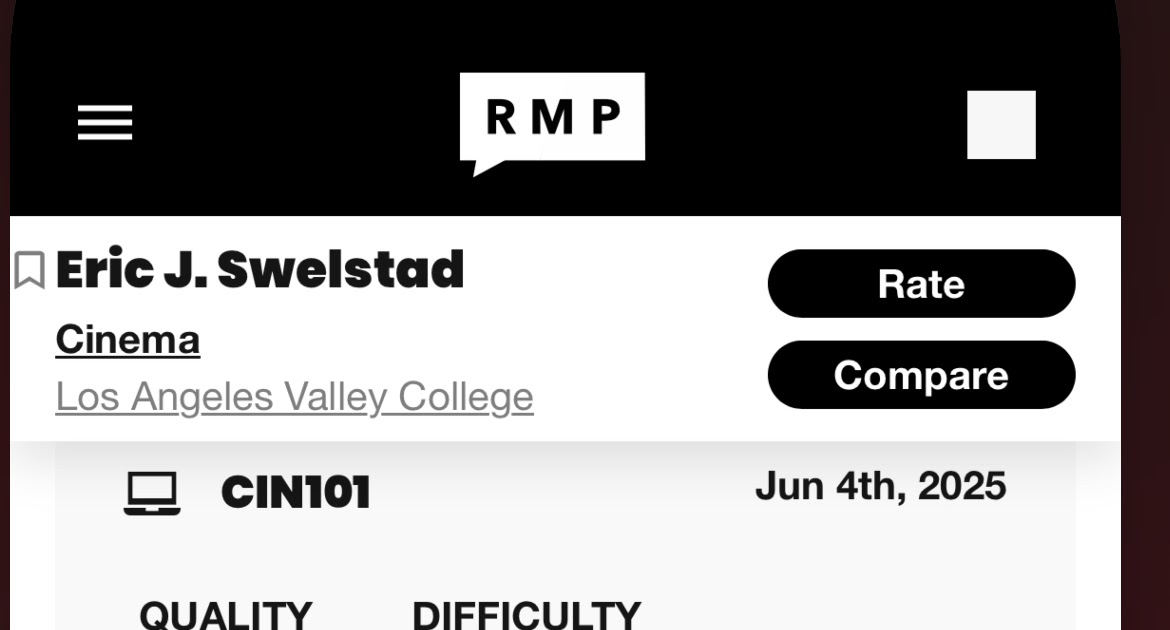
The dire financial outlook comes as new scrutiny falls on LAVC’s Media Arts Department, already under fire for years of alleged fraud, resume fabrication, and manipulation of public perception. Central to these concerns is the department’s chair, Eric Swelstad, who also oversees a $40,000 Hollywood Foreign Press Association (Golden Globe) grant for LAVC students—a role now drawing sharp criticism in light of mounting questions about his credentials and conduct.
Over the past two months, a troubling wave of digital censorship has quietly erased years of documented allegations. In May 2025, nearly two years’ worth of investigative reporting—comprising emails, legal filings, and accreditation complaints—were scrubbed from the independent news site IndyBay. The removed content accused Swelstad of deceiving students and the public for over two decades about the quality and viability of the Media Arts program, as well as about his own professional qualifications.
In June 2025, a negative student review about Swelstad—posted by a disabled student—disappeared from Rate My Professor. These incidents form part of what appears to be a years-long campaign of online reputation management and public deception.
An AI-driven analysis of Rate My Professor entries for long-serving Media Arts faculty—including Swelstad, Arantxa Rodriguez, Chad Sustin, Dan Watanabe, and Jason Beaton—suggests that the majority of positive reviews were written by a single individual or a small group. The analysis cited “Identical Phrasing Across Profiles,” “Unusually Consistent Tag Patterns,” and a “Homogeneous Tone and Style” as evidence:
“It is very likely that many (possibly a majority) of the positive reviews across these faculty pages were written by one person or a small group using similar templates, tone, and strategy… The presence of clearly distinct voices, especially in the negative reviews, shows that not all content comes from the same source.”
A now-deleted IndyBay article also revealed emails dating back to 2016 between LAVC students and Los Angeles Daily News journalist Dana Bartholomew, who reportedly received detailed complaints from at least a dozen students—but failed to publish the story. Instead, Bartholomew later authored two glowing articles featuring Swelstad and celebrating the approval of LAVC’s $78.5 million Valley Academic and Cultural Center:
* *”L.A. Valley College’s new performing arts center may be put on hold as costs rise,”* Dana Bartholomew, August 28, 2017.
Among the most explosive allegations is that Swelstad misrepresented himself as a member of the Writer’s Guild of America (WGA), a claim contradicted by official WGA-West membership records, according to another redacted IndyBay report.
This appears to be the tip of the iceberg according to other also scrubbed IndyBay articles
Other questionable appointments, payments, and student ‘success stories’ in the Los Angeles Valley College Media Arts Department include:
* **Jo Ann Rivas**, a YouTube personality and former Building Oversight Committee member, was paid as a trainer and presenter despite reportedly only working as a casting assistant on the LAVC student-produced film *Canaan Land*.
* **Diana Deville**, a radio host and LAVC alumna with media credits, served as Unit Production Manager on *Canaan Land*, but her resume claims high-profile studio affiliations including DreamWorks, MGM, and OWN.
The film *Canaan Land*, made by LAVC Media Arts students, has itself raised eyebrows. Filmmaker Richard Rossi claimed that both it and his earlier student film *Clemente* had received personal endorsements from the late Pope Francis. These assertions were echoed on *Canaan Land*’s GoFundMe page, prompting public denials and clarifications from the Vatican in *The Washington Post* and *New York Post*:
Censorship efforts appear to have intensified following the publication of a now-removed article advising students how to apply for student loan discharge based on misleading or fraudulent education at LAVC’s Media Arts Department. If successful, such filings could expose the department—and the district—to financial liability.
But the highest-profile financial concern is the 2020 establishment of the **Hollywood Foreign Press Association’s $40,000 grant** for LAVC Media Arts students, administered by Swelstad:
As a disreputable academic administrator with a documented history of professional fraud spanning two decades and multiple student success stories that aren’t, future grant donors may reconsider supporting the Department programs – further pushing the Los Angeles Valley College and by extension the district as a whole towards financial insolvency.
Crucial Insights: Understanding College Financial Aid Dynamics
(00:02:56) Variety of College Financial Assistance Options
(00:05:18) Scholarships: Balancing Merit and Financial Need
(00:10:00) Student Selection Strategies in College Admissions
(00:21:40) Financial Aid Strategy at Competitive vs. Smaller Schools
(00:26:29) Major-based Financial Aid Allocation in Colleges
The unemployment rate for new college graduates has recently surged. Economists say businesses are now replacing entry-level jobs with artificial intelligence.
First-year students who perform poorly in a course are particularly at risk of dropping out. To help boost retention of such students, the University of the Pacific has made strategic investments in promoting their success, including by remodeling gateway courses.
During an institutional data analysis, leaders at the California institution found that first-year students who earned a D or F grade or withdrew from a class (also called DFW rate) were less likely to persist into their second year, which affected the university’s overall attrition rate.
In particular, students who didn’t pass their gateway classes in economics, math, biology, physics or chemistry were less likely to remain enrolled at the university.
To improve student success, the university created top-down initiatives and structures to encourage student feedback, experimentation in the classroom and cross-departmental solutions to better support incoming students.
What’s the need: A 2018 study by EAB found that, on average, three in 10 students enrolled in any given course don’t earn credit for it, leaving them with what are known as “unproductive credits.” Among the gateway courses analyzed—Calculus 1, General Biology, Chemistry 1 and General Psychology—some universities reported an unproductive-credit rate as high as 46 percent.
A variety of factors can cause high DFW rates, including a lack of academic preparation or personal struggles experienced by first-year students, according to EAB’s report. Other research has shown that variability in the quality of instruction or in assessment tools can also increase DFW rates.
Closing the gap: To address obstacles in the classroom, the provost and dean of the College of the Pacific, the university’s liberal arts college, which houses the gateway courses, meet regularly with department chairs who oversee those courses.
Addressing DFW rates can be a challenge for institutions because it often focuses attention on the faculty role in teaching, learning and assessment, leaving instructors feeling targeted or on the hot seat. To address this, the provost is working to create a culture of innovation and experimentation for course redesign, encouraging new approaches and creating institutional support for trying something new or pivoting, even if it’s not successful.
One of the opportunities identified involved embedding teaching assistants in classes to serve as tutors for students and provide feedback to instructors. The embedded TAs are students who successfully completed the course, enabling them not only to mentor incoming students but also to provide a unique perspective on how to change the classroom experience.
The university has also created a retention council, which invites stakeholders from across the institution to break silos, identify structural barriers and discuss solutions; that has made a significant difference in addressing retention holistically, campus leaders said.
The university also hired an executive director of student success and retention who meets weekly with academic success teams from every department.
Another Resource
Indiana University Indianapolis’s Center for Teaching and Learning developed a productive discussion guide to facilitate conversations around course redesign and addressing DFW rates. Read more about it here.
How it’s going: Since implementing the changes, the university saw a 5 percent year-over-year drop in D’s, F’s and withdrawals among gateway courses. Retention of first-year, first-time students has also climbed from 86 percent in 2020 to 89 percent this past year.
Demand for curriculum redesign has grown from about 20 courses in the past year to 50 courses this year, requiring additional investment and capacity from leadership, administrators said. Faculty also indicate that they’re feeling supported in the course redesign process.
In the future, university leaders said, they will also redesign the first-year experience with a greater focus on integrating academic, experiential and student life along with academic advising to encourage belonging and a sense of community. For example, they plan to use data to identify students who may need additional support to navigate life challenges or financial barriers.