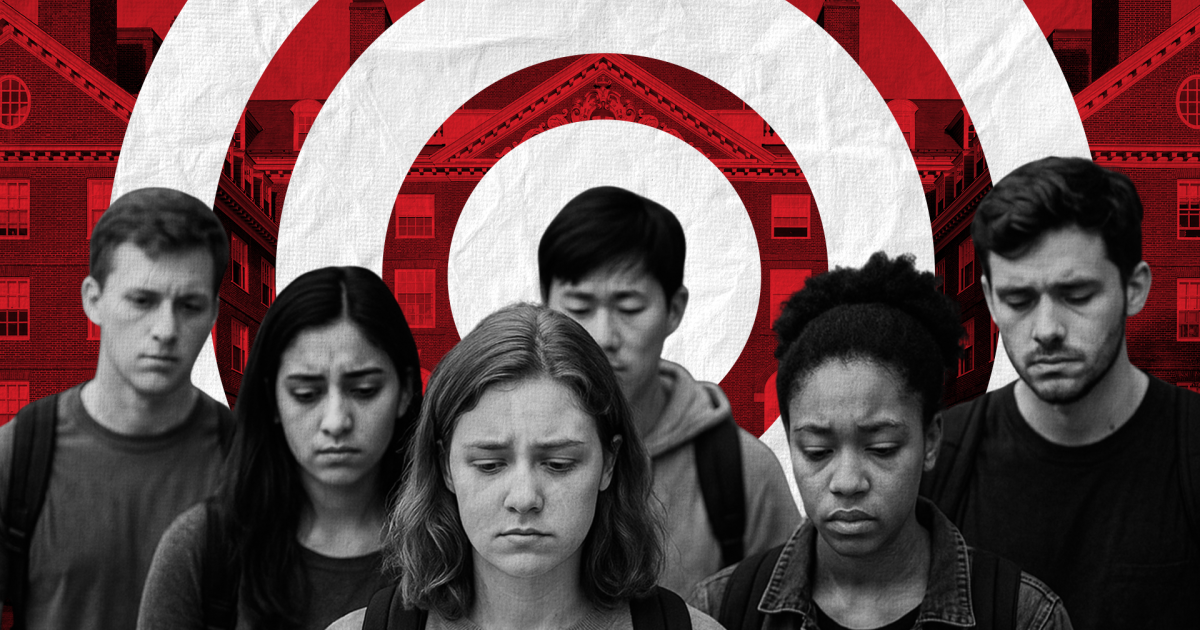
63% of over 1,000 efforts to suppress student speech resulted in administrative investigation or punishment.
In the wake of Hamas’s 2023 attack on Israel, administrators overtook students as the main instigators of attempted speech suppression.
Speech about race and the Israeli-Palestinian conflict led to most attempts.
PHILADELPHIA, May 15, 2025 — A new reportfrom the Foundation for Individual Rights and Expression found that 637 college students and student groups were punished or investigated by administrators for their constitutionally protected expression between 2020-2024.
“Students Under Fire” documents over 1,000 efforts to punish students for speech and expression over a five-year span, 63% of which resulted in some form of administrative punishment. The research provides the most detailed collection of speech-related campus controversies involving students to date. The underlying data will be compiled in an interactive database that will be regularly updated and searchable by the source of the outrage, demands made of the institution, whether the pressure is from the political left or right of the student’s speech, the outcome, and more.
“Every instance of censorship threatens students’ ability to engage in a free exchange of ideas,” said FIRE Senior Researcher Logan Dougherty. “Open minds and free debate, not self-censorship and punishment, must be the standard across our nation’s campuses.”
There were two dominant incendiary topics on campus: race and the Israeli-Palestinian conflict. The report found that following the murder of George Floyd in 2020, race was the topic that most commonly landed a student in hot water. The Oct. 7 Hamas attacks on Israel, and subsequent debates over the Israeli-Palestinian conflict and Israel’s military response, then quickly became the topic that most often produced attempts at punishment.
Other notable findings from the report include:
The problem spans ideologies. When it comes to speech about race, most students are targeted from their left, while students speaking out about the war in Gaza are more likely to be targeted from their right.
Among the worst punishments were 72 students or groups who were suspended, 55 who were expelled, lost student group funding, or were otherwise separated from their university, and 19 more who were unenrolled under ambiguous circumstances. In one case, a student had to sleep in his car after his university kicked him out of campus housing. In another, a student was suspended for sending a survey about mental health to his peers.
The most frequently targeted or punished student groups spanned the political divide: Students for Justice in Palestine (75 incidents), Turning Point USA (65 incidents), and the College Republicans (58 incidents)
The report also found that after a decade of surging efforts by students to silence campus speech, administrators have taken up the censorial mantle in the wake of the Israeli-Palestinian conflict. In 2020, only 27% of cases were initiated by administrators. By 2024, that number increased to 52%.
“This is unacceptable coming from people whose job it is to serve college students and ensure that their rights are protected,” said FIRE Chief Research Advisor Sean Stevens. “Their job should be to protect students’ free speech rights, not torpedo them.”
The First Amendment protects students at public institutions — and those institutions cannot legally punish students for the expression in the report (though they often do). Private institutions, though not directly bound by the First Amendment, often make institutional promises of free speech and academic freedom. FIRE advocates for targeted students at both types of institutions.
Students at public institutions should contact FIRE if they face punishment for their expression by submitting a case.
The Foundation for Individual Rights and Expression (FIRE) is a nonpartisan, nonprofit organization dedicated to defending and sustaining the individual rights of all Americans to free speech and free thought — the most essential qualities of liberty. FIRE educates Americans about the importance of these inalienable rights, promotes a culture of respect for these rights, and provides the means to preserve them.
This post was co-authored with Julie Bryant, Vice President for Student Success at RNL. Julie oversees the RNL Satisfaction-Priorities Surveys used by colleges and universities nationwide. She provides service to educators by assisting them in determining relationships between perceptions of importance and satisfaction of students, special populations, campus personnel, and the parents of currently enrolled students. Julie identifies ways these data can inform retention planning and be shared with the campus community. She also oversees the annual national reporting and trend analysis of these data.
Collaborating with 21 institutions as part of our second annual National Alumni Survey was a privilege. Nearly 51,000 alumni participated, and from their direct feedback, we learned more about what inspires their volunteer activity, what is likely to motivate future engagement, generational trends, and how student debt impacts charitable giving.
We also invited alumni to share more about their satisfaction with and current connection to their respective alma maters. Survey responses confirm what feels intuitive: Alumni with a favorable student experience are more likely to feel connected to and give back to their alma maters.
Student satisfaction makes a major difference in the likelihood to give
Alumni who report feeling “very satisfied” with their student experience and the education they received are up to 40x more likely to have donated to their alma mater in the past year than their “neutral” counterparts, and up to 80x more likely than those who report feeling “not very” or “not at all” satisfied with their student experience and the education they received.
Of the eight insights highlighted in this year’s report, this strong correlation between student satisfaction and alumni giving feels important for advancement teams to share with colleagues across departments, campus stakeholders, and executive leadership.
Alumni satisfaction and connection are shaped long before graduation. The interaction students have with faculty, staff, advisors, coaches, and the administration sets the groundwork for satisfaction, affinity, and a philanthropic relationship post-graduation. Therefore, the responsibility of improved alumni engagement, participation, and giving can’t rest solely on the shoulders of the advancement division. It’s a team sport (or should be).
Increasing student satisfaction can lay the foundation for long-term alumni engagement
This research study underscores the importance of influencing student satisfaction while students are enrolled in order to build strong, long-term alumni engagement. Through RNL’s Student Satisfaction Inventory (SSI), we measure student satisfaction and priorities, showing how satisfied students are as well as what issues are important to them. This is actionable data that colleges and universities can use today to inform and shape improved student programming and outreach.
The results from the SSI clearly identify institutional strengths (areas of high importance and high satisfaction) that can be celebrated with current students, alumni, and as part of the recruitment process. Institutional challenges are also clearly noted. Challenges are areas that are still very important to current students, but where they may be more dissatisfied. Identifying these areas provides direction to campus leadership, as they prioritize areas for improvement to show students their feedback matters and that the institution is working on their behalf. By gathering and acting on student satisfaction data, colleges and universities can show that they value students and help set the stage for ongoing engagement.
Through our RNL research, we have found that items related to campus climate and how students feel about being on campus are among the strongest indicators of overall student satisfaction and ultimately student retention. When institutional leadership works to change the experience or the perception students have around areas such as “it’s an enjoyable experience to be a student on this campus,” “the institution cares about me as an individual,” “I feel a sense of belonging here,” and “tuition paid is a worthwhile investment,” they can begin to see an impact on the long-term relationships ideally established between the student (future alum) and their alma mater.
Four things you can do to increase alumni connection
Good friend and strategic advisor on this project Howard Heevner is a fan of disrupting—leaning into new ways of genuinely connecting with students and alumni alike. He challenges fellow practitioners and leaders to:
Gather direct feedback and actively listen to learn what alumni need to feel our institution is a viable home for their philanthropic support.
Instead of touting institutional loyalty to inspire financial support, let’s build relationships that provide mutual value to both the individual and the institution.
Find new ways to support donor passions, choice, and self-determination in giving at all levels to attract a larger, more diverse set of donors.
Redefine philanthropy so that it is broader and more inclusive, recognizing gifts of service as well as financial gifts.
If you haven’t done so recently, engaging students and alumni through a survey project is an important first step. Do you have budget dollars left to spend this spring? Looking for fresh feedback and useful qualitative data from the audiences you serve to help inform planning for the new fiscal and academic year ahead? If you’d like to learn more about RNL’s survey instruments, please reach to Julie Bryant (Student Satisfaction Inventory) and Sarah Kleeberger (Alumni Survey).
This audio is auto-generated. Please let us know if you have feedback.
WASHINGTON — The momentum for providing all students access to meaningful career and college pathways is growing, but hurdles such as funding, teacher training, reluctance to change and other factors stand in the way, said speakers at the National Pathways Summit on Thursday.
Experiential learning about careers is what students, families and educators want. Industry leaders also want to employ workers with job skills and essential abilities like problem solving, collaboration and resilience, the speakers told the 300 summit attendees.
And these skills and abilities are not just desirable, but critical to the health of the economy, said Stanley Litow, chair of the National Pathways Initiative, a bipartisan federation of students and leaders from education, business, government, politics and advocacy organizations that promote promising K-12 and higher education career and college preparation programs.
“From the business community standpoint, there is an enormous amount of pressure in the labor market around the skills area,” said Litow, a former deputy schools chancellor for New York City Public Schools and former president of the IBM Foundation. He is currently a professor at Columbia University’s School of International and Public Affairs.
Litow said that by 2030, over 70% of the new jobs created will require some form of postsecondary education, which includes credentials, apprenticeships, two-year and four-year degrees, and other continuing learning programs.
But to make career and college preparation successful for students and industries, the education and business communities need to partner to align their needs, Litow said. “We have to break down the barriers, we have to collaborate, we have to work together.”
Successes and challenges
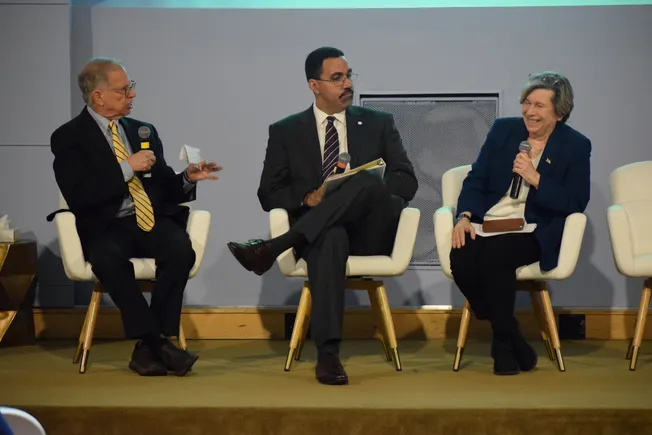
Randi Weingarten, president of the American Federation of Teachers, and John B. King, Jr., chancellor of the State University of New York and a former U.S. education secretary, both noted that there’s a high level of agreement across the country that workforce preparation in K-12 and higher education is important.
They also pointed to several successful programs that are helping students gain the skills necessary for their chosen occupation. King, for example, highlighted the Real Life Rosies program at Mohawk Valley Community College in Utica, New York — a 12-week pre-apprenticeship program that helps women gain advanced manufacturing skills.
But Weingarten and King also noted obstacles that are stunting students’ access to skill-based learning.
For one, K-12 school systems “are really terrible at change,” Weingarten said, adding that they “only change when an accountability system changes. And so the problem is we have a really outdated accountability system.”
Weingarten also said that school systems tend to be risk-averse. “People get blamed” if an initiative isn’t 100% successful, she said. That’s why school accountability systems need to be revised, “to give people permission to do something different.”
King said one obstacle is that there’s a culture challenge. Some people think that a liberal arts education and career readiness preparation programs are in conflict with each other, he said. “Sometimes people react against talk of careers, because it seems that it is making education just about the job,” he said.
King also said leaders from all industry sectors need to voice support for education and prioritize learning as an investment, as well as work on solutions to barriers. “We need the business community nudging people on both sides of the aisle to stand up for education and stand up for this vision we’ve been talking about today,” he said.
Reo Pruiett, Rashid Ferrod Davis and Don Haddad speak about the P-TECH approach to connecting K-12 students with college and career experiences during a panel at the National Pathways Summit at Gallaudet University in Washington, D.C., on May 8, 2025.
Permission granted by National Pathways Initiative
Two diplomas by high school graduation
Several speakers during another panel discussion highlighted one approach that is helping high school students graduate with both high school and associate degree diplomas while also gaining career skills and connections to potential employers through mentorships, paid internships, and other on-the-job experiences.
The P-TECH 9-14 school model was created by IBM to encourage public-private partnerships to give high school students specific workplace skills while they earn both diplomas. The first P-TECH school was launched in New York City in 2011.
Reo Pruiett, chief programs and engagement officer at Communities Foundation of Texas, focuses on improving K-12 and higher education outcomes. She calls the P-TECH approach “game changing.”
She said the program has helped students gain upward economic mobility and has “demystified” the college experience for students while they are still being supported as high schoolers.
“I think that’s one thing about P-TECH; It allows us to make sure our students are prepared to dream and not to just settle,” she said.
Don Haddad, superintendent of St. Vrain Valley School District in Colorado, credits the program for increases in the district’s graduation rates and reductions in the dropout rates, which now stands at 0.4%. He also cited an increase in the number of students participating in extracurricular activities. Students in the district have the opportunity to study career pathways for computer information systems, cybersecurity, medical and bio sciences, education and more.
“If you create the opportunities, every child is smart enough to systematically move through that system,” said Haddad, who is in his 17th year as the district superintendent.
But Pruiett, Haddad and Rashid Ferrod Davis, the founding principal of the Pathways in Technology Early College High School in New York City, said there are some pain points.
Pruiett said some Texas rural school districts don’t have access to a variety of business partners that some urban areas do, which can limit P-TECH students’ opportunities for on-the-job skill development. In those instances, some rural districts partner with each other to share industry partnerships and other resources.
Another workaround for the lack of business partners is to coordinate with other industries that may offer similar skill-building opportunities. For example, if there are no nearby hospitals, nursing homes may be able to offer related experiences to students interested in the medical sciences.
Likewise, hospitals may be ideal settings for on-the-job experiences for a variety of careers, such as medical sciences, hospitality and accounting. School districts are also potential partners for hosting interns, Pruiett said.
But the state, Pruiett said, is always looking for more partners to meet the demand for real-world job experiences for students. “So if you know someone in Texas, let us know.”
About three in five college students experienced some level of basic needs insecurity during the 2024 calendar year, according to survey data from Trellis Strategies. Over half (58 percent) of respondents said they experienced one or more forms of basic needs insecurity in the past 12 months.
Student financial challenges can negatively impact academic achievement and students’ ability to remain enrolled. About 57 percent of students said they’ve had to choose between college expenses and basic needs, according to a 2024 report from Ellucian.
While a growing number of colleges and universities are expanding support for basic needs resource centers—driven in part by state legislation that requires more accommodations for students in peril—not every campus dedicates funds to the centers. A 2024 survey by Swipe Out Hunger found that of 300-plus campus pantries, two in five were funded primarily through donations. Only 5 percent of food pantries had a dedicated budget from their institution as a primary source of funding.
Inside Higher Ed compiled four examples of institutions that are considering new or innovative ways to address students’ financial wellbeing and basic needs on campus.
Penn State University—School Supplies for Student Success
Previous research shows that when students have their relevant course materials provided on day one, they are more likely to pass their classes and succeed. Penn State’s Chaiken Center for Student Success launched a School Supplies for Student Success program that offers learners access to free supplies, including notebooks, writing utensils and headphones, to help them stay on track academically.
Students are able to visit the student success center on the University Park campus every two weeks to acquire items, which are also available at two other locations on campus. Learners attending Penn State Altoona and Penn State Hazleton can visit their respective student success center for supplies, as well.
The program is funded by a Barnes & Noble College Grant program and is sustained through physical and monetary donations from the university community.
Massachusetts College of Liberal Arts—Essential Needs Center
The Essential Needs Center was developed from a Service Leadership Capstone course, which required students to complete a community-based service project. One group of students explored rates of basic needs insecurity and established a food pantry to remedy hunger on campus.
“The program started as a drawer at my desk,” said Spencer Moser, assistant dean for Student Growth and Wellbeing, who taught the course. “Then it grew to fill a shelving unit, a closet and eventually its own space on campus.”
The center, now a one-stop shop for basic needs support on campus, provides students with small appliances, storage containers, personal care items and seasonal clothing, as well as resources to address housing and transportation needs, including emergency funding grants. Students can also apply for a “basic needs bundle” to select specific items they may require.
Paid student employees maintain the center but it’s also left “unstaffed” at some hours to address the stigma of seeking help for basic supplies. Between November 2023 and January 2025, over 1,300 students engaged with the center.
University of New Hampshire—Financial Wellness
A lack of financial stability can also have a negative impact on student thriving and success. To support students’ learning and financial wellbeing, the University of New Hampshire created an online digital hub that provides links to a budget worksheet, financial wellness self-evaluation, college cost calculator and loan simulator.
Students can also schedule an appointment to talk with an educator to discuss financial wellness or engage in a financial wellness workshop.
Roxbury Community College—the Rox Box
Most colleges operate on an academic calendar, with available hours and resources falling when class is in session. Roxbury Community College in Massachusetts launched a new initiative in winter 2023 to ensure students who were off campus for winter break didn’t experience food insecurity.
Before the break, staff at the college’s food pantry, the Rox Box, handed out Stop & Shop gift cards and grab-and-go meals, as well as a list of local places students could visit for meals over break.
Do you have a wellness intervention that might help others promote student success? Tell us about it.
Generative AI is changing the landscape of higher education, in both good and bad ways (Balch, 2023). In a world where AI skills and fluency will be necessary and marketable, colleges and universities have made efforts to embrace AI in the classroom (e.g., Balch & Blanck, 2025; Butulis, 2023; Parks & Oslick, 2024) and to provide their students with instruction and practice in using AI in productive and ethical ways (e.g., Schoeder, 2024). As the capacity of AI grows to complete increasingly complex tasks, we (as college instructors) may wonder what we can offer our students in the age of AI. Microsoft co-founder Bill Gates recently stated in an interview that advances in AI will mean the humans will no longer be needed “for most things,” and stated that doctors and teachers in particular could be replaced by AI (CNBC, 2025). Microsoft AI CEO Mustafa Suleyman stated the AI, because it will have the ability to complete tasks faster and more reliably than human workers, will change occupations broadly and will have a “hugely destabilizing” impact on the occupational landscape. Suleyman further stated that the fundamental purpose of AI is to be labor replacing (CNBC, 2025).
In higher education, we see our students use AI in many ways, to provide both authorized and unauthorized aid in their completion of assignments. We have crafted AI policies to help our students understand how AI is and is not permitted in our classes, and some of us have devoted energy to try to detect and police AI use in our classes. Given this reality in which AI can provide and synthesize information for and to our students at their requests in seconds, it is not completely paranoid to ask the question, “What can we, as college instructors, offer our students in the age of AI?”
Why College Instructors Matter: A Student’s Perspective
I had a conversation with one of my students recently about this exact question. He visited my office and in the course of our conversation he asked me how I thought I would use AI as a college instructor moving forward. I admit that I did not have the most thoughtful or eloquent answer as I discussed trying to keep up with advances, to recognize the utility of AI, but also to continue to foster critical thinking skills in my students. He told me that he uses ChatGPT all the time (and he is not alone among students in doing so; Kichizo Terry, 2023). He told me how quick and convenient it is. He surprised me, though, by telling me that he uses ChatGPT despite thinking that it would create “brain rot” in him and other students because it was doing their thinking for them. He then gave me the answer about what we can offer our students. He said that college instructors are not needed to give information to their students, at least not the foundations, definitions, etc., that comprise of a lot of traditional lecturing. He said that students could read much of the content off our PowerPoint slides and in the assigned readings without AI. What college instructors are needed for, he said, is to motivate our students to learn. We are needed to inspire students to come to class, to ask questions, to work out the answers with them. We are needed to engage them and to help them develop curiosity and critical thinking skills to offset their potential AI-induced brain rot. He said that students have had access to the information we teach prior to AI. They could always find and read the content on their own. What we can do as instructors is inspire them to learn the content, to ask their own questions, and to perhaps motivate their AI use to serve their own curiosity beyond the conversations in our classes.
Our Role as Instructors in the Age of AI
This is our role as instructors in the age of AI. This was our role as instructors prior to the advent of AI. As instructors, our role is not just to provide access to content. We cannot compete with the other resources available to our students in our fundamental content knowledge. Our role is to excite our students about the content. Our role is to inspire our students to learn that content. Our role is to bring PEACE to our classes so that our students will see the value in our classes and will engage in our classes to deepen their curiosity and their learning. PEACE is an acronym that stands for Preparation, Expertise, Authenticity, Caring, and Engagement (Saucier, 2019; Saucier, 2022; Saucier, Jones, Schiffer, & Renken, 2022). Beginning on the first days of our classes (Saucier, 2020; Saucier, Renken, Fulton, & Schiffer, 2024), we can demonstrate to our students that we have a plan, that we have content knowledge, that we are real living human beings with relatable thoughts and emotions, that we care about our students and their learning, and that we are enthusiastic and invested in the content we will learn with them. We can nurture our students’ intrinsic motivation to learn the content through demonstrations of our own engagement, activating the process of trickle-down engagement by which our own engagement as instructors promotes our students’ engagement and their subsequent learning (Saucier, Miller, Martens, & Jones, 2022). We can cue our engagement in the content by intentionally and explicitly sharing our own enthusiasm about the content and its value and importance (Saucier, Jones, Miller, Schiffer, Mills, & Renken, 2025).
AI is here. It is here to stay. It is a valuable tool that can accomplish important tasks quickly. Our students recognize its value and are already using it in many ways, both in and out of our classes. As college instructors, we are best served in providing our students with something that AI is not yet able to – our authentic investment in the learning, experiences, and success of our students. We have the ability to inspire our students’ wonder and curiosity in ways that will inspire them to be intrinsically motivated to learn and to keep learning. We should embrace this role as we teach in the age of AI.
Donald A. Saucier, Ph.D. (2001, University of Vermont) is a University Distinguished Teaching Scholar and Professor of Psychological Sciences at Kansas State University. Saucier has published more than 100 peer-reviewed journal articles and is a Fellow of the Society for Personality and Social Psychology, the Society for the Psychological Study of Social Issues, the Society for Experimental Social Psychology, and the Midwestern Psychological Association. His awards and honors include the University Distinguished Faculty Award for Mentoring of Undergraduate Students in Research, the Presidential Award for Excellence in Undergraduate Teaching, and the Society for the Psychological Study of Social Issues Teaching Resource Prize. Saucier is also the Faculty Associate Director of the Teaching and Learning Center at Kansas State University and offers a YouTube channel called “Engage the Sage” that describes his teaching philosophy, practices, and experiences.
CNBC (2025). “Bill Gates: Within 10 years, AI will replace many doctors and teachers—humans won’t be needed ‘for most things’.” Published March 26, 2025.
Saucier, D. A., Jones, T. L., Miller, S. S., Schiffer, A. A., Mills, H. D., & Renken, N. D. (2025). Cueing engagement: Applying the trickle-down engagement model to instructors’ in-class behaviors. Teaching of Psychology, 52(1), 45-52.
Saucier, D. A.,Jones, T. L., Schiffer, A. A., & Renken, N. D. (2022). The empathetic course design perspective. Applied Economics Teaching Resources, 4(4), 101-111.
Saucier, D. A., Miller, S. S., Martens, A. L., & Jones, T. L. (2022). Trickle down engagement: Effects of perceived teacher and student engagement on learning outcomes. International Journal of Teaching and Learning in Higher Education, 33(2), 168-179.
Miami –Achieve Miami, a nonprofit dedicated to equalizing educational opportunities for students throughout Miami-Dade County, has received $2.4 million from multiple philanthropic organizations and leaders, including a leadership gift of $2 million from Kenneth C. Griffin, founder and CEO of Citadel and founder of Griffin Catalyst. The funding, awarded over the past year, will further expand Achieve Miami’s transformative programs, reaching thousands of K-12 students through initiatives including Achieve Scholars, which prepares high schoolers for college success; Achieve Summer, a dynamic program combating learning loss through hands-on academics and enrichment; and the Teacher Accelerator Program (TAP), a groundbreaking effort to address Miami-Dade’s urgent teacher shortage.
Kenneth C. Griffin’s $2 million leadership gift is specifically focused on supporting TAP in creating a pipeline of talent for the teaching profession through recruiting, preparing, and mentoring aspiring educators, including those who had not previously considered a career in education. This gift builds on Griffin’s $3.5 million gift to TAP in 2022, further strengthening Achieve Miami’s efforts to recruit and train qualified educators to teach in public, private and charter schools across Miami-Dade and close learning gaps in the city’s schools. Griffin has a longstanding commitment to improving education and has contributed more than $900 million to providing greater access to a high-quality education and pathways to success for students in Florida and across the country.
Additional grants include:
$200,000 from the Bezos Family Foundation, which is a director’s gift supporting early and adolescent learning through grants and programs that advance the science of learning.
$100,000 from the Panera Bread Foundation, as part of its national initiative to support nonprofits that provide educational access to underserved youth.
$65,000 from Morgan Stanley, in support of Achieve Miami’s financial literacy and career readiness programs, which equip students in the organization’s Achieve Scholars program with essential money management skills for financial independence and future success. As part of its commitment, a team of Morgan Stanley employees guide students through financial literacy sessions across ten Miami-Dade County public schools, providing essential lessons on topics like budgeting, investing, entrepreneurship, savings, and credit.
$50,000 from City National Bank of Florida, as part of its long-term partnership with Achieve Miami in support of the Achieve Scholars program. City National Bank is planning financial literacy programming for students over the summer.
“Every student deserves access to resources, mentors, and opportunities that can set them up for success,” said Leslie Miller Saiontz, Founder of Achieve Miami. “These generous grants, led by Ken Griffin, will enable us to expand our reach, empower more educators, and bridge opportunity gaps that are prevalent in Miami. By investing in students and teachers, we are building a stronger future for our community.”
“Each of us has a story of how a teacher has changed our lives,” said Ken Griffin in February 2023 alongside his initial gift to Achieve Miami. “I care deeply about bringing more high-quality educators into Miami classrooms to help ensure the children of Miami will continue to enjoy the impact of life-changing teachers.”
Despite being one of the fastest-growing states with the nation’s fourth-largest economy, Florida ranks #21 in per capita education funding. Achieve Miami’s initiatives aim to eliminate educational disparities by equipping students with the tools and support needed for success with a variety of diverse enrichment programs such as Achieve Scholars, Achieve Saturdays, and Achieve Music.
Achieve Miami’s impact to-date includes support for over 10,000 Miami-Dade County students, college and career readiness programming for Achieve Scholars across ten high school sites, providing internet access to over 106,000 homes through Miami Connected, and the recruitment and training of nearly 200 new teachers through the Teacher Accelerator Program (TAP) since the initiative’s launch in 2023.
ABOUT ACHIEVE MIAMI
Achieve Miami is a nonprofit organization that is dedicated to fostering a transformational education ecosystem in Miami. Since its founding in 2015, the organization has supported over 10,000 K-12 students, bolstered programming for 60+ local schools, and engaged thousands of volunteers. Together with partners from the public and private sector, Achieve Miami designs and manages programs that bring together members from various parts of the community to extend learning opportunities for students, teachers, and community leaders. Learn more at www.achievemiami.org.
ABOUT THE TEACHER ACCELERATOR PROGRAM
Teacher Accelerator Program (TAP) is a non-profit organization creating a pipeline of talent for the teaching profession through recruiting, preparing, and mentoring aspiring educators. TAP’s comprehensive and streamlined program equips college students and career changers with the skills, knowledge, and certification necessary to excel in the classroom. TAP addresses the nationwide teacher shortage crisis by providing a built-in path to teaching, inspiring a new generation of educators.
TAP participants take a one-semester course, followed by a six-week paid summer internship, earn a certificate to teach, and begin instructing in a Miami-Dade County public, private, or charter school classroom. TAP is an initiative of Achieve Miami, supported by Teach for America Miami-Dade, and is offered by the University of Miami, Florida International University and Miami-Dade College. Learn more at www.teacheraccelerator.org.
eSchool Media staff cover education technology in all its aspects–from legislation and litigation, to best practices, to lessons learned and new products. First published in March of 1998 as a monthly print and digital newspaper, eSchool Media provides the news and information necessary to help K-20 decision-makers successfully use technology and innovation to transform schools and colleges and achieve their educational goals.
Professor Pete Kosek was a leading voice for the faculty at Sterling College — a small, private Christian college in central Kansas — when negotiating changes to the college’s employee handbook. Ken Troyer, another Sterling professor, spoke out as well, including statements to the media about concerns he had with Sterling administrators’ communication with faculty and about a vote of no confidence in the college’s president.
For these exercises of basic faculty expressive rights, Sterling has now punished them both for exhibiting “behavior that is fundamentally inconsistent” with Sterling’s mission. But it’s these punishments that are “fundamentally inconsistent” with Sterling’s promises that its faculty enjoy “free expression, on and off campus.”
FIRE wrote to Sterling on April 3, 2025, articulating our concerns. Its administration ignored us, so today we’re writing to the college again as well as its board of trustees, urging them to reverse the punishments of Kosek and Troyer.
College clashes with faculty over revisions to the employee handbook
In 2023, Sterling faculty received a new version of Sterling’s employee handbook. Faculty voiced concerns about whether faculty were obligated to sign the handbook’s acknowledgement, which appeared to require that faculty affirm Sterling’s institutional stance on marriage, life, gender identity, and human sexuality. For example, a provision in the handbook stated: “[m]arriage is designed to be the lifelong uniting of one man and one woman in a single, biblical, covenant union as delineated by Scripture.”
Concerned that this may adversely impact faculty who were divorced, Kosek led a group of faculty members in negotiating changes to the handbook. Over the course of a year, he went back and forth with Sterling administrators about making sure the handbook could be modified so that it didn’t single out divorced faculty for adverse action.
On Aug. 21, 2024, Kosek emailed a large group of faculty members informing them he believed he and anyone else would be fired if they did not sign the handbook acknowledgement. Kosek also told the administration that while he would abide by the terms of the handbook, he disagreed with how the administration went about communicating with faculty and instituting the new handbook. Two days later, the administration clarified that while faculty were expected to abide by the terms of the handbook, they would not be terminated for not signing it. Kosek subsequently clarified this to the rest of the faculty. The situation seemed resolved, right? Wrong.
Months later, on Feb. 25 of this year, administrators summoned Kosek to a meeting and gave him a disciplinary warning. They told him that it was because he allegedly misrepresented the college when he told other faculty that he believed he and others would be fired over not signing the handbook’s acknowledgement. Sterling provided Kosek no real opportunity to defend himself from the charge.
Troyer, meanwhile, received a nearly identical disciplinary warning on the same day as Kosek, purportedly because of his comments to the media criticizing Sterling’s poor communication with faculty. (This poor communication was a major reason why a group of faculty supported a no-confidence vote in Sterling’s leadership.) Troyer had also discussed the inclusion of non-Christian students at the college, and how that inclusion related to Sterling’s Christian mission.
Similar to Kosek, Troyer had no real opportunity to defend himself. He was just expected to take the disciplinary warning and keep his mouth shut.
If Sterling’s mission required absolute and unquestioning obedience to the administration, this might be understandable. But these punishments cannot be squared with the policies actually laid out in Sterling’s faculty handbook. That handbook does not demand unthinking fealty, but imposes on “students, faculty members, administrators and trustees” the obligation “to foster and defend intellectual honesty, freedom of inquiry and instruction, and free expression on and off campus.” As if anticipating the exact scenario facing both Kosek and Troyer, Sterling adds in the handbook, “administrators should respect the right of faculty members to criticize and seek revision of institutional regulations.”
FIRE’s first letter explained why the college could not square its punishment of Kosek with Sterling’s written commitments. Under First Amendment jurisprudence and at most private colleges (like Sterling) faculty members retain the right to comment on matters of public concern — and one of those concerns is how the college is being run. Indeed, faculty members are often among the most important voices regarding how colleges and universities operate since they witness firsthand the impacts of institutional policies.
Sterling blew FIRE off. So now we’re taking this up the chain and writing to the Board of Trustees as well as the college. When a private institution like Sterling makes promises in its handbooks to faculty, it must keep those promises. To violate them with impunity is to undermine trust and credibility.
U.S. universities have long relied on international students, and the big tuition checks they bring, to hit enrollment goals and keep the lights on. But now, just as the number of American college-aged students begins to fall — the trend that higher education experts call the “demographic cliff”— global tensions are making international students think twice about coming to the United States for college.
In this episode, hosts Kirk Carapezza and Jon Marcus take you inside the world of international admissions. With student visa revocations on the rise and a growing number of detentions tied to student activism, some international families say they are rethinking their U.S. college plans. And that has college leaders sounding the alarm.
In fact, international student interest was already falling. Now, as the Trump administration ramps up immigration crackdowns on campuses across the country, many worry the U.S. could lose its status as the top destination for global talent. So what happens if international enrollment drops just as domestic numbers dry up?
The stakes are high, not just for international students and colleges but for what everybody else pays — and for the whole U.S. economy.
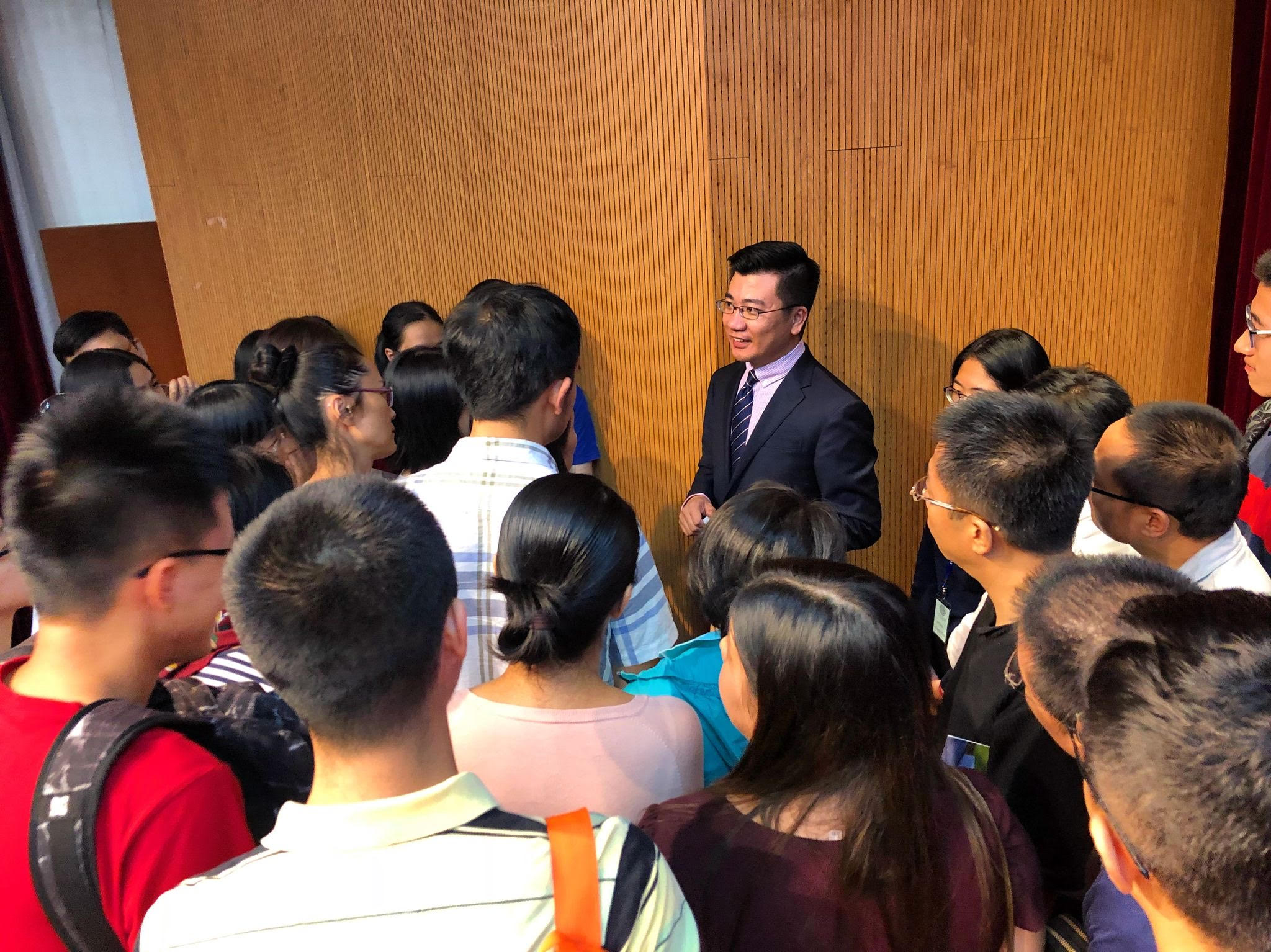
[Kirk] That’s Xiaofeng Wan, making his pitch in Mandarin to Chinese students and parents at a high school in Shanghai. Wan used to be an admissions officer at Amherst College in western Massachusetts. Now he’s a private college consultant, guiding Chinese students through the maze that is college admissions in the U.S.
[Xiaofeng Wan] So I’ll walk them through the initial high school years before they apply. And then by the time of their college applications, I’ll help them go through the process as well.
[Kirk] This is big business for colleges. Like most international students, Chinese families do not qualify for financial aid, and often they pay the full cost. Wan also trains guidance counselors across China, showing them how to support students heading abroad. So he’s got a front-row seat to what Chinese families are thinking right now.
[Xiaofeng Wan] They see the United States as a primary study-abroad destination.
[Kirk] But Wan says that might be starting to shift.
[Xiaofeng Wan] America has an image problem right now, so we will definitely start to see reluctance from families.
[Kirk] I caught up with him while he was in Ningbo, a port city known for manufacturing, on the same morning President Trump’s tariffs on Chinese goods took effect.
[sound of news anchor] Across the globe this weekend, world leaders are trying to figure out how to respond to President Trump’s attempt to reshape the global economy by imposing steep tariffs. …
[Kirk] Just hours later, the Chinese government warned the more than 270,000 Chinese students already studying in the U.S. to think twice about staying. Wan says that kind of message stokes fear that’s been building. House Republicans sent letters to six universities saying America’s student visa system has become a Trojan horse for Beijing, and a lot of Chinese parents worry the U S government doesn’t want their kids.
[Xiaofeng Wan] That’s what they’ve been hearing from President Trump, his rhetoric toward Chinese students. And now they’re seeing news about how international student visas are being revoked.
[Kirk] This is College Uncovered, a podcast pulling back the ivy to reveal how colleges really I’m Kirk Carapezza with GBH News …
[Jon] … and I’m Jon Marcus with The Hechinger Report. Colleges don’t want you to know how they operate, so GBH …
[Kirk] … in collaboration with The Hechinger Report, is here to show you.
This season, we’re staring down the demographic cliff.
[Jon] If you’re just joining us, a quick refresher here: The demographic cliff is a steep drop in the number of 18-year-olds. That’s because many Americans stopped having children after the Great Recession of 2008. And now, 18 years later, colleges are feeling the pinch.
[Kirk] Yeah, and just when many of them thought the situation couldn’t get any worse, international students are under threat. During President Donald Trump’s first term, we saw visa restrictions and travel bans contribute to a 12 percent drop in new international enrollment. So we’ll ask, could that happen again, just as schools are scrambling to fill empty seats?
[Jon] And we’ll explain what all of this means for you, whether you’re an international student or a domestic one, and why you should care.
Today on the show: The Student Trade Wars.
[Kirk] Since Trump’s return to power, his administration has yanked more than 1,000 student visas, often without explanation. Some students have been detained and faced deportation, fulfilling a pledge he often made on the campaign trail.
[Donald Trump] If you come here from another country and try to bring jihadism or anti-Americanism or antisemitism to our campuses, we will immediately deport you. You’ll be out of that school.
[Kirk] In just a few months, that hardline rhetoric has become policy, putting campuses on edge. ICE agents have detained pro-Palestinian student activists, including Mahmoud Khalil at Columbia and Rumeysa Ozturk at Tufts.
[sound from arrest of Rumeysa Ozturk]
[Kirk] This video of her arrest has shaken the international campus community and sparked protests across the country.
[sound of protesters] Free Rumeysa, free her now! We want justice, you say how? Free Rumeysa, free her now!
[Kirk] And now many international students won’t even go on the record, too scared the federal government will target them, or that they’ll be doxxed and ostracized online.
[Frank Zhao] The biggest difficulty for us is building trust.
[Kirk] At Harvard, student journalist Frank Zhao has seen that fear firsthand. He hosts the weekly news podcast for the student newspaper.
[sound of podcast] From The Harvard Crimson, I’m Frank Zhao. This is ‘News Talk.’
[Kirk] Zhao isn’t an international student himself, but the Chinese-American junior from Dallas is plugged into the campus, where a quarter of students are international.
How would you describe the current climate for international students?
[Frank Zhao] The overwhelming sentiment is anxiety. There are so many international student group chats where students were saying, ‘Oh my gosh, there are ICE agents on campus.’ And so it’s quite the Armageddon scenario.
[Kirk] The Trump administration has demanded Harvard turn over detailed records of all foreign students’ — quote — illegal and violent activities, or lose the right to enroll any international students. Harvard says it has complied but won’t publicly disclose details.
The university is suing the administration over this and other demands, but some faculty and students question how hard Harvard is really pushing back. Conservatives, though, defend increased immigration enforcement.
[Simon Hankinson] If a student is studying and minding their own business and obeying the rules of the college and of the United States and the state that they live in, they have nothing to worry about. This is a very small number of people that is being looked at for fraud.
[Kirk] Simon Hankinson is a senior fellow at the Heritage Foundation. He says visa vetting on and off campus is essential for national security after a year of disruptive campus protests.
[Simon Hankinson] Maybe your parents are shelling out a lot of money for you to go, or you’re getting a scholarship. Get your education. Make that the priority. Sure, go out and hold a placard if you want to, and do your thing, light a candle, but if your primary focus is protest and vandalism, I think you’re on the wrong type of visa, and we don’t have a visa for that.
[Jon] Higher education is now a global marketplace, and international students have emerged as a key part of the university funding equation. They’re fully baked into the business model as full-pay customers for colleges who subsidize the cost for domestic students.
[Kirk] And even before the demographic cliff, the competition for international students was fierce.
[Gerardo Blanco] It always has been and sometimes it is intended to be that way, but this is just making it like the Hunger Games
[Kirk] That’s Gerardo Blanco, director of the Center for International Higher Education at Boston College. He warns tht Trump’s America First approach, combined with federal funding cuts, is putting U.S. colleges at risk of losing a generation of global talent.
Is that hyperbole?
[Gerardo Blanco] I don’t think it’s hyperbole in any way.
[Kirk] Why not?
[Gerardo Blanco] The system has been built on the assumption that there wouldn’t be decreases in a dramatic scale to the funding dedicated to research. And therefore they have made some decisions that are somewhat risky.
[Kirk] What’s your biggest concern when it comes to international students?
[Gerardo Blanco] It’s just the generalized sense of uncertainty. I think there are so many balls up in the air and I think it’s really difficult to even focus our attention.
[Kirk] Take the reduction of research funding, for example. It’s affecting many graduate students, especially those who are international and can’t find work in labs. Some schools like Iowa State University, Penn, and West Virginia University are rescinding graduate admissions offers.
[Gerardo Blanco] So that’s one squeeze. We also are looking at just the general rhetoric that tends to be negative.
[Kirk] And Blanco says that rhetoric matters. One survey at the start of Trump’s second term found that nearly 60 percent of European students were less interested in coming to the U.S. Blanco said, considering the demographic cliff, the timing for all of this uncertainty couldn’t be worse for colleges.
[Gerardo Blanco] The clock is ticking and nobody really knows what’s happening.
[Kirk] Okay, so, Jon, why should American students and citizens care about all of this?
[Jon] Well, international students bring different perspectives and experiences to the classroom. And as we said earlier, they also tend to pay full tuition. So they subsidize tuition that American students pay.
But a drop in international student numbers isn’t just a college cash-flow problem. It’s a broader economic one. International students infuse $44 billion into the U.S. economy each year.
Here’s Barnet Sherman, a business professor at Boston University. It’s New England’s largest private university, and one in five students there are international.
[Barnet Sherman] Look, I just teach business and finance. So if one of my top 10 customers comes to me with $44 billion to spend and creates a lot of American jobs, over 375,000 American jobs, I don’t know about you, but I’m opening up the door and giving them the best treatment I possibly can.
[Jon] Here in Massachusetts alone, there are about 80,000 international students contributing $4 billion to the state’s economy each year. That puts the state fourth in the U.S., after California, Texas and New York. So, yeah, this matters.
But Sherman says the impact goes far beyond big cities like Boston, New York, and L.A. Take the tiny town of Mankato, Minnesota, for example — population, 45,000.
[Barnet Sherman] And they’ve got about 1,700 international students there contributing to the local economy. They’re bringing in literally over $25 million to, you know, a perfectly nice burg.
[Jon] In addition to tuition dollars, these students contribute to businesses and local communities that are losing population.
[Kirk] And, Jon, if fewer international and domestic students are coming through the pipeline to fill jobs that require college educations, it puts the U.S. at a serious disadvantage, just as other countries are actively recruiting talent and increasing the number of their citizens with degrees. More and more countries are recruiting international students, including Canada, France, Japan, South Korea and Spain, but also countries that hadn’t recruited before, like Poland and Kazakhstan.
Right before Trump’s first term, I went to Germany, where the government was offering free language classes to attract international students and scholars, including Americans. Because just like the U.S., Germany is losing population. A demographic cliff has already hit Europe, so it needs immigrants and international students, too. Think of it like this: It’s a global talent draft. All of these students, they’re the trading cards. The collectors are the countries. And the more talent you attract, the more ideas, innovation and business growth you get.
[Dorothea Ruland] If you look at Germany, the only resource we do have are human resources, actually.
[Kirk] Dorothea Ruland is the former secretary general of the German Academic Exchange Service, which is in charge of Germany’s international push. When I visited Bonn, we had coffee at her headquarters.
[Dorothea Ruland] We depend on innovation, on inventions, of course, and where do they come from? From institutions of higher education or from research institutions.
[Kirk] Ruland told me nearly half of foreign students earning degrees in Germany stick around. And not just for the short-term. About half of them stay for at least a decade. In the U.S., most international graduates leave and take their talent back home, often because of scarce visas available for skilled workers.
Do you see Germany competing with American universities?
[Dorothea Ruland] Yes, I would say so. You know, we are doing marketing worldwide because we are part of this world and we cannot neglect these trends going on. So of course we are competitors.
[Kirk] But she also made it clear the student trade war isn’t just about competition. It’s about collaboration.
[Dorothea Ruland] If you look at the global challenges everybody’s talking about, questions of climate change, energy, water, high tech, whatever, this cannot be solved by one institution or one country. So you have to have big international networks.
[Kirk] Since my visit, though, isolationism has been creeping in, not only in Germany, but Hungary and Russia, and obviously here in the U.S., too. Some professors and students have pointed to recent issues with visas and detainments without due process and accused the Trump administration of taking an authoritarian approach.
[sound of protest]
[Kirk] Outside Harvard’s Memorial Church in Cambridge, more than 100 students and faculty recently held signs and waved American flags, cheering the university for standing up to the White House and calling on Harvard to do more to protect their civil rights. Among other things, they spoke out about visa revocations. It is incredibly scary here.
Leo Gerdén is a senior from Sweden. He says the administration is trying to divide the campus community.
[Leo Gerdén] At first I was very anxious about speaking up. They want us to point fingers to each other and say, you know, deport them, don’t deport us. And you know, it’s classic authoritarian playbook.
[Jon] Trump supporters? Well, they see it very differently.
[Simon Hankinson] I would call that ridiculous. I mean, that’s an insane argument to make.
[Jon] Simon Hankinson is a senior fellow at the Heritage Foundation’s Center for Border Security and Immigration. We heard from him at the top of this episode, and we should also add he’s a career foreign service officer.
[Simon Hankinson] So I’ve certainly interviewed tens of thousands of these applicants, including thousands of students.
[Jon] Hankinson acknowledges the uptick in visa revocations lately, but says it’s still a tiny number compared to the one million international students in the U.S.
[Simon Hankinson] But just looking at the scale of it all, it is more than we’ve seen in the past, because, generally speaking, this wasn’t something that the government devoted a lot of resources to. But it was always a power that they had.
[Jon] And he’s not buying the narrative that these changes and the crackdowns on visas will scare off students from coming to the U.S.
[Simon Hankinson] Are people not going to go to Harvard because, you know, they’re afraid that they’re going to get hassled. No. Try going to Russia or China and speaking your mind. Good luck with that.
[Jon] Hankinson also argues some universities — especially ones with a high percentage of international students, like Columbia, NYU, Northeastern, and Boston University — they have a financial incentive for complaining.
[Simon Hankinson] It’s a strong constituency that they want to keep happy and they want to keep the money flowing. So they want to make this as big an issue as possible. They want to cry panic.
[Jon] So, Kirk, colleges signal all the time that they’re open to international students. Just listen to some of these welcome videos.
[sound of international recruiting videos]
[Jon] But parents like Claire from Beijing don’t feel like their kids are welcome.
[Claire] I think the government is really hostile right now.
[Jon] Claire asked us to withhold her full name, worried it could affect her son, who’s already studying here. She also has a daughter in high school who was thinking about college in the U.S., but now they’re rethinking her plans and looking at schools in the UK, Canada, Singapore and Hong Kong.
[Claire] You know, we have to consider all the possibilities, obviously in a trade war, you know, like, because next year, when my child has to go to college, you know, Trump is still the president.
[Kirk] Claire says she still believes in the power of an American education, so it’s really hard for her to just write it off completely.
[Jon] Okay. So, Kirk, we’ve tackled a lot in this episode. Bottom line, do you think American colleges will still be able to recruit and enroll enough international students to help offset this looming shortage we’ve been talking about in the number of 18-year-olds?
[Kirk] Well, it’s not looking great for colleges. International enrollment, as we said, dropped 12 percent during Trump’s first term, and now we’re heading toward a 15 percent drop in the number of 18-year-olds by 2039. That’s a big gap to fill, and the reality is the current climate would have to shift dramatically and quickly for the U.S. to stay competitive.
International students are essential for filling seats and making budgets, especially in regions like New England and the Midwest, where the demographic cliff isn’t coming — it’s already here. A college consultant once told me, if your campus isn’t near an international airport, the clock is ticking on your institution. And that was before America developed this reputation as an unwelcoming place.
[Jon] So what do you think you’ll be watching as we continue to cover this issue?
[Kirk] Yeah, for me, one of the biggest questions is how colleges handle what I see as a major communication and messaging problem. Administrators and faculty haven’t done a great job telling the full story of what U.S. universities actually do, or why international mobility benefits the country as a whole.
[Jon] This is College Uncovered. I’m Jon Marcus from The Hechinger Report …
[Kirk] … and I’m Kirk Carapezza from GBH News.
[Jon] This episode was produced and written by Kirk Carapezza …
[Kirk] … and Jon Marcus, and it was edited by Jonathan A. Davis.
Our executive editor is Jenifer McKim.
Our fact checker is Ryan Alderman.
GBH’s Robert Goulston contributed reporting to this episode.
[Jon] Mixing and sound design by David Goodman and Gary Mott.
All of our music is by college bands. Our theme song and original music is by Left Roman out of MIT.
Mei He is our project manager, and head of GBH podcasts is Devin Maverick Robins.
[Kirk] College Uncovered is made possible by Lumina Foundation. It’s a production of GBH News and The Hechinger Report and distributed by PRX.
Thanks so much for listening.
The Hechinger Report provides in-depth, fact-based, unbiased reporting on education that is free to all readers. But that doesn’t mean it’s free to produce. Our work keeps educators and the public informed about pressing issues at schools and on campuses throughout the country. We tell the whole story, even when the details are inconvenient. Help us keep doing that.
This audio is auto-generated. Please let us know if you have feedback.
Republicans on the House’s education committee grilled three college presidents Wednesday about how they’ve handled alleged incidents of antisemitism in the wake of the Israel-Hamas war, expanding their probe beyond the Ivy League and other well-known research universities.
The leaders came from Haverford College, a small private liberal arts college in Pennsylvania; DePaul University, a private Catholic research university in Chicago; and California Polytechnic State University, San Luis Obispo, a public institution in California.
All three institutions have been a hotbed of political activity for over a year. Pro-Palestinian protesters set up encampments at both Haverford and DePaul last year. Cal Poly also saw demonstrations, including a pro-Palestinian protest held around the one-year anniversary of the Oct. 7, 2023, Hamas attack on Israel.
Republicans on the House Committee on Education and Workforce said they sought to crack down on campus antisemitism and uphold Title VI of the Civil Rights Act, which prohibits discrimination based on race, color and national origin in federally funded programs.
However, some Democrats accused the panel’s GOP members of using antisemitism concerns to quell free speech. They also blasted the Trump administration for detaining international students involved in pro-Palestinian demonstrationsand for its heavy cuts to the U.S. Department of Education’s Office for Civil Rights, which investigates antisemitism and other discrimination allegations at colleges and schools.
Wednesday’s hearing was the first the House education committee has held on campus antisemitism since President Donald Trump retook office. Since then, his administration has frozen funding at several high-profile institutions that have been probed by the committee, claiming the colleges haven’t done enough to protect students from antisemitism.
“The Trump administration has taken a sledgehammer to due process rights of institutions,” said Virginia Rep. Bobby Scott, the top Democrat on the committee.“The public has seen a barrage of reports of this administration taking action without any investigation, such as taking away federal funding.”
Haverford’s federal funding threatened
Haverford President Wendy Raymond and DePaul President Robert Manuel struck a conciliatory tone in their opening remarks, and all three leaders outlined steps they have recently taken to protect Jewish students from discrimination, including setting up an antisemitism task force and tightening protest rules.
“I recognize that we haven’t always succeeded in living up to our ideals,” Raymond said. “I remain committed to addressing antisemitism and all issues that harm our community members. I am committed to getting this right.”
Last year, a group of Haverford students sued the collegeover allegations it had denied Jewish students the ability to participate in classes and educational activities “without fear of harassment if they express beliefs about Israel that are anything less than eliminationist.”
The lawsuit contains accounts of several incidents and comments it says are antisemitic, including one professor sharing a social media post on Oct. 11, 2023. The post included an image the lawsuit described as Hamas breaking through the border between Gaza and Israel and stating, “We should never have to apologize for celebrating these scenes of an imprisoned people breaking free from their chains.”
A federal judge dismissed the case in January but allowed plaintiffs to file an amended lawsuit, which they did that month.
Rep. Elise Stefanik, a Republican from New York, asked Raymond whether the professor who shared the post had faced disciplinary action,but the Haverford president declined throughout the hearing to talk about individual cases or share specific figures on disciplinary actions. The professor, Tarik Aougab, is listed on Haverford’s website as a faculty member.
“Many people have sat in this position who are no longer in the positions as president of universities for their failure to answer straightforward questions,” Stefanik replied.
During a similar hearing in 2023, Stefanik questioned the presidents of Harvard University, the University of Pennsylvania and the Massachusetts Institute of Technology, asking all three leaders whether calling for the genocide of Jewish people would violate campus rules.
They all declined to give a yes-or-no answer, contending that the language could cross the line into harassment depending on the situation.
The moment went viral, and Elizabeth Magill, then leader of Penn, resigned only days later. Claudine Gay stepped down as president of Harvard about a month later, amid allegations of plagiarism and growing calls for her ouster following the hearing.
During Wednesday’s hearing, Rep. Mark Messmer, a Republican from Indiana, asked whether calls for the genocide of Jews would violate university policies. All three said these types of calls would be subject to disciplinary action.
However, other Republican lawmakers criticized Raymond’s refusal to detail disciplinary actions, with some threatening Haverford’s federal funding.
“I suppose it’s your First Amendment right to be evasive, but it’s also our right to decide that such institutions are not deserving of taxpayer money,” Rep. Bob Onder, a Republican from Missouri, told her.
An anti-higher education agenda?
Democrats on the committee frequently lambasted recent cuts to the Office for Civil Rights, which lost roughly half of its staff and regional offices as part of the Trump administration’s moves to downsize — and eventually eliminate — the Education Department.
“For those of us who do want to stop the rise of antisemitism on college campuses, I remind you that the federal government already has an entity in place to investigate and resolve antisemitic instances”— OCR, said Rep. Suzanne Bonamici, a Democrat from Oregon.
She also pointed to reports from John Kelly, Trump’s former chief of staff, that the president privately said multiple times during his first term that Adolf Hitler “did some good things.” Bonamici likewise accused some congressional Republicans of promoting antisemitic conspiracy theories.
“It is unconscionable to weaponize the real problems of the Jewish community for political gain, and I’m not going to engage in more back-and-forth in this hearing with people who call out antisemitism when it’s part of their anti-higher education agenda but not when it’s coming from their side of the aisle,” Bonamici said.
Additionally, Bonamici pointed to a recent statement from 10 Jewish organizations, led by the Jewish Council for Public Affairs, which accused the Trump administration of stripping due process rights from studentsand threatening academic research under “the guise of fighting antisemitism.”
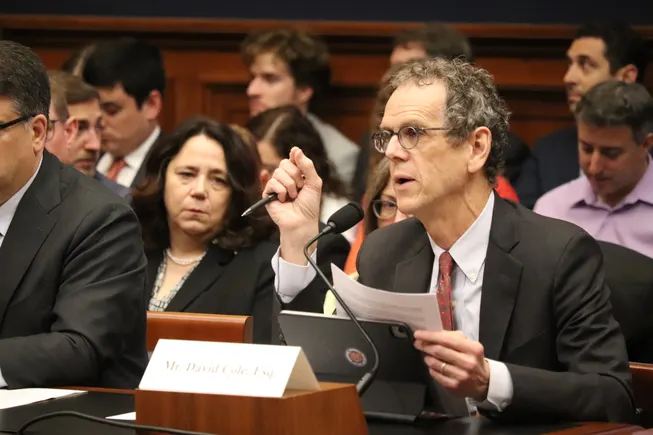
David Cole, a law and public policy professor at Georgetown Universityand the Democratic witness, didn’t mince words. Cole likened the House education committee’s use of hearings on antisemitism to McCarthyismand the work of the House Un-American Activities Committee, which probed suspected communists during that era.
Cole argued the committee had made “no effort to discern the difference between protected speech and discrimination.”
“That’s why I draw the comparison to HUAC,” Cole said.
He also said that Title VI does not prohibit antisemitic speech.
“Antisemitic speech, while lamentable, is constitutionally protected, just like racist speech, sexist speech and homophobic speech,” Cole said. “While such speech obviously causes deep harm, the greater danger is giving government officials the power to censor speech by labeling it antisemitic, racist or sexist.”
Antisemitic speech “implicates Title VI,” he said, when it constitutes harassment targeting an individual because of their Jewish identityor when it is “so severe, pervasive and objectively offensive that it denies equal access to an education.”
Determining whether speech has crossed into prohibited discrimination requires a fact-intensive investigation, Cole said. Moreover, colleges only violate Title VI when they were “deliberately indifferent” to the discrimination, he added.
Cole argued that the House hearings weren’t the right place to engage in these types of investigations, which he said require testimony from those involved in the alleged incidents. Instead, he called on the committee to bring in U.S. Education Secretary Linda McMahon.
“They should be calling Secretary of Education McMahon before the committee and asking her why she has decimated the very office that is supposed to be enforcing antidiscrimination law,” Cole said.
Clarification: This article has been updated to reflect that a group of Jewish organizations issued the statement led by the Jewish Council for Public Affairs.