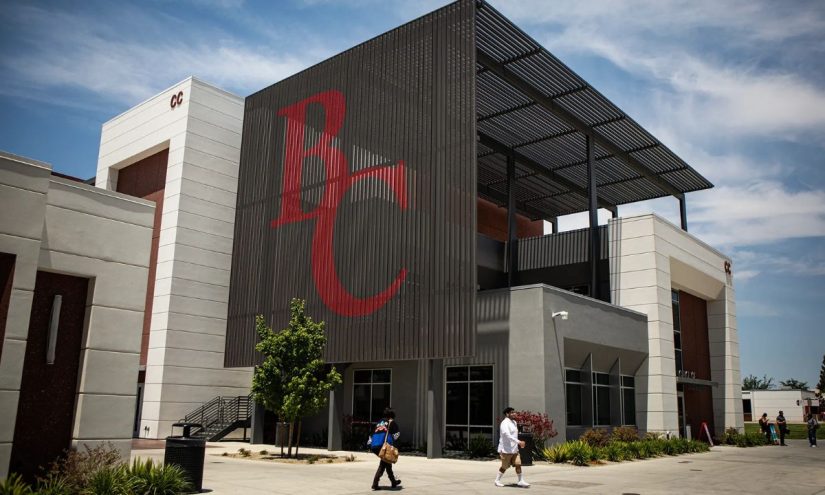
Butler County Community College is discontinuing credit-bearing, in-person programs at its LindePointe campus in response to enrollment troubles and the looming demographic cliff in Pennsylvania. The programs are scheduled to continue through the spring semester and shut down in August.
Enrollment at the LindePointe campus has fallen sharply, from 300 students in fall 2014 to 45 in fall 2024, with a particularly steep drop during the pandemic, according to a news release from the college Tuesday.
“Our numbers simply have not rebounded to a sustainable level,” Joshua Novak, vice president for student affairs and enrollment management, said in the release.
College leaders estimate ending in-person programs will save approximately $450,000 annually.
Students in Mercer County, where the LindePointe campus is located, will still be able to take online classes and participate in dual-enrollment and workforce training programs, including training in emergency medical and fire services at a local fire department. The college has promised to create degree-completion plans for each student, which may include online courses or classes taught at its five other locations. All the other campuses continue to offer in-person courses for credit. It’s unclear what will happen to LindePointe faculty and staff, though the college plans to “explore opportunities” for them, including potential reassignments, according to the release.
The move comes after the college previously considered but didn’t ultimately move forward with plans to teach its LindePointe courses and programs at Pennsylvania State University at Shenango as part of a potential partnership between the two institutions.
“While we looked at potential partnerships and alternative models, we could not identify a solution that was feasible long term,” Megan Coval, the college’s interim president, said in the release.

Stacy Bartlett, currently the chief of staff at Point University in Georgia, will become the institution’s president, effective July 1.
Michael Benson, president of Coastal Carolina University, has been named the 27th president of West Virginia University, starting in July.
John Butler, the Haub Vice President for University Mission and Ministry at Boston College, has been appointed the institution’s president, beginning in the summer of 2026.
Elizabeth Cantwell, president of the Utah State University system, has been appointed president of Washington State University, effective April 1.
Sylvia Cox, executive vice president and chief academic officer at Southeastern Community College, has been named president of Rockingham Community College, effective May 1.
Wendy Elmore, currently executive vice president and provost of Lamar State College–Orange in Texas, has been named the institution’s next president, effective June 1.
Andrea Goldsmith, dean of the School of Engineering and Applied Science at Princeton University, will become the seventh president of Stony Brook University, effective Aug. 1.
Adam Hasner, executive vice president of public policy for the Geo Group, has been named president of Florida Atlantic University.
Elizabeth Kiss, who most recently served as CEO of the Rhodes Trust, will become president of Union College, effective July 1.
Michelle Larson, president and CEO of the Adler Planetarium in Chicago, has been named president of Clarkson University, effective April 1.
Dean McCurdy, provost and senior vice president for academic affairs at Ivy Tech Community College, has been named president of Colby-Sawyer College, effective June 1.
Heather Norris, formerly the interim chancellor of Appalachian State University, has been appointed to the position permanently, effective March 1.
Joseph Odenwald, president of Southwestern Michigan College, has been named president of Alma College, effective June 1.
Andrew Rich, dean of the Colin Powell School for Civic and Global Leadership at the City College of New York, has been appointed president of Franklin & Marshall College, beginning this summer.
Daniel Shipp, the president of Pittsburg State University, has been named president of Maryville University in Missouri, starting in June.
Shane Smeed, president of Park University in Missouri, has been appointed president of Utah Tech University.
Gentry Sutton, currently executive vice president and vice president of advancement at Warner University in Florida, has been appointed president of the institution.
Suzanne Walsh, president of Bennett College in North Carolina, has been named president of City University of Seattle, effective July 1.
Jermaine Whirl, who most recently served as president of Augusta Technical College, has been appointed president of Savannah State University, effective April 1.

In December, The Wall Street Journal reported:
[President-elect Donald Trump’s nominee to lead the National Institutes of Health] Dr. Jay Bhattacharya […] is considering a plan to link a university’s likelihood of receiving research grants to some ranking or measure of academic freedom on campus, people familiar with his thinking said. […] He isn’t yet sure how to measure academic freedom, but he has looked at how a nonprofit called Foundation for Individual Rights in Education scores universities in its freedom-of-speech rankings, a person familiar with his thinking said.
We believe in and stand by the importance of the College Free Speech Rankings. More attention to the deleterious effect restrictions on free speech and academic freedom have on research at our universities is desperately needed, so hearing that they are being considered as a guidepost for NIH grantmaking is heartening. Dr. Bhattacharya’s own right to academic freedom was challenged by his Stanford University colleagues, so his concerns about its effect on NIH’s grants is understandable.
However, our College Free Speech Rankings are not the right tool for this particular job. They were designed with a specific purpose in mind — to help students and parents find campuses where students are both free and comfortable expressing themselves. They were not intended to evaluate the climate for conducting academic research on individual campuses and are a bad fit for that purpose.
While the rankings assess speech codes that apply to students, the rankings do not currently assess policies pertaining to the academic freedom rights and research conduct of professors, who are the primary recipients of NIH grants. Nor do the rankings assess faculty sentiment about their campus climates. It would be a mistake to use the rankings beyond their intended purpose — and, if the rankings were used to deny funding for important research that would in fact be properly conducted, that mistake would be extremely costly.
FIRE instead proposes three ways that would be more appropriate for NIH to use its considerable power to improve academic freedom on campus and ensure research is conducted in an environment most conducive to finding the most accurate results.
Why should the National Institutes of Health care about academic freedom at all?
The pursuit of truth demands that researchers be able to follow the science wherever it leads, without fear, favor, or external interference. To ensure that is the case, NIH has a strong interest in ensuring academic freedom rights are inviolable.
As a steward of considerable taxpayer money, NIH has an obligation to ensure it spends its funds on high-quality research free from censorship or other interference from politicians or college and university administrators.
Why the National Institutes of Health shouldn’t use FIRE’s College Free Speech Rankings to decide where to send funds
FIRE’s College Free Speech Rankings (CFSR) were never intended for use in determining research spending. As such, it has a number of design features that make it ill-suited to that purpose, either in its totality or through its constituent parts.
Firstly, like the U.S. News & World Report college rankings, a key reason for the creation of the CFSRs was to provide information to prospective undergraduate students and their parents. As such, it heavily emphasizes students’ perceptions of the campus climate over the perceptions of faculty or researchers. In line with that student focus, our attitude and climate components are based on a survey of undergraduates. Additionally, the speech policies that we evaluate and incorporate into the rankings are those that affect students. We do not evaluate policies that affect faculty and researchers, which are often different and would be of greater relevance to deciding research funding. While it makes sense that there may be some correlation, we have no way of knowing whether or the degree to which that might be true.
Secondly, for the component that most directly implicates the academic freedom of faculty, we penalize schools for attempts to sanction scholars for their protected speech, as tracked in our Scholars Under Fire database. While our Scholars Under Fire database provides excellent datapoints for understanding the climate at a university, it does not function as a systematic proxy for assessing academic freedom on a given campus as a whole. As one example, a university with relatively strong protection for academic freedom may have vocal professors with unpopular viewpoints that draw condemnation and calls for sanction that could hurt its ranking, while a climate where professors feel too afraid to voice controversial opinions could draw relatively few calls for sanction and thus enjoy a higher ranking. This shortcoming is mitigated when considered alongside the rest of our rankings components, but as discussed above, those other components mostly concern students rather than faculty.
Thirdly, using CFSR to determine NIH funding could — counterintuitively — be abused by vigilante censors. Because we penalize schools for attempted and successful shoutdowns, the possibility of a loss of NIH funding could incentivize activists who want leverage over a university to disrupt as many events as possible in order to negatively influence its ranking, and thus its funding prospects. Even the threat of disruption could thus give censors undue power over a university administration that fears loss of funding.
Finally, due to resource limitations, we do not rank all research universities. It would not be fair to deny funding to an unranked university or to fund an unranked university with a poor speech climate over a low-ranked university.
Legal boundaries for the National Institutes of Health as it considers proposals for actions to protect academic freedom
While NIH has considerable latitude to determine how it spends taxpayer money, as an arm of the government, the First Amendment places restrictions on how NIH may use that power. Notably, any solution must not penalize institutions for protected speech or scholarship by students or faculty unrelated to NIH granted projects. NIH could not, for example, require that a university quash protected protests as a criteria for eligibility, or deny a university eligibility because of controversial research undertaken by a scholar who does not work on NIH-funded research.
While NIH can (and effectively must) consider the content of applications in determining what to fund, eligibility must be open to all regardless of viewpoint. Even were this not the case as a constitutional matter (and it is, very much so), it is important as a prudential matter. People would be understandably skeptical of, if not downright disbelieve, scientific results obtained through a grant process with an obvious ideological filter. Indeed, that is the root of much of the current skepticism over federally funded science, and the exact situation academic freedom is intended to avoid.
Additionally, NIH cannot impose a political litmus test on an individual or an institution, or compel an institution or individual to take a position on political or scientific issues as a condition of grant funding.
In other words, any solution to improve academic freedom:
Guidelines for the National Institutes of Health as it considers proposals for actions to protect academic freedom
NIH should carefully tailor any solution to directly enhance academic freedom and to further NIH’s goal “to exemplify and promote the highest level of scientific integrity, public accountability, and social responsibility in the conduct of science.” Going beyond that purpose to touch on issues and policies that don’t directly affect the conduct of NIH grant-funded research may leave such a policy vulnerable to legal challenge.
Any solution should, similarly, avoid using vague or politicized terms such as “wokeness” or “diversity, equity, and inclusion.” Doing so creates needless skepticism of the process and — as FIRE knows all too well — introduces uncertainty as professors and institutions parse what is and isn’t allowed.
Enforcement mechanisms should be a function of contractual promises of academic freedom, rather than left to apathetic accreditors or the unbounded whims of bureaucrats on campus or officials in government, for several reasons.
Regarding accreditors, FIRE over the years has reported many violations of academic freedom to accreditors who require institutions to uphold academic freedom as a precondition for their accreditation. Up to now, the accreditors FIRE has contacted have shown themselves wholly uninterested in enforcing their academic freedom requirements.
When it comes to administrators, FIRE has documented countless examples of campus administrators violating academic freedom, either due to politics, or because they put the rights of the professor second to the perceived interests of their institution.
As for government actors, we have seen priorities and politics shift dramatically from one administration to the next. It would be best for everyone involved if NIH funding did not ping-pong between ideological poles as a function of each presidential election, as the Title IX regulations now do. Dramatic changes to how NIH conceives as academic freedom with every new political administration would only create uncertainty that is sure to further chill speech and research.
While the courts have been decidedly imperfect protectors of academic freedom, they have a better record than accreditors, administrators, or partisan government officials in parsing protected conduct from unprotected conduct. And that will likely be even more true with a strong, unambiguous contractual promise of academic freedom. Speaking of which…
The National Institutes of Health should condition grants of research funds on recipient institutions adopting a strong contractual promise of academic freedom for their faculty and researchers
The most impactful change NIH could enact would be to require as a condition of eligibility that institutions adopt strong academic freedom commitments, such as the 1940 Statement of Principles on Academic Freedom and Tenure or similar, and make those commitments explicitly enforceable as a contractual right for their faculty members and researchers.
The status quo for academic freedom is one where nearly every institution of higher education makes promises of academic freedom and freedom of expression to its students and faculty. Yet only at public universities, where the First Amendment applies, are these promises construed with any consistency as an enforceable legal right.
Private universities, when sued for violating their promises of free speech and academic freedom, frequently argue that those promises are purely aspirational and that they are not bound by them (often at the same time that they argue faculty and students are bound by the policies).
Too often, courts accept this and universities prevail despite the obvious hypocrisy. NIH could stop private universities’ attempts to have their cake and eat it too by requiring them to legally stand by the promises of academic freedom that they so readily abandon when it suits them.
NIH could additionally require that this contractual promise come with standard due process protections for those filing grievances at their institution, including:
If the professor exhausts these options, they may sue for breach of the contract. To reduce the burden of litigation, NIH could require that, if a faculty member prevails in a lawsuit over a violation of academic freedom, the violating institution would not be eligible for future NIH funding until they pay the legal fees of the aggrieved faculty member.
NIH could also study violations of academic freedom by creating a system for those connected to NIH-funded research to report violations of academic freedom or scientific integrity.
It would further be proper for NIH to require institutions to eliminate any political litmus tests, such as mandatory DEI statements, as a condition of grant eligibility.
The National Institutes of Health can implement strong measures to protect transparency and integrity in science
NIH could encourage open science and transparency principles by heavily favoring studies that are pre-registered. Additionally, to obviate concerns that scientific results may be suppressed or buried because they are unpopular or politically inconvenient, NIH could require its grant-funded research to make available data (with proper privacy safeguards) following the completion of the project.
To help deal with the perverse incentives that have created the replication crisis and undermined public trust in science, NIH could create impactful incentives for work on replications and the publication of null results.
Finally, NIH could help prevent the abuse of Institutional Review Boards. When IRB review is appropriate for an NIH-funded project, NIH could require that review be limited to the standards laid out in the gold-standard Belmont Report. Additionally, it could create a reporting system for abuse of IRB processes to suppress, or delay beyond reasonable timeframes, ethical research, or violate academic freedom.
The National Institutes of Health can incentivize study into campus climates for academic freedom
As noted before, FIRE’s College Free Speech Rankings focus on students. Due to logistical and resource difficulties surveying faculty, our 2024 Faculty Report looking into many of the same issues took much longer and had to be limited in scope to 55 campuses, compared to the 250+ in the CFSR. This is to say there is a strong need for research to understand faculty views and experiences on academic freedom. After all, we cannot solve a problem until we understand it. To that effect, NIH should incentivize further study into faculty’s academic freedom.
It is important to note that these studies should be informational and not used in a punitive manner, or to decide on NIH funding eligibility. This is because tying something as important as NIH funding to the results of the survey would create so significant an incentive to influence the results that the data would be impossible to trust. Even putting aside malicious interference by administrators and other faculty members, few faculty would be likely to give honest answers that imperiled institutional funding, knowing the resulting loss in funding might threaten their own jobs.
Efforts to do these kinds of surveys in Wisconsin and Florida proved politically controversial, and at least initially, led to boycotts, which threatened to compromise the quality and reliability of the data. As such, it’s critical that any such survey be carried out in a way that maximizes trust, under the following principles:
Conclusion: With great power…
FIRE has for the last two decades been America’s premier defender of free speech and academic freedom on campus. Following Frederick Douglass’s wise dictum, “I would unite with anybody to do right and with nobody to do wrong,” we’ve worked with Democrats, Republicans, and everyone in between (and beyond) to advance free speech and open inquiry, and we’ve criticized them in turn whenever they’ve threatened these values.
With that sense of both opportunity and caution, we would be heartened if NIH used its considerable power wisely in an effort to improve scientific integrity and academic freedom. But if wielded recklessly, that same considerable power threatens to do immense damage to science in the process.
We stand ready to advise if called upon, but integrity demands that we correct the record if we believe our data is being used for a purpose to which it isn’t suited.

After a year of many last events, Cabrini University celebrated its final commencement ceremonies last May and a “legacy” event to ceremonially close the institution and pass the legacy to Villanova University, which purchased the campus. As the emotions have tempered, and Cabrini’s president and academic leadership team have moved on to new career opportunities, we offer these lessons learned for financially struggling colleges that may be facing the possibility of closure, as well as insights for colleges in positions of financial strength on how they can help.
The quickest route to a chaotic close is running out of cash. Depending on how liquid an institution is—a combination of how much actual cash it holds with how many assets it has that can quickly be converted to cash—running out of cash can happen suddenly. A constant awareness of liquidity is imperative to avoid such a terrible outcome, and any potential partner will ask how long the cash will last as a preliminary decision criterion.
For many institutions, the most accessible cash resource is the unrestricted portion of the endowment. This can be both a blessing and a curse. Some institutions today are actively drawing more on their endowment than the historic 4 to 5 percent in support of annual operations in order to solve potentially existential challenges (the blessing)—but if the revitalization effort fails, then institutional resources may not be available to preclude closure (the curse). Without the Villanova partnership, Cabrini would have faced a significant cash crunch, which would have forced very difficult choices, especially related to supporting employees in the final stages of closing.
Rating agencies have also called out the growing amount of deferred maintenance colleges are facing. This is an in-the-weeds problem that many institutions are not addressing, at their great peril. In Cabrini’s case, we had to close a residence hall due to a heating system failure, and a heavily used campus road was so frequently repaired that it was difficult to traverse. We also could not provide competitive equipment for students in one of our most popular majors.
For institutions on the brink, deferred maintenance can be a real deterrent when considering deal terms with potential partners. Villanova has announced that it will spend $75 million to upgrade the Cabrini campus.
Here are some additional factors financially struggling institutions should consider:
If your institution has decided to close, consider the following steps before you announce:
In an ideal world of higher education, no institution would have to endure a sudden or planned closure. However, the current financial and enrollment pictures at many colleges and universities point to a harsher reality.
For others working at institutions that are exploring mergers, acquisitions or closures, do not work in isolation. There are now many higher education professionals who have lived through this experience who can offer advice confidentially and understand the need for nondisclosure. Higher education will be stronger if we work together, not in competition, and recognize our shared mission to serve students and our communities.
The final two years were a very difficult time for Cabrini University’s community. The institution’s leadership is forever grateful to the faculty and staff, all of whom rose to the occasion to embrace the many lasts. Their selfless work and sacrifice will serve as a legacy for Cabrini, as will the colleges where Cabrini students chose to continue their educations and the institutions where former Cabrini faculty and staff will continue their careers.

The challenges are proliferating while funding is deteriorating. Fortunately, the AI options to accomplish more with less funding are expanding. As of the end of February, a number of awe-inspiring deep research tools have been released. More than half a dozen such tools are available from different providers at prices ranging from no cost to $200 a month. They are becoming the key to enhancing efficiency and effectiveness of administrators, including deans.
Omar Santos, distinguished Cisco engineer, published on Feb. 21, 2025, “A Comparison of Deep Research AI Agents,” where he outlines some of the features of the five leading brands as of that date, noting, that “unlike simple question-answering bots, these agents perform multi-step reasoning: formulating search queries, browsing web content, analyzing data, and synthesizing findings into structured outputs with citations.” Santos goes on to describe that there are two primary architectural approaches to deep research agents:
“Fully Autonomous Agents: Once given a prompt or topic, these agents operate independently end-to-end. For example, OpenAI’s Deep Research feature (launched in Feb 2025) allows ChatGPT to act like a ‘research analyst,’ working for several minutes without intervention to gather information from the web and compile a report with sources. It is powered by a specialized version of OpenAI’s upcoming o3 model optimized for reasoning and web browsing. The user simply provides the topic, answers a few additional questions, and the agent handles the rest autonomously. This fully-automated approach is convenient but requires a very robust agent to decide on research directions and verify information on its own.
“Human-in-the-Loop (HITL) Agents: These agents incorporate human feedback or approval at different steps of the research workflow. Rather than running to completion unquestioned, the AI will pause for guidance—typically after formulating a research plan or outline—so the user can review and adjust it before the agent proceeds.”
Santos compares and contrasts five different such tools, leading with the OpenAI and Google Gemini versions. I would add two more to the list. First is the outstanding Storm tool developed as a brainstorming device by the Open Virtual Assistant Lab at Stanford University. The other is the Grok 3 Beta recently released by X.ai.
In all cases, these tools are capable of using advanced reasoning to develop a research plan, search the internet at large and other selected sites to which you provide access permissions, conduct probing research, compose a report with citations, revise the report and update as directed. Increasingly, the tools are offering options to ensure they do not use your inputs for training. Each of these tools will, no doubt, revise and improve in the coming months as new competitors enter the field. I expect that university IT departments will assist deans and other administrators as they select, train and become proficient at using the tool best suited to their needs.
Here are ways these tools may assist deans in meeting the challenges of their positions this fall and moving forward.
These are just a few of the important tasks of the dean that can be assisted by Deep Research tools. There are many more tasks that can be tackled by these tools. I hope that this brief list will prompt readers to become comfortable with the range of work that can be done in order to identify their own tasks for which they could use assistance.
Is your university preparing to implement these tools in support of deans and other administrators? Has training begun? It is important that your institution gets started so that you will not rapidly fall behind your peers in utilizing advanced AI tools to enhance effectiveness and efficiency.

Seventeen years ago, the Lumina Foundation set out to try to raise the percentage of working-age U.S. adults with a college credential from 38 percent to 60 percent by 2025.
It didn’t reach that goal, though it was only short a few percentage points; today, 55 percent of individuals between the ages of 25 and 64 have a college degree or short-term credential, an increase that Lumina CEO Jamie Merisotis called “one of the most significant but least recognized success stories of the past decade and a half.”
But times have changed since 2008, Lumina’s leaders said during a news briefing Monday, and in developing a new goal for the coming 15 years, they chose to focus not only on college attainment, but also on making sure that people’s college degrees help them find success and prosperity in their careers.
That’s why the foundation’s new goal aims to increase the number of adults in the labor force who have a “credential of value”—meaning they have earned a college credential and now make an income at least 15 percent more than the national average for high school graduates—to 75 percent by 2040. That number lines up with various labor projections, such as a Georgetown University Center on Education and the Workforce report, released earlier this year, that anticipated that 72 percent of jobs will require postsecondary education or training by the year 2031.
Lumina’s leaders decided to focus on earnings in large part because of Americans’ lack of confidence in the value of higher education. Polls by Gallup and Lumina have shown that a major reason people don’t think a degree is worth the high cost of attending college is because they don’t believe higher education sets people up well to be successful in the workforce.
“Our view is that we’ve got to do more to transform higher education workforce systems in order to meet human talent needs, in order to expand economic prosperity for individuals and for families and for communities,” said Merisotis. “Today, we have to make sure higher education literally serves more people better.”
Currently, only 44.1 percent of the U.S. labor force—which includes members of the military and those who are looking for work—has a college degree or certificate and earns at least 15 percent more than those with just a high school diploma, according to the foundation’s analysis of Census data. Those rates are significantly lower for Native American, Hispanic and Black people, and higher for white and Asian people.
The foundation laid out four pillars it plans to prioritize to reach that 75 percent goal: continuing to expand access to college, promoting student success and retention, redesigning college and workforce readiness to better support today’s students, and ensuring the credentials students receive do, in fact, pay off.
Wil Del Pilar, senior vice president at the education equity nonprofit EdTrust, lauded the foundation for turning its focus to college value—and for providing a definition of what a valuable credential actually is.
“The return-on-investment piece is under serious scrutiny nationally,” he said. “Including a metric that measures outcome—that measures income as an outcome—pushes folks to think about the return on investment of higher education that I think is a much-needed data point”—though he noted that earning 15 percent more than high school graduates, who made an average of about $38,000 in 2023, seems like “a low bar.”
(Courtney Brown, Lumina’s vice president of impact and planning, said at the media briefing that the 15 percent figure was determined in consultation with multiple labor economists.)
Lumina’s quest to increase credentials of value will be a boon not only to graduates, but also to employers seeking to recruit talent they can trust will have the job skills to succeed in their role, according to Shawn VanDerziel, president and CEO of the National Association of Colleges and Employers. In an email to Inside Higher Ed, he called the project a “worthy goal” and a “win-win” for graduates and employers.
“The education landscape is changing and how adults are consuming education is changing,” he wrote in an emailed statement to Inside Higher Ed. “With Lumina’s assistance, I hope we can expand the speed at which our educational institutions can evolve to meet the changing needs of employers and their focus on skills-based hiring.”
Charles Ansell, vice president for research, policy and advocacy at Complete College America, noted that while he appreciated the foundation’s focus on the value of credentials, he was also happy Lumina hadn’t shifted its focus away from attainment entirely.
“College attainment is still the best predictor of the higher wage outcomes,” he said. “If you have full-time-student graduation rates hovering in the 20s at best in the community college space … it’s hard to get economic mobility. It’s still extremely important to put that attainment goal itself first and not to lose sight of quantifying that college completion.”
As for whether the 75 percent goal seems achievable? That’s irrelevant, Ansel argued, because it’s simply what needs to happen to keep the country’s economy and democracy healthy.
“We should never lie to ourselves about what we need to do,” he said. “I don’t find it unrealistic—it’s what we need to do.”

Public confidence in higher education is declining. Even students, most of whom say they’re getting a quality education, question the value of a degree with respect to affordability. Such doubts increase higher education’s vulnerability to the threats it’s currently facing. All this evokes the long-running debate over whether higher education can be viewed as a public good. And when revisiting that debate, it’s instructive to know what students expect from their college or university—specifically, whether they consider themselves not just students but also customers.
In Inside Higher Ed’s first-ever Survey of College and University Student Success Administrators, released last fall, 71 percent of administrators said that undergraduates at their institution consider themselves customers (most of these administrators also agreed that parents of students consider themselves customers).
But what do undergraduates themselves say? According to a new analysis of IHE’s annual Student Voice survey with Generation Lab, nearly the same share of students—65 percent—consider themselves customers of their institution in some capacity, defined in the survey as expecting to have their needs met and be empathized with because they are paying tuition and fees.
Some 41 percent of the survey’s 5,025 two- and four-year student respondents say they see themselves as customers both in their classes and across campus. Another 13 percent consider themselves customers only in their classes, while 11 percent view themselves as customers only outside of class, when interacting with staff and administrators across campus.
Nearly three in 10 respondents (28 percent) to Inside Higher Ed’s annual Student Voice survey, fielded in May in partnership with Generation Lab, attend two-year institutions, and closer to four in 10 (37 percent) are post-traditional students, meaning they attend two-year institutions and/or are 25 or older. The 5,025-student sample is nationally representative. The survey’s margin of error is 1.4 percent.
Respondents include over 3,500 four-year students and 1,400 two-year students. Sixteen percent are exclusively online learners, and 40 percent are first-generation students.
Top-line findings from the full survey are here and the full data set, with interactive visualizations, is available here. The main annual survey asked questions on academic success, health and wellness, the college experience, and preparing for life after college.
How satisfied are students as customers of their institution? When those who do not identify as customers (n=1,744) are asked to wear that hat for a moment, nearly half (45 percent) say they’re somewhat satisfied with their institution. Another quarter (23 percent) are very satisfied. The rest are neither satisfied nor unsatisfied (19 percent), somewhat unsatisfied (9 percent), or very unsatisfied (3 percent).
What about students who do identify as customers (n=3,280)? The satisfaction numbers are very similar, but this group is slightly less likely to have high satisfaction; 45 percent, the plurality, are somewhat satisfied with their institution and an additional 18 percent are very satisfied. Twenty percent are neither satisfied nor unsatisfied, some 13 percent are somewhat unsatisfied and very few (4 percent) are very unsatisfied.
The results are relatively consistent across sector and a swath of student characteristics. However, two-year college students are less likely than four-year college students to say they consider themselves customers both in classes and when interacting with staff and administrators outside of class, at 35 percent versus 43 percent, respectively.
The higher-education-as-public-good debate typically centers on whether higher education meets the common criteria for a public good: nonexcludability, meaning it’s accessible to everyone, and nonrivalry, meaning one person’s use of the good the doesn’t limit others’ ability to use it.
In this sense, counting students as customers of higher education hurts the public good argument: How can one be a customer of a public good? And concerns about a creeping customer service dynamic in higher education have long worried scholars, including the authors of a 2010 paper in the International Journal for Educational Integrity arguing that a facile customer service model of higher education undermines the instructor-learner relationship by reducing it to transactional, vendor-vendee connection—one in which the institution meets the student’s expressed needs in exchange for payment. (Think grade inflation and more.) The name of that paper kind of says it all: “The Customer Isn’t Always Right: Limitations of ‘Customer Service’ Approaches to Education, or Why Higher Ed Is Not Burger King.”
But is thinking of students as customers—and students thinking of themselves as customers—a universally bad thing?
Various scholars have proposed alternatives to the customer service model of higher education.
Student as client: Scholar Keith B. Murray, for instance, proposed in a December Inside Higher Ed opinion piece that it’s better to think of students as clients. Whereas vendors need to appeal to customers via a product at an attractive price point, he wrote, in “client-type transactions, exchange of time, effort and money by the consumer is predicated on one party’s professional expertise and advice.” Typical client-based vendor examples include “physicians, dentists, financial advisers, tax preparers, accountants, veterinarians, therapists and professors,” he added.
Faculty and staff as stewards: Scholar Jeffrey Vetrano, in responding to Murray’s piece, also in Inside Higher Ed, advocated for a stewardship framework.
“Faculty and staff at institutions of higher education are stewards of both our students and their educations. As such, we take personal responsibility for granting them every opportunity to succeed, by maintaining strong ethics as identified in Murray’s article. As stewards, every action we take is for the care and development of our students, and we strive for much more than a client/vendor relationship.”
Luke Hobson, an instructional design leader and online lecturer with his own education podcast and blog, actually encouraged institutions to think of students as customers last year, citing these five reasons:
Summing up all these points, Hobson wrote in a blog post that the “most significant factor” here was to “emphasize caring. A business cares about their customers. Without them, they can’t survive.” Moreover, he said, “The greatest educators I can think of share this trait in that they cared. They were passionate. They were there for the students and to see them succeed. They could all have different styles of teaching, but at the end of the day, they served their students. It’s this mentality that will keep students engaged in the learning environment.” Indeed, existing research links instructor caring to student trust and sense of belonging, both of which are associated with student success. Quality nonclassroom student support services also promote student success.
Hobson also wrote that it’s “crucial to maintain a balance. Education is not a typical consumer good, and the primary goal of a university should be to educate and foster intellectual development, not just to satisfy customer demands. Students are coming to learn because they don’t have all the answers. They want to get better and they are seeking the expertise from the institution. The focus should be on helping them to reach their goals.”
A year later, Hobson recalls that post being his most polarizing ever, based on the feedback he got (some loved it, others hated it). But while he acknowledges the concerns of his peers—that, for example, a customer-focused model could hurt student autonomy by shifting the responsibility for learning onto institutions—his own views haven’t changed.
Reviewing the Student Voice data, Hobson imagines that students who describe themselves as customers believe they’re “paying for the ultimate learning experience,” defined by a “comprehensive blend of academic rigor, personalized support and opportunities for professional and personal growth.”
In this light, students expect “the best the university has to offer, including engaging faculty interactions, meaningful assignments, timely feedback and an overall environment that fosters intellectual and practical development,” he continues. They also “anticipate that this education will serve as a pathway to their future goals and aspirations. The effort they invest in their learning, they hope, will directly correlate to the outcomes they receive,” in the form of knowledge, skills or career opportunities.
This model has parallel benefits for institutions, Hobson adds, in that it encourages a focus on quality, including in online education; responsiveness to student feedback and a general feedback loop for continuous improvements to the learning environment; accountability for delivering “value for tuition and aligning institutional actions with expectations for academic rigor and integrity”; and market competitiveness by virtue of providing exceptional experiences.
Jhenai W. Chandler, vice president for research and policy at NASPA-Student Affairs Administrators in Higher Education, who also reviewed the Student Voice data, says she understands the impulse to think about students as customers or even clients. And she’s recently been on the student side of this conversation, helping two people close to her choose a college based on their very different needs and wants: Chandler’s own mother returned to community college to advance specific career goals, while her high school daughter is exploring colleges based on their ability to deliver a well-rounded education both in and outside the classroom.
Still, Chandler worries that framing the student as customer can sometimes reinforce “harmful misconceptions about the nature of higher education, particularly in a time when our field is under political scrutiny.”
Instead of using terms such as “client” or “customer,” “we need to focus on a more meaningful conversation about the value we provide and the outcomes we generate for students and society,” she says. Higher education’s value is “rooted in evidence that shows how students’ lives and communities improve after degree completion, whether it’s an associate, bachelor’s or graduate degree. We have a responsibility to communicate this impact effectively—through data, outcomes and success stories—to students, parents, industry leaders and policymakers.”
Chandler adds this: “Language and terminology can often be our worst enemies in this conversation, as the terms we use are not always understood outside of the academic world. We need to be intentional about the way we communicate, especially as we navigate misconceptions about what students expect from us.”
What do you think students who view themselves as customers—in classes or of their institution as a whole—expect from professors and/or administrators or staff across campus? Are the expectations typically reasonable ones? Tell us about it.

Email Nassau Community College now and tell them due process is not optional
If actions speak louder than words, then Nassau Community College has made its stance crystal clear: it is not a fan of the First Amendment. This New York institution has an astounding track record of disregarding the rights of students and faculty, but even FIRE was shocked by the brazen lawlessness of NCC’s recent actions against two student leaders.
The students, NCC Board of Trustees student member Jordon Groom and Academic Senate student chair Grant Peterson, were punished for alleged discrimination and harassment. While these are serious charges, the college fatally undermined the credibility of its sanctions by violating the most basic tenets of due process in doling out its discipline.
Groom and Peterson both found themselves embroiled in NCC’s broken disciplinary system late last year. NCC administrators initially told them that other students filed complaints against them for “discrimination” and “harassment,” but did not provide any further information. Now both students are left with no recourse, as they wonder how their due process rights could have been so badly violated by their local community college.
Last November, Peterson received formal notification of two complaints against him from NCC. But “formal” doesn’t mean it gave him any idea of what he allegedly did wrong — NCC just told him that complaints existed.
Peterson was left to use his imagination about the substance of the allegations until Dec. 2, when he met with an NCC administrator, who finally allowed him to see the complaints. The complaints cited a number of instances of Peterson using strong language — like telling another student, “You have no idea what you’re talking about, once again,” or calling an administrator an “idiot.” Doing so was alleged to have been discrimination and harassment.
Importantly, however, the college forbade Peterson from obtaining a copy of the complaint. NCC expected him to review the complaint — one that cited numerous alleged instances and charged him with high-stakes policy violations — and provide a substantive response to those allegations in the same meeting. There was no opportunity to provide a written defense or conduct a substantial review of the complaint. This was the sum total of Peterson’s “hearing.”
Due process protections, when properly followed, ensure fairness in proceedings and outcomes that can be trusted by all participants in the justice system.
Groom never received formal notification of any complaints. He got an inkling that something was amiss only when he was asked to leave a meeting of the Nassau Board of Trustees in December because of an active investigation—which was news to him.
Days later, he met with the same administrator as Peterson. Only this time, the administrator told Groom the complaint against him had been found meritless and had been closed, without offering any specifics. Great news, right? Wrong.
On Jan. 22, NCC informed both Peterson and Groom they had both been found responsible for discrimination and harassment. The college suspended Peterson from all club and organizational leadership roles for the remainder of the academic year — including from his role as student chair of the NCC Academic Senate. Whatever it was Groom did, he was required to complete a training module. There was no mention of an appeals process.
Obvious and basic principles of due process include:
NCC’s failure to provide even these basic requirements doesn’t even pass the “laugh test.” Sitting Peterson down for the first time with a stack of allegations and demanding he defend himself, now, is manifestly unjust. Groom didn’t even get to see the allegations against him before being found guilty, and was given outright misleading information to boot.
FIRE wrote NCC on Feb. 7, explaining how badly the college compromised its disciplinary process by neglecting the basic tenets of due process:
Simply put, NCC’s procedural abuses have now muddied the waters so severely that they have adversely affected everyone even peripherally involved in the case except NCC administrators. NCC subjected the complainants’ concerns to a broken process. It subjected Peterson and Groom to disciplinary measures without any chance to properly respond to the substance of the complaints — without any due process.
Accusations of discrimination and harassment are supposed to be taken seriously. This kind of total neglect of basic standards screams that it’s not being taken seriously at NCC.
The college responded to us two weeks later, effectively declining to substantively engage with our concerns. With no appeals process available, Peterson and Groom have no internal recourse for this discipline.
Due process protections, when properly followed, ensure fairness in proceedings and outcomes that can be trusted by all participants in the justice system. Someone needs to tell that to NCC. As we told the college in our letter, “NCC’s failure is comprehensive and total.” The damage this will do to the college and its students down the road still remains to be seen.

March 3, 2025, by Dean Hoke: This profile of the College of Wooster is the fourth in a series presenting small colleges throughout the United States.
Background
The College of Wooster, founded in 1866, is a private liberal arts institution located in Wooster, Ohio. Known for its commitment to mentored undergraduate research, Wooster offers a comprehensive liberal arts education in a residential setting. The college enrolls approximately 1,800 students representing diverse backgrounds from 47 U.S. states and 76 countries. The student-to-faculty ratio is 11:1, ensuring personalized attention and mentorship. For the 2022-2023 academic year, the total cost of attendance, including tuition, fees, room, and board, is $71,000. Notably, more than 85% of students receive financial aid, with an average award of $50,000.
Curricula
Wooster offers over 50 academic programs in the sciences, humanities, social sciences, and arts. A distinctive feature of the Wooster experience is the Independent Study program. In this program, students engage in a year-long research project under faculty mentorship, culminating in a thesis or creative work. This program fosters critical thinking, problem-solving, and effective communication skills.
Strengths
Weaknesses
Economic Impact
The College of Wooster significantly contributes to the local economy of Wooster, Ohio, which has a population of 27,012 and is the county seat of Wayne County, which has a population of 116,500. The college is a major employer in the region and attracts students, faculty, and visitors, bolstering local businesses and services. Additionally, cultural and academic events hosted by the college enrich the community’s cultural landscape. According to LeadIQ, approximately 1,200 people are employed by the college, and its annual operating expenses are over $88 million.
LinkedIn data shows that the college has nearly 17,000 alums, 4,700 of whom reside in Ohio and 1,120 in the Wooster, Ohio, area.
Enrollment Trends
Over the past decade, Wooster’s enrollment has slightly declined, from 2,100 to 1875 over a 10-year period. The student base is 35% in-state and 65% out-of-state and international. The college consistently attracts a diverse student body from across the United States and around the world. 98% of the student population lives in campus housing, and the age range is 18-24. Wooster does not have any graduate degree programs.
Degrees Awarded by Major
In the most recent report, 18 majors had graduates Wooster Degrees Conferred.

Alumni
Employment and or attending graduate school is very high. In the class of 2023, 97% of Wooster graduates secured employment or enrolled in graduate programs within six months post-graduation. 78% entered the workforce, 15% are attending graduate or professional school, 4% were applying for graduate school, and only 3% are seeking employment. Also, an average over the past three years shows that 91% of the Wooster graduates were accepted into their top choice graduate school. (Source: College of Wooster Destination Report, Class of 2023)
LinkedIn data shows the college has nearly 17,000 alumni. 28% live in Ohio, 18% in the greater Cleveland area, and 7% in the city of Wooster.
Notable Alumni:
Endowment and Financial Standing
As of June 30, 2023, The College of Wooster’s endowment stands at $395.5 million, reflecting prudent financial management and generous alum support. This endowment supports scholarships, faculty positions, and various institutional initiatives, ensuring the college’s long-term financial health. According to the 2023 Forbes financial report, The College of Wooster is rated 2.421 and a B- grade. Wooster has maintained a stable financial position.

Why is The College of Wooster Important?
This structured format highlights The College of Wooster’s key strengths, reinforcing its importance as a leading liberal arts institution.
Dean Hoke is Managing Partner of Edu Alliance Group, a higher education consultancy, and formerly served as President/CEO of the American Association of University Administrators (AAUA). With decades of experience in higher education leadership, consulting, and institutional strategy, he brings a wealth of knowledge on small colleges’ challenges and opportunities. Dean, along with Kent Barnds, are co-hosts for the podcast series Small College America. Season two begins on March 11, 2025.