Personal well-being—particularly related to mental health—is one of the greatest threats to persistence among college students.
Forty percent of students say mental health has “a great deal” of impact on their ability to focus, learn and perform academically, according to a May 2024 Student Voice survey by Inside Higher Ed and Generation Lab. Additionally, 19 percent of respondents believe their physical health impacts their academic success a great deal.
Colleges and universities are responding to this growing need for support; a 2024 Inside Higher Ed survey of college presidents found that 70 percent of respondents had invested in wellness facilities or services to promote overall well-being among students in the past year.
But students aren’t entirely satisfied with the offerings on their campuses; only 46 percent of Student Voice respondents rated the quality of campus health and wellness services as good or excellent.
Inside Higher Ed compiled five examples of new support resources universities are offering to improve student well-being and, in turn, their retention and graduation. Many focus on students’ self-regulation through meditation and reflection, tools that can help them manage physical and socio-emotional health.
In a small room located in the Eugene McDermott Library and Center for Brain Health, students are encouraged to take “brain breaks,” or short, intentional pauses to prime themselves for more focused, deeper thinking.
The room can only be used by one person at a time, and visitors are encouraged to turn off devices and set aside reading materials during this break.
The SDSU, Imperial Valley, administration cut the ribbon on a new wellness and success center in March, creating dedicated space for counseling and health services—as well as career, veterans’, student success and retention services. The goal is to offer holistic support in a one-stop shop. Imperial Valley is a commuter campus, with student housing under construction, making these resources particularly helpful for those living and studying in the area.
Counseling center services include crisis intervention, assessment and short-term therapy. The health center provides low- or no-cost medical services including preventive care, immunizations and psychiatric treatments.
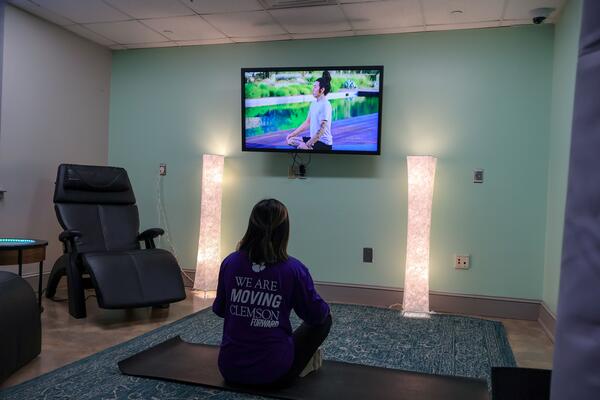
Clemson’s Fike Recreation Center is home to the Wellness Zone, a private room that an individual or group of students can reserve to engage in various activities. Created as a virtual fitness space, the room includes a touch-screen TV and zero-gravity chairs. Students can participate in self-paced yoga, stretching, mindfulness, breath work and meditation, as well as traditional exercises guided by an instructor on the TV.
IU repurposed an old sorority house on campus to centralize mental and physical health service offices, combining Student Wellness, Substance Use Intervention Services and the Collegiate Recovery Community offices under one roof.
In addition to staff offices, the new Wellness House also features reservable spaces for campus groups and four rooms where students can relax and meditate. Each room has a different theme and features; for example, the Fireplace Room is focused on studying and unwinding, whereas the Quiet Room has flexible seating such as beanbags and pillows for greater relaxation.
The goal is to provide an entry point for students who may be overwhelmed, potentially connecting them with relevant offices located in the Wellness House while they engage in other activities.
In 2021, Yale opened the doors to its Good Life Center, a space for unwinding and destressing; this year the university doubled the size of the space to accommodate more students.
The expansion includes five more themed rooms: the tree house, music room, game room, sensory room and balance room. Each offers wellness activities and features related to its theme, such as musical instruments, mini basketball hoops and sound-absorbing chairs.
The sensory room was designed in collaboration with Student Accessibility Services to provide specialized furniture and resources for students of all needs and abilities.
Do you have a wellness intervention that might help others promote student success? Tell us about it.
What if colleges started applying to you instead of the other way around?
The anxiety-inducing college admissions game is changing. With declining birth rates and growing skepticism about the value of a degree, higher education is facing an enrollment cliff, set to hit hard in 2026. That’s 18 years after the Great Recession, when many American families stopped having babies.
As competition for students intensifies, more states desperate for workforce talent and schools dependent on tuition dollars are turning to direct admission – a system in which students receive college acceptance offers and scholarships before they even apply.
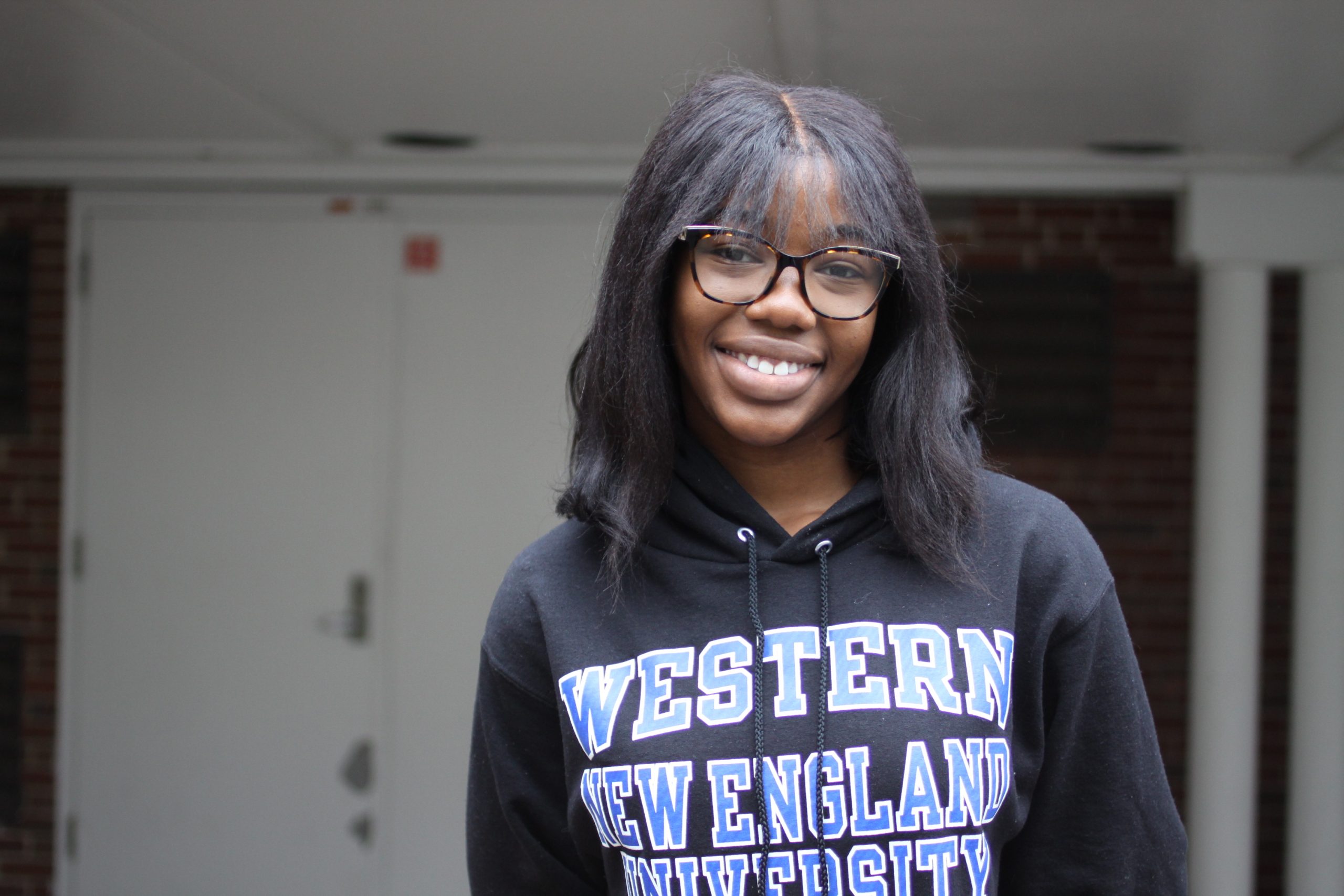
Marykate Agnes was directly admitted to Western New England University, and also got a significant amount of financial aid. Credit: Kirk Carapezza
In this episode, hosts Kirk Carapezza and Jon Marcus break down how we even got to the point at which the traditional college admission process required students to spend time and money with no guarantee of success. And they ask whether direct admission is the solution colleges and students need, or a Band-Aid on a bigger enrollment crisis.
In the basement of the Student Center at Western New England University in Springfield, Massachusetts, students play pool and ping pong. At a table in the back, Ndilei Lukulay is taking a break from her studies. She tells me her mother came to the U.S. from Sierra Leone. Growing up in Springfield, Lukulay felt nervous about applying to college.
[Ndilei Lukulay] I was definitely feeling the pressure of being that my mom is an immigrant. She’s very big on going to college and making sure that you get a good career and complete all your studies and so I didn’t know where to start and I was very stressed out about the whole thing.
[Kirk] Then this university in her hometown emailed to say she was admitted and would get a scholarship and she hadn’t even applied. So she was skeptical.
[Ndilei Lukulay] I was, like, is this a scam? Is this real?
[Kirk] It was real. Western New England, a private university with about 2,000 students, offered to admit her and more than 2,000 other students before they even applied. The university tells me the goal is to make college more accessible to low-income students, like Lukulay, who make up about a third of the school’s population.
This is called direct admission, and we’re seeing a lot more schools doing this as they confront a steep decline in the number of 18-year-olds, something economists call the demographic cliff. That’s going to mean a lot fewer college students — or potential customers.
[Jon] And, Kirk, schools in areas of the country like western Massachusetts are the hardest hit.
Here’s how it works. The college tells students they’d get in based on a handful of criteria, like their GPA or intended major. For students like Ndilei Lukulay, that means getting to skip writing essays, going to interviews, and getting letters of recommendation.
[Ndilei Lukulay] I think I received direct admissions offers from about 12 to 15 schools and I was actually very shocked. I just never heard anything about it and I’m like, is that easy?
[Jon] This is College Uncovered, a podcast pulling back the ivy to reveal how colleges really work. I’m Jon Marcus with the Hechinger Report. …
[Kirk] … and I’m Kirk Carapezza with GBH News. Colleges don’t want you to know how they operate, so GBH …
[Jon] … in collaboration with the Hechinger Report, is here to show you.
In this season, we’re standing on the precipice of the demographic cliff and exploring the changing higher education landscape. And one of the major changes is how people are getting into college. Applying to schools is really stressful. But what if all that went away and colleges applied to you?
Today on the show” Tag, You’re In!”
[Kirk] Direct admission is now used by hundreds of schools across the country. And more than a dozen state systems do this, too, including Oregon, Minnesota, and Connecticut. Idaho was the first state to create a direct admissions program.
[Jennifer Delaney] In Idaho, it was actually the president of the flagship who tried to apply to his own college and found it really hard.
[Kirk] Jennifer Delaney teaches higher ed policy at the University of California, Berkeley, and she studied the direct admissions program in Idaho, where every public institution in the state participates, as well as two private colleges.
[Jennifer Delaney] It was about how do we simplify, how do think about increasing, as a state, overall college enrollment. So every kid in a public high school in Idaho gets a letter. You’re either in everywhere in the state if your GPA is high enough, or you’re into all the open-access institutions, which is every community college plus two public four-years.
[Jon] This is a major shift, Kirk, in how colleges do business. For students, it helps ease the stress of the college search by letting them know they’re in before they even apply. For colleges desperate for students, it’s a way to fill their classroom.
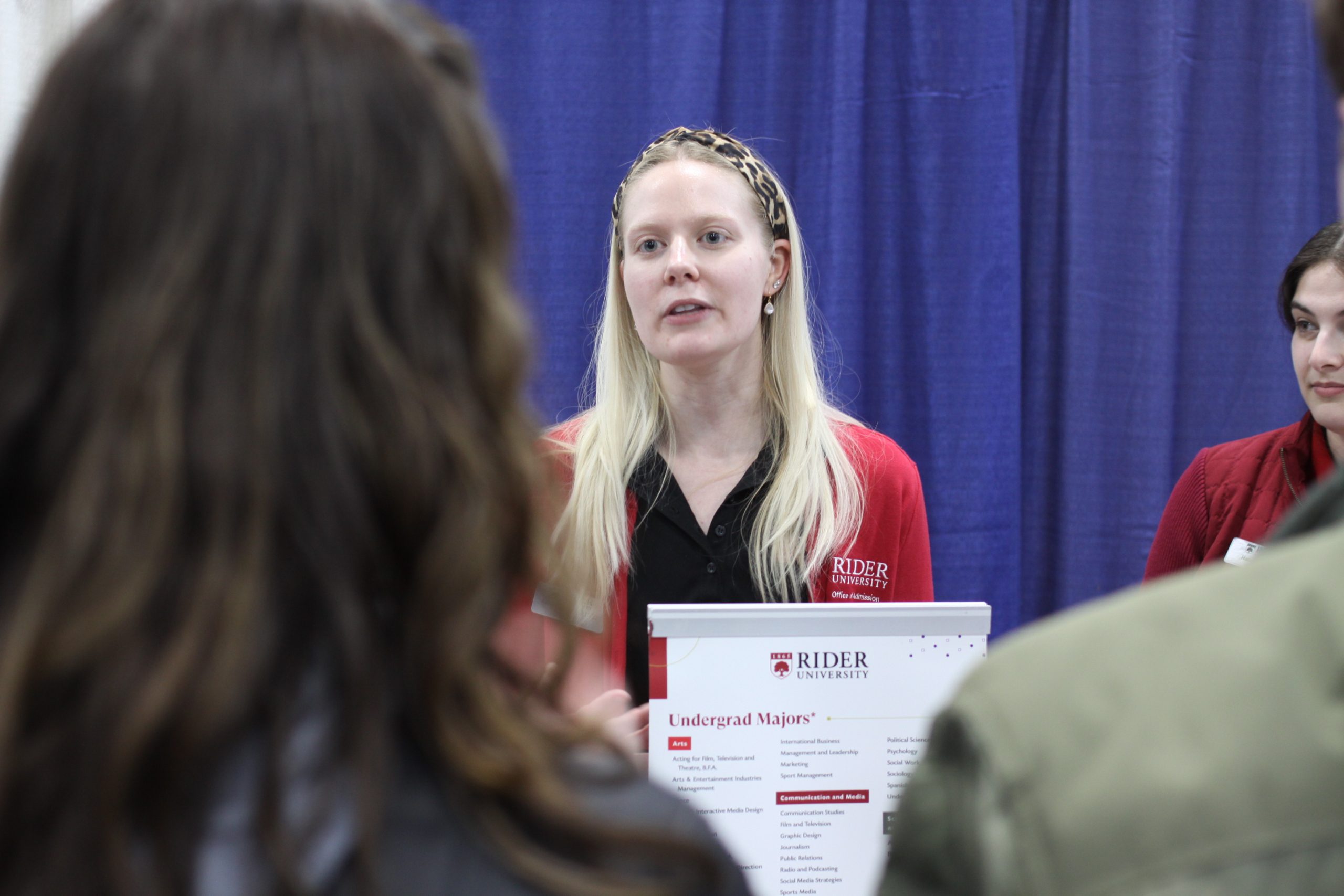
[Kirk] Yeah, and for states, Jon, it’s a way to keep talent close to home and develop a more educated workforce. Susan Makowski is director of admission at Rider University in New Jersey. We heard from her in our first episode this season.
[Susan Makowski] The cliff is coming, so we just will have less students.
[Kirk] At a college fair in Edison, New Jersey, she told me Rider was already admitting nearly 80 percent of those who applied when it decided to offer direct admission to students who’ve uploaded their applications through the Common App. That’s a single application accepted by more than 1,000 schools. So somebody applying to the University of Michigan suddenly gets accepted to other schools, like Rider.
[Susan Makowski] These direct admission programs run the gamut of different ways that a student gets admitted. I may alert them that they look like a great fit for Rider, but they still need to decide — do they feel that way? Whereas the other options, really, I think, sometimes worry students. Like, is this real?
[Jon] Interesting. But does direct admission really help colleges like Rider boost enrollment? And what if a college tags you? We’ll have more on that in a moment, so stay tuned.
But first, how did we get to this point where the college admissions process requires students to spend a ton of time and money with no guarantee of success? And how did the whole process become so anxiety-inducing?
[Kirk] Well, Jon, it wasn’t always this way.
[Archival newsreel sound] There were a group of congressmen with long memories who were in the last war. They knew that when a man gets out of the Army or Navy or Marines, he’s worried most about a job, an education, and a home. And that’s why Congress, led by the president, passed the law, the Servicemen’s Readjustment Act of 1944, better known as the G.I. Bill of Rights.
[Kirk] Some quick history. After World War II, most of the students applying to college applied to a single school. And by the 1970s, it was maybe two schools. Today, one in three students applies to seven or more places. That shift has created a lot of uncertainty for colleges hoping to fill their seats and a lot anxiety for students and their families. To get a sense of why colleges push this system, I reached out to a long-time admissions insider.
[John Burdick] My name is John Burdick. I was, until 2023, the vice provost for enrollment at Cornell University in New York.
[Kirk] Burdick was in the game for nearly four decades. Since he left Cornell, he’s been working on international college access in Africa. So technically he’s still in the game. I asked him what drove us here?
[John Burdick] This is basically just a classic arms race. The more rejection letters we can send, the more prestige we have, the more likely people will be willing to spend money on our services. And then students follow along behind that by a year or so and say, ‘I don’t know that I’m going to get in there or the other nine, 10, 19 prestigious places that I am applying to. So I better apply to all of them.’
[Kirk] Burdick says everybody in the game has a perverse incentive — students to increase the number of applications they send, and colleges to increase the number of applications they get.
[John Burdick] Now the Ivies will by and large say, ‘Oh, we don’t want more applications. We’re already only admitting 5 percent and it’s terrible and we’d just as soon not see applications.’ They’re lying through their teeth. They would freak out if they suddenly weren’t among the most selective universities on the planet.
[Kirk] And on this planet, most colleges — 80% — admit more than half the students who apply. Still, selective or elite college admission drives the national narrative.
Jon, you’ve reported on the fact that it’s getting easier to get into college and with the demographic cliff coming it’ll only get easier at certain schools, right?
[Jon] Yeah, not at Princeton and Yale, but despite public perception, and for the first time in decades, acceptance rates at most colleges and universities are going up.
[Kirk] Where are acceptance rates going up the most?
[Jon] Well, Bucknell, George Washington, Marquette, Oberlin, Gonzaga, Brigham Young — the list goes on and on. These universities want you to think it’s impossible, or at least hard, to get in. But the fact is, on average, universities are admitting a larger proportion of their applicants than they did 20 years ago. In fact, the median acceptance rate at four-year universities was about 8 percentage points higher in 2022 than it was in 2012.
[Kirk] Many students think it’s increasingly hard to get into college, and they see the whole process as a mystery. Even as you gather up your transcripts and test scores and then add some final touches on your personal essays, the question remains: Exactly what happens after your application goes out into the unknown? At the college fair in New Jersey, I asked high school juniors Masiambou Saysay and Harmony Roundtree what they think happens behind closed doors.
[Masiambou Saysay] They just have a lot of applications, they’re like, declined, oh yeah, I don’t know.
[Harmony Roundtree] I feel like a big pile of letters being stacked on top of each other and you just gotta pick, yeah.
[Kirk] And what do you think it looks like?
[Harmony Roundtree] Hmm. Like, a million emails and then, like, three different computers
[Kirk] I got a glimpse into one of those computers and the black box that is the admissions process — the mystery of who gets in, the secrets of what really matters. After I reached out to a bunch of schools, the College of the Holy Cross in Worcester agreed to give me access and a behind-the-scenes look at the admissions processes. Full disclosure, Jon, I’m a graduate of Holy Cross.
[Jon] Oh, really, Kirk? You never mention it. So the only school that would let you in is the only school that would allow you to observe the process?
[Kirk] That’s pretty much how this went down. The college let me sit in on one early decision committee meeting. Behind closed doors, inside a tiny conference room, I saw how the process historically went down.
[Woman’s voice] Nice program, good testing.
[Man’s voice] Yeah, a lot to like.
[Woman’s voice] People like him?
[Kirk] What’s most surprising is how quickly the committee reviews the candidates, spending about two minutes on each before deciding whether to accept, hold, or deny. To speed things along, the committee uses a lot of jargon, like LBB — that’s ‘late blooming boy’ — and RJ for ‘rejection.’
[Woman’s voice] Academically has everything. I wonder if a counselor call might be enlightening.
[Woman’s voice] I mean, honestly, it sounds like maybe he could work on it or be cognizant of it. I mean I don’t know, and he’s strong academically, I think he’s okay.
[Man’s voice] I think his classmates would bring him down to reality.
[Jon] Kirk, that’s just one small private college. So to get a broader sense of the admissions landscape and how it’s changing, we reached out to Jeff Selingo.
[Kirk] Yes, Selingo teaches higher ed leadership at Arizona State University, and he’s author of the book Who Gets In and Why. For his research, he spent a year inside three college admissions offices at Emory in Atlanta, Davidson in North Carolina, and the University of Washington in Seattle. So I asked him, how did he end up at those schools?
[Jeff Selingo] In some ways, it’s a lot like admissions. I approached 24 schools and asked them to get inside their admissions process. And most said no. And only three said yes. So it’s kind of like I applied to 24 schools. I only got into three.
[Kirk] And what do you think people imagine it’s like inside a college admissions office and what’s it actually like?
[Jeff Selingo] First of all, I think they think that the admissions officers are spending a lot more time with college applications than they really are. Emory had something like 40,000 applications. And so as a result, they’re like looking at these applications sometimes in just a couple of minutes. Probably the most they would take with an application might be 12 or 13 minutes. And meanwhile, you know, these kids are putting their heart and soul into it for years.
[Kirk] Selingo says the biggest change in the college admissions game is the lack of signals around what it takes to get in. Schools that used to require test scores, for example, have gone test-optional since the pandemic.
[Jeff Selingo] You know, some colleges have gone back, But that lack of a signal, like, if I got a 1400 or 1300 on the SAT, I kind of knew where that would place me in a class and I would not even apply to most of these schools. But now with test optional, it gave me the opportunity to potentially apply and get in. And so every year now you see just increasing number of applications again to these highly selective schools. And then you hear stories, ‘Oh, I didn’t, you, know, my kid didn’t get in or my cousin didn’t get in,’ and so the following year, kids get really nervous. And what do they do? They apply to not only those same set of schools, but then they apply to five more at the same time. And so you just see this vicious circle that just keeps going around and around again, particularly around these top schools.
[Kirk] How do you think the demographic cliff and the shortage of 18-year-olds will change this game?
[Jeff Selingo] I think the competition for student is going to intensify. And so you’re seeing that already. You see programs like direct admission, where students are getting accepted to colleges without even applying. You’re going to see a lot more marketing to students even earlier than they do now, in terms of buying their names and sending them information. The other thing, though, is on the financial aid side. I think the discounts and the merit aid that [colleges] are going to give, I think they’re just going to lean even more into that. And you’re just going to see more and more money flowing to students to try to persuade them to come to school X instead of school Y.
[Kirk] How else are these colleges handling these seismic shifts, and what’s the tone inside of the admissions office now? Is there a sense of desperation?
[Jeff Selingo] It’s interesting around enrollment. Even though we’ve known this cliff has been coming forever, admissions is really, like, especially at most of these schools that are tuition dependent and are really enrollment driven, it’s about butts in seats tomorrow, not a year from now. So, I mean, they’re kind of short sighted. They haven’t been doing very much to prepare for this. No, they haven’t, because they basically think ‘I just need to, I need to make this class for next year. I need to come in on budget. I need to. Make enrollment.’ They’re not really worried about two years down the road.
[Kirk] You mentioned direct admission. What do you make of this trend, and do you think we’ll see more schools and states adopt it?
[Jeff Selingo] Oh, I think you will, because there’s something in admissions where everybody kind of follows the leader. I’m a little skeptical of direct admission. Well, what happens when more and more schools adopt direct admissions and suddenly, now, Kirk, you’re getting, instead of, like, one or two direct admissions offers, now you’re get eight or nine, right? Like, how does that really help you, at the end of the day, make a decision, or from the college’s point of view, know who’s really interested and who’s coming?
[Jon] So Jeff Selingo is pretty skeptical of direct admission. But does it help colleges boost enrollment?
[Kirk] Well, sometimes, says Jennifer Delaney. She’s the researcher we heard at the top of this episode who looked at the first-in-the-nation program in Idaho.
[Jennifer Delaney] It’s not always able to move the needle on the enrollment side of things.
[Kirk] Delaney’s research found direct admission helped to increase full-time undergrad enrollment by at least 4 percent, and it boosted in-state enrollment by at least 8 percent.
[Jennifer Delaney] Having a bird in the hand in Idaho meant that you stayed in Idaho for school, and you didn’t go out of state.
[Kirk] And what about low-income students?
[Jennifer Delaney] Admission isn’t enough. You’ve got to be admitted and be able to pay for it.
[Kirk] And that’s why more schools are adding direct financial aid offers up front, too.
[Jon] Kirk, to compete, more and more community and four-year colleges are offering — quote, unquote — free tuition. We have a whole episode about that called “The Real Cost of Free.” You can find it in our second season.
At Western New England University, Marykate Agnes says she accepted the direct admission offer, but not before she reached out to increase her financial aid award. Agnes was admitted through direct admission, and she also received generous financial
[Marykate Agnes] I got the $32,000 scholarship, then I got another $2,000 for early action, and then I asked for more money and I got it. So I think I’m paying around $10,000. I think that it’s just an awesome thing, and it takes stress off of the students.
[Jon] Agnes says she doesn’t worry about attending a less selective school.
[Marykate Agnes] I don’t think it reflects the value of the education at all. I mean, at the end of the semester, I have more work than my friends at more selective schools do, and it’s harder, more rigorous, and the professors are absolutely amazing, and it is so personable. And I think that’s what you’re not getting at the more selective schools.
[Kirk] All of this change is putting pressure on colleges to develop a strategy. That’s where people like Kathy Ruby come in. She works with colleges to shape financial aid strategies to help them compete with other schools for students.
[Kathy Ruby] It’s a competitive market, and it’s going to get more competitive depending on where you are and the type of institution you are. I think not all institutions will experience the cliff in the same way.
[Kirk] Ruby says families are more cost-conscious than ever. Students and parents are more averse to debt, so schools are trying to make themselves seem cheaper. The goal is to attract middle-income families who don’t qualify for federal and state but also don’t have the means to pay the full price.
[Kathy Ruby] Certainly institutions are starting to focus on what can we do for those middle students, because that also can often be a good place to build. But it can be more expensive for the institution, because there’s no federal dollars to help.
[Kirk] Schools are focusing on scholarships that are offered up front and meet more students’ financial needs. Ruby’s advice to students and families? Shape a college list with your reach, target and safety schools, but also understand what that means for you.
[Kathy Ruby] Because if you’re a very bright student and your likely schools might be actually still pretty selective and not offer much in the way of merit aid, you have to do your homework on understanding what the college actually offers. Use their website, use their net price calculator, talk to people.
[Jon] And, as we always say on this podcast, ask questions and understand what your financial aid package might look like, even if you can’t get an exact figure.
[Kirk] The reality is there are tons of solid schools and programs out there. So try not to worry so much about that bumper sticker on the back of your neighbor’s SUV. And remember, getting into those bumper-sticker schools is often not about you. It’s about the college’s agenda. Factors like building a class, budgets and yield. You know, whether a student will even enroll if they’re accepted. Students and parents have a lot to gain if they change their perspective on what really qualifies as a quote,unquote good college.
[Jon] That’s right, Kirk. It’s easy to think a degree from a selective institution is the best insurance policy you can buy for your kid’s future. And if they’re not accepted, they’ll end up on the wrong side of this country’s economic divide.
But as we approach the demographic cliff, in many ways, that is simply not true. For many students, it’s a buyer’s market now.
[Kirk] This is College Uncovered. I’m Kirk Carapezza from GBH. …
[Jon] … and I’m Jon Marcus from the Hechinger Report.
[Kirk] This episode was produced and written by Jon Marcus …
[Jon] … and Kirk Carapezza, and it was edited by Jonathan A. Davis.
Our executive editor is Jennifer McKim.
[Kirk] Our fact checker is Ryan Alderman.
Mixing and sound design by David Goodman and Gary Mott.
All of our music is by college bands. Our theme song and original music is by Left Roman out of MIT.
The demographic cliff was set to sound for us by James Trayford of the Institute of Cosmology and Gravitation at the University of Portsmouth in England.
Mei He is our project manager. And head of GBH Podcasts is Devin Maverick Robbins.
[Jon] College Uncovered is made possible by Lumina Foundation. It’s produced by GBH News and The Hechinger Report, and distributed by PRX.
Thanks so much for listening.
More information about the topics covered in this episode:
The Hechinger Report provides in-depth, fact-based, unbiased reporting on education that is free to all readers. But that doesn’t mean it’s free to produce. Our work keeps educators and the public informed about pressing issues at schools and on campuses throughout the country. We tell the whole story, even when the details are inconvenient. Help us keep doing that.
Most Americans would probably rather forget the Great Recession that began in 2007. But as long ago as it may seem, it triggered something that is about to become a big problem: Americans started having fewer babies, and the birth rate hasn’t recovered since.
That means a looming decline in the number if 18-year-olds. Since those are the traditional customers for universities and colleges, enrollment is projected to fall dramatically and campuses to close.
In this episode, we tell you the surprising benefits of this for students and their parents — and the scary prospects for the economy, which will suffer shortages of workers just as baby boomers retire.
Brody Scully is a high school student looking at colleges. “There’s a lot of pressure on me. I have to decide in these next two years that I’ve got to go to a specific college,” he says.
Come with us to a college fair where recruiters line up to compete for applicants, and hear from enrollment consultants, economists, and the president of a school that has already closed.
[Kirk] This is College Uncovered. I’m Kirk Carapezza.
[Jon] And I’m Jon Marcus. We’re going to start this brand-new season of the podcast by taking you back to a time most Americans would probably rather forget.
[Archival news footage] Monday, Sept. 15, 2008. Lehman Brothers files the largest bankruptcy in U.S. history, precipitating the global financial crisis. … The Dow tumbled more than 500 points.
[Jon] What we now call the Great Recession started in 2008, and it left the world’s economy reeling.
[Archival news footage] More than two million prime mortgages, traditional loans for people with good credit, are now delinquent.
[Jon] The Great Recession did a lot of damage at the time, but it also caused something else most people haven’t noticed, and that’s about to affect us all.
[Archival news footage] Birth rates in the USA have dropped to their lowest annual levels in three decades, falling for nearly every group of women. … It changed the game when it comes to job security, and it led many young adults to delay marriage and kids.
[Jon] People stop having babies during economic downturns. That was a major but almost unseen impact of the Great Recession 18 years ago. And that means we’re about to run out of 18-year-olds. This is being called the demographic cliff.
Hey Kirk, help me explain the deal with this demographic cliff.
[Kirk] Yeah, so the demographic cliff is this big dropoff that’s about to hit the number of traditional-age college students. And the reason experts call it a cliff is that the number of students is going to go down, like you’re tumbling down a mountain and it never comes back up, Jon.
[Jon] The demographic cliff is pretty much the focus of our new season of this podcast. There’s some surprising good news that we’ll tell you about for students and their families, and for the parents of prospective college students. But this demographic cliff is also a big, big problem in ways most Americans don’t realize yet, for colleges and universities — and for economy.
[Nicole Smith] We are looking ahead down the road to circumstances, dire circumstances where we just can’t fill the jobs that are opening up.
[Wes Butterfield] We are at the, I’m going to call it the crossroads. You know, we’re at the cross roads for many campuses where they’re going to have to think creatively.
[Rachel Sederberg] We’re going to see issues across every occupation and every industry. There is going to be no one spared of this pain.
[Jon] Those are the voices of some experts whose job it’s been to watch this coming crisis. Like the lookouts with binoculars on the deck of the Titanic.
[Telephone ringing] Pick up, you bastards!
Yes, what do you see?
Iceberg! Dead ahead!
[Jon] So forgive us for the mixed metaphors and come with us as we help you cross these icy seas and this pivotal crossroads. We’ll show you how the demographic cliff will affect you.
[Kirk] This is College Uncovered, from GBH News and The Hechinger Report, a podcast pulling back the ivy to reveal how colleges really work. I’m Kirk Carapezza with GBH. …
[Jon] And I’m Jon Marcus of The Hechinger Report.
[Kirk] Colleges don’t want you to know how they operate, so GBH …
[Jon] … in collaboration with The Hechinger Report is here to show you.
[Kirk] In our fourth season, we’ll be looking at the many dramatic ways that college is changing right now and what it all means for you. Today on the podcast: “The Demographic Cliff.”
[Sound from college fair] Hi, guys, welcome to the college fair. If you’d like a bag…
[Kirk] To get a sense of what the demographic cliff looks and sounds like on the ground, I went to a national college fair in Edison, New Jersey.
[Sound from college fair] Students, make sure you have your barcode ready so the colleges can scan your barcodes.
[Kirk] Inside a massive convention and exposition center in an industrial park, a bunch of juniors and their families anxiously waited in the lobby before passing through turnstiles, and then they mingled with college representatives.
[Sound from college fair] And do you have one of the scan cards so I can get your information?
[Kirk] It’s kind of like speed dating, with most of the colleges here selling themselves.
[Sound from college fair] What’s cool about it is that we’re currently building our brand new college of business building that’s a lot of these that will be the biggest academic building on campus, so honestly your degree is going to work tenfold by the time that you end up coming to FSU.
[Kirk] There’s rows and rows of colleges. In some of those rows, it seems like there are more colleges than students.
[Sound from college fair] And we’re 10 minutes from London Heathrow Airport as well, so for international students getting on is great.
[Kirk] After the initial rush, the crowd thins out and those turnstiles stop turning.
Welcome to a new era of college admissions.
As you come to a fair like this, what are you looking for exactly?
[Brody Scully] I’m looking for environmental sciences and eco-engineering.
[Kirk] Brody Scully is a junior from West Milford, New Jersey. He says he knows exactly what he wants in a college: someplace where he can be active and maybe ski, and someplace small.
[Brody Scully] Because I definitely learn where there’s probably a smaller group of people, so I’m looking for that.
[Kirk] Is it anxiety-inducing for you guys, going through this process?
[Brody Scully] I would say yeah, definitely, and, like, time intensive.
[Kirk] Why is it so stressful?
[Brody Scully] There’s a lot of pressure on me. I have to decide in these next two years that I’ve got to go to a specific college.
[Kirk] But Brody may be in luck, because in the college admissions game, he was born at the right time: in 2008, just as birth rates in the U.S. started to decline. Remember Jon, that means there will be fewer 18-year-olds applying to college over the next few years. And except at elite schools like Harvard or Stanford and a few dozen other most selective colleges, the odds of getting in are going up. Eight out of 10 applicants to public universities and 7 out of 10 at private colleges are accepted now. That’s nearly 8 percentage points higher than 10 years ago.
Brody was surprised and thrilled when I told him this. In fact, his eyes widened.
[Brody Scully] I’m not aware of that at all and I’m kind of happy now that you told me that.
[Kirk] As the fair winds down, college reps, some standing alone in the back of the convention center, keep smiling, making eye contact, and hoping for just one more student to come by.
I mean, the reality is, this is a competitive landscape for many colleges, and for students, it’s increasingly a buyer’s market.
Take Rider University, which is trying really hard to stand out in this sea of schools. Its reps are simply telling potential students what the school is all about. and where it is.
[Susan Makowski] It is a small private school in Lawrenceville, New Jersey, which is about 15 minutes south of Princeton.
[Kirk] Susan Makowski is director of admissions at Rider, and for the past 20 years, she’s helped organize this fair.
This seems like organized chaos.
[Susan Makowski] I think that’s a great way to describe it.
[Kirk] This year, there are about 300 schools here looking for applicants. Colleges pay about $700 just to rent a booth. They think it’s worth it for a chance to connect with some of the nearly 3,000 registered students. And, of course, to scan their barcodes so they can follow up with endless reminders and marketing materials.
[Sound from college fair] I think I’m all good, but I’m making some…
Do you have one of the scans?
Uh, yes I do.
[Kirk] This year, Makowski tells me, Rider University is trying something a little different.
[Susan Makowski] Tonight, to be honest, I’m in New Jersey school at a New Jersey fair. I bought two booths. That’s how I’m standing out physically tonight so that you see that I’m here, right? You can’t miss me.
[Kirk] So you expanded your footprint.
[Susan Makowski] Yes, I did.
[Kirk] You can’t just walk, you can’t blow by you.
[Susan Makowski] Right, but that’s a selfish thing that I’m choosing to do, because I want to make certain that I can capture as many students Who might not have heard of us or might be really interested in us
[Kirk] Looking ahead and over the demographic cliff, Makowski tells me she knows things are about to change with fewer applicants.
[Susan Makowski] I think that’s going to be a natural progression, simply because a cliff is coming.
[Jon] Kirk, the seeds of this problem for colleges were planted back in 2008.
[Archival news footage] It was a manic Monday in the financial markets. The Dow tumbled more than 500 points after…
[Wes Butterfield] We were in a fairly dark place. And, again, that’s impacting us today.
[Jon] That’s Wes Butterfield. He’s chief of consulting services at Ruffalo Noel Levitz, a consulting firm that helps colleges and universities recruit students.
[Wes Butterfield] Anytime we reach those types of points in our history, birth rates go down. People just simply stop having babies. People were concerned about whether or not they’d have the resources to be able to start a family. And so those numbers backed off, and it takes a while for us to get to a point where it truly begins to impact us.
[Jon] The decline in births that started 18 years ago is about to translate into fewer students coming out of high school and enrolling in college. By 2039, there will be 15 percent fewer 18-year-olds per year than there are now.
The effect of all of this that you and I report about the most, Kirk, is what it will do to colleges and universities. It comes on top of a decline in enrollment that’s already been happening over most of the last 10 years. People have been questioning whether college is worth the high cost, and a relatively strong labor market drew a lot of high school graduates straight into jobs. Emily Wadhwani keeps a close eye on this as a senior director at Fitch Ratings, where she’s the sector lead for education. Fitch rates the financial health of institutions.
[Emily Wadhwani] We’ve been seeing kind of a trending downward of demand in terms of enrollment, particularly on the undergraduate side. So this is definitely a longer trend that we’re seeing.
[Jon] The pandemic only made things worse. And now the demographic cliff is here.
[Emily Wadhwani] Where we are now climbing back out of this post-pandemic recovery period, we see the same challenges that schools were facing prior to the pandemic, only now it’s more pronounced because those demographic trends have only deteriorated since then.
[Jon] That’s why colleges have started closing. Fitch categorizes the outlook for the higher education sector as deteriorating. Kirk, you and I have been seeing that a lot lately on abandoned campuses of colleges that have closed.
[Bob Allen] This is sort of a movie-set college campus, and people say that as soon as they essentially walk in the front gate.
[Kirk] That’s Bob Allen. He was the last president of a 185-year-old Green Mountain College in Vermont before it closed in 2019. By the time I visited the campus, it looked more like a ghost town.
[Bob Allen] So, yeah, watch yourself on these. They aren’t, see normally all of this would have been cleaned up.
One of the advantages of a small school is that it really was like an extended family. I knew not all of the students by name, but I knew most, and they knew me. They called me Bob, which was what I would prefer.
[Kirk] To Allen’s right, the red brick dining hall and dorms. To his left, the empty swimming pool, a ghost-like symbol of dried-up enrollment.
[Bob Allen] Increasingly students want to go to schools in cities and not rural areas. Poultney is a very tiny Vermont town.
[Kirk] At the time, Allen told me he preferred to give tours like these when the college was still open.
[Bob Allen] It was a lot more fun when we had students, all right.
[Kirk] At its peak, Green Mountain had about 800 students. That was already pretty small. But by the end of the 2010s, there were only a little more than half that many left. So Allen and his board decided that the college had to close.
[Bob Allen] It’s the hardest thing I’ve ever had to do personally. I spent most of my career building businesses and to take a 185-year-old institution and have to shut it down was really tough.
The demographics are working against all colleges, but in particular, small rural colleges. It’s tough for surrounding towns when colleges close too. Our payroll just for the college alone was $6 million. It has to, in the end, have an economic impact on the town. You know, some of the businesses had closed even long before we made our announcement.
[Jon] Kirk, the demographic cliff means there will be a lot more colleges closing. Don’t take it from us. That’s the prediction of the Federal Reserve Bank of Philadelphia. Already, 21 colleges defaulted on their bonds last year, or were at risk of defaulting. That’s way up. Here’s Emily Wadhwani from Fitch.
[Emily Wadhwani] We’ve seen the closure rate accelerate over the last few years. We expect to see that continue for the next few years. That has tended to be smaller, private, liberal arts, sometimes religiously affiliated schools with perhaps less than a thousand students. I’m generalizing; there are a couple outliers there, but broadly speaking, those are the types of schools that we’ve seen close.
[Jon] That’s a pretty good list of the kinds of colleges that are in trouble, and consumers need to keep that in mind. No matter what schools you’re considering, you need to do more these days than look at their courses or the athletics program. You need to check out their finances.
[Emily Wadhwani] The second place I would look is the strength of fundraising, often an indicator of the level of wealth the university has — the capacity to fund scholarships and other aid packages, less reliance on tuition as a primary means of operating revenue.
[Jon] We’ve talked before in this podcast about how you can see if your college might be in financial trouble. And we’ll post the link to that in the show notes.
Now, it’s obviously a sad situation when colleges close, for their employees and students and alumni, and for the towns that depend on them. But, Kirk, there are a couple of bright spots if you’re currently a college student or the parent of a college student, or have a child who’s considering college.
[Kirk] Yeah, Jon, colleges teach this in Econ 101. It’s the simple law of supply and demand. As the number of students is falling, there’s less demand. And as demand goes down, two things are happening. First, most colleges are becoming easier to get into. And second, the price of tuition has actually started falling.
[Jon] Now, Kirk, let’s be clear: College is still expensive, and to make up for keeping tuition low, colleges with dorms and dining plans are raising the price of food and housing. But increases in tuition are finally dropping when adjusted for inflation, after decades of exceeding the cost of almost everything else that Americans spend money on.
[Kirk] Exactly, Jon. You’re also likely to be able to negotiate for more financial aid. We gave a lot of advice about this in the first episode of our second season, and we’ll link that in the show notes too.
[Jon] We’ll have a lot more to tell you about the dramatic changes in admission in our next episode. So check that out.
[Kirk] So that’s all pretty good news for future students and their families. But there’s more bad news. And not just for colleges, but for the economy and society. There will be fewer graduates coming out the other end with skills employers need, and fewer young people in general available to work in any kinds of jobs.
[Jon] Right, and all of that, Kirk, is coinciding with the tidal wave of baby boomers who will be retiring at the same time.
[Rachel Sederberg] We’re already well underway in this process where we saw vast retirements over the last few years.
[Jon] That’s Rachel Sederberg, a senior economist and director of research at the labor market analytics firm Lightcast. Ten-thousand baby boomers are turning 65 every day. And Sederberg says there just aren’t enough workers coming up behind these retiring baby boomers to fill the jobs they’re leaving.
[Rachel Sederberg] The generations that follow the baby boomers are simply smaller and cannot mathematically make up for that decline.
[Jon] These shortages are already happening, Kirk.
[Rachel Sederberg] We are losing people across every occupation and industry. So we’re going to need more workers across, and we don’t have enough of any kind.
[Kirk] Okay, to tie this all together for you, we reached out to the Georgetown University Center on Education and the Workforce. It studies the connection between higher education and the economy. Chief Economist Nicole Smith connected these dots for us.
[Nicole Smith] So if you’re a college president, one way to look at this is, you know, ‘I don’t have enough students.’ But as an economist, I’m also thinking of the impact on the economy. Young people and young labor and the labor force — it’s the lifeblood of our society.
[Kirk] Smith says the decline in the number of traditional-aged college students will affect much more than whether a bunch of colleges close.
[Nicole Smith] We just don’t have enough who are completing and going to college and finishing school at as fast a rate as the economy is creating jobs for people with college degrees.
[Kirk] She’s not just talking about bachelor’s degrees, but all kinds of education after high school, including in manufacturing and the trades.
[Nicole Smith] Seventy-two percent of all jobs over the next decade will require some type of education and training beyond high school. So even if you don’t need a full bachelor’s, we need something that’s beyond high school and everyone has to be prepared to go back to get that credential so that you are prepared for that particular job.
[Kirk] So we’re all going to be falling down the demographic cliff together. In some parts of the country, labor shortages are already well underway.
[Nicole Smith] Many communities are facing this already. Rural communities are already having problems filling vacancies for some of their medical fields. They’re offering all sorts of incentives for doctors to come and work in those locations. So we’re already there.
[Jon] Kirk, as our experts have said, this demographic cliff is a dramatic turning point for higher education and it comes alongside questions about the value of college and a general decline in the proportion of high school students who are bothering to go.
[Kirk] Right, Jon, and that’s on top of huge political pressure on colleges and universities under the Trump administration and massive funding cuts.
[Jon] Throughout this season of the podcast, we’ll be looking at the ramifications of this unprecedented moment in the history of higher education. We’ll tell you how admissions is changing, why men in particular aren’t going to college, and the many new ways that are popping up, other than college, to train people for the workforce. and there’s much more.
[Kirk] So keep listening to future episodes to hear more about what colleges and universities don’t teach you in class.
This is College Uncovered. I’m Kirk Carapezza from GBH.
[Jon] And I’m Jon Marcus from The Hechinger Report.
[Kirk] This episode was produced and written by Jon Marcus …
[Jon] … and Kirk Carapezza, and it was edited by Jonathan A. Davis. Our executive editor is Jennifer McKim.
[Kirk] Our fact-checker is Ryan Alderman
Mixing and sound design by David Goodman and Gary Mott. All of our music is by college bands. Our theme song and original music is by Left Roman out of MIT. We also used some music in this episode from the Stony Brook University Orchestra.
The demographic cliff was set to sound for us by James Trayford of the Institute of Cosmology and Gravitation at the University of Portsmouth in England.
Mei He is our project manager and head of GBH podcasts is Devin Maverick Robbins.
[Jon] College Uncovered is made possible by Lumina Foundation. It’s produced by GBH News and The Hechinger Report, and distributed by PRX.
Thanks so much for listening.
More information about the topics covered in this episode:
The Hechinger Report provides in-depth, fact-based, unbiased reporting on education that is free to all readers. But that doesn’t mean it’s free to produce. Our work keeps educators and the public informed about pressing issues at schools and on campuses throughout the country. We tell the whole story, even when the details are inconvenient. Help us keep doing that.
This audio is auto-generated. Please let us know if you have feedback.
NASHVILLE – Entering college with prior learning credits can be a huge boon to students, cutting down on the time and money required to complete their degrees. But the pathways to earning these credits may favor traditional college students from well-resourced high schools.
Since 2020, leaders from Salt Lake Community College have worked to improve prior learning credit options for prospective and current students, they told attendees Monday at the American Association of Community Colleges‘ annual conference in Nashville. The college put a special emphasis on pathways for adult learners — those aged 25 and older — as the average student on its eight campuses is 25 years old.
Over the past five years, the resulting cross-campus collaboration has yielded Salt Lake Community College some promising results, including more students receiving credit for their work experience and lowered financial barriers for prior learning assessment exams.
Then
In 2019, the Utah Legislature passed a law requiring the state’s higher ed board to create a plan aimed at boosting public colleges’ issuance of credit for prior learning, work-based skills and competency-based assessments.
Salt Lake Community College — which enrolls just under 37,000 credit-bearing students across eight campuses — began an evaluation of its process for awarding prior learning credits the following year.
Rachel Lewis, Salt Lake Community College’s associate provost of academic systems, said the existing process turned out to be hardly a process at all.
“It used to be, if you knew the one advisor who knew the process and could talk to this person in the registrar’s office, we could get your prior learning,” she said. “Good for the students who found it — not good for all the others.”
The college’s leaders also uncovered a gap in what kind of credits were awarded.
In 2019-20, about 80% of the prior learning credits that Salt Lake Community College awarded were through pathways typically used by high school students, said Andrea Tipton, the institution’s director of credit for prior learning.
For instance, 807 of the 1,291 students who received prior learning credits earned them through Advanced Placement tests offered by the College Board.
In comparison, only 13 students that year received credit for their professional certifications or licenses, and just one student earned credit for their previous work experience and portfolio.
Now
To address this disconnect, Salt Lake Community College standardized its prior learning credit process. That included a new hire.
“We made a crucial decision to create a position at the college dedicated to prior learning — one person at the college who could be the point of contact to serve in that role,” Lewis said, nodding to Tipton, who was hired for the new role.
Salt Lake Community College now emphasizes credits for prior learning as an option through improved communications to students. The institution also works to inform students that it’s free to have their credits evaluated and added to their transcripts.
Once a prior learning credit is added to a student’s transcript, it is transferable as if they earned it at Salt Lake Community College, according to college policy.
“When that student goes to the University of Utah, it’s now considered transfer credit,” Lewis said. “They don’t reevaluate it. They don’t look at it.”
Roughly three-fourths of Salt Lake Community College graduates, 72%, go on to transfer to a four-year institution.
The college is also highlighting CLEP tests, an exam option offered by the College Board open to learners ages 13 and older.
The tests can provide a viable alternative to AP tests. But the registration fee — upwards of $95 in 2025 — proved to be a barrier for many students, Tipton said.
This year, Salt Lake Community College began directing students to the Modern States Education Alliance, anonprofit that will cover test costs for students who complete its free prep courses.
First-year results are still pending, Tipton said. But the college is processing more CLEP exams than before, suggesting more students are taking advantage now that the financial barrier to testing has been addressed, she said.
In 2023-24, the college awarded 248 credits to 33 students for their professional licenses and certifications. This represented nearly triple the prior learning credits students earned this way only a few years before.
It granted another 100 credits to 18 students for their work portfolios and experience. The number is still low, but the jump from just one or two students a year is statistically significant,Tipton said. And it’s a population the college wants to grow.
One prior learning pathway more commonly used by nontraditional students has seen a more complicated transformation — military credits.
Back in 2019-20, Salt Lake Community College appeared to do quite well in this regard, with 137 students receiving a whopping 2,184 prior learning credits for military experience that year.
“But it was a lot of electives,” Tipton said. “It wasn’t easily applicable to their degree or transferable in a meaningful way.”
Since then, military prior learning credits have declined significantly, down to 34 students receiving 46 credits in 2023-24.
That drop resulted from the college shifting from “awarding just whatever the credit you can get” to prioritizing military credits that go toward a student’s desired degree, Tipton said. She is now working with academic departments to continue establishing better course equivalencies for military experience.
Nearly 25% of college students in 2020 reported
limited or uncertain access to food. Despite being potentially eligible,
most didn’t receive Supplemental Nutritional Assistance Program (SNAP)
benefits—formerly known as “food stamps”—which could help them pay for
food.
A recent law gave the Department of Education
authority to share students’ Free Application for Federal Student Aid
data with federal and state SNAP agencies to identify and help students
who may be eligible for benefits.
But Education hasn’t made a plan to start sharing this data—nor have states received guidance about this opportunity.
The U.S. Department of Agriculture (USDA) and the Department of
Education have taken some steps to connect college students with
Supplemental Nutrition Assistance Program (SNAP) benefits to help them
pay for food, but gaps in planning and execution remain. Effective July
2024, a new law gave Education authority to share students’ Free
Application for Federal Student Aid (FAFSA) data with USDA and state
SNAP agencies to conduct student outreach and streamline benefit
administration. However, according to officials, Education had not yet
developed a plan to implement these complex data-sharing arrangements.
This risks delays in students getting important information that could
help them access benefits they are eligible for. Following the passage
of this new law, Education began providing a notification about federal
benefit programs for students who may be eligible for them. However, it
has not evaluated its method for identifying potentially eligible
students. According to GAO analysis of 2020 Education data, Education’s
method could miss an estimated 40 percent of potentially SNAP-eligible
students.
USDA encouraged state SNAP agencies to enhance student outreach and
enrollment assistance. However, USDA has not included important
information about the use of SNAP data and other student data in its
guidance to state SNAP agencies. These gaps in guidance have left states
with questions about how to permissibly use and share students’ data to
help connect them with benefits.
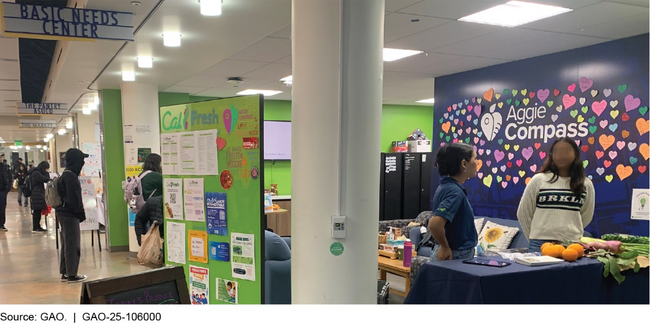
Student Food Assistance at a College Basic Needs Center
Officials from the three selected states and seven colleges GAO
contacted described key strategies for communicating with students about
their potential SNAP eligibility. These include using destigmatizing
language, linking students directly to an application or support staff,
and coordinating outreach efforts with SNAP agencies. Officials from the
states and colleges GAO contacted said it is helpful to have staff
available on campus to assist students with the SNAP application. Some
colleges have found it helpful to partner with their respective SNAP
agencies to obtain information on the status of students’ applications.
Why GAO Did This Study
According to a national survey, almost one-quarter of college
students were food insecure in 2020, yet GAO found many who were
potentially eligible for SNAP had not received benefits. The substantial
federal investment in higher education is at risk of not serving its
intended purpose if students drop out because of limited or uncertain
access to food. Studies have found using data to direct outreach to
those potentially eligible can increase benefit uptake.
GAO was asked to review college student food insecurity. This report
addresses (1) the extent to which Education and USDA have supported data
use to help college students access SNAP benefits, and (2) how selected
states and colleges have used student data to help connect students
with SNAP benefits.
GAO reviewed relevant federal laws and agency documents. GAO also
interviewed officials from Education, USDA, and national higher
education and SNAP associations. GAO selected three states and
interviewed officials from state SNAP and higher education agencies and
seven colleges in these states. GAO visited one selected state in person
and interviewed two virtually. States were selected based on actions to
support food insecure students and stakeholder recommendations.
Recommendations
GAO is making five recommendations, including that Education develop a
plan to implement FAFSA data-sharing and assess its benefit
notification approach; and that USDA improve its SNAP agency guidance.
The agencies neither agreed nor disagreed with these recommendations.
The
Secretary of Education should develop a written plan for implementing
provisions in the FAFSA Simplification Act related to sharing FAFSA data
with SNAP administrators, to aid in benefit outreach and enrollment
assistance. (Recommendation 1)
Department of Education
The
Secretary of Education should, in consultation with USDA, evaluate its
approach to identifying and notifying FAFSA applicants who are
potentially eligible for SNAP benefits and adjust its approach as
needed. (Recommendation 2)
Department of Education
The
Secretary of Education should inform colleges and state higher
education agencies that FAFSA notifications are being sent to applicants
who are potentially eligible for SNAP benefits. (Recommendation 3)
Department of Agriculture
The
Administrator of USDA’s Food and Nutrition Service should, in
consultation with Education, issue guidance to state SNAP agencies—such
as in its SNAP outreach priority memo—to clarify permissible uses of
student data, including FAFSA data, for SNAP outreach and enrollment
assistance. (Recommendation 4)
Department of Agriculture
The
Administrator of USDA’s Food and Nutrition Service should issue
guidance to state SNAP agencies—such as in its SNAP outreach priority
memo—to clarify the permissible uses and disclosure of SNAP data to
support SNAP student outreach and enrollment assistance. (Recommendation
5)
Higher education professionals have noted that today’s students are less engaged than previous classes. Many experts attribute this shift to the lack of socialization caused by COVID-19 stay-at-home orders. But according to a recently published study, students’ participation rates have been declining for the past decade.
A March report from the Student Experience in the Research University (SERU) Consortium found that while student engagement in various on-campus activities—including academic, civic, career, extracurricular and research work—has trended upward since 2020, rates are still lower than they were in 2019.
“The pandemic brought great disruption to [engagement] … and the narrative around is that, ‘Oh, things are back to normal. We’re operating normally.’ And it looks like, you know, on campuses, the pandemic has been forgotten … but in the data, in fact, we don’t see that,” said Igor Chirikov, senior researcher and SERU Consortium director.
Methodology
The report includes 10 years’ worth of survey and institutional data by the SERU Consortium, including 1.1 million student survey responses from 22 major research universities. The consortium is based at the Center for Studies in Higher Education at the University of California, Berkeley, and research was done in partnership with the University of Minnesota and the evaluation firm Etio.
“Pre-pandemic” data is categorized as responses collected between 2016 and 2019, and “post-pandemic” data reaches 2023. Survey respondents were all students at R-1 residential universities with high retention and graduation rates (ranging from 82 to 94 percent).
Overall declines: Researchers used the engagement indicators from 2018–19 as the reference point to mark the distinction between pre- and post-pandemic testing. All charts are focused on change, so they do not signify a decline in units (such as hours spent studying) but they do present an opportunity for comparison between indicators, Chirikov said.
Most indicators of campus involvement have declined since the onset of COVID-19, with few recovering to pre-pandemic levels as of 2023.
Academically, students reported significant differences in the amount of time studying in and outside of class, as well as in interacting with faculty members. Studying with peers also took a dip during the pandemic, but a relatively small one, which researchers said could be due to the shift to online and hybrid formats that created virtual study groups and other digital interactions.
During the 2020–21 academic year, the share of students who indicated that their professor knew or had learned their name declined, as did their confidence that they knew a professor well enough to ask for a letter of recommendation for a job or graduate school. Both factors made slight improvement during the 2022–23 academic year, but they remain below pre-pandemic levels.
The question about recommendation letters is one that interests Chirikov, particularly as universities are growing their enrollment and the student-faculty ratio increases. “I think that shows to what extent students have a person on campus, like a faculty member that knows them, that knows their work and can put in a good word for them,” he said.
Participation in faculty-led research also dropped, from 25 percent of students in 2018–19 to 20 percent in 2022–23. Wealthy students were 50 percent more likely to assist in faculty research, compared to their low-income peers.
“These are research universities, so part of their mission is to engage students in research and work in the lab, and we see, again, both declines and equity gaps in all this,” Chirikov said. “A lot of these opportunities are unpaid, and students coming from low-income families, they just cannot afford it. It’s becoming a luxury for rich kids.”
Involvement in extracurricular activities, interestingly, increased during the 2020–21 academic year, which researchers theorize could be due to students seeking new ways to connect with their peers amid social distancing measures.
“This indicator relies less on university infrastructure and opportunities; students worked themselves to restore that, to extend and create a different environment and spaces for communication and development friendship,” Chirikov said.
The following year, extracurricular involvement declined to below pre-pandemic levels. Students committed fewer hours to student groups and were less likely to hold a leadership role.
Since the pandemic, students have spent less time performing community service or volunteering and are less likely to have academic service-learning or community-based learning experiences.
On-campus employment also took a hit—fewer students indicated they worked on campus during 2022–23 compared to 2018–19, and employed students reported working one fewer hour per week. In addition, a smaller number of students said they completed an internship, practicum or field experience, which aligns with national trends that show that students are having more difficulty securing internships. Conversely, off-campus employment rates increased after the pandemic, though the number of hours students work has dropped.
Sowing Success
Noting barriers to access or confusion among students over how to get plugged in on campus, some colleges and universities have created new programming to address participation gaps.
Goucher College created micro-experiences in service learning to allow learners to participate in small-scale or one-day projects, opening doors for students who are engaged in other spaces on campus.
The University of Miami offers a precollege webinar series to support incoming students who receive Federal Work-Study dollars in identifying and securing on-campus employment opportunities.
San Francisco State University, part of the California State University system, established an online hub for students to identify research and creative activities that may interest them, removing informational barriers to participation.
Virginia Commonwealth University encourages faculty members to hold open office hours that meet across disciplines to facilitate greater interaction between learners and professors.
Across various engagement opportunities, college juniors and seniors were more likely to report participation, which could be tied to previous involvement before the COVID-19 pandemic, or an increased personal investment in achieving postgraduate success.
All demographic factors were controlled, so a changing student population has no effect on the overall trends, Chirikov said.
So what? Based on their findings, researchers recommend higher education revitalize engagement opportunities for students, particularly in the fields of research, community connections, student organization and career development programs.
Federal cuts to research may further disrupt this trend, which Chirikov hypothesizes will differ according to discipline and funding losses.
Efforts to expand access to higher education have resulted in higher enrollment rates and degree attainment rates making higher education an option that is open to more students than ever before. The greater the access to higher education, the more dynamic a curriculum must be to effectively and equitably educate and elevate the learning experiences of all students. Postsecondary education in America has historically been committed to “inventing courses of study, educational programs, or even whole institutions dedicated to the needs and expectations of its society, peoples, and cultures” (Community Colleges, n.d.). However, much of the emphasis has been placed on access rather than preparation. National policy has neglected to focus on the development of rigorous and integrated curricula that can prepare students for success (Kirst & Usdan, 2009).
Two Forms of Curriculum in Higher Education
There are two forms of curriculum in higher education. The first “is about defining or proposing which courses or subjects should be taken by students of a particular academic program” (Khan & Law, 2015). The second type of curriculum consists of the set of plans made for guiding learning, which includes the learning experiences and interactions that students have with the content, materials, resources and the process for evaluating mastery of the objectives (Glatthorn, Boschee, Whitehead & Boschee, 2019). A changing economic, social and political landscape requires complementary changes to curriculum. Costs of higher education degrees are rising and earning a degree is becoming more essential for personal and professional success (Bordelon, 2012). From a theoretical perspective, curriculum is much more than a set of plans or a program of study but instead represents the access to a particular way of life serving to “prepare students for dominant or subordinate positions in the existing society” (McLaren, 2002). Curriculum must be created in a way that promotes access and diversity, but also provides students with learning experiences relevant to the 21st century and beyond, and prepares them to be successful in a changing globalized society.
Need for Effective Curriculum Design in Higher Ed
Most class or instructional level curriculum is designed by professors, however, most professors have not received formal training in teaching or designing courses. In fact, “teaching is where professors receive the least training, if any at all” (Fertig, 2012). Support is sometimes available from veteran professors, faculty development offices and workshops or training to assist professors in the challenging work of course and curriculum development and implementation.
Many professors may not be familiar with, A self-directed guide to designing courses for significant learning, a resource designed to do just what it says.
The Integrated Course Design Model
Fink (2003) acknowledges that a professor’s ability to design courses is usually a limiting factor due to the fact that many professors have not been properly trained to do so. From this, Fink developed a model known as integrated course design which consists of three phases: the initial, intermediate and final design phases. The basic components of integrated course design include:
analyzing situational factors,
formulating learning goals,
designing feedback and assessment,
and selecting learning activities.
What distinguishes this model from other similar models is that the components are arranged “in a way that reveals and emphasizes their inter-relatedness” (Fink, 2003). The act of designing an integrated course should be done in a systematic way where each step is completed before the next, with the later steps building on the previous ones. This is similar to the structure-oriented theories of curriculum and the system approach to designing instruction consistent with the work of Bloom, Tyler and Mager (Pinar, Reynolds, Slattery, & Taubman, 1995). It is an ongoing, cyclical process based on flexibility, repeated reflection and transformation which corresponds with Taba’s modification of Tyler’s theory (Pina et al., 1995).
In the initial design phase, the first step is to gather information about the situational factors including possible constraints and opportunities. It is important that situational factors be identified as a key component to make planning decisions “since retrofitting one’s instructional design, delivery or assessment only after one finds out who is being instructed, are not effective use of faculty time, effort or university resources” (Schreiner, Rothernberger and Scoltz, 2013). Proactive focus on situational factors is preferable, as stated by Burgstahler, which is used in the Universal Design for Instruction model (Schreiner, Rothernberger and Scoltz, 2013). There are several important situational factors that Fink suggests can affect course design. The general categories of situational factors are: specific context of the teaching/learning situation, general context of the learning situation, nature of the subject, characteristics of the learners and characteristics of the teacher. Fink states that specific contextual factors are always important while other factors are sometimes important, but it is always useful to examine all factors when developing a course.
The Role of Student Interest and Prior Knowledge
Student interest and prior knowledge are valuable to consider because of the considerable impact they have on the student learning experience. Students bring pre-existing attitudes, beliefs and interests into the classroom, but situational factors can influence whether or not students develop interest in new material that is presented to them in an educational context (Durik, 2003). Course design must address “the basic proposition that knowledge cannot be divorced from human interest” (Macdonald, 1975). Professors can support the development of interest with characteristics of course design and delivery (Durik, 2003). Students’ prior knowledge and initial understanding must be engaged because learning transfer can depend on the orientation of prior knowledge (Smith, 2012). Learning activities that build on prior knowledge are so valuable because “ideas which are related tend to be remembered longer as compared to isolated factual information” (Smith, 2012).
Fink’s Worksheet for Identifying Situational Factors
Fink developed a worksheet for situational factors to be identified for each category starting with, of course, the factor he identifies as being the most important, the specific context of the teaching and learning situation.
After the first step of gathering and analyzing situational factors the second step is to decide the learning goals. This is what you want students to get out of the course, what you think is important for them to retain two to three years after they complete the course, what kind of thinking or application abilities you want them to develop, and how you want their learning to continue after the course is completed (Fink, 2003). For this step, Fink suggests the backward design model that starts at the end of the learning process and works backwards. Fink suggests avoiding an overemphasis on rote learning and focusing more on a learner centered approach which leads to more meaningful and significant learning, aligning with the holistic theory of education (Glatthorn et al., 2019). Fink proposes a taxonomy of significant learning that consists of six major types. The six types of significant learning are: foundational knowledge, application, integration, human dimension, caring and learning how to learn.
Fink’s Taxonomy of Significant Learning
Fink’s taxonomy is unique because each type of learning is interactive, which means that each type of learning can inspire other types of learning.
Foundational Knowledge: Understanding and remembering information and ideas.
Application: Critical, creative, and practical thinking, as well as managing projects and demonstrating skills.
Integration: Connecting ideas, people, and realms of life.
Human Dimension: Learning about oneself and others.
Caring: Developing new feelings, interests, and values.
Learning How to Learn: Self-directed learning and becoming a better student through inquiry.
Fink recognizes that it may be intimidating to include all six types of significant learning but states that the more you try to include, the more the learning goals will support each other and the more valuable the learning experience for the students (Smith, 2012). Fink developed a worksheet for formulating significant learning goals that includes key questions to ask about each of the six types of learning.
The third step in the initial design phase is to think about and plan the feedback and assessment procedures. Traditional courses consist of midterm and final exams, but a learning-centered course requires a more sophisticated approach (Fink, 2003). Educative assessments enhance the quality of learning and go beyond “audit-ive-type assessment” that is generally used for the sole purpose of awarding a grade (Fink, 2003). Educative assessment should be future oriented to improve student learning and have an impact on the student experience beyond the life of the course. To achieve this, an instructor must look ahead to a future where students will be able to apply their knowledge or showcase their skills, and then the professor creates a question or problem that recreates the real-life context as closely as possible in an open-ended format without being too rigid or pre-structured (Fink, 2003).
Students must be informed of the evaluative criteria being used to assess their performance. Brain research indicates that students are more engaged when they understand how and why they are being asked to perform or present what they have learned (Schreiner et al.,2013). The teacher’s standards must be clear and assessment must be practical. Student self-assessment is important because in the real-world students will have to assess their own performance. Research about learning shows the need for students to develop metacognition in order to “self-assess, understand, and appreciate their strengths and differences” (Smith, 2012). There are ways that instruction and assessment can encourage metacognition and promote student ownership of the learning process. An integral part of assessment is feedback and high-quality feedback includes the characteristics of “FIDeLity,” feedback which is frequent, immediate, discriminating and loving. Fink developed a worksheet to establish what he refers to as procedures for educative assessment.
“Traditional lectures are still the dominant form of undergraduate instruction in most first- and second-year college courses” however, more recently there has been research to support the need for providing more effective forms of active learning that can prepare students with the critical thinking skills that they will need to be successful for a wide range of professions (LoPresto & Slater, 2016). Step four in Fink’s guide consists of the teaching and learning activities, which in order to create significant learning opportunities, must incorporate active learning. Active learning, as defined by Bonwell and Eison (1991), is learning that goes beyond just listening to a lecture and includes engagement on the part of the student through reading, writing, discussion and problem solving. Active learning thus includes the act of students “doing things” which requires experiential opportunities and reflective dialogue.
Creating learning experiences has been described by Tyler (1975) as even more of an artistic endeavor than the selection of learning objectives. Not all curriculum developers or instructors know how to create new and effective learning activities. Fink suggests using a holistic view of active learning that includes activities from each of the three components of active learning: information and ideas, rich learning experiences and reflective dialogue. Rich learning experiences are those that stimulate several types of significant learning simultaneously and can be done in or out of class. Richness refers to the depth of the curriculum, the layers of meaning, and its multiple interpretations or possibilities (Doll, 1993).These experiences should be both experiential and reflective to assist students to develop new ways of thinking and feeling that can be implemented in various ways in real life situations (Schaffarzick & Hampson, 1975).
Once the strong primary components are developed in the initial phase, step five is where the course developer integrates the previous steps. Fink provides another worksheet to assess the quality of the course design using specific criteria as specified in steps one through four, which are then integrated and assembled into a coherent whole. Assembling the components is done in the intermediate design phase which are steps six through eight. To create a course structure the semester must be divided into four to seven segments that focus on the key concepts, issues or topics that make up the course. The topics must be arranged into a logical sequence and the course developer has to determine how many class sessions to assign to each one. This helps to promote the creation of assignments that gradually become more challenging.
There is a difference between an instructional strategy and a teaching technique. A teaching technique is a specific teaching activity while an instructional strategy is a set of learning activities arranged in a way that “energy for learning increases and accumulates as students go through the sequence” (Fink, 2003). Instructional strategy is designed in step seven with the goal of creating a sequence of activities that build on each other. Learning experiences that “are organized so that each subsequent experience builds on what has been learned in earlier ones and so that the student can perceive the connection” have greater impact and enhance learning (Schaffarzick & Hampson, 1975). Activities that are generated must also prepare students for their future work in the course. The structure and sequence of the activities must allow for time to practice what it is the students are expected to learn and students must be provided with prompt feedback. The quality of their work and performance must be assessed while also providing time for students to reflect on their own learning.
The course structure and the instructional strategy for the whole course must be integrated in step eight. Fink suggests creating a diagram of both the course structure and instructional strategy and recommends taking the time to find ways to enhance how both components can work together. Such a diagram would allow the course developer to reflect on two very important aspects of the course, differentiation and the integration. At the conclusion of step eight, one should be able to produce a week-by-week schedule of activities for the entire semester. Fink provides a worksheet for creating this schedule. At the end of this step there should be an integrated set of components that combine to form a cohesive course and the developer is ready for the final design phase.
The final design phase includes the four remaining steps to complete the design of the course. Step nine is deciding on a grading system which should incorporate a full range of the learning goals and activities, but not necessarily grading everything. The weight of each graded item should mirror the importance of the activity. Prompts provided include, “What will be the relative weight of the grade components? Are you going to determine that yourself, or will you involve the class in this process?” (Fink,2003). This is an opportunity to engage students in the design process using a dialogical model (Macdonald, 1975).
It is unlikely that any course design will be without faults or possible issues. It is in step ten that Fink suggests looking for what could go wrong. At this point the course design is really just a first draft and this step is included so that the designer can edit that first draft by checking for possible problems and discovering ways to solve those problems. After what Fink calls “de-bugging” the course, step eleven is to create a syllabus which is the way the professor shares the course plans with the students. As expected the syllabus contains traditional items such as general information, goals for the course, the structure and sequence of class activities including major due dates, required texts/materials, grading procedures and course policies.
The final step of designing a course for significant learning is planning how one will evaluate the course and how to evaluate one’s own teaching. It is through these evaluations that the course developer can gather the necessary insight to determine how to improve the course and how to improve pedagogy over time. Fink suggests collecting feedback throughout the course and upon completion of the course. A variety of sources of information are suggested such as video/audio, student ratings, student interviews/questionnaires, outside observer and test results. Questions to ask oneself include, were the goals of the course achieved and to what degree? What was the effectiveness of the learning activities? How effective was the instructor’s ability to interact with students?
After finishing steps one through twelve the course design is complete. Fink provides two caveats for consideration. The first is to stay flexible. Once the plan is complete it is still only a plan and should remain flexible and subject to change as needed throughout implementation.
The second caveat is that when trying to improve the design of the course, focus on only a few changes so as not to get overwhelmed. Start with making some changes in each of the three phases because each one impacts and strengthens the others. Each time teaching takes place there is an opportunity to assess the effectiveness of the plan and to make changes, as time goes on more ambitious changes can be implemented.
Fink’s guide provides a pragmatic approach to course design and redesign so that when implemented, it can gradually improve the user as a course designer. Commitment to designing courses for significant learning increases one’s “power and effectiveness as someone responsible for the quality of other people’s learning experience” (Fink, 2003).
Fink’s guide can be used by new professors to create courses that engage students and prioritize active learning. This model can also be used by seasoned and veteran professors to assess their courses and reconstruct them to “create subjects better able to negotiate the complexities of emergent forms of everyday life, labor and culture” (Kellner, 2003).
Being responsible for the learning experiences of others is one of great reward but if not taken seriously and executed with integrity and fidelity it can also have grave implications such as injustice, trauma, and cultural domination which is why higher education curriculum and course design should be a priority at every institution of higher learning.
Alana Sejdic, EdD is a special education administrator with East Hartford public schools. She is currently in a certification program for the Collaborative and Proactive Solutions (CPS) model developed by Dr. Ross Greene. She is a trainer in the Sexual Health & Relationships Education (SHARE) curriculum certified through Among Friends in Oregon. She recently published her book “When Spoons are Low”, a picture book about disability, written in verse for readers young and old. Her previous administrative experiences include residential and therapeutic education, juvenile justice education, and leading postsecondary disability services in private and public institutions of higher education. Dr. Sejdic is also a member of the Board of Directors for the CT Parent Advocacy Center (CPAC). Her most important role is being a mother to her two sons.
References
Bonwell, C. C., & Eison, J. A. (1991). Active Learning: Creating Excitement in the Classroom. 1991 ASHE-ERIC Higher Education Reports. ERIC Clearinghouse on Higher Education, The George Washington University, One Dupont Circle, Suite 630, Washington, DC 20036-1183.
Fink, L. D. (2003). A self-directed guide to designing courses for significant learning. University of Oklahoma, 27(11).
How Do Professors Learn to Teach (or Do They)? MAR 29, 2012 Jason Fertig
Kellner, D. (2003). Toward a critical theory of education. Democracy & Nature, 9(1), 51-64.
Kirst, M. W., & Usdan, M. D. (2009). The historical context of the divide between K-12 and higher education. PM Callan, States, Schools and Colleges: Policies to Improve Student Readiness for College and Strengthen Coordination between Schools and Colleges, NCPPHE (National Center for Public Policy and Higher Education), San Jose, 5.
LoPresto, M. C., & Slater, T. F. (2016). A new comparison of active learning strategies to traditional lectures for teaching college astronomy. Journal of Astronomy & Earth Sciences Education, 3(1), 59-76.
Macdonald, J. B. (1975). Curriculum and human interests. Curriculum theorizing: The reconceptualists, 283-294.
McLaren, P. (2002). Critical Pedagogy: A Look at the Major Concepts.
Pinar, W. F., Reynolds, W. M., Slattery, P., & Taubman, P. M. (1995). Understanding curriculum: An introduction to the study of historical and contemporary curriculum discourses (Vol. 17). Peter Lang.
Schreiner, M. B., Rothenberger, C. D., & Sholtz, A. (2013). Using Brain Research to Drive College Teaching: Innovations in Universal Course Design. Journal on Excellence in College Teaching, 24(3).
Efforts to expand access to higher education have resulted in higher enrollment rates and degree attainment rates making higher education an option that is open to more students than ever before. The greater the access to higher education, the more dynamic a curriculum must be to effectively and equitably educate and elevate the learning experiences of all students. Postsecondary education in America has historically been committed to “inventing courses of study, educational programs, or even whole institutions dedicated to the needs and expectations of its society, peoples, and cultures” (Community Colleges, n.d.). However, much of the emphasis has been placed on access rather than preparation. National policy has neglected to focus on the development of rigorous and integrated curricula that can prepare students for success (Kirst & Usdan, 2009).
Two Forms of Curriculum in Higher Education
There are two forms of curriculum in higher education. The first “is about defining or proposing which courses or subjects should be taken by students of a particular academic program” (Khan & Law, 2015). The second type of curriculum consists of the set of plans made for guiding learning, which includes the learning experiences and interactions that students have with the content, materials, resources and the process for evaluating mastery of the objectives (Glatthorn, Boschee, Whitehead & Boschee, 2019). A changing economic, social and political landscape requires complementary changes to curriculum. Costs of higher education degrees are rising and earning a degree is becoming more essential for personal and professional success (Bordelon, 2012). From a theoretical perspective, curriculum is much more than a set of plans or a program of study but instead represents the access to a particular way of life serving to “prepare students for dominant or subordinate positions in the existing society” (McLaren, 2002). Curriculum must be created in a way that promotes access and diversity, but also provides students with learning experiences relevant to the 21st century and beyond, and prepares them to be successful in a changing globalized society.
Need for Effective Curriculum Design in Higher Ed
Most class or instructional level curriculum is designed by professors, however, most professors have not received formal training in teaching or designing courses. In fact, “teaching is where professors receive the least training, if any at all” (Fertig, 2012). Support is sometimes available from veteran professors, faculty development offices and workshops or training to assist professors in the challenging work of course and curriculum development and implementation.
Many professors may not be familiar with, A self-directed guide to designing courses for significant learning, a resource designed to do just what it says.
The Integrated Course Design Model
Fink (2003) acknowledges that a professor’s ability to design courses is usually a limiting factor due to the fact that many professors have not been properly trained to do so. From this, Fink developed a model known as integrated course design which consists of three phases: the initial, intermediate and final design phases. The basic components of integrated course design include:
analyzing situational factors,
formulating learning goals,
designing feedback and assessment,
and selecting learning activities.
What distinguishes this model from other similar models is that the components are arranged “in a way that reveals and emphasizes their inter-relatedness” (Fink, 2003). The act of designing an integrated course should be done in a systematic way where each step is completed before the next, with the later steps building on the previous ones. This is similar to the structure-oriented theories of curriculum and the system approach to designing instruction consistent with the work of Bloom, Tyler and Mager (Pinar, Reynolds, Slattery, & Taubman, 1995). It is an ongoing, cyclical process based on flexibility, repeated reflection and transformation which corresponds with Taba’s modification of Tyler’s theory (Pina et al., 1995).
In the initial design phase, the first step is to gather information about the situational factors including possible constraints and opportunities. It is important that situational factors be identified as a key component to make planning decisions “since retrofitting one’s instructional design, delivery or assessment only after one finds out who is being instructed, are not effective use of faculty time, effort or university resources” (Schreiner, Rothernberger and Scoltz, 2013). Proactive focus on situational factors is preferable, as stated by Burgstahler, which is used in the Universal Design for Instruction model (Schreiner, Rothernberger and Scoltz, 2013). There are several important situational factors that Fink suggests can affect course design. The general categories of situational factors are: specific context of the teaching/learning situation, general context of the learning situation, nature of the subject, characteristics of the learners and characteristics of the teacher. Fink states that specific contextual factors are always important while other factors are sometimes important, but it is always useful to examine all factors when developing a course.
The Role of Student Interest and Prior Knowledge
Student interest and prior knowledge are valuable to consider because of the considerable impact they have on the student learning experience. Students bring pre-existing attitudes, beliefs and interests into the classroom, but situational factors can influence whether or not students develop interest in new material that is presented to them in an educational context (Durik, 2003). Course design must address “the basic proposition that knowledge cannot be divorced from human interest” (Macdonald, 1975). Professors can support the development of interest with characteristics of course design and delivery (Durik, 2003). Students’ prior knowledge and initial understanding must be engaged because learning transfer can depend on the orientation of prior knowledge (Smith, 2012). Learning activities that build on prior knowledge are so valuable because “ideas which are related tend to be remembered longer as compared to isolated factual information” (Smith, 2012).
Fink’s Worksheet for Identifying Situational Factors
Fink developed a worksheet for situational factors to be identified for each category starting with, of course, the factor he identifies as being the most important, the specific context of the teaching and learning situation.
After the first step of gathering and analyzing situational factors the second step is to decide the learning goals. This is what you want students to get out of the course, what you think is important for them to retain two to three years after they complete the course, what kind of thinking or application abilities you want them to develop, and how you want their learning to continue after the course is completed (Fink, 2003). For this step, Fink suggests the backward design model that starts at the end of the learning process and works backwards. Fink suggests avoiding an overemphasis on rote learning and focusing more on a learner centered approach which leads to more meaningful and significant learning, aligning with the holistic theory of education (Glatthorn et al., 2019). Fink proposes a taxonomy of significant learning that consists of six major types. The six types of significant learning are: foundational knowledge, application, integration, human dimension, caring and learning how to learn.
Fink’s Taxonomy of Significant Learning
Fink’s taxonomy is unique because each type of learning is interactive, which means that each type of learning can inspire other types of learning.
Foundational Knowledge: Understanding and remembering information and ideas.
Application: Critical, creative, and practical thinking, as well as managing projects and demonstrating skills.
Integration: Connecting ideas, people, and realms of life.
Human Dimension: Learning about oneself and others.
Caring: Developing new feelings, interests, and values.
Learning How to Learn: Self-directed learning and becoming a better student through inquiry.
Fink recognizes that it may be intimidating to include all six types of significant learning but states that the more you try to include, the more the learning goals will support each other and the more valuable the learning experience for the students (Smith, 2012). Fink developed a worksheet for formulating significant learning goals that includes key questions to ask about each of the six types of learning.
The third step in the initial design phase is to think about and plan the feedback and assessment procedures. Traditional courses consist of midterm and final exams, but a learning-centered course requires a more sophisticated approach (Fink, 2003). Educative assessments enhance the quality of learning and go beyond “audit-ive-type assessment” that is generally used for the sole purpose of awarding a grade (Fink, 2003). Educative assessment should be future oriented to improve student learning and have an impact on the student experience beyond the life of the course. To achieve this, an instructor must look ahead to a future where students will be able to apply their knowledge or showcase their skills, and then the professor creates a question or problem that recreates the real-life context as closely as possible in an open-ended format without being too rigid or pre-structured (Fink, 2003).
Students must be informed of the evaluative criteria being used to assess their performance. Brain research indicates that students are more engaged when they understand how and why they are being asked to perform or present what they have learned (Schreiner et al.,2013). The teacher’s standards must be clear and assessment must be practical. Student self-assessment is important because in the real-world students will have to assess their own performance. Research about learning shows the need for students to develop metacognition in order to “self-assess, understand, and appreciate their strengths and differences” (Smith, 2012). There are ways that instruction and assessment can encourage metacognition and promote student ownership of the learning process. An integral part of assessment is feedback and high-quality feedback includes the characteristics of “FIDeLity,” feedback which is frequent, immediate, discriminating and loving. Fink developed a worksheet to establish what he refers to as procedures for educative assessment.
“Traditional lectures are still the dominant form of undergraduate instruction in most first- and second-year college courses” however, more recently there has been research to support the need for providing more effective forms of active learning that can prepare students with the critical thinking skills that they will need to be successful for a wide range of professions (LoPresto & Slater, 2016). Step four in Fink’s guide consists of the teaching and learning activities, which in order to create significant learning opportunities, must incorporate active learning. Active learning, as defined by Bonwell and Eison (1991), is learning that goes beyond just listening to a lecture and includes engagement on the part of the student through reading, writing, discussion and problem solving. Active learning thus includes the act of students “doing things” which requires experiential opportunities and reflective dialogue.
Creating learning experiences has been described by Tyler (1975) as even more of an artistic endeavor than the selection of learning objectives. Not all curriculum developers or instructors know how to create new and effective learning activities. Fink suggests using a holistic view of active learning that includes activities from each of the three components of active learning: information and ideas, rich learning experiences and reflective dialogue. Rich learning experiences are those that stimulate several types of significant learning simultaneously and can be done in or out of class. Richness refers to the depth of the curriculum, the layers of meaning, and its multiple interpretations or possibilities (Doll, 1993).These experiences should be both experiential and reflective to assist students to develop new ways of thinking and feeling that can be implemented in various ways in real life situations (Schaffarzick & Hampson, 1975).
Once the strong primary components are developed in the initial phase, step five is where the course developer integrates the previous steps. Fink provides another worksheet to assess the quality of the course design using specific criteria as specified in steps one through four, which are then integrated and assembled into a coherent whole. Assembling the components is done in the intermediate design phase which are steps six through eight. To create a course structure the semester must be divided into four to seven segments that focus on the key concepts, issues or topics that make up the course. The topics must be arranged into a logical sequence and the course developer has to determine how many class sessions to assign to each one. This helps to promote the creation of assignments that gradually become more challenging.
There is a difference between an instructional strategy and a teaching technique. A teaching technique is a specific teaching activity while an instructional strategy is a set of learning activities arranged in a way that “energy for learning increases and accumulates as students go through the sequence” (Fink, 2003). Instructional strategy is designed in step seven with the goal of creating a sequence of activities that build on each other. Learning experiences that “are organized so that each subsequent experience builds on what has been learned in earlier ones and so that the student can perceive the connection” have greater impact and enhance learning (Schaffarzick & Hampson, 1975). Activities that are generated must also prepare students for their future work in the course. The structure and sequence of the activities must allow for time to practice what it is the students are expected to learn and students must be provided with prompt feedback. The quality of their work and performance must be assessed while also providing time for students to reflect on their own learning.
The course structure and the instructional strategy for the whole course must be integrated in step eight. Fink suggests creating a diagram of both the course structure and instructional strategy and recommends taking the time to find ways to enhance how both components can work together. Such a diagram would allow the course developer to reflect on two very important aspects of the course, differentiation and the integration. At the conclusion of step eight, one should be able to produce a week-by-week schedule of activities for the entire semester. Fink provides a worksheet for creating this schedule. At the end of this step there should be an integrated set of components that combine to form a cohesive course and the developer is ready for the final design phase.
The final design phase includes the four remaining steps to complete the design of the course. Step nine is deciding on a grading system which should incorporate a full range of the learning goals and activities, but not necessarily grading everything. The weight of each graded item should mirror the importance of the activity. Prompts provided include, “What will be the relative weight of the grade components? Are you going to determine that yourself, or will you involve the class in this process?” (Fink,2003). This is an opportunity to engage students in the design process using a dialogical model (Macdonald, 1975).
It is unlikely that any course design will be without faults or possible issues. It is in step ten that Fink suggests looking for what could go wrong. At this point the course design is really just a first draft and this step is included so that the designer can edit that first draft by checking for possible problems and discovering ways to solve those problems. After what Fink calls “de-bugging” the course, step eleven is to create a syllabus which is the way the professor shares the course plans with the students. As expected the syllabus contains traditional items such as general information, goals for the course, the structure and sequence of class activities including major due dates, required texts/materials, grading procedures and course policies.
The final step of designing a course for significant learning is planning how one will evaluate the course and how to evaluate one’s own teaching. It is through these evaluations that the course developer can gather the necessary insight to determine how to improve the course and how to improve pedagogy over time. Fink suggests collecting feedback throughout the course and upon completion of the course. A variety of sources of information are suggested such as video/audio, student ratings, student interviews/questionnaires, outside observer and test results. Questions to ask oneself include, were the goals of the course achieved and to what degree? What was the effectiveness of the learning activities? How effective was the instructor’s ability to interact with students?
After finishing steps one through twelve the course design is complete. Fink provides two caveats for consideration. The first is to stay flexible. Once the plan is complete it is still only a plan and should remain flexible and subject to change as needed throughout implementation.
The second caveat is that when trying to improve the design of the course, focus on only a few changes so as not to get overwhelmed. Start with making some changes in each of the three phases because each one impacts and strengthens the others. Each time teaching takes place there is an opportunity to assess the effectiveness of the plan and to make changes, as time goes on more ambitious changes can be implemented.
Fink’s guide provides a pragmatic approach to course design and redesign so that when implemented, it can gradually improve the user as a course designer. Commitment to designing courses for significant learning increases one’s “power and effectiveness as someone responsible for the quality of other people’s learning experience” (Fink, 2003).
Fink’s guide can be used by new professors to create courses that engage students and prioritize active learning. This model can also be used by seasoned and veteran professors to assess their courses and reconstruct them to “create subjects better able to negotiate the complexities of emergent forms of everyday life, labor and culture” (Kellner, 2003).
Being responsible for the learning experiences of others is one of great reward but if not taken seriously and executed with integrity and fidelity it can also have grave implications such as injustice, trauma, and cultural domination which is why higher education curriculum and course design should be a priority at every institution of higher learning.
Alana Sejdic, EdD is a special education administrator with East Hartford public schools. She is currently in a certification program for the Collaborative and Proactive Solutions (CPS) model developed by Dr. Ross Greene. She is a trainer in the Sexual Health & Relationships Education (SHARE) curriculum certified through Among Friends in Oregon. She recently published her book “When Spoons are Low”, a picture book about disability, written in verse for readers young and old. Her previous administrative experiences include residential and therapeutic education, juvenile justice education, and leading postsecondary disability services in private and public institutions of higher education. Dr. Sejdic is also a member of the Board of Directors for the CT Parent Advocacy Center (CPAC). Her most important role is being a mother to her two sons.
References
Bonwell, C. C., & Eison, J. A. (1991). Active Learning: Creating Excitement in the Classroom. 1991 ASHE-ERIC Higher Education Reports. ERIC Clearinghouse on Higher Education, The George Washington University, One Dupont Circle, Suite 630, Washington, DC 20036-1183.
Fink, L. D. (2003). A self-directed guide to designing courses for significant learning. University of Oklahoma, 27(11).
How Do Professors Learn to Teach (or Do They)? MAR 29, 2012 Jason Fertig
Kellner, D. (2003). Toward a critical theory of education. Democracy & Nature, 9(1), 51-64.
Kirst, M. W., & Usdan, M. D. (2009). The historical context of the divide between K-12 and higher education. PM Callan, States, Schools and Colleges: Policies to Improve Student Readiness for College and Strengthen Coordination between Schools and Colleges, NCPPHE (National Center for Public Policy and Higher Education), San Jose, 5.
LoPresto, M. C., & Slater, T. F. (2016). A new comparison of active learning strategies to traditional lectures for teaching college astronomy. Journal of Astronomy & Earth Sciences Education, 3(1), 59-76.
Macdonald, J. B. (1975). Curriculum and human interests. Curriculum theorizing: The reconceptualists, 283-294.
McLaren, P. (2002). Critical Pedagogy: A Look at the Major Concepts.
Pinar, W. F., Reynolds, W. M., Slattery, P., & Taubman, P. M. (1995). Understanding curriculum: An introduction to the study of historical and contemporary curriculum discourses (Vol. 17). Peter Lang.
Schreiner, M. B., Rothenberger, C. D., & Sholtz, A. (2013). Using Brain Research to Drive College Teaching: Innovations in Universal Course Design. Journal on Excellence in College Teaching, 24(3).
This audio is auto-generated. Please let us know if you have feedback.
Dive Brief:
Talladega Collegehas secured a $15 million loan to help the institution as it tries to right its finances after recent years of enrollment declines.
In a Tuesday news release, leaders of the historically Black college in Alabama described the working capital loan from Hope Credit Union as a sign of confidence and an investment in the institution.The proceeds will be used to help Talladega refinance its debt and pay vendors.
The college has made other moves to shore up its finances as well, including cutting athletics programs, ramping up collections on unpaid tuition, folding some vacant employee positions into other roles and working with a third party to boost enrollment, officials said at a press conference last week.
Dive Insight:
At a press conference last September, Talladega officials acknowledged the steep financial challenges facing the college after double-digit declines in enrollment in recent yearson top of rising expenses, particularly in staffing.
One of the main causes for concern was the college’s struggle to make payroll that spring — typically a sign of deep distress that can send institutions into a tailspin.Shortly after the cash issues surfaced, Talladega’s then-president resigned, as did its chief financial officer.
Since then, the college has pared down its expenses, including by shuttering sports programs, which has garnered the institution plenty of media attention.
In a February editorial, Talladega Interim President Walter Kimbrough, who joined in June, noted that the college under his leadership has cut four sports programs “that all began in the last 3 years without any plan for funding,” which he described as “bad decisions, point blank.”
He also addressed the decision to cut Talladega’s gymnastics program, which lost the college significant amounts of money.
“One of my first tough decisions was to end gymnastics, a feel-good program that cost almost $400,000 and generated no revenue,” Kimbrough wrote. “Just from a practical perspective, we did not have a place for our gymnasts to train, which meant traveling to Trussville three days a week for practice, adding to costs.”
Perhaps the college’s largest source of financial pain, though, has been its shrinking student body. Between 2018 and 2023, Talladega’s fall headcount dropped nearly 31% to 837 students. That decline has brought revenue pressure with it. Just between fiscal years 2022 and 2023, net tuition and fee revenue fell by just under $1 million to $5.6 million.
Talladega leaked money in other ways as well. At the April press conference, Kimbrough noted the college had not previously employed a debt collection agency to recoup unpaid tuition and fees.
Since the fall, a team of staff from across the university has worked to reach out to students to reduce the college’s bad debt — moving the figure from $1 million down to under $100,000 “in a couple of months,” Kimbrough said.
To help boost enrollment, Talladega has recently worked with a marketing firm that has done some pro bono work looking at ways the college can stand out, Kimbrough said.
Providing a loan to the college was “a no brainer,”Bill Bynum, CEO of Hope Enterprise Corp. and Hope Credit Union, said at the April press conference.Bynum notedTalladega leadership had what he called a “clear strategy” for moving the institution forward.
“Pound for pound, no one does more with less than HBCUs,” Bynum added. “So it’s a bet that we’re glad to make.”
Corequisite educational models are tied to higher pass and completion rates for students compared to remedial education, but ensuring learners are passing college-level courses often requires additional institutional investment.
Middle Georgia State University reimagined its corequisite education model to embed tutors, peer mentors and success coaches in entry-level math courses. Now, students who are falling behind are identified on a weekly basis, allowing for targeted and individualized outreach.
After the first term of the initiative, passing rates grew over 10 percentage points and withdrawals decreased, encouraging the university to scale the intervention to English courses and, starting next fall, STEM courses with high failure—D or F—or withdrawal rates.
What’s the need: Middle Georgia State offers 29 sections of its corequisite math course, Qualitative Reasoning. The course has seen stagnant success rates over the past few years, even though the number of students enrolled in corequisites grew, said Deepa Arora, senior associate provost of student success at Middle Georgia State.
Students who didn’t pass the class were less likely to stay enrolled and progress, prompting institutional leaders to consider new ways to engage these learners.
How it works: The solution was to create a support network of professionals who assist learners.
Faculty members are at the center of the initiative, flagging at-risk learners who are missing goals or failing to submit work.
From there, student success coaches, who are embedded in the course’s learning management system, reach out to those students to share resources, create a success plan and make referrals. Coaches also initiate a follow-up a week later to see if students have completed any action.
Depending on the student’s area of weakness, success coaches funnel them to one of two types of student employee: an embedded tutor or a peer mentor.
Embedded tutors address primarily academic concerns, such as low grades. Tutors attend class sessions, provide content-specific coaching and host review sessions as well as set up appointments for learners who need additional assistance, Arora said.
Corequisite learners who may be missing or not participating in classes are referred to a peer mentor, Arora said. In addition to teaching academic skills, peer mentors focus on a student’s sense of belonging and connection to the institution. They facilitate workshops, provide referrals to other support resources and connect students with classmates.
Both tutors and mentors are paid positions for which students must meet certain qualifications: They need to have passed the relevant course, be enrolled at least part-time and fulfill role-specific training.
Building better: The staffing changes were supported by revenue from tuition increases over the past two years. Faculty buy-in was also essential. “Faculty collaboration and cooperation with the success team was an integral part of the initiative and led to the development of a support ecosystem for the student,” Arora said.
Prior to implementing the new model, faculty members were briefed on the initiative’s design and asked to provide feedback and meet with the success coaches to build relationships.
Faculty didn’t receive any specific training other than guidance on how to identify at-risk students—those missing classes, earning low grades or failing to engage. Campus leaders also encouraged professors to send weekly communication regarding student performance and share related information about content with the success coach assigned to their section, Arora said.
The impact: The initiative succeeded in its goal of improving student pass rates: 73 percent of students who attempted the course in fall 2024 passed, a 14-percentage-point increase from the previous fall’s rate. (Excluding withdrawals, 77 percent of fall 2024 students passed the course.)
One trend the university noted was that the students who did fail were primarily in the online sections, suggesting that improvements to the in-person experiences were moving the needle.
Additionally, the connection between faculty and success coaches broke down institutional silos through ensuring timely identification of barriers and sharing of best practices. Success coaches appreciated being embedded in the learning management system, as it gave them greater insight into where the students needed help.
Support staff also noted increased student use of resources.
What’s next: After the initial positive results, university leaders chose to extend the initiative this term to include all sections of Composition I and its corequisite support courses. “The plan is also to extend this strategy to all sections of Anatomy and Physiology I and II where additional support is needed to improve their success rates,” Arora said.
The university will also invest in additional focus on online courses to close success gaps there.
Do you have an academic intervention that might help others improve student success? Tell us about it.