Chris Jennings’ daughter Alessandra is a freshman at a private college in the Northeast. He was surprised by how quickly tuition payments were due. “My daughter said the payment was due in July,” he says. “It was already June.”
Jennings started researching loans on the internet and found CommonBond, a financial services company that prides itself on offering competitive interest rates, advanced technology and award-winning customer service. He applied online and is a co-signer on his daughter’s loan.
“I’m setting up my child to succeed,” says Jennings, who’s happy to help pay for his daughter’s education and build her credit at the same time.
“Don’t panic,” Jennings advises other parents. “College isn’t as expensive as you think it is.”
Getting started
The College Board says this year students at a four-year public college are paying an average price of $20,770 for tuition and fees, plus room and board.
“It doesn’t have to be an overwhelming process,” says Pete Wylie, CommonBond’s vice president of in-school lending.
Some students apply for and receive grants or merit-based scholarships, both of which don’t have to be paid back. The rest of the expenses are typically covered by loans, which do need to be repaid. Loans can cover the full cost of college including classes, books, room and board. Or students can get a loan to cover just the basics: tuition only.
Loans are financed year by year. The bills are paid after the student graduates.
Better standing
CommonBond was started by students based on their experiences getting student loans. They wanted better customer service and guidance during the process so they created an alternative to traditional lenders.
“We offer a lot of flexibility,” says Wylie. “We offer 5, 10, 15-year rates and multiple payment options.”
CommonBond offers loans for undergraduate students enrolled at least half-time for any bachelor’s degree, at more than 2,000 not-for-profit schools. They require students to apply with a cosigner, such as a parent. The cosigner promises to pay the loan balance if the student doesn’t pay.
After two years of payments after graduation, a student can apply to release the cosigner from the loan. The lender’s loans have up to a 2 percent origination fee, depending on state of residency. There are no prepayment penalties and they offer forbearance to students who encounter economic hardship after graduation.
Financing a child’s education can benefit others too. CommonBond makes a “Social Promise” that for every loan they fund, they’ll also pay for the education of a child in need in the developing world. Already, almost 10,000 students — many of whom are in Ghana — have had their educations funded through that promise. The company also invites borrowers on an annual trip to Ghana to see its Social Promise in action.
Planning ahead
Bruce Dooley has been saving for his son Jordan’s college education since the incoming University of California San Diego freshman was a baby.
“We wanted to make sure our son is coming out of school debt-free,” says Dooley.
However, as the cost of college increased, Dooley realized he would need to take out loans to cover the tuition. He plans to pay off the loans in four years.
Not all parents are as prepared as Dooley but there’s still time to figure out financing.
“People don’t look at this as a multi-year process,” says Kalman Chany, author of “Paying for College Without Going Broke” and president of Campus Consultants, a financial aid advisory firm.
He cautions parents that the first year of a student loan — based on family income and qualifying rates — becomes the template for the next few years’ loans.
“Plan ahead so there’ll be no surprises,” says Chany.
Research and planning can help families gain a clearer picture of their student loan needs. Then finding the right student loan and loan provider may be easier than initially thought.
A federal judge recently dismissed claims that Drake University defamed Des Moines Area Community College, the latest development in a fraught trademark battle between the two institutions, the Des Moines Register reported.
Their ongoing legal dispute, which began last summer, is over the letter “D.”
Drake University sued the community college after it changed its logo to a simple, block-style “D.” The university has used a “D” as its logo for decades and argued the similar branding creates confusion.
U.S. Chief District Judge Stephanie Rose concluded in November that Drake was likely to prevail, given the logos’ similar color schemes and other details, and issued a preliminary injunction that the community college stop using the new logo. The order led to two pending appeals, one from the community college to reverse the preliminary injunction and one from Drake asserting the ruling didn’t include some older logos. The community college achieved some wins in February when Rose determined DMACC tried in “good faith” to change the logo and Drake should put more money toward helping the college switch the logo if Drake ultimately wins the case.
Meanwhile, counterclaims from DMACC accused Drake of defamation. The college dropped those claims after Drake asked the court to dismiss them but then brought defamation claims against the university again on behalf of the Des Moines Area Community College Foundation after Drake sent out an email about the case to its alumni in July.
Rose wrote on Friday that the foundation took “giant interpretive leaps from the content of the email” such that the defamation claims were “untenable.”
“While zealous advocacy is expected, counsel must ground their pleadings in reasonable factual and legal interpretations,” she chided.
Drake President Marty Martin said in an email statement to The Des Moines Register that he was pleased by the outcome. But DMACC shows little sign of giving up.
“DMACC and the DMACC Foundation continue to believe that Drake does not own the letter ‘D’ and the scope of Drake’s rights are now the subject of appeal,” spokesperson Dan Ryan said in a statement.
Here’s a condensed version of episode 23 on the Tom Talks College podcast with the graphic I referenced.
Hey, Juniors
This is the first in a series called “Hey, Juniors,” and the goal is simple: respond to your most common and most important questions with easy to understand visaul images and just enough verbiage to provide context. This week I’m tackling a question that seems far off, but our goal is to take a simple step that leads to action during a designated “work window.” Here’s the graphic.
You choose, juniors
The work windows given are just suggestions, and all of these are 45 days. If you want to kick butt and get ‘er done in 30 days, go for it. Let’s not drag this out anymore than we have to. But if you say you’re going to start then, you need to back it up with action. Until then, Mom and Dad have every right to talk with you about colleges — and you not only have the right but the opportunity to do the same — and everybody is on the same page about the start date.
Pieces and parts
In later podcasts, blogs, graphics and social media we’ll break down the application into its components to see how the pieces line up with what colleges look for in applicants. It’s going to make a lot of sense.
Next up: How to find the right colleges
Next week I’ll tackle one critical part of the much larger question about what to look for, what makes a college a great fit, what exactly is a “fit” anyway…and there will be another image, created by the former fine artist who never took a graphic design class. (No surprises there given the image above, TK.)
Until then…
Let us know if you have questions about applications, the process, timing or anything college-related including the ACT, call, email, text or schedule a free consult or 15-minute phone call. We’re OnCampus, and we’re in your corner.
Let’s talk about how students really tackle college planning. Forget the stereotypes about Gen Z being glued to their phones or allergic to human interaction. Our latest research reveals something more interesting: there isn’t just one type of college searcher anymore.
In our recent research with TeenVoice we identified four distinct personalities in how students approach their college planning, especially when it comes to using AI tools. And trust me, the results might surprise you!
Meet the cast of characters
First are the AI Pioneers – your early adopters who aren’t afraid to try new things. They’re all over college websites (62% of them use them!), but here’s the kicker: they still heavily rely on counselors (46%) and family input (48%). These students aren’t replacing human connection with technology; they combine both. They’re natural experimenters, comfortable jumping between digital and traditional resources to find what works best for each task.
Then there’s the AI Resistors. Despite their name, these students aren’t living under a rock – they’re actually the most likely to use counselors (55%). They’re old school in the best way possible, preferring face-to-face conversations over digital solutions. They are the “let’s grab a coffee and talk about it” crowd. For them, learning is deeply personal and relationship-based.
The AI Aspirers are our “interested but cautious” group. They’re spread evenly across their resources – about 40% use college websites, counselors, and social media. They’re curious about AI but haven’t fully embraced it yet. Think of them as methodical learners who want to understand all their options before diving in.
Finally, we have the AI Fence Sitters. These students are taking a more minimal approach across the board. They use college websites (40%) and family advice (38%), but they’re less likely to engage with any resource intensively. They might be overwhelmed by choices or still finding their preferred learning style.
The bigger picture: it’s about learning styles, not just tools
Here’s what makes these personas so fascinating: they’re not just about technology preferences. They reveal fundamental differences in how students learn, process information, and make decisions. The AI Pioneer isn’t just tech-savvy; they’re likely an active learner who thrives on exploring multiple information channels. The AI Resistor isn’t anti-technology; they’re probably someone who processes information best through dialogue and personal interaction.
Remember when we started talking about differentiated instruction in education? How we recognized that students learn differently and need various pathways to success? Well, these personas are telling us the same story about college planning. Some students will grasp complex college decisions better through AI-powered interactive tools, while others need face-to-face conversations to process the same information, and that’s OK, or it should be!
The evolution of college planning
This isn’t just about adding new tools to the toolbox. It’s about recognizing that the college planning journey itself looks different for each student. An AI Pioneer might start their search with ChatGPT, bounce to a college’s website, then validate their findings with a counselor. An AI Resistor might begin with a counselor meeting, use that framework to explore college websites, and rely on family discussions to process what they’ve learned.
Think about it: we’ve spent decades in K-12 education adapting to different learning styles – visual, auditory, kinesthetic, you name it. Isn’t it time we brought that same thoughtful approach to college planning? Our research suggests students are already naturally gravitating toward their preferred learning styles. Now it’s our turn to meet them there!
Supercharge your enrollment outreach with AI
RNL’s enrollment experts can help you understand how AI can help you engage more students on a personalized level at a scale your institution can handle. Ask for a complimentary consultation and we’ll discuss the best ways to add AI to your toolkit.
Understanding these personalities is only helpful if it leads to action. So, how can colleges adapt?
1. Mix it up, but keep it human
Every group, even the most tech-savvy, still values real human connections. AI can be useful, but it shouldn’t replace personalized outreach. Offer multiple ways for students to engage—AI chat tools, live Q&A sessions, and good old-fashioned phone calls.
2. Optimize college websites for different search styles
Since college websites are a top resource across all groups, they must serve different user preferences. Consider interactive AI tools for Pioneers and Aspirers while ensuring Resistors and Fence Sitters can easily find traditional contact options.
3. Equip counselors with the right tools
Counselors are still a major influence, especially for Resistors. Provide them with updated guides, resources, and training so they can confidently support all types of students—whether AI-driven or not.
4. Keep families in the loop
Parents remain a critical influence in college decisions. Institutions should create family-friendly resources that explain AI tools while reinforcing the importance of personal conversations.
5. Offer AI as an option—not a requirement
Some students love AI, and some won’t touch it. The key is providing flexibility. Let students decide how they engage rather than pushing AI as the default solution.
The bottom line
College planning isn’t one-size-fits-all (if it ever was). Some students will embrace AI, while others prefer traditional methods. The most successful institutions will be those that respect these differences, offering flexible pathways that meet students where they are—not where we think they should be. Because, at the end of the day, college search is personal. Whether students chat with AI, sit down with a counselor, or lean on family advice, what truly matters is that they feel supported in finding the right fit.
Click for larger size
Learn more in our webinar
Be sure to watch our webinar, The Four Faces of AI In College Planning, where we will dive into these personas and what we have learned about them. During our session, we will discuss how to:
Identify and understand student personas: Gain practical insights into the four distinct student personas.
Optimize AI tool strategies: Develop actionable strategies to effectively integrate AI tools in college planning, tailored to meet the needs and preferences of each student persona, ensuring maximum engagement and support.
Enhance communication and support systems: Learn how to implement communication and support systems that resonate with each persona, utilizing a blend of digital outreach, peer interaction, and traditional counseling to create a comprehensive support environment.
As higher education faces what experts call an “enrollment cliff,” with projections showing a potential 15% decline in traditional college-aged students, institutions are radically re-imagining their recruitment strategies. The latest data from RNL’s 2025 Marketing and Recruitment Practices For Undergraduate Students report reveals fascinating shifts in how different institutions connect with prospective students in this challenging landscape.
The human touch remains supreme
In an era dominated by digital technology, the enduring power of human connection stands out prominently in the data. Face-to-face interactions continue to be the most effective recruitment tool for both four-year private and public institutions while ranking as the second most effective strategy for two-year colleges. This finding reinforces what many enrollment professionals have long suspected: despite technological advances, students crave authentic, personal connections when making significant life decisions.
The effectiveness of in-person meetings spans various formats—from traditional campus tours to innovative “mini-sessions” with faculty and current students. These interactions provide prospective students with tangible experiences that digital alternatives cannot replicate. Recent research from Higher Education Marketing confirms that prospective students in 2025 seek personalized experiences that resonate with their individual aspirations and concerns.
Digital innovation takes center stage
While the human element remains crucial, the digital recruitment landscape has evolved beyond basic email campaigns into a sophisticated ecosystem of interconnected strategies. Two-year institutions are particularly notable for successfully adopting digital advertising as their primary recruitment tool, demonstrating how smaller institutions can effectively compete in the digital space.
Personalized videos have emerged as a powerful medium across all institution types, appearing in the top three most effective strategies for public universities and community colleges in the RNL Marketing and Recruitment report. These aren’t generic promotional videos—they’re customized content pieces that speak directly to individual student interests, academic goals, and career aspirations.
Text messaging has become a crucial communication channel, particularly for four-year institutions. This shift reflects the broader trend of meeting students where they are—on their mobile devices. Successful institutions are using texting not just for announcements but for meaningful engagement, including quick Q&A sessions, application status updates, and deadline reminders.
The advertising landscape
The advertising strategies employed by institutions reveal a nuanced understanding of their target audiences. Social media advertising dominates the scene for four-year private and two-year institutions, while public universities are finding success with a more diverse media mix, including television ads. This divergence suggests that different institutional types successfully identify and leverage the channels most effective for their specific audience segments.
Re-targeted ads have proven particularly effective in the top three strategies for private institutions and community colleges. This sophisticated approach indicates a deep understanding of the modern student’s digital journey—from initial awareness through the final enrollment decision. Video advertising’s strong performance across all categories underscores the growing importance of dynamic, visual content in capturing and maintaining student attention in an increasingly competitive digital landscape.
Digital strategy deep dive
Search engine optimization (SEO) has emerged as a cornerstone of digital strategy, particularly for private institutions. This emphasis on SEO reflects a fundamental truth about modern student behavior: the college search process overwhelmingly begins online. Institutions that excel at SEO are ensuring they’re visible at the crucial moment when students begin their higher education journey.
Request for information (RFI) forms continue to play a vital role, though their implementation has evolved significantly. The most successful institutions are now embedding RFI forms within interactive content experiences and using AI-powered chatbots to provide immediate, personalized responses. This shift toward automated yet personalized engagement represents a crucial evolution in how institutions manage initial student inquiries.
Management practices: The rise of AI and analytics
Behind the scenes, the most transformative changes occur in how institutions manage and analyze their recruitment efforts. The integration of AI in admissions has reached a tipping point, with eight in 10 colleges now utilizing some form of artificial intelligence in their processes. This technology is used for basic tasks, sophisticated predictive modeling, and personalized communication strategies.
Private institutions are leading the charge in leveraging AI for enrollment operations, while all institution types are embracing increasingly sophisticated tracking and analytics tools. Behavioral scoring and engagement tracking have moved from an innovative approach to an essential practice, indicating a decisive shift toward data-driven decision-making in enrollment management.
CRM systems have become particularly crucial for two-year institutions according to the RNL report, suggesting a growing emphasis on relationship management throughout the enrollment funnel. These systems are no longer simple contact databases but have evolved into comprehensive platforms that track, analyze, and optimize every student interaction.
Looking forward
These findings paint a picture of an industry in transition, balancing traditional high-touch approaches with innovative digital solutions. Success in 2025’s challenging enrollment landscape requires a sophisticated blend of:
Personal connection through face-to-face interactions
Strategic digital engagement across multiple channels
Data-driven decision-making powered by AI and analytics
Personalized communication at scale
For enrollment professionals, the message is clear: while the tools and techniques may evolve, the fundamental goal remains unchanged—connecting with prospective students in meaningful ways that address their individual needs and aspirations.
The institutions that will thrive can effectively combine the warmth of personal interaction with the efficiency of digital innovation, all while maintaining authentic connections with their prospective students.
This audio is auto-generated. Please let us know if you have feedback.
Dive Brief:
St. Norbert College’s trustee board recently approved discontinuing 20 academic programs, according to a message last week from college President Laurie Joyner.
Additionally, the Wisconsin college expects to terminate 21 faculty positions by May. It will eliminate another six faculty positions in 2026.
The cuts come as the private Catholic institution looks to shed $7 million in costs to balance its budget for fiscal 2026. “These decisions, though difficult, set us on a path to emerge stronger from this transitional period,” Joyner said Thursday.
Dive Insight:
Not long after Joyner joined St. Norbert in July 2023 — having previously led St. Xavier University in Chicago — she found “a significant miscalculation” in the upcoming budget for the fiscal 2024 year, according to the college.
After two consecutive years of running deficits, the 2024 budget’s gap was even larger than expected. The college subsequently moved to cut $12 million from the budget — including through multiple rounds of layoffs.But it still faces a $7 million deficit in fiscal 2026 and anticipated further gaps in the years ahead.
The deficits follow shrinking enrollments and rising costs. In 2022, according to the college, it had the highest faculty numbers in a decade but hundreds fewer students. Headcount during those 10 years fell by 405 students, with 1,882 students attending in fall 2022, per federal data.
The shrinking student body is a major source of financial strain on St. Norbert. The college received 50% of its core revenue from tuition and fees in the 2023 fiscal year, according to latest federal data.
Between fiscal 2021 and 2024, revenue from tuition and fees fell 13.1% to $35.8 million at St. Norbert, according to its financial statements.
The college says it is restructuring from “a position of relative strength as it adjusts its staffing to mirror its student population,” and the cuts are “creating an even stronger foundation as we prepare to weather the headwinds facing higher education.”
The slate of programs approved for discontinuation include both majors and minors running the gamut from studio art and theology to physics and applied mathematics. Students enrolled in majors and minors set for discontinuation will be able to complete them, Joyner said. And some coursework in discontinued programs will continue to be taught.
Graduating college is a stressful process for many, with a May 2024 Student Voice survey by Inside Higher Ed and Generation Lab finding seven in 10 current students feel at least somewhat stressed thinking and preparing for life postgraduation. The Class of 2025, on average, is pessimistic about starting their careers, due in part to competition for jobs and student loans, according to research from Handshake.
Recent survey data from the National Association of College and Employers points to uneven starting salary projections for the Class of 2025, with year-over-year movement on the decline for some bachelor’s degree majors, but all starting salaries have increased somewhat since 2022.
“These salary projections come on the heels of employers indicating plans to hire 7.3 percent more graduates from the college Class of 2025 than they did from the Class of 2024, which hints at the overall health of the current job market for college graduates,” Shawn VanDerziel, NACE’s president and chief executive officer, said in a press release.
The report draws on survey data from 158 employers and finds STEM students continue to have the highest starting salaries, compared to their communications, business and agriculture, and natural resources peers.
The results: NACE’s survey focuses on base salaries, not including bonuses, commissions or other benefits. Projected movement in salaries over all ranges, with agriculture and natural resources climbing 2.8 percent but social sciences declining 3.6 percent, compared to the year prior.
An Inside Higher Ed analysis of NACE’s winter surveys since 2022 finds that, while all degree programs have seen starting salary projections grow over the years, the growth has not been uniform. Communications and social sciences, in particular, saw growth in 2024 projections, which then fell in 2025.
The highest-paid individual majors were in the engineering field: computer ($82,565) and software engineering ($82,536). Math and sciences graduates remain the third-highest-paid majors but saw a 2 percent decrease in salary projections.
Employer respondents indicated the most in-demand majors are finance and computer science, with two-thirds of respondents indicating they will hire students in these majors. Similarly, accounting (65 percent), business administration (55 percent) and information sciences and systems (53 percent) are majors employers indicated that they will hire.
Students’ predictions: A November 2024 student survey by ScholarshipOwl found, on average, respondents expect to earn $60,000 to $80,000 per year for their first full-time job after they graduate. Around one-quarter of respondents indicated that they expect to earn $90,000 or more for their first job out of college, which is not reflected in employer responses.
In addition to having a competitive salary, students are most interested in jobs that provide tuition reimbursement or support for student loan repayment (61 percent), retirement savings benefits (59 percent), medical and dental benefits (58 percent), and paid vacation and holidays (49 percent). The results reflect the economic pressures college students face paying for college and high costs of living that disproportionately affect students.
Do you have a career-focused intervention that might help others promote student success? Tell us about it.
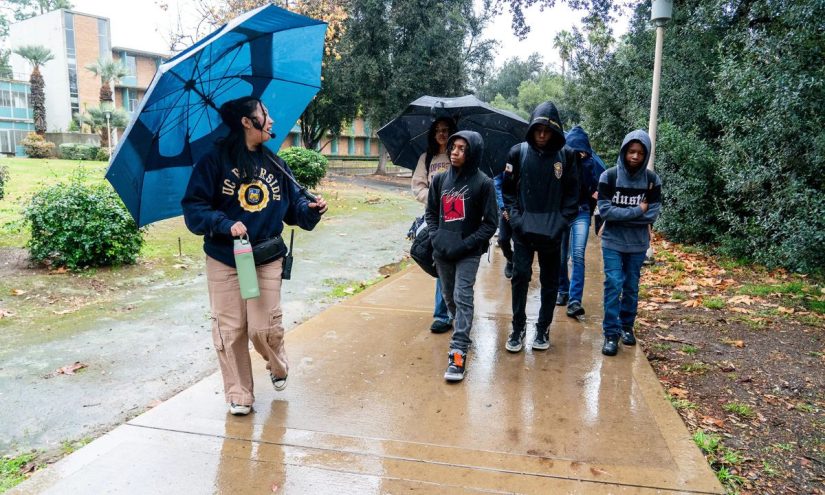
On a recent rainy day, several dozen students sat in a UC Riverside classroom, planning their path to college.
These weren’t high school seniors. They were seventh graders getting a jump-start on the competitive university application process. They’re part of a university program called the Middle School Initiative that aims to get Inland Empire students thinking about higher education long before they take their first AP class or submit an application.
With a four-year college graduation rate about half the state average of 35%, the Inland Empire is falling behind in educating students for well-paid, professional jobs, limiting the economic prospects of the region’s youngest inhabitants. In an effort to raise that ceiling, educators are trying to get tweens to envision their potential for a college education and career.
The students from Riverside middle schools discussed how to write college application essays, toured the university campus and learned about admission standards for California universities.
“I like that there’s something you can do in middle school so you can do more in high school,” said 13-year-old Simone Reid, a seventh-grader at Villegas Middle School who wants to major in business. “I want to get started early so I have more opportunities.”
UC Riverside Dean of Education Joi Spencer said she introduced the program this year to reach students who might not consider attending a university, or know how to prepare for it. Middle grades “are where kids get sorted into who’s going to go to college and who’s not,” she said.
The initiative aims to change that pattern. With an annual budget of $15,200, the program launched has so far reached 500 students, including more than 300 who joined campus tours at UC Riverside.
“Our first goal is to invoke a conversation across the Inland Empire related to university access and eventual success,” Spencer said. “First and foremost, too many youngsters do not even see university attendance as a possibility for them. This is our fault as adults and educators. We keep producing the same winners and losers in education and we need to break this cycle.”
The Middle School Initiative is open to students throughout Riverside and San Bernardino counties, with Jurupa, Moreno Valley, Alvord and Riverside Unified school districts among the first participants. Any students in the Inland Empire can participate, but in the early days of the program, administrators have prioritized students who have fallen through the cracks in class.
“Some of the students are high flyers, but are somehow overlooked in their school setting,” Spencer said. “Others may have average achievement, but high aspirations.”
The program isn’t just an introduction to college readiness. Program administrators plan to follow students along their academic journey, meeting with them throughout middle and high school and during the transition to college. They will also track college enrollment of students who participate in a related summer program called the STEAM Academy, which increases exposure to the fields of science, technology, education, art and math.
“This middle school period is the pivotal period to prepare for college,” said Elizabeth Benitez, Middle School Initiative coordinator.
For instance, she said, many middle schools have foreign language options. Taking that early, in seventh or eighth grade, can pave the way for advanced placement language classes in high school, which boost students’ grade point averages and allow them to earn credits for college.
Some students may be a step ahead because of their family background, Frances Calvin, director of the university’s Early Academic Outreach Program, told the group. During the campus workshop she asked seventh graders to raise their hands if they spoke a second language. Several responded that they spoke Spanish, Portuguese or other languages at home.
“If you speak a second language you are becoming marketable because the world is getting smaller and smaller,” Calvin said.
Students at the campus event said they clearly heard the message about academic achievement and vowed to work on raising their grade-point averages.
“I personally think I should focus more on my GPA,” said Dike Okeke, 12. “Then when I have that figured out I could find work to save for college.”
Money matters loom large for many of the students, especially those hoping to be the first in their family to attend a university. The initiative offers instruction on how to fill out financial aid forms and tips on finding scholarships. Students can come back to the program later in high school to seek help with that process, Benitez said.
“My family didn’t have the resources to experience college,” said Jeremiah Stinson, 12, who aims to study business and play college football. “I think I need to start saving money to afford this. I need to focus on a scholarship. Debt lasts forever. I don’t want to struggle with that.”
Interestingly, the seventh graders also discussed personal discipline, and almost universally acknowledged that they needed to curtail electronics use and pay attention to school.
“I also need to get rid of all my devices because I spend a lot of time on social media,” said Tatum Tobios, an aspiring fashion designer who favors Victorian Gothic styles and plans to go to art school.
Her peers nodded in agreement. How will they scale back their TikTok and Instagram habits?
Some of their solutions: “Delete the apps,” “Lock them away,” “Give it to my mom,” “Hide it from myself.”
Emma Bittner considered getting a master’s degree in public health at a nearby university, but the in-person program cost tens of thousands of dollars more than she had hoped to spend.
So she checked out master’s degrees she could pursue remotely, on her laptop, which she was sure would be much cheaper.
The price for the same degree, online, was … just as much. Or more.
“I’m, like, what makes this worth it?” said Bittner, 25, who lives in Austin, Texas. “Why does it cost that much if I don’t get meetings face-to-face with the professor or have the experience in person?”
Among the surprising answers is that colleges and universities are charging more for online education to subsidize everything else they do, online managers say. Huge sums are also going into marketing and advertising for it, documents show.
Universities and colleges “see online higher education as an opportunity to make money and use it for whatever they want to make money for,” said Kevin Carey, vice president of education and work at the left-leaning think tank New America.
Bittner’s confusion about the price is widespread. Eighty percent of Americans think online learning after high school should cost less than in-person programs, according to a 2024 survey of 1,705 adults by New America.
After all, technology has reduced prices in many other industries. And online courses don’t require classrooms or other physical facilities and can theoretically be taught to a much larger number of students, creating economies of scale.
While consumers complained about remote learning during the pandemic, online enrollment has been rising faster than was projected before Covid hit.
Yet 83 percent of online programs in higher education cost students as much as or more than the in-person versions, an annual survey of campus chief online learning officers finds. About a quarter of universities and colleges even tack on an additional “distance learning fee,” that survey found.
In addition to using the income from their online divisions to help pay for the other things they do, universities say they have had to pay more than they anticipated on advising and support for online students, who get worse results, on average, than their in-person counterparts.
Bringing down the price of a degree “was certainly a key part of the appeal” when online higher education began, said Richard Garrett, co-director of that survey of online education managers and chief research officer at Eduventures, an arm of the higher education technology consulting company Encoura.
“Online was going to be disruptive. It was supposed to widen access. And it would reduce the price,” said Garrett. “But it hasn’t played out that way.”
Related: Interested in more news about colleges and universities? Subscribe to our free biweekly higher education newsletter.
Today, online instruction for in-state students at four-year public universities costs $341 a credit, the independent Education Data Initiative finds — more than the average $325 a credit for face-to-face tuition. That adds up to about $41,000 for a degree online, compared to about $39,000 in tuition for a degree obtained in person.
Two-thirds of private four-year universities and colleges with online programs charge more for them than for their face-to-face classes, according to the survey of online managers. The average tuition for online learning at private universities and colleges comes to $516 per credit.
And community colleges, which collectively enroll the largest number of students who learn entirely online, charge them the same as or more than their in-person counterparts in 100 percent of cases, the survey of online officers found (though Garrett said that’s likely because community college tuition overall is already comparatively low).
Social media is riddled with angry comments about this. A typical post: “Can someone please explain to me why taking a course online can cost a couple $1000 more than in person?”
Online education officers respond that online programs face steep startup costs and need expensive technology specialists and infrastructure. In a separate survey of faculty by the consulting firm Ithaka S+R, 80 percent said it took them as much time, or more, to plan and develop online courses as it did in-person ones because of the need to incorporate new kinds of technology.
Online programs also need to provide faculty who are available for office hours, online advisors and other resources exclusively to support online students, who tend to be less well prepared and get worse results than their in-person counterparts. For the same reasons, many online providers have put caps on enrollment, limiting those expected economies of scale.
“You still need advisers, you still need a writing center, a tutoring center, and now you have to provide those services for students who are at a distance,” said Dylan Barth, vice president of innovation and programs at the Online Learning Consortium, which represents online education providers.
Still, 60 percent of public and more than half of private universities are taking in more money from online education than they spend on it, the online managers’ survey found. About half said they put the money back into their institutions’ general operating budgets.
Such cross subsidies have long been a part of higher education’s financial strategy, under which students in classes or fields that cost less to teach generally subsidize their counterparts in courses or disciplines that cost more. English majors subsidize their engineering classmates, for example. Big first-year lecture classes subsidize small senior seminars. Graduate students often subsidize undergrads.
“Online education is another revenue stream from a different market,” said Duha Altindag, an associate professor of economics at Auburn University who has studied online programs.
Universities “are not trying to use technology to become more efficient. They’re just layering it on top of the existing model,” said New America’s Carey, who has been a critic of some online education models.
“Public officials are not stopping them,” he said. “They’re not coming and saying, ‘Hey, we’re seeing this new opportunity to save money. These online courses could be cheaper. Make them cheaper.’ This is just a continuation of the status quo.”
Another page that online managers have borrowed from higher education’s traditional pricing playbook is that consumers often equate high prices with high quality, especially at brand-name colleges and universities.
“Market success and reputation can support higher prices,” Garrett said. It’s not what online courses cost to provide that determines the price, in other words, but how much consumers are willing to pay.
With online programs competing for customers across the country, rather than for those within commuting distance of a campus or willing to relocate to one, universities and colleges are also putting huge amounts into marketing and advertising.
An example of this kind of spending was exposed in a review by the consulting firm EY of the University of Arizona Global Campus, or UAGC, which the university created by acquiring for-profit Ashford University in 2020. Obtained through a public-records request by New America, the report found that the university was paying out $11,521 in advertising and marketing for every online student it enrolled.
The online University of Maryland Global Campus committed to spending $500 million foradvertising to out-of-state students over six years, a state audit found.
“What if you took that money and translated it into lower tuition?” asked Carey.
The online University of Maryland Global Campus is spending $500 million to market and advertise to out-of-state students over six years.
While they’re paying the same as or more than their in-person counterparts, meanwhile, online students get generally poorer success rates.
Online instruction results in lower grades than face-to-face education, according to research by Altindag and colleagues at American University and the University of Southern Mississippi — though they also found that the gap is narrowing. Students online are more likely to have to withdraw from or repeat courses and less likely to graduate on time, these researchers found, which further increases the cost.
Another study, by University of Central Florida Institute of Higher Education Director Justin Ortagus, found that taking all of their courses online reduces the odds that community college students will ever graduate.
Lower-income students fare especially poorly online, that and other research shows; scholars say this is in part because many come from low-resourced public high schools or are balancing their classes with work or family responsibilities.
Students who learn entirely online at any level are less likely to have graduated within eight years than students in general, who have a 66 percent eight-year graduation rate, data from the National Center for Education Statistics shows.
Graduation rates are particularly low at for-profit universities, which enroll a quarter of the students who learn exclusively online. In the American InterContinental University System, for example, only 11 percent of students graduated within eight years after starting, federal data shows, and at the American Public University System, 44 percent. The figures are for the period ending in 2022, the most recent for which they have been widely submitted.
Several private, nonprofit universities and colleges also have comparatively lower eight-year graduation rates for students who are online only, the data shows, including Southern New Hampshire University (37 percent) and Western Governors University (52 percent).
If they do receive degrees, online-only students earn more than their entirely in-person counterparts for the first year after college, Eduventures finds — perhaps because they tend to be older than traditional-age students, researchers speculated. But that advantage disappears within four years, when in-person graduates overtake them.
For all the growth in online higher education, employers appear to remain reluctant to hire graduates of it, according to still other research conducted at the University of Louisville. That study found that applicants for jobs who listed an online as opposed to in-person degree were about half as likely to get a callback for the job.
How strongly consumers feel that online higher education should cost less than the in-person kind was evident in lawsuits brought against universities and colleges that continued to charge full tuition even after going remote during the Covid-19 pandemic.
Yet students keep signing on. For all the complaining about remote learning at the time, its momentum seems to have beenspeeded up by the pandemic, which was followed by a 12 percent increase in online enrollment above what had been projected before it hit, according to an analysis of federal data by education technology consultant Phil Hill.
Online students save on room and board costs they would face on residential campuses, and online higher education is typically more flexible than the in-person kind.
Sixty percent of campus online officers say that online sections of classes tend to fill first, and nearly half say online student numbers are outpacing in-person enrollment.
There have been some widely cited examples of online programs with dramatically lower tuition, such as a $7,000 online master’s degree in computer science at the Georgia Institute of Technology (compared to the estimated nearly $43,000 for the two-year in-person version), which has attracted thousands of students and a few copycat programs.
There are also early signs that prices for online higher education could fall. Competition is intensifying from national nonprofit providers such as Western Governors, which charges a comparatively low average $8,300per year, and Southern New Hampshire, whose undergraduate price per credit hour is a slightly lower-than-average (for online courses) $330.
Universities have started cutting their ties with for-profit middlemen, called online program managers, who take big cuts of up to 80 percent of revenues. Nearly 150 such deals were canceled or ended and not renewed in 2023, the most recent year for which the information is available, the market research firm Validated Insights reports.
Another thing that could lower prices: As more online programs go live, they no longer require high up-front investment — just periodic updating.
“It is possible to save money on downstream costs if you offer the same course over a number of years,” Ortagus said.
A student studies on her laptop. The number of college students who learn entirely online will this year surpass the number who take all their classes in person.
While that survey of online officers found a tiny decline in the proportion of universities charging more for online than in-person classes, however, the drop was statistically insignificant. And as their enrollments continue to plummet, institutions increasingly need the revenue from online programs.
Bittner, in Texas, ended up in an online master’s program in public health that was just being started by a private, nonprofit university, and was cheaper than the others she’d found.
Her day job is at the national nonprofit Young Invincibles, which pushes for reforms in higher education, health care and economic security for young Americans. And she still doesn’t understand the online pricing model.
“I’m so confused about it. Even in the program I’m in now, you don’t get the same access to stuff as an in-person student,” she said. “What are you putting into it that costs so much?”
The Hechinger Report provides in-depth, fact-based, unbiased reporting on education that is free to all readers. But that doesn’t mean it’s free to produce. Our work keeps educators and the public informed about pressing issues at schools and on campuses throughout the country. We tell the whole story, even when the details are inconvenient. Help us keep doing that.
Canada’s college sector has welcomed a recent policy change from the IRCC stating that graduates of college degree programs will now join university students in being exempted from PGWP field of study requirements announced in October 2024.
At the time, the IRCC updated the eligibility criteria for students applying for a post-graduation work permit, allowing only college graduates from certain fields of study to apply for a PGWP, thus putting the college sector at a severe disadvantage.
The most recent revision has been hailed as a rare piece of good news for Canadian colleges, which stakeholders warned were at risk of being “decimated” by the IRCC’s eligibility criteria.
Conestoga College senior vice-president Gary Hallam said the decision was an “important step forward” for the sector, acknowledging “the excellence of our academic programming and the essential role colleges play in ensuring graduates have the skills and knowledge needed for success in today’s workforce”.
“We are particularly pleased our international students will now benefit from the breadth of our programming,” added Hallam, highlighting Conestoga’s 25 degree programs offering a blend of theory and hands-on practical learning.
The change applies to students who applied for a study permit after November 1, 2024, to pursue a college bachelor’s, master’s or doctoral degree program.
Coupled with other restrictions, the field of study requirements were already having a dramatic impact on Canadian institutions, with new international college enrolments seeing a 60% decline in 2024, triggering a stream of course closures and layoffs felt hardest in Ontario.
The IRCC’s decision… acknowledges the essential role colleges play in ensuring graduates have the skills and knowledge needed for success in today’s workforce
Gary Hallam, Conestoga College
The English and French language requirements announced last year remain in place for all PGWP applicants, and non-degree students will still have to meet the field of study requirements intended to foster greater alignment between education and labour-market needs.
Earlier this year, the IRCC added education as an eligible field of study reflecting labour market shortages across the regions in areas such as early childhood education, teaching assistance and childcare provision.
Despite some confusion regarding the wording of the IRCC’s guidance, the Canadian Bureau for International Education (CBIE) confirmed the change, and that the department was working to update its website.
Since January 2024, the IRCC has stepped up scrutiny of international student recruitment at Canadian institutions, capping international student numbers with the aim of reducing temporary residents from 6.5% of Canada’s total population to 5% by the end of 2026.