Tag: Collegis

  • 2025 Higher Ed Disruptions | Collegis Education

    2025 Higher Ed Disruptions | Collegis Education

    The coming year promises to be transformative for higher education as institutions find new ways to manage enrollment targets, operating costs, and shifting student expectations. Several existing and emerging trends have the potential to alter the higher ed landscape as we know it in 2025.

    Disruption isn’t necessarily a bad thing. It often leads to innovation and more efficient ways to meet the needs of students, faculty, and administrators. The good news is we have the tools and the know-how to address these challenges head-on. Institutions focused on building foundational capabilities in the coming months are best positioned to leverage technology effectively and position themselves for continued success.

    Here are the trends I predict will significantly impact higher ed this year and what we can do to take advantage of them.

    1. More Urgent Digital Transformation Plans
    Institutions need access to valid, reliable, and meaningful data to operate effectively. Thousands of schools still rely on proprietary, on-premise student information systems (SIS) with fragmented data sources, which limits their ability to make data-enabled decisions. Given that migrating to cloud-based solutions can take 18+ months, it’s important for schools to start the process now. Although the process is difficult given the significant change management associated with large cloud migrations, it will enable them to operate more efficiently and compete more effectively. I anticipate we’ll see SIS cloud migrations at the top of the priority lists at many institutions.

    2. Heightened Focus on Cybersecurity
    Cyber attackers have targeted higher education for years because they know they are a rich source of student and institutional data and the digital infrastructures at most schools are outdated. Hackers continue to find new ways to access networks and data, especially as the number of connected devices and applications swells. Institutions need to stay vigilant to cyber threats while also complying with various data privacy laws. I count 18 states with privacy regulations in addition to U.S. federal and European Union requirements. It’s an extremely complex situation only made more difficult by the shortage of cybersecurity professionals, especially at smaller schools. In 2025, institutions will focus on automating network security protocols and finding outside resources to augment their security capabilities.

    3. Expanded Use of Shared Services
    Smaller schools need access to the same technology and technical expertise as larger schools, just on a reduced scale with a more limited budget. I anticipate that smaller schools will seek strategic partners to manage critical IT and other specialized services to support data access, reliability, and usability. It’s a smart way to reduce costs while maintaining essential day-to-day services, enhancing security protocols, and being prepared for technology advancements.

    4. Continuation of Mergers and Acquisitions
    Financial pressures and the threat of closures will continue to drive acquisitions of some smaller schools. Mergers create significant challenges to combine the data, applications, and systems of the two institutions. However, the benefits to both sides are worth it in streamlining operations, retaining existing students, and growing enrollment. Given the breadth and depth of our functional and technical expertise, we can help schools to navigate the challenges and drive positive results.

    5. Adoption of Data-Enabled Technologies
    As institutions embrace digital transformation, they build out the foundation needed to take advantage of data-enabled technologies such as artificial intelligence (AI). With the initial hype of AI behind us, I anticipate in 2025 that schools will start to deploy AI-enabled solutions that feed off rich data sources to personalize recruitment efforts, improve retention, invigorate online classes, and predict demand for course offerings, as a few examples.

    6. Refinement of Enrollment and Retention Strategies
    The declining number of high school graduates and international enrollments continues to intensify the effort to recruit and retain students. I expect to see schools expand how they leverage data to personalize recruitment campaigns, target secondary audiences (such as adult learners and transfer students), and nurture existing students. The success of this strategy relies heavily on having the right infrastructure in place to support centralized data access, emerging technologies, and analytic tools.

    7. Shift to Career-Focused and Flexible Learning Opportunities
    Like changing recruitment and retention methods, institutions will continue to adapt their academic programs to meet the evolving needs of the workforce. They will highlight outcomes based on data about job placement rates, alumni success stories, and collaborations with area businesses to illustrate tangible benefits. They will evaluate current course offerings and pivot when it makes sense to expand hybrid learning models, professional development programs, and skill-based credentials. This effort may involve launching new programs in high-demand fields, such as data science and cybersecurity, or retooling existing programs to incorporate emerging technologies.

    8. Consolidation of Ed-tech Solution Providers
    Many higher education software and service providers have discussed how they could combine forces to serve colleges and universities better. I think we’ll see M&A activity pick up over the next two years. These consolidations will further the need for institutions to standardize business processes and accelerate cloud migrations as legacy systems will eventually become unsupported.

    I’m excited about the positive impact these eight trends might make in 2025. Higher education institutions that prioritize foundational improvements by aligning their data, technology, and talent are best suited to successfully address mounting challenges like demographic shifts and affordability concerns.

    I can’t wait to see how schools that adopt AI and predictive analytics are able to improve decision-making and enhance student experiences. However, the real breakthrough will come from integrating systems and breaking down data silos. Institutions that invest in building these foundational capabilities will be better positioned to leverage emerging technologies, drive measurable outcomes, and fulfill their mission to support lifelong learners.

    — Kim Fahey, CEO Collegis Education

    Source link

  • 2025 UPCEA Annual Conference – Collegis Education

    2025 UPCEA Annual Conference – Collegis Education

    Higher education is evolving, and institutions need innovative strategies to keep up with shifting learner expectations. That’s why Collegis Education is excited to attend the 2025 UPCEA Annual Conference, the premier event for leaders in professional, continuing, and online education. This conference brings together experts and decision-makers to explore the latest trends, technologies, and strategies that are transforming higher ed.

    Why Attend the 2025 UPCEA Annual Conference?

    This conference is a must-attend event for higher ed leaders looking to stay ahead of the curve in online learning, workforce development, and digital transformation. Key themes include:

    • Data-Driven Decision-Making – Leveraging analytics to improve student outcomes and enrollment strategies.
    • Technology & Digital Transformation – Implementing scalable solutions to enhance the student experience.
    • Workforce-Aligned Learning – Creating programs that meet the evolving needs of students and employers.
    • Marketing & Enrollment Growth – Adapting strategies to attract, engage, and retain today’s learners.

    Collegis Education brings the expertise and proven strategies to help institutions overcome enrollment challenges, optimize operations, and drive sustainable growth.

    Where to Find Us

    Our team will be on-site, ready to connect and discuss how Collegis can help your institution navigate the complexities of online education, marketing, and student success.

    Want to meet up? Let’s schedule a time to chat! Contact us to book a meeting.

    We look forward to seeing you in Denver!

    Source link

  • Graduate Enrollment Insights | Collegis Education

    Graduate Enrollment Insights | Collegis Education

    Inside the Minds of Grad Students: 5 Key Findings from Our Latest Study on Graduate Enrollment

    As a higher education leader, it’s no secret that you’re facing a fiercely competitive graduate enrollment landscape. You know as well as I do that understanding what prospective students want and how they behave isn’t just helpful – it’s crucial to your institution’s success. That’s why we teamed up with UPCEA to conduct a deep dive into today’s post-baccalaureate students, uncovering their unique needs, expectations, and wants.

    We’ve published those insights in our latest report to help colleges and universities fine-tune their graduate enrollment strategies and deliver real results. You can download the complete report here: Building a Better Pipeline: Enrollment Funnel Needs and Perspectives from Potential Post-Baccalaureate Students

    Our research focused on individuals who expressed at least some interest in pursuing advanced education, and this study sheds light on what matters most to potential graduate students—everything from program types and communication preferences to application expectations.

    As we dug into the data, some obvious themes emerged. Here are five key findings that can prepare your institution to stand out in this tight market and guide you in shaping strategies that resonate, engage, and deliver results.

    5 insights to sharpen your graduate enrollment strategy

    1. Graduate enrollment is a crowded market—and the stakes are high

    This is no surprise to those working in higher ed in recent years. Graduate enrollment is slowing, with just a 1.1% projected increase over the next five years. Adding to the challenge, 20% of institutions dominate 77% of the market. For everyone else, it’s a fierce battle for a shrinking pool of candidates. To win, you’ll need a sharp, focused approach.

    2. Online programs are the clear favorite

    Did you know that 71% of prospective students are “extremely” or “very” interested in fully online programs? Hybrid formats come in a close second, while traditional in-person options are struggling to keep pace. The data confirms that flexibility isn’t a trend—it’s a necessity.

    3. Program information is a make-or-break factor

    Here’s something we see far too often: quality programs losing prospective students simply because critical details—like tuition costs and course requirements—are buried or missing entirely from the school’s website. In fact, 62% of students indicated they would drop off early in their search for this exact reason.

    The fix? It’s simpler than you might think. By optimizing your program pages and doubling down on SEO, you can turn passive visitors into engaged prospects.

    4. Financial transparency builds trust

    Sticker shock is real. High application fees, vague cost information, and limited financial aid details are among the top reasons students abandon the application process late in the game. By addressing these concerns clearly and directly, you’re not just solving a problem, you’re building trust.

    5. Email is still king

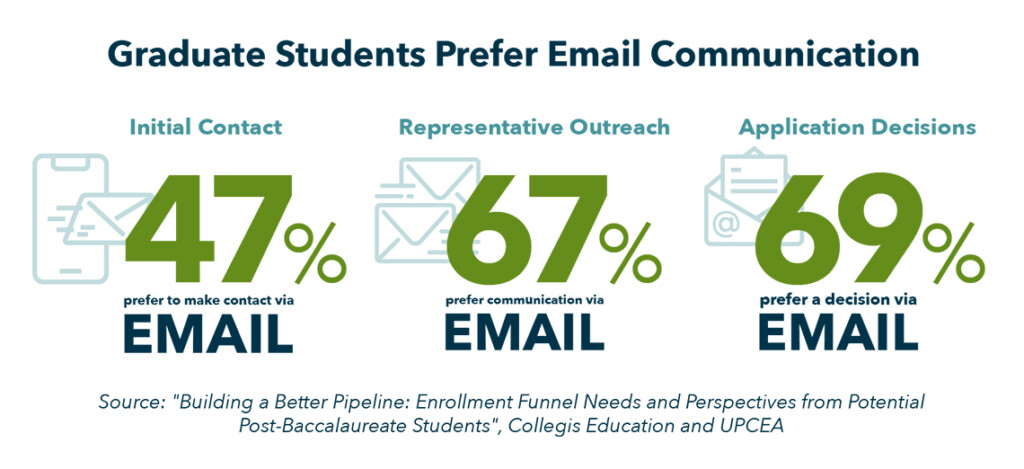
    When it comes to connecting with prospective graduate students, email reigns supreme. Whether it’s inquiring about programs (47%), application follow-ups (67%), or receiving application decisions (69%), email is the channel students trust the most.
    But here’s the catch: your emails have to be timely, personalized, and relevant in order to make an impact.

    The key to graduate enrollment success is just a click away

    The insights highlighted above are just the tip of the iceberg. Imagine what’s possible when you apply them to your graduate enrollment strategy.

    If you’re ready to refine your approach and stay ahead of the curve, we’ve got you covered. Our report dives deeper into the data and uncovers actionable insights, including:

    • Positioning your online and hybrid offerings to meet growing demand
    • Optimizing program pages to emphasize the information students value most
    • Communicating financial information proactively to convert candidates
    • Building email outreach strategies that build trust and keep students engaged

    Grab your complimentary copy of the report today, and let’s start building a better pipeline together!

    Your roadmap to winning in the competitive graduate market.

    Source link

  • Graduate Student Pipeline | Collegis Education

    Graduate Student Pipeline | Collegis Education

    Despite an increasingly competitive market, many colleges and universities still view graduate enrollment strategies as a key growth lever for their institutions. To win in the graduate enrollment space, you first need a deeper understanding of prospective graduate students’ preferences and behaviors.

    This infographic, “What Potential Graduate Students Expect in the Enrollment Funnel,” compiles some of the key data and insights from our recent collaboration with UPCEA that surveyed graduate students to uncover their needs and expectations, focusing on program preferences, delivery methods, and expectations during the inquiry and application processes.

    This infographic is only the tip of the iceberg. Learn more about how to tailor your graduate student recruitment strategies and position your programs for success and growth in our recent report, “Building a Better Pipeline: Enrollment Funnel Needs and Perspectives from Potential Post-Baccalaureate Students.”

    Source link

  • 2024 Growth & Innovation | Collegis Education

    2024 Growth & Innovation | Collegis Education

    As 2024 draws to a close, the holiday season inspires gratitude and reflection. Personally, I’m very grateful for the incredible partners and colleagues I’ve had the privilege to work with this year. Together, we accomplished so much.

    • We collaborated with our partners throughout the year to deliver great experiences for their students, alumni, and staff.
    • We collectively navigated some of higher education’s biggest challenges, driving partner growth and enabling impact.
    • We pushed the boundaries of innovation, embracing the power of data-enabled technologies.

    I’m so proud of the positive impact the Collegis team generated with our partners across the entire student lifecycle, from the moment prospective students first inquire about a program to the day they graduate.

    Let’s look back at some of 2024’s meaningful results

    Recruitment and Enrollment Growth

    We supported double-digit year-over-year (YoY) enrollment growth –– as high as 57% –– for many partner institutions in first-year, program-specific, transfer, and graduate populations. Engagement from our enrollment teams was instrumental in connecting students with the right programs and guiding them through the admissions process.

    IT Managed Services and Student Support

    Our IT team ensured seamless operations, providing reliable technology solutions that empower students and faculty. Some of my favorite examples from 2024 include:

    • Integrating systems to drive process improvement across enrollment, financial aid, academics, and career services.
    • Modernized campus infrastructures and networks to drive student engagement at a college’s main hall.
    • Significantly improved student experience by implementing a user-friendly, single sign-on (SSO) solution across student-facing systems.
    • Led an institution through a critical component of its digital transformation journey by migrating its on-premise, legacy ERP to a cloud-based, next-generation solution.

    Innovative Learning Experiences

    Our instructional design team enabled partners to grow their online course offerings on platforms such as Brightspace, Canvas, Coursera, and Blackboard Ultra, including course and online library development, course migrations, maintenance, faculty support, and term start/end deployment activities.

    We collaborated with the nursing program at one partner to revamp the entire library of online courses to meet new accreditation standards. Another partner was able to add 200 online courses to fill the needs of 13 online programs at three schools.

    Marketing Impact

    Our web team conducted a user survey and other research to refine a partner’s website, which increased clicks to inquire by 82%, the request for information (RFI) click rate to 71%, and clicks to apply by 7.5%.

    Another shining example was uncovering a way to target a healthcare provider’s employees who are eligible for a tuition discount. Because of healthcare regulations, the partner could not provide an audience list, so Collegis addressed this niche audience using in-platform targeting tools available on social media platforms. The return on ad spend (ROAS) is 2.2:1 overall in 2024 with plans to expand the program next year.

    Student Success

    Our student support team provided essential services to help students thrive and continue to pursue their academic goals.

    • At a public, four-year institution in Ohio, Collegis Student Success Coaches helped new students with the registration process, driving admit-to-enroll numbers and YOY growth of +66% in Fall 2024.
    • At a private, four-year institution in Texas, Fall retention was 97%, with a 90% retention rate since the partnership launched.
    • At a private, four-year institution in New York, term-over-term retention from Summer to Fall is 96%, with a 91% average retention rate since the partnership launched.
    • At a public, two-year institution in the Pacific Northwest, Collegis helped drive the sixth consecutive term of enrollment growth, with Fall enrollment trending toward +8%.

    Research and Portfolio Planning

    Because we are ingrained in every step of the student lifecycle, partners often ask us to assist with forward-looking strategies. For example, our team helped a partner understand the pros and cons of expanding their full-time Accelerated Bachelor of Science in Nursing (ABSN) with a part-time program. With our marketplace analysis, recommendations for how to offer courses, and a marketing launch plan, the institution is currently accepting applications for Summer 2025.

    Another institution asked for Collegis’s assistance to develop a multi-year strategic approach to graduate enrollments. The partner’s team lead noted that, “[Collegis] led productive brainstorming and strategic planning sessions with the team. Their deep knowledge of graduate enrollment trends, market analysis for graduate programs and expertise in leading our team from conceptualization to the delivery of specific recommendations on our next steps were invaluable.”

    Strategic Innovation and Workshop Design

    Our strategy and solutions team helped colleges and universities unpack complex problems and find innovative, human-centered solutions. We architected and facilitated numerous design thinking workshops, guiding leadership teams through critical strategic discussions about the future of their institutions. I’ll let some of the participants of the workshops explain the value they got out of the sessions:

    • “Collegis didn’t just help us evaluate our processes — they led us on a journey to uncover areas of improvement we hadn’t even considered. Their expert guidance illuminated the path forward, empowering us to create a more positive, streamlined, and truly enjoyable student experience.”
    • “My team and I were thoroughly impressed with your ability to take what essentially was a speck of an idea and collaboratively ideate possibilities for [the university] to offer new academic programs and training to underserved high school populations.”
    • “Collegis took the time to meet with leadership prior to the sessions and came prepared to tackle the challenges at the college. The activities were well thought-out and allowed individuals time to really think about the core issues. Thanks to Collegis, I am hopeful that our college can make key changes that will benefit our student experience and lighten our faculty/staff workload.”

    Looking Forward

    As you can see, 2024 has been a year of growth, innovation, and collaboration. We are grateful for the opportunity to work with our partners and look forward to even greater achievements in the years to come.

    I’d like to extend my sincere gratitude to my Collegis colleagues, who amaze me with their creativity, expertise, and dedication to delivering exceptional results. I can’t wait to see what you do in 2025 to continue inspiring each other and driving growth for our partners.

    Happy Holidays and best wishes for a prosperous New Year!

    — Kim Fahey, CEO Collegis Education

    Source link

  • 2025 Higher Ed Disruptions | Collegis Education

    2025 Higher Ed Disruptions | Collegis Education

    As 2024 draws to a close, the holiday season inspires gratitude and reflection. Personally, I’m very grateful for the incredible partners and colleagues I’ve had the privilege to work with this year. Together, we accomplished so much.

    • We collaborated with our partners throughout the year to deliver great experiences for their students, alumni, and staff.
    • We collectively navigated some of higher education’s biggest challenges, driving partner growth and enabling impact.
    • We pushed the boundaries of innovation, embracing the power of data-enabled technologies.

    I’m so proud of the positive impact the Collegis team generated with our partners across the entire student lifecycle, from the moment prospective students first inquire about a program to the day they graduate.

    Let’s look back at some of 2024’s meaningful results

    Recruitment and Enrollment Growth

    We supported double-digit year-over-year (YoY) enrollment growth –– as high as 57% –– for many partner institutions in first-year, program-specific, transfer, and graduate populations. Engagement from our enrollment teams was instrumental in connecting students with the right programs and guiding them through the admissions process.

    IT Managed Services and Student Support

    Our IT team ensured seamless operations, providing reliable technology solutions that empower students and faculty. Some of my favorite examples from 2024 include:

    • Integrating systems to drive process improvement across enrollment, financial aid, academics, and career services.
    • Modernized campus infrastructures and networks to drive student engagement at a college’s main hall.
    • Significantly improved student experience by implementing a user-friendly, single sign-on (SSO) solution across student-facing systems.
    • Led an institution through a critical component of its digital transformation journey by migrating its on-premise, legacy ERP to a cloud-based, next-generation solution.

    Innovative Learning Experiences

    Our instructional design team enabled partners to grow their online course offerings on platforms such as Brightspace, Canvas, Coursera, and Blackboard Ultra, including course and online library development, course migrations, maintenance, faculty support, and term start/end deployment activities.

    We collaborated with the nursing program at one partner to revamp the entire library of online courses to meet new accreditation standards. Another partner was able to add 200 online courses to fill the needs of 13 online programs at three schools.

    Marketing Impact

    Our web team conducted a user survey and other research to refine a partner’s website, which increased clicks to inquire by 82%, the request for information (RFI) click rate to 71%, and clicks to apply by 7.5%.

    Another shining example was uncovering a way to target a healthcare provider’s employees who are eligible for a tuition discount. Because of healthcare regulations, the partner could not provide an audience list, so Collegis addressed this niche audience using in-platform targeting tools available on social media platforms. The return on ad spend (ROAS) is 2.2:1 overall in 2024 with plans to expand the program next year.

    Student Success

    Our student support team provided essential services to help students thrive and continue to pursue their academic goals.

    • At a public, four-year institution in Ohio, Collegis Student Success Coaches helped new students with the registration process, driving admit-to-enroll numbers and YOY growth of +66% in Fall 2024.
    • At a private, four-year institution in Texas, Fall retention was 97%, with a 90% retention rate since the partnership launched.
    • At a private, four-year institution in New York, term-over-term retention from Summer to Fall is 96%, with a 91% average retention rate since the partnership launched.
    • At a public, two-year institution in the Pacific Northwest, Collegis helped drive the sixth consecutive term of enrollment growth, with Fall enrollment trending toward +8%.

    Research and Portfolio Planning

    Because we are ingrained in every step of the student lifecycle, partners often ask us to assist with forward-looking strategies. For example, our team helped a partner understand the pros and cons of expanding their full-time Accelerated Bachelor of Science in Nursing (ABSN) with a part-time program. With our marketplace analysis, recommendations for how to offer courses, and a marketing launch plan, the institution is currently accepting applications for Summer 2025.

    Another institution asked for Collegis’s assistance to develop a multi-year strategic approach to graduate enrollments. The partner’s team lead noted that, “[Collegis] led productive brainstorming and strategic planning sessions with the team. Their deep knowledge of graduate enrollment trends, market analysis for graduate programs and expertise in leading our team from conceptualization to the delivery of specific recommendations on our next steps were invaluable.”

    Strategic Innovation and Workshop Design

    Our strategy and solutions team helped colleges and universities unpack complex problems and find innovative, human-centered solutions. We architected and facilitated numerous design thinking workshops, guiding leadership teams through critical strategic discussions about the future of their institutions. I’ll let some of the participants of the workshops explain the value they got out of the sessions:

    • “Collegis didn’t just help us evaluate our processes — they led us on a journey to uncover areas of improvement we hadn’t even considered. Their expert guidance illuminated the path forward, empowering us to create a more positive, streamlined, and truly enjoyable student experience.”
    • “My team and I were thoroughly impressed with your ability to take what essentially was a speck of an idea and collaboratively ideate possibilities for [the university] to offer new academic programs and training to underserved high school populations.”
    • “Collegis took the time to meet with leadership prior to the sessions and came prepared to tackle the challenges at the college. The activities were well thought-out and allowed individuals time to really think about the core issues. Thanks to Collegis, I am hopeful that our college can make key changes that will benefit our student experience and lighten our faculty/staff workload.”

    Looking Forward

    As you can see, 2024 has been a year of growth, innovation, and collaboration. We are grateful for the opportunity to work with our partners and look forward to even greater achievements in the years to come.

    I’d like to extend my sincere gratitude to my Collegis colleagues, who amaze me with their creativity, expertise, and dedication to delivering exceptional results. I can’t wait to see what you do in 2025 to continue inspiring each other and driving growth for our partners.

    Happy Holidays and best wishes for a prosperous New Year!

    — Kim Fahey, CEO Collegis Education

    Source link