Tag: Communications

  • Transparency and truth in communications

    Transparency and truth in communications

    Key points:

    Dear Superintendent,

    Your job now requires a new level of transparency that you are reluctant to provide. This media crisis will burn for several more days if we sit silent. We are in a true leadership moment and I need you to listen to your communications expert. I can make your job easier and more successful.

    Signed,

    Your Communications Director

    As superintendents come under more political fire and frequent negative news stories about their school districts circulate, it is easy to see where the instinct to not comment and just focus on the work might kick in. However, the path forward requires a new level of transparency and truth-telling in communications. In fact, the work requires you to get out in front so that your teachers and staff can focus on their work.

    I recently spoke with a school district facing multiple PR crises. The superintendent was reluctant to address the issues publicly, preferring one-on-one meetings with parents over engaging with the media or holding town hall-style parent meetings. But when serious allegations of employee misconduct and the resulting community concerns arise, it’s crucial for superintendents to step forward and take control of the narrative.

    While the details of ongoing human resources or police investigations cannot be discussed, it’s vital to inform the community about actions being taken to prevent future incidents, the safeguards being implemented, and your unwavering commitment to student and staff safety. All of that is far more reassuring than the media reporting, “The district was not available for comment,” “The district cannot comment due to an ongoing investigation,” or even worse, the dreaded, “The school district said it has no comment.”

    Building trust with proactive communication

    A district statement or email doesn’t carry the same weight as a media interview or an in-house video message sent directly to community members. True leadership means standing up and accepting the difficult interviews, answering the tough questions, and conveying with authentic emotion that these incidents are unacceptable. What a community needs to hear is the “why” behind a decision so that trust is built, even if that decision is to hold back on key information. A lack of public statement can be perceived as indifference or a leadership void, which can quickly threaten a superintendent’s career.

    Superintendents should always engage with the media during true leadership moments, such as district-wide safety issues, school board meetings, or when the public needs reassurance. “Who Speaks For Your Brand?” looks at a survey of 1,600 school staff who resoundingly stated that the superintendent is the primary person responsible for promoting and defending a school district’s brand. A majority of the superintendents surveyed agreed as well. Promoting and defending the district’s brand includes the negative–but also the positive–opportunities like the first day of school, graduation, school and district grade releases, and district awards.

    However, not every media request requires the superintendent’s direct involvement. If it doesn’t rise to the severity level worthy of the superintendent’s office, an interview with a department head or communications chief is a better option. The superintendent interview is reserved for the stories we decide require it, not just because a reporter asks for it.  Reporters ask for you far more than your communications chief ever tells you.

    It is essential to communicate directly and regularly with parents through video and email using your district’s mass communication tools. You control the message you want to deliver, and you don’t have to rely on the media getting it right.  This is an amazing opportunity to humanize the office.  Infuse your video scripts with more personality and emotion to connect on a personal level with your community. It is far harder to attack the person than the office. Proactive communications help build trust for when you need it later.

    I have had superintendents tell me that they prefer to make their comments at school board meetings. School board meeting comments are often insufficient, as analytics often indicate low viewership for school board meeting live streams or recordings.  In my experience, a message sent to parents through district alert channels far outperforms the YouTube views of school board meetings.

    Humanizing the superintendent’s role

    Superintendents should maintain a consistent communications presence via social media, newsletters, the website, and so on to demonstrate their engagement within schools. Short videos featuring interactions with staff and students create powerful engagement opportunities. Develop content to create touch points that celebrate the contributions of nurses, teachers, and bus drivers, especially on their national days of recognition. These proactive moments of engagement show the community that positive moments happen hourly, daily, and weekly within your schools.

    If you are not comfortable posting your own content, have your communications team ghostwrite posts for you. You never want a community member asking, “What does the superintendent do all day? We never see them.” If you are posting content from all of the school visits and community meetings you attend, that accusation can never be made again. You now have social proof of your engagement efforts and evidence for your annual contract review.

    Effective communication is a superintendent’s superpower. Those who can connect authentically and show their personality can truly shine. Many superintendents mistakenly believe that hard work alone will speak for itself, but in today’s politically charged landscape, a certain amount of “campaigning” is necessary while in office. We all know the job of the superintendent has never been harder, tenure has never been shorter, and the chance of being fired is higher than ever.

    Embrace the opportunity to engage and showcase the great things happening in your district. It’s worth promoting positive and proactive communications so that you’re a seasoned pro when the challenging moments come. There might just be less of them if you get ahead.

    Latest posts by eSchool Media Contributors (see all)

    Source link

  • Report highlights growing movement to elevate student voice in school communications

    Report highlights growing movement to elevate student voice in school communications

    Key points:

    As K-12 leaders look for ways to strengthen trust, engagement, and belonging, a growing number of districts are turning to a key partner in the work: their students.

    A new national report from the National School Public Relations Association (NSPRA) and SchoolStatus reveals that districts that incorporate student voice into their communication strategies–through videos, messaging, and peer-created content–are seeing real results: stronger family engagement, increased student confidence, and more authentic school-community connection.

    The report, Elevating Student Voice in School Communications: A Data-Informed Look at Emerging Practices in School PR, is based on a spring 2025 survey, which received 185 responses from K-12 communications professionals. It includes real-world examples from school districts to explore how student perspectives are being incorporated into communication strategies. It highlights the growing use of first-person student storytelling, direct-to-student messaging, and student internships as strategies to build trust, improve engagement, and strengthen school-community relationships.

    “School communicators do more than share information. They help build connection, trust, and belonging in our communities,” said Barbara M. Hunter, APR, Executive Director of NSPRA. “Elevating student voice is not just a feel-good initiative. It is a powerful strategy to engage families, strengthen relationships, and improve student outcomes.”

    Key findings include:

    • Video storytelling leads the way: 81 percent of districts using student voice strategies rely on video as their primary format.
    • Direct communication with students is growing, but there is room for improvement in this area: 65 percent of districts report at least some direct communication with students about matters that are also shared with families, such as academic updates, behavioral expectations or attendance
      • However, just 39 percent of districts copy students on email messages to families, and just 37 percent include students in family-teacher conferences, allowing them to be active participants
    • Internships on the rise: 30 percent of districts now involve students as interns or communication ambassadors, helping create content and amplify student perspectives
    • Equity efforts around student storytelling vary significantly. While some districts say they intentionally recruit students with diverse perspectives, fewer encourage multilingual storytelling or provide structured support to help students share their stories

    Early results are promising: Districts report improved engagement, stronger student confidence, and more authentic communication when students are involved.

    • 61 percent of districts that track comparisons report student-led content generates higher engagement than staff-created communications
    • 80 percent of respondents observe that student voice positively impacts family engagement
    • A majority (55 percent) said direct communication with students improves academic outcomes

    Building Inclusive Student Voice Strategies
    The report outlines a three-part approach for districts to strengthen student voice efforts:

    • Start with student presence by incorporating quotes, videos, and creative work into everyday communications to build trust and visibility
    • Develop shared ownership through internships, ambassador programs, and student participation in content creation and feedback
    • Build sustainable systems by aligning student voice efforts with district communications plans and regularly tracking engagement

    The report also highlights inclusive practices, such as prioritizing student consent, offering mentorship and support for underrepresented students, featuring diverse stories, involving student panels in review processes and expanding multilingual and accessible communications.

    “When districts invite students to take an active role in communication, it helps create stronger connections across the entire school community,” said Dr. Kara Stern, Director of Education for SchoolStatus. “This research shows the value of giving students meaningful opportunities to share their experiences in ways that build trust and engagement.”

    The report also explores common challenges, including limited staff time and capacity, privacy considerations and hesitancy around addressing sensitive topics. To address these barriers and others, it offers practical strategies and scalable examples to help districts start or expand student voice initiatives, regardless of size or resources.

    This press release originally appeared online.

    eSchool News Staff
    Latest posts by eSchool News Staff (see all)

    Source link

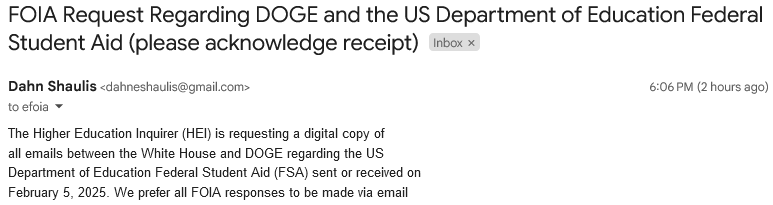
  • Higher Education Inquirer Investigating White House, DOGE Communications

    Higher Education Inquirer Investigating White House, DOGE Communications

     
    The Higher Education Inquirer (HEI) is investigating email communications between the White House and DOGE regarding the US Department of Education Federal Student Aid (FSA).  HEI has been using FOIA responses for a number of years to expose corruption in the US higher education business. The White House has 20 days to acknowledge receipt. We will let you know if and when we get any responses from the White House.  

    Source link

  • 2025 Trends in Marketing and Communications

    2025 Trends in Marketing and Communications

    Given my first job out of university was with Vichy L’Oreal where I served briefly as a junior product manager (because I was worth it) I tend to keep an eye of marketing and communication trends, always a moving target. As soon as one has upskilled, or briefed a sub-contractor, the goalposts have moved once again. Nonetheless, largely driven by the furious pace of technological advancements, and the slower shifts in social behaviours, we have seen several trends in 2024.

    Platforms like TikTok, Instagram Reels, and YouTube Shorts have continued to rise to dominance in the social media space, with brands leveraging these formats to create engaging, bite-sized content in the form of short-form video content. Alongside this we have seen commercial organisations allocate significant budgets to creator marketing, where influencers and content creators play a significant role in promoting products and services. The two trends together are just now beginning to be leveraged by universities, and to a lesser extent schools, by encouraging students and staff to generate marketable, authentic, content.

    Another trend of 2024 has been the nascent use of AI and marketing science to finetune marketing strategies and generate targeted personalise content. This, alongside with focussing on omnichannel, consolidated, messaging regardless of the device or platform promises to be a cost saving approach once embedded.

    Everyone is fighting for brand recognition more than ever, so it is not surprising that we see several educational institutions, at all levels, exploring new branding avenues.

    As we look forward to 2025, we can already identify several new trends emerging in marketing and communications. Ubiquitous debate about AI and Machine Learning promises to dominate, particularly as it relates to the regulation of responses to sales queries by AI tools. These should produce a wealth of insights into marketing content creation for those organisations that successfully close the loop.

    The increasing use voice search across platforms requires institutions to think about how their ‘audio-brand’ runs in a crowded space. If the organisation is the ‘London School of Economics and Political Science’ but everyone who is already in the know says ‘LSE’, not problem. What about those that don’t?

    The web is awash with predictions about the impact of AR and VR for 2025, but having presented at a conference in 2019 on AR/VR and Learning Design, and being assured that universal adoption was within 12-18 months… I am still holding my breath. There are great examples of 3D campus walk-throughs, and I suspect for most that works well enough.

    The focus for everyone in marketing and communications, in education as much as elsewhere, will (almost) undoubtedly be on the importance of innovation and authenticity. The trend that keeps giving.

    Source link

  • Innovative and Engaging Communications in and Beyond the Academy – GlobalHigherEd

    Innovative and Engaging Communications in and Beyond the Academy – GlobalHigherEd

    Editor’s note: this guest entry has been kindly developed by Gisèle Yasmeen, Ph.D., Senior Fellow, Institute of Asian Research, University of British Columbia, Canada. Dr. Yasmeen raises a series of important issues in the build-up to a call for a “structured dialogue” on the nature and role of knowledge in society.

    ~~~~~

    Innovative and Engaging Communications in and Beyond the Academy

    Gisèle Yasmeen, University of British Columbia

    Research and scholarship is primarily about asking and answering questions as well as conserving and constantly reinterpreting fragile and easily forgotten knowledge. When I started graduate studies more than 25 years ago, there was no talk of the world wide web, no blogs, no Twitterverse, Facebook, Academia.edu and so on. I grew up in an era of card catalogues, photocopying, typewriters and hand-written letters with supervisors and collaborators. My first experience with computers was with a mainframe “Amdahl” where you had to learn complex codes to do simple word-processing! I am convinced that the dramatic communications revolution we are experiencing is and will continue to transform research, teaching and academe beyond anything we are familiar with now in the next twenty years. So, how might we succinctly envision these changes and start to prepare for the scholarly world of the possible future? Or as I was asked recently by a university Vice-President of Research, “what are the implications of digital media for post-secondary institutions?”

    Many of us are still getting our heads around these questions – myself included – and follow with great interest the work of those like John Willinsky, Leslie Chan, and John Wilbanks. The purpose of this article is, therefore, to reflect on the actual and potential role of ICTs in research, teaching and scholarly communication, and to humbly offer in the conclusion my own suggestion that the time has come for a new “knowledge commission.” Hence, the intended audience is those who are new to the file and others who may be wondering, where could we take it from here?

    Research: the importance of ICTs for asking and answering questions

    New media tools in general – and high performance computing in particular – enable us to mine vast quantities of data (numeric, text, images, sound) at lightening speed compared to the past, which enables not only research questions to be answered but new research questions to be asked, which could not be asked before. This exciting approach to (re)discovery is at the forefront of a variety of (inter/multi/trans)disciplines ranging from bio-informatics and social statistics to the digital humanities. Examples of ICTs, “big data” and other emerging technologies leading to research breakthroughs in the natural and health sciences are well known. Most of us are familiar with the Higgs boson or “God-particle” confirmed through the CERN Hadron collider and revolutionary work on human genomics through the “barcode of life” dataset. What is perhaps less known is the growing use and study of emerging technologies in the social sciences and humanities. For example, advanced imaging technologies allowed literary scholars funded by the National Endowment of the Humanities to read and analyse an illegible and deteriorated copy of explorer David Livingstone’s diary, as reported by the New York Times. The study and use of emerging technologies, such as advanced ICTs is predicated on the development of appropriate tools for research and, as Clifford Lynch eloquently argued last year, the builders of those tools often do not get the respect they deserve as necessary “enablers” in the world of research compared to those who spend time using those tools.

    In fact, the concept of what is a “discipline” is worth reflecting on in an era of joint faculty appointments between computer science and literature or philosophy and the growing number of innovative instructional programs that combine information technology, creative arts and business. What are the implications of this for institutional and program design? After all, as the English language Wikipedia entry on academic discipline, drawing from the Encyclpaedia Britannica reminds us, “The University of Paris in 1231 consisted of four faculties: Theology, Medicine, Canon Law and Arts”. We need to be vigilant about how we classify and institutionalise structures of knowledge, particularly in an era of rapidly evolving collaboration between knowledge communities. Karoline Postel-Vinay of Sciences Po, at a recent Asian studies conference in Paris, encouraged participants to challenge our currently established conceptualizations of disciplines and areas of research.

    Digital media is also facilitating communication and collaboration between researchers in specialised fields in order to collectively advance and explore knowledge and is also enabling interaction with communities and experts beyond post-secondary institutions leading to the growth of “citizen science” and inter-sectoral modes of knowledge production (ie the co-creation of knowledge with “lay” collaborators). Hence, the issue of where legitimate knowledge lies and audience is an evolving one – or is it? Perhaps we need to begin by refuting the ivory tower myth. The walls of universities are and have always been porous for faculty and students. Virginia Woolf attended Oxford as one of the first women on campus and historical examples abound regarding restrictions on enrolment with respect to certain minorities either not accessing the hallowed halls of advanced education or being subject to quotas. Thankfully, this has changed for the better though barriers for many still remain, as many scholars argue. This is yet another reason to have a discussion on what is legitimate knowledge and how to structure our institutions around questions of its generation, conservation, transmission and value-addition – including reinterpretation.

    Furthermore, students are the single-biggest “export of universities”. One of the fundamental purposes of higher education and research is to foster the development of the next generation as well as be challenged by the innovative ideas of youth. The Socratic dialogue continues to this day and is a necessary step in the growth and development of ideas on an individual and collective level. Young people graduate and go on to lead productive lives across the public, private and not-for-profit sectors as well as the academic world.

    What we may be seeing accelerated via ICTs is an increasing blurring of boundaries with respect to knowledge intended for and/or accessed by academic audiences as well as those beyond. Data-intensive research is an area where we see sometimes very esoteric research questions being resourced and explored through digital means (e.g. medieval languages and literature) with user groups as well as commentators and “content providers” going well beyond academe. This might be compared to marketing a niche product to a global audience as well as sourcing suppliers through a global, often volunteer, network. The possibilities are endless.

    However, with ICTs, as with all tools, there is always a “dark side”. There are concerns and critiques by longstanding observers of emerging and disruptive technologies, such as Heather Menzies, of the negative impacts of “real time” communications and the sometimes-associated lack of depth, reduced attention spans, and difficulty to maintain meaningful inter-subjectivity. It is said that 80-90% of human communication remains non-verbal, hence we need to be vigilant and attentive to the dynamics of learning, thought and social interaction through emerging multidisciplinary fields such as cognitive neuroscience. We need to see new media as one tool, for knowledge generation and sharing but, by no means, the only one.

    A central challenge now confronting the scholarly community is how to assess the quality and impact of various types of content accessible to potentially millions of readers and commentators. This includes the conundrum of what to do with “user-generated” or self-published content. Furthermore, how do we conceptualize and classify who is a “peer” and their commentary on one’s work in various contexts given the accelerated blurring of boundaries between the academic, public, private and not-for-profit sectors? Who best plays the curatorial role of quality control in the information deluge? These are some of the fundamental and normative questions facing the world of research and scholarship, which the following section will attempt to unpack, at least in a preliminary way.

    Knowledge sharing – maximising value from good quality knowledge

    The previous section focused on “research”, commonly thought of as (re)discovery and analysis, but how does knowledge get documented, vetted, shared, commented-upon and preserved for present and future generations?   It goes without saying that teaching in its many, rapidly evolving forms – is primarily a form of knowledge transmission and, I would argue, two way exchange between generations. Others have written in great detail about the impact of ICTs on teaching, especially the growth of on-line learning, MOOCs, Khan Academy and the like so I will not go into detail about this topic here. Suffice it to say that ICTs are having a significant impact teaching in post-secondary institutions – some of which are having difficulty rising to the challenge. Rather, I’d like to focus on the impact of ICTs on scholarly publishing and debates on how to assess the quality published output, without expecting to resolve this complex conundrum.

    Bibliometrics, impact factors and indices such as the H-Index are, on the one hand, gaining importance and, on the other, coming under greater scrutiny for sometimes excluding entire scholarly communities such as humanities scholars who typically write books and those with a policy orientation who often produce “grey literature” such as technical and policy-oriented reports. In addition, there have been scandals of peer review “rings” in journals trying to enhance their impact factor. There is a tautology built into the issue of impact factor, namely that a more accessible publication tends to have wider readership and citations. Public Library of Science, or PLOS, a not-for profit publisher of open access journals that accepts roughly 70% of its peer-reviewed manuscripts and has a relatively high impact factor since it’s journals are open access. Articles rejected by PLOS journals often get published elsewhere so a general discussion on the meaning of acceptance and rejection rates are probably needed. John Willinsky also noted in a recent interview that PLOS requirements to include open access data also forces researchers to think through the quality of the datasets used to support their publications. How, therefore, to meaningfully establish the quality and impact of a publication?

    The growing “open” movement, which includes open access (OA) publishing, open source technologies and open data are revolutionizing the scholarly enterprise by being based on the premise that knowledge is a public good – particularly when it is publicly-funded – and that the outputs of research and related activities should be freely available, without charge, ideally on the internet. Part of rising to the “open” challenge is an infrastructural one but this is improving through the creation of OA platforms at the institutional level. The importance of open access to research results (journals and books) as well as raw datasets (numeric, text, images and sound) is hugely important to both the world of research and broader society and lead to greater readership and impact. One concrete example to note is when a number of Québec journals dramatically increased their readership within a few years when they went OA by joining the Ėrudit platform. Another example is the journal RNA Biology requiring several years ago that all its authors to submit their abstracts to Wikipedia. Another “open” phenomenon to mention is the growth of open peer review– strongest in the health world – where open access publishers are employing fully transparent processes in their review of articles. In other words, the identity of the reviewer is disclosed, as are his or her comments on the article being submitted, the author – and others for that matter – can respond and comment. We will likely be seeing more of this type of review and resulting publications.

    Conclusion – Dialogue on the nature and role of knowledge in society

    I recently published an article on scholarly and research infrastructure in the new 2nd edition of the International Encyclopedia of the Social and Behavioural Sciences, which begins to expand established knowledge boundaries to include an unprecedented number of contributions by non-Americans, women, non-anglophones, and minorities to get a more complete picture of contemporary scholarship. The next step would be to give more serious thought to the idea of “knowledge commissions”. Examples – some considered more successful than others – include the Indian Knowledge Commission as well as Canada’s Massey Commission in the 1950s, which ultimately led to the creation of national research funding infrastructure. Given advances in technology and associated virtual and intersectoral communities of interest, practice and purpose, are we at the point where we need to establish such knowledge commissions to review the place of knowledge in society and the institutions that support its creation, conservation and transmission/exchange? New media tools have enabled us to interact in real time on a regular basis with like-minded others around the world via exchange of knowledge and information in multiple directions. This helps researchers gather and curate precious information and often engages “fellow travellers” in the public, private and not-for-profit sectors. New collective voices are emerging, which were not heard before. Yes, it’s time for a structured dialogue.

    The author would like to acknowledge Chad Gaffield and Kris Olds for constructive comments on an earlier version of this article


    Source link