Job interviews have become significantly more formulaic and predictable. Employers seem to increasingly favor standardized or structured interviews, in which each applicant is presented with the same questions in the same order, with no variation permitted.
Over the past few years, I have had almost 20 such interviews for faculty positions, all almost exactly identical, as if the questions were read from a script. I was able to prepare my answers ahead of time just by consulting the ad. After I answered each question, the search committees moved on to the next one, with little or no follow-up. Every interview ended with “do you have any questions for us?” but even then there was no sense of conversational give and take.
There are two main reasons employers use structured interviews. One is that they are supposed to level the playing field between candidates, ensuring fairness. They are considered a best practice for the elimination of unconscious biases in interviewing. The other reason is that unstructured or open interviews are lousy predictors of job performance, as research has repeatedly shown.
But neither of these arguments is convincing. The structured interview is based on a flawed conception of fairness as well as a misguided understanding of what a job is. These flat and dehumanizing conversations are just as pointless as they seem to anyone who has been subjected to one. In the interest of genuine fairness and for the sake of healthy workplaces, the structured interview should be eliminated.
Start with the confusion about fairness. The structured interview rests on the assumption that the elimination of the interviewer’s subjective, individual perspective results in greater objectivity and thus less discrimination. But there’s nothing intrinsically fair about making everyone answer the same questions. On the contrary—making everyone answer the same questions goes against the very idea of equity.
Equity is the idea that individuals start in different places and that adjustments must be made to ensure fairness. It’s a worthy and important principle. In an emergency room, it might dictate that patients be treated based on the severity of their condition rather than on when they arrived. In a workplace, it might dictate that employees with physical disabilities be provided with additional resources to allow them to perform the job.
In the case of interviews, equity requires that employers make the effort to meet candidates where they are, so that each candidate can showcase their unique strengths. If a candidate served in the Iraq War before entering academia, for example, it might make more sense to spend more time discussing that experience than it would discussing previous jobs with a candidate who had worked only in academia.
This kind of imbalance in the interview process would hardly be unfair. Indeed, it would be unfair not to give the Iraq veteran a chance to discuss the relevance of her war experience.
It also makes the candidate feel seen and interesting. My structured interviews were exhausting, not because the questions were difficult, but because they were alienating and depressing. Designed to stifle the candidate’s individuality, structured interviews can end up costing candidates a lot in dignity and self-esteem. They are supposed to eliminate emotions from the hiring process, but in reality the candidate may go through intense negative emotions: In my experience, it felt like running a gantlet, in which questions were not real problems to solve, but a string of reminders that I was just one of many faceless cogs.
This brings us to the argument that unstructured interviews are lousy predictors of job performance. That argument assumes that what counts as “performance” is skills and deliverables, rather than the human element of the workplace. But what is a job, really, apart from working with other people? The structured interview neglects what really impacts job performance: the personal attributes of the individuals involved, their commitment to the work and their ability to work with colleagues. These interviews cannot predict how well my co-workers and I will get along, how long I will stay, how dedicated I will feel over time, how the job will challenge me and build my character—all essential elements of successful performance.
Job interviews are more equitable and more informative about what really matters when they are open-ended conversations. And such conversations let applicants evaluate prospective employers, too: Structured interviews give the candidate very little insight into their potential employer. The perfunctory and dreaded “do you have any questions for us?” tells me nothing about why I should want the job. Open interviews, by contrast, take the candidate seriously, as someone who can accept an offer or walk away.
Having unconscious biases is part of the human condition—everyone has them. We should strive to mitigate them in hiring practices, but not at the cost of the candidates’ self-esteem. What should we talk about in open interviews? The job, of course. But the absence of a formula allows the exchange to center on the people and take place in the moment. Is this not the ultimate goal behind our desire to eliminate unconscious bias—to be able to see people as they truly are?
Margret Grebowicz is the Maxwell C. Weiner Distinguished Professor of the Humanities and professor of philosophy at the Missouri University of Science and Technology.
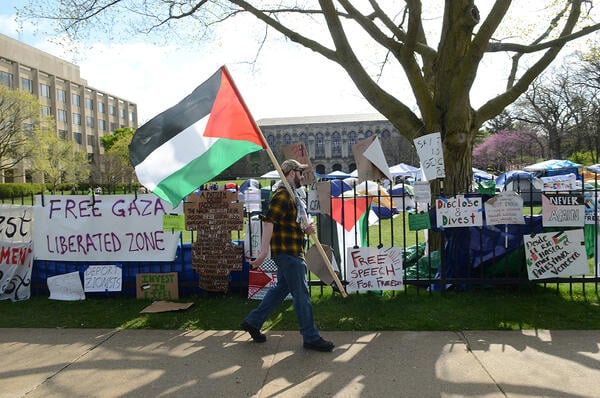
Last spring, as pro-Palestinian demonstrators set up encampments from coast to coast, a small number of college presidents struck agreements with students to get them to pack up their tents.
But a year after those protests ended, have the presidents lived up to their promises?
While the agreements varied widely by campus, the answer appears to mostly be yes, though many initiatives are still in progress.
Divestment from Israel or companies with ties to the Israeli government or military was the most common demand student protesters made, and while some presidents agreed to hold votes on the issue, they made no promises about how such decisions would go. In the vast majority of cases, universities outright rejected divestment demands; on rare campuses where administrators agreed to divest, the actions were largely contained, focused mostly on defense contractors.
Beyond divestment votes, colleges also struck agreements on multiple other points, including scholarships for displaced Palestinian students and increased support for Muslim students. Here’s a look at where such promises stand a year after the encampment protests ended.
Northwestern University
Few protest deals made more headlines than the one at Northwestern University, where President Michael Schill signed on to the Dearing Meadow agreement, as it came to be known, in late April of last year. Schill agreed to various concessions in exchange for protesters concluding the encampment. Those promises included support for Palestinian students and visiting Palestinian faculty, more space for Muslim student groups, and greater transparency in how the university invests its $14.3 billion endowment.
In signing the agreement, Schill caught the attention of Congress, which summoned him for a hearing last May alongside the leaders of Rutgers University and the University of California, Los Angeles. Schill defended the agreement, pushing back on GOP scrutiny.
The Daily Northwestern, the university’s student newspaper, confirmed that Schill has followed through on various initiativess; the university is currently supporting at least one Palestinian scholar and providing temporary space for Muslim students and the Middle Eastern and North African Student Association. (Renovation for a permanent space is ongoing.) The newspaper also confirmed that Northwestern added support for Jewish and Muslim students through the office of Religious and Spiritual Life, which funds weekly Shabbat dinners. But Northwestern officials have been reticent to discuss such efforts, ignoring requests for comment from the student newspaper and Inside Higher Ed.
(Multiple student activists also did not respond to requests for comment from Inside Higher Ed.)
Despite promising more transparency on its endowment, Northwestern does not appear to be living up to that part of the deal. According to the agreement, Northwestern “will answer questions from any internal stakeholder about specific holdings, held currently or within the last quarter, to the best of its knowledge and to the extent legally possible.” Officials promised to respond to such inquiries within 30 days or, if unable to do so, to “provide a reason and a realistic timeline.”
However, The Daily Northwestern reported last month that it sent officials questions about endowment holdings in February and did not receive a response within 30 days. The student newspaper noted that Northwestern did not provide a reason for the delay or a timeline for a response. A student reporter told Inside Higher Ed that the newspaper followed up on March 30 and the university then referred the questions to the Advisory Committee on Investment Responsibility.
The Daily Northwestern is still awaiting answers.
Rutgers University
Rutgers also struck a deal with encampment protesters last spring. As at Northwestern, that agreement landed then-president Jonathan Holloway in front of Congress mere weeks later.
Rutgers leaders agreed to eight of the students’ 10 demands; while they rejected calls to divest from Israel and terminate a partnership with Tel Aviv University, they agreed to accept 10 displaced Gazan students, establish Arab cultural centers at each Rutgers campus, seek a partnership with Birzeit University in the West Bank, hire faculty members who specialize in Palestinian and Middle East studies, and release a statement calling for a ceasefire, among other concessions.
Rutgers officials said all of the agreed-upon initiatives are currently in progress.
Rutgers agreed to eight out of 10 of the protesters’ demands.
“Work continues to advance a series of actions we believe will strengthen and build upon positive change across our community,” spokesperson Megan Schumann told Inside Higher Ed. “These efforts are grounded in the university’s values of free expression, inclusion, and mutual respect—and in the fundamental right of all members of our community to learn, teach, and carry out the university’s essential work in a safe and supportive environment.
University of Oregon
At the University of Oregon, the administration’s agreement with protesters included a statement calling for a ceasefire and condemning genocide, the addition of visiting scholars with expertise in Palestine and Israel, support for academics displaced by the war, new faculty hires with related expertise, new cultural spaces, and more.
Officials said they have lived up to their end of the agreement, though some initiatives are still underway. They noted that the university has already awarded its first International Crisis Response Scholarship, which was established by the agreement to support students affected by the conflict, and the recipient has begun studies at UO. The university has also funded two speaking events as part of its Special Initiative on Constructively Engaging the Conflict and the Pursuit of Peace in Palestine/Israel. Another five proposals for speaking events have already been approved, according to officials. Past and upcoming events have focused on topics such as Palestine and the future of U.S. campus activism and Palestinian identity.
Other efforts, such as faculty recruiting, are ongoing, with several academic units submitting hiring-plan proposals that are undergoing a standard review process. Plans to forge partnerships with Birzeit University in the West Bank and several universities in Israel are also underway.
Evergreen State College
The public institution in Washington agreed to various concessions in a deal with protesters. Officials launched four committees to work on different issues, including “divestment from companies that profit from gross human rights violations and/or the occupation of Palestinian territories,” according to language in the signed protest agreement. Another task force will develop policies to determine whether the college should accept or reject grants that “facilitate illegal occupations abroad, limit free speech, or support oppression of minorities.” The other two task forces are slated to review policing at Evergreen State and to develop a new “non–law enforcement” model for crisis responses.
President John Carmichael also kept his promise to protesters by making a statement on the bloodshed in Gaza last May, in which he called for a ceasefire, the release of hostages and the restoration of international law, which he wrote “requires that the International Court of Justice fairly adjudicate charges of genocide.” He also urged the university community to be “on guard against Islamophobia and antisemitism as we engage with each other in this moment.”
Those efforts are ongoing; the agreement provided a timeline for the task forces to complete their work, with deadlines to adopt their recommendations ranging from spring 2026 to 2030.
California State University, Sacramento
When Sacramento State struck an agreement with pro-Palestinian protesters last May, students framed the move as divestment in a social media post. But a more accurate reading would be that the university determined it did not have direct investments in companies profiting off the war effort and declared that it would not pursue such holdings. The university also established a “de minimis policy for indirect investments that prioritizes socially responsible investments,” a spokesperson wrote to Inside Higher Ed.
Sacramento State president Luke Wood said at the time, “The finance committee of our University Foundation has been so committed to socially responsible investments that we have no direct investments in any of the companies about which many of our students have concerns.” He also announced a policy to formalize socially responsible investment practices, in order to “avoid funding students’ education based on companies that profit from war and desolation,” the spokesperson said.
University leaders announced multiple other actions at the same time, which Wood said grew out of listening sessions with over 1,500 students, faculty, staff and alumni that began when he arrived the previous year. Those changes include introducing more halal and kosher food options on campus, new cultural centers and training on Islamophobia and antisemitism, as well as university task forces to address both Islamophobia and antisemitism. Other efforts include the development of recruitment plans to attract Palestinian and Jewish students to the university.
(This section has been updated to incorporate the university’s response.)
Sonoma State University
Sonoma State University may offer the most visible case of promises made and broken.
Last spring, then-president Mike Lee agreed to demands from protesters that included reviewing contracts to consider divestment opportunities, introducing a Palestinian studies curriculum and adding Students for Justice in Palestine members to a Sonoma State advisory council. Most controversially, he agreed to what was effectively an academic boycott, promising not to “pursue or engage in any study abroad programs, faculty exchanges, or other formal collaborations that are sponsored by, or represent, the Israeli state academic and research institutions.”
However, the agreement was not approved by his bosses in the California State University system, prompting officials to walk the deal back and Lee to retire suddenly. A new deal put forward by an acting president who replaced Lee scrapped much of the prior agreement.
A campus spokesperson noted that despite the changes to the initial agreement, SSU Foundation officials met with students to discuss investment holdings and launched other actions, including a three-part lecture series providing “differing viewpoints on the situation in Gaza and differing religious perspectives,” as well as new groups to support Jewish life.
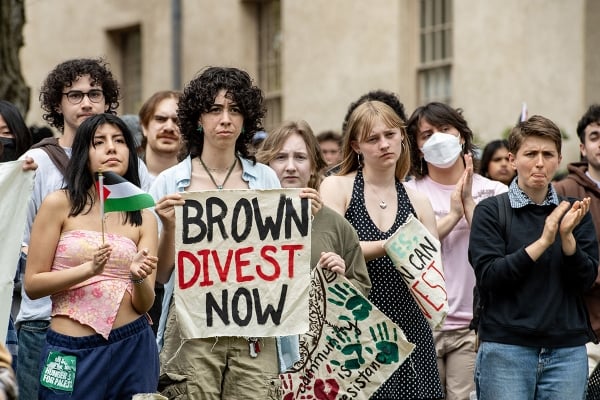
Protesters at Brown University demand divestment, April 29, 2024.
Joseph Prezioso/AFP/Getty Images
Divestment Demands
Multiple universities agreed to hold votes on some form of divestment in response to protesters, including Brown University, the University of Minnesota, the New School and others.
Governing boards, however, have largely rejected divestment except in a few cases.
The University of San Francisco announced several weeks ago that it would divest from four U.S. companies with ties to the Israeli military: Palantir, L3Harris, GE Aerospace and RTX Corporation. The university plans to sell off direct investments in those companies by June 1.
Nearby San Francisco State University has also adopted a form of divestment; in December, the public university’s governing board voted to add new investment screening policies. Now SFSU will no longer invest in companies that make 5 percent or more of their revenues from weapons manufacturing. SFSU also adopted more transparency around endowment holdings.
Many people are losing hope because of the anti-DEI policies that state legislators and governors have enacted over the past four years, as well as the Trump administration’s brutal attacks via executive orders and the U.S. Department of Education’s now-infamous Valentine’s Day Dear Colleague letter. Hopelessness also has ensued following the swift renaming and discontinuation of offices, centers and institutes, programs and professional positions on campuses. It all happened so fast—in some contexts, over four years; everywhere else, in a matter of months. A significant experience I had three decades ago gives me hope in the possibility of eventual recovery from these politicized storms that have produced such extraordinary damage to DEI initiatives in higher education.
I was born and spent the first 22 years of my life in South Georgia, a place that frequently experiences violent hurricanes and tornadoes. I have seen entire communities wiped out within minutes. In July 1994, just six weeks before the start of my freshman year in college, Tropical Storm Alberto brought torrential rains to Albany, Ga. The National Weather Service reports that more than 30 people died, nearly 50,000 residents were forced to evacuate their homes and over 18,000 structures were completely lost. Many of those buildings were at Albany State, a historically Black university located along the Flint River, which flooded during the storm. Nineteen of its 34 buildings were destroyed beyond repair and ultimately demolished.
Somehow, our fall quarter miraculously started on time. Instead of residence halls, most students in my first-year class moved into mobile homes on campus; dump trucks were scooping massive quantities of mud and recovery crews were still assembling modular units where we would sleep on the day I arrived. There was so much mud. The mess was widespread—everywhere, in fact.
For years, many classrooms and offices were located in trailers. Despite the chaos and abundance of annoying mud everywhere at Albany State, there was hope. As my family and I drove into campus for move-in day, I remember seeing a huge banner on one of the few surviving buildings that simply read, “Unsinkable.” That one word became an inspirational chant and declaration that still pervades the institution, now more than 30 years later.
The flood took so much from my beloved alma mater, but recovery efforts, which required tremendous reliance on the federal government, resulted in a more modernized campus with attractive new facilities that are atypical for most HBCUs due to state and federal funding inequities. Because of what I witnessed firsthand during my four undergraduate years, as well as in the aftermath of numerous other calamitous weather crises that occurred throughout my youth, I know that communities can rebuild homes and structures that are more solid, attractive and high-tech than what previously existed. Even still, a sense of community, family heirlooms and, in some instances, the lives of people and pets are lost. No amount of federal aid can restore those things.
While the context and circumstances are different, living through this disastrous moment in American higher education because of, but not limited to, the politicized teardown of DEI is familiar to me. Put differently, I have lived through and witnessed recovery from many tragic storms.
That does not make it any less distressing. But my four-year undergraduate experience taught me how to envision possibilities beyond the daily inescapability of mud, debris and devastation. When I arrived at Albany State as an 18-year-old freshman, rebuilding had not yet started. The institution instead was working as hard as it could with the resources it had at the time to educate, house and serve us. That is where many contemporary college and university campuses are at this very moment as it pertains to DEI.
Understandably, many students and employees who are most affected by the abandonment of institutional commitments to DEI only have the capacity to survive this catastrophic moment; they are not yet able to begin recovery work. The unavailability of federal, state and institutional resources makes it even less possible for most people to think about the next iteration of DEI efforts on campuses.
Notwithstanding, hope for something better—even if we do not know when that something better will become available—could be the one and only thing that sustains those of us who are truly committed to DEI. To be sure, I do not believe that hope alone will be enough—coalitions, elections, stock taking and documentation of harm, fundraising, activism, institutional and governmental accountability, and sophisticated strategizing are also required.
Right now, there is so much mud. The mess is widespread—everywhere, in fact. Like Albany State, the beautiful HBCU that still stands strong more than 30 years after its neighboring Flint River flooded, DEI in higher education is unsinkable. I have no choice but to believe this, and I will continue doing all I can to achieve this outcome for colleges, universities and our democracy.
Shaun Harper is University Professor and Provost Professor of Education, Business and Public Policy at the University of Southern California, where he holds the Clifford and Betty Allen Chair in Urban Leadership.
Math courses are often a barrier for students seeking to pursue a college credential, and for some, a lack of math curriculum during high school can make a STEM career seem out of reach.
A new course at Wentworth Institute of Technology in Boston serves as a stepping-stone for students who may not have had access to precalculus or calculus courses but are still interested in calculus-based learning. The university hopes the program will boost student enrollment and eliminate barriers to access for disadvantaged students.
What’s the need: The conversation about offering precalculus at Wentworth began in 2019, after university leaders saw that some students, despite having the same GPAs and high school transcripts as their peers, were less mathematically prepared, said Deirdre Donovan, Wentworth’s director of first-year math and interim associate dean of the School of Computing and Data Science.
At that time, Wentworth did not offer a math placement course, so all enrolled students launched at the calculus level.
Wentworth, like many colleges and universities, requires students to have already completed calculus coursework to enroll in specific major programs, which is “a barrier that can prevent otherwise qualified students from pursuing engineering and computing degrees,” Donovan said.
To complete calculus by the end of high school, students had to complete Algebra I in eighth grade, and not every student was ready, aware of or offered that course at their school, Donovan said.
Some high schools also push students to complete AP Statistics in lieu of calculus, and Donovan said this shift “can actually close more doors at STEM schools than it might open, because those AP credits can’t replace the calculus-based statistics required for engineering degrees.”
Campus leaders at Wentworth opted to review policies that were barring students from participating in STEM programs, starting with creating a math placement process and then developing a precalculus course.
How it works: In 2024, Wentworth removed precalculus as an admissions requirement for students, paving the way for the college to admit about 10 percent more students who might have previously received a conditional acceptance, Donovan said.
New students without calculus credit are now enrolled in a four-credit, first-semester course called Foundations of Calculus that helps them get up to speed. The investment in additional content hours is an indication of the university’s commitment to opportunities for students who may not have been able to enroll and succeed previously, Donovan said.
In addition to two hours of lectures each week, students also participate in two hours of labs that focus on engineering problem-solving skills, using real-world problems that are tied directly to a student’s major.
The course is also supported by embedded peer tutors who can address student questions, clarify confusing content and facilitate study groups outside of class time.
It was important to Donovan and her faculty team not to work from a deficit-minded perspective about students’ knowledge gaps. Language regarding the course and its content hours was specifically crafted to help students feel like they’re being guided onto an on-ramp, not held back or punished for not having precalculus experience.
The results: After the first semester, staff have seen promising results, Donovan said. “We are pinching ourselves that it went exactly how we had hoped it would go.”
In fall 2024, about 200 students participated in precalculus either because they lacked the course in high school or their placement exam results indicated it would benefit them.
Approximately 75 percent of precalc students passed their course in the first term, on par with national averages. When they attempted calculus in their second semester, students had similar passing rates to their peers who completed calculus in the first term.
University faculty and staff were encouraged to see that engineering programs received 20 percent more applications this year, signaling an increased level of interest in rigorous programs, Donovan said.
Fall-to-spring retention rates were slightly lower for precalc students, but that could be due to other factors, including students re-evaluating their chosen major or deciding whether they want to be at a STEM-focused institution.
The course has also expanded enrollment opportunities for students who otherwise might not have considered Wentworth. Overall applications were up 25 percent year over year this past application cycle, and deposits were up 30 percent, Donovan said.
What’s next: Student feedback from the first term has indicated a need for an additional credit hour of in-person, interactive lab work, which will be implemented this fall. The hour, which the university is calling a companion class, will function similarly to a first-year seminar, teaching students study skills and metacognition, as well as connecting back math concepts.
None of the downstream courses such as physics have undergone a curriculum change, requiring students to get up to speed in their first term to be successful over all in college. Students who complete precalc also may need to take summer classes to ensure they graduate in four years, but the university is looking to offer affordable online courses to accommodate learners, Donovan said.
Do you have an academic intervention that might help others improve student success? Tell us about it.
Erik Jacobsen, an associate professor of mathematics education at Indiana University, was nearing the end of a years-long project designed to address teacher biases with the goal of helping more students excel in math and pursue STEM careers. But that all stopped several weeks ago, when the National Science Foundation notified him that it had terminated the grant because it was “not in alignment with current agency priorities.”
Jacobsen’s grant, which was funding multiple graduate students and a postdoc, who are all now in limbo, is far from the only STEM education–focused grant the NSF recently canceled.
Of the approximately 1,500 grants the agency recently terminated, at least 750 came from the NSF’s education directorate, according to Grant Watch, an independent website that tracks terminated NSF grants. And that’s not the only shake-up happening at the NSF, which Congress created in 1950 to “promote the progress of science; advance the national health, prosperity and welfare; and secure the national defense.” The Trump administration has also laid off staff and proposed slashing the agency’s budget.
Additionally, NSF announced new priorities that include not funding projects aimed at recruiting more Americans from underrepresented backgrounds to the STEM workforce—a key focus for the agency historically.
The Trump administration says all these changes are part of its plan to reform the NSF, correct an alleged “scientific slowdown,” build a “a robust domestic STEM workforce” and “rapidly accelerate its investment in critical and advanced technologies such as artificial intelligence, quantum computing and biotechnology.” The NSF sends billions to colleges and universities to support STEM education and nonmedical scientific research.
Researchers and policy experts are worried that the major cuts to STEM education programs will jeopardize the long-term future of the STEM workforce and leave the nation with a deficit of scientists and other skilled workers who are capable of carrying out Trump’s vision of winning “the technological race with our geopolitical adversaries.”
“There may be enough scientists to do the projects that are left. But for how long? They’re eventually going to retire and there won’t be this robust pipeline,” Jacobsen said. “There’s so many kids in our country that learn math and science every day. And the reason they learn it as well as they do is because of NSF’s historic investment in education.”
‘Nearsighted’ Changes
Since Trump started his second term in January, the NSF has upended its operations and spurred chaos and uncertainty within the research community. In February, the agency fired 10 percent of its staff—many who help university researchers navigate the grant application and funding process—though a federal judge later ordered the NSF to reinstate some of those employees.
“Their absence means that even if the budget is sufficient to fund new projects, distributing that money fairly and appropriately is going to be delayed if not made impossible,” Suzanne Ortega, president of the Council of Graduate Schools, said. While those and other changes are already “having immediate effects on graduate students, postdocs and early-career scientists,” she said there will also be “major downstream consequences” that won’t come home to roost for at least five years.
According to the Bureau of Labor Statistics, employment in STEM occupations is expected to grow 10.4 percent between 2023 and 2033, more than double the projections for non-STEM careers. But decimating the NSF’s education directorate—which funds many projects focused on researching how to improve STEM education outcomes starting in K-12—will make it harder to cultivate the robust STEM workforce Trump says he wants, Ortega said.
“This kind of research tells us how we can develop curricula that makes the pathway from a Ph.D. program into industry more seamless. Or how we can create mentoring networks or other kinds of connections that foster more rapid degree completion,” she said. “To forget that education research itself is vital to improving the system that our research enterprise depends on is very nearsighted.”
Adding to the challenges is the Trump administration’s crackdown on international student visa holders—who make up a sizable portion of STEM graduate students—which could make strengthening the STEM career pipeline increasingly difficult, said Holden Thorp, editor in chief of the Science family of journals.
“We desperately need more effort to produce scientists who are U.S. citizens,” he said. “Regardless of whether those programs are devoted to marginalized groups or anyone else, there’s people we need to encourage to go into science. Even if you don’t accept the reason why some of these programs were set up. It’s a disastrous economic strategy to get rid of programs—especially when they were in midstream—that would be growing the supply of scientists in the American workforce.”
As these changes keep coming, the NSF remains without permanent leadership. Sethuraman Panchanathan—the Trump appointee who had run the agency since 2020—resigned in late April, stating that he’d done all he could “to advance the critical mission of the agency.”
Earlier this month, the NSF announced a plan to cap indirect cost rates—which fund laboratory space and other research supports that can be used for multiple projects—for universities at 15 percent. At the same time, Trump’s budget bill proposed cutting the NSF’s 2026 budget by 55 percent, which includes cutting $3.5 billion from the agency’s general education and research budget, $1.1 billion from the Broadening Participation programs and $93 million for agency operations and awards management.
A coalition of former NSF directors and National Science Board chairs blasted the proposal, saying it “would thwart scientific progress, decimate the research workforce and take a decade or more to recover” and “fast-track China’s plans for technological dominance.”
Although Congress will have to approve Trump’s budget proposal later this year for it to become law, the NSF is already preparing for a future with less funding.
According to Science, NSF has eliminated 37 divisions across its eight directorates and is also creating a new oversight body of unknown membership that will have the final say in reviewing a proposal to ensure it doesn’t violate the agency’s new anti-DEI priorities. Additionally, the NSF announced earlier this month that it plans to cut more than half of its senior administrations and slash the number of “rotators”—academic scientists who serve two- to four-year terms to help the NSF choose which research to fund—as part of its cost-saving strategies.
That has big implications for NSF-funded initiatives like the Advanced Technological Education (ATE), which is a congressionally mandated effort led by community colleges designed to improve and expand educational programs for technicians to work in high-tech STEM fields that drive the U.S. economy.
“ATE is heavily influenced by rotators from community colleges,” said Ellen Hause, associate vice president for academic and student affairs at American Association of Community Colleges. “With the rotators on the chopping block, we would lose some of this expertise not only in STEM technician education, but in the community college space, which is a unique piece of the STEM workforce and STEM education.”
Many of the future community college students who may want to participate in a program like ATE in the coming years are just now getting exposure to STEM fields in their K-12 classrooms. And projects like Jacobsen’s (the math education researcher at IU) were supposed to help more of those students get comfortable with the academic material required to pursue such careers. But canceling his and other STEM education research grants midstream is already undermining decades of federal investment in STEM education, he and others said.
“We’d already done most of the work and spent most of the money,” he said. “By not having the final amount, we can’t complete our work, which means the public doesn’t get the benefit of the knowledge we would have learned. We still don’t know if the tool we were developing works. And now we’ll never know. It’s just wasting that investment.”
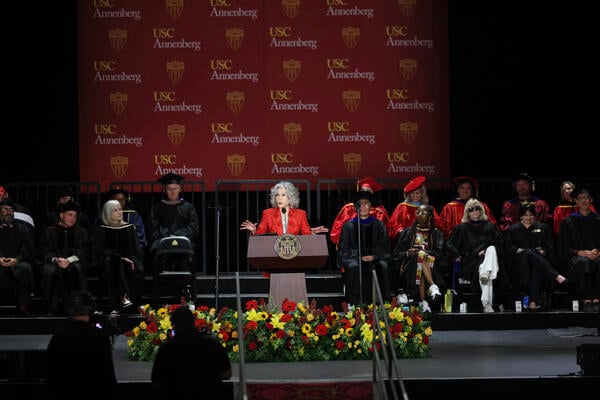
Commencement this year comes at a time of uncertainty for graduates, who find themselves entering a polarized country steeped in political and economic tumult. It’s a scenario many graduation speakers confronted head-on; actress Jane Fonda told the Class of 2025 that “the world has never faced anything like the challenges we face today.”
Much like 2024, this year’s commencement season has been marked by controversy, including at least twoinstances where student speakers were penalized for talking about the war in Gaza. Graduates also protested right-wing commencement speakers, including President Donald Trump himself, who spoke at the University of Alabama—which doesn’t traditionally invite guest speakers to commencement—and at the U.S. Military Academy at West Point, where his hourlong, meandering speech went viral.
But for many graduates, commencement went on as expected, with speakers doling out advice about how to survive—and even thrive—in these difficult times. Here’s what they had to say.
On the Current Political Climate
“Ignorance works for power. First, make the truth seekers live in fear. Sue the journalists and their companies for nothing, then send masked agents to abduct a college student who wrote an editorial in her college paper defending Palestinian rights and send her to a prison in Louisiana, charged with nothing. Then, move to destroy the law firms that stand up for the rights of others. With that done, power can rewrite history with grotesque false narratives. They can make criminals heroes and heroes criminals. Power can change the definition of the words we use to describe reality. ‘Diversity’ is now described as illegal. ‘Equity’ is to be shunned. ‘Inclusion’ is a dirty word. This is an old playbook, my friends. There’s nothing new in this. George Orwell, who we met on the street in London, 1949, he warned us about what he called ‘newspeak.’ He understood that ignorance works for power. But then it is ignorance, isn’t it, that you have repudiated every single day here at Wake Forest University? … Can the truth win? My friends, nothing else does.”
“I could never have imagined 55 years [after I graduated college] that a young woman would write her truth in your paper and find herself kidnapped and arrested for speaking her truth, somehow. And be put in jail. I could not have imagined that, 55 years later. But let me tell you that all of America salutes your president and Tufts University for supporting that student, Ms. Öztürk. It’s so important, and there’s the point when you think about Rümeysa. She said something recently. She said, ‘I still believe in this country and the right to free speech and to due process.’ … And so I can tell you when you say, ‘Oh, we’re going down the tubes.’ No, we are not. I believe in this country. As Rümeysa said, ‘We believe in the people.’ In you. This country will be OK.”
—Freeman Hrabowski III, education advocate and former president of the University of Maryland Baltimore County, May 18 at Tufts University
On Persistence
Maggie Rogers, pictured here in 2024, spoke at her alma mater, NYU, this month.
“My career arrived overnight. It’s this Cinderella story of a video—maybe you’ve seen it, maybe it was force-fed to you. If you haven’t seen it, I play a song for Pharrell Williams, he really likes it, his reaction goes on YouTube—ta-da, I’m famous. What people saw in that video was this moment of alignment; they saw a past life or the universe or whatever you want to call it come along and hold my hand to the flame. But no one saw all the hard work or all the times I almost quit. They never heard the songs that didn’t work or the shows that were just bad … I don’t know any artist that hasn’t considered quitting. But you didn’t get here because you wanted to do something easy; you got here because you wanted to do something great.”
“There’s a saying from one of America’s most practical minds, Benjamin Franklin, that I’ve used almost every day of my life: ‘Little strokes fell great oaks.’ It’s simple, it’s old, it’s absolutely true … I did run for governor in 1994 and lost, and one of the reasons I lost, I think, is I didn’t show my heart. I had five-point plans to cure every ailment in the state, but I didn’t really connect at a human level with people.
“So, in 1998, when I ran again, I vowed to campaign differently. For example, I went to visit 260 schools in a matter of a year. Back then, my views on education were considered pretty radical, so in essence I went into the lion’s den over and over and over again, trying to dehorn myself, I guess, with people that were skeptical of the ideas that I was advocating. I listened and learned, I shared my passion, I told stories of the challenges that teachers had. And I believe I became governor in 1998 because I was doggedly determined to show my heart. It’s easy to look at the world and believe that success happens overnight. We live in a world of immediate gratification, don’t we? Social media, movies, headlines often highlight the moments of triumph without showing the years of work, sacrifice and persistence that came before.”
“Don’t let anxiety or depression or hopelessness cause you to isolate. On the contrary, grow yourself a deep, solid community of people who share your values, have each other’s backs, check up on each other regularly, and be intentional about this. You know, in these uncertain times, we need to strengthen our ties to community, to our colleagues, our friends and family, because, more and more, we’re going to need this support for safety, for love, for help, for fun—let’s not forget fun—and for survival. You may not be aware of this, but since the 1980s, there’s been a concerted effort to promote individualism. You know, ‘I’m here for me and mine.’ And this shift to individualism is no accident; it’s being driven by people who want us disempowered. The myth of the rugged individual who needs no one is just that: It’s a myth created by stories through culture, told through culture, and the kinds of things that you all are going to be doing. So graduate students working with words and images—do the reverse. Encourage community versus individualism.”
Henry Winkler, pictured here in 2024, gave the commencement address at Georgetown University.
Harmony Gerber/Getty Images
“I was a negative thinker. I wanted to beat the system. ‘I can’t, I won’t, I’ll never, oh, she won’t go out with me.’ So, I tried to find the answer to negative thinking. I found Gurdjieff. He’s an Armenian philosopher who wrote a gigantic book. But he doesn’t want you to finish the book unless you understand him—so I didn’t. ’Cause I didn’t know what the hell he was talking about. And I found a disciple of his, Ouspensky—also a big book. I got one sentence. OK, so, you’re walking to your dream. Never let your dream out of your brain. And when you decide what it is you want to do, just know it without a doubt, know it without ambivalence. So you’re walking to your dream, and you have your dream in your brain, and all of a sudden a negative thought comes in. Your shoulders drop, your head drops and then that negative thought, it blooms into a thesis of negativity. A negative thought comes into your mind—you say out loud, you say out loud, ‘I am sorry, I have no time for you now.’
“Yes, people will look at you very strangely, but it doesn’t matter, because it becomes your habit. A negative thought comes into your mind, you move it out, you move a positive in. For me, it is a Bundt cake with melty chocolate chips—no icing—and all of a sudden your shoulders fly back, your head flies up and you continue your dream. And then you get to stand here and talk to you.”
“[I was] sitting in a doctor’s office, facing one of the most difficult decisions I’ve ever had: continue living my life in pain, or consider having my leg amputated. In that moment, something clicked. I stopped letting the reality of my present circumstances dictate the potential of my future. I stopped coming from a place of victim mentality and realizing that everything happens for a reason and something bigger was going on. That shift in perspective gave me the courage to move forward, to make the decision to have my leg amputated and hope of a better future.
“Since then, I’ve come to realize something. Experiencing pain doesn’t disqualify you from discovering your purpose. It prepares you for it. The reality is, every single person here has lost something at some point, a dream, a loved one, a friend. You see, the promise in [James 1:2–3] wasn’t that trials would go away; it was that endurance would grow. That’s what trials do. They forge something in us that comfort never could. They teach us to keep going when nothing makes sense to believe, when hope feels distant, to see ourselves, not by what we’ve lost, but by who we’re becoming. That’s the hidden gift in pain, because it’s the journey, not the destination that shapes us the most. So if you’re in the middle of something broken, don’t run from it. Embrace it. Life is hard, but the journey is worth it.”
Rep. Jasmine Crockett spoke at the Southern University of New Orleans, an HBCU in Louisiana.
“I will start by saying your existence as a graduate of this HBCU alone is and will be seen as a resistance. Let me break it down this way: They never wanted us to be educated. This isn’t false. It is absolutely a fact. I know y’all know the history, but there is something special in this moment in time to be allowed to tell the story in the midst of the many haters and agitators being elevated to the highest positions of power and trying to use an old-school eraser—emphasis on old-school. You know, the old pink one? They want to use that old-school eraser to erase us. They have no idea that this big pink eraser can’t erase what was written in blood. Blood that was shed by the many who bled so that brighter days like this could come.
“Much like the creation of this school, nothing in this life will be given to you. You will always walk into spaces due to your meritocracy. And even the spaces they seek to disallow you from, just know that they fear your greatness. You see, in 1956, Act 28 of the Louisiana Legislature established SUNO, but only after local African American leaders in the ’40s pushed for public college for Black students during segregation. Turn to your neighbor and say, ‘SUNO wasn’t created out of generosity.’ [graduates repeat] ‘It was created out of segregation.’ [graduates repeat] You see, they sought to build barriers. But SUNO built beginnings.”
“So, you might wonder why I’m speaking here instead of at the business school. Well, it’s because the business school got Snoop Dogg. Hard to compete with Snoop. Even though I did later go to business school, I could not have navigated the business world the way I did without the liberal arts education I earned right here. USC is where I discovered what I liked and what I didn’t. I did not, for example, like writing. That’s ironic for the CEO of a publishing company, I know. Eventually I came around.
“Physics, though, that hooked me right away … Physics instilled something in me that was more valuable than equations and theories. It gave me confidence. It became second nature to think, ‘I don’t know how to solve this problem, but I do know that I will figure out how to solve it.’ And that, Trojans, is what your USC education is giving you. More than a degree, more than a line on a résumé. It’s equipped you with a way of thinking. You now know how to distinguish between fact and fiction, how to analyze and approach problems, how to craft arguments, and how to lead. And whether you know it or not, whether you study law or literature, physics, philosophy, political science or the lab-based kind of science, and whether it took you, like me, an extra year to finish quantum mechanics—that’s a true story—you now have the confidence to navigate the unknowns of life.”
“The artist de Kooning said, ‘The problem with being poor is that it takes up all your time.’ I came here as a scholarship kid, first-gen, loaded up with Pell Grants, work-study, which is actually quite isolating. I never went on a spring break. I never studied abroad. I never had an unpaid internship. I needed all my time to be billable. I was privileged to look like a rich girl, a city girl, a girl who had ridden in a yellow taxi and should rush Tabard. But no, I had, in fact, never ridden in a yellow taxi and should be a Tri Delt. I found a rusted 10-speed bike in the basement of a frat house, tuned it up, rode it around for three years, and left it unlocked on 40th and Irving the day I graduated. Why was I in the basement of a frat house? You know why.
“The point is, I didn’t come to Penn to pursue a career in the arts. I came here to use the best tool for class migration that’s ever existed: higher education. And that was it. It was a low bar: be employable, hopefully well-paid. When people ask me when I knew I wanted to be an actor, my answer is, when I got paid for it. Was I passionate about it? Sure. Did it bring me self-esteem and joy? It did. But I was practical, pragmatic. But during my time here, I began to think differently. I was in control of my life, and I was working hard to build the confidence, the life skills, the connections and the grit to believe success at anything I devoted myself to was possible.”
The Trump administration still won’t be able to prevent Harvard University from enrolling international students after a federal judge decided Thursday to keep a temporary restraining order in place.
The hearing before Judge Allison Burroughs in Massachusetts District Court came a week after the Department of Homeland Security revoked Harvard’s ability to enroll international students and required those currently at the university to transfer. Harvard quickly sued to block that decision, and Burroughs granted a temporary restraining order May 23.
Harvard argued in the lawsuit that the administration violated the First Amendment and the university’s due process rights with the abrupt revocation. In an apparent effort to address Harvard’s concerns, the administration said ahead of the hearing that it would go through a more formal administrative process to decertify Harvard from the Student and Exchange Visitor Program. According to the notice filed in court Thursday morning, Harvard has 30 days to respond to the claims that it failed to comply with certain reporting requirements and to maintain a campus free from discrimination as well as “practices with foreign entities raising national security concerns.”
But while that process continues, Burroughs wants to maintain the status quo for Harvard, which means that international students can remain at the university. She plans to eventually issue a preliminary injunction, the next step after a temporary restraining order.
Burroughs said an order would give “some protection to international students who might be anxious about coming here or anxious about remaining here once they are here,” The Boston Globe reported.
The government lawyers argued in the hearing that an order wasn’t necessary because of the new notice. But Harvard’s lawyer Ian Heath Gershengorn countered that “we want to make sure there are no shenanigans” while Harvard challenges the Trump administration’s action.
And despite Burroughs’s quick restraining order, current and prospective international students at Harvard have faced disruptions.
Maureen Martin, director of immigration services in the Harvard International Office, wrote in a court filing that students scheduled to travel to the United States in the fall found out by the morning of May 23 that their visa applications were denied. (The administration revoked Harvard’s certification May 22.)
“I am personally aware of at least ten international students or scholars whose visa applications were refused for ‘administrative processing’ immediately following the Revocation Notice,” Martin wrote, adding that none of the visa applications that were refused or revoked following the revocation have been approved or reinstated.
For example, when a visiting research scholar at the Harvard School of Dental Medicine tried to obtain a J-1 visa at the U.S. embassy in Prague on May 23, her visa application was rejected.
“The officer gave the scholar a slip that stated she had ‘been found ineligible for a nonimmigrant visa based on section 221(g) of the U.S. Immigration and Nationality Act (INA).’ The slip said, ‘In your case the following is required,’ and the consular officer checked the box marked ‘Other’ and handwrote, ‘SEVP Revocation / Harvard,’” Martin wrote.
Martin wrote that the Trump administration has caused “significant emotional distress” for current international students and raised a number of questions for either incoming or prospective students who are trying to assess their options. At least one student deferred admission for a year for visa-related reasons.
Secretary of State Marco Rubio announced on Wednesday night that the Trump administration will “aggressively revoke” Chinese college students’ visas and heighten scrutiny of visa applicants from China. The new policy specifically targets “those with connections to the Chinese Communist Party or studying in critical fields.”
It’s the administration’s latest move in what has been a sudden resurgence in its attacks on international students, which it seemed to suspend in April after legal efforts led to the restoration of the legal status of thousands of students.
The news sent shock waves through higher education and could lead to a major reduction in foreign students at American universities, especially public research institutions. China contributes the largest number of international students to the U.S., with nearly 280,000 enrolled in 2023–24, according to data from the Institute of International Education—about a quarter of the total international student population in the country.
That share, however, has been shrinking since the COVID-19 pandemic; last year, India overtook China as the No. 1 source country of international students. But Chinese students are far more likely to enroll in undergraduate programs and pay more in tuition. They also make up a significant slice of STEM researchers: 16 percent of all U.S. graduate students in STEM fields and 2 percent of undergraduates are Chinese nationals, according to a 2020 report from the Center for Security and Emerging Technology at Georgetown University.
It’s not clear whether the visa revocations would be accompanied by legal status terminations in the Student Exchange and Visitor Information System or prompt deportation proceedings, as they did for thousands of international students in March and April. Those steps would be the purview of the Department of Homeland Security.
The targeting of students in “critical fields” in particular could devastate STEM programs and research labs at smaller universities across the country, where Chinese international students are heavily represented. Rubio did not clarify what fields could be considered critical, potentially setting the stage for a sweeping focus on areas where GOP lawmakers have raised concerns about sensitive national security research being shared with the Chinese government.
A spokesperson for the State Department did not respond to a list of questions, including requests to clarify the scope of the new policy’s target and the timeline for visa revocations, in time for publication. At a press conference yesterday, department spokesperson Tammy Bruce declined to “get into the details” of how the new visa scrutiny would be applied or what “critical fields” the department was referring to, because it “might give up our hand and make certain things less effective.”
“When we think of critical fields, we think of national security, the nature of how we keep America safe and secure and more prosperous,” she said. “It is important to keep a broad base, because that could mean many things.”
The new policy’s focus on students with ties to the Chinese Communist Party has also raised concerns about academic freedom and free speech violations. Jonathan Friedman, managing director of U.S. free expression at PEN America, said the new policy targeting Chinese students would “hold student visas hostage to an ideological litmus test and disrupt the open exchange of ideas across cultures and borders.”
“‘Aggressively revoking’ visas based on political ideology is a gross violation of basic free expression principles that anchor the academy,” he wrote to Inside Higher Ed.
William Brustein, a retired longtime international student administrator, said the vague nature of Rubio’s directive could enable a sweeping dragnet that catches the majority of Chinese students—especially since association with the ruling Communist Party is difficult to avoid in China.
“How will they know who’s a member? Maybe they’ll say if you were in a Chinese-sponsored youth group as a child, that could prevent you,” Brustein said. “Right now that policy is so vague that it could cover all Chinese students who want to study in the U.S.”
A lull followed the restoration as students, advisers and lawyers waited for the administration’s next move. It came two weeks ago, when the Department of Homeland Security released a new Immigration and Customs Enforcement policy granting the agency more leeway to revoke students’ SEVIS status with little justification.
The State Department has also begun to tighten visa restrictions for applicants and incoming students. On Tuesday, Rubio announced a pause on all new student and exchange visa interviews while the administration implements an intensive new social media screening policy. The latest announcement on China also said the State Department would review application criteria to “enhance scrutiny of all future visa applications” from China and Hong Kong.
Marjorie Hass, president of the Council of Independent Colleges, said there’s already a process for vetting international students, and that the administration’s new policy seems more aimed at scoring political points and justifying deportations than enhancing national security.
“Institutions have their own admissions standards and the embassies do vet students who come into the country,” she said. “It’s not currently the Wild West.”
Brustein said that if international students from China weren’t already moving away from American colleges en masse due to this spring’s targeting of foreign students, the latest move is sure to discourage future applicants.
“We’re shooting ourselves in the foot,” he said. “Even if some of these decisions are reversed, we’re undoing the progress we’ve made over so many years in being this welcoming environment for the best and brightest in the world.”
“That harm I don’t think can be undone.”
A Blow for Research Universities
Brustein has led international student offices at West Virginia University, the University of Illinois at Urbana-Champaign and Ohio State University, where he said there were “thousands” of Chinese students who often paid three times as much as their domestic peers.
He said the colleges likely to be hit hardest by a major reduction in current and future Chinese students are public ones, especially regional institutions in areas with shifting demographics and declining college-going rates.
“There are regional public universities and flagships across the Midwest, in the South, that have a large contingent of Chinese students who are coming particularly for STEM education,” Brustein said. “It’s those ones that survive on a thin revenue stream who are going to suffer the most.”
He added that a sizable reduction in Chinese international students would likely hit scientific research hardest.
“Many Chinese students get degrees in computer science, engineering, and go on to go to grad school or do an OPT,” he said. “They stay in the country, work in our labs, contribute significantly to innovation in this country, not China. To lose that is going to be a very big blow to our capacity for innovation.”
Hass said that Chinese students have been both a financial lifeline and a source of cross-cultural exchange between the two countries for more than a decade. She said the benefits for higher education and for American diplomacy have been overwhelmingly positive, and a large-scale rollback of that relationship would be destructive for both.
“This is a place where the balance of trade is very much in favor of the U.S.,” she said. “It’s mystifying why we would be undermining that.”
She added that for many colleges, international students—and the volume of full-paying Chinese students in particular—help institutions improve access for local students.
“Colleges will miss out on a lot of revenue,” she said. “That means the burden has to be borne by domestic students.”
By Ruth Arnold, Executive Director of External Affairs, Study Group and cofounder of the #WeAreInternational campaign
This weekend, an American president stood on the tarmac by Air Force One and took questions from reporters. One picked on his current legal confrontation with one of the world’s most famous universities and one older than the United States itself, Harvard.
‘Part of the problem with Harvard,’ he said, ‘is they are almost 31% of foreigners coming to Harvard… it’s too much, because we have Americans that want to go there. No foreign government contributes money to Harvard. We do.’ Harvard’s single sentence response on X was clear, ‘Without its international students, Harvard is not Harvard.’ Within a day, the State Department had paused all US student visa appointments globally – affected students around the world immediately began rethinking their options.
Here in Britain, politics around international students has less of the overt drama of the US. Yet even as the Immigration White Paper stepped back at the eleventh hour from the most extreme measures to curtail the Graduate Visa, a link between efforts to reduce immigration statistics and to use student levers to do so is now explicit. British universities’ pride in reaching the government’s own target of 600,000 overseas students is no longer simply applauded as a success for regional economies, research capacity and soft power, but also seen as a contributor to political risk. And if we think political narratives in the US won’t travel across the Atlantic, we’ve not understood the world we now live in.
‘The Overseas Student Question’ – taking a long view of UK international education strategy
A few months ago, a friend gave me a book found in an Oxfam shop. Published in 1981 by the Overseas Student Trust, The Overseas Student Question: Studies for a Policy promised a fresh look at a growing debate – what were the costs and benefits of welcoming international students, the implications for foreign policy, the importance for ‘developing countries’ of study abroad? And what were the requirements of students themselves?
First, though, I wanted to understand who was behind this book. The Overseas Student Trust was founded in 1961 as an educational charity by a group of leading transnational companies, many of whom sponsored international students to come to the UK – Barclays, BP, ICI, Shell and Blue Circle amongst them. There had also been a companion report, Freedom to Study, and an earlier National Union of Students (NUS) survey called International Community?. I noted the ominous question mark in the title and a link to the founding of the UK Council for Overseas Student Affairs. The author and editor was Lord Carr of Hadley – a Conservative politician, pro-European former Home Secretary and such an able reformer that when Margaret Thatcher became Prime Minister and didn’t offer him a role as Foreign Secretary, she chose not to offer him an alternative to avoid having such a capable opponent in her ranks.
Lord Carr began with a recognition of policy failure and a need to do better: ‘The overseas student question has generated more heat than light in the recent past and therefore nothing but good can come from a long, cool look at its various aspects.’ Then as now, nobody was clear where in government international student policy should sit. For 30 years it had been led by overseas departments of state, and delegated to the British Council they funded. Yet the policies which actually impacted students were found ‘in the Department of Education and Science in respect of tuition fees, and the Home Office as regards immigration and employment’.
There was also a shortage of reliable data to inform decisions, and it was nearly impossible to calculate their political or even trading benefits. These were ‘so far off in time that the link between cause and effect can scarcely be recognised, and the case for overseas students is thus the victim, because unfortunately in politics the short-term tends to preempt the long-term, and the urgent usurps the place of the important.’
So Lord Carr pulled in the heavyweights of his day to make a case for the value of international education to government. In addition to the Department of Trade and CBI, the Chairmen of more than forty of Britain’s largest exporters and firms with interests abroad wrote letters to make plain the importance to their future success of ‘the foreign national who has had some of his education in Britain’. Leading industrialists argued for ‘as large a population of international students as possible in the years ahead.’
Yet Lord Carr recognised a need for balance between national priorities and the preservation of institutional autonomy in the process of selection and admissions, and he had doubts about the ability of government to make such decisions alone. ‘These are not matters to be laid solely at government’s door. Industry and the educational world should be involved, both in the thinking and the implementation.’
The Labour beginnings of international cross-subsidy
The International Student Question was written at a point of inflection. In 1963, the Robbins Committee on Higher Education described subsidies to international students as a form of foreign aid, estimated to be £9 million for 20,000 students. In 1966 it was a Labour government that first announced a differential fee, £250 compared to £70 for home students, and in 1969 Shirley Williams argued for a more restrictive policy on international students.
All this led to a change in dynamic from self-interested charity to overt trade. So Lord Carr made a new plea for ‘careful thought about how we provide for overseas students once they have arrived in this country,’ noting that students were ‘no longer subsidised objects of charity’ but have become the purchasers of services at £5000 per year. He quoted the Chairman of ICI – ‘caring pays because overseas students will expect value for money.’
This is not to say international education had lost all ideals. Carr, a post-War Private Secretary to Anthony Eden, saw a greater prize – ‘The British experience must be seen in the wider context of the international mobility of students which is one of the foundation stones of a peaceful, stable and interdependent world.’
International Education Strategies Globally
Which brings us back to our own times, where questions of peace and interdependence through international mobility still matter.
The UK refresh of the International Education Strategy is now overdue, and it will no doubt focus heavily on national priorities, on growth and innovation, inward and outbound mobility, global partnerships, transnational provision and terminology beloved of the FCDO, ‘soft power’. And yet hard forces are at play. It isn’t just a question of global trade and avoiding conflict – we now live in a multipolar era in which former colonies and adversaries are the burgeoning economic powers of the future. Our government does not act in isolation or have the ability to control the choices made by sponsors, families and students a world away. While international education strategy is written in Whitehall, the forces that drive it in actuality are global.
Home thoughts from abroad
A few years ago, I gave evidence to a parliamentary committee considering the local economic impact of international students with the then mayor of South Yorkshire and now a Labour government minister, Dan Jarvis. It wasn’t difficult for Dan to say what an influx of cash meant to a region like ours or the importance of cross-subsidy to research collaboration with industry. On his doorstep was a major new research campus on the formerly derelict waste ground of Orgreave. Inspiration had come from a Vietnamese PhD student on placement in a struggling local manufacturing firm. Her insights addressed live problems and the company won multiple orders against global competition, securing jobs. South Yorkshire wanted more of this.
But what of that student’s home country? If we want our international education policies to reflect our own times rather than the age of Empire, we need take an interest in her side of the story too. Today, Vietnam is transformed from the war-torn nation that the student and her family had left behind. In common with much of ASEAN, it is now going through its own efforts to lift manufacturing capacity and transform its economy through research, education and high-value tech manufacturing. It’s got more in common with post-industrial S Yorkshire than many realise.
Today’s Vietnamese students travel to traditional study destinations, but global education is changing. Vietnam is keen to emulate the successes of Malaysia and Singapore as a major Asian education hub. The aim is for partnerships and an education system that will lift more of its young population and so transform its prospects. We might take our own lessons from that.
International education is increasingly seen as a key driver of global development. China and India, the two great source countries for traditional study destinations, are actively building their own domestic capacity. China invests 4% of its GDP in its universities, leading to a significant increase in research output, global rankings, and international collaborations, and it is now actively seeking to attract students and scholars from overseas, including through full and partial funding for undergraduate and postgraduate studies. Meanwhile, India’s growing reputation as a global education hub, coupled with initiatives like the ‘Study in India’ programme, is boosting its appeal. Fifteen foreign universities are opening campuses in India this year, including the Universities of Southampton and Liverpool.
The so-called Big Four study destinations – the UK, America, Canada and Australia are now increasingly seen as the Big Ten and counting. Korea, Japan, Malaysia and Thailand are seeing the possibilities to lift their own institutions and economies by persuading talent and investment to stay closer to home. The Middle East is pursuing similar aims. For many students, the lure of the West and its freedoms continues, but it is no longer the only aspirational option, whatever those countries’ International Education Strategies say.
In search of a double win
One of the great challenges across the world is youth unemployment and underemployment, including among graduates. As nations all compete to move up the value chain and labour markets navigate headwinds of trade restrictions and AI disruption, old certainties about returns on higher education are taking a hit.
International Education Strategies need to find a sweet spot, and the UK government is aiming for just that. One that meets both national and international needs and desires, which lifts local communities and sustains universities, while equipping intrepid young people across the world with the degrees and cultural agility that comes from living and working overseas, fluent in what is still the dominant language of global commerce and much innovation.
The challenge for the International Education Strategy and its authors is to speak to more than their own ministers and domestic audiences. We should learn from the US. The news of an immediate threat to revoke international student visas at Harvard made its way around the world within hours. Universities in Hong Kong, China and Malaysia offered unconditional offers to ‘Harvard refugees’, a term worried international students had themselves used on social media. The UK has form here too. Negative rhetoric and the loss of post-study work led to a calamitous fall in international students and a brutal loss of trust. We don’t want to go back to that.
What we need now is something better. A strategy which acknowledges both sides of an equation, what is right for the home nation, but also improves the lives and opportunities of students from around the world. Lord Carr was right. At a time of global change and complexity, knowledge and those who seek and add to it cannot be contained behind borders. The next British International Education Strategy should honour and do right by all who contribute to global education, our students and our academics. It should enable our universities to play a full part in both the success of their own communities and of the world. This is not a matter of funding alone, but of education and identity. Let’s hope it succeeds. After all, higher education is not an island; we are international.
After 13 years of testing higher-order active learning modalities in the classroom, collecting data, building a database, and analyzing student learning results in bi-annual principles of marketing classes, my colleague and I saw two important results emerge. First, all students, regardless of their SES (socio-economic status) standing, showed significantly higher levels of retained learning than the control group which used the time-honored lectures, basic active learning techniques, and case approaches. Secondly, of greater importance, lower-level SES students showed significantly higher retained learning than the general student population. In surveying the literature, significant results have been reported for all students, but not significantly higher than the norm for lower-level SES students.
In the beginning, we decided to build a database measuring what might work better than the currently accepted flipped classroom concept. This step was taken especially since it became more difficult for me over the years in the classroom to keep today’s device-driven students focused beyond 10 seconds or less on an assigned major concept for each of my fifty-minute classes. Retained learning was there but not at the expected levels. In the last 15-20 years as a college professor, especially in marketing and management courses, I have struggled to keep students’ attention, keep them engaged, and keep them on the desired path to improved retained learning of the important course concepts. Fortunately, the classic lecture format, “we speak-you listen”, was replaced years ago by variations of the flipped classroom—students read and studied course content on their own and came to class ready to discuss the major components and issues of what was being studied. However, in this environment, professors must also demonstrate how to apply major concepts to actual problems.
What are the Necessary Steps to Specifically Help SES Students?
We started with guidance from Jean Piaget’s Constructivist Learning Theory, “a process of constructing knowledge based on experience” which embraced active learning modalities as viable examples of the theory. In doing so, we were able to proceed to acceptable testing for TBL/PjBL (Task-Based Learning/Project-Based Learning), simulation, and TBL/PjBL aspects of active learning. With the promise of significantly improving student retained learning experiences, we proceeded to apply the processes to the major classroom concepts under study, connecting them to relevant, firsthand, rigorously applied applications. The best results came from the highest order TBL/PjBL combined modalities where teams chose their own community service projects,
How do you start this process? Some form of testing should be considered if such modalities have not been tried in the past. While our data collection was for entry level classes to a major, it is not recommended that you do that. For that class level, I recommend the simulation modality as offered by some of the major publishers. In addition, we found that problem-based learning, using specific real -world problems, did not work well in my classes as every semester had a different local problem supplied. I also realized that any single problem assignment for the semester in the PjBL format could not be stretched to cover all the semester’s major concepts in the discipline.
Here is a basic framework for using simulation or the TBL/PjBL combination in certain marketing, management, and other related business classes as examples:
1. Choose a Familiar Visualization
To start with, for any principles or like-named introductory classes in the major, regardless of how you introduce the higher order modalities, it is important that you choose a visualization for students to use in their application exercises. In marketing, I use a bookbag (backpack) because of the obvious student familiarity. In management, it might be a company. In sociology, it might be a defined demographic group. In picking a visualization, make sure students have experience with it as a necessary knowledge base on which to build their applications for greater retained learning. This step is essential in all forms of active learning, especially in the higher order modalities. Even though current generational students resist group work, I encouraged them to team up with a study partner (for experience) where they can help each other with content, application, and reporting (even though all submissions must be individual and not just copied from their partner).
If you do not have experience with simulation or TBL/PjBL, it is strongly recommended to test the various forms in a segment of the course, such as in the last four weeks. The easiest way to start this segment is to use a graded, flipped simulation where students apply the application outside of class in that timeframe, with you testing the applied learning results using one concept per week. The way I did this was to have each student submit a written weekly ¾ page minimum response showing how they applied that week’s concept. This will require extra work for you, but the results should be enlightening to your teaching success along with problem areas that should be addressed.
If you choose just simulation, McGraw Hill, for example, uses 8-10 application-based activities (called ABAs) for critical inclusion at set times throughout the semester. Because of the lack of student experience in a general business operation, I allowed three tries at each activity before posting a student’s grade. Two weeks before the end of the semester, I offered students extra credit if they ran the whole marketing process to sell backpacks. Anecdotally, adding TBL/PjBL modalities were too much for them to manage and there was too much group conflict. Thus, a month of individual response classes could be considered a capstone for the class. Now, with the introduction to generative AI, you will now need to review how to let the students use it as a source, just like Google or any other such media; however, be sure to have them quote their source along with properly noting with exact quotes for any AI content used as presented.
For your classes at upper levels such as marketing communications and consumer behavior, use the combined higher order active learning TBL/PjBL model. On the first day of class, define the visualization requirement; however, this will be different for each group as they choose their project. Next, in that same class period, note that they will be working in groups for their TBL/PjBL project with each formed group confirmed by you two weeks in. Define the group size as no more than four students; no less than two students if necessary (class size, resistance etc. may impact choices). Even if you have used or are familiar with higher order modalities in the classroom, you should review the most current literature on how and why components of cooperation must be included (which includes collaboration) and what constitutes an effective TBL/PjBL group. My colleague and I have found that TBL/PjBL projects worked better if developed, designed, and implemented by each student team and with our professorial guidance.
I suggest that you review the details on why the community service project is best, starting with Kuh, Kinzie, Schuh, and Whitt (2005) who first mentioned this approach and recognized its benefits, and Kuh (2008) who expanded on them. See also von Freymann and Cuffe (2020) for six reasons to choose community service projects. Our university has been quite pleased with the outcomes and publicity—along with a sizable donation to one of our schools as a thank you.
2. Form Intentional Teams and Track Achievement Data
Be sure to devise measurement methods for data collection from the start of class to record and compare lower-level SES student achievement versus non-lower-level SES student achievements. Allowing groups to form on their own may not allow for using all the aspects of higher-order cooperation. As an aside: Group composition is often the most difficult step in upper-level classes as many may have their friends in class and who they feel more comfortable working with. A class vote has not worked in the past, so you need to consider setting up the teams yourself guided by your experience with these students and their posted GPAs. You will get some pushbacks, but you should explain in class at the beginning of the semester why this will work better for everyone in the end.
3. Syllabus Inclusions
Syllabus inclusions—promise and provide proper guidance throughout the semester with individual teams outside of class. Also review situations and/or results in class that apply to all the groups’ efforts. Once decided, be sure to update your syllabus with the revised details of what’s expected, how to do it, and what graded parts will be needed.
From the beginning, it’s important to clearly explain in your syllabus how the process will be conducted and assessed, including the required written submissions and final presentation for all higher-order modality applications. For TBL/PjBL, part of the process should require a group response of what was found in the literature review. This will help support the plan recommendation in the final written document and presentation. (Students in the simulation classes should be assigned some individual concept research as well to help them get used to using other sources.) Due to the added student workload, the team research should be submitted by mid-semester for acceptance and separate grading by the professor. Each team member must submit three to five supporting articles with an assessment of how it will help the planning process.
Using the tenants of Constructivist Theory for support, explain to students how the theory should work for them and remind them throughout the course to focus on what they might know, can vicariously relate to, and what they have adapted to, as their base experience in learning the course core concepts as they are revealed by you throughout the semester.
Dr. von Freymann spent thirty years in advertising and marketing as a practitioner working with many companies from high tech to consumer products, national to local. Moving on, Jeff earned an MBA and DBA, each with a marketing emphasis and spent the later part of his career teaching, settling at Wingate University as an associate professor. Using his business experience, he was able to show students how the business process works and why it’s essential for them to be able to apply that learning after graduation.