The report based its findings on voluntary online surveys of at least 1,200 students across a variety of countries and more than 1,000 employers in the U.S., U.K., Brazil, France, India, Indonesia, Mexico, Saudi Arabia, Thailand and Turkey. The surveys were fielded between December 2024 and January 2025. Coursera offers a variety of microcredentials on its course-sharing platform.
The survey found that most employers, 96 percent, felt microcredentials help a candidate’s application, and 85 percent were more likely to hire a job candidate with a microcredential compared to one without. Meanwhile, 90 percent of employers were willing to offer higher starting salaries to candidates with recognized, credit-bearing microcredentials. Most employers believed microcredentials have various advantages, including employers saving on first-year training costs and hires coming in with higher proficiency in vital industry skills. Eighty-seven percent of employers hired at least one employee with a microcredential in the past year.
Learners surveyed had overwhelmingly positive feelings toward microcredentials, as well. Ninety-four percent of students felt microcredentials build essential career skills. The same percentage wanted to see microcredentials embedded in degree programs, up from 55 percent in 2023. The report says students are twice as likely to enroll in a program that includes a microcredential and 2.4 times more likely to enroll if it’s a microcredential for credit.
The report also found that entry-level employees with microcredentials felt the programs benefited their careers. Among surveyed entry-level workers with microcredentials, 28 percent reported receiving a pay raise and 21 percent received a promotion after earning a microcredential. Seventy percent felt like their productivity increased after earning a microcredential and 83 percent said microcredentials gave them confidence to adapt to new job responsibilities.
“Employer demand for skills-based hiring requires educators to prioritize skills-based learning,” Francesca Lockhart, professor and cybersecurity clinic program lead at the University of Texas at Austin, said in a blog post about the report from Coursera. “We must adapt our curricula to prepare students for a job market where desired qualifications are shifting too quickly for traditional education to keep pace.”
A vote on the Antisemitism Awareness Act—a bill that would codify the International Holocaust Remembrance Alliance’s controversial definition of antisemitism—was postponed Wednesday following a testy two-hour debate in the Senate Health, Education, Labor and Pensions Committee, Jewish Insider reported.
The committee’s Republican chairman, Sen. Bill Cassidy of Louisiana, called off the planned vote after the Democratic minority won enough Republican support to pass several amendments aimed at more clearly distinguishing what qualifies as discriminatory speech and protecting the First Amendment rights of pro-Palestinian protesters.
For instance, some of the proposed amendments included clarifying that it is not antisemitic to oppose the “devastation of Gaza,” or to criticize Israeli prime minister Benjamin Netanyahu, as well as preventing the revocation of visas based on “protected conduct under the First Amendment.” Lawmakers also sought to ensure students and faculty members could protest as long as they don’t incite violence.
Cassidy opposed the amendments, saying they were “problematic” and could jeopardize GOP support for the bill on the Senate floor.
“So that it’s clear for the people that are watching, supporting these amendments is an effort to kill this bill, which protects Jewish students from antisemitic acts,” he said during the meeting. “The bill [already] includes protections for free speech. So let’s not be naïve as to what’s taking place here.”
But Democrats and Republican Rand Paul of Kentucky said the amendments were necessary to ensure that while objecting to bigotry and discrimination, this bill also upheld the constitutional right to peaceful protest. (Sen. Susan Collins, a Maine Republican, also supported some of the amendments.)
“I worry very much that the Antisemitism Awareness Act that we are considering today is unconstitutional and will move us far along in the authoritarian direction that the Trump administration is taking us,” Sen. Bernie Sanders, a Vermont Independent and ranking member of the committee, said in his opening remarks.
Paul also objected the current bill’s language, particularly the examples of antisemitic speech it includes.
“The problem is if you look at the IHRA’s examples of speech, they are going to be limiting on campuses everything on that list … protected by the First Amendment,” Paul said. “The First Amendment isn’t about protecting good speech; it protects even the most despicable and vile speech.”
The bill was already expected to face a tight vote given that the committee consists of 12 Republicans and 11 Democrats. So if two Republicans voted in opposition to the act, it wouldn’t move forward.
Furthermore, multiple Republican members of the committee were not present for the full hearing due to other commitments. Cassidy said there was not enough time for all Republicans to return to the committee room for a vote before the meeting ended, so he postponed the vote. A vote on the Protecting Students on Campus Act, which would require colleges to notify students of how to file discrimination complaints, was also delayed.
One in three chief technology and information officers says their institution is significantly more reliant on artificial intelligence than it was even last year, according to the Inside Higher Ed/Hanover Research 2025 Survey of Campus Chief Technology/Information Officers, published today. Yet those same campus tech leaders also indicate their institutions are struggling with AI governance at a time of upheaval for higher education.
The fragmentation in campus technology policies and approaches is only adding “another layer of uncertainty” to the general chaos, said Chris van der Kaay, a one-time college CIO and current higher education consultant specializing in AI policy.
Some additional disconnects: Only a third of campus tech leaders say investing in generative artificial intelligence is a high or essential priority for their institution, and just 19 percent say higher education is adeptly handling the rise of AI.
This, combined with technology companies’ growing influence in society and the sector, raises big questions about college and university agency in defining how AI will shape their futures.
Maintaining Control
“Colleges and universities have to be in control of how AI is being used unless they want the private sector dictating how it will be used at their institutions,” van der Kaay said. “If they want to maintain control and be at the forefront of change, helping institutions adapt and supporting staff and faculty needs—they have to make it a top priority.”
More on the Survey
On Wednesday, June 18, at 2 p.m. Eastern, Inside Higher Ed will present a webcast to discuss the results of the survey. Please register here.
This independent Inside Higher Ed Survey of Campus Chief Technology/Information Officers was supported in part by Softdocs, Grammarly, Jenzabar and T-Mobile for Education.
Inside Higher Ed’s 2025 Survey of Campus Chief Technology/Information Officers was conducted by Hanover Research. The survey included 108 CTOs from public and private institutions, two-year and four-year, for a margin of error of 9 percent. A copy of the free report can be downloaded here.
Between February and March of this year, Inside Higher Ed and Hanover Research sent surveys to 2,197 college and university CTOs. Of the 108 who submitted responses, providing a valuable snapshot of this terrain, 59 percent serve on an executive cabinet or council at their institution. But close to half believe their college isn’t fully leveraging their knowledge and insights to inform strategic decisions and planning involving technology.
And it’s in that environment that the majority of CTOs reported both a rise in demand for online education and a lack of formal AI governance: 31 percent say their institution hasn’t created any AI use policies, including those that address teaching, research, student services and administrative tasks.
Similar to last year’s survey results, just 11 percent of CTOs indicate their institution has a comprehensive AI strategy, while about half (53 percent) believe their institution puts more emphasis on thinking about AI for individual use cases than thinking about it at an enterprise scale.
“AI has implications for every single area of an organization. It’s not just another technology we have to learn. It’s much broader than that,” van der Kaay said. “AI has us not only thinking about how we’re doing things but why we’re doing them, which is why it’s important to have that enterprise-level thinking in using these tools. If we’re just trying to use AI to accomplish things based on decades-old policies, processes, procedures—that’s not the most effective use.”
Ultimately, van der Kaay said he’s “optimistic that it’s giving us an opportunity here to make a lot of meaningful change.”
Digital Divides and Risks Persist
But the rise of AI has also heightened long-standing problems for colleges and universities, including access divides and cybersecurity concerns.
As the technology allows hackers to carry out larger-scale, more sophisticated breaches, only three in 10 CTOs are highly confident their college’s practices can prevent cyberattackers from compromising data and intellectual property, or launching a ransomware event. Van der Kaay said that while this likely reflects the cautious mindset of many CTOs, creating sound cybersecurity policy underscores the need for a cohesive, campuswide technology strategy.
“You don’t want an IT department just locking down stuff without working collaboratively with the faculty and staff to make sure there’s no impact on the learning process,” he said, noting that cybersecurity systems are also expensive. “If CTOs are not engaged with senior leadership and education planning at the highest level, that’s a problem.”
Beyond internal discussions and challenges, external influences are forcing rapid changes to the resources, focus and delivery of higher education.
Since President Donald Trump began his second term in January, his administration has cut billions in federal research funding to higher education institutions, leaving even wealthy institutions with craters in their budgets. At the same time, large technology companies are marketing AI-driven products to colleges and students as tools capable of moving the needle on student success—though many in the academic community are still skeptical of those claims.
Student success is also top of mind for CTOs surveyed, including 68 percent who say leveraging data for student success insights is a high or essential priority in digital transformation efforts and 59 percent who say the same of teaching and learning. While 39 percent of CTOs say their institution has set specific goals for digital transformation, none has yet achieved a complete transformation.
Commonly cited barriers to meeting those digital transformation goals are insufficient number of IT personnel, insufficient financial investment and data-quality and/or integration issues.
More on Tech and Student Success
“Data by itself is fine, but it just tells you what’s wrong,” said Glenda Morgan, an education technology market analyst for Phil Hill and Associates. “But you need to take action after, which is harder.” She added that taking effective action to improve student outcomes is even more urgent as of this week, after House Republicans on the Education and the Workforce Committee advanced a bill known as the Student Success and Taxpayer Savings Plan, which would create a risk-sharing program making colleges partially responsible for unpaid student loans.
“Emerging technologies do have a role to play, but probably not as much as many vendors and CTOs might think,” Morgan said. “You need the data to make the moves, but it also needs to be linked to student journeys.”
Days before the House advanced that bill, Trump issued an executive order calling for AI literacy in K-12 schools through public-private partnerships with AI industry groups, nonprofits and academic institutions that will develop those resources.
The results of that AI literacy directive will have implications for higher education, too. While school districts may start requiring their teachers to start using specific education-technology products, university instructors have more autonomy in how they choose to incorporate technology—if at all.
“We’re going to have to respond to that by going to state legislative bodies to get funding to make sure our faculty are prepared to teach AI-literate students and that our students are prepared to go into the workforce,” said Marc Watkins, a lecturer in creative writing and assistant director of academic innovation at the University of Mississippi. “AI isn’t going away; it’s only becoming more advanced. If you don’t actually have a plan to start thinking about what it’s going to look like over the next five years, it’s going to be incredibly hard to catch up.”
But getting the resources to make that happen won’t be like “waving a magic wand,” Watkins emphasized. “It’s going to take time, and a lot of thoughtful purchases and initiatives that involve human beings. It’s not just flipping a switch.”
While some institutions, such as the California State University system, have already made big investments in giving every student access to generative AI tools, the CTO survey suggests that half of colleges don’t grant students access to such tools. And those disparities will only deepen at universities that don’t invest in AI or create comprehensive policies that translate into action.
“You can have a vision statement about AI, but if every school, department and teacher has their own say about how to incorporate AI, it creates a difficult situation to navigate,” Watkins said. “For students, it’s nagging to think about what they should be expected to know about generative AI. How can they be AI-literate and workforce-ready when many faculty still think it’s cheating? We need to have open conversations about how AI is changing knowledge.”
The year is 2025, and the influence of a rapidly evolving social media space in shaping education marketing campaigns is as critical as ever. While it has undoubtedly brought up several opportunities for those in the picture, it has also thrown up a few challenges that require the right gears to navigate. The stats are quite interesting: An increasing number of Gen Z users now turn to TikTok and Instagram as search tools, often preferring them over Google for quick information and exploration. This simply means that having a social presence for your school is no longer open to debate, it is an absolute necessity.
Today’s prospective students spend a lot of time browsing through multiple social media platforms. They make key decisions about their academic future based on what they see on these platforms. This is why an active social media presence is a key part of today’s educational marketing campaigns. However, beyond being active on these platforms, it takes a deliberate and strategic social marketing strategy to curate and create winning margins in this space.
At Higher Education Marketing Agency, we have several years of experience helping schools navigate the social space, converting interest into enrollment, and producing positive outcomes for many schools. Our personal, tested, and tried social media playbook for education marketers combines insights from leading education marketing experts with real-world examples. This playbook is designed to help your institution not just survive but thrive in today’s digital ecosystem. Read on to find out how.
Struggling with enrollment?
Our expert digital marketing services can help you attract and enroll more students!
The New Social Landscape: Multiple Platforms, Multiple Touchpoints
With social media evolving and becoming even more powerful, it is no longer a good idea to focus all your school’s attention on one platform. Today’s prospective students split most of their time among different platforms, and that’s why schools must be visible everywhere.
Prospective students might discover your school through a friend’s TikTok, research your programs on Instagram, watch alumni testimonials on YouTube, and check what parents are saying about you on Facebook, all before visiting your website. Your presence on each of these social media platforms will offer you unique opportunities to engage with different audiences.
Here’s a brief outline of the roles that different social media trends and platforms can play in your education marketing efforts.
Instagram: Great for visual storytelling, event promotions, and engaging reels showing student experiences.
TikTok: Ideal for short, fun, and informative content that drives brand awareness among younger audiences.
YouTube: The best place to show long-form videos, student testimonials, virtual tours, and other educational content.
Facebook: Essential for connecting with parents, alums, and local communities.
LinkedIn: Great for professional connections and showing academic credibility, targeting parents and graduate prospects.
While having a presence across key platforms is essential, mastering the content formats that resonate most, particularly short-form video, has become equally critical.
Example: John Cabot University offers virtual tours of its campuses, some of which you’ll find via its social media pages, YouTube, and straight off its website.
The influence of short-form video in shaping social media trends is at an all-time high today. Gen Z and Gen Alpha consume information fast, they don’t want to watch traditional ads or sit through long videos all day. Prospective students want to see what life at a school looks like in under 60 seconds.
A large number of these students now turn to TikTok and its bite-sized videos for everything from study tips to campus tours. This is why things like TikTok and Instagram Reels have become key for student recruitment, school branding, and engagement.
“Your goal is to freeze the thumb,” as one marketing expert puts it, creating content compelling enough to make someone stop scrolling.For best results, it is crucial to create educational short-form videos along these lines:
1. Day-in-the-life glimpses: A student takes viewers through their campus routine
2. Quick tips/educational snippets: A professor explaining a complex concept in 30 seconds
3. Behind-the-scenes peeks: Showing areas of campus rarely seen on official tours
4. Celebration moments: Capturing authentic reactions during events like graduation or move-in day
5. “Did you know” facts about your institution’s unique features or history
How can schools use short-form video to attract students? The key to creating winning short-form videos is to go for authenticity. Start by identifying what makes your institution stand out, whether it’s a unique program, a beloved campus tradition, or exceptional career outcomes.
You can then showcase these elements through quick, visually engaging stories highlighting your unique value proposition.
The Authenticity Advantage: User-Generated Content
The content created by your existing community is a powerful tool for building trust and driving engagement. User-generated content (UGC) from students, faculty, and alumni offers authentic perspectives as it comes from a real person, hence its effectiveness. Research shows that 84% of consumers trust UGC more than polished advertisements.
How can we get user-generated content from students? One proven strategy in this line is to allow a student to manage your school’s Instagram Stories for a day, sharing their authentic campus experience. These glimpses into real student life help prospective students envision themselves at your institution in ways that traditional marketing cannot achieve.
Here are some ways to incorporate UGC in your education marketing efforts:
Find your existing ambassadors: Search your school’s hashtags and location tags to find students already creating content about your institution. These natural enthusiasts often make the best collaborators.
Create participation opportunities: Develop challenges, contests, or hashtag campaigns encouraging content creation. For example, a “#MyFirstDayAt[YourSchool]” campaign can generate authentic content while welcoming new students.
Feature diverse voices: Ensure your UGC represents various perspectives, undergraduate and graduate students, international students, faculty members, alumni at different career stages, and parents.
Provide gentle guidance without controlling: When working with student content creators, provide general themes or questions but allow their authentic voice to shine through. Over-scripting defeats the purpose.
Amplify and appreciate contributors: Always credit creators when sharing their content and express genuine appreciation. This encourages continued participation while signaling to others that their contributions are valued.
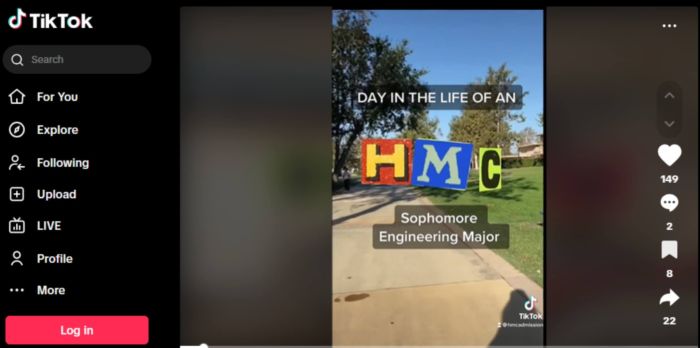
Example: Harvey Mudd College frequently posts user-generated content of its students on its social media pages, like this one featuring a day-in-the-life of a sophomore engineering student posted on TikTok.
Social Media as Search Engines: Optimizing for Discoverability
Today, social media platforms are increasingly taking on the role of search engines for young people. Two-thirds of Gen Z use social platforms to research topics, including potential schools. A teenager is more likely to find your school by watching videos and posts on TikTok or Instagram than by visiting your website or Googling the school. This brings us to Social SEO, a way to optimize your content to be discoverable via social media platform searches.
What is social SEO, and why is it important? Social SEO is the practice of optimizing your content to be discoverable through social media platform search functions. It’s important because younger audiences now use platforms like TikTok and Instagram as search engines. Optimizing SEO for visibility on these platforms helps schools reach and engage prospective students where they’re already searching.
Here are some key steps to improve your school’s visibility in social media searches:
Profile optimization: Treat your social profiles like mini homepages. Use clear, keyword-rich descriptions, consistent branding, and up-to-date contact information across all platforms.
Content that answers questions: Create videos and posts that address common queries, such as “What’s the student-faculty ratio at [Your School]?” or “What’s housing like at [Your School]?” These directly match what prospective students search for.
Strategic hashtags and keywords: Research what terms and keywords your target audience uses when searching for educational content. Incorporate these naturally into your posts, captions, and hashtags.
Geo-tagging: Always tag your location in posts. Many users search by location when researching schools in specific areas.
Consistent posting: Regular activity signals relevance to algorithms, improving your visibility in search results.
It is important to note that these social platforms have different search algorithms; a hashtag strategy that worked on Instagram may need to be adjusted for TikTok or LinkedIn. To make your school more discoverable, explore and learn what best practices apply to each platform and what topics drive current conversations.
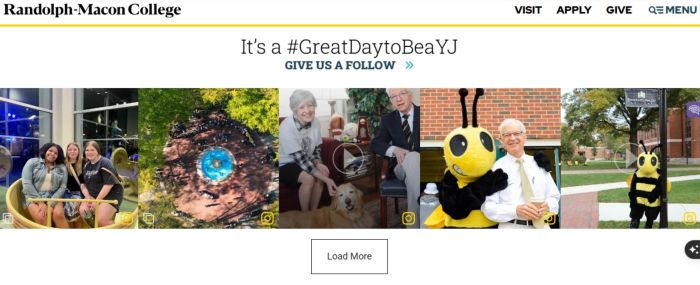
Example: Randolph-Macon College frequently posts social media content featuring catchy headlines and hashtags, such as the one seen here promoting its athletics team, the Yellow Jackets.
Although maintaining a presence across multiple social platforms is great, using a tailored approach for each one is even better. Here’s how you can leverage the strengths of major platforms.
Facebook
Often dismissed as an “older person” platform, Facebook continues to be key to reaching parents who double as key decision-makers for many prospective students. It is great for community building and event promotion. Here’s how to successfully use Facebook marketing for schools in your social marketing campaigns:
Use Facebook Events for open houses, application deadlines, and virtual info sessions
Create targeted ad campaigns using Facebook’s detailed demographic filters
Establish groups for admitted students or parents to foster community
Share longer-form content like student success stories and program highlights
Instagram
Instagram is a predominantly visually driven platform favored by people of different age groups. It is great at showcasingcampus aesthetics and student experiences.
Post high-quality photos showcasing campus beauty and student life
Use Stories for day-in-the-life content, quick announcements, and behind-the-scenes glimpses
Create highlight collections for key topics (Admissions, Student Life, Athletics)
Utilize Reels for short-form video marketing
Leverage the Explore page for discovery by new audiences
TikTok
TikTok, the fast-growing epicenter of youth engagement and viral content, is important for reaching Gen Z. Some students now select schools based on how the schools will look on TikTok.
Create authentic, entertaining content that aligns with platform trends
Feature charismatic students or faculty who connect naturally with viewers
Participate in challenges relevant to education (with your institutional twist)
Use TikTok’s native editing tools and popular sounds to boost algorithm visibility
Don’t be afraid of humor and personality. TikTok rewards authenticity over polish
YouTube
YouTube for education favors long-form content and resources that can be searched.
Produce both longer videos (3-10 minutes) and YouTube Shorts
Optimize video titles and descriptions with relevant keywords
Use cards and end screens to guide viewers to related content
Consider hosting live Q&A sessions during key decision periods
LinkedIn
LinkedIn is an underutilized tool that can help shape your education marketing. It is great for engagingparents, graduate prospects, and professionals.
Share thought leadership from faculty and administrators
Highlight alum success stories and career outcomes
Post about research innovations and academic achievements
Engage in industry conversations relevant to your programs
Encourage faculty and alumni to mention your institution in their profiles
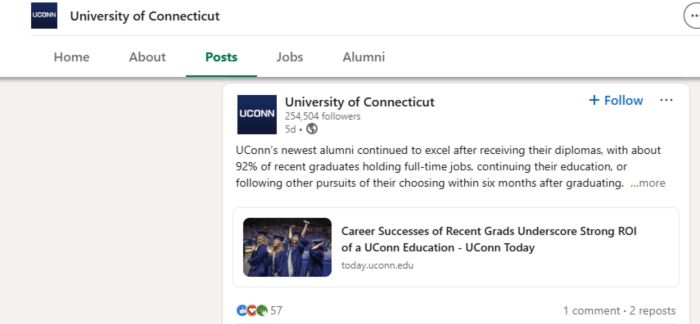
Example: The University of Connecticut regularly posts news about its recent graduates, alumni, and students on its LinkedIn page. The LinkedIn post below highlights the success of its recent graduates.
Education marketing should be serious and informative, but serious does not mean bland and uninspiring. This is where gamification comes in, for fun and engaging learning. With gamification, you incorporate game-like elements and interactive content into your school’s content, effectively turning passive scrolling into active participation. Here are some gamification content and approaches:
Instagram Story quizzes about campus facts or traditions
TikTok challenges that showcase student creativity
Digital scavenger hunts across your website and social platforms
“Day in the life” simulation content where viewers “choose their adventure”
Trends are the main driver of conversations across social media. Connecting your content to a broader cultural conversation can give your school more relevance in the social space. Follow these three trends to place your institution in a position of opportunity.
Nostalgia Marketing: For institutions with some history to draw from, using content that brings back some memories of the past can provoke nostalgic feelings and add value to social marketing campaigns. This is nostalgia marketing. For best results, share throwback campus photos, compare “then and now” scenes, or invite alumni to submit memories. This content typically generates high engagement and shares.
Values and Social Impact: Today’s students care deeply about the position their schools take on issues of social and environmental relevance. To leverage this situation, highlight your school’s sustainability initiatives, community service programs, or research contributions. Point students to recycling initiatives and green campus programs via your social media videos and blogs.
Wellness and Mental Health: Any content that addresses student well-being will resonate strongly with prospects and parents concerned about support systems. This is why you must ensure you share resources from your counseling center and feature student wellness initiatives in your content. Also, create content acknowledging the stresses of academic life and how your institution helps students manage them. A student testimonial about how a mentor or counselor helped them thrive can help humanize your brand, so consider it.
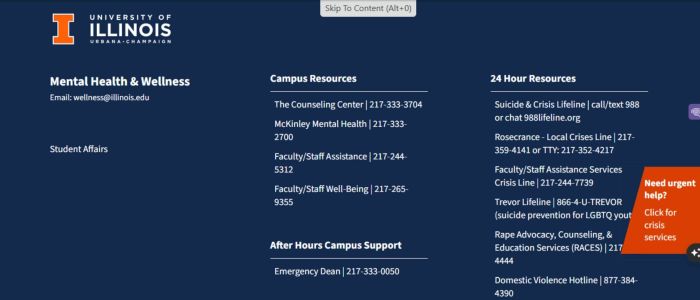
Example: The University of Illinois runs a mental health and awareness program with a full complement of staff and resources committed to student and staff welfare on campus.
Successful social media marketing calls for consistency in learning and adaptation. Platform algorithms are subject to regular changes that affect content visibility and engagement. Here’s what you can do to stay visible and ahead of the curve:.
Monitor metrics to identify which content types perform best
A/B test different formats and approaches
Stay alert to algorithm changes and platform updates
Focus on generating quality engagement (comments, shares)
Adopt new platform features early for visibility boosts
Although social engagement is key to positive brand building, it’s not the ultimate goal. That would be converting interest into action, from website visits to inquiries or applications.
To effectively bridge the gap between interest and action, here are a few tips worth considering:
Optimize your social profiles: Link every platform you’re active on to relevant landing pages. Consider using “link in bio” tools that offer multiple destination options (Apply Now, Virtual Tour, Financial Aid, etc.).
Strategic calls to action: Not every post needs a CTA, but regularly include invitations to learn more, especially on high-interest content. For example, after sharing a student success story, add something like “Discover how you can follow in Sarah’s footsteps—check out our Business program (link in bio).”
Track and analyze traffic sources: Find out which social platforms and specific posts drive the most valuable traffic using resources like UTM parameters. With this information in hand, you can refine your strategy toward what converts.
Amplify high-performing content: When a post generates strong engagement organically, extend its reach to similar audiences by allocating an ad budget to it. By putting out content that resonates with your existing community, you can reach prospects who share similar interests and achieve the desired engagement result.
Align social and search strategies: While many prospects might discover your school on social media, they often go on to later search your name on Google. This is why you must ensure that your search engine marketing complements your social strategy for a seamless user journey.
Building Your School’s Social Media Playbook
As social media continues to evolve and draw more prospective students, today’s schools have to target it with intentional and strategic content. The most successful education marketers approach social media as conversations with future students, current community members, parents, and alumni.
The goal of these conversations goes beyond promoting your institution, it involves bringing its unique culture and value to life in ways that traditional marketing can not achieve. This is why schools must develop an effective social media marketing strategy that factors in all the essentials and adds some extras. While at it, remember a few things: authenticity resonates, visual content engages, and genuine connection converts.
By embracing short-form video, leveraging user-generated content, optimizing for social search, and maintaining a strategic presence across platforms, you create multiple pathways for meaningful connection. Add gamification elements and cultural relevance, and you have a formula for visibility and genuine engagement that drives enrollment outcomes.
See the full Webinar here:
Struggling with enrollment?
Our expert digital marketing services can help you attract and enroll more students!
Frequently Asked Questions
Question: What is social SEO, and why is it important?
Answer: Social SEO is the practice of optimizing your content to be discoverable through social media platform search functions. It’s important because younger audiences now use platforms like TikTok and Instagram as search engines. Optimizing for visibility on these platforms helps schools reach and engage prospective students where they’re already searching.
Question: How can we get user-generated content from students?
Answer: One proven strategy in this line is to allow a student to manage your school’s Instagram Stories for a day, sharing their authentic campus experience. These glimpses into real student life help prospective students envision themselves at your institution in ways that traditional marketing cannot achieve.
Question: How can schools use short-form video to attract students?
Answer: The key to creating winning short-form videos is to go for authenticity. Start by identifying what makes your institution stand out, whether it’s a unique program, a beloved campus tradition, or exceptional career outcomes.
You can then showcase these elements through quick, visually engaging stories highlighting your unique value proposition.
The rapid advent of AI capabilities, coupled with the developing economic pressures worldwide, have led to a surge in employers seeking to reduce operating expenses through widespread use of generative and agentic AI to augment, and in some cases, replace, humans in their workforce. This follows last year’s warning from the World Economic Forum that said, “AI skills are becoming more important than job experience.”
The World Economic Forum report goes on to cite the 2024 Work Trend Index Annual Report, which draws on a survey of 31,000 people across 31 countries, hiring trends from LinkedIn, Microsoft 365 productivity data and research with Fortune 500 companies: “Over the past eight years, hiring for technical AI roles was up 323%, and businesses are now turning to non-technical talent with the skills to apply generative AI tools like ChatGPT and Copilot. Two-thirds of business leaders surveyed say they wouldn’t hire a candidate without AI skills. Nearly three-quarters said they would rather hire a less experienced candidate with AI skills than a more experienced candidate without them.”
Writing in The Chronicle of Higher Education, Beth McMurtrie defines AI literacy: “The term AI literacy can feel squishy. But the definitions circulating among campus working groups, disciplinary associations, and other organizations share several key components. To be AI literate, they agree, you must understand how generative AI works, be able to use it effectively, know how to evaluate its output, and understand its weaknesses and dangers. For AI skeptics, that last point is crucial. Too many workshops stop short, they say, focusing only on how to use AI tools.”
In a survey conducted last November, Educause reported only 37 percent of institutions were supporting needed AI abilities by “upskilling or reskilling” faculty or staff, and just 1 percent reported hiring new AI staff. A larger percentage of faculty and staff were addressing related academic integrity and assessment issues. The Educause AI Landscape Study reported,
“Respondents from smaller institutions are remarkably similar to respondents from larger institutions in their personal use of AI tools, their motivations for institutional use of AI, and their expectations and optimism about the future of AI.
“Respondents from small and larger institutions differ notably, however, in the resources, capabilities, and practices they’re able to marshal for AI adoption.”
These responses from as recently as the end of last semester show that the majority of institutions are lagging behind in preparing themselves and their graduates and certificate completers for the rapid changes that are expected to take place in workplaces around the world over the coming months. Yet, as reported in Government Technology, new laws creating frameworks in California and the European Union are leading the way in ensuring learners are well prepared for the emerging workplace:
“Under California’s new law, AI literacy education must include understanding how AI systems are developed and trained, their potential impacts on privacy and security, and the social and ethical implications of AI use. The EU goes further, requiring companies that produce AI products to train applicable staff to have the ‘skills, knowledge and understanding that allow providers, deployers and affected persons … to make an informed deployment of AI systems, as well as to gain awareness about the opportunities and risks of AI and possible harm it can cause.’ Both frameworks emphasize that AI literacy isn’t just technical knowledge but about developing critical thinking skills to evaluate AI’s appropriate use in different contexts.”
The American Library Association has taken a leading role in developing a draft document, “AI Competencies for Academic Library Workers,” that is currently under review based upon recommendations made by constituencies in recent weeks. The document includes two sections: “dispositions (tendencies to act or think in a particular way) and competencies (skills, knowledge, behaviors, and abilities). Dispositions are presented as a single list. Competencies are organized into four categories: Knowledge & Understanding; Analysis & Evaluation; Use & Application; and Ethical Considerations.”
“Such initiatives are spreading rapidly across higher education. The University of Florida aims to integrate AI into every undergraduate major and graduate program. Barnard College has created a ‘pyramid’ approach that gradually builds students’ AI literacy from basic understanding to advanced applications. At Colby College, a private liberal arts college in Maine, students are beefing up their literacy with the use of a custom portal that lets them test and compare different chatbots. Around 100 universities and community colleges have launched AI credentials, according to research from the Center for Security and Emerging Technology, with degree conferrals in AI-related fields increasing 120 percent since 2011.”
These initiatives are exemplars of a variety of approaches that institutions might consider to respond to the urgent need to prepare learners for the workplace that is so rapidly emerging. Yet, now, as we move into the final weeks of the spring semester, it still appears that many, if not most, of the institutions of higher learning are failing their students. We are failing to fully prepare those students to enter the workforce where, as the World Economic Forum says, two-thirds of business leaders surveyed say they wouldn’t hire a candidate without AI skills and nearly three-quarters said they would rather hire a less experienced candidate with AI skills than a more experienced candidate without them.
What is your institution doing to meet this urgent need? Who is leading a universitywide initiative to meet this need? Will your spring graduates and certificate completers be able to compete with others who have credentials that include knowledge and competencies in AI?
Johns Hopkins University is turning to earnings on its $13.2 billion endowment to preserve research and protect researchers, trainees and staff amid drastic cuts to federal funding, The Baltimore Banner reported Monday.
Since President Donald Trump started his second term in January, federal agencies have terminated or stalled billions in research grants to colleges and universities in a move scientists and higher education advocates warn will decimate university budgets, slow scientific innovation and hurt local economies. Johns Hopkins estimates that it has so far lost 100 federal grants, while others remain under review by the Trump administration to ensure they align with the federal goal of rooting out diversity, equity and inclusion, among other things. As a result, the university said it’s approaching $1 billion in federal funding losses so far this year.
While Trump and his allies have suggested universities can use their endowments to fund research, officials at Johns Hopkins—which received more funding from the National Institutes of Health in 2024 than any other university—said Monday that’s not so easy.
“It’s a common misconception that universities can simply ‘use the endowment’ in moments like this,” university officials said in a statement. “The reality is that most of our endowment is made up of legally restricted funds designated by donors for specific purposes. The principal of the endowment must legally be preserved in perpetuity—to support Johns Hopkins’ mission now and for future generations—and cannot be drawn down like a reserve fund.
“That said, we are using flexible resources—some of which are tied to endowment earnings—to help sustain critical research in this moment of uncertainty.”
Johns Hopkins hasn’t disclosed how much total earnings it plans to take from its endowment to help faculty and students continue their research, according to a news release.
But in the plan released Monday, it said individuals will receive up to $100,000 for delayed grants or $150,000 for terminated grants during a 12-month period. The university will also offer a year of support to Ph.D. students completing their dissertations and postdoctoral fellows who had been expecting support from federal grants that were terminated, as well as expand a program that offers editorial support for grant proposals and journal articles and another that enables undergraduates to work with faculty mentors on original research or projects.
“Harvard Law Review’s article selection process appears to pick winners and losers on the basis of race, employing a spoils system in which the race of the legal scholar is as, if not more, important than the merit of the submission,” said Acting Assistant Secretary for Civil Rights Craig Trainor in a statement. “Title VI’s demands are clear: recipients of federal financial assistance may not discriminate on the basis of race, color, or national origin … The Trump Administration will not allow Harvard, or any other recipients of federal funds, to trample on anyone’s civil rights.”
The statement alleged that the editor of the Harvard Law Review wrote that it was “concerning” that the vast majority of people seeking to respond to an article about police reform “are white men.” It also accused another editor of suggesting that a submission receive “expedited review because the author was a minority.”
Education Secretary Linda McMahon reposted a tweet from the Free Beacon that purports to show additional evidence of race-based decision-making at the Law Review.
“We will not allow recipients of federal funding to discriminate on the basis of race,” McMahon wrote.
Members of the Harvard Law Review have not publicly commented on the allegations. But an HLS spokesperson told Axios, “Harvard Law School is committed to ensuring that the programs and activities it oversees are in compliance with all applicable laws and to investigating any credibly alleged violations.”
Indiana state lawmakers have sent their governor a state budget bill that goes beyond setting funding levels. If Republican governor Mike Braun signs it into law, House Enrolled Act 1001 will require faculty at public colleges and universities to post their syllabi online and undergo “productivity” reviews.
The bill would also—among other things—prohibit faculty emeriti from voting in faculty governance organizations, place low-enrolled degree programs at risk of elimination by the Indiana Commission for Higher Education and end alumni elections for three Indiana University Board of Trustees seats by filling them with gubernatorial appointees. In addition, it has a provision that would let Braun remove the currently elected board members before their terms expire.
“I think overreach doesn’t begin to describe the actions of the Legislature,” said Russ Skiba, a professor emeritus of education at IU Bloomington. “This is really a sweeping takeover of higher education in Indiana.”
The Republican-controlled Indiana General Assembly passed the legislation—which runs more than 200 pages—less than two days after revealing it Wednesday, April 23. The state House approved it around 12:45 a.m. Friday, followed by the Senate’s agreement at about 1:20 a.m.
“I know a lot of legislators … simply didn’t have enough time to fully read it,” Skiba said. “There was no opportunity whatsoever for any sort of public input.”
Matt Pierce, a Democratic Indiana House member who’s a senior lecturer at IU Bloomington, said the conference committee report revealing the budget bill wasn’t even released until Wednesday evening.
“As people began to kind of go through it, they discovered all these higher education provisions that had never been discussed anywhere,” Pierce said. To have “provisions of this magnitude” pass in the budget bill “with no hearing or public input, that was pretty shocking,” he said.
The budget bill’s higher education provisions echo those passed, or at least proposed, in other red states. But Indiana’s General Assembly continues to be in the vanguard among even GOP-controlled legislatures in its fervor for regulating public higher education. Last year, state lawmakers passed, and the former governor signed, a law threatening the jobs of nontenured and tenured faculty who don’t sufficiently foster “intellectual diversity,” as defined by campus boards of trustees.
These bills follow pro-Palestine protests at IU Bloomington and tensions between faculty and university president Pamela Whitten. And with a further reduction of tenure protections looming in the new bill, a tenured professor at IU Bloomington says he’s under investigation for allegedly violating a policy the university wrote to uphold last year’s intellectual diversity law.
Ben Robinson, an associate professor of Germanic studies and a prominent pro-Palestine campus protester, told Inside Higher Ed that an anonymous student filed a complaint against him in October. The unnamed student, according to a copy of the complaint Robinson provided, wrote that Robinson “talks negatively about the state of Israel and describes the war in untrue and unfair ways” and has discussed being arrested at a pro-Palestine rally “on numerous occasions.” The student also complained that Robinson had spoken “against Indiana University on several occasions” and used class time to say the university was restricting free speech.
This complaint was filed in IU’s bias incident reporting system, which wouldn’t have involved potential discipline, Robinson said, but university administrators appeared to refile it as an intellectual diversity–related complaint under the policy passed after the General Assembly’s intellectual diversity law. He said he thinks administrators “want to overcomply on particularly this ideological issue, because that’s what they’re being told they have to enforce” by the federal government.
“How can a professor know what’s going to be called bias?” Robinson said. He also said IU Bloomington is “a campus in which the witch hunts are alive and well, and I, along with many others, have been an open target of them.”
IU spokesperson Mark Bode, in response to Inside Higher Ed’s requests for an interview and written questions about Robinson’s situation, wrote in an email simply that “IU does not comment on personnel matters.”
Accusations of IU Involvement
Multiple critics have accused IU leaders of backing one or more of the 11th-hour budget bill’s higher education changes. When asked about this, Bode provided a written statement that didn’t say whether IU was specifically involved.
“Throughout the session, Indiana University engaged with state lawmakers to shape meaningful conversations about the university’s commitments to making higher education accessible to Hoosiers and driving the state’s economy through life-changing research and innovation,” the statement said. IU “will be working over the coming weeks to understand the full impact of state legislation and ensure compliance.”
Before the bill passed, Pierce said, he texted an IU lobbyist asking the university’s position on it. The lobbyist replied that the institution didn’t have a position because it was still carefully reviewing the legislation, Pierce said.
“And right then and there I knew that IU was behind it,” Pierce said. He also questioned how lawmakers would have the “pretty esoteric” knowledge that emeritus faculty serve in some faculty governance organizations.
“You now have a convergence of the Republican attacks on higher education and the actual administration of Indiana University, and that’s a pretty shocking development,” he said.
The IU Board of Trustees currently has six gubernatorial appointees—including a student with a two-year term—plus three members elected by alumni. If Braun signs the budget bill, he and future governors will be able to appoint all nine members, the student member’s term will drop to one year and there will be no more alumni-elected members.
Braun has expressed support for this change, according to the Indiana Capital Chronicle.
“I think it’s being done because the current process [has] not maybe yielded the proper results on the entirety of how you want that important part of our state to be run—from curriculum to cost to the whole way one of our flagship universities has been operating,” Braun said, according to the Capital Chronicle. “I want to get a board there that is going to be a little more rounded, that’s going to produce better results.”
Vivian Winston, one of the elected board members, who previously announced she’s not seeking re-election, said she voted against IU president Whitten’s contract extension and the university’s post-encampment protest restrictions. But she said she doesn’t know whether her votes were related to the board change part of the legislation—which, like the other higher ed provisions in the bill, caught her “unaware.”
“I found out through the media,” Winston said of the changes in the bill.
Rodric Bray, a Republican and Indiana’s Senate president pro tem, provided Inside Higher Ed a rationale for the part of the bill ending alumni elections.
“A very small fraction of the IU alumni have been participating in the election for the alumni seats on the IU Board of Trustees,” Bray said in an emailed statement. “Of the approximately 790,000 alumni around the world, only about 2.5% of alumni voted in the most recent election for trustee. Because the number is so small, it is not a fair representation.”
But some opponents of the provision don’t see it that way. Skiba, the IU Bloomington emeritus faculty member, said, “This is clearly payback for opposition of policies favored by the president of the university and the Legislature.” He said the change would “take those voices of opposition off the Board of Trustees and essentially give complete control of the Board of Trustees over to the governor.”
Over all, Skiba said, “this Legislature is following the Trump lead—wishing to put an airtight lid on free expression. And if you’re wishing to do that, universities are an obvious place to start.”
The Mellon Foundation is giving $15 million in emergency funding to state humanities councils after the National Endowment for the Humanities eliminated $65 million in support for the councils, amid sweeping cuts to its grants and workforce, the foundation announced Tuesday.
These councils, established by Congress in 1971, are nonprofits that support educational programming for the public, such as literacy initiatives, lectures, book fairs and cultural programs. The support will go toward all 56 state and jurisdictional humanities councils across the country in hopes of staving off possible deep cuts and closures. The foundation plans to allocate $2.8 million to challenge grants of up to $50,000 for each council, to be matched by other funders. And each council will received $200,000 in immediate operational support, The New York Timesreported.
Elizabeth Alexander, president of the Mellon Foundation, said in the announcement that while the emergency funds can’t cover the full extent of cuts, it’s a show of support.
“At stake are both the operational integrity of organizations like museums, libraries, historical societies in every single state, as well as the mechanisms to participate in the cultural dynamism and exchange that is a fundamental part of American civic life,” Alexander said.
Phoebe Stein, president of the Federation of State Humanities Councils, called the foundation funding a “lifeline.”
“Mellon’s support allows us to not only preserve this vital network—it helps ensure that everyday Americans can thrive through lifelong learning, connection, and understanding of one another,” she said in the announcement.
Over strong objections from Democrats, House Republicans on the Education and the Workforce Committee advanced legislation Tuesday that would make dramatic changes to the federal student aid system.
For a full Inside Higher Ed analysis of what provisions are included in the reconciliation bill, read here.
The sweeping 103-page bill, known as the Student Success and Taxpayer Savings Plan, passed on a party-line vote after more than five hours of debate. The legislation would cap the amount of federal loans a student can take out, cut off the Pell Grant for students who attend less than half time, consolidate income-driven repayment plans and introduce a risk-sharing program where colleges are partially responsible for unpaid student loans. The bill, which would also reverse multiple Biden-era student borrower protection regulations, could save more than $330 billion in federal funding over 10 years, committee Republicans say.
It’s just one section of a larger budget bill that lawmakers are planning to use to fund some of President Donald Trump’s top priorities, like lofty tax cuts for the wealthy and a major crackdown on immigration. But House Republicans said the changes were more than just a means to fund his MAGA agenda.
“If there is any consensus when it comes to student loans, it’s that the current system is effectively broken and littered with incentives that push tuition prices upward,” Rep. Tim Walberg, a Michigan Republican and committee chair, said in his opening statement. Higher education is “on a fiscally unsustainable path, so we must deliver on the promise of economic mobility to our students and families. Taken together, the provisions in this package will do just that.”
Democrats on the committee argued the legislation is nothing more than a means to fund tax cuts for the wealthy that will force low-income and racial minority students to take on more debt and penalize the community colleges, regional universities and minority-serving institutions that educate those students. All in all, the bill will put the cost of a college degree out of reach for many, they said.
“I appreciate that my colleagues acknowledge that the cost of college is too high, and that Congress should reform the system. But the committee print before us today … seriously misses the mark of making college more affordable,” said Rep. Bobby Scott, a Virginia Democrat and ranking member on the committee. “Put bluntly, this Republican proposal will limit how much money middle- and low-income students can borrow from the federal government.”
Scott and other Democrats proposed 33 amendments—all of which Republicans voted down. They ranged from requests to prove the bill wouldn’t disproportionately affect certain institutions and increase costs for students to defending the Pell eligibility of part-time students and some consumer-protection regulations. Democrats also proposed replacing the income-driven repayment plan in the legislation with a more generous Biden-era alternative and striking the bill entirely. Other amendments touched on other issues unrelated to this section of the legislation, such as proposed cuts to Medicaid and the Department of Government Efficiency’s access to sensitive data.
Republicans countered that Democrats’ allegations that the bill would make college less affordable were, as Rep. Burgess Owens of Utah said, “nothing further from the truth.” The proposed changes to the federal aid system will lead to better loan terms and repayment options that are also fair to taxpayers and avoid wasteful spending, they argued.
The bill will now head to the House Budget Committee, where it will be folded into a complex omnibus bill before it is sent to the floor for a full House vote.
But even if it clears the House, the legislation still has a long way to go. The House and the Senate have differing ideas about how much federal spending they wish to cut and what programs they are willing to slash. The Senate is aiming to make at least $1 billion in education cuts, which is less than 1 percent of the House committee’s $330 billion reduction.
This reconciliation bill only needs a simple majority vote, or 51 yeas, to pass the upper chamber, but that will require almost all Republicans in the Senate to agree, which experts don’t think is a foregone conclusion.
Risk Sharing
One of the more contentious proposals in the bill is the risk-sharing provision, which would require colleges to repay the government a portion of students’ unpaid loans.
Republicans on the committee described the risk-sharing proposal as critical, adding that it would penalize colleges for forcing their students into unmanageable debt and would incentivize them to lower their cost of attendance.
“The best way for us to do that is not to loan [students] more money, but to reduce the cost so that they don’t need the loans,” said Rep. Randy Fine of Florida, who has been active in higher ed in the Sunshine State. “That’s what this bill does over and over and over again.”
But Democrats said it is misleading to say the bill and provisions like risk-sharing would reduce costs and increase graduation rates, arguing it would actually incentivize colleges to accept fewer low-income students and increase tuition or cut critical student-support programs in order to foot the bill of new penalties.
Rep. Alma Adams, a Democrat of North Carolina, called risk-sharing “a dire threat” especially to historically Black colleges and universities, which would have to pay an average of $1.7 million per year to account for the debt of their graduates.
The students at these institutions “started behind but are determined to get ahead,” Adams said, adding that they don’t default because they are failing; they default because they are “carrying the burden of generations of inequity.”
“This bill will tell colleges to take only the best students and leave the rest behind,” she added.
Multiple student advocacy and higher education groups opposed risk-sharing and other proposals in letters to the committee and fact sheets.
Third Way, a left-of-center think tank, noted in a memo Monday that the concept of risk-sharing “has a lot of intuitive appeal,” but the proposal “misses the mark for meaningful accountability.” Other provisions like loan limits and changes to the Pell Grant program will also “drive students into the private loan market,” the memo added.
And the Association of Public and Land-grant Universities told the committee that, if passed, risk-sharing would amount to a “staggering level of federal overreach” that penalizes colleges and universities for “decisions beyond their control.”
“The gravity of these changes would have a far reaching impact to current and future students,” APLU wrote. “There is a better way.”
If Republicans “truly believed” the bill would not raise the cost of college and the burden of debt for students, then they would have no problem passing proposed amendments that certify its impact on students and institutions, said Adams, the North Carolina Democrat.
“Let’s be clear about what this really means: This bill punishes students for being poor. It punishes students for needing to work. It punishes students for living in the real world,” she said. It transforms financial aid “from a bridge into a barricade.”