Tag: Education

  • College holiday videos feature mascots, movie references

    College holiday videos feature mascots, movie references

    It’s been another challenging year in higher ed, and colleges are unsure what 2025 could bring, especially with the Biden administration coming to an end and former president Trump returning to the White House. But that doesn’t mean there’s nothing for them to celebrate this holiday season, whether it’s increased enrollment, new awards and recognitions, a close-knit campus community—or just the fact that there are students on campus willing to star in a silly holiday video.

    Here are Inside Higher Ed’s favorite greetings of this holiday season, including five presidential cameos, four mascot stunts, three live music performances, two Die Hard references … and a partridge in a pear tree.

    University of Wisconsin–Superior

    Since when can yellowjackets ice-skate? Google tells me that wasps need to find somewhere warm to hide away when temperatures drop below 40 degrees—but Buzz the Yellowjacket, the University of Wisconsin at Superior’s mascot, appears to be the exception. In this holiday greeting video, Buzz not only makes an impressive ice hockey goal but also displays some figure skating prowess, pulling off a top-rate arabesque. Could Buzz become the nation’s first ever apian Olympian?

    Riverland Community College, Austin, Minn.

    In this video from Riverland Community College in southern Minnesota, different groups of students wish viewers a happy holiday in turn. Their greetings give glimpses into the unique programs, clubs and spaces on campus, from cosmetology students giving pedicures in a salon to handy welders- and electricians-in-training showing off their skills.

    Iowa State University, Ames, Iowa

    Iowa State’s Cyclone Marching Band comes together in perfect harmony in this artfully choreographed video, marching across campus to provide some brassy musical accompaniment for the campus’s tree lighting. From what I could find in my research, the group first plays the university’s alma mater, “The Bells of Iowa State,” which was written in 1931 by Iowa State English professor Jim Wilson, followed by a rousing rendition of ISU’s fight song.

    Georgia State University College of the Arts, Atlanta

    Coniferous trees spring from sidewalks and dance studios in this collage-like animation by a GSU alumnus, featuring background music by a current undergraduate student. The video concludes with punny well-wishes for the holidays: “May the arts spruce up your season with good cheer!”

    Eastern Washington University, Cheney, Wash.

    This sketch from Washington’s EWU opens with the university’s president, Shari McMahan, jokingly bemoaning the fact that she had run out of acorns on which to use her large collection of nutcrackers. But the campus community takes that joke seriously and shifts into high gear, with each department researching how to help her get her hands on more “nutcracker food.” I hope those math students were able to finally solve for the numeric value of acorn!

    Howard University, Washington, D.C.

    Howard president Ben Vinson III highlights the university’s 2024 achievements in this holiday message, including the D.C. university’s record-breaking freshman class and its 100th homecoming. “As we prepare for the holidays, I look forward to all that lies ahead. I wish everyone a joyful and restful break and a successful start to the new year,” Vinson said.

    Whitman College, Walla Walla, Wash.

    Rhythmic choral music rings out through Whitman College’s Memorial Building before the singers are eventually joined by an instrumental septet in this distinctive holiday video. What makes this video so unusual is the choice to use not a well-known holiday carol but a choral song by living composer Jeff Newberry with lyrics by Malcolm Guite, a poet and Anglican priest, that nevertheless speak to the gratitude and peace of the holiday season: “Become an open singing-bowl, whose chime / Is richness rising out of emptiness, / And timelessness resounding into time.”

    Massachusetts Institute of Technology, Cambridge, Mass.

    MIT’s video this year is a short animated sequence that shows what happens after it magically begins snowing inside one of the university’s academic buildings. A student walks through the snow-dusted hallway, eventually happening upon an atrium where her classmates are playing instruments crafted from ice, sledding and crafting a snow beaver in the image of the institution’s mascot.

    University of North Carolina at Charlotte

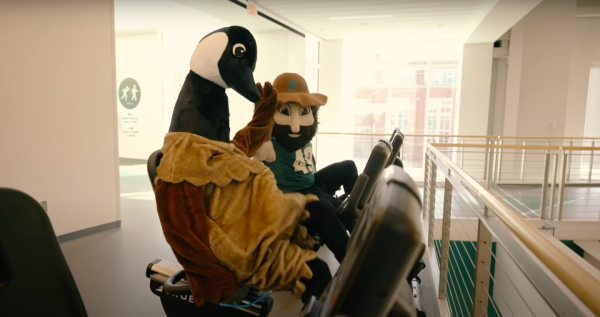
    What a beautiful message for this holiday season: the importance of friendship across differences. When Norm the Niner, the University of North Carolina at Charlotte’s gold-mining mascot, orders goose on a food delivery app, he’s expecting dinner to arrive. But instead, he finds a live goose at his door at ready to move onto UNC-Charlotte’s campus. At first, the goose only wants to cause chaos, but eventually he mellows out, learning to enjoy college basketball, fine art and taking selfies before eventually departing south for the winter.

    Tarrant County College, Tarrant County, Tex.

    In this heartfelt video from one of Texas’s largest counties, members of the Tarrant County College community join together at a beautifully set table for what looks to be a homemade holiday dinner, reminding TCC students that they will always “have a seat at the table.” Joining them is college chancellor Elva Concha LeBlanc and Toro the Trailblazer, the college’s blue bull mascot, which is dancing in the background.

    Oral Roberts University, Tulsa, Okla.

    Hot takes abound in this video of Oral Roberts students answering Christmas-related questions, like their favorite holiday songs and films. Is Home Alone 2 superior to the original? Does the Phineas and Ferb Christmas special really qualify as a Christmas movie? Does anyone actually know the words to “Grandma Got Run Over by a Reindeer”? If you and your family don’t have enough to argue about this holiday, these are some questions you could bring up to really cause a ruckus.

    Yale University, New Haven, Conn.

    Why does it seem like there’s a trend this year of rebuffing all the classic carols in favor of introducing new songs to represent the spirit of the season? I’m not complaining; apparently the song in this video is from Frozen 2, a movie I have never seen, but Yale’s student performers make it sound as loved and lived-in as a warm woolen sweater. This video also features Handsome Dale, Yale’s bulldog mascot, and Angus, the university’s First Puppy.

    Clackamas Community College, Oregon City, Ore.

    One of two institutions returning to this list from last year, Clackamas Community College in Oregon is back with another parodic holiday heist. This year, the college took inspiration from Die Hard. It stars Adam Hall, a math instructor at the college, in the role of John McClane, having to fight against a plot to “encrypt the digits of pi to ruin their holiday joy.” I’ve never seen Die Hard, but I have to assume that’s extremely accurate to what happens in the movie.

    Oakland Community College, Oakland County, Mich.

    Oakland Community College is the second to make another appearance on this list from last year. In this year’s self-aware video, chancellor Peter Provenzano decides to use ChatGPT—one its few, if only, appearances in any of these videos!—to gather ideas for a Christmas movie parody that Talon, OCC’s owl mascot, could star in. The AI spits out It’s a Wonderful Life, Die Hard, A Charlie Brown Christmas and more, but none satisfy Provenzano. The moral of the story? “There are a lot of stories Talon can tell to capture the season’s joy, but none better than the story we tell at OCC,” he says. (And stick around to the end for bloopers!)


    Source link

  • What were we reading about higher education in 2024?

    What were we reading about higher education in 2024?

    As 2024 draws to a close, Josh Freeman, Policy Manager, and the HEPI team look back on a remarkable year in higher education policy.

    We have a fantastic programme of events to look forward to in 2025, which you can read all about here.

    One of the best things about working at HEPI is that we can take a bird’s eye view of the sector. Today, we gaze over quite a different policy landscape from the one I wrote about this time last year. We have a new Government which, unlike the last one, is not afraid to raise tuition fees. The Graduate Route visa survived in its current form, largely because of the international fee income it helps bring to struggling institutions. Universities UK published its Blueprint, proving it is possible to get 140 vice-chancellors (or thereabouts) to agree on something. Despite all this, nothing seems to stop the interminable slide into financial precarity with up to three-quarters of institutions at risk of running deficits in 2025.

    It has been a privilege to capture many of these moments and more on the HEPI blog, which had another exceptionally busy year. As we approach the end of 2024, the HEPI team reflects on the pieces which set the tone for the year, struck a chord in institutions, led policy change or were just a great read.

    Winter

    In January, we heard from Laura Coryton MBE about period poverty in higher education, the stigma attached to it and the strategies institutions can take to address it. HEPI intern Famke Veenstra-Ashmore also discussed this issue, among many others, in her report on the gender awarding gap at Oxbridge in November.

    Richard Courtney of the University of East London won the prize for best analogy of the year with his comparison of a Chinese meal to higher education qualification types in February.

    And HEPI published its best-read report of the year, Provide or punish? Students’ views on generative AI in higher education. (Watch out for an update in early 2025!) Our other top reports of the year include:

    Spring

    This spring was a season of reflection, with Susan Mueller, Director at Stand Alone, bidding farewell and marking the closure of a charity which supported estranged students since 2015.

    And Naimat Zafary, PhD researcher at the University of Sussex, marked 1,000 days since girls’ education was banned in Afghanistan with an extraordinarily powerful piece reminding us not to take education for granted:

    Last week, I visited the British Library, one of my favourite places in London. I was attracted by the Magna Carta which declared: ‘No free man shall be seized, imprisoned, dispossessed, outlawed, exiled or ruined in any way, nor in any way proceeded against, except by the lawful judgment’.

    But where is lawful judgment for those denied? What fault in Afghan girls? My little nieces don’t understand their crime. Is love of education a criminal act if you happen to be female?

    Summer

    As we absorbed the previous day’s General Election results, attention turned to its consequences for higher education. While some of us were struggling to function on two hours’ sleep, HEPI Director Nick Hillman was already analysing how far students’ had swayed the results, building on his own analysis of the 2019 General Election and my analysis ahead of the 2024 vote.

    University of Southampton Chief of Staff Giles Carden made his pitch for 10 policies the new Government could implement to fill the policy vacuum, including ‘fundamental reform’ to the Office for Students and setting out a new strategy for digital education.

    And our political commentary came to a head when Rose Stephenson, Director of Policy and Advocacy, and I described what we had seen and heard at the Labour Party Conference.

    Autumn

    The introduction of the Renters’ Rights Bill to Parliament in September 2024 generated much discussion, including several pieces by former Unipol CEO Martin Blakey. His essential primer from October is a must-read for those trying to get their heads around the draft legislation. Martin also wrote for us in June and November on the same topic.

    HEPI Director Nick Hillman asked whether restricting access to the Russell Group would improve social mobility (he was sceptical).

    Also in October, outgoing Open University Vice-Chancellor Tim Blackman asked, responding to Office for Students (OfS) analysis of degree classifications, whether and how we should measure ‘grade inflation’. In the words of our Director of Partnerships, Lucy Haire, the blog:

    poses challenges to the OfS’s methods and use of data, but even more than that, it gets to the heart of what learning is all about and how it is achieved. It tackles prejudice about disadvantage and weak prior learning and, above all, recognises the strides that students take, the role of good teaching and the importance of skilled teachers.

    Our piece with a star-studded lineup, including former Welsh Director of Skills, Higher Education and Lifelong Learning Professor Huw Morris and Professor of Public Policy at Manchester Andy Westwood, set out a vision for a new tertiary system.

    And particular credit goes to one of our highest-performing pieces of the year from Meti Basiri, CEO of ApplyBoard. He asks which international student populations institutions should be recruiting from. He also wins the (coveted) prize for best graphics.

    That’s it from us

    Thank you to everyone who has written for us, supported our research, kept up with our daily 6:30am blogs and engaged with us in any way over the past year.

    The HEPI blog will continue in a limited form over the break, so do keep an eye out between mince pies. We will be back in full force in January.

    Until then, have a wonderful festive break and we will see you for more in 2025!

    Source link

  • It’s the higher education Christmas movie and TV guide

    It’s the higher education Christmas movie and TV guide

    There’s nothing on the telly this Christmas.

    There never is. Unless you’re searching for some hidden nuance in repeats of The Chase.

    But if, like me, you have trouble switching off from work but also enjoy being slumped in front of the box with a tub of Quality Street, I have good news.

    I’ve picked out ten films and TV shows released this year that either have something to say about higher education, are set on campus and/or depict contemporary student life.

    You’ll laugh, you’ll cry, you’ll shell out for a VPN, you’ll get frustrated by torrent ratios, and you’ll almost certainly switch off, which is what the break is for – eventually.

    It really was slim pickings this year from a UK perspective. Everyone talks a lot about how universities are portrayed “in the media”, but I think they mean on Newsnight or in the Telegraph. The sector will probably win more hearts and minds on Netflix, if anyone knows anyone that might be able to help.

    Before you take to the comments, I’ve not put in books or podcasts. I do enough reading in this job, and I edit ours, so my appetite for either is fairly thin – but do pop suggestions below if there are any.

    You’re welcome – and apologies in advance if you’re at work over the next couple of weeks.

    If having worked in or around the sector you’ve not quite had your fill of toxic and manipulative relationships this year, the second season of Tell Me Lies is a good bet. Filmed largely on the picturesque campus of Agnes Scott College in Georgia, we’re whisked into a world of 2008 fashions, messy frat parties, tense dorm room interactions and academics’ office hours – all used to illustrate how central character Lucy Albright’s university experiences shaped her later life. It’s all a bit soapy, but the deep discomfort at having to hang out with your exes that campus life can require is very well played.

    There are more depictions of dorm life in Sweethearts, a romantic comedy whose set-up centres on two friends breaking up with their girlfriends from home over a holiday weekend. It’s all a bit loaded lads retro – flying urine and a flaccid full-frontal give you a sense of the tone here – but treat it like gazing out of the window on a train, and you’ll take in some lovely interior scenes from Ramapo College in Mahwah, and some lush exterior shots from the Vermont College of Fine Arts.

    This is a low-budget “feminist horror thriller” that follows a fraternity pledge who, during a brutal hazing ritual, is pressured to lose his virginity by leading a drugged girl upstairs at a party – something that has unexpected and increasingly disturbing consequences. It’s cleverly filmed, there’s a cracking soundtrack and it’s comically gruesome – until you remember that without the blood and gore of act three, it’s depicting an unsettlingly common scenario.

    Yôji Minamimaru, the central character of Land of Tanabata, navigates all the typical challenges of being a student – academic life, social relationships, self-discovery, and a supernatural ability to create small holes in objects, something he shows off as the President of the New Skills Development Research Society. It’s an unlikely hook for a series, and the murder (of a professor) mystery that ensues is a struggle to stick with in this manga adaptation.

    Two old friends enroll in an adult university, looking for adventure, love and fun. What could go wrong? Quite a lot, it seems, in this Dominican go at mature student life that drags up some particularly dated caricatures of women and LGBT+ people. I got about 15 minutes in before I was tired of the buffering.

    What do you fancy watching. A drama? A rom-com? A thriller? An overdone Indonesian horror film based on a viral Twitter thread from 2016? On the assumption that it’s the latter, Dosen Ghaib: Sudah Malam atau Sudah Tahu (The Ghost Lecturer: Is It Night Already or Do You Already Know) follows four university students who fail the year and are required to enrol onto a catch-up module over the holiday, who pitch up only to get a message that the lecturer can’t make it – so who is the person already in the room? For clarity, it’s a murdery ghost man, not one of his PhD students.

    You might remember a story from 2023 that involved an academic specialising in the social impacts of climate change avoiding air travel to minimise his carbon footprint – only to get sacked for doing so. The Researcher chronicles Gianluca Grimalda’s 40-day journey via trains, buses, and ships to reach his research site in Papua New Guinea. Maybe he was sacked for not using Key Travel to book it all.

    Decades on from the end of apartheid, Afrikaans media is only just starting to break away from its historically conservative roots. Wyfie – opening up conversations about rape, sexuality and politics – caused quite a stir when it appeared in 2023, and this year’s second season of the show, about four mismatched university roommates at a womens’ residence at the fictional Eike University, takes things up a notch. It’s especially fascinating for the insights into university life – first-year initiation ceremonies, cheating on a test to maintain academic standing and a mother-and-daughter tea event all make it in, as does a whole bunch of drama over an annual photo of those in the halls. It’s especially good on both portraying and dramatising that “you befriend people that aren’t like you” cliche.

    If all of these sensitive and revealing portrayals of student life are a bit woke for your liking, and you’ve never got around to reading The Coddling of the American Mind, you’ll be pleased to learn that you watch it now instead. The central conceit of the Lukianoff and Haidt viral article-cum-bestseller gains some visuals, voxpops and dramatic music here – but decent evidence for their claims, which to these eyes and ears is age-old generational indignation dressed up as science – is still in short supply. That said, the idea that pervasive racism, sexism, homophobia and transphobia are merely bad ideas that a good debate will solve is at least in the solid tradition of Christmas TV escapism.

    This is set in Kota, Rajasthan – a city known as a hothousing hub for coaching centers that prepare students for India’s highly competitive IIT-JEE entrance exams. Back for a darker yet compelling third season this year, there’s plenty to learn here about the coaching system’s human impact as the focus shifts a little to draw in the coaches themselves and the choices made between the gifted students and everyone else. If there’s a fault with it, it’s the season ending – a crowbarred bit of plotting presumably designed to hang out the prospect of a fourth run.

    Admissions were quite a big story in the US in 2023 – the supreme court banned the use of affirmative action policies that had been in place for decades – and Bad Genius plays into the slipstream by overlaying some higher education race politics to a remake of a Thai blockbuster from 2017. The plot centres around a clever student who helps her friends cheat on their entrance exams to reflect the struggles of first-generation Americans pressured to support their immigrant families. If you’re a fan of the original you’ll be wondering why they bothered – but given you’ve not seen the original, this is a fun way to while away an afternoon if you’re into watching the underdog poor outmaneuvering the rich.

    Finally, (and no I’m not including One Day), I won’t have a word said against Big Boys, which had a criminally under-celebrated season 2 this year. The search for student housing, mental health, student sex work and plenty of students’ union activity all feature at Brent University, where Jack and Danny’s decidedly uncool struggles with the second year manage to be both laugh-out loud funny, heart-wrenching and revealing often all in the same scene. Set somewhere near Watford (and filmed largely on the Harrow campus of the University of Westminster), it’s the polar opposite of glamorous, and all the better for it.

    Source link

  • Higher education postcard: Christ Church, Oxford

    Higher education postcard: Christ Church, Oxford

    We’re well into advent, so it seems apposite to look at Christmas and, in the context of higher education postcards, a college named after its eponymous protagonist.

    We’ll start in 1002, which is well before there was a university at Oxford, let alone a college. King Æethelred had ordered a massacre of Danes within his kingdom, which took place on 13 November, St Brice’s day. Amidst the massacring, St Frideswide’s nunnery was destroyed (with, presumably, woeful consequences for the nuns). As a result of the massacre of the Danes – which Æethelred had apparently been advised would be an effective pre-emptive strike – the Danes, led by Sweyn Forkbeard, went on a bit of a rampage. This, by the way, was why Æethelred was the unrede – not “unready” but “badly advised”.

    Anyway, back to the main story. Æethelred had St Frideswide rebuilt as a priory, and under Henry I this became an Augustinian foundation. Which rubbed along with the people of Oxford until in 1524 it was suppressed, by Cardinal Wolsey. He used the proceeds from the suppression of other priories, including Wallingford Priory, to repurpose the priory’s buildings and establish Cardinal College.

    Which you may never have heard of, at least until now. And that’s because Wolsey had a spectacular fall from grace. Having failed to secure a divorce for psychopathic king Henry VIII, he was cast from the inner court. In 1530, ill with dysentery, he died in Nottingham as he was returning to London to face trial for treason.

    Now Henry was not the sort of king to let bygones be bygones. He suppressed Cardinal College in 1531, and the following year re-founded it. As King Henry VIII’s College. He wasn’t a modest man.

    And in 1546 he was a much richer man. Using the Protestant reformation as cover for personal aggrandisement, he broke from Rome, founded the Church of England with himself as its head (like I said, he wasn’t a modest man), and moved from dissolving priories to dissolving monasteries – far richer pickings. This enabled him to re-found King Henry VIII’s College as Christ Church College, and simultaneously made the priory church into the cathedral of the Church of England diocese of Oxford. The college’s full formal name reflects all of this: the Dean and Chapter of the Cathedral Church of Christ in Oxford of the Foundation of King Henry the Eighth.

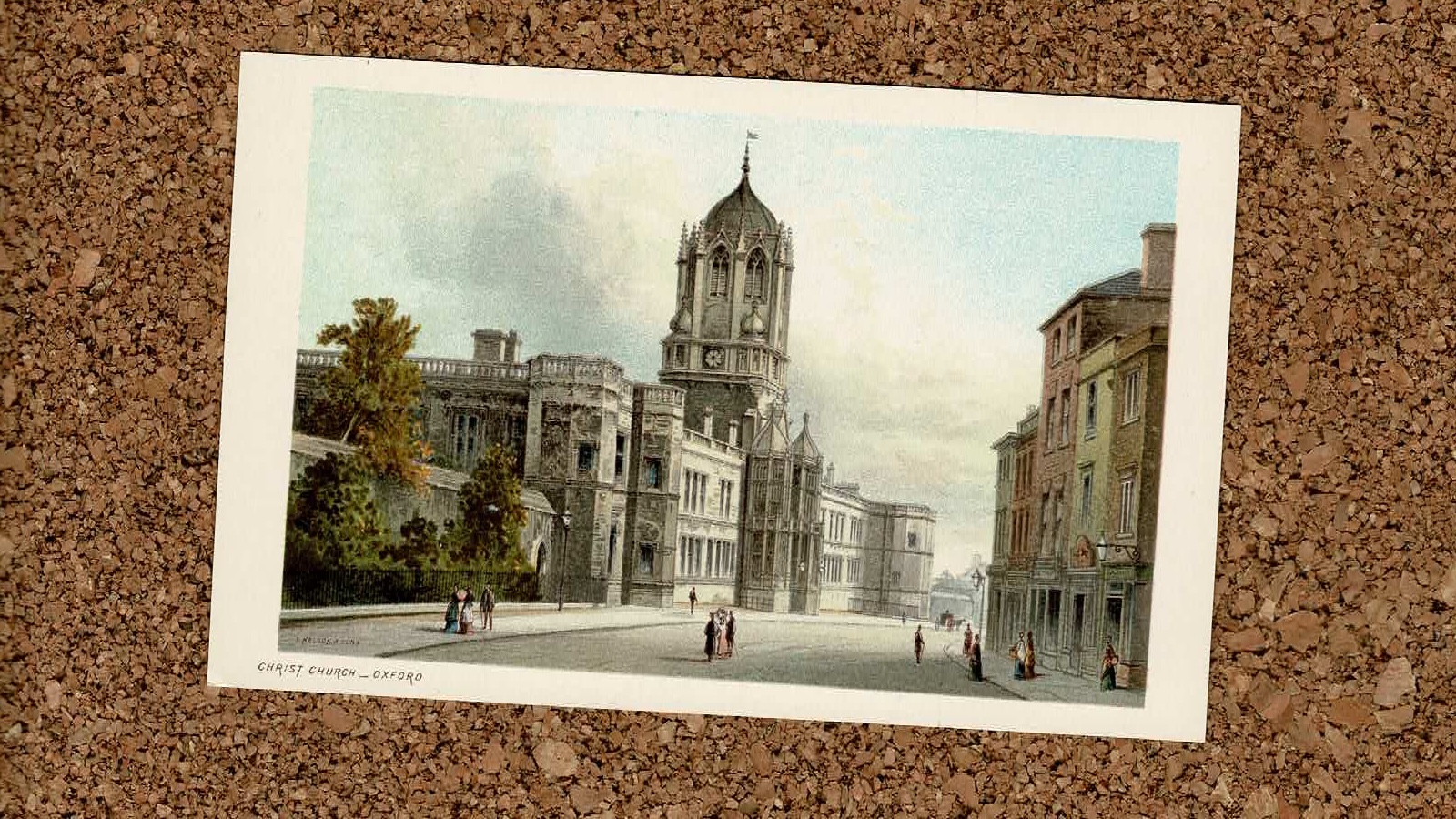
    The buildings started by Wolsey were completed, and added to. Christoper Wren designed the Tom Tower, the one on the card. This holds the Great Tom bell, which is rung 101 times every night at 9pm Oxford time (yes, of course it has its own time zone), or about five minutes past 9pm Greenwich Mean Time.

    Let’s fast forward to 1642. Supporters of Parliament were at war with supporters of the king; armies had been raised. A pitched battle had been fought at Edgehill; it was indecisive, enabling the king – Charles I, or Charles as he was known at the time – to continue his march on London. Realising London could not be taken by force, Charles retreated to Oxford, and made his base there. (In the meantime, parliamentarian forces had arrested the university’s vice chancellor, John Prideaux, an event which must, even today, give hope to people across higher education.)

    Charles set up shop in Christ Church. He used the deanery as his royal apartments, and the college’s great hall became the meeting place for the parliament. (Parliament had not been dissolved before the outbreak of the war. Charles summoned it to Oxford. Most of the Lords attended, and about a third of the Commons. It met from January to April 1644 and again from October 1644 to March 1645. What did it do? We don’t really know, as its records were burnt in 1646 before parliamentary forces retook the city.)

    Christ Church’s alumni include thirteen British Prime Ministers, although one of the them, William Pulteney, first Earl of Bath, held office for two (2) days only, and whether he actually ever was Prime Minister is now disputed by historians. The parliamentary history records that after his two-day prime ministership he “spent the rest of his life in retirement, consoling himself with the pleasures of avarice, to which he had always been notoriously, indeed scandalously, addicted.”

    Alumni also include many politicians of ministerial rank (for example, Nigel Lawson, David Willetts, Chris Skidmore); monarchs (including Edward VII, although he transferred to Trinity Cambridge); scientists (such as Robert Hooke, Martin Ryle); a whole gaggle of top-drawer philosophers (such as John Locke, Freddie Ayer, Daniel Dennett, John Rawls, and a personal favourite, Gilbert Ryle); literary figures including Lewis Carroll, W H Auden, and John Ruskin; and, perhaps best of all, both Flanders and Swann.

    There are a few additional points to cover before I wrap up this account.

    Firstly, an epic disagreement between the former dean of Christ Church and the college. This long statement by the college sets out one side of the issue.

    Secondly, what a wonderful set of buildings! They’ve inspired the buildings of the University of Galway, and have also, apparently, featured in the Harry Potter films, although as your correspondent has never seen any of these we have to take this on trust.

    And finally, Christ Church’s arms: these are Cardinal Wolsey’s arms; properly described they are Sable, on a cross engrailed argent, between four leopards’ faces azure a lion passant gules; on a chief or between two Cornish choughs proper a rose gules barbed vert and seeded or. And its always good to see a chough, whether from Cornwall or anywhere else.

    Here’s a jigsaw of the postcard, to give you a bit of festive diversion; and a bonus jigsaw of the college kitchen, which is a bit harder, should you need an excuse to spend more time secluded with your computer over the festive season.

    And that’s it for 2024’s higher education postcards. I’ll be back in January with more; in the meantime, a very merry Christmas to you all.

    Source link

  • What does Christmas shopping have to do with higher education?

    What does Christmas shopping have to do with higher education?

    For the time being, John Cater is the longest-serving Vice-Chancellor in UK higher education, having held his current post for approaching 32 years. He hands over the reins at Edge Hill University at the end of January 2025. In the blog below he finds parallels between what is happening in the high street and in the university sector…

    This week Mark Allen, the Chief Executive of Land Securities, announced that his company had paid £490m for a 92% stake in Liverpool One, the shopping centre. In quotes, he explained that the top one per cent of UK retail shopping destinations provide access to 30 per cent of all in-store retail spend, “which is why we continue to see brands focus on fewer but bigger and better stores in the best locations”.

    You may well ask, ‘What has this to do with higher education?’ First, there is a tangential link, in that Mark Allen is a former Chief Executive of Unite Students, the sector’s largest housing provider and a company that has, indeed, sought to maximise access to student residential spend and in the ‘best’ locations, typically cities with universities that are part of the perceptual elite.

    But are we seeing this in higher education too? Any graph of higher education participation since the removal of the student number cap in 2015 has seen an increasing bifurcation between high-tariff institutions and, initially, low and, more recently, mid-tariff institutions. If you’re in the latter categories and you look at the 2024 intake data, the new cohort is in the sector, just not, in all probability, in your institution.

    So, are we seeing Land Securities’ retail revolution, a race to the best locations, a clear focus of demand, in higher education? A decade of ‘spending’ decisions by each new intake, their friends, families and schools and colleges – ‘where do I go to draw down my loan?’ – says so. The UCAS 2024 End of Cycle data, as ever ably summarised by David Kernohan for Wonkhe, makes it clear that “higher tariff providers have been fishing in deeper waters”, with both lower tariff offers and a more flexible approach to clearing. And this is clearly understood by those making ‘purchasing’ decisions, with the exponential growth of self-release highlighting (perceived) trading-up.

    With no constraints on an institution’s numbers, this trend appears inexorable, whilst a constraint on numbers would constitute a significant reduction in choice. There may be a middle road, a managed market, with limitations on the pace of growth, possibly determined by discipline, but the howls of protest would reverberate, particularly in elements of the media, constituency postbags and selective schools. And, whilst the Department for Education has indicated that it is no longer using Russell Group entries as a measure of a school’s success, the Treasury has yet to mirror that action.

    The crunch is coming. With very few exceptions, university sustainability depends on two variables, number and price. The failure to secure, at least to date, a five-year index-linked settlement has curtailed price, and, with it, investment and forward planning. And a broadly static market, with no signs of an increase in all-age participation, is reflected in curtailed demand and fewer numbers.

    From 2030 the age cohort declines by one-sixth. Demand for traditional higher education is broadly static and increasingly differentiated by tariff. Innovation, be it Lifelong Learning or apprenticeships, has yet to grip the market.

    In retail investment has headed in two directions, niche providers in up-market ‘village’ style communities, whilst the big city retail brands, such as those in Liverpool One, acquire floor space and greater market penetration. Quoted companies pay nine figure sums for a piece of the big city pie, whilst non-niche players, the poor, the periphery, the ‘red wall’ towns, suffer.

    Is this relevant to higher education? I believe so. Demand for higher education is broadly static and increasingly concentrated in a smaller number of providers. In-migration is severely constrained and the number of UK-resident eighteen-year-olds is heading towards a cliff edge.

    I have written previously on the possible shape of higher education in the coming decade. Trifurcation: a three-way split. A perceptual elite offering three-year away from home residential degrees. Sub-regional providers closely tied to further education, anchor institutions in their communities. And, a (re-) emergence of global online players in the education marketplace, with strong brands and an almost uncapped resource; providers with the capacity, largely unfettered, to shape opinions and behaviours on whim.

    Source link

  • Graduate Enrollment Insights | Collegis Education

    Graduate Enrollment Insights | Collegis Education

    Inside the Minds of Grad Students: 5 Key Findings from Our Latest Study on Graduate Enrollment

    As a higher education leader, it’s no secret that you’re facing a fiercely competitive graduate enrollment landscape. You know as well as I do that understanding what prospective students want and how they behave isn’t just helpful – it’s crucial to your institution’s success. That’s why we teamed up with UPCEA to conduct a deep dive into today’s post-baccalaureate students, uncovering their unique needs, expectations, and wants.

    We’ve published those insights in our latest report to help colleges and universities fine-tune their graduate enrollment strategies and deliver real results. You can download the complete report here: Building a Better Pipeline: Enrollment Funnel Needs and Perspectives from Potential Post-Baccalaureate Students

    Our research focused on individuals who expressed at least some interest in pursuing advanced education, and this study sheds light on what matters most to potential graduate students—everything from program types and communication preferences to application expectations.

    As we dug into the data, some obvious themes emerged. Here are five key findings that can prepare your institution to stand out in this tight market and guide you in shaping strategies that resonate, engage, and deliver results.

    5 insights to sharpen your graduate enrollment strategy

    1. Graduate enrollment is a crowded market—and the stakes are high

    This is no surprise to those working in higher ed in recent years. Graduate enrollment is slowing, with just a 1.1% projected increase over the next five years. Adding to the challenge, 20% of institutions dominate 77% of the market. For everyone else, it’s a fierce battle for a shrinking pool of candidates. To win, you’ll need a sharp, focused approach.

    2. Online programs are the clear favorite

    Did you know that 71% of prospective students are “extremely” or “very” interested in fully online programs? Hybrid formats come in a close second, while traditional in-person options are struggling to keep pace. The data confirms that flexibility isn’t a trend—it’s a necessity.

    3. Program information is a make-or-break factor

    Here’s something we see far too often: quality programs losing prospective students simply because critical details—like tuition costs and course requirements—are buried or missing entirely from the school’s website. In fact, 62% of students indicated they would drop off early in their search for this exact reason.

    The fix? It’s simpler than you might think. By optimizing your program pages and doubling down on SEO, you can turn passive visitors into engaged prospects.

    4. Financial transparency builds trust

    Sticker shock is real. High application fees, vague cost information, and limited financial aid details are among the top reasons students abandon the application process late in the game. By addressing these concerns clearly and directly, you’re not just solving a problem, you’re building trust.

    5. Email is still king

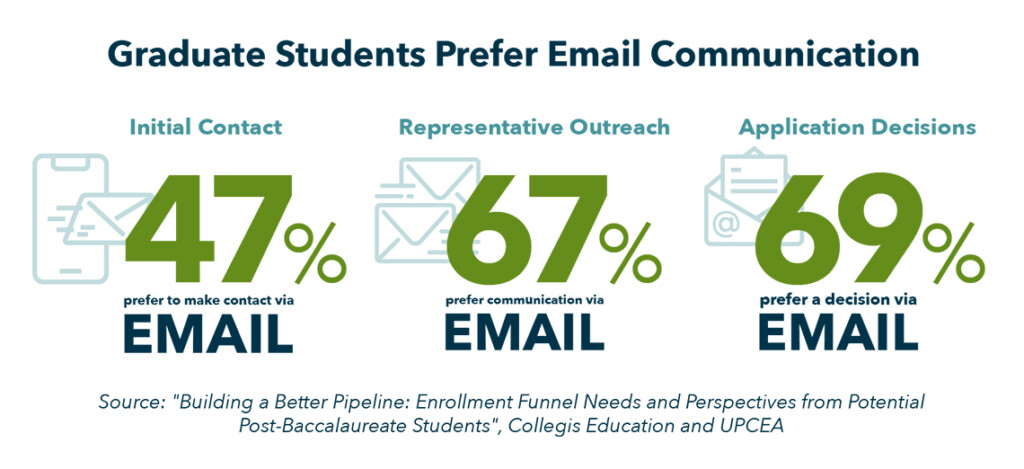
    When it comes to connecting with prospective graduate students, email reigns supreme. Whether it’s inquiring about programs (47%), application follow-ups (67%), or receiving application decisions (69%), email is the channel students trust the most.
    But here’s the catch: your emails have to be timely, personalized, and relevant in order to make an impact.

    The key to graduate enrollment success is just a click away

    The insights highlighted above are just the tip of the iceberg. Imagine what’s possible when you apply them to your graduate enrollment strategy.

    If you’re ready to refine your approach and stay ahead of the curve, we’ve got you covered. Our report dives deeper into the data and uncovers actionable insights, including:

    • Positioning your online and hybrid offerings to meet growing demand
    • Optimizing program pages to emphasize the information students value most
    • Communicating financial information proactively to convert candidates
    • Building email outreach strategies that build trust and keep students engaged

    Grab your complimentary copy of the report today, and let’s start building a better pipeline together!

    Your roadmap to winning in the competitive graduate market.

    Source link

  • Graduate Student Pipeline | Collegis Education

    Graduate Student Pipeline | Collegis Education

    Despite an increasingly competitive market, many colleges and universities still view graduate enrollment strategies as a key growth lever for their institutions. To win in the graduate enrollment space, you first need a deeper understanding of prospective graduate students’ preferences and behaviors.

    This infographic, “What Potential Graduate Students Expect in the Enrollment Funnel,” compiles some of the key data and insights from our recent collaboration with UPCEA that surveyed graduate students to uncover their needs and expectations, focusing on program preferences, delivery methods, and expectations during the inquiry and application processes.

    This infographic is only the tip of the iceberg. Learn more about how to tailor your graduate student recruitment strategies and position your programs for success and growth in our recent report, “Building a Better Pipeline: Enrollment Funnel Needs and Perspectives from Potential Post-Baccalaureate Students.”

    Source link

  • 2024 Growth & Innovation | Collegis Education

    2024 Growth & Innovation | Collegis Education

    As 2024 draws to a close, the holiday season inspires gratitude and reflection. Personally, I’m very grateful for the incredible partners and colleagues I’ve had the privilege to work with this year. Together, we accomplished so much.

    • We collaborated with our partners throughout the year to deliver great experiences for their students, alumni, and staff.
    • We collectively navigated some of higher education’s biggest challenges, driving partner growth and enabling impact.
    • We pushed the boundaries of innovation, embracing the power of data-enabled technologies.

    I’m so proud of the positive impact the Collegis team generated with our partners across the entire student lifecycle, from the moment prospective students first inquire about a program to the day they graduate.

    Let’s look back at some of 2024’s meaningful results

    Recruitment and Enrollment Growth

    We supported double-digit year-over-year (YoY) enrollment growth –– as high as 57% –– for many partner institutions in first-year, program-specific, transfer, and graduate populations. Engagement from our enrollment teams was instrumental in connecting students with the right programs and guiding them through the admissions process.

    IT Managed Services and Student Support

    Our IT team ensured seamless operations, providing reliable technology solutions that empower students and faculty. Some of my favorite examples from 2024 include:

    • Integrating systems to drive process improvement across enrollment, financial aid, academics, and career services.
    • Modernized campus infrastructures and networks to drive student engagement at a college’s main hall.
    • Significantly improved student experience by implementing a user-friendly, single sign-on (SSO) solution across student-facing systems.
    • Led an institution through a critical component of its digital transformation journey by migrating its on-premise, legacy ERP to a cloud-based, next-generation solution.

    Innovative Learning Experiences

    Our instructional design team enabled partners to grow their online course offerings on platforms such as Brightspace, Canvas, Coursera, and Blackboard Ultra, including course and online library development, course migrations, maintenance, faculty support, and term start/end deployment activities.

    We collaborated with the nursing program at one partner to revamp the entire library of online courses to meet new accreditation standards. Another partner was able to add 200 online courses to fill the needs of 13 online programs at three schools.

    Marketing Impact

    Our web team conducted a user survey and other research to refine a partner’s website, which increased clicks to inquire by 82%, the request for information (RFI) click rate to 71%, and clicks to apply by 7.5%.

    Another shining example was uncovering a way to target a healthcare provider’s employees who are eligible for a tuition discount. Because of healthcare regulations, the partner could not provide an audience list, so Collegis addressed this niche audience using in-platform targeting tools available on social media platforms. The return on ad spend (ROAS) is 2.2:1 overall in 2024 with plans to expand the program next year.

    Student Success

    Our student support team provided essential services to help students thrive and continue to pursue their academic goals.

    • At a public, four-year institution in Ohio, Collegis Student Success Coaches helped new students with the registration process, driving admit-to-enroll numbers and YOY growth of +66% in Fall 2024.
    • At a private, four-year institution in Texas, Fall retention was 97%, with a 90% retention rate since the partnership launched.
    • At a private, four-year institution in New York, term-over-term retention from Summer to Fall is 96%, with a 91% average retention rate since the partnership launched.
    • At a public, two-year institution in the Pacific Northwest, Collegis helped drive the sixth consecutive term of enrollment growth, with Fall enrollment trending toward +8%.

    Research and Portfolio Planning

    Because we are ingrained in every step of the student lifecycle, partners often ask us to assist with forward-looking strategies. For example, our team helped a partner understand the pros and cons of expanding their full-time Accelerated Bachelor of Science in Nursing (ABSN) with a part-time program. With our marketplace analysis, recommendations for how to offer courses, and a marketing launch plan, the institution is currently accepting applications for Summer 2025.

    Another institution asked for Collegis’s assistance to develop a multi-year strategic approach to graduate enrollments. The partner’s team lead noted that, “[Collegis] led productive brainstorming and strategic planning sessions with the team. Their deep knowledge of graduate enrollment trends, market analysis for graduate programs and expertise in leading our team from conceptualization to the delivery of specific recommendations on our next steps were invaluable.”

    Strategic Innovation and Workshop Design

    Our strategy and solutions team helped colleges and universities unpack complex problems and find innovative, human-centered solutions. We architected and facilitated numerous design thinking workshops, guiding leadership teams through critical strategic discussions about the future of their institutions. I’ll let some of the participants of the workshops explain the value they got out of the sessions:

    • “Collegis didn’t just help us evaluate our processes — they led us on a journey to uncover areas of improvement we hadn’t even considered. Their expert guidance illuminated the path forward, empowering us to create a more positive, streamlined, and truly enjoyable student experience.”
    • “My team and I were thoroughly impressed with your ability to take what essentially was a speck of an idea and collaboratively ideate possibilities for [the university] to offer new academic programs and training to underserved high school populations.”
    • “Collegis took the time to meet with leadership prior to the sessions and came prepared to tackle the challenges at the college. The activities were well thought-out and allowed individuals time to really think about the core issues. Thanks to Collegis, I am hopeful that our college can make key changes that will benefit our student experience and lighten our faculty/staff workload.”

    Looking Forward

    As you can see, 2024 has been a year of growth, innovation, and collaboration. We are grateful for the opportunity to work with our partners and look forward to even greater achievements in the years to come.

    I’d like to extend my sincere gratitude to my Collegis colleagues, who amaze me with their creativity, expertise, and dedication to delivering exceptional results. I can’t wait to see what you do in 2025 to continue inspiring each other and driving growth for our partners.

    Happy Holidays and best wishes for a prosperous New Year!

    — Kim Fahey, CEO Collegis Education

    Source link

  • 2025 Higher Ed Disruptions | Collegis Education

    2025 Higher Ed Disruptions | Collegis Education

    As 2024 draws to a close, the holiday season inspires gratitude and reflection. Personally, I’m very grateful for the incredible partners and colleagues I’ve had the privilege to work with this year. Together, we accomplished so much.

    • We collaborated with our partners throughout the year to deliver great experiences for their students, alumni, and staff.
    • We collectively navigated some of higher education’s biggest challenges, driving partner growth and enabling impact.
    • We pushed the boundaries of innovation, embracing the power of data-enabled technologies.

    I’m so proud of the positive impact the Collegis team generated with our partners across the entire student lifecycle, from the moment prospective students first inquire about a program to the day they graduate.

    Let’s look back at some of 2024’s meaningful results

    Recruitment and Enrollment Growth

    We supported double-digit year-over-year (YoY) enrollment growth –– as high as 57% –– for many partner institutions in first-year, program-specific, transfer, and graduate populations. Engagement from our enrollment teams was instrumental in connecting students with the right programs and guiding them through the admissions process.

    IT Managed Services and Student Support

    Our IT team ensured seamless operations, providing reliable technology solutions that empower students and faculty. Some of my favorite examples from 2024 include:

    • Integrating systems to drive process improvement across enrollment, financial aid, academics, and career services.
    • Modernized campus infrastructures and networks to drive student engagement at a college’s main hall.
    • Significantly improved student experience by implementing a user-friendly, single sign-on (SSO) solution across student-facing systems.
    • Led an institution through a critical component of its digital transformation journey by migrating its on-premise, legacy ERP to a cloud-based, next-generation solution.

    Innovative Learning Experiences

    Our instructional design team enabled partners to grow their online course offerings on platforms such as Brightspace, Canvas, Coursera, and Blackboard Ultra, including course and online library development, course migrations, maintenance, faculty support, and term start/end deployment activities.

    We collaborated with the nursing program at one partner to revamp the entire library of online courses to meet new accreditation standards. Another partner was able to add 200 online courses to fill the needs of 13 online programs at three schools.

    Marketing Impact

    Our web team conducted a user survey and other research to refine a partner’s website, which increased clicks to inquire by 82%, the request for information (RFI) click rate to 71%, and clicks to apply by 7.5%.

    Another shining example was uncovering a way to target a healthcare provider’s employees who are eligible for a tuition discount. Because of healthcare regulations, the partner could not provide an audience list, so Collegis addressed this niche audience using in-platform targeting tools available on social media platforms. The return on ad spend (ROAS) is 2.2:1 overall in 2024 with plans to expand the program next year.

    Student Success

    Our student support team provided essential services to help students thrive and continue to pursue their academic goals.

    • At a public, four-year institution in Ohio, Collegis Student Success Coaches helped new students with the registration process, driving admit-to-enroll numbers and YOY growth of +66% in Fall 2024.
    • At a private, four-year institution in Texas, Fall retention was 97%, with a 90% retention rate since the partnership launched.
    • At a private, four-year institution in New York, term-over-term retention from Summer to Fall is 96%, with a 91% average retention rate since the partnership launched.
    • At a public, two-year institution in the Pacific Northwest, Collegis helped drive the sixth consecutive term of enrollment growth, with Fall enrollment trending toward +8%.

    Research and Portfolio Planning

    Because we are ingrained in every step of the student lifecycle, partners often ask us to assist with forward-looking strategies. For example, our team helped a partner understand the pros and cons of expanding their full-time Accelerated Bachelor of Science in Nursing (ABSN) with a part-time program. With our marketplace analysis, recommendations for how to offer courses, and a marketing launch plan, the institution is currently accepting applications for Summer 2025.

    Another institution asked for Collegis’s assistance to develop a multi-year strategic approach to graduate enrollments. The partner’s team lead noted that, “[Collegis] led productive brainstorming and strategic planning sessions with the team. Their deep knowledge of graduate enrollment trends, market analysis for graduate programs and expertise in leading our team from conceptualization to the delivery of specific recommendations on our next steps were invaluable.”

    Strategic Innovation and Workshop Design

    Our strategy and solutions team helped colleges and universities unpack complex problems and find innovative, human-centered solutions. We architected and facilitated numerous design thinking workshops, guiding leadership teams through critical strategic discussions about the future of their institutions. I’ll let some of the participants of the workshops explain the value they got out of the sessions:

    • “Collegis didn’t just help us evaluate our processes — they led us on a journey to uncover areas of improvement we hadn’t even considered. Their expert guidance illuminated the path forward, empowering us to create a more positive, streamlined, and truly enjoyable student experience.”
    • “My team and I were thoroughly impressed with your ability to take what essentially was a speck of an idea and collaboratively ideate possibilities for [the university] to offer new academic programs and training to underserved high school populations.”
    • “Collegis took the time to meet with leadership prior to the sessions and came prepared to tackle the challenges at the college. The activities were well thought-out and allowed individuals time to really think about the core issues. Thanks to Collegis, I am hopeful that our college can make key changes that will benefit our student experience and lighten our faculty/staff workload.”

    Looking Forward

    As you can see, 2024 has been a year of growth, innovation, and collaboration. We are grateful for the opportunity to work with our partners and look forward to even greater achievements in the years to come.

    I’d like to extend my sincere gratitude to my Collegis colleagues, who amaze me with their creativity, expertise, and dedication to delivering exceptional results. I can’t wait to see what you do in 2025 to continue inspiring each other and driving growth for our partners.

    Happy Holidays and best wishes for a prosperous New Year!

    — Kim Fahey, CEO Collegis Education

    Source link

  • Higher education in England needs a special administration regime

    Higher education in England needs a special administration regime

    Extra government funding for the higher education sector in England means the debate about the prospect of an HE provider facing insolvency and a special administration regime has gone away, right?

    Unfortunately not. There is no additional government funding; in fact the additional financial support facilitated by the new Labour government so far is an increase to tuition fees for the next academic year for those students that universities can apply this to. It is estimated that the tuition cost per student is in excess of £14K per year, so the funding gap has not been closed. Add in increased National Insurance contributions and many HE providers will find themselves back where they are right now.

    It is a problem that there is no viable insolvency process for universities. But a special administration regime is not solely about “universities going bust.” In fact, such a regime, based on the existing FE special administration legislation, is much more about providing legal clarity for providers, stakeholders and students, than it is about an insolvency process for universities.

    Managing insolvency and market exit

    The vast majority of HE providers are not companies. This means that there is a lack of clarity as to whether current Companies and Insolvency legislation applies to those providers. For providers, that means that they cannot avail themselves of many insolvency processes that companies can, namely administration, company voluntary arrangements and voluntary liquidation. It is debatable whether they can propose a restructuring plan or be wound up by the court, but a fixed charge holder can appoint receivers over assets.

    Of these processes, the one most likely to assist a provider is administration, as it allows insolvency practitioners to trade an entity to maximise recoveries from creditors, usually through a business and asset sale.

    At best therefore, an HE provider might be able to be wound up by the court or have receivers appointed over its buildings. Neither of these two processes allows continued trading. Unlike administration, neither of these processes provides moratorium protection against creditor enforcement either. They are not therefore conducive to a distressed merger, teach out or transfer of students on an orderly basis.

    Whilst it is unlikely that special administration would enable survival of an institution, due to adverse PR in the market, it would provide a structure for a more orderly market exit, that does not currently exist for most providers.

    Protections for lenders

    In addition to there being no viable insolvency process for the majority of HE providers, there is also no viable enforcement route for secured lenders. That is a bad thing because if secured lenders have no route to recovering their money, then they are not going to be incentivised to lend more into the sector.

    If government funding is insufficient to plug funding gaps, providers will need alternative sources of finance. The most logical starting point is to ask their existing lenders. Yes, giving lenders more enforcement rights could lead to more enforcements, but those high street lenders in the sector are broadly supportive of the sector, and giving lenders the right to do something is empowering and does not necessarily mean that they will action this right.

    Lenders are not courting the negative press that would be generated by enforcing against a provider and most probably forcing a disorderly market exit. They are however looking for a clearer line to recovery, which, in turn, will hopefully result in a clearer line to funding for providers.

    Protections for students

    Students are obviously what HE providers are all about, but, if you are short of sleep and scour the Companies and Insolvency legislation, you will find no mention of them. If an HE provider gets into financial distress, then our advice is that the trustees should act in the best interest of all creditors. Students may well be creditors in respect of claims relating to potential termination of courses and/or having to move to another provider, potentially missing a year and waiting longer to enter the job market.

    However, the duty is to all creditors, not just some, and under the insolvency legislation, students have no better protection than any other creditor. Special administration would change that. The regime in the FE sector specifically provides for a predominant duty to act in the best interest of students and would enable the trustees to put students at the forefront of their minds in a time of financial distress.

    A special administration regime would therefore help trustees focus on the interest of students in a financially distressed situation, aligning them with the purposes of the OfS and charitable objects, where relevant.

    Protections for trustees

    Lastly, and probably most forcefully, a special administration regime would assist trustees of an HE provider in navigating a path for their institution in financial distress. As touched on above, it is not clear, for the vast majority of HE providers, whether the Companies and Insolvency legislation applies.

    It is possible that a university could be wound up by the court as an unregistered company. If it were, then the Companies and Insolvency legislation would apply. In those circumstances, the trustees could be personally liable if they fail to act in the best interest of creditors and/or do not have a reasonable belief that the HE provider could avoid an insolvency process.

    Joining a meeting of trustees to tell them that they could be personally liable, but it is not legally clear, is a very unsatisfactory experience; trust me, this is not a message they want to hear from their advisors.

    A special administration regime, applying the Companies and Insolvency legislation to all HE providers, regardless of their constitution or whether they are incorporated, would allow trustees to have a much clearer idea of the risks that they are taking and the approach that they should follow to protect stakeholders.

    In the event a special administration was to be brought in, we would hope it would not need to be applied to a market exit situation. Its real value, however, is in bringing greater legal clarity for lenders and trustees and more protection for students, in the current financial circumstances that HE providers find themselves in.

    Source link