Tag: Flexible

  • The future of financial hardship support needs to be flexible

    The future of financial hardship support needs to be flexible

    The government’s recent white paper on Post-16 Education and Skills places flexibility and choice at the centre of the future student experience.

    When it comes to students, the government wants universities and colleges to adapt to a much wider range of demographics and to further embrace diversity – while continuing to break down the barriers to opportunity for students from all backgrounds.

    One of the ways to strengthen opportunity is through the additional forms of financial support (via bursaries, scholarships and special-case funds) that higher education institutions provide for those students most at risk of dropping out, or those simply denied opportunity in the first place.

    When it comes to this funding, the sector needs to work much harder in supporting a more varied set of future students, whilst making better use of data to design support packages, and adapting to the real-time user requirements for this type of funding.

    Beyond the post-school model

    The majority model of financial support is still designed primarily for a post-school entrant market (in line with access and participation plans) but we now need to evolve this for a much broader range of working students, part-time students, later life students and so on – based on the white paper’s steer for different student demographics and for more support for students from lower income backgrounds. This will require more agility. It will also require a closer and more strategic, data driven approach to the timing, delivery and use of such student funding.

    Universities will increasingly be expected to meet the needs of a more diverse and complex learner population, one that is typically older, more financially stretched, and balancing work, family, caring responsibilities, and study. While the student body is evolving at pace, and there are encouraging signs of greater flexibility and adaptability across the sector, as highlighted in The Shape of Student Financial Support in 2025, there is also clear recognition that more progress is needed.

    In our work with universities (designed to strengthen the effective delivery and impact of student financial support) we refer to this sea-change in funding as enabling both more optionality (for the funders) and greater agency (for the beneficiaries). Too much of the sector’s current model still assumes the profile and rhythms of the traditional 18-year-old school leaver. Policy momentum is pushing us firmly beyond this, and institutions will need to rethink not just how much financial support they provide, but how, when and in what form it is provided, and crucially, who it is designed for.

    A new student majority

    Commuter students, part-time learners, those studying while working full-time, and individuals returning to education later in life are no longer outliers. They are becoming a significant and growing segment of the student population, and the white paper’s direction of travel signals that this growth will continue.

    These learners typically have different cost profiles, different pressures, and different expectations around support. Rent and food costs matter, of course, but so do childcare, caring responsibilities, travel to placements and campus, and the financial instability that often comes with shift-based or zero-hours work. Their support needs do not fall neatly around term dates.

    A modern student support system must reflect that reality.

    Beyond the “once-a-year” mindset

    One of the strongest messages emerging from our work with universities is that timing of support is as critical as the pound value that support. Students increasingly need support that works with the grain of real life, not against it. That means agility: funds that can be released quickly during a crisis; support that can be drawn down in a way that helps with budgeting; and options that reflect different lifestyles, responsibilities, and individuals preferences around how they manage their finances.

    For mature learners, the notion of a predictable “start of term” pressure point is often irrelevant. Housing, employment and family commitments create fluctuating financial pinch-points throughout the year. A forward-looking and agile hardship and support model must therefore allow universities to intervene dynamically, reacting to student need rather than institutional calendar.

    Across the more than 40 institutions we partner with, we see a growing shift toward more targeted, purpose-led and flexible support. Although institutions are facing significant financial constraints, they are adapting, often rapidly, to ensure funding reaches the right students in a way that genuinely makes a difference.

    We are seeing:

    • A move toward more tailored interventions, with universities reshaping bursaries and hardship schemes around specific learner profiles, including mature and commuter students.
    • Increased use of real-time payment mechanisms, enabling rapid support when a financial shock threatens continuation.
    • Greater use of data to understand how different types of students use support, and what interventions are most likely to prevent financial distress, disengagement or withdrawal.
    • Growing recognition that support must be designed around lived experience, responsive to trends and feedback, not just institutional tradition.

    This shift is encouraging, but the system as a whole is not yet optimised for the demographic change that the White Paper anticipates.

    Where policy meets practice: recommendations for a modernised support model

    To prepare for a more diverse learner population, the sector will need to reimagine its support architecture. From our work with universities and our ongoing analysis of funding patterns, several recommendations emerge:

    We should build support models around life-stage, not simply level of study. Mature and non-traditional learners experience costs and vulnerabilities that differ from the archetypal school-leaver. Support schemes should explicitly recognise this, particularly around childcare, travel, digital access, and household stability.

    There is a need to shift from fixed-cycle payments to flexible, real-time support. Financial crises rarely occur conveniently during scheduled disbursement windows. Universities need mechanisms that allow for rapid, secure, and dignified disbursement of funds whenever needed.

    It is time to explore hybrid support models that blend cash, credit and vouchers. Different pressures require different tools. Cash support is essential in alleviating hardship. Credit and voucher mechanisms can help direct funds toward participation, learning, and targeting food poverty. Mature learners often benefit from a mixture of both.

    We must make data central to decision-making. With financial pressure mounting across the sector, institutions must allocate limited resources with precision. Data on spending patterns, draw-down behaviour and student feedback can inform more effective and equitable holistic support strategies.

    We should co-design support with the students who rely on it. There is no substitute for listening to those living the experience. Mature and non-traditional students frequently report that support systems “aren’t designed for people like me”. Bringing their voices into design and evaluation will be vital.

    A financial support system fit for the future

    The white paper’s direction is clear: widening participation will no longer be defined simply by access for school leavers from underrepresented groups. It will increasingly require a system capable of supporting learners from every life stage, people retraining, upskilling, switching careers, balancing caring responsibilities, or returning to education for the first time in decades.

    This transition will require institutions to be flexible, evidence-led, and prepared to evolve their traditional models of support. Our latest annual report provides one lens on how this evolution is taking place, and where further change is needed. But the wider policy moment demands more than reflection: it demands intentional redesign.

    If universities are to deliver opportunity for all, as the white paper sets out, they will need financial support systems that reflect the real, diverse, year-round lives of today’s and tomorrow’s students. Flexibility is no longer a helpful addition; it is the foundation on which effective, equitable support must be built.


    Source link

  • Unis need modern tech for flexible courses – Campus Review

    Unis need modern tech for flexible courses – Campus Review

    Calls for universities to offer shorter, more flexible courses that meet the demands of Australia’s future economy must be met with better technology management, according to sector voices from a leading software company.

    Please login below to view content or subscribe now.

    Membership Login

    Source link

  • Flexible Learning and Policy Challenges

    Flexible Learning and Policy Challenges

    What impact is flexible learning having on learners from K-12 through to professional development?

    New Zealand has remarkably high levels of digital access across the population. Why aren’t we out performing other countries in educational measurements?

    This piece serves to introduce a series of six challenges faced by policy makers around flexible learning.

    These six challenges are:

    1. Unequal Access to Technology and Connectivity
    2. Socioeconomic Disparities
    3. Digital Literacy and Skills Gaps
    4. Quality Assurance and Consistent Experience
    5. Teacher Preparedness and Support
    6. Policy and Funding Models

    In this first piece I want to establish what I mean by ‘flexible learning’.

    Like many I struggle to have a single, concise, and consistent “definition” of flexible learning. I would say that flexible learning is a model of delivery that offers learners agency and control over various aspects of their learning experience. Flexible learning is a spectrum. Formal learning courses exist on a continuum between “rigid” and “flexible” delivery. The more control and choice given to the learner, the more flexible the learning experience.

    Flexible learning aims to “empower the student to choose what learning should be studied face-to-face and that which should be studied online, and how to go about engaging with that learning” (2022). This Means empowering the learner to make choices regarding:

    • When: synchronous or asynchronous learning, pace-mandated or self-paced progression.
    • Where: Learning in different locations (home, campus, workplace, etc.).
    • How: Different modes of engagement (online, in-person, blended, hybrid, hyflex).
    • What: Some degree of choice over content or learning pathways, though this is often more associated with “open learning.” Indeed in a world where students are overwhelmed with choices, there are strong arguments that having a prescriptive programme serves students well.

    In my article “Definitions of the Terms Open, Distance, and Flexible in the Context of Formal and Non-Formal Learning,” (2023) I argued that flexible learning is a model of delivery, rather than a fundamental mode of learning. I posit that there are only two core modes of learning: in-person (or face-to-face) and distance learning. Flexible learning then emerges from various combinations and approaches to curriculum design that empower learners to choose amongst these two modes

    As education has a habit of inventing new terms for marginally different practices it might be worth just pointing out the relationship I think exists between flexible learning and forms of Blended, Hybrid, and HyFlex learning. I perceive blended, hybrid, and HyFlex learning as specific models of delivery that fall under the umbrella of flexible learning. They all aim to give agency to the learner regarding how they engage with the material, combining elements of in-person and distance learning.

    I believe that designing for flexible learning means considering the learner’s context and perspective, and creating learning experiences that are relevant, meaningful, motivating, realistic, and feasible within an agreed timeframe. This also involves careful consideration of learning outcomes and assessment in diverse delivery contexts. This means course creators need clarity about learning design principles in relation to flexible approaches, such as working with Notional Study Hours (2020a) and the importance of Learning Outcomes (2020b).

    Based on my broad definition thatFlexible Learning refers to educational approaches and models of delivery that provide learners with a significant degree of choice and control over the time, place, pace, and mode of their learning, leveraging combinations of in-person and distance learning to enhance accessibility and cater to diverse learner needs, how do we face those six policy challenges?

    Watch this space…

    Atkinson, S. P. (2020a, April 14). Working with Notional Study Hours (NSH) or “How much is enough?” Simon Paul Atkinson. https://sijen.com/2020/04/14/working-with-notional-study-hours-nsh-or-how-much-is-enough/

    Atkinson, S. P. (2020b, April 4). Designing Courses: Importance of Learning Outcomes. Simon Paul Atkinson. https://sijen.com/2020/04/04/designing-courses-importance-of-learning-outcomes/

    Atkinson, S. P. (2022a, July 15). How do you define hybrid, or hyflex, learning?. Simon Paul Atkinson. Retrieved from https://sijen.com/2022/07/15/how-do-you-define-hybrid-or-hyflex-learning/

    Atkinson, S. P. (2023). Definitions of the Terms Open, Distance, and Flexible in the Context of Formal and Non-Formal Learning. Journal of Open, Flexible, and Distance Learning, 26(2).3 Retrieved from https://jofdl.nz/index.php/JOFDL/article/view/521

    Source link

  • Why Not Flexible Transfer for All, Not Just in Crisis?

    Why Not Flexible Transfer for All, Not Just in Crisis?

    Meet Estevan, featured by Texas A&M University–Corpus Christi as a Transfer Student Success Story. Estevan benefited from a high degree of personalized support—including advising on course selection and financial aid planning—that helped him identify a clear path to transfer in his major of choice. Such personalized support helped Estevan thrive and make the dean’s list after transferring.

    Estevan’s story is one of the many inspiring success stories about transfer students we hear every day, even when the odds seem stacked against them. For example, we know that 80 percent of community college students nationwide intend to complete a bachelor’s degree, yet only 31 percent transfer to a four-year institution within six years of entry. When they succeed in transferring, transfer students often outperform their peers who start and stay at the same institution. And yet, we do not make transfer easy. For one, learners face a confusing set of ever-changing rules that varies across institutions, making it difficult to know which courses are transferable and applicable to their intended program of study.

    Added to that, we know life is unpredictable and even a learner’s best-laid plans can be derailed by one lost job, one sick family member or one unexpected change in financial aid. When the unpredictable happens, can institutions better flex to meet learners where they are?

    The signs point to yes—if you look at the examples of incredible institutional flexibility in response to the recent rise in institutional closures and mergers. As reported by Inside Higher Ed, nearly 100 institutions closed in the last academic year alone due to declining enrollments and financial pressures. When institutions close, accreditors and their member institutions step up to support students through a process called teach-out. Teach-out policies, while they differ by accreditor, are generally designed to help other institutions flexibly accept and apply students’ coursework to a degree or credential in order to help affected students complete their studies in a timely fashion. In such arrangements, the expressed goal is to apply the rules in ways that help bring students in and flex those rules that would effectively leave students out.

    Teach-out policies are exactly the type of thoughtful guidance that should be in place to support students. But as we’ve described, institutional closure is not the only reason students transfer, and it is not the only crisis students face. So this leads us to ask, if institutions can be flexible when faced with one type of student transfer, can they be similarly flexible in other transfer scenarios as well?

    We are excited to share that we had the opportunity to ask that question of the members of the Middle States Commission on Higher Education (for which one of the authors, Heather Perfetti, serves as president). In fall of 2024, MSCHE, WASC Senior College and University Commission, and the Southern Association of Colleges and Schools Commission on Colleges partnered with the Beyond Transfer Policy Advisory Board and Sova to design and field the Survey on Transfer and Learning Mobility to their institutional members. The survey sought to determine members’ perspectives on student transfer and learning mobility and to discern the role of accreditors in these processes through the institutional lens.

    In one of the most striking survey results, half of MSCHE’s responding institutions said they believe that institutions should apply similar flexibility for students who transfer and/or have previous learning as they do for students in teach-out situations (138 institutions responded to the survey, with a 30 percent response rate). Members of the PAB shared this finding at MSCHE’s Annual Meeting in December 2024, and a MSCHE member voiced the following powerful reflection: “We flex that way all the time for our own self-interest when we want to close one of our own programs.”

    We share these findings not to throw open the doors on academic rigor and quality, but rather to ask the field to pause and reflect on why credit transfer policies are stringent, knowing the barriers they may pose for students. We recognize the claims that strict credit transfer policies protect student preparation and program cohesion. If that’s true, what data are used to prove that students are not well prepared if they don’t take courses in a linear sequence? What evidence is used to understand and control for program cohesion? And if it’s not true, what are the real reasons, and can we discuss them openly so that we can better serve students? We can’t identify real solutions if we’re not honest about the actual problems.

    From MSCHE’s perspective, this survey finding feels like a call to pause, reflect and inspire us into action. MSCHE is proud of its existing transfer policies, which are crafted to support students and the mobility of their learning. But MSCHE is also willing to revisit its policies and accreditation activities through the lens of how principles related to teach-out during crises, like closures, can inform transfer more generally.

    Through the Council of Regional Accrediting Commissions, in collaboration with WSCUC and SACSCOC, we’ll talk to our peer accreditation agencies as well about key questions for accreditors and how accreditors can and should:

    • Engage governing boards and member institutions about the importance of transfer and learning mobility;
    • Leverage self-study as a moment for institutions to review and revise policies that are barriers to transfer;
    • Celebrate with institutions the ways they are supporting stronger transfer policies and the awarding of credit;
    • Remind constituents that accreditors want to see and support institutional innovation to better serve students;
    • Promote what accreditation policies actually require, and bust myths around statements such as “the accreditor won’t let me do that” (because, quite frankly, those statements are rarely true);
    • Elevate how the accreditor complaint and third-party comment process can be used by students to bring institutional transfer policies, procedures and decisions to accreditor attention; and
    • Quite simply: Be student centered, all the time.

    We hope this post gives you food for thought. Through our partnership and aligned efforts such as the Learning Evaluation and Recognition for the Next Generation Commission (led by Sova and the American Association of Collegiate Registrars and Admissions Officers and on which MSCHE, WSCUC and SACSCOC all sit), we will be looking to support the field with additional thinking about strong principles for student-centered credit evaluation and transfer. In the meantime, we’ll leave you with this question: How do you flex for students?

    Source link

  • Hybrid, Remote and Flexible Work: The Secret Sauce for Employee Retention? – CUPA-HR

    Hybrid, Remote and Flexible Work: The Secret Sauce for Employee Retention? – CUPA-HR

    by CUPA-HR | September 19, 2023

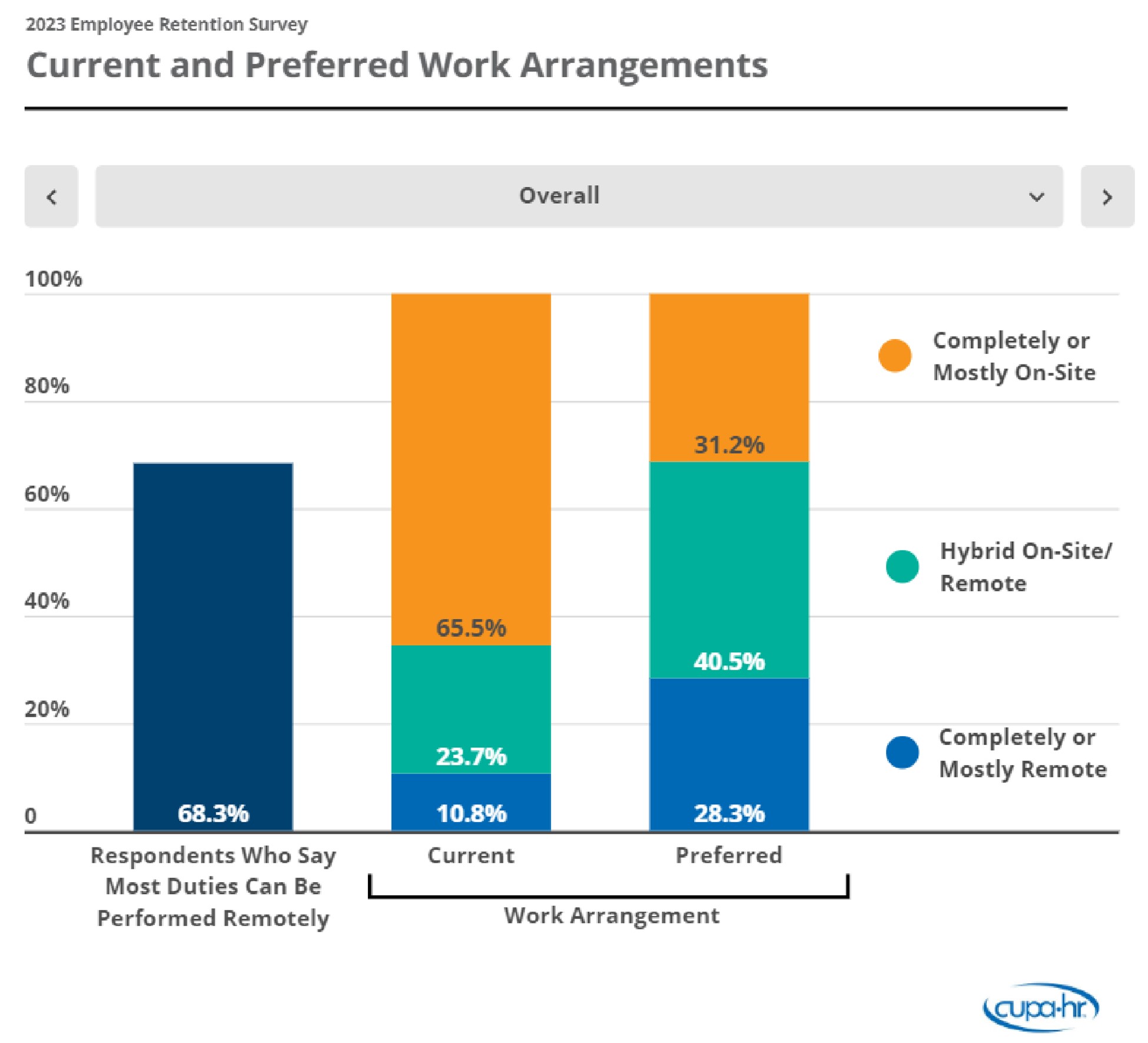
    Given the number of employees who successfully executed their work remotely at the height of the pandemic, it may come as no surprise that a substantial gap exists between the work arrangements that higher ed employees want and what institutions offer. According to the new CUPA-HR 2023 Higher Education Employee Retention Survey, although two-thirds of employees state that most of their duties could be performed remotely and two-thirds would prefer hybrid or remote work arrangements, two-thirds of employees are working completely or mostly on-site.

    Inflexibility in work arrangements could be costly to institutions and contribute to ongoing turnover in higher ed. Flexible work is a significant predictor of employee retention: Employees who have flexible work arrangements that better align with their preferences are less likely to look for other job opportunities.

    Flexible Work Benefits: A No-Brainer for Retention

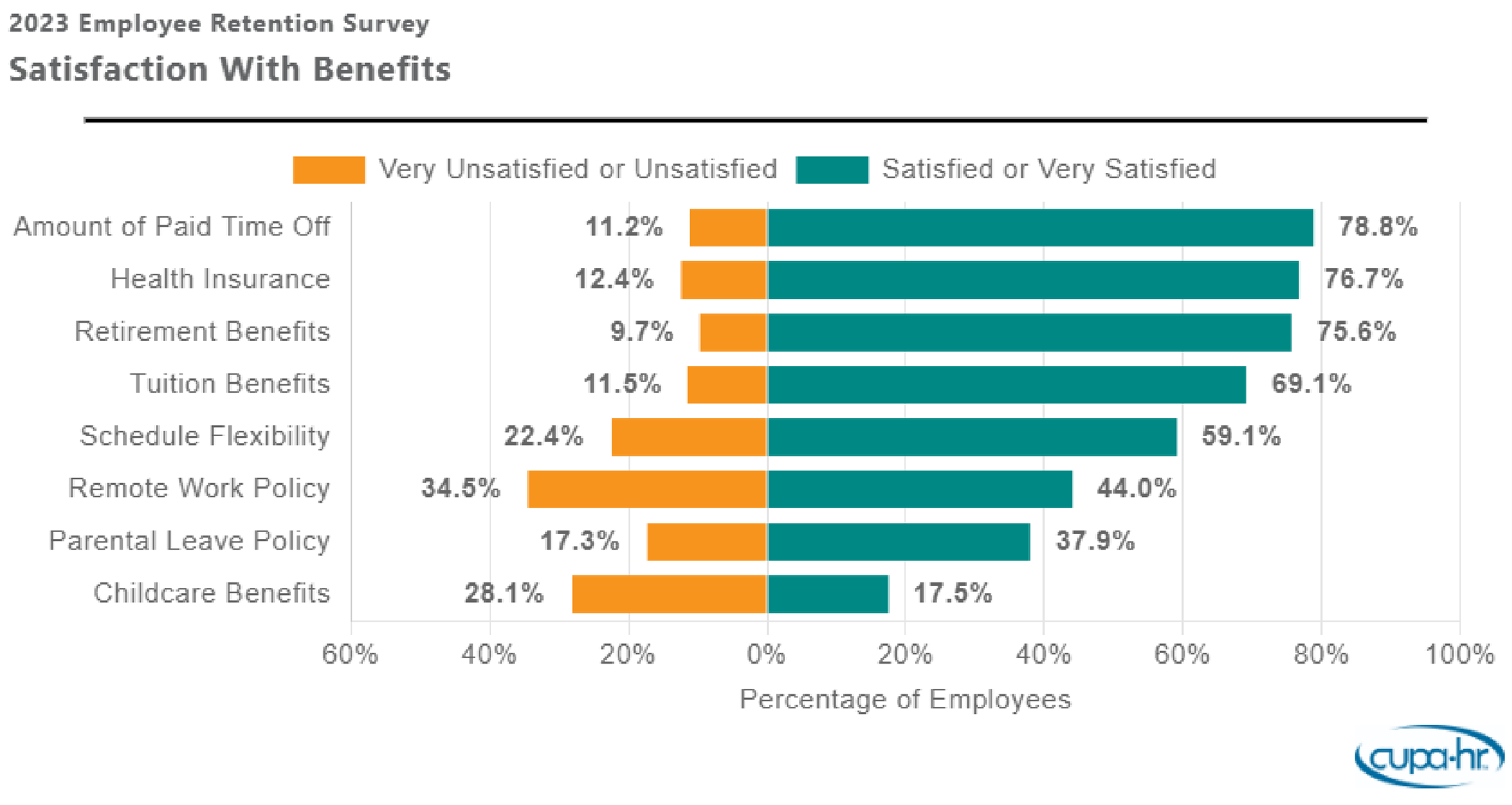
    While more than three-fourths of employees are satisfied with traditional benefits such as paid time off and health insurance, survey respondents were the most dissatisfied with the benefits that promote a healthier work-life balance. These include remote work policies and schedule flexibility, as well as childcare benefits and parental leave policies.

    Most employees are not looking for drastic changes in their work arrangements. Even small changes in remote policies and more flexible work schedules can make a difference. Allowing one day of working from home per week, implementing half-day Fridays, reducing summer hours and allowing employees some say in their schedules are all examples of flexible work arrangements that provide employees some autonomy in achieving a work-life balance that will improve productivity and retention.

    A more flexible work environment could be an effective strategy for institutions looking to retain their top talent, particularly those under the age of 45, who are significantly more likely not only to look for other employment in the coming year, but also more likely to value flexible and remote work as a benefit. Flexible work arrangements could also support efforts to recruit and retain candidates who are often underrepresented: the survey found that women and people of color are more likely to prefer remote or hybrid options.

    Three Things You Can Do

    1. Use Data to Make a Case for Change. The CUPA-HR 2023 Higher Education Employee Retention Survey provides multiple data points that support remote, hybrid and flexible work for the retention and recruitment of top talent.
    1. Explore CUPA-HR Resources. Discover best practices and policy models for navigating the challenges that come with added flexibility, including managing a multi-state workforce:
    1. Remember the Two-Thirds Rule. In reevaluating flexible and remote work policies, remember: Two-thirds of higher ed employees believe most of their duties can be performed remotely and two-thirds would prefer hybrid or remote work arrangements, yet two-thirds are compelled to work mostly or completely on-site.

    You may also be interested in:


    Source link

  • Journal of Open, Flexible and Distance Learning (JOFDL) Vol 22(2) – Sijen

    Journal of Open, Flexible and Distance Learning (JOFDL) Vol 22(2) – Sijen

    It is my privilege to serve alongside Alison Fields as co-editor of the Journal of Open, Flexible and Distance Learning, an international high-quality peer-reviewed academic journal. I also have a piece in this issue entitled ‘Definitions of the Terms Open, Distance, and Flexible in the Context of Formal and Non-Formal Learning‘.

    Issue 26 (2) of the Journal of Open, Flexible and Distance Learning (JOFDL) is now available to the world. It begins with an editorial looking at readership and research trends in the journal post-COVID, followed by a thought-provoking Invited Article about the nature of distance learning by Professor Jon Dron. This general issue follows with 7 articles on different aspects of research after COVID-19.
    Alison Fields and Simon Paul Atkinson, JOFDL Joint Editors. 

    Editorial

    Post-pandemic Trends: Readership and Research After COVID-19

    Alison Fields, Simon Paul Atkinson

    1-6

    Image of Jon Dron

    Invited Article

    Technology, Teaching, and the Many Distances of Distance Learning

    Jon Dron

    7-17

    Position Piece

    Definitions of the Terms Open, Distance, and Flexible in the Context of Formal and Non-Formal Learning

    Simon Paul Atkinson

    18-28

    Articles – Primary studies

    Images of Hulbert and Koh

    The Role of Non-Verbal Communication in Asynchronous Talk Channels ‎

    Image of Leomar Miano

    An An Initial Assessment of Soft Skills Integration in Emergency Remote Learning During the COVID-19 Pandemic: A Learners’ PerspectiveA Learners Perspective

    Image of small child at a laptop

    Supporting English Language Development of English Language Learners in Virtual Kindergarten: A Parents’ Perspective

    Image of Lockias Chitanana

    Parents’ Experience with Remote Learning during COVID-19 Lockdown in Zimbabwe

    Image of Martin Watts & Ioannis Andreadis

    First-year Secondary Students’ Perceptions of the Impact of iPad Use on Their Learning in a BYOD Secondary International School

    venn diagram for AIM

    Teaching, Engaging, and Motivating Learners Online Through Weekly, Tailored, and Relevant CommunicationAcademic Content, Information for the Course, and Motivation (AIM)


    Source link