Fear. Uncertainty. Those are human emotions that many people are feeling these days. It turns out you can quantify fear and uncertainty by looking at the stock market.
Stocks are shares of a business that people can buy on a public market, betting that the business will grow and profit and the shares will be more valuable over time. But share prices also rise and fall based on how people feel about the economic future.
So individual stocks, as well as whole sectors of an industry or the overall market in general, can rise or fall on economic or company reports, politics, geopolitical events, unexpected news and whether investors are optimistic or pessimistic about the future.
When these kinds of changes or reports cause stocks to suddenly and frequently rise and fall, we say the market is “volatile.”
Throughout 2025, the U.S. stock market, which is the biggest in the world, has been pretty volatile. One way to measure it is through the Standard and Poor’s 500 Index, which is a snapshot of 500 major company stocks.
Politics and plunging markets
From mid-February to early April, the S&P 500 index plummeted 19% as U.S. President Donald Trump launched a trade war that raised fears of inflation, a recession, job losses and a swelling national debt.
The U.S. market has largely recovered those losses in response to Trump pausing his tariff wars and lowering tariffs from scary levels. As of 30 June 2025, the stock market was dancing in record high territory.
Robert Whaley, a finance professor at Vanderbilt University and director of its Financial Markets Research Center, developed a way to measure a stock market’s volatility by keeping track of stock options — contracts that gives investors the right, but not an obligation, to buy or sell a stock at a predetermined price at a set future date.
It is popularly known as the “fear index” and goes by the symbol VIX.
The fear index is a measure of how much volatility is expected in the next month. Historically, its long-term average has been 17. During April, it was 40-50. In comparison, the index was at 85 in the COVID-19 market crash of March 2020 and at 89.5 during the global financial crisis of 2008-2009.
Buying and selling on fear
What happens during market volatility? High volatility usually implies higher risk because price movements are less predictable. While some short-term stock traders can make money during market volatility, longer-term buy-and-hold investors might get jittery.
Mutual fund cash holdings were at a 15-year high in March. That means that professional money managers held onto cash and stayed on the sidelines. What do global investors crave? Stability and predictability.
“The VIX as of now (intraday June 30) is at 17 so things are calmer which is surprising given what is happening in Ukraine and Iran,” Whaley said. “It seems the markets have become quite comfortable about it.”
He underscored that the fear index is intended to help institutional investors — such as those who manage pension funds or retirement accounts that many people invest in — predict market volatility over the next 30 days. For people who might not be actively involved in the stock market, all of this still matters.
“It reflects how institutions are feeling about the marketplace,” Whaley said. “An analogy would be if you own a house on the beach and learn a hurricane is coming. How much might insurance cost if you could actually buy it that late?”
Reading the market
Whaley said that young people should develop an intuitive feel of stock market volatility, since it is an expression of nervousness.
“In essence, it’s a fear gauge,” he said. “If people are getting nervous buying put options [that gives investors a right to buy] that drives up put prices. If VIX was at 30-40% institutions are scared to death. Right now at 17%, there’s no concern in the short run.”
Whaley said the index is normally around 15-20%, but a reading below 15% would reflect that investors are complacent.
As for the limitations of the fear index, Whaley said some people read too much into it and some institutions might overpay for VIX options and futures to try to insure their investments against losses.
While the fear index was born on a real-time basis in 1993, Whaley calculated that it would have reached an intraday high of 172 and closed at 156 on October 19, 1987, the date of the global stock market crash known as Black Monday. Whaley said other market earthquakes that caused big percentage drops included the 2008 financial crisis and Trump’s tariffs.
Whaley said viewed in a historical context, the fear index is like any other index — like the Dow Jones Industrial Average — that has a market value. “Indices are useful in terms of their history,” he said. “A barometer of fear. If VIX is higher, figure out what is going on.”
Questions to consider:
1. What type of news might cause fear in a stock market?
2. If there is a lot of uncertainty in a stock market, what do many professional investors do?
3. Can you think of another way to measure how fearful people are about the future?
I recently stood before hundreds of young people in California’s Central Valley; more than 60 percent were on that day becoming the first in their family to earn a bachelor’s degree.
Their very presence at University of California, Merced’s spring commencement ceremony disrupted a major narrative in our nation about who college is for — and the value of a degree.
Many of these young people arrived already balancing jobs, caregiving responsibilities and family obligations. Many were Pell Grant-eligible and came from communities that are constantly underestimated and where a higher education experience is a rarity.
These students graduated college at a critical moment in American history: a time when the value of a bachelor’s degree is being called into question, when public trust in higher education is vulnerable and when supports for first-generation college students are eroding. Yet an affordable bachelor’s degree remains the No. 1 lever for financial, professional and social mobility in this country.
Related: Interested in innovations in higher education? Subscribe to our free biweekly higher education newsletter.
A recent Gallup poll showed that the number of Americans who have a great deal of confidence in higher education is dwindling, with a nearly equal amount responding that they have little to none. In 2015, when Gallup first asked this question, those expressing confidence outnumbered those without by nearly six to one.
There is no doubt that higher education must continue to evolve — to be more accessible, more relevant and more affordable — but the impact of a bachelor’s degree remains undeniable.
And the bigger truth is this: America’s long-term strength — its economic competitiveness, its innovation pipeline, its social fabric — depends on whether we invest in the education of the young people who reflect the future of this country.
There are many challenges for today’s workforce, from a shrinking talent pipeline to growing demands in STEM, healthcare and the public sector. These challenges can’t be solved unless we ensure that more first-generation students and those from underserved communities earn their degrees in affordable ways and leverage their strengths in ways they feel have purpose.
Those of us in education must create conditions in which students’ talent is met with opportunity and higher education institutions demonstrate that they believe in the potential of every student who comes to their campuses to learn.
UC Merced is a fantastic example of what this can look like. The youngest institution in the University of California system, it was recently designated a top-tier “R1” research university. At the same time, it earned a spot on Carnegie’s list of “Opportunity Colleges and Universities,” a new classification that recognizes institutions based on the success of their students and alumni. It is one of only 21 institutions in the country to be nationally ranked for both elite research and student success and is proving that excellence and equity can — and must — go hand in hand.
In too many cases, students who make it to college campuses are asked to navigate an educational experience that wasn’t built with their lived experiences and dreams in mind. In fact, only 24 percent of first-generation college students earn a bachelor’s degree in six years, compared to nearly 59 percent of students who have a parent with a bachelor’s. This results in not just a missed opportunity for individual first-generation students — it’s a collective loss for our country.
The graduates I spoke to in the Central Valley that day will become future engineers, climate scientists, public health leaders, artists and educators. Their bachelor’s degrees equip them with critical thinking skills, confidence and the emotional intelligence needed to lead in an increasingly complex world.
Their future success will be an equal reflection of their education and the qualities they already possess as first-generation college graduates: persistence, focus and unwavering drive. Because of this combination, they will be the greatest contributors to the future of work in our nation.
This is a reality I know well. As the Brooklyn-born daughter of Dominican immigrants, I never planned to go away from home to a four-year college. My father drove a taxi, and my mother worked in a factory. I was the first in my family to earn a bachelor’s degree. I attended college as part of an experimental program to get kids from neighborhoods like mine into “top” schools. When it was time for me to leave for college, my mother and I boarded a bus with five other students and their moms for a 26-hour ride to Vanderbilt University in Nashville, Tennessee.
Like so many first-generation college students, I carried with me the dreams and sacrifices of my family and community. I had one suitcase, a box of belongings and no idea what to expect at a place I’d never been to before. That trip — and the bachelor’s degree I earned — changed the course of my life.
First-generation college students from underserved communities reflect the future of America. Their success is proof that the American Dream is not only alive but thriving. And right now, the stakes are national, and they are high.
That is why we must collectively remove the obstacles to first-generation students’ individual success and our collective success as a nation. That’s the narrative that we need to keep writing — together.
Shirley M. Collado is president emerita at Ithaca College and the president and CEO ofCollege Track, a college completion program dedicated to democratizing potential among first-generation college students from underserved communities.
The Hechinger Report provides in-depth, fact-based, unbiased reporting on education that is free to all readers. But that doesn’t mean it’s free to produce. Our work keeps educators and the public informed about pressing issues at schools and on campuses throughout the country. We tell the whole story, even when the details are inconvenient. Help us keep doing that.
This audio is auto-generated. Please let us know if you have feedback.
Dive Brief:
While career and technical education has long connected students to real-world job skills and opportunities in different fields, it may also offer an avenue to strengthen arts programming and diversify career pathways for students interested in the arts.
CTE experts emphasize the importance of thinking outside the traditional arts education framework by combining foundational techniques with an awareness of how those skills can be applied in the real world and meet local job market needs.
“There’s a dismissiveness about careers in the arts because it’s assumed that you have to be a starving artist, but that’s truly not the case,” said Ashley Adams, executive director of Arts Media Entertainment Institute, a nonprofit that connects educators to creative professionals. “There are incredible jobs for students that use their creative skills, and it empowers them if you can teach them about those careers early on.”
Dive Insight:
Adams began as a classroom teacher at a school with a robust Parent Teacher Association that regularly fundraised to support high-quality arts programming. However, not every school has access to this type of resource, Adams said, which is why she views CTE in the arts as an avenue for equity and access for students.
For example, a theater teacher in Colorado launched a new course that teaches technical theater skills such as set design and sound design in order to qualify for CTE state and federal level funding.
Technical training is valuable for students because graduating with a certification in an industry-recognized software platform boosts and strengthens their resume when applying for jobs, Adams said. She added that because CTE programs are project-based, it’s a great preparation for the workforce, as many jobs are seeking professionals who can work collaboratively.
For an arts-oriented CTE course to succeed, one of the main factors to take into consideration — as with any CTE course — is labor market value. Dan Hinderliter, associate director of state policy for Advance CTE, a national association for CTE directors and professionals, explained that there needs to be at least some level of local labor market analysis to determine which careers and opportunities are available, and to make these explicitly clear to stakeholders.
“There’s a lot of programs in, say, California — where there’s more opportunity because they have the labor market — than you would find in rural Oklahoma, where they don’t inherently have a lot of need for students with a lot of technical arts skill and background,” Hinderliter said.
If a school district decides they have a local labor market that’s looking for a much more technical approach to arts education, Hinderliter encourages them to make sure they partner with the employers in that area and, more comprehensively, with the state.
At the local level, the AME Institute connects teachers with creative industries and ensures they have training resources and the knowledge necessary to prepare students for these jobs. The organization provides virtual learning opportunities, in-person institutes that include visits to industry studios, and curated programming to strengthen pathway curriculum.
“It’s workforce development, and our workforce needs creators, it needs innovators, if we are going to continue to be a leader,” Adams said. “Entertainment is a huge industry sector within our economy, but if we’re going to continue to lead in that industry sector and many others, we have to have creative thinkers. We have to have people who are taking these tools and using them in innovative ways.”
This audio is auto-generated. Please let us know if you have feedback.
With diversity, equity and inclusion efforts facing scrutiny under the Trump administration, school districts and states looking to diversify their teacher workforces are in a precarious situation.
Nearly a month into President Donald Trump’s second term, for instance, the U.S. Department of Education slashed $600 million in “divisive” teacher training grants — specifically through the Teacher Quality Partnership Program and the Supporting Effective Educator Development Grant Program. The department said in February that those cuts were made to grants that “included teacher and staff recruiting strategies implicitly and explicitly based on race.” Advocates for the federal grants said the decision particularly impacted funding for programs aiming to improve teacher diversity in classrooms.
For years, there’s been a push for more policies to support the recruitment and retention of teachers of color as the nation’s K-12 public school student population grows more racially diverse and as teacher shortages persist. Advocates often point to research that shows when schools hire teachers who look like their students — particularly students of color — student achievement improves and disciplinary rates go down.
While research from the National Council on Teacher Quality found that teacher diversity slowly grew between 2014 and 2022, those findings also suggested that teachers of color are opting out of careers in education as teacher diversity lags behind the rate of the broader workforce.
But with the U.S. Supreme Court’s 2023 ruling that repealed race-conscious admissions in higher education and the Trump administration’s ongoing push against DEI, some experts advise districts and states to be cautious when approaching teacher diversity efforts moving forward. On the flip side, advocates say the need for these initiatives remain.
A ‘scary’ time for teacher diversity initiatives
Before Modesto City Schools began its teacher workforce diversity partnership with California State University, Stanislaus, there was a “mismatch” in representation between students of color and teachers of color in its elementary schools, said Shannon Panfilio-Padden, an associate professor at the university’s college of education.
During the 2021-22 school year, elementary enrollment for students of color in Modesto City Schools could range from 60% in some buildings to as much as 98% in others. That’s compared to the range of 13% to 66% among elementary teachers of color in the district, said Panfilio-Padden, who helped oversee the partnership between the district and university. “What Modesto had been working on for years was diversifying their teacher workforce, but no matter what they tried, it wasn’t working.”
By improving collaboration and identifying workforce barriers with Modesto City Schools, CalState Stanislaus — which has a majority Hispanic student population — was able to double the number of candidates who are teachers of color, from 6 to 16, who entered the district’s classrooms between the 2021-22 and 2023-24 school years, said Panfilio-Padden.
At a time when such initiatives are being targeted at the federal level, Panfilio-Padden said “it can be scary.” But, she said, she’s dedicated to supporting her students, who are aspiring teachers from diverse backgrounds.
“We need teachers so desperately in California, and we need highly qualified teachers,” she said. Panfilio-Padden said the university can’t predict the amount of federal aid or state grant money that will be available to aspiring teachers, but “at the same time, when they continue to come to us with an enthusiasm to teach elementary kids, it just puts everything into perspective.”
Meanwhile, on the other side of the country, Massachusetts enacted the Educator Diversity Act in November 2024 as part of the state’s economic development package. The legislation looks to address barriers to recruiting and retaining educators of color by allowing multiple pathways for teacher certification, creating a statewide dashboard for tracking educator workforce diversity at the district level, and increasing uniformity in hiring practices to support candidates from underrepresented backgrounds.
Students of color make up more than 45% of public school enrollment in Massachusetts, while only 10% of teachers in the state are people of color, according to Latinos for Education, a nonprofit advocacy group that supported the Educator Diversity Act.
The Educator Diversity Act is “going to help all communities” and not just aspiring educators of color, because the legislation creates more equitable opportunities to enter the teaching profession — and that ultimately benefits everyone, said Jorge Fanjul, executive director for the Massachusetts chapter of Latinos for Education. If the law included a quota based on race, that would be discriminatory, he said, but that’s not the case here.
While Fanjul said he’s hopeful about the efforts to improve teacher diversity in Massachusetts, parts of the broader movement in the U.S. “may be wounded” because of the Trump administration’s anti-DEI policies.
Elsewhere, a 33-year-old Illinois state law aiming to boost teacher diversity, known as the Minority Teachers of Illinois Scholarship Program, is being challenged in court by public interest law firm Pacific Legal Foundation, which claims the program discriminates against nonminorities. A motion to dismiss the case is still pending in the U.S. District Court for the Central District of Illinois.
Since the program’s beginnings in 1992, 13,000 scholarships have been awarded to aspiring teachers through the Minority Teachers of Illinois Scholarship Program, said Bravetta Hassell, director of communications for Advance Illinois, an organization that supports the state’s scholarship program.
Applicants must be a minority student to receive the scholarships, which are “intended to help diversify the teaching pool and provide a supply of well-qualified and diverse teachers for hard-to-staff schools,” according to the program’s website.
Over the last decade, teaching candidates of color have jumped from 20% to 36% in Illinois, Hassell said. That’s not enough, considering over half of all K-12 public school students in the state are students of color compared to just 18% of the state’s teachers being educators of color, she added.
‘Tread carefully’
The lawsuit challenging MTI alleges that not allowing nonminority students to receive a scholarship on the basis of race is a violation of the equal protection clause of the 14th Amendment. For Erin Wilcox, senior attorney at Pacific Legal Foundation, MTI is a pretty clear example of a government program that gives out a benefit based on race.
Since the Supreme Court’s ruling against race-based admissions practices in 2023, Wilcox said, courts are starting to implement a stricter standard for when the government can discriminate on the basis of race for many different programs.
The latest challenge against the MTI program “is one more example of how states have really got to take a hard look at their laws and start cleaning up their act” as they approach similar programs that promote teacher diversity, Wilcox said.
“The race-based programs, ones that specifically admit or exclude applicants based on their race, I think those are on a collision course with the U.S. Constitution. I think it’s unavoidable,” Wilcox said.
While schools “desperately” need teachers nationwide, Wilcox said, districts and states need to continue encouraging people to become teachers — but “you can’t do it based on the race of the person who’s applying for your program.”
Though there’s promising research on the importance of having a diverse teaching staff, districts should “tread carefully,” on teacher diversity initiatives, which are now increasingly at risk of potential legal scrutiny, said Mike Petrilli, president of the Thomas B. Fordham Institute, a nonprofit education policy think tank.
Districts have to make sure their policies and practices don’t discriminate against Black or Hispanic teachers, Petrilli said. While they seek to expand their pipeline to include those candidates, districts must also avoid discriminating against White or Asian teachers. Rather, he said, the district workforce strategy should be “opening the door to everybody.”
The point, Petrilli said, should be, “How can we get as close to a non-discriminatory approach and a non-biased approach as possible, and can that help us improve our diversity?”
American higher education is under pressure from within and without—squeezed by financial strain, declining enrollment, political hostility, and technological disruption. But the greatest challenge may be coming from a group of powerful outsiders—figures with deep influence in politics, technology, and media—who are actively reshaping how education is perceived, delivered, and valued. Among them: Donald Trump, Elon Musk, Peter Thiel, Sam Altman, Alex Karp, and Charlie Kirk. Each brings a different ideology and strategy, but their combined influence represents an existential threat to traditional colleges and universities.
Donald Trump’s second rise to power has included a full-spectrum attack on elite and public institutions of higher learning. From threats to strip funding from schools that promote diversity, equity, and inclusion, to freezing billions in research grants at elite institutions like Harvard, Trump has positioned universities as enemies in a broader cultural and political war. His proposed education policy emphasizes trade schools and short-term credentials over liberal arts and research, while his administration has floated revoking accreditation from institutions that resist his agenda. Rather than investing in public education, the Trump agenda calls for punishment, privatization, and obedience. And for institutions that don’t comply, there are growing threats of taxation, defunding, and public humiliation.
Elon Musk is undermining higher education in a different way. Musk has openly mocked the need for college degrees, suggesting that “you can learn anything online for free.” While that’s partly rhetoric, it’s also a blueprint for disruption. His experimental school Astra Nova already offers a glimpse into a post-institutional future—one that favors creative, independent thinking over traditional credentialing. Now, with plans to launch the Texas Institute of Technology & Science, Musk is betting that elite training can happen outside the bounds of accreditation and federal oversight. Musk’s future is technocratic and libertarian, with universities seen as bloated, slow-moving, and culturally out of touch.
Peter Thiel’s vision is even more radical. Thiel has compared American higher education to the Catholic Church before the Reformation—rich, corrupt, and intellectually bankrupt. His Thiel Fellowship pays young people to skip college entirely, offering $100,000 to start companies instead of accumulating debt. He argues that universities reward conformity and delay adulthood. For Thiel, colleges don’t just fail to prepare students—they actively mislead them. His endgame is a decentralized, market-driven system in which talent rises through initiative and capital, not credentials.
Sam Altman, CEO of OpenAI, presents yet another threat—this time from artificial intelligence. Altman doesn’t reject learning, but he does question the institutions that monopolize it. With tools like ChatGPT and future AI tutors, Altman envisions personalized, real-time learning for everyone, everywhere. In this model, universities risk becoming obsolete—not because they are wrong, but because they are too slow and too expensive. Altman has also pushed universities to take a more active role in shaping AI policy; if they don’t, the tech industry will do it for them. The message is clear: adapt or be replaced.
Alex Karp, CEO of Palantir, is building a new kind of corporate university. Through programs like the Palantir Meritocracy Fellowship and “Semester at Palantir,” Karp is recruiting students directly out of elite schools—particularly those disillusioned by what he sees as anti-Israel sentiment or campus censorship. These programs offer practical, high-paid experience that bypasses traditional academic pathways. Karp’s vision doesn’t require the elimination of universities—it just renders them unnecessary for the most competitive jobs in tech and intelligence. His model suggests a future in which corporations, not universities, decide who is qualified.
Charlie Kirk, founder of Turning Point USA, has weaponized the culture war to delegitimize higher education entirely. Kirk’s brand of activism portrays universities as corrupt, anti-American indoctrination centers. Through social media campaigns, donor networks, and student chapters, he has built an infrastructure of resistance against academic institutions. His goal isn’t reform—it’s replacement. Through efforts like the Freedom College Alliance, Kirk is helping to build a parallel educational system rooted in conservative Christian values, classical curricula, and ideological purity. In Kirk’s world, higher education isn’t broken—it’s the enemy.
Together, these six men are shaping a new, fragmented future for American education. Some want to burn it down. Some want to replace it. Some want to privatize it or profit from its collapse. What they share is a conviction that traditional universities no longer serve their intended purpose—and that a new model, rooted in tech, politics, or religion, must take its place.
This isn’t a theoretical debate. Universities are already responding—cutting liberal arts programs, racing to implement AI tools, rebranding themselves as career accelerators, and seeking favor with donors who increasingly resemble these disruptive outsiders. For those who resist, the future may include not just funding cuts, but political investigations, lawsuits, and public smear campaigns.
Higher education faces a stark choice. It can double down on its public mission—defending critical thinking, civic engagement, and social mobility—or it can retreat into elite credentialing and survival mode. What it cannot do is ignore the forces gathering at its gates. These forces are rich, powerful, ideologically driven—and they are not waiting for permission to remake the system.
How might international student enrollment changes impact colleges and universities? This Thursday, on June 5th, from 2-3 pm ET, the Future Trends Forum is holding an interactive exercise to work through an evidence-based scenario wherein fall 2025 numbers crash. Everyone will participate by representing themselves in the roles they currently have or would like to take up, and in those positions explore the scenario.
We will develop responses to the situation in real time, which may help us think ahead for whatever form the crisis eventually takes. In this exercise, everyone gets to collaboratively explore how they might respond.
As with our first election simulation, not to mention our solarpunk, generative AI, black swan, and digital twin workshops, this one will involve participants as cocreators and investigators, exploring and determining what might come next. Consider it a trial run for a potential future.
To RSVP ahead of time, or to jump straight in at 2 pm ET this Thursday, click here:
To find more information about the Future Trends Forum, including notes and recordings of all previous sessions, click here: http://forum.futureofeducation.us/.
By Fiona Hnatow, Chief People Officer at the University of Portsmouth.
In an era of mounting financial pressures across the UK higher education sector, the University of Portsmouth has not been immune to these difficulties. However, through considered efficiency programmes and an innovative approach to pension reform, we are emerging from the initial financial pressures into a stronger and sustainable position. As one of the largest Post-92 institutions in the UK, the University plays a vital role in the local and national economy. With nearly 4,000 staff and 29,000 students, 6,000 of whom are international, the University is not only a major employer in the Solent region but also a hub of innovation, research and global engagement.
In 2024 alone, the University contributed an impressive £1.4 billion to the UK economy, including £658 million in the Solent region and £505 million in Portsmouth, supporting over 8,800 jobs locally. These figures underscore the University’s critical role in regional development and its broader impact on the national landscape.
By early 2023, it became increasingly clear that the UK higher education sector was heading towards a financial crisis. A combination of declining undergraduate and international student applications, rising utility and employment costs and inflexible pension obligations created a perfect storm, particularly for Post-92 universities.
One of the most significant financial burdens facing these institutions is the Teachers’ Pension Scheme (TPS). Mandated by the Further and Higher Education Act 1992, Post-92 universities are required to offer TPS to all academic staff, with no option to opt out. In contrast, non-Post-92 institutions can offer alternative schemes, such as the Universities Superannuation Scheme (USS), which carry significantly lower employer contribution rates.
As of April 2025, TPS employer contributions rose from 23.68% to 28.68%. This means that employing an academic on a £50,000 salary now costs Post-92 institutions nearly £9,000 more per year than their competitors. With further increases projected in 2026, the financial strain is only expected to intensify.
The Reset Programme: A Strategic Pivot
Recognising the urgency of the situation, the University of Portsmouth launched its ‘Reset’ programme in early 2023. This comprehensive initiative was designed to reduce both staff and non-staff costs, streamline operations and build a digitally enabled, efficient institution. The goal: to ensure both operational and financial sustainability in the face of unprecedented challenges.
The Reset programme introduced a series of targeted workstreams over an 18-month period, including:
Creation of a staffing subsidiary (UASL) to employ new staff under a more affordable pension scheme.
Voluntary Severance Scheme to reduce the need for compulsory redundancies.
Enhanced vacancy management, filling only business-critical roles.
Non-pay budget reductions, including cuts to travel, training, printing, and consumables.
Removal of budget contingencies during annual planning.
Policy changes to limit professional accreditation and subscription costs.
Professional services reviews to centralise functions and reduce staffing levels.
Academic restructuring, including faculty mergers and rebalancing student/staff ratios.
Contracted services reviews to improve value for money.
Student retention initiatives to reduce withdrawals and protect tuition income.
UASL: A Bold and Necessary Innovation
In August 2024, the University launched University of Portsmouth Academic Services Limited (UASL), a wholly owned subsidiary created to employ new academic and professional services staff. While maintaining existing terms and conditions, UASL introduced a new Defined Contribution (DC) pension scheme through Aviva, offering a 12% employer contribution for permanent staff and 6% for casual staff. Additionally, the National Employment Savings Trust (NEST) scheme was introduced for casual workers, primarily students.
This move was not taken lightly as the University recognises how important pensions are to attract and retain staff. However, it was essential to avoid the unsustainable costs associated with TPS and the Local Government Pension Scheme (LGPS). Importantly, all staff employed before August 2024 retained their existing pension arrangements, helping to maintain strong relationships with unions such as UCU and Unison.
The TPS, and its statutory imposition on Post-92 providers, is a throwback to when institutions like the University of Portsmouth, as former polytechnics, were administered by their local authority. At the time, it made sense. But in the thirty years since we achieved full University status, it has become impossible to justify the retention of this outdated system. It is clear that those bodies responsible for setting and monitoring higher education funding, who are admittedly not known for their responsiveness, have failed to adapt to the realities of the higher education landscape. When vast swathes of the sector are faced with a worsening financial position, many of those being post-92 institutions, it is baffling that this outdated system remains to hinder determined efforts to manage institutional finances.
The results have been significant. In 2024/25 alone, the University is on track to save over £1 million, with projected savings rising to £2.8 million in 2025/26 and £4.4 million in 2026/27. Moreover, the new pension schemes have proven attractive, particularly to early-career professionals, international staff, and those on lower salaries—groups that had previously opted out of TPS due to affordability concerns.
Balancing Innovation with Risk
While the creation of UASL has delivered substantial financial benefits, it has also introduced new challenges. Notably, Research England and UKRI have begun placing restrictions on the eligibility of subsidiary-employed academics for research funding and participation in the Research Excellence Framework (REF). This poses a significant risk to the University’s research ambitions and its ability to compete on a national and global scale.
Despite these concerns, the University had to weigh the risks of innovation against the very real threat of insolvency. Without decisive action, the financial outlook would have been dire. In 2023/24, the University had budgeted for an income of £321 million but achieved only £304 million, resulting in a £9.2 million deficit—despite achieving £19.7 million in Resetsavings. For 2024/25, the budgeted income is £290.5 million, with a projected deficit of £2.9 million, inclusive of £24 million in planned savings.
A Call for Sector-Wide Reform
The University of Portsmouth’s experience is not unique. Many Post-92 institutions across the UK are being forced to consider similar measures, simply to remain viable. In Scotland, the government has stepped in to support institutions facing equivalent pension cost increases, highlighting the uneven playing field across the UK.
The University is now calling on the Department for Education and the UK Treasury to reform elements of the Further and Higher Education Act 1992 that tie Universities to an outdated, restrictive and overly costly pension scheme and advocates for greater flexibility in pension arrangements. Such reform would allow institutions to manage their finances more effectively, attract and retain top talent, and avoid widespread job losses and regional economic disruption. Our view is that it is wholly unfair that the Government have subsidised schools and further education colleges in England to compensate for the rising cost of TPS, yet Higher Education Institutions have not.
Conclusion: Leading Through Change
The University of Portsmouth has demonstrated that with strategic foresight, bold decision-making, and a commitment to collaboration, it is possible to navigate even the most challenging financial landscapes. However, we continue to advocate that reform is urgently needed for the good of the sector as a whole, to ensure long-term sustainability.
The kindergartners of South Dakota’s Hamlin County are, in fact, in space. To be specific, they are on planet Earth, near the geographic center of North America, sitting crisscross applesauce inside an 11-foot-high inflatable planetarium set up in their school gym.
The darkness is velvety. Childish whispers skitter around the dome like mice. The kids are returning from a short mission to Jupiter, piloted by Kristine Heinen, a young museum educator with a ponytail who knows how to make her voice BIG AND EXCITED and then inviting and quiet to hold little ones’ attention.
“Now we’re over China!” Heinen says.
“My friend went to China!” a girl calls out.
“The other side is nighttime and this side’s bright,” expounds a boy with a crew cut. “The sun shines here so it can’t shine over there.“
The school is in eastern South Dakota, 34 miles northeast of the settlement where Laura Ingalls Wilder grew up and attended a one-room schoolhouse. The sprawling Hamlin Education Center is a modern-day analogue, serving an entire district in one building, with just under 900 students, pre-K through 12. Notable graduates include U.S. Homeland Security Secretary Kristi Noem, the former governor of South Dakota.
The center is roughly equidistant from four tiny towns, surrounded by open fields where cornstalks shine in the sun; 95 percent of students arrive by bus, from up to 20 miles away. Over a third of them qualify for free or reduced-price lunch, said Dustin Blaha, the elementary school’s principal.
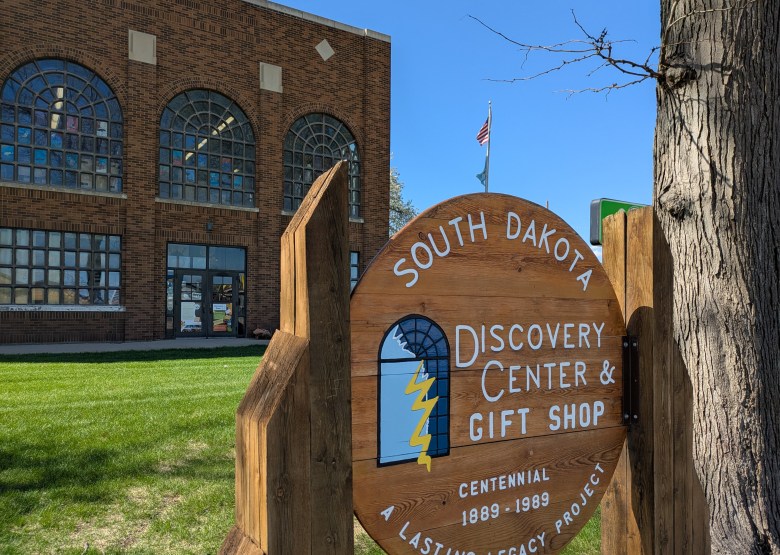
Hamlin Elementary students line up for their turn visiting a traveling planetarium sponsored by the South Dakota Discovery Center. Credit: Anya Kamenetz for The Hechinger Report
During the planetarium’s daylong visit to the small community of Hayti, S.D., an educator from the South Dakota Discovery Center wowed 500 elementary school students with a presentation about the planets and stars. Credit: Anya Kamenetz for The Hechinger Report
Many Hamlin Elementary haven’t had a chance to visit the South Dakota Discovery Center in Pierre three hours away, so the museum brings traveling exhibits like a portable planetarium to them. Credit: Anya Kamenetz for The Hechinger Report
Blaha said that most of these children have never been to the South Dakota Discovery Center, a hands-on science museum three hours west in the state capital. But thanks to a federal agency called the Institute of Museum and Library Services, a part of the museum can come to them.
The IMLS was established in 1996, combining previously separate programs. The small agency became the largest source of federal funding for museums and libraries, last year awarding $266.7 million in program grants, research and policy development across all 50 states. IMLS awarded the South Dakota Discovery Center about $45,000 in 2023 to upgrade this traveling planetarium.
But students around the state may be waiting a long time for the next upgrade.
Related: Young children have unique needs and providing the right care can be a challenge. Our free early childhood education newsletter tracks the issues.
President Donald Trump signed an executive order in mid-March calling for the agency to be “eliminated to the maximum extent consistent with applicable law.” Mass firings followed.
On May 1, the U.S. District Court in Washington, D.C., issued a temporary restraining order to block the agency’s dismantling, followed on May 6 by a second federal judge finding the dismantling of this and two other agencies unconstitutional. On May 20, the American Library Association reported that employees are returning to work and some grants have been restored.
But the administration is continuing its legal battle to all but shutter the IMLS. The latest post on the agency’s Instagram account is captioned, “The era of using your taxpayer dollars to fund DEI grants is OVER,” holding up for criticism grants that were aimed at addressing systemic racism in museums, equitable library practices, and diverse staff development. The IMLS and the Department of Government Efficiency did not respond to requests for comment.
A veteran of the agency who asked to remain anonymous because of fear of reprisal said they first saw DOGE staffers meeting with leadership on March 28. “On the 31st, we were put on administrative leave. We had about two hours to turn in your key cards, your ID, get everything off your laptop you’re ever going to need. We were locked out of our computer systems by 3:30 and told to get out of the building.” A skeleton crew was hastily rehired the next day.
The ex-staffer points out that the Institute of Museum and Library Services spends, or spent, just 7 percent of its budget on its 70 staff, passing the rest along as grants. “We are not a bloated agency.” They have two kids at home, one with special needs and are married to another federal employee whose job is also at risk; but they are almost as worried about their grantees as themselves.
“After 20 years, I didn’t even get to put an out-of-office response up. Is someone emailing me right now and getting nothing, because all of a sudden their grant just ended? I hate that,” the former IMLS employee said.
Almost all grants awarded required a one-to-one cost share out of the local institution’s budget, the staffer said. Plus, typically the grantees pay for activities first and then apply to get reimbursed. “We’re leaving these often small rural museums and libraries on the hook.”
Anne Lewis, executive director of the South Dakota Discovery Center, said that organizations like hers would be “wobbly” without federal funding and would have to scale back on ambitious programs like the planetarium upgrade.
“The new system has much better interaction and control,” said Heinen, the museum educator. An earlier version had a static point of view, but upgraded visual effects means that “now we have spaceship mode,” she said. “We can travel to destinations including planets, and go in a full 360-degree mode around galaxies.”
With a flick of the touchscreen menu, she can also display the constellations of a dozen different cultures including Lakota, a significant benefit especially when she visits tribal schools.
The South Dakota Discovery Center, based in Pierre, has used federal support from the Institute for Museum and Library Services to pay for a traveling planetarium exhibit. Credit: Anya Kamenetz for The Hechinger Report
It’s a lean operation: Heinen drove solo nearly 200 miles from Pierre to Watertown the evening before and spent the night at an Econo Lodge. From there, it was another 20-some miles to Hayti, where she arrived at 7:30 in the morning, set up the dome herself, and ran 30-minute programs all day.
The whole elementary school, about 500 kids in total, saw the planetarium, with each show customized to the children’s interest and grade level; and she also conducted a parent engagement program in the afternoon. Heinen said she never tires of being a “Santa Claus” for science. ”As soon as they see me, they know something fun is going to happen.”
During this visit, the fan favorites were Jupiter, Mars and the sun. “It was cool when we went to Mars,” said Nash Christensen, 6. “And the volcano on that one moon, and the big hurricane on Jupiter. I think Jupiter is a dangerous place to live.”
Grant recipients of the Institute of Museum and Library Services say the support from the federal government has been critical to running their programs. For example, the Boston Children’s Museum, the second-oldest children’s museum in the country, has used federal grant money to improve school readiness. One of the outcomes was a new exhibit in the museum, “Countdown to Kindergarten,” that mimics a kindergarten classroom, complete with a school bus you can sit in out front.
“It’s helpful not only for the kids, but some of our caregivers who came from other countries and may not have gone to a school like this,” said Melissa Higgins, the museum’s vice president of programs and exhibits.
At the Madison Children’s Museum in Wisconsin, federal funds paid for a multistate partnership that provides climate education for young children and their families. In Fort Lauderdale, Florida, a grant covered five “STEMobiles,” which offer hands-on science activities for children ages 3-5 in low-income parts of Broward County. The Philadelphia School District won a two-year planning grant to try to improve its pipeline of school librarians; they were down to only a handful for a district of 200,000 students.
But the greatest impact may come in rural, often deep-red areas.
“Rural communities have particularly unique challenges,” said Lewis at the South Dakota Discovery Center. “There’s 800,000 people in the state, and they’re dispersed. We don’t have a concentration of funders and donors who can help support these enrichment activities.”
She said the teachers she serves are “passionate, committed and, like every other place in the world, underfunded.” If not for institutions like hers, students would probably go without this kind of hands-on science experience, she said.
Blaha, the elementary school principal, concurred. “The planetarium brings excitement and expertise that we don’t typically have in a community like this,” he said.
For now, the excitement is coming to an end. The class has “landed” on a green lawn, under a deep blue sky. Heinen announces “It’s time to leave.” She’s met with a chorus of, “Noo!”
“You guys, we were in here for a full 30 minutes.”
“It felt like 10!”
“It felt like a second!”
Tonight, many of them will be able to look up at the dark sky over the prairie and show their parents Jupiter, Ursa Major and Mars.
Contact the editor of this story, Christina Samuels, at 212-678-3635 via Signal at cas.37 or [email protected].
The Hechinger Report provides in-depth, fact-based, unbiased reporting on education that is free to all readers. But that doesn’t mean it’s free to produce. Our work keeps educators and the public informed about pressing issues at schools and on campuses throughout the country. We tell the whole story, even when the details are inconvenient. Help us keep doing that.
I’ll be the first in my family to earn a college degree, and that’s something I hold very close to my heart.
My family and I moved to the United States in 2014. We chose Memphis as our second home to start fresh and build a better future.
When I graduated high school in 2020, I decided to join the Army Reserve so I could work full-time to help support my family financially. Along the way, my parents always reminded me of the importance of a college degree. Honestly, I struggled with the decision between choosing work over school.
That changed when I discovered the University of Memphis Global (UofM Global) where I could earn my degree 100% online from an accredited, nationally recognized Carnegie R1 university. The flexibility of the program made it possible to balance work, life, and education. Once I enrolled, I knew I made the right choice.
As an online student, I stayed involved with campus life through career fairs and joining student organizations like the Society of Human Resource Management. I wanted to get the most out of my college experience and connect with people who shared my passion for HR.
Last November, I deployed to Kuwait, with a month left of fall semester. Thanks to the support and structure of UofM Global, I was able to finish strong, even making the Dean’s List. I’m taking four classes while serving on active duty, and I’m proud to say I’ll be graduating in May.
Being able to serve my country, support my family, and earn my degree means the world to me. I feel ready to take on whatever comes next.
Dwight SanchezIn today’s hyper-competitive higher education landscape, the challenges facing Historically Black Colleges and Universities (HBCUs) and Minority Serving Institutions (MSIs) are immense. Declining birth rates, changing student expectations, shifting public sentiment, and persistent underfunding place extraordinary pressure on institutions that have long served as lifelines for students of color and first-generation learners. Yet amid these challenges lies an opportunity. By reimagining Strategic Enrollment Management (SEM) through the lens of negotiation theory, HBCUs and MSIs can increase their strategic agility, strengthen institutional partnerships, and yield more robust enrollment outcomes.
SEM as Negotiation
Strategic Enrollment Management isn’t merely about admissions and financial aid—it’s about aligning institutional mission with market realities in ways that are both student-centered and data-informed. Viewed through the lens of negotiation, SEM becomes a dynamic system of interdependent relationships: with prospective students, families, community influencers, K-12 schools, alumni, faculty, and internal staff. Drawing from 3D Negotiation: Powerful Tools to Change the Game in Your Most Important Deals by David Lax and James Sebenius, and Essentials of Negotiation by Lewicki, Saunders, and Barry, three principles become especially relevant: setup, deal design, and tactical interaction.
Setup involves determining who needs to be at the table, what interests are at stake, and which parties have influence over enrollment decisions. For HBCUs, this means engaging not just students, but parents, clergy, high school counselors, and community mentors who shape the decision-making ecosystem.
Deal Design refers to how institutions create value through the student’s experience. It’s not just about price; it’s about crafting offers that resonate emotionally and practically with underserved populations. This might include mentorship programs, clear career pathways, and intentional support systems.
Tactics, while often emphasized, should follow—not lead—strategy. Scripts matter less than systems, and strategic enrollment leaders must know when to pivot from persuasive messaging to coalition-building and issue reframing.
The Cultural Context
The diversity within HBCUs and MSIs also means that enrollment negotiations occur across varied cultural, economic, and generational dimensions. Chapter 11 of Essentials of Negotiation reminds us that in international and cross-cultural negotiations, assumptions can be fatal. For instance, assuming that all Black or Latino students respond similarly to recruitment strategies ignores regional, familial, and economic differences. Strategic enrollment leaders must develop cultural humility and data literacy to avoid overgeneralization and instead build nuanced personas that guide outreach.
Equally important is the political environment. Public perceptions of DEI initiatives, affirmative action, and federal funding can dramatically alter an institution’s appeal and perceived legitimacy. In this context, setup becomes a shield—anticipating changes, diversifying recruitment pipelines, and framing the institutional value proposition in ways that transcend political cycles.
Leadership and Accountability
Leading enrollment through this lens requires a shift from short-term performance metrics to long-term strategy. Enrollment managers must adopt a leadership posture that blends transformational vision with collaborative execution. As Lewicki et al. note in Chapter 10, multiparty negotiations (such as cross-department SEM committees) require clear roles, shared goals, and open channels of communication. Leaders must foster psychological safety while holding teams accountable to institutional KPIs—bridging the often-siloed worlds of marketing, academic affairs, and student support.
Professional development plays a critical role here. Too often, enrollment teams are equipped with tactical training (CRM usage, phone scripts, event planning) but lack exposure to systems thinking, data storytelling, or negotiation dynamics. Embedding professional learning communities and creating leadership pipelines within SEM units allows HBCUs and MSIs to develop internal change agents who can sustain innovation over time.
The Path Forward
HBCUs and MSIs are more than educational institutions—they are engines of social mobility and cultural affirmation. But to thrive, they must adopt a strategic posture that sees every element of SEM as a negotiation: from brand positioning to student engagement, from financial structuring to internal alignment.
Consider this: An HBCU looking to boost STEM enrollment among underrepresented males recognizes that traditional outreach and scholarship packages have limited impact. Instead of only increasing merit aid, the institution reframes its offer through negotiation theory. They partner early with high schools, launch a summer bridge program co-led by STEM faculty and alumni, and guarantee every enrolled student a faculty mentor and paid internship by year two. They also engage parents and community leaders as ambassadors—tapping into local trust networks. At the internal level, they align academic and student affairs teams through shared enrollment metrics and regular scenario planning meetings, increasing accountability and cohesion.
This isn’t just marketing—it’s “setup” and “deal design” in action. It expands the scope of stakeholders, adds value beyond dollars, and creates a win-win proposition for the student, family, and institution. It also reflects a broader institutional willingness to act as a proactive negotiator in shaping its market position.
By leveraging the principles of negotiation—particularly setup, value creation, and coalition building—enrollment leaders can develop strategic enrollment plans that are not only adaptive but transformative. In doing so, they ensure their institutions remain vital pathways for generations of students yet to come.
Dwight Sanchez is the Executive Director of Enrollment Management at the University of Maryland School of Pharmacy.