Tag: labour

  • Labour takes steps to bring higher education and local skills closer together

    Labour takes steps to bring higher education and local skills closer together

    The post-16 white paper promised to strengthen statutory guidance on local skills improvement plans (LSIPs), including “clearer expectations on higher education providers to engage” and a move to make the plans cover skills all the way up to level 8.

    This greater roles for universities in LSIPs was gestured at in Skills England’s ministerial guidance, and even announced by Labour in opposition.

    Now, the revised guidance has been published – and the push for higher education providers to play a more central role has indeed materialised.

    This is a local shop

    LSIPs were introduced in the Skills and Post-16 Education Act under the last government as employer-owned priorities and actions around skills needs and the provision of technical education in a designated local area of England. Some 38 different plans were approved by the Secretary of State in summer 2023, with annual progress reports following – you can find them all on this page if you don’t mind navigating through some confusingly designed websites.

    That legislation also introduced mechanisms to assess how well education providers were contributing to the plans – for example, accountability agreements for further education colleges. For higher education institutions, the only mention of accountability in the old guidance was an enjoinder to make a note of activity related to LSIP priorities in strategic plans. The previous government framing around LSIPs was notably quiet on the role of higher education, as we’ve noted before – which is not to say that many HE institutions didn’t get involved, to greater or lesser extents (the progress reports linked above demonstrate this, though in a non-systematic way).

    LSIPs cover a three-year period, so a new round in summer 2026 is Labour’s big chance to reshape them in its preferred fashion. Today’s guidance is to be used for an LSIP draft submitted by the end of March, and – pending government approval – the new plans will be published in or around June next year.

    The areas covered by LSIPs, and the corresponding employer representative bodies (ERBs), have also been shifting – today we get the latest areas confirmed, now sensibly contiguous with local authority areas. An additional wrinkle that Labour announced in last year’s devolution white paper is for so-called strategic authorities (“mayoral and non-mayoral combined authorities, combined county authorities, and the Greater London Authority”) to take joint ownership of LSIPs, along with ERBs. Eventually everywhere will be in a strategic authority – one day – but today’s guidance is in many places split depending on whether the LSIP is or is not in a more devolved part of England.

    Best laid plans

    LSIPs are a complicated undertaking at the best of times – as the government puts it, they “unite employers, strategic authorities, higher education, further education and independent training providers and wider stakeholders in solving skills challenges together.” Their effectiveness in really driving change remains unproven but – in theory – they respond to calls for a skills system that is planned at a local rather than central government level (or one that is not planned at all).

    The new guidance confirms just quite how complex an endeavour putting a plan together has become. New LSIPs will need to join up with the industrial strategy and its sector plans, “as far as they relate to industries within the local area.” This will also create synergies (or cross-purposes) with the new local growth plans for mayoral authorities announced at the spending review, which focus on economic development, and the Local Get Britain Working Plans (GBWPs) which are supposed to be looking at “broader causes of economic inactivity.”

    The guidance references a need for a read-across to the clean energy jobs plan (the LSIPs legislation placed a requirement on the plans to consider the environment), but this presumably will equally apply all the other forthcoming workforce strategies – now renamed as jobs plans, keep up – that different sectors are being obliged to come up with for purposes of linking migration and skills.

    And in perhaps the most notable shift of all, the new Labour version of the LSIP is instructed to pay heed to the post-16 white paper, and specifically the new prime ministerial targets for participation in higher-level learning. This is even presented as the first bullet point in the list of what the Secretary of State will take into account in the approval process. Reading between the lines, it looks like the government will be wanting plans which are relatively bullish on the growth of provision, including – but not only – at levels 4 and 5.

    Skills England is tasked with monitoring and oversight, as well as providing copious data to inform the plans’ development.

    Get HE in

    As set out in the new guidance at least, each LSIP will function as a little microcosm of the more coherent and cooperative education and skills landscape that Labour is swinging for in its white paper vision. Whether the plans can really drive these reforms, or simply reflect their framing, is another question – but there’s similar language about asking both further and higher education providers to lean in and

    work together in support of the ambitions set out in their respective LSIP, creating a more coherent post-16 education system with better pathways and opportunities to progress from entry up to higher level skills, enabled by the Lifelong Learning Entitlement.

    As mentioned, LSIPs will now be required to run the full gamut of technical education from entry level up to level 8, having previously been limited to level 6 provision as a cut-off. Asking employers and local areas to think about postgraduate-level skills needs is a bit of a watershed moment, even if the government itself seems to have only limited appetite for much policy change, and it will be fascinating to see what comes of it.

    Perhaps it’s the paucity of much proper government support for the higher education sector in recent years which leads me to celebrate this, but the language in the guidance around higher education’s fit within local systems feels spot on, in terms of how the sector would like itself to be understood:

    Higher education providers (HEPs) are focal points for higher level technical skills, research and innovation. The differences in mission, specialisms and strategic objectives between different types of institutions mean that HEPs can add unique value to local skill systems in a variety of ways, including through industry partnerships, research-led innovation, and national and international development initiatives; as well as feeding in higher education specific intelligence, such as graduate outcomes or skills pipeline data, to complement and add to further education and employer data.

    What getting stuck in looks like

    Both HE and FE providers will be expected to play a role in LSIP governance. Core elements of the new plans will need to include details of how both types of providers have been engaged in shaping the priorities and actions, as well as identifying challenges, and set out how they will support implementation and review progress.

    The potential actions included within LSIPs are varied, but it’s anticipated that they will speak to both improving the local skills “offer” – including changes that higher and further education providers can make to better align provision with the skills needs of the area and to simplify access – and to raise awareness of existing provision, helping both employers and learners to better understand what’s available.

    On the latter, there’s a nice moment where the guidance makes a genuinely sensible suggestion:

    Where engagement between higher education providers and LSIPs has not previously taken place, ERBs (and Strategic Authorities) may find engaging with the heads of careers and employability (who tend to work on skills development and measuring skills impact) a useful starting point.

    Higher education institutions will be “expected” (more on that later) to help ERBs and local government structures help map higher technical skills needs, share information about what they currently offer, and reflect on how their provision can be more responsive. And help with evaluation, and use their subject expertise and industry links to help develop the technical skills of staff elsewhere. And employ their national and international reach to gather best practice. It’s almost as if universities are teeming hives of resource and capable people, rather than ivory towers intent on remaining aloof from their local areas.

    Plus there’s an expectation for collaboration with further education and with other higher education providers to, “where appropriate”,

    create a more strategically planned response to skills needs, leading to improved local and regional coverage and coordination.

    It all sounds very nice if it works – and it all helps to flesh out the how of the white paper’s grand but largely un-operationalised ideas.

    Who’s accountable then?

    In its promises to give universities a “seat at the table” in LSIPs, it sounded like there was the possibility of Labour introducing a degree of accountability for higher education institutions, in the same way that applies to further education colleges (both through accountability agreements with DfE, and in a growing emphasis on local skills in Ofsted inspections). Research from the Association of Colleges has previously highlighted universities’ lack of formal accountability within the LSIP system as a mild bone of contention among stakeholders.

    This hasn’t happened – as far as accountability applies to higher education institutions’ role in the plans, it will remain limited to an expectation that activity is recorded in strategic or business plans, as was previously the case. There is now also encouragement for HEIs to “publicly communicate their role in the LSIP in other ways.” What we do get much more of is an emphasis on those responsible for the plans to seek out and involve the higher education sector.

    We therefore run up against the same issues that dog Labour’s HE agenda elsewhere – there might be an attractive vision of collaboration and coherence, which all things being equal the sector would be well-disposed towards, but at a time of maximum turmoil and with incentives pointing in other directions, can it really gel? Otherwise put: is dedicating enormous resource, goodwill and strategic direction to local needs a prudent choice for institutions battling to survive, or would they be better off focusing on recruiting every single last international student they can get their hands on for the rest of the Parliament? To which we might also add that the retrenchment in higher education civic work that seems to be taking place in some areas has likely already damaged some of the required structures and led to the loss of needed expertise.

    It’s a similar story elsewhere in the system: local government structures have never been more stretched, devolution-related reforms are still in their infancy, and while employer groupings may be well-placed to say what skills they would like more of, are they really effective stewards of fiendishly complicated local projects involving multiple actors and spotty data?

    A set of 39 well thought through and carefully monitored LSIPs at the heart of a responsive ecosystem of employers, HE and FE, and local government – each with one eye on the industrial strategy, and another on an area’s own specific character – would do wonders for Labour’s education and skills agenda. But the conditions need to be in place for it to emerge, and right now it feels like quite the reach.

    Source link

  • Podcast: Labour Conference 2025 | Wonkhe

    Podcast: Labour Conference 2025 | Wonkhe

    This week on the podcast, as the dust settles on Labour conference in Liverpool, we unpack what Keir Starmer’s new higher education participation target really means – and whether universities have the capacity and funding to meet the moment.

    We also get into the surprise return of targeted maintenance grants – funded controversially by the levy on international student fees, and we reflect on the wider political atmosphere at the conference – from policy signals to sector perceptions, and what all this might tell us about Labour’s emerging offer and forthcoming White Paper.

    With Gary Hughes, Chief Executive at Durham Students’ Union, Eve Alcock, Director of Public Affairs at QAA, Michael Salmon, News Editor at Wonkhe and hosted by Jim Dickinson, Associate Editor at Wonkhe.

    The PM’s announcement on higher level participation is a win for the HE sector

    The fifty per cent participation target is no more. Again.

    Grants return, the levy stays

    Maybe the levy just moves money to where it’s needed most

    The Augar review is back, baby. Just don’t about talk yourself

    Students are being othered again – and everyone loses out

    Have universities got the capacity and cash to respond to the government’s agenda?

    How much should the new maintenance grant be?

    Universities should be central to rebuilding communities

    Students are working harder than ever – because they have to

    I have a lot of questions about the LLE

    Who’s ready for a debate at 930am on a Sunday?

    The education policy trap: will the Augar review avoid the mistakes of the past?

    You can subscribe to the podcast on Apple Podcasts, YouTube Music, Spotify, Acast, Amazon Music, Deezer, RadioPublic, Podchaser, Castbox, Player FM, Stitcher, TuneIn, Luminary or via your favourite app with the RSS feed.

    Source link

  • As the Labour Party Conference draws to a close, HEPI takes a look at what just happened

    As the Labour Party Conference draws to a close, HEPI takes a look at what just happened

    Nick Hillman, HEPI Director, bottles his thoughts about this year’s Labour Party Conference.

    As multiple fringe events showed, when it comes to higher education the Labour Conference was very busy, with notably more vice-chancellors in attendance than in days of yore.

    My Conference sojourn started on Saturday with a trip to Liverpool’s famous Cavern Club to watch the brilliant in-house Beatles tribute band. At the time, I mused about which fab-four song might best sum up the next few days. ‘Taxman’ perhaps?

    (If you drive a car) I’ll tax the street

    (If you try to sit) I’ll tax your seat

    (If you get too cold) I’ll tax the heat

    (If you take a walk) I’ll tax your feet

    In fact, when it came to higher education, the big news was a giveaway rather than a new tax. I’ll always remember where I was when Margaret Thatcher resigned as Prime Minister (in the Manchester University Students’ Union shop). Perhaps education policy wonks will similarly always remember where they were when they heard maintenance grants were on their way back (albeit for a second time – they were last reintroduced in the mid-2000s before being abolished a decade later).

    In my case, I was with dozens of others in a fascinating HEPI fringe event on students’ cost of living, chaired by my colleague Rose Stephenson and featuring Alex Stanley (NUS), Gavan Conlon (London Economics) and Nic Beech (University of Salford). This came hot on the heels of two other HEPI fringe events – one on public opinion and higher education featuring a bevy of vice-chancellors and another with Cambridge University Press and Assessment on ‘Quality Matters’.

    It was no surprise the news about maintenance grants won a spontaneous round of applause. It reminded me of the cheer I got during a speech to the University of Derby in 2016, when I read out the breaking news that UKIP’s Leader had just stood down (‘Nigel Farage resigns’, the Guardian reported, ‘after “achieving political ambition”’).

    In both instances, the initial reaction was premature. Brexit was not the end of Faragism and it quickly became clear in Liverpool that the return of maintenance grants is not quite what it first seemed either.

    Bridget Phillipson’s tweet announcing the change said:

    Access to our colleges and universities shouldn’t just be for a wealthy few.

    That’s why I’m bringing back maintenance grants for those who need them most.

    Labour is ambitious for all our young people, no matter their background. I’m putting our values into action.

    Most people who have calculated the cost of reintroducing grants have assumed it would cost something in the region of £2 billion a year. However, Ministers plan to fund the new grants via the proposed levy on international students’ fees, which is expected to raise around £600 million. So entitlement to the new means-tested grants will, it turns out, be limited by students’ course choice. You will be quids in only if you are studying what the politicians want you to study. 

    As I noted at the King’s College London Policy Institute fringe meeting on Wednesday afternoon, funding the new grants from the new levy may seem like clever politics, at least inside Number 10 and the Treasury and also perhaps by anyone seeking election as the Labour Party’s Deputy Leader.

    Students and vice-chancellors have been desperate for grants to return and rightly so – for the reasons why, see our recent report on a Minimum Income Standard for Students with TechnologyOne and Loughborough University. But the levy / tariff / tax on international students is hated by those same students and vice-chancellors, putting them in something of a bind when it comes to responding to the Government’s announcement.

    Not only do international students typically come from countries that are poorer than the UK, but they are already subsidising UK research and the teaching of domestic students. Now they are expected to contribute towards the day-to-day living costs of poorer home students too (just so long as those UK students are studying courses deemed to be of most economic value). Just how broad do Ministers think international students’ shoulders are?

    Many of them come from wealthy backgrounds but some do not have very deep pockets and none is obliged to study in the UK rather than elsewhere. So our higher education institutions are unlikely to be able to pass on the full 6% without seeing a drop in demand.

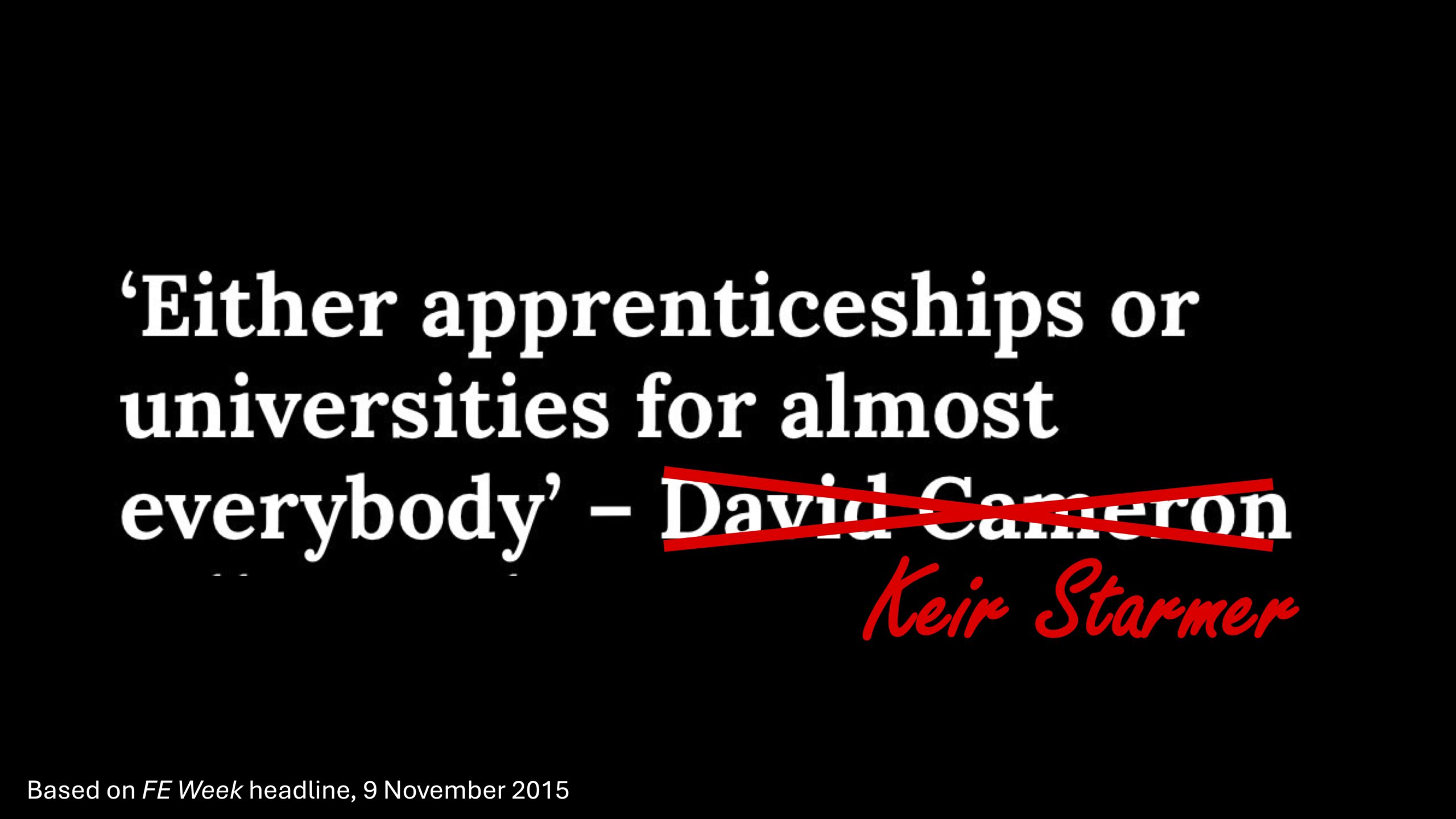
    It was great to witness so many backbench Labour MPs, like Alex Sobel, Daniel Zeichner, Abtisam Mohamed and Dr Lauren Sullivan, advocating for UK universities across the conference fringe programme. But more generally, there were parts of the Conference that felt flat as well as parts that were presumably in line with what the organisers wanted – including the Leader’s big set-piece speech. Starmer’s big reveal was the rejection of the ancient 50% target for young people’s participation in higher education in preference for a new target ‘That two-thirds of our children should go either to university… Or take a gold standard apprenticeship.’

    The Prime Minister would be unlikely to welcome the comparison but this reminded me of nothing so much as David Cameron’s pledges as Prime Minister. In 2013, for example, Cameron said: ‘I want us to have as a new norm the idea that in school, everybody, everyone who can, either takes that path on to university, or takes that path on to an apprenticeship. You should be doing one or the other.’

    The challenge is not coming up with such commitments; it is delivering them. Fewer adults are doing apprenticeships now than when David Cameron spoke, despite the introduction of an Apprenticeship Levy. Perhaps Starmer can succeed where Cameron and his successors failed…

    At the end of the Conference, I was left feeling the biggest omission compared to past Labour Conferences was a clear and broad narrative about His Majesty’s Official Opposition: the Conservative Party. If the choice facing the country really is between ‘division’ and ‘decency’, as Keir Starmer says, then might not the best way to defeat division be, as with Le Pen in France or the AfD in Germany, for centre-right and centre-left parties to act together?

    If Tony Blair and William Hague can work together, surely this is not impossible? But – and this is a personal opinion only – I left Liverpool wondering if the main problem for today’s Labour leadership is that they have spent the last 15 years making such strong criticisms of their bedfellows in the mainstream centre of British politics that they are unable to admit they may now need to work with the centre-right to stave off their worst fears.

    Then again, perhaps today’s Tory Party also cannot see that the opposite of division is not so much ‘decency’ (however much we might want that) as collaboration. We’ll find out for certain next week as the policy caravan moves across the north-west to Manchester for the Conservative Party Conference. Do come to HEPI’s event there if you can – it is outside the secure zone so no expensive pass is needed.

    Carole Cox, HEPI’s Events and Communications Administrator (and HEPI’s biggest Beatles’s fan) explains why Liverpool is the perfect place for day-trippers and long-stayers.

    The City of Liverpool has the biggest single collection of Grade One listed buildings than any other English city outside London and it was named the European Capital of Culture in 2008. A football mecca, it also boasts a plethora of museums, including the World Museum, the International Slavery Museum, the Museum of Liverpool, Tate Liverpool and the Merseyside Maritime Museum.

    It is also an interestingly quirky place, which harbours some amazing public toilets (you read that right). For example, if you ever happen to drop into the Philharmonic Dining Rooms in the Georgian Quarter, feel free to admire the famous Grade I-listed urinals in their pink marble splendour.

    And then, there is the deservedly famous Mersey Beat. Liverpool and The Beatles, these are words that go together well.* The Liverpudlian group are considered the best-selling band in music history, hailed as pioneers who revolutionised the music industry and popular culture.

    In summary, Liverpool is a ‘blast’ in more ways than one: a city which does not shy away from its heritage, a city with so much to offer culturally, but also a windy city open to the strong maritime winds gusting from the docks. Which may be why the French translation of the 1964 Beatles film A Hard Day’s Night is Les Quatre Garçons Dans Le Vent, a French colloquial idiom for their growing popularity – which, when translated word-for-word, awkwardly reads as ‘the four boys in the wind’.

    * ‘these are words that go together well’ are lyrics from the 1965 Beatles song Michelle (Lennon/McCartney).

    Source link

  • The LLE finally gets a Labour overhaul

    The LLE finally gets a Labour overhaul

    If you still imagined that the Lifelong Learning Entitlement (LLE) would mean that a student studying any module from any course would be eligible for 30 credits of funding, it’s long past time to disabuse yourself of that notion.

    Under the latest plans, eligibility only extends to short courses dealing with those subjects identified as national priorities – via a somewhat tenuous link to the industrial strategy – along with HTQ modules. Everything else in higher education will be funded by year of study, as is currently the case.

    If you were thinking that this latest round of changes – taking us even further away from the initial dreams of Boris Johnson (or even Philip Augar) – completes the long gestation of the LLE in full detail you will be disappointed. For instance, the credit transfer nettle has yet to be grasped – with a consultation due in early 2026, not far in advance of the September 2026 soft launch. And there are, as we shall see, a number of other issues still dangling.

    It’s a continuation of DfE’s gradual retreat from a universal system of funding that was supposed to transform the higher education landscape. No variable intensity, a vast reduction in modular availability – it just allows some of the short courses that universities and colleges already offer to be funded via the loan system (a measure, lest we forget, of dubious attractiveness to learners).

    A bridge to nowhere

    The Lifelong Learning Entitlement (originally known as the Lifelong Loan Entitlement) was announced by Prime Minister Boris Johnson on 29 September 2020, as a part of the government’s lifetime skills guarantee:

    we’ll expand and transform the funding system so it’s as easy to get a loan for a higher technical course as for a university degree, and we’ll enable FE colleges to access funding on the same terms as our most famous universities; and we’ll give everyone a flexible lifelong loan entitlement to four years of post-18 education – so adults will be able to retrain with high level technical courses, instead of being trapped in unemployment.

    Like most of Boris’ wheezes it was originally somebody else’s idea – in this case Philip Augar. He had a few more specifics:

    The government should introduce a single lifelong learning loan allowance for tuition loans at Levels 4, 5 and 6, available for adults aged 18 or over, without a publicly funded degree. This should be set, as it is now, as a financial amount equivalent to four years’ fulltime undergraduate degree funding. Learners should be able to access student finance for tuition fee and maintenance support for modules of credit-based Level 4, 5 and 6 qualifications. ELQ rules should be scrapped for those taking out loans for Levels 4, 5 and 6.

    But it makes more sense to think of the idea as being 100 per cent Boris in that it was a massive infrastructure initiative that he had no clue how to actually deliver (in all honesty, not much of Augar was deliverable either – perhaps that was the attraction). As has proved to be the case.

    As you were

    Let’s start by looking at what’s unchanged, following the latest revisions. The timeline for getting started remains as was: applications from September 2026 for courses and modules starting in January 2027. This still feels extremely optimistic. Plus – as has been the case for a while – a staggered rollout of standalone modules is planned, rather than an enormous platter of bitesize options spread out to pick from come next September.

    The use of the current plan 5 student loan model, with its 40-year term and nine per cent repayment rate above what is currently around minimum wage, is still there – with all the peculiarities this will inevitably engender. If anyone was expecting a large scale shake-up of the student finance system any time soon, this should serve as an enormous hint that no radically new model is arriving in the short to medium term.

    Also retained from DfE’s planning under the Conservatives is the system of “residual eligibility”, meaning how much loan is available to those who have already, for example, studied one undergraduate degree. You still get the equivalent of four years overall, though with lots of wrinkles.

    The aspiration for each member of the public to have an LLE personal account continues – this will still include, in theory, information on one’s loan balances, an application tracker, and advice and guidance on career planning.

    And in broad strokes the government’s rationale for the LLE persists: more flexible routes through tertiary education, support for upskilling and retraining throughout one’s career, and the promise of more learner mobility between institutions.

    Picking winners

    The LLE is replacing England’s entire student funding system, and so funding for full years of study at levels 4 to 6 – such as degrees or higher technical qualifications – will flow through it. In many cases, though, this is just a shift on paper.

    What’s always been the more significant change is how it will bring the funding of individual modules into scope, along with the resulting interplay between single modular courses and larger programmes of study in a learner’s lifelong journey.

    Modular provision that would be eligible had previously been defined as “modules of technical courses of clear value to employers” – this is now rejigged to:

    modules of higher technical qualifications, and level 4, 5 and 6 modules from full level 6 qualifications, in subject groups that address priority skills gaps and align with the government’s industrial strategy.

    We flagged this link between the LLE and the industrial strategy priority areas when the latter was published last month – and the updated LLE policy paper does say that DfE has worked with Skills England to assess skills priorities, though there is no detail on this.

    What we very much don’t get is a mapping between LLE subjects and the industrial strategy sectors (the IS-8), or the priority sub-sectors and their corresponding links to certain regions or clusters which is, y’know, what the industrial strategy is all about. Arguably the main bone thrown to the industrial strategy is the concept of the government “picking winners” – but note there is no stumping up of public funds to support this.

    So we get a list of which subject groups will be in scope for modular study:

    • computing
    • engineering
    • architecture, building and planning, excluding the landscape gardening subgroup
    • physics and astronomy
    • mathematical sciences
    • nursing and midwifery
    • allied health
    • chemistry
    • economics
    • health and social care.

    Common Academic Hierarchy (CAH) fans will be delighted to spot that this appears to have been done (with the curious landscape gardening exception) at the very top level. These are very broad subject groups, which will contain multiple subjects with questionable relevance to the industrial strategy.

    While on the face of it there is some ambiguity about whether this subject list refers to only level 6 qualifications, or to these and higher technical qualifications (HTQs), the accompanying provider preparation guide makes clear that the subject groups here are for level 6 qualifications only – and provision via HTQ modules covers many other subject areas, which in some cases overlap. This currently includes subjects such as business and administration, education and early years, legal and accounting, and many others – but these will need to go through the HTQ approval route.

    The provider preparation guide suggests that institutions should be looking at their current degree provision, working out where it aligns to the priority skills gaps areas that DfE has identified, and then proceeding from there in thinking about what could be modularised. All modular study, remember, needs to form part of an existing designated full course which the provider delivers – we’re a long way from some of the previous visions of universities coming up with new stand-alone bitesize offers.

    All the other funding eligibility rules for modular provision remain – they must have a single qualification level at level 4, 5 or 6, they must be at least 30 credits (though bundling up modules to meet that minimum is allowed), and a standardised transcript of some form to be determined must be delivered upon completion, to facilitate credit transfer.

    But there is one change to eligibility rules – modular provision must not be delivered through franchised arrangements. This had always sounded like a recipe for disaster. The government has been gradually setting its face against a lot of existing franchising activity, given concerns about quality and reports of fraud.

    Getting approved

    The previous plan for approving modules (outside of HTQs) for LLE eligibility was what was being labelled a “qualifications gateway”, which the Institute for Apprenticeships and Technical Education consulted on last January. This terminology has been scrubbed entirely out of the policy paper now, with just a note that “we will set out details on how level 4 to 6 Ofqual regulated qualifications could enter the market and access LLE funding.”

    But there’s a new approval process in town – providers who are interested in delivering modular provision from January 2027 will need to submit an expression of interest, from this month.

    This process will involve an “assurance check” – seemingly run centrally by DfE, rather than Skills England as might have previously been expected. There’s a wonderful flowchart in the provider guide, which you may or may not be able to read depending on how enormous your screen is:

    That’s right – TEF! Providers with gold or silver will have access to a “simpler and quicker approval process” for modular provision. Those who do not will be asked to provide additional information around “readiness, capability and successful delivery of the parent course.”

    Hang on, you cry, doesn’t the fact a provider is registered with the Office for Students demonstrate that it has “readiness” and “capability” to deliver courses of any type? Well, yes, it does. It is possible that DfE simply doesn’t trust OfS to make this kind of judgement – which would point to a rather larger issue with higher education regulation – or it could be that this is a last gasp attempt to give TEF awards some regulatory relevance.

    This is also the case for those rated “good” or “outstanding” for Ofsted provision – and if Ofsted inspects your skills provision and you have a TEF award, they both need to make the grade. Now headline Ofsted assessments were supposed to disappear from September 2025, which makes this all a bit confusing.

    If you don’t deliver HTQs or appropriate level 6 qualifications, it’s noted that modular provision is anticipated to “gradually expand when appropriate to do so” and so you may, one day, come in line for eligibility.

    Regulatory issues

    One of the areas the previous version of the policy paper promised was further information on the regulation of modular funding. This, rather oddly, is no longer listed under “next steps”, given that the update we do get is relatively slim.

    What we might have expected was a follow-up to the Office for Students’ call for evidence on positive outcomes for students studying on a modular basis – a call for evidence which closed in November 2023, and we’ve heard little of since. As DK set out at the time, the quasi-consultation asked how things like the B3 conditions could apply to individual modules, and the regulator’s initial thinking seemed to be that completion would still be a valuable metric for regulation, as would progression – though exactly how progression was assessed would need to be refined.

    There’s still no news on this complicated issue. The new section of regulation focuses more on registration categories, while noting that DfE “will refine the existing regulatory framework to ensure it is proportionate, is targeted [and] supports a high quality, flexible system.” If you were thinking that a whole new approach to learning would need a new oversight framework, the direction of travel suggests not.

    The bigger regulatory news is that, likely to the surprise of few, the idea of having a third registration category for smaller providers offering level 4 and 5 qualifications has been scrapped. Instead the government will extend the current system of advanced learner loan funding for levels 4 to 6 until the end of summer 2030. This will give unregistered providers more time to apply for OfS registration in one of the two existing categories, though OfS is scheduled to consult in autumn 2025 on proposals to disapply some conditions of registration for providers in the further education statutory sector (which already has a regulator looking after most of this stuff).

    Maintenance chunks

    As expected, student maintenance support will be available on a pro-rata basis (depending on course, location, and personal circumstances) in an equivalent way to the existing undergraduate offer. Because this support is intended to deal with “living costs”, DfE has decided to continue to restrict availability to students attending in person – there’s nothing for online or distance learning.

    Additional targeted grants (most likely this just refers to existing disabled students’ allowance and such like) will still be available – but there’s more to come on this later this year, alongside more guidance on maintenance generally. We can perhaps hope that a forthcoming announcement modifying the decades-old system (or even just the parental income thresholds) is playing a part in this delay.

    That feeling of entitlements

    Another area where things have mostly stayed the same is the personal entitlement for tuition fee funding equivalent to four full-time years (480 credits, currently £38,140) of traditional study – with the welcome clarification that where a provider charges less than the maximum the cash value rather than the credit value will be deducted from the total. Maximum borrowing is for 180 credits a year (which would just about cover a year of an accelerated degree). And for existing graduates (with the frankly wild caveats as before) there will be an entitlement to funding equivalent to unused residual credits.

    But what happens when your balance reaches £0? No more learning for you? Not quite – a “priority additional entitlement” may be available (fees plus maintenance) in order to complete a full course in a small number of subjects (medicine, dentistry, nursing and midwifery, allied health professions, initial teacher training, social work).

    For those who follow career paths that require five years or more of study (veterinary surgery, architecture part 2, an integrated masters in Scotland) there will be a “special additional entitlement” of up to two years, again covering fees and maintenance. There’s also additional entitlements for those who take foundation years, placement years, or study abroad years. It’s by-and-large a smoothing-out of some of the unintended consequences with existing provision where representations had been made.

    Plus, importantly, the government will now play a part in mitigating circumstances – if you are resitting a year because of “compelling personal reasons” (illness, bereavement) you will have the costs of your study covered. And resits on longer courses will be covered anyway.

    The credit transfer question

    “The LLE and modular provision will provide a pathway to strengthen opportunities for credit transfer and learner mobility,” the new version of the paper states. While no-one would deny that the LLE could be a “pathway to strengthen opportunities,” especially given how tepid the phrasing is, there has still been essentially no progress on the thorny question of credit transfer.

    The largely new section on “recognition of prior learning, credit transfer, and record of learning” sets out aspirational areas where the government thinks it can work collaboratively with the sector – to promote pathways between providers, to improve guidance for both incoming and outgoing learners, and to generally square the recognition of prior learning circle despite all the intractable problems therein.

    Interestingly, DfE also wants institutions to embed all this into “broader strategies for widening access”. It’s not immediately clear how this will come off – but we get the note that this year will bring an update on “proposed changes that will start to embed this flexibility and greater learner mobility across LLE funded provision.” This might be a reference to the post-16 education and skills white paper.

    To facilitate all this flexibility, DfE had previously said it would be introducing a “standardised transcript template.” Tellingly, this has now been revised down to “a standardised transcript as part of modular funding designation.” So it appears the plan is now to look at enforcing this standardisation for the (potentially scant) modular provision that the LLE will generate, while sidestepping the much bigger question of how portability between modules and larger qualifications including degrees will work. This is a substantial scaling down in ambition – and yet it’s still a complicated thing to get agreed implemented in little over a year.

    What’s next

    As is probably coming across, there is still an awful lot yet to be confirmed. Secondary legislation to implement the LLE fee limits and funding system still needs to be laid. Fee loan limits for non-fee capped provision are pending confirmation. The Student Loans Company needs to get its systems ready.

    There will be another consultation too, in addition to OfS’ further education one. While it’s not mentioned in the updated policy paper, the accompanying provider preparation guide reveals that the Department for Education will consult on “learner mobility across LLE-funded provision in early 2026” (maybe this will be the moment when credit transfer finally gets sorted out once and for all). Opening a consultation in early 2026 when big chunks of the whole shebang are supposed to be ready to go that September does not necessarily inspire confidence.

    And the drip-by-drip announcements about the policy plumbing of the LLE mean that it’s a long time since the government has really restated its belief that there is demand out there for modular provision, or committed to working to drum some up. Really it’s baffling why this week’s announcements haven’t been packaged up with the skills white paper, as surely they must form part of a wider vision. Some clarity within this about overlaps and interplay with the apprenticeship levy would have been welcome too.

    The provider preparation guide entreats institutions to start thinking about how they will market modular provision, which is a tricky question given the absence of demand that pilots have demonstrated. But one of the examples given is particularly problematic:

    if you seek to target mature students, do you need to start building relationships with local employers and/or recruitment agents, rather than only relying on existing recruitment channels?

    This isn’t a new addition to the guidance – but since the last update, Bridget Phillipson has told Parliament that the government will “take immediate action on the use of agents to recruit students,” adding that “the government can see no legitimate role for domestic agents in the recruitment of UK students,” following the Sunday Times franchising investigation fallout. So DfE is at the same time banning the use of domestic agents – or at least it said it would – while acknowledging that recruitment to modular provision might be tricky without them.

    It’s of a piece with much of the preparation guide – the responsibility to iron out the holes in the LLE’s business case is being passed onto providers. Supposedly over the rest of the year universities and colleges should be reviewing everything from accommodation to wrap-around support, while building up relationships with employers and potentially rewriting their academic regulations. All while plenty remains unclear at the sector level. It would be unsurprising to see providers reluctant to leap into the approvals process right away, and instead assess how others fare.

    Given all this, it’s perhaps unsurprising that the ambition of the LLE has diminished a little bit each time the policies around it have been updated. We’re a long way from where we started.

    Probably the most damning assessment you could make is that, were Labour to have opted to cancel the whole LLE and just allow students to take out loans for a handful of higher education short courses tenuously linked to industrial strategy priorities, the sector would be in a very similar situation to the one it is in now. And – given clear indications of lack of student demand, and common sense assessments of the general public’s appetite for more tuition fee debt wrapped up in confusing bitesize-but-lifelong repayment obligations – few would think it was a good idea.


    Source link

  • One year on from the election, Labour is losing the student vote

    One year on from the election, Labour is losing the student vote

    A year ago, Sir Keir Starmer secured the largest election victory in the UK since 1997.

    Labour won 411 seats and a 174-seat majority – and while Labour’s vote share across many constituencies dropped compared to national predictions, the UK was washed with red seats.

    Yet as we reflect on Labour’s time in government to date, it’s fair to say the journey has not been smooth.

    Starmer has already made several significant U-turns and has announced policy changes that haven’t landed well with voters – increases to national insurance contributions, reducing winter fuel payments and the “tractor tax”, to name a few.

    As public trust in the government continues to decline and disapproval rates rise, we are continuing to see a swing of support over to Reform UK – including in constituencies with large student populations.

    PLMR recently commissioned Electoral Calculus to conduct a new multi-level regression and post-stratification (MRP) poll to understand voting intentions and the current political attitudes of the public.

    Conducted in June 2025 with a sample size of 5,400 individuals, the results show a significant change in student voting patterns and beg the question – is Labour losing the student vote?

    Voting intentions

    If a General Election was called tomorrow, our data currently places Reform UK with 31 per cent of the vote share ahead of Labour with 22 per cent and the Conservatives trailing with 19 per cent. Reform UK is predicted to win an outright majority, securing 377 seats and a majority of 104.

    If a General Election was therefore called tomorrow, Nigel Farage would become the Prime Minister of the United Kingdom.

    The data also shows changes in constituency MPs, including for ministers with responsibility for higher education like the Secretary of State for Education, Bridget Phillipson MP, according to the projections.

    While the sector is not unaccustomed to experiencing regular and quick changes in political governance – with six university ministers being in post in the last five years alone – the data does point to wider challenges for HE and the student vote.

    Reform the system

    Last year, the Higher Education Policy Institute (HEPI) published a piece about whether students made a difference at the 2024 General Election – identifying the top twenty student constituencies and Labour’s vote share in these seats.

    We have analysed our polling to understand how these constituencies would fare in an election if it were called tomorrow – the results from which show the changing state of voting intentions in these areas.

    Of the twenty constituencies, over one-third (35 per cent) are predicted to move away from being Labour-held to either Reform or Green. This aligns with the national picture – voters are showing an ever-growing frustration with the current government and are therefore evolving their political affiliation.

    When we look specifically at the data for 18-24-year-olds – acknowledging the experiences of those beyond this age group who are currently studying in UK higher education – we continue to see this pattern of voting behaviour.

    For example, when asked who they would vote for if a General Election was called tomorrow, 24 per cent of 18-24-year-olds who indicated a likelihood to vote noted their intention to vote for Labour – with 23 per cent claiming they would vote for Reform UK and 21 per cent for the Green Party.

    The Conservatives followed with 13 per cent, the Liberal Democrats with 10 per cent and Scottish National Party and Plaid Cymru with 1 per cent each.

    Interestingly, when we then consider the likelihood of voting among 18-24-year-olds we see further frustration with the current political system.

    For example, under half (41 per cent) of 18-24-year-olds responded that they would “definitely” vote in a General Election if it were called tomorrow, followed by 11 per cent who would be “very likely” to vote.

    Yet 21 per cent responded that they would “definitely not” or are “unlikely” to vote, and 16 per cent were unsure. That reveals an almost even split in the likelihood of voting among 18-24-year-olds. For a traditionally politically mobile population, this raises concerns about young people’s faith and willingness to engage with an election.

    Participants were then asked about the most important issues that will influence how they vote at the next General Election, with the top three issues for 18-24-year-olds being the cost of living and the economy (57 per cent), the National Health Service (NHS) waiting times, staffing and funding (45 per cent), and immigration and border control (25 per cent).

    While these generally align with trends in all other age groups,

    18-24-year-olds express greater concern for wider issues than other age cohorts. For example, 23 per cent of individuals in this age group reported being concerned about housing affordability and home ownership, 22 per cent about trust in politicians and government integrity, and 19 per cent about climate change and the environment.

    While some in other age cohorts reported concerns in these areas, the proportion is highest among 18-24-year-olds.


    So what does all of this tell us?

    It’s clear that Labour isn’t sustaining the support it built up during the General Election campaign last year, despite securing such an historic electoral victory, and this is true especially in student-heavy constituencies – with many already indicating their interest in seeing an electoral change.

    As economic challenges continue to create barriers within HE, with many institutions closing courses, implementing redundancy programmes and depending on international fees due to limited increases to domestic fees in line with inflation, government must be proactive in its engagement with the sector to recognise how challenges to the student experience can impact voter intention.

    With a growing national swing towards Reform UK, Labour must become aware of the challenges facing student voters if it wants to change the projected course of action and secure a second term in office.

    With lots of work to do ahead of 2029 – and only a year into this Parliament – student interests need to rise up the political agenda.

    Source link

  • Labour is learning the wrong lessons from Reform on immigration

    Labour is learning the wrong lessons from Reform on immigration

    The working classes are an easy foil for the dreams of conservative politicians. They are the salt of the earth, proper people who do real stuff, unlike the woke metropolitan elite who sit around and think things but are removed from the real world.

    As Joel Budd points out in his new book Underdogs The Truth About Britain’s White Working Class, they are to the conservative imagination “sensible truth-tellers and bulwarks against left-wing nonsense.” Even more so they are the consensus position on immigration “The mass immigration that the elite has tolerated is crushing their wages, burdening the public services they rely on and filling their neighbourhood with strangers.” As Budd also points out this, well, isn’t true. In 2024 they voted for Starmer’s Labour Party who campaigned on public finances, NHS, and inflation.

    New Labour old problems

    It is with this in mind that Labour’s response to Reform’s election performance is as wrong as it is entirely predictable. Its wrongness could have significant consequences for universities.

    Let’s start with the big results. In May’s local elections in England Reform gained 677 councillors,ten councils, two mayors, and an MP. The votes are spread across the country but as John Curtice points out for the BBC there is an education faultline.

    Reform did best in places that most overwhelmingly voted for Brexit. University graduates overwhelmingly did not vote for Brexit. Reform received less than 20 per cent of the vote in wards where more than two in five people have a degree compared to 43 per cent in wards where over half of adults have few qualifications. As Curtice states

    In summary, Reform did best in what has sometimes been characterised in the wake of the Brexit referendum as ‘left-behind’ Britain – places that have profited less from globalisation and university expansion and where a more conservative outlook on immigration is more common.

    The policy solution alighted on by outriders in the Labour Party has so far been to say that Reform has done well therefore Labour should do things that appeal to the kind of people that vote for Reform. Or, at least, the kind of things Labour assumes appeal to the people that vote for Reform. And one of the key assumptions is that getting immigration down, whoever those immigrants might be, including students, is necessary for their electoral survival.

    Blue Labour redux

    University of Oxford graduate, and Blue Labour standard bearer, Jonathan Hinder MP has said he would not be “that disappointed” if universities went bust because of reducing international student immigration. Presumably he does not mean his own alma mater. Jo White, of the Red Wall Caucus, has urged Labour to “take a leaf out of President Trump’s book” when it comes to immigration. The end of the Labour Party which purports to be closer to its working class roots is moving rapidly and decisively against immigration. Tightening restrictions on graduates, and by extension making the UK a less attractive place to study, has been reported as an idea winning favour at the Home Office.

    The issue with the general public is that it is complicated. On its own, reducing student immigration will not win Labour a single vote in Runcorn in Helsby where Reform most recently won an MP. For a start Runcorn does not have a university so it will certainly not address immigration issues brought up during the election. Runcorn does however have several organisations that benefit from a vibrant university sector. SME net-zero collaboration with Lancaster. INEOS which benefits from the proximity of a university workforce and industrial collaborations. And Riverside College, amongst other examples, as a franchise partner of the University of Staffordshire.

    It is also worth making entirely clear that people in Runcorn also go to university. It’s a particular fault of both an understanding of class and an understanding of universities that this conflation is often made.

    Immigration, immigration, immigration

    If reducing student immigration will not make a material difference perhaps it will signal a vibes shift that will bring places like Runcorn on side. Again, here is where the working class will let you down. Analysis of the British Election Study collated by Joel Budd demonstrates that “Young white working-class people are not as liberal as young white middle-class people. But when it comes to immigration and race, they resemble them more closely than they resemble old white working-class people.” Again, there is just not a long term winning strategy in discouraging student and graduate migration.

    For universities this might be comforting but it isn’t the point.

    The extent to which anyone is willing to defend student immigration is the question of the extent to which they are willing to defend the value of universities. The value of universities is felt in exports and jobs but it is most directly felt on the extent to which the effects of a university make a place feel better. The thing that Boris Johnson, or at least his advisors, understood that higher education consistently has not is that people see politics through their places. Crime. Clean high streets. Local shops. Good jobs. Green spaces. Feeling safe to go out at night. And the myriad of tangible things that make up a place.

    In policy terms the absolute antithesis of levelling up are reforms which will depress international student numbers. The last thing Runcorn needs is a poorer Liverpool and weaker universities. The challenge for universities is to tilt the scale toward being popular not just being valuable. So popular as to make decisions on cutting student immigration culturally and electorally harder not just economically wrongheaded.

    The question then is how can universities do things in places that feel like they are doing good as well as actually doing good.

    A day like today is not for soundbites

    A key question is how infrastructure can be use toward a broad and good civic end. For example, of all of the things that the University of Liverpool did during Covid (of which there were many I have direct experience of, having worked there), the one that looms largest in my memory is when it gave up its car parks for NHS staff. Not the vaccines it helped develop or the PPE it manufactured but a low cost, high kindness gesture that resonated with people at the time. The other part of this is how largely universities loom in local communities. The extent to which their infrastructure, offices, shops, cafes, and other buildings and amenities are dispersed across the towns, cities, and localities so their presence has a resonance with the lives of people from day to day. People will often be aware of a university where it precedes the word hospital. There are opportunities for other collaborative infrastructures.

    Universities tend to be pretty good at turning their research into lectures, experiments, and days out for young people in an education setting. They are less good at making their research experiential for adults. Light Years by the University of Durham (full disclosure: I volunteer in supporting this work) has taken research to places people actually gather, places of worship, highstreets, and places of local interest across Durham county, as opposed to just the city.

    And it’s harder to articulate or even work out, but the extent to which local people feel universities are on their side matters. The cultural closeness universities build to their populations is not always about what they do but whether local people feeling it’s “their” or “the” university. There is no magic bullet for this beyond the slow grind of knowing a local place and acting with it.

    The political vibes risk overtaking a political reality. The key to Labour winning back its voters is to make tangible differences in the places they live. The economic headroom for them to do that runs through higher education institutions and their success. The permission to do so depends on people feeling like universities are a thing worth saving even with difficult political trades offs.

    Source link

  • The labour of being a student nurse

    The labour of being a student nurse

    It’s 5:15pm and I’ve just finished an extra shift on placement to meet my required 2300 hours. I haven’t had time to change out of my nursing uniform.

    I had to support a deteriorating patient, a patient who was dying, and a patient that needed a new catheter as an emergency – otherwise they could have died too. And then I remembered I was running late to a board of governors’ meeting.

    I run in and apologise: scrubs on, hair ragged, eyes puffy, pouring the first glass of water I have managed to drink since 8am that morning.

    I explain I need to leave a bit early for patient bedtime calls. People were surprised, and suddenly the focus was away from the agenda and the questions flooded. I began to explain what it is really like to be a student nurse.

    I explained about the unpaid placement hours, dealing with real life patients and people who rely on us in some of their most vulnerable moments. The full time studying, having to work alongside it all and the toll on our mental and physical health. I was just scratching the surface.

    According to the Royal College of Nursing (RCN), more than 32,000 student nurses could drop out of their courses by the next parliament and seven in ten are considering quitting due to financial pressures. Statistics like these don’t surprise me, instead they reflect me and my colleagues’ experiences.

    Ultimately, institutions and governments can’t support student nurses, increase numbers and reduce retention issues if they first don’t understand their experience.

    It’s a full-time job on top of a full-time job

    We are told studying a full-time degree is a full-time job. Many students are now working more hours part- or full-time to fill the gap left by an inadequate student maintenance system, but what about student nurses?

    Student nurses juggle between 37.5 and 48 hours a week of unpaid work placements – and also work part-time jobs because the cost of living is so tough. We see student nurses rely on the free tea and toast in the staff rooms as their only source of nutrition for the day.

    In August I was on a five-day week placement. I had hours I had to make up as I was unable to attend a period of placement earlier that year due to my mum being treated for cancer. For student nurses, every time we encounter a barrier, the first thing we think about is the hours we’ll need to make up.

    We’re not entitled to sick pay, special leave or bereavement when it comes to placement. At the time of writing, I am currently on my ninth straight working day, between placement and my job as a sabbatical officer. My rent is due, my bills need paying – this is survival.

    Is it even worth it?

    It’s understandable that nursing students often feel like they exist in a limbo between the university they’re studying at and their placements. Where the student journey is so different, there needs to be different or specialised support to ensure nursing students can succeed.

    Nursing students don’t have the ability to commit to all the things that enrich the student experience – clubs, societies or volunteering – because they don’t have the time for it.

    It makes many question if they can ever actually just be students.

    In a context of an incredibly challenged health care system, student nurses are being asked to do more and more before they are qualified. As future healthcare professionals who signed up for these degrees because we want to take care of others, we are in positions where we can’t care for ourselves.

    The labour of being a student nurse feels heavy but that’s not to say that there isn’t room to make positive change.

    To universities, talk to your healthcare students, celebrate their differences from other students but acknowledge the challenge it can bring. By understanding them and lobbying on their behalf they’ll feel validated and supported by their institution.

    Looking to the government, with future reform of the NHS on the government’s agenda, how will you look at the whole student nurse journey before focusing on only recruitment? Working with trade unions including the RCN to improve the immediate conditions of student nurses is an important first step to ensure retention.

    This could include student discounts on food in hospital trusts, travel bursaries, and flexible working regulations. In order to increase recruitment in the long term, the government should consider livable bursaries and the introduction of a loan forgiveness scheme.

    It’s important that both the health sector and the higher education sector look after our future NHS and healthcare workforce. Because no matter who you are or where you come from, in yours’ or your loved one’s time of need, we want to always be there to help you.

    We’ll only see progress once there is a joined up approach from universities and government to improve the experience, and that starts with better understanding the labour of being a student nurse.

    Source link

  • Invisible labour: visible activism | SRHE Blog

    Invisible labour: visible activism | SRHE Blog

    by Sarah Montano, Inci Toral and Sarah Percy

    Behind many academic success stories lies an untold narrative of invisible labour – a hidden force driving progress but often overlooked or undervalued. From providing emotional support to sitting on committees, the silent effort sustains institutions yet leaves many working tirelessly in the background on non-promotable tasks. Only when invisible labour is met with visible activism, can change begin.

    As a group of academics over the years we became conscious of a phenomenon that affected not only ourselves but many of our colleagues. We particularly noticed that women* were increasingly being asked to take on emotional labour and tasks that, when it came to promotions were classified as “Non-Promotable Tasks” yet were essential to institutional practices. We concluded that this form of emotional labour was a form of wife work, work that is essential to the running of the home (aka Higher Education Institutions (HEIs)) yet often undervalued and the person carries the mental load. We use the term wife work due to the pejorative nature of wife work in the media and the value placed on such work in wider society. Using a feminist collaborative autoethnographic approach we explored invisible and emotional labour among female academics. Therefore, at the 2024 SRHE conference we delivered our paper on ‘Invisible Labour: Visible Activism’ and argued that it is only such activism that will help to end the inequities in HEIs.

    *we acknowledge that invisible and emotional labour can affect any academic of any gender, particularly those on education/ teaching focussed contracts.

    Shining a light on invisible labour

    Despite the increase in women’s participation in the workforce and in academia, there is still a significant gender pay gap and to compound the issue, this gap widened in 2021 and 2022 in 20/33 OECD countries. As noted by Stephenson (2023), in HE only 28% of professors are female despite women making up 43% of the academic workforce leading to a pay gap of 11.9%. We acknowledge that the reason for such pay gaps and gender biases are complex and multi-factorial (Westoby 2021), thus we focus specifically on the issue of the “gender unequal distribution” of academic labour (Järvinen and Mik-Mayer 2024:1).

    There is much discussion on the mental load outside the workplace; therefore, our focus is on the unpaid or unrewarded workload inside the workplace. As universities have new developed pathways to promotion (e.g. education or impact), citizenship has become less important, yet it is critical work that still needs to be done. However, the result of shifting paths to tenure/promotion means that women are carrying out “Non-Promotable Tasks” (Babcock et al, 2022: 15), which are institutionally important yet will not help career success.

    Wife work defined

    Wife work tasks include: writing references for students; mentoring; assisting students with emotional problems or recruitment; careers advice; taking on someone’s admin work whilst they gain awards; and committee work, effectively comprising what is known as service work. Importantly, a significant component of wife work is emotional labour. Emotional labour involves managing emotions and interactions in the academic setting without formal recognition or workload compensation. These emotional labour tasks may include student emotional support, listening, supporting colleagues, helping people or just always being nice. Such wife work occurs due to societal and institutional expectations that prompt women to take on such wife work, yet this labour whilst maintaining the organisation’s reputation and can lead to emotional dissonance and burnout (Grandey, 2013).

    Making the invisible visible

    Drawing on institutional theory​, feminist theory and theory of gendered organizations we explore how universities, embedded in social norms and values, perpetuate traditional gender roles and expectations. Our research specifically focuses on the “Non-Promotable Tasks,” which are essential for institutional functioning but do not contribute to career success and are undervalued and unrecognised. We highlight patterns about gender distinctions that lead to advantages or exploitations of academics and how these create differing identities and expectations within academia.​

    How we uncovered the invisible

    Our research has two stages. In the first stage, we used a feminist collaborative autoethnographic approach to explore invisible and emotional labour among female academics (Rutter et al, 2021)​. This method allowed for an in-depth examination of personal and shared experiences within our academic community (Akehurst and Scott, 2021)​. As the research subjects, we are comprised of female academics from the same department across international campuses, reflecting on our experiences with non-promotable tasks, emotional dissonance, mental load, and burnout (Grandey, 2013; Lapadat, 2017; Babcock et al, 2022)​. We go beyond individual experiences to co-construct the meaning of invisible and emotional labour collectively​.

    Findings that shape our understanding of invisible labour

    We identified the following categories of “wife-work”:​

    • Mentoring support (outside normal expectations or workload) ​
    • Administrative and Logistical Tasks/ Roles​
    • Recruitment and Outreach ​
    • Committee Work
    • Supporting Career Development
    • Academic and Professional Development​
    • Volunteering and Institutional Presence​
    • Helping people​
    • Taking on someone else’s role while they work on “important stuff”​
    • Listening​
    • Being kind ​

    Using the institutional framework, in which the institutional norms shape the undervaluation of service work (Palthe, 2014), we argue that the regulative, normative, and cognitive-cultural elements of institutional theory contribute to the gendered division of labour.  Through the application of these key dimensions, our findings can be categorised under three dimensions:

    1. Institutional Dimension, underpinned by the explicit rules, laws, and regulations that constrain and guide behaviour such as academic quality assurance and behavioural expectations within HEIs.

    2. Social Dimension, encompassing implicit values, norms, and expectations that define acceptable behaviour within a society or organization such as social expectations around punctuality, dress codes, and academic etiquettes in HEIs.

    3. Individual Dimension, which involves implicit but shared beliefs and mental models shaping how individuals perceive and interpret their environments. These are often taken for granted and operate at a subconscious level.

    Using this framework our findings are categorised accordingly to these elements outlined in Figure 1 below.  

    Figure 1:  Invisible Labour: Visible Activism Findings. Source: Developed by the authors

    It’s time for change

    We recognise that the critical issue is, as Domingo et al (2022) highlighted, the significance of recognising and valuing women’s work within institutions, and stress that the real issue lies within organisational practices rather than women themselves. Addressing emotional labour is vital for a supportive and equitable work environment. The burden of responsibility is deeply embedded into the societal norms and often acts as a catalyser for such responses by female academics (Andersen et al, 2022). ​As organisations shift their focus towards formal progress procedures that undervalue volunteerism and emotional labour (Albia and Cheng, 2023), there is a pressing need for activism to ensure equitable recognition and valuation of women’s contributions within academia.

    A path forward – from silence to solidarity

    Invisible labour has long been an unseen and unrecognised necessity in academia, but we argue that it need not, and should not be this way. Acknowledging and recognising the existence and value of invisible and emotional labour will ensure these ‘non-promotable’ tasks become more visible.  Therefore, there is a pressing need for activism to ensure equitable recognition and valuation of women’s contributions within academia. We emphasise the necessity of addressing these systemic issues to foster a more inclusive and supportive academic environment for all individuals involved. Change starts with awareness, so we hope this is a step in the right direction.

    Professor Sarah Montano is a Professor of Retail Marketing at Birmingham Business School. She was awarded a National Teaching Fellowship in 2023. Her research interests are primarily authentic assessments, digital education and retail as a place of community. She is an engaging and skilled communicator and regularly appears in the media on the subject of retail industry change.

    Dr Inci Toral is an Associate Professor at the University of Birmingham, Business School and she is the Business Education Research and Scholarship (BERS) Convenor at Birmingham Business School. Her work revolves around digital marketing, retailing, creativity and innovation in retail education and authentic assessments. 

    Dr Sarah Percy is an Assistant Professor in Marketing at Birmingham Business School, University of Birmingham, with a special interest in authentic assessments.

    Author: SRHE News Blog

    An international learned society, concerned with supporting research and researchers into Higher Education

    Source link