The judge denied a motion for a preliminary injunction to block the anti-DEI law.
Just_Super/iStock/Getty Images Plus
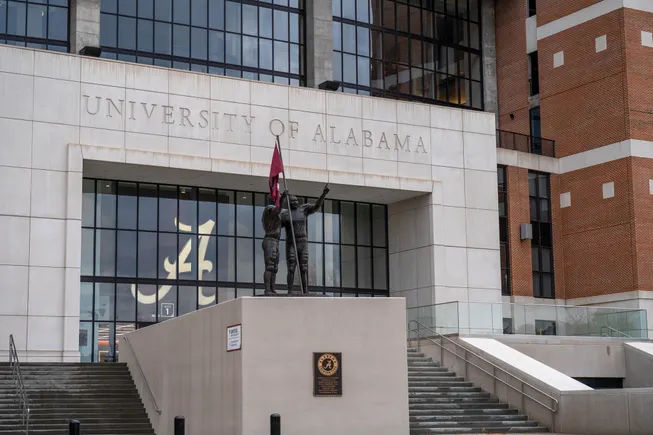
Ruling in part that professors lack First Amendment protections in the classroom, a federal judge denied an effort from college faculty and students in Alabama to block a 2024 state law that banned diversity, equity and inclusion programs as well as the teaching of so-called divisive concepts.
The plaintiffs, who include students from the University of Alabama at Birmingham and professors at the University of Alabama in Tuscaloosa, argued in court filings and at hearings that the legislation known as Senate Bill 129 amounted to state-sponsored censorship and infringed on their rights under the First and 14th Amendments. The professors alleged that they had to cancel class projects or events and faced other questions about their classroom conduct from administrators because of the law. They’ve also changed course material as a result.
R. David Proctor, chief judge in the U.S. District Court for the Northern District of Alabama, found that while the professors and the Alabama NAACP had standing to sue, they weren’t likely to succeed at this time. For instance, he ruled that the professors aren’t protected by the First Amendment because their “in-class instruction constitutes government speech.”
Furthermore, Proctor wrote, based on other rulings in the U.S. Court of Appeals for the 11th Circuit, “when there is a dispute about what is taught in the classroom, the university’s interests outweigh those of a professor, and the professor’s interest in academic freedom and free speech do not displace the university’s interest inside the classroom.”
The plaintiffs said Proctor’s ruling was disappointing.
“I feel incredibly dismayed that SB 129 is allowed to continue going into the new school year,” said Sydney Testman, one of the students who sued, in a statement. “As a senior at University of Alabama at Birmingham, I’ve seen firsthand how SB 129 has transformed my college campus for the worst. Voices have been silenced, opportunities have been revoked, and meaningful community engagement has faded. This decision undermines the need for students to properly feel a sense of belonging and inclusion on campus.”
This audio is auto-generated. Please let us know if you have feedback.
Dive Brief:
A federal judge declined to temporarily block the enforcement of a state law that bans public colleges from funding diversity, equity and inclusion programsand from compelling students to affirm certain “divisive concepts.”
Earlier this year, a group of students and faculty members sued the state’s governor and the University of Alabama’s trustees over the new law,arguing that it violates their free speech rights by placing viewpoint-based restrictions on what can be taught in the classroom. They also contended that the law undermines due process by being so ambiguous that instructors and students don’t know what is prohibited.
U.S. District Judge R. David Proctor— a George W. Bush appointee —pushed back on those arguments in his 146-page ruling Wednesday. Proctor denied their request for a preliminary injunction, writing that public colleges could reasonably control curricular contentand rejecting assertions that the law’s language is impermissibly vague.
Dive Insight:
Last year, Alabama Gov. Kay Ivey signed a law known asSB 129,which bans public colleges and K-12 schools from having DEI initiatives.It defined those efforts as programs, training or other events where attendance is based on “race, sex, gender identity, ethnicity, national origin, or sexual orientation.”
PEN America noted last yearthat while this language doesn’t outright ban all DEI initiatives, the attendance restrictions could bar public colleges from activities like creating programming specifically for international students or recognizing a Black student union.
The law also barred public colleges from requiring students to affirm or adhere to a list of so-called divisive concepts.
Under the law, one of the concepts is that individuals “are inherently responsible for actions committed in the past by other members of the same race, color, religion, sex, ethnicity, or national origin.”Another is that people are “inherently racist, sexist, or oppressive, whether consciously or subconsciously” based on their personal characteristics.
The law also contains carve-outs.It says that the language does not bar public colleges from teaching or discussing divisive concepts “in an objective manner and without endorsement as part of a larger course of academic instruction.”
According to court documents, faculty members who sued over the measure said that while they do not require students to affirm or adhere to these concepts, they worry that their instruction on race and gender could be viewed as running afoul of the law — even with the carve-outs for teaching.
“I do not know what it means to discuss a divisive concept ‘in an objective manner’ and ‘without endorsement,’” plaintiff Cassandra Simon, a social work professor at University of Alabama, said in court documents.“There is robust empirical evidence of implicit bias, white privilege, and the absence of a colorblind meritocracy. I am unable to determine whether continuing to present these scholarly findings, and assigning readings on these subjects, would violate SB 129.”
One of Simon’s class assignments — that students select a social issue of their choice and advocate for it — was abruptly canceled due to the law, according to court documents.
Her students chose to hold a sit-in to protest SB 129 for their project. The day of the sit-in, however, the social work dean told Simon to cancel the assignment in part over concerns that it would compel students to agree with one of the banned divisive concepts.
Another plaintiff raised concerns over teaching about topics such as structural racism, employment discrimination and health disparities by race. And another voiced concerns that the law potentially limits his ability to teach about eugenics.
However, Proctor wrote in his ruling that the law doesn’t prohibit the teaching of divisive concepts and pointed to the carve-outs provided.
The judge also cited an appeals court case that found a public college could “reasonably control the content of its curriculum, particularly that content imparted during class time.”
“There is no legal basis for concluding that the First Amendment protects a university professor’s academic freedom in the way the Professors suggest,” Proctor wrote.
Referring to the canceled sit-in, Proctor wrote that it was “a reasonable exercise of control over course curriculum to ensure that students would not feel coerced into advocating for a belief with which they disagreed.”
Proctor also dismissed Ivey as a defendant in the case, ruling that plaintiffs’ alleged injuries aren’t traceable to her.
The plaintiffs in the case slammed the decision on Thursday.
“SB129 created a culture of fear that has severely hindered the ability of professors to provide comprehensive instruction in our areas of expertise,” Dana Patton, a University of Alabama professor and plaintiff in the case, said in a statement.“The law infringes on our academic freedom and our duty to students to provide a truthful and comprehensive education.”
Alabama state Sen. Will Barfoot, the sponsor of the legislation, didn’t immediately respond to a request for comment.
The Department of Justice said Tuesday that George Washington University was “deliberately indifferent” toward Jewish students and faculty who said they faced antisemitic harassment and had violated federal civil rights law that bars discrimination based on race and national origin.
The four-page letter signals that George Washington could be the next university in the Trump administration’s crosshairs. The DOJ sent a similar letter to the University of California, Los Angeles, late last month, and then various federal agencies froze more than $500 million in federal grants at the university. Since then, the Trump administration has demanded $1 billion from the UC system to resolve the dispute—a move the state’s governor called “extortion.”
GW was one of 10 universities that a federal task force to combat antisemitism had planned to visit and investigate. That list included UCLA and Harvard and Columbia Universities, which also have been targeted by the Trump administration.
Harmeet Dhillon, the assistant attorney general for the civil rights division, wrote in the letter that the department plans to enforce its findings unless the university agrees to a voluntary resolution agreement to address the agency’s concerns. She didn’t detail what such an agreement would entail or what enforcement might look like.
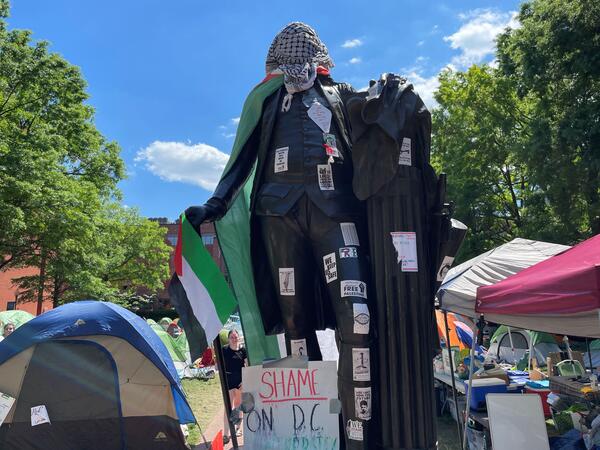
The department’s allegations largely center on how the university responded—or didn’t—to a spring 2024 encampment established to protest the war in Gaza. The university ultimately called in D.C. police to clear the demonstration after it persisted for nearly two weeks.
“The purpose of the agitators’ efforts was to frighten, intimidate, and deny Jewish, Israeli, and American-Israeli students free and unfettered access to GWU’s educational environment,” Dhillon wrote. “This is the definition of hostility and a ‘hostile environment.’”
She also wrote that university officials “took no meaningful action” in the face of at least eight complaints alleging that demonstrators at the encampment were discriminating against students because they were Jewish or Israeli.
George Washington spokesperson Shannon McClendon said in a statement that university officials were reviewing the letter.
“GW condemns antisemitism, which has absolutely no place on our campuses or in a civil and humane society,” McClendon said. “Moreover, our actions clearly demonstrate our commitment to addressing antisemitic actions and promoting an inclusive campus environment by upholding a safe, respectful, and accountable environment. We have taken appropriate action under university policy and the law to hold individuals or organizations accountable, including during the encampment, and we do not tolerate behavior that threatens our community or undermines meaningful dialogue.”
Conservative commentator Charlie Kirk recently made headlines by calling for a full military occupation of American cities following what he terms the “liberation” of Washington, D.C. Speaking on a national platform, Kirk advocated deploying U.S. military forces to urban centers such as Chicago, New York, Boston, Philadelphia, Portland, and San Francisco to restore order amid rising crime and social unrest. He emphasized that a sustained military presence was necessary until these cities were “safe,” drawing comparisons to the low-crime, tightly controlled environments of Tokyo and Singapore.
Kirk’s call is not merely rhetorical; it reflects a growing faction within right-wing politics that endorses the federalization of local law enforcement issues, invoking military force as a tool for domestic order. He also proposed federalizing Washington, D.C., with military oversight — a step he deems essential to restoring law and order in the nation’s capital.
This stance has sparked significant debate over the balance between public safety and civil liberties. Critics warn that deploying military forces in civilian settings risks authoritarian overreach and undermines democratic norms. Supporters, meanwhile, argue that urgent and decisive action is needed in cities they see as suffering from governance failures. The implications of such a military occupation extend beyond crime statistics to the very fabric of American democracy, raising concerns about militarization, racial justice, and the erosion of local governance.
Background on Charlie Kirk and Turning Point USA
Charlie Kirk is the founder and president of Turning Point USA (TPUSA), a conservative nonprofit organization established in 2012. Founded when Kirk was just 18, TPUSA has grown into a powerful network dedicated to promoting free markets, limited government, and conservative values among youth. Financially backed by donors including the late Foster Friess and Home Depot co-founder Bernie Marcus, TPUSA reported revenues exceeding $55 million in 2022.
The organization’s stated mission is to “identify, educate, train, and organize students to promote freedom.” However, its campus activities have drawn criticism for compiling “watchlists” targeting left-leaning faculty and spreading misinformation. The Higher Education Inquirer has closely documented TPUSA’s growth, spotlighting its alliances with conservative student chapters, the appearances of controversial figures on its platforms, and its alignment with Trump administration policies. Beyond campuses, TPUSA has expanded through initiatives like TPUSA Faith, TPUSA Live, and the AmericaFest conference series, which have featured speakers such as Donald Trump Jr., Candace Owens, Tucker Carlson, and Marjorie Taylor Greene.
Fox News and the Epstein Fallout: Kirk’s Rising Media Profile
Amid Fox News’ ongoing tensions with Rupert Murdoch’s Wall Street Journal over the Jeffrey Epstein investigative files, Charlie Kirk has been tapped to guest host Fox & Friends Weekend. His upcoming appearances on July 27–28, 2025, alongside Rachel Campos-Duffy and Charlie Hurt, signal a strategic move by Fox News to bolster its conservative youth appeal and MAGA alignment amid internal pressures.
This development follows the Wall Street Journal’s July 2025 investigative report detailing Donald Trump’s past ties with Jeffrey Epstein, including allegations about a hand-drawn birthday card sent to Epstein. Trump has vehemently denied the claims and sued the Journal and Rupert Murdoch for $10 billion, labeling the report defamatory. Fox News, however, has noticeably limited its coverage of the Epstein files and the lawsuit, unlike other right-leaning outlets such as Newsmax and Real America’s Voice.
Kirk has vocally attacked the Journal’s reporting, calling it “fake” and “a hit job” on Trump. He praised Trump’s lawsuit on his podcast and social media platforms, framing the allegations as baseless attempts to tarnish the former president’s reputation. Despite initial criticism of Attorney General Pam Bondi over a DOJ memo regarding the Epstein investigation, Kirk later shifted his position, urging trust in government officials — a reversal that drew attention to the strategic recalibrations within MAGA circles.
Institutional Expansion and Political Influence
TPUSA’s influence extends well beyond college campuses. Through Turning Point Academy, it reaches high schools, while TPUSA Faith engages religious communities. Its political arm, Turning Point Action, spent over $7 million in the 2022 midterms, reflecting significant investment in electoral politics. TPUSA’s 2023 annual report highlights its presence in more than 2,500 schools and training of over 12,000 student activists.
Kirk’s upcoming role on Fox News underscores the merging of youth-oriented conservative political branding with legacy cable television platforms. This integration comes as Fox News attempts to balance the demands of its MAGA base against legal and reputational challenges linked to its corporate ownership. Kirk’s rising profile represents the normalization and institutionalization of organizations like TPUSA within mainstream conservative media.
Charlie Kirk’s calls for military occupation of American cities, coupled with his increasing prominence within conservative media, highlight the evolving landscape of political influence, youth activism, and media power in the United States. As debates intensify over public safety, civil liberties, and the militarization of law enforcement, it is crucial to scrutinize the intersection of political ideology and institutional authority. The implications extend far beyond partisan disputes — touching the core of democratic governance and social cohesion in a deeply divided nation.
Sources:
Axios (July 2025): “Charlie Kirk to co-host Fox & Friends Weekend”
Wall Street Journal (July 2025): “Trump’s Epstein Birthday Card”
IRS Form 990 Filings (TPUSA 2021–2023)
Media Matters: “Fox News Epstein Coverage Analysis”
FEC.gov: Turning Point Action Political Expenditures
Rolling Stone, Puck News (July 2025): Trump’s calls to allies over Epstein story
TPUSA 2023 Annual Report
Higher Education Inquirer Archive (2016–2025): Reports on TPUSA campus activity
The University of Utah is cutting 81 offerings in response to state budget reductions and a new law.
Aaron M. Sprecher/Getty Images
The University of Utah plans to eliminate 81 academic programs and minors—a step that administrators attribute to a new state law that called for “strategic reinvestment” after lawmakers slashed funding to public colleges and universities.
The Republican-controlled Utah Legislature passed House Bill 265 this spring. Lawmakers cut 10 percent of institutions’ state-funded instructional budgets, but the law said they could earn back the money by cutting programs and positions and instead funding “strategic reinvestment.” Institutions’ reinvestment plans must be based on enrollment, completion rates, job placement, wages, program-level costs and local and statewide workforce demands.
Other Utah universities detailed their planned cuts in the spring, but this is the first glimpse at how the state’s flagship will respond to the new law.
The planned cuts at the University of Utah include Ph.D.s in chemical physics, physiology, experimental pathology and in theater; master’s degrees in ballet, modern dance, marketing, audiology and applied mechanics; bachelor’s degrees in chemistry teaching, Russian teaching and German teaching; certificates in public administration, veterans’ studies and computational bioimaging; various minors; and more.
Richard Preiss, president of the university’s Academic Senate, said his body’s Executive Committee reviewed the list of programs. He said that, except for one that the committee persuaded the administration to remove from the list, none had graduated more than one student in the past eight years, according to the university’s data. But a university spokesperson said that “some had zero or one, but some had up to a dozen students. Our threshold to identify inactive or low-enrollment courses was 15.”
Preiss said that while theselection process was accelerated, faculty had enough time to give meaningful input.
“These were relatively easy cuts to make and they were relatively painless,” Preiss said. “I anticipate that more painful ones are on the horizon.”
The U.S. Department of Justice alleged Tuesdaythat the University of California, Los Angelesviolated civil rights lawby failing to do enough to protect Jewish and Israeli students from harassment.
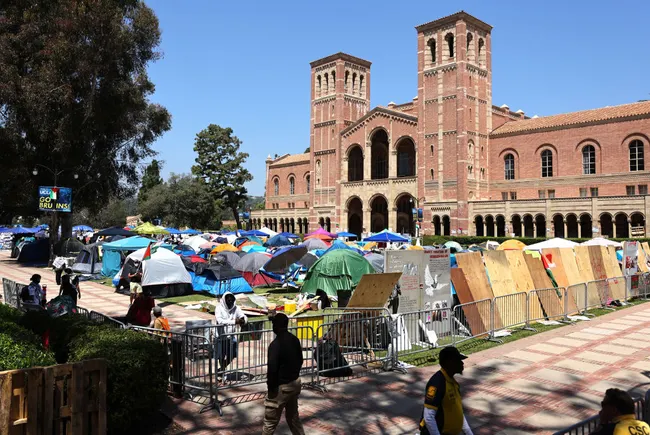
The findings stem from UCLA’s approach to a pro-Palestinian encampment that students erected on the university’s campus in the spring 2024 term.UCLA officials declined to disband the encampment for nearly a week, citing the need to balance free speech protections with student and employee safety.
In a letter to Michael Drake, president of the University of California system,Justice Department officials said they would seek to enter a voluntary resolution with UCLA to “ensure that the hostile environment is eliminated.”
Dive Insight:
The Justice Department is also investigating the entire University of California system over similar allegations. That systemwide probe found “concerning evidence of systemic anti-Semitism at UCLA that demands severe accountability,” U.S. Attorney General Pamela Bondi said in a Tuesday statement.
“DOJ will force UCLA to pay a heavy price for putting Jewish Americans at risk and continue our ongoing investigations into other campuses in the UC system,” Bondi said.
Justice Department officials gave UCLA leaders until Aug. 5 to reach out about entering a voluntary resolution. They threatened the university with a lawsuit by Sept. 2 if they don’t believe they can strike an agreement with the institution.
The Justice Department investigation focused on the pro-Palestinian encampment erected on UCLA’s campus on April 25, 2024. Encampment demonstrators demanded that the university divest from companies with ties to Israel’s military.
On the same day it was erected, a university spokesperson told the campus community that officials were monitoring the situation to balance the “right to free expression while minimizing disruption” to the institution’s teaching and learning mission.
However, several days into the protest, some demonstrators formed human blockades to prevent some people on campus from moving freely throughout Royce Quad, including students wearing a Star of David or those who refused to denounce Zionism, according to an internal report from a university task forcereleased last October.
The task force also found the encampment violated university rulesand that the blockades disparately impacted Jewish people.
The Justice Department’s letter to UCLA heavily cited the university’s own task force report,as well as 11 complaints the university received alleging that encampment protesters discriminated against them based on their race, religion or national origin.
“UCLA’s documentation established that it did not outright ignore these complaints; however, the University took no meaningful action to eliminate the hostile environment for Jewish and Israeli students caused by the encampment until it was disbanded,” the letter states.
Violence broke out at the site on the night of April 30, 2024, when counterprotesters attempted to dismantle the encampment’s barricade, The New York Times reported.
The counterprotesters attacked those within the encampment,including by launching fireworks into the encampment and hitting the pro-Palestinian protesters with sticks, according to the publication. Some of the pro-Palestinian protesters also fought back.
Police arrived hours later, though they did not immediately break up the violence. The next day, UCLA officials made the call to have police break up the encampment, resulting in over 200 arrests.
“In the end, the encampment on Royce Quad was both unlawful and a breach of policy,” then-UC Chancellor Gene Block said in a statement. “It led to unsafe conditions on our campus and it damaged our ability to carry out our mission. It needed to come to an end.”
In their letter, Justice Department officials criticized university leaders, alleging they knew that protesters were “engaging in non-expressive conduct unprotected by the First Amendment” and were denying“Jewish and Israeli students access to campus resources” days before they moved to disband the encampment.
UCLA did not immediately respond to a request for comment.
The Justice Department findings come the same day the university settled a lawsuit from Jewish students and a Jewish professor, who alleged their civil rights were violated because UCLA allowed protesters to block their campus access.
The agency’s letter mentioned the lawsuit’s filings, though it did not refer to the settlement.
As part of that agreement, UCLA agreed to pay about $6 million,with the funds going directly toward the plaintiffs and their legal fees, as well as to Jewish groups and a campus initiative to combat antisemitism.
Most law professors face a similar challenge when designing their courses: how to explain to students the enduring gap between what the law says and how it functions in reality. One of the foundational assumptions of legal education is that law is more than just the written rules found in statutes, bills, or constitutions. Without an understanding of how these rules influence a judge’s decision-making, they remain little more than pretty playthings: abstract ideas with no real-world impact. This realist approach in domestic legal education helps bridge the divide between legal theory and practice; the same arguments might apply in most disciplines and fields with a similar divide between theory and practice. If you can examine a rule and confidently predict how it will be applied, you are engaging in the most basic form of legal research. But consider a legal system without a centralised rule-making authority or a single, binding interpreter – no supreme legislature or final court to settle disputes definitively. This is the reality of international law. While there are many judicial and quasi-judicial bodies, there is no universal, mandatory forum for resolving disputes, and most conflicts never reach a formal judgment. Instead, states, international organizations, and individuals all contribute to shaping the rules by advocating for their preferred interpretations, hoping to sway the broader consensus. International lawyers refer to this evolving consensus as the ‘invisible college of international lawyers’, a term that captures the discipline’s informal, socially constructed boundaries. In essence, international law is what international lawyers do.
Teaching international law, then, comes with an added layer of complexity: the lack of formal structures undermines legal certainty. Every international lawyer, to some degree, can influence the field. Through journal articles, blog posts, social media debates, or legal practice, they argue for their version of the correct interpretation of a rule. Academics may even challenge established meanings, making persuasive cases that defy the literal text of foundational documents like the UN Charter.
Yet teaching international law does not require taking a stance on the theory-practice divide, because that divide is not inherent to the discipline. Law professors are not bound by the same rigid distinctions as, say, natural scientists, who must separate theoretical models from empirical observation. Instead, legal education can bypass this dichotomy entirely by focusing on the deeper conditions that shape how we understand both theory and practice. Rather than treating practice as a constraint on theory, students can learn to apply theoretical insights pragmatically. This approach allows law schools to teach practical skills without forcing an artificial separation between legal thought and legal action, following larger trends in pedagogical training outside legal academia.
Still, many international law professors struggle with curriculum design because of these perceived divides. On one hand, students must master a baseline of doctrinal knowledge to enter legal practice. On the other, mere knowledge acquisition is not enough – students must also develop the ability to analyse, synthesise, and critically evaluate legal arguments. A well-rounded legal education should cultivate these higher-order skills, enabling students to engage in meta-cognitive reflection about the law they are learning.
Moreover, there is no strong evidence that ‘thinking like a lawyer’ is a unique cognitive skill. Legal reasoning shares much with other forms of reasoning, meaning that better teaching methods alone will not necessarily produce better lawyers. Instead, what matters is equipping students with evaluative tools to interpret and refine legal arguments. By treating core legal knowledge as a foundation rather than a rigid boundary, and critical thinking as a method for engaging with that knowledge, the supposed divide between mainstream and critical approaches begins to fade.
The same logic applies to the theory-practice debate. The tension between these approaches persists only if we assume they are mutually exclusive. Law schools often face criticism from practitioners who argue that graduates lack practical skills, while academics defend the importance of theoretical training. But must these roles be in conflict?
Perhaps the real issue in international law is not the existence of these divides, but our insistence on treating them as inevitable. If there is little evidence that ‘thinking like a lawyer’ is a distinct cognitive skill, there is even less reason to impose it as a rigid framework for international legal education. Instead, we might focus on cultivating adaptable, reflective practitioners who can navigate both theory and practice – not as opposing forces, but as complementary dimensions of the same discipline. This is a lesson relevant for many if not all professional disciplines.
Sebastian Machado Ramírez is Postdoctoral Researcher at the University of Helsinki, where he works on the PRIVIGO project examining private governance and international law. He holds a PhD from the University of Melbourne, where his dissertation analyzed interpretive approaches in the law governing the use of force.
Paolo Amorosa is University Lecturer in International Law at the University of Helsinki. He holds a PhD from the same institution and specializes in the history and theory of international law and human rights. His monograph Rewriting the History of the Law of Nations (OUP 2019) critically re-examines the ideological foundations of international law’s canon.
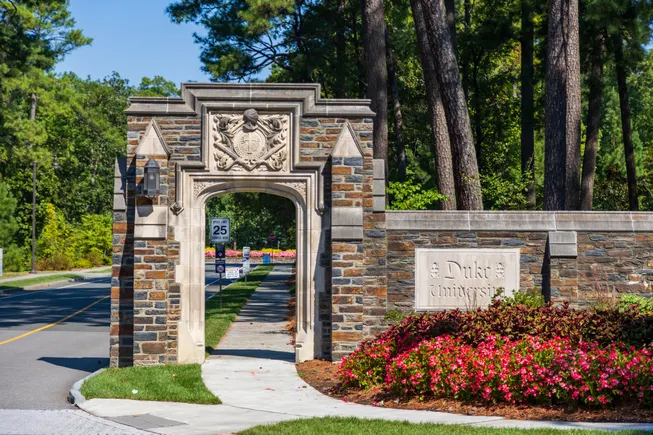
The U.S. Department of Educationannounced Monday that it has opened a civil rights investigationinto Duke University and its law journal, based on allegations that the institution racially discriminates to select the publication’s editors.
Separately, the Education Department and the U.S. Department of Health and Human Services also sent a letter Monday to university officials saying they’re reviewing allegations that Duke’s medical school and Duke Health racially discriminate in their hiring, admissions, financial aid and recruitment practices.
The probes come less than a week after U.S. Education Secretary Linda McMahon said officials hoped that Columbia University’s $221 million settlement with the federal government would be a “template for other universities around the country.”
Dive Insight:
Like with the federal government’s previous Columbia probes, the Education Department has opened an investigation into Duke University to determine whether it has violated Title VI, which prohibits federally funded institutions from discriminating based on race, color or national origin.
The department said its probe is based on recent reporting that Duke Law Journal racially discriminates against students applying to be editors. It comes one month after The Washington Free Beacon,a conservative publication, alleged that Duke Law Journal potentially gave students applying to be editors an edge if they held leadership positions in affinity groups or if they explained how their “membership in an underrepresented group” would help them promote diverse voices.
Duke Law Journal shared this information only with the law school’s affinity groups, according to the Beacon.
The letter from HHS and the Education Department doesn’t provide the source of the allegations of racial discrimination against Duke’s medical school and Duke Health.However, it says Duke Health would be “unfit for any further financial relationship with the federal government” if the federal government determines they are true.
In their letter, officials suggested they want to cut a deal with the university.
“Our Departments have historically recognized Duke’s commitment to medical excellence and would prefer to partner with Duke to uncover and repair these problems, rather than terminate this relationship,” McMahon and HHS Secretary Robert F. Kennedy Jr. wrote.
The two Cabinet secretaries demanded that the university review and reform policies at Duke Health to ensure they don’t include illegal racial preferences, including by making “necessary organizational, leadership, and personnel changes.”
They also asked Duke to establish a Merit and Civil Rights Committee, which would be delegated authority from the university’s board, to conduct the review.
“The Committee must be made up of those members of Duke’s leadership and medical faculty most distinguished in and devoted to genuine excellence in the field of medicine, and the members chosen must satisfy the federal government as to their competence and good faith,” McMahon and Kennedy said in their letter.
McMahon and Kennedy threatened Duke with enforcement actions if the federal government and the Merit and Civil Rights Committee reach an impasse — or if they don’t change the “alleged offending policies” within six months.
Following Columbia’s controversial agreement with the federal government — which also included vast policy changes — law and free speech scholars warned that the Trump administration may attempt to increase their pressure campaigns against other universities to cut deals.
“The Trump administration has made clear that while Columbia is first in line, it intends to reach comparable agreements with other schools — to scale the Columbia shakedown into a broader model of managing universities deemed too woke,”David Pozen, a Columbia law professor, wrote in a blog post. “As has already occurred with law firms, tariffs, and trade policy, regulation by deal is coming to higher education.
The prompt is one of 10 options for a supplemental essay.
Photo illustration by Justin Morrison/Inside Higher Ed | Gazanfer and InspirationGP/iStock/Getty Images
In 2023, the University of Michigan Law School made headlines for its policy banning applicants from using generative AI to write their admissions essays.
Now, two admissions cycles later, the law school is not only allowing AI responses but actually mandating the use of AI—at least for one optional essay.
For those applying this fall, the law school added a supplemental essay prompt that asks students about their AI usage and how they see that changing in law school—and requires them to use AI to develop their response. (Applicants may write up to two supplemental essays, selected from 10 prompt options in total.)
“TO BE ANSWERED USING GENERATIVE AI: How much do you use generative AI tools such as ChatGPT right now? What’s your prediction for how much you will use them by the time you graduate from law school? Why?” the prompt asks.
Sarah Zearfoss, senior assistant dean at the University of Michigan Law School, said she was inspired to include such a question after hearing frequent anecdotes over the past year about law firms using AI to craft emails or short motions.
Indeed, in a survey released by the American Bar Association earlier this year, 30 percent of all law firms reported that they use AI tools; among law firms with over 100 employees, the share is 46 percent.
But many have been derailed by the same well-documented hallucinations that have plagued other AI users. Judges havesanctionednumerouslawyers over the past several years because their use of AI resulted in filings riddled with imaginary cases and quotations. That makes it all the more important to evaluate whether prospective students are able to use AI tools responsibly and effectively, the law school believes.
“That is now a skill that … probably not all legal employers, but big law firms, are looking for in their incoming associates,” Zearfoss said in an interview. “So I thought it would be interesting: If we have applicants who have that skill, let’s give them an opportunity to demonstrate it.”
Michigan Law still disallows applicants from using AI writing tools when they compose their personal statements and for all other supplemental essay questions, which Zearfoss hopes will allow her to compare applicants’ writing with AI’s assistance to their writing without it.
Is AI Inevitable for Lawyers?
Frances M. Green, an attorney with Epstein Becker & Green, P.C., who specializes in AI, told Inside Higher Ed that she believes the ability to use and engage with AI will eventually become a required skill for all lawyers. That doesn’t mean just using it to write court filings but also understanding how to manage the use of AI-generated evidence—say, the notes of a physician who uses AI technology to listen to and summarize appointments, rather than old-fashioned, handwritten doctors’ notes.
“I believe lawyers who use AI will replace lawyers who don’t,” she said. “I think that is very, very true. And judges even, in some jurisdictions, are encouraging the use of artificial intelligence tools.”
Even so, Green noted that she doesn’t really like how Michigan’s question is phrased, because applicants may be inclined to over- or understate how much they use AI based on what they think the admissions officer is looking for.
But Melanie Dusseau, an English professor at the University of Findlay in Ohio and a critic of AI, questioned the prompts’ utility in actually evaluating if a student is well-suited for law school.
“A law school application is a showcase of a student’s language abilities, their passion for lively rhetoric, logic, and captivating narrative. Do reviewers want to know how well future lawyers can prompt a bot [to] turn its beige copyslop into something compelling, or how well they can write? And which would be more important in a law school application?” she wrote in an email. “Since LLMs are fawning sycophants, at least tonally, I would imagine that future lawyers would do better to polish their persuasive writing chops without automation.”
Zearfoss is not a prolific AI user herself; once she decided she wanted to include an essay option related to AI, she recruited the help of another Michigan Law professor, Patrick Barry, who teaches a course on lawyering in the age of AI, to help compose the question itself.
She expects the essays will reveal uses of and perspectives on AI that she never would have been exposed to otherwise.
“I’m always excited when an essay teaches me something, but I don’t really expect that—it’s sort of a bonus, right?” she said. “But I think with this particular prompt, I assume a high percentage of the essays will be teaching me something.”
A group of Texas law school deans is urging the state Supreme Court to uphold American Bar Association accreditation standards for public law schools. The state’s highest court announced in April that it was considering dropping the ABA requirement for licensure, opening a public comment period on the matter that closed July 1.
“We strongly support continued reliance on ABA accreditation for Texas law schools and licensure eligibility,” the deans of eight of the state’s 10 ABA-accredited law schools wrote in a letter to the Texas Supreme Court. “ABA accreditation provides a nationally recognized framework for quality assurance and transparency; portability of licensure through recognition of ABA accreditation by all 50 states, which is critical for graduates’ career flexibility; consumer protections and public accountability through disclosure standards; and a baseline of educational quality that correlates with higher bar passage rates and better employment outcomes.”
Though the Texas justices did not say why they were reviewing ABA accreditation, the law deans’ letter noted that the body has already suspended its DEI standards—a move it announced in February and then extended in May through Aug. 31, 2026. That means “the language of the Standard can be revised in accordance with federal constitutional law and Texas state law that bar certain diversity, equity and inclusion practices at state universities,” the deans wrote.
Of the state’s ABA-accredited law schools’ deans, only Robert Chesney of the University of Texas and Robert Ahdieh of Texas A&M didn’t sign the letter, Reuters reported.
In his own nine-page letter to the state Supreme Court, Chesney urged the justices to look at “alternative” pathways for ensuring law school standards “to help pave the way for innovative, lower-cost approaches to legal education.”
Ahdieh told Reuters that whatever the court decides about ABA accreditation, it’s “critical” that law degrees earned in Texas remain portable.