BOSTON — Ignite Reading — a Science of Reading-based virtual tutoring program serving students in 18 states nationwide — today announced its approval by the Massachusetts Department of Elementary and Secondary Education (DESE) to continue providing 1:1 high-dosage evidence-based literacy tutoring to K-3 students across the commonwealth.
Massachusetts Governor Maura Healey’s administration called on her state to invest heavily in high-dosage tutoring (HDT) earlier this year, earmarking $25 million in her state budget proposal to help accelerate literacy growth, “complementing the more systemic, long-term improvement work” being supported under the administration’s five-year literacy improvement campaign, Literacy Launch.
In its approval process, DESE evaluated Ignite Reading’s services to Massachusetts districts over the past three school years and approved the literacy company to again provide school districts and charter schools with tutoring that is focused on building foundational skills — including phonological awareness, phonics knowledge and decoding skills — to help students become independent fluent readers in the early grades.
Since Ignite Reading first gained DESE approval during the 2022-23 school year:
30 Massachusetts schools and districts have partnered with Ignite Reading to provide students with 15 minutes of daily, 1:1 virtual tutoring.
Ignite Reading’s tutor educators have delivered differentiated, evidence-based early literacy instruction to more than 7,800 Massachusetts students.
Researchers at Johns Hopkins University’s Center for Research and Reform in Education have followed approximately 2,000 Massachusetts 1st graders enrolled in the program. The quasi-experimental study found the number of students reading on benchmark increased 213% after a year of Ignite Reading tutoring. At the same time, the percentage of students who required intensive reading intervention decreased 55%. All student groups — including Black and Hispanic students, those with IEPs and Multilingual Learners — had equitable skills growth, and those meeting end-of-year reading benchmarks grew more than 125%.
The Healey-Driscoll Administration recently announced that schools and districts in Massachusetts are invited to apply for high-dosage early literacy tutoring for K-3 students with 1st grade as the state’s top priority.
“When we get kids reading proficiently by the end of 1st grade, we set them up for a lifetime of academic success,” said Ignite Reading CEO Jessica Sliwerski. “Our continued approval by DESE means we can keep delivering the intensive, personalized support that Massachusetts 1st graders need to learn to read on grade level and on time. We are honored to be able to continue to partner with Massachusetts districts to ensure all students can access the tools they need to succeed as readers.”
Ignite Reading is on a mission to ensure every student can access the tools they need to be a confident, fluent reader by the end of 1st grade. School districts nationwide depend on Ignite Reading’s virtual tutoring program to deliver literacy support at scale for students who need help learning to read. Our highly trained tutors provide students with 1:1 tutoring in foundational literacy skills each school day, helping them go from learning to read to reading to learn.
A recent study by the Center for Research and Reform in Education at Johns Hopkins University found that Ignite Reading students across demographics — including students who are English Learners, Black, Hispanic, and those with Individualized Education Programs (IEPs) — achieve the same outstanding gains of more than 5 months of additional learning during a single school year. For more information about Ignite Reading, visit www.ignite-reading.com.
eSchool Media staff cover education technology in all its aspects–from legislation and litigation, to best practices, to lessons learned and new products. First published in March of 1998 as a monthly print and digital newspaper, eSchool Media provides the news and information necessary to help K-20 decision-makers successfully use technology and innovation to transform schools and colleges and achieve their educational goals.
Students often consider the return on investment of their degree when deciding whether and where to enroll in college, but not every student receives financial education from their institution on how to turn a college education into a life-sustaining career. A 2022 survey by Inside Higher Ed found that 67 percent of students are not sure if their college or university offers personal financial education; an additional 9 percent said no programs or classes are offered regarding financial literacy.
To rectify that, colleges and universities are implementing programs that promote students’ money management skills, increase their awareness of financial planning and help them understand the debts they may acquire while in school.
What’s the need: Student debt has skyrocketed over the past 20 years, with 42.7 million student borrowers holding nearly $1.7 trillion in federal loans. The average student who takes out loans to attend a public university borrows $31,960 to attain a bachelor’s degree, and over half of graduates use federal loans at some point. Loan debt can limit students’ earnings after college and hinder their socioeconomic advancement.
Even while students are in college, financial challenges can impact their persistence and outcomes. A 2024 survey by Trellis Research found that 71 percent of students experienced financial trouble while enrolled, and nearly half said their current financial situation made it difficult to concentrate on schoolwork.
A lack of financial education can also exacerbate equity concerns. An April 2025 report from Education Northwest found that only 25 percent of students were able to answer three financial questions correctly, with students from low-income families and those younger than 21 even less likely to answer correctly. Similarly, Black, American Indian or Alaska Native, Hispanic or Latino, and Native Hawaiian or Pacific Islander students were less likely to answer financial literacy questions correctly.
Inside Higher Ed highlights six institutions that have introduced innovative programs to combat financial illiteracy.
Florida State University: Unconquered by Debt
Housed within the university’s Gus. A Stavros Center for Advancement of Free Enterprise and Economic Education, FSU’s Unconquered by Debt program enhances student financial literacy to ensure graduates leave with the ability to advance their socioeconomic standing.
The program walks students through crucial areas of financial planning including selecting a career, establishing healthy spending habits, investing, managing credit, ensuring assets and planning for retirement.
Students can attend workshops on campus and enjoy free food and drinks while they learn more about money management and how to plan for their futures beyond college.
The center recently hired an assistant director as part of a program expansion funded by the Office of the Provost.
University of Miami: Money Management
In 2019, the University of Miami created the Money Management Program to help build students’ short- and long-term financial well-being. The program has proven so successful in increasing student persistence that it has also received external grant funding, a university spokesperson said.
Through workshops called Money Talks, the program addresses budgeting, credit and credit cards, loans, and debt repayment, as well as saving and investing. Students can also participate in half-day personal finance workshops on Saturdays throughout the academic year. The university hires peer coaches to provide confidential one-on-one coaching, to help prepare students for future careers in the finance world as well as bridge knowledge gaps for those who may need support.
During the 2022–23 academic year, the university hosted over 240 Money Management events for more than 2,500 attendees, according to the spokesperson.
East Carolina University: Financial Wellness Hub
The Financial Wellness Hub at East Carolina University offers regular workshops on how to mitigate financial challenges while enrolled and helps students understand credit reports, debt management and student loan repayment strategies. The Hub caters services to various seasonal holidays, hosting a “Falling in Love With Credit” workshop for Valentine’s Day and “Spooky Credit Scores” for Halloween, as well as a budgeting workshop for gift giving during the winter holiday season.
The Hub relies on relationship building and partnerships across the university to generate an audience for programs, director Kevin Sutton told Inside Higher Ed. Services are also available to alumni and staff, who in turn can better advise students or elect to contribute financially to the program’s budget.
Penn State: Sokolov-Miller Family Financial and Life Skills Center
Penn State established a center dedicated to managing financial wellness in college and beyond, which offers one-on-one coaching and workshops. In addition, the center provides students with access to a course on Canvas called MoneyCounts, which gives them a self-paced opportunity to engage in 28 modules on financial wellness.
Other resources include live webinars, offered on the first and third Tuesday of each month at noon, which are recorded for those who can’t make it synchronously, and a free bookshelf stocked with financial wellness books— topics range from simple money skills to insurance—that is supported by Barnes & Noble.
Babson College: The Babson Financial Literacy Project
In addition to supporting current students, the BFLP is a nonprofit organization the ensures all community members can receive quality financial education. The program was developed by faculty at Babson and coaches lead online and in-person workshops, as well as train staff to deliver content on their own.
Between its launch in fall 2018 and March of this year, the program has supported 418 workshops with 17,189 participants, according to the program webpage.
In addition, participants can engage with various student organizations on campus to learn more about the world of finance, including the Babson Finance Association, Babson Scholars of Finance and Women in Finance.
Western Washington University: Financial Wellness Badges
Students can earn badges in such areas as financial mindfulness, investment, savings and credit, as well as budgeting and spending.
To earn the financial mindfulness starter badge, for example, students must complete a financial wellness checkup and a money meditation on iGrad, then write a financial wellness journal entry. Each badge has three levels, from foundations to expert, building on students’ knowledge and signaling deep understanding of the topic.
If your student success program has a unique feature or twist, we’d like to know about it. Click here to submit.
Through this work, and in collaboration with international partners, we have identified what genuinely supports inclusion and what simply pays lip service to it. While AI is often heralded as a tool for levelling the educational playing field, our research shows that without intentional support structures and inclusive design, it can reinforce and even widen existing disparities.
Supporting mature students’ AI literacy is, therefore, not just a pedagogical responsibility; it is an ethical imperative. It intersects with wider goals of equity, social justice, and sustainable digital inclusion. If higher education is to fulfil its mission in an age of intelligent technologies, it must ensure that no learner is left behind, especially those whose voices have long been marginalised.
Why Mature Students Matter in the AI Conversation
Mature students are one of the fastest-growing and most diverse populations in higher education. They bring a wealth of life and work experience, resilience, and motivation. Yet, they are often excluded from AI-related initiatives that presume a level of digital fluency not all possess. However, they are often left out of AI-related initiatives, which too frequently assume a baseline level of digital fluency that many do not possess. Media portrayals tend to depict older learners as technologically resistant or digitally inept, reinforcing deficit narratives that erode confidence, undermine self-efficacy, and reduce participation.
As a result, mature students face a dual barrier: the second-order digital divide—inequity in digital skills rather than access—and the social stigma of digital incompetence. Both obstruct their academic progress and diminish their employability in a rapidly evolving, AI-driven labour market.
Principles that Support Mature Learners
The QAA-funded project, developed in partnership with five universities across the UK and Europe, embedded AI literacy through three key principles—each critical for mature learners:
Accessibility
Learning activities were designed for varying levels of digital experience. Resources were provided in multiple formats (text, video, audio), and sessions used plain language and culturally inclusive examples. Mature students often benefited from slower-paced, repeatable guidance and multilingual scaffolding.
Collaboration
Peer mentoring was a powerful tool for mature students, who often expressed apprehension toward younger, digitally native peers. By fostering intergenerational support networks and collaborative projects, we helped reduce isolation and build mutual respect.
Personalised Learning
Mature students frequently cited the need for AI integration that respected their goals, schedules, and learning styles. Our approach allowed learners to set their own pace, choose relevant tools, and receive tailored feedback, building ownership and confidence in their digital journeys.
Inclusive AI Strategies That Work – Based on What Mature Learners Told Us
Here are four practical strategies that emerged from our multi-site studies and international collaborations:
1. Start with Purpose: Show AI’s Relevance to Career and Life
Mature learners engage best when AI tools solve problems that matter to them. In our QAA project, students used ChatGPT to refine job applications, generate reflective statements, and translate workplace policies into plain English. These tools became career companions—not just academic add-ons.
‘When I saw what it could do for my CV, I felt I could finally compete again,’ shared a 58-year-old participant.
2. Design Age-Safe Learning Spaces
Many mature students fear embarrassment in digital settings. We created small, trust-based peer groups, offered print-friendly guides, and used asynchronous recordings to accommodate different learning paces. These scaffolds helped dismantle the shame often attached to asking for help.
3. Make Reflection Central to AI Literacy
AI use can be empowering or alienating. We asked students to record short video reflections on how AI shaped their thinking. This helped them develop critical awareness of what the tool does, how it aligns with academic integrity, and what learning still needs to happen beyond automation.
4. Use Media Critique to Break Stereotypes
Drawing on my research into late-life workers and digital media, we used ageist headlines, adverts, and memes as classroom material. Mature learners engaged critically with how society depicts them, transforming deficit narratives into dialogue, and boosting confidence through awareness.
How We Measured Impact (and Why It Mattered)
We evaluated these strategies using mixed methods informed by both academic and lived-experience perspectives:
Self-reflective journals and confidence scales tracked growth in AI confidence and self-efficacy
Survey data from mature students (aged 55+) in the UK and Albania (from my older learners study) revealed the key role of peer support, professional experience, and family encouragement in shaping digital resilience
Narrative mapping, developed with COST DigiNet partners, was used to document shifts in learners’ digital identity—from anxious adopter to confident contributor
Follow-up interviews three months post-intervention showed sustained engagement with AI tools in personal and professional contexts (e.g., CPD portfolios, policy briefs)
Policy and Practice: Repositioning Mature Learners in AI Strategy
As highlighted in our Tirana Policy Workshop (2024), national and institutional policy often fails to differentiate between age-based needs when deploying AI in education. Mature students frequently face a “second-order digital divide,” not just in access, but in relevance, scaffolding, and self-belief.
If UK higher education is serious about digital equity, it must:
Recognise mature learners as a distinct group in AI strategy and training
Fund co-designed AI literacy programmes that reflect lived experience
Embed inclusive, intergenerational pedagogy in curriculum development
Disrupt media and policy narratives that equate older age with technological incompetence
Conclusion: Inclusion in AI Isn’t Optional – It’s Foundational
Mature learners are not a marginal group to be retrofitted into digital learning. They are core to what a sustainable, equitable, and ethical higher education system should look like in an AI-driven future. Designing for them is not just good inclusion practice—it’s sound educational leadership. If we want AI to serve all learners, we must design with all learners in mind, from the very start.
Many school districts have adopted an evidence-based literacy curriculum called the “science of reading” that features phonics as a critical component.
Phonics strategies begin by teaching children to recognize letters and make their corresponding sounds. Then they advance to manipulating and blending first-letter sounds to read and write simple, consonant-vowel-consonant words – such as combining “b” or “c” with “-at” to make “bat” and “cat.” Eventually, students learn to merge more complex word families and to read them in short stories to improve fluency and comprehension.
In practice, Louisiana used a variety of science of reading approaches beyond phonics. That’s because different students have different learning needs, for a variety of reasons.
Yet as a scholar of reading and language who has studied literacy in diverse student populations, I see many schools across the U.S. placing a heavy emphasis on the phonics components of the science of reading.
If schools want across-the-board gains in reading achievement, using one reading curriculum to teach every child isn’t the best way. Teachers need the flexibility and autonomy to use various, developmentally appropriate literacy strategies as needed.
This was the case with my own child. He had been a proficient reader from an early age, but struggles emerged when his school adopted a phonics program to balance out its regular curriculum, a flexible literature-based curriculum called Daily 5 that prioritizes reading fluency and comprehension.
I worked with his first grade teacher to mitigate these challenges. But I realized that his real reading proficiency would likely not have been detected if the school had taught almost exclusively phonics-based reading lessons.
Another weakness of phonics, in my experience, is that it teaches reading in a way that is disconnected from authentic reading experiences. Phonics often directs children to identify short vowel sounds in word lists, rather than encounter them in colorful stories. Evidence shows that exposing children to fun, interesting literature promotes deep comprehension.
Balanced literacy prompts children to learn words encountered in authentic literature during guided, teacher-led read-alouds – versus learning how to decode words in word lists. Teachers use multiple strategies to promote reading acquisition, such as blending the letter sounds in words to support “decoding” while reading.
Another balanced literacy strategy that teachers can apply in phonics-based strategies while reading aloud is called “rhyming word recognition.” The rhyming word strategy is especially effective with stories whose rhymes contribute to the deeper meaning of the story, such as Marc Brown’s “Arthur in a Pickle.”
The rhyming structure of ‘Arthur in a Pickle’ helps children learn to read entire words, versus word parts.
After reading, teachers may have learners arrange letter cards to form words, then tap the letter cards while saying and blending each sound to form the word. Similar phonics strategies include tracing and writing letters to form words that were encountered during reading.
There is no one right way to teach literacy in a developmentally appropriate, balanced literacy framework. There are as many ways as there are students.
What a truly balanced curriculum looks like
The push for the phonics-based component of the science of reading is a response to the discrediting of the Lucy Calkins Reading Project, a balanced literacy approach that uses what’s called “cueing” to teach young readers. Teachers “cue” students to recognize words with corresponding pictures and promote guessing unfamiliar words while reading based on context clues.
A 2024 class action lawsuit filed by Massachusetts families claimed that this faulty curriculum and another cueing-based approach called Fountas & Pinnell had failed readers for four decades, in part because they neglect scientifically backed phonics instruction.
The intention here is for learners to acquire words in the context of engaging literature. But critics of Calkins contend that “cueing” during reading is a guessing game. They say readers are not learning the fundamentals necessary to identify sounds and word families on their way to decoding entire words and sentences.
Here are five evidence-based tips to promote reading for all readers that combine phonics, balanced literacy and other methods.
1. Maintain the home-school connection. When schools send kids home with developmentally appropriate books and strategies, it encourages parents to practice reading at home with their kids and develop their oral reading fluency. Ideally, reading materials include features that support a diversity of learning strategies, including text, pictures with corresponding words and predictable language.
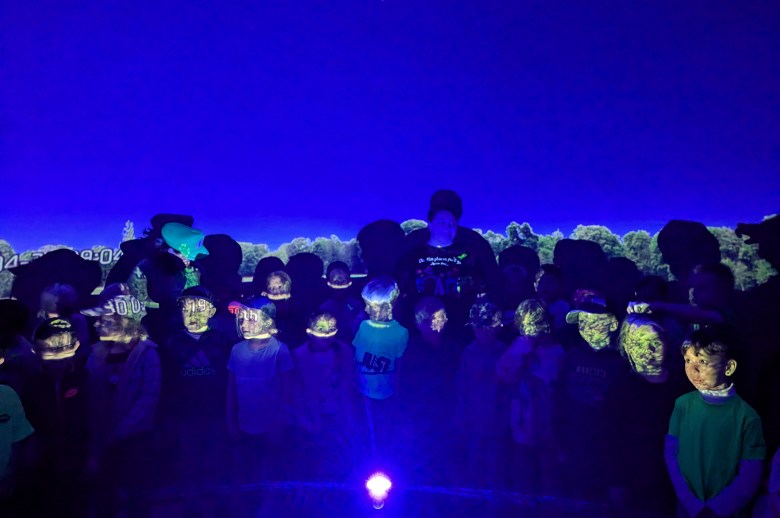
The kindergartners of South Dakota’s Hamlin County are, in fact, in space. To be specific, they are on planet Earth, near the geographic center of North America, sitting crisscross applesauce inside an 11-foot-high inflatable planetarium set up in their school gym.
The darkness is velvety. Childish whispers skitter around the dome like mice. The kids are returning from a short mission to Jupiter, piloted by Kristine Heinen, a young museum educator with a ponytail who knows how to make her voice BIG AND EXCITED and then inviting and quiet to hold little ones’ attention.
“Now we’re over China!” Heinen says.
“My friend went to China!” a girl calls out.
“The other side is nighttime and this side’s bright,” expounds a boy with a crew cut. “The sun shines here so it can’t shine over there.“
The school is in eastern South Dakota, 34 miles northeast of the settlement where Laura Ingalls Wilder grew up and attended a one-room schoolhouse. The sprawling Hamlin Education Center is a modern-day analogue, serving an entire district in one building, with just under 900 students, pre-K through 12. Notable graduates include U.S. Homeland Security Secretary Kristi Noem, the former governor of South Dakota.
The center is roughly equidistant from four tiny towns, surrounded by open fields where cornstalks shine in the sun; 95 percent of students arrive by bus, from up to 20 miles away. Over a third of them qualify for free or reduced-price lunch, said Dustin Blaha, the elementary school’s principal.
Hamlin Elementary students line up for their turn visiting a traveling planetarium sponsored by the South Dakota Discovery Center. Credit: Anya Kamenetz for The Hechinger Report
During the planetarium’s daylong visit to the small community of Hayti, S.D., an educator from the South Dakota Discovery Center wowed 500 elementary school students with a presentation about the planets and stars. Credit: Anya Kamenetz for The Hechinger Report
Many Hamlin Elementary haven’t had a chance to visit the South Dakota Discovery Center in Pierre three hours away, so the museum brings traveling exhibits like a portable planetarium to them. Credit: Anya Kamenetz for The Hechinger Report
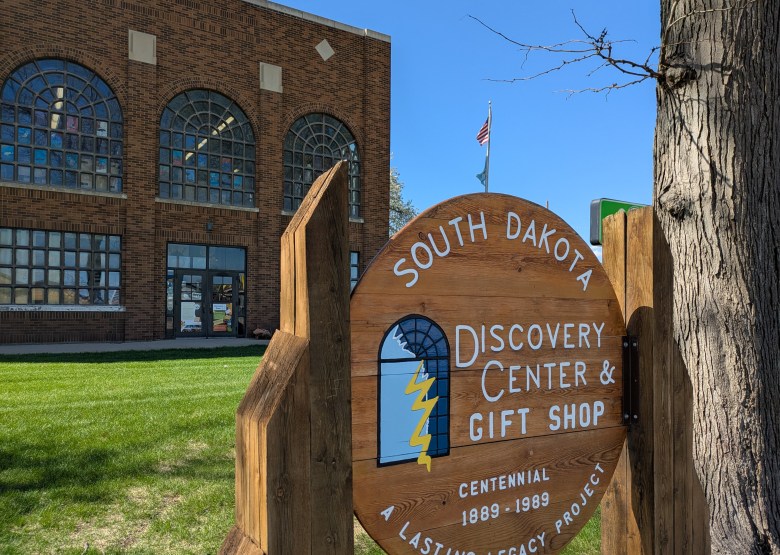
Blaha said that most of these children have never been to the South Dakota Discovery Center, a hands-on science museum three hours west in the state capital. But thanks to a federal agency called the Institute of Museum and Library Services, a part of the museum can come to them.
The IMLS was established in 1996, combining previously separate programs. The small agency became the largest source of federal funding for museums and libraries, last year awarding $266.7 million in program grants, research and policy development across all 50 states. IMLS awarded the South Dakota Discovery Center about $45,000 in 2023 to upgrade this traveling planetarium.
But students around the state may be waiting a long time for the next upgrade.
Related: Young children have unique needs and providing the right care can be a challenge. Our free early childhood education newsletter tracks the issues.
President Donald Trump signed an executive order in mid-March calling for the agency to be “eliminated to the maximum extent consistent with applicable law.” Mass firings followed.
On May 1, the U.S. District Court in Washington, D.C., issued a temporary restraining order to block the agency’s dismantling, followed on May 6 by a second federal judge finding the dismantling of this and two other agencies unconstitutional. On May 20, the American Library Association reported that employees are returning to work and some grants have been restored.
But the administration is continuing its legal battle to all but shutter the IMLS. The latest post on the agency’s Instagram account is captioned, “The era of using your taxpayer dollars to fund DEI grants is OVER,” holding up for criticism grants that were aimed at addressing systemic racism in museums, equitable library practices, and diverse staff development. The IMLS and the Department of Government Efficiency did not respond to requests for comment.
A veteran of the agency who asked to remain anonymous because of fear of reprisal said they first saw DOGE staffers meeting with leadership on March 28. “On the 31st, we were put on administrative leave. We had about two hours to turn in your key cards, your ID, get everything off your laptop you’re ever going to need. We were locked out of our computer systems by 3:30 and told to get out of the building.” A skeleton crew was hastily rehired the next day.
The ex-staffer points out that the Institute of Museum and Library Services spends, or spent, just 7 percent of its budget on its 70 staff, passing the rest along as grants. “We are not a bloated agency.” They have two kids at home, one with special needs and are married to another federal employee whose job is also at risk; but they are almost as worried about their grantees as themselves.
“After 20 years, I didn’t even get to put an out-of-office response up. Is someone emailing me right now and getting nothing, because all of a sudden their grant just ended? I hate that,” the former IMLS employee said.
Almost all grants awarded required a one-to-one cost share out of the local institution’s budget, the staffer said. Plus, typically the grantees pay for activities first and then apply to get reimbursed. “We’re leaving these often small rural museums and libraries on the hook.”
Anne Lewis, executive director of the South Dakota Discovery Center, said that organizations like hers would be “wobbly” without federal funding and would have to scale back on ambitious programs like the planetarium upgrade.
“The new system has much better interaction and control,” said Heinen, the museum educator. An earlier version had a static point of view, but upgraded visual effects means that “now we have spaceship mode,” she said. “We can travel to destinations including planets, and go in a full 360-degree mode around galaxies.”
With a flick of the touchscreen menu, she can also display the constellations of a dozen different cultures including Lakota, a significant benefit especially when she visits tribal schools.
The South Dakota Discovery Center, based in Pierre, has used federal support from the Institute for Museum and Library Services to pay for a traveling planetarium exhibit. Credit: Anya Kamenetz for The Hechinger Report
It’s a lean operation: Heinen drove solo nearly 200 miles from Pierre to Watertown the evening before and spent the night at an Econo Lodge. From there, it was another 20-some miles to Hayti, where she arrived at 7:30 in the morning, set up the dome herself, and ran 30-minute programs all day.
The whole elementary school, about 500 kids in total, saw the planetarium, with each show customized to the children’s interest and grade level; and she also conducted a parent engagement program in the afternoon. Heinen said she never tires of being a “Santa Claus” for science. ”As soon as they see me, they know something fun is going to happen.”
During this visit, the fan favorites were Jupiter, Mars and the sun. “It was cool when we went to Mars,” said Nash Christensen, 6. “And the volcano on that one moon, and the big hurricane on Jupiter. I think Jupiter is a dangerous place to live.”
Grant recipients of the Institute of Museum and Library Services say the support from the federal government has been critical to running their programs. For example, the Boston Children’s Museum, the second-oldest children’s museum in the country, has used federal grant money to improve school readiness. One of the outcomes was a new exhibit in the museum, “Countdown to Kindergarten,” that mimics a kindergarten classroom, complete with a school bus you can sit in out front.
“It’s helpful not only for the kids, but some of our caregivers who came from other countries and may not have gone to a school like this,” said Melissa Higgins, the museum’s vice president of programs and exhibits.
At the Madison Children’s Museum in Wisconsin, federal funds paid for a multistate partnership that provides climate education for young children and their families. In Fort Lauderdale, Florida, a grant covered five “STEMobiles,” which offer hands-on science activities for children ages 3-5 in low-income parts of Broward County. The Philadelphia School District won a two-year planning grant to try to improve its pipeline of school librarians; they were down to only a handful for a district of 200,000 students.
But the greatest impact may come in rural, often deep-red areas.
“Rural communities have particularly unique challenges,” said Lewis at the South Dakota Discovery Center. “There’s 800,000 people in the state, and they’re dispersed. We don’t have a concentration of funders and donors who can help support these enrichment activities.”
She said the teachers she serves are “passionate, committed and, like every other place in the world, underfunded.” If not for institutions like hers, students would probably go without this kind of hands-on science experience, she said.
Blaha, the elementary school principal, concurred. “The planetarium brings excitement and expertise that we don’t typically have in a community like this,” he said.
For now, the excitement is coming to an end. The class has “landed” on a green lawn, under a deep blue sky. Heinen announces “It’s time to leave.” She’s met with a chorus of, “Noo!”
“You guys, we were in here for a full 30 minutes.”
“It felt like 10!”
“It felt like a second!”
Tonight, many of them will be able to look up at the dark sky over the prairie and show their parents Jupiter, Ursa Major and Mars.
Contact the editor of this story, Christina Samuels, at 212-678-3635 via Signal at cas.37 or [email protected].
The Hechinger Report provides in-depth, fact-based, unbiased reporting on education that is free to all readers. But that doesn’t mean it’s free to produce. Our work keeps educators and the public informed about pressing issues at schools and on campuses throughout the country. We tell the whole story, even when the details are inconvenient. Help us keep doing that.
The recent NAEP scores have confirmed a sobering truth: Our schools remain in the grips of a literacy crisis. Across the country, too many children are struggling to read, and too many teachers are struggling to help them. But why? And how do we fix it?
There are decades of research involving thousands of students and educators to support a structured literacy approach to teaching literacy. Teacher preparation programs and school districts across the nation have been slow to fully embrace this research base, known as the science of reading. Since 2017, consistent media attention focused on the literacy crisis has created a groundswell of support for learning about the science of reading. Despite this groundswell, too many educators are still entering classrooms without the skills and knowledge they need to teach reading.
While there is steady progress in teacher preparation programs to move toward the science of reading-aligned practices, the National Council on Teacher Quality’s latest report on the status of teacher preparation programs for teaching reading (2023) still shows that only 28 percent of programs adequately address all five components of reading instruction. Furthermore, according to the report, up to 40 percent of programs still teach multiple practices that run counter to reading research and ultimately impede student learning, such as running records, guided reading, leveled texts, the three cueing systems, etc. This data shows that there is still much work to be done to support the education of the teacher educators responsible for training pre-service teachers.
The disconnect between theory and practice
When it comes to literacy instruction, this problem is especially glaring. Teachers spend years learning about teaching methods, reading theories, and child development. They’re often trained in methods that emphasize comprehension and context-based guessing. However, these methods aren’t enough to help students develop the core skills they need to become proficient readers. Phonics–teaching students how to decode words–is a critical part of reading instruction, but it’s often left out of traditional teacher prep programs.
One primary reason this disconnect happens is that many teacher prep programs still rely on outdated methods. These approaches prioritize reading comprehension strategies that focus on meaning and context, but they don’t teach the foundational skills, like phonics, essential for developing fluent readers.
Another reason is that teacher prep programs often lag when it comes to incorporating new research on reading. While the science of reading–a body of evidence built from decades of research and studies involving thousands of students and educators about how humans learn to read and the instructional practices that support learning to read–has been gaining deserved traction, it’s not always reflected in the teacher preparation programs many educators go through. As a result, teachers enter classrooms without the knowledge, skills, and up-to-date methods they need to teach reading effectively.
A way forward: Structured literacy and continuous professional development
For real progress, education systems must prioritize structured literacy, a research-backed approach to teaching reading that includes explicit, systematic instruction in phonics, decoding, fluency, and comprehension. This method is effective because it provides a clear, step-by-step process that teachers can follow consistently, ensuring that every single student gets the support they need to succeed.
But simply teaching teachers about structured literacy is not enough. They also need the tools to implement these methods in their classrooms. The goal should be to create training programs that offer both the theoretical knowledge and the hands-on experience teachers need to make a lasting difference. Teachers should graduate from their prep programs not just with a degree but with a practical, actionable plan for teaching reading.
And just as important, we can’t forget that teacher development doesn’t end once a teacher leaves their prep program. Just like doctors, teachers need to continue learning and growing throughout their careers. Ongoing professional development is critical to helping teachers stay current with the latest research and best practices in literacy instruction. Whether through in-person workshops, online courses, or coaching, teachers should have consistent, high-quality opportunities to grow and sharpen their skills.
What do teacher educators need?
In 2020, the American Federation of Teachers published an update to its seminal publication, Teaching Reading is Rocket Science. First published in 2000, this updated edition is a collaboration between the AFT and the Center on Development and Learning. Although some progress has been made over the past 20 years in teaching reading effectively, there are still too many students who have not become proficient readers.
This report outlines in very specific ways what pre-service and in-service teachers need to know to teach reading effectively across four broad categories:
Knowing the basics of reading psychology and development
Understanding language structure for word recognition and language comprehension
Applying best practices (based on validated research) in all components of reading
Using validated, reliable, efficient assessments to inform classroom teaching
There should be a fifth category that is directly related to each of the four areas listed above: the knowledge of how to address the specific oral language needs of multilingual learners and speakers of language varieties. Structured, spoken language practice is at the heart of addressing these needs.
Moving forward: Reimagining teacher training
Ultimately, fixing the literacy crisis means changing the way we think about teacher preparation and ongoing professional development. We need to create programs that not only teach the theory of reading instruction but also provide teachers with the practical skills they need to apply that knowledge effectively in the classroom. It’s not enough to just teach teachers about phonics and reading theory; they need to know how to teach it, too.
Literacy instruction must be at the heart of every teacher’s training–whether they teach kindergarten or high school–and ongoing professional development should ensure that teachers have the support they need to continuously improve.
It’s a big task, but with the right tools, knowledge, and support, we can bridge the gap between theory and practice and finally begin to solve a literacy crisis that has stubbornly endured for far too long.
Lacey Robinson, UnboundEd & CORE Learning
Lacey Robinson, CEO of UnboundEd and board chair of CORE Learning, has devoted her career to empowering educators to break the predictability of student achievement outcomes. She oversees UnboundEd’s vision for how grade-level, engaging, affirming, and meaningful–GLEAM®–instruction can ensure every single student succeeds and thrives. A former teacher, principal, professional development specialist, and author of Justice Seekers, Robinson was named to Forbes 50 Over 50 list in 2023.
Latest posts by eSchool Media Contributors (see all)
Why do so many students struggle to understand what they read, even after they learn how to read?
That’s a topic of hot debate among reading researchers. One camp has been arguing that schools have been going about it all wrong. These critics say that instead of drilling students on the main idea (similar to questions students will see on annual state exams), teachers should spend more time building students’ background knowledge of the world.
The theory is that the more familiar students are with science, history, geography and even art, the easier it will be for students to grasp new ideas when reading. Many educators are embracing this theory, and knowledge building lessons have been spreading rapidly across the country, from Baltimore to Mississippi to Colorado.
Related: Our free weekly newsletter alerts you to what research says about schools and classrooms.
But the evidence for this approach is still emerging, and some reading researchers urge caution. They worry that sometimes, too much time is being spent on background knowledge rather than actually reading and discussing texts. These skeptics argue students aren’t going to magically understand what they are reading just from knowing more about the world, and they need to be explicitly taught how to identify the main idea and how to summarize.
Debates like this are common in education as new research addresses unresolved issues, such as exactly how to teach reading once students have learned phonics and how to decode the words on the page.
“Early research showed that background knowledge plays a part,” said Kausalai Wijekumar, a professor of education at Texas A&M University, who has been studying reading instruction and recently produced a study that sheds more light on the debate. “People with good background knowledge seem to be able to read faster and understand quicker.”
For some children, particularly children from affluent families, she said, background knowledge is “enough” to unlock reading comprehension, but not for all. “If we want all the children to read, we have proven that they can be taught with the right strategies,” said Wijekumar. She has a body of research to back her position.
Wijekumar agrees that drilling students on the main point or the author’s purpose isn’t helpful because a struggling reader cannot come up with a point or a purpose from thin air. (She’s also not a fan of highlighting key words or graphic organizers, both common strategies for reading comprehension in schools.) Instead, Wijekumar advocates for a step-by-step process, conceived in the 1970s by her mentor and research partner, Bonnie J.F. Meyer, a professor emeritus at Penn State.
The first step is to guide students through a series of questions as they read, such as “Is there a problem?” “What caused it?” and “Is there a solution?” Based on their answers, students can then decide which structure the passage follows: cause and effect, problem and solution, comparisons or a sequence. Next, students fill in blanks — like in a Mad Libs worksheet — to help create a main idea statement. And finally, they practice expanding on that idea with relevant details to form a summary.
Wijekumar analyzed the story of Cinderella for me, using her approach. The problem? Cinderella is bullied by her stepmother and stepsisters. We learn this because she’s forced to do extra chores and isn’t allowed to attend the ball. The cause of the problem? They’re jealous of her. That’s why they take away her pretty clothes. Finally, the solution: A fairy godmother helps Cinderella go to the ball and meet Prince Charming. Students can then put all these elements together to come up with the main idea: Cinderella is bullied by her stepmother and stepsisters because they are jealous of her, but a fairy godmother saves her.
It’s a formulaic approach and there are certainly other ways of seeing or expressing the main idea. I wouldn’t have analyzed Cinderella that way. I would have guessed it’s a story about never giving up on your dreams even if your life is wretched now. But Wijekumar says it’s a helpful start for students who struggle the most.
“It’s very structured and systematic, and that provides a strong foundation,” Wijekumar said. “This is just the starting point. You can take it and layer on more things, but 99 percent of the children are having difficulty just starting.”
Wijekumar transformed Meyer’s strategy into a computerized tutor called ITSS, which stands for Intelligent Tutoring using the Structure Strategy. About 200,000 students around the world use ITSS. Wijekumar’s nonprofit, Literacy.IO, charges schools $40 a student plus teacher training, which can run $800 per teacher, depending on school size.
The tutor allows students to practice reading comprehension at their own pace. ITSS was one of only three online learning technologies that demonstrated clear evidence for improving student achievement, according to a February 2021 report by the Institute of Education Sciences, the research and development arm of the U.S. Department of Education.
Since then, Wijekumar has continued to refine her reading program and test it with more students. Her most recent study, a large-scale replication in high poverty schools, was highly successful according to one yardstick, but not so successful, according to another measure. It was published last year in the Journal of Educational Psychology.
A team of six researchers led by Wijekumar randomly assigned 17 of 33 schools in the Northeast and along the Texas border to teach reading with ITSS, while the remaining 16 schools taught reading as usual. More than 1,200 fifth graders practiced their reading comprehension using ITSS for 45 minutes a week over six months. Their teachers received 16 hours of training in how to teach reading comprehension this way and also delivered traditional analog reading lessons to their students.
After six months, students who received this reading instruction posted significantly higher scores on a researcher-designed assessment, which measured students’ ability to write main ideas, recall key information and understand text structures. However, there was no statistically significant difference between the two groups on a standardized test, the Gray Silent Reading Test (GSRT), which measured students’ general reading comprehension. The researchers did not report state test scores.
Earlier studies with wealthier students showed improvements on the standardized reading comprehension test. It’s hard to make sense of why this study showed giant benefits using one measure, but none using another.
Substantial changes in the instruction were needed for these high-poverty students. Some were such weak readers that Wijekumar’s team had to draft easier texts so that students could practice the method. But the biggest change was 14 hours of additional teacher training and the creation of instructional guides for the teachers. Wijekumar’s strategies directly contradicted what their schools’ textbooks told them to do. At first, the students were confused with the teachers teaching them one way and ITSS another. So Wijekumar worked with the teachers to scrap their textbook instructions and teach her way.
I consulted with Marissa Filderman,a respected reading expert who has reviewed the literature on comprehension instruction for children who struggle with reading and is an assistant professor at the University of Alabama. She said despite the imperfect evidence from this study, she sees Wijekumar’s body of research as evidence that explicit strategy instruction is important along with building background knowledge and vocabulary. But it’s still an evolving science, and the research isn’t yet clear enough to guide teachers on how much time to spend on each aspect.
Improving reading comprehension is critical, and I’ll be watching for new research to help answer these questions for teachers.
The Hechinger Report provides in-depth, fact-based, unbiased reporting on education that is free to all readers. But that doesn’t mean it’s free to produce. Our work keeps educators and the public informed about pressing issues at schools and on campuses throughout the country. We tell the whole story, even when the details are inconvenient. Help us keep doing that.
When students become literacy influencers, reading transforms from a classroom task into a global conversation.
When teens take the mic
Recent studies show that reading for pleasure among teens is at an all-time low. According to the National Assessment of Educational Progress (NAEP), only 14 percent of U.S. students read for fun almost every day–down from 31 percent in 1984. In the UK, the National Literacy Trust reports that just 28 percent of children aged 8 to 18 said they enjoyed reading in their free time in 2023.
With reading engagement in crisis, one group of teens decided to flip the narrative–by turning on their cameras. What began as a simple classroom project to encourage reading evolved into a movement that amplified student voices, built confidence, and connected learners across cultures.
Rather than writing traditional essays or book reports, my students were invited to create short video book reviews of their favorite titles–books they genuinely loved, connected with, and wanted others to discover. The goal? To promote reading in the classroom and beyond. The result? A library of student-led recommendations that brought books–and readers–to life.
Project overview: Reading, recording, and reaching the world
As an ESL teacher, I’ve always looked for ways to make literacy feel meaningful and empowering, especially for students navigating a new language and culture. This video review project began with a simple idea: Let students choose a book they love, and instead of writing about it, speak about it. The assignment? Create a short, personal, and authentic video to recommend the book to classmates–and potentially, to viewers around the world.
Students were given creative freedom to shape their presentations. Some used editing apps like Filmora9 or Canva, while others recorded in one take on a smartphone. I offered a basic outline–include the book’s title and author, explain why you loved it, and share who you’d recommend it to–but left room for personal flair.
What surprised me most was how seriously students took the project. They weren’t just completing an assignment–they were crafting their voices, practicing communication skills, and taking pride in their ability to share something they loved in a second language.
Student spotlights: Book reviews with heart, voice, and vision
Each student’s video became more than a book recommendation–it was an expression of identity, creativity, and confidence. With a camera as their platform, they explored their favorite books and communicated their insights in authentic, impactful ways.
Mariam led the way with a polished and emotionally resonant video review of John Green’s The Fault in Our Stars. Using Filmora9, she edited her video to flow smoothly while keeping the focus on her heartfelt reflections. Mariam spoke with sincerity about the novel’s themes: love, illness, and the fragility of life. She communicated them in a way that was both thoughtful and relatable. Her work demonstrated not only strong literacy skills but also digital fluency and a growing sense of self-expression.
In one of the most touching video reviews, Dana, a student who openly admits she’s not an avid reader, chose to spotlight “Dear Tia,” written by Maria Zaki, her best friend’s sister. The personal connection to the author didn’t just make her feel seen; it made the book feel more real, more urgent, and worth talking about. Dana’s honest reflection and warm delivery highlight how personal ties to literature can spark unexpected enthusiasm.
Farah’s confident presentation introduced her classmates to Utopia, a dystopian novel by Egyptian author Ahmed Khaled Towfik. Through her review, she brought attention to Arabic literature, offering a perspective that is often underrepresented in classrooms. Farah’s choice reflected pride in her cultural identity, and her delivery was clear, persuasive, and engaging. Her video became more than a review–it was a form of cultural storytelling that invited her peers to expand their literary horizons.
Rita’s review of Frostblood, a fantasy novel by Elly Blake, stood out for its passionate tone and concise storytelling. She broke down the plot with clarity, highlighting the emotional journey of the protagonist while reflecting on themes like power, resilience, and identity. Rita’s straightforward approach and evident enthusiasm created a strong peer-to-peer connection, showing how even a simple, sincere review can spark curiosity and excitement about reading.
Literacy skills in action
Behind each of these videos lies a powerful range of literacy development. Students weren’t just reviewing books–they were analyzing themes, synthesizing ideas, making connections, and articulating their thoughts for an audience. By preparing for their recordings, students learned how to organize their ideas, revise their messages for clarity, and reflect on what made a story impactful to them personally.
Speaking to a camera also encouraged students to practice intonation, pacing, and expression–key skills in both oral language development and public speaking. In multilingual classrooms, these skills are often overlooked in favor of silent writing tasks. But in this project, English Learners were front and center, using their voices–literally and figuratively–to take ownership of language in a way that felt authentic and empowering.
Moreover, the integration of video tools meant students had to think critically about how they presented information visually. From editing with apps like Filmora9 to choosing appropriate backgrounds, they were not just absorbing content, they were producing and publishing it, embracing their role as creators in a digital world.
Tips for teachers: Bringing book reviews to life
This project was simple to implement and required little more than student creativity and access to a recording device. Here are a few tips for educators who want to try something similar:
Let students choose their own books: Engagement skyrockets when they care about what they’re reading.
Keep the structure flexible: A short outline helps, but students thrive when given room to speak naturally.
Offer tech tools as optional, not mandatory: Some students enjoyed using Filmora9 or Canva, while others used the camera app on their phone.
Focus on voice and message, not perfection: Encourage students to focus on authenticity over polish.
Create a classroom premiere day: Let students watch each other’s videos and celebrate their peers’ voices.
Literacy is personal, public, and powerful
This project proved what every educator already knows: When students are given the opportunity to express themselves in meaningful ways, they rise to the occasion. Through book reviews, my students weren’t just practicing reading comprehension, they were becoming speakers, storytellers, editors, and advocates for literacy.
They reminded me and will continue to remind others that when young people talk about books in their own voices, with their personal stories woven into the narrative, something beautiful happens: Reading becomes contagious.
Nesren El-Baz, ESL Educator
Nesren El-Baz is an ESL educator with over 20 years of experience, and is a certified bilingual teacher with a Master’s in Curriculum and Instruction. El-Baz is currently based in the UK, holds a Masters degree in Curriculum and Instruction from Houston Christian University, and specializes in developing in innovative strategies for English Learners and Bilingual education.
Latest posts by eSchool Media Contributors (see all)
The rapid advent of AI capabilities, coupled with the developing economic pressures worldwide, have led to a surge in employers seeking to reduce operating expenses through widespread use of generative and agentic AI to augment, and in some cases, replace, humans in their workforce. This follows last year’s warning from the World Economic Forum that said, “AI skills are becoming more important than job experience.”
The World Economic Forum report goes on to cite the 2024 Work Trend Index Annual Report, which draws on a survey of 31,000 people across 31 countries, hiring trends from LinkedIn, Microsoft 365 productivity data and research with Fortune 500 companies: “Over the past eight years, hiring for technical AI roles was up 323%, and businesses are now turning to non-technical talent with the skills to apply generative AI tools like ChatGPT and Copilot. Two-thirds of business leaders surveyed say they wouldn’t hire a candidate without AI skills. Nearly three-quarters said they would rather hire a less experienced candidate with AI skills than a more experienced candidate without them.”
Writing in The Chronicle of Higher Education, Beth McMurtrie defines AI literacy: “The term AI literacy can feel squishy. But the definitions circulating among campus working groups, disciplinary associations, and other organizations share several key components. To be AI literate, they agree, you must understand how generative AI works, be able to use it effectively, know how to evaluate its output, and understand its weaknesses and dangers. For AI skeptics, that last point is crucial. Too many workshops stop short, they say, focusing only on how to use AI tools.”
In a survey conducted last November, Educause reported only 37 percent of institutions were supporting needed AI abilities by “upskilling or reskilling” faculty or staff, and just 1 percent reported hiring new AI staff. A larger percentage of faculty and staff were addressing related academic integrity and assessment issues. The Educause AI Landscape Study reported,
“Respondents from smaller institutions are remarkably similar to respondents from larger institutions in their personal use of AI tools, their motivations for institutional use of AI, and their expectations and optimism about the future of AI.
“Respondents from small and larger institutions differ notably, however, in the resources, capabilities, and practices they’re able to marshal for AI adoption.”
These responses from as recently as the end of last semester show that the majority of institutions are lagging behind in preparing themselves and their graduates and certificate completers for the rapid changes that are expected to take place in workplaces around the world over the coming months. Yet, as reported in Government Technology, new laws creating frameworks in California and the European Union are leading the way in ensuring learners are well prepared for the emerging workplace:
“Under California’s new law, AI literacy education must include understanding how AI systems are developed and trained, their potential impacts on privacy and security, and the social and ethical implications of AI use. The EU goes further, requiring companies that produce AI products to train applicable staff to have the ‘skills, knowledge and understanding that allow providers, deployers and affected persons … to make an informed deployment of AI systems, as well as to gain awareness about the opportunities and risks of AI and possible harm it can cause.’ Both frameworks emphasize that AI literacy isn’t just technical knowledge but about developing critical thinking skills to evaluate AI’s appropriate use in different contexts.”
The American Library Association has taken a leading role in developing a draft document, “AI Competencies for Academic Library Workers,” that is currently under review based upon recommendations made by constituencies in recent weeks. The document includes two sections: “dispositions (tendencies to act or think in a particular way) and competencies (skills, knowledge, behaviors, and abilities). Dispositions are presented as a single list. Competencies are organized into four categories: Knowledge & Understanding; Analysis & Evaluation; Use & Application; and Ethical Considerations.”
“Such initiatives are spreading rapidly across higher education. The University of Florida aims to integrate AI into every undergraduate major and graduate program. Barnard College has created a ‘pyramid’ approach that gradually builds students’ AI literacy from basic understanding to advanced applications. At Colby College, a private liberal arts college in Maine, students are beefing up their literacy with the use of a custom portal that lets them test and compare different chatbots. Around 100 universities and community colleges have launched AI credentials, according to research from the Center for Security and Emerging Technology, with degree conferrals in AI-related fields increasing 120 percent since 2011.”
These initiatives are exemplars of a variety of approaches that institutions might consider to respond to the urgent need to prepare learners for the workplace that is so rapidly emerging. Yet, now, as we move into the final weeks of the spring semester, it still appears that many, if not most, of the institutions of higher learning are failing their students. We are failing to fully prepare those students to enter the workforce where, as the World Economic Forum says, two-thirds of business leaders surveyed say they wouldn’t hire a candidate without AI skills and nearly three-quarters said they would rather hire a less experienced candidate with AI skills than a more experienced candidate without them.
What is your institution doing to meet this urgent need? Who is leading a universitywide initiative to meet this need? Will your spring graduates and certificate completers be able to compete with others who have credentials that include knowledge and competencies in AI?
This audio is auto-generated. Please let us know if you have feedback.
Bob Wise is a former governor of West Virginia and former member of the U.S. House of Representatives. Javaid Siddiqi is president and CEO of the Hunt Institute and a former Virginia secretary of education.
Believe it or not, there is a clear path forward for literacy in the United States.
Bob Wise
Permission granted by The Hunt Institute
We wouldn’t blame you to think otherwise given the grim outlook from the media, the federal government, and this year’s alarming results from The Nation’s Report Card. (In case you missed it — more than half of 4th and 8th graders are reading below proficiency. These are real children with futures at stake.)
While the National Assessment of Educational Progress and other national measuring sticks sit on the chopping block with this presidential administration, the distressing trends emphasized by this year’s results spell disaster should we continue with current practices.
But here’s a fresh perspective: Most states have already forged the tools to turn poor literacy performance into meaningful progress.
In this polarized landscape, state policy and education leaders should take heart that education is a nonpartisan issue for much of the public. As a recent Hunt Institute survey showed, 89% of parents and voters across parties favor implementing evidence-based literacy programs in classrooms to improve student reading levels.
According to 2024 data, 40 states and the District of Columbia have adopted major policy measures requiring these practices be incorporated at every stage of literacy education. The fact that so many red and blue states have recently adopted significant — and similar — legislative literacy initiatives shows widespread support.
Passing laws is only part of the solution; effectively implementing them is now the major challenge.
4th grade reading and math NAEP scores 2000-2024
States are adopting major education literacy policy measures to improve student reading levels.
That being said, education leaders must implement necessary pedagogy and maintain the necessary data to track improvement over the upcoming critical years.
The most effective NAEP response from state education leaders would be to launch an intentional period of implementation of what is enacted into law. We’re seeing this in some states, but others, like Delaware and Iowa, have room for further action.
Javaid Siddiqi
Permission granted by The Hunt Institute
For state policymakers, the most meaningful implementation actions include:
Signaling commitment through legislative oversight
Legislators can drive improvement by exercising their traditional oversight role — holding hearings, reviewing implementation data, and identifying barriers. Education and finance committees should assess progress, address funding needs, and push for cross-agency collaboration. Few things prompt action from an agency like an invitation to testify at an oversight hearing.
Ensuring statewide early literacy screening
States should implement comprehensive early literacy screening strategies for pre-K through 3rd grade. Most states already require some form of screening to identify potential reading strengths and weaknesses. Tailoring instruction to each child’s individual needs and strengths is the critical first step in developing a personalized learning plan.
Elevating teacher preparation
Investing in the support, oversight, and improvement of teacher preparation programs is essential — how educators teach reading directly impacts student outcomes. Most states have mandated the removal of outdated curricula in favor of evidence-based practices rooted in the science of reading.
Through initiatives like The Hunt Institute’s Path Forward, states like Alabama are working to enhance teacher literacy training in partnership with educator preparation programs. While some institutions have made significant progress, many still need to align with best practices.
Supporting district leadership
Encourage and support school district leadership to adopt the necessary changes in policy and practice in every school and classroom. From tiny Buttonwillow in California to Birmingham Public Schools in Alabama, central office buy-in determines whether teaching practices evolve and reading performance improves.
Significant change does not come on the cheap. States and districts must be prepared to provide funding for the necessary training for reading coaches, other forms of professional development, and relevant curriculum. Spend now to build strong readers, or pay more later in remediation.
The continued dismal NAEP results show the traditional literacy instruction of the past 50 years has not worked for most students. This is why most states have enacted meaningful legislative and policy directives to move toward evidence-based approaches to teaching reading. The states showing genuine progress passed the legislation and funding, then monitored and supported the implementation over many years to achieve positive change in every school.
NAEP has made one thing crystal clear: Policy alone won’t save us.Action, implementation, and accountability will. The next chapter of literacy reform is about delivering real results where they matter most: in the classroom.