In today’s digital-first world, higher education institutions are increasingly turning to digital marketing to educate, engage, enroll, and retain students. However, one of the key challenges that the campus decision-makers face is understanding the potential costs associated with digital marketing and how to effectively budget for growth.
As someone deeply immersed in the world of digital strategy, I often find myself having the same conversation with campus leaders: how do we set realistic expectations about what it really costs to do effective digital marketing? And more importantly, how do we directly link those costs with your institution’s growth objectives? In this blog, I will highlight the key data-driven strategies for assessing ROI and how these strategies inform a strategic budget plan that strengthens your institution’s overall portfolio and drives sustainable growth.
The importance of setting realistic expectations
Success in higher education landscape, particularly when managing a large portfolio, is driven by a disciplined, metrics-oriented approach. From my experience, the institutions that excel are those that rely on crisp numbers, rigorously evaluate their plans ahead of time, and understand the value of projections and estimations. By leveraging detailed forecasts and aligning resources accordingly, we can navigate the complexities of enrollment growth with precision and confidence, always mindful that incremental progress, evaluated at every stage, is key to achieving long-term goals.
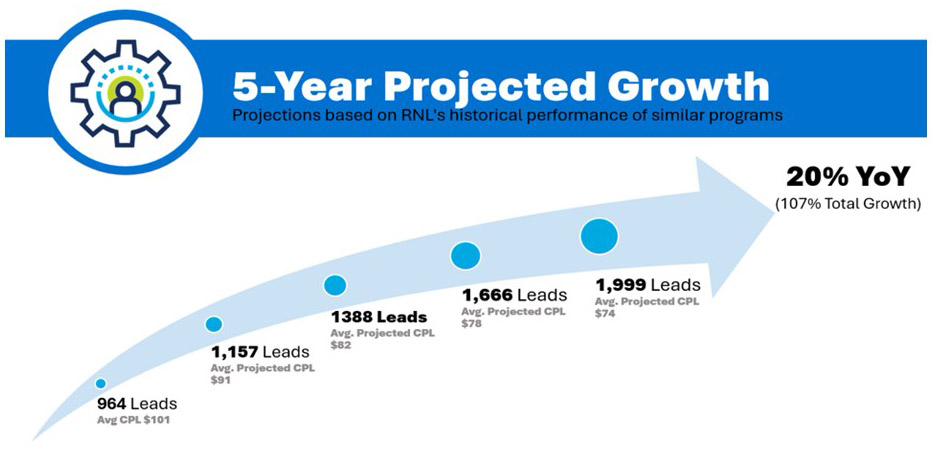
Setting expectations means recognizing that significant results take time and careful planning. This translates to setting realistic growth expectations based on an understanding that reaching your enrollment goals will take multiple academic terms. When I am collaborating with our partners, we adopt a structured five year growth trajectory where Year 1 serves as the “foundational” phase, establishing the core infrastructure and strategic alignment. Year 2 is focused on “scaling,” optimizing initial investments to drive measurable growth. Years 3 and beyond are dedicated to “sustained value creation,” with a continuous focus on refining processes and maximizing returns through ongoing optimization and strategic enhancements. This phased approach allows for calculated risk-taking and ensures a clear path to long-term, scalable success.
Once we’ve set realistic expectations for our digital strategy, it’s crucial to ensure that every tactic -whether paid digital marketing, SEO, or creative content, all work together seamlessly to achieve your goals. These elements don’t function in isolation; rather, they complement each other to drive greater visibility, engagement, and, ultimately, enrollments. A well-rounded strategy that integrates SEO to boost discoverability, paid digital marketing for targeted reach, and compelling content to engage prospective students will create a strong foundation for success. By understanding how these components interrelate, you’ll be better equipped to assess their effectiveness and make data-driven adjustments as needed.
From here, let’s dive into how digital strategy translates into budget planning and ROI. Understanding the interconnectedness of these key elements will help you allocate resources more efficiently and set a clear path for measuring the success of your investments.
Connecting strategy to ROI and crafting a strategic budget plan for growth
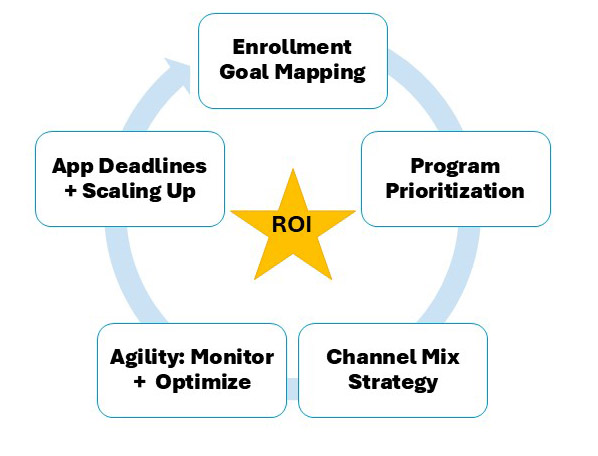
The connection between strategy and ROI is grounded in the ability to align your digital marketing efforts with measurable outcomes, and it all starts with the establishment of clear and precise enrollment goals. Prioritizing top programs ensures that marketing resources are directed toward the areas with the highest demand or growth potential, improving overall program performance. The right channel mix is crucial to reaching the right audience, maximizing visibility, and efficiently converting interest into applications. Monitoring data and optimizing it in real-time ensures that marketing efforts are continuously adjusted for maximum effectiveness, enhancing the likelihood of meeting targets and improving ROI. Finally, effective allocation based on application timing, seasonality projections, and market revisions allows for strategic adjustments in campaigns to account for fluctuating demands, ensuring marketing spend is optimized throughout the enrollment cycle. Collectively, these elements create a robust framework for maximizing ROI, ensuring that marketing investments lead to increased applications, conversions, and, ultimately, student enrollment.
How do you craft a budget that supports your growth goals? Whether you are the decision-making authority or a decision influencer, here are the essential steps to craft a budget plan that aligns with your institution’s growth objectives and maximizes your enrollments:
1. Define your enrollment goals in detail
When you think of marketing costs, what comes to mind first? How much will it cost to meet your enrollment goals, right? So, your first step in planning a budget is to have your overall Enrollment goal (and, for graduate or online programs, a goal for every program) in front of you. With the goal (or program-level goals) in hand, determine what that means in terms of percentage growth from the current state. You may also have subsidiary goals like enhancing brand awareness, building more brand equity, or engaging alumni. If these are going to be part of your plan, they should also have tangible goals for what you are trying to do. Defining your enrollment goals helps you allocate your budget accordingly and measure ROI effectively.
STRATEGY TIP
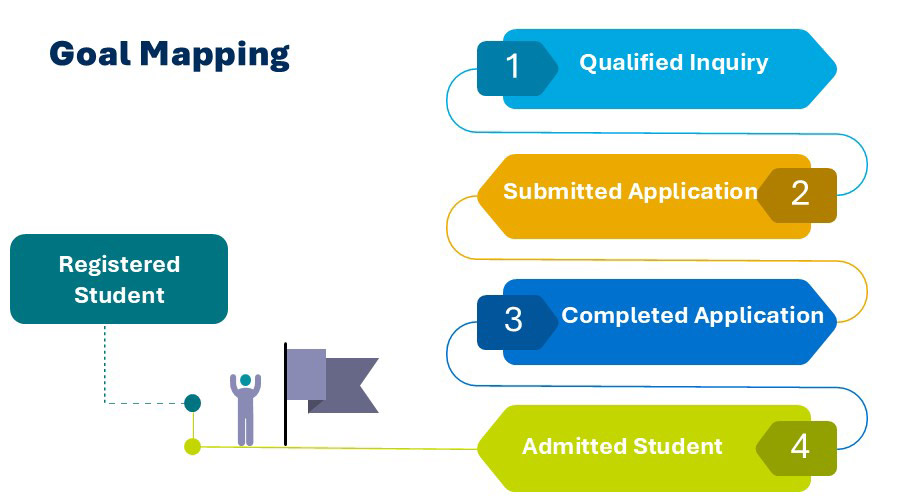
Develop a “Goal Mapping” Scenario or you can say a Reverse Funnel (for each program). After you set enrollment goals (for the year or the term) you then need to understand the lead to enroll ratio. This will help you work backwards to determine how many accepted apps/admits will be needed, how many completed apps, how many submitted apps, and finally how many qualified leads will be needed. Based on the program category, dig deeper into what the Cost per Leads (CPL’s) are, based on industry benchmarks. That will help you calculate the estimated ad spend needed to generate those qualified leads.
A note on program-level goals: If you don’t have program-level enrollment goals for your online and graduate programs, finalize those as soon as possible. Until then, focus marketing on building brand awareness. It is likely that people in your own backyard could be less familiar with your program than you may think they are. Brand advertising will ensure that awareness rises so that when you have your program goals, you can build your campaigns on a higher level of familiarity with your institution. However, given that Google reports that 75 percent of graduate and online program searches don’t include an institution name, remember that branding alone will not be enough to fill your classes.
Institutional example: When we began work with one of our partners nearly two years ago, they had not established program-level goals. So, in year one, we focused the largest portion of the budget on institutional awareness, with mini-campaigns focused on specific programs of importance to the institution. By the beginning of the second year, the institution had set program-level goals based on a greater understanding of market conditions. At that point, we began transitioning our campaigns to focus (ultimately 80 percent of the budget) on the programs with the “mini campaign” focused on continuing the brand equity efforts.
2. Prioritize your programs
It is highly unlikely that most institutions can spend marketing dollars on every program they offer. This means that in order to maximize the ROI of your marketing budget, you must prioritize your programs. But how? Take a data-driven approach, prioritizing programs for which you a) know there is market demand both among students and employers, and b) understand the competitor environment. These are the “cash cows” that will demonstrate the best ROI on your marketing spend and support the programs that, while not demonstrating significant market demand, are critical to the institutional mission.
STRATEGY TIP
Spreading a $100K marketing budget across 15 -20 programs will only dilute the ad spend, by spreading it too thin. Instead, identify the top 5-7 programs that have the greatest market demand and focus on them. Note that sometimes, the programs that seem most in need of a “marketing boost”, really aren’t. They are struggling because their market demand situation is not what it once was.
Institutional example: A partner institution recently commissioned RNL to conduct a Program Prioritization and Positioning study focused on their current program mix. The goal was to take a data-driven deep dive into 12 programs vying for marketing dollars, with a focus on understanding student demand and employer needs in the region. The results indicated that while one of the programs they had planned to prioritize came out on top, two others that they hadn’t been planning to focus on also demonstrated strong demand, and one of the programs that they had questioned was confirmed as having weak local market demand.
3. Determine your channel strategy
Once you have prioritized your programs for marketing ROI, setting your channel strategy is pivotal. Personas (at the graduate and online levels developed for each program) dictate the channels on which you should focus. You don’t want (or need) to be present on every single channel just for the sake of “eyeballs.” Be mindful of the budget and how best to use it in order to maximize return, which can only be accomplished if you apply the personas that will inform you where your target student spend their “digital time.” So, for example, not every program may benefit from marketing on LinkedIn. Since it is expensive with a $10 minimum ad spend, a persona-based approach may indicate that other platforms are a much better match. But you can only do this if you know the characteristics of your audience, and that comes from the program personas.
STRATEGY TIP
The critical element in increasing marketing ROI is to engage the right students at the right time on the right channel, without spreading your budget too thin. In contrast, being too invested in any single channel exclusively or too long is also almost always the wrong strategy. There is always a point of diminishing returns as students cycle to different platforms, and you want to be sure to know where to go next before you approach that point by being able to tap into the next new thing.
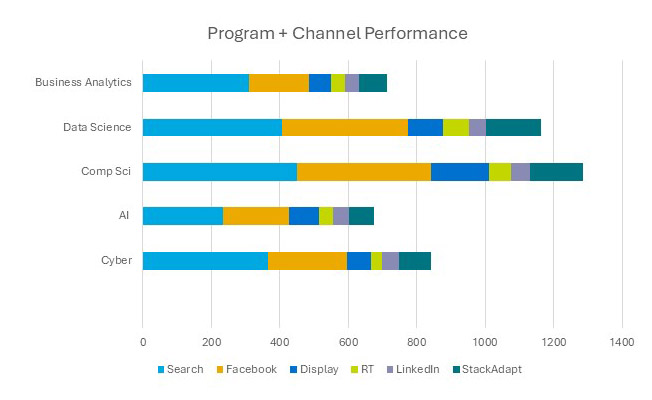
Institutional example: One of our prestigious campus partners was struggling with recent market shifts that resulted in an overall decline in applications. We dug into market and performance data to help them prioritize programs that had the highest lead-to-enroll ratios, lowest cost per acquisition, and good search volume with an eye to increasing marketing ROI and overall success. This approach not only helped regain their momentum at the top of the funnel but also generated strong conversion volume that exceeded goals and sustainably reduced cost per conversion. These changes benefited not only the marketing operation but were also felt by the call center, and further down the funnel where we saw an increase in applications.
Talk with our digital and enrollment experts
We’re to help you find the right digital marketing and recruitment strategies. Let’s set up a time to talk.
4. Analyze data regularly and optimize with agility
If (quality) content is king, data is queen! Sustained growth can only occur when data and insights are continuously incorporated into strategy. Analyzing performance data is crucial to understanding which programs and channels are yielding the largest numbers of applications and enrollments and, hence, generating the best return on ad spend (ROAS). This type of analysis allows for a data-driven approach to strategic pivots on how the marketing budget is allocated to ensure the highest ROI (or ROAS) across channels and the program portfolio. As the cost of marketing has risen, so has the need for marketers to make an effective case to senior leadership for additional marketing dollars. You can only do this if you can demonstrate that you are the best possible stewards of current resources.
STRATEGY TIP
As you continue to increase your campaign efficiency and success with the focus on ROI, your cost per lead will gradually start to go down – on average by 5 – 10 percent in year 2 and beyond. So, campaigns can generate more qualified leads efficiently over the years (for the same cost), thereby maximizing the return on your ad spend (ROAS). This helps you not just grow but also helps in building forecasts and projections for growth compounded over several years – and it also provides a strong ROI-driven basis for any requests you may need to make for additional funds elsewhere.
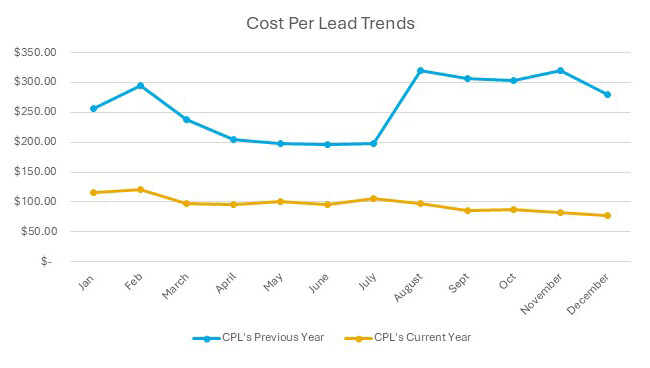
A note on analytics platforms: The fact that resources have become increasingly scarce at the same time as marketing costs have skyrocketed has resulted, out of necessity, in more sophisticated tracking of ROI. If your internal systems are set up in the correct manner (or if you are working with a strategic partner like RNL) every lead can be tracked to its source, thereby allowing for the assessment of just how effectively each marketing dollar has been used.
Institutional example: A prestigious campus partner was having challenges with converting leads to applications and enrollments. We reviewed their full-funnel data (compete with attribution percentages) and realized something wasn’t working. The top of the funnel was healthy, with good lead volume. However, down the funnel we saw that a disproportionate number of leads were not converting to apps and enrollments. As a result of the review and data analysis, we made a bold strategic pivot to shift significant budget allocations to the channel (Google search) that we could see was producing the greatest numbers of applications and enrollments. Without the data, solving the challenge would have been impossible. With the data, it was easy. Since we made this change, applications, and enrollments have consistently increased each academic period.
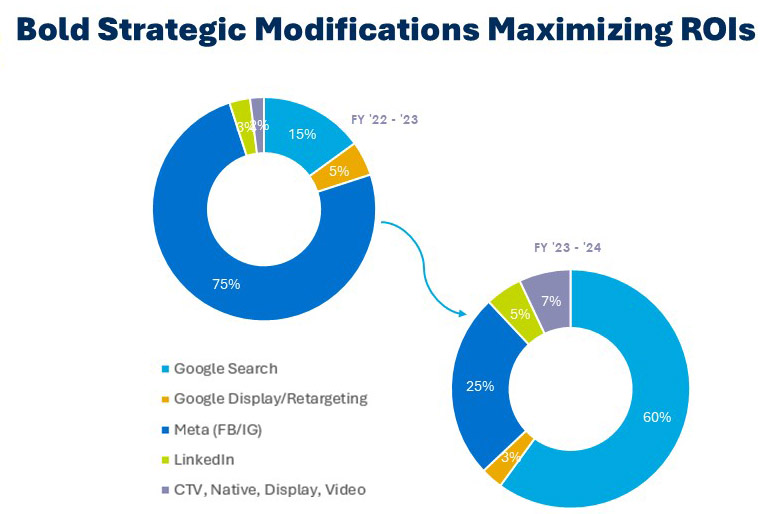
Making sure that the top of the funnel strategy is guided by down funnel numbers is the KEY! Effective strategy must evolve through ongoing optimizations with thoughtful placements across diverse media platforms that are informed by performance data. Remember that the path to enrollment is rarely linear and an integrated media strategy allows you to provide a personalized message in the right place at the right time.
5. Understand and account for seasonality/application timings/expansion
Another aspect of the dynamic nature of the marketing process relates to the seasonality of lead flow – and subsequent enrollment. This requires flexibility to adjust your strategies based on real-time performance data collected throughout the year. For any program or institution, there are times of the year during which more or fewer leads are generated. Fully understanding these trends takes time; you can make preliminary judgments on when the lead volume is highest and lowest within one year, but multiple years will allow for greater certainty. As you build your capacity to track lead generation – and conversion throughout the funnel – by program and source – you can create visualizations that map these factors by month. They can be used to build monthly budget allocations like those presented below.
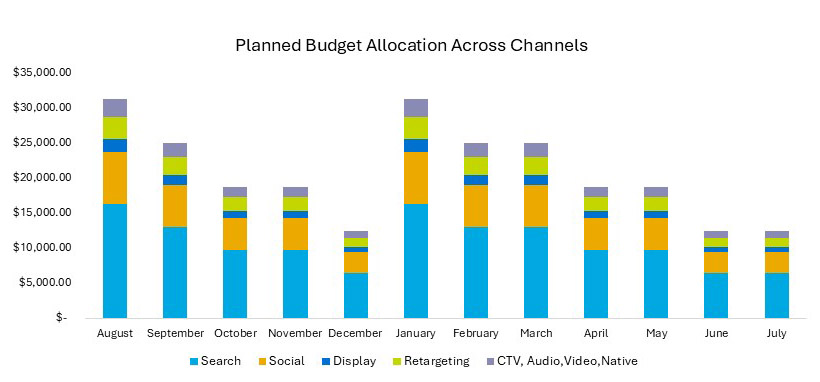
Institutional example: For one campus partner we used the annual performance data in an innovative way. Our data insights indicated that there was more market share to capture, by having the program leverage low cost per conversion at the top of the funnel at certain points in the year, and low cost per acquisition at the bottom at other points of the year. There was time to scale up both applications and enrollments. We developed a forecast plan to address the potential areas of opportunity, calculated the cost, and pitched it to the partner. Once approved, we moved with agility, and implemented additional ad spend on the top champion programs and frontloaded the budgets for the academic periods yielding the highest number of applicants and enrollments. With this, we were not only able to meet the qualified lead goal but also exceeded the enrollments by 19% for the following academic period.
The lifetime value of the student
As you budget for growth, it’s crucial to consider the lifetime value (LTV) of a student. LTV refers to the total revenue a student generates throughout their academic journey and beyond. This value encompasses tuition fees, ancillary revenues (like housing and meal plans), alumni donations, and increasingly in our era lifelong learning opportunities.
Talk with our digital and enrollment experts
We’re to help you find the right digital marketing and recruitment strategies. Let’s set up a time to talk.