Tag: math

  • 10+ Years of Lasting Impact and Local Commitment

    10+ Years of Lasting Impact and Local Commitment

    Over 60,000 students have benefited from the math program built on how the brain naturally learns

    A new analysis shows that students using ST Math at Phillips 66-funded schools are achieving more than twice the annual growth in math performance compared to their peers. A recent analysis by MIND Research Institute, which included 3,240 students in grades 3-5 across 23 schools, found that this accelerated growth gave these schools a 12.4 percentile point advantage in spring 2024 state math rankings.

    These significant outcomes are the result of a more than 10-year partnership between Phillips 66 and MIND Research Institute. This collaboration has brought ST Math, created by MIND Education, the only PreK–8 supplemental math program built on the science of how the brain learns, fully funded to 126 schools, 23 districts, and more than 60,000 students nationwide. ST Math empowers students to explore, make sense of, and build lasting confidence in math through visual problem-solving.

    “Our elementary students love JiJi and ST Math! Students are building perseverance and a deep conceptual understanding of math while having fun,” said Kim Anthony, Executive Director of Elementary Education, Billings Public Schools. “By working through engaging puzzles, students are not only fostering a growth mindset and resilience in problem-solving, they’re learning critical math concepts.”

    The initiative began in 2014 as Phillips 66 sought a STEM education partner that could deliver measurable outcomes at scale. Since then, the relationship has grown steadily, and now, Phillips 66 funds 100% of the ST Math program in communities near its facilities in California, Washington, Montana, Oklahoma, Texas, Illinois, and New Jersey. Once involved, schools rarely leave the program.

    To complement the in-class use of ST Math, Phillips 66 and MIND introduced Family Math Nights. These events, hosted at local schools, bring students, families, and Phillips 66 employee volunteers together for engaging, hands-on activities. The goal is to build math confidence in a fun, interactive setting and to equip parents with a deeper understanding of the ST Math program and new tools to support their child’s learning at home.

    “At Phillips 66, we believe in building lasting relationships with the communities we serve,” said Courtney Meadows, Manager of Social Impact at Phillips 66. “This partnership is more than a program. It’s a decade of consistent, community-rooted support to build the next generation of thinkers and improve lives through enriching educational experiences.”

    ST Math has been used by millions of students across the country and has a proven track record of delivering a fundamentally different approach to learning math. Through visual and interactive puzzles, the program breaks down math’s abstract language barriers to benefit all learners, including English Learners, Special Education students, and Gifted and Talented students.

    “ST Math offers a learning experience that’s natural, intuitive, and empowering—while driving measurable gains in math proficiency,” said Brett Woudenberg, CEO of MIND Education. “At MIND, we believe math is a gateway to brighter futures. We’re proud to partner with Phillips 66 in expanding access to high-quality math learning for thousands of students in their communities.”

    Explore how ST Math is creating an impact in Phillips 66 communities with this impact story: https://www.mindeducation.org/success-story/brazosport-isd-texas/

    About MIND Education
    MIND Education engages, motivates and challenges students towards mathematical success through its mission to mathematically equip all students to solve the world’s most challenging problems. MIND is the creator of ST Math, a pre-K–8 visual instructional program that leverages the brain’s innate spatial-temporal reasoning ability to solve mathematical problems; and InsightMath, a neuroscience-based K-6 curriculum that transforms student learning by teaching math the way every brain learns so all students are equipped to succeed. Since its inception in 1998, MIND Education and ST Math has served millions and millions of students across the country. Visit MINDEducation.org.

    About Phillips 66
    Phillips 66 (NYSE: PSX) is a leading integrated downstream energy provider that manufactures, transports and markets products that drive the global economy. The company’s portfolio includes Midstream, Chemicals, Refining, Marketing and Specialties, and Renewable Fuels businesses. Headquartered in Houston, Phillips 66 has employees around the globe who are committed to safely and reliably providing energy and improving lives while pursuing a lower-carbon future. For more information, visit phillips66.com or follow @Phillips66Co on LinkedIn.

    eSchool News Staff
    Latest posts by eSchool News Staff (see all)

    Source link

  • AI can be a great equalizer, but it remains out of reach for millions of Americans; the Universal Service Fund can expand access

    AI can be a great equalizer, but it remains out of reach for millions of Americans; the Universal Service Fund can expand access

    In an age defined by digital transformation, access to reliable, high-speed internet is not a luxury; it is the bedrock of opportunity. It impacts the school classroom, the doctor’s office, the town square and the job market.

    As we stand on the cusp of a workforce revolution driven by the “arrival technology” of artificial intelligence, high-speed internet access has become the critical determinant of our nation’s economic future. Yet, for millions of Americans, this essential connection remains out of reach.

    This digital divide is a persistent crisis that deepens societal inequities, and we must rally around one of the most effective tools we have to combat it: the Universal Service Fund. The USF is a long-standing national commitment built on a foundation of bipartisan support and born from the principle that every American, regardless of their location or income, deserves access to communications services.

    Without this essential program, over 54 million students, 16,000 healthcare providers and 7.5 million high-need subscribers would lose internet service that connects classrooms, rural communities (including their hospitals) and libraries to the internet.

    Related: A lot goes on in classrooms from kindergarten to high school. Keep up with our free weekly newsletter on K-12 education.

    The discussion about the future of USF has reached a critical juncture: Which communities will have access to USF, how it will be funded and whether equitable access to connectivity will continue to be a priority will soon be decided.

    Earlier this year, the Supreme Court found the USF’s infrastructure to be constitutional — and a backbone for access and opportunity in this country. Congress recently took a significant next step by relaunching a bicameral, bipartisan working group devoted to overhauling the fund. Now they are actively seeking input from stakeholders on how to best modernize this vital program for the future, and they need our input.

    I’m urging everyone who cares about digital equity to make their voices heard. The window for our input in support of this vital connectivity infrastructure is open through September 15.

    While Universal Service may appear as only a small fee on our monthly phone bills, its impact is monumental. The fund powers critical programs that form a lifeline for our nation’s most vital institutions and vulnerable populations. The USF helps thousands of schools and libraries obtain affordable internet — including the school I founded in downtown Brooklyn. For students in rural towns, the E-Rate program, funded by the USF, allows access to the same online educational resources as those available to students in major cities. In schools all over the country, the USF helps foster digital literacy, supports coding clubs and enables students to complete homework online.

    By wiring our classrooms and libraries, we are investing in the next generation of innovators.

    The coming waves of technological change — including the widespread adoption of AI — threaten to make the digital divide an unbridgeable economic chasm. Those on the wrong side of this divide experienced profound disadvantages during the pandemic. To get connected, students at my school ended up doing homework in fast-food parking lots. Entire communities lost vital connections to knowledge and opportunity when libraries closed.

    But that was just a preview of the digital struggle. This time, we have to fight to protect the future of this investment in our nation’s vital infrastructure to ensure that the rising wave of AI jobs, opportunities and tools is accessible to all.

    AI is rapidly becoming a fundamental tool for the American workforce and in the classroom. AI tools require robust bandwidth to process data, connect to cloud platforms and function effectively.

    The student of tomorrow will rely on AI as a personalized tutor that enhances teacher-led classroom instruction, explains complex concepts and supports their homework. AI will also power the future of work for farmers, mechanics and engineers.

    Related: Getting kids online by making internet affordable

    Without access to AI, entire communities and segments of the workforce will be locked out. We will create a new class of “AI have-nots,” unable to leverage the technology designed to propel our economy forward.

    The ability to participate in this new economy, to upskill and reskill for the jobs of tomorrow, is entirely dependent on the one thing the USF is designed to provide: reliable connectivity.

    The USF is also critical for rural health care by supporting providers’ internet access and making telehealth available in many communities. It makes internet service affordable for low-income households through its Lifeline program and the Connect America Fund, which promotes the construction of broadband infrastructure in rural areas.

    The USF is more than a funding mechanism; it is a statement of our values and a strategic economic necessity. It reflects our collective agreement that a child’s future shouldn’t be limited by their school’s internet connection, that a patient’s health outcome shouldn’t depend on their zip code and that every American worker deserves the ability to harness new technology for their career.

    With Congress actively debating the future of the fund, now is the time to rally. We must engage in this process, call on our policymakers to champion a modernized and sustainably funded USF and recognize it not as a cost, but as an essential investment in a prosperous, competitive and flourishing America.

    Erin Mote is the CEO and founder of InnovateEDU, a nonprofit that aims to catalyze education transformation by bridging gaps in data, policy, practice and research.

    Contact the opinion editor at [email protected].

    This story about the Universal Service Fund was produced by The Hechinger Report, a nonprofit, independent news organization focused on inequality and innovation in education. Sign up for Hechinger’s weekly newsletter.

    The Hechinger Report provides in-depth, fact-based, unbiased reporting on education that is free to all readers. But that doesn’t mean it’s free to produce. Our work keeps educators and the public informed about pressing issues at schools and on campuses throughout the country. We tell the whole story, even when the details are inconvenient. Help us keep doing that.

    Join us today.

    Source link

  • A gender gap in STEM widened during the pandemic. Schools are trying to make up lost ground

    A gender gap in STEM widened during the pandemic. Schools are trying to make up lost ground

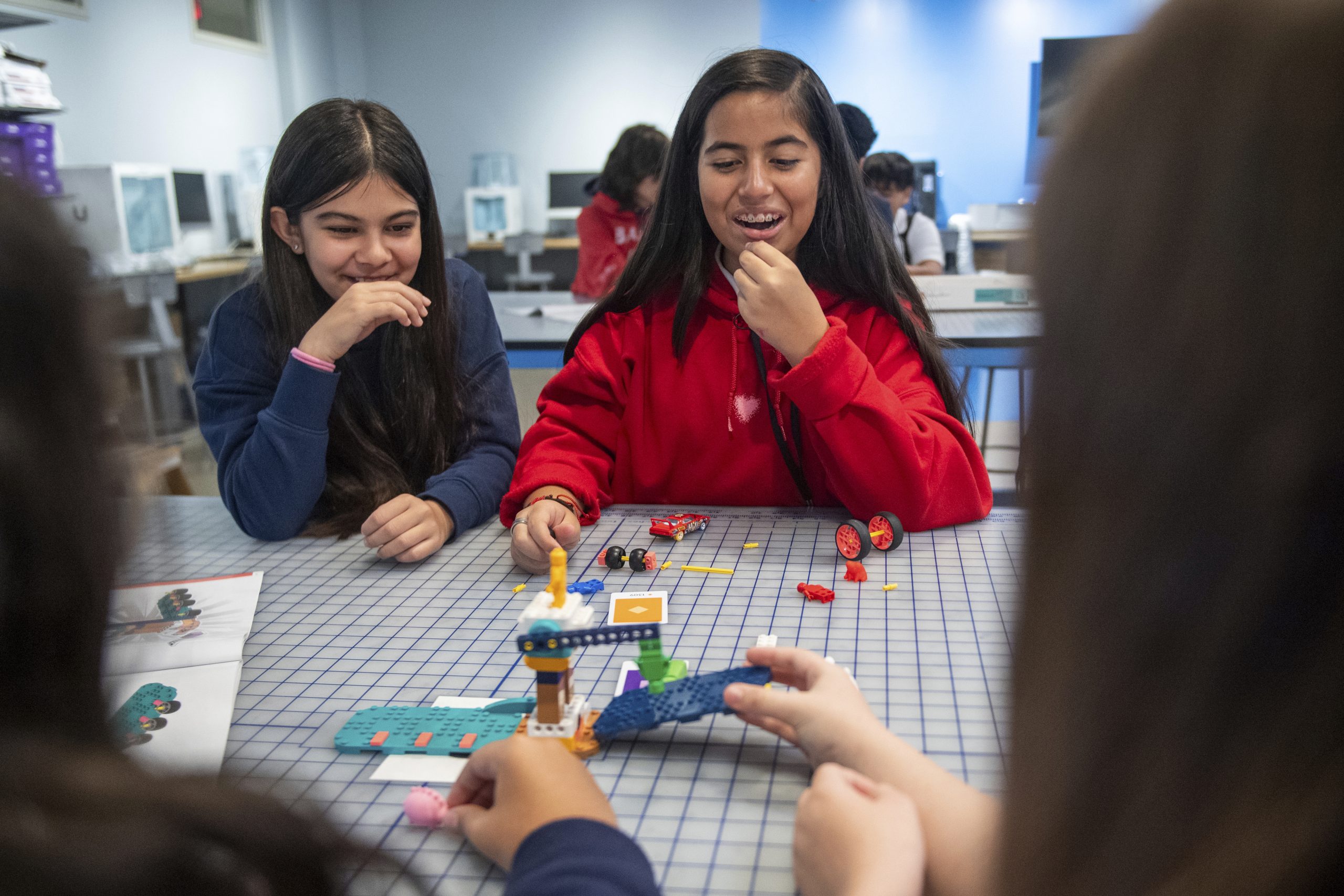
    IRVING, Texas — Crowded around a workshop table, four girls at de Zavala Middle School puzzled over a Lego machine they had built. As they flashed a purple card in front of a light sensor, nothing happened. 

    The teacher at the Dallas-area school had emphasized that in the building process, there are no such thing as mistakes. Only iterations. So the girls dug back into the box of blocks and pulled out an orange card. They held it over the sensor and the machine kicked into motion. 

    “Oh! Oh, it reacts differently to different colors,” said sixth grader Sofia Cruz.

    In de Zavala’s first year as a choice school focused on science, technology, engineering and math, the school recruited a sixth grade class that’s half girls. School leaders are hoping the girls will stick with STEM fields. In de Zavala’s higher grades — whose students joined before it was a STEM school — some elective STEM classes have just one girl enrolled. 

    Efforts to close the gap between boys and girls in STEM classes are picking up after losing steam nationwide during the chaos of the Covid pandemic. Schools have extensive work ahead to make up for the ground girls lost, in both interest and performance.

    In the years leading up to the pandemic, the gender gap nearly closed. But within a few years, girls lost all the ground they had gained in math test scores over the previous decade, according to an Associated Press analysis. While boys’ scores also suffered during Covid, they have recovered faster than girls, widening the gender gap.

    As learning went online, special programs to engage girls lapsed — and schools were slow to restart them. Zoom school also emphasized rote learning, a technique based on repetition that some experts believe may favor boys, instead of teaching students to solve problems in different ways, which may benefit girls. 

    Old practices and biases likely reemerged during the pandemic, said Michelle Stie, a vice president at the National Math and Science Initiative.

    “Let’s just call it what it is,” Stie said. “When society is disrupted, you fall back into bad patterns.”

    Related: A lot goes on in classrooms from kindergarten to high school. Keep up with our free weekly newsletter on K-12 education.

    In most school districts in the 2008-09 school year, boys had higher average math scores on standardized tests than girls, according to AP’s analysis, which looked at scores across 15 years in over 5,000 school districts. It was based on average test scores for third through eighth graders in 33 states, compiled by the Educational Opportunity Project at Stanford University. 

    A decade later, girls had not only caught up, they were ahead: Slightly more than half of districts had higher math averages for girls.

    Within a few years of the pandemic, the parity disappeared. In 2023-24, boys on average outscored girls in math in nearly 9 out of 10 districts.

    A separate study by NWEA, an education research company, found gaps between boys and girls in science and math on national assessments went from being practically non-existent in 2019 to favoring boys around 2022.

    Studies have indicated girls reported higher levels of anxiety and depression during the pandemic, plus more caretaking burdens than boys, but the dip in academic performance did not appear outside STEM. Girls outperformed boys in reading in nearly every district nationwide before the pandemic and continued to do so afterward.

    “It wasn’t something like Covid happened and girls just fell apart,” said Megan Kuhfeld, one of the authors of the NWEA study. 

    Related: These districts are bucking the national math slump 

    In the years leading up to the pandemic, teaching practices shifted to deemphasize speed, competition and rote memorization. Through new curriculum standards, schools moved toward research-backed methods that emphasized how to think flexibly to solve problems and how to tackle numeric problems conceptually.

    Educators also promoted participation in STEM subjects and programs that boosted girls’ confidence, including extracurriculars that emphasized hands-on learning and connected abstract concepts to real-life applications. 

    When STEM courses had large male enrollment, Superintendent Kenny Rodrequez noticed girls losing interest as boys dominated classroom discussions at his schools in Grandview C-4 District outside Kansas City. Girls were significantly more engaged after the district moved some of its introductory hands-on STEM curriculum to the lower grade levels and balanced classes by gender, he said.

    When schools closed for the pandemic, the district had to focus on making remote learning work. When in-person classes resumed, some of the teachers had left, and new ones had to be trained in the curriculum, Rodrequez said. 

    “Whenever there’s crisis, we go back to what we knew,” Rodrequez said. 

    Related: One state tried algebra for all eighth graders. It hasn’t gone well

    Despite shifts in societal perceptions, a bias against girls persists in science and math subjects, according to teachers, administrators and advocates. It becomes a message girls can internalize about their own abilities, they say, even at a very young age. 

    In his third grade classroom in Washington, D.C., teacher Raphael Bonhomme starts the year with an exercise where students break down what makes up their identity. Rarely do the girls describe themselves as good at math. Already, some say they are “not a math person.” 

    “I’m like, you’re 8 years old,” he said. “What are you talking about, ‘I’m not a math person?’” 

    Girls also may have been more sensitive to changes in instructional methods spurred by the pandemic, said Janine Remillard, a math education professor at the University of Pennsylvania. Research has found girls tend to prefer learning things that are connected to real-life examples, while boys generally do better in a competitive environment. 

    “What teachers told me during Covid is the first thing to go were all of these sense-making processes,” she said. 

    Related: OPINION: Everyone can be a math person but first we have to make math instruction more inclusive 

    At de Zavala Middle School in Irving, the STEM program is part of a push that aims to build curiosity, resilience and problem-solving across subjects.

    Coming out of the pandemic, Irving schools had to make a renewed investment in training for teachers, said Erin O’Connor, a STEM and innovation specialist there.

    The district last year also piloted a new science curriculum from Lego Education. The lesson involving the machine at de Zavala, for example, had students learn about kinetic energy. Fifth graders learned about genetics by building dinosaurs and their offspring with Lego blocks, identifying shared traits. 

    “It is just rebuilding the culture of, we want to build critical thinkers and problem solvers,” O’Connor said.

    Teacher Tenisha Willis recently led second graders at Irving’s Townley Elementary School through building a machine that would push blocks into a container. She knelt next to three girls who were struggling.

    They tried to add a plank to the wheeled body of the machine, but the blocks didn’t move enough. One girl grew frustrated, but Willis was patient. She asked what else they could try, whether they could flip some parts around. The girls ran the machine again. This time, it worked.

    “Sometimes we can’t give up,” Willis said. “Sometimes we already have a solution. We just have to adjust it a little bit.” 

    Lurye reported from Philadelphia. Todd Feathers contributed reporting from New York. 

    The Associated Press’ education coverage receives financial support from multiple private foundations. AP is solely responsible for all content. Find AP’s standards for working with philanthropies, a list of supporters and funded coverage areas at AP.org.

    The Hechinger Report provides in-depth, fact-based, unbiased reporting on education that is free to all readers. But that doesn’t mean it’s free to produce. Our work keeps educators and the public informed about pressing issues at schools and on campuses throughout the country. We tell the whole story, even when the details are inconvenient. Help us keep doing that.

    Join us today.
    Source link

  • Nation’s Report Card at risk, researchers say

    Nation’s Report Card at risk, researchers say

    This story was reported by and originally published by APM Reports in connection with its podcast Sold a Story: How Teach Kids to Read Went So Wrong.

    When voters elected Donald Trump in November, most people who worked at the U.S. Department of Education weren’t scared for their jobs. They had been through a Trump presidency before, and they hadn’t seen big changes in their department then. They saw their work as essential, mandated by law, nonpartisan and, as a result, insulated from politics.

    Then, in early February, the Department of Government Efficiency showed up. Led at the time by billionaire CEO Elon Musk, and known by the cheeky acronym DOGE, it gutted the Department of Education’s Institute of Education Sciences, posting on X that the effort would ferret out “waste, fraud and abuse.”

    A post from the Department of Government Efficiency.

    When it was done, DOGE had cut approximately $900 million in research contracts and more than 90 percent of the institute’s workforce had been laid off. (The current value of the contracts was closer to $820 million, data compiled by APM Reports shows, and the actual savings to the government was substantially less, because in some cases large amounts of money had been spent already.)

    Among staff cast aside were those who worked on the National Assessment of Educational Progress — also known as the Nation’s Report Card — which is one of the few federal education initiatives the Trump administration says it sees as valuable and wants to preserve.

    The assessment is a series of tests administered nearly every year to a national sample of more than 10,000 students in grades 4, 8 and 12. The tests regularly measure what students across the country know in reading, math and other subjects. They allow the government to track how well America’s students are learning overall. Researchers can also combine the national data with the results of tests administered by states to draw comparisons between schools and districts in different states.

    The assessment is “something we absolutely need to keep,” Education Secretary Linda McMahon said at an education and technology summit in San Diego earlier this year. “If we don’t, states can be a little manipulative with their own results and their own testing. I think it’s a way that we keep everybody honest.”

    But researchers and former Department of Education employees say they worry that the test will become less and less reliable over time, because the deep cuts will cause its quality to slip — and some already see signs of trouble.

    “The main indication is that there just aren’t the staff,” said Sean Reardon, a Stanford University professor who uses the testing data to research gaps in learning between students of different income levels.

    All but one of the experts who make sure the questions in the assessment are fair and accurate — called psychometricians — have been laid off from the National Center for Education Statistics. These specialists play a key role in updating the test and making sure it accurately measures what students know.

    “These are extremely sophisticated test assessments that required a team of researchers to make them as good as they are,” said Mark Seidenberg, a researcher known for his significant contributions to the science of reading. Seidenberg added that “a half-baked” assessment would undermine public confidence in the results, which he described as “essentially another way of killing” the assessment.

    The Department of Education defended its management of the assessment in an email: “Every member of the team is working toward the same goal of maintaining NAEP’s gold-standard status,” it read in part.

    The National Assessment Governing Board, which sets policies for the national test, said in a statement that it had temporarily assigned “five staff members who have appropriate technical expertise (in psychometrics, assessment operations, and statistics) and federal contract management experience” to work at the National Center for Education Statistics. No one from DOGE responded to a request for comment.

    Harvard education professor Andrew Ho, a former member of the governing board, said the remaining staff are capable, but he’s concerned that there aren’t enough of them to prevent errors.

    “In order to put a good product up, you need a certain number of person-hours, and a certain amount of continuity and experience doing exactly this kind of job, and that’s what we lost,” Ho said.

    The Trump administration has already delayed the release of some testing data following the cutbacks. The Department of Education had previously planned to announce the results of the tests for 8th grade science, 12th grade math and 12th grade reading this summer; now that won’t happen until September. The board voted earlier this year to eliminate more than a dozen tests over the next seven years, including fourth grade science in 2028 and U.S. history for 12th graders in 2030. The governing board has also asked Congress to postpone the 2028 tests to 2029, citing a desire to avoid releasing test results in an election year. 

    “Today’s actions reflect what assessments the Governing Board believes are most valuable to stakeholders and can be best assessed by NAEP at this time, given the imperative for cost efficiencies,” board chair and former North Carolina Gov. Bev Perdue said earlier this year in a press release.

    The National Assessment Governing Board canceled more than a dozen tests when it revised the schedule for the National Assessment of Educational Progress in April. This annotated version of the previous schedule, adopted in 2023, shows which tests were canceled. Topics shown in all caps were scheduled for a potential overhaul; those annotated with a red star are no longer scheduled for such a revision.

    Recent estimates peg the annual cost to keep the national assessment running at about $190 million per year, a fraction of the department’s 2025 budget of approximately $195 billion.

    Adam Gamoran, president of the William T. Grant Foundation, said multiple contracts with private firms — overseen by Department of Education staff with “substantial expertise” — are the backbone of the national test.

    “You need a staff,” said Gamoran, who was nominated last year to lead the Institute of Education Sciences. He was never confirmed by the Senate. “The fact that NCES now only has three employees indicates that they can’t possibly implement NAEP at a high level of quality, because they lack the in-house expertise to oversee that work. So that is deeply troubling.”

    The cutbacks were widespread — and far outside of what most former employees had expected under the new administration.

    “I don’t think any of us imagined this in our worst nightmares,” said a former Education Department employee, who spoke on condition of anonymity for fear of retaliation by the Trump administration. “We weren’t concerned about the utter destruction of this national resource of data.”

    “At what point does it break?” the former employee asked.

    Related: Suddenly sacked

    Every state has its own test for reading, math and other subjects. But state tests vary in difficulty and content, which makes it tricky to compare results in Minnesota to Mississippi or Montana.

    “They’re totally different tests with different scales,” Reardon said. “So NAEP is the Rosetta stone that lets them all be connected.”

    Reardon and his team at Stanford used statistical techniques to combine the federal assessment results with state test scores and other data sets to create the Educational Opportunity Project. The project, first released in 2016 and updated periodically in the years that followed, shows which schools and districts are getting the best results — especially for kids from poor families. Since the project’s release, Reardon said, the data has been downloaded 50,000 times and is used by researchers, teachers, parents, school boards and state education leaders to inform their decisions.

    For instance, the U.S. military used the data to measure school quality when weighing base closures, and superintendents used it to find demographically similar but higher-performing districts to learn from, Reardon said.

    If the quality of the data slips, those comparisons will be more difficult to make.

    “My worry is we just have less-good information on which to base educational decisions at the district, state and school level,” Reardon said. “We would be in the position of trying to improve the education system with no information. Sort of like, ‘Well, let’s hope this works. We won’t know, but it sounds like a good idea.’”

    Seidenberg, the reading researcher, said the national assessment “provided extraordinarily important, reliable information about how we’re doing in terms of teaching kids to read and how literacy is faring in the culture at large.”

    Producing a test without keeping the quality up, Seidenberg said, “would be almost as bad as not collecting the data at all.”

    The Hechinger Report provides in-depth, fact-based, unbiased reporting on education that is free to all readers. But that doesn’t mean it’s free to produce. Our work keeps educators and the public informed about pressing issues at schools and on campuses throughout the country. We tell the whole story, even when the details are inconvenient. Help us keep doing that.

    Join us today.



    Source link

  • Math is Out, Cake is In: Introducing Students to Rubrics – Faculty Focus

    Math is Out, Cake is In: Introducing Students to Rubrics – Faculty Focus

    Source link

  • Fewer Young People See Math Skills as Very Important in Work

    Fewer Young People See Math Skills as Very Important in Work

    Higher education stakeholders have noted that math anxiety can hold students back from pursuing some disciplines or major programs, but a new analysis from Gallup finds that young Americans over all place less importance on math skills compared to the general population.

    While over half of all Americans rate math skills as “very important” in their work (55 percent) and personal (63 percent) lives, only 38 percent of young people (ages 18 to 24) said math skills are very important in their work life and 37 percent in their personal life, according to a December survey of 5,100 U.S. adults.

    The survey highlights generational divisions in how math skills are perceived, with adults older than 55 most likely to see math as very important compared to younger adults, and Gen Z least likely to attribute value to math skills.

    To Sheila Tabanli, a mathematics professor at Rutgers University, the low ratings point to a lack of perceived connection between math skills and career development, despite the clear correlation she sees.

    Tabanli said it can be hard to convince many Gen Z and Alpha students that math content is necessary for their daily lives, in part because access to information is so convenient and they can perform calculations on their phones or online.

    “We need to transition from focusing too much on the concept, the domain, the content—which we do love as math people, otherwise we wouldn’t be doing it for a living—but students don’t see that connection [to employable skills],” Tabanli said.

    When asked how important math skills were for the majority of the U.S. workforce, 40 percent of young adults rated having math skills as very important—the lowest rating of nine skills evaluated, including reading, language, technology and leadership, according to Gallup.

    Young people also rated the importance of math skills for the general workforce, as compared to their own lives, the lowest of all age cohorts. Adults ages 55 to 64 (71 percent) and 65 and older (68 percent) were most likely to say math is a very important skill for the general workforce.

    Most career competencies that colleges and universities teach, such as those by the National Association for Colleges and Employers, focus on broader skills—including critical thinking, leadership, communication and teamwork—as essential for workplace success. Math can teach students how to solve problems and engage with difficult content, which Tabanli argues are just as important for an early-career professional.

    One reason a young adult might not rate math skills highly is because many students face undue math anxiety or a skepticism about their own ability to do math, falling into the belief that they’re not “math people,” Tabanli said.

    In response, Tabanli believes professors should help students apply computational skills to their daily lives or link content to other classes to encourage students to invest in their math learning. While this may be an additional step for a faculty member to take, Tabanli considers it a disservice to neglect this connection.

    Professors can also strive to make themselves and the content more human and approachable by sharing information about their lives, their careers and why they’re passionate about the subject, Tabanli said.

    Source link

  • Racial bias affects early math education. Researchers are trying to stop that

    Racial bias affects early math education. Researchers are trying to stop that

    The early years are a critical time to teach the foundations of math. That’s when children learn to count, start identifying shapes and gain an early understanding of concepts like size and measurement. These years can also be a time when children are confronted with preconceived notions of their abilities in math, often based on their race, which can negatively affect their math success and contribute to long-standing racial gaps in scores. 

    These are some of the motivating factors behind the Racial Justice in Early Math project, a collaboration between the Erikson Institute, a private graduate school focused on child development, and the University of Illinois Chicago. The project aims to educate teachers and provide resources including books, teacher tips and classroom activities that help educators combat racial bias in math instruction.  

    I sat down with Danny Bernard Martin, professor of education and mathematics at the University of Illinois Chicago, project director Priscila Pereira and Jennifer McCray, a research professor at the Erikson Institute, to learn more about their work. This conversation has been edited for length and clarity.

    What are some of the key examples of racial injustice that you see in early math education?

    Martin: If I say to you, ‘Asians are good at math,’ that’s something that you’ve heard, we know that’s out there. When does that kind of belief start? Well, there’s something called ‘racial-mathematical socialization’ that we take seriously in this project, that we know happens in the home before children come to school. Parents and caregivers are generating messages around math that they transmit to children, and then those messages may get reinforced in schools.

    Even at the early math level, there are research projects beginning to construct Black children in particular ways, comparing Black children to white children as the norm. That is a racial justice issue, because that narrative about white children, Black children, Asian American children, Latinx children, then filters out. It becomes part of the accepted truth, and then it impacts what teachers do and what principals and school leaders believe about children.  

    What does this look like in schools?

    McCray: Perhaps the math curriculum doesn’t represent them or their experience. We all know that often schools for children of color are under-resourced. What often happens in under-resourced schools is that the curriculum and the teaching tends to focus on the basics. There might be an overemphasis on drilling or doing timed tests. We also have those situations where people are doing ability grouping in math. And we know what the research says about that, it’s basically ‘good education for you, and poor education for you.’ It’s almost impossible to do any of that without doing harm. 

    One line of research has been to watch teachers interact with children and videotape or study them. And in diverse classrooms with white teachers … often it is observed that children who are Black or Latina aren’t called on as often, or aren’t listened to as much, or don’t have the same kind of opportunity to be a leader in the classroom.  

    What should teacher prep programs, administrators and families do to address racial justice issues in early math? 

    McCray: Maybe the white teacher is reflecting on themselves, on their own biases … trying to connect with families or communities in some way that’s meaningful. We want teachers to have that balance of knowing that sometimes you do want to teach a procedure, but you never want to be shutting down ideas for creative ways to solve a math problem, or culturally distinct ways to solve a math problem that might come from your students.

    It might be something like, you’re working on sorting in an early childhood classroom. And what if a child is thinking about a special craft that their parent does that’s like the [papel picado], or papers that get cut in very elaborate designs in Mexico. … If the teacher doesn’t have space to listen, it could be a shutdown moment, instead of a moment of connection, where the child is actually bringing something … that is associated with their own identity.

    Pereira: I do feel that sometimes the conversations of racial justice really put the weight on teachers and teachers alone. Teaching is part of a larger structure. Maybe your school will not allow you to do the work that is needed. I’m thinking about [a teacher] who was required to follow a scripted curriculum that did not promote the positive math identity for Black children. It needs to be a whole community effort.

    How is your initiative changing this?

    Pereira: There are resources in terms of opportunities that we offer to teachers to engage with our content and ideas: webinars, a fellowship and an immersive learning experience in the summer of 2026. These spaces are moments in which educators, researchers and people that are engaged in the education of young learners, can come together … and disrupt mainstream notions of understanding what is racial justice and how one gets that in the classroom.  

    Right now, research and initiatives zeroing in on race are under scrutiny, especially at the college level. Do you foresee any additional challenges to this work?

    Pereira: There was a National Science Foundation grant program focused on racial equity in STEM and we had been planning to apply for funds to do something there. … It’s gone. … The only place we’re welcome is where there’s a governor who is willing to take on Trump. We just have to keep doing the work, because we know what’s right. But it is challenging, for sure.

    Contact staff writer Jackie Mader at 212-678-3562 or [email protected]

    This story about racial justice in math was produced by The Hechinger Report, a nonprofit, independent news organization focused on inequality and innovation in education. Sign up for the Early Childhood newsletter.

    The Hechinger Report provides in-depth, fact-based, unbiased reporting on education that is free to all readers. But that doesn’t mean it’s free to produce. Our work keeps educators and the public informed about pressing issues at schools and on campuses throughout the country. We tell the whole story, even when the details are inconvenient. Help us keep doing that.

    Join us today.
    Source link

  • Creative approaches to teaching math can help fill AI talent gap

    Creative approaches to teaching math can help fill AI talent gap

    Key points:

    Not surprisingly, jobs in AI are the fastest growing of any in the country, with a 59 percent increase in job postings between January 2024 and November 2024. Yet we continue to struggle with growing a workforce that is proficient in STEM. 

    To fill the AI talent pipeline, we need to interest kids in STEM early, particularly in math, which is critical to AI. But that’s proven difficult. One reason is that math is a stumbling block. Whether because of math anxiety, attitudes they’ve absorbed from the community, inadequate curricular materials, or traditional teaching methods, U.S. students either avoid or are not proficient in math.  

    A recent Gallup report on Math Matters reveals that the U.S. public greatly values math but also experiences significant gaps in learning and confidence, finding that: 

    • 95 percent of U.S. adults say that math is very or somewhat important in their work life 
    • 43 percent of U.S. adults wish they had learned more math skills in middle or high school. 
    •  24 percent of U.S. adults say that math makes them feel confused  

    Yet this need not be the case. Creative instruction in math can change the equation, and it is available now. The following three examples from respected researchers in STEM education demonstrate this fact. 

    The first is a recently published book by Susan Jo Russell and Deborah Schifter, Interweaving Equitable Participation and Deep Mathematics. The book provides practical tools and a fresh vision to help educators create math classrooms where all students can thrive. It tackles a critical challenge: How do teachers ensure that all students engage deeply with rigorous mathematics? The authors pose and successfully answer key questions: What does a mathematical community look like in an elementary classroom? How do teachers engage young mathematicians in deep and challenging mathematical content? How do we ensure that every student contributes their voice to this community? 

    Through classroom videos, teacher reflections, and clear instructional frameworks, Russell and Schifter bring readers inside real elementary classrooms where all students’ ideas and voices matter. They provide vivid examples, insightful commentary, and ready-to-use resources for teachers, coaches, and school leaders working to make math a subject where every student sees themselves as capable and connected. 

    Next is a set of projects devoted to early algebra. Significantly, research shows that how well students perform in Algebra 2 is a leading indicator of whether they’ll get into college, graduate from college, or become a top income earner. But introducing algebra in middle school, as is the common practice, is too late, according to researchers Maria Blanton and Angela Gardiner of TERC, a STEM education research nonprofit. Instead, learning algebra must begin in K-5, they believe. 

    Students would be introduced to algebraic concepts rather than algebra itself, becoming familiar with ways of thinking using pattern and structure. For example, when students understand that whenever they add two odd numbers together, they get an even number, they’re recognizing important mathematical relationships that are critical to algebra. 

    Blanton and Gardiner, along with colleagues at Tufts University, University of Wisconsin Madison, University of Texas at Austin, Merrimack College, and City College of New York, have already demonstrated the success of an early algebra approach through Project LEAP, the first early algebra curriculum of its kind for grades K–5, funded in part by the National Science Foundation.  

    If students haven’t been introduced to algebra early on, the ramp-up from arithmetic to algebra can be uniquely difficult. TERC researcher Jennifer Knudsen told me that elementary to middle school is an important time for students’ mathematical growth. 

    Knudsen’s project, MPACT, the third example of creative math teaching, engages middle school students in 3D making with everything from quick-dry clay and cardboard to digital tools for 3D modeling and printing. The project gets students involved in designing objects, helping them develop understanding of important mathematical topics in addition to spatial reasoning and computational thinking skills closely related to math. Students learn concepts and solve problems with real objects they can hold in their hands, not just with words and diagrams on paper.  

    So far, the evidence is encouraging: A two-year study shows that 4th–5th graders demonstrated significant learning gains on an assessment of math, computational thinking, and spatial reasoning. These creative design-and-making units are free and ready to download. 

    Math is critical for success in STEM and AI, yet too many kids either avoid or do not succeed in it. Well-researched interventions in grade school and middle school can go a long way toward teaching essential math skills. Curricula for creating a math community for deep learning, as well as projects for Early Algebra and MPACT, have shown success and are readily available for school systems to use.

    We owe it to our students to take creative approaches to math so they can prepare for future AI and STEM professions. We owe it to ourselves to help develop a skilled STEM and AI workforce, which the nation needs to stay competitive. 

    Latest posts by eSchool Media Contributors (see all)

    Source link

  • Texas Students Make Gains in Reading but Struggle with Math, STAAR Scores Show – The 74

    Texas Students Make Gains in Reading but Struggle with Math, STAAR Scores Show – The 74


    Get stories like this delivered straight to your inbox. Sign up for The 74 Newsletter

    Texas’ students saw some wins in reading but continued to struggle to bounce back from pandemic-related learning losses in math, state testing results released Tuesday showed.

    Elementary students who took the State of Texas Assessments of Academic Readiness exam this year made the biggest gains in reading across grade levels. Third graders saw a three percentage point increase in reading, a milestone because early literacy is a strong indicator of future academic success. Progress among middle students in the subject, meanwhile, slowed.

    “These results are encouraging and reflect the impact of the strategic supports we’ve implemented in recent years,” said Texas Education Agency Commissioner Mike Morath. “We are seeing meaningful signs of academic recovery and progress.”

    This year’s third grade test takers have benefited from state investments in early literacy in recent years. Teachers in their classrooms have completed state-led training in early literacy instruction, known as reading academies. The state also expanded pre-K access and enrollment in 2019.

    Morath did acknowledge students needed more help to make similar gains in math. Five years after pandemic-related school closures, students are still struggling to catch up in that subject, the results showed. About 43% of students met grade-level standards for math, a 2 percentage point increase from the previous year, but still shy of the 50% reached in 2019.

    Low performance in math can effectively shut students out of high-paying, in-demand STEM careers. Economic leaders have been sounding the alarm about the implications that weak math skills can have on the state’s future workforce pipeline.

    The STAAR exam tests all Texas public school students in third through eighth grade in math and reading. A science test is also administered for fifth and eighth graders, as well as a social studies test for eighth graders. Science performance improved among fifth and eighth grades by 3 and 4 percentage points respectively, but students in those grades are still below where they were before the pandemic.

    Students in special education also made small gains. English learners, meanwhile, saw drops in all subjects but one — a 4% decrease in reading, a 2% decrease in math, and a 2% decrease in social studies.

    The test scores give families a snapshot of how Texas students are learning. School accountability ratings — which the Texas Education Agency gives out to each district and campus on an A through F scale as a score for their performance — are also largely based on how students do on the standardized tests.

    The test often casts a shadow over classrooms at the end of the year, with teachers across the state saying they lose weeks of valuable instructional time preparing children to take the test. Some parents also don’t like the test because of its high-stakes nature. They have said their kids don’t want to go school because of the enormous pressure the hours-long, end-of-year test puts on them.

    A bill that would have scrapped the STAAR test died in the last days of the 2025 legislative session. Both Republican and Democratic legislators expressed a desire to overhaul STAAR, but in the end, the House and Senate could not align on what they wanted out of an alternative test.

    Legislators this session did approve a sweeping school finance package that included academic intervention for students who are struggling before they first take their STAAR test in third grade. The package also requires teachers get training in math instruction, mirroring existing literacy training mandates.

    Parents can look up their students’ test results here.

    Graphics by Edison Wu

    This article originally appeared in The Texas Tribune, a member-supported, nonpartisan newsroom informing and engaging Texans on state politics and policy. Learn more at texastribune.org.


    Get stories like these delivered straight to your inbox. Sign up for The 74 Newsletter

    Source link

  • Many students decide they’re not a ‘math person’ by the end of elementary school, new study shows

    Many students decide they’re not a ‘math person’ by the end of elementary school, new study shows

    This story was originally published by Chalkbeat. Sign up for their newsletters at ckbe.at/newsletters.

    Roughly half of middle and high schoolers report losing interest in math class at least half the time, and 1 in 10 lack interest nearly all the time during class, a new study shows.

    In addition, the students who felt the most disengaged in math class said they wanted fewer online activities and more real-world applications in their math classes.

    Those and other findings published Tuesday from the research corporation RAND highlight several ongoing challenges for instruction in math, where nationwide student achievement has yet to return to pre-pandemic levels and the gap between the highest and lowest-performing students in math has continued to grow.

    Feeling bored in math class from time to time is not an unusual experience, and feeling “math anxiety” is common. However, the RAND study notes that routine boredom is associated with lower school performance, reduced motivation, reduced effort, and increased rates of dropping out of school.

    Perhaps unsurprisingly, the study found that the students who are the most likely to maintain their interest in math comprehend math, feel supported in math, are confident in their ability to do well in math, enjoy math, believe in the need to learn math, and see themselves as a “math person.”

    Dr. Heather Schwartz, a RAND researcher and the primary investigator of the study, noted that the middle and high school years are when students end up on advanced or regular math tracks. Schwartz said that for young students determining their own sense of math ability, “Tracking programs can be a form of external messaging.”

    Nearly all the students who said they identified as a “math person” came to that conclusion before they reached high school, the RAND survey results show. A majority of those students identified that way as early as elementary school. In contrast, nearly a third of students surveyed said they never identified that way.

    “Math ability is malleable way past middle school,” Schwartz said. Yet, she noted that the survey indicates students’ perception of their own capabilities often remains static.

    The RAND study drew on data from their newly established American Youth Panel, a nationally representative survey of students ages 12-21. It used survey responses of 434 students in grades 5-12. Because this was the first survey sent to members of the panel, there is no comparable data on student math interest prior to the pandemic, so it doesn’t measure any change in student interest.

    The RAND study found that 26% percent of students in middle and high school reported losing interest during a majority of their math lessons. On the other end of the spectrum, a quarter of students said they never or almost never lost interest in math class.

    There weren’t major differences in the findings across key demographic groups: Students in middle and high school, boys and girls, and students of different races and ethnicities reported feeling bored during a majority of math class at similar rates.

    Dr. Janine Remillard, a professor at the University of Pennsylvania Graduate School of Education and expert in mathematics curriculum, said that in many math classes, “It’s usually four or five students answering all the questions, and then the kids who either don’t understand or are less interested or just take a little bit more time — they just zone out.”

    Over 50% of students who lost interest in almost all of their math classes asked for fewer online activities and more real-world problems, the RAND study shows. Schwartz hypothesizes that some online math programs represent a “modern worksheet” and emphasize solo work and repetition. Students who are bored in class instead crave face-to-face activities that focus on application, she said.

    During Remillard’s math teacher training classes, she puts students in her math teacher training class into groups to solve math problems. But she doesn’t tell them what strategy to use.

    The students are forced to work together in order to understand the process of finding an answer rather than simply repeating a given formula. All of her students typically say that if they had learned math this way, they would think of themselves as a math person, according to Remillard, who was not involved in the RAND study.

    Chalkbeat is a nonprofit news site covering educational change in public schools.

    For more news on STEM learning, visit eSN’s STEM & STEAM hub.

    Latest posts by eSchool Media Contributors (see all)

    Source link