K-12 GenAI adoption rates have grown–but so have concerns
A new era for teachers as AI disrupts instruction
With AI coaching, a math platform helps students tackle tough concepts
For more news on GenAI, visit eSN’s AI in Education hub
Almost 3 in 5 K-12 educators (55 percent) have positive perceptions about GenAI, despite concerns and perceived risks in its adoption, according to updated data from Cengage Group’s “AI in Education” research series, which regularly evaluates AI’s impact on education.
More News from eSchool News
HVAC projects to improve indoor air quality. Tutoring programs for struggling students. Tuition support for young people who want to become teachers in their home communities.
Our school has built up its course offerings without having to add headcount. Along the way, we’ve also gained a reputation for having a wide selection of general and advanced courses for our growing student body.
When it comes to visual creativity, AI tools let students design posters, presentations, and digital artwork effortlessly. Students can turn their ideas into professional-quality visuals, sparking creativity and innovation.
Ensuring that girls feel supported and empowered in STEM from an early age can lead to more balanced workplaces, economic growth, and groundbreaking discoveries.
In my work with middle school students, I’ve seen how critical that period of development is to students’ future success. One area of focus in a middle schooler’s development is vocabulary acquisition.
For students, the mid-year stretch is a chance to assess their learning, refine their decision-making skills, and build momentum for the opportunities ahead.
Middle school marks the transition from late childhood to early adolescence. Developmental psychologist Erik Erikson describes the transition as a shift from the Industry vs. Inferiority stage into the Identity vs. Role Confusion stage.
Art has a unique power in the ESL classroom–a magic that bridges cultures, ignites imagination, and breathes life into language. For English Language Learners (ELLs), it’s more than an expressive outlet.
In the year 2025, no one should have to be convinced that protecting data privacy matters. For education institutions, it’s really that simple of a priority–and that complicated.
Teachers are superheroes. Every day, they rise to the challenge, pouring their hearts into shaping the future. They stay late to grade papers and show up early to tutor struggling students.
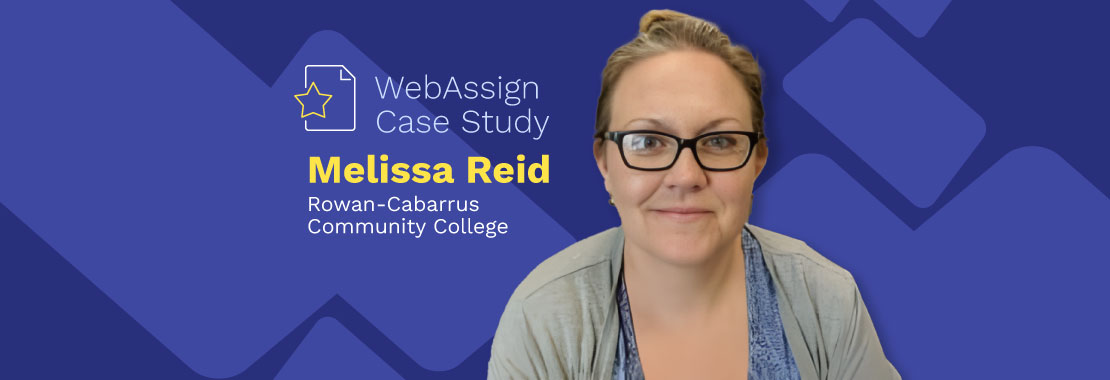
Melissa Reid, Department Chair at Rowan-Cabarrus Community College, was concerned that students in her developmental math course were lacking critical support from her previous publisher and online learning platform, resulting in discouragingly low pass rate numbers. She was looking for more personalized support that would hopefully jumpstart her students on the pathway to success in future gateway-level math courses.
“…we were blown away.”
After switching to WebAssign in the Fall of 2022, Reid saw major improvements in the level of support both students and faculty members were receiving. She was impressed by how easy course setup was, and how efficiently she was able to coordinate with the WebAssign team to develop customized student content. Most importantly, she loved that students were able to enjoy a personalized learning experience and take advantage of various built-in study resources and features, like “Watch Its.”
The results? Pass rates in Professor Reid’s developmental math course increased by 117% within the span of one semester. Her students are enthusiastic about what WebAssign offers and have been able to develop better concept building skills.
“After we worked with Cengage to create a developmental design, our pass rates dramatically improved! Students often commented about how they enjoyed all of the resources within WebAssign, like the ‘Read Its’ and ‘Watch Its’.” – Melissa Reid
Learn more about how WebAssign helped prepare Professor Reid’s developmental math students for gateway-level math courses, while providing critical support along the way.
Corequisite educational models are tied to higher pass and completion rates for students compared to remedial education, but ensuring learners are passing college-level courses often requires additional institutional investment.
Middle Georgia State University reimagined its corequisite education model to embed tutors, peer mentors and success coaches in entry-level math courses. Now, students who are falling behind are identified on a weekly basis, allowing for targeted and individualized outreach.
After the first term of the initiative, passing rates grew over 10 percentage points and withdrawals decreased, encouraging the university to scale the intervention to English courses and, starting next fall, STEM courses with high failure—D or F—or withdrawal rates.
What’s the need: Middle Georgia State offers 29 sections of its corequisite math course, Qualitative Reasoning. The course has seen stagnant success rates over the past few years, even though the number of students enrolled in corequisites grew, said Deepa Arora, senior associate provost of student success at Middle Georgia State.
Students who didn’t pass the class were less likely to stay enrolled and progress, prompting institutional leaders to consider new ways to engage these learners.
How it works: The solution was to create a support network of professionals who assist learners.
Faculty members are at the center of the initiative, flagging at-risk learners who are missing goals or failing to submit work.
From there, student success coaches, who are embedded in the course’s learning management system, reach out to those students to share resources, create a success plan and make referrals. Coaches also initiate a follow-up a week later to see if students have completed any action.
Depending on the student’s area of weakness, success coaches funnel them to one of two types of student employee: an embedded tutor or a peer mentor.
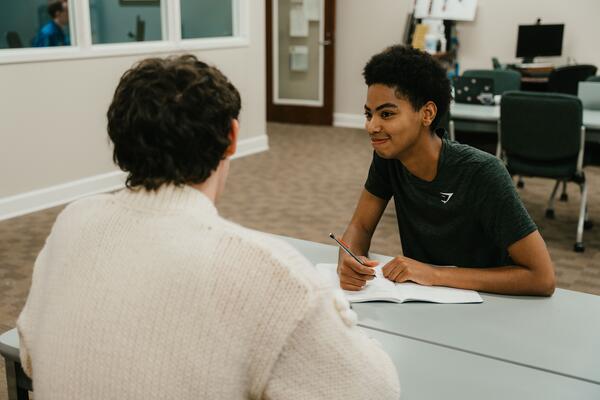
Embedded tutors address primarily academic concerns, such as low grades. Tutors attend class sessions, provide content-specific coaching and host review sessions as well as set up appointments for learners who need additional assistance, Arora said.
Corequisite learners who may be missing or not participating in classes are referred to a peer mentor, Arora said. In addition to teaching academic skills, peer mentors focus on a student’s sense of belonging and connection to the institution. They facilitate workshops, provide referrals to other support resources and connect students with classmates.
Both tutors and mentors are paid positions for which students must meet certain qualifications: They need to have passed the relevant course, be enrolled at least part-time and fulfill role-specific training.
Building better: The staffing changes were supported by revenue from tuition increases over the past two years. Faculty buy-in was also essential. “Faculty collaboration and cooperation with the success team was an integral part of the initiative and led to the development of a support ecosystem for the student,” Arora said.
Prior to implementing the new model, faculty members were briefed on the initiative’s design and asked to provide feedback and meet with the success coaches to build relationships.
Faculty didn’t receive any specific training other than guidance on how to identify at-risk students—those missing classes, earning low grades or failing to engage. Campus leaders also encouraged professors to send weekly communication regarding student performance and share related information about content with the success coach assigned to their section, Arora said.
The impact: The initiative succeeded in its goal of improving student pass rates: 73 percent of students who attempted the course in fall 2024 passed, a 14-percentage-point increase from the previous fall’s rate. (Excluding withdrawals, 77 percent of fall 2024 students passed the course.)
One trend the university noted was that the students who did fail were primarily in the online sections, suggesting that improvements to the in-person experiences were moving the needle.
Additionally, the connection between faculty and success coaches broke down institutional silos through ensuring timely identification of barriers and sharing of best practices. Success coaches appreciated being embedded in the learning management system, as it gave them greater insight into where the students needed help.
Support staff also noted increased student use of resources.
What’s next: After the initial positive results, university leaders chose to extend the initiative this term to include all sections of Composition I and its corequisite support courses. “The plan is also to extend this strategy to all sections of Anatomy and Physiology I and II where additional support is needed to improve their success rates,” Arora said.
The university will also invest in additional focus on online courses to close success gaps there.
Do you have an academic intervention that might help others improve student success? Tell us about it.
Math isn’t just about numbers. It’s about language, too.
Many math tasks involve reading, writing, speaking, and listening. These language demands can be particularly challenging for students whose primary language is not English.
There are many ways teachers can bridge language barriers for multilingual learners (MLs) while also making math more accessible and engaging for all learners. Here are a few:
1.Introduce and reinforce academic language
Like many disciplines, math has its own language. It has specialized terms–such as numerator, divisor, polynomial, and coefficient–that students may not encounter outside of class. Math also includes everyday words with multiple meanings, such as product, plane, odd, even, square, degree, and mean.
One way to help students build the vocabulary needed for each lesson is to identify and highlight key terms that might be new to them. Write the terms on a whiteboard. Post the terms on math walls. Ask students to record them in math vocabulary notebooks they can reference throughout the year. Conduct a hands-on activity that provides a context for the vocabulary students are learning. Reinforce the terms by asking students to draw pictures of them in their notebooks or use them in conversations during group work.
Helping students learn to speak math proficiently today will pay dividends (another word with multiple meanings!) for years to come.
2. Incorporate visual aids
Visuals and multimedia improve MLs’ English language acquisition and engagement. Picture cards, for example, are a helpful tool for building students’ vocabulary skills in group, paired, or independent work. Many digital platforms include ready-made online cards as well as resources for creating picture cards and worksheets.
Visual aids also help MLs comprehend and remember content. Aids such as photographs, videos, animations, drawings, diagrams, charts, and graphs help make abstract ideas concrete. They connect concepts to the everyday world and students’ experiences and prior knowledge, which helps foster understanding.
Even physical actions such as hand gestures, modeling the use of a tool, or displaying work samples alongside verbal explanations and instructions can give students the clarity needed to tackle math tasks.
3. Utilize digital tools
A key benefit of digital math tools is that they make math feel approachable. Many MLs may feel more comfortable with digital math platforms because they can practice independently without worrying about taking extra time or giving the wrong answer in front of their peers.
Digital platforms also offer embedded language supports and accessibility features for diverse learners. Features like text-to-speech, adjustable speaking rates, digital glossaries, and closed captioning improve math comprehension and strengthen literacy skills.
4. Encourage hands-on learning
Hands-on learning makes math come alive. Math manipulatives allow MLs to “touch” math, deepening their understanding. Both physical and digital manipulatives–such as pattern blocks, dice, spinners, base ten blocks, and algebra tiles–enable students to explore and interact with mathematical ideas and discover the wonders of math in the world around them.
Many lesson models, inquiry-based investigations, hands-on explorations and activities, and simulations also help students connect abstract concepts and real-life scenarios.
PhET sims, for example, create a game-like environment where students learn math through exploration and discovery. In addition to addressing math concepts and applications, these free simulations offer language translations and inclusive features such as voicing and interactive descriptions.
Whether students do math by manipulating materials in their hands or on their devices, hands-on explorations encourage students to experiment, make predictions, and find solutions through trial and error. This not only fosters critical thinking but also helps build confidence and perseverance.
In U.S. public schools, Spanish is the most commonly reported home language of students learning English. More than 75 percent of English learners speak Spanish at home. To help schools incorporate students’ home language in the classroom, some digital platforms offer curriculum content and supports in both English and Spanish. Some even provide the option to toggle from English to Spanish with the click of a button.
In addition, artificial intelligence and online translation tools can translate lesson materials into multiple languages.
6. Create verbal scaffolds
To respond to math questions, MLs have to figure out the answers and how to phrase their responses in English. Verbal scaffolds such as sentence frames and sentence stems can lighten the cognitive load by giving students a starting point for answering questions or expressing their ideas. This way, students can focus on the lesson content rather than having to spend extra mental energy figuring out how to word their answers.
Sentence frames are often helpful for students with a beginning level of English proficiency.
A square has sides.
An isosceles triangle has at least equal angles.
Sentence stems (a.k.a. sentence starters) help students get their thoughts going so they can give an answer or participate in a discussion.
The pattern I noticed was .
My answer is . I figured it out by .
Whether online or on paper, these fill-in-the-blank phrases and sentences help students explain their thinking orally or in writing. These scaffolds also support academic language development by showing key terms in context and providing opportunities to use new vocabulary words.
Making math welcoming for all
All students are math language learners. Regardless of their home language, every student should feel like their math classroom is a place to learn, participate, contribute, and grow. With the right strategies and tools, teachers can effectively support MLs while maintaining the rigor of grade-level content and making math more accessible and engaging for all.
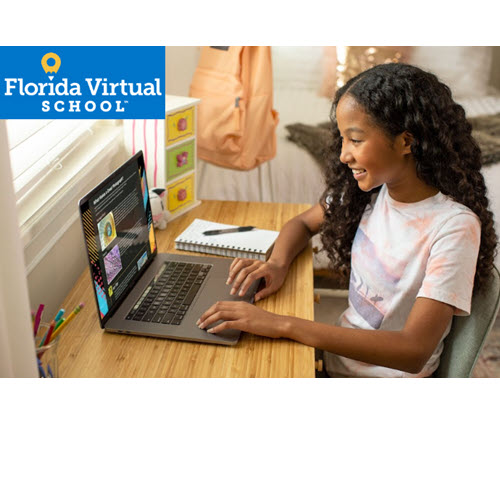
ORLANDO, Fla. — Florida Virtual School (FLVS) is partnering with the University of Florida (UF) and the Concord Consortium to introduce a groundbreaking year-long “Artificial Intelligence (AI) in Math” supplemental certification for FLVS middle and high school students enrolled in the school’s Flex option. FLVS instructors who teach Algebra 1 will lead this innovative program, teaching the online courses while also supplementing students’ learning with activities that build students’ understanding of math and AI concepts. FLVS students enrolled in Algebra 1 who elect to earn the certification will begin April 7.
The certification will introduce students to the foundational principles of AI that intersect with core math topics while offering insights into real-world applications, ethical considerations, and career opportunities in AI-related fields. By merging 21st-century technology with education, the program aims to boost students’ math skills, cultivate positive attitudes toward mathematics, and expose them to the rapidly evolving AI landscape.
“As a leader in online education for more than 27 years, Florida Virtual School is committed to being at the forefront of educational innovation,” said Dr. Louis Algaze, president and CEO of Florida Virtual School. “By partnering with the University of Florida and the Concord Consortium, we are equipping our students with essential math skills and the knowledge to navigate and succeed in an AI-enhanced world.”
The certification also includes a collaborative feedback loop between FLVS teachers and UF and Concord Consortium researchers. Teachers will provide critical insights into the online course structure and student outcomes, helping to refine and improve the certification’s effectiveness for future online learners.
“AI is revolutionizing industries worldwide, creating new opportunities,” said Jie Chao, project director at the Concord Consortium. “Our partnership with FLVS allows us to offer robust AI learning opportunities to students with limited access to such resources, bridging the educational gaps and preparing young people for an AI-powered future.”
FLVS teachers will also complete 40 hours of online professional development as part of the program. The training will include learning about specialized learning technologies designed to help visualize abstract math concepts and create interactive AI model explorations to ensure students engage with the AI development process in meaningful and dynamic ways.
FLVS Flex students who are either currently enrolled or are interested in taking Algebra 1 can now sign up for the “AI in Math” certification by filling out this survey. Students who complete the program as part of their FLVS math class will receive enrichment credit and the AI Literacy certificate issued by UF and the Concord Consortium.
About Florida Virtual School (FLVS)
At Florida Virtual School (FLVS), the student is at the center of every decision we make. For 27 years, our certified online teachers have worked one-on-one with students to understand their needs and ensure their success – with FLVS students completing 8.1 million semester courses since the school’s inception. As a fully accredited statewide public school district, Florida students in grades Kindergarten through 12 can enroll tuition-free in full-time and part-time online education options. With more than 200 effective and comprehensive courses, and over 80 fun and exciting clubs, FLVS provides families with a safe, reliable, and flexible education in a supportive environment. As a leading online education provider, FLVS also offers comprehensive digital learning solutions to school districts, from online courses that result in high student performance outcomes, to easy-to-use online platforms, staff training, and support. To learn more, visit our website.
eSchool Media staff cover education technology in all its aspects–from legislation and litigation, to best practices, to lessons learned and new products. First published in March of 1998 as a monthly print and digital newspaper, eSchool Media provides the news and information necessary to help K-20 decision-makers successfully use technology and innovation to transform schools and colleges and achieve their educational goals.
Hancy Maxis spent 17 years incarcerated in New York prisons. He knew that he needed to have a plan for when he got out.
“Once I am back in New York City, once I am back in the economy, how will I be marketable?” he said. “For me, math was that pathway.”
In 2015, Maxis completed a bachelor’s degree in math through the Bard Prison Initiative, an accredited college-in-prison program. He wrote his senior project about how to use game theory to advance health care equity, after observing the disjointed care his mom received when she was diagnosed with breast cancer. (She’s now recovered.)
When he was released in 2018, Maxis immediately applied for a master’s program at Columbia University’s Mailman School of Public Health. He graduated and now works as the assistant director of operations at Montefiore Medical Center in the Bronx. He helped guide the hospital’s response to Covid.
Maxis is one of many people I’ve spoken to in recent years while reporting on the role that learning math can play in the lives of those who are incarcerated. Math literacy often contributes to economic success: A 2021 study of more than 5,500 adults found that participants made $4,062 more per year for each correct answer on an eight-question math test.
While there don’t appear to be any studies specifically on the effect of math education for people in prison, a pile of research shows that prison education programs lower recidivism rates among participants and increase their chances of employment after they’re released.
Hancy Maxis spent 17 years incarcerated in New York prisons. He now works as the assistant director of operations at Montefiore Medical Center in the Bronx. Credit: Yunuen Bonaparte for The Hechinger Report
Plus, math — and education in general — can be empowering. A 2022 study found that women in prison education programs reported higher self-esteem, a greater sense of belonging and more hope for the future than women who had never been incarcerated and had not completed post-secondary education.
Yet many people who enter prison have limited math skills and have had poor relationships with math in school. More than half (52 percent) of those incarcerated in U.S. prisons lack basic numeracy skills, such as the ability to do multiplication with larger numbers, long division or interpret simple graphs, according to the most recent numbers from the National Center for Educational Statistics. The absence of these basic skills is even more pronounced among Black and Hispanic people in prison, who make up more than half of those incarcerated in federal prisons.
In my reporting, I discovered that there are few programs offering math instruction in prison, and those that do exist typically include few participants. Bard’s highly competitive program, for example, is supported primarily through private donations, and is limited to seven of New York’s 42 prisons. The recent expansion of federal Pell Grants to individuals who are incarcerated presents an opportunity for more people in prison to get these basic skills and better their chances for employment after release.
Alyssa Knight, executive director of the Freedom Education Project Puget Sound, which she co-founded while incarcerated, said that for years, educational opportunities in prison were created primarily by people who were incarcerated, who wrote to professors and educators to ask if they might send materials or teach inside the prison. But public recognition of the value of prison education, including math, is rising, and the Pell Grant expansion and state-level legislationhave made it easier for colleges to set up programs for people serving time. Now, Knight said, “Colleges are seeking prisons.”
Related: Interested in innovations in higher education? Subscribe to our free biweekly higher education newsletter.
Jeffrey Abramowitz understands firsthand how math can help someone after prison. After completing a five-year stint in a federal prison, his first post-prison job was teaching math to adults who were preparing to take the GED exam.
Fast forward nearly a decade, and Abramowitz is now the CEO of The Petey Greene Program, an organization that provides one-on-one tutoring, educational supports and programs in reading, writing and now math, to help people in prison and who have left prison receive the necessary education requirements for a high school diploma, college acceptance or career credentials.
The average Petey Greene student’s math skills are at a fourth- or fifth-grade level, according to Abramowitz, which is in line with the average for “justice-impacted” learners; the students tend to struggle with basic math such as addition and multiplication.
“You can’t be successful within most industries without being able to read, write and do basic math,” Abramowitz said. “We’re starting to see more blended programs that help people find a career pathway when they come home — and the center of all this is math and reading.”
Abramowitz and his team noticed this lack of math skills particularly among students in vocational training programs, such as carpentry, heating and cooling and commercial driving. To qualify to work in these fields, these students often need to pass a licensing test, requiring math and reading knowledge.
The nonprofit offers “integrated education training” to help students learn the relevant math for their professions. For instance, a carpentry teacher will teach students how to use a saw in or near a classroom where a math teacher explains fractions and how they relate to the measurements needed to cut a piece of wood.
“They may be able to do the task fine, but they can’t pass the test because they don’t know the math,” Abramowitz said.
Math helped Paul Morton after he left prison, he told me. When he began his 10.5 years in prison, he only could do GED-level math. After coming across an introductory physics book in the third year of his time in prison, he realized he didn’t have the math skills needed for the science described in it.
He asked his family to send him math textbooks and, over the seven years until his release, taught himself algebra and calculus.
The recent expansion of federal Pell Grants to individuals who are incarcerated presents an opportunity for more people in prison to get these basic skills and better their chances for employment after release. Credit: Helen H. Richardson/The Denver Post via Getty Images
“I relentlessly spent six hours on one problem one day,” he said. “I was determined to do it, to get it right.”
I met Morton through the organization the Prison Mathematics Project, which helped him develop his math knowledge inside prison by connecting him with an outside mathematician. After his release from a New York prison in 2023, he moved to Rochester, New York, and is hoping to take the actuarial exam, which requires a lot of math. He continues to study differential equations on his own.
The Prison Mathematics Project delivers math materials and programs to people in prison, and connects them with mathematicians as mentors. (It also brings math professors, educators and enthusiasts to meet program participants through “Pi Day” events; I attended one such event in 2023 when I produced a podcast episode about the program, and the organization paid for my travel and accommodations.)
The organization was started in 2015 by Christopher Havens, who was then incarcerated at Washington State Penitentiary in Walla Walla. Havens’ interest in math puzzles, and then in algebra, calculus and other areas of mathematics, was ignited early in his 25-year- term when a prison volunteer slid some sudoku puzzles under his door.
“I had noticed all these changes happening inside of me,” Havens told me. “My whole life, I was searching for that beauty through drugs and social acceptance … When I found real beauty [in math], it got me to practice introspection.”
As he fell in love with math, he started corresponding with mathematicians to help him solve problems, and talking to other men at the prison to get them interested too. He created a network of math resources for people in prisons, which became the Prison Mathematics Project.
The group’s website says it helps people in prison use math to help with “rebuilding their lives both during and after their incarceration.”
But Ben Jeffers, its executive director, has noticed that the message doesn’t connect with everyone in prison. Among the 299 Prison Mathematics Project participants on whom the program has data, the majority — 56 percent — are white, he told me, while 25 percent are Black, 10 percent are Hispanic, 2 percent are Asian and 6 percent are another race or identity. Ninety-three percent of project participants are male.
Yet just 30 percent of the U.S. prison population is white, while 35 percent of those incarcerated are Black, 31 percent are Hispanic and 4 percent are of other races, according to the United State Sentencing Commission. (The racial makeup of the program’s 18 female participants at women’s facilities is much more in line with that of the prison population at large.)
“[It’s] the same issues that you have like in any classroom in higher education,” said Jeffers, who is finishing his master’s in math in Italy. “At the university level and beyond, every single class is majority white male.”
He noted that anxiety about math tends to be more acute among women and people of any gender who are Black, Hispanic, or from other underrepresented groups, and may keep them from signing up for the program.
Sherry Smith understands that kind of anxiety. She didn’t even want to step foot into a math class. When she arrived at Southern Maine Women’s Reentry Center in December 2021, she was 51, had left high school when she was 16, and had only attended two weeks of a ninth grade math class.
“I was embarrassed that I had dropped out,” she said. “I hated to disclose that to people.”
Smith decided to enroll in the prison’s GED program because she could do the classes one-on-one with a friendly and patient teacher. “It was my time,” she said. “Nobody else was listening, I could ask any question I needed.”
In just five months, Smith completed her GED math class. She said she cried on her last day. Since 2022, she’s been pursuing an associate’s degree in human services — from prison — through a remote program with Washington County Community College.
In Washington, Prison Mathematics Project founder Havens is finishing his sentence and continuing to study math. (Havens has been granted a clemency hearing and may be released as early as this year.) Since 2020, he has published four academic papers: three in math and one in sociology. He works remotely from prison as a staff research associate in cryptography at the University of California, Los Angeles, and wrote a math textbook about continued fractions.
Havens is still involved in the Prison Mathematics Project, but handed leadership of the program over to Jeffers in October 2023. Now run from outside the prison, it is easier for the program to bring resources and mentorship to incarcerated students.
“For 25 years of my life, I can learn something that I wouldn’t have the opportunity to learn in any other circumstances,” Havens said. “So I decided that I would, for the rest of my life, study mathematics.”
Contact editor Caroline Preston at 212-870-8965 or [email protected].
The Hechinger Report provides in-depth, fact-based, unbiased reporting on education that is free to all readers. But that doesn’t mean it’s free to produce. Our work keeps educators and the public informed about pressing issues at schools and on campuses throughout the country. We tell the whole story, even when the details are inconvenient. Help us keep doing that.
When I was 12, my family lived adjacent to a small farm. Though I was not old enough to work, the farm’s owner, Mr. Hall, hired me to man his roadside stand on weekends. Mr. Hall had one rule: no calculators. Technology wasn’t his vibe.
Math was my strong suit in school, but I struggled to tally the sums in my head. I weighed odd amounts of tomatoes, zucchini and peppers on a scale and frantically scribbled calculations on a notepad. When it got busy, customers lined up waiting for me to multiply and add. I’m sure I mischarged them.
I was thinking about my old job as I read a quirky math study published this month in the journal Nature. Nobel Prize winning economists Abhijit Banerjee and Esther Duflo, a husband and wife research team at MIT, documented how teenage street sellers who were excellent at mental arithmetic weren’t good at rudimentary classroom math. Meanwhile, strong math students their same age couldn’t calculate nearly as well as impoverished street sellers.
“When you spend a lot of time in India, what is striking is that these market kids seem to be able to count very well,” said Duflo, whose primary work in India involves alleviating poverty and raising the educational achievement of poor children. “But they are really not able to go from street math to formal math and vice versa.”
Related: Our free weekly newsletter alerts you to what research says about schools and classrooms.
Ina series of experiments, Duflo’s field staff in India pretended to be ordinary shoppers and purposely bought unusual quantities of items from more than 1,400 child street sellers in Delhi and Kolkata. A purchase might be 800 grams of potatoes at 20 rupees per kilogram and 1.4 kilograms of onions at 15 rupees per kilogram. Most of the child sellers quoted the correct price of 37 rupees and gave the correct change from a 200 rupee note without using a calculator or pencil and paper. The odd quantities were to make sure the children hadn’t simply memorized the price of common purchases. They were actually making calculations.
However, these same children, the majority of whom were 14 or 15 years old, struggled to solve much simpler school math problems, such as basic division. (After making the purchases, the undercover shoppers revealed their identities and asked the sellers to participate in the study and complete a set of abstract math exercises.)
The market sellers had some formal education. Most were attending school part time, or had previously been in school for years.
Duflo doesn’t know how the young street sellers learned to calculate so quickly in their heads. That would take a longer anthropological study to observe them over time. But Duflo was able to glean some of their strategies, such as rounding. For example, instead of multiplying 490 by 20, the street sellers might multiply 500 by 20 and then remove 10 of the 20s, or 200. Schoolchildren, by contrast, are prone to making lengthy pencil and paper calculations using an algorithm for multiplication. They often don’t see a more efficient way to solve a problem.
Lessons from this research on the other side of the world might be relevant here in the United States. Some cognitive psychologists theorize that learning math in a real-world context can help children absorb abstract math and apply it in different situations. However, this Indian study shows that this type of knowledge transfer probably won’t happen automatically or easily for most students. Educators need to figure out how to better leverage the math skills that students already have, Duflo said. Easier said than done, I suspect.
Duflo says her study is not an argument for either applied or abstract math. “It would be a mistake to conclude that we should switch to doing only concrete problems because we also see that kids who are extremely good at concrete problems are unable to solve an abstract problem,” she said. “And in life, at least in school life, you’re going to need both.” Many of the market children ultimately drop out of school altogether.
Back at my neighborhood farmstand, I remember how I magically got the hang of it and rarely needed pencil and paper after a few months. Sadly, the Hall farm is no longer there for the town’s children to practice mental math. It’s now been replaced by a suburban subdivision of fancy houses.
This story about applied math was written by Jill Barshay and produced by The Hechinger Report, a nonprofit, independent news organization focused on inequality and innovation in education. Sign up for Proof Points and other Hechinger newsletters.
The Hechinger Report provides in-depth, fact-based, unbiased reporting on education that is free to all readers. But that doesn’t mean it’s free to produce. Our work keeps educators and the public informed about pressing issues at schools and on campuses throughout the country. We tell the whole story, even when the details are inconvenient. Help us keep doing that.
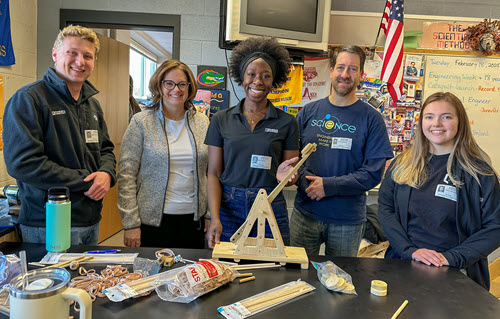
Middletown, PA – Phoenix Contact engineers head back into the classroom this week to teach sixth-grade science class at Middletown Area Middle School in Middletown, Pa. The classes are part of Phoenix Contact’s National Engineers Week celebration.
Phoenix Contact has worked with the school every February since 2007. The engineers lead hands-on lessons that make science fun. The goal is to inspire young people to consider careers in science, technology, engineering, and math (STEM).
The lessons include:
Building catapults
Racing cookie tins down ramps
Building an electric motor
Learning about static electricity with the Van de Graaff generator
“Our engineering team created this outreach program many years ago, and the partnership with Middletown Area School District has stood the test of time,” said Patty Marrero, interim vice president of human relations at Phoenix Contact. “National Engineers Week is a special time for them to share their passion for technology with students. It’s also our chance to thank our engineers for the creativity and innovations that drive our company forward.”
About Phoenix Contact
Phoenix Contact is a global market leader based in Germany. Since 1923, Phoenix Contact has created products to connect, distribute, and control power and data flows. Our products are found in nearly all industrial settings, but we have a strong focus on the energy, infrastructure, process, factory automation, and e-mobility markets. Sustainability and responsibility guide every action we take, and we’re proud to work with our customers to empower a smart and sustainable world for future generations. Our global network includes 22,000 employees in 100+ countries. Phoenix Contact USA has headquarters near Harrisburg, Pa., and employs more than 1,100 people across the U.S.
For more information about Phoenix Contact or its products, visit www.phoenixcontact.com, call technical service at 800-322-3225, or email [email protected].
eSchool Media staff cover education technology in all its aspects–from legislation and litigation, to best practices, to lessons learned and new products. First published in March of 1998 as a monthly print and digital newspaper, eSchool Media provides the news and information necessary to help K-20 decision-makers successfully use technology and innovation to transform schools and colleges and achieve their educational goals.
In the words of Carol Dweck, “Becoming is better than being.” As novice sixth grade math and English teachers, we’ve learned to approach our mid-year benchmark assessments not as final judgments but as tools for reflection and growth. Many of our students entered the school year below grade level, and while achieving grade-level mastery is challenging, a growth mindset allows us to see their potential, celebrate progress, and plan for further successes amongst our students. This perspective transforms data analysis into an empowering process; data is a tool for improvement amongst our students rather than a measure of failure.
A growth mindset is the belief that abilities grow through effort and persistence. This mindset shapes how we view data. Instead of focusing on what students can’t do, we emphasize what they can achieve. For us, this means turning gaps into opportunities for growth and modeling optimism and resilience for our students. When reviewing data, we don’t dwell on weaknesses. We set small and achievable goals to help students move forward to build confidence and momentum.
Celebrating progress is vital. Even small wins (i.e., moving from a kindergarten grade-level to a 1st– or 2nd-grade level, significant growth in one domain, etc.) are causes for recognition. Highlighting these successes motivates students and shows them that effort leads to results.
Involving students in the process is also advantageous. At student-led conferences, our students presented their data via slideshows that they created after they reviewed their growth, identified their strengths, and generated next steps with their teachers. This allowed them to feel and have tremendous ownership over their learning. In addition, interdisciplinary collaboration at our weekly professional learning communities (PLCs) has strengthened this process. To support our students who struggle in English and math, we work together to address overlapping challenges (i.e., teaching math vocabulary, chunking word-problems, etc.) to ensure students build skills in connected and meaningful ways.
We also address the social-emotional side of learning. Many students come to us with fixed mindsets by believing they’re just “bad at math” or “not good readers.” We counter this by celebrating effort, by normalizing struggle, and by creating a safe and supportive environment where mistakes are part of learning. Progress is often slow, but it’s real. Students may not reach grade-level standards in one year, but gains in confidence, skills, and mindset set the stage for future success, as evidenced by our students’ mid-year benchmark results. We emphasize the concept of having a “growth mindset,” because in the words of Denzel Washington, “The road to success is always under construction.” By embracing growth and seeing potential in every student, improvement, resilience, and hope will allow for a brighter future.
Latest posts by eSchool Media Contributors (see all)
This story was produced by the Associated Press and reprinted with permission.
Math is the subject sixth grader Harmoni Knight finds hardest, but that’s changing.
In-class tutors and “data chats” at her middle school in Compton, California, have made a dramatic difference, the 11-year-old said. She proudly pulled up a performance tracker at a tutoring session last week, displaying a column of perfect 100 percent scores on all her weekly quizzes from January.
Since the pandemic first shuttered American classrooms, schools have poured federal and local relief money into interventions like the ones in Harmoni’s classroom, hoping to help students catch up academically following COVID-19 disruptions.
But a new analysis of state and national test scores shows the average student remains half a grade level behind pre-pandemic achievement in both reading and math. In reading, especially, students are even further behind than they were in 2022, the analysis shows.
Compton is an outlier, making some of the biggest two-year gains in both subjects among large districts. And there are other bright spots, along with evidence that interventions like tutoring and summer programs are working.
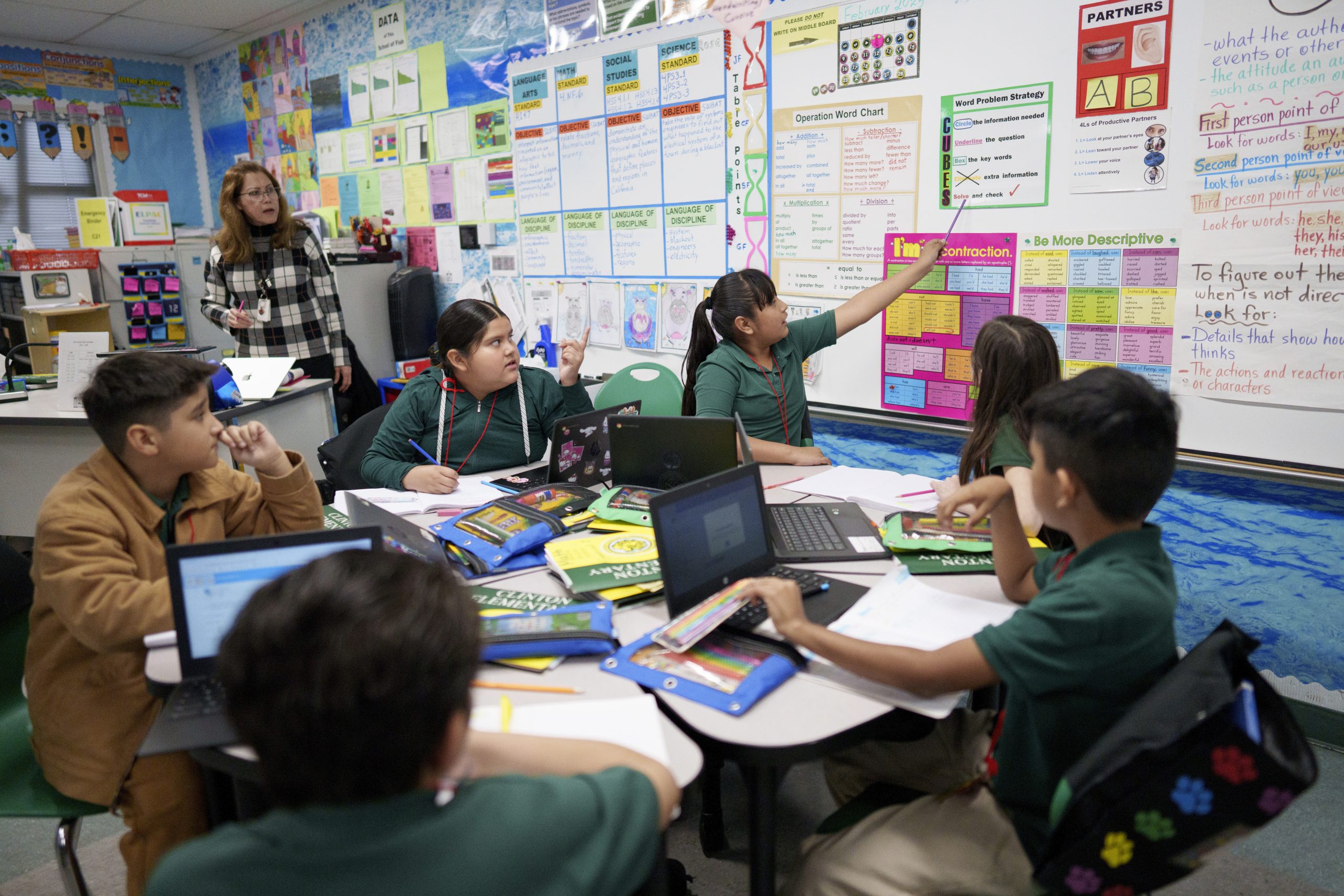
Students interact in a fourth grade classroom at William Jefferson Clinton Elementary in Compton, Calif., Thursday, Feb. 6, 2025. Credit: Eric Thayer/Associated Press
The Education Recovery Scorecard analysis by researchers at Harvard, Stanford and Dartmouth allows year-to-year comparisons across states and districts, providing the most comprehensive picture yet of how American students are performing since COVID-19 first disrupted learning.
The most recent data is based on tests taken by students in spring 2024. By then, the worst of the pandemic was long past, but schools were dealing still with a mental health crisis and high rates of absenteeism — not to mention students who’d had crucial learning disrupted.
“The losses are not just due to what happened during the 2020 to 2021 school year, but the aftershocks that have hit schools in the years since the pandemic,” said Tom Kane, a Harvard economist who worked on the scorecard.
In some cases, the analysis shows school districts are struggling when their students may have posted decent results on their state tests. That’s because each state adopts its own assessments, and those aren’t comparable to each other. Those differences can make it impossible to tell whether students are performing better because of their progress, or whether those shifts are because the tests themselves are changing, or the state has lowered its standards for proficiency.
The Scorecard accounts for differing state tests and provides one national standard.
Higher-income districts have made significantly more progress than lower-income districts, with the top 10 percent of high-income districts four times more likely to have recovered in both math and reading compared with the poorest 10 percent. And recovery within districts remains divided by race and class, especially in math scores. Test score gaps grew by both race and income.
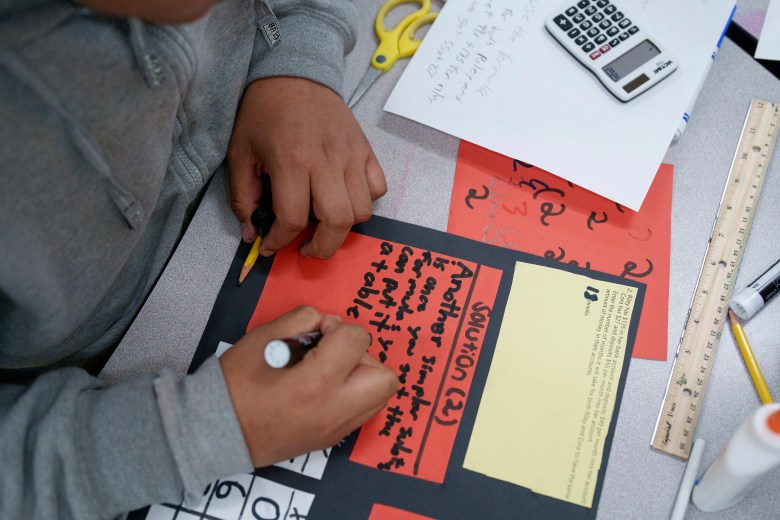
A student works in a classroom at Benjamin O. Davis Middle School in Compton, Calif., Thursday, Feb. 6, 2025. Credit: Eric Thayer/Associated Press
“The pandemic has not only driven test scores down, but that decline masks a pernicious inequality that has grown during the pandemic,” said Sean Reardon, a Stanford sociologist who worked on the scorecard. “Not only are districts serving more Black and Hispanic students falling further behind, but even within those districts, Black and Hispanic students are falling further behind their white district mates.”
Still, many of the districts that outperformed the country serve predominantly low-income students or students of color, and their interventions offer best practices for other districts.
Related: Become a lifelong learner. Subscribe to our free weekly newsletter featuring the most important stories in education.
In Compton, the district responded to the pandemic by hiring over 250 tutors that specialize in math, reading and students learning English. Certain classes are staffed with multiple tutors to assist teachers. And schools offer tutoring before, during and after school, plus “Saturday School” and summer programs for the district’s 17,000 students, said Superintendent Darin Brawley.
To identify younger students needing targeted support, the district now conducts dyslexia screenings in all elementary schools.
The low-income school district near downtown Los Angeles, with a student body that is 84 percent Latino and 14 percent Black, now has a graduation rate of 93 percent, compared with 58 percent when Brawley took the job in 2012.
Harmoni, the sixth-grader, said that one-on-one tutoring has helped her grasp concepts and given her more confidence in math. She gets separate “data chats” with her math specialist that are part performance review, part pep talk.
“Looking at my data, it kind of disappoints me” when the numbers are low, said Harmoni. “But it makes me realize I can do better in the future, and also now.”
Brawley said he’s proud of the district’s latest test scores, but not content.
“Truth be told, I wasn’t happy,” he said. “Even though we gained, and we celebrate the gains, at the end of the day we all know that we can do better.”
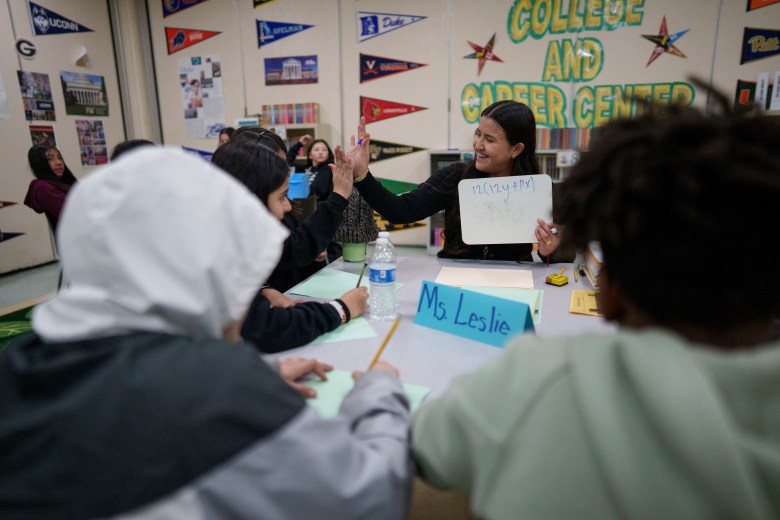
A tutor helps students at Benjamin O. Davis Middle School in Compton, Calif., Thursday, Feb. 6, 2025. Credit: Eric Thayer/Associated Press
As federal pandemic relief money for schools winds down, states and school districts will have limited resources and must prioritize interventions that worked. Districts that spent federal money on increased instructional time, either through tutoring or summer school, saw a return on that investment.
Reading levels have continued to decline, despite a movement in many states to emphasize phonics and the “science of reading.” So Reardon and Kane called for an evaluation of the mixed results for insights into the best ways to teach kids to read.
The researchers emphasized the need to extend state and local money to support pandemic recovery programs that showed strong academic results. Schools also must engage parents and tell them when their kids are behind, the researchers said.
And schools must continue to work with community groups to improve students’ attendance. The scorecard identified a relationship between high absenteeism and learning struggles.
In the District of Columbia, an intensive tutoring program helped with both academics and attendance, said D.C. Public Schools Chancellor Lewis Ferebee. In the scorecard analysis, the District of Columbia ranked first among states for gains in both math and reading between 2022 and 2024, after its math recovery had fallen toward the bottom of the list.
Pandemic-relief money funded the tutoring, along with a system of identifying and targeting support at students in greatest need. The district also hired program managers who helped maximize time for tutoring within the school day, Ferebee said.
Students who received tutoring were more likely to be engaged with school, Ferebee said, both from increased confidence over the subject matter and because they had a relationship with another trusted adult.
Students expressed that “I’m more confident in math because I’m being validated by another adult,” Ferebee said. “That validation goes a long way, not only with attendance, but a student feeling like they are ready to learn and are capable, and as a result, they show up differently.”
Federal pandemic relief money has ended, but Ferebee said many of the investments the district made will have lasting impact, including the money spent on teacher training and curriculum development in literacy.
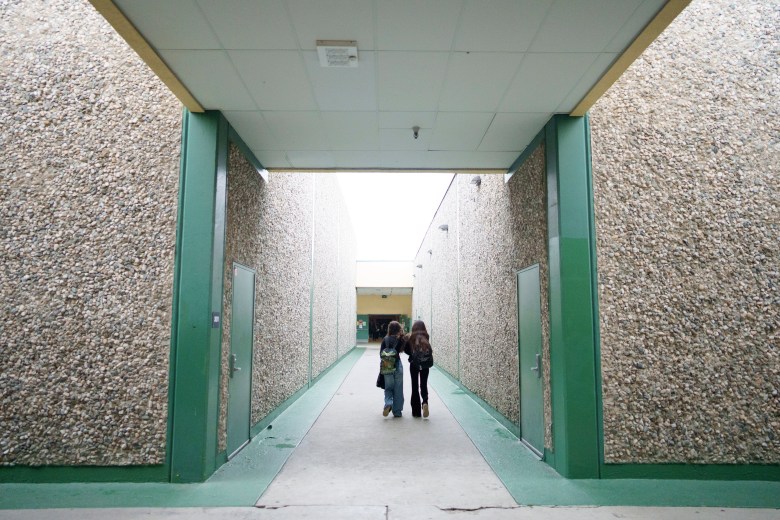
Students walk through a hallway at Benjamin O. Davis Middle School in Compton, Calif., Thursday, Feb. 6, 2025. Credit: Eric Thayer/Associated Press
Christina Grant, who served as the District of Columbia’s state superintendent of education until 2024, said she’s hopeful to see the evidence emerging on what’s made a difference in student achievement.
“We cannot afford to not have hope. These are our students. They did not cause the pandemic,” Grant said. “The growing concern is ensuring that we can … see ourselves to the other side.”
The Associated Press’ education coverage receives financial support from multiple private foundations. AP is solely responsible for all content. Find AP’s standards for working with philanthropies, a list of supporters and funded coverage areas at AP.org.
The Hechinger Report provides in-depth, fact-based, unbiased reporting on education that is free to all readers. But that doesn’t mean it’s free to produce. Our work keeps educators and the public informed about pressing issues at schools and on campuses throughout the country. We tell the whole story, even when the details are inconvenient. Help us keep doing that.