Tag: News

  • Richard Bland wins total autonomy from William & Mary

    Richard Bland wins total autonomy from William & Mary

    Richard Bland College is one step closer to total autonomy, the Progress-Index reported.

    The public two-year college in Virginia, established in 1960 as an extension campus of William & Mary, has always been governed by its parent institution’s Board of Visitors. Now both houses of the State Legislature have passed a bill that establishes an independent, nine-member Board of Visitors for Richard Bland—a longtime goal of the college’s administrators.

    The legislation now awaits Governor Glenn Youngkin’s signature.

    “Governor Youngkin has demonstrated his commitment to growth and prosperity in Petersburg, and his support of RBC’s independence will add to that legacy,” said Richard Bland president Debbie Sydow.

    While the college has always operated independently of William & Mary, efforts to set up its own board have been ongoing for over a decade.

    Sydow called the new legislation “momentous, especially as RBC is poised to deepen and expand its strategic partnerships.” 

    Source link

  • Senate panel approves McMahon for education secretary

    Senate panel approves McMahon for education secretary

    Chip Somodevilla/Getty Images

    Linda McMahon’s bid to become the next education secretary moved forward Thursday after a Senate committee voted 12–11 along party lines to advance her nomination.

    At the preceding committee hearing on Feb. 13, Republicans of the Health, Education, Labor and Pensions Committee largely praised McMahon, saying they couldn’t think of a better person to lead the nation’s education system.

    They used their questions to ensure the nominee recognized that only Congress has the statutory power to carry out Trump’s plan to abolish the Education Department—to which she said, “Well, certainly President Trump understands that we will be working with Congress.” In addition to shutting down or reducing the size of the department, McMahon made clear at the hearing that she supports combating campus antisemitism, prohibiting trans women from participating in sports and eliminating diversity, equity and inclusion programs.

    Since the hearing, the Education Department released a sweeping Dear Colleague letter that directs colleges to end any race-based policies or programming in K-12 schools and colleges by Feb. 28. The letter, which targeted “every facet of academia,” has received significant pushback from the public but likely won’t affect McMahon’s confirmation.

    The committee’s vote advances McMahon’s confirmation to the Senate. The full Senate will now vote on McMahon’s nomination, likely in the next two weeks.

    Once formally recognized as secretary, McMahon will be an important arrow in Trump’s quiver, as she’s seen as dedicated to carrying out the president’s agenda, from abolishing the agency to stripping certain institutions of access to federal student aid when they do not align with his ideals.

    This story will be updated.

    Source link

  • Higher ed must resist authoritarian rule. It’s the mission.

    Higher ed must resist authoritarian rule. It’s the mission.

    Together, we should be clear on what President Donald Trump is trying to do to higher education.

    Destroy it. Whatever public rationales he or his administration release, the intent of his actions is clear, so if we’re going to discuss responses to those actions, we must remember, always, that Donald Trump is trying to destroy higher education.

    Michelle Goldberg at The New York Times gets it; the rest of us should, too.

    This goal is not new. In 2021 in a speech at the National Conservatism Conference, future vice president JD Vance declared, “We have to honestly and aggressively attack the universities in this country.” Vance (and Trump) are open admirers of Hungarian authoritarian leader Viktor Orbán, who has subjugated the once-free higher education institutions of his country to his own needs.

    This is the Trump/Vance playbook. The unannounced, unilateral (now paused thanks to court intervention) cuts to NIH grants, and the Dear Colleague letter that goes well beyond, and even actively distorts current law to threaten institutions with punishment for failing to obey, are just the latest attacks in a war that has been going on for quite some time, and not just at the federal level, but in the states as well, as exemplified by Ron DeSantis’s wanton destruction of Florida’s New College.

    Sadly, as callous, counterproductive and wasteful of taxpayer money as it was, DeSantis taking a wrecking ball to New College in order to install his cronies while recruiting enough athletes for three baseball teams—despite New College not being in an athletic conference—was within the power of the state’s chief executive.

    What Trump is doing to higher education institutions is not. It should be unthinkable for institutions to obey diktats that are not only unlawful, but in direct conflict with the purported mission of the institution.

    If any institutional leaders are thinking that if they do just enough compliance with Trump’s demands, he will stop the war, they are kidding themselves.

    How is the rush to declare institutional neutrality to not just words but actions, as enacted by Vanderbilt chancellor Daniel Diermeier last year, working out? Surely they are feeling secure knowing that they got ahead of the abuse.

    What’s that? That isn’t happening? Turns out Vanderbilt has had to pause graduate student admissions because of concerns about funding. I guess surrendering in advance wasn’t the way to go.

    I used Vanderbilt only because it was a recent, handy example, not the only one. The silence from major, well-resourced higher education institutions is truly deafening.

    Writing at her personal website, Jackie Gharapour Wernz, an education and civil rights attorney, calls the Dear Colleague letter “regulation by intimidation,” which is exactly right. Bending the knee at this moment only demonstrates the effectiveness of intimidation.

    Wernz walks through a number of ways the advisories in the letter go well beyond well-established law, while also making an additional important point: Trump is busy gutting the very agencies that would be able to do the investigation and enforcement of institutions they believe are in violation of legal regulations. This reality, plus the various procedural steps involved in these investigations, suggests that it may be far more advantageous to dig in and run out the clock of this initial flurry, particularly when existing law is clearly on your side.

    But this doesn’t seem to be the strategy for most institutions. They are going to hope this goes away. Trying to make yourself a smaller target doesn’t mean the people intent on destroying you are going to stop attacking.

    Interestingly, the group of higher ed leaders who are … uh … leading belong to the Education for All coalition, primarily consisting of community college administrators. Under the “freedom’s just another world for nothing left to lose” theory, this should not be surprising. Giving in to the Trump administration’s demands to give up on providing educational opportunities to diverse cohorts of students with different desires and needs would be to abandon their work entirely. Their defiance is both principled and practical.

    To me, this suggests that the more prestigious institutions that are cowering in the face of the intimidation perhaps do not see their mission in terms of providing access to all. In a lot of ways, the present situation is primarily revealing that which we already knew—that the interests in diversity, equity and inclusion in elite spaces were a virtue-signaling scrim over the much less savory reality of wealth and exclusion.

    Look, I’m getting worked up here. The truth is, I don’t wish any harm on any higher education institution, but the institutions with the most resources, most power and most influence must step up.

    The present threat goes well beyond an attack on the institutional coffers. These attacks on higher education are part of a much broader push toward authoritarianism as a federal executive (and his minions) direct the actions of formerly free institutions and people.

    The good news is that should institutions stand up for themselves, I think they will find many people standing up with them, including, most importantly, the students. Unfortunately, the longer institutions hesitate to stand for the values they claim to hold, the more distrust they’re sowing with the very constituencies who could save them, who do not want to destroy them, but the opposite, who want to see them thrive.

    The stakes are almost impossibly high. Shouldn’t we act like it?

    Source link

  • Florida ends in-state tuition for undocumented students

    Florida ends in-state tuition for undocumented students

    Florida state lawmakers have eliminated in-state tuition for undocumented students, reversing a decade-old law that once enjoyed bipartisan support.

    Previously, undocumented students in Florida could apply for waivers to pay in-state tuition rates, if they went to high school in the state for at least three consecutive years and enrolled in college within two years of graduating.

    Under the new policy, included in a sweeping immigration bill signed by Governor Ron DeSantis last week, only “citizens of the United States” or those “lawfully present in the United States” qualify. Students receiving the waivers need to be “reevaluated for eligibility” by July 1.

    “I don’t think you should be admitted to college in Florida if you’re here illegally,” DeSantis said in a press conference Friday, “but to give in-state tuition was just a slap in the face to taxpayers.”

    Florida was one of 25 states that offered in-state tuition to undocumented students at public colleges and universities, according to the Higher Ed Immigration Portal, a data hub run by the Presidents’ Alliance on Higher Education and Immigration. These reduced tuition prices came as a relief to undocumented students, who can’t access federal financial aid like their peers and often lack work authorization unless they’re part of the Deferred Action for Childhood Arrivals, or DACA, program. (Of the approximately 400,000 undocumented students enrolled in U.S. colleges and universities, most don’t hold DACA status.)

    Policymakers in other states are considering taking similar steps to curb in-state tuition for these students as they embrace President Donald Trump’s national push against undocumented immigration. Since the presidential election in November, state lawmakers in Massachusetts, Minnesota and Texas have introduced legislation to remove in-state tuition for undocumented students. As the issue becomes a political lightning rod, politicians in other states are doubling down on financial supports for these students, introducing bills that would expand in-state tuition eligibility, including in Indiana, New Mexico, Oregon and Pennsylvania.

    Miriam Feldblum, president and CEO of the Presidents’ Alliance, said advocates “should be prepared and ready” to come out against similar legislation elsewhere in the country.

    A Game of ‘Political Football’

    In-state tuition for undocumented students has become a “political football” in Florida, said Jared Nordlund, Florida state director at UnidosUS, a Latino civil rights organization. But that wasn’t always the case.

    Republican lieutenant governor Jeanette Nuñez—who resigned last week to become interim president of Florida International University—originally advocated for extending in-state tuition to undocumented students, and former Republican governor Rick Scott, now Florida’s senior U.S. senator, signed the bill into law. Nuñez has since pulled back her support for the policy, posting on X in January that the law had “run its course” and needed to be repealed.

    The political winds have shifted on what was once a fairly bipartisan issue, Nordlund said. “Ten years ago, the Republican Party wasn’t the party of Trump.”

    Ira Mehlman, media director at the Federation for American Immigration Reform, an organization that promotes more restrictive immigration policies, applauded Republican state lawmakers for “not rewarding people who are in the country illegally.”

    “The more you reward people for breaking the laws, even if it’s through their kids, the more likely people are to disobey the laws,” Mehlman said. And “you are filling seats that might otherwise have gone to kids who are equally deserving and whose parents have not violated any laws.”

    Now undocumented students are left to pay out-of-state tuition prices, a significant cost difference. During the 2023–24 academic year, average tuition and fees at Florida colleges and universities for out-of-state students was more than triple the cost state residents paid, according to the Florida Policy Institute, an organization that promotes economic mobility in Florida. The state’s in-state tuition waivers benefited an estimated 6,500 undocumented students that year.

    The Ripple Effects

    An undocumented student at University of Central Florida, who requested anonymity, told Inside Higher Ed that she couldn’t have pursued a bachelor’s degree as a full-time student without in-state tuition. She would’ve gone for an associate degree instead, taking one or two classes at a time, to keep costs down.

    Without in-state tuition, “who knows if I’d be graduating right now,” she said.

    The student, who was brought to Florida from Mexico at age 4, is graduating this spring, before the policy change takes effect. But she worries about her peers who won’t have the same resources she did. She previously helped and encouraged other undocumented students to apply for the in-state tuition waiver because of how much it helped her.

    “I gave them that hope,” she said, “and now it’s being snatched away from them.”

    The student argued she and other undocumented students would use their degrees to contribute to the local labor market, a point they’ve made to state lawmakers in the past; her long-term goal is to open a marketing agency and work with small business owners in the state.

    “We studied here our whole life, and our goal is to get our degree and be able to contribute to the economy,” she said.

    Diego Sánchez, director of policy and strategy at the Presidents’ Alliance, said he scrambled to pay for college in Florida before in-state tuition became available to undocumented students like him.

    In 2008, he enrolled at St. Thomas University, a private institution, and joined as many activities as he could that came with university scholarships—student government, choir and cross country, even though he wasn’t a singer or a runner. He couldn’t have afforded college otherwise, which is why he and other activists advocated for in-state tuition for Florida’s undocumented population. He’s “very disappointed” to see that win reversed.

    “It’s about scoring political points,” Sánchez said. “And unfortunately, these students who grew up in Florida, went to our public schools, are going to suffer the consequences … The state has already invested in them, and they’re working their way up to contribute to the community, [to] pay taxes.”

    Undocumented students and their supporters argue Florida is going to lose out on these students as future skilled workers at a time when the state is challenged by workforce shortages and an aging population.

    Feldblum said these students tend to be “tremendously determined” and will likely attend college in other states, taking their talents with them. She also expects some will stop out of higher ed altogether because they can’t afford it or because they don’t know about other resources available to them, like privately funded scholarships.

    “When there are obstacles put in front of students, when students are told, ‘You’re not welcome here’ in different ways, that’s really discouraging,” she said. “That’s disincentivizing,” when Florida has a “need for talent, the need for workforce development.”

    What’s Next

    The fight for in-state tuition in Florida isn’t over, some advocates say.

    “Hopefully we can eventually undo the repeal [of in-state tuition] when the time is right,” Nordlund said. For now, he’s focused on educating state lawmakers and the public about the economic benefits of the repealed policy.

    Sánchez plans to lobby state lawmakers to at least let undocumented students already in college finish their degrees at in-state tuition prices, a proposed amendment to the law that previously failed. He hopes colleges and universities push state lawmakers on the issue as well.

    He continues to worry, however, that these kinds of attacks on students’ in-state tuition “could spread to other parts of the country.”

    Mehlman would like to see other states, and even Congress, look to Florida’s example and work to end in-state tuition for noncitizens nationwide.

    “Florida and Texas have sort of been leaders in this area,” he said, “and they certainly can show the way for other states that might be considering this as well.”

    Source link

  • This LSU law professor’s job has become a legal drama

    This LSU law professor’s job has become a legal drama

    In a Jan. 14 lecture, Ken Levy, Holt B. Harrison Distinguished Professor of Law at Louisiana State University, dropped f-bombs against then–president-elect Donald Trump and Louisiana governor Jeff Landry and told students who like Trump that they need his “political commentary.”

    Some students found the apparent attempt at political humor funny, according to an audio recording of the class obtained by Inside Higher Ed from a student who supports Levy.

    But at least one student in the administration of criminal justice class who subsequently complained, according to LSU, wasn’t amused—and neither were the university and the governor. An LSU spokesperson said the institution “took immediate action to remove Professor Levy from the classroom after complaints about the professor’s remarks.”

    Levy got a lawyer and took immediate action himself, pulling LSU into court instead of waiting for the university to take further steps internally regarding his job.

    In the month since that lecture, state district court judges have twice ruled that Levy should return to the classroom, only for a state appeals court to twice overrule that. The back-and-forth nature of the case has attracted attention in Louisiana and in law circles, including via headlines such as “The LSU Law School Professor Free Speech Hot Potato Saga Continues.”

    Landry also continues to discuss the case. A Republican governor who’s repeatedly inserted himself in LSU affairs, Landry used social media in the fall to call on the university to punish one of Levy’s law school colleagues for alleged in-class comments about Trump-supporting students. Landry has now repeatedly posted about Levy, recently saying an alleged exam he gave was incendiary and suggesting that “maybe it’s time to abolish tenure.”

    In and Out

    In the lecture in question, Levy referenced Landry’s previous criticism of his LSU colleague Nick Bryner, adding that he “would love to become a national celebrity [student laughter drowns out a moment of the recording] based on what I said in this class, like, ‘Fuck the governor!’”

    Levy also referenced Trump. “You probably heard I’m a big lefty, I’m a big Democrat, I was devastated by— I couldn’t believe that fucker won, and those of you who like him, I don’t give a shit, you’re already getting ready to say in your evaluations, ‘I don’t need his political commentary,’” Levy told students. “No, you need my political commentary, you above all others.”

    A few days after that lecture, LSU notified Levy he was suspended from teaching pending an investigation into student complaints, according to a letter from the university provided by Levy’s attorney, Jill Craft.

    On Jan. 28, Craft filed a request for a temporary restraining order against LSU to get Levy back in the classroom. The filing alleged that a student complained to the governor, not LSU, and calls were then made to LSU. A state district court judge granted the restraining order Jan. 30 without a hearing.

    In the first reversal, a panel of appellate judges wrote Feb. 4 that the lower court shouldn’t have approved the return-to-teaching part of the temporary restraining order without a full evidentiary hearing. But after the lower court held a two-day hearing last week, a different group of appellate judges overruled Levy’s return to teaching again—without explaining why.

    Local journalists who covered last week’s hearing reported that district court judge Tarvald Anthony Smith kicked an LSU deputy general counsel out of the courtroom because the lawyer told the law school dean, who was a scheduled and sequestered witness, about a student witness’s earlier testimony. The testimony was reportedly that the student had recorded a conversation with the dean.

    Smith ruled Feb. 11 that LSU policy required the university to keep Levy in class during the investigation of his comments, WBRZ reported. But a Feb. 4 statement from university spokesman Todd Woodward to Inside Higher Ed suggested the investigation was already over: “Our investigation found that Professor Levy created a classroom environment that was demeaning to students who do not hold his political view, threatening in terms of their grades and profane.” The university didn’t make anyone available for an interview about the case.

    Amid this legal back-and-forth, Landry continues to denounce Levy on social media. Last week, Landry posted on X an alleged exam from Levy that included potential sexual and other crimes committed by various fictitious individuals and asked students at the end to “discuss all potential crimes and defenses.” The narrative included a teen who put his penis into pumpkins on Halloween and was seen by trick-or-treating children, and a powerful Republican and suspected pedophile who invited the children inside to dance for him.

    “Disgusting and inexcusable behavior from Ken Levy,” Landry wrote on X regarding what he claimed was Levy’s test. “Deranged behavior like this has no place in our classrooms! If tenure protects a professor from this type of conduct, then maybe it’s time to abolish tenure.” Asked about this document, Craft said she believes the assignment was part of the sex crimes portion of Levy’s criminal law exam years ago, but she did not confirm it.

    After the latest appellate ruling in LSU’s favor, Landry wrote on X that “Levy should stay far, far away from any classroom in Louisiana!”

    Craft said Levy has received death threats on X due to Landry’s comments there. “This seems to be a situation entirely of the governor’s making,” she said. “He has been active on social media, trying to accuse my client of all kinds of bad things. He’s a lawyer himself. He attacked the courts and the judge.”

    Landry’s office didn’t respond to requests for comment.

    Craft also said Levy’s roughly 80 students remain with another 80 in another professor’s classroom.

    “I’m not sure how he can handle office hours for 160 law students,” Craft said of that second professor. The university says it’s doubled the number of student tutors for the course.

    No Longer the U.S.?

    Craft said Levy was set to return to the classroom Feb. 13, but Louisiana’s First Circuit Court of Appeal issued its two-sentence order around 9:30 a.m. that appeared to stay the part of the lower court’s order that returned Levy to teaching.

    LSU again kept Levy out of the classroom Tuesday, Craft said. But she said the rest of the lower court order remains in place, at least for now, and that prevents LSU from taking further employment action against Levy due to his expression.

    “This is a critical issue, and I feel like we have got to, as a nation, understand that there has to be academic freedom, there has to be free speech in this country, and there have to be protections against governmental intrusions without due process,” she said. “We take all that away and we are no longer the United States of America.”

    Source link

  • Lawsuit slaps heart of academic freedom (opinion)

    Lawsuit slaps heart of academic freedom (opinion)

    A lawsuit filed in July against the Columbia University chapter of the American Association of University Professors, along with 20 other organizations and individuals, alleged that our public statements in support of antiwar and pro-Palestinian student protests last spring harmed other students by contributing to the campus shutdown that followed. Unraveling the cynical logic of this claim is for the courts. But what is clear from this lawsuit is that the purpose of such recourse to legal theater is not to ameliorate harm. It is to silence public and academic speech.

    This effort is part and parcel of a broader attack on higher education, one characterized by legislative attacks on diversity, equity and inclusion; instruction; and tenure; and an epidemic of jawboning by public officials meddling into curricula, campus programming and even the careers of individual faculty members. Following a series of executive orders from President Donald Trump, colleges and universities across the country now find themselves in the crosshairs.

    The tactic used against us is what is known as a strategic lawsuit against public participation (SLAPP). These suits are brought principally not to win in court but to harass and intimidate individuals or groups into curtailing speech. By entangling defendants in costly and invasive litigation—or even just threatening to do so—plaintiffs can frighten those with whom they disagree into silence. In the context of higher education, this comes at an incalculable cost.

    On its own, this lawsuit certainly threatens the speech of Columbia-AAUP. But in the current climate, it also opens a front in the widespread attack on universities as sanctuaries of critical inquiry and reasoned debate. In their mere filing, lawsuits like this one aim especially to chill dissenting speech, including speech that takes place at the intersection of the classroom and the public square. Such legal instruments are a dangerous cudgel that could be used to threaten broad swaths of political and academic speech on American campuses.

    Our chapter has precisely sought to combat this hostile environment in the speech over which we are being sued. In multiple public statements made during the height of the campus protests last spring, we condemned partisan congressional meddling in Columbia’s affairs, arguing that this “undermine[s] the traditions of shared governance and academic freedom.” We called for a vote of no confidence in university leadership, who we believe “failed utterly to defend faculty and students” and “colluded in political interference.” And we affirmed the Columbia Faculty of Arts and Sciences’ subsequent vote of no confidence in our then-president for her “failure to resist politically motivated attacks on higher education,” whereby she endangered students and undermined our rights as faculty.

    In challenging our statements in support of faculty and students, this particular SLAPP targets both our constitutionally protected public speech and our academic freedom. We are fortunate enough to be represented by the American Civil Liberties Union and civil rights firm Wang Hecker LLP, who have filed a motion to dismiss on our behalf that utilizes New York State’s anti-SLAPP law, one of the 35 state-level anti-SLAPP laws on the books across the United States. But the outcome of a SLAPP shouldn’t depend on your counsel, or the state in which you live. Unfortunately, for many faculty and students faced with a SLAPP, the only available option may well be to self-censor.

    Interests committed to the mainstream political consensus have found pro-Palestinian political advocacy on American campuses to be unacceptable. To silence dissent, they have shown themselves willing to use every instrument at their disposal in a manner that recalls the red scares of the early and mid-20th century, when character assassination and blacklists were employed in industry and civil society, including academia. This SLAPP revives such measures, as do the theatrical congressional grillings of college presidents, including our own, and the wave of censorship that has swept over higher education during the course of the past year. In this context, attacks on public speech are also attacks on academic freedom.

    Academic freedom depends essentially upon a social contract that remains under perpetual debate both inside and outside the academy. SLAPPs like this one aim at the very heart of that contract, which accords to academics relative autonomy to explore difficult and often uncomfortable truths on the assumption that those truths will ultimately benefit society. Although the classroom, the laboratory and the library are classic sites for the practice and protection of this freedom, the truths pursued there translate to worlds outside the campus gates. Bullying faculty and students into self-censorship in the public square, SLAPPs seek to further silence and constrain the pursuit of uncomfortable truths in the classroom.

    Scholarly knowledge consists of truth claims, not dicta. Whether exercised in the classroom or in the public square, academic freedom is therefore the freedom to make and to contest such claims. This goes for all sides in a debate, including the debates still quietly raging on our campuses. However, a stark reality disclosed by SLAPPs is that political force is now poised to govern the contest over truth in place of enlightened reason and democratic deliberation.

    If such high-minded concepts as truth claims, enlightened reason and democratic debate seem too lofty for the dirty realism of the day, it is important to remember that these still lie at the core of any academic freedom worthy of the name. Academic freedom is not a narrowly academic matter; it is a matter of determining whether something is or is not true. SLAPPs are designed to decide such questions in advance, in favor of those who can afford the attorneys, or on whose behalf politically motivated law firms work. It is time for us to exercise our freedoms and responsibilities as academics, in defense of our right and that of our students to speak.

    Reinhold Martin is president of the American Association of University Professors chapter at Columbia University, on whose behalf he wrote this piece, and a professor of architecture.

    Source link

  • Higher ed unions rally against Trump’s cuts, layoffs

    Higher ed unions rally against Trump’s cuts, layoffs

    At more than a dozen events across the country Wednesday, workers and faculty at colleges and universities gathered to speak out against what they see as an attack on federal research funding, lifesaving medical research and education. 

    In Washington, D.C., hundreds rallied in the front of the Department of Health and Human Services, while in Philadelphia, hundreds gathered at the office of Senator Dave McCormick, a Pennsylvania Republican. Other protests were planned at colleges in Seattle and St. Louis, among others. 

    The rallies were part of a national day of action organized by a coalition of unions representing higher ed workers, students and their allies. The coalition includes the American Association of University Professors, the American Federation of Teachers, Higher Ed Labor United and United Auto Workers, among others.

    Hundreds in Philly braved the freezing temps to rally for our healthcare, research, and jobs! ❄️💪Workers & students from CCP, Drexel, UPenn, Rutgers, Temple, Jefferson, Arcadia, Rowan, Moore—alongside elected leaders & union presidents—made it clear: We won’t back down. #LaborForHigherEd

    [image or embed]

    — Higher Education Labor United (HELU) (@higheredlabor.bsky.social) February 19, 2025 at 2:33 PM

    In recent weeks, the Trump administration has proposed capping reimbursements for indirect research costs, laid off hundreds of federal employees and cracked down on diversity, equity and inclusion. Most recently, the Education Department gave colleges and K-12 schools until Feb. 28 to end all race-conscious student programming, resources and financial aid. Higher education advocates have called that directive “dystopian” and “very much outside of the law.”

    Colleges and universities sued to block the rate cut for indirect costs, warning it would mean billions in financial losses and an end to some research. Some colleges have already frozen hiring in response, even though the cut is temporarily on hold.

    “If politics decides what I can and cannot study, I’m afraid I will fail the very people who need this research and inspire me to do it,” said Lindsay Guare, a doctoral student at the University of Pennsylvania, in a news release about the Philadelphia event. “In an ideal world, I would be fighting to expand support for my science instead of fighting to keep it afloat … The work done in Philadelphia’s institutions doesn’t just lead the world in innovation—it saves lives.”

    Source link

  • Seton Hall sues its former president

    Seton Hall sues its former president

    A year after being sued by ex-president Joseph Nyre for alleged breach of contract and retaliation, among other claims, Seton Hall University has hit back with its own legal action against the former leader.

    In a lawsuit filed Wednesday in the Superior Court of New Jersey, the university accused Nyre of “illicitly accessing, downloading, maintaining, and later disseminating confidential and proprietary documents, as well as documents protected by the attorney-client and work product privileges, and information after his departure as President of the University.” Those documents led to critical reports about the university’s current president, Monsignor Joseph Reilly.

    Alongside Nyre, the lawsuit also names John Does 1–10, referring to them as “persons who are in possession of documents unlawfully maintained, retrieved, accessed, and/or downloaded.”

    In a statement to Inside Higher Ed, a Seton Hall spokesperson wrote that Wednesday’s filing “makes clear that confidential documents were utilized with sections selectively released, causing damage to the University and its leadership and painting a false narrative about Monsignor Reilly.” Reilly has been accused of failing to report allegations of sexual misconduct and thus violating the university’s Title IX policies.

    An attorney for Nyre blasted the lawsuit as a “cover-up” by Seton Hall.

    A Legal Clash

    Nyre led Seton Hall from 2019 to 2023, when he stepped down unexpectedly.

    The former president later sued Seton Hall, alleging he was pushed out by the Board of Regents amid conflict with then-chair Kevin Marino, whom Nyre accused of micromanagement, improperly involving himself in an embezzlement investigation at the law school and sexually harassing the president’s wife, Kelli Nyre, among other claims. Marino, who is no longer a board member, was not named as a defendant in Nyre’s lawsuit, and an investigation found no evidence of sexual harassment.

    While Seton Hall is defending itself against Nyre’s lawsuit, it also threw a legal counterpunch in suing the ex-president. The university alleges that its information technology team confirmed that Nyre had improperly accessed materials after his departure, and in doing so, he violated confidentiality provisions in his employment and separation agreement.

    Specifically, Nyre is accused of improperly downloading confidential documents that were later provided to Politico. Those files—some of which were also obtained by Inside Higher Ed—seemed to indicate Reilly, the current president, overlooked instances of sexual harassment while rector and dean of the university’s graduate seminary from 2012 to 2022.

    However, one of the leaked documents in question—a letter from a Board of Regents member to Reilly in February 2020 that said he had violated university Title IX policies through his inaction—was an unsent draft, university officials previously told Inside Higher Ed.

    Seton Hall officials said in the lawsuit that though the Politico reporter never disclosed who provided him with the documents, “it was clear that [Nyre], directly or indirectly, was responsible” for the leak of confidential information to the news outlet between December and February. Seton Hall accused Nyre of trying to “create a false impression about” Reilly, arguing he acted in “bad faith and malicious intent” by not disclosing that the February 2020 letter was never sent.

    The allegations against Reilly have prompted calls for transparency from state lawmakers and Democratic governor Phil Murphy, who called on the university to release an investigative report that allegedly cleared Reilly. Seton Hall has thus far declined to do so, citing the need to protect the confidentiality of participants who voluntarily cooperated with the investigation.

    The allegations against Reilly come as the university is only a few years removed from the sprawling sexual abuse scandal involving former cardinal Theodore McCarrick, who sat on both of Seton Hall’s governing boards. Investigators determined in a 2019 university report that McCarrick “created a culture of fear and intimidation” and “used his position of power as then–Archbishop of Newark”—which sponsors Seton Hall—“to sexually harass seminarians” for decades. (McCarrick was defrocked but avoided criminal charges due to a dementia diagnosis.)

    As part of the lawsuit, Seton Hall is seeking a temporary restraining order to stop Nyre from allegedly sharing more documents. University officials argued in court filings that Seton Hall stands to “suffer irreparable harm” from further leaks, which “cannot be adequately compensated” monetarily.

    “The nature of the harm is such that it affects the university’s ability to maintain the confidentiality of sensitive information, which is crucial for its operations and reputation,” filings read. “Moreover, to the extent that documents to which defendant has access are protected under [the Family Educational Rights and Privacy Act] or Title IX, the disclosure of such documents would directly implicate the right of students and their parents to control the disclose [sic] of such confidential educational records as well as the confidentiality rights of university employees.”

    Pushback

    In a statement to Inside Higher Ed, Nyre attorney Matthew Luber called the lawsuit “a desperate, retaliatory ploy designed to silence a whistleblower and distract from the university’s own corruption and misconduct.”

    Luber did not specifically address the allegations that Nyre had inappropriately leaked confidential documents but accused Seton Hall of ignoring red flags in hiring Reilly and overlooking Title IX infractions.

    “Let’s be clear: Dr. Nyre was not at Seton Hall when Monsignor Reilly engaged in misconduct, nor when the board knowingly violated its own policies and Title IX to install him as President,” Luber wrote. “But he was the one who warned university officials about Reilly’s disqualifying history during his presidential search—warnings that were deliberately ignored by board leadership. Instead of addressing their own failures, Seton Hall is now attempting to smear and intimidate Dr. Nyre.”

    As of publication, a judge has not set to a hearing to consider the request for a restraining order.

    Source link

  • Ilya Shapiro is back . . . with a new book — First Amendment News 458

    Ilya Shapiro is back . . . with a new book — First Amendment News 458

    I never intended to become a poster boy for cancel culture. Nor do I intend to let those four months of Georgetown farce define my life or career. But I’m using this chance to expose the institutional rot in academia and trace it to the illiberal winds blowing across America.

    Those words are from Ilya Shapiro’s latest book, about which more will be said in a moment. But a few “set up” words first.

    Today, Ilya Shapiro is a senior fellow and director of constitutional studies at the Manhattan Institute. Previously he was executive director and senior lecturer at the Georgetown Center for the Constitution, and before that a vice president of the Cato Institute and director of Cato’s Robert A. Levy Center for Constitutional Studies. And as before, Shapiro continues to file briefs in the U.S. Supreme Court.

    Ilya Shapiro speaking at the 2016 Conservative Political Action Conference (CPAC) in National Harbor, Maryland. (Gage Skidmore / Flickr.com)

    But his today comes against the backdrop of a quarrelsome yesterday involving a ‘cancel culture’ dispute at Georgetown Law School where he was slated to work with Professor Randy Barnett and others at the School’s Center for the Constitution. But things started to go south after Shapiro wrote that “we’ll get lesser black woman” instead of Biden’s pick of Judge Sri Srinivasan. He later apologized. Following a four-month law school investigation, Shapiro was reinstated, only thereafter to resign on June 6, 2022:

    After full consideration of the report of the Office of Institutional Diversity, Equity, and Affirmative Action (“IDEAA Report”), and upon consultation with counsel, family, and trusted advisers, it has become apparent that my remaining at Georgetown has become untenable. Although I celebrated my “technical victory” in the Wall Street Journal, further analysis shows that you’ve made it impossible for me to fulfill the duties of my appointed post.

    [ . . . ]

    I cannot again subject my family to the public attacks on my character and livelihood that you and IDEAA have now made foreseeable, indeed inevitable. As a result of the hostile work environment that you and they have created, I have no choice but to resign.

    Ilya Shapiro resigns from Georgetown following reinstatement after 122-day investigation of tweets

    News

    After a more than four-month investigation that led to his reinstatement last week, Ilya Shapiro resigned today from Georgetown University Law Center.


    Read More

    In the midst of the controversy, FIRE’s Greg Lukianoff and Adam Goldstein wrote:

    Shapiro’s targeting marks the 10th attempt to get a professor sanctioned for ideological reasons at Georgetown University since 2015. Five attempts have been successful, with sanctions involving investigation, resignation, suspension and termination. . . . Higher education’s credibility rests on the public belief that it is a place where all sides of every argument are subject to robust debate, disputation and discussion. If it becomes clear that these discussions are impossible on campuses, the reputation of higher education — and the shared world of facts it was intended to create — will suffer.

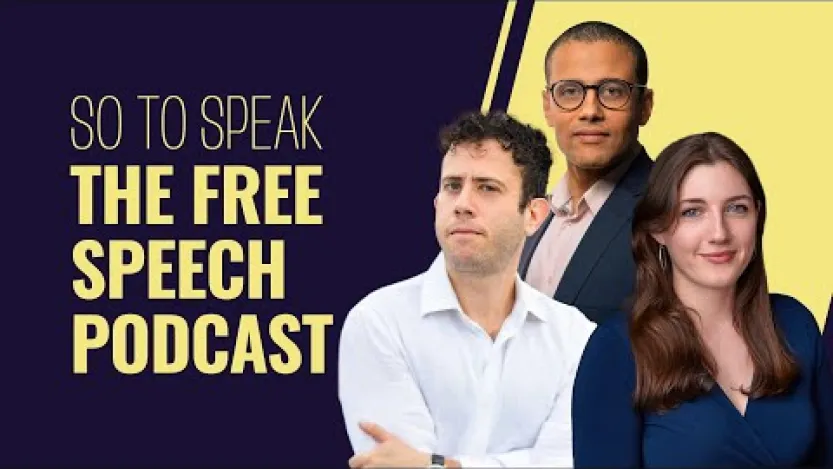
    And now on to Shapiro’s new book. It is titled “Lawless: The Miseducation of America’s Elites” and it’s already getting ample notice from publications ranging from The Volokh Conspiracy to the Hugh Hewitt show, including a recent podcast exchange with Nico Perrino on “So to Speak”:


    The publisher’s summary:

    In the past, Columbia Law School produced leaders like Franklin Delano Roosevelt and Ruth Bader Ginsburg. Now it produces window-smashing activists.

    When protestors at Columbia broke into a building and created illegal encampments, the student-led Columbia Law Review demanded that finals be canceled because of “distress.”

    Law schools used to teach students how to think critically, advance logical arguments, and respect opponents. Now those students cannot tolerate disagreement and reject the validity of the law itself. Rioting Ivy Leaguers are the same people who will soon:

    • Be America’s judges, DAs, and prosecutors
    • File and fight constitutional lawsuits
    • Advise Fortune 500 companies
    • Hire other left-wing diversity candidates to staff law firms and government offices
    • Run for higher office with an agenda of only enforcing laws that suit left-wing whims

    In Lawless, Ilya Shapiro explains how we got here and what we can do about it. The problem is bigger than radical students and biased faculty — it’s institutional weakness. Shapiro met the mob firsthand when he posted a controversial tweet that led to calls for his firing from Georgetown Law. A four-month investigation eventually cleared him on a technicality but declared that if he offended anyone in the future, he’d create a “hostile educational environment” and be subject to the inquisition again. Unable to do the job he was hired for, he resigned.

    This cannot continue. In Lawless, Shapiro reveals how the illiberal takeover of legal education is transforming our country. Unless we stop it now, the consequences will be with us for decades.

    A few selected quotes:

    • Is there anything we can do to stop or reverse . . . ill liberal tendencies? Should we — those of us who care about universities’ traditional truth-seeking mission and law schools’ commitment to the American constitutional order — just throw up our hands, gird our loins, and regroup to fight elsewhere? Surely we need to develop novel responses to heterodox challenges, ones that involve culture, legislation, and institution building.
    • The real issue here is taking exclusionary action — real discrimination, not a mere assertion that someone’s position on Israel (or anything) is ‘harmful’ or denies someone’s right to exist.
    • More than a 100 institutions have endorsed a version of the Report of the Committee on Freedom of Expression at the University of Chicago (known as the Chicago Statement), which is the gold standard. The problem is that, as I experienced personally, so many of these speech-and-expression policies aren’t worth the paper (or pixels) they’re written on, falling by the wayside when seeming to conflict with the demands of DEI.
    • Cancellation victims, and others who make national news are the tip of the iceberg. As we see from survey results, self-censorship pervades academia, detracting from any intellectual mission, to say the least. Knowledge is never developed, and many old-school professors leave academia entirely — such as the famed First Amendment scholar Eugene Volokh’s move from the UCLA school of law to the Hoover Institution and the early retirement of five right-of-center law professors from the University of San Diego (which used to be a bastion of originalism). Universities are at best failing to resist these illiberal forces and at worst encouraging them.

    Shapiro’s four main recommendations in “Lawless”: 

    1. Abolish DEI bureaucracies
    2. End mandatory diversity training
    3. Stop political coercion
    4. End identity-based preferences.

    Related


    WATCH VIDEO: Gaza protesters disrupt UC Berkeley dean’s party, triggering responses over free speech.

    Forthcoming book on ideology, science, and free speech

    Cover of Lawrence M. Krauss' book "The War on Science: Thirty-Nine Renowned Scientists and Scholars Speak Out About Current Threats to Free Speech, Open Inquiry, and the Scientific Process"

    An unparalleled group of prominent scholars from wide-ranging disciplines detail ongoing efforts to impose ideological restrictions on science and scholarship throughout western society.

    From assaults on merit-based hiring to the policing of language and replacing well-established, disciplinary scholarship by ideological mantras, current science and scholarship is under threat throughout western institutions. 

    As this group of prominent scholars ranging across many different disciplines and political leanings detail, the very future of free inquiry and scientific progress is at risk. Many who have spoken up against this threat have lost their positions, and a climate of fear has arisen that strikes at the heart of modern education and research. Banding together to finally speak out, this brave and unprecedented group of scholars issues a clarion call for change.

    “Higher education isn’t what it used to be. Cancel Culture and DEI have caused many to keep their mouths shut. Not so the authors of this book. This collection of essays tells of threats to open inquiry, free speech, and the scientific process itself. A much-needed book.” — Sabine Hossenfelder, Physicist and Author of Existential Physics: A Scientist’s Guide to Life’s Biggest Questions

    Campus speech conflicts continue

    Campus free speech podcasts

    What is academic freedom? With Keith Whittington

    In recent weeks, the Academic Freedom Podcast has released two new episodes focusing on campus free speech issues.

    First up was a conversation with Timothy Zick, the John Marshall Professor of Government and Citizenship at William & Mary Law School. He is the author most recently of Managed Dissent: The Law of Public Protests. The episode focuses on the law surrounding public protests on and off college campuses.

    Next was a conversation with Jennifer Ruth and Michael Berube about their recent book, It’s Not Free Speech: Race, Democracy, and the Future of Academic Freedom. They are both long-serving leaders in the American Association of University Professors, and the book develops a provocative proposal for patrolling the acceptable boundaries of extramural speech by university faculty.

    More to come.

    White House Associated Press controversy

    The White House barred a credentialed Associated Press reporter and photographer from boarding the presidential airplane Friday for a weekend trip with Donald Trump, saying the news agency’s stance on how to refer to the Gulf of Mexico was to blame for the exclusion. It represented a significant escalation by the White House in a four-day dispute with the AP over access to the presidency.

    The administration has blocked the AP from covering a handful of events at the White House this week, including a news conference with India’s leader and several times in the Oval Office. It’s all because the news outlet has not followed Trump’s lead in renaming the body of water, which lies partially outside U.S. territory, to the “Gulf of America.”

    Volokh weighs in on AP exclusion controversy

    [1.] The Administration has no First Amendment obligation to provide any press conferences or interviews. The question, though, is whether, once it starts doing that, it may exclude the press based on its viewpoint, or on its supposedly unfair coverage, or on its use of terms that are seen as expressing a viewpoint.

    [2.] It seems pretty clear that government officials can choose — including in viewpoint-based ways — whom they will sit down with for interviews. The President may choose to give interviews to journalists whose views he likes, and to refuse to speak with those whose views he dislikes. Indeed, a government official may even order employees not to talk to certain reporters, without thereby violating the reporters’ rights. Baltimore Sun v. Ehrlich (4th Cir. 2006).

    [ . . . ]

    [3.] It also seems pretty clear that government officials, even in large press conferences, can choose to ignore questions that express views they dislike, or to ignore questioners who have expressed those views. . . 

    [4.] This having been said, there are precedents (Sherrill, TGP, and John K. Maciver Inst. for Public Policy v. Evers (7th Cir. 2021)) that recognize a right not to be excluded based on viewpoint from large press conferences that are generally open to a wide range of reporters. Those precedents treat those press conferences more or less like “limited public fora” or “nonpublic fora” — government property where the government may impose viewpoint-neutral restrictions but not viewpoint-based ones.

    [ . . . ]

    [5.] But what about in-between events, which are open only to a small set of reporters? Air Force One apparently has 13 press seats, and I take it the Oval Office is likewise limited.

    [ . . . ]

    [6.] So I think that for Air Force One and Oval Office appearances, the best I can say is that the First Amendment analysis is unsettled.

    FIRE weighs in on AP exclusion controversy

    As one federal court proclaimed, “Neither the courts nor any other branch of the government can be allowed to affect the content or tenor of the news by choreographing which news organizations have access to relevant information.”

    And because denying press access involves the potential deprivation of First Amendment rights, any decision about who’s in or out must also satisfy due process. That means the government must establish clear, impartial criteria and procedures, and reporters must receive notice of why they were denied access and have a fair opportunity to challenge that decision.

    The AP — a major news agency that produces and distributes reports to thousands of newspapers, radio stations, and TV broadcasters around the world — has had long-standing access to the White House. It is now losing that access because its exercise of editorial discretion doesn’t align with the administration’s preferred messaging.

    That’s viewpoint discrimination, and it’s unconstitutional.

    This isn’t the first time the White House has sent a journalist packing for reporting critically, asking tough questions, or failing to toe the government line. During Trump’s first term, the White House suspended CNN reporter Jim Acosta’s press pass after he interrogated the president about his views on immigration. After the network sued, a federal court ordered the administration to restore Acosta’s pass.

    Related

    Sean ‘Diddy’ Combs sues NBC

    Sean “Diddy” Combs is suing NBC Universal over a documentary that he says falsely accuses him of being a serial murderer who had sex with underage girls as he awaits trial on federal sex trafficking charges.

    The lawsuit filed Wednesday in New York state court says the documentary, “Diddy: Making of a Bad Boy,” included statements that NBC Universal either knew were false or published with reckless disregard for the truth in order to defame the founder of Bad Boy Records.

    “Indeed, the entire premise of the Documentary assumes that Mr. Combs has committed numerous heinous crimes, including serial murder, rape of minors, and sex trafficking of minors, and attempts to crudely psychologize him,” the complaint reads. “It maliciously and baselessly jumps to the conclusion that Mr. Combs is a ‘monster’ and ‘an embodiment of Lucifer’ with ‘a lot of similarities’ to Jeffrey Epstein.”

    Executive Watch


    WATCH VIDEO: Trump says freedom of speech under threat in Europe | AFP

    Secretary Rubio on free speech and the Holocaust


    WATCH VIDEO: Marco Rubio slams CBS journalist for suggesting free speech caused the Holocaust.

    More in the news

    2024-2025 SCOTUS term: Free expression and related cases

    Cases decided

    • Villarreal v. Alaniz (Petition granted. Judgment vacated and case remanded for further consideration in light of Gonzalez v. Trevino, 602 U. S. ___ (2024) (per curiam))
    • Murphy v. Schmitt (“The petition for a writ of certiorari is granted. The judgment is vacated, and the case is remanded to the United States Court of Appeals for the Eighth Circuit for further consideration in light of Gonzalez v. Trevino, 602 U. S. ___ (2024) (per curiam).”)
    • TikTok Inc. and ByteDance Ltd v. Garland (The challenged provisions of the Protecting Americans from Foreign Adversary Controlled Applications Act do not violate petitioners’ First Amendment rights.)

    Review granted

    Pending petitions

    Petitions denied

    Last scheduled FAN

    FAN 457: “Timothy Zick’s ‘Executive Watch’: Introduction

    This article is part of First Amendment News, an editorially independent publication edited by Ronald K. L. Collins and hosted by FIRE as part of our mission to educate the public about First Amendment issues. The opinions expressed are those of the article’s author(s) and may not reflect the opinions of FIRE or Mr. Collins.

    Source link

  • Closing a college with dignity, part 1 (opinion)

    Closing a college with dignity, part 1 (opinion)

    Founded in 1957, Cabrini University, a small, tuition-driven Roman Catholic liberal arts institution located outside of Philadelphia, closed last June after providing a year’s notice of its impending closure. One of at least 14 nonprofit four-year colleges that announced closures in 2023, Cabrini announced a memorandum of understanding with Villanova University in June 2023, signed a definitive agreement in November 2023 and closed the transaction in June 2024.

    Through this transaction, Cabrini was afforded a final year of operation prior to closure. Villanova acquired Cabrini’s assets, including a 112-acre property, and committed to preserving the legacy of Cabrini through commitments like naming its new campus Villanova University Cabrini Campus, providing Cabrini representatives two seats on the Villanova board for up to two successive five-year terms, stewarding the Mother Cabrini special collections and planning events for Cabrini alumni.

    In this three-part essay, we—Cabrini’s former interim president, Helen Drinan, and former members of the academic leadership team—describe our decision to seek a strategic partner, the planning that went into a dignified closure and the ways we supported employees and students through a mission-driven plan to help them transition in terms of their careers and academic studies.

    It was a dignified closing for an institution that began the 2022–23 academic year facing significant obstacles to its survival. As the university welcomed a new interim president, Cabrini’s profile reflected five metrics used to identify rising pressure on nonprofit higher education institutions with fewer than 5,000 students.

    • High acceptance rate: It increased from 72 percent in 2018 to 79 percent in 2022.
    • Low yield on offers of admission: It declined from 17 percent in 2018 to 11 percent in 2022.
    • Falling enrollment: 29.3 percent decline between 2018 (2,283) and 2022 (1,613).
    • Rising institutional aid: Institutional aid awards increased by about 38 percent from 2018 to 2022 ($10,595 per student in 2018 to $14,638 per student in 2022), outpacing small increases in tuition. In 2022–23, 39 percent of Cabrini’s undergraduate students were receiving Pell Grants and 99 percent received institutional grant or scholarship aid.
    • Persistent operating losses: Eight years of operating losses from 2015 to 2022, ranging between $1.9 million and $10 million, topped off by a fiscal year 2023 budget awaiting approval that included its highest-ever multimillion-dollar operating loss.

    Enrollment and financial operating data of course tell only part of the story of a troubled institution. Many leadership decisions made over time cumulatively result in these kinds of outcomes. At least three common practices have emerged as critical leadership traps in higher education: nonstrategic launches of initiatives intended to increase revenues or decrease costs, consistent drawdowns of the endowment to cover annual losses and accumulation of deferred maintenance. All three of these institution-threatening practices were occurring at Cabrini over the eight years leading to the summer of 2022, when we realized time was running out.

    The Road to Closure

    Sound strategic planning for a tuition-dependent, modestly endowed, indebted institution like Cabrini depends on choosing opportunities that expand on existing expertise, require minimal capital outlays and are tested for success within a three-year time frame. At Cabrini, too many new initiatives, well beyond historic areas of expertise, were launched in the eight years prior to closure, resulting in a laundry list of only loosely related activities: a targeted international student recruitment program, graduate online education, revived adult degree completion offerings, new doctoral programs, a new residence hall and parking garage, efforts to qualify as a Hispanic-serving institution, and the start-up of a new undergraduate nursing program. All this occurred while the university took on additional debt for construction activity and used federal pandemic relief funding to fill revenue gaps, pushing the institution to the point where it faced its largest-ever annual deficit and rapidly declining cash on hand going into fiscal year 2023.

    In summer 2022, Cabrini’s Board of Trustees approved a four-month budget delay, and the senior leadership team sought to identify $10 million in revenue and expense improvements. In September, the senior leadership team presented the board with two alternative paths: 1) a plan to operate for three-plus years to assess the financial feasibility of staying independent or 2) a plan to find the best possible partner to help support the institution financially. Past strategies such as voluntary separation programs, involuntary separations and the hiring of external consultants all yielded unsuccessful results and negatively impacted employee morale. The best opportunities for maintaining independence involved growing revenues, reducing costs (with the understanding that previous attempts to do so were insufficient), capitalizing on real estate and seeking nontraditional revenue streams.

    The Penultimate Year

    Prior to the decision to close, while institutional leaders remained focused on staying viable, senior leadership offered an exclusive interview to The Philadelphia Inquirer in the spirit of transparency, announcing very aggressive organizational changes and plans for new programs and publicly expressing an interest in partnerships. Such an approach, we realized, would raise further questions about the future of the institution: The truth is that once an institution acknowledges difficulties, questions will proliferate, and it is best to be transparent and open when responding.

    As fall 2022 moved into winter, our leadership team became aware of three negative trends: 1) efforts to recruit the new first-year class were falling short of enrollment targets, 2) new program launches took longer than expected, creating a lag in new revenue, attributable in large part to reduced marketing resources, and 3) partnership conversations yielded few opportunities serious enough to pursue. Two institutions were seriously considering partnering with us, allowing for academic and possibly athletic continuity. However, in both cases, potential partner boards determined they were “unable to buy Cabrini’s problems” because of its declining cash and indebtedness.

    Given the direction of these conversations, we concluded that the institution was not financially viable. We determined that the best opportunity to preserve Cabrini’s legacy and ensure students, faculty and staff would experience a full academic year prior to closure was to readily agree to the MOU with Villanova, the initial step toward an asset purchase agreement and a graceful closure.

    Villanova’s strategic direction proved key to the partnership decision. Villanova’s strength as an Augustinian institution in the Catholic tradition aligned beautifully with Cabrini’s heritage, and the missions of both institutions made for wonderful integration opportunities in such areas as immigration, leadership and services for marginalized populations. Cabrini’s real estate offered the expansion opportunities Villanova desired in close proximity to its beautifully built-out campus. And Villanova’s financial resources enabled Cabrini to deliver a robust final year to all its students, faculty and staff, the value of which is beyond measure.

    The university graduated a senior class in May 2024, offered placements to every student interested in continuing their education and supported its workforce with a combination of job-seeking resources, retention payments and severance, none of which would have been possible without Villanova’s remarkable engagement. (Part 2 of this series provides further detail about Cabrini’s final year and transition planning.)

    Part of why we think the partnership worked was because we, as the institutional leadership team, effectively checked our egos at the door. We knew our focus had to be on what was best for the institution, not our own personal outcomes, to credibly lead the university through closure. A key lesson for other institutions exploring acquisitions or mergers is that the future expectations of the sitting president as well as of board members in a new organization should be clarified early in partner conversations; otherwise, personal expectations could present an obstacle to the transaction’s success.

    Another lesson for any struggling institution is to think critically about the kinds of partner institutions that would find you attractive, how much leverage you might have and how much you can do to minimize your downsides. This is not typically work you can do as you face the threat of immediate closure. For institutions that may be financially stable but are experiencing some of the indicators of risk and stress mentioned at the start of this essay, the task of thoughtfully identifying potential partners could be an important activity for trustees and senior leadership teams to pursue.

    Editor’s note: The second and third installments of the series will be published on the next two Wednesdays.

    Helen Drinan served as interim president of Cabrini University. Previously, she served as president of Simmons University.

    Michelle Filling-Brown is associate vice provost for integrated student experience and a teaching professor in the Department of English at Villanova University. She formerly served as chief academic officer/dean for academic affairs at Cabrini University, where she also served as a faculty member for 16 years.

    Richie Gebauer is dean of student success at Bryn Mawr College. He formerly served as assistant dean of retention and student success at Cabrini University.

    Erin McLaughlin is the interim dean of the College of Arts, Education and Humanities at DeSales University. She formerly served as associate dean for the School of Business, Education and Professional Studies at Cabrini University, where she also served as a faculty member for 16 years.

    Kimberly Boyd is assistant professor of biology and anatomy and physiology at Delaware County Community College. She formerly served as dean of retention and student success at Cabrini University, where she also served as a faculty member for 25 years.

    Missy Terlecki is dean of the School of Professional and Applied Psychology at Philadelphia College of Osteopathic Medicine. She formerly served as associate dean for the School of Arts and Sciences at Cabrini University, where she also served as a faculty member for 19 years.

    Lynda Buzzard is associate vice president and controller at Villanova University. Previously, she served as the vice president of finance and administration at Cabrini University in its final year.

    Source link