Tag: News

  • Trump signs order banning trans athletes in women’s sports

    Trump signs order banning trans athletes in women’s sports

    President Donald Trump signed an executive order Wednesday banning transgender women from participating in women’s sports.

    “The war on women’s sports is over,” he said. “With my action this afternoon, we are putting every school receiving taxpayer dollars on notice that if you let men take over women’s sports teams or invade your locker rooms, you will be investigated for violations of Title IX and risk your federal funding.”

    The executive order, signed on National Girls and Women in Sports Day, declares that it’s “the policy of the United States to oppose male competitive participation in women’s sports more broadly, as a matter of safety, fairness, dignity, and truth.” Under the order, the assistant to the president for domestic policy will bring together representatives of “major athletic organizations and governing bodies, and female athletes harmed by such policies, to promote policies that are fair and safe, in the best interests of female athletes.”

    The president’s latest action builds on the GOP’s broader campaign to remove all recognition of transgender individuals from state and federal programs. On his first day in office, Trump signed a separate executive action declaring that there are only two sexes and banning federal funding for any program related to “gender ideology.” And House Republicans have passed a bill that would unilaterally ban trans women from competing in women’s sports. In nearly half of the country, trans women are banned from playing women’s sports at the K-12 or higher education level, but the order would take those bans nationwide.

    Additionally, the order calls on the education secretary to prioritize “Title IX enforcement actions against educational institutions (including athletic associations composed of or governed by such institutions) that deny female students an equal opportunity to participate in sports and athletic events by requiring them, in the women’s category, to compete with or against or to appear unclothed before males.” (Federally funded K-12 public schools and colleges are required to comply with Title IX, which bars discrimination based on sex in educational settings.)

    Charlie Baker, president of the National Collegiate Athletic Association, told Congress recently that out of the more than 500,000 college athletes, fewer than 10 were transgender. The NCAA released a statement Wednesday that said, “The NCAA Board of Governors is reviewing the executive order and will take necessary steps to align NCAA policy in the coming days, subject to further guidance from the administration.”

    As Trump spoke Wednesday, girls and women—including former University of Kentucky swimmer and anti-trans advocate Riley Gaines—stood behind him, often clapping in support.

    After thanking them, the president turned back to face the rest of the East Room audience. He acknowledged the federal lawmakers, state attorneys general and governors in attendance, describing them as “friends of women’s sports.”

    “My administration will not stand by and watch men beat and batter women,” he said. “It’s going to end and nobody’s gonna be able to do a damn thing about it because when I speak [I] speak with authority.” (Trump was referring to an Olympic gold medal–winning Algerian boxer whom some accused of being transgender; the boxer has publicly said she was born a woman.)

    Fatima Goss Graves, president of the National Women’s Law Center, said in a statement that trans students do not pose a threat in sports and deserve the same opportunities as their peers.

    “The far-right’s disturbing obsession with controlling the bodies, hearts, and minds of our country’s youth harms all students,” Graves said.

    Education secretary nominee Linda McMahon attended the ceremony, though her confirmation hearing for the office has yet to be scheduled. In the meantime, the department is being led by a collection of acting officials and appointees, including Deputy General Counsel Candice Jackson, who described the president’s order as “a demonstration of common sense.”

    “The President affirmed that this administration will protect female athletes from the danger of competing against and the indignity of sharing private spaces with someone of the opposite sex,” Jackson said in a news release. “The Department of Education stands proudly with President Trump’s action as we prioritize Title IX enforcement against educational institutions that refuse to give female athletes the Title IX protections they deserve.”

    Other Republican lawmakers praised the order Wednesday, arguing it would ensure women and girls won’t be pushed to the sidelines.

    But Representative Bobby Scott, a Democrat from Virginia and ranking member on the House education committee, was quick to oppose the order, calling it “yet another overreach by this administration” and saying its lack of clarity will further complicate what should be addressed by sports associations.

    “Rather than address the real, urgent issues that students and families are facing every day, this administration continues to target vulnerable students—specifically transgender girls and women—with a shameless attempt to bully them,” he said in a statement. “They are willing to use the most vulnerable Americans as pawns in a political game.”

    Source link

  • Career coaches fill critical gaps in Ph.D. training

    Career coaches fill critical gaps in Ph.D. training

    To the editor:

    In “The Doctoral Dilemma” (Feb. 3, 2025), Inside Higher Ed reporter Johanna Alonso describes career coaching as a “cottage industry” of “gurus” that emerged to fill critical gaps in graduate training. As a career coach cited in the article, I was disappointed to see such an inaccurate and biased portrayal of my work. 

    Coaching is a professional industry with proven methods, tools, and credentialing provided by the International Coaching Federation (ICF). Coaching is distinct from “consulting,” and it’s an intentional, strategic step for anyone seeking to change careers. This is why Johns Hopkins University employs coaches as part of its Doctoral Life Design Studio. Yet, the article portrays these university-led coaching initiatives as legitimate, structured and holistic, while describing coaching outside of the university as an opportunistic “cottage industry.” Why frame the same service in two very different ways?

    From our wide-ranging, 20-minute interview, Alonso only highlighted my hourly rate—$250/hour for a single one-to-one meeting—without any context. There is no mention of the benefits of career coaching, or whether universities like Johns Hopkins pay their coaches a similar rate. The monetary cost, presented in isolation, suggests exploitation. The reality? As a neurodivergent person, I find one-to-one meetings draining, so I’ve priced them to limit bookings. Instead, I direct Ph.D.s toward my free library of online content, my lower-cost group programs and my discounted coaching packages, all of which have helped Ph.D.s secure industry roles that double or triple their academic salaries. The article doesn’t include these details.

    The most telling sign of the article’s bias is the use of the word “guru.” Why use a loaded term like “guru” instead of “expert” to describe career coaches? As I frequently remind my clients, language shapes perception. Ph.D.s are more likely to be seen as industry-ready professionals if they use terms like “multi-year research project” instead of “dissertation” or “stakeholders” instead of “academic advisers.” The same logic applies here—calling career coaches “gurus” trivializes our work, implying we are self-appointed influencers rather than qualified professionals. I’ll never forget the professor who once tweeted, “If life outside of academia is so great, why do alt-ac gurus spend so much time talking about it? Don’t they have better things to do?”

    My response? “I wouldn’t have to do this if professors provided ANY professional development for non-academic careers.”

    Because contrary to what the article claims, I didn’t start my coaching business because I wished there were more resources available to me. I started it because, after I quit my postdoctoral fellowship for an industry career, I spent untold hours providing uncompensated career support to Ph.D.s. For nearly two years, I responded to thousands of messages, created online resources, reviewed résumés and met one-to-one with hundreds of Ph.D. students, postdocs and even tenured professors—all for free, in my leisure time. Eventually, I burned out from the incessant demand. I realized that, if I was going to continue pouring my time into helping Ph.D.s, I needed to be compensated. That’s when I started my business.

    Academia conditions us to see for-profit businesses as unethical, while “nonprofit” universities push students into a lifetime of high-interest debt. It convinces us that charging for expertise is predatory, while asking Ph.D.s to work for poverty wages is somehow noble. It forces us to internalize the idea that, if you truly care about something, you should sacrifice your well-being and life for it. But our time is valuable. Our skills are valuable. We deserve to be fairly compensated for our labor, inside and outside of academia.

    Career coaching isn’t the problem. The real problem is that academia still refuses to take a critical look in the mirror.

    Ashley Ruba is the founder of After Academia.

    Source link

  • Coming soon: ‘Executive Watch’ — Tracking the Trump Administration’s free speech record — First Amendment News 456

    Coming soon: ‘Executive Watch’ — Tracking the Trump Administration’s free speech record — First Amendment News 456

    To lift a line from the songwriter extraordinaire of our era, “the times they are a- changin’.” Indeed, they are — and this is certainly true in our own corner of the world, the world of free speech. 

    For better and worse, Donald Trump and his agents are rearranging the structure of free expression in America. Only a few weeks into his presidency, things are proceeding at a breakneck speed, with a flurry of executive orders flying out the windows of the White House. Even early on, there is a sense that what will follow may well mark one of those pinpoints in our history when that “experiment” of which Holmes spoke is tested. Whatever else happens, it is important that there is some record of these times and what happened in them. To that end, we will soon launch a new segment within FAN called “Executive Watch” to track it all: the President’s orders, the executive agencies’ actions, the activities of the President’s affiliates, and Mr. Trump’s personal undertakings.

    Enter Professor Timothy Zick, the William and Mary Law School Robert & Elizabeth Scott Research Professor and John Marshall Professor of Government and Citizenship. 

    Prof. Timothy Zick

    Zick is the author of five books on the subject: “Speech out of Doors: Preserving First Amendment Liberties in Public Places,” “The Cosmopolitan First Amendment: Protecting Transborder Expressive and Religious Liberties,” “The Dynamic Free Speech Clause: Free Speech and its Relation to Other Constitutional Rights,” “The First Amendment in the Trump Era,” and “Managed Dissent: The Law of Public Protest.” He is also the co-author of a First Amendment casebook, “The First Amendment: Cases and Theory.”

    For all of the above reasons and others, Professor Zick is well suited to undertake the “Executive Watch” bi-monthly feature of First Amendment News. 

    Even at this early stage, this project comes a time when news stories like the following 21 surface with increasing frequency:


    WATCH VIDEO: Trump Calls For Changes To First Amendment, Demands “Mandatory One-Year In Jail” For U.S. Flag Burning.

    By chronicling such information and then analyzing it, the hope is that our readers will have a more informed sense of the state of free speech at a time when so much is in flux. There is the hope that “Executive Watch” will prompt further discussion of that vital freedom that is at the core of constitutional government in America.

    FBI agents file First Amendment class action

    While FBI agents may be at-will employees who can, generally speaking, be fired for “any reason or no reason,” they can’t be fired for an unconstitutional reason, or as punishment for the exercise of their constitutional rights (e.g. he can’t fire all the African-American agents, or all the agents registered as Democrats).

    The Complaint, filed in DC District Court, is posted here. Plaintiffs are “employees of the FBI who worked on Jan. 6 and/or Mar-a-Lago cases, and who have been informed that they are likely to be terminated in the very near future for such activity.” They “intend to represent a class of at least 6,000 current and former FBI agents and employees who participated in some manner in the investigation and prosecution of crimes and abuses of power by Donald Trump, or by those acting at his behest.”

    Knight Institute on need for fact-checking platform

    [Recently] Meta announced changes . . . to its content moderation policies, including that it’s replacing third-party fact checking with a Community Notes model that allows users to publicly flag content they believe to be incorrect or misleading. 

    The following can be attributed to Katherine Glenn Bass, the Knight Institute’s research director:

    Katy Glenn Bass Research Director Knight Institute

    Katy Glenn Bass

    “Mark Zuckerberg’s announcement today is a stark reminder that many of the biggest platforms we use to communicate about issues of public importance are owned by billionaires who are not accountable to us. Apart from the obvious effort to signal political allegiance, the impact of the announced changes will not be clear for some time. But if we have any hope of measuring or understanding what is happening on these platforms, we need strong protections for the independent researchers and journalists who study them, and better mechanisms for ensuring they can access platform data.”

    In 2019, more than 200 researchers signed an open letter in support of the Knight Institute’s efforts to persuade Facebook to amend its terms of service to establish a “safe harbor” for public-interest journalism and research on the platform. Read more about that effort here.

    Shibley on Harvard’s anti-Semitism settlement

    Robert Shibley

    Robert Shibley

    Just one day after President Trump took office, Harvard agreed to settle two lawsuits brought against it by Jewish students that alleged the university ignored “severe and pervasive anti-Semitism on campus” and created “an unbearable educational environment” in the wake of the October 7, 2023, Hamas attack on Israel and the ongoing war in Gaza.

    While the settlement language itself does not appear to be public, a press release filed on the official docket of The Louis D. Brandeis Center for Human Rights Under Law v. President and Fellows of Harvard College included some details. Most notably, Harvard agreed to adopt the International Holocaust Remembrance Alliance’s (IHRA’s) definition of anti-Semitism. FIRE’s worry, shared by many others — including the definition’s primary author — is that, when added to policies used to punish discriminatory harassment on American campuses, the definition is too likely to be used to punish speech that is critical of Israel or its government but that is not motivated in animus against Jews or Israelis.

    FIRE has repeatedly proposed steps to address anti-Semitic discrimination on campus that would safeguard students from harassment while protecting freedom of speech, most recently in our inauguration-day letter to President Trump. Getting this right is important; any proposal that chills or censors protected speech on campus won’t pass constitutional muster at public universities, won’t square with free speech promises at private universities (like Harvard), and won’t effectively address anti-Semitism.

    Nevertheless, attempts to codify the IHRA definition of anti-Semitism into laws or regulations are nothing new. FIRE posted a roundup of the widespread civil libertarian opposition to its codification last year, when Congress considered adopting it as federal law. Among those opponents is the definition’s primary author, Kenneth Stern, who spoke at length with FIRE’s Nico Perrino on our So to Speak podcast about why it’s not the right tool for the job of regulating speech. As Stern wrote back in 2016 for The New York Times: “The definition was intended for data collectors writing reports about anti-Semitism in Europe. It was never supposed to curtail speech on campus. . . . And Jewish students are protected under the law as it now stands.” (Perhaps “as it is now written” would have been more precise; whether colleges follow the law is a different issue.)

    As Stern predicted in that piece:

    If this bill becomes law it is easy to imagine calls for university administrators to stop pro-Palestinian speech. Even if lawsuits alleging Title VI violations fail, students and faculty members will be scared into silence, and administrators will err on the side of suppressing or censuring speech.

    Stern’s prediction is about to receive ground testing at Harvard, and likely at other universities that may follow its lead.

    Forthcoming book: New edition of Neier’s ‘Defending My Enemy’

    A new edition of the most important free speech book of the past half-century, with a new essay by the author on the ensuing fifty years of First Amendment controversies.

    Cover of the book "Defending My Enemy: Skokie and the Legacy of Free Speech in America" by Aryeh Neier

    When Nazis wanted to express their right to free speech in 1977 by marching through Skokie, Illinois — a town with a large population of Holocaust survivors — Aryeh Neier, then the national director of the ACLU and himself a Holocaust survivor — came to the Nazis’ defense. Explaining what many saw as a despicable bridge too far for the First Amendment, Neier spelled out his thoughts about free speech in his 1977 book Defending My Enemy.

    Now, nearly fifty years later, Neier revisits the topic of free speech in a volume that includes his original essay along with an extended new piece addressing some of the most controversial free speech issues of the past half-century. Touching on hot-button First Amendment topics currently in play, the second half of the book includes First Amendment analysis of the “Unite the Right” march in Charlotteville, campus protest over the Israel/Gaza war, book banning, trigger warnings, right-wing hate speech, the heckler’s veto, and the recent attempts by public figures including Donald Trump to overturn the long-standing Sullivan v. The New York Times precedent shielding the media from libel claims.

    Including an afterword by longtime free speech champion Nadine Strossen, Defending My Enemy offers razor-sharp analysis from the man Muck Rack describes as having “a glittering civil liberties résumé.”

    Praise for Defending My Enemy

    “Aryeh Neier’s Defending My Enemy is as relevant today as it was when it was first published. The book is a powerful reminder of why free speech matters—not just for the voices we agree with, but for the voices we abhor. Neier’s story of defending Nazis’ rights to speak in Skokie underscores a timeless truth: If we want to preserve freedom for ourselves, we must be willing to defend it for others, no matter how deeply we disagree. At a time when censorship is on the rise globally, Defending My Enemy stands as a bold and principled call to action. Every advocate of free expression needs to read this book—and more importantly, live its lessons.” — Greg Lukianoff

    Forthcoming scholarly article: ‘Output of machine learning algorithms isn’t entitled to First Amendment protection’

    Stanford Law Review logo

    Machine learning algorithms increasingly mediate our public discourse – from search engines to social media platforms to artificial intelligence companies. And as their influence on online speech swells, so do questions of whether and how the First Amendment may apply to their output. A growing chorus of scholars has expressed doubt over whether the output of machine learning algorithms is truly speech within the meaning of the First Amendment, but none have suggested a workable way to cleanly draw the line between speech and non-speech.

    This Article proposes a way to successfully draw that line based on a principle that we call “speech certainty” – the basic idea that speech is only speech if the speaker knows what he said when he said it. This idea is rooted in the text, history, and purpose of the First Amendment, and built into modern speech doctrines of editorial discretion and expressive conduct. If this bedrock principle has been overlooked, it is because, until now, all speech has been imbued with speech certainty. Articulating its existence was never necessary. But machine learning has changed that. Unlike traditional code, a close look at how machine learning algorithms work reveals that the programmers who create them can never be certain of their output. Because that output lacks speech certainty, it’s not the programmer’s speech.

    Accordingly, this Article contends that the output of machine learning algorithms isn’t entitled to First Amendment protection. With the Supreme Court signaling its intent to address unresolved questions of online speech, we are poised to enter a new era of First Amendment jurisprudence in the coming years. As we do, scholars, practicing attorneys, and judges can no longer ignore how the algorithms underlying online speech actually work – and how they have changed with the advent of machine learning. 

    Without recognizing this paradigm shift in algorithmic speech, we risk sleepwalking into a radical departure from centuries of First Amendment jurisprudence. By failing to distinguish between traditional and machine learning algorithms, current consensus about algorithmic speech suggests that the Constitution should, for the first time in its history, protect speech that a speaker does not know he has said. Speech certainty provides a novel and principled approach to conceptualizing machine learning algorithms under existing First Amendment jurisprudence. 

    Related

    More in the news

    2024-2025 SCOTUS term: Free expression and related cases

    Cases decided 

    • Villarreal v. Alaniz (Petition granted. Judgment vacated and case remanded for further consideration in light of Gonzalez v. Trevino, 602 U. S. ___ (2024) (per curiam))
    • Murphy v. Schmitt (“The petition for a writ of certiorari is granted. The judgment is vacated, and the case is remanded to the United States Court of Appeals for the Eighth Circuit for further consideration in light of Gonzalez v. Trevino, 602 U. S. ___ (2024) (per curiam).”)
    • TikTok Inc. and ByteDance Ltd v. Garland (The challenged provisions of the Protecting Americans from Foreign Adversary Controlled Applications Act do not violate petitioners’ First Amendment rights.)

    Review granted

    Pending petitions

    Petitions denied

    Last scheduled FAN

    FAN 455: “Eight free expression cases pending on SCOTUS docket

    This article is part of First Amendment News, an editorially independent publication edited by Ronald K. L. Collins and hosted by FIRE as part of our mission to educate the public about First Amendment issues. The opinions expressed are those of the article’s author(s) and may not reflect the opinions of FIRE or Mr. Collins.

    Source link

  • Encouraging first-gen students to study abroad

    Encouraging first-gen students to study abroad

    Study abroad is tied to personal and professional growth for college students, but crossing the border can be an enormous hurdle or feel unattainable for some learners.

    A new initiative at Bucknell University seeks to empower and support first-generation and low-income students who are interested in experiential learning and study away through workshops, financial aid and mentorship.

    In this episode of Voices of Student Success, host Ashley Mowreader speaks to Chris Brown, Bucknell’s Andrew Hartman ’71 and Joseph Fama ’71 Executive Director of the Center for Access and Success, to learn more about the center and how it reduces barriers to student participation in high-impact activities.

    Listen to the episode here and learn more about The Key here.

    Read a transcript of the podcast here.

    Source link

  • As DEI is scapegoated, silence is complicity (opinion)

    As DEI is scapegoated, silence is complicity (opinion)

    President Trump has used diversity, equity and inclusion to explain failures in education, the economy and national security, so you might think we’d be inured to his strategies by now. When he blamed the tragic plane crash in Washington, D.C., on DEI, he reached a new nadir of callousness. The victims of the crash had not even been recovered and he was blaming DEI policies for “lower” standards. When pressed by reporters, he couldn’t even articulate the object of his complaint or any specifics related to last week’s crash. His instinct, though, reveals a deeper, more troubling current.

    By tacking immediately to DEI in the wake of a tragedy, he seeks to create an association in the minds of Americans: People of color are underqualified and incompetent. As a woman of color who earned a Ph.D. and is also the president of a university, I know these narratives are baseless. I know how many talented, innovative people of color there are in our country. I know that their leadership, research and intelligence have produced countless benefits to our society. I also know that we have spent the last century undoing the psychological and practical damage of systemic racism in our nation. We have spent precious capital in our country recreating equality of opportunity, and programs of diversity, equity and inclusion have been essential to this transformation.

    When a president of the United States has the audacity to pose DEI as a corruption tool he is combating, I cannot be silent. It is an affront to those who sacrificed in the multiple civil rights struggles of the 20th century and helped position our nation as a place with more equality of opportunity than ever in our history. Education has been a central part of that architecture.

    As a student of language and culture, I also know that when a president and his narrow-minded minions repeat a paradigm ad nauseam, people start to believe it. The forerunner of exclusion and violence across history has been gradual dehumanization. Let us not be complicit with our silence.

    DeRionne P. Pollard is president of Nevada State University. The views expressed here are her own and do not represent the views of Nevada State University or the Nevada System of Higher Education.

    Source link

  • Hegseth orders military academies to end affirmative action

    Hegseth orders military academies to end affirmative action

    Newly confirmed U.S. secretary of defense Pete Hegseth issued a memo Jan. 29 ordering the Department of Defense to eliminate diversity, equity and inclusion initiatives and offices—including race-conscious admissions at military academies.

    The memo establishes a task force “charged with overseeing the department’s efforts to abolish DEI offices” and specifically prohibits “sex-based, race-based or ethnicity-based goals for academic admission” within the department, which oversees military academies. Hegseth wrote that he’s enforcing an executive order issued by President Trump instructing military academy leaders to eliminate DEI initiatives. 

    When the Supreme Court struck down affirmative action in 2023’s Students for Fair Admissions v. Harvard and UNC Chapel Hill, the justices explicitly made an exception for the military academies. In his majority opinion, Chief Justice John Roberts argued that the institutions, which train the military officer corps, may have “potentially distinct interests” when it comes to admissions and that diversity in the armed forces may be a national security prerogative.

    Three of those academies—the Military Academy at West Point, the Naval Academy and the Air Force Academy—have since been sued by anti–affirmative action groups seeking to eliminate the exemption. Last February the Supreme Court declined to hear the case against West Point, and in December a federal judge ruled that the Naval Academy can continue to consider race in admissions; the case against the Air Force Academy is ongoing. 

    It is unclear if Hegseth’s order to eliminate race-based “quotas” in admissions would prohibit military academies from considering race at all when reviewing applications. 

    Source link

  • Trump reiterates plan to abolish the Education Department

    Trump reiterates plan to abolish the Education Department

    Amid reports that the White House is finalizing an executive order to get rid of the Education Department, President Donald Trump said Tuesday that when he nominated Linda McMahon as secretary, he instructed her to “put herself out of a job.” 

    “Linda, I hope you do a great job and put yourself out of a job,” the president said to a group of reporters in the Oval Office.

    The comment was the first time Trump has publicly talked about his campaign promise to dissolve the department since taking office last month. Several media outlets reported Monday that the administration is preparing an executive order that would direct department officials to shut down some functions and develop a plan for the agency’s demise. The timing of such an order is still unclear.

    When asked Tuesday whether abolishing the department was something he could legally do, the president said, “I’d like to be able to do that.” He later added that “there are some people that think I could.” Many experts say that only Congress can kill off the federal agency.

    Trump said that the largest obstacle in the way of passing a bill to dissolve the department is teachers’ unions.

    “The teachers’ unions are the only ones that are opposed to it,” he said. “No one else would want to hold [us] back.”

    A recent Wall Street Journal poll found that 61 percent of registered voters oppose getting rid of the department. Numerous education lobbying groups, higher education experts and Democratic lawmakers have criticized the concept, saying that it would cause chaotic disruptions and make college hard to access for low-income students and those with disabilities.

    “Investment in our children is an investment in our future. Dismantling the Department of Education would do the opposite by making it harder for children to achieve and for parents, caregivers, and communities to thrive,” Senator Edward Markey, a Democrat from Massachusetts, said in a news release. “President Trump wants to lock the promise of public education—of equal opportunity and hope for all—behind an ivory tower accessible only to his billionaire donors … It is callous and cynical.” 

    Source link

  • Seven strategies to build global learning community at scale

    Seven strategies to build global learning community at scale

    In higher education, your relationship with learners shouldn’t end when their program does. If fostered correctly, they’re applying the knowledge they gained, sharing their experiences with their personal and professional networks, and staying engaged with your institution.

    Strengthening your relationships post-program will not only enhance the learning experience and create a sense of belonging, but inspire lifelong learning and repeat engagement, build awareness in a competitive education landscape, and transform your learners into your brand’s biggest advocates.

    Building a vibrant community is vital for maintaining these post-program relationships. In a survey by the community marketing platform TINT, 73 percent of consumers reported having a positive opinion of brand communities, while 84 percent said the community surrounding a brand impacts their feelings about it.

    Many online learning providers must battle the misperception that community-building and networking only happen in person. At Harvard Business School Online, we launched our Community in 2018 to provide online learners the chance to connect off-line by forming chapters worldwide. Over the last six years, we’ve expanded to nearly 40 chapters and more than 650,000 members from 190 countries. And importantly, we’ve evolved beyond in-person meetups to also host virtual events and discussions through our Community platform.

    If you’re interested in building a global community at scale, here are seven tips to consider.

    Tips for Building an Engaged Global Community

    1. Find Your Superusers Early

    Start by identifying your most active, engaged learners. Perhaps they’re always the first to comment on their peers’ responses and provide feedback. Or maybe they’re sharing their certificate and learning experiences on LinkedIn, taking multiple programs, or promoting your school and proactively addressing questions in Reddit threads. Determine your engagement metrics and use them to spot your superusers early.

    Programs should offer multiple connection points throughout the experience. HBS Online offers networking opportunities before, during and after courses. Anyone can join a public chapter to learn more about the brand and build knowledge. Once enrolled and upon course completion, they’re added to different private discussion boards and gain access to exclusive networking opportunities.

    The earlier you integrate community into their experience, the faster they’ll become familiar with it and the more engaged they’ll be over the long term—helping you more easily surface your superusers.

    1. Transform Your Superusers Into Brand Ambassadors

    Communities are stronger when everyone is involved. Once you’ve identified your superusers, empower them to be brand ambassadors. Provide ownership of the community experience to keep them invested and committed to fueling its success. In turn, you can scale faster by delegating some of the event and community management.

    Our chapters are run by chapter organizers—volunteers who’ve taken at least one HBS Online course and been vetted by our team. These volunteers are responsible for hosting an event a quarter and posting on their chapter’s discussion board.

    This structure enables us to grow our Community globally and offer in-person and virtual events and networking opportunities throughout the year. Our learners forge real-world connections while our chapter organizers gain experience they can add to their LinkedIn profiles and résumés.

    1. Provide Them With Helpful Tools, Training and Tactics

    To help your learners become brand ambassadors, equip them with the right tools, tips and training. Onboard them to your community software, develop documentation and responses to frequently asked questions, and regularly host training sessions to explain new and existing platform features.

    Data is another powerful tool. Track which conversations garner the most engagement or the events with the highest registrations, and share those insights with your community leaders. It will provide a jumping-off point and help them build stronger networking opportunities and relationships.

    1. Establish and Share Clear Guidelines

    During onboarding, share clear brand guidelines and expectations with your community leaders, including:

    • Your community’s goals and objectives
    • What their role entails and how to refer to it
    • How they should attribute your brand, and if/when they can leverage your logo
    • Your social channels and any campaign hashtags
    • Examples of effective content, whether a social post, forum discussion or event
    • Specific brand style guidelines

    By providing this material, you can empower them to be stronger advocates and alleviate branding concerns as you grow and scale your community.

    1. Highlight Achievements and Incentivize Advocacy

    For your community to be successful, it needs to be mutually beneficial. Your learners are likely juggling their education alongside various personal and professional commitments. Acknowledge their time spent volunteering.

    At HBS Online, we share our praise in various ways, including dedicated learner profiles, Community engagement and recognition badges, social media callouts, a monthly Community-focused newsletter where we promote upcoming events and achievements, and free tickets to and dedicated recognition at our annual hybrid learner conference, Connext.

    Consider how you can leverage gamification to encourage engagement or incentivize your community leaders to promote your brand. Perhaps you gift them exclusive swag if they hit certain engagement metrics or welcome them to beta-test new products. Determine what works best for your institution, but ensure you’re meaningfully saying, “Thank you.”

    1. Give Your Community Meaning

    Purpose fuels passion. Find ways to make your community something your learners are proud to participate in. Survey them to discover how they view your community and the value they derive from it and leverage those insights to create programming aligned with your institution’s mission.

    Six years ago, HBS Online introduced the Community Challenge to empower our learners to enact global change. Through the challenge, we collaborate annually with a nonprofit and ask for a pressing issue facing their business. We then share that problem with our learners, who gather worldwide to develop and pitch solutions. Over the years, they’ve tackled topics like food insecurity, climate change and education access while applying the business knowledge gained through our courses and fostering teamwork globally.

    1. Create an Internal Support System

    For any of these community efforts to take off, you need buy-in from senior leadership. Without it, you’re unlikely to get the necessary tools and resources to grow an engaged community. Communicate the value to your institution’s key stakeholders and provide them with the talking points to advocate for the initiative organizationwide since you’ll need support from multiple teams—like tech, program delivery and marketing—to make this work possible.

    If feasible, having a dedicated community manager can also help supercharge your efforts. That employee can provide a safe space for your community leaders, give them a direct point of contact, listen to and enact feedback, and ensure brand guidelines and expectations are met.

    Build Lifelong Relationships

    Your learners are your higher education brand’s most valuable asset. They can provide insights to help you develop new programs, advocate on your brand’s behalf, build awareness and drive repeat engagement.

    To foster lifelong learning, you must prioritize building lifelong relationships. Is your institution missing out on a competitive advantage?

    Lauren Landry is the director of marketing and communications at Harvard Business School Online, overseeing its organic marketing strategy, brand messaging, Community and events. Prior to joining HBS Online, she served as an associate director of content marketing at Northeastern University and as a reporter and editor covering higher education and start-ups for the likes of BostInno and Boston Magazine.

    Source link

  • College leaders in the foxhole (opinion)

    College leaders in the foxhole (opinion)

    The second Trump administration has begun with a cacophony of executive orders, memos from the Office of Management and Budget, and the disconcerting disappearance—and some reappearance—of research grants and programs. This has led to fear of the loss of important federal data, threats to the livelihoods of researchers and students, and the end of critical programs that have enabled greater participation in science. Many of these actions are being litigated in the courts, and while some judges have helped stop the worst actions, the whiplash leads to more drama and uncertainty. The research community on college campuses has been left in a state of anxiety and confusion.

    The public response from college presidents has been mostly muted so far. While this is causing even more distress in some quarters, there are reasons for it. The administration has suggested that on top of the current actions, there are prospects for increasing the tax on large university endowments, cutting indirect cost recovery on federal grants, investigating students and institutions for antisemitism, and more. It’s no surprise that university presidents, general counsels, communications professionals and federal relations officials want to play it safe. Many of these leaders probably also feel constrained by their commitments to institutional neutrality and don’t want to be seen as taking a political position against the administration’s actions.

    And so higher education is in yet another crisis. This one affects the whole country, just like the 2008 financial crisis and the pandemic. Former Tulane University president Scott Cowen faced a unique local crisis after Hurricane Katrina and also navigated the pandemic as interim president at Case Western Reserve University. He has been justifiably praised as an outstanding crisis manager, bringing Tulane through an event that easily could have permanently devastated the institution. He said on this site that—both after Hurricane Katrina in New Orleans and during COVID-19 in Cleveland—frequent, emotionally transparent communication was crucial to lower anxiety and provide updated information.

    “Crises are bound to happen,” he said, “impacting a few people or everyone. How we lead through them depends in large part on the nature of the crisis. And when one strikes, a leader should first understand how that particular crisis makes them feel” (emphasis mine).

    We don’t need to wonder about how people feel this time. The current crisis is definitely making people on campuses anxious and afraid. A few presidents have heeded Cowen’s advice and made public statements, including Christina Paxson at Brown University, Maurie McInnis at Yale University and Kevin Guskiewicz at Michigan State University. These statements have all acknowledged the pain and anxiety on the campuses. All three of these presidents are quite experienced: Paxson has been in office at Brown for 12 years, and McInnis and Guskiewicz are both in their second executive positions.

    Paxson perhaps went the farthest in taking a stand. “We always follow the law,” she said. “But we are also prepared to exercise our legal right to advocate against laws, regulations or other actions that compromise Brown’s mission.” That would be a difficult statement to make at a public university in a red state—and is still quite a courageous one at a private one in Rhode Island.

    Other presidents have made similar statements, and as the situation grinds on, more will continue to do so, particularly as it becomes apparent that this is not something to be waited out but rather to be managed and adapted to. Nearly every college president cares first and foremost about their campus; when they don’t show it, it’s usually because they think doing so would cause more damage in the long run. My heart goes out to all of the officials who for two weeks—and for many weeks to come—have had long early-morning and late-night meetings trying to figure out what they can and cannot do or say. Being in the foxhole late at night with your team and college town takeout can be energizing at first, but as it continues, it gets very difficult, especially as the days start to blur and it’s hard to remember whether you’ve already decided something or not.

    I went through two crises myself as chancellor of University of North Carolina at Chapel Hill. I followed Cowen’s advice on the first one, the 2008 financial crisis; I had seen him present on what he did at Tulane at my first presidents’ meeting. I sent out frequent emails to the campus with the help of a very sharp communications colleague who helped me craft my voice for such times. I went to employee meetings and answered all the questions I could. I hugged people when appropriate and let them share their emotions. As an autistic person, I don’t always know when emotions are in the air, but this was a dire enough situation that I didn’t need to do a lot of interpreting. We got through it, and I felt even more connected to the campus when we did.

    In the second crisis, which was a local scandal involving UNC athletics, I started off on the right foot by famously apologizing to “everyone who loves this university” at the first press conference. It seemed a logical continuation of what had gotten me through my first crisis, and it was consistent with what I had learned from Cowen. But the reaction was very different. While much of the campus appreciated it, the sports fans ridiculed me for being apologetic and not having a “stiffer spine” when it came to fighting for athletics. To my literal brain, this meant they wanted me to say it was acceptable that we cheated. I should have ignored that, because it caused me to lose my voice for a year or more, during which I just looked tongue-tied and indecisive while the scandal grew. As with the current situation, I was worried that saying anything would lead to more investigations and penalties for the Tar Heels. Finally, a wise adviser told me that I needed to decide who my people were. The people on the campus—the students, staff and faculty—those were my people. The sports fans were not; I can’t make a layup to save my life. “Stick to your people,” he said. I eventually got my voice back and happily went off to a Division III university.

    As the current crop of presidents goes through this same process, they’ll begin sticking with their people, too. Like me, many of them will end up wishing they did it sooner, but that’s to be expected given the stress and tension. In the long run, we need leaders who can lead the academic community to the other side of this. And that doesn’t always mean overt “resistance” as we often hear calls for, although as Paxson said in her letter, it certainly does mean standing up for the academic freedom of the individuals on the campus. It also means understanding the situation, caring for the people under their charge who are affected, helping them grieve for what is being lost and leading a conversation about how higher education is going to adapt to the new realities without sacrificing our values. I believe those leaders will emerge.

    As McInnis said at Yale, “Our mission is to create, share and preserve knowledge; to educate and inspire students; and to apply our discoveries to address the world’s greatest challenges. We are committed to navigating these times with a steadfast focus on advancing that mission and on supporting members of our community.” Most of the college leaders who read this and don’t think they can say something like it are wishing they could. In the coming weeks, more will.

    In the meantime, the academic community needs to stick together and try not to get overwhelmed by responding to everything that comes along while also acknowledging the fear, loss and pain many are experiencing. Teaching, patient care, research, justice and opportunity have defined American higher education for a century. And, somehow, they will continue.

    Holden Thorp is the editor in chief of the Science family of journals. He previously served as the chancellor of the University of North Carolina at Chapel Hill and the provost of Washington University in St. Louis.

    Source link

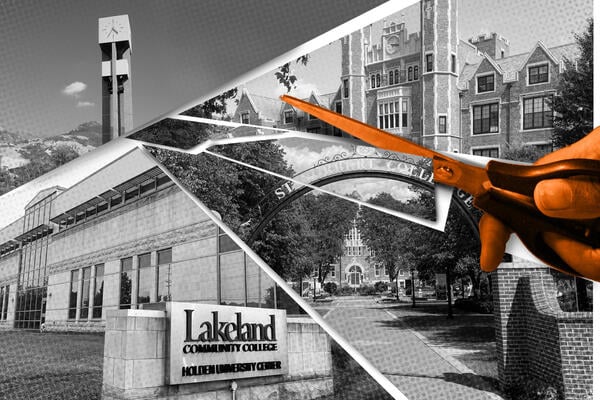
  • Big state systems were among those announcing cuts in January

    Big state systems were among those announcing cuts in January

    A new year is underway, but many colleges are still reeling from the fiscal challenges of 2024.

    With yawning budget gaps and bleak financial projections at some campuses, administrators are cutting jobs, academic programs and athletics options to plug holes and stabilize their finances.

    Here’s a look at cuts announced in January.

    Sonoma State University

    Facing a budget deficit estimated at nearly $24 million, the California State University campus is enacting deep cuts that will include dismissing dozens of faculty members, eliminating multiple programs and dropping athletics, according to an announcement from interim president Emily F. Cutrer.

    “The University has had a budget deficit for several years. It is attributable to a variety of factors—cost of personnel, annual price increases for supplies and utilities, inflation—but the main reason is enrollment,” Cutrer wrote in an announcement last month.

    She added that Sonoma State’s enrollment has dropped by 38 percent since 2015.

    On the personnel side, 46 faculty members, including tenured as well as adjunct professors, will not have their contracts renewed for the next academic year. An unspecified number of lecturers will also receive notices that “no work will be available in fall 2025,” Cutrer wrote. Four management and 12 staff positions are also being eliminated as part of Sonoma State’s cost-cutting measures.

    In addition, more than 20 programs have been identified for closure and others will be combined. University officials are also looking to close a half dozen academic departments.

    All 11 SSU athletic programs, which compete at the NCAA Division II level, will be eliminated. However, SSU coaches have announced plans to file a lawsuit in an effort to save their sports.

    California State University, Dominguez Hills

    Anticipated budget cuts also drove layoffs at this CSU campus in Southern California, which let go 32 employees last month, many probationary or temporary workers, LAist reported.

    “While these layoffs will be disruptive to our operations, the vast majority of our staff will remain employed at CSUDH continuing to provide the high level of support to our community that we are known for,” President Thomas Parham wrote in an email.

    Other institutions across California are also likely to introduce cost-cutting measures in the coming months due to anticipated decreases in state appropriations that will limit funding. The 23 institutions in the CSU system are bracing for state budget cuts of nearly $400 million.

    University of New Orleans

    After consolidating five colleges into two in December, the University of New Orleans laid off 30 employees last month as it chips away at a $10 million budget deficit, NOLA.com reported.

    Additionally, the university announced furloughs for full-time, nontenured employees last month, which local media outlets reported will affect nearly 300 workers.

    “While these actions are necessary, we are deeply sensitive to the hardship they undoubtedly will cause. We remain fully committed to supporting those who are affected through this transition,” President Kathy Johnson said in a January announcement. “Our focus remains on protecting UNO’s academic mission and its vital role in the New Orleans region. We are pursuing long-term strategies to increase enrollment, secure new funding, and enhance operational efficiency to avoid similar measures in the future.”

    St. Francis College

    The financially struggling institution in New York laid off 17 employees last month, The City reported. It follows other moves administrators have made in recent years—including previous layoffs, the sale of the Brooklyn campus and the elimination of athletic programs—to help fix St. Francis’s financial woes.

    Despite the institution’s recent struggles and multiple years of operating losses, President Tim Cecere offered the news outlet an optimistic outlook, noting that cost-cutting measures have put the college on a path toward sustainability.

    “The college hasn’t been this strong in years,” Cecere said. “We have zero debt, which not a lot of colleges can say. Every dollar that comes in is optimized for the benefit of the students.”

    St. Norbert College

    Jobs and programs are on the chopping block as the small Catholic institution in Wisconsin navigates financial issues, The Green Bay Press Gazette reported.

    At least 13 majors will be cut, including chemistry, computer science, history and physics.

    An unspecified number of faculty members are also expected to be laid off, the newspaper reported, as the college aims to shave $7 million in expenses ahead of the next fiscal year.

    Cleveland State University

    Efforts to cut spending prompted Cleveland State University to drop three athletic programs—wrestling, women’s softball and women’s golf—Ideastream Public Media reported.

    Cleveland State will also move its esports team from athletics to the College of Engineering.

    The move comes as the university whittles down a budget deficit that reportedly stands at $10 million. Last summer 50-plus faculty members took buyouts as part of cost-reduction efforts.

    Indiana University

    More than two dozen jobs were eliminated from the state flagship’s athletics department last month—part of a cost-reduction effort in response to the House v. NCAA settlement, which will require IU and other institutions to begin sharing revenue with athletes starting in the 2025–26 academic year, The Indianapolis Star reported.

    Of the 25 positions eliminated, 12 were reportedly vacant.

    Western Illinois University

    Furloughs for administrative employees who are not in a bargaining unit are expected as the regional public institution seeks to cut expenditures, Tri States Public Radio reported.

    WIU is reportedly dealing with a $14 million deficit for fiscal year 2025.

    The furlough program will run from the beginning of February through July 31 and is tiered by annual salary. Administrators making more than $150,000 will be required to take three unpaid days off each month, while those earning between $100,000 and $149,000 will be asked to take off two unpaid days each month and those making $99,999 to $75,000 will have to take off one unpaid day per month.

    Catholic University of America

    With the Catholic research university in Washington, D.C., facing a $30 million structural deficit, administrators are considering merging departments and potentially closing the Benjamin T. Rome School of Music, Drama, and Art, Catholic News Agency reported.

    Officials did not specify publicly whether job cuts would be included as part of the overall changes, which are expected to go before CUA’s Board of Trustees for approval in March.

    University System of Maryland

    Amid state budget cuts, Maryland’s public university system will likely be forced to lay off employees.

    Anticipating a funding cut of $111 million across the 11-campus system, officials may eliminate as many as 400 jobs through layoffs as well as closing vacant positions, The Baltimore Banner reported, which they estimate will save $45 million. Though a timeline for cuts was not announced, system chancellor Jay Perman said some jobs will be student facing, including advising, counseling and mental health services. Perman also noted that some faculty positions across the system will likely go unfilled.

    Source link