Tag: News

  • U of Washington Research Coordinators, Consultants Unionize

    U of Washington Research Coordinators, Consultants Unionize

    More than 700 University of Washington research coordinators and consultants have unionized, joining already organized research scientists and engineers there to create a bargaining unit more than 2,000 members strong, the union announced.

    UAW 4121 said in a news release Tuesday that research coordinators and consultants are largely health-care professionals focused on research.

    “They are responsible for running clinical trials, liaising with patients and scientists, and ensuring that research results are grounded in rigorous science,” the release said. “Despite the critical role they play at the university, many report job insecurity, a lack of transparency around career advancement and workload, low compensation relative to cost of living, and more as their reasons for forming a union.”

    “The University of Washington recognizes and respects the right of employees to organize,” university spokesperson Victor Balta wrote in an email to Inside Higher Ed. “UW values the research coordinators and consultants who help make vital work possible and we look forward to negotiating in good faith their inclusion into the existing UAW 4121 bargaining unit of research scientists and research engineers.”

    Mike Sellars, executive director of Washington State’s Public Employment Relations Commission, said his agency certified the unionization of the research coordinators and consultants Thursday. Nearly 400 employees submitted cards in favor of unionizing. A union spokesperson said cards were collected over the past year.

    Mike Miller, director of UAW Region 6, said in the news release, “As workers and workers rights’ are under assault by the Trump administration, it’s never been more important to have the rights and protections of a union.”

    Source link

  • Trump Dismantles US Institute of Museum and Library Services (YT Daily News)

    Trump Dismantles US Institute of Museum and Library Services (YT Daily News)

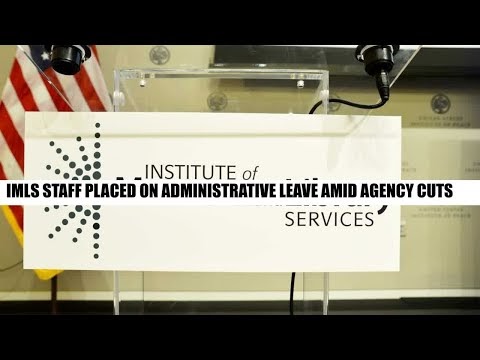
    The Institute of Museum and Library Services (IMLS) has put its entire staff on administrative leave following President Trump’s executive order to eliminate seven federal agencies, including IMLS. 
     
    Keith E. Sonderling has been appointed as the acting director during this transition. Staff were notified via email about their 90-day paid leave, which included instructions to return government property and had their email accounts disabled. 
     
    IMLS is a small federal agency, with about 70 employees,
    that awards grant funding to museums and libraries across the United
    States. Last year it granted $266 million to support essential cultural institutions.


    Source link

  • New Food Security Threats 5 Years After COVID-Era Effort to Feed All Kids – The 74

    New Food Security Threats 5 Years After COVID-Era Effort to Feed All Kids – The 74

    A multi-pronged attack on food aid by Republican lawmakers could mean more of the nation’s children will go hungry — both at home and at school.

    The U.S. Department of Agriculture recently cut two federal programs that provided roughly $1 billion in funding for the purchase of food by schools and food banks. 

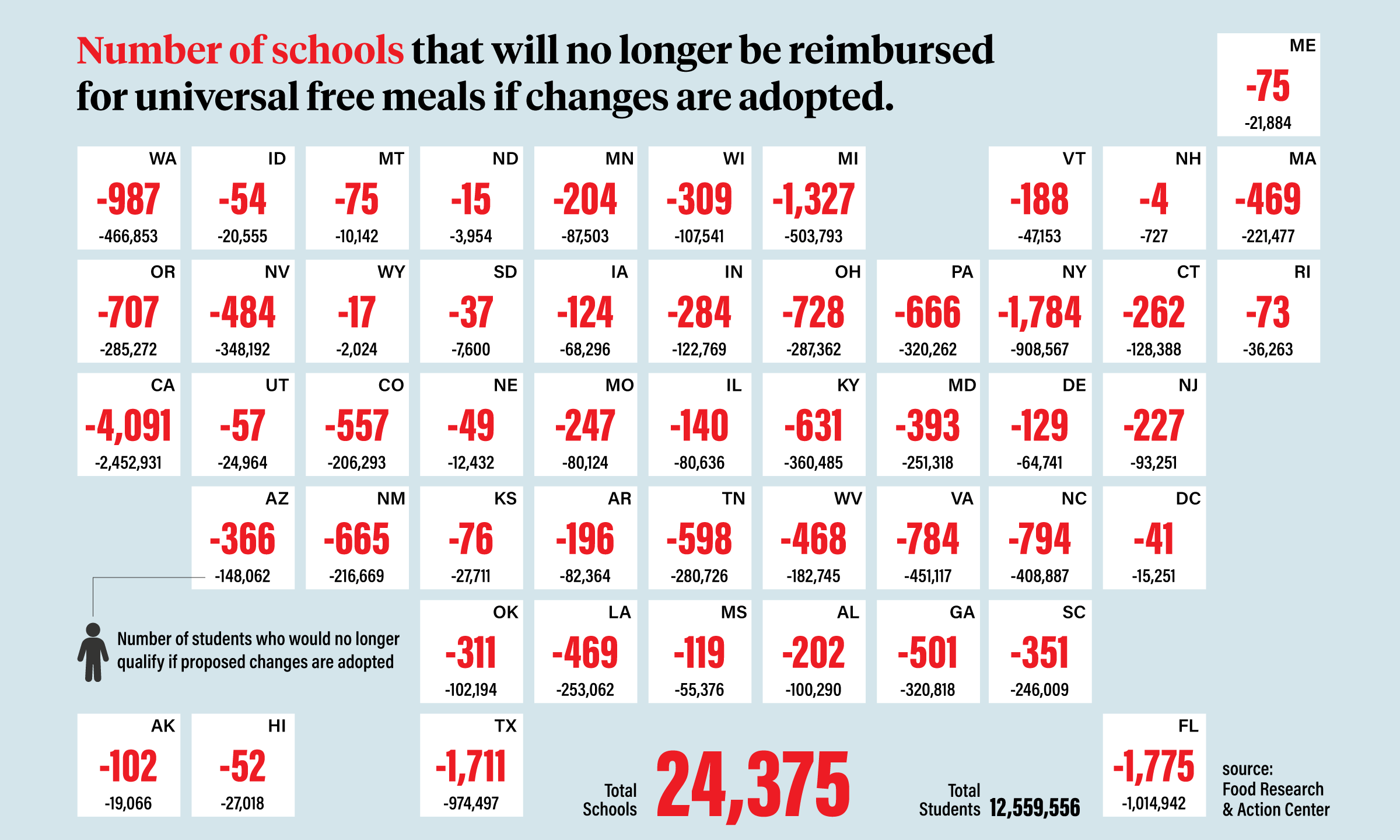
    And the Community Eligibility Provision, which reimburses tens of thousands of schools that provide free breakfast and lunch to all students, may tighten its requirements, potentially pushing some 12 million kids out of the program.

    These moves come at the same time the House Republican budget plan calls for deep cuts to the Supplemental Nutrition Assistance Program, or SNAP. The program fed more than 42 million low-income people per month nationwide in 2023. In 2022, 40% were younger than 18.  

    This recent shift reflects a stark reversal of earlier, nationwide efforts to keep families fed during the pandemic. Many districts, such as Baltimore, organized grab-and-go meals sites days after schools were shuttered in March 2020 with no identification or personal information required. Those initiatives led to the nation’s food insecurity rate dropping to a 20-year low when it reached 10.2% in 2021, down from a 14.9% high a decade earlier, according to the USDA.

    It has since crept back up to 13.5% and now, five years after schools utilized USDA waivers to deliver meals in innovative ways, they are bracing for what could be massive cuts from the federal government.

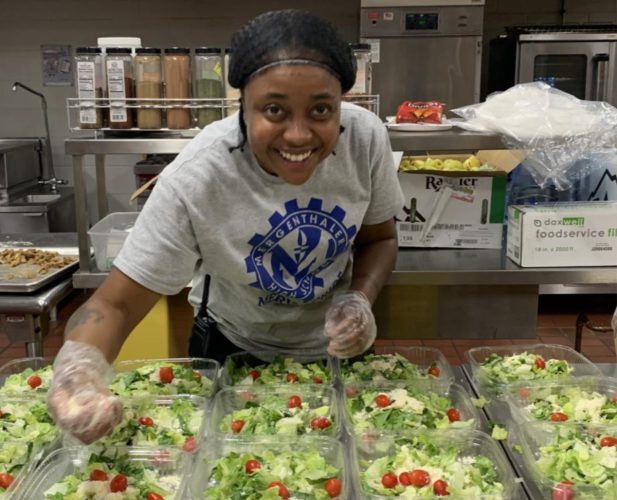
    Latoya Roberson, manager at Mergenthaler Vocational-Technical High School in Baltimore (Baltimore City Public Schools) 

    Elizabeth A. Marchetta, executive director of food and nutrition services for Baltimore City Public Schools, said 31 campuses — serving 19,000 children — would lose out on free breakfast and lunch if the Community Eligibility Provision changes go through. They are among 393 schools and 251,318 children statewide who would be shut out. 

    “It would be devastating,” Marchetta said. “These are critical funds. If we are not being reimbursed for all of the meals we’re serving … the money has to come from somewhere else in the school district, so that is really not great.”

    Nearly 48,000 schools in more than 7,700 districts benefited from the Community Eligibility Provision in the 2023-24 school year. The program reimburses schools that provide universal free meals based on the percentage of their students who automatically qualify for free and reduced-price lunch because their families receive other types of assistance, like SNAP. 

    In 2023, after the COVID-era policy ended where any student could receive a free school meal regardless of income, President Biden lowered the percentage of high-need students required for a school to qualify from 40% to 25%, greatly expanding participation. 

    House GOP Budget Committee Chairman Jodey Arrington now seeks to raise the rate to 60%. The budget proposal would also require all students applying for free and reduced-price meals to submit documentation verifying their family income.

    School meal debt, a barometer of food insecurity among students, is already on the rise. It will almost certainly increase if universal school meals disappear for students whose families make too much to qualify for free and reduced-price lunch but too little to afford to buy meals at school. At the same time, kids who are eligible for free and reduced-price meals could lose that benefit if the required paperwork becomes harder. 

    In the fall of 2023, across 808 school districts, the median amount of school meal debt was $5,495. By the fall of 2024, that amount reached $6,900 across 766 districts, a 25% increase, according to the School Nutrition Association.

    It was just $2,000 a decade earlier. A trio of Democratic senators is pushing to erase the $262 million annual debt total, with Pennsylvania Sen. John Fetterman saying in 2023, “‘School lunch debt’ is a term so absurd that it shouldn’t even exist. That’s why I’m proud to introduce this bill to cancel the nation’s student meal debt and stop humiliating kids and penalizing hunger.”

    Research shows students benefit mightily from free meals: those who attend schools that adopted the Community Eligibility Provision saw lower rates of obesity compared to those who did not. Free in-school meals are also credited for boosting attendance among low-income children, improving classroom behavior and lowering suspensions.

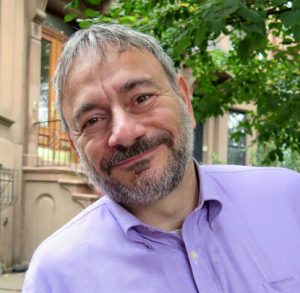
    Joel Berg, CEO of Hunger Free America. 

    Joel Berg, the CEO of Hunger Free America, said further cuts will greatly harm the poorest students. 

    “Over the last few years, things have gone from bad to worse,” he said. “We were all raised seeing Frank Capra movies, where, in the end everything works out. But that’s not how the real world works. In the real world, when the economy gets a cold, poor people get cancer.”

    Hunger Free America found the number of Americans who didn’t have enough to eat over two one-week periods increased by 55.2% between August-September 2021 and August-September 2024. The states with the highest rates of food insecure children were Texas at 23.8%, Oklahoma at 23.2% and Nebraska at 22.6%. Georgia and Arkansas both came in at 22.4%. 

    The USDA slashed the $660 million Local Food for Schools Cooperative Agreement Program for 2025 — it allowed states to purchase local foods, including fresh fruits and vegetables, for distribution to schools and child care institutions — and $500 million from the Local Food Purchase Assistance Cooperative Agreement Program, which supported food banks nationwide. 

    Diane Pratt-Heavner, director of media relations for the School Nutrition Association, said that as families struggle with the high cost of groceries, the government should be doing more — not less — to bolster school meals and other food aid programs. 

    “We’re urging Congress not only to protect the federal Community Eligibility Provision, but to expand it,” Pratt-Heavner said. “Ideally, all students should have access to free school breakfast and lunch as part of their education.” 

    SNAP benefits stood at $4.80 per person per day through 2020 before jumping to more than $6 per person per day after they were adjusted for rising food and other costs. Even then, the higher amount was not enough to cover the cost of a moderately priced meal in most locations. 

    Republicans in Congress seek to cut the program by $230 billion over the next nine years, possibly by returning to the pre-pandemic allotment of $4.80 and/or expanding work-related requirements, said Salaam Bhatti, SNAP director at the Food Research & Action Center

    Another possibility, he said, is that SNAP costs could be pushed onto states — including those that can’t afford them. 

    “This would be an unfunded mandate,” Bhatti said. “States would have to take away from their discretionary spending to offset the cost and if it is not a mandate, then states in rural America and in the South that don’t have the budgets just won’t do it.” 

    Food-related funding decreases come as the child tax credit, created to help parents offset the cost of raising children, is also facing uncertainty, said Megan Curran, the director of policy at the Center on Poverty and Social Policy at Columbia University.

    The American Rescue Plan increased the amount of the child tax credit from $2,000 to $3,600 for qualifying children under age 6, and $3,000 for those under age 18. Many taxpayers received monthly advance payments in the second half of 2021, instead of waiting until tax filing season to receive the full benefits. The move cut child poverty nearly in half. The expanded child tax credit was allowed to lapse post-pandemic and now even the $2,000 credit could revert back to just $1,000

    All food-related and tax benefit cuts — plus the unknowns of Trump-era tariffs — will leave some Americans particularly vulnerable, Curran said. 

    “It’s shaping up to be a very precarious time for families,” she said, “especially families with children.”


    Get stories like these delivered straight to your inbox. Sign up for The 74 Newsletter


    Source link

  • Wellesley Non-Tenure-Track Strike May Impact Class Credits

    Wellesley Non-Tenure-Track Strike May Impact Class Credits

    Hours after Wellesley College’s non-tenure-track faculty went on strike last Thursday, students received word that they might receive only half credit for courses taught by the professors on strike.

    The college attributed the decision to federal regulations on how much instruction students must receive per credit hour, noting that if the strike ends quickly, students will be able to return to their classes and get full credit. In the meantime, they were told they could sign up for other classes, taught by tenure-track faculty, for the last four weeks of the semester. That would allow them to continue to earn full credit hours, which is especially important for students who need to maintain full-time status for financial aid, athletics or visa-related reasons.

    According to college spokesperson Stacey Schmeidel, only about a third of non-tenure-track faculty members’ classes could be affected by this change; the remaining two-thirds met frequently enough during the first 10 weeks of the semester that they had already reached the required minimum number of instructional hours. Over all, she said, about 30 students out of the 2,350 enrolled at the women’s college are currently at risk of dropping below full-time status, though hundreds opted to switch into new classes to ensure they receive the number of credits they planned on for this semester.

    But students and faculty union members have questioned the college’s solution, noting that students may struggle to find replacement courses that fit their schedule or that they have the necessary prerequisites for.

    “Imagine being a student entering into a class that only has four weeks left,” said Jacquelin Woodford, a chemistry lecturer and organizing committee member for the faculty union, Wellesley Organized Academic Workers. “It’s such a weird plan that could all be avoided if the college just bargained with us and settled the contract.” Woodford also noted that striking faculty members had not been informed before Thursday about this plan and still haven’t received formal communication from the institution about what is happening with their classes.

    Non-tenure-track faculty at Wellesley began unionizing almost a year ago in an attempt to obtain higher wages and better job security. Union organizers say the institution has come back with only bare-bones offers.

    On March 25, administrators offered non-tenure-track faculty 2.75 percent annual raises for the duration of the contract and proposed adding an additional course to their teaching loads, for which they would be paid an additional $10,000. But union members argue that $10,000 is equivalent to what they are already paid for teaching an extra course.

    “The College’s proposal makes working overtime the new, required norm,” wrote Erin Battat, senior lecturer in the writing program and a member of the bargaining committee, in an email to The Wellesley News, the college’s student paper. “We had hoped that Wellesley was serious about their claims to care about averting a strike, but their actions at the bargaining prove otherwise.”

    WOAW’s latest proposal, meanwhile, includes a revised salary scale that would see some NTT faculty with more than 18 years at Wellesley earn over $170,000 a year—25 percent more than full professors with the same amount of experience. Wellesley has countered that the proposed pay scale, which would afford faculty raises of 54 percent in the contract’s first year, is untenable.

    The union voted in February to authorize a strike.

    “We called for a strike authorization vote to encourage Wellesley to make substantial progress towards our key priorities. Our goal is to negotiate a fair contract that will be ratified by our members,” said one bargaining committee member, Christa Skow, senior instructor in biological sciences, in an update on WOAW’s website at the time.

    Pizza and Ponchos

    Students have been supportive of the strike despite its impact on their courses, said Woodford, noting that they have joined the picket lines at the motor and pedestrian entrances to campus over the past several days.

    “They’ll come and go between their courses. They’re so kind; they’ve been sending us food and pizza and they brought us ponchos today for the rain,” she said, noting that tenured colleagues, alumnae and Massachusetts state politicians have also come out to support them.

    The next bargaining session will take place on Tuesday, and union organizers questioned why the institution was unwilling to bargain any earlier than five days into the strike. In an email, Schmeidel said the college and the union had, prior to the strike, mutually agreed to a session on April 3; after the strike began, Wellesley offered to move the session to today, April 1.

    She also said that the union had rejected the college’s proposal to work with a mediator.

    “The College feels that the union’s refusal to go to mediation and to instead call for a strike is arbitrary and premature,” she wrote.

    For some students, it’s unclear what the next few weeks will bring. Jeanne, a freshman who asked to have her last name withheld, is currently taking a writing course impacted by the strike. She said she received an email from the dean of first-year students saying that those in the course would receive full credit, but students should nevertheless attempt to keep up with the syllabus as much as possible. She doubts she’ll be able to, though, as the materials she needs for the next paper haven’t been posted for students to access online yet.

    Still, she said she is in favor of the strike, noting that WOAW has been transparent with the students about what the stoppage will entail since much earlier in the semester.

    “[WOAW] had been speaking about negotiations with the college since I arrived on the campus last semester,” she said. “They’ve been very clear with the students that they believe their treatment is unfair and they’ve been working with the college for a while now to get the situation fixed.”

    In an FAQ about how Wellesley will handle the strike, the institution said it is still figuring out how grading will be impacted by the half-credit courses and noted that it may be necessary to include a transcript note for anyone impacted. It said the same about making up any content students may lose out on as a result of the strike.

    “Department chairs and faculty are thinking seriously about any course content that may not have been covered and how to make up for this in a future semester,” the FAQ says.

    Source link

  • Ohio and Kentucky Ban DEI, Reduce Tenure Protections

    Ohio and Kentucky Ban DEI, Reduce Tenure Protections

    Republican-controlled legislatures in two bordering states, Ohio and Kentucky, have now passed laws requiring post-tenure review policies at public universities and banning diversity, equity and inclusion offices, along with other DEI activities.

    Many faculty and some Democratic leaders say the new laws threaten academic freedom and undermine tenure. In Ohio, lawmakers passed the sweeping higher education legislation, which has been in the works for a few years, over protests from faculty and students. The Ohio Student Association, for instance, said the bill would kill higher education in the state. Meanwhile, in Kentucky, Republican lawmakers rushed legislation through the process in order to successfully override their Democratic governor’s veto and put their higher education changes into law.

    Ohio and Kentucky join Arkansas, Utah and Wyoming this year as states where Republicans have passed laws targeting DEI and/or promoting alternative “intellectual diversity.” Even if the Trump administration’s ongoing nationwide attacks on DEI founder, these laws lock in restrictions on DEI in these states, preventing institutions from reversing course on diversity program rollbacks.

    Much of the new laws in Ohio and Kentucky echo the DEI bans that the other states have enacted, but Ohio’s legislation goes further than Kentucky’s, allowing immediate “for cause post-tenure reviews,” banning strikes for a large group of faculty and much more.

    Ohio governor Mike DeWine, a Republican, signed into law Friday a version of higher education legislation that’s been debated for the last two years but had failed to pass despite Republican majorities in the capitol. Senate Bill 1, the evolution of the failed legislation, combined numerous postsecondary changes that GOP legislators have sought to enact in other states.

    Among many other things, the new law bans full-time faculty from striking. It prohibits DEI offices, DEI in job descriptions and DEI in scholarships, without defining what DEI is. It requires institutions to “demonstrate intellectual diversity” in a range of areas, including course approval, general education requirements, common reading programs and faculty annual reviews. It also requires four-year institutions to publicly post online the syllabi for undergraduate courses, including the names of the instructors and “any required or recommended readings.” Community colleges must post more general syllabi.

    SB 1 also mandates a version of institutional neutrality, requiring colleges and universities to declare they “will not endorse or oppose, as an institution, any controversial belief or policy, except on matters that directly impact the institution’s funding or mission of discovery, improvement, and dissemination of knowledge.” The “controversial” beliefs and policies that institutions are required to stay silent on include any that are “the subject of political controversy, including issues such as climate policies, electoral politics, foreign policy, diversity, equity, and inclusion programs, immigration policy, marriage, or abortion.” (Ohio colleges and universities do retain the right to endorse Congress when it goes to war.)

    The law further requires all institutions to establish post-tenure review policies—which could lead to firing tenured faculty. The legislation bans unions from using their collective bargaining rights to negotiate over these policies. And SB 1 allows certain administrators to launch “an immediate and for cause post-tenure review at any time for a faculty member who has a documented and sustained record of significant underperformance” outside their regular annual performance evaluations.

    “This bill eliminates tenure,” said Sara Kilpatrick, executive director of the Ohio Conference of the American Association of University Professors. “If certain administrators can call for post-tenure review at any time and fire a faculty member without due process, that is not real tenure, that is tenure in name only.”

    Pointing to a provision for an appeals process, Republican state senator Jerry Cirino, who filed SB 1, said, “They’re lying about that” and “once again, the AAUP is misrepresenting the facts.”

    He added that the bill is “very pro–higher education.”

    “I’m not going to fall for these false narratives that the left is trying to put out there mischaracterizing this bill,” Cirino said.

    The Ohio governor’s office didn’t respond to Inside Higher Ed’s requests for comment Monday about why DeWine signed this bill into law.

    In Kentucky, the Democratic governor didn’t go along with the legislature, vetoing an anti-DEI bill. But Republicans overrode Gov. Andy Beshear.

    Bucking Beshear

    Kentucky’s House Bill 4 bans what that legislation defines as DEI offices, employees and training in public colleges and universities, as well as the use of affirmative action in hiring and in deciding scholarships and vendor selection. It also affects curricula by barring institutions from requiring courses whose “primary purpose is to indoctrinate participants with a discriminatory concept.”

    The new law generally defines a “discriminatory concept” as one that “justifies or promotes differential treatment or benefits” for people based on “religion, race, sex, color or national origin.” It broadly characterizes DEI as promoting a discriminatory concept. And it defines “indoctrinate” as imbuing or attempting to “imbue another individual with an opinion, point of view or principle without consideration of any alternative.”

    Additionally, under the new law, the Council on Postsecondary Education, which oversees Kentucky’s public colleges and universities, can’t approve new degrees or certificates that require courses or trainings primarily intended to “indoctrinate” with discriminatory concepts. And it encourages the council to eliminate current academic programs that contain such requirements.

    Beshear vetoed House Bill 4 on March 19 and defended diversity programs, adding that the legislation attempts to “control how universities and colleges meet the needs of their students and prepare them for their future.”

    “Acting like racism and discrimination no longer exist or that hundreds of years of inequality have been somehow overcome and there is a level playing field is disingenuous,” Beshear added. “History may look at this time and this bill as part of the anti–civil rights or pro-discrimination movement. Kentucky should not be a part of that movement.”

    On Thursday, the Kentucky House voted 79 to 19 to override this veto, and the Senate voted 32 to 6.

    Beshear also vetoed another bill, House Bill 424, which required institutions to evaluate president and faculty “productivity” at least once every four years using a board-approved process. Presidents or faculty who fail performance and productivity metrics could lose their jobs, under the bill. Beshear wrote in his veto message that the legislation “threatens academic freedom.”

    “In a time of increased federal encroachment into the public education, this bill will limit employment protections of our postsecondary institution teachers” and the state’s “ability to hire the best people,” he wrote. Lawmakers overrode him with an 80-to-20 House vote and a 29-to-9 Senate vote.

    Amy Reid, Freedom to Learn senior manager at PEN America, a free speech and academic freedom advocacy group, said in an email that the new Ohio and Kentucky laws “are not only significant blows to public higher education, but also reflect a galling disregard for the voters, educators and students in these states.”

    “Ohioans were massively organized in their opposition to SB 1, with hundreds of citizens coming to the capital to testify against the bill,” Reid said. “The legislature ignored them and so did Governor DeWine.” She said there was also “strong opposition across Kentucky” to the new laws there.

    But Tom Young, chairman of the Ohio House Workforce and Higher Education Committee, said he had heard support for the legislation from students and faculty who were concerned about speaking up. He said DEI had become “a tool for dividing people,” and most opposition to SB 1 that he heard regarded its anti-strike and post-tenure review provisions.

    “I don’t believe that any of these professors are concerned about the classroom,” Young said of faculty upset about the new law.

    Source link

  • Yes, Academic Job Loss Really Is Different (opinion)

    Yes, Academic Job Loss Really Is Different (opinion)

    If you’ve been watching the rolling thunderstorm of executive orders affecting higher education and thinking, simultaneously, “what a loss to the world” and “what a loss for those scholars” … you are right.

    It is a massive and increasingly uncorrectable loss to the world that life-enriching and life-saving research is being stopped in its tracks. We will now not know things that we might have otherwise learned, and we will not think thoughts that might have otherwise given us joy or revelation. These consequences are now unavoidable.

    But societal impacts are not the only consequences to consider. The loss of knowledge that is being widely grieved right now goes hand in hand with immediate or forthcoming loss of livelihood for individual scholars. And even though academics have become adept at mourning these individual losses—we write mike-drop essays, lobby our professional associations and contribute to GoFundMe accounts—we have generally limited ourselves to catharsis and critique.

    Our current moment calls for more. What we are now experiencing in American higher education and what we will continue to experience for the foreseeable future is a generational loss. We need to understand why it is this kind of loss. We need to be able to explain this to others in ways that do not trigger fresh complaints about ivory tower academics. And we need to grasp the nature of the obligation on those of us left behind.

    Put simply, we need to acknowledge, contextualize and equip. With apologies to Erin Bartram for repurposing her excellent title—without any of the irony—we have to sublimate the grief of the left behind.

    Academic Job Loss Is Different

    Industries change, businesses close and employers lay off existing employees or fail to hire new ones. While this is never easy, people find new jobs all the time. Why can’t a tenured professor or a recent hire or an eager postdoc do likewise? Why isn’t this just another instance of scholars being snowflakes?

    Here are just three reasons why job loss is especially fraught for academics. There are more than three reasons, of course—and I discuss many in my forthcoming book, The War on Tenure. But these three are a good place to start.

    Institutionalized Employment

    To begin with, academia is a highly institutionalized industry.

    What does that mean? It means that if you want to be a professor, you need to find one specific type of employer—a university—that will hire you to be that. Sure, without a university employer, you can still be a scholar, a public intellectual, a researcher, a writer or a teacher. Often you can be two or more of these simultaneously. But you cannot be a professor if you are not employed by a university.

    Many of academia’s peer professions are not institutionalized to the same degree. You can be a lawyer, an accountant, an architect or a psychologist—you can even practice many types of medicine—all without being hired by specific types of employers. You can, for example, practice the very specific type of law that I teach, employment law, as a solo practitioner, or in a law firm that’s small, medium or large, or as part of a company’s in-house counsel, or for the government (in which case you are exceptionally busy right now). You are not limited to one type of employer if you want to practice employment law. In other fields—like human resources, information technology, sales or communications—you not only can work for different types of employers, you probably should do so to become a well-rounded practitioner.

    But there is only one way to be a professor: get hired (and stay employed) by a university.

    Because of this institutionalization, when universities stop hiring, as they are increasingly doing in response to federally induced chaos, it isn’t simply that a difficult job market has become harder: It’s that a difficult job market is ceasing to exist altogether. That’s the first reason why academic job loss—and specifically academic opportunity loss—really is different.

    Quasi Monopsony

    The institutionalized nature of academic employment makes the academic labor market difficult. But that bad situation is made worse by the fact that the academic market consists of a few geographically dispersed employers seeking highly specialized employees. This makes academia a quasi monopsony.

    As of 2020, according to U.S. News, there were around 1,400 accredited nonprofit institutions offering four-year degrees and serving at least 200 students each. That may sound like a wealth of job opportunities for aspiring professors. But having just half a dozen potential employers within driving distance of one another is considered an exceptionally dense job market in academia. In other industries—again, say, law—the same market would be considered exceptionally shallow. (Try comparing the number of law schools in Atlanta, where I currently live, with the number of law firms and companies that maintain in-house counsel.)

    Thanks to this shallow, thin and quasi-monopsonistic job market, aspiring professors know that whenever a job does arise, you go where it takes you and whether or not it suits you and your family. Or, particularly if you’re a heterosexual woman, maybe you just forgo having family at all.

    (The same job market picture gets worse still when you remember that universities don’t just hire professors or even law professors: They hire, for instance, labor and employment law professors or intellectual property law professors … and they usually only need one or two of each. And that job market keeps getting worse when you factor in the adjunctification that has characterized academia for decades, and that I’m largely bypassing in this essay. Forget driving distance: In many subfields, job candidates are lucky if there are half a dozen jobs available nationwide in a given year.)

    Given all these difficult market dynamics, what happens when a job that you already have disappears? What happens when four years into a tenure-track position—or 20 years after tenure—your lab or your department is forced to close?

    Well, if you’ve committed to a labor market characterized by “a few geographically dispersed employers seeking highly specialized employees,” either you find a comparable employer within your existing geographic market, or you relocate to a new geographic market, or—if neither of these options is available to you—you exit the industry altogether.

    This is a second reason why academic job loss is different. Although I can’t offer statistical evidence of this given the lack of prior data collection (and the unlikelihood of future data collection), the scholarship strongly suggests that institutional exits are likely to coincide with industry exits because academic workers often have no other choice.

    Autodepreciation

    In the influential essay whose title I’ve borrowed, Erin Bertram notes that we avoid grappling with the loss of colleagues who have been forced out of academia by “reminding the departing scholar about all the amazing skills they have.” We tell the departing scholar, “You can use those skills in finance! Insurance! Nonprofits! All sorts of regular jobs that your concerned parents will recognize!” But as Bartram and other commentators observe, you could probably have won those jobs just as easily without the Ph.D. at all.

    What even these critics often overlook is that you could actually have won many of those jobs more easily without the Ph.D.

    I’m not talking about the mountain of debt and the lost decade or so of earning capacity that come with many Ph.D.s. I’m not even talking about the way in which academic training leaves you with valuable but fairly generic skills (“critical reading”) as well as specific skills that won’t help you in the general labor market (e.g., assembling a syllabus that students find interesting, that strikes the right balance between challenging and feasible assignments, and that accounts for institutional resources, for different learning styles and for applicable accommodations, all without relying on an overly pricey set of books). These things matter, but they are still only some of the ways in which competing to enter and succeed in academia harms the people who do it.

    Instead, what I’m referring to here is a phenomenon that many commentators implicitly understand but few explicitly articulate: Academic training, expectations and norms force you to unlearn or forgo skills you might have otherwise had that could have served you well in the general labor market. Put differently, academic training forces you to engage in a kind of autodepreciation.

    In my book, I use the example of Judith Butler’s famously critiqued and parodied writing to illustrate this. Butler’s writing is notoriously difficult—characterizing it as such is probably one of the few things their supporters and critics can agree on—but it’s just an extreme example of how scholars are often required to write and speak in ways that won’t serve them well outside academia. Phrases like “Althusserian theory” and “homologous ways,” both taken from Butler’s award-winning “bad sentence,” can be efficient shorthand for people who must contribute to complex debates that have evolved over decades or centuries. It’s not always possible to communicate complicated ideas via relatively short sentences written in the standard American English that I’m using right now. I certainly don’t write this way when I’m discussing worker classification doctrine or theories of democratic sovereignty.

    To stand a chance of succeeding in academia, you need to regularly use that type of expert vocabulary and complex sentence structure. You need to write in it to publish scholarship, you need to speak in it to present research and teach students, and this means you must also learn to think in it. But once you’ve had to think, speak and write using expert shorthand for decades—for up to nine years of graduate school, a year or three of postdoctoral fellowships, not to mention any time spent as a full-fledged professor—you will understandably struggle to sound … not like Judith Butler.

    What happens, then, if an acute financial shock prompts most universities to stop hiring new professors just as you’re finishing your degree? Or, supposing you’ve already scrambled into a full-time job, what if the same shock forces your department or program to be eliminated? Where does that leave you?

    Where it leaves you, in many fields, is holding a too-fancy degree, a handful of irrelevant publications, skills that are either widely possessed (critical reading) or overly specialized (syllabus writing), and a tendency to speak and write in ways that nonacademics find unappealing or confusing, or unappealing because they’re confusing. Where it leaves you, in other words, is having depreciated your own generally valuable skills in order to become competitive for the highly specialized job you tried to get—or actually got—but that no longer exists. This is a third reason why academic job loss really is different.

    Whither Now?

    What I’ve just said is not uplifting. There is no uplifting way to spin the individual effects of the current assault on higher education. My goal in discussing dynamics like institutionalized employment, quasi monopsony and auto-depreciation was not to set the stage for a happy ending: It was to provide an explanation and a language for the trauma of job loss in academia. It’s not just you. It really is different.

    But it’s not enough for us to understand and name these dynamics. If we believe that knowledge is power (and I’m assuming that if you are reading this article, you subscribe to that view on some level), then there must be some way to derive power from this knowledge. Here are a few possibilities.

    First, having understood the nature of this loss and some reasons why it is so profound, acknowledge both publicly. Explain the dynamics that make academic job loss different. Explain them to your uncle, your cousin, your neighbor, your college friend. Learn to say them partially, and therefore inadequately, instead of either keeping silent or holding forth in the grocery aisle. It’s true that many nonacademics do not understand why our industry is so difficult and so seemingly distinct from the industries that are familiar to them. But that’s at least partly because we do not explain things to nonacademics nearly as often as we explain—and decry—them to each other. Hand-wringing illuminates nothing and helps no one.

    Second, don’t be afraid to encourage early-career researchers to develop Plan B’s and Plan C’s (which they should already have, but that’s a different and well-trodden path). In fact, don’t be afraid to encourage them to pursue those alternative plans right now and even if it comes at some expense to their academic progress. Obviously, the A.B.D. who is one chapter away from finishing should probably finish that chapter given her sunk costs. But discuss with her whether she should postpone graduating until she can develop an alternative income stream.

    Third, when academic hiring thaws—whether that is six months from now or several years into the future—give serious consideration to candidates with CV gaps dating to this period, the person who worked in a retail job or in an industry research position for which she was grossly overqualified needed to buy food and pay rent. If she is still qualified for the position you are later lucky enough to offer, do plan to consider her for it—and do plan on indicating that you will do so in the job advertisement so that she knows to apply.

    And, fourth, don’t be afraid to ask colleagues who are forced out of academia whether they would like to stay involved somehow. Maybe they would like to work in journal operations (and maybe they would appreciate the small income this kind of work occasionally generates). Maybe they would like to participate in free virtual reading groups or brown-bag lunches. Maybe they would even like to join a mentorship circle, whether as mentor or mentee. Regardless of the nature of the opportunity, don’t be afraid to ask—and don’t take it personally if they decline. Bearing the discomfort of a curt no (or even a verbose one) is something those of us who are left behind can and should do.

    Job loss is difficult in all industries, but it is not equally difficult. For the most part, we can’t avoid or undo the job loss that is now unfolding in academia. But we can understand it, name it and explain it to our nonacademic friends and family so that they better understand our grief. And we can work to mitigate the effects of job loss and opportunity loss for our colleagues in whatever small ways are open to us. It is time for academics to hunker down and try to keep each other warm, because winter, as they say, is coming.

    Deepa Das Acevedo is a legal anthropologist and associate professor of law at Emory University. Her book, The War on Tenure, is forthcoming this fall from Cambridge University Press.


    Source link

  • FBI Raids Indiana U Cybersecurity Professor’s Homes

    FBI Raids Indiana U Cybersecurity Professor’s Homes

    Federal investigators spent hours last Friday raiding two homes belonging to a cybersecurity professor at Indiana University at Bloomington, multiple local news outlets reported.

    It’s unclear what investigators were looking for, but Chris Bavender, an FBI spokesperson, confirmed to The Herald-Times that the raid was “court authorized law enforcement activity,” and that the agency had “no further comment.”

    Xiaofeng Wang, a tenured computer science professor and director of IU’s Center for Security and Privacy in Informatics, Computing, and Engineering, has worked at the university for more than 20 years. But after numerous government agents began removing boxes from the Bloomington home Wang shares with his wife, Nianli Ma—who also worked for IU’s library as a systems analyst and programmer—neighbors told The Herald-Times they knew little about the couple, including their names. 

    Law enforcement also arrived Friday morning at a home belonging to the couple in Carmel, about an hour and 15 minutes north of Bloomington. A video taken by a neighbor and published by local NBC affiliate, WTHR, shows FBI agents shouting, “FBI, come out!” through a megaphone pointed toward the residence. 

    An unidentified woman then exits the home holding a phone, which agents confiscated before questioning her and later removing evidence from the home. The woman left the scene and returned hours later with her lawyer, who later told WTHR “they’re not sure yet what the investigation is about.”

    According to The Bloomingtonian, Wang was fired from IU in early March. Both his and Ma’s employee profiles have been scrubbed from the university’s websites.

    Source link

  • Former Harvard President Looks Back on Decades of Protests

    Former Harvard President Looks Back on Decades of Protests

    In 1967, in the midst of the Vietnam War, Harvard University English professor Neil Rudenstine intervened in a protest on campus, where a recruiter from Dow Chemical Company, which made napalm, had been surrounded by students upset about U.S. attacks on Vietnamese civilians. He helped defuse the tension by negotiating with students to release the recruiter.

    That foray into conflict resolution prompted an unexpected shift from a budding literary career to academic administration. Rudenstine would then go on to serve as dean of students at Princeton University and in other roles before making his way back to Harvard as president, a job he held from 1991 to 2001.

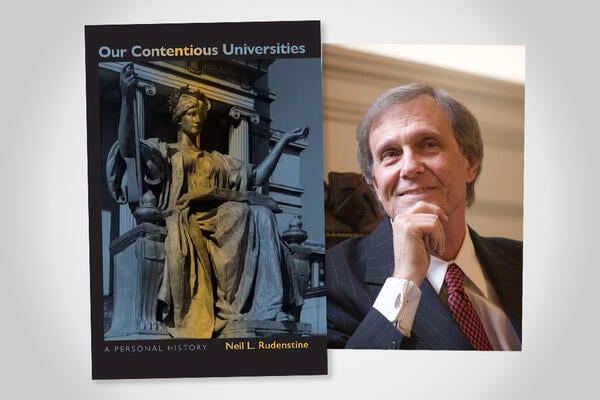
    Now 90, Rudenstine released a book last month titled Our Contentious Universities: A Personal History (The American Philosophical Society Press) that is partly a memoir and partly an exploration of campus protests movements across multiple decades and causes.

    Rudenstine discussed the book with Inside Higher Ed, sharing his personal experiences of protests in years past and his thoughts on the latest wave of pro-Palestinian demonstrations.

    Excerpts of the conversation have been edited for length and clarity.

    Q: What motivated you to write this book?

    A: From my point of view, increasing student protests starting in the ’90s seemed to be different from those of the ’60s, and more complicated to deal with. So I began to try to find out what the differences were and what the results might be of the new movement, so to speak. That got me immersed to look again at the 1960s, and after that, events began to take over.

    Q: What differences do you see in protests of the past versus today?

    A: In the ’60s, student protests were quite violent at times, but they were all mainly concerned with the Vietnam War. Of course, there were other things, like student protests over apartheid in South Africa [in the 1980s]. But the main issue in the 1960s was the war, and students were essentially united in their feelings against the war. There was virtually no sense of students in any way protesting against one another, or student groups disagreeing with other student groups. It was a united feeling.

    It was also a feeling that if the war were to come to an end, the protests would probably also come to an end. In the ’90s and afterward, students were far more diverse. There were more Black students, Jewish students, Asian American students, first-generation students and so on. These groups did not necessarily agree with one another in terms of what was important to protest against, and they sometimes protested against one another. So the situation was very different; there was no single overriding issue like the war.

    Q: Tell me about your own protest experiences, starting when you were a professor at Harvard in 1967 and helped bring an end to a protest organized by Students for a Democratic Society.

    A: I was, at the time, an assistant professor of English literature, and totally absorbed by that job at Harvard. One day I was walking across campus outside of Harvard Yard, and I heard shouting and cheering going on around [Mallinckrodt Laboratory], which was a chemistry building. It turned out that Students for a Democratic Society had organized a protest that imprisoned a recruiter for the Dow Chemical Company who wanted to interview students for jobs. And since Dow was making some products [such as napalm] that were used in the war, the SDS students decided to imprison this recruiter.

    Purely by chance, I stopped by, and I thought it was not proper of the university to imprison a recruiter who’d come to interview students and told the students that by using their megaphone. After several hours of discussion and debate, the students released the recruiter and gave up the protest. I was somehow identified as the person who had helped to bring this about, and that led to me being asked to be dean of students at Princeton University to help with their protest movements. A very considerable accident got in the way of my literary career and deflected me from literature to student protests in a way that I had never imagined. It was purely the result of chance and serendipity.

    Q: Near the end of your career, students staged a sit-in to demand a living wage at Harvard. How were you able to wind that protest down without police intervention?

    A: That was a very complicated situation. Students sat in my office building, Massachusetts Hall, because they wanted to change the way in which many people at the university were reimbursed for their services. The living wage protest was not very rational. If they had wanted a minimum wage change, we might have been able to discuss it, but the method they chose was not rational, and they sat in the building for more than two weeks. So we had a very complicated and delicate situation.

    I decided at the beginning that whatever we would do, we would not call the police, because calling the police in earlier days at Columbia, Harvard, Kent State and other places had led to terrible situations of riots and police beating students. So the question was, how can we not call the police but also bring the situation to a conclusion? It took many, many days of discussion and waiting in order to try to find this conclusion.

    What happened was that the next president [Larry Summers] said, “Why don’t you put together a committee to look into the issue, and that will give the students a way out, and it’ll give you a way out? It’s not likely that this committee will embrace the solution that the students have chosen at all, but it’ll bring an end to the protests.” And that’s what happened. We appointed a committee, the students were able to claim the victory and walk out of the building, and we were able go back into our offices and basically say that we were happy nobody had been hurt, and that we would trust the new committee to make very good recommendations about what should be done in the future.

    Q: You wrote that you were “taken aback” by how quickly presidents brought in police to break up protest encampments last spring. What other tactics do you believe they should have considered first?

    A: Obviously, every situation is different, so there’s no one general thing you can do. But there is a way which you can call for the judiciary to step in. If students are identified as being in the protest, if the [judiciary] tells them to evacuate whatever building they happen to be occupying or whatever they’re doing wrong, they can be held in contempt of court if they don’t obey those admonitions. That’s a very good substitute for bringing in the police; if you’re held in contempt of court, it’s a very serious crime, and very few students want to do that, so they tend to leave right away. We had tried that at Princeton, and that seemed to be a good substitute for actually calling the police, which led, of course, to terrible things at Columbia and elsewhere, when the police tended to just brutalize the students when they were called in.

    Another alternative, of course, is to wait out the students in the hope that sooner or later, their academic needs will force them to go back out and get to their studies. That was a tactic we also used at Princeton.

    Q: What do you think about the institutional neutrality movement?

    A: I’m a little bit skeptical about the conception and certainly the term of neutrality. I understand why people would embrace the idea at the University of Chicago, for example, and other places. I think that’s a very interesting point of view, and I think at times it’s definitely the thing to do. You don’t want to go around commenting all the time on what has happened internationally or nationally. At the same time, it’s a very difficult row to hoe, because there simply are some events that require, if not an actual stance by the university, certainly some kind of an analysis with a possible outcome. I do think that there are times when it’s important for a leader to speak out, and it has to be done very thoughtfully, and one has to choose those moments carefully.

    Q: Any advice for today’s college presidents on how to handle campus protests?

    A: That’s a tough one. I think what they’re doing is about as good as can be done, and that’s clarifying what is legitimate as a protest or what is not legitimate and being willing to discipline students if they really cross the line of what’s permissible in an obstructive way that harms other people’s capacity to do their jobs. I hope the universities are open to discussing in a more collaborative way things that need to be ironed out, other than simply responding with police force. The more they can discuss and analyze and find ways to reason with the students and even some faculty … the more they are able to possibly defuse protest or the threat of protest.

    Source link

  • Rosemont College to Merge With Villanova

    Rosemont College to Merge With Villanova

    Rosemont College will merge with its much larger neighbor, Villanova University, joining two private, Catholic institutions in the Philadelphia area, The Philadelphia Inquirer reported.

    The small college, located less than a mile from Villanova, will be renamed Villanova University, Rosemont Campus, in a move that seems more akin to an acquisition than a merger. Tenured and tenure-track faculty at Rosemont will reportedly be offered teaching contacts.

    Like many small colleges, Rosemont has faced financial and enrollment challenges recently. 

    Rosemont’s enrollment stood at 777 students in fall 2023, according to recent federal data. While that number was higher than the two preceding years, it fell short of the 902 students Rosemont enrolled in 2019, or in previous years when the college typically surpassed the 1,000 mark.

    Public financial records show that Rosemont operated at a loss in the last four fiscal years. Amid the financial struggles, Rosemont has borrowed $7 million from its endowment—recently valued at $23 million—since 2020. A recent audit indicated “substantial doubt” that Rosemont would be able to remain open if its financial struggles persisted.

    During the merger process—which is expected to be completed in 2028, pending regulatory approvals—Rosemont will stay open and operate independently, with financial support from Villanova. But officials told the Inquirer they will stop accepting new students in October.

    The Rosemont merger comes after Cabrini University, another small private college in the Philadelphia region, closed in May 2024. Villanova purchased Cabrini’s campus soon afterward.

    Financial challenges have battered colleges in the Keystone State in recent years, with three institutions announcing closures last year. Another, the Pennsylvania Academy of the Fine Arts, ended its degree programs but remains open as a museum. More closures are on the horizon as Pennsylvania State University considers a plan to shutter up to 12 of its campuses.

    Source link

  • Survey: Trump Policies Push 75% of Scientists to Consider Leaving U.S.

    Survey: Trump Policies Push 75% of Scientists to Consider Leaving U.S.

    Survey: Trump Policies Push 75% of Scientists to Consider Leaving U.S.

    kathryn.palmer…

    Tue, 04/01/2025 – 03:00 AM

    Byline(s)

    Source link