Tag: Paper

  • Everything in the immigration white paper for higher education

    Everything in the immigration white paper for higher education

    The Home Office immigration white paperRestoring control over the immigration system – has arrived, and there are some seriously consequential decisions for international students and the higher education sector.

    The graduate route will be cut from two years (for undergraduates and master’s students) to 18 months. A range of new measures that will make visa sponsorship duties more onerous for higher education providers are coming into effect. There are steps to attract “top scientific talent.”

    And most unexpectedly of all, the idea of introducing a levy on international student tuition fees is floated, “to be reinvested into the higher education and skills system.”

    Mood music

    For all that there are some serious, significant changes to student and graduate visas contained within the white paper, the last few years of policy turmoil has demonstrated that much of the impact of migration policy on student recruitment is determined by how changes are interpreted by prospective students weighing up their choices between different destination countries.

    After having spent a couple of months in office making more positive noises about international students – and repeatedly patting themselves on the back about it – Labour has since plunged back into the murky waters of “talking tough on migration”, with students a political football yet again. How much this resonates abroad, and with what tenor the press in key recruiting countries reports on all of this, will probably have the greatest overall effect on what follows for the sector.

    But the white paper itself is pretty bullish on international students – more so than we might have expected. There’s plenty of language that would have not looked out of place in a Conservative policy document, had Rishi Sunak not scrambled for an election instead of providing a proper response to the MAC review. So the Home Office tells us:

    In recent years, we have seen an increase in students staying in the UK following their studies. Alongside this, we have also seen an increase in sponsored study visas for lower-ranking education institutions.

    And that:

    We have also seen a series of problems involving misuse and exploitation of student visas, where visas are used as an entry point for living and working in the UK without any intention to complete the course, and increasing numbers of asylum claims from students at the end of their course, even though nothing substantive has changed in their home country while they have been in the UK.

    Home secretary Yvette Cooper’s introduction even tries to paint the last government as recklessly pro-international recruitment (our bolding):

    Immigration policy during the last Parliament replaced free movement with a free-market experiment which incentivised employers to freely recruit from abroad rather than train at home, allowed education institutions to pursue unlimited expansion of overseas students without proper checks in place, and directly encouraged the NHS and care organisations to bring in far more staff from abroad while still cutting support or training places in the UK.

    The Office for National Statistics’ recent finding that more than half of students arriving in 2020 still held leave after three years gets an airing – a point which those in the sector who have repeatedly been arguing that the vast majority of international students return home after graduating would do well to heed.

    We’d also note that the white paper’s observation that growth in international recruitment has been particularly pronounced in those institutions further down the international rankings (made up as they are in the main of research output and spurious reputation surveys) is particularly inane, and yet another of those examples of the Home Office weighing in on education policy and the size and shape of the sector. It has its roots in the last government’s response to the MAC review, but it’s profoundly depressing to see it taken forward as a stick to beat teaching-intensive universities with.

    The graduate route

    The post-study work visa’s reduction in length will likely generate the most headlines, at home and abroad. Drawing on a new piece of evaluation conducted last spring, the Home Office concludes that:

    Too many graduates allowed to stay in the UK following the successful completion of their studies are not moving into the graduate level roles for which the Graduate visa route was created.

    A survey of just under 3,000 visa holders saw only 30 per cent report being in “professional” occupations, with others either not giving a straightforward answer to the question or (31 per cent) being in occupations whose entry requirements are likely to be A level equivalent or lower.

    The build-up to the white paper’s publication was accompanied by a somewhat ludicrous debate over whether the (non-sponsored) graduate visa would somehow be limited to graduate-level work or salary – regardless of the fact that this would have meant turning it into a completely different visa with a heavy overlap with the skilled worker route.

    Instead, the government has concluded that it should be reduced to 18 months – it appears that this applies only to undergraduate and master’s students, who currently are entitled to two years, rather than PhDs.

    It’s not really spelled out how this new length has been arrived at – the charitable interpretation would be that this is sufficient time to allow graduates who are going to find graduate-level work to indeed find it, while those who are either unable to or were never really serious about doing so (in the government’s eyes) will be obliged to leave sooner.

    This Home Office’s statement of the problem is that “the intention behind the Graduate route was to support the economy.” No mention is made of enhancing the UK’s attractiveness as a study destination, which was also a strategic objective at the route’s launch, and part of the international education strategy. The government no longer seems to want to have this conversation.

    The survey that (in parts) provides the evidence base for the curtailment of the route also notes that 65 per cent of users said that gaining work experience was one of the most important reasons to engage in post-study work. But – as we’ve observed before – this function of the graduate route gets increasingly ignored. The Home Office frames all graduate route holders as needing to acquire graduate-level roles, as quickly as possible, and then disapproves of the contribution to net migration that this begets.

    Diving a bit deeper into the graduate route evaluation that is, in theory, the justification for the changes, we again see the Home Office continuing to divide up the sector in terms of Russell Group and non-Russell Group, despite the fact that DfE under Labour has discontinued this practice in school performance management.

    The majority of Graduate route users graduated from a non-Russell Group university (72%), while a quarter (26%) graduated from a Russell Group university.

    While this finding doesn’t get a mention in the white paper itself, it’s of a piece with the pronouncements elsewhere that too many students seem to be coming through those less prestigious universities for the Home Office’s liking.

    So what’s the upshot? Yet again, the impact modelling deployed in government to assess the effects of visa changes on the higher education sector is pretty pathetic. A student route evaluation published alongside the white paper sees 66 per cent of survey respondents say they were aware of the Graduate route (this gets us down to n = 1,265). Of these, 73 per cent said it influenced their decision. Of these, 29 per cent said they would not have come if it wasn’t available. Blithely multiplying these percentages together leads to an assumption (in the white paper’s technical annex) that 14 per cent of applicants would be put off if the graduate route were abolished.

    Of course, the Home Office didn’t ask about reducing it by six months – it’s almost as if this decision was thrashed out in Whitehall horse-trading rather than a pragmatic example of policy implementation. As they are lopping a quarter of the graduate route, they have – genuinely – divided 14 per cent by four to get 3.5 per cent. This would equate to around 12,000 students a year if by some stroke of dumb luck the assumption turned out to be true. But what really comes across is that they have no idea.

    For international students who are not put off, the result of shortening the route will be either to reduce the amount of time they have to accrue valuable work experience or – for those who are hoping to build a career in the UK – accelerated pressure on the job hunt. Institutions will need to get even more serious about advice, careers support, and evaluation. This is especially the case given all the other wholesale changes to work visas that the white paper detonates – students will need support in navigating a system that each year is a little different to how it was when they started thinking about where to apply.

    Compliance

    In a lengthy section entitled “responsible recruitment”, the white paper sets out some serious reforms to how UK Visas and Immigration (UKVI) will manage compliance among those higher education institutions sponsoring students. It’s argued that current thresholds are “too lenient” and “have left the route open to abuse and exploitation.”

    We saw promises to make compliance standards stricter in the last government’s response to the MAC review, so there is a sense that some of what’s proposed in the white paper has been held back over the autumn to be made public here. UKVI has already been subjecting certain institutions to enhanced scrutiny for the last few months – but what’s proposed here goes quite substantially beyond that, and could be extremely challenging for some (especially small) institutions.

    The current metrics used to determine whether a sponsoring higher education provider is fulfilling its duties are – via the annual basic compliance assessment, or BCA – having a visa refusal rate of less than 10 per cent, a course enrolment rate of at least 90 per cent, and a course completion rate of at least 85 per cent.

    The white paper reveals that all of these measures will be made five percentage points stricter. To get an indication of how substantive such changes would be, it is noted that:

    Data from the 2023–24 BCA suggests that 22 HEIs would not have met at least one of the tightened criteria set out in this paper. These institutions sponsored approximately 49,000 students while refusing 400 during their 12-month assessment period.

    The technical annex also assumes that, of these 22, five would not be able to become compliant and therefore lose sponsorship rights, for at least a year. It puts the impact at between 9,000 and 14,000 fewer student visa grants, given that some students will be squeezed out of the system, whereas other genuine applicants will find alternative study destinations. It’s very much a guesstimate though – but the vastly increased requirements will put enormous pressure on higher education institutions to play it extremely safe with recruitment and agent partnerships, and to subject applicants to even more rigorous checks.

    There’s more as well – UKVI will roll out new interventions for sponsors “close to failing metrics”, sign-up to the Agent Quality Framework will be mandated – a measure that has been proposed about a hundred times by this point, and the framework is already widely subscribed to – and a new RAG rating will be used to rate each sponsoring institution’s compliance. On this latter point, it’s mentioned that this will help the public assess institutions’ compliance, raising the intriguing possibility that we are about to get a lot more transparency from UKVI than was ever the case. And massively ramping up the pressure on universities (and, especially, smaller providers) to avoid falling foul of the rules.

    It’s also worth not losing sight of the impact on international students themselves of all this bearing down on compliance – a measurably more bureaucratic study experience and, if not well implemented by providers, one that reinforces a sense of unwelcomeness as they are repeatedly asked to jump through hoops that home students do not face.

    But probably the most important measure contained within the proposals – and, if implemented properly, an extremely welcome one – is obliging a provider who wants to request a larger CAS allocation to “demonstrate that they are considering local impacts when taking its decision on international recruitment.” There’s no further information on what this would look like, but housing must clearly be front and centre of the government’s thinking here – it’s something Yvette Cooper has mentioned on a number of occasions.

    Asylum claims

    In the run-up to the white paper’s publication, leaks to the press made it clear that one area where international higher education was in the Home Office’s crosshairs was over the proportion of asylum claims generated by those who had arrived in the UK on student visas – as we’ve recently written about on Wonkhe, this hit 16,000 in 2024, almost 15 per cent of all claims in the year.

    The white paper says that this number has been increasing “at pace”, and also reveals that the majority of the students claiming asylum “do so as they approach their visa expiry date” – a fact which is ascribed to students making claims to stay in the UK, rather than due to changes in their own country.

    It had been briefed to the media that applications for work and study visas by those deemed most likely to overstay and claim asylum would face higher rejection rates, through some of “pattern spotting” – a predictive measure that would inevitably face legal challenges, it should be noted. The white paper doesn’t, in fact, get too much into the detail here, rather setting out towards the end a “series of further measures” that will be explored.

    One of these seems likely to be the use of international students’ proof of funds as evidence that they should not be eligible for asylum. We also get reference to potential “financial measures, penalties and sanctions” for sponsoring institutions – which would include universities. Detail on all this is going to come at a later point.

    An international student levy?

    When the Australian government commissioned a wholesale review of higher education – the Accord – one of the ideas that generated most pushback from the sector was for a levy on international students. It came out of the Accord commission’s interim report – then education minister Jason Clare said it was analogous to a “sovereign wealth fund” for the sector, and could be spent on infrastructure or research.

    Australia’s research-intensives – the Group of Eight – called it a “damaging international student tax”. It was absent from the Accord’s final recommendations, replaced by a “futures fund” with joint contributions from universities and government. It still wasn’t popular and, like much of the Accord’s long-term thinking, there hasn’t been any sign of policymakers picking it up.

    And yet – completely out of the blue, something similar has cropped up in today’s white paper:

    The Government will explore introducing a levy on higher education provider income from international students, to be reinvested into the higher education and skills system. Further details will be set out in the Autumn Budget.

    The Home Office wants to stress that this is not a final policy position – indeed, it is not something that one government department could move forward with on its own. The technical annex gives the “illustrative” example of a six per cent levy on tuition (and also notes that it would likely be passed on to students in higher fees).

    A six per cent levy would generate something in the order of £570m, if we generously take into account the reductions in recruitment that the Home Office has modelled (the levy’s putative effects are transmogrified into assumptions about changes to student demand based on some work from London Economics that was only focused on students from the EU, but it’s not even worth getting into that).

    There’s no way to reliably say which universities would lose out in terms of paying the levy – the government appears to be assuming that the students that won’t now come are the ones that they don’t want to come, which would likely hit less prestigious providers with more international students. You might imagine that some part of the levy would have to be used to prop up otherwise struggling providers in deprived areas – as we would otherwise lose them.

    What that would amount to is a word we’ve not heard from any government for a good few years – redistribution. Though the idea of the sector as a single set of accounts is familiar among headline writers and UCU campaigners, in practice there’s been little deviation from the idea that the market is the fairest means to distribute resources (“the funding follows the student”) with the exception of a very small amount of funds for “world class” small and specialist providers.

    Of course, by mentioning that the levy would be spent on “higher education and skills” opens the door to the money going elsewhere in the tertiary space. And, as with the apprenticeship levy, there’s no guarantee that the funds would not be top-sliced by the Treasury. There is absolutely no doubt that such a system, in the event that it came to pass, would be the subject of policy instability for many subsequent years, with everyone and their dog coming up with tweaks, fiddles and overhauls in how it should best be deployed.

    We’ve noted that the Home Office vaguely intimates that the cost of the levy would be borne by students (via increased fees) rather than by higher education providers. This may well not be the case. The last decade has shown that providers will set the fees at the level where they think they can recruit, rather than with reference to cost of provision (or home fees). If fees could comfortably go up six per cent, then they already would have. So expect a serious lobbying effort from universities against any further plans to introduce this levy.

    There are also substantial issues around devolution here. International student fees are really not there for the Home Office to grab and claim that they are a reserved matter, in the way that visas are. Presumably what’s being considered here would apply England-only – unless the devolved governments suddenly think this is worth going along with.

    All the other stuff

    Given that higher education is so intimately interconnected with both the visa system and the labour market, there’s barely a page of the white paper that doesn’t have some degree of consequence for the sector. Here’s a rundown.

    Global talent: the one area where there is a commitment to increasing migration is “very high talent routes.” There is talk of simplifying the use of the global talent visa to recruit top scientific talent, as well as possibly doubling the number of overseas universities whose graduates qualify for the high potential individual work visa route. Eligibility here is based on international university rankings, and consequently is a complete mess.

    Student dependants: there will be a new English language requirement for all adult dependants, at A1 on the Common European Framework of Reference for Languages (CEFR). It’s also noted that the intention is to increase this over time.

    Short-term study visas: the government has already increased scrutiny of these visas for students coming on short (six to eleven month) English language courses, but there will also be a review of accreditation bodies, due to a very high refusal rate.

    Immigration skills charge: This charge for companies sponsoring those on skilled worker visas (currently £1,000 a year for medium or large sponsors) will be increased by 32 per cent. It’s one of those things that sounds good on paper – reinvesting visa fees into the skills system – but has never been implemented properly, with money just vanishing into the Treasury. In theory, that’s now going to change, with the spending review to announce “skills funding for priority sectors” paid for out of these funds.

    We should also note that higher education institutions are currently exempt from paying this charge for many categories of scientist, research managers and teaching professionals – so worth keeping an eye on the detail of the changes here when they do appear.

    The Labour Market Evidence Group: this body, which had previously been referred to as “the quad”, is to be made up of the industrial strategy advisory council, the Migration Advisory Committee (MAC), Skills England (and the devolved nations’ skills bodies, to the extent the government will properly involve them rather than dumping policy on them), and the DWP. We don’t learn much that wasn’t in the MAC’s annual report, but this group’s evidence will be used to inform workforce strategies for sectors that have high levels of overseas recruitment.

    The Immigration Salary List: this set of occupations eligible for discounts on skilled worker visa salary premiums is to be abolished. This was until recently known as the shortage occupation list, to give you a sense of how much churn successive governments have instituted in migration policy. Instead, the MAC is going to conduct a review of how discounts are used, with the result that the exact salary requirements for different jobs – which universities may want to recruit onto, or international graduates might want to progress to – are up in the air again. Currently those on student or graduate visas are entitled to a discount in the required salary for sponsorship.

    International education strategy refresh: Nope, no mention of this. The last we heard this was due for “early spring”, and presumably now the white paper has landed the DfE and the business department have a freer hand to get it launched.

    It’s hard to see how some of the original IES targets around diversification can persist, given the increased pressure on compliance (stay out of “risky” markets), potential plans to profile certain nationalities, and the fearmongering about students attending less prestigious institutions. A student number target feels a million miles away from how Labour is trying to position itself politically. And education export objectives, without any detail on what aspects on international activity the government is OK with increasing, are pretty meaningless. So what’s left to be in it?

    Source link

  • An end to sticking plaster politics? Why the government needs to use its upcoming white paper to take a different approach to immigration

    An end to sticking plaster politics? Why the government needs to use its upcoming white paper to take a different approach to immigration

    The Labour Party was elected to government last year on a promise to reduce net migration. Their victory in the 2024 General Election followed a period in which net migration to the UK peaked at 906,000 and public concerns over migration began to rise again for the first time since the Brexit referendum.

    Unsurprisingly, Number 10 views progress on this issue as central to their re-election prospects. Precisely how the government will look to do this is still unclear, yet recent weeks have seen growing speculation over an immigration white paper which is expected to land pretty soon.

    White paper

    A new approach to immigration is needed. Too often, immigration policy has been dictated by the release of the latest migration figures and so the development of a white paper on immigration in and of itself is no bad thing. Moreover, it provides the government with an opportunity to take a more strategic approach to migration policy.

    Prior to the election, the Labour Party committed to a different style of governing which would end ‘sticking plaster’ politics. But how to apply this longer-term view to immigration policy? To be judged as successful, any new approach to immigration would need to see net migration reduced given their manifesto commitment. As such, tough choices need to be made about where further reforms could be made to reduce the overall number of people coming to the UK.

    This creates some obvious risks for UK universities given the importance of international students to the financial sustainability of our sector. Universities UK (UUK) has been clear that, over the long-term, international recruitment should not be the answer to the financial sustainability of higher education institutions. Instead, we need to work with government on a long-term plan, secure increased investment, and explore new approaches to efficiency and transformation in the sector.

    In the absence of a long-term plan to address the underfunding of the higher education sector, any new approach to immigration would, at the very least, need to enable universities to continue to attract international students to study in the UK to prevent current financial challenges from deteriorating further.

    Three tests

    This is no easy task, but it is possible. So, what could a different course of action on migration policy actually look like? I think there are three clear things we need:

    1. A joined up, coordinated approach.

    2. Look forward not back, (as the Labour Party once encouraged us to do).

    3. Draw a line between temporary and permanent migration.


    The left-hand ought to know what the right-hand is doing

    The starting point of any new immigration policy ought to be based on having a joined-up and co-ordinated approach. This may seem obvious but would be a welcome change.

    The key opportunity for the new government is to use their immigration white paper to finally align migration policy with wider government objectives. Based on what the Home Secretary has outlined, at least part of this would be to create much greater join-up between the UK’s visas and skills systems so that immigration is not used as an alternative to training or tackling workforce problems, thereby reducing overall net migration. This is a good start, but the white paper offers an opportunity to go further.

    Under previous administrations, there was a distinct lack of coordination and coherence in policy and strategy. This can be seen most clearly in the development of an International Education Strategy – which set an explicit aim of government policy to grow the number of international students coming to the UK, but which then came up against a Home Office who had been instructed to curb the growth in international students.

    Don’t use the rear-view mirror

    With a clear joined-up strategy, the government should then look to shift the focus of immigration policy away from retrospective net migration trends, towards focussing on future forecasts, thereby creating a more realistic timeframe to achieve their strategy.

    It is quite clear that reducing net migration is going to continue to be the focus of government policy. Yet as we have seen, annual net migration focuses too much on short-term migration trends – be it the increase of people coming from Ukraine, or Hong Kong – and doesn’t focus enough on the anticipated impact of recent policy – such as changes to dependant’s which has led a dramatic reduction in the UK’s attractiveness as a study destination in certain countries.

    By shifting towards long-term projections (measured over a rolling 5-year average), the government could then create the political space to actually achieve their wider objectives. For example, providing a longer-term timeframe to work with employers to implement skills and training initiatives to support those roles where recruitment is primarily met through immigration.

    Any future forecast would, inevitably, be subject to changes and revisions but it would represent a far better metric than basing government policy on retrospective and highly volatile net migration trends from the previous year.

    Separate the temporary from the permanent

    A final welcome change would be for the government to distinguish more between ‘temporary’ and ‘permanent’ migration. After all, while many migrants do settle in the UK, many others do not and have little intention of doing so.

    This applies to many international students. They may stay for a few years after their studies, but very few end up remaining in the UK for the long-term and get settlement. Rather than taking students out of net migration – which would only serve to highlight the contribution which international students do make to net migration while ignoring the impact which students do have on housing and local services – the government should look to place greater focus on different types of visas being granted to those coming to the UK.

    There are lots of ways this could be done, but focussing more on those visa routes which lead to settlement (or ‘indefinite leave to remain’) would help improve public understanding of migration and better reflect the fact that many migrants included in the net migration stats do not contribute significantly to the long-term population of the UK.

    Concerns about immigration are unlikely to go away anytime soon, but the opportunity for a better approach is there for the taking.

    Many parts of the world – particularly across the Anglosphere – are currently seeing higher levels of net migration, and how countries respond is an issue facing many governments.

    With aging societies, slowing rates of economic growth, not to mention an increasing number of people displaced due to climate change, conflict, and natural disasters, immigration will continue to be high on the political agenda.

    Through their immigration white paper, the new UK government has a clear opportunity to address this challenge head on and take a different approach to previous administrations and, in doing so, demonstrate that well-managed immigration can be – and indeed is – a force for good.

    In developing a more joined-up approach, while focussing on future projections – rather than retrospective trends – and which makes a clearer distinction between temporary and permanent migration, the UK government could go a long way to developing a more sensible approach to immigration policy.

    The opportunity is there, the question is whether the government will take it.

    Source link

  • Innovation and skills in the English devolution white paper

    Innovation and skills in the English devolution white paper

    Devolution is a central plank of the government’s growth agenda. Providing places with the tools and resources to address local problems in ways that make sense on the ground is a means to unleash potential – and to end what English devolution minister Jim McMahon is happy to call the “top-down micromanaging” approach of ringfencing funds and centralising decision making.

    The launch of the English devolution white paper is the first step on that journey. Strategic authorities, led (for preference) by elected mayors, will cover the entirety of England. Integrated settlements will provide powers covering transport, infrastructure, housing, public services – and, of particular interest to the higher education sector, skills and innovation.

    A big part of the work of the white paper is in consolidating and standardising what had become an unruly system. Sitting above unitary, county, and district councils, a layer of strategic authorities will take on the services that larger areas need to thrive:

    Our goal is simple. Universal coverage in England of Strategic Authorities – which should be a number of councils working together, covering areas that people recognise and work in. Many places already have Combined Authorities that serve this role.

    The forthcoming English Devolution Bill will enshrine this concept in law. We get a computer game-like hierarchy of how strategic authorities will level up (so to speak): foundation strategic authorities (which do not – yet – have a mayor), followed by mayoral strategic authorities, which can then “unlock” designation as established mayoral strategic authorities through fulfilling various criteria. This will grant integrated funding settlements and other treats such as the ability to pilot new kinds of devolution.

    Already eligible for this top designation are Greater Manchester, Liverpool City Region, the North East, South Yorkshire, West Midlands, and West Yorkshire. There’s an aspiration for something similar to apply to London as well, but some legislative fiddling will be needed due to the capital’s “unique circumstances.”

    Innovation

    If you’ve got your head around the different levels of hierarchy, there’s actually quite a lot in the white paper for research and innovation, dependent on an area’s level of devolution.

    In language echoing the industrial strategy green paper, we are told that a strong local network of public and private institutions focused on R&D, innovation, and the diffusion of ideas “is one of the factors which sets highly productive local economies apart.” A big part of this is closer join-up between UKRI and local government.

    Working our way up the devolution ladder, all strategic authorities (including foundation level) will be able to draw on UKRI data on the location of R&D investments, to better allow them to “understand publicly supported innovation activity in their region and how to best take advantage of it.”

    Those mayoral strategic authorities will additionally work with Innovate UK to produce joint plans, to shape long-term innovation strategies and investments in places. UKRI will also be extending its regional partnerships and “network of embedded points of contact” with mayoral strategic authorities.

    And then coming up to the pinnacle of devolution, those established mayoral strategic authorities – to remind you: Greater Manchester, Liverpool City Region, the North East, South Yorkshire, West Midlands, and West Yorkshire, and possibly London – will get actual devolved research funding, in the form of a future regional innovation funding programme allowing local leaders to develop “bespoke innovation support offers for their regions.”

    This draws somewhat on the spirit of the Regional Innovation Fund, though this was allocated to individual higher education institutions – what’s on offer here sounds like a pot of money controlled by mayors. Its format is also to be based on lessons learned from the Innovation Accelerator pilot, which was funding by levelling up money.

    Plus, established mayoralties will get an annual meeting with the science minister, more regular engagement with senior staff at UKRI, and the chance to be consulted on the development of relevant DSIT and UKRI strategies.

    All in all, it’s a decent start down the road of a more significantly devolved research landscape. Important to note, however, that the actual funding on offer to established mayors is contingent on next year’s spending review, and so we’re talking about 2026–27 onwards here. And we might also observe that the House of Commons science committee’s inquiry into regional R&D, announced last week, has clearly been set up with an eye to influencing how this all comes together.

    At least to begin with, there will also be a not insignificant gap between what’s on offer to the most established sites of devolution – some funds to spend as desired, a seat at the strategy table – and what those “foundation” strategic authorities receive, which will be little more than a bit of regional R&D data. There’s potential for imbalance between regions here. Foundation-level authorities are described as a “stepping stone” to later acquiring a mayor, but it could be a long and drawn-out process.

    Skills and more

    On skills, strategic authorities will retain ownership of the Adult Skills Fund (with ringfencing removed from bootcamp and free course pots to allow for flexibility), take on joint ownership of Local Skills Improvement Plans alongside employer representative bodies, and work with employers to take on responsibility for promoting 16-19 pathways. In future, strategic authorities will have a “substantial role” in careers and employment support design outside of the existing Jobcentre Plus network, as the Get Britain Working white paper gestured towards.

    You’ll have spotted that this does not immediately extend to higher education, except to the extent that universities and colleges already get involved with adult skills provision. However the centre of gravity is such that any provider with an avowed interest in the local area will end up developing close relationships with strategic authorities. It isn’t just on skills or innovation – many universities work with local government on issues that affect students (and staff!) such as housing, infrastructure, and transport, and will have a strong interest in working with strategic authorities with new and wider powers to act.

    Administrative geography corner

    If you are labouring under the impression that dividing England up into administrative chunks is a fairly straightforward task, may we introduce you to possibly the single finest document ever published by the Office for National Statistics: the Hierarchical Representation of UK Geographies.

    Pedants may also note that the existing geography of LSIPs, which was controversially allowed to evolve into being outside of the established local authority boundaries, does not map cleanly to current or proposed local authorities – something that a future iteration of plans may need to consider. Likewise, the scope of university core recruitment areas or civic aspirations may not map to either.

    What we’d have loved to have shown you is a map showing which of the new strategic authorities your campus might be in. Sadly the boundaries of the “current map of English devolution” included in the white paper do not cleanly map to England’s many contradictory systems of administrative geography. Some of the devolved areas depicted are almost LSIP regions, one (Surrey) is a non-metropolitan ceremonial county, and one – Devon, including Torbay but not under any circumstances Plymouth – is just plain mad.

    As soon as we get an answer and some boundaries from ONS, we’ll let you know. In the meantime, here’s the map from the white paper:

    Source link

  • CBE Learning Platform Architecture White Paper –

    CBE Learning Platform Architecture White Paper –

    Earlier this year, I had the pleasure of consulting for the Education Design Lab (EDL) on their search for a Learning Management System (LMS) that would accommodate Competency-Based Education (CBE). While many platforms, especially in the corporate Learning and Development space, talked about skill tracking and pathways in their marketing, the EDL team found a bewildering array of options that looked good in theory but failed in practice. My job was to help them separate the signal from the noise.

    It turns out that only a few defining architectural features of an LMS will determine its fitness for CBE. These features are significant but not prohibitive development efforts. Rather, many of the firms we talked to, once they understood the true core requirements, said they could modify their platforms to accommodate CBE but do not currently see enough demand among customers to invest the resources required.

    This white paper, which outlines the architectural principles I discovered during the engagement, is based on my consulting work with EDL and is released with their blessing. In addition to the white paper itself, I provide some suggestions for how to move the vendors and a few comments about other missing pieces in the CBE ecosystem that may be underappreciated.

    The core principles

    The four basic principles for an LMS or learning platform to support CBE are simple:

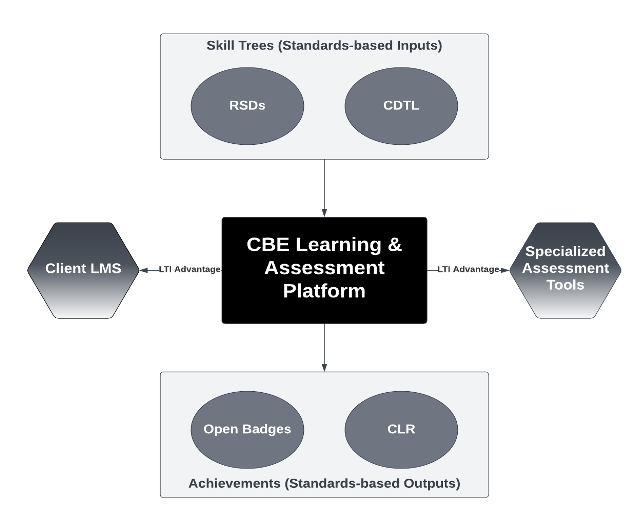
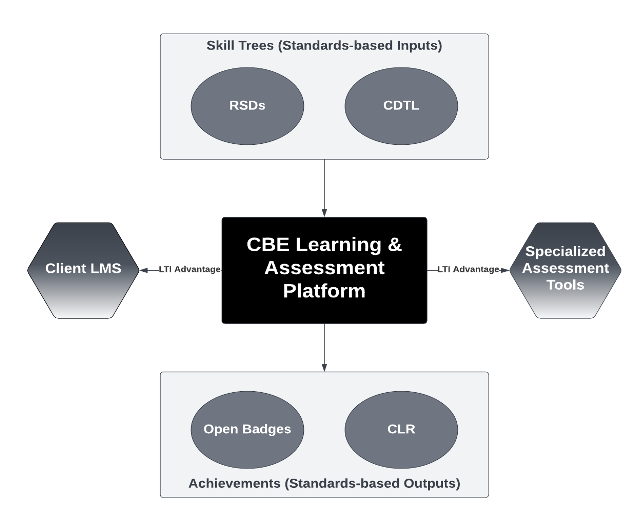
    • Separate skill tree: Most systems have learning objectives that are attached to individual courses. The course is about the learning objectives. One of the goals of CBE is to create more granular tracking of progress that may run across courses. A skill learned in one course may count toward another. So a CBE platform must include a skill tree as a first-class citizen of the architecture, separate from the course.
    • Mastery learning: This heading includes a range of features, from standardized and simplified grading (e.g., competent/non-yet) to gates in which learners may only pass to the next competency after mastering the one they’re on. Many learning platforms already have these features. But they are not tied to a separate skill tree in a coherent way that supports mastery learning. This is not a huge development effort if the skill tree exists. And in a true CBE platform, it could mean being able to get rid of the grade book, which is a hideous, painful, never-ending time sink for LMS product developers.
    • Integration: In a traditional learning platform, the main integration points are with the registrar or talent management system (tracking registrations and final scores) and external tools that plug into the environment. A CBE platform must import skills, export evidence of achievement, and sometimes work as a delivery platform that gets wrapped into somebody else’s LMS (e.g., a university course built and run on their learning platform but appearing in a window of a corporate client’s learning platform). Most of these are not hard if the first two requirements are developed but they can require significant amounts of developer time.
    • Evidence of achievement: CBE standards increasingly lean toward rich packages that provide not only certification of achievement but also evidence of it. That means the learner’s work must be exportable. This can get complicated, particularly if third-party tools are integrated to provide authentic assessments.

    The full white paper is here:

    (The download button is in the top right corner.)

    Getting the vendors to move

    Vendors are beginning to move toward support for CBE, albeit slowly and piecemeal. I emphasize that the problem is not a lack of capability on their part to support CBE. It’s a lack of perceived demand. Many platform vendors can support these changes if they understand the requirements and see strong demand for them. CBE-interested organizations can take steps to accelerate vendor progress.

    First, provide the vendors with this white paper early in the selection process and tell them that your decision will be partly driven by their demonstrated ability to support the architecture described in the paper. Ask pointed questions and demand demos.

    Second, go to interoperability standards bodies like 1EdTech and work with them to establish a CBE reference architecture. Nothing in the white paper requires new interoperability standards any more than it requires a radical, ground-up rebuild of a learning platform. But if a standards body were to put them together into one coherent picture and offer a certification suite to test for the integrations, it could help. (Testing for the platform-internal functionality like competency dashboards is often outside the remit of interoperability groups, although there’s no law preventing them from taking it on.)

    Unfortunately, the mere existence of these standards and tests doesn’t guarantee that vendors will flock to implement CBE-friendly architectures. But the creation process can help rally a group that demonstrates demand while the existence of the standard itself makes the standard vendors have to meet clear and verifiable.

    What’s still missing

    Beyond the learning platform architecture, I see two pieces that seem to be under-discussed amid the impressive amount of CBE interoperability and coalition-building work that’s been happening lately. I already wrote about the first, which is capturing real job skills in real-time at a level of fidelity that will convince employers your competencies are meaningful to them. This is a hard problem, but it is becoming solvable with AI.

    The second one is tricky to even characterize but it has to do with the content production pipeline. Curricular materials publishers, by and large, are not building their products in CBE-friendly ways. Between the weak third-party content pipeline and the chronic shortage of learning design talent relative to the need, CBE-focused institutions often either tie themselves in knots trying to solve this problem or throw up their hands, focusing on authentic certification and mentoring. But there’s a limit to how much you can improve retention and completion rates if you don’t have strong learning experiences, including formative assessments that enable you to track students’ progress toward competency, address the sticking points in learning particular skills, and so on. This is a tough bind since institutions can’t ignore the quality of learning materials, can’t rely on third parties, and can’t keep up with demand themselves.

    Adding to this problem is a tendency to follow the CBE yellow brick road to what may look like its logical conclusion of atomizing everything. I’m talking about reusable learning objects. I first started experimenting with them at scale in 1998. By 2002, I had given up, writing instead about instructional design techniques to make recyclable learning objects. And that was within corporate training—as it is, not as we imagine it—which tends to focus on a handful of relatively low-level skills for limited and well-defined populations. The lack of a healthy Learning Object Repository (LOR) market should tell us something about how well reusable learning object strategy holds up under stress.

    And yet, CBE enthusiasts continue to find it attractive. In theory, it fits well with the view of smaller learning chunks that show up in multiple contexts. In practice, the LOR usually does not solve the right problems in the right way. Version control, discoverability, learning chunk size, and reusability are all real problems that have to be addressed. But because real-world learning design needs often can’t be met with content legos, starting from a LOR and adding complexity to fix its shortcomings usually brings a lot of pain without commensurate gain.

    There is a path through this architectural mess, just like there is a path through the learning platform mess. But it’s a complicated one that I won’t lay out in detail here.

    Source link

  • Ben Sasse and Paper Tigers in Academia

    Ben Sasse and Paper Tigers in Academia

     This quote caught my eye in the Gainesville Sun today. It is about, Ben Sasse,  the likely new president of UF, and faculty opposition: “I think many of my colleagues feel that his  academic credentials are not where we would have wanted them to be.”

    I’ve deleted the name of the person quoted because that quote is representative of  law professors speak. They say things that mean nothing or, put differently, allow for total deniability while at the same time stirring the pot ever so gently.  It’s the reason I was always an outsider in the Ivory Tower. 

     The statement, and that of law professors’ generally, reminds of a something John Cage said, “I have nothing to say and I am saying it.”

    For example, note the speaker only “thinks” this could be the case. This leaves room to say, if asked to defend the statement, “It’s only what I thought or the impression I had. I could be wrong.”And then there is the word “many.” What is “many?” Is it 12? Could be. Is it a majority? Maybe, maybe not. 

     This reminds me of what I call faculty trolling. For example, say you think someone up for tenure does not deserve it but you are too much of a wuss to say it. You go office to office and say, “I have heard that some people are concerned about Joe’s (the candidate) scholarship.” Not you, of course, unless the person you are talking to says someone like “Yes, I too was wondering about this.” If that is the response, the troller has has hit pay dirt and gets a movement started without ever actually taking a position. If the answer is “I have not heard anything about that.” The troller moves on to the next office.

    And could someone tell me what “where we would have wanted them to be” means. How about, “are not satisfactory” What on earth does “where we would have wanted them to be” actually say. “We would have/” Would have what? In a different universe? On Mars?

    But wait. In the same passage the writer does use the word “we” which includes “I.” So it could say “I wish his credentials were better.” The problem is nearly everyone wishes everything were better. I  wish my car got better mileage but what it gets is fine. I wish my dinner was better last night but it was fine. Wishing for better or wanting better is saying nothing. 

    So what would my quote have been of the Sun had asked me? “I can’t speak for everyone but his academic credentials make him unfit. In addition, he is obviously the product of a rigged search that was guaranteed to produce a candidate to the liking of our right wing, mean spirited Governor.”

    Source link