Tag: Rise

  • Student AI Use on the Rise: Why Universities Must Lead with Ethical Support

    Student AI Use on the Rise: Why Universities Must Lead with Ethical Support

    Title: 2025 U.S. Student Wellbeing Survey

    Source: Studiosity in partnership with YouGov

    The higher education landscape is undergoing a profound transformation shaped by rapid technological advancements and shifting student expectations. The 2025 U.S. Student Wellbeing Survey, conducted by Studiosity in partnership with YouGov, offers in-depth insights into student behavior, particularly their growing reliance on AI tools for academic support.

    The report states that 82 percent of U.S. students have used AI for assignments or study tasks. This trend is even more pronounced among international students, with 40 percent reporting regular AI use compared with 24 percent of domestic students. The findings make clear: AI is no longer emerging—it’s central to the student academic experience.

    While student use of AI is high, only 58 percent of respondents feel their universities are adapting quickly enough to provide institution-approved AI tools, a figure that shows minimal improvement from 2024 (57 percent). Furthermore, 55 percent of students now expect their institution to provide AI support, reflecting shifting priorities among students. This year, “confidence” overtook “speed” as the main reason students prefer institution-provided AI tools, underscoring the demand for reliable and ethical solutions.

    The data also highlight heightened stress levels linked to AI use, with 66 percent of students reporting some level of anxiety about incorporating AI into their studies. Students voiced concerns about academic integrity, accidental plagiarism, and cognitive offloading. One student said, “AI tools usually need a well-detailed prompt. Most times AI gets outdated data. Most importantly, the more reliable AI tools require payment, which makes things unnecessarily hard.” This highlights an equity issue in AI use, as some students reported paying for a premium AI tool to get better results. Those experiencing constant academic stress were more likely to report regular AI use, suggesting a need for support systems that integrate human connection with technological assistance.

    The research emphasizes actionable strategies for universities:

    • Develop or purchase institution-backed AI tools with clear ethical guidelines.
    • Provide transparent and consistent policies to help students understand how to use AI responsibly.
    • Integrate AI support with existing academic services to preserve human interaction and peer engagement.
    • Ensure equitable, affordable access to AI technologies to avoid exacerbating existing inequalities.

    As students navigate an increasingly AI-driven academic environment, universities must step into a leadership role. Providing ethical, institution-approved AI tools isn’t just about keeping pace with technology; it’s about safeguarding learning, reducing stress, and fostering confidence in academic outcomes. The 2025 survey makes one thing clear: students are ready for universities to meet them where they are in their AI use, but they are asking for guidance and assurance in doing so.

    To download a copy of the USA report, click here. For global reports and surveys, including cross-institutional meta-analyses and educator surveys, click here.


    If you have any questions or comments about this blog post, please contact us.

    Source link

  • Rise of the Incompetents (opinion)

    Rise of the Incompetents (opinion)

    As an English composition instructor, I’m prone to doomscrolling articles (written primarily by other English composition instructors) about the uses, advantages and dangers of large language models in college classrooms. I think my colleagues, focused on concerns about plagiarism, policing and the tenability of our own employment (all pressing issues in their own rights), may be ignoring the greater threat that text-generation technology poses to our democratic institutions, the judgment of our electorate and the competence of our workforce.

    In one of the articles I found myself scrolling, John Villasenor, writing for the Brookings Institution, suggested that LLMs would lead to “the democratization of good writing.” I was surprised to see that description. The ChatGPT-produced assignments I see on a weekly basis are rarely mistakable for “good.”

    More to the point, research suggests that uniform style and content will not produce a level playing field of competent writers but, more likely, a ceiling of barely capable thinkers. In a study published by Nature Human Behaviour, researchers discovered that “reliance on ChatGPT … reduces the diversity of ideas in a pool of ideas,” to the degree that “94 percent of ideas from those who used ChatGPT ‘shared overlapping concepts.’”

    Academics like Vered Shwartz at the University of British Columbia have also raised concerns that if North American models “assume the set of values and norms associated with western or North American culture, their information for and about people from other cultures might be inaccurate and discriminatory.”

    A diversity of perspective, experience, talent and know-how are required to run and maintain a healthy democratic society. That civic diversity cannot be replicated by machines, and it would be severely damaged by voter rolls consisting of former students educated in the art of outsourcing their mental faculties to chat bots.

    AI proponents are quick to point out historical instances of educators running about like headless chickens at the inventions of keyboards, calculators, pen and ink. I would go further: Socrates opposed the act of writing itself, which he believed would “introduce forgetfulness into the soul of those who learn it.”

    We remember this quote because Plato wrote it down. It is a fallacy to conflate those examples with the full replacement (sometimes called “assistance”) of human thought by LLMs. Pens, keyboards and even Gutenberg’s printing press democratized writing in that they made it simpler for a greater number of human beings to convey themselves. In contrast, “AI” technology does not make writing easier for writers: At best it makes them readers—at worst, copy-pasters. LLMs pull words from data centers filled with the ideas of other writers, whose work is to a large degree not credited or paid for (even children will tell you that’s called theft). The result is akin to regurgitated vomit.

    To create this essay, I applied Microsoft Word’s red squiggly lines to spot my misspellings. I’ve always been a poor speller (ask my middle school teachers), but the words I produce, the mistakes I make, are still my own, and the reason I make them is tied to my human experience as a communicator. Whether I learn from those mistakes or simply press “fix” and doom myself to repeat them is a conscious choice I make every time I write.

    Of course, the choices don’t end there. I also decided how to approach the topic; what references to pull; how to order my paragraphs (both before and after I wrote them); what idioms, metaphors and introductory language to use; where to place hooks and callbacks; what to title the piece; and how to utilize grammar and punctuation to express my sassy indignation. These are vital skills for students to practice, not because they’re required in every profession, but because they emphasize executive function and cognitive reasoning. Writers are responsible for what they write, speakers for what they say, leaders for what they decide and voters for whom they elect. This in and of itself is reason enough to teach actual writing.

    Another common argument of writers who unironically propose supplanting their own perspectives with generative AI summaries is that the traditional method of teaching writing caters to what Villasenor calls an “inherently elitist” system. To their credit, this is true. In his guide Writing With Power (Oxford, 1998), the esteemed rhetoric and composition professor Peter Elbow, who passed away earlier this year, explained,

    Grammar is glamour … the two words just started out as two pronunciations of the same word … If you knew grammar you were special … But now, with respect to grammar, you are only special if you lack it. Writing without errors doesn’t make you anything, but writing with errors …makes you a hick, a boob, a bumpkin.”

    The fact that we have raised the bar for ourselves is a sign of intellectual progress. Yes, gaps continue to exist (I taught ESL for several years), but I wouldn’t be so quick to concede the higher ground of achievement. Besides, while knowing one’s split infinitives and dangling modifiers is not a prerequisite for civic engagement, an innate, perhaps unconscious understanding of collective grammar norms is still required for reading, and this is true for every written language, in all of its forms (including memes and text messages).

    We should be wary of the faux-populist sentiment behind arguments like this. A willful naïveté is required, I think, to suggest that the products of LLM parent companies (Google, Meta, OpenAI, Microsoft) foster equitable principles.

    Even more dangerous is the tactic of deriding the abilities and wisdom of specialists and academics who seek rare and valuable knowledge. This has been and remains a frequent trick of authoritarians, which is why educators should be concerned by the visibly cozy relationship many of these tech companies have fostered with the Trump administration.

    Both thematically and practically, this partnership, forged in campaign contributions, public appearances and the elimination of internal dissent (see: Jeff Bezos and The Washington Post), represents a threat to the university system. The Trump White House, intent on canceling research grants, deporting students and revoking accreditation, has very clearly demonstrated its opposition to “the elites” of academia. Ignorant consumers, like ignorant voters, are easier to manipulate, and ignorance thrives when education falters. Trump stated his preference clearly in a Nevada campaign event back in 2016:

    We won with young. We won with old. We won with highly educated. We won with poorly educated. I love the poorly educated!”

    According to a Pew Research Center analysis, Trump won the non-college-educated population by a 14-point margin (56 to 42 percent) in the 2024 presidential election, double his margin from 2016. The bad-actor alliance between Trump and big tech companies is no coincidence. They do not want you to write because they do not want you to think.

    The falseness of LLM-generated content is a perfect fit for the reality-rejecting ethos of the Trump administration. Back in April, the White House was accused of outsourcing its world-altering tariff calculations to ChatGPT. In May, the Health and Human Services secretary, Robert F. Kennedy Jr., published a report that experts discovered was filled with what appeared to be AI-generated false citations.

    These people have access to the greatest resources known to mankind. Why are they operating like bumfuzzled freshmen, submitting sloppy work at the 11th hour? Check the roster. The head of the Environmental Protection Agency has no experience working with the environment. The secretary of education is not an educator. The head of the Department of Housing and Urban Development is a former football player. The secretary of homeland security has never served in either an intelligence or defense capacity. RFK Jr. is a lawyer, not a doctor. Donald Trump is a reality TV star and convicted felon with six bankruptcies and numerous failed businesses to his name. If there is a better example of the Peter Principle in action on Planet Earth today, I don’t know it.

    Jason Stanley, an expert on fascism previously at Yale University and now at the University of Toronto (he was spurred by the Trump administration’s actions to leave the country), identified “anti-intellectualism” as a signature feature in fascist movements.

    As he writes, “Fascist politics seeks to undermine public discourse by attacking and devaluing education, expertise and language. Intelligent debate is impossible without an education with access to different perspectives, a respect for expertise when one’s own knowledge gives out, and a rich enough language to precisely describe reality.”

    As Americans, we are in real danger of voluntarily submitting our cognitive faculties to LLMs for the sake of convenience, thereby weakening our ability to express truth and sort it from falsehood, a dilemma we already face with the advent of social media, extremist “news” networks and both foreign- and domestic-born disinformation. It is easier to give up than to resist. It is easier to delegate than to work hard. Aldous Huxley, author of Brave New World, knew this well. In a 1949 letter to George Orwell, he predicted,

    Within the next generation, I believe that the world’s rulers will discover that infant conditioning and narco-hypnosis are more efficient, as instruments of government, than clubs and prisons, and that the lust for power can be just as completely satisfied by suggesting people into loving their servitude.”

    Our mothers gave us sage advice when we were children; they said, “Don’t take candy from strangers.” Like a creep in a white van, LLMs represent nebulous actors with nefarious purposes. In addition to stealing from countless unattributed human writers, companies like Meta and Google have demonstrated a careless—if not outright vampiric—interest in our personal data.

    The availability of this technology is equally pervasive. There’s a van on every street corner and the driver says that I can save 30 minutes of work by outsourcing it to Gemini. Why shouldn’t I? Isn’t this a benefit to me as an employee? Game theory suggests otherwise—if all competitors offload their work in the same manner, none of them get ahead. In a recent working paper published by the National Bureau of Economic Research, economists Anders Humlum and Emilie Vestergaard found that “AI chatbots have had no significant impact on earnings or recorded hours in any occupation.”

    Perhaps a more important question is this: Where do we imagine that 30 minutes goes? The rise of “AI” has yet to instigate a four-day workweek, and it is unlikely to do so. Since the Industrial Revolution—from black lung to Black Friday—American workers have learned that innovations in productivity rarely manifest as increased pay or shorter work hours.

    In the United States, labor conditions have improved only when collective action demanded it from lawmakers. Such was the case with Roosevelt’s New Deal in the 1930s. On their own, the steam engine, spinning jenny, desktop computer and mobile phone failed to reduce the need for workers to be productive. Rather, they set new production standards, profiting company shareholders. Line graphs of U.S. worker salaries and CEO earnings versus inflation over time bear this out quite strikingly.

    Big tech corporations are currently installing LLM apps in every corner of our daily lives, degrading the accuracy of search engines, making it harder to reach human customer service representatives and filling the internet with identical templates and “slop.” This may be profitable for wealthy investors, but it is not progress for average Americans. Moreover, as has been reported by Business Insider and Time, among many others, this rapid incursion represents a serious threat to the livelihood of employees across multiple sectors. Micha Kaufman, founder and CEO of Fiverr, a multinational company offering an “AI-enhanced” platform connecting freelancers and businesses, said back in April that “AI is coming for your jobs. Heck, it’s coming for my job too.”

    I imagine Kaufman can afford to lose his job. Can you? In the short term, corporate bosses may favor compliant employees who hastily enter prompts into LLMs, a skill that might take as much as a few hours of guesswork to develop. But leadership requires competence. Leaders make decisions, carry responsibility and know what to do when systems go down. If a 50-foot wave comes careening over your boat, whom do you want at the helm—a captain with years of sailing experience or one who is very good at asking AI what to do?

    Every time I enter a new classroom on the first day of the semester, I look across the desks and wonder which of my pupils will be a part of the next big thing. Which of them will enter government service? Which of them will teach in my place when I’m gone?

    Educators should not relent in pushing their students beyond the bounds of incompetence. Our collective goal should remain as it always has been—to inspire students to struggle and learn from that struggle, thereby forging new, more capable identities. I want my students to make something of themselves. What a disservice I’d do if, instead, I taught them how to delegate their potential to a machine.

    Noah B. Goldsher is a first-year seminar and first-year writing instructor at Quinnipiac University.


    Source link

  • Complaints About Federal Student Aid Office Rise Sharply

    Complaints About Federal Student Aid Office Rise Sharply

    Photo illustration by Justin Morrison/Inside Higher Ed | Marvin Joseph/The Washington Post/Getty Images | MauMyHaT/iStock/Getty Images | subtik/E+/Getty Images

    Complaints about the Office of Federal Student Aid’s operations have increased significantly over the past few months, according to the latest edition of a survey from the National Association of Student Financial Aid Administrators. Challenges that were once just kinks behind the scenes are evolving to become student-facing issues on the front line, the association says.

    The share of institutions reporting disruptions to communication, responsiveness or processing timelines rose from 59 percent in May to 72 percent in July. Meanwhile, the share of aid offices reporting student confusion about the process increased from 32 percent to 51 percent.

    The report, which is based on responses from financial aid officers at more than 500 NASFAA member institutions across the country, builds upon a similar survey conducted in May. It shows rising frustration with the FSA, despite the agency’s attempt to rehire about 50 of the more than 300 employees laid off earlier this year.

    “I wasn’t overly surprised” by the data, said NASFAA president Melanie Storey. “But it was largely a disappointment that the trajectory is moving in the wrong direction.”

    She added that the new loan caps and repayment plan changes detailed in President Trump’s One Big Beautiful Bill Act could compound the damage, creating long-term consequences for college attainment rates.

    Given the “fissures and cracks around trust in higher education, we need to eliminate barriers and support students clearly and consistently—and that includes helping them figure out how they’re going to finance their higher education,” Storey said. “If this trajectory continues, I’m really concerned about the decisions that students and families are going to be able to make to enroll in postsecondary education.”

    An Education Department official called the NASFAA report inaccurate and accused the organization of “peddling a false narrative to preserve the status quo.”

    “It is an embarrassment for NASFAA to release a ‘survey’ that blatantly parrots falsehoods and is not representative of the higher education community nor the American people’s overwhelming charge for change,” deputy press secretary Ellen Keast said in an email to Inside Higher Ed. “While NASFAA stands idly by ready to see us fail, the Trump Administration has just launched the earliest FAFSA form ever, which they are well aware of and decided to ignore.”

    Storey responded that NASFAA has tried repeatedly to partner with the administration in their “shared goal of serving students,” applauding efforts such as FAFSA beta testing.

    But to dismiss the survey results as “fabricated or political undermines the expertise of those working directly with students every day, eager to deliver on the promise of postsecondary education, and shows that the administration is not interested in working with experts in the field to achieve the best results for students; instead, it is focused on advancing its own agenda,” she said.

    Worsening Outcomes

    It’s been an eventful few months for the FSA. Mass layoffs throughout the department, first announced in March, quickly faced legal challenges; in May, a district court temporarily blocked the executive action. But any hopes that the staffing shortage would be resolved were squashed when the Supreme Court overturned the lower court’s ruling in July. And while the justices have yet to hear the full case or issue a final ruling, the order allows Education Secretary Linda McMahon to proceed with the pink slips.

    Storey said that some of the increased frustration and concern higher ed officials expressed in the survey may be related to timing; the district court ruling spurred cautious optimism in May, which had largely tanked by July. Similarly, the repercussions of staffing shortages were not necessarily evident in May but are now becoming clear. She also noted that the mounting discontent could simply be a reflection of the cyclical nature of student aid and the imminent start of the new academic year.

    Either way, the survey suggests that FSA operations are flagging, and many NASFAA members say it’s preventing them from properly processing aid. For example, 63 percent of institutions that have submitted their E-App—a form that must be completed and approved in order to receive federal aid—said their submission had yet to be processed in July.

    Department officials argue that this data is biased due to NASFAA’s survey method. They point specifically to the sample size, saying that the 500 institutions represented are predominantly nonprofit or public institutions, reflecting only a sliver of the more than 5,000 that FSA works with—and are the ones most likely to harbor anti-Trump sentiments.

    The department also described the survey’s questions as biased toward the negative and said it was conducted just as the department finished updating its Partner Connect Portal to address various complaints, meaning the results don’t accurately reflect the new changes.

    But Storey stood by her view that most of the challenges financial aid offices face today are the same as those they reported in May, only worse, and with longer delays in response time.

    For example, previous Inside Higher Ed reporting shows that when students hit a wall and cannot log in to the FAFSA application portal, college advisers struggle to reach the central processing system that manages user IDs. While a department spokesperson said all help lines remain fully open, multiple college and NASFAA representatives say they have been unable to get through at certain times.

    The latest survey shows this is still a major problem. More than half of institutions reported issues with federal call centers, and more than 40 percent cited problems with the National Student Loan Data System. In addition, over a third flagged disruptions with student loan servicing. Collectively, the NASFAA report said, these failures affect colleges’ ability to resolve aid issues for students in real time.

    Once the delays start to hit students—which is happening more and more often, according to NASFAA’s report—it could leave them without access to loans and therefore unable to pay their bills and stay enrolled. Although colleges can grant students extensions for tuition payments or on-campus housing fees, they can’t change when off-campus rent or childcare payments are due. Situations like these often force students to take a job and attempt to pay off their debt with some college but no degree.

    So unless FSA addresses its shortcomings, Storey said, the impact could be far-reaching.

    “It’s a compounding of issues and uncertainties that I think could have a long-lasting and significant impact on postsecondary enrollment and financing,” she said.

    Source link

  • With Reform UK on the rise, what impact would their higher education policy have?

    With Reform UK on the rise, what impact would their higher education policy have?

    This HEPI guest blog was kindly authored by Fred Jacques, a Year 12 student who recently completed a week of work experience at HEPI.

    (Have you completed the HEPI survey? If not, time is running out! It will only take a few minutes and will help inform our future output. You can access the survey here.)

    With Reform UK gaining significant ground in recent elections and opinion polls, the prospect of a future Reform government is now plausible. The party discusses education very little, instead focusing on their big, vote-winning issues such as opposing immigration and net zero. But what are Reform’s plans for higher education and what impact would these have? Their 2024 manifesto is lacking in detail, but it outlines a handful of proposals that suggest the direction a Reform government might take. They promised to:

    • bar international student dependents
    • make universities provide two-year undergraduate courses
    • cut funding for universities that undermine free speech; and
    • scrap interest on student loans.

    Scrapping tuition fees for STEM degrees

    Additionally, in an interview with ITV following the release of the manifesto, Nigel Farage stated that he would abolish tuition fees for STEM (science, technology, engineering and mathematics) degrees while maintaining them for all other courses. Although this policy was not included in the 2024 manifesto, it did appear in Farage’s 2015 UKIP manifesto, suggesting it is a long-standing idea of his and therefore one that could be implemented if Reform were to win power.

    While this proposal is intended to attract more students into these fields, it may not be effective. In his HEPI report, Peter Mandler argues that the current increase in the uptake of STEM degrees (the ‘swing to science’) is due to numerous factors: demographic and cultural changes, perceptions of future job prospects and subject choice at A level primarily. Government policy is less influential than these factors. Therefore, given that the swing to science is happening of its own accord because of high student demand, this policy is not even necessary, especially considering the enormous cost. If Reform do want to accelerate this trend, though, then removing the barrier of poor A level results by improving attainment in secondary schools may be more effective than targeting STEM at degree level.

    Despite its possible shortcomings in attracting more students to STEM courses, the policy could still accelerate the decline in the popularity of arts and humanities degrees. While those with arts or humanities A levels are unlikely (and probably unable) to switch to a completely different field purely for financial reasons, the disparity in fee structure may discourage them from pursuing a university degree altogether. This appears to be Farage’s intention: he suggests that arts and humanities degrees are not worthwhile and ’[students would] have been better off learning trades and skills’. If this aspect of the policy is successful, then it would negatively impact students, institutions and the country. Humanities degrees are incredibly valuable: they help students develop transferable skills like communication and critical thinking that are needed in any workplace and they are a pathway into careers in law, business, or media. And without humanities degrees, who will teach Reform’s ‘patriotic’ curriculum in primary and secondary schools? The arts, meanwhile, are also valuable to the economy and positively impact culture and society.

    Overall, while efforts to increase the number of students pursuing STEM degrees are commendable, this should not come at the expense of arts and humanities students. Higher education institutions should work with Reform to ensure that the contributions of these subjects are properly recognised and supported by the party, should they win power.

    Two-year undergraduate courses

    Reform’s policy of expanding two-year undergraduate courses to all universities across the UK would be beneficial to higher education, provided they do not replace the typical three-year degrees. These accelerated degrees are already offered by universities like Buckingham and Northumbria and have many benefits, such as allowing students to enter into work sooner and reducing the amount of debt they incur. Furthermore, students on accelerated courses are generally more focused and motivated and the more intensive nature of the courses prepares students for the workplace. These degrees are well suited to subjects like law or business and could therefore act as an alternative to some arts and humanities students who feel discouraged by Reform’s tuition fee policy.

    But although these courses are a good idea in theory, there is little evidence to suggest that there is a high demand for them. Slightly older students entering higher education for the first time and wanting to progress into the workplace faster may find these courses appealing, but most typical 18-year-old undergraduates prefer the more flexible three or four-year courses. Perhaps this is due to a lack of awareness, which Reform could work to correct, but as it stands, it is unrealistic for them to expect all universities to provide these accelerated programmes, given the low demand.

    Conclusion

    This blog has not covered the entirety of Reform’s higher education policy, and some proposals, such as cutting funding for universities that undermine free speech, raise challenges of their own. Nonetheless, the policies discussed here do show some promise: expanding the availability of two-year undergraduate courses and encouraging more people into STEM degrees could be beneficial to the country. However, the apparent lack of regard for arts and humanities degrees is concerning and the effectiveness of the tuition fee policy is debatable, as is the achievability of the accelerated degree policy.

    Perhaps the greatest flaw with Reform’s education policy, and wider policy platform, is the achievability. The party’s plans to scrap tuition fees on STEM degrees and encourage all universities to provide two-year undergraduate programmes will all come at a massive cost to the government and institutions. Reform’s policy of barring international student dependents (presumably beyond current restrictions) will also worsen the issue, as this could lead to lower numbers of international students, meaning that universities’ incomes are significantly reduced. Reform need a way to fund their policies, but according to the Institute for Fiscal Studies, Reform’s proposed savings did not add up in 2024, and they remain vague today.

    With this unrealistic funding, it is debatable whether these policies would be implemented, even if Reform do win power. And with the unpredictability of modern politics, who knows if they will even get to that stage. Regardless, universities have the opportunity to work with this emerging party to challenge and shape their policy proposals to produce the best outcomes for students and the nation as a whole.

    Source link

  • The rise of the ghost academic

    The rise of the ghost academic

    The conference circuit, once lively with questioning and dialogue, now contends with a new problem: the “ghost academic”.

    These are scholars whose names appear in conference programmes and proceedings, whose abstracts are listed, yet who never turn up to deliver their presentations.

    They accrue the CV line, but never share the substance.

    At first glance, this may seem a minor oddity, a logistical blip among myriad research meetings. But look closer and the phenomenon hints at deeper problems within higher education; changes driven by the mounting pressures of the marketised university.

    These invisible delegates are not simply absent individuals, they are symptoms of a system that increasingly privileges the performance of productivity over the practice of scholarship, with worrying consequences for academic life and the exchange of knowledge.

    The academic CV arms race

    The last two decades have seen universities across the UK, and elsewhere, adopt an increasingly commercial approach to governance and funding. Driven by competition for students, research income, and global rankings, institutions have shifted towards a marketised logic in which outputs, metrics, and performative achievements are central. Performance is tracked through an ever-more elaborate system of audits, league tables, and key performance indicators.

    For academics, this means living under the constant scrutiny, whether at a national level as in the REF (Research Excellence Framework), or internally through job criteria and annual reviews. The message is clear: career progression is tied to visible productivity. For early career researchers and established scholars alike, the need to have CVs brimming with publications, conference papers and other outputs has become existential.

    The ghost academic emerges

    It is within this climate that the ghost academic thrives. The defining feature is simple: the submission and acceptance of a conference abstract, sometimes even the appearance of a full paper in published proceedings, without any intention (or ability) to actually present at the conference. For academics faced with the paradox of decreased funding paired with ever-increasing demands of evidence of impact, having a conference paper publicly available from a conference which was never attended is one way to satisfy the metrics.

    By simply having a paper accepted and your name in the programme, you can pad your achievements in your CV and cite the research as being delivered at an international or national event, regardless of whether you gave the talk, fielded questions, or participated in the event itself.

    Sometimes, this “ghosting” is genuine. Travel plans change, funding falls through, or illness intervenes. Nobody begrudges a legitimate absence. But conference organisers increasingly report a more deliberate pattern: a growing number of accepted speakers who register for an event in order to secure their place, who don’t respond to follow-up communication and fail to turn up, without explanation. The paper often remains in the official record, granting the appearance of participation with none of the substance.

    This is an escalation from another known practice: academics who attend conferences only to deliver their own paper, then promptly depart without engaging in the rest of the event. Ghost academics take it one step further, they do not bother to show up at all.

    More than just an empty chair

    It might be tempting to dismiss the rise of the ghost academic as an organisational nuisance, an inconvenience for conference planners and session chairs. But the long-term consequences are more profound. Conferences are not just mechanisms to present findings, they are vital spaces for academic exchange, where ideas evolve, collaborations form, and feedback improves research. When “ghosting” becomes common, it devalues these functions, turning conferences into mere career-filling rituals rather than platforms for genuine engagement.

    The damage is most acute for those who stand to gain the most from conferences—early career researchers, postgraduate students, and scholars from underrepresented backgrounds. For them, conferences offer spaces to connect with mentors, get feedback on work in progress, and gain visibility in their fields. When speakers don’t show, or when panels are left half-empty, these opportunities diminish.

    There is also a subtler, cultural cost: the erosion of academic citizenship. At its best, the academic conference represents a collective endeavour to advance knowledge through dialogue, questioning, and debate. The ghost academic is a warning sign that the culture is shifting from collegiality to calculation, from dialogue to box-ticking.

    Rethinking academic incentives

    If the rise of the ghost academic is the result of systemic pressures, it follows that only systemic change will address it. First, universities and research funders must reconsider how conference contributions are evaluated. Rather than relying solely on the number of acceptances or proceedings entries, hiring panels and promotion committees should reward substantive forms of participation, such as evidence of engagement in discussion, collaboration with other attendees, or contributions to follow-up outputs.

    Some conference organisers are experimenting with stricter attendance and participation requirements: only registered attendees are permitted in the final programme; attendance is tracked; non-attending speakers are required to submit a video or withdraw altogether. Others are moving towards smaller, more genuinely interactive models, which foster engagement over mass participation.

    Hybrid and virtual conferences, while easier to ghost, can be designed to promote accountability and inclusion. Live question sessions, post-event fora, and real-time engagement metrics offer ways to ensure that participants are more than names on a slide.

    Ultimately, though, the solution must lie in a recalibration of values. As long as academic cultures reward the appearance of productivity over its substance, and as long as institutional structures idolise the performance of output, the ghost academic will remain. We must begin to value intellectual engagement—sharing, questioning, and collaboration, as much as, if not more than, abstract lines on a CV.

    The spectre of the ghost academic serves as a potent warning for higher education. At stake is more than just the orderliness of conference schedules or the hassle faced by organisers. What is imperilled is the tradition of lively, open intellectual exchange that has long been the hallmark of scholarly life.

    Addressing the rise of the ghost academic will not be easy. It will require courage from individuals to resist box-ticking, from institutions to rethink how they view publication and dissemination, and from the sector to restore the culture of engagement which gives academia its enduring value. Only by doing so can conferences reclaim their status as genuine meeting grounds—where knowledge is truly shared, tested, and brought to life.

    Source link

  • The rise of the post-graduation careers service

    The rise of the post-graduation careers service

    Recent debates about how parents are supporting graduates in finding work have missed some of the point.

    Not because parents don’t matter – they do. In fact, my wife, a primary school teacher, often talks about how parental engagement is one of the strongest predictors of a child’s development. So, when I hear that parents are stepping up to help their children navigate the world of work, that’s no bad thing.

    But with more graduates returning to the parental home after university, we need fresh policy approaches to support their early careers and ensure talent isn’t lost from regional economies.

    Place-based

    Regional graduate schemes offer a promising solution. Initiatives like those in West Yorkshire and Sheffield connect skilled graduates with local SMEs, which often struggle to compete with larger employers for talent. These schemes create new pathways for graduates to stay and thrive in the regions where they studied or grew up, while helping employers fill critical skills gaps. Crucially, they also act as a focal point for collaboration between local authorities, businesses, and training providers (including universities) to drive inclusive regional growth.

    Expanding these kinds of initiatives also helps signal to policy makers that higher education has a key role to play in the skills discussion, which too often gets overlooked, leading to fragmented policy making. The formation of Skills England has the potential to address this, provided they properly recognise the contribution of higher education.

    University careers services hold a huge reservoir of expertise in supporting graduate transitions. With the right backing, they could play a much greater role in driving regional employability initiatives. The potential is there; it just needs the support and opportunity to be fully unlocked.

    Worth it

    Part of the solution is for the sector to get better at articulating impact, so we can challenge the lazy characterisations you sometimes see in the media about degrees not being worth it, despite much evidence to the contrary.

    What’s perhaps less widely understood is just how far university careers services have come in recent years. They’ve shifted from being a niche student support team at the edge of campus life to playing a central role in institutional strategy. In an era where graduate outcomes are a key metric for regulators, rankings, and reputation, careers services have massively upped their game.

    Most universities now offer at least two years of careers support after graduation, and lifetime access is rapidly becoming the norm (our latest sector benchmarking report based on responses from 112 Heads of Careers found 41 per cen of careers services now offer lifetime support to alumni). But how many graduates know this? And more importantly, how many are using it? The support is there – from trained, experienced professionals – but we need to do a better job of shouting about it.

    Practicality

    And careers services today are doing far more than CV checks and advice appointments. They’re innovating to meet students’ real-world needs. Nottingham Trent University, for example, have set up a Professional Student Wardrobe, helping level the playing field by providing smart clothes for interviews and professional workplaces. And most institutions are also experimenting with AI-powered tools to increase efficiency and scale up support.

    Innovative practices are also coming out of Kingston University, which runs simulated assessment centres for all second years to help them understand their skills and get the chance to experience graduate recruitment processes before hitting the real thing after graduation. This initiative has been welcomed by employers and Kingston University recently picked up two accolades at the Institute of Student Employers Awards as a result.

    Careers services do a fantastic job of providing tailored support for individual students, but scaling impact is no small feat when the average staff-to-student ratio in careers services is around 1:1,080. However, careers services have found one of the best ways of scaling impact across the institution is to proactively work with academics to embed employability in the curriculum. I like to think of it as yeast in a loaf of bread – invisible, but transformative.

    Cause for celebration

    We need to get better at celebrating the work of careers services because they’re not just a nice extra; they’re fundamental to helping students succeed and universities thrive. Working at AGCAS, we benefit from seeing the global picture, and it’s clear that institutions in the UK and Ireland really are world leading when it comes to employability. It’s time to recognise that, champion it, and make sure careers teams get the visibility and support they need to keep making such a difference. As a first step, we should all work to increase visibility of careers services to parents, so they can better signpost the support that is available.

    The inaugural Academic Employability Awards are a sign that the tide is turning. We’re seeing deeper collaboration between careers teams and academic departments, embedding employability into course design, assessment, and pedagogy.

    So, is it parents or careers services that help graduates find jobs? Well, it’s both.

    Parents know their child better than anyone and may be able to offer networks, but there’s also a huge amount that careers and employability teams do that really moves the dial for students and graduates.

    Source link

  • The Higher Education Inquirer’s Dramatic Rise in Viewership

    The Higher Education Inquirer’s Dramatic Rise in Viewership

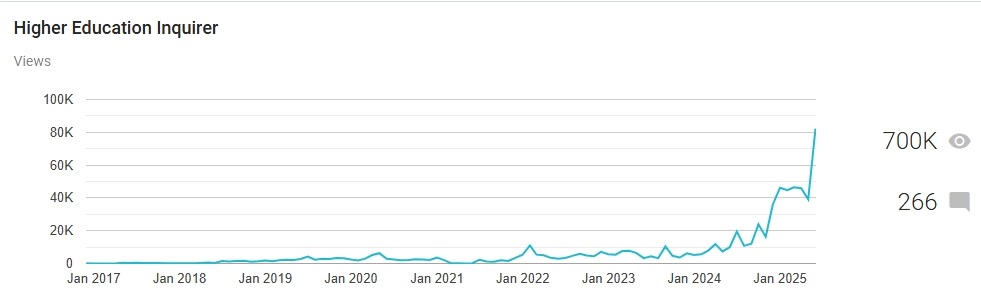
    The Higher Education Inquirer has experienced a dramatic surge in readership in recent months, defying the odds in a media ecosystem dominated by corporate influence, algorithmic manipulation, and declining public trust. Without the benefit of advertising dollars, search engine optimization tactics, or institutional backing, the Inquirer has built an expanding audience on the strength of its investigative rigor, academic credibility, and fearless confrontation of power in higher education.

    The Inquirer’s success lies in its refusal to chase headlines or appease stakeholders. Instead, it examines the underlying systems that have shaped the American higher education crisis—escalating student debt, the exploitation of adjunct faculty, administrative overreach, the encroachment of private equity, and the weakening of regulatory oversight. Its reporting draws directly from primary source documents: internal university records, SEC filings, FOIA requests, and government data from the U.S. Department of Education, Department of Veterans Affairs, and other public institutions. Readers trust the Higher Education Inquirer not simply because it is independent, but because it is evidence-based and relentlessly honest.

    This journalistic integrity has attracted a diverse and influential group of contributors whose work amplifies the publication’s reach and credibility. Among them is David Halperin, an attorney, journalist, and watchdog who has long held the for-profit college industry accountable. Halperin’s sharp investigative writing has helped shape federal policy, inform regulatory action, and expose the inner workings of a powerful, often unregulated sector of higher education.

    Other essential contributors include Henry Giroux, whose writing connects neoliberalism, authoritarianism, and education policy; Bryan Alexander, who offers foresight into technological and demographic changes shaping the future of academia; and Michael Hainline, who combines investigative rigor with grassroots activism. Together, these voices reflect a commitment to intellectual diversity grounded in a shared mission: to make sense of a higher education system in crisis, and to imagine alternatives.

    HEI’s timing could not be more significant. As student loan debt hits historic levels, public confidence in higher education erodes, and international students reassess their futures in the United States, people are seeking answers—and not from the usual pundits or PR firms. They’re turning to sources like the Inquirer that offer clarity, accountability, and a refusal to look away from injustice.

    With more than 700 articles and videos in its growing archive, the Inquirer has become a vital resource for researchers, journalists, educators, and activists alike. And unlike many mainstream outlets, it remains open-access, free of paywalls and advertising clutter. It encourages participation from readers through anonymous tips, public commentary, and shared research, building a collaborative community that extends beyond the screen.

    Last week, more than 30,000 readers visited the site—a significant number for an independent, ad-free platform. But more than numbers, this growth signals a shift in how people consume and value journalism. It shows that there is a real appetite for media that holds power accountable, that prioritizes substance over spectacle, and that dares to tell the truth even when it’s inconvenient.

    The Higher Education Inquirer is not chasing influence—it’s earning it. Through fearless reporting, scholarly insight, and a commitment to justice, it has become a trusted voice in the fight to reclaim higher education as a public good. And with its core group of contributors continuing to inform and inspire, the Inquirer is poised to grow even further, serving as a beacon for those who believe that education—and journalism—should serve the people, not the powerful.

    Source link

  • USyd makes $500m surplus, Mark Scott gets $150k pay rise – Campus Review

    USyd makes $500m surplus, Mark Scott gets $150k pay rise – Campus Review

    The University of Sydney (USyd) recorded a $500 million surplus in 2024 and boosted its vice-chancellor Mark Scott’s pay by $150,000 to a $1.349 million salary, its 2024 financial result showed.

    Please login below to view content or subscribe now.

    Membership Login

    Source link

  • Can the sea’s rise be a language’s demise?

    Can the sea’s rise be a language’s demise?

    A language is not merely a collection of words; it is a symphony of memories, a melody that holds the heartbeat of a nation. It is a living chronicle of history, breathed across the ages, inscribed on the rhythms of life and sung by the winds that dance upon the sacred lands.

    Picture a serene village cradled among ancient mountains, where elders speak a tongue as timeless as the rocks beneath their feet. Each syllable is a thread, knitted into a rich tapestry of legends, lore and traditions that bind them to the soil they call home.  

    But what becomes of this language when the land itself starts to crumble? When the waves rise to consume coasts, or parched earth splits under a blistering sun, does the song fall silent? Today, as the planet warms, it is not only ice caps and forests that vanish — but languages, and with them, entire ways of perceiving the world.

    Around the globe, ancient languages — the essence of human history — are vanishing. Climate change, a tenacious force reshaping landscapes, frays the delicate cultural threads that root communities to their identity. Rising seas engulf islands where indigenous tongues blossom like rare flowers. Wildfires sweep away more than homes, reducing sacred spaces and oral histories to ash. Each vanished habitat is a stilled voice, an erased library of metaphors, idioms and songs that offered a unique lens on life.

    Language extinction

    According to a 2021 report by the UN Permanent Forum on Indigenous Issues, more than 40% of the world’s estimated 7,000 languages are at risk of disappearing. “When a language dies,” said linguist K. David Harrison, “a unique vision of the world is lost.”

    While globalisation and modernisation are often blamed for the erosion of ancient languages, environmental destruction plays an even more insidious role, quietly displacing communities and severing their linguistic roots. When climatic disasters scatter people, they do not only lose their home — they lose the vessel of their shared soul. Dispersed and assimilating, their words, their tales, their melodies — once carried across centuries — fade into echoes long forgotten.

    Today, nearly half of all languages spoken globally are endangered. According to UNESCO, one language disappears every two weeks — a rhythm of loss as steady as the ticking of a clock. In this tide of vanishing voices, climate change surges as an unrecognised adversary, disrupting the habitats where these languages are rooted.

    Consider the small island nations of the Pacific — Tuvalu, Kiribati, the Marshall Islands — where languages are inseparable from the ocean’s ebb and flow. As seas rise up to threaten these vulnerable islands, the inhabitants must depart, and with them, their distinct vision of the world drifts away. Words that once named the tides, the winds, the colour of the sky before monsoon, these vanish as the speakers are displaced.

    Likewise, in the Arctic, the Sámi and Inuit communities confront an ugly truth: their languages, like their frozen lands, are melting under the pressure of a warming world. The vocabulary used to describe different types of snow, hunting rituals or the behaviour of migrating herds holds ancestral wisdom. As the landscape changes, the words that once matched its rhythms no longer apply — and are slowly lost.

    Worldviews and wisdom

    When languages are lost, they take with them entire worldviews and centuries of wisdom encoded in words. The knowledge of forests, of skies, of seas — how to farm to the beat of nature, how to heal using the plants that grow in secret groves — is lost.

    For instance, in the Amazon rainforest, indigenous languages such as Kayapo contain the secrets of life-abundant ecosystems. According to Survival International and linguistic researchers, these languages encode unique ecological wisdom that cannot be translated. Each word is a secret to decoding the harmony of nature and each lost language shelves an irreplaceable piece of the puzzle.

    In the Philippines, the Agta people hold oral traditions that teach sustainable fishing and forest stewardship. Their language contains knowledge passed down through chants and stories that teach children when to harvest, what to leave behind and how to give back. Without their land, without their rituals, such teachings dissolve.

    In Vanuatu, where the rising tide of the ocean promises to wash away land and language, communities are in a mad dash to record their heritage. Elders and linguists collaborate, transcribing words into digital platforms, preserving the poetry of their world for future generations. Stories once passed from mouth to ear around firelight are now finding their way into apps, audio archives and cloud storage — fragile vessels carrying ancient truths.

    A fading past and uncertain future

    Technology, too, becomes a bridge between the fading past and an uncertain future. Apps like Duolingo and platforms like Google’s Endangered Languages Project breathe new life into ancient words, making them accessible to the young and curious.

    Augmented reality and virtual storytelling spaces are beginning to preserve not just the language, but the experience of being immersed in it. But technology alone cannot carry the weight of this preservation. It must be paired with policies that protect the vulnerable — giving displaced communities a voice not only in language preservation but in shaping climate action itself.

    Governments must go beyond digitisation and invest in cultural resilience. Language must be taught in schools, inscribed in constitutions, spoken on airwaves and celebrated in ceremonies. We need climate policies that understand that saving ecosystems and saving languages are part of the same struggle. Both are about preserving what makes us human.

    In the end, saving a language is an act of defiance against the erasure of identity. It is a way to honour the past while forging a path to a sustainable future. These languages do not merely recount history — they carry the wisdom of living in harmony with the Earth. In their poetry and proverbs, in their songs and silences, they have answers to questions we have not even thought to ask yet.

    To preserve these voices, we must become their echoes. We must act before it’s too late. Before the last storytellers fall silent. Before the rivers can no longer remember the songs they once inspired. To save a language is to save a piece of ourselves — the spirit of who we are, where we’ve been and the dreams of where we might go.

    When we lose a language, we don’t just lose words — we lose the Earth’s voice itself. If these voices vanish, who will remember the names of the stars? Who will tell us how the mountains mourned or the forests sang? The Earth is listening and its languages are calling. 

    Let us not forget how to answer.


    Questions to consider:

    1. Why are languages at risk of extinction due to climate change?

    2. How are preservation of language connected to whole cultures?

    3. Why might someone want to master a language that is not widely spoken?


    Source link

  • College Tech Officers on the Rise of AI

    College Tech Officers on the Rise of AI

    Inside Higher Ed’s fourth annual Survey of Campus Chief Technology/Information Officers, conducted with Hanover Research, is out now. The survey gathered insights from 108 college and university chief technology and information officers at two- and four-year institutions across the U.S. about the following issues: 

    • CTOs as strategic partners 
    • IT infrastructure and investments
    • Artificial intelligence adoption and governance
    • Cybersecurity readiness and challenges
    • Sustainability and environmental impact of technology
    • Staff recruitment and retention challenges
    • Digital transformation priorities and barriers
    • Emerging technologies beyond AI
    • Digital learning 
    • Data and student success 

    On Wednesday, June 18, at 2 p.m. Eastern, Inside Higher Ed will present a webcast with campus technology leaders who will share their perspectives on the findings. Register for that discussion here.

    Read our initial reporting on the survey—on uneven student access to generative AI tools and how institutions are struggling to respond to the rise of AI amid other fundamental challenges—here and here. Download the full survey here. And check out these key findings: 

    1. While many CTOs (59 percent) do have a seat at the executive leadership table at their institution, only about half (53 percent) feel their knowledge is fully leveraged to inform strategic decisions involving technology.
    2. Legacy infrastructure is hampering innovation, say 60 percent of CTOs, with implications for student success: Most rate their learning management systems highly (91 percent), but just a third (33 percent) believe their investments in student success technology have been highly effective.
    3. Despite the buzz about AI, only a third of CTOs (34 percent) report that investing in generative AI is a high or essential priority for their institution, with even fewer prioritizing investment in AI agents (28 percent) or predictive AI (24 percent).
    4. While most CTOs report effective collaboration channels between IT and academic affairs on AI policy (66 percent), only one in three (35 percent) believe their institution is handling the rise of AI adeptly. Just 11 percent indicate their institution has a comprehensive AI strategy.
    1. Cybersecurity remains a concern, with only 31 percent of CTOs feeling very or extremely confident in their institution’s ability to prevent cyberattacks. The most common security measures taken include multifactor authentication (90 percent) and required cybersecurity training for staff (86 percent). But just a fraction (26 percent) report required cybersecurity training for students, who are important players in this space.
    2. Technology staffing remains a significant challenge, with 70 percent of CTOs struggling to hire new technology employees and 37 percent facing retention issues. The primary factor is a usual suspect for higher education: competition from better-paying opportunities outside the sector.
    3. Student success is driving digital transformation priorities, with 68 percent of CTOs saying leveraging data for student success is a high or essential priority, followed by teaching and learning (59 percent). The top barriers to digital transformation in 2025 are insufficient IT personnel, inadequate financial investment and data-quality issues.
    4. Environmental sustainability is largely overlooked in technology planning, with 60 percent of CTOs reporting that their institution has no sustainability goals related to technology use, and 69 percent saying senior leaders don’t consider environmental impact in technology decisions.
    5. A majority of institutions represented (61 percent) have not partnered with online program managers and aren’t considering it. At the same time, 59 percent of CTOs express confidence in the quality of their institution’s online and hybrid offerings in general, and half (49 percent) somewhat or strongly agree that student demand for online and/or hybrid course options has increased substantially in the last year.
    6. While most CTOs believe their institution effectively uses data to support student success (60 percent), and nearly as many report a data function structure that supports analytics needs (52 percent), just 11 percent report having unified data models, which can reduce data siloes and improve data governance

    This independent editorial project was made possible with support from Softdocs, Grammarly, Jenzabar and T-Mobile for Education.

    Source link