Tag: Rise

  • Minnesota college leaders eye tuition hikes as costs rise and state funding flatlines

    Minnesota college leaders eye tuition hikes as costs rise and state funding flatlines

    This audio is auto-generated. Please let us know if you have feedback.

    Dive Brief:

    • Minnesota’s public colleges could institute substantial tuition spikes in the next academic year, after state officials have so far failed to meet funding requests. 
    • College officials’ latest projections estimate students could see price increases ranging from 4% to 9.9% to offset budget gaps, according to a presentation at a Minnesota State system board of trustees meeting this week. Most colleges and universities are modeling an increase of 8%. 
    • Those proposed increases come as analysis from the Minneapolis Federal Reserve showed enrollment in public Minnesota colleges increased substantially in the 2024-25 academic year — up 12% at two-year institutions and 4% at four-year institutions.

    Dive Insight:

    Leaders at public institutions in Minnesota are having to grapple with state funding that will likely remain flat while inflation continues lifting costs for college operations. 

    Minnesota State Board of Trustees, which oversees 33 institutions, requested $465 million in new funding in the state budget covering fiscal 2026 and 2027. 

    But so far, state executive and House budget proposals include no funding increases for the system, said Bill Maki, vice chancellor of finance and facilities for the Minnesota State system, during Tuesday’s presentation. He noted that the state Senate offered additional funding but only a fraction of what was asked for — $100 million.

    The muted proposals from the state — which is facing its own fiscal shortfalls — would leave colleges on their own in filling budget gaps created by increasing costs and financial needs, such as maintenance backlogs. 

    Modest tuition increases would still leave substantial structural deficits, Maki noted. A system-wide tuition increase of 3.5% would still leave a $65.1 million budget shortfall in fiscal 2026. Even a 9% tuition hike would mean a $23.8 million gap. 

    Regardless of what level of tuition increase may be approved by the board, every one of our colleges and universities is going to have to implement budget reallocations and reductions in order to cover inflationary costs,” Maki said. 

    Complicating things, as the chancellor pointed out, is that institutions have to set tuition rates before they fully know their costs for the year. 

    To date, the Minnesota State system has remained relatively strong financially. The system’s operating revenues increased in fiscal years 2024 and 2023, according to its latest financial statement. It ended fiscal 2024 with total revenues of $2.3 billion and a surplus of $108.9 million. 

    Helping the system’s finances is the support it has received from the state. In 2024-25, tuition accounted for about 30% of the Minnesota State system’s revenue, compared to 42% made up by state appropriations. 

    And the state’s public colleges have beaten the nationwide trend of declining enrollment, reporting student growth in recent years.

    Minnesota’s enrollment growth brought the state just short of its pre-pandemic levels in 2019, according to the Minneapolis Fed’s analysis. 

    The state’s enrollment upticks in 2024 and 2023 also break a decade of decline in Minnesota and many of its neighboring states.

    In explaining the state’s enrollment growth, the Fed’s analysis pointed in part to Minnesota’s recently implemented North Star Promise. The program offers free tuition to students whose families make under $80,000 — a boon to enrollment and educational access but not necessarily to colleges’ coffers.

    Source link

  • Ireland’s ELE sector slams sharp rise in financial threshold

    Ireland’s ELE sector slams sharp rise in financial threshold

    The national body representing over 60 accredited English language schools has warned the move could lead to mass cancellations, reputational damage to Ireland, and loss of key emerging markets that have helped rebuild the sector post-pandemic.

    Starting from 30 June 2025, students from countries such as Argentina, Brazil, and Mexico will be asked to show €6,665 in available funds to study in Ireland for eight months – a 120% increase on the 2023 threshold of €3,000.

    “This change has come without consultation, justification, or notice. It is difficult to see how a 120% increase in two years can be considered proportionate when the cost of living has risen just 2% annually,” said Lorcan O’Connor Lloyd, CEO of EEI.

    The affected students are legally permitted to work part-time in Ireland, yet are now being required to show financial backing as if they were not, argued O’Connor Lloyd, who said the policy “undermines the entire work-study visa model that Ireland has in place”.

    It is difficult to see how a 120% increase in two years can be considered proportionate when the cost of living has risen just 2% annually
    Lorcan O’Connor Lloyd, English Education Ireland

    Stakeholders have also raised concerns around the short period of notice of just over 90 days, which means that students who have already paid, booked flights, and made arrangements will be forced to find an extra €2,000 or risk losing their place.

    EEI is therefore calling for an immediate pause and review of the policy, a transition period to protect students who have already booked, and a full consultation with the education sector moving forward.

    Source link

  • Higher Education Inquirer : Rise to power of authoritarian states

    Higher Education Inquirer : Rise to power of authoritarian states

    Structural factors refer to the context that makes the rise to power of an authoritarian state more likely. Authoritarian regimes are unusual in countries that are rich, socially stable and that have a tradition of constitutionally limited, civilian government.  If they do emerge in these sorts of countries, it is usually the result of a crisis, brought about by external factors such as war or international economic crisis.   As usual with history, the history teachers favorite acronym PESC is a good way to go about organizing these structural factors – PESC = the political, economic, social, and cultural conditions that encourage authoritarian rule. 


    Source link

  • Philanthropic Giving to Higher Ed on the Rise

    Philanthropic Giving to Higher Ed on the Rise

    Philanthropic giving to higher ed institutions increased 3 percent when adjusted for inflation—for a total of $61.5 billion—between 2023 and 2024, according to a new report from the Council for Advancement and Support of Education.

    Philanthropy from foundations, higher ed’s biggest supporter, increased 13.3 percent over that period, while alumni giving, the second-largest source of support, increased 7.5 percent; giving from nonalumni donors increased 4.7 percent. Giving from corporations, however, dropped 7.3 percent.

    Donors’ priorities have also shifted somewhat. Gifts supporting current operations increased 2.3 percent, while those earmarked for capital purposes—like endowments, property, buildings or equipment—grew 11.7 percent.

    Nearly half of endowment gifts, 48.3 percent, were designated for student financial aid. Almost 16 percent of endowment gifts went toward faculty and staff compensation, 23 percent funded academic divisions, and 8.8 percent supported research. Smaller shares supported athletics and student life, 2.4 percent and 1.6 percent respectively.

    Gifts toward current operations represented 58.2 percent of gifts to higher ed in 2024. Research dominated, receiving 43.6 percent of those funds. A little over 28 percent of those gifts went toward academic divisions, 12.8 percent supported athletics and 12 percent funded student financial aid; 2.2 percent was designated for faculty and staff compensation, and 1.3 percent supported student life.

    “Philanthropy remains essential to the success and sustainability of higher education,” Sue Cunningham, president and CEO of CASE, wrote in the report. “The consistent generosity of donors reflects a collective belief in the transformative power of education and its ability to create a more prosperous society.”

    Source link

  • College Applications Rise, Especially From Minority Students

    College Applications Rise, Especially From Minority Students

    The number of students applying to college rose 4 percent this admission cycle, and applicants submitted 6 percent more applications over all, according to a new report from the Common App. 

    The increase was fueled by an especially large spike in the number of underrepresented minority applicants, which rose by 12 percent compared to non-URM applicants’ 2 percent increase. In addition, applicants from families below the median income level rose 8 percent, compared to 3 percent from above the median.

    The increase could reflect the Common App’s addition of more community colleges and open-access institutions to its platform, expanding to include more institutions that primarily serve low-income students.

    One striking finding in the report: Domestic applicant growth exceeded that of international students for the first time since 2019. Domestic applicants increased by 5 percent while the number of international applicants declined by 1 percent.

    In addition, the number of applicants submitting test scores in 2024–25 grew by 11 percent, outpacing nonreporters for the first time since 2021. Some schools began returning to mandatory test requirements this application cycle, abandoning test-optional policies adopted during the pandemic.

    Source link

  • Building inclusive research cultures– How can we rise above EDI cynicism?

    Building inclusive research cultures– How can we rise above EDI cynicism?

    • Dr Elizabeth Morrow is Research Consultant, Senior Research Fellow Royal College of Surgeons in Ireland, & Public Contributor to the Shared Commitment to Public Involvement on behalf of National Institute for Health and Care Research.
    • Professor Tushna Vandrevala is Professor of Health Psychology, Kingston University.
    • Professor Fiona Ross CBE is Professor Emerita Health and Social Care Kingston University, Deputy Chair Westminster University Court of Governors & Trustee Great Ormond Street Hospital Charity.

    Commitment and Motivation for Inclusive Research

    The commitment to inclusivity in UK research cultures and practices will endure despite political shifts abroad and continue to thrive. Rooted in ethical and moral imperatives, inclusivity is fundamentally the right approach. Moreover, extensive evidence from sources such as The Lancet, UNESCO and WHO highlights the far-reaching benefits of inclusive research practices across sectors like healthcare and global development. These findings demonstrate that inclusivity not only enhances research quality but also fosters more equitable outcomes.

    We define ‘inclusive research’ as the intentional engagement of diverse voices, communities, perspectives, and experiences throughout the research process. This encompasses not only who conducts the research but also how it is governed, funded, and integrated into broader systems, such as policy and practice.

    Beyond higher education, corporate leaders have increasingly embraced inclusivity. Research by McKinsey & Company shows that companies in the top quartile for gender diversity are 25% more likely to outperform their peers in profitability, while those leading in ethnic diversity are 36% more likely to do so. This clear link between inclusivity, innovation, and financial success reinforces the value of diverse teams in driving competitive advantage. Similarly, Egon Zehnder’s Global Board Diversity Tracker highlights how diverse leadership enhances corporate governance and decision-making, leading to superior financial performance and fostering innovation.

    Inclusion in research is a global priority as research systems worldwide have taken a ‘participative turn’ to address uncertainty and seek solutions to complex challenges such as Sustainable Development Goals. From climate change to the ethical and societal implications of Artificial Intelligence (AI), inclusive research is a track that ensures that diverse perspectives shape solutions that are effective, fair and socially responsible.

    Take the example of AI and gender bias – evidence shows that women are frequently not included in technology research and are underrepresented in data sets. This creates algorithms that are biased and can have negative consequences of sensitivity, authenticity, or uptake of AI-enabled interventions by women. Similar biases in AI have been found for other groups who are often overlooked because of their age, gender, sexuality, disability, or ethnicity, for example.

    Accelerating Inclusion in UK Research

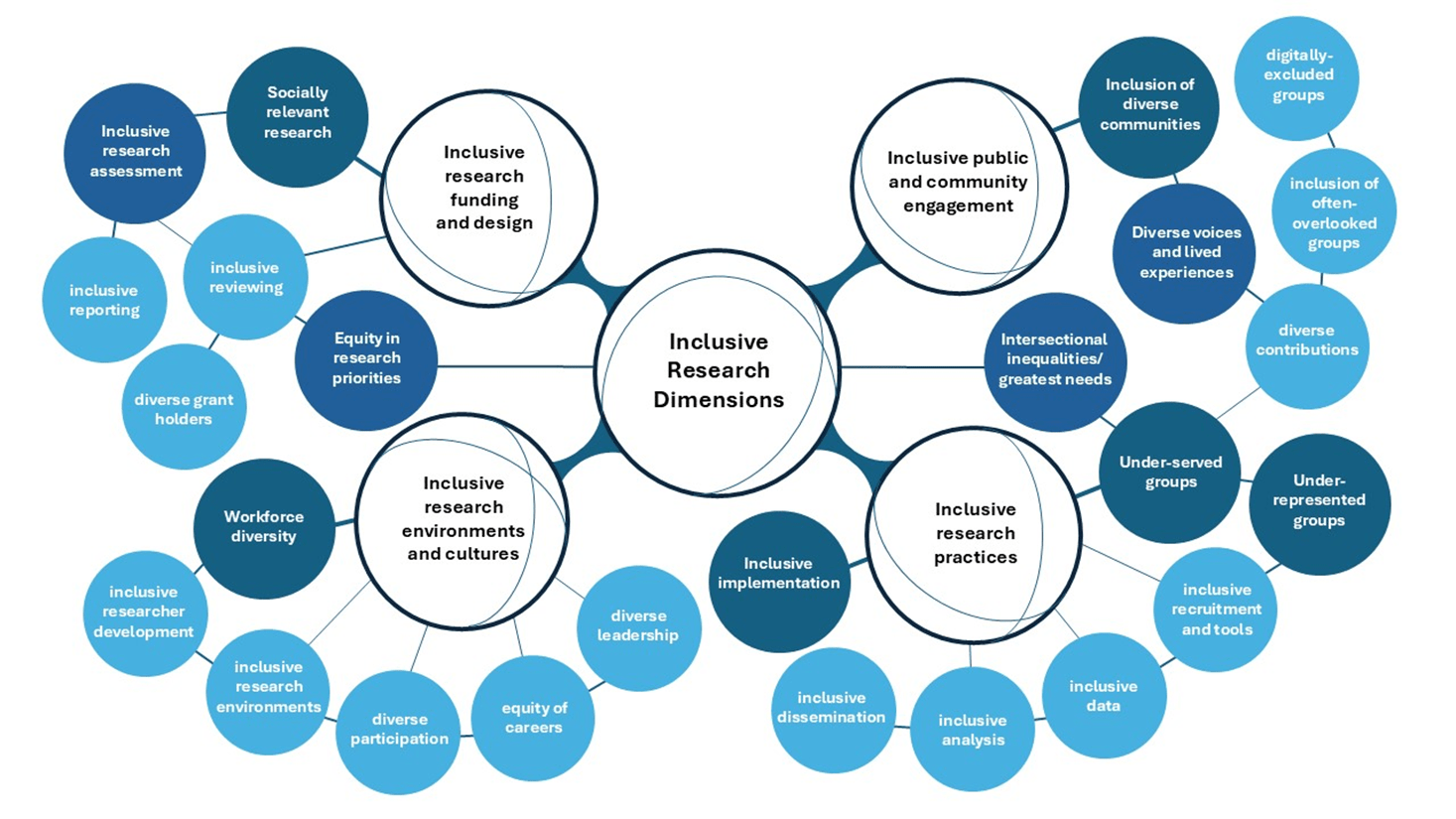
    A recent horizon scan of concepts related to the UK research inclusion landscape indicates domains in which inclusive research is being developed and implemented, illustrated by Figure 1.

    Inclusion is being accelerated by the Research Excellence Framework (REF) 2029, with a stronger focus on assessing People, Culture, and Environment (PCE). REF 2029 emphasises the integration of EDI considerations across research institutions, with a focus on creating equitable and supportive cultures for researchers, participants and communities. The indicators and measures of inclusion that will be developed and used are important because they can encourage diversity of perspectives, knowledge, skills and worldviews into research processes and institutions, thereby increasing relevance and improved outcomes. All units of assessment and panels involved in the REF process will have guidance from the People and Diversity Advisory Panel and the Research Diversity Advisory Panel. This means that inclusion will develop in both the culture of research institutions and the practices that shape research assessment.

    The National Institute for Health Research, which is the largest funder of health and social care research, has pioneered inclusion for over 30 years and prioritises inclusion in its operating principles (see NIHR Research Inclusion Strategy 2022-2027). NIHR’s new requirements for Research Inclusion (RI) will be a powerful lever to address inequalities in health and care. NIHR now requires all its domestic commissioned research to address RI at the proposal stage, actively involve appropriate publics, learn from them and use this learning to inform impact strategies and practices.

    Given the learning across various domains, we ask: How can the broader UK system share knowledge and learn from the setbacks and successes in inclusion, rather than continually reinventing the wheel? By creating space in the system between research funders and institutions to share best practices, such as the Research Culture Enablers Network, we can accelerate progress and contribute to scaling up inclusive research across professional groups and disciplines. There are numerous examples of inclusive innovation, engaged research, and inclusive impact across disciplines and fields that could be shared to accelerate inclusion.

    Developing Shared Language and Inclusive Approaches

    Approaches to building inclusive cultures in research often come with passion and commitment from opinion leaders and change agents. As often happens when levering change, a technical language evolves that can become complex and, therefore, inaccessible to others. For example, acronyms like RI can apply to research inclusion, research integrity and responsible innovation. Furthermore, community-driven research, public and community engagement, and Patient and Public Involvement (PPI) have become synonymous with inclusive research, and such participation is an important driver of inclusion.

    The language and practices associated with inclusive research vary by discipline to reflect different contexts and goals. This can confuse rather than clarify and form barriers that possibly get in the way of trust and more effective inclusion strategies and practices. We ask: How can we establish shared understanding, methods of participation, accountability pathways and mechanisms that will promote inclusion in the different and dynamic contexts of UK research?

    With over 20 years of experience in the fields of inclusion and equity, like other researchers, we have found that interdisciplinary collaboration, participatory methods, co-production, and co-design offer valuable insights by listening to and engaging with publics and communities on their own terms and territory. An inclusive approach has deepened our understanding and provided new perspectives on framing, methodological development, and the critical interpretation of research.

    Final reflection

    Key questions to overcome EDI cynicism are: How can we deepen our understanding and integration of intersectionality, inclusive methods, open research, cultural competency, power dynamics, and equity considerations throughout research processes, institutions, and systems? There is always more to learn and this can be facilitated by inclusive research cultures.

    Figure 1. Inclusive Research Dimensions

    Source link

  • Student mental health difficulties are on the rise, and so are inequalities

    Student mental health difficulties are on the rise, and so are inequalities

    As current discussions around higher education understandably focus on the challenges (especially around funding) that the sector faces, the experience of the nearly three million students attending our universities and colleges can often be overlooked.

    Current students generally benefit from and enjoy their time in higher education, but the national conversation too often ignores the challenges students face and the inequalities that many students experience.

    One area that deserves greater attention is student mental health.

    Correlation

    In a report published today, we find that the proportion of students reporting mental health difficulties has reached 18 per cent, tripling in just seven years. This implies that around 300,000 of the UK’s undergraduate student population is affected by mental health difficulties, a number that has been rising over recent years.

    And the rise in reported mental health difficulties is greater for some student groups than others. Notably, twice as many women as men report mental health difficulties, while rates for LGBTQ+ students are particularly high, rising to nearly one in three for lesbian (30 per cent) and bisexual (29 per cent) students. Higher still are the rates for trans students (around 40 per cent report mental health difficulties) and nonbinary students (over half report mental health difficulties). While sample sizes make it harder to compare trends over time for these groups, the rates of mental health difficulties are shocking, and require action from higher education providers.

    There is an association between socio-economic status and mental health difficulties. Mental health difficulties are directly correlated with higher participation rates: for every POLAR region of higher education participation, the lower the rate of higher education participation, the higher the proportion of people reporting mental health difficulties. Similarly, state educated pupils are more likely to report difficulties than privately educated pupils, indicating a need for greater support for children’s mental health services too.

    Better reporting

    There are some possible explanations for the sharp rise in student mental health difficulties. First, it is important to note that these figures reflect respondents’ self-reported mental health. Compared to a decade ago, there is less social stigma around disclosing and discussing mental health difficulties, and this may mean that previous reporting underestimated the numbers facing difficulties. There has also been a wider rise in mental health difficulties among all younger people, sometimes linked to the cost of living, concerns about the climate crisis or negative experiences on social media and smartphones. Our findings do not allow us to conclude which (if any) of these explanations is driving the rise in mental health difficulties, but given the rate of increase over the last seven years, it is unlikely to be caused by one explanation alone.

    There is one positive finding in the study, namely that over the course of their studies, LGBTQ+ students experience a relative increase in wellbeing. It is important to note that these students still have higher rates of mental health difficulties compared to their peers, but it’s also worth reflecting on the beneficial role that attending higher education can bring. Particularly for younger LGBTQ+ students, higher education may allow them to navigate and affirm their identity in a new way, and find like-minded friends and peers for the first time. Indeed, there may be learning for other organisations and institutions, particularly employers, in thinking about how they enable wellbeing among their recent and future graduate employees.

    Public health

    What, then, can be done to better address student mental health? One important change would be to adopt a “public health” approach to student mental health, and mental health generally. Higher education providers could also ensure that they effectively signpost students to both wellbeing support services and to clinical health services where required. Significantly, given that some students are more likely to experience mental health difficulties than others, providers also need to ensure these services reach everyone, and may need to tailor their services to do so.

    A key recommendation regards students leaving their courses. In the survey, mental health difficulties was by far the most common reason cited for why students were considering dropping out of their course, mentioned almost five times more than the second most common reason (financial difficulties). Providers therefore need to ensure that their retention efforts address mental health while also measuring how wellbeing and mental health support impacts on the likelihood that students complete their courses.

    Providers need to ensure that they are effectively evaluating their wellbeing and mental health services. It is positive that mental health is now seen as an important area for university services, and that social stigma has declined. Tight financial circumstances are increasing pressure on universities, and we all recognise the challenges of meeting every student need. At the same time, foregrounding the interests of students and ensuring their success in higher education requires a more extensive, effect focus on student mental health, not least given the extent of mental health difficulties, and how inequalities both produce and amplify these difficulties, before, during and after students leave higher education.

    Source link

  • Interest in QuestBridge students on the rise

    Interest in QuestBridge students on the rise

    As colleges and universities look for new ways to diversify their student bodies and increase access to low-income students, one national program is emerging as an increasingly popular tool in those efforts.

    QuestBridge, a national match program that places high-achieving low-income students at selective partner colleges, saw early-admission rates for its applicants rise by 17 percent this year, according to data released in December. A total of 2,627 students from QuestBridge’s program were accepted early to the Class of 2029, and that number will likely grow as regular-decision acceptance letters roll in.

    And that growth will likely continue into the future after the 21-year-old organization recently added three new university partners to its roster: Bates College, the University of Richmond and, most notably, Harvard University—the last Ivy League institution to join forces with the organization.

    QuestBridge students go through a competitive application process to become finalists: Only 7,288 were selected this cycle out of more than 25,000 applicants. The finalists rank their top choices out of the organization’s 55 partner colleges, and QuestBridge matches them with a full scholarship at the highest-ranking institution on their list that accepts them.

    A spokesperson for QuestBridge chalked up this cycle’s record-breaking early acceptances to typical growth. But the numbers are hard to ignore: QuestBridge went from having 1,755 early admits in 2023 to 2,627 in 2025, during which time it only added two partner universities.

    Institutions say that QuestBridge helps deliver talented students from diverse backgrounds, filling in where their resources fall short. That’s become especially important since the Supreme Court’s decision in June 2023 banning affirmative action. In fact, universities’ interest in QuestBridge scholars surged last year, too, right after the ruling, when admit rates went up by a whopping 28 percent and the program added Cornell University and Skidmore College as partners.

    The vast majority of QuestBridge’s partner schools practiced affirmative action before the court decision. After a slew of selective colleges reported declines in Black and Hispanic enrollment this fall, they have been looking for race-neutral recruitment and admissions tools to enhance incoming classes’ diversity, including expanded financial aid programs and a commitment to first-generation students.

    Bryan Cook, director of higher education policy at the Urban Institute and the author of an ongoing study on the wide-reaching effects of the Supreme Court decision, said that whether colleges were looking to boost racial diversity or expand on efforts to admit more low-income students post–affirmative action, QuestBridge fits the bill.

    “My sense from talking to admissions professionals across the country is that they’re utilizing every tool available to them to identify diverse students,” Cook said. “Before [the Supreme Court decision], QuestBridge was a good resource but maybe not necessary,” so “it’s not surprising to see an uptick after the fact.”

    Some of the colleges with the steepest declines in underrepresented student enrollment are doubling down on QuestBridge during this early admissions cycle. Brown University, which saw a 10 percent decline in Black, Hispanic and Indigenous students, admitted 90 QuestBridge finalists early, up from 64 the prior year. Tufts University had a six-percentage-point drop in underrepresented students this fall and admitted 42 QuestBridge applicants early, up from 30 in 2023–24. The Massachusetts Institute of Technology, which reported a nine-point drop in minority students, admitted 100 QuestBridge students early, nearly double the 56 it accepted last year and comprising more than 10 percent of its early-action cohort this cycle. Black, Hispanic and Indigenous enrollment also fell by 10 percentage points this fall at Cornell, which is welcoming its first class of QuestBridge scholars this cycle.

    QuestBridge, crucially, is not a race-based program—if it were, it might earn the scrutiny being given other race-conscious scholarships and admission-adjacent initiatives. Instead, its criteria are income-based; this past year, 90 percent of applicants came from families who earn less than $65,000. While the organization’s website breaks down data on certain applicant characteristics—81 percent first-generation, 37 percent Southerners, 5 percent noncitizens—it offers no information on racial demographics. As recently as 2020, the organization did publish those breakdowns; that year, about 41 percent of finalists were white, 24 percent were Asian American, 14 percent Latino and 9 percent Black.

    “As an organization focused on socioeconomic status, we do not currently publish race data, although there have not been significant shifts in our demographics by race pre and post the [Supreme Court] decision,” a QuestBridge spokesperson wrote in an email.

    Chazz Robinson, education policy adviser at the left-of-center think tank Third Way, said the affirmative action ban isn’t the only important context for the rise in QuestBridge admits. Heightening scrutiny of wealthy colleges has increased pressure to boost financial aid programs and increase socioeconomic diversity—both problems that QuestBridge can be part of addressing.

    “There’s growing concern from students about costs. There’s growing questions for administrators about value, about the students they’re serving,” Robinson said. QuestBridge “can be part of building the case that they’re helping students from struggling backgrounds achieve socioeconomic mobility.”

    In a statement, Harvard admissions director William Fitzsimmons said the partnership reflected the university’s commitment to “bringing the most promising students to Harvard from all socioeconomic backgrounds.”

    Leigh Weisenburger, dean of admission and vice president for enrollment at Bates, said the new partnership isn’t specifically aimed at increasing racial diversity, but it is part of the university’s commitment to increasing “all kinds of diversity.”

    “Given the law, I don’t want to misconstrue [the QuestBridge partnership] as an attempt to racially diversify our class,” she said. “While we can’t consider race any longer, we obviously are continuing to do everything in our power to feed our prospect applicant pools in access-oriented ways.”

    Extending Recruiters’ Reach

    Stephanie Dupaul, vice president for enrollment management at the University of Richmond, wrote in an email to Inside Higher Ed that the university had been entertaining a partnership with QuestBridge for “many years.” She emphasized the program’s potential to amplify the university’s recruitment range geographically and reach high schools outside its normal recruitment zone.

    “We were particularly interested in their connections with rural students who might not have exposure to schools like Richmond,” she wrote.

    Weisenburger also stressed the benefits of QuestBridge’s broad geographic reach.

    “Bates is on the smaller scale of many of the institutions with whom QuestBridge partners and so for us to be present in Oklahoma as much as we’re present in California, as much as we’re present in rural Vermont, just isn’t feasible,” she said. “This allows us to be in those students’ conversations.”

    Geographic gaps aren’t the only recruitment concern for selective private colleges. Bates, like many small New England liberal arts colleges, has historically struggled to diversify its student body, which is currently about 72 percent white; its most diverse cohort yet, admitted last year, was made up of 32 percent domestic students of color. Bates’s student body is also disproportionately wealthy. Fewer than half of students receive any kind of need-based aid, and a 2023 New York Times report ranked Bates as tied for last in socioeconomic diversity out of a pool of 283 colleges. The Times report also found that only 8 percent of Bates students receive Pell Grants, and the share of Pell recipients in the student body fell by five percentage points from 2011 to 2023.

    Weisenburger said that while Bates has always striven to welcome a wide variety of students to its Lewiston, Me., campus, finding the resources to not only recruit those students but support them once they arrive on campus can be a challenge. And though she maintains Bates has a better history of diversity than many of its peers, Weisenburger acknowledged the college has a reputation for being “undiverse and privileged.”

    “We do have limited resources, looking at the college’s overall operating budget and our financial aid budget, and so we have to think really strategically and critically about how we’re going to best use those funds,” Weisenburger said. “That’s where QuestBridge for us just seems obvious.”

    Cook said that QuestBridge, with only a few thousand finalists a year, is not a cure for colleges’ diversity woes. But as admissions offices scramble to plug the hole left by the affirmative action ban, he said, partnering with outside organizations like QuestBridge can be a good short-term solution—and based on growing interest in the program, colleges may be thinking the same thing.

    “A lot of admissions professionals are still trying to figure out what are the best tools and options available to achieve the type of diverse student bodies they want. And most of them, to my knowledge, have not found a magic bullet,” he said. “I wouldn’t say that QuestBridge is a replacement for doing the hard work of figuring out other strategies. But understanding that’s not going to happen overnight, why not use it to help in the interim?”

    Source link