Georgia Southern Universityis poised to absorb East Georgia State College after the University System of Georgiagoverning board approved a merger plan Tuesday.
The board’s vote follows USGChancellor Sonny Perdue’srecommendation for the consolidation last week.Tuesday’s action marks “the first step in a careful process that will take more than a year,” the system said.
The new institution will retain the “identity” of East Georgia State, which has struggled with enrollment declines in recent years. At the same time, it will become part of Georgia Southern and will be led by the latter’s president, Kyle Marrero, according to the announcement. The consolidation requires the approval of the institutions’ accreditor.
Dive Insight:
Perdue trumpeted the consolidation of Georgia Southern and East Georgia State as a way to invest in key higher education functions — especially student success and degree access — by saving on administrative costsand reducing academic program overlap.
“By using public resources as efficiently as possible, we’re making sure every dollar saved is reinvested into those programs that truly empower our students, support our faculty and strengthen our communities for a brighter future,” Perdue said in Tuesday’s announcement.
Georgia state Rep. Butch Parrish— who represents Swainsboro, which is home to East Georgia State and 40 miles from Georgia Southern— praised the plan.
“It’s essential that as the system streamlines and operates more efficiently, we safeguard access to higher education in the local area and keep the EGSC spirit going,” Parrish said in a statement.
Now that the board has greenlit the merger, the institutions plan on quickly forming an implementation team with representatives from both colleges to work out details, the system said. That team will also prepare and submit the required paperwork for approval by their accreditor, the Southern Association of Colleges and Schools Commission on Colleges.
USG and the institutions plan on holding campus and community listening sessions to seek input on the new institution’s design, withthe first one slated for Wednesday on East Georgia State’s campus.
Of the two, Georgia Southern is by far the larger institution. As of fall 2023, the university enrolled 26,041 students to East Georgia State’s 1,756, according to federal data.Georgia Southern’s enrollment has been relatively stable, declining 1.4% between 2018 and 2023, while East Georgia State’s fell by 40.3%.
The larger university also has a much deeper catalog of programs compared to East Georgia State, which according to its website offers six associate and three bachelor’s degree programs.
The planned consolidation is the latest move in an effort going back nearly 15 years to pare down Georgia’s state university system. So far, USG has undertaken 13 consolidations. From these, it has saved $30 million in administrative expenses that it said it has reinvested into student services and faculty and staff hires
Once the Georgia Southern and East Georgia State combination completes, USG will have 25 institutions, the system said.
Career and technical education, teacher workforce funding and student achievement are some of the main education policy priorities for governors across the country, according to a report from the Education Commission of the States and the National Governors Association.
The report tracked and analyzed 2025 State of the State addresses so far this year from 49 governors, including the U.S. Virgin Islands and Guam. The State of the State Address is an annual speech given by state governors that provides the opportunity to outline policy priorities and elevate successes.
The top education policy trend this year, the report found, was workforce development opportunities for students. Thirty-three governors discussed career and technical education as an opportunity to prepare students for entering the workforce and bolster the economy.
Dive Insight:
The Education Commission of the States has tracked and analyzed trends in education policy accomplishments and proposals featured in governors’ State of the State addresses for the last 20 years. This is the sixth year the commission has partnered with the National Governors Association to create a special report that highlights the top education policy topics mentioned.
The 33 governors speaking about CTE also discussed internships and apprenticeships as avenues to gain real-world skills that prepare young people for workforce demands.
Some states highlighted their current offerings and programs, like Tennessee’s Youth Employment Program and Wyoming’s Innovation Partnership. Others, like Delaware and Oklahoma, highlighted incoming legislative efforts to provide more workforce development opportunities.
In previous years, K-12 funding has been a consistent priority expressed across most of the state addresses. This year, at least 32 governors addressed funding, and several highlighted historic investments in K-12 funding — like Nevada’s investment of over $2 billion in new funding for students and schools last session, which marked the largest education investment in the state’s history.
Federal funding for K-12, however, is facing some risks. While the Trump administration has promised to preserve “all statutory programs that fall under the agency’s purview,” such as funding for students with disabilities, the downsizing of the U.S. Department of Education is putting school districts at financial risk, according to Moody’s Ratings.
Teacher workforce is another common priority among governors. At least 26 mentioned teacher recruitment and retention or teacher compensation, the report states.
Some states like Connecticut and Maryland are trying to create workforce programs that bring more diverse teacher demographics, while other states mentioned recent investments into teacher salaries.
Indiana highlighted legislation that will raise the minimum salary for public school teachers by $5,000 and require that 65% of state school funding support to districts go to teacher compensation.
Cuts to the federal Education Department have also impacted the teacher workforce. On April 4, the U.S. Supreme Court granted the Trump administration’s emergency request to maintain a freeze on millions of dollars in federal teacher training grants.
Additionally, at least 25 governors addressed academic achievement, including commitments to math and reading instruction. Several states created and implemented literacy and proficiency programs that have shown growth and increased scores.
For example, Alaska Gov. Mike Dunleavy spoke about early data from the state’s implementation of the Alaska Reads Act. In his address, Dunleavy said that the percentage of Alaskan students who met early literacy benchmarks grew from 41% to 57%.
According to the report, governors stressed the importance of early literacy skills for life-long achievement. Science of reading was also highlighted as a major contributor to building early literacy skills.
Cuts at Sonoma State University are on pause after a judge found leaders had not followed necessary procedures in winding down academic programs amid an ongoing budget crunch.
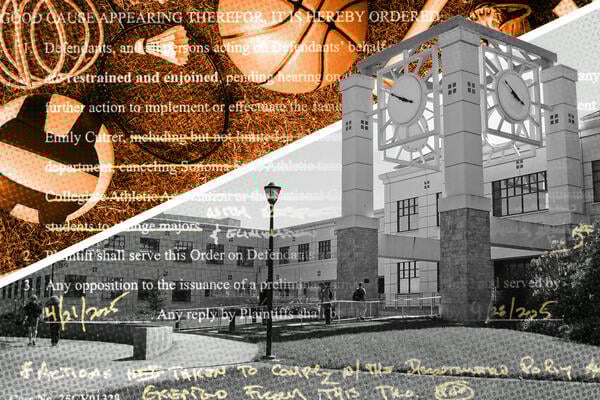
Sonoma County Judge Kenneth English ruled that the university sidestepped its own written policies when it announced plans to ax multiple academic programs; he issued a temporary restraining order to halt the process. According to university policies, Sonoma State is required to include the Academic Senate in decisions about program eliminations. But that allegedly didn’t happen, according to a lawsuit to stop the cuts filed on behalf of seven students.
Sonoma State has denied circumventing its own policies.
At the heart of the lawsuit is a fight over athletics, which Sonoma State plans to cut entirely. All seven plaintiffs played various sports at the university, which competes at the NCAA Division II level. However, the judge’s ruling did not halt the administration’s plans to eliminate athletics; the restraining order applied only to the academic programs for now.
It will remain in effect until May 1, the date of the next hearing in the case.
A Fight Over Cuts
In January, Sonoma State—part of the California State University system—announced sweeping cuts, citing a nearly $24 million budget deficit.
“The University has had a budget deficit for several years. It is attributable to a variety of factors—cost of personnel, annual price increases for supplies and utilities, inflation—but the main reason is enrollment,” Interim President Emily Cutrer wrote in an announcement.
She noted that enrollment at SSU had dropped by 38 percent since it peaked in 2015 at 9,408 students, according to federal data.
Sonoma State had already taken moves over the last two years to close its persistent budget gap, including offering buyouts and freezing hiring, among other measures. But those actions “are not enough,” Cutrer wrote. After making piecemeal cuts in prior years, she announced a plan to eliminate more than 20 academic programs, let 46 faculty contracts lapse and ax athletics.
But at least part of that plan is now on hold.
Legal counsel for the plaintiffs requested a temporary restraining order to stop the shutdown of programs, arguing that their clients “will suffer irreparable harm and the Decision will be unable to be reversed even after it is ultimately found to be unlawful, or if new Sonoma State leadership or the California legislature seek to reverse the decision,” according to an April 10 court filing.
David Seidel, an attorney representing the plaintiffs, who is also a graduate of Sonoma State, where he played soccer, told Inside Higher Ed that he was concerned about the abrupt nature of the planned program cuts, which he alleged were illegal and “extremely damaging” to students.
He added that multiple student athletes transferred to Sonoma State over the winter. If officials were aware that SSU planned to cut athletics, as they announced in January, he believes those students were lured by false promises to play for programs that may no longer exist.
“This is a failure of leadership,” Seidel said.
While he recognizes that the university may still move forward with the cuts, he wants to see the process restarted under new leadership and using the procedures SSU allegedly bypassed.
Seidel also plans to address concerns related to athletics at the May 1 hearing.
“The temporary restraining order does not affect athletics at this time. Of course, that’s still very much a live issue that we will be pursuing on May 1, and we’re seeking a preliminary junction on athletics as well. Sonoma State and [the California State University system] have passed very specific policies and regulations with respect to discontinuing academic programs,” Seidel said. “And it isn’t necessarily true that those also apply to athletics.”
In an email to Inside Higher Ed, SSU rejected the notion that it violated its own policies.
“SSU maintains that the university followed its established policies regarding academic discontinuation, including communicating with and considering feedback from all programs impacted by the proposed reductions,” SSU spokesperson Jeff Keating wrote. “Yesterday’s ruling set a later date when the court will more fully review the parties’ positions, including evidence from the university that SSU is complying with its academic discontinuation policy.”
Other Challenges
The court decision came amid an already challenging week for Sonoma State.
At a legislative forum on Monday, state lawmakers criticized Sonoma State’s plans to pull the university out of its fiscal crisis. Beyond the cuts, administrators have developed a blueprint known as Bridge to the Future, which aims to increase enrollment by 20 percent within the next five to seven years, launch new programs and carry out various other actions. But some lawmakers took issue with the plan, arguing it was too light on specifics.
Sonoma State’s recent financial woes have also been accompanied by leadership turnover.
Cutrer, the interim president, is Sonoma State’s third leader in as many years after both her predecessors were felled by scandal. In 2022, then-president Judy Sakaki resigned after she was accused of mishandling a sexual harassment scandal tied to her husband, Patrick McCallum, who was accused of acting inappropriately with several university employees. McCallum also defied a ban to stay off the Sonoma State campus while Sakaki was president.
Sonoma State’s next president, Mike Lee, retired abruptly last year after he was placed on administrative leave when he struck a deal with pro-Palestinian protesters to review contracts to consider divestment opportunities and agreed to an academic boycott of Israel. CSU officials accused Lee of insubordination in making the deal with protesters and ultimately walked back the agreement with students.
A University of Utah lawyer last week urged faculty to comply with the state’s new prohibition on the “prominent“ display of pride flags and other flags on campus, The Salt Lake Tribune reported.
Deputy general counsel Robert Payne urged faculty in a meeting not to “be a lightning rod to the Legislature” and said state lawmakers “have a lot of power over us,” the newspaper reported. Payne also suggested that if employees tried to get around the law by hanging pride posters instead of flags, legislators might “come back with something worse,” the Tribune reported.
Utah’s Republican-controlled Legislature passed House Bill 77 last month, and Gov. Spencer J. Cox, a Republican, let it become law without signing or vetoing it. When it takes effect May 7, it will ban government entities, including public colleges and universities, from displaying flags on government property “in a prominent location.” Some flags are exempted, such as the U.S. flag and the prisoner of war/missing in action flags.
Trevor Lee, a Republican Utah House member and HB 77’s chief sponsor, told Inside Higher Ed he didn’t file the legislation specifically to ban pride flags. But “that’s just been the biggest, biggest issue of any political flag,” he said. “I mean, it’s not even close.”
Lee said the flags go beyond representing inclusivity. He said, “It’s a sex flag. It tells everyone what sexual ideology you believe in.”
The University of Utah has released guidance online saying the law generally bans pride flags, Juneteenth flags and others from prominent locations. The guidance notes exemptions, including that students and employees can “wear or carry a flag as a personal expression of free speech,” and that employees can decorate their offices with flags “so long as they are not easily visible outside of their personal space (e.g., posted in an office window).”
Payne said the university hasn’t yet decided how it will enforce the flag ban, according to the Tribune. The university’s guidance says, “Flags may also be used as decorations in connection with a brief cultural celebration hosted by the university within a university building,” but can’t be up for more than a week. It’s unclear whether pride will be considered a cultural celebration.
Title: Flourishing: Bolstering the Mental Health of Students at HBCUs and PBIs
Source: United Negro College Fund (UNCF)
Student mental health is often a chief concern for university administrations and faculty alike, with institutions working to develop strong mental health resources for students. Mental health concerns, however, can vary drastically from student to student, requiring dynamic responses to support the ever-changing challenges students face.
Over the course of two semesters in 2023, over 2,500 students at 16 HBCUs and two Predominantly Black Institutions were administered the Health Minds Survey (HMS) to determine the unique mental health challenges and provide insights into the college experience for Black students. A report by UNCF, in partnership with the Healthy Minds Network and The Steve Fund, found that Black students at HBCUs demonstrate more positive mental health outcomes compared to students overall. The report also highlights potential areas for schools to further support students. The key takeaways are listed below:
HBCU students are flourishing: 45 percent of HBCU students report flourishing mental health, in comparison to the national HMS sample of students (36 percent) and Black students at small predominantly white institutions (PWIs) (38 percent). These figures were determined by students agreeing with statements such as “I am a good person and live a good life” and “I am confident and capable in the activities that are important to me.”
HBCU students report a greater sense of belonging (83 percent) and lower levels of high loneliness (56 percent) than their peers when compared to Black students at PWIs, of whom 72 percent report feeling a sense of belonging and 58 percent report high loneliness.
HBCU students report less anxiety, less substance use, and being less at-risk for developing an eating disorder than both the national HMS sample of students and the sample of Black students at PWIs.
Financial stress plays a significant role in mental health for students at HBCUs, with 52 percent of students reporting that their financial situation is “always” or “often” stressful.
More than half of students at HBCUs report unmet mental health needs (54 percent), which can be defined as “exhibiting moderate to severe symptoms of anxiety or depression and reporting no mental health treatment within the past year.” Findings indicate that this may stem in part from HBCU students reporting stigmas around seeking out mental health services. 52 percent of HBCU students reported experiencing these stigmas, compared to 41 percent of the national HMS sample.
Nearly 80 percent of HBCU students agree that student mental health is a top priority for their school, and 55 percent of students report feeling that their campus supports open discussions regarding mental health.
In response to the survey findings, the report supplies several recommendations to further support and increase research on HBCU mental health resources. UNCF states that producing longitudinal studies regarding mental health at HBCUs and exploring the intersecting factors that impact mental health may allow institutions to better react to the ever-changing mental health needs of their students. Further data support would provide means to measure outcomes for mental health programs and resources, allowing institutions to fine-tune their services to best support student flourishing.
To read more, click here to access the full report.
—Julia Napier
If you have any questions or comments about this blog post, please contact us.
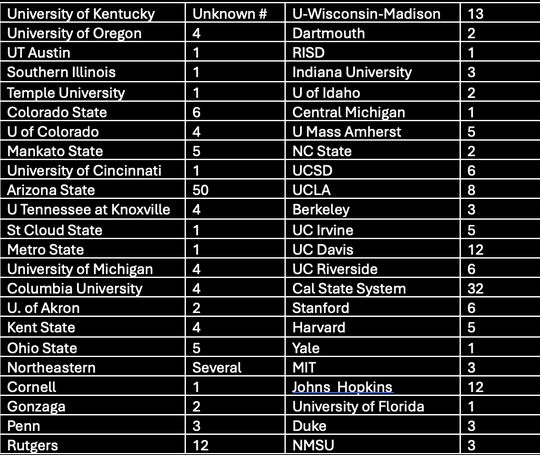
According to WeAreHigherEd.org, there are now 46 schools where student visas have been revoked. Arizona State tops the list at 50, followed by the University of Wisconsin-Madision (13), UC Davis (12), Rutgers (12), and Johns Hopkins (12) . The website includes profiles of a number of those students who have been detained. If you know of someone who has been abducted, you can report it here.
Shantay Bolton, executive vice president of administration and finance and chief business officer at Georgia Tech, has been named president of Columbia College Chicago, effective July 1.
Laura Crawley, vice president of mission, engagement and innovation at Lenoir-Rhyne University in North Carolina, will become president of Bethany College in Kansas, effective May 1.
Farouk Dey, vice provost for integrative learning and life design at Johns Hopkins University, has been appointed president of Palo Alto University, effective July 1.
William Downs, president of Gardner-Webb University in North Carolina, has been named president of Campbell University, also in North Carolina, beginning July 1.
Charles Edmonds, currently executive vice president of Lycoming College, will become president of the Pennsylvania-based institution on July 1.
Louise Fincher, currently the interim president of Emory & Henry University in Virginia, has been named president of the institution.
Thomas Gibson, chancellor of the University of Wisconsin–Stevens Point, has been named the next chancellor of the University of Wisconsin–Milwaukee, beginning on or around July 1.
Michael Hill, president of Chautauqua Institution in New York, has been appointed president of Virginia’s Randolph-Macon College, effective Aug. 1.
Kevin Howell, chief external affairs officer at University of North Carolina Health and the UNC School of Medicine, has been named chancellor of North Carolina State University, effective May 5.
Mark Johnson, director of the doctor of ministry program at New Orleans Baptist Theological Seminary, has been elected president of Louisiana Christian University.
Michael Kotlikoff, interim president of Cornell University since last July, has been named the institution’s president, effective immediately.
Dean Pribbenow, vice president for academic affairs and dean of the faculty at Elmhurst University in Illinois, has been appointed president of Millikin University, also in Illinois, effective July 1.
Sean Ryan, senior vice president of administration, strategic initiatives and trustee affairs at Bellarmine University in Kentucky, will become president of Anna Maria College in Massachusetts, effective July 1.
James Schmidt, chancellor of the University of Wisconsin–Eau Claire, has been named president of James Madison University in Virginia, effective July 1.
Claire Shipman, co-chair of the Columbia University Board of Trustees, has been named acting president of the university, effective immediately.
Marlene Tromp, president of Boise State University in Idaho, will become president of the University of Vermont, effective this summer.
More than 17,400 high school seniors last fall got the sweetest news any anxious student can get: Congratulations, because of your high school GPA, you’re automatically admitted to one of 10 California State University campuses of your choice — and they’re all relatively affordable.
Even with less than a week to go before the campuses wrap their final decisions about whom to admit, a pilot program focusing on Riverside County is already showing that more students have been admitted from the county than last year, about 10,600 so far in 2025 compared to last year’s roughly 9,800.
The pilot builds on Cal State’s efforts to enroll more students and works like this: High school seniors receive a notice in the mail that they’re automatically admitted as long as they maintain their grades, finish the 15 mandatory courses necessary for admission to a Cal State, and complete an admissions form to claim their spot at a campus. Cal State was able to mail the notices because it signed an agreement with the Riverside County Office of Education that gave the university eligible students’ addresses.
Now in the program’s first year, Cal State joins other public universities across the country in a growing national movement to automatically admit eligible students. From November through January, Cal State informed students they were accepted to the 10 campuses. To claim a spot, students needed to go online and pick at least one campus.
If past admissions and enrollment trends hold, Cal State as a system will educate hundreds of more students, all from Riverside, than they would have without the pilot. That’d be a boon for a system that prides itself on its affordability and motto that it’s the people’s university; Cal State admits a far higher percentage of students than the University of California. It also could serve as a much-needed budget boost from the extra tuition revenue those students bring, especially at campuses with sinking enrollment.
Eight campuses — Channel Islands, Chico, East Bay, Humboldt, Maritime Academy, Monterey Bay, San Francisco, and Sonoma — are so under-enrolled that Cal State is pulling some of their state revenues to send to campuses that are still growing. Cal Maritime is soon merging with another campus because of its perilous finances. The pilot also includes the two closest campuses to the county, San Bernardino and San Marcos.
The system chose Riverside County because all of its public high school students were already loaded onto a state data platform that can directly transmit student grades to Cal State — a key step in creating automatic admissions. Riverside is also “ethnically and economically representative of the diversity of California — many of the students the CSU is so proud to serve,” a spokesperson for the system, Amy Bentley Smith, wrote in an email.
At Heritage High School, a public school in Riverside County, the pilot encouraged students who previously didn’t even consider attending a public four-year university to submit the automatic admission forms to a Cal State.
Silvia Morales, a 17-year-old senior at Heritage, got an automatic admissions letter. “I was pretty set on going to community college and then transferring, because I felt like I wasn’t ready for the four-year commitment to a college,” she said.
Even with a 3.0 GPA, higher than the 2.5 GPA Cal State requires for admission, she nearly didn’t submit the forms to secure her admission until early January. That’s well past the standard Nov. 30 admissions deadline.
It wasn’t until her counselor, Chris Tinajero, pulled her into a meeting that she decided to opt into the pilot. “I went through the sales pitch like, ‘Hey, you get this guaranteed admission, you’re an amazing student,’” he recounted.
The pitch worked. Though Cal State sent a physical pamphlet and her high school also emailed her about the pilot, “I wasn’t really paying attention,” Morales said. She needed an adult she trusted at the school to persuade her that the applications were worth the effort, she said.
Morales applied to three Cal State campuses in the pilot plus two outside the program that were still accepting late applications — Chico, Humboldt, Los Angeles, Northridge and San Bernardino. She got into each one, she said.
Her parents are “proud of me because I want to go to college,” Morales said. Neither went to college, she added.
Final enrollment figures won’t be tallied until August, including how many of the students admitted through the pilot attended one of the 10 campuses. But the system’s chancellor’s office is already planning to replicate the pilot program in a Northern California county, which will be named sometime in April, Cal State officials said.
A bill by Christopher Cabaldon, a state senator and Democrat from Napa, would make automatic enrollment to Cal State for eligible students a state law. The bill hasn’t been heard in a committee yet.
A boost in application numbers
Of the 17,000 students who received an invitation to secure their automatic admissions, about 13,200 submitted the necessary forms. That’s about 3,000 more students who applied from the county than last year.
Those who otherwise wouldn’t have applied to a Cal State include students who were eyeing private colleges, said Melina Gonzalez, a counselor at Heritage who typically advises students who are already college-bound.
Nearby private colleges offer all students application fee waivers; at Cal State, typically only low-income students receive fee waivers. But the pilot provided each Cal State student one fee waiver worth $70, which was a draw to students and their parents who don’t qualify for the fee waiver but might struggle to pay.
Last year, 10 of the 100 senior students Gonzalez counseled didn’t apply to a Cal State. This application season, all her students submitted at least one Cal State application, she said.
“It was big, it was really cool, their eyes, they were so excited,” she said of the automatically admitted students. “They would come in and show me their letters.”
Parents called her asking if the pamphlet from Cal State was authentic. With guaranteed admission, some parents ultimately decided to pay for additional applications to campuses in the pilot, knowing it wasn’t in vain.
At Heritage, high school counselors reviewed Cal State’s provisional list of students eligible for the pilot to add more seniors, such as those who hadn’t yet completed the mandatory courses but were on track to do so.
Tinajero was also able to persuade some students who hadn’t completed all the required courses for Cal State entry to take those, including online classes. Still, others with qualifying grades didn’t apply because they weren’t persuaded that a four-year university was for them. Tinajero sees program growth in the coming years, assuming Cal State continues with the pilot. Younger high school students who witnessed the fanfare of automatic admissions may take more seriously the need to pass the 15 required courses to be eligible for a Cal State or University of California campus, he said.
That’s part of Cal State’s vision for this pilot, said April Grommo, the system’s assistant vice chancellor of strategic enrollment management: Begin encouraging students to take the required courses in ninth grade so that by 11th and 12th grade they’re more receptive to applying to Cal State.
Pilot leads to more applications
The automatic admissions pilot is likely what explains the jump in overall applicants, said Grommo. “If you look at the historical numbers of Riverside County students that have applied to the CSU, it’s very consistent at 10,000, so there’s no other accelerator or explanation for the significant increase in the applications,” she said.
Some campuses in the pilot are probably going to see more students from Riverside County than others. The eight under-enrolled Cal State campuses each enrolled fewer than than 100 Riverside students as freshmen, a CalMatters review of 2024 admissions data show. Two enrolled fewer than 10 Riverside students as freshmen.
Cal State isn’t solely relying on past trends to enroll more students. Grommo cited research that suggests direct admissions programs are associated with increases in student enrollment, but not among low-income students, who are less familiar with the college-going process or have additional economic and family demands, like work and child care.
The quad at San Francisco State University in San Francisco on July 7, 2023. Photo by Semantha Norris, CalMatters
Even after students are admitted, some don’t complete key steps in the enrollment process, such as maintaining their grades in the second semester, completing registration forms to enroll, and paying deposits. Others, especially low-income students, have a change of heart over summer about attending college, which scholars call “summer melt.” Then there are the students who got into typically more selective campuses, such as at elite private schools and the University of California, and choose instead to go to those.
To prompt more students to actually enroll, Cal State officials in early March hosted two college fairs in Riverside County for students admitted through the pilot. About 2,600 students signed up to be bussed from their high schools to large venues, including the Riverside Convention Center, where they met with staff, alumni and current students from all 10 Cal State campuses participating in the program. Those were followed by receptions with students and parents.
Grommo said they maxed out capacity at both venues for the student events. While it’s common for individual campuses to host events for admitted students, it was a first for Cal State’s central office.
The event costs, physical mailers to students about their admissions guarantee, invitation to the college fairs and another flyer about the relative affordability of a Cal State cost the system’s central office around $300,000, Grommo estimates. But if the event moves the needle on students agreeing to attend a Cal State, the tuition revenue at the largely under-enrolled campuses alone would be a huge return on investment.
The effort is a far more targeted approach than another admissions outreach effort Cal State rolled out last fall to inform students who started but didn’t finish their college applications that they’re provisionally accepted, as long as they complete and send their forms. The notification went to 106,000 students and was the result of a $750,000 grant Cal State won from the Lumina Foundation, a major higher education philanthropy. The system will know by fall if this notification resulted in more students attending a Cal State.
But that was aimed at students who already applied. The Riverside pilot brings in students, like Morales, who wouldn’t have applied without the mailers and entreaties from counselors. She’s leaning toward picking Cal State San Bernardino for next fall. It’s close to home and an older cousin recently graduated who had a good experience there, she said.
Her next task? Working with her parents to complete the federal application for financial aid by April 2, the deadline for guaranteed tuition waivers for low- and middle-income students.
It’s possible that Cal State may take the direct admissions pilot statewide. All counties are required by state law to join the state-funded data system that Riverside is already a part of to electronically transmit students’ high school grades to Cal States and UCs. Doing so removes the need for schools to send campuses paper transcripts. The deadline for all counties to join the state data system is summer of 2026.
This audio is auto-generated. Please let us know if you have feedback.
Dive Brief:
The struggling University of New Orleans should return to the Louisiana State University system, the state’s higher education board has recommended.
UNO, founded in 1956 as part of the LSU system, transferred to the University of Louisiana system in 2011 amid enrollment declines stemming from Hurricane Katrina damage.
Transferring the institution back to the LSU system would require state legislation, which Louisiana’s board of regents voted unanimously to recommend at a meeting on Wednesday.
Dive Insight:
UNO’s enrollment has never fully recovered from the disaster of Katrina nearly two decades ago. The university even grew its student body slightly after the hurricane but has since lost those gains. For the 2023-24 academic year, full-time equivalent enrollment stood at 5,114 students — just over a third of what it was in 2004-05.
Accompanying those declines has been financial instability. Between fiscal years 2015 and 2024, UNO’s tuition and fee revenue fell about 20% to $65 million.
State fiscal support has also collapsed. Louisiana has gone through “one of the largest higher education disinvestments in the nation,” according to a March feasibility study from the regents on returning UNO to the university system. For UNO, state funding has fallen by just under 45% from two decades ago.
In addition to cost increases felt throughout higher education, UNO also faces contractual debt obligations such as for bookstore and dining services and a deferred maintenance backlog exceeding $2 billion.
The report also laid blame with the university, stating that “UNO’s lack of aggressive action to address these issues immediately as they arose has resulted in a deep budget deficit that must be strategically repaired.”
Amid all its many revenue and expense challenges — and despite job cuts and other budget efforts — UNO’s budget gap has reached $30 million, according to the study.
All of those problems indicate failed thinking behind the university’s transfer into the UL system, according to the regents’ report. Moving UNO into UL’s fold came with an “expectation that new governance would assist in reversing declining enrollment and graduation rates to yield a stronger and more vibrant UNO,” it noted.
But things did not turn out as planned. “Instead, the institution’s fiscal condition has deteriorated to its current dire state, challenging UNO’s ability to meet its academic, research and community service missions,” the report said
Yet the university “plays a significant role in advancing the intellectual and economic development of the City of New Orleans,” the study argued, pointing to well-regarded programs in jazz studies, naval architecture and marine engineering, hospitality and cybersecurity.
While the regents voted to recommend the university’s transfer to the LSU system, some board members expressed concern that doing so would just make UNO’s financial troubles a systemwide problem.
“I just worry that, when you look at the shortfall, you’re taking the shortfall from one area and transferring it to the other,” Regent Dallas Hixson said at Wednesday’s meeting.
The point of transferring the university to the LSU system would be to “unlock the full potential of UNO, fostering regional prosperity while ensuring a smooth and efficient transfer of governance and leadership,” the feasibility study stated. It offered few details, however, for how that would occur.
To ensure a smooth transfer, the regents recommended setting up a transition team that would engage the system and UNO leadership. It also called for an in-depth third-party forensic financial audit, as well as program and facilities assessments, to help enumerate and address UNO’s challenges.
The Higher Education Inquirer (HEI) has requested a list of more than 300 students who have had their visas revoked. The State Department has acknowledged receipt. We hope other media outlets will follow suit. At this point, we only know of a handful of these cases. We will keep the public informed as this story develops.