Title: Bridging Education and Opportunity: Exploring the ROI of Higher Education and Workforce Development
Author: Paula Nazario
Source: HCM Strategists
New insights from HCM Strategists highlight how continued state investments in higher education are creating pathways to economic mobility, with the majority of degree programs delivering increased earnings and a solid return on investment (ROI). However, despite the continued success and quality of many degree programs, both students and the public have increased concerns about whether postsecondary credentials are worth the time and money.
If consumers do not understand the ROI of their credentials, this can contribute to decreased enrollment, funding, and research, which would in turn produce broader economic and social consequences. While the data are clear that a majority of postsecondary programs do pay off, there are many degrees that fail to provide a measurable ROI. HCM Strategists’ recent analysis of College Scorecard data shows that the average student at over 1,000 institutions earns less 10 years after they first enrolled than the typical high school graduate. While nearly two-thirds of these institutions are certificate-focused, for-profit institutions, there are still many private nonprofit and public colleges that do not provide strong economic outcomes.
To help students and the public understand the differences between institutions and degree programs that provide positive and negative value, the author of the brief urges states and policymakers to provide clear data on post-graduation outcomes. Some states have already advanced initiatives to help consumers see in real time the differences in earnings for those that enroll in higher education.
The author highlights several states initiatives that help students see the value of their credentials including California Community Colleges’ Salary Surfer tool, the Texas Higher Education Coordinating Board’s student outcomes dashboards and reports, and the Virginia Office of Education Economics’ College and Career Outcomes Explorer. Ohio and Colorado are also highlighted for their investments in employer partnerships to expand graduates’ opportunities for well-paying and workforce relevant jobs.
To read more on these new insights from HCM Strategists, click here.
—Austin Freeman
If you have any questions or comments about this blog post, please contact us.
Dr. Nicole DelMastro-Jeffery, former executive director for the DEI and Belonging office and Title IX coordinator at Richland Community College.On January 21, one day after his inauguration, President Donald J. Trump signed an executive order he called “Ending Illegal Discrimination and Restoring Merit-Based Opportunity,” instructing federal agencies to end diversity, equity, and inclusion (DEI) practices and programs.
The very next day, Dr. Nicole DelMastro-Jeffery, executive director for the DEI and Belonging office and Title IX coordinator at Richland Community College in Decatur, Illinois, was let go from her non-federal position.
In a sense, DelMastro-Jeffery’s story is familiar. State legislatures across the country have introduced and passed laws curbing DEI at educational institutions, even before Trump issued his order. Since then, a growing number of DEI offices have either shuttered or reorganized, and DEI-focused employees have been dismissed or had their roles changed.
But Illinois has no anti-DEI laws established, despite some competing bills introduced on the House and Senate floor. On February 7, State Sen. Andrew S. Chesney introduced SB2288, calling for the abolishment of DEI programs in departments of the state government. Conversely, on January 29, State Rep. Sonya M. Harper filed HR0077, a bill to affirm DEI programs in local, state, federal, educational and other institutions.
According to DelMastro-Jeffery, in early 2024 when the Biden-Harris administration issued a new Dear Colleague letter which expanded Title IX for the further protection of women and transgender individuals, Richland moved toward implementing those changes. However, by December 2024, she said that Richland “quickly rolled back to the 2020 legislation.”
“Ultimately,” she said, “Going back to 2020 legislative measures decreased protections, not only for transgender community members but women as well.”
For DelMastro-Jeffery, the institutional waffling between Title IX regulations was a red flag, one that should be heeded by other DEI professionals and institutions working to preserve their DEI programs.
“We have rarely considered the legal ramifications of separate laws and how their implementation and adjustments may in fact serve as awareness flags of next moves, like that of chess match players,” she said. “It is my belief that this federal injunction or swift rollback of expanded 2024 Title IX protections should have served as an immediate wakeup call to our DEI community.”
DelMastro-Jeffery arrived at Richland fresh off an internship with the Biden-Harris administration. She said she was thrilled at the chance to apply all she had learned to a rural college environment. Her dismissal, she said, “felt like a triple backlash to both my former public service work, status as a woman of color in higher education, and DEI executive leader.”
Paulette Granberry Russell, CEO and president of the National Association of Diversity Officers in Higher Education (NADOHE), said the attacks on DEI, including Trump’s order, have continued to demonize it, stripping all meaning from the acronym. She intentionally uses the words “diversity, equity, and inclusion,” instead of DEI.
Paulette Granberry Russell, CEO and president of NADOHE.Granberry Russell said she is “disappointed by the failure of institutions that over-complied to the threats to diversity, equity, and inclusion efforts, rather than taking a stand to say these efforts are not divisive.”
The misinformation disseminated through anti-DEI laws and orders have produced significant misunderstanding in the public sphere, “that somehow efforts associated with advancing diversity, equity, and inclusion is unlawful. That is not the case,” said Granberry Russell.
“We’re seeing what I often refer to as a ‘chilling effect,’ where institutions are preemptively scaling back diversity, equity, and inclusion efforts due to political pressure or fear of litigation,” said Granberry Russell.
NADOHE is the lead plaintiff in a federal lawsuit filed by Democracy Forward, a national legal organization of litigators, policy makers, regulators and public educators working to advance democracy. The suit was filed against the Trump Administration in early February calling Trump’s attack on DEI unconstitutional.
Granberry Russell acknowledged that, since the legislation and executive order, many DEI officers and employees have lost their roles. But she does not know how many, as there is no national database tracking these changes.
DelMastro-Jeffery said “this experience has illuminated, for me, the intersection between gender, leadership values, and the importance of pressing on.”
She continued, “Amid the growing dismissal of DEI programming, now diluted to words on a website, we would be negligent to forget the value of diversity and how the world, including systems of education, thrives on it.”
Richland leadership did not respond to requests for comment. Their website still hosts a page for Diversity, Equity, Inclusion, Belonging and Accessibility, which affirms these as a “core institutional value.”
Arizona State University (ASU) chief information officer Lev Gonick and Dave Rosowsky, senior advisor to the president of ASU, both believe universities can thrive in the age of AI by actively shaping how the technology is integrated into higher education.
In this podcast, they share how ASU fosters innovation through bold leadership, a culture of rapid experimentation, and partnerships with over 300 tech companies.
Get a sneak peek into the lessons they’ll be sharing at HEDx’s April conference in Melbourne, which will offer insights into how universities can “do the work to change the model” and embrace the transformative potential of AI.
Kevin HowellThe University of North Carolina Board of Governors has elected Kevin Howell as North Carolina State University’s 15th chancellor, marking a historic appointment as the first chancellor to have also served as the university’s student body president.
Howell, who will assume the role on May 5, will succeed Chancellor Randy Woodson, who is retiring in June after 15 years of leadership.
UNC System President Peter Hans recommended Howell following a national search that attracted more than 75 candidates.
“Kevin Howell is a born leader with a long record of service to North Carolina, the UNC System and NC State University,” Hans said. “His deep relationships across the state have helped drive investment and growth. I am confident that he will strengthen NC State’s role as a frontier research university, keeping North Carolina competitive in the most important fields of our future.”
Howell currently serves as chief external affairs officer at UNC Health. His previous experience includes various leadership positions at NC State, including vice chancellor for external affairs, partnerships and economic development from 2018 to 2023. He also worked as assistant to the chancellor for external affairs from 2006 to 2016 and has held interim roles in university advancement and alumni affairs.
From 2016 to 2018, Howell served as senior vice president for external affairs at the UNC System Office. His government experience includes working as a legislative liaison to two former governors, along with roles at the NC Bar Association and Jefferson-Pilot Financial Insurance Company. He began his career as a legal clerk at the North Carolina Court of Appeals.
“This university shaped my life in profound and generous ways, and I am honored for the chance to lead my alma mater,” Howell said. “NC State is a brilliant and inspiring place, just like the state we serve. There are exciting days ahead for the Pack, and I’m ready to make a difference.”
A native of Cleveland County, Howell earned his bachelor’s degree in political science from NC State, where he represented students on the university’s Board of Trustees as student body president. He later received his law degree from the University of North Carolina School of Law.
Ed Stack, vice chair of the NC State Board of Trustees and chair of the chancellor search advisory committee, praised the selection. “Among an impressive group of candidates, he stood out as the strongest choice. Kevin truly exemplifies the university’s ‘think and do’ spirit – especially in driving economic development and improving the lives of North Carolinians,” said Stack.
Ed Weisiger, chair of the NC State Board of Trustees and a member of the search committee, highlighted Howell’s relationship-building skills, calling him “a trusted partner to those he leads and those with whom he interacts and works.”
UNC Board of Governors Chair Wendy Murphy said that she is confident that Howell “will steward university resources, build industry relationships and lead the institution to even greater success.”
The Tennessean reported last week that the chronically underfunded historically Black university in Nashville is preparing to lose $14.4 million, the remainder of an $18 million grant it received from the National Institute of Food and Agriculture. It’s one of hundreds of colleges and universities across the country facing financial uncertainty as the Trump administration moves to cut trillions of dollars from the federal budget.
“This is going to impact our people,” Jim Grady, TSU’s chief financial officer, said at a finance committee meeting Wednesday evening. “We’ll continue to evaluate the volatility … and the potential impact to employees, students and university operations.”
Grady said nothing would change for at least 90 days after receiving notice of the grant cancellation, and it’s not yet clear how many jobs will be eliminated as a result. And that’s not the only federal grant in question, according to The Tennessean.
In February, the U.S. Department of Agriculture—which includes the National Institute of Food and Agriculture—canceled $45 million in federal grants to the cash-strapped university, which eliminated 114 positions last fall amid a looming budget shortfall.
Earlier this month, the USDA restored about $23 million of those grants, though another $115 million could be suspended or frozen. TSU’s federal grants fully fund 62 employees and partially fund another 112.
In the midst of the financial uncertainty, TSU has suspended its search for a permanent president, WKRN reported.
A new report finds that $41 million in state appropriations “were not properly restricted and in some instances were co-mingled with other funds” at Oklahoma State University in violation of state laws and policies, according to an internal audit obtained by media outlets in the state.
The audit—conducted by an office of the Oklahoma Agricultural and Mechanical Colleges Board of Regents, which oversees Oklahoma State and other public institutions—found “significant issues in the allocation and management of legislatively appropriated funds” at OSU.
The report found examples of such funds being transferred improperly, including $11.5 million for aerospace, health and polytechnic programs being directed to the OSU Innovation Foundation instead, without a contractual agreement or approval from regents.
“As a result, some state appropriated funds were utilized for unauthorized and unrelated purposes, and were not retained in full by OSU, the intended recipient,” the audit found.
A university spokesperson told the Tulsa World that “while the financial decisions and transactions which occurred are concerning, they were isolated and do not impact OSU’s overall financial foundation.”
The audit also called on Oklahoma State to improve financial oversight and transparency.
Though the audit did not name former president Kayse Shrum, who resigned abruptly without explanation last month, it indicated the alleged misappropriation happened during her administration. Shrum did not appear to be interviewed as part of the audit, according to a list of individuals who were contacted as part of the investigation into the use of appropriated funds.
Secretary of State Marco Rubio plans to use artificial intelligence to review and revoke visas of foreign students who appear to be Hamas sympathizers, Axiosreported Thursday, citing State Department officials.
The “Catch and Revoke” initiative will use AI to review tens of thousands of student visa holders’ social media accounts, looking for signs that they supported Hamas’s Oct. 7, 2023, attack on Israel.
If officials find a social media post from an international student that appears to endorse the attack and looks “pro-Hamas,” that could be grounds for visa revocation, an official told Axios.
Officials also plan to check news reports of anti-Israel demonstrations and lawsuits brought by Jewish students that might indicate a foreign national engaged in antisemitic activity.
Axios reported that to launch Catch and Revoke, the department examined a database of 100,000 people in the Student Exchange Visitor System since October 2023 to see if any visas had been revoked but the student was allowed to stay in the country during the Biden administration.
“We found literally zero visa revocations during the Biden administration,” a State Department official said, “which suggests a blind eye attitude toward law enforcement.”
The official said, “It would be negligent for the department that takes national security seriously to ignore publicly available information about [visa] applicants in terms of AI tools … AI is one of the resources available to the government that’s very different from where we were technologically decades ago.”
“Under President Trump, the Immigration Nationality Act [sic] is great again,” the official added.
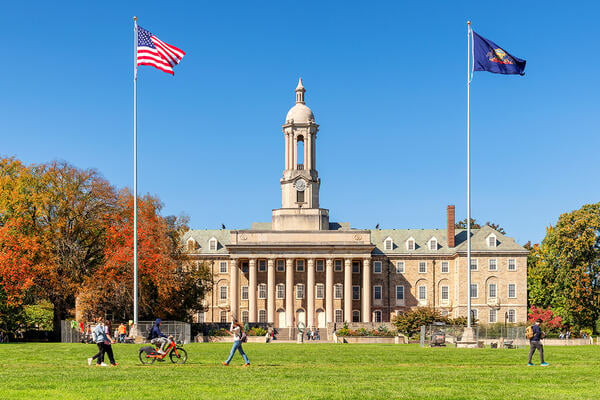
Embattled Pennsylvania State University trustee Barry Fenchak’s time on the board may be nearing an end: A subcommittee voted Wednesday that he was “unqualified and ineligible” to run again.
Fenchak is one of nine trustees on the 36-member board who are elected by alumni. His term is set to expire at the end of June. But Fenchak—who is already locked in litigation with Penn State over what he considers its lack of fiscal transparency—plans to fight the decision.
“This is completely in line with Penn State’s long-standing pattern with regard to trying to maintain their secrecy, and myself and our legal team will be evaluating these recent actions by Penn State and taking the appropriate actions in the court,” Fenchak told Inside Higher Ed.
The outspoken trustee has been at the center of controversy for nearly a year as he has sought to obtain more details on the university’s rising endowment management fees, even filing a lawsuit for that information. Penn State initially refused to provide the financial details that Fenchak, an investment adviser, said he needed to perform his fiduciary duties; he argued that endowment management fees inexplicably climbed from 0.62 percent in 2013–14 to 2.49 percent by 2018–19. Eventually, as a result of his litigation, he was able to obtain the requested documents, he told Inside Higher Ed.
Fellow trustees previously tried to boot Fenchak from the board last fall after he made a crude joke to a female staff member. Paraphrasing the PG-rated Tom Hanks movie A League of Their Own, Fenchak—who is bald and had just received a Penn State baseball cap as a gift at a university event—joked that it made him look like “a penis with a hat on,” according to court records.
In his opinion granting the preliminary injunction, Centre County Court Judge Brian J. Marshall wrote that while he “is not suggesting that plaintiff should not be sanctioned,” the court had been “presented with credible and, in many instances uncontroverted, evidence that Plaintiff has been subject to ongoing retaliation by Defendants.”
The judge also noted that Fenchak had sued Penn State just three days before the remark that the board used as justification for his removal.
Now, months later, the board landed on a new tactic to remove Fenchak: The nine-member nominating subcommittee voted 8 to 1 last week to bar him from running for re-election.
Daniel Delligatti, vice chair of the subcommittee, argued that Fenchak had been warned multiple times about “inappropriate behavior” and that he failed to live up to the board’s code of conduct.
Fenchak’s attempt at humor made staff members feel uncomfortable, Delligatti said, and his candidacy for a second term was not in “alignment with Penn State’s mission and values.”
Trustee Jay Paterno was the sole dissenting vote. He argued that “the process” as he understood it was “outside the scope of our review.”
Fenchak attended the virtual meeting but was denied an opportunity to speak on his own behalf.
Deliberations on blocking Fenchak from running for re-election were largely confined to a closed executive session meeting of the nominating subcommittee, which preceded the deciding vote.
A Legal Fight
Though a judge halted Penn State’s initial efforts to remove Fenchak, the board and the university’s legal team are again trying to oust him. The same day that the nominating subcommittee shot down Fenchak’s re-election bid, the university filed a motion to dissolve the preliminary injunction that allowed Fenchak to remain on the board as his lawsuit proceeded.
Fenchak alleges the motion was filed mere minutes after the subcommittee’s decision, which would prevent him from finishing his current term as well as serving another one.
Penn State officials did not provide a comment on the situation.
In response to a request for an interview with trustees, Shannon Harvey, assistant vice president and secretary for the board, referred Inside Higher Ed to a video of the subcommittee’s virtual meeting.
As of publication, Fenchak had not filed a legal response. But he noted one is coming. Beyond the impact on him personally, he also has broader concerns about the board’s process to bar trustees from re-election, which was adopted over the last year as he pressured the university to release financial documents.
“Forget about my specific situation. This process disenfranchises and essentially steals the vote from our alumni,” Fenchak said. “That’s a right our alumni have had for 150 years, and now we are telling those alumni who they can and who they cannot vote for to represent them on the board. Frankly, that’s unconscionable. As a Penn Stater, it’s heartbreaking.”
Changes to the way alumni trustees are elected have also caught the attention of state lawmakers.
At a Feb. 20 Pennsylvania House Appropriations Committee hearing, Republican representative Marla Brown questioned Penn State president Neeli Bendapudi about the change. Brown said she had fielded complaints from constituents and seemed skeptical about the new processes.
“I can tell you that people are not happy about it, and the optics on it are not good. As I’m sure you’re aware, it looks like a conflict of interest that the board is mainly concerned with picking and choosing the muscle in which the candidates will be serving on the board,” Brown said.
Asked why Penn State made the change, Bendapudi noted it was a board decision.
“Did you support the change?” Brown asked.
“I report to them and I have no say in it one way or the other,” Bendapudi answered.
This audio is auto-generated. Please let us know if you have feedback.
Dive Brief:
An Arizona bill that would cut all state funding for public colleges offering classroom instruction related to diversity, equity and inclusion cleared a key legislative hurdle Thursday. State Senate lawmakers advanced the bill in a preliminary vote, and a final Senate vote on the measure could come as soon as Monday.
If enacted, the legislation would prohibit faculty at the state’s public universities and community colleges fromrelating “contemporary American society” to a wide range of social and economic topics, including whiteness, antiracism, unconscious bias and gender-based equity.
It would also ban colleges from teaching that racially neutral or color-blind policies or institutions “perpetuate oppression, injustice, race-based privilege, including white supremacy and white privilege, or inequity.”
Dive Insight:
State Sen. David Farnsworth introduced the bill earlier this month, saying in a recent press release that he was motivated to do so after taking a class at a nearby community college.
“The course provided by the local community college represents the very ideology that is dividing America, teaching students to view white American men through a lens of privilege and oppression,” he said.
Farnsworth further described education about gender fluidity as “indoctrination” and said his proposal puts “students’ academic futures over political agendas.”
If the bill is enacted, faculty would not be allowed to “relate contemporary American society to”:
Critical theory.
Whiteness.
Systemic racism.
Institutional racism.
Antiracism.
Microaggressions.
Systemic bias.
Implicit bias.
Unconscious bias.
Intersectionality.
Gender identity.
Social justice.
Cultural competence.
Allyship.
Race-based reparations.
Race-based privilege.
Race-based diversity.
Gender-based diversity.
Race-based equity.
Gender-based equity.
Race-based inclusion.
Gender-based inclusion.
The bill would allow colleges to teach about subjects related to racial hatred or race-based discrimination, like slavery and Japanese-American internment in World War II — but only if instructors do not include any of the above subjects.
The proposal faces an uncertain fate, as control of Arizona’s executive and legislative branches is split between parties, with a Democratic governor but Republican control of the House and Senate.
Despite growing more conservative through the 2024 election, the Republican party doesn’t have a veto-proof supermajority. And Arizona Gov. Katie Hobbs, who has voiced support for and spearheaded DEI initiatives, is unlikely to sign the bill.
Even so, the bill threatens large pools of funding for Arizona’s higher education institutions, especially its three public universities.
Arizona’s public four-year institutions receive 74% of their funding from state support,according to a 2024 report from theState Higher Education Executive Officers Association.
For example, the University of Arizona’s main campus got almost $303 million in state general funds in fiscal 2024.
Farnsworth’s bill comes as Arizona colleges are already facing two powerful headwinds — a $96.9 million reduction in overall state funding for fiscal year 2025 and a wave of federal DEI restrictions.
Since taking office Jan. 20, President Donald Trump has signed executive orders attempting to eliminate DEI in higher education and elsewhere, though a court order recently blocked major portions of two of those orders.And the U.S. Department of Education recently issued guidance giving colleges until the end of February to cut all DEI or risk losing federal funding.
The University of Arizona recently took down the webpage for its Office of Diversity and Inclusion. The flagship also removed references to “diversity” and “inclusion” from its land acknowledgement — a statement recognizing the Indigenous tribal land the campus sits on — though the original version remains available on at least one department webpage.
Protesters on the University of Arizona’s main campus called on the institution’s leaders Thursday to continue its DEI initiatives.
As of Thursday evening, almost 2,500 University of Arizona students, employees, affiliates and others signed a letter calling for the institution to reverse the changes it made to its web presence.
“We view your actions as preemptive and harmful over-compliance,” the letter reads, referencing the university’s response to the Education Department’s guidance and Trump’s executive orders. “Faculty, staff, and students should not have to fear political retaliation for upholding academic freedom, engaging in free speech, or advocating for their rights.”