Tag: State

  • Black Women Reach Record State Legislative Representation Despite Persistent Gaps at Higher Levels

    Black Women Reach Record State Legislative Representation Despite Persistent Gaps at Higher Levels

    Black women achieved record-high representation in state legislatures and made historic gains in the U.S. Senate in 2025, according to a new report tracking their political progress over the past decade.

    Senators Lisa Blunt Rochester of Delaware and Angela Alsobrooks of Maryland.The “Black Women in American Politics 2025” report, released by Higher Heights Leadership Fund and the Center for American Women and Politics at Rutgers University, documents significant advances for Black women in elected office while highlighting continued underrepresentation at the highest levels of government.

    Black women now hold 401 state legislative seats nationwide, representing 5.4% of all state legislators and 16.2% of all women state legislators. This marks a 67.1% increase from 240 seats in 2014, when the organizations began tracking these statistics.

    The most dramatic change occurred in the U.S. Senate, where two Black women now serve simultaneously for the first time in American history. Angela Alsobrooks of Maryland and Lisa Blunt Rochester of Delaware both won open seats in the 2024 election, doubling Black women’s representation in the upper chamber.

    “This year also marks the first time in history that two Black women serve together in the United States Senate,” Alsobrooks and Blunt Rochester wrote in the report’s foreword. “That milestone is not a coincidence; it’s a culmination. It’s the result of investments made, barriers challenged, and generations of Black women who refused to be sidelined.”

    At the congressional level, 29 Black women currently serve as voting members, including 27 in the House and two in the Senate. This represents nearly double the 15 Black women who served in Congress when tracking began in 2014. All current Black congresswomen are Democrats except for the two senators.

    The 2024 election cycle was particularly significant because Vice President Kamala Harris became the first Black woman to head a major-party presidential ticket. Though Harris lost the election, her 107-day campaign raised $81 million in its first 24 hours and nearly doubled Democratic voter enthusiasm, according to the report.

    Black women also made notable gains in municipal leadership. Three new Black women became mayors of major cities: Cherelle Parker in Philadelphia, Sharon Tucker in Fort Wayne, and Barbara Lee in Oakland. Eight Black women now serve as mayors of the nation’s 100 most populous cities, matching their proportion of the U.S. population.

    However, significant representation gaps persist at higher levels. No Black woman has ever served as governor, and Black women remain underrepresented in statewide executive offices. Currently, 10 Black women serve in such positions nationwide, including four lieutenant governors, two attorneys general, two secretaries of state, one auditor, and one controller.

    The report notes that 34 states have never elected a Black woman to statewide executive office. Since 2014, only 25 Black women have ever held such positions across 17 states.

    “In our nation’s 249-year history, a Black woman has never served as governor of a state or as president of the United States,” the senators wrote. “That reality is a stark reminder that our work is not done.”

    The growth in Black women’s representation has occurred almost exclusively among Democratic officeholders. The report documents only seven Black Republican women state legislators nationwide and notes that all Black congresswomen are Democrats.

    State-level representation varies significantly by region. Maryland leads with Black women comprising 18.6% of state legislators, followed by Georgia at 17.4%. Conversely, five states have no Black women in their legislatures: Hawaii, Idaho, Montana, North Dakota, and South Dakota.

    The report also highlights institutional leadership gains. Twenty Black women now hold state legislative leadership positions, including six who lead their chambers. In Congress, Black women hold over 22% of House Democratic leadership positions.

    Looking ahead, the organizations identify opportunities for continued growth. Virginia Lieutenant Governor Winsome Earle-Sears, a Republican, is running for governor in 2025 and could become the first Black woman governor in U.S. history if successful. Additionally, over 200 statewide offices will be up for election in 2026.

    This marks the eighth iteration of the annual report series, which began in 2014 and has been published in 2015, 2017, 2018, 2019, 2021, and 2023. The comprehensive analysis tracks Black women’s political participation across federal, state, and local levels, providing the most detailed picture available of their representation in American politics.

    Source link

  • Smile for the surveillance state

    Smile for the surveillance state

    Nora Mitchell is a rising 2L at Drexel University and a FIRE Summer Intern.


    On July 7, Barnard College settled a lawsuit from students who claimed the institution had failed to address student accounts of anti-Semitism on campus. In the settlement, Barnard agreed to establish a Title VI Coordinator position, sever communication with the student group Columbia University Apartheid Divest, and prohibit the use of face masks during campus protests — a move that is becoming increasingly popular across college campuses. 

    Mask bans are quickly becoming a new frontline in the nationwide battle over campus expression. Barnard’s agreement follows a controversial decision earlier this year in which Columbia University agreed to ban masks at protests, among other measures, in exchange for the release of $400 million in frozen federal funding. Columbia’s move came just days after President Donald Trump declared on Truth Social that he would end federal funding for any school that “allows illegal protests,” adding: “NO MASKS!”

    While some institutions like Columbia and Barnard impose strict rules prohibiting masks, policies at other colleges and universities allow face coverings to be worn unless students are violating law or school policy, or if officials ask for them to be removed. 

    For example, California State University’s time, place, and manner policy allows wearing masks on university property as long as students do not “attempt to hide or disguise their identity from the university official” when violating university policy. In Texas, the recently passed Senate Bill 2972 bans face coverings during protests at public colleges, undermining the state’s efforts to protect student speech rights back in 2019.  

    Placing a preemptive, blanket requirement on all protesters to identify themselves to college administrators — untethered to engaging in misconduct — risks discouraging students and faculty from speaking their minds. Instead of these speech-chilling bans, universities should limit their policies to seeking the identification of those who violate university policies or the law.

    From the Boston Tea Party to Occupy Wall Street, protesters have historically used face coverings to protect their identities from public violence, doxxing, and retaliation from employers and government officials. More recently, using masks to avoid identification has become associated with protesters advocating for Palestinian rights. Given the threats coming from school administrations and the U.S. government, activists may feel it necessary to take precautions to avoid revealing their identities and becoming targets for their expression.

    Sometimes people just want to be able to express themselves without concern for what their family, friends, the general public, or the government may think.

    So why are schools and local authorities putting so much effort into banning masks? The answer is control. When people have fewer protections, they face a higher risk of being penalized for their speech. That’s a risk that many are afraid to take.

    Legal and ethical backlash is building against mask bans

    Politicians claim mask bans are about stopping crime. But the real effect is to make dissent more costly and dangerous — especially when tied to hot-button issues like the Israeli-Palestinian conflict.

    Officials in Nassau County, New York, for example, signed a mask ban into law in August 2024 aimed at discouraging crime and anti-Semitic acts. According to CBS News, violating the law is considered a misdemeanor punishable by a year in jail or a $1,000 fine. Critics of the ban point out that, even with religious and health-related exemptions, the new policy gives authorities the power to question anyone wearing a mask — a power that can easily be abused. 

    So to Speak Podcast Transcript: ‘Shouting fire,’ deepfake laws, tenured professors, and mask bans

    The FIRE team discusses Tim Walz’s controversial comments on hate speech and “shouting fire in a crowded theater.” We also examine California’s AI deepfake laws, the punishment of tenured professors, and mask bans.


    Read More

    lawsuit challenged the mask ban in Nassau County by contending that the law could lead to discrimination against individuals with disabilities. A judge dismissed the case a month later, ruling that the law included sufficient exemptions. However, even with health-related exemptions, there remains a risk of the law being used to silence protesters. In fact, among the first arrests made under the ordinance was an individual who was peacefully protesting while wearing a keffiyeh.  

    It’s no wonder there has been backlash from students and the public over these sweeping policies. In February, a student government representative at Columbia sent out a poll to students asking their opinions on campus security and the potential mask ban. The findings, published by the Columbia Spectator, showed that nearly three-quarters of respondents do not support mask bans.  

    Critics have been challenging the legal basis of anti-mask policies on and off campus, highlighting the possibility for discrimination and infringement on First Amendment rights. After all, masks can be used for a variety of purposes, from protecting one’s health to protesting anonymously to dressing up on Halloween. It shouldn’t be assumed that all mask-wearers intend to commit a crime. Sometimes people just want to be able to express themselves without concern for what their family, friends, the general public, or the government may think. Many uses of masks are inherently expressive. That means banning them raises constitutional concerns.

    What’s the legal precedent for mask bans on campus?

    The history of mask bans in the United States is complicated. The Supreme Court has never directly commented on whether banning masks during expressive activities infringes on First Amendment rights, and jurisdictions are split on the matter.

    In many states, mask bans gained popularity between the 1920s and 1950s in response to actions of the Ku Klux Klan. For example, in Church of the American Knights of the Ku Klux Klan v. Kerik, KKK members challenged a New York anti-mask law when the group’s parade permit was denied because of planned mask-wearing. Despite the group’s argument that the masks were a form of expression, the U.S. Court of Appeals for the Second Circuit held that the masks worn by KKK members added “no expressive force to the message portrayed by the rest of the outfit.” Since the robes and hoods that were part of their uniforms could easily communicate to others that they were part of the Klan, the court concluded the “expressive force of the mask is, therefore, redundant.” 

    Similarly, in State v. Miller, another case involving the KKK, the Supreme Court of Georgia upheld a state mask ban because “the statute distinguishe[d] appropriately between mask-wearing that is intimidating, threatening or violent and mask-wearing for benign purposes.”

    In contrast, in American Knights of the Ku Klux Klan v. City of Goshen, the U.S. District Court for the Northern District of Indiana struck down the city’s mask ban, holding the “United States Constitution protects a group’s speakers the right to anonymity when past harassment makes it likely that disclosing the members would impact the group’s ability to pursue its collective efforts at advocacy.”

    Likewise, in Ghafari v. Municipal Court for San Francisco, California’s First Appellate District struck down the state’s mask law when it was used to arrest members of the Iranian Students’ Association who were peacefully protesting outside the Iranian Consulate in San Francisco. The students were covering their faces while protesting out of concern that the Iranian government would retaliate against them or their family members.

    If people aren’t allowed to use tools to protect their identities when speaking out, many voices will be silenced.

    While some states have deemed mask restrictions unconstitutional, others still have them in place. For example, the state of Virginia still has a law passed in the 1950s that prohibits wearing face masks in public spaces with a few exceptions for health and religious reasons. 

    Despite the conflicting case precedent, it is safe to say that any full mask ban with no exceptions is likely unconstitutional. This is for a variety of reasons: health concerns, religious protections, and the right to anonymous speech. 

    The history of constitutional protections for anonymous expression

    The Supreme Court has consistently upheld the right to engage in anonymous speech. In the 1960 case Talley v. California, civil rights activist Manuel Talley was arrested and fined after distributing handbills on a sidewalk in Los Angeles. The handbills called for the boycott of merchants who carried products from manufacturers who refused to extend equal employment opportunities to racial minorities. Though the handbills included the name of the organization Talley was representing, law enforcement officers found them to be in violation of a Los Angeles City ordinance banning the distribution of handbills without an author’s name. 

    The Supreme Court declared the ordinance was unconstitutional, holding that it was overbroad and not narrowly tailored to its suggested purpose of “identify[ing] those responsible for fraud, false advertising and libel.” In his opinion for the Court, Justice Hugo Black stated that “[a]nonymous pamphlets, leaflets, brochures and even books have played an important role in the progress of mankind,” highlighting the importance of these works in securing American independence.

    What to make of anti-mask laws and mask-required laws? — First Amendment News 429

    First Amendment News is a weekly blog and newsletter about free expression issues by Ronald K. L. Collins and is editorially independent from FIRE.


    Read More

    Thirty-five years later in McIntyre v. Ohio Elections Commission, the Supreme Court upheld protections for anonymous speech when a resident of Westerville, Ohio, was fined for distributing anonymous handbills in opposition to her local school district’s request for a tax levy. Overturning Ohio’s election law that prohibited the distribution of anonymous campaign literature, the Court held that First Amendment protection for anonymous speech extends to “core political speech.” In doing so, the Court acknowledged that anonymous speech serves “to protect unpopular individuals from retaliation — and their ideas from suppression — at the hand of an intolerant society.”

    Despite this precedent, higher courts haven’t really addressed the role that masks play in protecting speech in our modern world where phones and cameras are always watching. If courts want to preserve free expression, they should keep in mind the many threats that individuals face when speaking in public. If people aren’t allowed to use tools to protect their identities when speaking out, many voices will be silenced.

    What does this mean for college campuses?

    Since mask bans on college campuses are a newer issue, it’s unclear how courts may react. Still, we know a few things for sure. First, any public university policy must be viewpoint neutral and narrowly tailored toward achieving a specific and important government goal. Also,  anti-mask policies must include exceptions for individuals with disabilities or religious customs that involve wearing face coverings. 

    But narrow tailoring also means universities cannot ban mask-wearing in ways that unnecessarily burden protected activity, such as anonymous protest. It is not a crime to peacefully protest while wearing a mask to avoid retaliation, and a blanket prohibition that includes such activity would raise serious constitutional issues.

    That said, school can restrict masks in certain situations. For instance, schools can prohibit masks while committing crimes or violent acts, violating school rules, or engaging in unprotected speech. And if you’re breaking the law, law enforcement can absolutely ask for identification.

    Is dissent the real target?

    Protesting in today’s world is different than it was before. When we leave our homes, we enter a space that is always being watched — not just by individuals walking around with their phones, but also by security cameras and surveillance technology. These are serious things for modern protesters to consider, especially when having a video go viral can bring severe and disproportionate consequences, such as losing your scholarship, your job, or even your visa. In this way, mask bans empower both police and private actors to suppress dissent. 

    A lack of anonymity can also amplify the “chilling effect,” in which people self-censor out of concern that they will violate some type of law, regulation, or social norm. According to FIRE’s 2025 College Free Speech Rankings, the chilling effect can be a problem for students across the political spectrum, with 34% of very conservative students and 15% of very liberal students reporting that they self-censored “very” or “fairly” often. 

    Masks are one way of combating this problem. For example, a student who wishes to participate in a pro-life rally may be more comfortable doing so if they can wear a mask and avoid being judged or harassed by their peers. Similarly, students and faculty may feel more free to voice their concerns about their school administration if they are able to wear masks. In an interview for CNN, an anonymous Columbia student going by the name “Maria” told reporters that she would no longer be participating in protests on campus due to the new policies adopted by the university. She stated she is “staunchly aware of how militarized and surveilled [the] campus is now,” and is fearful of retaliation. With mask bans becoming increasingly popular, this will likely be a growing sentiment among students. 

    Masks are an important tool for dissent and expression, both on and off campus. Even if sometimes ineffective in the face of advanced technology, masks provide a last line of defense for individuals who want to peacefully engage in public expression, giving them a small but important sense of security and anonymity. With recent reports of students being arrested for merely engaging in protected speech on their campuses, it is more important than ever to defend the right to anonymous speech.

    Source link

  • Dundee’s troubles and the state of the sector

    Dundee’s troubles and the state of the sector

    “Dundee University’s reputation soars,” shouted the front page of the Courier in 2004. Making the most of a rise in the league tables, the then university secretary highlighted the institution’s commitment to excellent learning and teaching, its outstanding research and its contribution to the local community.

    Fast forward 21 years and more recent press coverage has been less positive – the university’s desperate financial situation, rapid departures by senior staff, emergency government funding, threats of large-scale job losses and very painful sessions before the Scottish parliament education committee.

    A hard-hitting report by former Glasgow Caledonian principal Pamela Gillies put the blame on “poor financial judgement, inadequate management and reporting, poor monitoring of the financial sustainability KPI, a lack of agility in responding to a fall in income by the University leadership and weak governance in relation to financial accountability by the University Court” compounded by the “top-down, hierarchical and reportedly over-confident style of leadership and management” and “a culture in which challenge was actively discouraged.”

    The 64-page document is excoriating in its condemnation of senior officers and the university’s governors – a view shared by the select committee, where MSPs expressed their criticism in the strongest possible terms. Later events – including the departure of the interim finance director after a week in the job – have only made the agony worse.

    The financial collapse at Dundee inevitably raises questions for the rest of the HE sector in Scotland and the UK as a whole. Are the same weaknesses present in other institutions? Is higher education in crisis? And how should governments and the sector respond?

    Governance and management

    Before going any further, I must declare a personal interest – I was the university secretary quoted in the 2004 press article and I have retained an abiding affection for the University of Dundee since leaving in 2008.

    I also chaired the group that produced the latest revision of the Scottish Code for Good Higher Education Governance in 2023 – a document which Professor Gillies deems fit for purpose, provided institutions follow it carefully. However, implementing the code of governance, excellent as it is, will not be enough – we all need to learn lessons from the Dundee story and make sure that our own universities are protected from a similar fate. To that end, we ought to engage in an open discussion about what has happened and consider it from every angle.

    So far, the criticism has focused on the failings of Dundee’s senior managers and governors. In response, they have accepted that they should have spotted the financial problems earlier and taken avoiding action. That way, as one officer put it to the committee, they could have dealt with them “under their own steam”.

    Senior managers and the university court should certainly have been aware of the worsening financial situation in the second half of academic year 2023–24. Student recruitment fell in September 2023 and again in January 2024; meanwhile the international market was contracting and the UK government looked set to implement unhelpful policy developments as part of its anti-immigrant agenda.

    At that stage, the university’s executive board should have been keeping an eagle eye on the monthly management accounts, freezing all but essential staff recruitment and paring back expenditure. The failure even to recognise there was a financial deficit until October 2024 was a critical lapse.

    Reflecting on this, all universities will now be examining their systems, processes and culture to make sure they do not fall into the same trap. The sense of urgency will be especially acute in institutions which are running deficits – a plight that now affects many HEIs previously considered immune to such challenges. In Scotland, the cabinet secretary for education has urged the sector to address the problem of “unsustainable jobs” – apparently giving the green light to further staffing reductions.

    University courts and councils will be assessing governance arrangements and exploring how to strengthen financial scrutiny; some will also be reviewing the way they interact with their vice chancellors and senior teams. In doing this, they should ensure that senior officers and trade union reps are enabled to challenge heads of institutions and bring any concerns they have to the governing body.

    Model issues

    All of this is sensible, but the debate so far has largely ignored some fundamental points. Most importantly, the sector needs a different financial model – it cannot survive by placing ever greater reliance on the international student fee account. In England, the UK government has at least allowed the home undergraduate fees cap to increase in line with inflation but Holyrood has not made a similar move, and nor is it likely to before the 2026 Scottish election.

    The lack of funding will mean further retrenchments and cost-cutting in estates and IT budgets; unpalatable options such as delaying the national pay uplift or cancelling academic promotions rounds may also come into play. Against this background, Scotland’s politicians must step up – we need to treat university funding as a national problem which deserves an enduring solution, preferably identified through a review supported by all parties.

    Returning to Dundee, there is a reason why that university was so badly hit that goes beyond mistakes made by senior management. For at least 30 years, Dundee has been a powerhouse of life sciences research, with a special focus on cancer and tropical diseases. A glance at the 2021 REF results for biological sciences bears this out – there is Dundee, ranked number two behind the Institute of Cancer Research, ahead of Oxford, Cambridge, Imperial and many other universities with much greater resources.

    This is an extraordinary story – a relatively small, provincial university taking on and beating some of the greatest and best-funded institutions in the world; in the process, Dundee’s researchers have benefited humanity, not just in this country but also across the global south. Sir Alfred Cuschieri, Sir David Lane, Sir Philip Cohen, Cheryll Tickle CBE, Sir Pete Downes, Sir Mike Ferguson – the list of top biomedical scientists whose careers have flourished at Dundee is hugely impressive.

    However, this achievement comes at a price – even 20 years ago, Dundee struggled to generate surpluses which would protect the institution against a rainy day. As everyone knows, research funding simply does not cover the cost of the work it is supposed to support – universities have to cross-subsidise scientific endeavour with endowments, donations and international student fees.

    The challenge is even greater when much of your funding is from charities, which pay a lower overhead than government research councils. That left Dundee in an especially vulnerable position when the international student recruitment market began to contract in 2023–24 – a problem not shared by other universities with a fraction of Dundee’s research activity.

    Given what has happened, it is right that universities conduct self-audits and make certain that their own houses are in order. The Scottish government and the funding council should also seek assurance that Scotland’s HEIs are effectively led and managed. But the deeper question of how the sector should be funded still needs to be addressed, and quickly.

    As part of this we should recognise that world-class research of the kind nurtured in Dundee is something to be cherished; we should all back the recovery effort on Tayside. For my part, I believe strongly that the university will remain a powerhouse of research and excellence in learning and teaching for decades to come. With the right support, Dundee’s reputation will soon soar again.

    Source link

  • El Paso Community College Helps Design State Program for Adults Without High School Diplomas – The 74

    El Paso Community College Helps Design State Program for Adults Without High School Diplomas – The 74


    Get stories like this delivered straight to your inbox. Sign up for The 74 Newsletter

    Kurt Micklo lost interest in academics after he failed to make the basketball team as a sophomore at Chapin High School. Soon after, he fathered a son and began to work full time, which put him further behind in his studies.

    A counselor finally advised him during his junior year that he should withdraw and try to earn a GED. He dropped out and – through hard work – found professional success as a general manager of a subcontracting logistics company. However, the lack of a high school diploma haunted him. He wants one to give his family – especially his mother – another reason to be proud of him.

    A busy work and family schedule have kept him from returning to school, but the flexibility of a new state program aimed at people aged 18 and older without a high school diploma will allow him to earn a diploma and a college career and technical education, or CTE, credential for programs such as health care, welding or computer science at the same time.

    The concept of Opportunity High School Diploma was part of House Bill 8, which the state Legislature passed in 2023. The state funneled about $2 million into this program to help the approximately 4.3 million Texans as of 2023, including about 30,000 adult El Pasoans, without a diploma to earn the academic credits most of them will need to acquire higher-paying jobs. The program is scheduled to launch in spring 2026.

    “If I could juggle it, I’d be pretty interested” in the program, said 34-year-old Micklo, a father of three ages 15, 10 and 5. He is the general manager of three warehouses, two in El Paso and one in Laredo, Texas, as well as four sites near the international ports of entry with Mexico in El Paso, Tornillo and Santa Teresa, New Mexico, were commodities are offloaded.. “It would make my stepfather (a retired educator) and my mother happy if I earned my high school diploma.”

    El Paso Community College is one of five community college districts in the state selected for the design and implementation phases of this program. The other institutions in the design phase are Alamo Colleges District, Austin Community College, Dallas College and San Jacinto College near Houston.

    They work under the direction of the Texas Higher Education Coordinating Board. The board will review the instructional outcomes and performance expectations that the college collaborators created during an October meeting. Once finalized, the college faculty will begin to work with school districts to design the curriculum.

    The program is flexible for students who probably work full time and have family obligations. Courses would have suggested timelines, but students would turn in assignments as their schedule allowed through the end of the term.

    Micklo, a Northeast resident, said the promised flexibility is the only reason he might consider the program. As for his credential, he said he would need to review EPCC’s career and technical education options. The college offers more than 100 career programs such as HVAC, or heating, ventilation and air conditioning, and electrical, automotive or diesel technologies.

    Students will be co-enrolled in competency-based high school curriculum such as math, civics, sciences and communication, and a career and technical workforce program. Competency based courses are focused more on a students’ mastery of a skill or subject than the amount of time spent in a classroom.

    Isela Castañón Williams

    Isela Castañón Williams, professor and coordinator of EPCC’s teacher preparation programs, is in charge of the college’s 13-member team. She called the project a “monumental task” because of its scope and uniqueness. She said her team, and its counterparts, played a critical role in the design phase.

    “Faculty at EPCC are very innovative,” she said. “I think that my colleagues have approached this process with a great deal of enthusiasm. We’re always looking to provide better services and educational experiences to the community we serve.”

    EPCC faculty advocated for the program to be designed to accommodate English Second Language and English Language Learner populations, a THECB spokesman said in a July 1 statement. He said last year that the board selected EPCC for the project’s design phase because of its border insights, and because its CTE degrees and credentials are in line with the program.

    While the state wants to attract students aged 18 and older, EPCC officials will aim for people 25 and older so as to not compete with K-12 school districts that have their own dropout recovery programs. EPCC, which will offer the program at its five campuses, expects some of the program’s younger students to come from rural areas outside El Paso.

    Steven E. Smith

    Steven E. Smith, vice president of Instruction and Workforce Education at EPCC, said the state will provide funds to the colleges to cover tuition for initial cohorts. He expects the first groups will range from 30 to 50 students and scale up from there.

    “We think this is a big market in El Paso, and I think once the word starts to get out, that will grow tremendously,” Smith said.

    The administrator said that he would work on ways to market the program later this month with the college’s External Relations, Communication & Development Division. He said the college would work with school district partners to build lists of potential OHSD students.

    “As you might imagine, that is a pretty difficult population to identify and reach out to because they are not in the system anymore,” Smith said.

    This article first appeared on El Paso Matters and is republished here under a Creative Commons Attribution-NoDerivatives 4.0 International License.


    Get stories like these delivered straight to your inbox. Sign up for The 74 Newsletter

    Source link

  • Alabama Schools to Implement State Approved Anti-Vaping Policies – The 74

    Alabama Schools to Implement State Approved Anti-Vaping Policies – The 74

    Alabama schools are set to implement a new system to prevent vaping by public school students in the coming academic year.

    HB 8, sponsored by Rep. Barbara Drummond D-Mobile, requires the Alabama State Board of Education to create a model policy for local boards of education to adopt by November.

    “[Drummond] wanted an anti-vaping law, so we were able to work with her on something that’s not too overwhelming for the districts, but they are all going to have an anti-vaping policy,” State Board of Education Superintendent Eric Mackey told members of the board in a meeting on Tuesday.

    Under the proposed policy, students who are caught vaping once will have their parents contacted and students who are caught vaping twice will have to take a state approved vaping awareness, education and prevention class which includes a curriculum created in collaboration with the Drug Education Council.

    The topics covered in the proposed curriculum presented to board members include health consequences, peer pressure, nicotine and addiction, resources to quit vaping and common misconceptions about vaping among others.

    According to the Children’s of Alabama newsroom, the media branch for the Children’s of Alabama hospital, nearly 20% of high school students in 2023 said they had vaped.

    Some board members at Tuesday’s meeting questioned the need for the vaping law.

    “As an educator, parent and grandparent, I don’t quite understand the focus on this and bifurcating or separating from the other common concerns in every discipline policy,” said Wayne Reynolds, who represents District 8 on the board. “Why would you separate what you’re doing to a child caught vaping and contacting the parents than any other child in the discipline policy?”

    District 1 Representative Jackie Zeigler raised concerns about children moving onto other drugs like Fentanyl and Xylazine or tranq and pushed for broader language in the law to prevent having to add resolutions to add other specific items such as marajuana into the law.

    “I don’t think by labeling it does any justice,” she said. “We need to make it broader so these things fit into it so we don’t have to come back and say, ‘now we have [THC] gummies, and now we have vaping.’”

    Mackey agreed that the law is more specific than most Alabama Department of Education policies, but because it’s the law they have to follow it and said the board is “being no more restrictive than the law requires.”

    Beginning in the 1995 school year, Alabama schools were required to have a policy prohibiting the usage of tobacco on school property and the Code of Alabama Title 16 Chapter 41 states every county and city school system must have drug abuse and education courses in their curriculum.

    The Alabama State Board of Education will vote on the model policy for the law next month.

    Alabama Reflector is part of States Newsroom, a nonprofit news network supported by grants and a coalition of donors as a 501c(3) public charity. Alabama Reflector maintains editorial independence. Contact Editor Brian Lyman for questions: [email protected].


    Get stories like these delivered straight to your inbox. Sign up for The 74 Newsletter

    Source link

  • State Lawmaker Asks HHS to Investigate Texas A&M

    State Lawmaker Asks HHS to Investigate Texas A&M

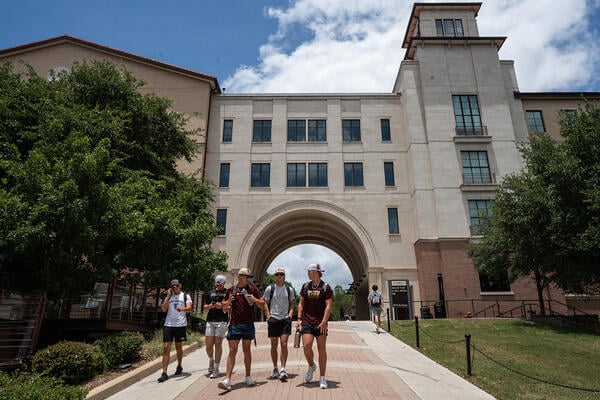
    Texas state representative Brian Harrison has asked the U.S. Department of Health and Human Services to investigate his alma mater, Texas A&M University, for allegedly engaging in “discriminatory” student recruiting practices, The Dallas Express reported.

    “In the state of Texas, government entities … should not be treating people differently based on anything other than merit,” Harrison told the outlet. “We have got to bring back a focus on meritocracy. And the president of Texas A&M brags about the fact that he’s doing it.”

    According to a May letter to HHS acting general counsel Brian Keveney that Harrison posted on X, Texas A&M president Mark Welsh had sent him a letter “admitting @TAMU is still engaged in DEI courses and discriminatory ‘targeted recruiting’ practices.”

    Welsh’s letter, which Harrison also included, criticizes the lawmaker for posting a video and other content online accusing the TAMU president of flouting the law.

    “Your comments accompanying the video imply that the university is doing something illegal by engaging in ‘targeted’ student recruitment efforts,” Welsh’s letter says. “You’ve also posted about student groups and academic courses, which, like recruiting activities, are specifically exempted in the bill. Since you voted in favor of the law, you must also be aware of those exemptions.”

    In his letter to Keveney, Harrison called Welsh’s defense—that Texas law does not explicitly ban targeted recruiting—“preposterous.” He asked HHS to “take any action[s] you or President Trump’s Task Force deem appropriate to ensure that Texas universities receiving federal funds are complying with the U.S. Constitution.”

    Harrison told The Dallas Express that HHS had received his letter and is “taking it and handling it appropriately.”

    Source link

  • An Oklahoma Teacher Took a Leap of Faith. She Ended Up Winning State Teacher of the Year – The 74

    An Oklahoma Teacher Took a Leap of Faith. She Ended Up Winning State Teacher of the Year – The 74


    Get stories like this delivered straight to your inbox. Sign up for The 74 Newsletter

    OKLAHOMA CITY — Those who knew Melissa Evon the best “laughed really hard” at the thought of her teaching family and consumer sciences, formerly known as home economics.

    By her own admission, the Elgin High School teacher is not the best cook. Her first attempt to sew ended with a broken sewing machine and her mother declaring, “You can buy your clothes from now on.”

    Still, Evon’s work in family and consumer sciences won her the 2025 Oklahoma Teacher of the Year award on Friday. Yes, her students practice cooking and sewing, but they also learn how to open a bank account, file taxes, apply for scholarships, register to vote and change a tire — lessons she said “get kids ready to be adults.”

    “Even though most of my career was (teaching) history, government and geography, the opportunity to teach those real life skills has just been a phenomenal experience,” Evon told Oklahoma Voice.

    After graduating from Mustang High School and Southwestern Oklahoma State University, Evon started her teaching career in 1992 at Elgin Public Schools just north of Lawton. She’s now entering her 27th year in education, a career that included stints in other states while her husband served in the Air Force and a break after her son was born.

    No matter the state, the grade level or the subject, “I’m convinced I teach the world’s greatest kids,” she said.

    Her family later returned to Oklahoma where Evon said she received a great education in public schools and was confident her son would, too.

    Over the course of her career, before and after leaving the state, she won Elgin Teacher of the Year three times, district Superintendent Nathaniel Meraz said.

    So, Meraz said he was “ecstatic” but not shocked that Evon won the award at the state level.

    “There would be nobody better than her,” Meraz said. “They may be as good as her. They may be up there with her. But she is in that company of the top teachers.”

    Oklahoma Teacher of the Year Melissa Evon has won her district’s top teacher award three times. (Photo provided by the Oklahoma State Department of Education)

    Like all winners of Oklahoma Teacher of the Year, Evon will spend a year out of the classroom to travel the state as an ambassador of the teaching profession. She said her focus will be encouraging teachers to stay in education at a time when Oklahoma struggles to keep experienced educators in the classroom.

    Evon herself at times questioned whether to continue teaching, she said. In those moments, she drew upon mantras that are now the core of her Teacher of the Year platform: “See the light” by looking for the good in every day and “be the light for your kids.”

    She also told herself to “get out of the boat,” another way of saying “take a leap of faith.”

    Two years ago, she realized she needed a change if she were to stay in education. She wanted to return to the high-school level after years of teaching seventh-grade social studies.

    The only opening at the high school, though, was family and consumer sciences. Accepting the job was a “get out of the boat and take a leap of faith moment,” she said.

    “I think teachers have to be willing to do that when we get stuck,” Evon said. “Get out of the boat. Sometimes that’s changing your curriculum. Sometimes it might be more like what I did, changing what you teach. Maybe it’s changing grade levels, changing subjects, changing something you’ve always done, tweaking that idea.”

    Since then, she’s taught classes focused on interpersonal communication, parenting, financial literacy and career opportunities. She said her students are preparing to become adults, lead families and grow into productive citizens.

    And, sure, they learn cooking and sewing along the way.

    “I’m getting to teach those things, and I know that what I do matters,” Evon said. “They come back and tell me that.”

    Oklahoma Voice is part of States Newsroom, a nonprofit news network supported by grants and a coalition of donors as a 501c(3) public charity. Oklahoma Voice maintains editorial independence. Contact Editor Janelle Stecklein for questions: [email protected].


    Get stories like these delivered straight to your inbox. Sign up for The 74 Newsletter

    Source link

  • Los Angeles Community College District Claims to Be Facing State Takeover Amid Allegations of Fraud and Censorship in LAVC Media Arts Department (LACCD Whistleblower)

    Los Angeles Community College District Claims to Be Facing State Takeover Amid Allegations of Fraud and Censorship in LAVC Media Arts Department (LACCD Whistleblower)

    The Los Angeles Community College District (LACCD) may be facing state takeover within two years due to overextended hiring and budget mismanagement, as discussed during a May 2025 meeting of the Los Angeles Valley College (LAVC) Academic Senate. Faculty warned that the looming financial crisis could result in mass layoffs—including tenured staff—and sweeping program cuts.

    Start Minutes LAVC Academic Senate

    “R. Christian-Brougham: other campuses have brand new presidents doing strange things. If we don’t do things differently as a district, from the mouth of the president in two years we’ll be bankrupt and go into negative.
     Chancellor has responsibility
    C. Sustin  asks for confirmation that it is the Chancellor that can and should step in to curb campus budgets and hirings.
    R. Christian-Brougham: the Chancellor bears responsibility, but in the takeover scenario, the Board of Trustees – all of them – would get fired
    E. Perez: which happened in San Francisco
    C. Sustin: hiring is in the purview of campuses, so they can’t directly determine job positions that move forward?
    R. Christian-Brougham: Chancellor and BoT could step in and fire the Campus Presidents, though.
    E. Perez: in next consultation with Chancellor, bringing this up.
    C. Maddren: Gribbons is not sitting back; he’s acting laterally and going upward
    E. Thornton: looping back to the example of City College of San Francisco: when the takeover happened there the reductions in force extended to multiple long-since-tenured members of a number of disciplines, including English. For this and so many other reasons, it was a reign of terror sort of situation. So we really need to push the Chancellor.”

    End Minutes Academic Senate

    https://go.boarddocs.com/ca/laccd/Board.nsf/vpublic?open#

    The dire financial outlook comes as new scrutiny falls on LAVC’s Media Arts Department, already under fire for years of alleged fraud, resume fabrication, and manipulation of public perception. Central to these concerns is the department’s chair, Eric Swelstad, who also oversees a $40,000 Hollywood Foreign Press Association (Golden Globe) grant for LAVC students—a role now drawing sharp criticism in light of mounting questions about his credentials and conduct.

    Over the past two months, a troubling wave of digital censorship has quietly erased years of documented allegations. In May 2025, nearly two years’ worth of investigative reporting—comprising emails, legal filings, and accreditation complaints—were scrubbed from the independent news site IndyBay. The removed content accused Swelstad of deceiving students and the public for over two decades about the quality and viability of the Media Arts program, as well as about his own professional qualifications.

    In June 2025, a negative student review about Swelstad—posted by a disabled student—disappeared from Rate My Professor. These incidents form part of what appears to be a years-long campaign of online reputation management and public deception.

    An AI-driven analysis of Rate My Professor entries for long-serving Media Arts faculty—including Swelstad, Arantxa Rodriguez, Chad Sustin, Dan Watanabe, and Jason Beaton—suggests that the majority of positive reviews were written by a single individual or a small group. The analysis cited “Identical Phrasing Across Profiles,” “Unusually Consistent Tag Patterns,” and a “Homogeneous Tone and Style” as evidence:

    “It is very likely that many (possibly a majority) of the positive reviews across these faculty pages were written by one person or a small group using similar templates, tone, and strategy… The presence of clearly distinct voices, especially in the negative reviews, shows that not all content comes from the same source.”

    A now-deleted IndyBay article also revealed emails dating back to 2016 between LAVC students and Los Angeles Daily News journalist Dana Bartholomew, who reportedly received detailed complaints from at least a dozen students—but failed to publish the story. Instead, Bartholomew later authored two glowing articles featuring Swelstad and celebrating the approval of LAVC’s $78.5 million Valley Academic and Cultural Center:

    * *”L.A. Valley College’s new performing arts center may be put on hold as costs rise,”* Dana Bartholomew, August 28, 2017.

      [https://www.dailynews.com/2016/08/09/la-valley-colleges-new-performing-arts-center-may-be-put-on-hold-as-costs-rise/amp/](https://www.dailynews.com/2016/08/09/la-valley-colleges-new-performing-arts-center-may-be-put-on-hold-as-costs-rise/amp/)

    * *”L.A. Valley College’s $78.5-million arts complex approved in dramatic downtown vote,”* Dana Bartholomew, August 11, 2016.
      [https://www.dailynews.com/2016/08/11/la-valley-colleges-785-million-arts-complex-approved-in-dramatic-downtown-vote/](https://www.dailynews.com/2016/08/11/la-valley-colleges-785-million-arts-complex-approved-in-dramatic-downtown-vote/)

    Among the most explosive allegations is that Swelstad misrepresented himself as a member of the Writer’s Guild of America (WGA), a claim contradicted by official WGA-West membership records, according to another redacted IndyBay report.

    This appears to be the tip of the iceberg according to other also scrubbed IndyBay articles

    Other questionable appointments, payments, and student ‘success stories’ in the Los Angeles Valley College Media Arts Department include:

    * **Jo Ann Rivas**, a YouTube personality and former Building Oversight Committee member, was paid as a trainer and presenter despite reportedly only working as a casting assistant on the LAVC student-produced film *Canaan Land*.

    (https://transparentcalifornia.com/salaries/2018/los-angeles-district/jo-ann-rivas/)

    * **Robert Reber**, a student filmmaker, was paid as a cinematography expert.

    (https://transparentcalifornia.com/salaries/2017/los-angeles-district/robert-reber/)

    * **Diana Deville**, a radio host and LAVC alumna with media credits, served as Unit Production Manager on *Canaan Land*, but her resume claims high-profile studio affiliations including DreamWorks, MGM, and OWN.

    (https://www.tnentertainment.com/directory/view/diana-deville-13338)

    The film *Canaan Land*, made by LAVC Media Arts students, has itself raised eyebrows. Filmmaker Richard Rossi claimed that both it and his earlier student film *Clemente* had received personal endorsements from the late Pope Francis. These assertions were echoed on *Canaan Land*’s GoFundMe page, prompting public denials and clarifications from the Vatican in *The Washington Post* and *New York Post*:

    [https://www.washingtonpost.com/news/early-lead/wp/2017/08/17/after-july-miracle-pope-francis-reportedly-moves-roberto-clemente-closer-to-sainthood/]
    * [https://nypost.com/2017/08/17/the-complicated-battle-over-roberto-clementes-sainthood/]

    Censorship efforts appear to have intensified following the publication of a now-removed article advising students how to apply for student loan discharge based on misleading or fraudulent education at LAVC’s Media Arts Department. If successful, such filings could expose the department—and the district—to financial liability.

    But the highest-profile financial concern is the 2020 establishment of the **Hollywood Foreign Press Association’s $40,000 grant** for LAVC Media Arts students, administered by Swelstad:

    * [HFPA Endowed Scholarship Announcement (PDF)](https://www.lavc.edu/sites/lavc.edu/files/2022-08/lavc_press_release-hfpa-endowed-scholarship-for-lavc-film-tv-students.pdf)
    * [LAVC Grant History Document](https://services.laccd.edu/districtsite/Accreditation/lavc/Standard%20IVA/IVA1-02_Grants_History.pdf)

    As a disreputable academic administrator with a documented history of professional fraud spanning two decades and multiple student success stories that aren’t, future grant donors may reconsider supporting the Department programs – further pushing the Los Angeles Valley College and by extension the district as a whole towards financial insolvency. 

    Source link

  • Don’t believe the hype: the Government and state school admissions to Oxford University

    Don’t believe the hype: the Government and state school admissions to Oxford University

    • HEPI Director, Nick Hillman, looks at the latest row on admissions to the University of Oxford.

    In a speech on Friday, the Minister for Skills, Baroness Smith, strongly chastised her alma mater, the University of Oxford, for taking a third of their entrants from the 6% of kids that go to private schools.

    In a section of the speech entitled ‘Challenging Oxford’, we were told the situation is ‘absurd’, ‘arcane’ and ‘can’t continue’:

    Oxford recently released their state school admissions data for 2024.

    And the results were poor.

    66.2% – the lowest entry rate since 2019.

    I want to be clear, speaking at an Oxford college today, that this is unacceptable.

    The university must do better.

    The independent sector educates around 6% of school children in the UK.

    But they make-up 33.8% of Oxford entrants.

    Do you really think you’re finding the cream of the crop, if a third of your students come from 6% of the population?

    It’s absurd.

    Arcane, even.

    And it can’t continue.

    It’s because I care about Oxford and I understand the difference that it can make to people’s lives that I’m challenging you to do better.  But it certainly isn’t only Oxford that has much further to go in ensuring access.

    This language reminded me of the Laura Spence affair, which produced so much heat and so little light in the Blair / Brown years and which may even have set back sensible conversations on broadening access to selective higher education.

    I wrote in a blog over the weekend that the Government are at risk of forgetting the benefit of education for education’s sake. That represents a political hole that Ministers should do everything to avoid as it could come to define them. Ill-thought through attacks on the most elite universities for their finely-grained admissions decisions represent a similar hole best avoided. Just imagine if the Minister had set out plans to tackle a really big access problem, like boys’ educational underachievement, instead. The Trump/Harvard spat is something any progressive government should seek to avoid, not copy.

    The latest chastisement is poorly formed for at least three specific reasons: the 6% is wrong in this context; the 33.8% number does not tell us what people tend to think it does; and Oxford’s current position of not closely monitoring the state/independent split is actually in line with the regulator’s guidance.

    1. 6% represents only half the proportion (12%) of school leavers educated at independent schools. In other words, the 6% number is a snapshot for the proportion of all young people in private schools right now; it tells us nothing about those at the end of their schooling and on the cusp of higher education.
    2. The 33.8% number is unhelpful because 20%+ of Oxford’s new undergraduates hail from overseas and they are entirely ignored in the calculation. If you include the (over) one in five Oxford undergraduate entrants educated overseas, the proportion of Oxford’s intake that is made up of UK private school kids falls from from something like one-third to more like one-quarter. This matters in part because the number of international students at Oxford has grown, meaning there are fewer places for home students of all backgrounds. In 2024, Oxford admitted 100 more undergraduate students than in 2006, but there were 250 more international students – and consequently fewer Brits. We seem to be obsessed with the backgrounds of home students and, because we want their money, entirely uninterested in the backgrounds of international students.
    3. The Office for Students dislikes the state/private metric. This is because of the differences within these two categories: in other words, there are high-performing state schools and less high-performing independent schools. Last year, when the University of Cambridge said they planned to move away from a simplistic state/independent school target, John Blake, the Director of Fair Access and Participation at the Office for Students, confirmed to the BBC, ‘we do not require a target on the proportion of pupils from state schools entering a particular university.’ So universities have typically shied away from this measure in recent times. If Ministers think it is a key metric after all and if they really do wish to condemn individual institutions for their state/independent split, it would have made sense to have had a conversation with the Office for Students and to have encouraged them to put out new guidance first. At the moment, the Minister and the regulator are saying different things on an important issue of high media attention.

    Are independently educated pupils overrepresented at Oxbridge? Quite possibly, but the Minister’s stick/schtick, while at one with the Government’s wider negative approach to independent schools, seems a sub-optimal way to engineer a conversation on the issue. Perhaps Whitehall wanted a headline more than it wanted to get under the skin of the issue?

    we do not require a target on the proportion of pupils from state schools entering a particular university

    John Blake, Director for Fair access and participation

    Source link

  • The state of the UK higher education sector’s finances

    The state of the UK higher education sector’s finances

    • Jack Booth and Maike Halterbeck at London Economics take a closer look at the recently published HESA Finance data to investigate the financial state of UK higher education.
    • At 11am today, we will host a webinar to mark the launch of the Unite Students Applicant Index. You can register for a free place here.

    In recent years, financial pressures have mounted across the entirety of the UK higher education (HE) sector, and have left many institutions in an exceptionally vulnerable position. In England alone, 43% of institutions are expected to face a financial deficit for 2024-25, prompting the House of Commons Education Select Committee to announce an inquiry into university finances and insolvency plans. Wide-ranging cost-cutting measures and redundancies are taking place across the sector, and the first institution (to our knowledge) has recently received emergency (bailout) funding from its regulator.

    With the recent release of the full HESA Finance data for 2023-24, we now have an updated picture of the scale of the financial challenges facing higher education providers (HEPs). London Economics analysed HEPs’ financial data between 2018-19 and 2023-24 to better understand the current financial circumstances of the sector.
     
    While other recent analyses focused on England only or covered other types of financial variables, here, we include providers across all of the UK and focus on three core financial indicators. 

    What does the analysis cover?

    Our analysis focuses on four broad clusters of HEPs, following the approach originally developed by Boliver (2015), which categorises a total of 126 providers according to differences in their research activity, teaching quality, economic resources, and other characteristics. Cluster 1 includes just two institutions: the University of Oxford and the University of Cambridge. Cluster 2 is composed mainly of other Russell Group universities and the majority of other pre-1992 institutions (totalling 39 institutions). Cluster 3 includes the remaining pre-1992 universities and most post-1992 institutions (67 institutions), and Cluster 4 consists of around a quarter of post-1992 universities (totalling 18 institutions). The latest HESA Finance data were, unfortunately, not available for 8 of these clustered institutions, meaning that our analysis covers 118 institutions in total.

    We focus on three key financial indicators (KFIs):

    1. Net cash inflow from operating activities after finance costs (NCIF). This measure provides a key indication of an institution’s financial health in relation to its day-to-day operations. Unlike the more common ‘surplus’/‘deficit’ measure, NCIF excludes non-cash items as well as financing-related income or expenditure.
    2. Net current assets (NCA), that is, ‘real’ reserves. This measure captures the value of current assets that can be turned into cash relatively quickly (i.e. in the short term, within 12 months), minus short-term liabilities.
    3. Liquidity days. This is based on the sum of NCA and NCIF, to evaluate whether institutions can cover operational shortfalls using their short-term resources. We then estimate the number of liquidity days each institution holds, defined as the number of days of average cash expenditure (excluding depreciation) that can be covered by cash and equivalents. The Office for Students requires providers to maintain enough liquid funds to cover at least 30 days’ worth of expenditures (excluding depreciation).

    What are the key findings?

    The key findings from the analysis are as follows:

    • In terms of financial deficits (NCIF), 40% of HEPs included in the analysis (47) posted a negative NCIF in 2023-24.
    • The average surplus across the institutions analysed (in terms of NCIF as a percentage of income) declined from 6.1% in 2018-19 to just 0.5% in 2023-24.
    • In terms of financial assets/resilience (NCA), 55% of HEPs analysed (65) saw a reduction in their NCA (as a proportion of their income) in 2023-24 as compared to 2018-19.
    • The decline in NCA has been particularly large in recent years, with average NCA declining from 27.4% of income in 2021-22 to 20.0% in 2023-24.
    • In terms of liquidity days, 20% of HEPs (24) had less than 30 days of liquidity in 2023-24, including 17 providers that posted zero liquidity days.

    A challenging time for the sector

    The analysis shows that the financial position of UK higher education institutions is worsening, with all three indicators analysed (i.e. NCIF, NCA, and liquidity days) showing a decline in providers’ financial stability. Major challenges to the sector’s finances are set to continue, especially as the UK government is looking to further curb net migration through potential additional restrictions on international student visas. Therefore, the financial pressures on UK HE providers are expected to remain significant.

    Want to know more?

    Our more detailed analysis, including a number of charts and additional findings on each indicator by university ‘cluster’, can be found on our website.

    Source link