Alabama schools are set to implement a new system to prevent vaping by public school students in the coming academic year.
HB 8, sponsored by Rep. Barbara Drummond D-Mobile, requires the Alabama State Board of Education to create a model policy for local boards of education to adopt by November.
“[Drummond] wanted an anti-vaping law, so we were able to work with her on something that’s not too overwhelming for the districts, but they are all going to have an anti-vaping policy,” State Board of Education Superintendent Eric Mackey told members of the board in a meeting on Tuesday.
Under the proposed policy, students who are caught vaping once will have their parents contacted and students who are caught vaping twice will have to take a state approved vaping awareness, education and prevention class which includes a curriculum created in collaboration with the Drug Education Council.
The topics covered in the proposed curriculum presented to board members include health consequences, peer pressure, nicotine and addiction, resources to quit vaping and common misconceptions about vaping among others.
According to the Children’s of Alabama newsroom, the media branch for the Children’s of Alabama hospital, nearly 20% of high school students in 2023 said they had vaped.
Some board members at Tuesday’s meeting questioned the need for the vaping law.
“As an educator, parent and grandparent, I don’t quite understand the focus on this and bifurcating or separating from the other common concerns in every discipline policy,” said Wayne Reynolds, who represents District 8 on the board. “Why would you separate what you’re doing to a child caught vaping and contacting the parents than any other child in the discipline policy?”
District 1 Representative Jackie Zeigler raised concerns about children moving onto other drugs like Fentanyl and Xylazine or tranq and pushed for broader language in the law to prevent having to add resolutions to add other specific items such as marajuana into the law.
“I don’t think by labeling it does any justice,” she said. “We need to make it broader so these things fit into it so we don’t have to come back and say, ‘now we have [THC] gummies, and now we have vaping.’”
Mackey agreed that the law is more specific than most Alabama Department of Education policies, but because it’s the law they have to follow it and said the board is “being no more restrictive than the law requires.”
The Alabama State Board of Education will vote on the model policy for the law next month.
Alabama Reflector is part of States Newsroom, a nonprofit news network supported by grants and a coalition of donors as a 501c(3) public charity. Alabama Reflector maintains editorial independence. Contact Editor Brian Lyman for questions: [email protected].
Texas state representative Brian Harrison has asked the U.S. Department of Health and Human Services to investigate his alma mater, Texas A&M University, for allegedly engaging in “discriminatory” student recruiting practices,The Dallas Express reported.
“In the state of Texas, government entities … should not be treating people differently based on anything other than merit,” Harrison told the outlet. “We have got to bring back a focus on meritocracy. And the president of Texas A&M brags about the fact that he’s doing it.”
According to a May letter to HHS acting general counsel Brian Keveney that Harrison posted on X, Texas A&M president Mark Welsh had sent him a letter “admitting @TAMU is still engaged in DEI courses and discriminatory ‘targeted recruiting’ practices.”
Welsh’s letter, which Harrison also included, criticizes the lawmaker for posting a video and other content online accusing the TAMU president of flouting the law.
“Your comments accompanying the video imply that the university is doing something illegal by engaging in ‘targeted’ student recruitment efforts,” Welsh’s letter says. “You’ve also posted about student groups and academic courses, which, like recruiting activities, are specifically exempted in the bill. Since you voted in favor of the law, you must also be aware of those exemptions.”
In his letter to Keveney, Harrison called Welsh’s defense—that Texas law does not explicitly ban targeted recruiting—“preposterous.” He asked HHS to “take any action[s] you or President Trump’s Task Force deem appropriate to ensure that Texas universities receiving federal funds are complying with the U.S. Constitution.”
Harrison told The Dallas Express that HHS had received his letter and is “taking it and handling it appropriately.”
OKLAHOMA CITY — Those who knew Melissa Evon the best “laughed really hard” at the thought of her teaching family and consumer sciences, formerly known as home economics.
By her own admission, the Elgin High School teacher is not the best cook. Her first attempt to sew ended with a broken sewing machine and her mother declaring, “You can buy your clothes from now on.”
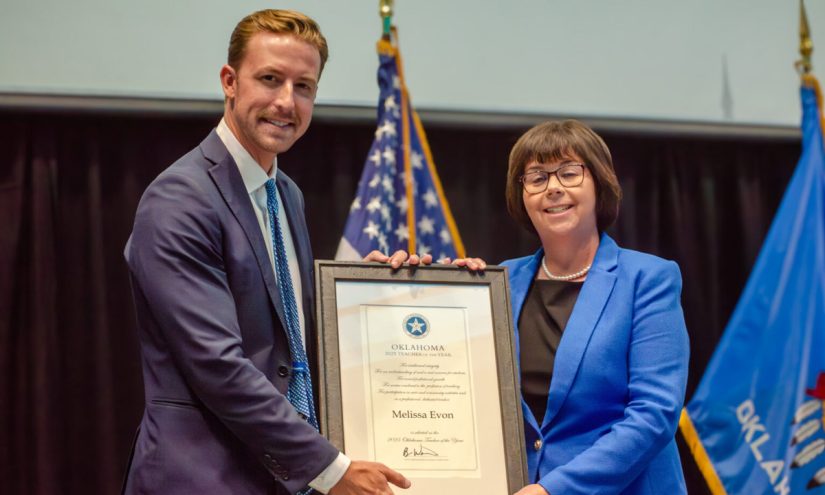
Still, Evon’s work in family and consumer sciences won her the 2025 Oklahoma Teacher of the Year award on Friday. Yes, her students practice cooking and sewing, but they also learn how to open a bank account, file taxes, apply for scholarships, register to vote and change a tire — lessons she said “get kids ready to be adults.”
“Even though most of my career was (teaching) history, government and geography, the opportunity to teach those real life skills has just been a phenomenal experience,” Evon told Oklahoma Voice.
After graduating from Mustang High School and Southwestern Oklahoma State University, Evon started her teaching career in 1992 at Elgin Public Schools just north of Lawton. She’s now entering her 27th year in education, a career that included stints in other states while her husband served in the Air Force and a break after her son was born.
No matter the state, the grade level or the subject, “I’m convinced I teach the world’s greatest kids,” she said.
Her family later returned to Oklahoma where Evon said she received a great education in public schools and was confident her son would, too.
Over the course of her career, before and after leaving the state, she won Elgin Teacher of the Year three times, district Superintendent Nathaniel Meraz said.
So, Meraz said he was “ecstatic” but not shocked that Evon won the award at the state level.
“There would be nobody better than her,” Meraz said. “They may be as good as her. They may be up there with her. But she is in that company of the top teachers.”
Oklahoma Teacher of the Year Melissa Evon has won her district’s top teacher award three times. (Photo provided by the Oklahoma State Department of Education)
Like all winners of Oklahoma Teacher of the Year, Evon will spend a year out of the classroom to travel the state as an ambassador of the teaching profession. She said her focus will be encouraging teachers to stay in education at a time when Oklahoma struggles to keep experienced educators in the classroom.
Evon herself at times questioned whether to continue teaching, she said. In those moments, she drew upon mantras that are now the core of her Teacher of the Year platform: “See the light” by looking for the good in every day and “be the light for your kids.”
She also told herself to “get out of the boat,” another way of saying “take a leap of faith.”
Two years ago, she realized she needed a change if she were to stay in education. She wanted to return to the high-school level after years of teaching seventh-grade social studies.
The only opening at the high school, though, was family and consumer sciences. Accepting the job was a “get out of the boat and take a leap of faith moment,” she said.
“I think teachers have to be willing to do that when we get stuck,” Evon said. “Get out of the boat. Sometimes that’s changing your curriculum. Sometimes it might be more like what I did, changing what you teach. Maybe it’s changing grade levels, changing subjects, changing something you’ve always done, tweaking that idea.”
Since then, she’s taught classes focused on interpersonal communication, parenting, financial literacy and career opportunities. She said her students are preparing to become adults, lead families and grow into productive citizens.
And, sure, they learn cooking and sewing along the way.
“I’m getting to teach those things, and I know that what I do matters,” Evon said. “They come back and tell me that.”
Oklahoma Voice is part of States Newsroom, a nonprofit news network supported by grants and a coalition of donors as a 501c(3) public charity. Oklahoma Voice maintains editorial independence. Contact Editor Janelle Stecklein for questions: [email protected].
The Los Angeles Community College District (LACCD) may be facing state takeover within two years due to overextended hiring and budget mismanagement, as discussed during a May 2025 meeting of the Los Angeles Valley College (LAVC) Academic Senate. Faculty warned that the looming financial crisis could result in mass layoffs—including tenured staff—and sweeping program cuts.
Start Minutes LAVC Academic Senate
“R. Christian-Brougham: other campuses have brand new presidents doing strange things. If we don’t do things differently as a district, from the mouth of the president in two years we’ll be bankrupt and go into negative. Chancellor has responsibility C. Sustin asks for confirmation that it is the Chancellor that can and should step in to curb campus budgets and hirings. R. Christian-Brougham: the Chancellor bears responsibility, but in the takeover scenario, the Board of Trustees – all of them – would get fired E. Perez: which happened in San Francisco C. Sustin: hiring is in the purview of campuses, so they can’t directly determine job positions that move forward? R. Christian-Brougham: Chancellor and BoT could step in and fire the Campus Presidents, though. E. Perez: in next consultation with Chancellor, bringing this up. C. Maddren: Gribbons is not sitting back; he’s acting laterally and going upward E. Thornton: looping back to the example of City College of San Francisco: when the takeover happened there the reductions in force extended to multiple long-since-tenured members of a number of disciplines, including English. For this and so many other reasons, it was a reign of terror sort of situation. So we really need to push the Chancellor.”
The dire financial outlook comes as new scrutiny falls on LAVC’s Media Arts Department, already under fire for years of alleged fraud, resume fabrication, and manipulation of public perception. Central to these concerns is the department’s chair, Eric Swelstad, who also oversees a $40,000 Hollywood Foreign Press Association (Golden Globe) grant for LAVC students—a role now drawing sharp criticism in light of mounting questions about his credentials and conduct.
Over the past two months, a troubling wave of digital censorship has quietly erased years of documented allegations. In May 2025, nearly two years’ worth of investigative reporting—comprising emails, legal filings, and accreditation complaints—were scrubbed from the independent news site IndyBay. The removed content accused Swelstad of deceiving students and the public for over two decades about the quality and viability of the Media Arts program, as well as about his own professional qualifications.
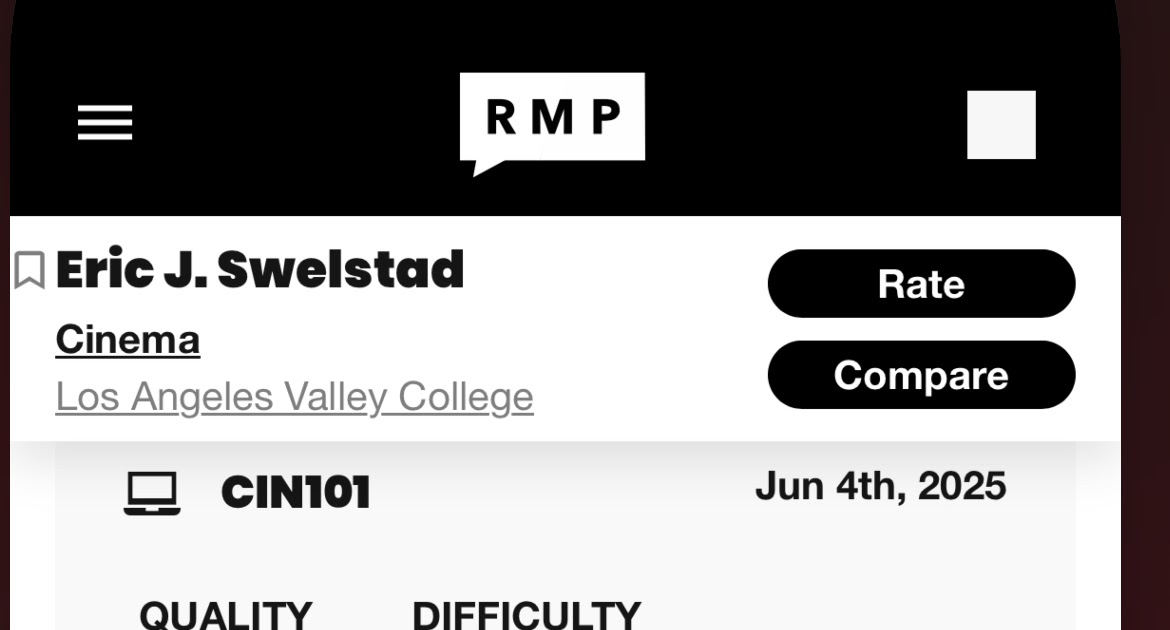
In June 2025, a negative student review about Swelstad—posted by a disabled student—disappeared from Rate My Professor. These incidents form part of what appears to be a years-long campaign of online reputation management and public deception.
An AI-driven analysis of Rate My Professor entries for long-serving Media Arts faculty—including Swelstad, Arantxa Rodriguez, Chad Sustin, Dan Watanabe, and Jason Beaton—suggests that the majority of positive reviews were written by a single individual or a small group. The analysis cited “Identical Phrasing Across Profiles,” “Unusually Consistent Tag Patterns,” and a “Homogeneous Tone and Style” as evidence:
“It is very likely that many (possibly a majority) of the positive reviews across these faculty pages were written by one person or a small group using similar templates, tone, and strategy… The presence of clearly distinct voices, especially in the negative reviews, shows that not all content comes from the same source.”
A now-deleted IndyBay article also revealed emails dating back to 2016 between LAVC students and Los Angeles Daily News journalist Dana Bartholomew, who reportedly received detailed complaints from at least a dozen students—but failed to publish the story. Instead, Bartholomew later authored two glowing articles featuring Swelstad and celebrating the approval of LAVC’s $78.5 million Valley Academic and Cultural Center:
* *”L.A. Valley College’s new performing arts center may be put on hold as costs rise,”* Dana Bartholomew, August 28, 2017.
Among the most explosive allegations is that Swelstad misrepresented himself as a member of the Writer’s Guild of America (WGA), a claim contradicted by official WGA-West membership records, according to another redacted IndyBay report.
This appears to be the tip of the iceberg according to other also scrubbed IndyBay articles
Other questionable appointments, payments, and student ‘success stories’ in the Los Angeles Valley College Media Arts Department include:
* **Jo Ann Rivas**, a YouTube personality and former Building Oversight Committee member, was paid as a trainer and presenter despite reportedly only working as a casting assistant on the LAVC student-produced film *Canaan Land*.
* **Diana Deville**, a radio host and LAVC alumna with media credits, served as Unit Production Manager on *Canaan Land*, but her resume claims high-profile studio affiliations including DreamWorks, MGM, and OWN.
The film *Canaan Land*, made by LAVC Media Arts students, has itself raised eyebrows. Filmmaker Richard Rossi claimed that both it and his earlier student film *Clemente* had received personal endorsements from the late Pope Francis. These assertions were echoed on *Canaan Land*’s GoFundMe page, prompting public denials and clarifications from the Vatican in *The Washington Post* and *New York Post*:
Censorship efforts appear to have intensified following the publication of a now-removed article advising students how to apply for student loan discharge based on misleading or fraudulent education at LAVC’s Media Arts Department. If successful, such filings could expose the department—and the district—to financial liability.
But the highest-profile financial concern is the 2020 establishment of the **Hollywood Foreign Press Association’s $40,000 grant** for LAVC Media Arts students, administered by Swelstad:
As a disreputable academic administrator with a documented history of professional fraud spanning two decades and multiple student success stories that aren’t, future grant donors may reconsider supporting the Department programs – further pushing the Los Angeles Valley College and by extension the district as a whole towards financial insolvency.
HEPI Director, Nick Hillman, looks at the latest row on admissions to the University of Oxford.
In a speech on Friday, the Minister for Skills, Baroness Smith, strongly chastised her alma mater, the University of Oxford, for taking a third of their entrants from the 6% of kids that go to private schools.
In a section of the speech entitled ‘Challenging Oxford’, we were told the situation is ‘absurd’, ‘arcane’ and ‘can’t continue’:
Oxford recently released their state school admissions data for 2024.
And the results were poor.
66.2% – the lowest entry rate since 2019.
I want to be clear, speaking at an Oxford college today, that this is unacceptable.
The university must do better.
The independent sector educates around 6% of school children in the UK.
But they make-up 33.8% of Oxford entrants.
Do you really think you’re finding the cream of the crop, if a third of your students come from 6% of the population?
It’s absurd.
Arcane, even.
And it can’t continue.
It’s because I care about Oxford and I understand the difference that it can make to people’s lives that I’m challenging you to do better. But it certainly isn’t only Oxford that has much further to go in ensuring access.
This language reminded me of the Laura Spence affair, which produced so much heat and so little light in the Blair / Brown years and which may even have set back sensible conversations on broadening access to selective higher education.
I wrote in a blog over the weekend that the Government are at risk of forgetting the benefit of education for education’s sake. That represents a political hole that Ministers should do everything to avoid as it could come to define them. Ill-thought through attacks on the most elite universities for their finely-grained admissions decisions represent a similar hole best avoided. Just imagine if the Minister had set out plans to tackle a really big access problem, like boys’ educational underachievement, instead. The Trump/Harvard spat is something any progressive government should seek to avoid, not copy.
The latest chastisement is poorly formed for at least three specific reasons: the 6% is wrong in this context; the 33.8% number does not tell us what people tend to think it does; and Oxford’s current position of not closely monitoring the state/independent split is actually in line with the regulator’s guidance.
6% represents only half the proportion (12%) of school leavers educated at independent schools. In other words, the 6% number is a snapshot for the proportion of all young people in private schools right now; it tells us nothing about those at the end of their schooling and on the cusp of higher education.
The 33.8% number is unhelpful because 20%+ of Oxford’s new undergraduates hail from overseas and they are entirely ignored in the calculation. If you include the (over) one in five Oxford undergraduate entrants educated overseas, the proportion of Oxford’s intake that is made up of UK private school kids falls from from something like one-third to more like one-quarter. This matters in part because the number of international students at Oxford has grown, meaning there are fewer places for home students of all backgrounds. In 2024, Oxford admitted 100 more undergraduate students than in 2006, but there were 250 more international students – and consequently fewer Brits. We seem to be obsessed with the backgrounds of home students and, because we want their money, entirely uninterested in the backgrounds of international students.
The Office for Students dislikes the state/private metric. This is because of the differences within these two categories: in other words, there are high-performing state schools and less high-performing independent schools. Last year, when the University of Cambridge said they planned to move away from a simplistic state/independent school target, John Blake, the Director of Fair Access and Participation at the Office for Students, confirmed to the BBC, ‘we do not require a target on the proportion of pupils from state schools entering a particular university.’ So universities have typically shied away from this measure in recent times. If Ministers think it is a key metric after all and if they really do wish to condemn individual institutions for their state/independent split, it would have made sense to have had a conversation with the Office for Students and to have encouraged them to put out new guidance first. At the moment, the Minister and the regulator are saying different things on an important issue of high media attention.
Are independently educated pupils overrepresented at Oxbridge? Quite possibly, but the Minister’s stick/schtick, while at one with the Government’s wider negative approach to independent schools, seems a sub-optimal way to engineer a conversation on the issue. Perhaps Whitehall wanted a headline more than it wanted to get under the skin of the issue?
we do not require a target on the proportion of pupils from state schools entering a particular university
John Blake, Director for Fair access and participation
Jack Booth and Maike Halterbeck at London Economics take a closer look at the recently published HESA Finance data to investigate the financial state of UK higher education.
At 11am today, we will host a webinar to mark the launch of the Unite Students Applicant Index. You can register for a free place here.
With the recent release of the full HESA Finance data for 2023-24, we now have an updated picture of the scale of the financial challenges facing higher education providers (HEPs). London Economicsanalysed HEPs’ financial data between 2018-19 and 2023-24to better understand the current financial circumstances of the sector.
While other recent analyses focused on England only or covered other types of financial variables, here, we include providers across all of the UK and focus on three core financial indicators.
What does the analysis cover?
Our analysis focuses on four broad clusters of HEPs, following the approach originally developed by Boliver (2015), which categorises a total of 126 providers according to differences in their research activity, teaching quality, economic resources, and other characteristics. Cluster 1 includes just two institutions: the University of Oxford and the University of Cambridge. Cluster 2 is composed mainly of other Russell Group universities and the majority of other pre-1992 institutions (totalling 39 institutions). Cluster 3 includes the remaining pre-1992 universities and most post-1992 institutions (67 institutions), and Cluster 4 consists of around a quarter of post-1992 universities (totalling 18 institutions). The latest HESA Finance data were, unfortunately, not available for 8 of these clustered institutions, meaning that our analysis covers 118 institutions in total.
We focus on three key financial indicators (KFIs):
Net cash inflow from operating activities after finance costs (NCIF). This measure provides a key indication of an institution’s financial health in relation to its day-to-day operations. Unlike the more common ‘surplus’/‘deficit’ measure, NCIF excludes non-cash items as well as financing-related income or expenditure.
Net current assets (NCA), that is, ‘real’ reserves. This measure captures the value of current assets that can be turned into cash relatively quickly (i.e. in the short term, within 12 months), minus short-term liabilities.
Liquidity days. This is based on the sum of NCA and NCIF, to evaluate whether institutions can cover operational shortfalls using their short-term resources. We then estimate the number of liquidity days each institution holds, defined as the number of days of average cash expenditure (excluding depreciation) that can be covered by cash and equivalents. The Office for Students requires providers to maintain enough liquid funds to cover at least 30 days’ worth of expenditures (excluding depreciation).
What are the key findings?
The key findings from the analysis are as follows:
In terms of financial deficits (NCIF), 40% of HEPs included in the analysis (47) posted a negative NCIFin2023-24.
The average surplus across the institutions analysed (in terms of NCIF as a percentage of income) declined from 6.1% in 2018-19 to just 0.5% in 2023-24.
In terms of financial assets/resilience (NCA), 55% of HEPs analysed (65) saw a reduction in their NCA (as a proportion of their income) in 2023-24 as compared to 2018-19.
The decline in NCA has been particularly large in recent years, with average NCA declining from 27.4% of income in 2021-22 to 20.0% in 2023-24.
In terms of liquidity days, 20% of HEPs (24) had less than 30 days of liquidity in 2023-24, including 17 providers that posted zero liquidity days.
A challenging time for the sector
The analysis shows that the financial position of UK higher education institutions is worsening, with all three indicators analysed (i.e. NCIF, NCA, and liquidity days) showing a decline in providers’ financial stability. Major challenges to the sector’s finances are set to continue, especially as the UK government is looking to further curb net migration through potential additional restrictions on international student visas. Therefore, the financial pressures on UK HE providers are expected to remain significant.
Want to know more?
Our more detailed analysis, including a number of charts and additional findings on each indicator by university ‘cluster’, can be found on our website.
ELKHART, Ind. — Ever since Ty Zartman was little, people told him he had to go to college to be successful. “It was engraved on my brain,” he said.
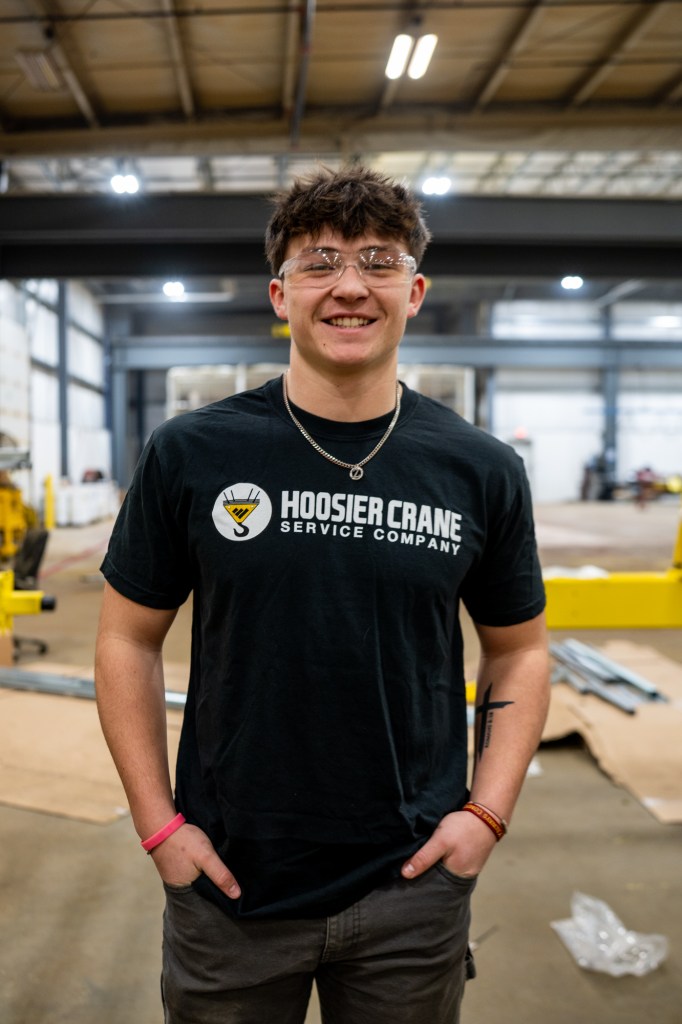
But despite earning straight A’s, qualifying for the National Honor Society, being voted prom king and playing on the high school football and baseball teams, the teen never relished the idea of spending another four years in school. So in fall 2023 he signed up through his Elkhart, Indiana, high school for an apprenticeship at Hoosier Crane Service Company, eager to explore other paths. There, he was excited to meet coworkers who didn’t have a four-year degree but earned good money and were happy in their careers.
Through the youth apprenticeship, Ty started his day at the crane manufacturing and repair business at 6:30 a.m., working in customer service and taking safety and training courses while earning $13 an hour. Then, he spent the afternoon at his school, Jimtown High, in Advanced Placement English and U.S. government classes.
In June, the 18-year-old started full-time at Hoosier Crane as a field technician.
“College is important and I’m not dissing on that,” Ty said. “But it’s not necessarily something that you need.”
Elkhart County is at the forefront of a movement slowly spreading across Indiana and the nation to make apprenticeships a common offering in high school.
In 2019, as part of a plan to boost the region’s economic prospects, county leaders launched an effort to place high schoolers in apprenticeships that combine work-based training with classroom instruction. About 80 students from the county’s seven school districts participated this academic year, in fields such as health care, law, manufacturing, education and engineering. In April, as part of a broader push to revamp high school education and add more work-based learning, the state set a goal of 50,000 high school apprentices by 2034.
Tim Pletcher, the principal of Jimtown High, said students are often drawn first to the chance to spend less time in class. But his students quickly realize apprenticeships give them work-based learning credits and industry connections that help them after graduation. They also earn a paycheck. “It’s really causing us to have a paradigm shift in how we look at getting kids ready for the next step,” he said.
Related: Become a lifelong learner. Subscribe to our free weekly newsletter featuring the most important stories in education.
This “earn and learn” model is taking hold in part because of deepening disillusionment with four-year college, and the fact that well-paying jobs that don’t require bachelor’s degrees are going unfilled nationally. The past three presidential administrations invested in expanding apprenticeships, including those for high schoolers, and in April, President Donald Trump signed an executive order calling for 1 million new apprentices. In a recent poll, more than 80 percent of people said they supported expanding partnerships between schools and businesses to provide work-based learning experiences for students.
Yet in the United States, the number of so-called youth apprenticeships for high schoolers is still “infinitesimally small,” said Vinz Koller, a vice president at nonprofit group Jobs for the Future. One estimate suggests they number about 20,000 nationally, while there are some 17 million high school students.By contrast, in Switzerland — which has been praised widely for its apprenticeship model, including by U.S. Education Secretary Linda McMahon — 70 percent of high schoolers participate. Indiana is among several states, including Colorado, South Carolina and Washington, that have embraced the model and sent delegations to Switzerland to learn more.
Elkhart, Indiana, known as the “RV capital of the world,” saw widespread unemployment during the Great Recession. That led community leaders to focus on apprenticeships as a way to diversify their economy. Credit: Camilla Forte/The Hechinger Report
Experts including Ursula Renold, professor of education systems at the Swiss Federal Institute of Technology (ETH) Zurich, note that importing the model to the United States at a large scale won’t be simple. Most businesses aren’t accustomed to employing apprentices, parents can be resistant to their students trading four-year college aspirations for work, and public transportation to take students to apprenticeships is limited, especially in rural areas. Many high schoolers don’t have a driver’s license, access to a car or money for gas. School districts already face a shortage of bus drivers that makes transporting students to apprenticeships difficult or impossible.
Still, Renold, who is known as the “grande dame of apprenticeships,” said Indiana’s commitment to apprenticeships at the highest levels of state government, as well as the funding the state has invested in work-based learning, at least $67 million, seem to be setting the state up for success, though it could take a decade to see results.
“If I had to make a bet,” said Renold, “I would say it’s Indiana who will lead the way.”
Elkhart County’s experiment with apprenticeships has its roots in the Great Recession. Recreational vehicle manufacturing dominates the local economy, and demand for the vehicles plummeted, contributing to a regional unemployment rate at that time of nearly 20 percent. Soon after, community leaders began discussing how to better insulate themselves from future economic instability, eventually focusing on high school education as a way to diversify industries and keep up with automation, said Brian Wiebe, who in 2012 founded local nonprofit Horizon Education Alliance, or HEA, to help lead that work.
Elkhart County, Indiana, was the first community in Indiana to encourage businesses to employ high school students as apprentices, where they can earn work-based learning credits and make industry connections that help them, even if they decide to go on to college. Credit: Camilla Forte/The Hechinger Report
That year, Wiebe and two dozen local and state political, business, nonprofit and education leaders visited Switzerland and Germany to learn more about the apprenticeship model. “We realized in the U.S., there was only a Plan A, a path to college,” he recalled. “We were not supporting the rest of our young people because there was no Plan B.”
HEA partnered with Elkhart County school districts and businesses, as well as with CareerWise, a youth apprenticeship nonprofit that works nationally. They began rolling out apprenticeships in 2019, eventually settling on a goal of increasing participation by 20 percent each year.
In 2021, Katie Jenner, the new secretary of education for Indiana, learned about Elkhart’s apprenticeships as she was trying to revamp high school education in the state so it better prepared students for the workforce. Elkhart, as well as six other apprenticeship pilot sites funded by Indianapolis-based philanthropy the Richard M. Fairbanks Foundation, provided a proof of concept for the apprenticeship model, said Jenner.
In December, the state adopted a new diploma system that includes an emphasis on experiential and work-based learning, through apprenticeships, internships and summer jobs.
On a weekday this winter, 17 sophomores at Elkhart’s Concord High School were sitting at computers, creating resumes they planned to use to apply for apprenticeships. The students were among some 50 sophomores at the high school who’d expressed interest in apprenticing and met the school’s attendance and minimum 2.5 GPA requirements, out of a class of roughly 400. They would receive coaching and participate in mock interviews before meeting with employers.
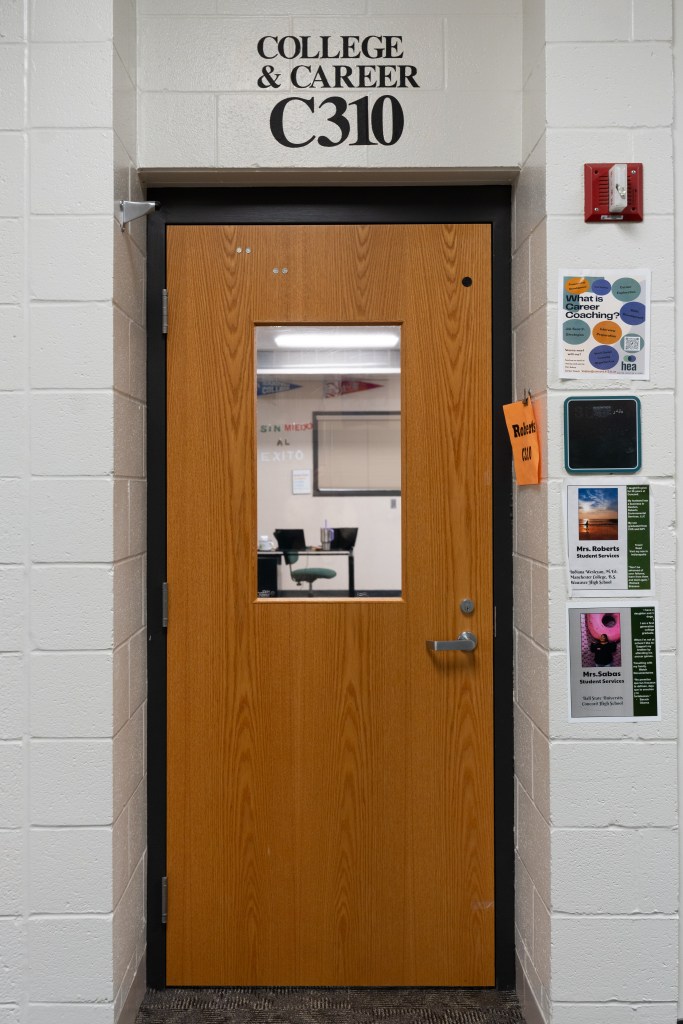
Becca Roberts, a former English teacher who now oversees the high school’s college and career programs, said apprenticeships help convince students of the importance of habits like punctuality, clear communication and regular attendance. “It’s not from a book,” she said. “They’re dealing with real life.”
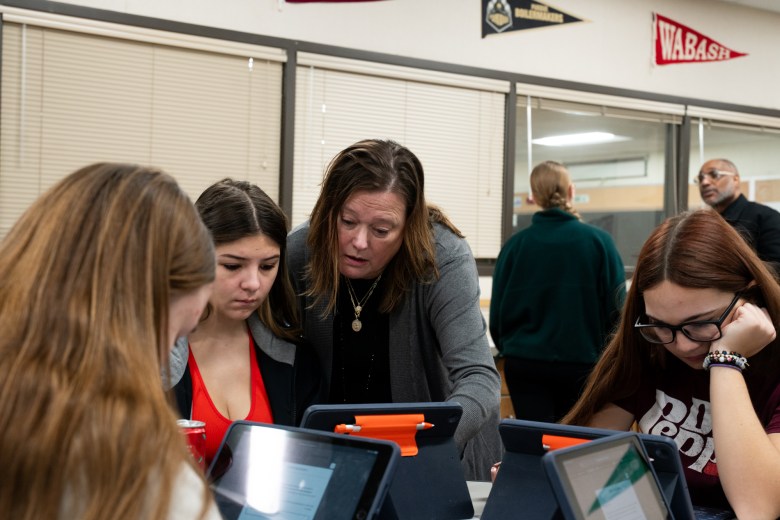
Becca Roberts, who oversees college and career programs at Concord High School in Indiana, helps students research different companies offering apprenticeships, including job descriptions, work schedules and commuting distances. Credit: Camilla Forte/The Hechinger Report
One student, Ava Cripe, said she hoped for an apprenticeship of some sort in the health care field. She’d only been a pet sitter and was nervous at the thought of having a professional job. “You’re actually going out and working for someone else, like not for your parents or your grandma, so it’s a little scary,” she said.
CareerWise Elkhart has recently beefed up its support for students and businesses participating in apprenticeships. It employs a business partnership manager and customer success managers who help smooth over issues that arise in the workplace — an apprentice who isn’t taking initiative, for example, or an apprenticeship that isn’t sufficiently challenging. “Before, if an issue came up, a business would just fire a student or a student would leave,” said Sarah Koontz, director of CareerWise Elkhart County. “We’re now more proactive.”
In Elkhart and across the state, the embrace of work-based learning has worried some parents who fear it will limit, not expand, their children’s opportunities. In previous generations, career and technical programs (then known as vocational education) were often used to route low-income and Black and Hispanic students away from college and into relatively low-paying career paths.
Anitra Zartman, Ty’s mother, said she and her husband were initially worried when their son said he wanted to go straight to work. They both graduated from college, and her husband holds a master’s degree. “We were like, ‘Don’t waste your talent. You’re smart, go to college.’” But she says they came around after seeing how the work experience influenced him. “His maturity has definitely changed. I think it’s because he has a responsibility that he takes very seriously,” she said. “He doesn’t want to let people down.”
Her eldest daughter, Senica Zartman, also apprenticed during her final two years of high school, as a teacher’s assistant. She is now in college studying education. “The apprenticeship solidified her choice,” Anitra Zartman said, and it helped her decide to work with elementary students. Anitra Zartman said she would encourage her two youngest children to participate in apprenticeships too.
Ty Zartman works from 6 a.m. to noon at his apprenticeship at Hoosier Crane Service Company before he goes to school for afternoon classes. Credit: Camilla Forte/The Hechinger Report
Sarah Metzler, CEO of the nonprofit HEA, said apprenticeships differ from the vocational education of the past that tended only to prepare students for relatively low paid, entry-level jobs. With apprenticeships, she said, students must continually learn new skills and earn new licenses and industry certifications as part of the program.
Litzy Henriquez Monchez, 17, apprentices in human resources at a company of 50 people, earning $13.50 an hour. “I deal with payroll, I onboard new employees, I do a lot of translating. Anything that has to do with any of the employees, I deal with,” she said. She’s also earning an industry-recognized certification for her knowledge of a human resources management system, and says the company has offered to pay for her college tuition if she continues in the position.
Koontz said most companies pay for their apprentices to attend Ivy Tech, a statewide community college system, if they continue to work there. One is even paying for their apprentice’s four-year degree, she said.
Attracting employers has proven to be the biggest challenge to expanding youth apprenticeships — in Elkhart and beyond. In total, 20 companies worked with the Elkhart school districts last year, and 28 have signed on for this coming school year — only enough to employ about a third of interested students.
The obstacles, employers say, include the expense of apprentices’ salaries, training and other costs.
Metzler and others, though, point to studies showingbenefits for employers, including cost savings over time and improved employee loyalty. And in Indiana, the Fairbanks foundation and other organizations are working on ways to reduce employer costs, including by developing a standard curriculum for apprenticeships in industries like health care and banking so individual companies don’t bear the costs alone.
Business leaders who do sign on say they are happy with the experience. Todd Cook, the CEO of Hoosier Crane Service Company, employs 10 high schoolers, including Ty Zartman, as engineering and industrial maintenance technician apprentices, approximately 10 percent of his staff. He said the pipeline created by the apprenticeship program has helped reduce recruiting costs.
“We’re starting to build our own farm system of talent,” he said. Students initially earn $13 an hour, and finish their apprenticeship earning $18. If they continue with the company, he said, they can earn up to $50 an hour after about five years. And if they go on to become trainers or mentors, Cook said, “Honestly, there is no ceiling.”
Transportation has been a limiting factor too. There’s no public transit system, and students who can’t rely on their parents for rides are often out of luck. “We’d love to offer a bus to every kid, to every location, but we don’t have people to run those extra bus routes,” said Principal Pletcher.
The state has tried to help by investing $10 million to help students pay for costs such as transportation, equipment and certifications. Each school that provides work-based learning opportunities also receives an additional $500 per student.
Indiana has a goal to employ 50,000 high school students as apprentices by 2034. State leaders in business, education, government and nonprofits are working closely with Swiss experts to adopt a youth apprenticeship program similar to the one in that country. Credit: Camilla Forte/The Hechinger Report
Trump’s executive order called for the secretaries of education, labor and commerce to develop a plan by late August for adding 1 million new apprenticeships. The order does not set a date for reaching that milestone, and it applies to apprentices of all ages, not just high schoolers. Vinz Koller of Jobs for the Future said the goal is modest, and achievable; the number of youth apprenticeships has doubled just in the past few years, he said, and California alone has a goal of reaching 500,000 apprenticeships, across all ages, by 2029.
Still, the order did not include additional funding for apprenticeships, and the Trump administration’s proposed budget includes major cuts to workforce development training. In an email, a White House spokesperson said the administration had promoted apprenticeships through outreach programs but did not provide additional information including on whether that outreach had a focus on youth apprenticeships.
Back in Elkhart, Ty Zartman, the Hoosier Crane apprentice, has begun his technician job with the company after graduating in early June. He is earning $19 an hour. He is also taking a class at the local community college on electrical work and recently received a certificate of completion from the Department of Labor for completing 2,000 hours of his apprenticeship.
Anitra Zartman said she wishes he’d attended more school events like pep rallies, and sometimes worried he wasn’t “being a kid.” But Ty said his supervisor is “super flexible” and he was able to go to the winter formal and prom. “I think I still live a kid life,” he said. “I do a lot of fun things.”
Of his job, he said, “I love it so much.”
Contact editor Caroline Preston at 212-870-8965, via Signal at CarolineP.83 or on email at [email protected].
The Hechinger Report provides in-depth, fact-based, unbiased reporting on education that is free to all readers. But that doesn’t mean it’s free to produce. Our work keeps educators and the public informed about pressing issues at schools and on campuses throughout the country. We tell the whole story, even when the details are inconvenient. Help us keep doing that.
Wayne State University will offer incarcerated people the opportunity to enroll in a bachelor’s of sociology starting this fall.
Wayne State University
With the reinstatement of Pell Grant eligibility for incarcerated individuals in 2023, more colleges have launched or restarted prison education programs. Wayne State University in Michigan will join their ranks this fall, offering a bachelor’s degree to incarcerated individuals for the first time.
Twenty-five students will join the inaugural cohort in August, and the university is forging ahead with program plans despite looming Pell Grant cuts.
What’s the need: Twenty-five percent of formerly incarcerated people have no high school diploma, and 20 percent have only a high school diploma, compared to the 91 percent of Americans who have attained at least that credential. “We know that today’s workforce, much of it requires a college education, so it’s almost a necessary criterion to earn a living wage in today’s society,” said Michelle Jacobs, a professor of sociology and Wayne State’s Prison Education Program lead.
While many incarcerated individuals express an interest in postsecondary education, college often gets placed on the back burner after they leave prison as they focus on more pressing challenges, such as meeting basic needs and providing for themselves, Jacobs said. Higher education–in–prison programs help students get a head start on reclaiming their lives after they are released.
The initiative also ties into Wayne State president Kimberly Andrews Espy’s Prosperity Agenda for the Detroit area, which includes supporting economic mobility for students, improving the health of urban neighborhoods and fostering innovation in the local economy.
Individuals who participate in postsecondary education programs while in prison are 48 percent less likely to be reincarcerated than those who don’t, and they are more likely to get a job after their release. Research also shows that education-in-prison programs not only benefit the individual but also increase safety in prison settings and can improve families’ socioeconomic mobility.
“One of our goals for the program is to empower families in low-income communities that have been disproportionately impacted [by mass incarceration],” Jacobs said.
How it works: Wayne State’s Prison Education Program will enroll 25 incarcerated men at the Macomb Correctional Facility in Lenox, Mich., about 35 miles northeast of the university.
To be considered, applicants have to be at least five years from their earliest release date, giving them time to finish the program, and they must complete an essay outlining why they want to participate.
All courses will be delivered in person and the university will provide any school supplies or resources the students need for their coursework, including pens, paper and dictionaries. Students have to complete paper applications and FAFSA forms, so staff will assist with that process.
Program participants will complete a degree in sociology, as well as a range of general education courses, similar to their on-campus peers. Students can also opt in to an entrepreneurship and innovation minor.
Both programs are designed to support the unique experiences of incarcerated people, Jacobs said.
“I’m extremely biased towards sociology, and I think that benefits everyone,” Jacobs said. “I think that incarcerated individuals can benefit so much, not only in terms of understanding the broader structures that have impacted their own realities, but also on that interactional level … I think that’ll be really helpful for them as they’re navigating their lives postrelease.”
Faculty members from across the university will serve as instructors.
Facing headwinds: Since beginning the project, Wayne State has encountered various challenges.
The initial plan was to use donor funding to kick off the program, but officials had to pivot to relying on Pell dollars and money from the Michigan Department of Corrections to cover student tuition. Then, reorganization at the federal Department of Education and a lack of staff stalled approval of the program. Changes to the Pell Grant may further impede the program’s future.
Despite the obstacles, Jacobs and her team are pushing on.
“Once we started working on it, I couldn’t let it go,” Jacobs said. “I deeply believe in the transformative power of education, and I also deeply believe that there is an amazing among of talent and wit and love and humor and expertise already in carceral settings … I just made a decision that we will forge ahead regardless of what is happening at the federal level—while, of course, paying attention to it.”
Wayne State staff received advice and support in establishing the program from the Michigan Consortium for Higher Education in Prison. “It’s very collaborative instead of competitive, which is unique for academic spaces, and I appreciate it so much,” Jacobs said.
Next steps: Jacobs and her team are currently reviewing student applications to select the inaugural cohort, with plans to enroll another cohort in fall 2026.
Before classes start this August, participating faculty and students will both complete an orientation. The faculty orientation will provide instructors with professional development that helps prepare them to teach inside a prison, supported by a student organization on campus focused on criminal justice reform.
Students will be given college-readiness support, as well as access to academic and support resources similar to those offered on campus.
If your student success program has a unique feature or twist, we’d like to know about it. Click here to submit.
On June 18, the Department of State issued a cable to all U.S. diplomatic and consular posts formally expanding the screening and vetting process for applicants of F, M and J (FMJ) nonimmigrant visas. The State Department guidance resumes FMJ appointment scheduling after a previous announcement from the agency paused all student visa interviews as they prepared for the new social media screening and vetting guidance.
Background
At the end of May, the State Department announced that U.S. embassies and consular sections were pausing new student visa interviews as they awaited further guidance on new social media screening and vetting requirements. CUPA-HR joined the American Council on Education and other higher education associations on a letter to Secretary of State Marco Rubio requesting the agency quickly implement the new vetting measures to ensure new student visas could be efficiently processed before the 2025-2026 academic year. No further guidance was publicly announced between the announced pausing of student visa interviews and the cable sent out to all diplomatic and consular posts.
New Screening and Vetting Guidance
The cable directs consular sections to resume scheduling FMJ appointments after implementing the new vetting procedures. The guidance requires officers to conduct “a comprehensive and thorough vetting of all FMJ applicants, including online presence, to identify applicants who bear hostile attitudes toward our citizens, culture, government, institutions, or founding principles; who advocate for, aid, or support designated foreign terrorists and other threats to U.S. national security; or who perpetrate unlawful antisemitic harassment or violence.” The posts are directed to implement the new guidance within five business days.
As explained in the cable, consular officers are directed to conduct intake and interviews in accordance with standard procedures, but once an FMJ applicant is otherwise eligible for the requested nonimmigrant status, officers must temporarily refuse the case under Section 221(g) of the Immigration and Nationality Act (INA). After refusing the case, officers must request the applicant set all social media accounts to “public,” after which the officer must examine “the applicant’s entire online presence — not just social media activity — using any appropriate search engines or other online resources.”
The new vetting procedures could limit the consular officers’ ability to process student visa applications quickly and efficiently as the cable also mentions that consular sections should “consider the effect of this guidance on workload” when resuming the scheduling of FMJ appointments. Even with these concerns, the cable does request expedited appointments for certain FMJs, including J-1 physicians and F-1 students seeking to study at U.S. institutions where the international student body constitutes 15 percent or less of the total student population.
While much of the advocacy from interested stakeholders on this issue revolves around students, individuals seeking J-1 visas to participate in cultural and educational exchange programs to conduct research or teach at institutions could be subject to an enhanced level of scrutiny. CUPA-HR will continue to monitor for updates related to the FMJ vetting processes.
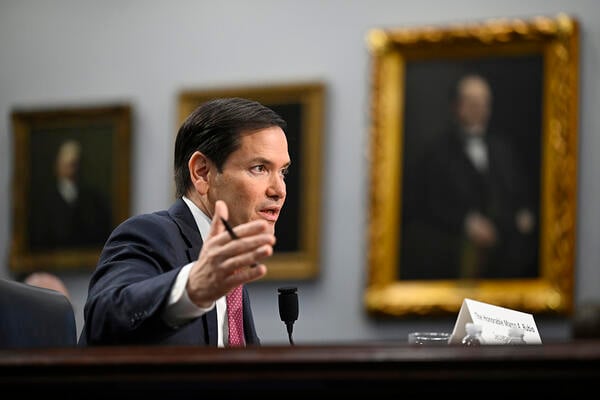
Rubio paused visa interviews last month while the State Department created rules for the social media screenings.
John McDonnell/Getty Images
The U.S. State Department is rolling out sweeping new rules for vetting student visa applicants using their social media presence, according to Politico.
The new process will include screening for “any indications of hostility towards the citizens, culture, government, institutions or founding principles of the United States,” according to an internal State Department cable.
Department officials will also look for posts that signal “advocacy for, aid or support for foreign terrorists and other threats to national security” and “support for antisemitic harassment or violence,” specifically citing support for Hamas—a charge commonly levied against student protesters advocating for Palestinian rights—as grounds for rejection. The cable also directs officials to cull applicants who “demonstrate a history of political activism.”
The news comes a few weeks after Secretary of State Marco Rubio paused all student visa interviews in order to implement a new screening policy focusing on students’ online activity. The Associated Press reported that the department rescinded the pause, but applicants who don’t allow the government to review their social media accounts could be rejected.
The cable is the Trump administration’s latest effort to curtail the flow of international students to the U.S., as tens of thousands of foreign students await approval of their visas after months of delays and with only weeks until the start of the fall semester.
State Department spokespeople did not respond to a list of questions from Inside Higher Ed in time for publication.