By embracing Universal Design for Learning (UDL) principles in purchasing decisions, school leaders can create learning spaces that not only accommodate students with disabilities but enhance the educational experience for all learners while delivering exceptional returns on investment (ROI).
Strangely enough, the concept of UDL all started with curb cuts. Disability activists in the 1960s were advocating for adding curb cuts at intersections so that users of wheelchairs could cross streets independently. Once curb cuts became commonplace, there was a surprising secondary effect: Curb cuts did not just benefit the lives of those in wheelchairs, they benefited parents with strollers, kids on bikes, older adults using canes, delivery workers with carts, and travelers using rolling suitcases. What had been designed for one specific group ended up accidentally benefiting many others.
UDL is founded on this idea of the “curb-cut effect.” UDL focuses on designing classrooms and schools to provide multiple ways for students to learn. While the original focus was making the curriculum accessible to multiple types of learners, UDL also informs the physical design of classrooms and schools. Procurement professionals are focusing on furniture and technology purchases that provide flexible, accessible, and supportive environments so that all learners can benefit. Today entire conferences, such as EDspaces, focus on classroom and school design to improve learning outcomes.
There is now a solid research base indicating that the design of learning spaces is a critical factor in educational success: Learning space design changes can significantly influence student engagement, well-being, and academic achievement. While we focus on obvious benefits for specific types of learners, we often find unexpected ways that all students benefit. Adjustable desks designed for wheelchair users can improve focus and reduce fatigue in many students, especially those with ADHD. Providing captions on videos, first made available for deaf students, benefit ELL and other students struggling to learn to read.
Applying UDL to school purchasing decisions
UDL represents a paradigm shift from retrofitting solutions for individual students to proactively designing inclusive environments from the ground up. Strategic purchasing focuses on choosing furniture and tech tools that provide multiple means of engagement that can motivate and support all types of learners.
Furniture that works for everyone
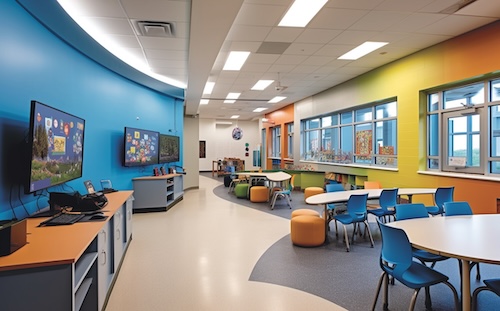
Modern classroom furniture has evolved far beyond the traditional one-size-fits-all model. Flexible seating options such as stability balls, wobble cushions, and standing desks can transform classroom dynamics. While these options support students with ADHD or sensory processing needs, they also provide choice and movement opportunities that enhance engagement for neurotypical students. Research consistently shows that physical comfort directly correlates with cognitive performance and attention span.
Modular furniture systems offer exceptional value by adapting to changing needs throughout the school year. Tables and desks that can be easily reconfigured support collaborative learning, individual work, and various teaching methodologies. Storage solutions with clear labeling systems and accessible heights benefit students with visual impairments and executive functioning challenges while helping all students maintain organization and independence.
Technology that opens doors for all learners
Assistive technology has evolved from specialized, expensive solutions to mainstream tools that benefit diverse learners. Screen readers like NVDA and JAWS remain essential for students with visual impairments, but their availability also supports students with dyslexia who benefit from auditory reinforcement of text. When procuring software licenses, prioritize platforms with built-in accessibility features rather than purchasing separate assistive tools.
Voice-to-text technology exemplifies the UDL principle perfectly. While crucial for students with fine motor challenges or dysgraphia, these tools also benefit students who process information verbally, ELL learners practicing pronunciation, and any student working through complex ideas more efficiently through speech than typing.
Adaptive keyboards and alternative input devices address various physical needs while offering all students options for comfortable, efficient interaction with technology. Consider keyboards with larger keys, customizable layouts, or touchscreen interfaces that can serve multiple purposes across your student population.
Interactive displays and tablets with built-in accessibility features provide multiple means of engagement and expression. Touch interfaces support students with motor difficulties while offering kinesthetic learning opportunities for all students. When evaluating these technologies, prioritize devices with robust accessibility settings including font size adjustment, color contrast options, and alternative navigation methods.
Maximizing your procurement impact
Strategic procurement for UDL requires thinking beyond individual products to consider system-wide compatibility and scalability. Prioritize vendors who demonstrate commitment to accessibility standards and provide comprehensive training on using accessibility features. The most advanced assistive technology becomes worthless without proper implementation and support.
Conduct needs assessments that go beyond compliance requirements to understand your learning community’s diverse needs. Engage with special education teams, occupational therapists, and technology specialists during the procurement process. Their insights can prevent costly mistakes and identify opportunities for solutions that serve multiple populations.
Consider total cost of ownership when evaluating options. Adjustable-height desks may cost more initially but can eliminate the need for specialized furniture for individual students. Similarly, mainstream technology with robust accessibility features often costs less than specialized assistive devices while serving broader populations.
Pilot programs prove invaluable for testing solutions before large-scale implementation. Start with small purchases to evaluate effectiveness, durability, and user satisfaction across diverse learners. Document outcomes to build compelling cases for broader adoption.
The business case for UDL
Procurement decisions guided by UDL principles deliver measurable returns on investment. Reduced need for individualized accommodations decreases administrative overhead while improving response times for student needs. Universal solutions eliminate the stigma associated with specialized equipment, promoting inclusive classroom cultures that benefit all learners.
Leslie Stebbins, Research4Ed
Leslie Stebbins is the director of Research4Ed. She has more than twenty-five years of experience in higher education and K-12 learning and design. She has an M.Ed. from the Technology Innovation & Education Program at the Harvard Graduate School of Education and a Master’s in Library and Information Science from Simmons College.
Latest posts by eSchool Media Contributors (see all)
Higher education in the UK has a solid background in leveraging scale in purchasing digital content and licenses through Jisc. But when it comes to purchasing specific technology platforms higher education institutions have tended to go their own way, using distinct specifications tailored to their specific needs.
There are some benefits to this individualistic approach, otherwise it would not have become the status quo. But as the Universities UK taskforce on transformation and efficiency proclaims a “new era of collaboration” some of the long standing assumptions about what can work in a sharing economy are being dusted off and held up to the light to see if they still hold. Efficiency – including finding ways to realise new forms of value but with less overall resource input – is no longer a nice to have; it’s essential for the sector to remain sustainable.
At Jisc, licensing manager Hannah Lawrence is thinking about the ways that the sector’s digital services agency can build on existing approaches to collective procurement towards a more systematic collaboration, specifically, in her case, exploring ideas around a collaborative route to procurement for technology that supports assessment and feedback. Digital assessment is a compelling area for possible collaboration, partly because the operational challenges are fairly consistent between institutions – such as exam security, scalability, and accessibility – but also because of the shared pedagogical challenge of designing robust assessments that take account of the opportunities and risks of generative AI technology.
The potential value in collaboration isn’t just in cost savings – it’s also about working together to test and pilot approaches, and share insight and good practice. “Collaboration works best when it’s built on trust, not just transaction,” says Hannah. “We’re aiming to be transparent and open, respecting the diversity of the sector, and making collaboration sustainable by demonstrating real outcomes and upholding data handling standards and ethics.” Hannah predicts that it may take several years to develop an initial iteration of joint procurement mechanism, in collaboration with a selection of vendors, recognising that the approach could evolve over years to offer “best on class” products at a competitive price to institutions who participate in collective procurement approaches.
Reviewing the SIKTuation
One way of learning how to build this new collaborative approach is to look to international examples. In Norway, SIKT is the higher education sector’s shared services agency. SIKT started with developing a national student information system, and has subsequently rolled out, among other initiatives, national scientific and diploma archives, and a national higher education application system – and a national tender for digital assessment.
In its first iteration, when the technology for digital assessment was still evolving, three different vendors were appointed, but in the most recent version, SIKT appointed one single vendor – UNIwise – as the preferred supplier for digital assessment for all of Norwegian higher education. Universities in Norway are not required to follow the SIKT framework, of course, but there are significant advantages to doing so.
“Through collaboration we create a powerful lobby,” says Christian Moen Fjære, service manager at SIKT. “By procuring for 30,000 staff and 300,000 students we can have a stronger voice and influence with vendors on the product development roadmap – much more so than any individual university. We can also be collectively more effective in sharing insight across the network, like sample exam questions, for example.” SIKT does not hold views about how students should be taught, but as pedagogy and technology become increasingly intertwined, SIKT’s discussions with vendors are typically informed by pedagogical developments. Christian explains, “You need to know what you want pedagogically to create the specification for the technical solution – you need to think what is best for teaching and assessment and then we can think how to change software to reflect that.”
For vendors, it’s obviously great to be able to sell your product at scale in this way but there’s more to it than that – serving a critical mass of buyers gives vendors the confidence to invest in developing their product, knowing it will meet the needs of their customers. Products evolve in response to long-term sector need, rather than short-term sales goals.
SIKT can also flex its muscles in negotiating favourable terms with vendors, and use its expertise and experience to avoid pitfalls in negotiating contracts. A particularly pertinent example is on data sharing, both securing assurances of ethical and anonymous sharing of assessment data, and clarity about ultimate ownership of the data. Participants in the network can benefit from a shared data pool, but all need to be confident both that the data will be handled appropriately and that ultimately it belongs to them, not the vendor. “We have baked into the latest requirements the ability to claw back data – we didn’t have this before, stupid, right?” says Christian. “But you learn as the needs arise.”
Difference and competition
In the UK context, the sector needs reassurance that diversity will be accommodated – there’s a wariness of anything that looks like it might be a one-size-fits-all model. While the political culture in Norway is undoubtedly more collectivist than in the UK, Norwegian higher education institutions have distinct missions, and they still compete for prestige and to recruit the best students and staff.
SIKT acknowledges these differences through a detailed consultation process in the creation of national tenders – a “pre-project” on the list of requirements for any technology platform, followed by formal consultation on the final list, overseen by a steering group with diverse sector representation. But at the end of the day to realise the value of joining up, there does need to be some preparedness to compromise, or to put it another way, to find and build on areas of similarity rather than over-refining on what can often be minor differences. Having a coordinating body like SIKT convene the project helps to navigate these issues. And, of course, some institutions simply decide to go another way, and pay more for a more tailored product. There is nothing stopping them from doing so.
As far as SIKT is concerned, competition between institutions is best considered in the academic realm, in subjects and provision, as that is what benefits the student. For operations, collaboration is more likely to deliver the best results for both institutions and students. But SIKT remains agnostic about whether specific institutions have a different view. “We don’t at SIKT decide what counts as competitive or not,” says Christian. “Universities will decide for themselves whether they want to get involved in particular frameworks based on whether they see a competitive advantage or some other advantage from doing so.”
The medium term horizon for the UK sector, based on current discussions, is a much more networked approach to the purchase and utilisation of technology to support learning and teaching – though it’s worth noting that there is nothing stopping consortia of institutions getting together to negotiate a shared set of requirements with a particular vendor pending the development of national frameworks. There’s no reason to think the learning curve even needs to be especially steep – while some of the technical elements could require a bit of thinking through, the sector has a longstanding commitment to sharing and collaboration on high quality teaching and learning, and to some extent what’s being talked about right now is mostly about joining the dots between one domain and another.
This article is published in association with UNIwise. For further information about UNIwise and the opportunity to collaborate contact Tim Peers, Head of Partnerships.
Ever since I first stepped onto the debate stage, I have been passionate about speech and debate. For the last three of my high school years, I have competed and placed nationally at major tournaments in Dallas, Los Angeles, Chicago, Atlanta and Las Vegas, among many others. Debate demands an incredible amount of research, preparation and practice, but those aren’t the biggest challenges for me.
I attend a public high school in California that lacks a formal debate program or coach, which has forced me to choose between quitting an activity I love and competing independently without any school support.
I chose the latter. And that means I prepare alone in the dark, navigate complex registration processes and, most importantly, pay hefty fees.
As many of us know, debate is an effective way to strengthen students’ comprehension, critical thinking and presentation skills. Debate allows students to explore ideas in a myriad of topics, from biotechnology to nuclear proliferation, and find their unique passions and interests.
Yet for many students, a lack of school support is a major entry barrier. It has turned debate into another private-school-dominated space, where private-school students receive access to higher quality research and on-the-spot coaching on argument structure and prose, like a football coach adjusting strategy on the sidelines. Additionally, most prestigious tournaments in the U.S. prohibit non-school-affiliated debaters like me from competing altogether.
These circumstances de facto prevent lower-income debaters from becoming successful in the activity. And that is why I believe that all schools should incorporate speech and debate classes into their core curriculums. Existing history and English teachers could act as debate coaches, as they do in many private schools. School districts could even combine programs across high schools to save resources while expanding access (Mountain View High School and Los Altos High School in California have pursued this strategy).
Over the past two decades, the debate community has engaged in efforts to democratize access to speech and debate through the creation of new formats (for example, public forum), local debate associations and urban debate leagues, among others.
However, many of these initiatives haven’t been successful. These newer formats, initially intended to lessen the research burden on debaters, have shifted toward emphasizing strict evidence standards and complex debate jargon. This shift has made debate less, not more, accessible, and led to more students from private schools — who were quickly able to out-prepare those from public schools — entering and dominating the competition.
Local debate associations and competitive leagues for neighboring schools have provided more students with opportunities to participate. Still, debate via these organizations is limited, as they don’t provide direct coaching to member schools or rigorous opportunities for students, and prohibit certain students and programs from competing.
Similarly, urban debate leagues (for example, the Los Angeles Metropolitan Debate League) have been incredibly successful in expanding debate access to lower-income and minority students; however, these programs are concentrated in major metropolitan cities, face opposition from some school districts and rely on donor funding, which can be uncertain.
In my debate rounds, I have analyzed pressing social problems such as global warming and economic inequality through a policymaking lens; in some rounds I defended increased wealth taxes, and in others I argued against bans on fossil fuels. Without debate, I wouldn’t be so conscious of the issues in my community. Now, as I enter college, I’m looking forward to continuing debate and leveraging my skills to fight for change.
Speaking of college, in the competition for admission to the most selective colleges, extracurricular involvement can be a deciding factor, and debate is an excellent way to stand out, at least for those students with proper support.
However, when students from rural and low-income communities lack access to the same opportunities as students from more metropolitan and higher-income communities, we risk exacerbating the educational achievement gap to our collective detriment.
In the meantime, debate tournaments should reduce entry barriers for nontraditional debaters and for students from public schools without coaches and extra support.
Without these initiatives, too many rural and low-income students will be excluded from an amazing activity, one that is especially important in today’s polarizing and divisive climate.
Aayush Gandhi is a student at Dublin High School. He is an avid writer and nationally ranked Lincoln-Douglas debater.
The Hechinger Report provides in-depth, fact-based, unbiased reporting on education that is free to all readers. But that doesn’t mean it’s free to produce. Our work keeps educators and the public informed about pressing issues at schools and on campuses throughout the country. We tell the whole story, even when the details are inconvenient. Help us keep doing that.
September is National Preparedness Month, which serves as a reminder that we all must take action to prepare, now and throughout the year, for the types of emergencies that could affect us where we live, work, and visit.
Each household, business, and school should have an emergency plan, emergency kits and people trained in emergency preparedness and response.
I started my training in emergency preparedness while on my trail to Eagle Scout. Emergency Preparedness is a required merit badge and the Boy Scouts emphasize emergency preparedness among the scouts. I am a retired Paramedic, Special Operations Paramedic and FEMA trained in Emergency Preparedness and Emergency Management. I’ve responded to many disasters including 9/11 in NYC, hurricanes, blizzards, and mass casualty events and been incident command or staff at many of them.
Here are some of my favorite resources for learning about Emergency Preparedness.
Take time to learn lifesaving skills − such as CPR and first aid, check your insurance policies and coverage for the hazards you may face, such as flood, earthquakes, and tornado’s. Make sure to consider the costs associated with disasters and save for an emergency. Also, know how to take practical safety steps like shutting off water and gas.
The devastating hurricanes and wildfires of the last few years reminded the nation of the importance of preparing for disasters. Often, we will be the first ones in our communities to take action after a disaster strikes and before first responders arrive, so it is important to prepare in advance to help yourself and your community.
It is important to consider three scenarios when planning for an emergency: 1) an escape route and meeting point if everyone is in the house; 2) what to do during a school day; and 3) how to handle an emergency during the weekend, when family members might be scattered.
Although many people are familiar with the concept of developing a family plan for emergencies, most fail to take the time to sit down and actually come up with one. One great resource is the FEMA-sponsored website: http://www.ready.gov/. Check out their kids section too: http://www.ready.gov/kids
FEMA (Federal Emergency Management Agency) Emergency Management Insitute The FEMA EMI offers free, online courses for anyone to take. The courses are well done and there are plenty of downloadable materials to help you. If you pass the test at the end, you even get a certificate. Here are a list of the courses that I think all educators should take: (I’ve taken these, and more)
Education Administrators should also be involved in community emergency planning because schools are on the top of the list as emergency shelters and field hospitals and the building administrators know their buildings.
Here is another great resource for schools from the US Dept of Ed – REMS – Readiness and Emergency Management for Schools. This site includes materials, resources and training (including free, on-site training) to help schools start assessing the safety, security, accessibility, and emergency preparedness of their buildings and grounds.
Ready.Gov also has Materials for Educators – Emergency preparedness curriculum for grades 1-12 that teach kids what to do before, during, and after an emergency while fostering critical 21st-century skills such as problem solving, teamwork, creativity, leadership, and communication. Youth Emergency Preparedness Curriculum (4 PDFs)
American Medical Response, the EMS agency I worked for as a paramedic, also has some great resources for safety and preparedness, including bike safety, cold weather, hurricane, winter driving and much more.
Ready.gov is the US Government’s web site for information and resources on emergency preparedness and response. There are resources for making a plan, an emergency kit, and how to stay informed. Information is included for individuals and businesses.
The Boy Scouts of America, who train all their Scouts and Adults in Emergency Preparedness, has partnered with the Department of Homeland Security to provide resources for the public on getting prepared. The site has planning resources, how to make an emergency kit, and other resources.
School bus fleets have a deceptively simple mission: To safely transport students to and from their homes, games, field trips, and other events. Achieving that mission is anything but simple, regardless of the size of the school or its vehicle fleet.
The sheer number of variables a school transportation director must manage is overwhelming. Buses have to be well-maintained and fueled up before hitting the road; drivers must be thoroughly trained and regularly monitored for performance; systems need to be in place to quickly locate buses and the kids on them; and drivers, students, parents, and school administrators need objective tools to help investigate alleged behavioral or safety incidents that take place on board a vehicle.
Unfortunately, the tools most schools have in place today make achieving all those objectives more challenging, time-consuming, and expensive. For example, most schools lack real-time visibility about the location of buses, often relying on GPS or cell phone and radio calls to drivers. “Right now, most people don’t have any real-time visibility,” said Amber Stanton, senior account executive and team lead focused on the public sector for Samsara, the connected operations technology trusted by organizations across public and private fleets.
Transportation directors and their staff must also manage a mixture of standalone systems to track buses and ensure student safety. Besides GPS, it is common for schools to have both routing software and cameras to monitor, document, and investigate possible safety incidents. “There’s a chance that some of those systems interact with each other, but it’s not typically a perfect fit,” Stanton said. “There is usually friction.”
A lack of visibility and simplicity
That lack of visibility and the need to juggle multiple systems often translates into confusion, frustration, and wasted time and resources. A big reason why: When parents and others can’t confidently pinpoint the location of a bus using an app, they will call the school. “There’s congestion on the phone line because nobody can see where the bus is and they will call to ask,” Stanton said. “It takes time for the transportation to locate the bus and pass that information along – time they could use to do something more valuable, since they have so many other responsibilities.”
Thoroughly investigating behavioral or safety incidents that take place on a bus is also time-consuming and cumbersome, even if buses are outfitted with cameras. If a student is accused of vaping or bullying, for example, staff must physically pull a DVR (digital video recorder) from a bus, upload footage, and analyze hours of video.
It doesn’t have to be this way. By adopting Samsara’s telematics and camera solutions, school districts gain a single, connected view of their buses, drivers, and students. The platform links core safety and efficiency systems that schools already use. The result is faster response when incidents occur, less time spent tracking down buses, and a better experience for students, parents, and transportation staff alike.
Lessons from the road
With 182,000 students, Gwinnett County Public Schools (GCPS) in Georgia is one of the 10 largest districts in the country. GCPS utilized siloed GPS and camera systems but found that parent complaints and incident investigations took days, sometimes weeks, to resolve.
GCPS implemented Samsara GPS and AI dash cams across its 2,000 buses. The impact has been dramatic. Investigation times have been sliced in half, from as many as two weeks to just 24 to 48 hours.
Implementing Samsara also helps address one of the biggest challenges facing transportation directors. “No one can keep drivers right now,” Stanton said. “It’s the number one problem for almost every transportation director I work with.”
Canyons School District in Utah demonstrates how Samsara can help. With 190 buses serving 30 schools, Canyons had long relied on legacy GPS and camera systems that were unreliable in Utah’s extreme weather. Bus delays, slow video retrieval, and lagging GPS data created frustration for parents, administrators, and drivers.
Switching to Samsara gave Canyons real-time visibility across its operations and enabled a new approach to safety culture. Dual-facing AI Dash Cams allowed administrators to proactively coach drivers and reduced driver mobile phone usage. Importantly, Samsara enabled Canyons to motivate drivers through recognition and friendly competition, not just discipline. By gamifying safe driving and celebrating strong performance, Canyons improved engagement and retention during a challenging labor market.
The shift paid off. They improved safety outcomes and driver satisfaction and retention. Which in turn provides relief to the transportation director who oversees drivers and the entire fleet – and who often must drive a route themselves because of staffing shortages. “That person wears 20 different hats. They’re the main point of contact for parents, for students, for drivers, for leadership,” Stanton said. “In the end, transportation directors are looking for relief and more time.”
In an age defined by digital transformation, access to reliable, high-speed internet is not a luxury; it is the bedrock of opportunity. It impacts the school classroom, the doctor’s office, the town square and the job market.
As we stand on the cusp of a workforce revolution driven by the “arrival technology” of artificial intelligence, high-speed internet access has become the critical determinant of our nation’s economic future. Yet, for millions of Americans, this essential connection remains out of reach.
This digital divide is a persistent crisis that deepens societal inequities, and we must rally around one of the most effective tools we have to combat it: the Universal Service Fund. The USF is a long-standing national commitment built on a foundation of bipartisan support and born from the principle that every American, regardless of their location or income, deserves access to communications services.
Without this essential program, over 54 million students, 16,000 healthcare providers and 7.5 million high-need subscribers would lose internet service that connects classrooms, rural communities (including their hospitals) and libraries to the internet.
The discussion about the future of USF has reached a critical juncture: Which communities will have access to USF, how it will be funded and whether equitable access to connectivity will continue to be a priority will soon be decided.
Earlier this year, the Supreme Court found the USF’s infrastructure to be constitutional — and a backbone for access and opportunity in this country. Congress recently took a significant next step by relaunching a bicameral, bipartisan working group devoted to overhauling the fund. Now they are actively seeking input from stakeholders on how to best modernize this vital program for the future, and they need our input.
I’m urging everyone who cares about digital equity to make their voices heard. The window for our input in support of this vital connectivity infrastructure is open through September 15.
While Universal Service may appear as only a small fee on our monthly phone bills, its impact is monumental. The fund powers critical programs that form a lifeline for our nation’s most vital institutions and vulnerable populations. The USF helps thousands of schools and libraries obtain affordable internet — including the school I founded in downtown Brooklyn. For students in rural towns, the E-Rate program, funded by the USF, allows access to the same online educational resources as those available to students in major cities. In schools all over the country, the USF helps foster digital literacy, supports coding clubs and enables students to complete homework online.
By wiring our classrooms and libraries, we are investing in the next generation of innovators.
The coming waves of technological change — including the widespread adoption of AI — threaten to make the digital divide an unbridgeable economic chasm. Those on the wrong side of this divide experienced profound disadvantages during the pandemic. To get connected, students at my school ended up doing homework in fast-food parking lots. Entire communities lost vital connections to knowledge and opportunity when libraries closed.
But that was just a preview of the digital struggle. This time, we have to fight to protect the future of this investment in our nation’s vital infrastructure to ensure that the rising wave of AI jobs, opportunities and tools is accessible to all.
AI is rapidly becoming a fundamental tool for the American workforce and in the classroom. AI tools require robust bandwidth to process data, connect to cloud platforms and function effectively.
The student of tomorrow will rely on AI as a personalized tutor that enhances teacher-led classroom instruction, explains complex concepts and supports their homework. AI will also power the future of work for farmers, mechanics and engineers.
Without access to AI, entire communities and segments of the workforce will be locked out. We will create a new class of “AI have-nots,” unable to leverage the technology designed to propel our economy forward.
The ability to participate in this new economy, to upskill and reskill for the jobs of tomorrow, is entirely dependent on the one thing the USF is designed to provide: reliable connectivity.
The USF is also critical for rural health care by supporting providers’ internet access and making telehealth available in many communities. It makes internet service affordable for low-income households through its Lifeline program and the Connect America Fund, which promotes the construction of broadband infrastructure in rural areas.
The USF is more than a funding mechanism; it is a statement of our values and a strategic economic necessity. It reflects our collective agreement that a child’s future shouldn’t be limited by their school’s internet connection, that a patient’s health outcome shouldn’t depend on their zip code and that every American worker deserves the ability to harness new technology for their career.
With Congress actively debating the future of the fund, now is the time to rally. We must engage in this process, call on our policymakers to champion a modernized and sustainably funded USF and recognize it not as a cost, but as an essential investment in a prosperous, competitive and flourishing America.
Erin Mote is the CEO and founder of InnovateEDU, a nonprofit that aims to catalyze education transformation by bridging gaps in data, policy, practice and research.
The Hechinger Report provides in-depth, fact-based, unbiased reporting on education that is free to all readers. But that doesn’t mean it’s free to produce. Our work keeps educators and the public informed about pressing issues at schools and on campuses throughout the country. We tell the whole story, even when the details are inconvenient. Help us keep doing that.
PITTSBURGH — Saisri Akondi had already started a company in her native India when she came to Carnegie Mellon University to get a master’s degree in biomedical engineering, business and design.
Before she graduated, she had co-founded another: D.Sole, for which Akondi, who is 28, used the skills she’d learned to create a high-tech insole that can help detect foot complications from diabetes, which results in 6.8 million amputations a year.
D.Sole is among technology companies in Pittsburgh that collectively employ a quarter of the local workforce at wages much higher than those in the city’s traditional steel and other metals industries. That’s according to the business development nonprofit the Pittsburgh Technology Council, which says these companies pay out an annual $27.5 billion in salaries alone.
A “significant portion” of Pittsburgh’s transformation into a tech hub has been driven by international students like Akondi, said Sean Luther, head of InnovatePGH, a coalition of civic groups and government agencies promoting innovation businesses.
The Pittsburgh Innovation District along Forbes Avenue in Pittsburgh’s Oakland section, near the campuses of the University of Pittsburgh and Carnegie Mellon University. Credit: Nancy Andrews for The Hechinger Report
“Next Happens Here,” reads the sign above the entrance to the co-working space where Luther works and technology companies are incubated, in an area near Carnegie Mellon and the University of Pittsburgh dubbed the Pittsburgh Innovation District. The neighborhood is filled with people of various ethnicities speaking a variety of languages over lunch and coffee.
What might happen next to the international students and graduates who have helped fuel this tech economy has become an anxiety-inducing subject of those conversations, as the second presidential administration of Donald Trump brings visa crackdowns, funding cuts and other attacks on higher education — including here, in a state that voted for Trump.
Related: Interested in innovations in higher education? Subscribe to our free biweekly higher education newsletter.
Inside the bubble of the universities and the tech sector, “there’s so much support you get,” Akondi observed, in a gleaming conference room at Carnegie Mellon. “But there still is a part of the population that asks, ‘What are you doing here?’ ”
Much of the ongoing conversation about international students has focused on undergraduates and their importance to university revenues and enrollment. Many of these students — especially in graduate schools — fill a less visible role in the economy, however. They conduct research that can lead to commercial applications, have skills employers need and start a surprising number of their own companies in the United States.
Sean Luther, head of InnovatePGH, at one of the organization’s co-working spaces. One reason tech companies have come to Pittsburgh “is because of those non-native-born workers,” Luther says. Credit: Nancy Andrews for The Hechinger Report
“The high-tech engineering and computer science activities that are central to regional economic development today are hugely dependent on these students,” said Mark Muro, a senior fellow at the Brookings Institution who studies technology and innovation. “If you go into a lab, it will be full of non-American people doing the crucial research work that leads to intellectual property, technology partnerships and startups.”
Some 143 U.S. companies valued at $1 billion or more were started by people who came to the country as international students, according to the National Foundation for American Policy, a nonprofit that conducts research on immigration and trade. These companies have an average of 860 employees each and include SpaceX, founded by Elon Musk, who was born in South Africa and graduated from the University of Pennsylvania.
Whether or not they invent new products or found businesses of their own, international graduates are “a vital source” of workers for U.S.-based tech companies, the National Science Foundation reported last year in an annual survey on the state of American science and engineering.
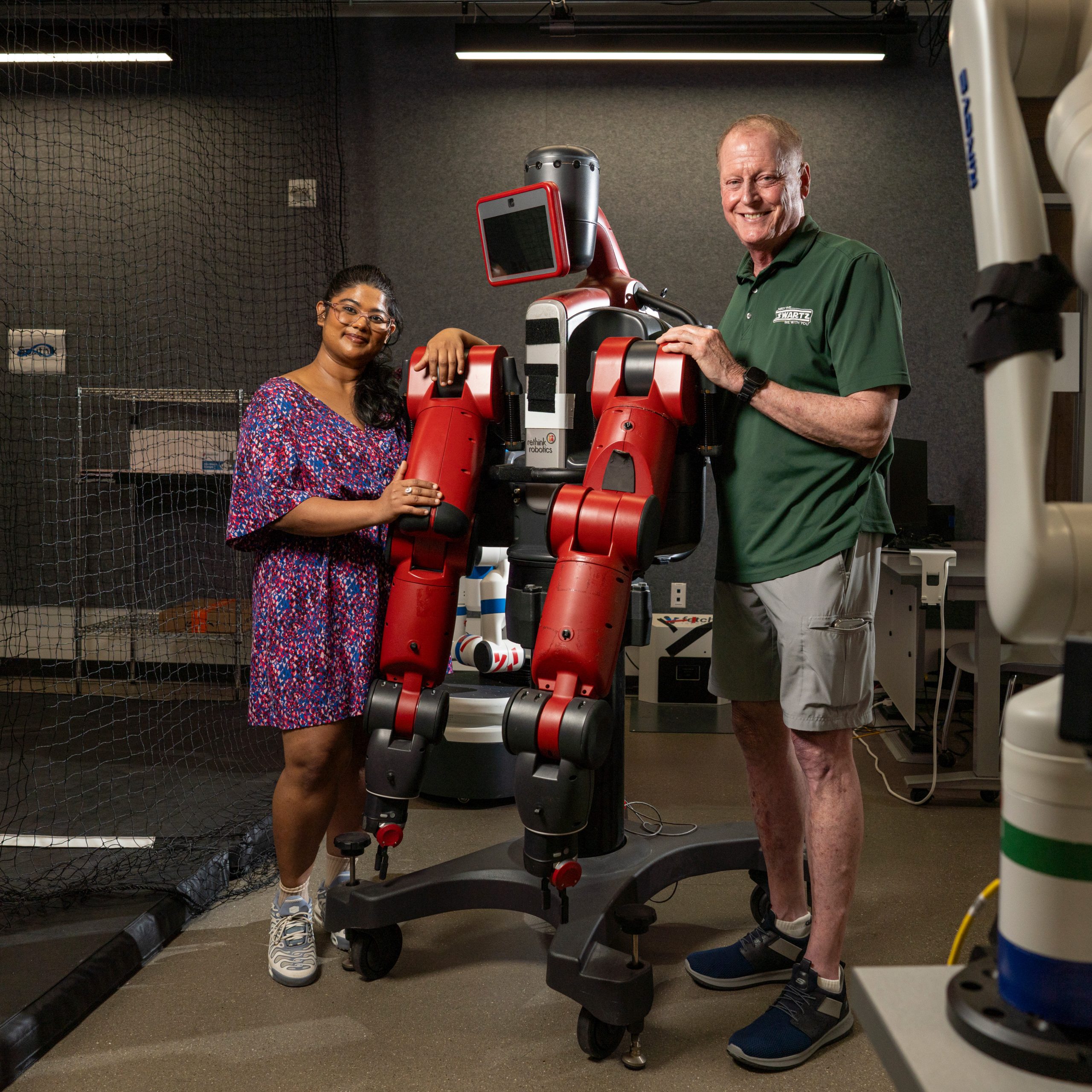
Dave Mawhinney, founding executive director of the Swartz Center for Entrepreneurship at Carnegie Mellon University, with Saisri Akondi, an international graduate and co-founder of the startup D.Sole. “There still is a part of the population that asks, ‘What are you doing here?’ ” says Akondi. Credit: Nancy Andrews for The Hechinger Report
It’s supply and demand, said Dave Mawhinney, a professor of entrepreneurship at Carnegie Mellon and founding executive director of its Swartz Center for Entrepreneurship, which helps many of that school’s students do research that can lead to products and startups. “And the demand for people with those skills exceeds the supply.”
That’s in part because comparatively few Americans are going into fields including science, technology, engineering and math. Even before the pandemic disrupted their educations, only 20 percent ofcollege-bound American high school students were prepared for college-level courses in these subjects. U.S. students scored lower in math than their counterparts in 21 of the 37 participating nations of the Organization for Economic Cooperation and Development on an international assessment test in 2022, the most recent year for which the outcomes are available.
One result is that international students make up more than a third of master’s and doctoral degree recipients in science and engineering at American universities. Two-thirds of U.S. university graduate students and more than half of workers in AI and AI-related fields are foreign born, according to Georgetown University’s Center for Security and Emerging Technology.
“A real point of strength, and a reason our robotics companies especially have been able to grow their head counts, is because of those non-native-born workers,” said Luther, in Pittsburgh. “Those companies are here specifically because of that talent.”
International students are more than just contributors to this city’s success in tech. “They have been drivers” of it, Mawhinney said, in his workspace overlooking the studio where the iconic children’s television program “Mister Rogers’ Neighborhood” was taped.
Jake Mohin, director of solution engineering at a company that uses AI to predict how chemicals will synthesize, uses a co-working space at InnovatePGH in Pittsburgh’s Innovation District. Credit: Nancy Andrews for The Hechinger Report
“Every year, 3,000 of the smartest people in the world come here, and a large proportion of those are international,” he said of Carnegie Mellon’s graduate students. “Some of them go into the research laboratories and work on new ideas, and some come having ideas already. You have fantastic students who are here to help you build your company or to be entrepreneurs themselves.”
Boosters of the city’s tech-driven turnaround say what’s been happening in Pittsburgh is largely unappreciated elsewhere. It followed the effective collapse of the steel industry in the 1980s, when unemployment hit 18 percent.
In 2006, Google opened a small office at Carnegie Mellon to take advantage of the faculty and student expertise in computer science and other fields there and at neighboring higher education institutions; the company later moved to a nearby former Nabisco factory and expanded its Pittsburgh workforce to 800 employees. Apple, software and AI giant SAP and other tech firms followed.
“It was the talent that brought them here, and so much of that talent is international,” said Audrey Russo, CEO of the Pittsburgh Technology Council.
Sixty-one percent of the master’s and doctoral students at Carnegie Mellon come from abroad, according to the university. So do 23 percent of those at Pitt, an analysis of federal data shows.
The city has become a world center for self-driving car technology. Uber opened an advanced research center here. The autonomous vehicle company Motional — a joint venture between Hyundai and the auto parts supplier Aptiv — moved in. So did the Ford- and Volkswagen-backed Argo AI, which eventually dissolved, but whose founders went on to create the Pittsburgh-based self-driving truck developer Stack AV. The Ford subsidiary Latitude AI and the autonomous flight company Near Earth Autonomy also are headquartered in Pittsburgh.
Among other tech firms with homes here: Duolingo, which has 830 employees and is worth an estimated $22 billion. It was co-founded by a professor at Carnegie Mellon and a graduate of the university who both came to the United States as international students, from Guatemala and Switzerland, respectively.
InnovatePGH tracks 654 startups that are smaller than those big conglomerates but together employ an estimated 25,000 workers. Unemployment in Pittsburgh (3.5 percent in April) is below the national average (3.9 percent). Now Pitt and others are developing Hazelwood Green, which includes a former steel mill that closed in 1999, into a new district housing life sciences, robotics and other technology companies.
In a series of webinars about starting businesses, offered jointly to students at Pitt and Carnegie Mellon, the most popular installment is about how to found a startup on a student visa, said Rhonda Schuldt, director of Pitt’s Big Idea Center, in a storefront on Forbes Avenue in the Innovation District.
One of the co-working spaces operated by InnovatePHG in the Pittsburgh Innovation District. Credit: Nancy Andrews for The Hechinger Report
Some international undergraduates continue into graduate school or take jobs with companies that sponsor them so they can keep working on their ideas, Schuldt said.
“They want to stay in Pittsburgh and build businesses here,” she said.
There are clear worries that this momentum could come to a halt if the supply of international students continues a slowdown that began even before the new Trump term, thanks to visa processing delays and competition from other countries.
The number of international graduate students dropped in the fall by 2 percent, before the presidential election, according to the Institute of International Education. Further declines are expected following the government’s pause on student visa interviews, publicity surrounding visa revocations and arrests and cuts to federal research funding.
Rhonda Schuldt, director of the Big Idea Center at the University of Pittsburgh. International students “want to stay in Pittsburgh and build businesses here,” Schuldt says. Credit: Nancy Andrews for The Hechinger Report
It’s too early to know what will happen this fall. But D. Sole co-founder Saisri Akondi has heard from friends who planned to come to the United States that they can’t get visas. “Most of these students wanted to start companies,” she said.
“I would be lying if I said nothing has changed,” said Akondi, who has been accepted into a master’s degree program in business administration at the Stanford University Graduate School of Business under her existing student visa, though she said her company will stay in Pittsburgh. “The fear has increased.”
This could affect whether tech companies continue to come to Pittsburgh, said Russo, at least unless and until more Americans are better prepared for and recruited into tech-related graduate programs. That’s something universities have not yet begun to do, since the unanticipated threat to their international students erupted only in March, and that would likely take years.
Audrey Russo, CEO of the Pittsburgh Technology Council. If the number of international students declines, “Who’s going to do the research? Who’s going to be in these teams?” she asks. Credit: Nancy Andrews for The Hechinger Report
“Who’s going to do the research? Who’s going to be in these teams?” asked Russo. “We’re hurting ourselves deeply.”
The impact could transcend the research and development ecosystem. “I think we’ll see almost immediate ramifications in Pittsburgh in terms of higher-skilled, higher-wage companies hiring here,” said Sean Luther, at InnovatePGH. “And that affects the grocery shops, the barbershops, the real estate.”
There are other, more nuanced impacts.
Mike Madden, left, vice president of InnovatePGH and director of the Pittsburgh Innovation District, talks with University of Pittsburgh graduate student Jayden Serenari in one of InnovatePGH’s co-working spaces. Credit: Nancy Andrews for The Hechinger Report
“Whether we like it or not, it’s a global world. It’s a global economy. The problems that these students want to solve are global problems,” Schuldt said. “And one of the things that is really important in solving the world’s problems is to have a robust mix of countries, of cultures — that opportunity to learn how others see the world. That is one of the most valuable things students tell us they get here.”
Pittsburgh is a prime example of a place whose economy is vulnerable to a decline in the number of international students, said Brookings’ Muro. But it’s not unique.
“These scholars become entrepreneurs. They’re adding to the U.S. economy new ideas and new companies,” he said. Without them, “the economy would be smaller. Research wouldn’t get done. Journal articles wouldn’t be written. Patents wouldn’t be filed. Fewer startups would occur.”
The United States, said Muro, “has cleaned up by being the absolute central place for this. The system has been incredibly beneficial to the United States. The hottest technologies are inordinately reliant on these excellent minds from around the world. And their being here is critical to American leadership.”
Contact writer Jon Marcus at 212-678-7556, [email protected]orjpm.82 on Signal.
The Hechinger Report provides in-depth, fact-based, unbiased reporting on education that is free to all readers. But that doesn’t mean it’s free to produce. Our work keeps educators and the public informed about pressing issues at schools and on campuses throughout the country. We tell the whole story, even when the details are inconvenient. Help us keep doing that.
Earlier this month, higher education policy leaders from all 50 states gathered in Minneapolis for the 2025 State Higher Education Executive Officers Higher Education Policy Conference. During a plenary session on the future of learning and work and its implications for higher education, Aneesh Raman, chief economic opportunity officer at LinkedIn, reflected on the growing need for people to be able to easily build and showcase their skills.
In response to this need, the avenues for learning have expanded, with high numbers of Americans now completing career-relevant training and skill-building through MOOCs, microcredentials and short-term certificates, as well as a growing number of students completing postsecondary coursework while in high school through dual enrollment.
The time for pontificating about the implications for higher education is past; what’s needed now is a pragmatic examination of our long-standing practices to ask, how do we evolve to keep up? We find it prudent and compelling to begin at the beginning—that is, with the learning-evaluation process (aka credit-evaluation process), as it stands to either help integrate more Americans into higher education or serve to push them out.
A 2024 survey of adult Americans conducted by Public Agenda for Sova and the Beyond Transfer Policy Advisory Board found, for example, that nearly four in 10 respondents attempted to transfer some type of credit toward a college credential. This included credit earned through traditional college enrollment and from nontraditional avenues, such as from trade/vocational school, from industry certification and from work or military experience. Of those who tried to transfer credit, 65 percent reported one or more negative experiences, including having to repeat prior courses, feeling limited in where they could enroll based on how their prior learning was counted and running out of financial aid when their prior learning was not counted. Worse, 16 percent gave up on earning a college credential altogether because the process of transferring credit was too difficult.
What if that process were drastically improved? The Council for Adult and Experiential Learning’s research on adult learners finds that 84 percent of likely enrollees and 55 percent of those less likely to enroll agree that the ability to receive credit for their work and life experience would have a strong influence on their college enrollment plans. Recognizing the untapped potential for both learners and institutions, we are working with a distinguished group of college and university leaders, accreditors, policy researchers and advocates who form the Learning Evaluation and Recognition for the Next Generation (LEARN) Commission to identify ways to improve learning mobility and promote credential completion.
With support from the American Association of Collegiate Registrars and Admissions Officers and Sova, the LEARN Commission has been analyzing the available research to better understand the limitations of and challenges within current learning evaluation approaches, finding that:
Learning-evaluation decision-making is a highly manual and time-intensive process that involves many campus professionals, including back-office staff such as registrars and transcript evaluators and academic personnel such as deans and faculty.
Across institutions, there is high variability in who performs reviews; what information and criteria are used in decision-making; how decisions are communicated, recorded and analyzed; and how long the process takes.
Along with this variability, most evaluation decisions are opaque, with little data used, criteria established or transparency baked in to help campus stakeholders understand how these decisions are working for learners.
While there have been substantial efforts to identify course equivalencies, develop articulation agreements and create frameworks for credit for prior learning to make learning evaluation more transparent and consistent, the data and technology infrastructure to support the work remain woefully underdeveloped. Without adequate data documenting date of assessment and aligned learning outcomes, credit for prior learning is often dismissed in the transfer process; for example, a 2024 survey by AACRAO found that 54 percent of its member institutions do not accept credit for prior learning awarded at a prior institution.
Qualitative research examining credit-evaluation processes across public two- and four-year institutions in California found that these factors create many pain points for learners. For one, students can experience unacceptable wait times—in some cases as long as 24 weeks—before receiving evaluation decisions. When decisions are not finalized prior to registration deadlines, students can end up in the wrong classes, take classes out of sequence or end up extending their time to graduation.
In addition to adverse impacts on students, MDRC research illuminates challenges that faculty and staff experience due to the highly manual nature of current processes. As colleges face dwindling dollars and real personnel capacity constraints, the status quo becomes unsustainable and untenable. Yet, we are hopeful that the thoughtful application of technology—including AI—can help slingshot institutions forward.
For example, institutions like Arizona State University and the City University of New York are leading the way in integrating technology to improve the student experience. The ASU Transfer Guide and CUNY’s Transfer Explorer democratize course equivalency information, “making it easy to see how course credits and prior learning experiences will transfer and count.” Further, researchers at UC Berkeley are studying how to leverage the plethora of data available—including course catalog descriptions, course articulation agreements and student enrollment data—to analyze existing course equivalencies and provide recommendations for additional courses that could be deemed equivalent. Such advances stand to reduce the staff burden for institutions while preserving academic quality.
While such solutions are not yet widely implemented, there is strong interest due to their high value proposition. A recent AACRAO survey on AI in credit mobility found that while just 15 percent of respondents report currently using AI for credit mobility, 94 percent of respondents acknowledge the technology’s potential to positively transform credit-evaluation processes. And just this year, a cohort of institutions across the country came together to pioneer new AI-enabled credit mobility technology under the AI Transfer and Articulation Infrastructure Network.
As the LEARN Commission continues to assess how institutions, systems of higher education and policymakers can improve learning evaluation, we believe that increased attention to improving course data and technology infrastructure is warranted and that a set of principles can guide a new approach to credit evaluation. Based on our emerging sense of the needs and opportunities in the field, we offer some guiding principles below:
Shift away from interrogating course minutiae to center learning outcomes in learning evaluation. Rather than fixating on factors like mode of instruction or grading basis, we must focus on the learning outcomes. To do so, we must improve course data in a number of ways, including adding learning outcomes to course syllabi and catalog descriptions and capturing existing equivalencies in databases where they can be easily referenced and applied.
Provide students with reliable, timely information on the degree applicability of their courses and prior learning, including a rationale when prior learning is not accepted or applied. Institutions can leverage available technology to automate existing articulation rules, recommend new equivalencies and generate timely evaluation reports for students. This can create more efficient advising workflows, empower learners with reliable information and refocus faculty time to other essential work (see No.3).
Use student outcomes data to improve the learning evaluation process. Right now, the default is that all prior learning is manually vetted against existing courses. But what if we shifted that focus to analyzing student outcomes data to understand whether students can be successful in subsequent learning if their credits are transferred and applied? In addition, institutions should regularly review course transfer, applicability and student success data at the department and institution level to identify areas for improvement—including in the design of curricular pathways, student supports and classroom pedagogy.
Overhaul how learning is transcripted and how transcripts are shared. We can shorten the time involved on the front end of credit-evaluation processes by shifting away from manual transcript review to machine-readable transcripts and electronic transcript transmittal. When accepting and applying prior learning—be it high school dual-enrollment credit, credit for prior learning or a course transferred from another institution—document that learning in the transcript as a course (or, as a competency for competency-based programs) to promote its future transferability.
Leverage available technology to help learners and workers make informed decisions to reach their end goals. In the realm of learning evaluation, this can be facilitated by integrating course data and equivalency systems with degree-modeling software to enable learners and advisers to identify the best path to a credential that minimizes the amount of learning that’s left on the table.
In these ways, we can redesign learning evaluation processes to accelerate students’ pathways and generate meaningful value in the changing landscape of learning and work. Through the LEARN Commission, we will continue to refine this vision and identify clear actionable steps. Stay tuned for the release of our full set of recommendations this fall and join the conversation at #BeyondTransfer.
Beth Doyle is chief of strategy at the Council for Adult and Experiential Learning and is a member of the LEARN Commission.
Carolyn Gentle-Genitty is the inaugural dean of Founder’s College at Butler University and is a member of the LEARN Commission.
Jamienne S. Studley is the immediate past president of the WASC Senior College and University Commission and is a member of the LEARN Commission.
By Pete Moss, Business Development Director at Ellucian.
‘Pouvez-vous s’il vous plaît me dire où se trouve la gare?’ – this is the extent that a colleague of mine can remember from his Introductory French module that he completed as part of a computing degree in the late 90s. That institution’s attempt at the time to embed flexibility and cross-curriculum choice to help students develop skills out of their discipline to help with employability. ‘It was easier to pass than the programming courses’ was the authentic feedback that my colleague gave in retrospect, but they did at least have the choice to expand their learning experience and gain some broader foundational skills. That institution, however, has long abandoned much of that flexibility, largely due to the apparent complexity of administration.
That is not to say that there are not fantastic examples of employability related skills initiatives across the sector, but the recent policy landscape (not least the Skills England Sector evidence on the growth and skills offer) and ever-present national growth agenda are now firmly putting the spotlight on the role of HE in this area. The if element of HE holding that key role in the skills agenda is widely held, but now the thorny problem of how must be addressed. Technology advancements, specifically AI, will play a contributory factor in how institutions can remove barriers that caused institutions to reduce flexibility in the past, but what of the wider considerations?
To explore this topic further I asked Ben Rodgers, an experienced academic registrar and AHEP consultant, for his views on the topic:
In today’s fast-moving global economy, the value of a university education is increasingly measured not just by academic achievement, but by the employability of graduates. Employers are no longer looking solely for degrees, they’re looking for skills: digital fluency, critical thinking, communication, and technical know-how that align with the needs of their industries. Meanwhile, universities are under pressure to demonstrate that their programmes deliver real-world value. The challenge is clear: how do we bridge the gap between what is taught and what is needed?
This is where technology can make a transformative difference. At the forefront of this change is a new wave of AI-powered innovation designed to bridge the gap between academic programmes and real-world skill demands. These emerging technologies can analyse curricula, extracting the skills embedded within them and mapping those against labour market data to identify areas of alignment and gaps.
Crucially, they work in both directions; institutions can see what skills a course develops, while students or employers can start with a desired competency like coding or digital marketing and trace back to the programmes that build those capabilities.
It is the kind of innovation that higher education has long needed. For too long, the link between the classroom and the workplace has been inconsistent or poorly articulated. Universities may know they are delivering valuable learning, but haven’t always had the means to evidence that value in terms that resonate with employers and prospective students. These technologies bring much-needed clarity, offering structured and data-informed ways to demonstrate how academic learning contributes directly to employment readiness.
A Game-Changer for the Lifelong Learning Entitlement (LLE)
This kind of technology becomes even more important as the UK rolls out the Lifelong Learning Entitlement (LLE). The LLE is set to reshape the educational landscape by allowing individuals to access student finance for short courses, modular learning and skills-based development over the course of their lives. This shift away from traditional three-year degrees opens new possibilities, but also new challenges.
How will learners know which modules to pick? How will they know what skills they need for the job they want or even the job they haven’t yet imagined? With the support of emerging AI-driven tools, learners can begin to reverse-engineer their career goals. Want to become a Data Scientist? These systems can help identify which combinations of modules across a university lead to that destination. Interested in project management? The technology can pinpoint where those skills are taught, and which courses offer them. It’s like having a careers advisor, curriculum guide, and labour market analyst all in one—offering personalised insights that connect educational choices with professional ambitions.
This sort of capability is vital if LLE is to be more than just a funding mechanism. It needs to be supported by intelligent infrastructure that empowers learners to make informed choices. Otherwise, there’s a risk that modular study becomes a confusing patchwork of disconnected learning.
Towards a Shared, Inter-University Skills Ecosystem
Now imagine if we took this even further. What if a skills platform were adopted not just by individual institutions but as a shared framework across regions or even nationally? In this model, students in Glasgow, Cardiff, Birmingham, or Belfast could see the skills they need for local job markets and be directed to the institutions offering them. This would create a more agile, responsive, and learner-centred education system. Universities wouldn’t just be competing with each other; they’d be collaborating to build a broader skills ecosystem.
The scale of opportunity here is significant and growing fast. Consider this: if every individual in the workforce has access to around £1,800 in personal development funding each year, the cumulative potential across a university’s learner base is vast. Multiply that by hundreds or thousands of learners, and you’re looking at a transformative funding stream that’s currently underutilised.
This is not just an opportunity for students, it’s a strategic imperative for institutions. By enabling individuals to build relevant, targeted skills, universities position themselves as essential engines of workforce development, driving economic resilience at local, regional, and national levels. It’s a win-win: empowered learners, future-ready graduates, and sustainable new revenue for the sector.
Of course, this requires a shift in thinking from institutional autonomy to inter-institutional alignment. But the benefits are compelling: more efficient use of public funding, stronger regional economies, and better outcomes for students.
Making Programme Design More Purposeful
Beyond helping students choose what to study, this technology also has the power to influence what universities choose to offer. If data consistently shows that a particular programme has little connection to current or emerging job markets, it is worth investigating. It does not mean the course should be cut. There may be academic or social reasons to preserve it, but it does mean the institution is equipped with the intelligence needed to make informed decisions.
It also invites a more purposeful approach to curriculum design. Are we including this module because it is pedagogically valuable, or because it’s always been there? Are we assessing this way because it builds a skill, or because it is the easiest to administer? When you can map outcomes to employment skills, these questions become easier to answer.
Moreover, it provides a compelling framework for conversations with students, parents, and policy-makers about the value of university education. It shows that we are listening to what the world needs and responding with academic rigour and strategic intent.
Global Potential, Local Application
The skills gap is not just a UK issue; it’s a global one. The World Economic Forum reports that nearly half of all workers (66 per cent) will need reskilling by 2030. Universities worldwide are grappling with how to stay relevant in an era of automation, AI and constant disruption. Emerging AI tools offer the potential for a globally shared skills taxonomy that could, with appropriate localisation, apply anywhere.
Conclusion
As universities continue to evolve, their role as engines of economic and social mobility becomes more important than ever. To fulfil that role, we must ensure that what we teach aligns with what the world needs. That does not mean turning every degree into job training, but it does mean being thoughtful, strategic, and transparent about the skills our programmes provide.
Emerging technologies offer an exciting glimpse into a more connected, skills-aware future. They empower students to take greater control of their learning, help universities refine and align their programmes and ensure that the promise of Higher Education translates into meaningful, real-world opportunities.
After all, education is a journey. It’s time the map caught up.
Atlanta, Georgia,(GLOBE NEWSWIRE) — Savvy Cyber Kids, a 501(c)(3) non-profit organization, appointed new members to the Board of Directors starting July, 1, 2025.
Joining the Board of Directors for Savvy Cyber Kids are James Azar, Anne-Marie Brockwell, Jason Cenamor, Nelson Soares, and Dr. Jasyn Voshell.
Savvy Cyber Kids enables youth, families and school communities empowerment through technology by providing age-appropriate cyber safety, cyber ethics and digital parenting resources and education starting at three years old.
———-
“As a father, cybersecurity practitioner, and advocate for creating a safer digital environment for all children, I was compelled to join the board of Savvy Cyber Kids,” states James Azar, CISO and Host, CyberHub Podcast. “The organization’s mission, under the leadership of Ben Halpert, deeply resonates with me. Promoting responsible internet use begins at home, and Savvy Cyber Kids equips parents with the guidance and talking points they need to raise digitally aware and cyber-safe children.”
James Azar is a dedicated cybersecurity practitioner and CISO in industries like FinTech, Banking, Energy and Oil and Gas with over 20 years of experience. He has a passion for aligning security and business goals, believing that innovation and creative thinking are key to solving today’s security challenges. As the host of the CyberHub Podcast, James enjoys sharing insights and fostering conversations around cybersecurity, technology, and business. He’s had the privilege of speaking at industry-leading events like RSA and CyberTech Israel and contributing to well-known publications. When not immersed in security, James enjoys espresso, good food, and a fine whiskey.
———-
“I’m thrilled to join the board of Savvy Cyber Kids, where I can further my commitment to empowering families, educators, and students with the knowledge to navigate the digital world safely and responsibly,” states Anne-Marie Brockwell, Account Executive, Microsoft. “Through my advocacy for proactive digital learning and community engagement, I aim to expand awareness and foster a more inclusive, ethical online future. I look forward to using my network to amplify this vital mission.”
Anne-Marie Brockwell is a seasoned Account Executive and strategic education leader with a deep commitment to empowering learners and advancing digital citizenship. At Microsoft, she leads partnerships with premier higher education institutions across New England, helping them accelerate AI innovation, modernize infrastructure, transform data strategies, and strengthen cybersecurity postures—all in service of their ultimate stakeholders: the students. With over a decade of experience spanning education technology and enterprise sectors, Anne-Marie brings a global, cross-industry perspective shaped by leadership roles at Rosetta Stone, Sanofi/Genzyme, Imagine Learning, and Deloitte. Her career has consistently focused on consulting selling, strategic partnerships, and operational excellence, underpinned by a passion for equity, access, and innovation in education.
———-
“As technology becomes increasingly more prominent in our everyday lives, so does the need for increased education around cybersecurity,” states Jason Cenamor, Founder, Confide Group and The CISO Society. “Like all important things, cybersecurity education starts at the grassroots, and organizations like Savvy Cyber Kids will ensure cyber safety becomes as natural as looking both ways before you cross the road. Witnessing so many people fall victim to bad actors every day, I could not be more passionate about ensuring the next generation is prepared to navigate the new world equipped with the knowledge and tools to avoid the same fate.”
Jason is the Founder and CEO of Confide Group – a cybersecurity advisory firm, and the Founder and Chief Community Officer of The CISO Society – a private community where members collaborate and share expertise on security strategy, project roadmaps, technology partners, CISO jobs, talent acquisition, industry news, and more. As a community figurehead and advocate, Jason possesses a passion for relationship building, networking, events, and providing an environment for security leaders to connect and learn from one another.
———-
“As a father, cybersecurity advocate, and entrepreneur passionate about digital education, I’m honored to join the Board of Directors at Savvy Cyber Kids,” states Nelson Soares, Founder & CEO, C-Vision International and CEO, NS Advisory Group Inc. “Today’s children are growing up in a world shaped by rapid technological change—one that demands both awareness and resilience. I’ve spent my career helping organizations navigate innovation responsibly, and I believe there’s no greater mission than empowering our youth to do the same. I look forward to contributing to this critical cause and supporting Savvy Cyber Kids in building a safer digital future for families everywhere.”
Nelson Soares is a dynamic entrepreneur and executive with deep expertise in leadership, consulting, and go-to-market strategy. As the Founder & CEO of C-Vision International, he has played a pivotal role in producing global thought leadership experiences for C-suite executives. He is also the CEO of NS Advisory Group Inc., where he advises startups and enterprise technology providers on scale, sales, and strategic growth. Nelson’s work bridges innovation and executive influence, particularly in cybersecurity and enterprise software, and his network spans the U.S., EMEA, LATAM, and APAC. He also serves on the board of Pocket Security, a nonprofit. A proud husband and father of two daughters, Nelson brings a personal and professional commitment to helping the next generation thrive in the digital age.
———-
“I’ve had the privilege of knowing and working with Ben Halpert for over 20 years, including some of his earliest projects in cybersecurity education,” states Dr. Jasyn Voshell, Senior Director, Products and Solutions Security, Zebra Technologies. “Joining the Savvy Cyber Kids Board is especially meaningful to me as an uncle to nieces and nephews who are growing up in a world where digital technology is ever-present. Being part of an organization that empowers families to navigate the online world safely and confidently is both a personal passion and professional commitment I hold close to my heart.”
Dr. Jasyn Voshell is the Senior Director of Products and Solutions Security at Zebra Technologies, where he leads the global Product & Solutions Security Program. He is responsible for the strategy, planning, and execution of Zebra’s enterprise-wide security initiatives across all products and solutions. Jasyn works closely with engineering and business teams to ensure security is embedded throughout the product lifecycle—secure by design, secure in use, and secure through trust. Jasyn was instrumental in establishing the Product Security Organization at Zebra, significantly reducing risk exposure while reinforcing customer trust in Zebra’s solutions. Under his leadership, the organization has delivered measurable improvements in secure software development practices, vulnerability management, and risk governance across the product portfolio. He holds bachelor’s degrees in Mathematics and Physics, a master’s degree in Applied Mathematics and Computer Information Systems, and a doctorate in Civil Law and Cybersecurity. Jasyn also maintains numerous industry-recognized certifications in cybersecurity and audit.
———-
“Our children are frontline warriors pitted against threats delivered by today’s latest technology they can’t even comprehend,” states Ben Halpert, Founder, Savvy Cyber Kids. “Parents and schools unwittingly place the children they are responsible for up against harms they are not equipped to triumph over in their daily battles, both physically and mentally.”
Making meaningful, long term, generational change for the world’s most vulnerable population which is young children, takes dedication. “In today’s reality of youth sextortion related suicide, AI suicide encouragement, 24/7 cyberbullying, and the realization of harms against our children delivered through technology, educating young children starting at age three is paramount,” said Ben Halpert.
“Most people want to believe quick fixes will work; when it comes to shaping human behaviors to build individual resilience, that is not the case. Our dedicated team looks forward to expanding our reach for the benefit of the world’s children,” said Ben Halpert.
Savvy Cyber Kids is grateful for the ongoing support of its sponsors: CISO Horizon, C-Vision International, VIPRE Security Group, PWC US, Yass Partners, Jodi Fink Halpert Berkshire Hathaway HomeServices Georgia Properties, Vercel,and SecurityScorecard.
About Savvy Cyber Kids
Savvy Cyber Kids (SCK), a 501(c)(3) nonprofit organization whose mission is to enable youth, families, and school communities to be empowered by technology, recognizes that children may be Digital Natives but are also “Digital Naives”, who, without intervention, completely lack understanding of the implications of their digital actions. Founded in 2007 by noted speaker and author Ben Halpert, Savvy Cyber Kids resources are used in 50 states and 54 countries around the world to help parents and teachers educate today’s youth on cyber safety and cyber ethics topics of cyberbullying, digital reputation, technology and screen-time balance, mental health, body and self-image, physical safety, sexting, privacy, gaming, child sexual predators, and more starting at 3 years old.
eSchool Media staff cover education technology in all its aspects–from legislation and litigation, to best practices, to lessons learned and new products. First published in March of 1998 as a monthly print and digital newspaper, eSchool Media provides the news and information necessary to help K-20 decision-makers successfully use technology and innovation to transform schools and colleges and achieve their educational goals.