
Tag: Universities

  • First-year student diversity in American colleges and universities, 2018-2022

    First-year student diversity in American colleges and universities, 2018-2022

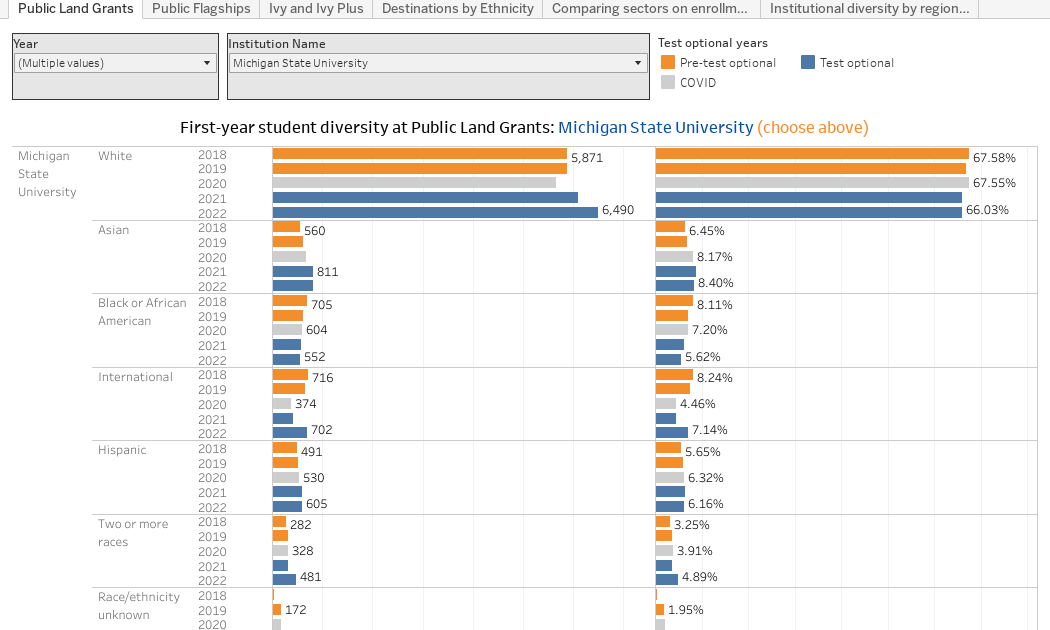
    I started this visualization to show how first-year classes at the highly rejective colleges had changed since COVID-19 forced them all to go to a test-optional approach for the Fall of 2021.  But it sort of took on a life of its own after that, as big, beefy data sets often do.

    The original point was to help discount the conventional wisdom, which is propped up by a limited, old study of a small set of colleges that showed test-optional policies didn’t affect diversity.  I did this post last year, after just one year of data made it fairly clear they did at the institutions that had the luxury of selecting and shaping their class. 

    This year I took it a little farther.  The views, using the tabs across the top, show the same trends (now going to 2022) for Public Land Grants, Public Flagships, the Ivy and Ivy+ Institutions.  In each case, choose one using the control.

    Note that I had colored the years by national trends: 2018 and 2019 are pre-test optional, gray is COVID, and blue is post-test optional.  This is not to say that any individual college selected either required tests or went test-optional in those years, but rather shows the national trend.  And remember these show enrolling students, not admitted students, which is why gray is critical; we know COVID changed a lot of plans, and thus 2020 may be an anomalous year. 

    The fourth view shows where students of any selected ethnicity enroll (again, use the dropdown box at the top to make a selection); the fifth view breaks out ethnicity by sector; and the final view allows you to look at diversity by sector and region (to avoid comparing diversity in Idaho, California, and Mississippi, for instance, three states with very different racial and ethnic makeups.)

    On all views, hovering over a data point explains what you’re seeing.

    If you work at a college or university, or for a private company that uses this data in your work, and want to support my time and effort, as well as software and web hosting costs, you can do that by buying me a coffee, here. Note that I won’t accept contributions from students, parents, or high school counselors, or from any company that wants to do business with my employer.

    And, as always, let me know what jumps out at you here. 
    Source link

  • Tuition and Fees at Flagship and Land Grant Universities over time

    Tuition and Fees at Flagship and Land Grant Universities over time

    If you believe you can extract strategy from prior activities, I have something for you to try to make sense of here.  This is a long compilation of tuition and fees at America’s Flagship and Land Grant institutions.  If you are not quite sure about the distinction between those two types of institutions, you might want to read this first.  TLDR: Land Grants were created by an act of congress, and for this purpose, flagships are whoever I say they are.  There doesn’t seem to be a clear definition.  

    Further, for this visualization, I’ve only selected the first group of Land Grants, funded by the Morrill Act of 1862.  They tend to be the arch rival of the Flagship, unless, of course, they’re the same institution.

    Anyway, today I’m looking at tuition, something you’d think would be pretty simple.  But there are at least four ways to measure this: Tuition, of course, but also tuition and required fees, and both are different for residents and nonresidents.  Additionally, you can use those variables to create all sorts of interesting variables, like the gap between residents and nonresidents, the ratio of that gap to resident tuition, or even several ways to look at the role “required fees” change the tuition equation.  All would be–in a perfect world–driven by strategy.  I’m not sure I’d agree that such is the case.

    Take a look and see if you agree.

    There are five views here, each getting a little more complex.  I know people are afraid to interact with these visualizations, but I promise you can’t break anything.  So click away.

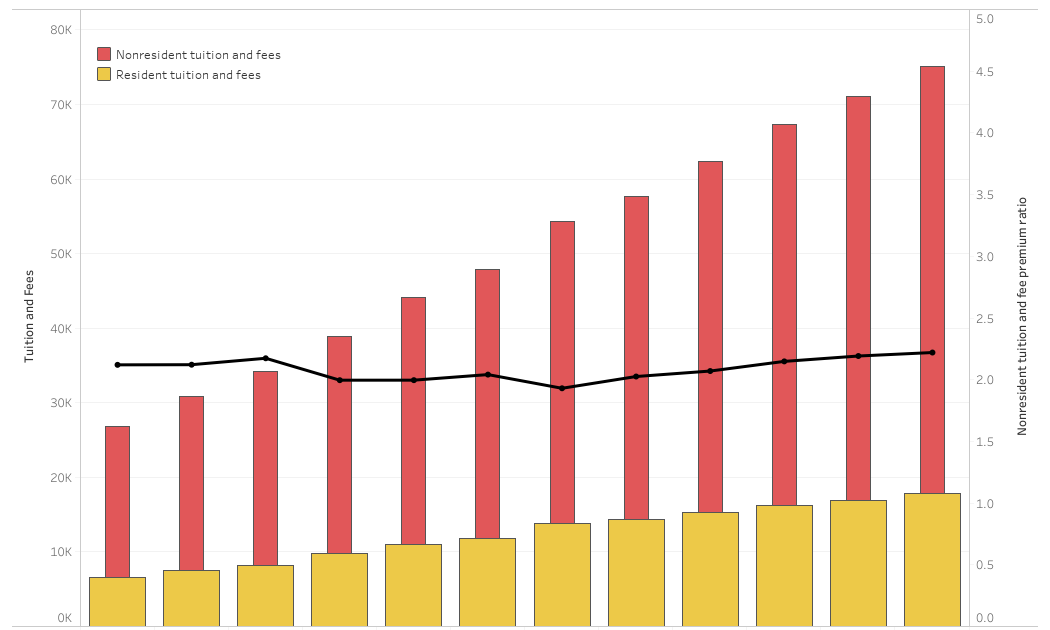
    The first view (using the tabs across the top) compares state resident full-time, first-time, undergraduate tuition and required fees (yellow) to those for nonresidents (red bar). The black line shows the gap ratio.  For instance, if resident tuition is $10,000 and nonresident tuition is $30,000, the gap is $20,000, and that is 2x the resident rate.  The view defaults to the University of Michigan, but don’t cheat yourself: Us the filter at top left to pick any other school. If you’ve read this blog before, you know why Penn State is showing strange data.  It’s not you, it’s IPEDS, so don’t ask.)

    The second tab shows four data points explicitly, and more implicitly.  This view starts with the University of Montana, but the control lets you change that.  On top is resident tuition (purple) and resident tuition and fees (yellow). Notice how the gap between the two varies, suggesting the role of fees in the total cost of attendance.  The bottom shows those figures for nonresidents.

    The third view looks a little crazy. Choose a value to display at top left, and the visualization will rank all 77 institutions from highest to lowest.  Use the control at top right to highlight an institution to put it in a national context.  Hover over the dots for details in a popup box.  If you want to look at a smaller set of institutions, you can do that, too, using the filters right above the chart.  The fourth view is the exact same, but shows the actual values, rather than the rank.  As always, hover for details.

    Finally, the fifth view is a custom scatter plot: Choose the variable you want on the x-axis and the variable to plot it against on the y-axis.  Then use the filters to limit the included institutions. As always, let me know what you find that’s interesting.

    Source link