This blog was kindly authored by Professor Annabel Kiernan, Deputy Vice-Chancellor for Education and Student Experience at Goldsmiths University. It follows her speech at a HEPI event with the same title as this blog, held at the 2025 Conservative Party Conference.
To accept this question at its face and to understand what universities can and should do to build back public support, we need to look at how we got here. In broad terms, universities are not the only institutions whose role, purpose and efficacy are being challenged. There has been a wider breakdown of trust between the public and a wide range of local and national infrastructure, both public and private – from water and train companies, to the courts and local government.
In part, this is the inevitable consequence of two periods of significant financial stress – firstly from the 2008 financial crash and its resulting ten-year austerity programme, followed swiftly by the post-COVID cost-of-living crisis. The economic bite for the personal and public purse and the knock-on impact of such economic dislocation has been a considerable shrinking of the wider public realm and a gnawing away at the previous slowly progressive move towards a more ‘bread and roses’ type of social compact for all: of needing the fundamentals of life (bread), but also making available what brings beauty, culture and wellbeing (roses) to wider society, irrespective of economic circumstance. The shrinking of the public realm has pushed back this access to public goods.
Many education institutions, including universities, have attempted to be a buttress for this impact – whether that’s filling in social, behavioural, skills and knowledge gaps from lost learning, responding to increased mental health pressures, trying to mitigate, where possible, the impacts of poverty and other generalised impacts of closures of youth centres, libraries, museums and so on.
Clearly then, universities play a key role in delivering progress to individuals and the broader public. They are core to economic and social growth, delivering these while managing the public’s varied aspirations and differing expectations. The expansion of higher education was sought to widen the benefits of a university education and experience. Even before the Blair expansion in the 2000s, my own family – my mum, the eldest of six, with a miner and a housewife as parents – were beneficiaries, with all six children going to university during the 1970s and 1980s. Despite both leaving school at 14, my grandparents knew that university was the route to a different life. It paid off for all six brothers and sisters, and here I am today, the eldest grandchild of that mobility, a Deputy Vice Chancellor contributing a HEPI blog on public trust in universities.
But, whilst the cost of university entry has now significantly increased, the mobility pay off, or graduate premium, appears more challenged. This is despite the OECD’s Education at a Glance 2025 report showing that, over the course of a lifetime, attending university still delivers financially. In times of heightened economic stress, however, the public needs more immediacy in the financial payoff and surety in the belief that infrastructure delivers a high-quality service. We can see the political articulation of the need to see, feel and believe things work and have tangible benefits for individuals, their families and communities now. People’s sacrifices need to matter, and their investment needs to pay off.
So what do universities do to play their part?
As a sector, we work very hard on our civic role, but we need to be more porous. We can’t be seen to effectively privatise public space. We need to be of our places, and lead the charge on building solutions and helping people to navigate change – from how we work with local communities to how we contribute to global challenges. In other words, we need to reemphasise our role in sustaining the social, cultural and intellectual infrastructure of society,
To support that civic role, we need to offer more seamless education journeys and be accessible for learners throughout their lifetime. That means accelerating the ways in which we work in partnership with each other, with colleges, schools, employers and local authorities. Lifelong education is a philosophy, not just a government policy. The Lifelong Learning Entitlement needs to align with a wide range of policies. For example, now that ‘skills’ is situated with the Department for Work and Pensions, what harm in referring people to a bit of modular learning to get their employment on track rather than piecemeal training or benefit sanctions? Universities are a public infrastructure, so we need to connect well with other infrastructure to deliver our part of the ecosystem for individual and collective economic and social gains.
We must remain intentional, be high quality, deliver an excellent experience. There should continue to be robust regulation of bad actors. We should deliver success for all our students and we shouldn’t be a homogeneous model; learners take different pathways through higher learning and need to access it in different ways, through different modes and will have different needs for flexibility. There are specialisms and expertise in research and teaching, and these should remain available as choices. There has been much written about the detrimental impact of out-of-town shopping centres on our high streets. Similarly, if all universities have to deliver at scale for efficiencies, the impact of closures on the towns and cities of smaller, more specialist institutions would be devastating.
At this moment, we need to emphasise our value in relation to the individual economic benefit gained from the investment of a student loan. In other words, highly paid graduate employment. I’m not sure how potent the arguments for the collective economic benefit of universities currently are. Personal storytelling of meaningful impacts, like that of my own family, may have traction in our university locales.
Overall, we need to continue to deliver and continue to engage. We work hard in these spaces already, but we need to tell our story differently and continue to adapt our model.
Importantly, universities have a central part to play in delivering space for reflection, intellectual enquiry, creative and critical action and solutions which will help to navigate us, the public, through these significant and challenging periods of rapid economic, political and technological transition.
As Oppenheim wrote in his 1911 poem:
Hearts starve as well as bodies: Give us Bread, but give us Roses.
What better challenge for universities to continue to rise to.
In a year already defined by polarization and violence, the assassination of Charlie Kirk at Utah Valley University plunged higher education into crisis. The killing of one of the nation’s most prominent conservative activists on a college campus has been weaponized by political factions, prompting administrative crackdowns and faculty firings. What were once familiar battles in the campus culture wars have escalated into something more dangerous: a struggle over the very conditions of inquiry, where violence, scandal and political pressure converge to erode academic freedom. And now, a proposed “compact” with higher education institutions would seek to condition federal funding on requirements that colleges ensure a “broad spectrum of viewpoints” in each academic department and that they abolish “institutional units that purposefully punish, belittle, and even spark violence against conservative ideas.”
At the center of this struggle lies a persistent illusion: that the university should provide a platform for “every perspective.” Critics claim campuses suppress conservative voices or silence dissenting students, arguing institutions should resemble open marketplaces where all viewpoints compete for attention. Enticing as this rhetoric may be, the expectation is both unworkable and misguided. No university can present every possible outlook in equal measure, nor should it. The mission of higher education is more demanding: to cultivate, critique and transmit knowledge while attending to perspectives that have shaped history and public life. The contrast between an endless marketplace of opinion and the rigorous pursuit of knowledge is crucial to understanding what universities are for.
Karl Mannheim once distinguished between ideology and knowledge, cautioning against their uncritical conflation. That warning remains essential. Universities are not platforms for unchecked ideology but institutions dedicated to showing how knowledge emerges through observation, interpretation, critique and debate. Perspectives matter, but exposure alone is insufficient; they must be contextualized and weighed against evidence. Free speech and academic freedom overlap but are not the same. Free speech protects individuals from state repression in public life. Academic freedom protects scholars in their pursuit of inquiry and ensures students gain the tools to test claims critically. The distinction is central: The university has an obligation not to amplify all voices equally, but to cultivate discernment.
This does not mean shielding students from offensive or discredited ideas. On the contrary, a serious education requires grappling with perspectives that once commanded influence, however abhorrent they may now appear. Students of American history must study the intellectual justifications once advanced for slavery—not because they deserve validation, but because they shaped institutions and legacies that continue to structure society. Students of religious history should encounter theological controversies that once divided communities, whether or not they resonate today, because they explain enduring traditions and conflicts. To include such perspectives is not to offer them equal standing with contemporary knowledge, but to illuminate their historical weight and consequences.
Confusing exposure with endorsement—or opinion with knowledge—risks leaving students adrift in noise. Universities are not megaphones for any thesis but arenas where students learn how to evaluate sources, test claims and trace the consequences of ideas over time. Academic freedom does not mean a free-for-all. Instead, it allows scholars to curate, critique and contextualize knowledge—including ideas that are controversial, even offensive or (as in the study of slavery or fascism) historically consequential. Education that multiplies opinions without cultivating methods of judgment undermines critical capacity; education that fosters discernment equips students to enter public debates wisely and responsibly.
Recent events in higher education reveal how fragile these principles have become. Violence itself intimidates expression, but administrative and political overreaction magnifies the threat. Faculty have been disciplined for social media posts. In Texas, a lecturer was dismissed for teaching about gender identity. In California, University of California, Berkeley administrators released to federal authorities the identities of more than a hundred students and faculty whose names appeared (as accused, accuser or affected party) in complaints about antisemitism. Faculty watch colleagues punished unjustly, while students—especially international and marginalized ones—face surveillance and potential charges. Across the country, dissent is mistaken for hate, controversial speech treated as threat and scandal avoidance prioritized over defending expressive rights.
Academic freedom has long enjoyed special constitutional protection, granting professors wide latitude in teaching and research. But this protection depends on public trust: the sense that higher education fosters critical inquiry rather than partisan indoctrination. When professors behave as ideologues or exercise poor judgment in public, that trust erodes. Yet the greater danger comes not from individual missteps but from capitulating to the demand that every perspective deserves equal standing—or from letting violence and political pressure set the boundaries of what may be said. Higher education should not resemble a bazaar of endless opinion but a community dedicated to the disciplined creation, transmission and critique of knowledge. By training students not to hear every voice equally but to weigh evidence and evaluate claims, universities preserve both their scholarly mission and their democratic role. Institutions that cave to intimidation, or that mistake neutrality for abdication, abandon their responsibility to defend inquiry.
Equally important, universities serve as legitimating institutions. To place a perspective within their walls signals that it merits serious study, that it has crossed the threshold from private belief to public knowledge. This conferral of legitimacy makes curatorial responsibility critical. Treating perspectives as interchangeable voices distorts the university’s purpose, but so does admitting or excluding them solely under political pressure. Both compromises undermine credibility. External actors understand this and exploit universities’ legitimating authority, pressing institutions to provide platforms that elevate discredited or dangerous views into claims of scholarly validation. The responsibility of the university is not to magnify every claim in equal volume but to steward the line between ideas worth engaging and those demanding correction or refusal. Only in this way can institutions preserve their academic mission and their democratic contribution.
The way forward is neither unbounded opinion nor fearful silence. It is the principled defense of creating, critiquing and reimagining knowledge through inquiry guided by evidence and protected from violence and censorship. To retreat from this responsibility is to weaken not only higher education but democracy itself.
Gerardo Martí is the William R. Kenan Jr. Professor of Sociology at Davidson College.
Fourteen of the new MacArthur fellows announced Wednesday are associated with universities.
ilbusca/DigitalVision Vectors/Getty Images
Numerous academics are part of the 2025 class of MacArthur Foundation fellows announced Wednesday. This year, the foundation selected a slate of 22 “extraordinarily creative individuals” to receive the “genius award.” Each recipient will get $800,000—no-strings attached—over the next five years to “foster and enable innovative, imaginative, and ground-breaking ideas, thinking, and strategies.”
Since the fellowship launched in 1981, fellows have included writers, scientists, artists, social scientists, humanists, teachers and entrepreneurs. While no institutional affiliation is required, the award went to the following 2025 fellows with ties to a college or university:
Atmospheric scientist Ángel F. Adames Corraliza, an associate professor in the Atmospheric and Oceanic Sciences Department at the University of Wisconsin at Madison, for investigating the mechanisms underlying tropical weather patterns.
Epidemiologist Nabarun Dasgupta, director of the Opioid Data Lab at the University of North Carolina’s Injury Prevention Research Center, for advocating for harm reduction and creating practical programs to mitigate harms from drug use, particularly opioid overdose deaths.
Archaeologist Kristina Douglass, associate professor of climate at Columbia University, for investigating how human societies and environments co-evolved and adapted to climate variability.
Astrophysicist Kareem El-Badry, assistant professor of astronomy at the California Institute of Technology, for leveraging astronomical data sets and theoretical modeling to investigate binary star systems, black holes, neutron stars and other stellar bodies.
Political scientist Hahrie Han, the Stavros Niarchos Foundation Professor in the political science department at Johns Hopkins University, for employing a range of ethnographic, sociological, experimental and quantitative methods to examine organizational structures and tactics that encourage individuals to interact across lines of difference and work together for change in the public sphere.
Cultural anthropologist Ieva Jusionyte, the Watson Family University Professor of International Security and Anthropology at Brown University, for exploring the political and moral ambiguities of border regions, where state policies regulate historically shifting distinctions between legal and illegal practices.
Evolutionary biologist Toby Kiers, research chair and professor in the Ecology and Evolution Department at Vrije Universiteit in Amsterdam, for illuminating the evolutionary mechanisms underlying cooperation between species and the role of plant-microbe mutualisms in ecosystem health.
Structural biologist Jason McLellan, professor and Robert A. Welch Chair in Chemistry in the Department of Molecular Biosciences at the University of Texas at Austin, for investigating virus fusion proteins and developing new interventions to prevent infectious diseases.
Fiction writer Tommy Orange, faculty mentor in the creative writing program at the Institute of American Indian Arts, for capturing a diverse range of Native American experiences and lives in novels that traverse time, space and narrative perspectives.
Nuclear security specialist Sébastien Philippe, assistant professor in the Nuclear Engineering and Engineering Physics Department at the University of Wisconsin at Madison, for exposing past harms and potential future risks from building, testing and storing launch-ready nuclear weapons.
Interdisciplinary artist Gala Porras-Kim, visiting critic in sculpture at the Yale School of Art, for proposing new ways to make visible the layered meanings and functions of cultural artifacts held in museums and institutional collections.
Neurobiologist and optometrist Teresa Puthussery, associate professor in the Herbert Wertheim School of Optometry and Vision Science at the University of California, Berkeley, for exploring how neural circuits of the retina encode visual information for the primate brain.
Chemical engineer William Tarpeh, assistant professor in the Department of Chemical Engineering at Stanford University, for developing sustainable and practical methods to recover valuable chemical resources from wastewater.
Mathematician Lauren K. Williams, the Dwight Parker Robinson Professor of Mathematics at Harvard University, for elucidating unexpected connections between algebraic combinatorics and concepts in other areas of math and physics.
This guest blog was kindly authored by Vincenzo Raimo, an independent international higher education consultant
The UK government’s proposed 6 per cent levy on international tuition fees has added yet another layer of complexity to the already fragile international student recruitment landscape. The levy is intended to fund the introduction of targeted maintenance grants for home students, but for universities it represents an additional cost that could reshape recruitment strategies and, in some cases, make international activity unviable.
Higher education providers will not all respond in the same way. Their choices will be shaped by their position in the market, their pricing power, and their cost of acquisition (CoA) – the real cost of recruiting through to enrolment of each international student.
In a previous blog I set out five institutional archetypes in international student recruitment: Prestige Players, Volume Hunters, Strategists, Opportunists, and Outsourcers. These archetypes can help us think through the likely responses to the levy, and where the risks and opportunities lie.
Levy Responses: From Resilience to Retreat
Pass-throughs (High Brand, Low CoA): These are the strong Prestige Player institutions with the brand power to raise fees by 6 per cent (or more) without losing applicants. For them, the levy will likely be passed straight on to students. In fact, some may look back and wonder why they had not already increased fees earlier. The impact on recruitment will be minimal.
Squeezed Prestige (High Brand, High CoA): Some universities occupy a less comfortable position. They may have strong brands, but their recruitment costs are high often due to heavy scholarship spending and dependence on expensive marketing and recruitment strategies. They can pass on some of the levy, but margins will erode. Expect this group to look carefully at their agent portfolios, renegotiate commission deals, and cut back on scholarships. Opportunists often sit here, swinging between good years and bad.
Absorbers (Low Brand, Low CoA): A number of institutions will choose to absorb the levy, keeping international fees flat to remain competitive. Margins will tighten, but recruitment volumes are likely to remain stable. These are often Strategists or Outsourcers, who have already kept their CoA under control through efficiency or partnerships. They will see absorbing the levy as a necessary cost of staying in the game.
Exits (Low Brand, High CoA): For some, the levy may be the final straw. Institutions already dependent on discounting and agent commissions who charge low international fees to chase volume, may no longer see international recruitment as viable. Volume Hunters are the most exposed here. Their models are built on fragile margins, and the levy risks pushing them into unsustainable territory. For some, exit will not mean giving up on international students altogether. But it may mean dramatically scaling back, consolidating markets, and retreating from high-risk geographies.
Alternative Paths
Alongside these responses, two further groups are worth highlighting.
Innovators: Some universities will take the levy as a trigger to rethink their model entirely. Expect more to explore transnational education, offshore hubs, or pathway partnerships as a way of diversifying income and reducing exposure to UK-based fee inflation. Innovation may prove the most sustainable long-term response, if vice-chancellors and governing bodies have the stomach for it.
Niche/Selective Recruiters: For specialist institutions – arts, theology, agriculture, or mission-driven providers – international student recruitment has never been about volume. For them, the levy is simply the cost of doing business. They will continue to recruit selectively, valuing diversity and global presence more than surplus.
What Does This Mean for the Sector?
The archetype framework helps us see that there is no single sector response. Institutions will react in line with their pricing power, cost base, and strategic orientation. Prestige Players may pass through the levy with little concern. Absorbers will hold their nerve and tighten margins. Volume Hunters, by contrast, risk being forced out of the game altogether.
For these institutions, scaling back international recruitment will not just be a strategic shift but a financial shock. The loss of international fee income raises an uncomfortable question of how they will fill the gap – whether by yet more cost cutting, chasing riskier sources of income, or considering more fundamental changes to their operating models.
The levy therefore brings the deeper issue into sharp focus: the sustainability of international student recruitment. Chasing volume is no longer enough. Institutions must use this moment to confront the costs of recruiting and support these students, rethink pricing, and reconsider the value they offer. Those that do so will be far better placed to build resilient, sustainable futures in international education.
For the past twelve months, the National Coordinating Centre for Public Engagement has been leading a project to reimagine the future of the engaged university: Engaged Futures. It’s been a rollercoaster ride, taking in everything from the baked-in prejudices of our sector, to debating the very purpose of higher education.
And it feels that this is the right time to ask that question, as universities seek to change, diversify, remodel and restructure. What is the purpose at the heart of our universities? Is it the same regardless of type, or size, or age of institution? Is it something set in stone at inception, or can it be remoulded by leadership teams?
And crucially, is it fit for purpose?
As a sector we have always talked a good game about being integral to the success of our region, whether we call this place-based, civic or “locally-rooted”, or are badged as an “anchor institution”. Show me a university that hasn’t made this claim.
I would argue that this is the very purpose of the university. Universities should be rooted in their region; responsive and reactive, open and honest; curators of conversations and collaborations; compassionate nurturers; apolitical agents of change.
Cohesion with place
But there is evidence that this work is taking a back seat as the sector grapples with financial challenge and looks for new ways to operate. The National Civic Impact Accelerator report on the “fragile foundations of civic” shone a light on the quiet diminishing of the civic commitment, with work moving under the umbrella of public affairs, or innovation, or marketing. And civic university agreements left on the shelf for later.
It remains to be seen if transformative measures such as mergers, the creations of super universities, takeovers by private providers and (hopefully not) provider closures, take universities further away from this work.
At the Labour party conference, the phrase of the moment was “social cohesion”. Politicians are talking about how to rebuild civic pride – in fact, they are actively directing funds to this. But there is no mention of the role of universities in delivering this type of social impact, despite all the fanfare of the civic movement.
So in this space, let’s consider an alternative transformational model: the local university. Local isn’t a word you hear very often in universities, with “globally-connected”, “world-leading” and “internationally-recognised” being preferred terms.
A local, social purpose university, would build on the university centre model we have seen operate effectively in cold spots such as Scarborough.
But I would take this one step further, envisaging an institution so deeply knitted into its place, that the campus and community interact seamlessly.
Another kind of merger
As our university campuses have expanded, filled with multimillion-pound pioneering buildings, our high streets have decayed, public spaces have closed and communities have fractured. Local offerings, such as libraries, community centres and even banks have shut up shop.
Rather than developing shared services with another university, perhaps instead a university could merge with its place? There are assets, facilities and buildings that could work for both students and residents. Activities that could leave campus and take place in spaces that would otherwise be closed, to an augmented audience. And costs could be shared with other public sector organisations, providing the much needed savings to the public purse.
Beyond the physical assets, consider business operations – the social purpose university would make intentional decisions about partnerships, procurement, campus developments and ensure that purpose stands alongside profitability. Spending locally, lobbying for improvements in infrastructure, listening and being open to change. There might even be a residents’ panel, feeding into decision-making… or is that a dream too far?
Willingness to change
What would we need for this to be successful? Well, a shift in the success criteria for a start. Like it or not, the metrics that the sector is judged by would need to change, as outcomes for the local university are unlikely to be the same as the super-university. We would need a broader way of speaking about our sector, of acknowledging the ecosystem of higher education that doesn’t slip into hierarchy. And we’d need to be willing to change, evolve and work in genuine co-creation.
Throughout Engaged Futures – a conversation there is still the opportunity to contribute to – we have looked at the art of the possible and are now sketching a blueprint for a different higher education experience.
One which is genuinely inclusive, not simply ticking boxes and publishing policies. One which is accessible to all, without the deep-rooted hierarchies that make it harder for everyone to find their space. One which values all forms of knowledge, wherever and however it is created. One that makes space for compassion, is self-reflective, accepts criticism and challenge.
This HEPI blog was authored by Isabelle Bristow, Managing Director UK and Europe at Studiosity, a HEPI Partner.
The Universities UK Annual Conference always serves as a vital barometer for the higher education sector, and this year, few topics were as prominent as the role of Generative Artificial Intelligence (GenAI). A packed session, Ethical AI in Higher Education for improving learning outcomes: A policy and leadership discussion, provided a refreshing and pragmatic perspective, moving the conversation beyond academic integrity fears and towards genuine educational innovation.
Based on early findings from new independent research commissioned by Studiosity, the session’s panellists offered crucial insights and a clear path forward.
A new focus: from policing to pedagogy
For months, the discussion around Gen-AI has been dominated by concerns over academic misconduct and the development of detection tools. However, as HEPI Director Nick Hillman OBE highlighted, this new report takes a different tack. Its unique focus is on how AI can support active learning, rather than just how students are using it.
The findings, presented by independent researcher Rebecca Mace, show a direct correlation between the ethical use of AI for learning and improved student attainment and retention. Crucially, these positive effects were particularly noticeable among students often described as ‘non-traditional’. This reframes the conversation, positioning AI not as a threat to learning but as a powerful tool to enhance it, especially for those who need it most.
The analogy that works
The ferocious pace of AI’s introduction to the sector has undoubtedly caught many off guard. Professor Marc Griffiths, Pro-Vice Chancellor for Regional Partnerships, Engagement & Innovation at UWE Bristol, acknowledged this head-on, advocating for a dual approach of governance and ‘sand-boxing’ (the security practice of isolating and testing to make sure an application, system or platform is safe) of new technologies. Instead of simply denying access, he argued, we must test new tools and develop clear guardrails for their use.
In a welcome departure from the widely used but ultimately flawed calculator analogy (read more here Generative AI is not a ‘calculator for words’. 5 reasons why this idea is misleading), Professor Griffiths offered a more fitting one: the overhead projector. Like PowerPoint today, the projector was a new technology that was a conduit for content, but it never replaced the core act of teaching and learning itself. AI, he posited, is simply another conduit. It is what we put into it, and what we get out of it, that matters.
Evidenced insights and reframing the conversation
The panel also grappled with the core questions leaders must ask themselves. Stephanie Harris, Director of Policy at Universities UK posed two fundamental challenges:
How can I safeguard my key product that I am offering to students?
How can I prepare my students for the workforce if I don’t yet know how AI will be used in the future?
She stressed the importance of protecting the integrity of the educational experience to prevent an ‘erosion of trust’ between students and institutions. In response to the second question, both Steph and Marc emphasised the answer lies not in specific tech skills, but in timeless critical thinking skills that will prepare students not just for the next three years, but for the next 15. The conversation also touched upon the need for universities to consider students under 16 as the future pipeline, ensuring our policies and frameworks are future-proof. Steph mentioned further prompts for leaders to think about as listed in a UUK-authored, OfS blog Embracing innovation in high education: our approach to artificial intelligence– which was given a commonsense shorthand by Steph as ‘have fun, don’t be stupid!’.
The session drove home the importance of evidence-based insights. Dr David Pike, Head of Digital Learning at the University of Bedfordshire, shared key findings from his own research comparing student outcomes for Studiosity users versus those of non-Studiosity users, stating that the results were ‘very clear’ that students did improve at scale. He provided powerful data showing significant measurable academic progress, along with a large positive correlational impact on retention and progression. Dr. Pike concluded that, given this demonstrated positive impact, we should be calling the technology ‘Assisted Intelligence,’ because when used correctly, that is exactly what it is.
A guiding framework of values
To navigate this new landscape, Professor Griffiths laid out seven core values that must underpin institutional policy on AI:
Academic integrity: Supporting learning, not replacing it.
Equity of access: Addressing the real challenge of paywalls.
Transparency: Clearly communicating how students will be supported.
Ethical Responsibility
Empowerment and Capability Building
Resilience
Adaptability
These values offer a robust framework for leaders looking to create policies that are both consistent and fair, ensuring that AI use aligns with a university’s mission.
The policy challenge of digital inequality
The issue of equity of access was explored in greater detail by Nick Hillman, who connected the digital divide to the broader student funding landscape. He pointed out that no government had commissioned a proper review on the actual cost of being a student since 1958. With modern student life costing upwards of £20,000 annually if a student wants to involve themselves fully in student life. He made a powerful case for increased maintenance support to match an increased tuition fee, which would also help prevent further disparity between those who can afford premium tech tools and those who cannot. This highlights that addressing digital inequality is not just a technical challenge; it is a fundamental policy one too.
In closing
The session’s core message was clear: while the rise of AI has been rapid, the sector’s response does not have to be only reactive. By embracing a proactive, values-led approach that prioritises ethical development, equity and human-centric learning, universities can turn what was once seen as a threat into a powerful catalyst for positive change.
Studiosity is AI-for-Learning, not corrections – to scale student success, empower educators, and improve retention with a proven , while ensuring integrity and reducing institutional risk.
Universities and colleges today face a highly competitive recruitment environment. Declining enrollment trends, shifting demographics, and the rise of alternative education options mean institutions must work harder than ever to connect with prospective students. Traditional outreach methods alone are no longer enough.
That’s where digital marketing for universities comes in. By leveraging the right mix of online strategies, higher education institutions can build brand awareness, generate qualified leads, and foster lasting relationships with students. From content marketing and SEO to social media and data-driven analytics, digital tools give schools the power to meet prospective students where they are: online.
In this blog post, we’ll break down eight proven digital marketing strategies tailored for universities. Along the way, we’ll answer common questions—like what exactly digital marketing in education means and how much universities invest in it—to give you a clear, actionable roadmap for success.
Struggling with enrollment?
Our expert digital marketing services can help you attract and enroll more students!
Understanding Digital Marketing in Higher Education
What is digital marketing in education? Digital marketing in education is the use of online channels—such as websites, SEO, social media, email, and digital ads—to promote programs, connect with prospective students, and engage alumni. Unlike other sectors, the “product” is not just a service but an experience and long-term investment, so messaging must inform, inspire, and build trust.
Why is digital marketing for universities so critical now? The stakes are high. With declining enrollments and growing skepticism about the value of a degree, institutions are investing heavily in outreach. According to SimpsonScarborough’s 2019 State of Higher Ed Marketing report, universities typically allocate between $429 and $623 per enrolled student each year to marketing efforts. The University of Maryland Global Campus, for example, committed $500 million over six years, half dedicated to digital ads.
Digital channels offer clear advantages: precise targeting, interactive storytelling, and measurable results. More importantly, they allow two-way communication—helping schools nurture relationships from first contact through enrollment, turning digital marketing into both a recruitment engine and a trust-building tool.
Below, we outline 8 proven digital marketing strategies for universities and colleges. These strategies have been tested in the education sector and shown to drive results – whether it’s increasing website traffic, applications, or student engagement. Along the way, we’ll highlight real-world examples (with sources) from reputable institutions to illustrate how each strategy can be put into practice.
1. Content Marketing and Search Engine Optimization (SEO)
In higher education, content is king. Universities that create valuable, student-focused content build trust and attract more applicants. Effective content marketing means answering the questions students and parents are already asking—through program pages, blogs, testimonials, videos, guides, and virtual tours.
SEO ensures this content gets discovered. When prospects search “best MBA in Canada” or “colleges with digital marketing programs,” optimized titles, headings, and keywords help your institution appear in results. Consistent updates, quality backlinks, and keyword-rich program pages boost visibility even further.
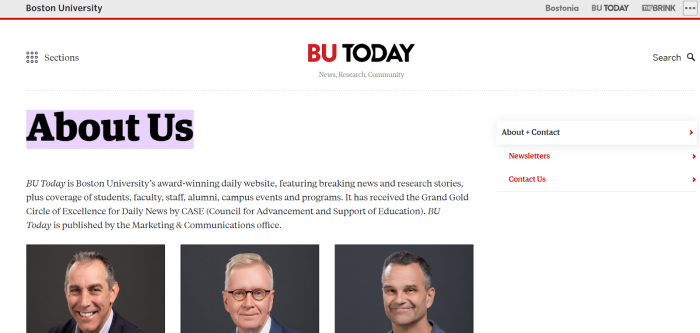
Example: Boston University runs an extensive content hub (“BU Today”) that publishes daily stories about student life, wellness, careers, research and more. This on-site news magazine – featuring contributions from students, faculty, staff, and alumni – builds trust and drives organic traffic by answering the questions prospective students are asking. BU Today’s engaging content strategy not only informs and inspires readers, but also strengthens the university’s visibility in search results through fresh, keyword-rich stories.
Students spend countless hours on social media, making it one of the most powerful tools for higher ed marketing. Platforms like Instagram, TikTok, YouTube, and LinkedIn allow universities to showcase campus life, share authentic stories, and build community long before students arrive on campus.
Tailor content to each platform: Instagram thrives on visual storytelling, TikTok on fun, viral content, YouTube on long-form video, and LinkedIn on alumni success. Meeting students where they are ensures your message resonates.
Authenticity wins: Many schools hand over the reins to students for “takeovers.” For instance, Babson College used Instagram takeovers for Q&As, giving prospects a candid look at campus life. Spelman College maximizes Instagram’s features—Stories, Highlights, and IGTV—to create a polished yet authentic presence that builds trust.
TikTok’s rise: Universities like Oxford and Indiana University leverage TikTok trends to humanize their brand and showcase student enthusiasm, boosting engagement dramatically.
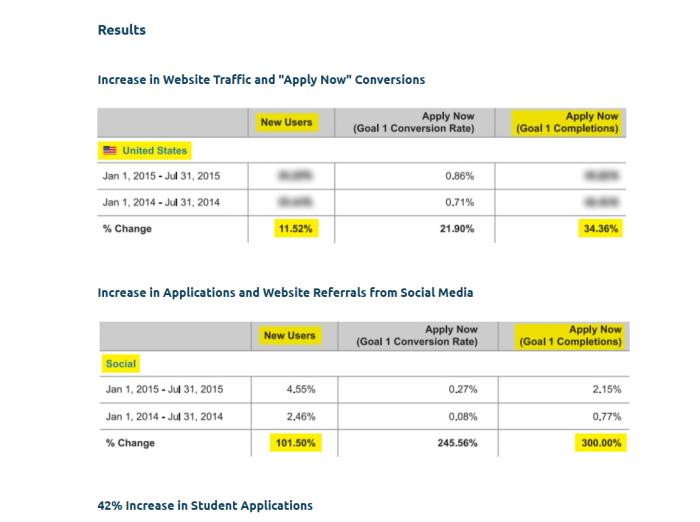
The payoff is real: John Cabot University increased applications by 42% after ramping up its social media presence. Done right, social platforms don’t just market a school—they cultivate belonging and amplify word-of-mouth.
Example: John Cabot University, an American-accredited university in Rome, overhauled its social media strategy to engage prospective students and saw remarkable results. By partnering with Higher Education Marketing and tailoring content to its audience, JCU achieved a 300% increase in applications coming directly from social media and a 42% overall rise in student applications. In practice, this involved creating more audience-targeted posts and campaigns that funneled followers to the admissions site – demonstrating how active social engagement can translate into measurable recruitment gains.
Organic content builds long-term visibility, but paid digital advertising delivers immediate reach. Pay-Per-Click (PPC) ads—on Google, Facebook, Instagram, LinkedIn, or YouTube—allow universities to target demographics, locations, and search intent with precision.
Search ads help institutions appear at the top of results for competitive terms like “MBA program online” or “study in Canada.” Even major universities bid on their own branded keywords to capture applicants searching directly for admissions. These ads often lead to optimized landing pages designed to convert interest into inquiries.
Social ads provide granular targeting. The takeaway? With smart targeting, strong creative, and optimized landing pages, PPC can deliver measurable results in recruitment, even on modest budgets.
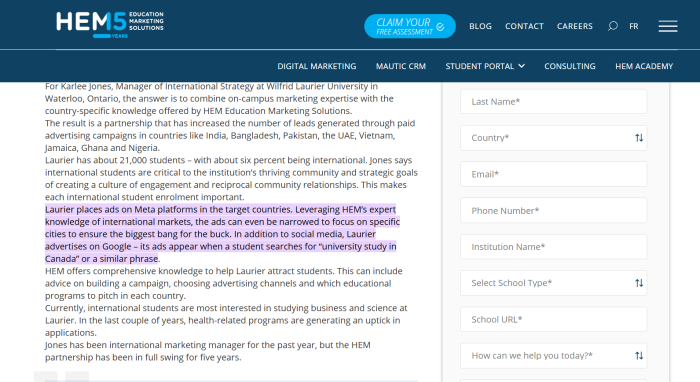
Example: Laurier employs highly targeted PPC advertising to reach international prospects in key markets. In partnership with HEM, Laurier runs country-specific campaigns on Google and Meta (Facebook/Instagram), even narrowing ads to specific cities to maximize relevance. For example, prospective students in India, Nigeria or Vietnam might see ads for Laurier programs, and search ads ensure Laurier appears for queries like “study in Canada university.” This precise targeting has boosted Laurier’s lead generation from countries such as India, Bangladesh, Ghana and more, illustrating how PPC can efficiently capture students in different regions.
Email remains one of the highest-ROI tools for higher ed recruitment. When a prospect shares their email, it creates an opportunity for personalized, direct communication that nurtures them through the enrollment journey.
Lead nurturing works best through sequenced emails—welcoming inquiries, highlighting programs, showcasing campus life, and reminding applicants to complete next steps. Segmentation and personalization make campaigns more effective: tailoring messages by program, audience type, or student behavior ensures relevance and boosts engagement.
Automation tools like HubSpot or Slate allow universities to trigger timely follow-ups—such as reminders for incomplete applications or pre-visit info before a campus tour. Done well, email serves as the connective tissue of digital strategy—tying content, events, and ads into one cohesive student journey.
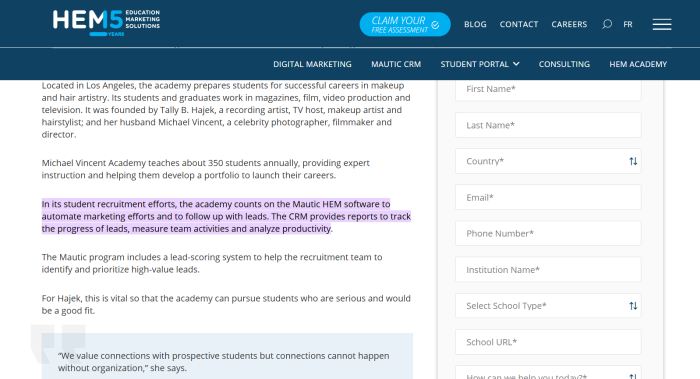
Example: Michael Vincent Academy, a private vocational school in Los Angeles, streamlined its recruitment process by implementing a customized CRM with marketing automation. The academy uses an automated system (HEM’s Mautic CRM) to follow up with every inquiry, score leads, and send sequenced emails. Routine tasks – from welcome emails to application reminders – are now handled automatically, allowing staff to spend more time on personal outreach to high-value prospects. The impact is significant: key elements of the follow-up workflow are now automated, improving efficiency and ensuring no prospective student falls through the cracks.
Pro Tip: Don’t overload inboxes—send 1 email every 7–10 days, keep designs mobile-friendly, and always include a clear call-to-action.
5. Website Optimization and User Experience (UX)
Your website is your digital campus, often the first impression prospective students have. A well-optimized site improves engagement and conversion by guiding visitors smoothly through their journey.
Mobile-first design is non-negotiable. With most students researching on phones, responsive layouts, fast load speeds, and intuitive navigation are critical. Google also rewards mobile-friendly sites in search rankings.
Clear navigation helps diverse audiences—prospective undergrads, grads, parents, international students—find relevant information quickly. Saint Louis University, for example, introduced an interactive admissions page with customizable “pathways,” simplifying content discovery and personalizing the student journey.
Engaging media like photos, videos, and virtual tours immerse visitors in campus life, while CTAs such as “Request Info” or “Apply Now” nudge them toward action.
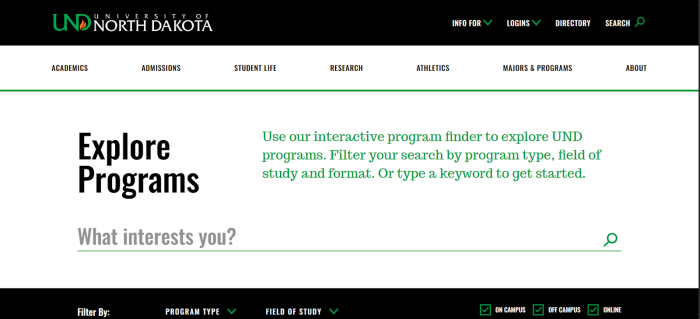
Example: University of North Dakota undertook a comprehensive website refresh that yielded strong results in both engagement and conversions. The new site introduced a powerful “Program Finder” tool giving prospective students one central place to discover academic programs by interest. The homepage and navigation were reorganized around key audiences (prospective undergrads, grad students, parents, etc.), making it easier for each group to find relevant info. UND also weaves in student stories and news in a way that reflects student life and values, rather than just facts. This focus on UX paid off: after launch, UND saw organic traffic climb and a 62% jump in undergraduate inquiries year-over-year, all while many peer institutions saw declines. It underscores that a fast, intuitive, mobile-friendly site can be a university’s best recruitment tool.
Pro Tip: Audit your site regularly—outdated info or broken links can undo even the best design.
6. Search Engine Marketing (SEM) and Local SEO
Search engine marketing ensures your institution is visible when prospective students actively look for programs. Beyond broad SEO, local optimization and targeted campaigns make a significant difference.
Local SEO helps capture location-based searches like “MBA in Toronto” or “universities near me.” Universities should claim and update their Google Business profiles, add campus photos, respond to reviews, and use city/region keywords across their site. For multi-campus schools, create individual location pages optimized with local terms.
Long-tail keywords are equally powerful. Students often search specific queries like “best undergraduate business programs for entrepreneurship.” Creating FAQ pages, blog posts, or landing pages around these terms captures highly motivated prospects. Likewise, many universities now optimize program pages with alumni career outcomes and salary data to rank for career-focused searches.
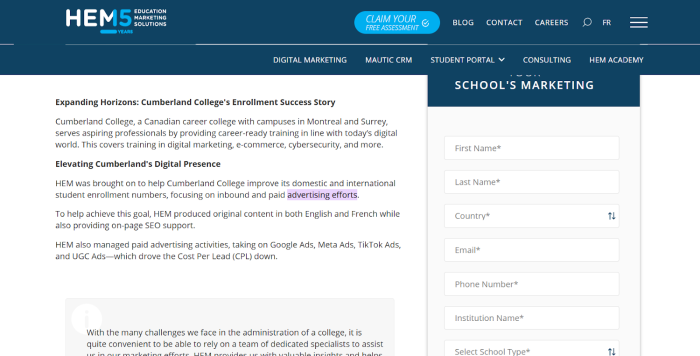
Example: Cumberland College, a career college in Montréal, used SEM and on-page SEO to significantly boost its visibility and inquiries. With expert help, Cumberland optimized its website content (in English and French) and refocused its keyword strategy – plus ran complementary Google Ads – to capture more search traffic. The impact was dramatic over a short period: organic web visitors rose by 27.5%, and overall leads (inquiries) jumped by 95% after the campaign, compared to the previous year. Even more striking, leads coming specifically from organic search increased nearly five-fold (a 386% increase) as Cumberland climbed higher in search results.
Pro Tip: Align SEM campaigns with the admissions cycle—boost spend before deadlines to capture undecided applicants.
7. Video Marketing and Virtual Engagements
In the digital era, video has become an incredibly powerful medium of digital marketing for colleges, and universities are uniquely positioned to leverage it. From campus tour videos and student vlogs to recorded webinars and live-streamed events, video marketing allows prospective students to experience a taste of campus life and academics from anywhere in the world. It’s engaging, shareable, and often more memorable than text.
Campus tours and virtual experiences: When students cannot visit in person (due to distance or as we saw during pandemic lockdowns), a virtual tour is the next best thing. Many universities now feature immersive 360-degree virtual campus tours on their websites. These let users “walk” through the quad, peek into classrooms, dorms, and labs, all from their computer or phone. It’s an interactive way to showcase facilities and atmosphere. Even a simple narrated campus tour video on YouTube can be effective – guiding viewers through major spots on campus while current students or staff explain highlights.
Storytelling through students: Prospective students trust their peers. “Day in the life” vlogs or testimonial clips highlighting internships and career outcomes resonate strongly. Short, authentic videos often outperform highly produced pieces.
Example: Montgomery County Community College (USA) grabbed attention with an award-winning recruitment video campaign. Their 30-second video spot, “You in Motion,” is a high-energy montage that inspires viewers to envision their success at the college. In that half-minute, the video communicates key value props – an affordable, top-notch education; extensive support resources; and a wide range of programs – all set to uplifting visuals of campus and student achievements. The campaign succeeded in exciting prospective students and driving home the message that at Montco you can “make your own momentum”. It’s a prime example of how concise, well-produced video content can boost a school’s appeal and conversion rates.
Source: YouTube
Takeaway: Video marketing builds trust through storytelling, making your institution both relatable and aspirational.
8. Data Analytics and Continuous Optimization
A major advantage of digital marketing for colleges is the ability to measure performance in real time. Universities that actively track and optimize campaigns consistently outperform those that rely on static strategies.
With tools like Google Analytics, CRMs, and marketing automation, schools can monitor conversions such as info requests, applications, and event signups, while attributing results to specific channels. For example, McGill University’s School of Continuing Studies implemented eCommerce-style tracking with HEM, enabling them to connect digital ad spend directly to applications and enrollment outcomes.
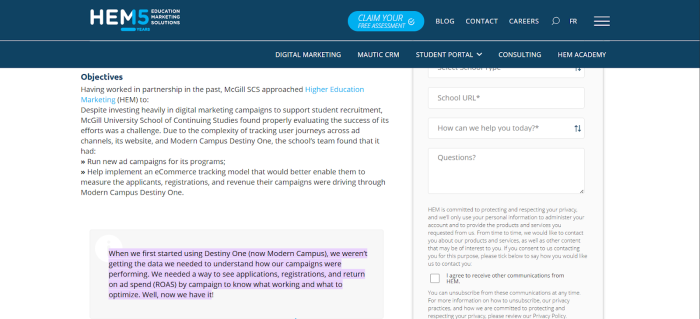
Example: McGill’s School of Continuing Studies struggled to connect its digital ad spend to actual enrollments – until it implemented an advanced analytics solution. Working with HEM, McGill SCS set up eCommerce-style tracking (via its Destiny One online registration system) to measure exactly how ads and web campaigns translated into applications, registrations, and revenue. This involved configuring Google Analytics and tag manager to capture each student touchpoint and conversion. The result was a newfound ability to make data-driven decisions on marketing: McGill can now see ROI by campaign and optimize accordingly, rather than guessing.
Optimization goes beyond tracking. A/B testing landing pages, refining email subject lines, or adjusting ad targeting can deliver significant lifts in conversions. Ultimately, analytics turn insights into action. By continuously refining campaigns based on real results, institutions ensure smarter spending, better engagement, and stronger recruitment outcomes.
Bringing It All Together
Digital marketing is no longer optional for universities—it’s the foundation of how students discover, evaluate, and choose their educational path. From content marketing and social media engagement to PPC, email nurturing, and data-driven optimization, each strategy plays a role in building trust and guiding prospects through the enrollment journey.
The institutions that succeed are those that take an integrated approach: aligning their website, campaigns, and student communications to deliver a consistent, authentic experience. Real-world examples—from Boston University’s content hub to McGill University’s data-driven enrollment gains—show how strategy translates into measurable results.
Ultimately, digital marketing is about connection. By telling authentic stories, engaging students where they are, and continuously refining based on analytics, universities can cut through the noise, reach the right audiences, and build relationships that last well beyond enrollment.
Done right, digital marketing doesn’t just attract students—it creates advocates who carry your institution’s story forward.
Struggling with enrollment?
Our expert digital marketing services can help you attract and enroll more students!
FAQs
Q: What is digital marketing in education?
A: Digital marketing in education is the use of online channels—such as websites, SEO, social media, email, and digital ads—to promote programs, connect with prospective students, and engage alumni. Unlike other sectors, the “product” is not just a service but an experience and long-term investment, so messaging must inform, inspire, and build trust.
Q: Why is digital marketing for universities so critical now?
A: The stakes are high. With declining enrollments and growing skepticism about the value of a degree, institutions are investing heavily in outreach.
Q: How much do universities spend on digital marketing?
A: Universities now spend between $429 and $623 per enrolled student, per year on marketing.
The Trump administration has escalated its confrontation with higher education institutions by sending detailed policy demands to nine universities, conditioning their continued access to federal funding on compliance with the president’s political objectives.
The unprecedented move, delivered via letters signed by Education Secretary Linda McMahon and other senior officials, presents a 10-page “compact” that outlines sweeping requirements affecting tuition pricing, international student enrollment, gender policy, and campus speech.
The compact mandates that participating institutions freeze tuition rates for five years, place restrictions on international student enrollment, and adopt administration-approved definitions of gender. Universities must also commit to preventing any policies that the administration characterizes as punishing conservative viewpoints.
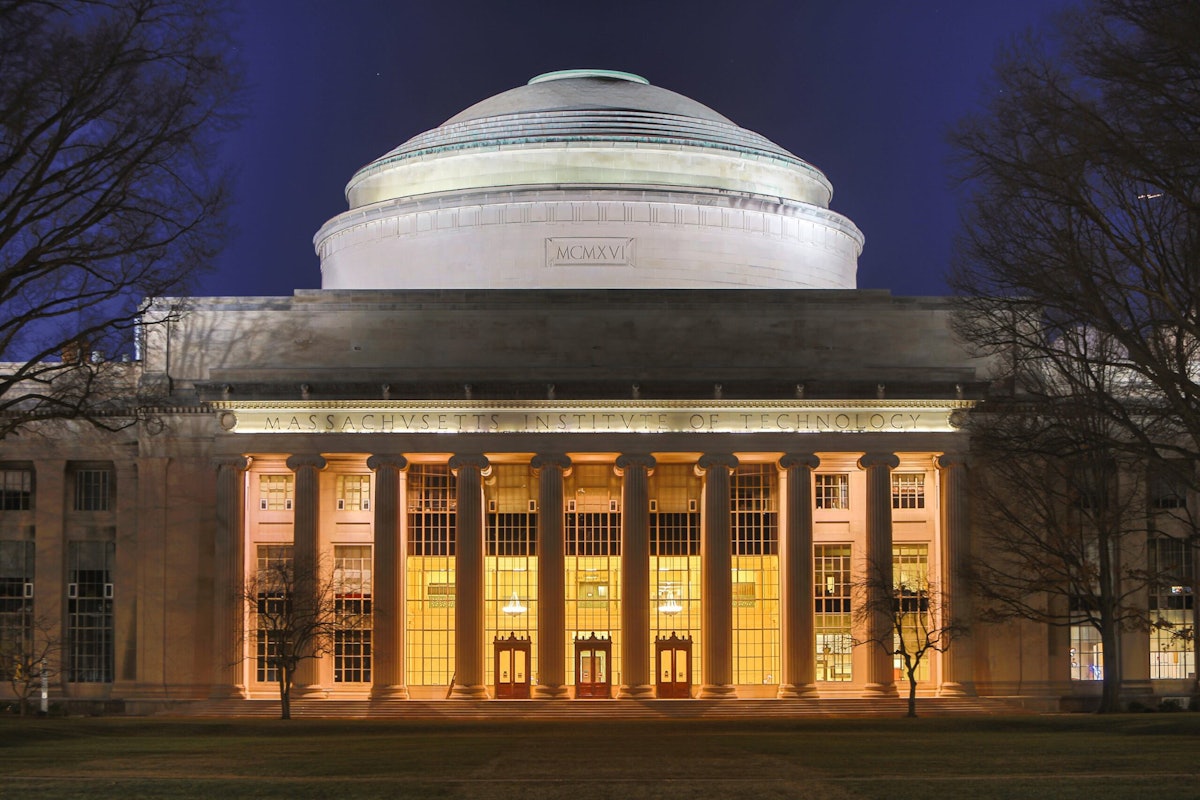
The nine institutions that received letters on Wednesday include Dartmouth College, Brown University, Massachusetts Institute of Technology, University of Southern California, University of Arizona, University of Virginia, University of Pennsylvania, University of Texas, and Vanderbilt University.
According to The New York Times, May Mailman, the White House’s senior adviser for special projects and a letter signatory, indicated the administration remains open to dialogue with contacted universities. “We hope all universities ultimately are able to have a conversation with us,” Mailman stated.
The demands represent a significant threat to institutional autonomy and could have far-reaching implications for diversity, equity, and inclusion efforts on college campuses. The restrictions on international student enrollment raise particular concerns about the future of global education exchange and the presence of international scholars who contribute substantially to research and campus diversity.
The administration’s approach effectively creates a two-tiered system where compliance brings preferential treatment in federal grant competitions. As one senior White House official told The Washington Post, universities would technically remain eligible for grants, but compliant institutions would gain a “competitive advantage.”
This compact represents the latest escalation in the administration’s sustained campaign targeting higher education. Previous actions have included funding freezes, threats to revoke tax-exempt status, and attempts to eliminate universities’ authorization to host international students.
The administration has particularly focused on policies related to international students, pro-Palestinian campus activism, transgender student athletes, and diversity, equity, and inclusion programming.
Harvard University stands alone among major research universities in actively resisting the administration’s demands through litigation. In an April open letter to the Harvard community, President Alan Garber articulated the stakes for academic freedom: “No government—regardless of which party is in power—should dictate what private universities can teach, whom they can admit and hire, and which areas of study and inquiry they can pursue.”
However, on Tuesday, President Trump claimed a deal with Harvard was nearing completion. The administration has already announced agreements with the University of Pennsylvania, Columbia University, and Brown University earlier this year.
This blog outlines a speech given by Professor Sasha Roseneil, Vice-Chancellor and President of the University of Sussex at a HEPI panel at the Labour Party Conference on the 29 September 2025
‘How can universities win back public support?’ was the question set for a panel discussion of Vice-Chancellors at the 2025 Labour Party Conference yesterday. But, with all due respect to HEPI’s Director, Nick Hillman, who posed this question, I do not accept its premise.
There is compelling evidence from multiple sources to suggest that key stakeholders – students, prospective students, parents, and grandparents – are strongly supportive of higher education.
First and foremost, students are very positive about their experience at university. The overall positivity score in the 2025 National Student Survey, which gathers the opinions of all final year students, was 86%, with 87% of students positive about teaching on their course, and 88% reporting that they felt able to express their ideas, beliefs and opinions at university. All over 85%. And HEPI and Advance HE’s 2025 Student Academic Experience Survey found that, whilst tuition fees are clearly not popular, more students consider that they receive good value for their fees than not – 37% versus 29% feeling that they receive poor value for money.
Second, young people continue to want to go to university: the number of people applying to university was 1.3% higher for 2025 entry than the year before, with a record number of 18-year-old applicants, and 2% increase on 2024, and a 4.7% increase in the number of 19-year-olds (and only mature student applicants declining).
And, according to a recent YouGov survey sponsored by University Alliance, members of the public across the political spectrum overwhelmingly want university for their loved ones: 84% of parents and grandparents want their children to go to university, and only 8% are against. Amongst Conservative voters, 90% want their children or grandchildren to go to university, the same as Green voters, slightly higher than the 89% of Labour voters, and slightly lower than the 93% of Liberal Democrat voters, with 72% of Reform voters also wanting their young family members to go to university.
The YouGov survey didn’t ask why – but I would suggest that it is implicitly understood by members of the public that higher education opens up worlds and improves lives for individuals, and that graduates are generally wealthier over their lifetimes, healthier, and happier than non-graduates. People might not have read David Willetts’ report for the Resolution Foundation but they seem to have tacit knowledge of its findings.
So where does the idea that universities have lost public support come from?
Above all, it comes from the media – from a cacophony of newspapers that feed a daily diet of anti-university stories, circulating and recirculating the same ideas. It is my contention that these stories are grounded in one key thing – a more or less explicit rejection of the democratisation and expansion of access to higher education that has taken place over the past twenty years, and that has been part of the wider processes of cultural and social liberalisation and equalisation that have been in train since the late 1960s.
Steeped in nostalgia for the days when higher education was the preserve of a privately and grammar school educated elite, some newspapers hark back to a time when university guaranteed access to the upper echelons of society. Their view is often based on an implicit understanding of university education as being about the reproduction and transmission of established bodies of knowledge, and thus the wider status quo. From this standpoint, they have waged a long and relentless campaign against universities. Universities are presented as one of the biggest social problems of our time, as the propagators of ‘woke ideologies’, as the source of blame for the reduction in the graduate premium, and for the failure of some graduates to rapidly realise their career or income aspirations.
Such stories are written by journalists who almost all went to university themselves (although to a limited range of universities) and have children whom they expect to go to a similarly limited range of universities. It is other people’s children going to university that is the problem, taking places away from those who should naturally enter their preferred universities. And it’s the ideas and identities that those young people might encounter, and that they might develop for themselves, at university that concerns them.
There were, of course, similar concerns several decades ago about what went on in the new universities that were established in the 1960s – but far fewer young people were exposed to the university experience in those days and it cost the public purse much less to educate them. But perhaps most importantly, the middle class was rapidly expanding and the middle class parents’ ‘fear of falling’ – that their children will not achieve the social and economic status that they have been born into – was not at all prevalent in the way that it is today.[1]
Those earlier generations of students were, of course, also much more generously supported in their studies, and therefore much more able to take full advantage of all that higher education had to offer, and much less likely to have to undertake the very significant amount of paid work that today’s students are doing – at very real cost to the time they have for independent study. And they didn’t have to pay the fees that lead to questions about student attitudes to value for money.
And so there is now a discourse that suffuses public culture that going to university is a waste of time and money, that only some universities are worth going to, and only some courses are worth studying. And, by implication, only some students are worth educating to a higher level. The more young people go to university and the more widespread across society the expectation and desire to go to university, the louder and more vociferous the attacks on higher education.
The idea that universities lack public support also provides ‘look over here’ distraction from the real problem that faces higher education – an unprecedented funding crisis. Across the country, universities are engaging in repeated rounds of ever deeper cuts, losing thousands – tens of thousands – of highly skilled jobs, and closing courses and departments. There is no national oversight of the impact of this on subject provision across the country, on students’ ability to access higher education in the full range of subjects locally (which impacts disproportionately on students from lower socio-economic backgrounds and from marginalised groups, who are much more likely to study close to home), on regional economies, and on our sovereign capability in critical industries and priority growth areas.
Last week’s report from the Institute of Physics sounded the alarm bell in relation to the health of this vital, foundational STEM discipline, and the British Academy has done the same for the humanities and the social sciences – particularly modern foreign languages, linguistics, anthropology and classics, with English, history and drama likely to follow soon.
If this were any other sector in which the UK was an undisputed world leader, and the rapid helter-skelter unplanned contraction which will cause enormous harm to the economies and civic life of cities and regions around the country, there would be stories in the news every day about the crisis. And there would be urgent government action to intervene.
Instead, universities are lambasted every day in the press and then told by government that we are independent autonomous bodies that need to solve our financial problems ourselves. This is despite the fact that universities are increasingly heavily regulated, and despite our main sources of income being home student fees, which are determined by government, and international student fees, the source of which has been under attack because international students are an easy target in the context of commitments to reduce net migration, and which is further threatened by the imposition of an international student levy.
The reality is that universities cannot solve our problems ourselves, either individually or collectively. We are all seeking greater efficiencies. We are all looking at how we can cut back on everything that is not absolutely essential to the student experience in the here and now.We are all considering carefully how we might collaborate with others to do more with less. Research is being radically squeezed, and labs and equipment are not being repaired and renewed, in order to try to ensure our financial survival.
But what now really must be called out is the failure of the competitive quasi-market model under which higher education operates. It is this that is source of our problems, and we need government to act.
The question then really should be: how can universities win government support to enable us to fulfil our primary purpose of education and research for the common good?
And the answer to that has to be by means of careful, rational, evidenced argument – with a flourish of rhetoric – of the sort that universities were established to propagate and which is so vital to the future of liberal democracy. We need to articulate and demonstrate our value, our vital importance, and our need for calm, considered and creative policy attention.
The global excellence of UK universities rests on decades, and in some cases, several centuries, of public investment in knowledge creation and learning for the public good. But that quality is in imminent danger. We urgently need government action to support our universities to continue conducting the world-leading research, catalysing the growth-producing innovation, and providing the transformative education and advanced skills that we are capable of doing – before it is too late.
There is active, deliberate government-led destruction of higher education and research taking place elsewhere. Don’t let’s do that here too by falling for the idea that the public doesn’t care about universities, and by failing to act in time.
[1] Ehrenreich, Barbara. Fear of falling: The inner life of the middle class. Twelve, 2020