
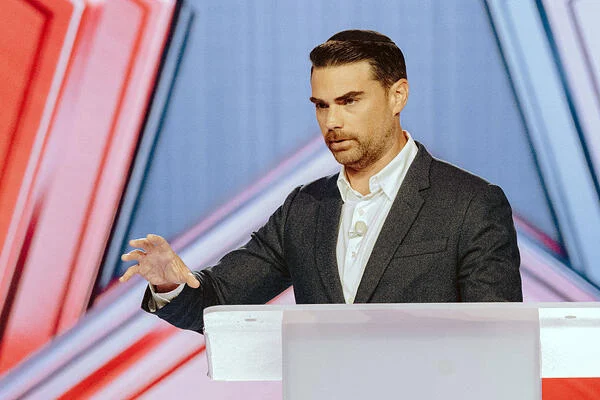
I showed my class a three‑minute clip of Ben Shapiro. It went about as you’d expect. I am an assistant professor of higher education, and I teach an undergraduate course called Embracing Diversity. I have taught this course for four consecutive semesters, during a period when the very ideas we examine (diversity, inequality, critical race theory and systemic racism) have been publicly demonized, politicized and, in some states, explicitly banned.
On a recent afternoon, after introducing students to the tenets of critical race theory, I played a short video of Shapiro, a conservative commentator and podcast host, explaining his critique of critical race theory and whether or not it should be taught in schools. Before the clip ended, the room filled with laughter. Students mocked his cadence and pitch. Someone compared him to a cartoon character. Students joked about his voice and his delivery. Someone said he sounded like a South Park character. Another compared him to a fast‑talking podcast host on 1.5-times speed. The laughter built on itself, crowding out any serious engagement with what he was actually saying.
I stopped the video.
What happened next is the part that has stayed with me, not because it was unprecedented, but because it exposed something we rarely name in spaces like this. Not because the moment was especially surprising (it wasn’t, at least not to me), but because of how quickly a class devoted to dialogue, equity and inclusion slid into dismissal, caricature and harm. We had not engaged Shapiro’s argument at all.
While the moment was lighthearted on the surface, it revealed something deeper: how quickly humor can become a substitute for thinking. I also understand why some readers may already be uneasy with my decision to bring Shapiro into a diversity classroom. His name alone carries political freight. For some, platforming him at all feels irresponsible.
I felt that tension myself before pressing play. But I did it anyway.
Why Bring a Contradicting Voice Into This Space?
In courses on diversity, power and inequality, we often expose students to marginalized voices that have been historically excluded from dominant narratives. That work matters. But if we stop there—if we never ask students to seriously engage ideas they find troubling, reactionary or even offensive—we risk teaching a form of moral comfort rather than intellectual rigor.
Shapiro is not a fringe figure. His arguments about race, merit and education circulate widely in public discourse and shape how many people, including students’ parents, community members, donors and policymakers, understand these issues. Pretending those arguments don’t exist does not make them disappear. It just ensures that students encounter them elsewhere, without guidance, context or accountability.
My goal was not persuasion. It was practice, especially at a time when many educators are teaching under heightened scrutiny, wondering which examples might invite backlash or misinterpretation. Can we listen carefully to a viewpoint we dislike without reducing the speaker to a meme? Can we distinguish between critiquing an argument and dismissing a person? Can we name what we disagree with, and why, without retreating into ridicule?
Judging by the initial reaction, the answer was no. And that failure was not especially about my students; it was about the quiet assumptions embedded in how many of us teach these courses, myself included.
Rewinding the Tape
After stopping the video, I named what I was seeing. We were responding to tone, reputation and identity, not substance. I asked the class to sit with the discomfort of that realization. Then I played the clip again, this time with a different task: summarize his argument as accurately as possible, as if his remarks were a reading assigned for discussion.
The room changed.
Students shifted in their seats. Some looked frustrated. Others looked uneasy. A few were visibly annoyed that I was asking them to slow down and listen. But they did it. They identified his central claims, his assumptions about race and individualism, and the evidence he did (and did not) use. Only after that did we move to critique.
The critiques were sharper the second time around. They were also more precise. Instead of “he’s ridiculous,” students said things like, “This argument ignores structural inequality,” or “He treats race as irrelevant without explaining why disparities persist.” Disagreement did not disappear. It deepened.
What the Discomfort Revealed
In student reflections weeks later, many returned to that class session unprompted. I was struck by how often they framed it not as a debate about Shapiro, but as a mirror held up to their own habits as listeners, learners and consumers of information. Several described it as a turning point, not because they suddenly respected Shapiro’s views, but because they recognized how easily they had substituted mockery for analysis. A few wrote that they were unsettled by how quickly they had joined in.
That discomfort mattered—not because it produced a dramatic conversion, but because it disrupted a shared sense of moral and intellectual ease.
Higher education often talks about preparing students for a pluralistic democracy, but we sometimes underestimate how hard that actually is. Listening across differences is not intuitive. It requires restraint, humility and a willingness to be uncomfortable—especially when the other voice is loud, confident and already coded as “the enemy.”
If we do not create structured opportunities to practice that skill, students will default to what social media teaches best: dismissing and dehumanizing. In that sense, the moment was less a student misstep than a pedagogical mirror.
A Note on Risk, and a Note to Fellow Educators
Some will argue that there are limits to which voices belong in our classrooms. They are right. Not every perspective deserves equal time, and harm must always be named and addressed. But avoiding contradiction altogether comes with its own risks. It can produce students who know what they oppose, but not how to engage.
Bringing a controversial figure into a diversity classroom is not a neutral act. It requires careful framing, clear boundaries and a willingness to intervene when things go wrong (as they did for me). It also requires accepting that the class may not go smoothly and that you may feel exposed, criticized or unsure in the moment.
I was also aware, even in the moment, that sharing this experience, especially now, could draw attention to me, my classroom or my course. That risk is real, and it is not evenly distributed across faculty.
That day, I felt it.
But if our goal is to help students think critically rather than reflexively, to argue rather than ridicule and to hold their values with confidence rather than fragility, then leaning into that discomfort may be necessary.
Not because Shapiro needed to be heard—but because our students needed to learn how to listen.