
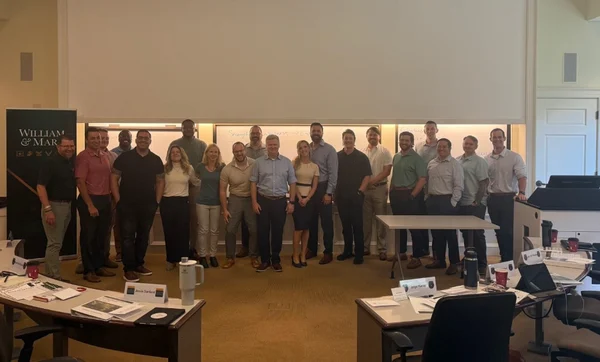
As higher education institutions nationwide increasingly invest in solutions to help student veterans transition to college life, William & Mary has developed a targeted pre-orientation program that centers student veterans’ values and strengths.
Launched in August 2025, the business school’s Center for Military Transition piloted a weeklong pre-orientation session focused on helping students with military experience identify their values, interests and strengths as they clarify the professional skills, career goals and sense of belonging they hope to build on campus.
Jonathan Due, executive director of the Center for Military Transition at William & Mary, said nearly 20 students participated in the pilot, including about six who were still on active duty. He noted that what makes the pre-orientation distinct is its emphasis on “reflection, preparation and connection.”
“Instead of jumping right into helping students seek a new professional identity or a new career, we want them to reflect first,” Due said. “From there, we focus explicitly on their professional strengths and use that self-reflection as a foundation to help them connect.”
“That provides additional insight into the specific preparation for what comes next and only then are we ready to really dive deep into career search and application strategies,” he added, noting that the institution has about 250 student veterans and 1,700 military-connected students.
William & Mary’s program is well timed. A recent research brief from the Center for Higher Education Policy and Practice found that about 5 percent of all undergraduates are active-duty military, reservists, National Guard members or veterans, yet many college systems are not designed to meet their needs.
The report identified several strategies to improve their experiences, including clearly outlining program costs and available support services, offering peer mentorship programs that connect incoming students with currently enrolled military learners and connecting students with career coaches who can help translate military experience into the civilian workforce.
For Due, addressing student veterans’ needs begins with recognizing how deeply military service shapes students’ values—and centering the pre-orientation program around that foundation.
“Having students reflect on their individual values, which in many cases have been deeply shaped by their military experience, helps them carry those values into new contexts and form different professional relationships,” Due said.
The pre-orientation model: The program begins with a relationship-building module led by a business school professor who specializes in impression management and is also a Navy veteran.
“We came up with some ideas that were very relationship-driven,” Due said. “There’s a series of discussions about how we hold values as a stimulus for motivation.”
The program then moves into conversations about student autonomy, which Due said is particularly important for student veterans who are accustomed to a “hierarchical structure” from their military background.
The remaining sessions focus on translating military experience into corporate culture, completing a CliftonStrengths assessment—an online tool from Gallup that helps individuals identify and develop their natural talents—and participating in one-on-one career coaching.
“It really orients them to themselves,” Due said. “We’re immediately introducing them to resources that are there for them, too, and integrating that in a meaningful way.”
The takeaway: Due said an alumnus’s donation, along with additional grant funding, will allow the college to continue and expand the program in the fall. Planned additions include more faculty and military experts to lead exercises and reflection, as well as networking opportunities with alumni who can serve as job referrals.
Ultimately, Due said having a dedicated pre-orientation focused on student veteran needs is important for other institutions that serve large military-connected student populations.
“They’re an interesting group because they’re nontraditional students,” Due said. “The key principle I would share is to keep the student veteran experience itself at the heart of program design.”
Get more content like this directly to your inbox. Subscribe here.