
Lowering college costs, boosting accountability and reforming accreditation will likely be at the top of congressional Republicans’ to-do list for 2026. But as public approval ratings for President Trump continue to decline and midterm elections loom, higher education policy experts across the political spectrum say congressional conservatives could be running out of time.
The push for more affordable higher education has been gaining momentum for years, and while it was a common refrain at the committee level in 2025, complex and sweeping debates over tax dollars soaked up much of lawmakers’ attention.
First, the Republicans passed their signature piece of legislation, the One Big Beautiful Bill Act, which cut taxes for wealthy individuals, increased them for elite universities and overhauled the student loan system. Then, they turned their attention to disagreements on the federal budget—an impasse that led to the record 43-day government shutdown.
But in the few cases where members of the GOP did get to home in on college cost issues, whether via legislation or hearings, an underlying theme emerged—holding colleges accountable for their students’ return on investment.
Higher education experts have no doubt that concern will continue in 2026, but Congress won’t have the time or the oxygen needed to nail down real changes unless they figure out how to fund the government, which runs out of money again Jan. 31.
“The Republican majority is very conscious that it may be on the clock, and this would argue for trying to move rapidly and get things done,” said Rick Hess, a senior fellow and director of education policy studies at the American Enterprise Institute, a right-leaning think tank. “But with the narrow and fractious House majority, the way the budget is going to chew up time going into January and the pressure on the Senate to get judges confirmed, it’s just going to be a challenge for them to find much time to move further higher ed–related legislation.”
Legislative Actions
Republicans spent much of 2025 using their control of Congress and the White House to pass what many industry leaders have described as the largest overhaul to higher education policy in more than a decade—the One Big Beautiful Bill Act. And while policy experts were initially skeptical that this multi-issue package could pass given the complex, restrictive nature of a legislative process called reconciliation, the GOP found a way.
The final bill, signed into law July 4, served as a major win for the GOP, expanding federal aid for low-income students to include nontraditional short-term training programs, limiting loans for graduate students, consolidating the number of repayment plans and increasing taxes on wealthy colleges, among other provisions.
Conservative policy experts like Hess praised the overhaul as “a much-needed and positive set of changes.”
“There’s certainly more that can be done, but I think it moved us in a substantially better direction than we’ve been,” he added.
But aside from OBBBA, little legislation concerning colleges and universities advanced. Only one bill tracked by Inside Higher Ed, the Laken Riley Act, reached the president’s desk. That law gave state attorneys general increased power over visas that could affect some international students and scholars. Others, including the Protection of Women and Girls in Sports Act, a bill that forbids trans women from participating in women’s sports, and the DETERRENT Act, a bill designed to restrict foreign academic partnerships, made it out of the House in a matter of weeks but then got stuck in the Senate.
The story of 2025 in higher ed is a big, dramatic one, but it’s almost entirely one of executive branch activity.”
—Rick Hess, AEI
So when asked what congressional accomplishments stood out from 2025, progressive policy experts told Inside Higher Ed they didn’t see much. The things that did happen, they added, hurt students and institutions more than they helped.
“‘Accomplishments’ is not really the word I would use considering the challenges that higher education faced this year,” said Jared Bass, senior vice president of education at the Center for American Progress. “I don’t think that Congress actually met the moment for affordability or defending and preserving higher education.”
Instead, he said, legislators placed the burden of cost on the backs of students.
“The Republican argument is by cutting access to these loans they’ll actually drive down costs. But we’ll have to wait and see if that happens,” he explained. “But I would say it didn’t actually make college more affordable. It just made resources less available.”
Hearings Highlight Priorities
Congress did, however, hold a number of higher ed–related hearings to dive into their priorities, which included improving the transparency of financial aid offers, establishing stronger records of the skills students gain and elevating ideological concerns like allegedly illegal use of diversity, equity and inclusion practices and liberal biases in the Truman Scholarship program.
Although the House Committee on Education and Workforce hosted a greater number of higher ed hearings, some of the more notable panels came from the Senate Health, Education, Labor and Pensions Committee.
“They actually wanted to put the ‘E’ back in HELP and focus on education issues,” said Emmanual Guillory, senior director of government relations at the American Council on Education, a leading higher ed lobbying group. “That wasn’t really the case under prior leadership. So that was good.”
Chairman Bill Cassidy, a Republican from Louisiana, right, and ranking member Sen. Bernie Sanders, Independent of Vermont, lead the Senate Health, Education, Labor and Pensions Committee.
Tom Williams/CQ–Roll Call Inc./Getty Images
Much of the shift in interest, Guillory added, was likely tied to new leadership. This was the first year that Sen. Bill Cassidy, a Louisiana Republican, held the gavel. In the last Congress, Cassidy had served as ranking member.
The House Committee on Education and Workforce also had new leadership, as Rep. Virginia Foxx of North Carolina handed the baton to Rep. Tim Walberg from Michigan. But it was the Senate’s tactics that led to more meaningful legislative progress in ACE’s view.
“Mr. Walberg may have pushed a slightly more aggressive agenda. The House definitely had more hearings in the higher ed space and tackled more hard-punching issues, but in the Senate they took a different approach,” Guillory said. “When it came to those difficult issues and conversations, the Senate chose to discuss those a bit more quietly and really work on solutions with stakeholder groups and ask, ‘How can we be influential with actual legislation?’”
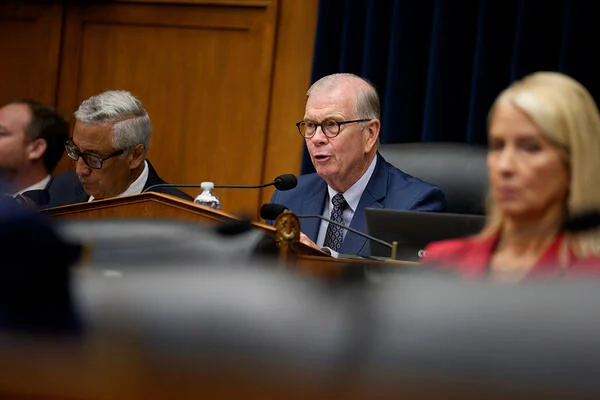
Chairman Tim Walberg took over the House Education and Workforce Committee in 2025.
Andrew Harnik/Getty Images
When asked for their reflections on the year, Cassidy and Walberg pointed to OBBBA, which they touted as a historic reform to drive down college costs and limit students from taking on insurmountable debt. But while Walberg then looked back to the ongoing antisemitism discussions and concerns about “hostile learning environments,” Cassidy touted his legislation aimed at helping students better understand the cost of college.
“College is one of the largest financial investments many Americans make, but there is little information to ensure students make the right decision,” he said. “That is why I introduced the College Transparency Act to empower families with better information so they can decide which schools and programs of study are best suited to fit their unique needs and desired outcomes.”
Democrats Fight Back
Meanwhile, Democrats in both chambers said they were forced to spend much of their time and attention maintaining the Department of Education, an agency they say is needed to do much of the work to fulfill Republicans’ priorities, be it addressing antisemitism and other civil rights issues or driving down college costs.
From his early days on the campaign trail in 2024, Trump has promised to dismantle the department, and starting in March of 2025, he began doing so—all without congressional approval.
First, the president laid off nearly half of the agency’s staff. Then, just a week later, he signed an executive order directing Education Secretary Linda McMahon to close down the department “to the maximum extent appropriate and permitted by law.”
Later, he tried to slash federal spending, redistribute grant dollars and use the government shutdown to lay off even more employees. Most recently, Trump approved a series of six interagency agreements that reallocate many of ED’s responsibilities to other agencies.
Through it all, the Democrats repeatedly decried his “attack” on higher ed. They used statements, town halls and demonstrations outside the department to draw attention to decisions they said would be “detrimental” to “students, teachers and educators.”
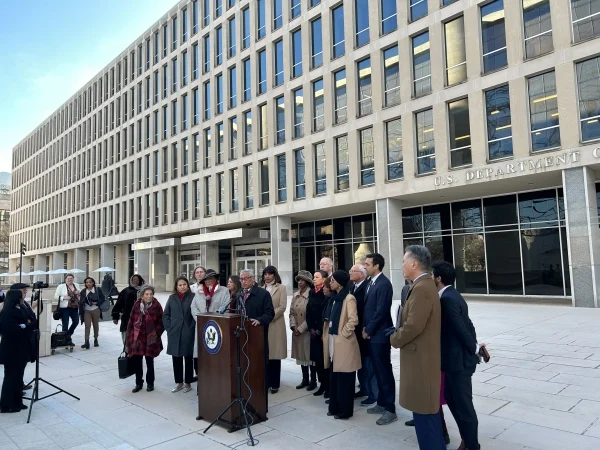
Lawmakers tried to access the Education Department in February but were denied entry.
Katherine Knott/Inside Higher Ed
Rep. Bobby Scott, a Virginia Democrat and ranking member of the House education committee, said he has spent much of his year in defense mode, pushing back against each of these actions.
“The administration has been dismantling the Department of Education, making access to education much less available,” he said. “And we’ve been trying to keep it together.”
But both Scott and Sen. Patty Murray, a Washington Democrat and former educator, acknowledged that as members of the minority, they can only do so much. A few Republicans have joined them in voicing concern about specific issues, but not enough, they say.
“We’ve had some successes—forcing some funding to be restored and rejecting, for example, President Trump’s push to slash Pell Grants by half in our draft funding bill for the coming year—but ultimately, we need a whole lot more bipartisan outrage and pushback from Republicans to truly start to undo the sweeping damage Trump has already caused,” Murray said.
And it wasn’t just Democrats who raised concerns.
“Congress has done very little to ask important questions, to ask the executive branch to justify some of the actions it is taking,” said Hess from AEI. “Hill Republicans are very much marching in lockstep to what the White House asks. The story of 2025 in higher ed is a big, dramatic one, but it’s almost entirely one of executive branch activity.”
What’s Ahead in 2026?
Now that congressional Republicans have completed a number of the tasks they set for themselves back in January 2025, most experts say two remaining items—college cost and accreditation reform—will be top priorities in 2026.
Most sources Inside Higher Ed spoke with anticipated that college cost reduction and transparency would be addressed first, largely because related bills made it out of a House committee in December and senators held a hearing on the topic. The bills, which would standardize financial aid offers and create a universal net price calculator, have already gained some significant bipartisan support.
Meanwhile, many remain skeptical of Republicans’ proposals for accreditation. Although no exact legislative language has been released, GOP lawmakers and Trump officials at the Department of Education have called for a major overhaul to not only ensure better student outcomes but also to deconstruct a what they see as a systemic liberal bias.
“I would hope to see a focus on accreditors taking an active role and not just sort of a check-the-box approach to quality assurance,” said Carolyn Fast, director of higher education policy at the Century Foundation, a left-leaning think tank. “What I’m concerned about is some of the efforts to reform accreditation don’t seem necessarily as concerned about making sure that the system is working in terms of their role as gatekeepers of federal funds … but more about political and cultural war issues.”
Bass from CAP said that he will be keeping a close eye on the midterm election campaign trail for a pulse on higher ed policy in general this year, as it gives the public a chance to speak up and direct change.
“I’m curious to see how conversations about affordability play out, not just for higher education or education over all, but just for the country,” he said. “There are going to be over 30 gubernatorial races next year, and the debate gets shaped over key issues like higher education, like college costs, like affordability. So it will be very interesting to see how both parties are going to show up.”