
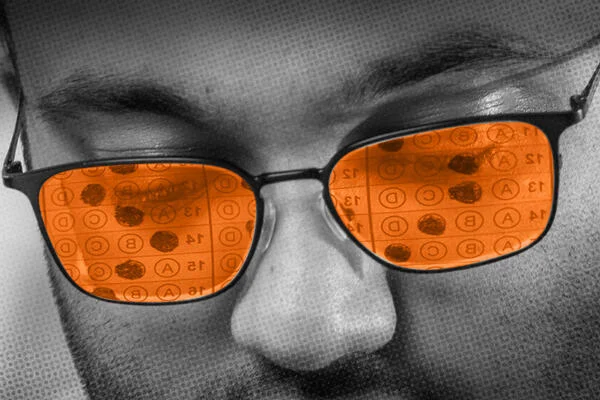
Students will not be allowed to wear the devices, even if they are prescription glasses.
Photo illustration by Justin Morrison/Inside Higher Ed | Izusek and Spiderplay/E+/Getty Images
The College Board will prohibit students from wearing smart glasses—wearable, internet-connected computers that allow users to see a computer display in the lenses—while taking the SAT, starting in March 2026.
The organization has long banned any wearable electronics, such as Apple AirPods and Apple Watches, said Priscilla Rodriguez, senior vice president of college readiness assessments at the College Board. Such devices, as well as students’ phones, are taken away by the test’s proctor before the test begins; the rule outlawing smart glasses is just an extension of that existing policy.
Although the first smart glasses emerged in the early 2010s, the technology has risen to prominence in recent years, especially as companies such as Meta and Google have debuted artificial intelligence–enabled versions of the product. As they’ve become more common, professors have also raised alarm bells about whether they will be used for cheating; they fear that students will use them to scan tests and get fed the answers by AI in real time without detection.
At least one documented example exists of a student using smart glasses to cheat; a student in Tokyo was caught using his spectacles to post questions from a college entrance exam on the social media site X and received answers from other social media users.
An op-ed by professors at the University of Victoria in Canada also warned that the threat of smart glasses in the classroom goes beyond cheating. They also discussed them as a threat to academic freedom; the glasses could allow students to record their professors without their professors knowing they’re being filmed, allowing them to leak lectures or even create deepfakes, the professors said.
Outside of higher education, they have been criticized for violating people’s privacy as it has become increasingly common for social media content creators to secretly record their conversations with strangers via smart glasses and post those videos online.
SAT proctors are now trained to spot and take away students’ smart glasses if they spot them. Although the glasses look similar to a regular pair of spectacles, Rodriguez said most mainstream smart glasses brands have a distinctive look with thick, black rims, and when they’re in use, the camera on the front lights up.
“It’s a noticeable light, so if someone were taking a video, a photo, having someone talk to them through the glasses, etc., the light shines and that’s kind of like the dead giveaway,” she said.
Students will not be allowed to wear the devices even if they are prescription glasses, she noted. If students are unable to take the test without their smart glasses, they will be asked to return on a different day to take the test with a regular pair of glasses.
So far, Rodriguez said, she is unaware of any instances where students have been caught cheating with smart glasses in the SAT, but the step to ban the devices was taken preemptively.
“We have a really robust test security team here at College Board, coupled with, really, an industry-leading technology team. So, between those two, they’re always looking out to say, ‘what could be next? What’s the next frontier if you’re trying to gain an advantage on this test?’” she said. “They were monitoring the pre-launch announcements of these kinds of glasses and gadgets well before they hit the market, so we were ready.”