There’s no denying climate change when a tornado rips through your town or a blizzard buries you in snow. So why blame the people who raise weather alarms?
Source link
Blog
-

Decoder Replay: Can we prepare for unpredictable weather?
-

Who’s helping UK unis open their Indian campuses?
India is becoming the next transnational education (TNE) hotspot, with nine top UK universities having announced plans to open overseas branch campuses out there. Earlier this year, the University of Southampton became the first of this new tranche of campuses to open its doors, with several others close behind.
As the TNE boom continues, several universities have revealed the independent providers that are helping them set up their campuses in India. Meanwhile, other providers have expressed an interest in this space.
Here’s our list of who’s working with who.
Who’s opening a campus in India?
Nine UK universities have confirmed they are joining the TNE scramble in India. They are:
- The University of Southampton
- The University of Liverpool
- The University of York
- The University of Aberdeen
- The University of Bristol
- Coventry University
- The University of Surrey
- Lancaster University
- Queen’s University Belfast
Who are they working with?
Oxford International Education Group (OIEG) – Southampton has confirmed it worked with OIEG in setting up its campus in Gurugram, which opened earlier this year. OIEG provided the financial backing and the professional services needed to set up the campus
India Business Group – Another provider assisting Southampton on the ground, India Business Group is providing the university with strategic support.
Emeritus and Daskalos – The University of York has confirmed it is working with the edtech platform Emeritus to set up its Mumbai campus. Working alongside Emeritius is Daskalos – a new venture from Atul Khosla, the founder and vice-chancellor of Shoolini University, as confirmed by Khosla in a LinkedIn post. Khosla has said Emeritus and Daskalos’s partners include “three Russell Group Universities, one of the oldest universities of the world, a top tier US university and a leading Australian university”.
Khosla has also confirmed on LinkedIn that Daskalos and Emeritus are working with the University of Liverpool on its Bengaluru campus, as well as the University of Bristol on its Mumbai campus. Meanwhile, it appears that the University of Aberdeen may be another institution working with the duo, with a job posting advertising an Emeritus job at the university.
Study World – The education infrastructure company Study World is working with Coventry on its GIFT City campus, according to local news reports. The company’s group chief operating officer Kate Gerrard is quoted as saying: “Study World has over two decades of experience in delivering a wide range of educational services in partnership with leading international universities around the world. This association with Coventry University in India will be highly beneficial for students in India and the wider region.”
GUS Global Services – The University of Surrey has confirmed it it is working with GUS Global Services, with GUS leading on strategic support services such as Indian student enrolment support, advice on the local market and campus and operational management.
For their part, Lancaster University and Queens University Belfast have remained tight lipped on which providers – if any – they are working with as they explore setting up campuses in India.
Which other providers could be eyeing up opportunities?
GEDU Global Education – the UK-headquartered company has already invested in several campuses in GIFT City, making it a prime provider to step in and help institutions set up overseas branches in India.
UniQuad – an arm of ECA, which has previously partnered with UK universities to run overseas campuses and other TNE projects, UniQuad is a new division with a specific goal of introducing university partners to India’s evolving educational landscape, meaning it’s well placed to help in this area.
Amity – the private Indian provider is already working with major British institutions – such as Queen Mary University of London – on program articulation arrangements in India, as well as having MoUs with others on things like joint research and dual degrees. Could it be looking to expand into new ventures?
British Council – while the British Council isn’t a private provider, it is a key strategic enabler for institutions looking to set up in India. It can help with policy dialogue and advocacy, support through the UK Universities in India Alliance, as well as providing market intelligence, helping institutions decide which partners are right for them.
-

Best Sites & Apps for K-12 Education Games
This article was updated December 2025.
Game-based learning turns potentially tedious study time into an adventurous knowledge quest, complete with catchy soundtracks and digital rewards. It helps keep kids engaged with the subject matter and motivated to pursue greater expertise. Best of all, web- or app-based gameplay integrates easily into both online and in-person classes.
We’ve curated the best K-12 educational game sites and apps, arranged according to cost. Many are free (or offer free basic accounts), while some provide progress tracking and analysis tools for teachers. All are remarkably creative and will help kids enjoy learning.
Best Free K-12 Education Games
LangGuesser
Listen to a brief clip of someone speaking, then click on a country where that language is spoken. It may “sound” easy, but it’s surprising how tricky it is to distinguish unfamiliar spoken languages from one another. No account required, but do create an account in order to track your progress. A great exercise for any language class.Brilliant
Brilliant employs colorful professional graphics and gamified learning to help kids master STEM topics such as algebra and computer science. Exercises start with the basics and gradually build to more complex problems. Each answer, whether correct or incorrect, has an accompanying explanation to aid in understanding the topic. Best of all, Brilliant provides completely free access to its premium account for educators and administrators with school email addresses.GeoGuesser Name The Countries – Geography Quiz Game
There are 195 recognized countries in the world. How many can you identify on an unmarked map, and how fast can you do it? Eight different versions add to the possible challenges. A great way to learn and practice geopolitical knowledge. Free, no account required.Quizzity
A super simple but challenging geography quiz. How close can you place the pin to the city-level location provided? The worldwide map includes nothing but political borders to the province/state level. What I liked about this game is that players earn points for being close, even when incorrect. In this way, users are encouraged to keep trying and learning.Vocab Scrabble
Can you improve your English vocabulary by playing online Scrabble? Yes, according to AE Studio’s Vocab Scrabble, a simple-yet-challenging digital version of the beloved word game. The rules are elementary. Or shall I say basic? Perhaps fundamental? Click “start playing” and the five-minute countdown begins. Like Scrabble, the player receives a selection of letters with which to compose words. Unlike Scrabble, the selection changes after each word created. No account required.New York Times Games Subscription | iOS Android
While not strictly speaking educational games, these standout puzzles from The New York Times clearly require users to exercise language, math, and logic skills. Non-subscribers can play the following inventive games for free: Wordle, Sudoku, Connections, Pips, Strands, and the daily Mini Crossword for free. My favorite is Connections, the devilishly tricky word game that asks users to create four sets of related words. Players must carefully consider all possible meanings of each word before making their choices. And be sure to try creating your own Wordle game, which can be shared with friends, colleagues, and students. Games offer difficulty levels, hints post-game analysis. Available via website or app.Prodigy English
From the makers of the popular Prodigy Math, Prodigy English is a gamified English language learning program that features all the fun bells and whistles of gaming, from creating worlds to boosting energy with correct answers. A suite of teachers’ tools includes assessments and reports. Aligned to Common Core reading and language standards for grades 1 to 6. Best of all, the premium Prodigy English is fully free to educators.Prodigy Math
An award-winning, standards-aligned online math game designed for grades 1-8, Prodigy is modeled on popular fantasy-style multiplayer games. Students select and customize an avatar, and then prepare to battle math problems. Free basic account includes core gameplay and basic pet features. Prodigy Math is fully free to educators.Ducksters
This easy-to-navigate site affords a wide range of educational digital games for students or anyone who enjoys gameplay and learning. Included are math, word, geography, and puzzle games as well as classic games such as chess, checkers, backgammon, mahjong, and more. But it’s not just fun and games at Duckster. An extensive collection of illustrated lessons in history, biography, geography, and science are accompanied by quizzes and links to the relevant games. No account required to play or learn.Khan Academy Kids
An award-winning, free iOs or Android app, Khan Academy Kids offers a comprehensive collection of educational math, literacy, and music games and activities for kids aged 2-8 years. Top-rated by users, this free app includes no ads—and no subscription is needed.Puzzle Playground
From the publisher of Math Playground, Puzzle Playground is a free game-based learning site that uses puzzles of every kind to engage kids’ imaginations. Don’t think “jigsaw” because these amazingly creative puzzles go far beyond shape-fitting. Instead, these varied digital puzzles will keep kids of any age busy challenging their problem-solving, trial-and-error, spatial reasoning, and perseverance skills. Super fun too.Best Free Virtual Escape Rooms for Schools
These top free virtual escape rooms combine the best elements of gameplay — suspense, skill, knowledge, and speed. Arranged according to age suitability.Moose Math – Duck Duck Moose iOs Android
A multi-level math game that allows kids ages 3-7 to earn rewards and decorate cities by solving math problems disguised as adventures. Common Core-aligned for kindergarten and first grade.Wordscapes iOs Android
Wordscape combines the best features of crossword puzzles, word connect, and word anagram games, all accompanied by scenery designed to relax and focus the mind.Mind Games
Don’t worry, this site doesn’t advocate gaslighting or psychological manipulation. Rather it’s a collection of free online number, word and logic games, brain teasers, sudoku, crosswords, and more. Free with (blockable) ads. For a premium ad free gaming, visit adfreegames.com, where users pay only $10 for a full year of access.Solving the Rubik’s Cube!
From educator Ryan Chadwick comes this top-notch digital tutorial for one of the most challenging hands-on puzzles ever. Includes images and advice to boost your speed solving Rubik’s cube. Free, no account required.Annenberg Classroom That’s Your Right
Kids play alone or in multiplayer mode to learn and practice their Bill of Rights expertise. With high-quality graphics and music and three levels of difficulty, this free game is an excellent way to support civics education for middle and high school students. Additional resources include a Constitution guide, review of Supreme Court cases, and lesson plans.Funbrain
Browse K-8 educational games by grade level, popularity, and topics such as math, grammar, and vocabulary. New games include chess, sudoku, and What on Earth?! (geography). Free, no registration required.iCivics Games
A rich resource for social studies education, the nonprofit iCivics was founded by Supreme Court Justice Sandra Day O’Connor in 2009 to educate Americans about our democracy. The site includes an educational portal for learning about civics and standards-based games and curricula.Little Alchemy 2
Air. Earth. Fire. Water. Simply creative. Simply brilliant. iOs and Android too. For makers and imaginers of any age.National Geographic Kids
Free quizzes and games in topics ranging from animals and bugs to solving ciphers.PBS Kids Games
Dozens of free games, from math to social-emotional learning, will delight younger learners. No account required on this user-friendly website. English and Spanish. New games include Nature Sights and Sounds, Puppy Pet Care, Road Repair, and many more.Play4A
A deceptively simple interface allows users to play surprisingly challenging games for free. In addition, teachers create gamified quizzes, then share the code with their students. A jaunty musical soundtrack adds to the enjoyment.RoomRecess
Find 140+ free learning games in a wide variety of subjects, including math, language arts, typing and keyboard skills, digital puzzles, and more. Games are grouped by grades as well as topics. Highly popular with teachers and students alike.Tate Kids
Explore art-based games and quizzes on this super appealing, highly visual site from Great Britain’s Tate Museum. Activities focus on learning and discovery rather than test scores. An exceptional way to get kids thinking about and making art. Free.HoloLAB Champions (Educators Edition)
Players in this remarkable virtual chemistry lab will measure, weigh, pour, and heat in a series of competitive lab skills games. No safety goggles required—but don’t forget your virtual pair! Free for educators. HoloLAB Champions is available in English on Steam for the Oculus Rift and VIVE VR platforms. Free to educators.NASA Space Place
NASA invites users to investigate Earth and outer space via games that ask big questions such as, “How does NASA talk to its faraway spacecraft?” and “How does the sun make energy?” Free and fascinating.
Best Freemium K-12 Education Games
Factile
Clue: The best known and loved quiz game show in American history. Response: What is Jeopardy!? Factile, with its sleek, sophisticated interface, allows users to create and share Jeopardy!-like quiz games, in addition to playing publicly available games. Create games manually or allow AI to populate the game board with clues related to your chosen topics. Free account users can create up to three custom games, share and embed games and play public games. Transparent pricing allows for easy comparison among account options, with Home/School Basic at $48 annually and Home/School Plus under $100 annually.GrooveLit
Groovelit’s COPPA- and FERPA-compliant gamified writing practice helps students in grades 4-10 find their voice. Teachers can create new writing games or make use of ready-made games with adjustable player settings. Customizable to state standards. Groovelit Basic provides unlimited free access to gamified writing practice and unlimited students per game, while Groovelit Go adds individualized feedback/analysis and other premium features.Education.Com Games
With nearly 1,000 high-quality, engaging educational games covering math, science, social studies, and English, Education has something for every preK-8 student. Basic members can access three free downloads per month, while premium members have unlimited access to all Education.com resources. Premium-only features include Guided Lessons, Collections, and more.ABCya Free Games of the Week
More than 300 lively educational games and mobile apps for preK-6 students. Games can be searched by Common Core State Standards, as well as Next Generation Science Standards. Six new free games released every week. Free for desktop use, premium plan for mobile devices.Arcademics
An award-winning, innovative site for K-8 game-based learning in math, language arts, geography, and other subjects, Arcademics includes an educational portal that allows teachers to monitor student progress, generate detailed reports, and assess student learning. Free basic account provides most features and is ad-supported. Free 30-day trial. No credit card required.Oodlu
An online education gaming platform, Oodlu is perfect for learners of any age with some reading ability. Teachers create their own games using the built-in question bank, and analytics provide progress reports for each student. Free standard account.Blooket
A wonderful gamified learning/quiz platform with a user-friendly interface, Blooket offers nine different game modes and runs on student devices as well as desktop computers. Free basic account allows for unlimited sets and edits, unique game modes, and question set search for up to 60 players.Turtle Diary Online Games
An extensive collection of games, videos, quizzes, lesson plans, and other digital tools for preK-5 students, searchable by topic, grade, and Common Core standard. Free and premium accounts.Gimkit
Created by a high school student, Gimkit bills itself as a game show for the classroom. Kids can earn in-game cash with correct answers and invest the money in upgrades and power-ups. Reports for educators are generated after every game played. A second program, Gimkit Ink, allows students to publish and share their schoolwork. $4.99/month, or group pricing for schools. A 30-day free trial of Gimkit Pro can be converted to a free basic account.Kahoot
One of the most popular sites for gamifying the classroom. Teachers create games and quizzes and students answer them on their mobile devices. You’ll find a plan for every budget: free basic, pro, and premium.Knoword
A fine, fast-paced vocabulary game. Educators can create their own word packs and track student progress. Free basic accounts allow play of all public word packs, sharing, and exporting, while the moderately priced Pro and Team accounts allow unlimited word pack creation and assignments.Legends of Learning
A fine collection of standards-aligned science and math games for K-8 students. Free teacher accounts, with premium features for school and district-level accounts. Bonus: Learn about the games before signing up here. Be sure to check out their free upcoming game-based STEM competitions.
Best Premium K12 Education Games
Geoguessr
A unique and visually captivating geography brainteaser that encourages children to decipher locations using hints from Google Street View and Mapillary visuals. Ideal for fostering cognitive abilities and logical reasoning, while providing an entertaining and immersive experience.Math Playground
Explore this extensive selection of math, logic, skills, and word games for kids in grades K-6. Created by educator Coleen King, Math Playground is kidSAFE/COPPA Certified and includes only COPPA-certified children’s ads. Shareable in Google Classroom.Vocabulary Spelling City
Three dozen free games cover topics including vocabulary, spelling, phonics, and language arts. Each game includes several variations, so the total number of games to play exceeds 100. Just start playing- no account needed. Looking for premium content? Head over to the new site for premium games at VocabularyA-Z.comBuzzmath
Buzzmath provides more than 14,000 interactive math questions, as well as manipulable objects, audio text reading, math glossary, brain teasers, badges, and digital rewards. Teachers can personalize learning for each student with this standards-aligned supplementary math resource.Sumdog
Sumdog’s standards-based math and spelling practice platform aims to boost student learning and confidence with adaptive personalized gameplay. A hit with kids and research-validated to boot. Free 30-day trial.MinecraftEdu
A block-based graphics game, designed for education, that allows students to build and explore virtual worlds. Built-in educator controls support a safe and education-directed experience. The abundant classroom resources include lesson plans, training for educators, challenge building, and more.Skoolbo
Skoolbo offers educational games for reading, writing, numeracy, languages, science, art, music, and logic. Digital books and step-by-step animated lessons support young learners as well. Various plans for classes and schools, with the first month free.Enjoy our content? Make sure to add Tech & Learning as a preferred source on Google to keep up with our latest news, how-tos, profiles, events, and more.
-

The Top 20 Education Next Articles of 2025
In a journal devoted to U.S. education reform, some recurring themes in its content are expected: student achievement, curriculum, teacher effectiveness, school choice, testing, accountability. Other topics are more contemporaneous, reflecting the functional reality of American schooling in its present context. The latter group may capture just a moment in time and give future education historians a glimpse at what mattered to early 21st century reformers (and seem quaint in hindsight). It may also reflect prescient insights from leaders, thinkers, and scholars—contributions that document the early stages of a significant transformation in education policy and practice (and later be deemed ahead of their time).
What we can say confidently is that Education Next published a good mix of the classic and the contemporary in 2025, just as it has each year in its quarter century of existence. You can see for yourself below in our annual Top 20 list of most-read articles, which features an assortment of writings by researchers, journalists, academics, and teachers.
Among the traditional fare, readers turned to EdNext to keep apprised of developments in classroom instruction, from reading to literacy to history. They wanted to know if the U.S. might be better off evaluating schools using the European model of inspections rather than, or in addition to, student test scores. Amid ongoing debates about the merits of using standardized tests to gauge student preparation, readers were drawn to the findings of researchers in Missouri that 8th graders’ performance on the state’s MAP test are highly predictive of college readiness. In the realm of teachers and teaching, proponents of merit pay received a boost by an analysis of Dallas ISD’s ACE program, which was shown to improve both student performance and teacher retention in the district.
As for school choice, Education Next followed successes like the expansion of education savings account programs, the proliferation of microschools, and the federal scholarship tax credit passed by Congress as part of the One Big Beautiful Bill Act. But the stumbles of choice had more of a gravitational pull for readers. There were the defeats of private-school voucher measures in three states—continuing a long string of choice failures at the ballot box. There are the enrollment struggles of Catholic schools, which researchers found are impacted by competition from tuition-free charter schools. And just when Catholic and other private religious schools could have gotten a shot in the arm by being allowed to reformulate as religious charters, the Supreme Court deadlocked on the constitutionality of the question, leaving the matter to be relitigated for another day.
There was no shortage of timely topics that exploded onto the scene and captivated readers. American education is still grappling with the fallout from the Covid-era school shutdowns, now five years in the rearview. Many harbor consternation about the politics of pandemic closures, as demonstrated by the enthusiasm over a new book that autopsied the decisions of that era and the subsequent book review that catapulted onto this year’s list (an unusual feat!). And now there’s research to corroborate the disaster closures were for public education. Two Boston University scholars find evidence of diminishing enrollment in public middle schools, an indication that families whose children were in the early grades in 2020 are parting for the more rigorous shores of private choice. But the post-pandemic problems in schooling have not been uniform. In one of the most-read articles this year, founding EdNext editor Paul Peterson and Michael Hartney show how, based on recent NAEP results, learning loss was greater among students in blue states that had more prolonged school shutdowns than in red states that reopened more quickly.
Meanwhile, everyone in education circles continues to grapple with what to do about technology in the classroom. Two writers did so in our own pages, presenting opposite perspectives on Sal Khan’s prediction that AI will soon transform education with the equivalent of a personalized tutor for each student. And one of our favorite cognitive scientists gave readers a different way of thinking about how digital devices affect student attention.
It is perhaps fitting that our most-read article of 2025 was also the cover story of the last print issue of Education Next. (You can read more about our transition to a web-only publication here.) After Donald Trump reassumed the presidency this year and his administration enacted major reductions to the federal bureaucracy, several education-focused programs (and indeed the entire U.S. Department of Education) came under intense scrutiny. One target was Head Start, in part because Project 2025 called to eliminate the program on the grounds it is “fraught with scandal and abuse” and has “little or no long-term academic value for children.” Paul von Hippel, Elise Chor, and Leib Lurie tested those claims against the research and found little basis for them. Yet they also highlight lingering questions about the program’s impact on students’ long-term success—and opportunities to answer them with new research. As of this writing, the nation’s largest early-education program survives, but the sector is still watching and waiting.
And so are we all for what will happen next in education. Some issues captured by Education Next this year will continue into 2026. Some will flame out. And others that are unforeseen will arise. Readers can depend on Education Next to lean into all the twists and turns that come in the year ahead.
The full top 20 list is here:
-

DEI in education: Pros and cons
eSchool News is counting down the 10 most-read stories of 2025. Story #6 focuses on DEI in education.
Key points:
Diversity, equity, and inclusion (DEI) initiatives have become integral to educational institutions across the United States. DEI aims to foster environments where all students can thrive regardless of their backgrounds. The programs are designed to address systemic inequalities, promote representation, and create inclusive spaces for learning. However, as DEI becomes more prevalent, it also faces scrutiny and debate regarding its effectiveness, implementation, and impact on educational outcomes.
One of the main advantages of DEI in education is the promotion of a more inclusive and representative curriculum. Students gain a broader understanding of the world by integrating diverse perspectives into course materials. This enhances critical thinking and empathy. Furthermore, the approach prepares students to navigate and contribute to our increasingly globalized society. Moreover, exposure to diverse viewpoints encourages students to challenge their assumptions and develop a more nuanced perspective on complex issues.
DEI initiatives also contribute to improved academic outcomes by fostering a sense of belongingness amongst students. When students see themselves reflected in their educators and curricula, they are more likely to feel valued and supported. This leads to increased engagement and motivation. This sense of inclusion can result in higher retention and graduation rates (particularly among historically marginalized groups). Furthermore, diverse learning environments encourage collaboration and communication skills because students learn to work effectively with peers from different backgrounds.
In addition to benefiting students, DEI programs can enhance faculty satisfaction and retention. Institutions that prioritize diversity in hiring and promotion practices create more equitable workplaces. This can lead to increased job satisfaction among faculty members. Mentorship programs and professional development opportunities focused on DEI can also support faculty in creating inclusive classroom environments, which further benefits students.
Despite these benefits, DEI initiatives are not without challenges. One significant concern is the potential for resistance and backlash from individuals who perceive DEI efforts as a threat to traditional values (in other words, a form of reverse discrimination). This resistance can manifest in various ways (opposition to DEI policies, legal challenges, and political pressure). Such opposition can hinder the implementation and effectiveness of DEI programs, thereby creating a contentious atmosphere within educational institutions.
Another challenge is the difficulty in measuring the success of DEI initiatives. Without clear metrics, it can be challenging to assess the impact of these programs on student outcomes, faculty satisfaction, or institutional culture. The lack of quantifiable data can lead to skepticism about the efficiency of DEI efforts, thus resulting in reduced support or funding for such programs. Additionally, the absence of standardized definitions and goals for DEI can lead to inconsistent implementation across institutions.
Resource allocation is also a critical issue in the execution of DEI initiatives. Implementing comprehensive DEI programs often requires significant financial investment (funding for specialized staff, training, and support services). In times of budget constraints, institutions may struggle to prioritize DEI efforts. This may lead to inadequate support for students and faculty. Without sufficient resources, DEI programs may fail to achieve their intended outcomes thus further fueling criticism and skepticism.
The potential for tokenism is another concern associated with DEI initiatives. When institutions focus on meeting diversity quotas without fostering genuine inclusion, individuals from underrepresented groups may feel marginalized or exploited. Tokenism may undermine the goals of DEI by creating superficial diversity that does not translate into meaningful change or equity. To avoid this, institutions must commit to creating inclusive environments where all individuals feel valued and empowered to contribute fully.
Furthermore, DEI programs can sometimes inadvertently reinforce stereotypes or create division among student populations. For example, emphasizing differences without promoting commonalities may lead to increased social fragmentation or feelings of isolation among certain groups. Educators must carefully balance the celebration of diversity with the promotion of unity and shared values to foster cohesive learning communities.
In summary, DEI initiatives in education offer numerous benefits, but these programs also face significant challenges. To maximize the positive impact of DEI efforts, educational institutions must commit to thoughtful, well-resourced, and inclusive implementation strategies that promote genuine equity and inclusion for all members.
Latest posts by eSchool Media Contributors (see all) -

stories that shaped the sector
It was August 2000 when Chloé Gorlei found herself at Nijmegen train station in the Netherlands, standing in the hot summer air and waiting for a minibus that would carry her to the international office at the University of Radboud.
“There, I would sign the necessary paperwork and collect my bedroom pack; two towels, some bedding, and a single, unremarkable tea towel that somehow made the whole adventure feel suddenly real.”
Gorlei, now head of international partnerships and student recruitment at Escape Studios, was the the first in her family to go to university, and had recently completed a two-year diploma in business and marketing and the University of Montpellier II in France.
She describes her level of English at the time as “basic”, she didn’t know anyone in the country and was without a mobile phone. Despite these challenges, this was the start of a new chapter for her.
“Not only did I meet people from all over the world, and learnt about new cultures, accents and habits, but I also lived in an unfamiliar place that would become home for ten months. Although culturally close to my country, I had to learn new codes, and even a new language.”
“The university itself was very different to what I had known so far: going through economics books in English was a challenge! I was also not used to only having a few hours of lectures a week. Where I came from, we had lectures all day, five days a week,” she recalled.
“This is Erasmus to me: experiences that shaped my future and friendships for life. It’s not all rosy, there are challenges, but it gives everyone, regardless of background or financial situation, a glimpse of what it means to be an international student. It opens your eyes to a world you might never have discovered otherwise,” said Gorlei.
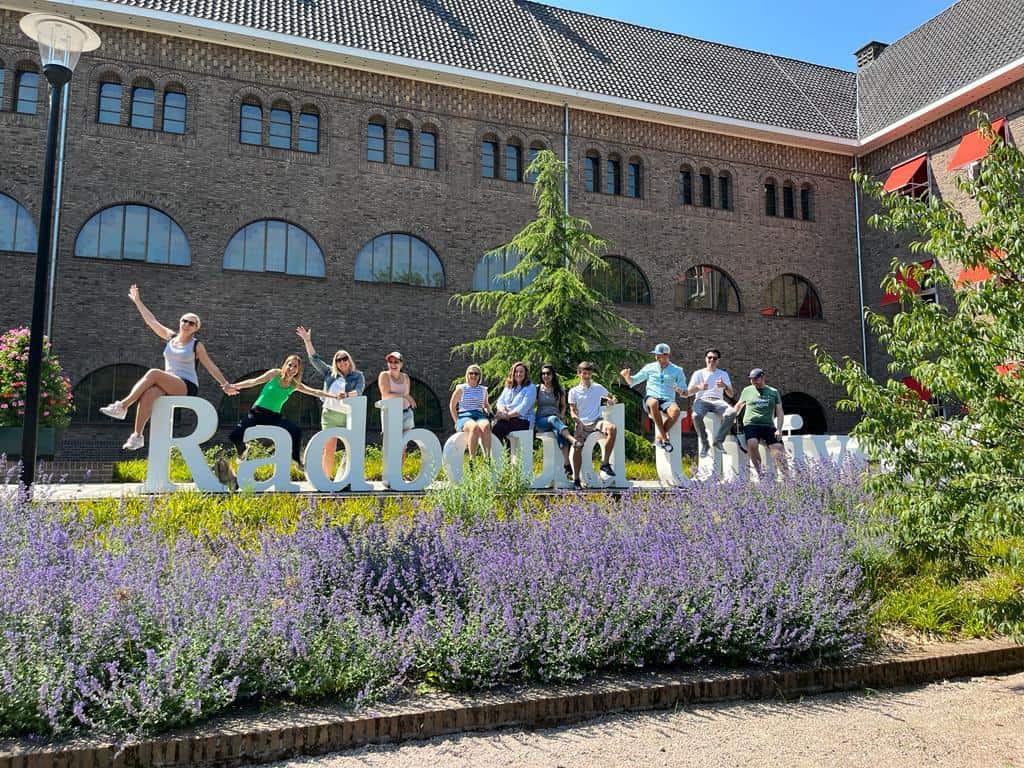
Photo: Chloé Gorlei In 2023, Gorlei reunited with some of her fellow Erasmus students in the Netherlands, describing it as “a wonderful chance to relive those moments, cycle the same lanes, and party in the same bars”.
“It fills me with joy and hope that UK students will finally have this chance again, and that European students will discover the UK, an opportunity they might otherwise never have.”
For Maria de la Pisa, deputy director international and head of international partnerships and relations at the University of Bristol, the UK’s reassociation to Erasmus+ is the early Christmas present she was hoping for.
“I am incredibly excited to hear that the UK is going to rejoin the Erasmus+ program from 2027. This is wonderful news for the UK higher education sector and for all the thousands of UK and EU students who will be able to benefit from this transformative opportunity.”
De la Pisa is proud to call herself an Erasmus scholar, having spent a year at the Univerity of Leicester, studying in a second language and quickly adapting to a very different academic approach compared to what she was used to in Spain.
“I embraced British culture wholeheartedly,” she said.
“That year was full of making international friends, travelling to as many corners of the UK as my budget allowed, and embracing the unexpected. I discovered fascinating traditions and celebrations which I had never even heard of before. It was a year of growth, adventure, and unforgettable experiences.”
And it was that during this year that de la Pisa met her husband, who later went on to participate in an Erasmus exchange in Spain. The couple celebrated their 20th wedding anniversary in 2025.
The pair returned to the University of Leicester, 27 years later, to show their children where they first met – at an international student party in the Students’ Union (Percy Gee Building).

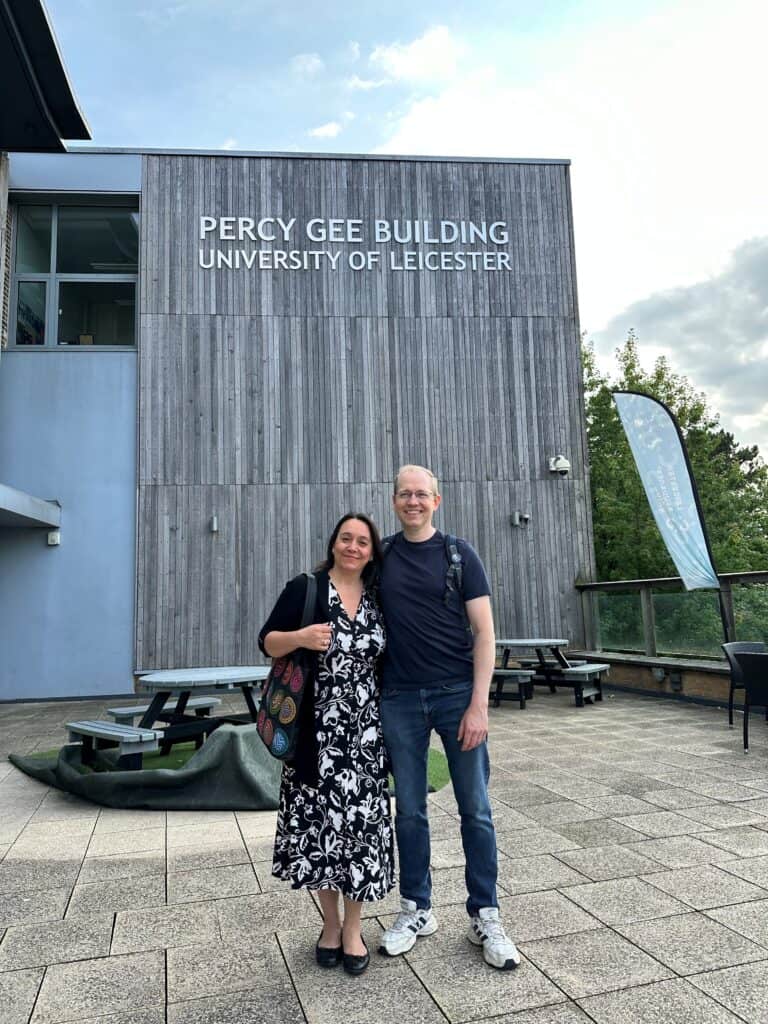
Photo: Maria de la Pisa As de la Pisa’s son prepares to enter university next year, she said she is “delighted” that this opportunity will also be available to him and many other UK students.
“Professionally, this incredible opportunity sparked an interest in working in international education and I have spent over two decades in the higher education sector motivated by a commitment to extend the same transformative opportunities I had to others.
“For the sector, this is a huge win. It will strengthen collaboration with European partners, not only through student mobility but also through research, education, and cultural exchange. I hope this renewal also inspires a wider interest in language learning and the arts, areas that enrich society and reinforce global connections,” said de la Pisa.
“Here’s to the next generation discovering the world, building friendships across borders, and shaping their futures. A big thank you to Universities UK International and all those who have tirelessly advocated for this change.”
For Anne Marie Graham, chief executive of UKCISA, it is no exaggeration to say that Erasmus changed her life – both personally and professionally. Speaking to The PIE, she reflected on the transformative impact of the program and expressed her delight that young people in the UK will once again have access to the same life-shaping opportunities through Erasmus.
“I didn’t know it at the time but I would have been a Widening Participation student. I was lucky enough to be funded for two Erasmus semesters – one in Granada, Spain and another in Clermont-Ferrand, France,” she told The PIE. She recalled her time in Granada with particular fondness, remembering it as it was before it became the global tourist destination it is today.
“It was free to enter the Alhambra and I just used to go up on a Sunday afternoon with my book to sit and recover after a fun Saturday night out!”

Photo: Anne Marie Graham “It was daunting at first, but loved being able to study alongside Spanish and French students, and create links with locals through university projects,” said Graham.
“I was lucky to be able to immerse myself in many ways in Spain, and it was life-changing. It gave me self-confidence, language skills, intercultural competence and of course friends for life with students from other Uk universities, Spain, Italy, Sweden and the US. I’m very happy that these opportunities are returning to UK students.”
The PIE‘s own Jacqui Jenkins also took a moment to reflect on her experience as an Erasmus student at weißensee academy of art berlin (then widely known as the East Berlin Art College).
“Erasmus was genuinely life-changing for me – and, in many ways, probably the reason I’m still addicted to working in this wonderfully chaotic international education sector,” said Jenkins.
I left the UK in 1997 as a Brit. I came back thinking much more like a global citizen
Jacqui Jenkins, The PIE
“Being dropped into a classroom with students from entirely different backgrounds changes how you see the world. Many of my peers had grown up in the former East Germany or the wider USSR and had experienced a very different schooling system and social reality. Those conversations – and that context – forced me to see everything through a different lens.
“I left the UK in 1997 as a Brit. I came back thinking much more like a global citizen.”
-

Today’s learners have changed – can universities keep up?
Higher education has always prided itself on staying ahead of change. Yet, the last few years have reshaped how people learn, work, and define ‘engagement’ much faster than most institutions anticipated. Engagement is no longer a hand raised in a lecture hall. It may be a late night discussion board post, or a student quietly rewatching a lecture at 1.25x – 1.5x speed – whatever their personal sweet spot for learning may be.
Today’s learners expect to engage on their own terms – and the universities that do not adapt risk falling behind.
Walk onto almost any campus today and you’ll meet an eclectic mix of learners: international students juggling multiple time zones, those studying around work or family commitments, neurodivergent learners who thrive with asynchronous participation, and mature learners returning after long professional careers. All of them, probably looking at their phones.
Learning needs and expectations have rapidly outpaced many traditional institutional models, and they will continue to evolve just as quickly as AI reshapes our world.
Yet, teaching and assessment often still assume a ‘standard student’ – someone who lives nearby, has no dependants, thrives in three hour seminars, loves group work, and apparently doesn’t need sleep. That student certainly exists – but it doesn’t apply to every student, and they are not even the norm anymore. The new classrooms are multigenerational and, like it or not, include learners who will use AI as a tutor, a translator, an assistant, or to whisper the correct answers to them.
Flexibility matters as much as program quality
Flexibility is now just as important to students as program quality. Students aren’t just looking for online resources, they want learning experiences that bend around the complexities of their lives and unlock value for their future employment.
The rise of hybrid and remote work has played a part. Today’s students – many of whom are working alongside their studies – are already accustomed to flexibility, asynchronous communication and digital collaboration. It’s no surprise they expect the same from their learning environments.
Meeting learners where they are
Flexibility does not mean universities must add more tools or redesign their entire curricula overnight. Instead, it means making intentional choices that give every learner meaningful ways to participate.
This can include:
Multiple modes of engagement
A student who is quiet in seminars might contribute confidently in written discussions. Another might absorb information better through video than text. Some need transcripts, captions, or additional time. All are legitimate learning preferences that institutions should plan for.
Assessment choice
Offering varied and new assessment formats broadens the ways students can demonstrate their learning, whether it’s through a written essay, a recorded presentation, a reflective piece, or another method.
Consistent and modern digital spaces
A well organised virtual learning environment should support students, not turn them into detectives hunting for course materials. When resources are always accessible, connected with their favourite apps and easy to find, students can focus their energy on learning rather than navigating platforms.
Accessibility from the outset
Designing with accessibility in mind benefits all learners and reduces barriers. It also spares lecturers from having to re-engineer materials when a student requests accommodations.
Technology won’t solve everything, but it can reduce friction
Debates about technology in higher education are familiar: concerns about pace, complexity, distraction or cost. But technology is not the goal itself. The goal is to remove the barriers that prevent students from engaging fully.
Effective and data-driven digital environments help educators see who is engaging, who may be struggling, and who might need adjustments or support. They offer students personalised pathways through their learning and allow institutions to respond when circumstances change, whether due to shifting demographics or external events.
Good teaching does not depend on technology, but scalable, equitable, mobile and flexible learning does. That’s where technology earns its keep – and maybe even saves a few lecturers from endless email chains.
The risk of doing nothing
Universities that do not adapt to the changing needs of learners are at risk of losing prospective students – and current ones – to institutions that can offer more modern, responsive, flexible experiences.
Students live according to real-time logic: they expect confirmation, follow-up, and immediate responses, just as they do when they shop online, but the answer cannot be to indiscriminately flood classrooms with tools; it is about personalising and adapting to the different generations that now make up the educational landscape.
In a world of multicultural and multigenerational classrooms, engagement now means allowing students to participate in ways that genuinely suit them – not in ways dictated by inherited habits at an institution.
-

All I want for Christmas is for policy to align its ambition with its action
This blog was kindly authored by Dr Kate Wicklow, GuildHE Director of Policy and Strategy
The higher education sector is renowned for its innovation and global standing, with diverse providers consistently delivering great work and immense value. However, the sector could also certainly do with some festive cheer at the moment. There are multiple pressures placed upon us which impact our resilience and threaten our energies and resources to continue to be a global powerhouse.
A vision without the tools to deliver it
The Post-16 White Paper has offered the sector a new vision, one where it asks higher education institutions to govern themselves differently, with greater collaboration between providers, and therefore less market based ideologies within sector activity. But it places all of the responsibility to fix the sector challenges on individual providers rather than offering systems leadership or policy support.
The recently published new OfS strategy also offers a welcome reset of the regulator-institution relationship to be less combative. However, the actions proposed to underpin the strategic statements seem disconnected from the DfE vision of sector coordination, likely in part due to their unfortunate simultaneous development. The OfS strategy roadmap provides no clarity on how the regulator plans to either reduce the regulatory burden or sustain its current risk-based methodology. Furthermore, it omits measures essential for safeguarding sector diversity, an obligation under the Higher Education and Research Act (HERA), and one that is arguably critical in the current climate.
The missing piece: financial realism
Both documents omit the critical financial realities institutions face, which aren’t solely due to governance failings, but rather mounting pressures that are well rehearsed and have forced the sector to do more with less for the last 13 years – which just isn’t sustainable. At some point, the system breaks, and we are seeing cracks widen now. While the White Paper offered a fee uplift, the unexpected international student levy negates this. We are certainly in a critical moment for the future shape of the sector, which makes the forthcoming review of OfS’s Strategic Priority Grant particularly concerning in its potential to destabilise what additional state funding is received.
A sector whose diversity is its strength – and its vulnerability
GuildHE represents the UK’s most diverse range of higher education providers, varying in size, location, and operational models. Our members, who include small and large, rural and urban, practice-based and online, specialist and more generalist, and both publicly and privately funded institutions, are renowned for delivering practical, industry-relevant education, research, and innovation. Thanks to this unparalleled diversity, GuildHE acts as a crucial gauge for the higher education sector, offering unique insights into the opportunities and challenges affecting the entire landscape.
The white paper rightly highlights the immense value that this diverse range of higher education providers brings to students, local economies, and the nation as a whole. Our member institutions are often pioneers in their fields, offering unique courses and producing highly skilled graduates. Yet, despite this declared commitment to diversity, policy mechanisms and funding models always seem to operate with an inevitable bias towards scale and homogenisation.
The true barrier to sustaining sector excellence and diversity isn’t simply a lack of commitment from institutions, but a contradiction at the heart of policymaking: the very mechanisms of funding and regulation are inadvertently acting as a constraint on the diversity they claim to champion.
The current regulatory framework, built for a typical large-scale, multi-faculty provider, often inadvertently penalises innovative and smaller-scale or specialist institutions. A clear example is how the Teaching Excellence Framework (TEF), with its emphasis on metrics, disadvantages, by design, providers with small student cohorts. The core issue is not just which metrics are used, but the inherent volatility of data when applied to small cohort sizes. Offering providers the opportunity to contextualise their quantitative data with other evidence is therefore vital, but adds additional burden on these institutions.
Funding must recognise the distinctiveness and value of specialist institutions, both in teaching and in research. For research, the White Paper encourages institutions to focus on strengths, specialise, and collaborate, but we must ensure this doesn’t undermine world-leading specialists by overusing the ‘specialist’ term too liberally. Equally, there must be incentives for collaboration, tangible reasons for larger institutions to work with smaller-scale or different partners, and levers pulled to encourage institutions not to simply rinse and repeat the same collaborative arrangements. In addition, innovation funding remains skewed towards larger-scale operations, with thresholds on HEIF remaining a particular barrier for smaller-scale institutions. We need fresh thinking on knowledge exchange and innovation funding to diversify recipients, sustain innovation across all institutions, and enable commercialisation.
In teaching funding, the review of SPG will inevitably create winners and losers. There are worries in the sector that the subject prioritisation will not reflect all of the I8 areas. For example, creative skills are at the top of the Industrial Strategy and are regularly cited as being important to all industries. The creative industries are rife with skills shortages and clearly require graduate skills (75% of the industry have degrees, significantly higher than the UK average of 51%). Yet we are concerned that the forthcoming SPG review will not redress years of creative subject funding cuts to deliver this much-needed pipeline.
Specialist institutions of all types require state-of-the-art equipment, from professional-grade theatres to medical-grade clinics and working farms. These learning environments come with high fixed costs, regardless of student numbers, which themselves need to remain fairly static to ensure the equipment is accessible to all students for a high-quality experience. If funding is driven solely by student volume, without adequate recognition of the fixed costs of this distinctiveness, the business model for specialist institutions becomes perpetually precarious. This is what we’ve seen materialise over the past 10 years and is why the OfS and DfE recognise the additional financial needs through specialist institution funding. This funding is also under review in the new year.
Aligning ambition with action
To genuinely champion institutional diversity, the OfS must do more than offer rhetorical support or simply monitor providers. In line with the white paper’s emphasis on protecting and preserving diversity, the OfS has a duty to ensure its funding proposals reflect this goal. If OfS is serious about safeguarding diversity, its conclusions on funding and its response to the white paper must lead to a review of the regulatory policies and processes that currently encourage uniformity. This is essential to create the conditions necessary for all types of institutions to not just survive, but truly thrive. DfE also has a bigger role to play in thinking about diversity within its policy development and vision for the sector. Moving away from market-style regulatory dynamics offers them new levers and ideas for bringing us all together to collectively support our world-class provision to grow and innovate.
GuildHE will continue to push for a regulatory landscape that is proportionate and focused on fostering greater sector collaboration in order to achieve excellence across the widest range of institutions because that is how we deliver for the widest range of students.
So our Christmas wish is simple: that policymakers seize more opportunities to make good on HERA and the white paper’s stated ambition to protect the sector’s diversity.
-

Federal judge rules California teachers are allowed to ‘out’ transgender students to parents
Parents rights supporters attend a rally in Simi Valley on Sept. 26, 2023.,the night before a Republican presidential primary debate.
Credit: Courtesy of Rebecca Holz / California Policy Center
Top Takeaways
- A judge ruled parents have the right to know if a student expresses gender incongruence.
- California Attorney General Rob Bonta’s office applied to stay the court’s injunction.
- The ruling may ultimately be appealed to the U.S. Supreme Court.
A federal judge issued a ruling Monday that strikes down California school policies aimed at preventing schools from revealing a student’s gender identity to their parents.
The class action suit, filed by California teachers and parents, hinges on whether TK-12 educators can breach a student’s confidentiality and tell parents that students are using a name or pronoun other than what they have been assigned at birth.
U.S. District Judge Roger Benitez, of San Diego, ruled in favor of two Escondido Union School District teachers, Elizabeth Mirabelli and Lori Ann West, who claimed that district policies “flatly prohibit teachers from respecting parents’ wishes.” The middle school teachers named district officials in the suit and said district policies violated the teachers’ constitutional free speech and religious rights.
Benitez, a George W. Bush appointee, wrote in his order granting summary judgment that California’s public schools “place a communication barrier between parents and teachers.” The judgment applies to all California public schools, not just the original North San Diego County district.
“Parents and guardians have a federal constitutional right to be informed if their public school student child expresses gender incongruence,” Benitez wrote. “Teachers and school staff have a federal constitutional right to accurately inform the parent or guardian of their student when the student expresses gender incongruence.”
The suit, filed in April 2023, named California state officials, including State Superintendent Tony Thurmond, the State Board of Education and Attorney General Rob Bonta.
Benitez’s ruling references guidance that the California Department of Education shared with school districts, including an FAQ that has since been deleted, as well as cultural competency training. But he stated that this case is not about California Assembly Bill 1955, which prohibits forcing teachers to disclose the gender identity of their students.
The Support Academic Futures and Educators for Today’s Youth, or SAFETY Act, was signed by Gov. Gavin Newsom in July 2024, in response to more than a dozen California school boards proposing or passing parental notification policies that required school staff to inform parents if a child asks to use a name or pronoun different from the one assigned at birth.
A statement from the California Legislative LGBTQ Caucus says that Benitez’s ruling “deliberately injects confusion into the public understanding” of the SAFETY Act and “signals an alarming willingness to undermine long-standing constitutional rights to privacy and nondiscrimination protections across California law.”
Bonta’s office on Monday filed a brief seeking to stay the court’s injunction. A spokesperson for Bonta said the district court misapplied the law and that the decision will ultimately be reversed on appeal.
“We are committed to securing school environments that allow transgender students to safely participate as their authentic selves while recognizing the important role that parents play in students’ lives,” said a statement from Bonta’s office.
Benitez referenced the U.S. Supreme Court decision this summer in Mahmoud v. Taylor, which granted public school parents the right to withdraw from materials and discussions that conflict with their sincerely held religious beliefs.
A statement from the Thomas More Society, the Chicago-based conservative Catholic law firm that took on the case, called the judge’s decision a “landmark class-action ruling.”
“Today’s incredible victory finally, and permanently, ends California’s dangerous and unconstitutional regime of gender secrecy policies in schools,” said Paul M. Jonna, special counsel at Thomas More Society and a partner at LiMandri & Jonna.
The American Civil Liberties Union said in a statement that this ruling puts transgender and gender-nonforming students at risk of being outed.
“A culture of outing harms everyone — students, families, and school staff alike — by removing opportunities to build trust. LGBTQ+ students deserve to decide on their own terms if, when, and how to come out, and to be able to be themselves at school,” said Christine Parker, senior staff attorney with the ACLU Foundation of Southern California.
An attorney for the Escondido Union School District argued in court documents that both the California Constitution and the state education code protect the privacy rights of students in many contexts. For instance, the California Supreme Court has held that children have the right to an abortion without state notification of their parents. And school counselors are barred from disclosing confidential information if the counselor believes that it would result in a danger to the health or safety of the student.
Legal experts said the case is likely to reach the U.S. Supreme Court.
When the case came up during a panel at the California School Boards Association conference in Sacramento earlier this month, Anthony De Marco, a partner at the firm Atkinson, Andelson, Loya, Ruud & Romo, which represents school districts, called it a “direct attack” on California education.
“It crosses a line,” De Marco said, while speaking to board members about important legal issues they may be facing. “Certified employees should not be able to opt out.”
Jeff Freitas, president of the California Federation of Teachers, called the court decision “an attack on the safety of our students and educators.” He said that as a math teacher, he witnessed students who were struggling with issues that they wanted to keep private from their parents.
“Students more often go to their parents than their teachers,” Freitas said. “If they’re not going to their parents, there’s probably a reason why.”
EdSource reporter Thomas Peele contributed to this report.