Balancing academics, relationships, deadlines, and personal expectations can be incredibly challenging for students. Between hybrid learning, digital overload, and increased competition, the demands of student life in 2025 can feel overwhelming.
But here’s the good news: with the right tools and support, you can maintain your mental well-being while thriving academically and personally. This guide will help you understand your mental health, manage stress, and build resilience throughout your student journey.
Understanding Mental Health: The Foundation of Well-Being
Your mental health affects how you think, feel, act, solve problems, and connect with others. It isn’t just about “feeling okay”—it’s about:
Healthy coping strategies
Acknowledging your mental health needs is a sign of strength and maturity, not weakness.
Managing Stress: Practical Strategies for Students
Stress is normal—but chronic stress isn’t.
Major student stressors today include:
To manage stress effectively:
Try these proven strategies:
Time Management: Use planners or apps to organize your week.
Mindfulness & Meditation: Even 5 minutes a day can help reduce anxiety.
Healthy Work-Life Balance: Schedule breaks, downtime, and hobbies.
Breathing Techniques: Box breathing, 4-7-8 breathing, or grounding exercises.
2025 Trend: Students increasingly rely on mental wellness apps like Headspace, Calm, Finch, or Breathwrk for daily routines.
Prioritize Self-Care (Non-Negotiable!)
Self-care is more than face masks and long walks—it’s the practice of protecting your energy.
Daily self-care essentials:
Sleep: Aim for 7–8 hours
Nutrition: Consistent balanced meals
Exercise: Even 20 minutes a day boosts mood
Hobbies: Do things that spark joy—music, art, reading, sports
Digital boundaries: Reduce screen time before bed
Self-care fuels your ability to focus, learn, and handle challenges.
Know When to Ask for Help
You don’t have to struggle alone.
Reach out when you experience:
Constant stress or anxiety
Difficulty concentrating
Relationship or family conflicts
Support can come from:
Friends or trusted peers
Mental health professionals
University support groups
Most universities now offer free counseling, 24/7 helplines, mental health workshops, and peer support networks.
Seeking help is courageous—and life-changing.
Build a Supportive Environment Around You
Mental health thrives in supportive communities.
Universities today are taking this seriously by implementing:
Mental health awareness campaigns
Peer mentoring programs
Safe spaces for students
Counseling centers & crisis lines
Workshops on resilience, stress management, and academic pressure
You can also create your own micro-support system with friends, mentors, clubs, or study groups.
Final Thoughts: Your Mental Health Matters Every Day
Prioritizing mental health is essential to succeed academically, socially, and personally. When you combine self-awareness, practical strategies, and supportive connections, you build the resilience needed to face student life with strength and confidence.
Remember: Taking care of your mental health is not a sign of weakness—it’s a reflection of self-respect, clarity, and emotional intelligence.
Need Support With Academic Stress or Application Pressure?
If balancing academics, applications, and future planning feels overwhelming, ReachIvy’s experts are here to help. We support students holistically, not just academically.
Our services include: ✨ 1:1 Counseling Sessions ✨ Profile Evaluation to reduce guesswork ✨ Essay Editing & Application Guidance to ease stress ✨ Career Discovery Sessions for clarity & direction
👉 Start your journey with expert support at ReachIvy.com Your well-being comes first—always.
History often portrays social change as the work of seasoned leaders, elected officials, or famous intellectuals. Yet again and again, it is young people—often teenagers with little formal power—who ignite movements that reshape institutions and force nations to confront injustice. Long before they could vote, hold office, or even graduate, these teens recognized wrongs that adults had normalized and acted with courage that altered the course of history.
Among the most consequential examples in U.S. education history is Barbara Rose Johns, a 16-year-old high school student whose leadership in 1951 helped set in motion events that would culminate in Brown v. Board of Education and the formal end of legalized school segregation.
In the spring of 1951, Johns was a junior at Robert Russa Moton High School in Farmville, Virginia. The school, designated for Black students under Jim Crow law, was overcrowded and severely underfunded. Students were taught in makeshift tar-paper shacks without adequate heat. Textbooks and supplies were outdated, and facilities bore little resemblance to those at the nearby white high school. For years, parents and community leaders had petitioned local officials for improvements, but their appeals were ignored.
Johns concluded that waiting for adults or authorities to act was futile. Acting largely on her own initiative, she secretly organized a student strike. On April 23, 1951, more than 450 students walked out of their classrooms. Johns had planned an assembly in advance, arranging for a speaker and framing the protest not as a request for cosmetic improvements but as a challenge to the underlying injustice of segregation itself. At just 16 years old, she demonstrated a sophisticated understanding of how institutional inequality operated and how public action could force change.
The strike quickly attracted attention beyond Prince Edward County. It led to involvement from the NAACP, including attorneys Spottswood Robinson and Oliver Hill, and later Thurgood Marshall. What began as a protest against unsafe and unequal facilities evolved into a direct legal challenge to segregated schooling. The resulting case, Davis v. County School Board of Prince Edward County, became one of the five cases consolidated into the Supreme Court’s 1954 decision in Brown v. Board of Education, which declared that “separate educational facilities are inherently unequal.”
The personal consequences for Johns were severe. She and her family faced threats and intimidation, and she was sent to live with relatives outside Virginia for her safety. For decades, her role received relatively little public recognition, even as the Brown decision became one of the most celebrated rulings in American history. Yet without her initiative, one of the central cases behind Brown might never have existed.
Barbara Johns’ story underscores a broader truth about social change: teenagers are not merely passive recipients of policy decisions, especially in education. They experience institutional inequality firsthand, and when they organize, they often articulate moral truths that adults have learned to tolerate or rationalize. From desegregation to contemporary student movements challenging unequal funding, surveillance, gun violence, and climate inaction, youth activism has repeatedly forced institutions to confront contradictions between democratic ideals and lived reality.
More than seventy years after the Moton High School strike, American education remains deeply unequal. Schools are still segregated by race and income, facilities vary dramatically by zip code, and access to opportunity is uneven. Johns’ legacy remains relevant precisely because the conditions that provoked her action have not fully disappeared. Her story challenges educators, policymakers, and communities to ask why it so often falls to young people to demand justice—and why their leadership is so frequently overlooked.
Barbara Rose Johns did not wait for permission to make history. She organized, resisted, and changed the trajectory of American education while still a teenager. In remembering her, we are reminded that meaningful change often begins not in boardrooms or legislatures, but in classrooms where students decide that injustice is no longer acceptable.
Sources
Barbara Rose Johns, Wikipedia.
Smithsonian National Museum of American History, “The Moton School Strike, 1951.”
Library of Congress, Civil Rights History Project, Prince Edward County and Davis v. County School Board.
National Park Service, Robert Russa Moton High School National Historic Landmark.
Kluger, Richard. Simple Justice: The History of Brown v. Board of Education and Black America’s Struggle for Equality.
eSchool News is counting down the 10 most-read stories of 2025. Story #4 focuses on making math instruction more relevant to students.
Key points:
How much longer will we keep trying to solve our nation’s dismal math proficiency problem by writing new math problems? Clearly, if that was the answer, it would have worked by now–but it hasn’t, as evidenced by decades of low proficiencies, historic declines post-COVID, and the widest outcome gaps in the world.
The real question students are asking is, “When am I ever going to use this?” As a former math teacher, I learned that addressing this question head-on made all the difference. Students’ success in math wasn’t found in a book–it was found in how math applied to them, in its relevance to their future career plans. When math concepts were connected to real-world scenarios, they transformed from distant and abstract ideas into meaningful, tangible skills.
My first-hand experience proved the premise of education innovator Dr. Bill Daggett’s “rigor-relevance-relationship” framework. If students know what they’re learning has real-life implications, meaning and purpose will ensure that they become more motivated and actively engaged in their learning.
Years later, I founded the nonprofit Pathway2Careers with a commitment to use education research to inform good policy and effective practice. From that foundation, we set out on a path to develop a first-of-its-kind approach to math instruction that led with relevance through career-connected learning (CCL).
In our initial pilot study in 2021, students overwhelmingly responded positively to the curriculum. After using our career-connected math lessons, 100 percent of students reported increased interest in learning math this way. Additionally, they expressed heightened curiosity about various career pathways–a significant shift in engagement.
In a more comprehensive survey of 537 students spanning grades 7–11 (with the majority in grades 8 and 9) in 2023, the results reinforced this transformation. Students reported a measurable increase in motivation, with:
48 percent expressing “much more” or “slightly more” interest in learning math
52 percent showing greater curiosity about how math skills are applied in careers
55 percent indicating newfound interest in specific career fields
60 percent wanting to explore different career options
54 percent expressing a stronger desire to learn how other skills translate to careers
Educators also noted significant benefits. Teachers using the curriculum regularly–daily or weekly–overwhelmingly rated it as effective. Specifically, 86 percent indicated it was “very effective” or “somewhat effective” in increasing student engagement, and 73 percent highlighted improved understanding of math’s relevance to career applications. Other reported benefits included students’ increased interest in pursuing higher education and gaining awareness of various postsecondary options like certificates, associate degrees, and bachelor’s degrees.
Building on these promising indicators of engagement, we analyzed students’ growth in learning as measured by Quantile assessments administered at the start and end of the academic year. The results exceeded expectations:
In Pre-Algebra, students surpassed the national average gain by 101 Quantiles (141Q vs. 40Q)
Algebra I students achieved more than triple the expected gains (110Q vs. 35Q)
Geometry learners outpaced the average by 90 Quantiles (125Q vs. 35Q)
Algebra II showed the most significant growth, with students outperforming the norm by 168 Quantiles (198Q vs. 30Q)
These outcomes are a testament to the power of relevance in education. By embedding math concepts within real-world career contexts, we transformed abstract concepts into meaningful, tangible skills. Students not only mastered math content at unprecedented levels but also began to see the subject as a critical tool for their futures.
What we found astounded even us, though we shouldn’t have been surprised, based on decades of research that indicated what would happen. Once we answered the question of when students would use this, their mastery of the math content took on purpose and meaning. Contextualizing math is the path forward for math instruction across the country.
And there’s no time to waste. As a recent Urban Institute study indicated, students’ math proficiencies were even more significant than reading in positively impacting their later earning power. If we can change students’ attitudes about math, not just their math problems, the economic benefits to students, families, communities, and states will be profound.
Dr. Joseph Goins, Pathway2Careers
Dr. Joseph Goins is the founder and CEO of Pathway2Careers, LLC, and a former Tennessee Teacher of the Year nominee. To learn more about Pathway2Careers, visit www.p2c.org.
Latest posts by eSchool Media Contributors (see all)
Business schools in India are evolving as the country’s education sector experiences significant growth, with projections indicating that the market will reach US$102.29 billion by 2029. This growth signals an increasing appetite for high-quality, future-ready education, particularly in business. In response, a new generation of undergraduate business programmes is reshaping the academic landscape. These institutions extend beyond traditional theory by incorporating real-world exposure, entrepreneurial thinking, and global insights. This blog explores four emerging business schools in India that are leading this shift.
Institution
Location
Degree Awarded
Global Exposure
Key Distinction
Tetr College of Business
Multiple global campuses
BSc from Illinois Tech; BSc (Hons) from a UK-accredited university
7-country rotation model
Industry-designed, hands-on curriculum
Mesa School of Business
Bengaluru
Professional certificate (not a degree)
3-month Silicon Valley immersion
Build 3 real businesses + 3 internships
Master’s Union School of Business
Gurugram
Bachelor’s degree (final year optional at Illinois Tech)
Optional 4th year in the US
Faculty of 60+ CXOs and a high placement rate
Bower School of Entrepreneurship
Hyderabad
BBA from Manipal University
Hyderabad startup hub
Venture-building curriculum + VC access
1) Tetr College of Business
Tetr College of Business is a future-focused institution offering a four-year, mentor-led undergraduate business programme designed to develop real-world skills through immersive, hands-on learning. Unlike traditional models, Tetr follows a global rotation format. Each term takes place in a different country across seven international destinations. Its industry-aligned curriculum, created with input from global business leaders, prioritises problem-solving, venture building, and applied knowledge over passive theory. Students learn directly from Ivy League faculty and seasoned professionals, including founders, CXOs, and venture capitalists. This exposure builds practical, high-level insight. With a cohort drawn from over 45 countries, the programme fosters a collaborative, cross-cultural learning environment integrated into every project and challenge.
Tetr offers two undergraduate degrees. The Bachelor of Science in Artificial Intelligence, delivered in partnership with the Illinois Institute of Technology, includes immersive projects such as building tech platforms and launching startups, alongside global business and cultural experiences. Students graduate with a degree from Illinois Tech and benefit from paid internships, research opportunities with leading companies, and scholarships covering up to 100% of tuition. The Bachelor’s Programme in Management & Technology combines entrepreneurial learning with academic rigour across locations like IIT in India, NUS in Singapore, and INSEAD in Europe. Students engage in real-world projects, including launching e-commerce ventures and sustainable brands, while faculty assess performance against clear business metrics. Graduates earn a Bachelor of Science (Honours) from a UK-accredited university, with the option to major in International Business, Management, or AI/ML.
What makes this Indian business school unique?
Global rotation model with each term in a new international study destination
Strong industry partnerships enabling live project work
“Learn By Doing” approach that blends academics and real-world learning
2) Mesa School of Business
Located in Bengaluru, India, The Mesa School of Business offers a cutting-edge, four-year, full-time, residential Undergraduate Program in Business Management and Entrepreneurship. This programme is carefully designed with a hands-on, practical teaching approach, aiming to foster future leaders and job creators by embedding students deeply within the startup community.
The programme combines academic rigour with practical application. It covers core business management principles alongside modern topics such as technology, AI, and product development. A key part of the curriculum involves students establishing three actual businesses with genuine customers, real revenue, and tangible products during their studies, offering unparalleled practical experience.
Students learn from professors at leading universities, such as IIM, ISB, and Kellogg, as well as industry leaders, and participate in expert-run societies for drama, debate, public speaking, performing arts, and sports.
Additionally, Students complete three internships, spanning four months directly within the “founder’s office” of rapidly growing early-stage startups, providing invaluable practical work experience. These internships ensure students are immersed in the operational realities of dynamic businesses. Students also spend three months in Mountain View, USA, learning entrepreneurship directly from top Silicon Valley founders and operators. The internships and international exposure prepare graduates for immediate, impactful roles in businesses, product management, and other high-growth sectors, nurturing their development as effective entrepreneurs and business leaders.
What defines this business school in India?
Students launch three real businesses to gain hands-on startup experience.
Three internships at various founders’ offices provide exposure to startups.
A Silicon Valley module provides direct access to top innovators.
Note – Mesa School of Business is not a UGC-accredited higher education institution and does not offer degrees or diplomas. Students who complete all program requirements will earn a professional certificate.
3) Master’s Union School of Business
Located in Gurugram (Gurgaon), Haryana, Master’s Union School of Business was founded by a collective of business stalwarts, academics, and bureaucrats who aimed to redefine business education.
The institution offers comprehensive four-year, full-time undergraduate programmes that emphasise experiential learning to gain practical skills by engaging in real-world challenges and projects rather than solely theoretical study. The faculty comprises over 60 active CXOs, MDs, and industry leaders from leading companies, ensuring that students learn directly from those who shape the business world. Master’s Union offers three distinct undergraduate programmes:
Undergraduate Programme in Technology & Business Management: This programme equips students with a robust understanding of both core business principles and cutting-edge technological advancements. It focuses on preparing students for dynamic roles at the intersection of business and technology. The curriculum emphasises experiential learning through real-world projects and industry-aligned challenges.
Undergraduate Programme in Data Science and Artificial Intelligence: This programme equips students with the analytical skills and technical expertise necessary for success in the fields of data science and artificial intelligence. Students learn to master data interpretation, develop AI-driven solutions, and understand the ethical dimensions of these powerful technologies.
Undergraduate Programme in Psychology and Marketing: This unique interdisciplinary programme explores the fascinating synergy between human behaviour and effective marketing strategies. Students gain in-depth knowledge of psychological theories, consumer insights, and contemporary marketing practices, including digital and brand management.
Students can choose a “Global Track,” which allows them to spend their fourth year at the Illinois Institute of Technology in Chicago, graduating with a B.S. degree from Illinois Tech. This unique structure ensures students are exposed to both domestic and international business practices. The business school also boasts a 92% placement rate, with graduates securing roles at top global firms, including Microsoft, Zomato, Accenture, BCG, EY, Google, Razorpay, and Bain.
What makes this business school in India different?
Practitioner-led learning with a faculty comprising industry leaders
Industry exposure and an experiential curriculum, ensuring practical application of knowledge.
Global Pathways culminating in a degree from an international university
4) Bower School of Entrepreneurship
Located in Knowledge City, Hyderabad, the Bower School of Entrepreneurship offers an undergraduate programme in Business Entrepreneurship, with a major in Emerging Technologies. Designed for future entrepreneurs, this business school offers a highly immersive and hands-on learning experience. The core philosophy centres on students being actively engaged in building and launching real-world startups from the outset, culminating in a BBA degree from Manipal University. The programme blends structured academic content with boot camps and direct exposure to the entrepreneurial ecosystem.
Students typically undergo a journey from idea to venture through structured phases, including ideation, market validation, prototyping, pitching, and scaling, all while immersed in real-world startup environments. They are mentored by domain experts and business leaders, with access to angel and VC networks for potential funding.
The curriculum emphasises experiential learning with live projects, accelerator-style sprints, and ongoing collaboration with seasoned entrepreneurs, investors, and CXOs. It is structured over three years, with each year focusing on critical stages of venture development.
Year 1: Foundations of entrepreneurship introduces students to core business concepts, innovation methodologies, and essential analytical tools. This includes coursework in Design Thinking, Business Analytics and Technology Foundations, Accounting Information and Decision Making, and Financial Management and Planning. Students also gain an early insight into the entrepreneurial journey through a “Startup Lab” focused on “Experiencing the Life of a Founder.”
Year 2: Growth and partnerships deepen this practical engagement with a “Startup Lab 360” and dedicated modules on “Venture Creation,” guiding students through the intricacies of growing their businesses and forging strategic alliances.
Year 3: Scale and Impact focuses on strategies for expanding ventures and maximising their influence, though further detailed curriculum specifics for this year were not explicitly outlined.
What makes this business school in India stand out?
Tailored specifically for future entrepreneurs
Expert mentorship from entrepreneurs, seasoned investors, and industry leaders
Strategically located within Hyderabad’s technology, business, and finance hub
Real-world learning and start-up exposure at business schools in India
The table below compares how these institutions integrate real-world learning and start-up exposure across leading business schools in India.
Institutions
Real-World Projects
Internships
Startup Experience
Industry Mentorship
Tetr College of Business
Global business projects
Paid internships with top firms
E-commerce and AI venture building
Ivy League faculty + business leaders
Mesa School of Business
Build 3 businesses with real customers
3 founders’ office internships
Deep integration in the startup lifecycle
Founders, VCs, and top academics
Master’s Union School of Business
CXO-led real-world projects
Practicum-based learning
Optional capstone ventures
60+ active industry leaders
Bower School of Entrepreneurship
Live projects + accelerator-style sprints
Not standardised internships
Structured startup labs every year
Direct mentorship + VC network
Institutions like Tetr, Mesa, Master’s Union, and Bower reflect how business schools in India are responding to industry needs through experiential, application-led undergraduate programmes. For prospective students seeking dynamic, future-ready business education in India, these breakthrough institutions are certainly worth exploring. For assistance with the application process, connect with us today. Meanwhile, read our blogs, The Revival of Liberal Arts Education in India and The Ultimate Guide to 16 Exceptional Summer Programmes in India.
As 2025 comes to a close, we want to take a moment to extend our gratitude to our members who continue to lead with courage, care, and conviction. May this winter break offer time for renewal and strength for the important work that lies ahead for our community.
Wishing you peace, warmth, and hope throughout the holidays and into the year ahead.
See you in 2026,
UCEA Headquarters
[Note: Headquarters will be closed until January 5]
Message sent by UCEA Headquarters, [email protected] University Council for Educational Administration | 620 Farm Lane | 431 Erickson Hall | East Lansing, Mich 48824
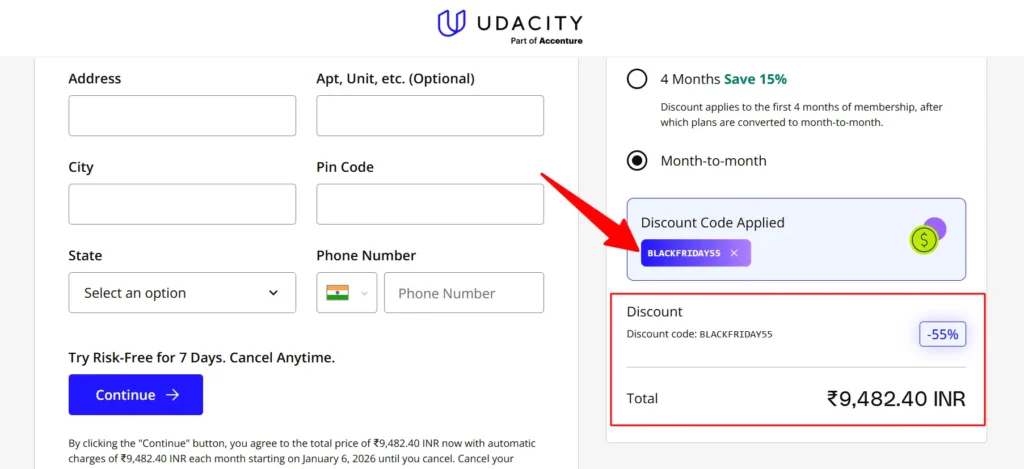
This is the highest discount Udacity is offering right now on its subscription plans, valid in most countries until January 6, 2026.
If you’re planning to enroll in a Nanodegree program – to learn in-demand tech skills, get expert mentorship, and boost your career – this is the perfect time to save big. Don’t miss out on these huge savings.
Not sure if this Udacity discount is worth it or how it can benefit your career? Keep reading – I’ll break it all down for you.
But first, let’s see how much Udacity and its Nanodegree programs will cost you after this discount.
💰 Udacity Regular Cost vs. 55% Off Discounted Cost”
And it’s not just about saving money – this heavy discount unlocks all Nanodegree programs, giving you the freedom to learn whatever you want. It’s a great opportunity if you want to:
Enroll in multiple programs at once, from beginner to advanced levels, without worrying about the cost of each individual program.
Easily switch between Nanodegree programs if one doesn’t meet your learning goals.
Explore new career paths—from programming to data analytics, AI to cybersecurity, Udacity offers a wide range of Nanodegree programs in every major tech domain.
If you’re concerned about whether Udacity programs provide the right training or help you land a job, let me explain why they’re worth it – especially with the current 55% off sale.
Why Choose Udacity?
Udacity is a top-notch online learning platform offering high-quality courses and training programs, mostly in in-demand tech fields.
These Nanodegree programs are not accredited by any educational institution, but they are developed in collaboration with leading tech companies in their respective industries, and their value comes from these companies themselves.
Now, there’s no guarantee that holding a Nanodegree will land you a job at these top companies, as it depends on many factors – your hard skills, soft skills, academic background, and overall work experience. However, I can confidently say that the quality of training you’ll receive is truly worth it.
Most Udacity Nanodegree programs are taught by industry experts who already work in the field you aspire to enter.
From real-world projects to hands-on learning and career mentorship, these Nanodegree programs delivers exceptional value.
If you want to test the quality yourself, start with these free programs I’ve personally taken:
AWS Machine Learning Foundations
Intro to Python Programming
Intro to Data Structures and Algorithms
Developing Android Apps with Kotlin
You won’t need to pay anything – just sign up and start learning. These courses are beginner-friendly, so anyone can enroll. Once you’re satisfied with the quality, you can grab the subscription at 55% off.
⚠️ Note: This discount is only valid until January 6, 2026—so don’t wait too long! If finding worth it, claim your 55% Udacity discount.
How to Get Your 55% Off Udacity Discount: Step-by-Step Guide
Follow these steps to get Udacity’s biggest discount on its subscription:
Find the Nanodegree program you want to enroll in, or select any Nanodegree if you plan to purchase the Udacity subscription.
Scroll down – on the right-hand side, you’ll see the regular pricing plans with the 55% off offer displayed below.
Click the discount button, sign up for a free account, and log in.
Choose your pricing plan- either month-to-month or a bundled course plan (longer duration). Both options include the 55% discount.
Apply coupon code FUTURE40 and review the final cost.
Complete your purchase by entering your payment details and confirming the payment.
Act fast – this offer expires is only available for a week, valid until January 6, 2026.
Top Udacity Nanodegree Programs – Access with Udacity 55% Off:
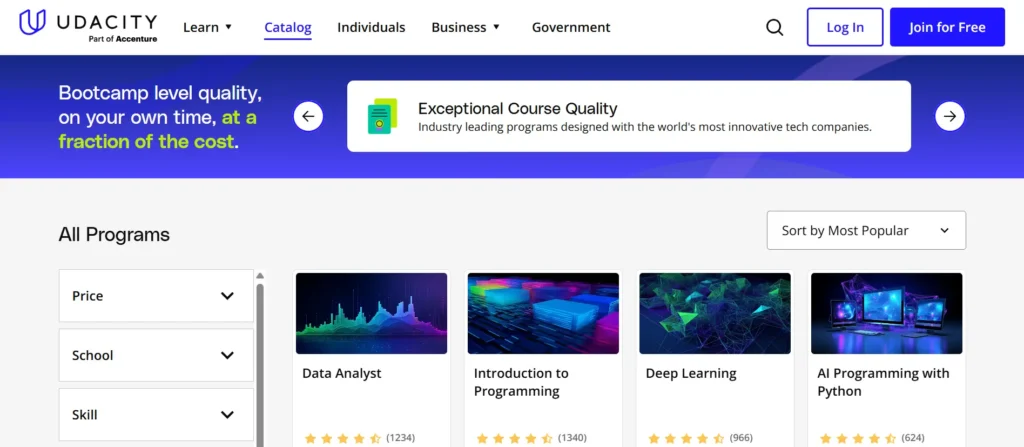
Udacity is best known for its Nanodegree programs. With the current 55% off offer, you can access some of the most popular ones.
These programs are featured based on:
Verified learner feedback from communities like Reddit, Quora, and Trustpilot
Enrollment volume and course completion rates (where available)
Popular Udacity Nanodegree Programs You Can Get with 55% Off
Introduction to Programming – Build a strong foundation in web development and Python programming over four months. This beginner-friendly program includes hands-on projects, making it perfect for newcomers to coding.
Business Analytics Nanodegree – Learn SQL, Python, data visualization, and advanced Excel in just two months—no prerequisites required. Ideal for aspiring business, data, or financial analysts.
Data Analyst Nanodegree – Gain skills in data cleaning, exploratory analysis, and regression testing. Requires prior knowledge of Python, SQL, and statistics. Perfect for finding patterns in complex datasets.
Data Engineering with AWS -Learn to build scalable data infrastructure using AWS tools like S3, Redshift, and Lambda. Covers data modeling, warehousing, and big data technologies. Best for those with programming experience transitioning to data engineering.
Digital Marketing Nanodegree – Covers SEO, SEM, social media marketing, email marketing, and online advertising. Beginner-friendly and ideal for launching a digital marketing career.
Deep Learning Nanodegree – Master neural networks, NLP, computer vision, and reinforcement learning through hands-on AI and machine learning projects.
Programming for Data Science with Python – Start from scratch and learn Python, data visualization, and machine learning using NumPy, Pandas, and Scikit-learn. Includes real-world projects for practical skills.
Front-End Web Developer – Learn HTML, CSS, JavaScript, and React to create responsive, interactive websites. Includes hands-on projects for beginner web developers.
Data Scientist Nanodegree – An advanced program covering machine learning, data wrangling, and predictive modeling. Requires Python, SQL, and data analysis experience.
C++ Nanodegree – Master object-oriented programming, memory management, and multithreading in C++. Great for software, game, and systems development, with mentorship and practical projects.
Note: All these Nanodegree programs are available at 55% off until January 6, 2025.
Final Thoughts: Is Udacity’s 55% Off Sale Worth It?
If you’ve been waiting for the right time to invest in your skills, this is it. Udacity’s 55% off deal is their biggest discount of the year, and it makes their premium Nanodegree programs far more affordable.
Whether you want to start from scratch, switch careers, or upgrade your current skills, this offer gives you access to all Udacity Nanodegree programs—so you can learn at your own pace, explore multiple career paths, and gain hands-on experience through real-world projects.
Remember, Udacity’s programs are built in collaboration with leading tech companies like Google, Meta, and AWS, and taught by industry experts who know what it takes to succeed in the field.
While no certification can guarantee you a job, the skills, mentorship, and project experience you’ll gain from Udacity can put you miles ahead in your career journey.
⚠️ Don’t wait too long—this 55% off offer ends on January 6, 2026. If you’re serious about boosting your career, now’s the time to grab it.
Happy Learning 🙂
Udacity 55% Off – FAQs
How long does the 55% off sale last?
Udacity’s End of Year Sale 55% off sale is valid until January 6, 2026 in most countries. After this date, the offer will expire, and regular pricing will apply. If you’re planning to enroll, it’s best to grab the discount before the deadline.
Udacity 55% Off – Month-to-Month vs. Bundle Subscription: Which One Should You Choose?
When using Udacity’s 55% off deal, you have two options: month-to-month or bundle subscription.
Bundle Subscription – Best for longer-term learning (typically 5–6 months). You lock in the 55% discount for the entire duration of your plan, giving you more time to complete your Nanodegree at your own pace without worrying about renewing each month. This is ideal if you want to take your time or explore more in-depth topics.
Month-to-Month – Gives you 55% off for the first month only, and then you’ll be billed at the regular monthly price from the second month onward. This option works if you’re confident you can finish your Nanodegree quickly or just want to try it out before committing to a longer plan.
✅ Recommendation: If you plan to complete your program over several months, the bundle subscription offers better value and long-term savings.
Can I combine this with other offers or scholarships?
No — Udacity’s 55% off discount cannot be combined with other promotions, coupon codes, or scholarships. You’ll need to choose either this limited-time same or any other eligible offer, but not both.
What kind of support do I get with a Nanodegree?
With a Udacity Nanodegree, you get a range of support to help you succeed, including:
1-on-1 technical mentor support – Get guidance when you’re stuck or need clarification on course content. Personalized project feedback – Industry experts review your projects and provide actionable feedback. Career services – Access resume reviews, LinkedIn profile optimization, and interview prep resources. Student community – Connect with fellow learners in forums and study groups for motivation and peer support. Flexible learning – Learn at your own pace with lifetime access to completed Nanodegree content.
This combination of technical help, career guidance, and community support ensures you’re not learning alone.
Today I’m taking a break from blogging to wish all of you who celebrate a merry Christmas. If you’re in a cold and/or wet climate, be warm and dry. Hug your loved ones and relish some downtime. Be safe and take care.
Not everyone around the world celebrates Christmas. But it does seem that on December 25 of each year, much of the world takes a bit of a breather. In many countries, everything shuts down so that even those who don’t celebrate Christmas take the day off.
For this December 25, we give you some stories from across the world from our correspondents and students that you might have missed this past year and that might leave you feeling better about the world you inhabit. Wait till after the new year to begin working on those resolutions and worrying about obligations.
Today’s News Headlines for School Assembly, December 26, 2025: Here are the news headlines for school assembly on December 26. A Maoist leader was killed in Odisha, Delhi’s fog eased, and Kerala introduced photo identity cards. Tarique Rahman returned to Bangladesh, blasts in Nigeria and Gaza. Australia faces England in cricket on Friday, while young Indians shine in chess. India’s GDP data defended, CTET window reopens, AI courses surge in 2025.
Learning data has played a larger role in the planning and operations of education systems. In 2026, the focus will shift from reporting what happened to actually using data to make informed decisions. Institutions are already tracking a wider range of learning conditions. System‑level indicators are being used to understand how students experience education in real settings. As data governance expectations mature, this evolution is a strategic opportunity and an operational requirement.
The State of Learning Data in 2025: A Retrospective
In 2025, learning data practices moved beyond experimentation and into daily operations. Several patterns stood out across the sector.
As many platforms started responding dynamically to learner behavior, AI‑driven personalization and real‑time analytics became harder to ignore. The U.S. Department of Education’s AI report shows how real‑time data signals support educators with decision‑making tools like content pacing and targeted feedback. It also highlights why human oversight and transparency in AI‑supported systems are necessary.
At the same time, institutions began using large‑scale datasets to identify intervention points earlier. CoSN’s 2025–26 emerging technology trends show that K–12 leaders are using aggregated engagement data to inform decisions earlier in the academic year.
With the expansion of personalization, concerns about privacy and bias also increased. Ethical AI and federated learning models gained traction. Distributed data approaches that limit centralized storage while still enabling learning insights became more relevant, particularly for organizations serving multiple districts or states.
Another notable shift was the rise of immersive and multimodal data sources. Deloitte’s analysis of higher‑education trends shows growing use of simulations, virtual labs, and experiential learning environments, all of which generate complex engagement data that goes beyond clicks or completion rates.
5 Must-Know Learning Data Trends in 2026
1. From Retrospective to Predictive Data Analytics
The shift from retrospective analysis to predictive insights is the most vital learning data trend as we move into 2026. Dashboards that explain what already happened are giving way to models that signal what is likely to happen next.
Predictive retention models are becoming central to student‑success strategies. Enrollment data from the National Student Clearinghouse show continued volatility in postsecondary enrollment, reinforcing the importance of early identification of at‑risk students rather than reactive interventions.
Adaptive learning systems increasingly use AI‑driven signals to adjust content difficulty, recommend resources, or trigger educator outreach before learners disengage. Institutions are also applying predictive analytics to enrollment forecasting and resource planning, helping leaders prepare for demand shifts rather than responding after the fact.
For 2026, the value lies in proactive decision‑making.
K–12 Districts: Predictive signals support early‑warning systems for attendance, disengagement, and dropout risk.
Higher Education: Predictive advising models help institutions support persistence and degree completion more effectively.
EdTech Companies: Usage analytics can identify friction points in the learner experience before they affect retention or outcomes.
The shift toward prediction marks a practical change in how learning data is used.
2. Ethical, Privacy‑First Data Governance
As learning data becomes more powerful, governance expectations are tightening. In 2026, ethical and privacy‑first data practices will be foundational, not optional.
Federated learning and decentralized analytics models are gaining relevance because they reduce the need to move or duplicate sensitive student data. Federal guidance on student privacy emphasizes minimizing data exposure while still enabling legitimate educational use, particularly when advanced analytics or AI are involved.
At the same time, compliance requirements are becoming more explicit. Updated FERPA resources and guidance reinforce schools’ responsibilities around data access, consent, and transparency, while COPPA and state‑level privacy laws continue to evolve.
In 2026, strong governance will not slow innovation. It will determine which organizations are trusted to scale it.
3. Data Unification Across Platforms and Systems
Learning data still sits in separate systems. LMS platforms track activity. SIS tools store records. Assessment and engagement tools add another layer. As a result, information often remains fragmented. As noted in market analysis, interoperability challenges continue to slow integration across these systems. When data are brought together, their role changes.
What unification enables:
Attendance and grades establish academic context
Engagement signals reveal patterns as they emerge
Assessment outcomes confirm where support is effective
Viewed together, this information supports earlier and more informed decisions across instruction and operations. District leaders are actively pushing for integrated data environments to make this possible at scale.
By 2026, leadership teams will expect consolidated learner views rather than disconnected reports generated by individual systems.
4. Analytics for Product‑Led Growth in EdTech
For EdTech companies, analytics are no longer limited to reporting usage. They increasingly influence how products evolve.
Teams are using analytics to understand how features are adopted, where learners disengage, and which workflows support sustained use. Feature‑level usage data are becoming a core input for continuous‑improvement decisions across learning products.
Common areas of focus include:
Feature adoption across different learner groups
Drop‑off points within learning flows
Signals that indicate confusion or friction
Product teams are also relying more on controlled testing to validate changes before scaling them. Evidence‑based iteration is increasingly tied to quality and accreditation expectations, reinforcing the role of analytics in product decision‑making.
By 2026, EdTech companies that consistently use analytics to guide product iteration will be better positioned to respond to changing learner needs.
5. Visual, Explainable Analytics for Educators
As learning data grows in volume, usability becomes a limiting factor. Information that cannot be interpreted quickly rarely informs day‑to‑day decisions in classrooms or academic teams.
Clear and accessible data presentation has long been tied to better decision‑making in education systems, particularly when insights are intended for non‑technical users. This emphasis on clarity becomes more important as analytics move closer to instructional practice.
Educators tend to engage with analytics when:
Signals are easy to interpret
Alerts include context, not just flags
Recommendations are tied to observable evidence
By 2026, trust in learning analytics will depend less on model sophistication and more on whether educators can understand where insights come from and how to act on them.
Segment Spotlight: Unique Needs and Data Trends
Different segments are solving different problems with learning data.
K–12 School Districts
Early‑warning indicators
Attendance and behavior trends
Equity and access signals
Higher Education
Enrollment forecasting
Learner‑pathway analysis
Retention monitoring
EdTech Product Teams
Feature‑adoption metrics
Cohort‑behavior analysis
Real‑time engagement signals
Preparing for 2026 and Beyond: Actionable Recommendations
Focus on execution, not frameworks
Define where prediction adds value
Set clear rules for data access and use
Reduce duplication across systems
Present insights in educator‑friendly formats
Reassess data maturity as tools evolve
Preparing for the Next Phase of Learning Data
The next phase of learning data will be shaped not by how much insight organizations generate, but by how consistently they act on it. As data move closer to everyday decisions, they start influencing instruction, product design, and learner support in real ways.
That shift brings opportunity, but it also raises expectations. Insight needs to be usable. Systems need to be trustworthy. Decisions need to be grounded in evidence, not noise.
Organizations that treat learning data as a practical tool rather than a theoretical asset will be better positioned for what 2026 demands.